
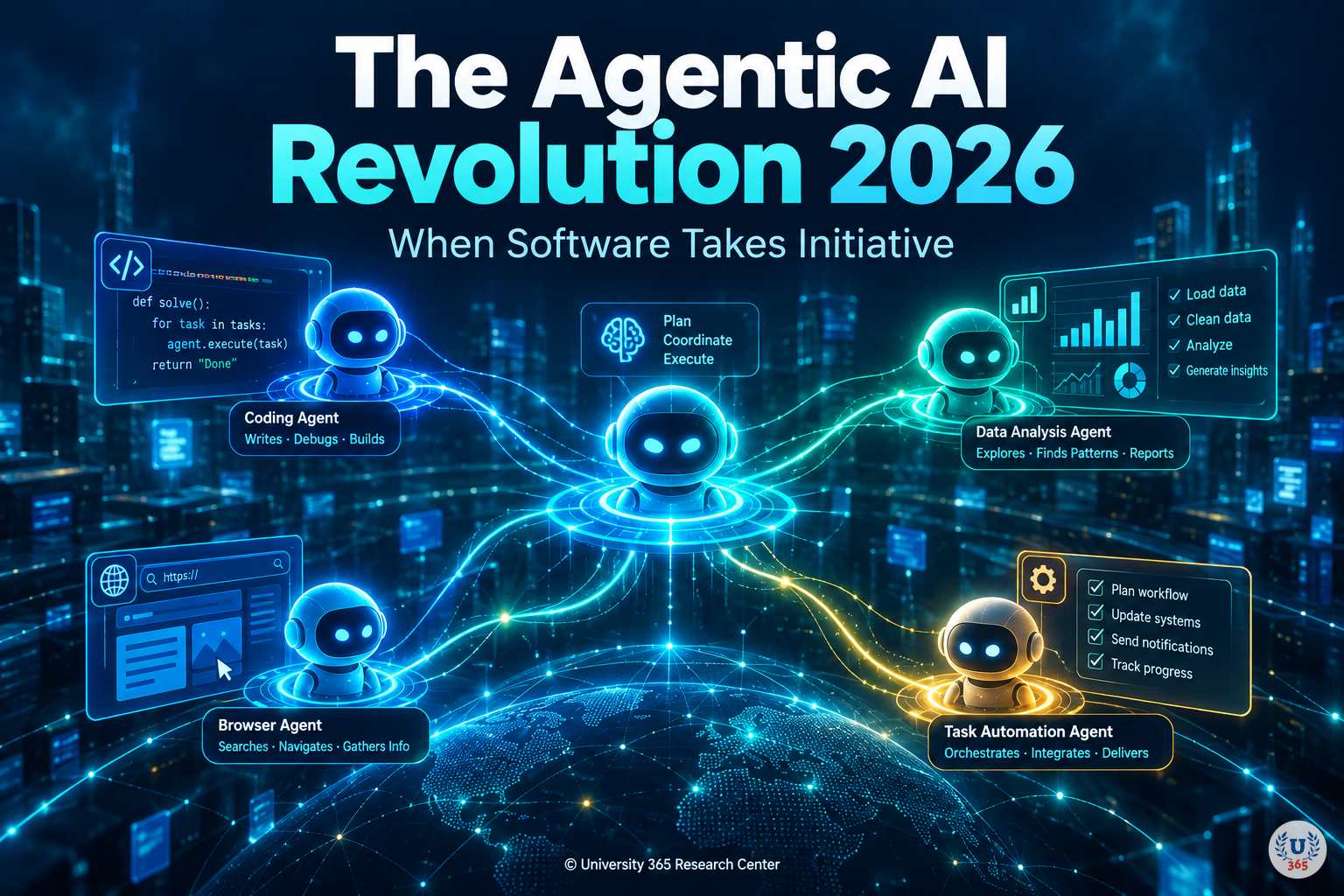
The Agentic AI Revolution 2026: When Software Takes Initiative

In This Report
The Context: What Agentic AI Is, and Why 2026 Changed Everything
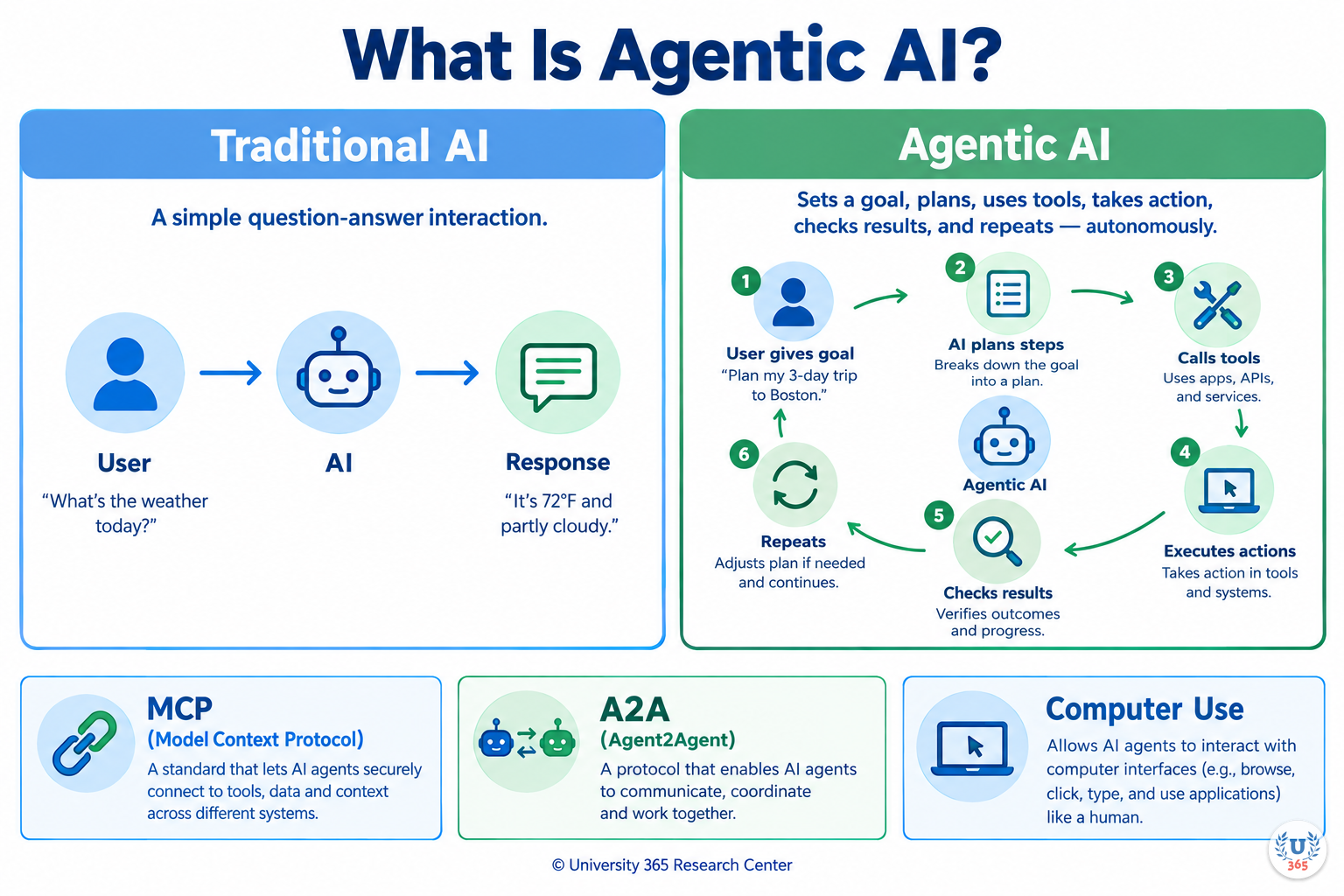
For most people, AI means a chatbot. You type a question, the AI types an answer. You ask for a summary, the AI produces text. This is how ChatGPT worked when it launched in November 2022, and it is still how most people interact with AI today. The AI responds. It does not act.
Agentic AI is different. An AI agent receives a goal, not a question. It then plans the steps needed to achieve that goal, selects and calls external tools (databases, web browsers, code interpreters, APIs), executes those steps, checks whether the results are correct, and repeats until the goal is met or the agent determines it cannot succeed. The human gives the instruction once. The agent does the rest.
Think of the difference between asking someone for a recipe and asking someone to cook dinner. The first is a question-and-answer interaction. The second delegates a task that requires planning, accessing ingredients, using tools, adapting when something goes wrong, and producing a finished result. Agentic AI is the second kind of interaction.
Three developments in 2025 and 2026 made this shift practical:
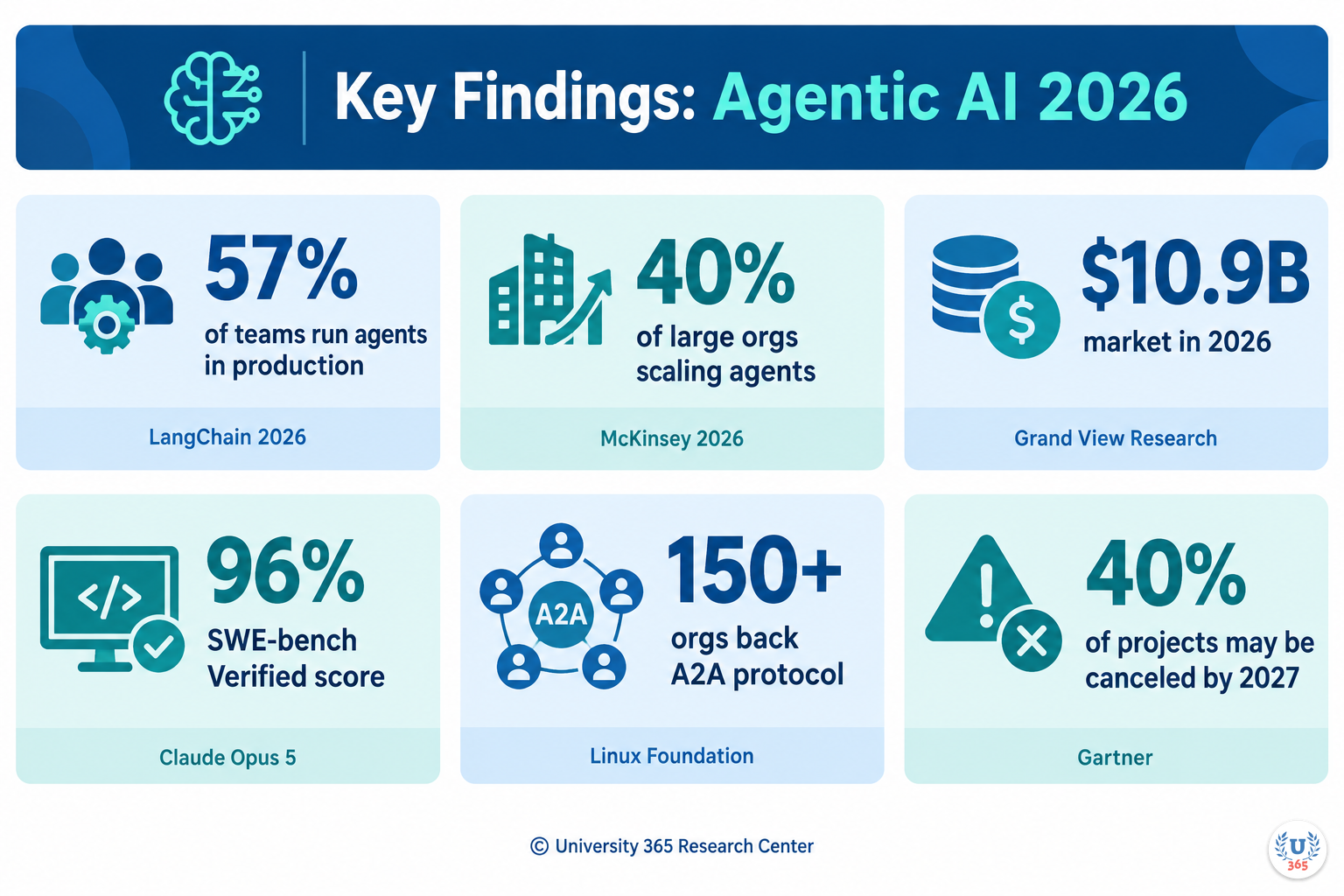
First, the models got better at sustained reasoning. OpenAI released GPT-6 Astra on September 3, 2026, describing it as their most intelligent and aligned model, with state-of-the-art performance on Terminal-Bench 4.0 (57.9 percent, up from 37.3 percent for the previous generation), Agents' Last Exam, and computer use benchmarks. Anthropic's Claude Opus 5 reaches 96 percent on SWE-bench Verified, a benchmark that tests whether an AI can independently fix real bugs in real software repositories. These are not marginal improvements. They represent models that can maintain coherent multi-step plans over long interactions without losing track of what they are doing.
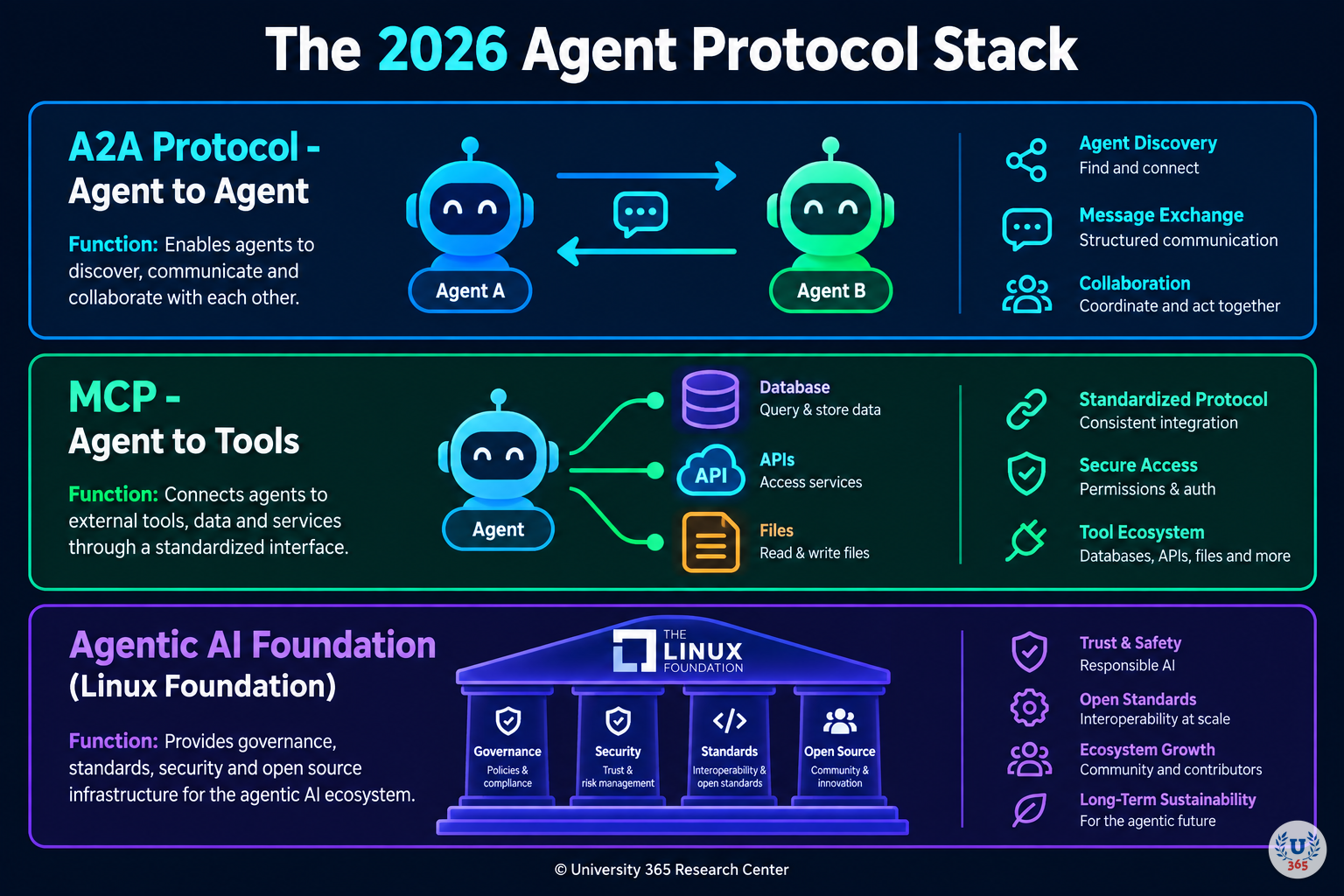
Second, the tooling around the models matured. Anthropic's Model Context Protocol (MCP), open-sourced in November 2024 and donated to the Linux Foundation's Agentic AI Foundation in December 2025, standardizes how an AI agent connects to external tools, databases, and APIs. Google's Agent2Agent (A2A) protocol, launched in April 2025 and donated to the Linux Foundation in June 2025, standardizes how separate AI agents discover and communicate with each other. Together, these two protocols created a shared infrastructure layer that lets agents built by different vendors, on different frameworks, work together without custom integration code for every pairing.
Third, the software harness around the models learned to run tasks autonomously. Coding agents like Claude Code, Cursor, and OpenAI's Codex Cloud now run in isolated cloud environments, execute tasks without a person watching each step, and report back with a finished result. Anthropic's computer use capability, which lets Claude control a desktop by taking screenshots, clicking, and typing, reached general availability in 2026 and now runs in the background on macOS.
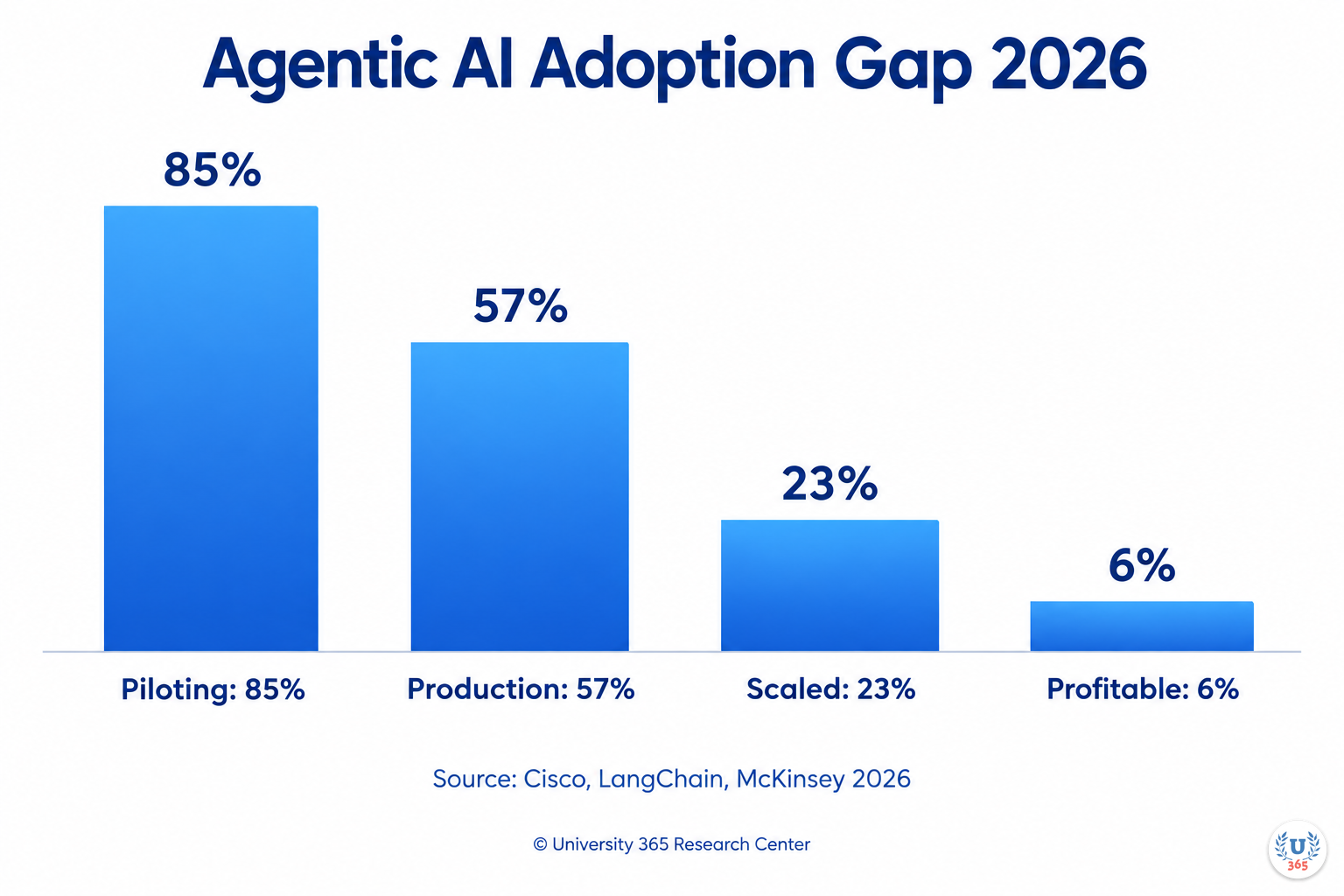
The result is that agentic AI stopped being a demo category and became infrastructure. LangChain's State of Agent Engineering report, published June 12, 2026, found that 57 percent of 1,340 surveyed engineering teams now run AI agents in production, rising to 67 percent at organizations with 10,000 or more employees. McKinsey's State of AI 2026 survey found that 40 percent of large organizations (annual revenue above $1 billion) are scaling AI agents, up from 27 percent the previous year. The market is real. The question is no longer whether agents work, but whether we can control them.

The Question: Can We Trust Software That Acts on Its Own?
The central question of this report is not whether agentic AI is powerful. The benchmarks, the adoption numbers, and the production deployments make that clear. The question is whether the structures we have built to govern software, structures designed for tools that wait for human input and execute exactly what they are told, can handle software that plans, decides, and acts with varying degrees of autonomy.
When an AI chatbot produces a wrong answer, the human reads it, catches it, and moves on. The damage is limited to a moment of confusion. When an AI agent takes a wrong action, the consequences are different. The agent may have already called an API, modified a database, sent a message, or triggered a workflow in a production system. The action is real. The state change is real. The reversal may be difficult or impossible.
The CISA Five Eyes guidance, published May 1, 2026 by six national cybersecurity agencies (US, UK, Australia, Canada, New Zealand, plus the NSA), identified five risk categories specific to agentic AI: privilege escalation, design and configuration flaws, behavioral unpredictability, cascading structural failures, and accountability deficits. The guidance states that human oversight must be designed into agent workflows, not delegated to the agents themselves, and that high-stakes actions require human-in-the-loop approval.
This is the tension this report investigates: the same autonomy that makes agents valuable in production is what makes them dangerous. The question is not whether to deploy agentic AI. That decision is already being made, in thousands of organizations, every day. The question is how to deploy it with enough control that the benefits exceed the risks.
The Contradiction: More Capability, Less Control
Here is the paradox at the heart of agentic AI in 2026: the more capable agents become, the harder they are to control.
Consider the numbers. Agent capability is accelerating rapidly. GPT-6 Astra can find and exploit previously unknown security vulnerabilities without step-by-step human guidance, reaching what OpenAI calls the Critical cybersecurity capability threshold. Claude Opus 5 resolves 96 percent of bugs on SWE-bench Verified, a benchmark where the previous generation scored around 80 percent just months earlier. Multi-agent systems, where specialized agents coordinate to solve complex tasks, have become the default architecture rather than an advanced option.
At the same time, governance maturity is lagging. McKinsey's 2026 AI Trust Maturity Survey found that average responsible-AI maturity sits at just 2.3 out of 4, with only 30 percent of organizations reaching level 3 or higher in governance and agentic AI controls. The Cloud Security Alliance found that 74 percent of organizations acknowledge their agents routinely receive more access than necessary, 68 percent cannot clearly distinguish AI agent activity from human activity in their logs, and only 18 percent express high confidence that their existing identity and access management systems can adequately govern AI agents.
Gartner predicts that over 40 percent of agentic AI projects will be canceled by the end of 2027, citing escalating costs, unclear business value, and inadequate risk controls. Forbes analysis of the Gartner forecast noted that the projects that fail rarely die because the models were too dumb to do the work. They die because companies turn agents loose without a success metric, without access to the right data, and without a plan for what happens when the agent goes sideways.
The contradiction is precise: agents are being deployed to make autonomous decisions at a speed and scale that outpaces human oversight, while the governance structures needed to keep those decisions safe are still being designed. Capability is outrunning control. The agents that survive 2027 will not be the ones running the largest models. They will be the ones with a number attached to their job and a name on the override switch.
The Current State: Players, Protocols, and Production Data
The agentic AI landscape in September 2026 has three layers: the models that power agents, the protocols that connect them, and the production systems that deploy them.
The model layer is led by Anthropic and OpenAI. Anthropic's Claude Opus 5 (released July 24, 2026) and Claude Sonnet 5 (June 30, 2026) are the most capable agentic models, with Opus 5 scoring 96 percent on SWE-bench Verified. OpenAI's GPT-6 Astra (September 3, 2026) leads on Terminal-Bench 4.0 at 57.9 percent and is the first model to reach the Critical cybersecurity capability threshold. DeepSeek V4-Pro (April 24, 2026) scores 80.6 percent on SWE-bench Verified and remains the leading open-weight option. Google's Gemini 3.5 Flash scores 78.4 percent on OSWorld-Verified, a benchmark for computer use tasks.
The protocol layer consolidated dramatically in 2026. MCP, now under the Linux Foundation's Agentic AI Foundation with over 170 member organizations, has crossed 97 million monthly SDK downloads. A2A, with over 150 supporting organizations including AWS, Cisco, Google, IBM, Microsoft, Salesforce, SAP, and ServiceNow, reached specification v1.0 in March 2026 and added signed Agent Cards for cryptographic identity verification.
The production layer shows real adoption with persistent gaps. LangChain reports 57 percent of surveyed teams have agents in production. McKinsey reports 40 percent of large organizations are scaling agents. Grand View Research values the AI agents market at $10.9 billion in 2026, projected to reach $182.9 billion by 2033. But Snyk found that while 33 percent of organizations use agentic architectures, only 2 percent have achieved at-scale deployment. Cisco data shows 85 percent of enterprises are piloting AI agents, but only 5 percent have shipped them to production.
Metric | Value | Source | Date |
Teams with agents in production | 57% | LangChain | June 2026 |
Large orgs scaling agents | 40% | McKinsey | August 2026 |
Enterprises piloting agents | 85% | Cisco | August 2026 |
Enterprises with production agents | 5% | Cisco | August 2026 |
AI agents market size | $10.9B | Grand View Research | 2026 |
At-scale deployment | 2% | Snyk | August 2026 |
Key Findings: 7 Discoveries Defining the Agentic Shift
1. Protocols standardized faster than any prior computing standard. MCP reached 97 million monthly SDK downloads by March 2026, faster adoption than almost any protocol in computing history. A2A reached v1.0 with 150+ supporting organizations in its first year. Both now sit under the same Linux Foundation governance body. This means agent interoperability is becoming a settled standard, not a vendor bet.
2. Coding agents are the leading production use case. Enterprise AI coding agents, estimated by Gartner at $9.8 to $11.0 billion annualized spend as of April 2026, represent the most mature agentic category. Claude Code leads Terminal-Bench 2.1 at 83.8 percent. One published case study reports 18,240 autonomous data warehouse delivery sessions per month with an 87.2 percent success rate, median delivery time dropping from 228 minutes to 23 minutes. McKinsey found that 32 percent of organizations have decided against buying software products because they could build them internally with agentic coding tools.
3. Quality, not cost, is the top barrier to production. LangChain's survey found that 32 percent of teams cite quality (hallucinations, output consistency, context engineering) as their primary blocker. Cost concerns dropped from the previous year. The models got cheaper. The reliability problem did not. Nearly 30 percent of teams with production agents do not evaluate them at all.
4. Multi-agent systems became the default architecture. The 2026 default architecture looks like a small team: a planner, a researcher, a coder, and a reviewer, each with a narrow set of tools, coordinating through A2A. However, multi-agent systems compound reliability problems: research published in 2026 reports failure rates of 41 to 86.7 percent across seven frameworks, and DeepMind documented 17x error amplification in cascading multi-agent chains.
5. Governance frameworks are emerging but not yet enforced. The CISA Five Eyes guidance (May 2026), the EU AI Act Annex III (enforcement began August 2, 2026, with penalties up to EUR 35 million or 7 percent of global turnover), the OWASP Agentic AI Maturity Model (June 2026), and NIST's proposed project on AI agent identity all converged on the same requirements: pre-execution control, auditable enforcement, and human oversight. But McKinsey found that only 30 percent of organizations have reached governance maturity level 3 or higher.
6. Computer use crossed from research to product. Anthropic's computer use capability, which lets Claude control a desktop by taking screenshots, clicking, and typing, reached general availability in 2026 with a new browser use tool. Claude can now use a computer in the background on macOS while the user works on something else. This means agents can now work in applications that were never built for automation. The attack surface expands accordingly.
7. Agent identity is the missing governance layer. AI agents, service accounts, API tokens, and automated workflows now outnumber human identities in enterprise environments by ratios exceeding 80 to 1. The Cloud Security Alliance found that 74 percent of organizations acknowledge their agents receive more access than necessary, and 92 percent of CISOs lack full visibility into AI identities operating in their environments. An agent can be authenticated, hold valid credentials, and have permission to use a system, but whether it has the legitimate authority to perform a particular action in context is a question most organizations cannot answer.
Deep Analysis: The Protocol Revolution, The Reliability Gap, The Governance Frontier
The Protocol Revolution
The most important structural development in 2026 is not a model release. It is the consolidation of agent infrastructure under neutral governance.
MCP standardizes how an AI agent connects to external tools, databases, and APIs. Think of it as a universal plug: write an integration once, use it with every compatible agent. Anthropic open-sourced MCP in November 2024. Within a year, every major agent framework converged on MCP for tool calling. By March 2026, MCP had crossed 97 million monthly SDK downloads.
A2A standardizes how independent agents discover and communicate with each other. Google launched A2A in April 2025. By April 2026, it had surpassed 150 supporting organizations, integrated into Azure AI Foundry, Amazon Bedrock, and Google Cloud. The v1.0 specification introduced signed Agent Cards, which let one agent cryptographically prove its identity before another agent hands it a task or sensitive data.
In December 2025, both protocols moved under the same governance body: the Agentic AI Foundation (AAIF), a Linux Foundation directed fund co-founded by Anthropic, Block, and OpenAI, with Google, Microsoft, AWS, Cloudflare, and Bloomberg as platinum members. By August 2026, A2A formally joined the AAIF alongside MCP. The AAIF grew to over 170 member organizations by April 2026, more than double CNCF's membership at a comparable stage.
The Reliability Gap
The gap between agent capability in benchmarks and agent reliability in production is the most underreported story in agentic AI.
On SWE-bench Verified, Claude Opus 5 scores 96 percent. On Terminal-Bench 4.0, GPT-6 Astra scores 57.9 percent. These numbers get cited in press releases. But the same models, deployed in production agent loops, exhibit failure patterns that benchmarks do not capture.
LangChain's report identifies the core problem: 89 percent of teams have observability (they can see what their agents did), but only 52 percent run evaluations (they actually test whether agents do the right thing). Nearly 30 percent of teams with production agents do not evaluate them at all. Human review, at 59.8 percent, is still the dominant evaluation method, which does not scale past a handful of agents.
Multi-agent architectures compound the problem. When an orchestrating agent delegates tasks to worker agents, the decision graph expands rapidly. A manipulation injected at one layer may propagate across the network before any human observer can intervene. Research published in 2026 reports Multi-Agent System Task failure rates of 41 to 86.7 percent across seven frameworks. DeepMind documented 17x error amplification in cascading multi-agent chains.
The Governance Frontier
Governance is no longer a brake on agentic AI adoption. It is increasingly the factor that decides which projects survive and which get shut down.
The CISA Five Eyes guidance, published May 1, 2026, is the first multi-nation joint security advisory specifically addressing autonomous AI agents. It identifies five risk categories: privilege escalation, design and configuration flaws, behavioral unpredictability, cascading structural failures, and accountability deficits. The guidance requires human-in-the-loop approval for irreversible and high-impact actions.
The EU AI Act reached a critical milestone on August 2, 2026, when enforcement of Annex III high-risk system obligations began. Penalties reach EUR 35 million or 7 percent of global turnover for prohibited practices. The OWASP GenAI Security Project published its State of Agentic AI Security and Governance report in June 2026, noting that almost every one of its ten risk categories now has at least one confirmed real-world incident behind it.
Gartner estimates that through 2028, at least 80 percent of unauthorized AI agent transactions will come from internal policy violations rather than from external attacks. The first governance problem is not the hacker. It is the agent doing exactly what a vague instruction told it to do.
Framework | Date | Key Requirement | Penalty |
CISA Five Eyes | May 2026 | Human-in-the-loop for high-impact | Advisory |
EU AI Act Annex III | August 2026 | Conformity assessment for high-risk AI | Up to EUR 35M or 7% turnover |
OWASP Agentic Maturity | June 2026 | Capability-governance matrix | Industry standard |
NIST AI RMF | Ongoing | Govern, Map, Measure, Manage | Voluntary |
Data and Evidence: Metrics, Market Size, and Benchmarks
This section presents the quantitative backbone of the report. All data is sourced, with confidence ratings to distinguish robust evidence from preliminary signals.
Key Metrics Table
Metric | Value | Source | Confidence |
Teams with agents in production | 57% | LangChain | High |
Large orgs scaling agents | 40% | McKinsey | High |
AI agents market size 2026 | $10.9B | Grand View Research | Medium |
SWE-bench Verified top score | 96% (Opus 5) | BenchLM.ai | High |
Terminal-Bench 4.0 top score | 57.9% (Astra) | OpenAI | High |
MCP monthly SDK downloads | 97M | Trendix.tech | Medium |
A2A supporting orgs | 150+ | Linux Foundation | High |
Responsible-AI maturity | 2.3/4 avg | McKinsey | High |
Agents with excess access | 74% of orgs | CSA | High |
Multi-agent failure rates | 41-86.7% | State of AI Agent Gov | Medium |
AI skill salary premium | 23% | WEF / UK study | High |
Timeline of Key Events
Date | Event | Significance |
Nov 2024 | Anthropic open-sources MCP | First standard for agent-to-tool communication |
Apr 2025 | Google launches A2A | First standard for agent-to-agent communication |
Dec 2025 | MCP donated to AAIF | Both protocols under neutral governance |
Mar 2026 | A2A spec v1.0 | Stable specification with signed Agent Cards |
May 2026 | CISA Five Eyes guidance | First multi-nation security advisory for agents |
Jun 2026 | LangChain State of Agent Engineering | 57% production adoption confirmed |
Aug 2026 | EU AI Act Annex III enforcement | Regulatory obligations for high-risk AI |
Sep 2026 | GPT-6 Astra released | First model at Critical cybersecurity threshold |
Implications: What This Means for Individuals, Companies, and Governments
For individuals, agentic AI changes the nature of work with software. Instead of operating tools directly, you increasingly delegate goals to agents that execute them. This shifts the skill that matters from execution to specification: clearly defining what you want, setting appropriate constraints, and verifying the result. The risk is delegation without verification. When you hand a task to an agent and walk away, you are trusting it to act correctly in conditions you may not have anticipated.
For companies, the implications are structural. Forrester predicts that 2026 is the year AI agents become the company's digital workforce, with 30 percent of enterprise app vendors launching their own MCP servers, and 50 percent of ERP vendors releasing autonomous governance modules. The business model behind enterprise software is shifting from per-seat licensing to outcome-based pricing. Companies need to evaluate vendors not just on capability but on governance: who carries the legal liability when an agent makes an autonomous decision? Under most legal frameworks, the organization is liable, not the vendor.
For governments, the agentic AI shift raises questions that existing regulatory frameworks were not designed to answer. The EU AI Act Annex III, now in enforcement, requires conformity assessments for high-risk AI systems. But agentic AI blurs the boundary between a system that recommends and a system that acts. When an agent autonomously initiates a transaction or modifies infrastructure, the regulatory question shifts from whether the AI produced a harmful output to whether the AI was authorized to take that action. The CISA Five Eyes guidance treats human oversight as an architectural requirement, not a best practice.
Education and Skills Impact: Learning to Live With Autonomous Software
The agentic AI shift changes what people need to learn, how they learn it, and what skills become more or less valuable.
What people need to learn: The most important new skill is delegation literacy, the ability to specify goals precisely, set appropriate constraints, define success criteria, and verify results. This is not prompt engineering. It is a higher-order skill: designing the boundary conditions within which an autonomous agent operates safely and productively. A second critical skill is agent evaluation: the ability to assess whether an agent's output is correct, not just plausible. A third skill is agent governance: understanding identity management, access scoping, audit trails, and human-in-the-loop design.
What skills become more valuable: Systems thinking, the ability to understand how components interact in complex systems, becomes more important as multi-agent architectures become the default. Critical thinking and verification skills become more valuable, not less, because the cost of accepting a wrong agent output is higher than the cost of rejecting a correct one. Domain expertise becomes more valuable because someone needs to judge whether the agent's work is actually correct in context. The OECD's 2026 research found that non-routine cognitive, social, and creative skills are the least susceptible to automation.
What skills become less relevant: Pure execution skills (writing boilerplate code, filling in templates, performing routine data transformations) are increasingly handled by agents. The World Economic Forum projects 170 million new jobs created by 2030 but 92 million displaced. The OECD found that AI skills command a 23 percent salary premium, but workers with AI skills represent only about 1 percent of the workforce. The skills gap is real and widening.
How learning changes: The agentic AI shift enables new learning modalities. AI tutoring systems, powered by agents that can adapt to individual learner needs, are emerging. But the same agentic capabilities create risks: if students delegate learning tasks to agents, they may produce outputs without developing understanding. Learning science research on active recall, spaced repetition, and desirable difficulties suggests that the most effective learning requires cognitive engagement that delegation to an agent can bypass.
The U365 position: The CI-First, ULM, and LIPS methods address this tension directly. CI-First emphasizes co-intelligence: AI amplifies human capability rather than replacing it. ULM emphasizes self-directed, active learning where the learner drives the process. LIPS provides a framework for connecting learning to real-world goals. These methods prepare learners for the agentic AI era by developing the delegation literacy, critical thinking, and systems thinking that agents cannot provide for them.
The CI-First Perspective: Amplification, Imposture, and the Human Authority Question
The Co-Intelligence-First (CI-First) approach is a genuine and unique University 365 concept: a proposal for imagining a better future where AI and Human Intelligence coexist productively, each amplifying the other rather than replacing it.
Capability amplification: Agentic AI, used well, extends human capability in specific and measurable ways. Coding agents let a developer produce more correct code in less time. Research agents can synthesize information from dozens of sources in minutes. Computer use agents can operate software that was never designed for automation. The McKinsey data confirms this: 80 percent of respondents report that AI has improved their individual productivity. The amplification is real at the individual level.
AI Imposture risk: The same McKinsey data reveals the imposture danger. While 80 percent report improved individual productivity, the share of organizations reporting enterprise-level financial impact from AI has not changed since the previous year. Thirty-seven percent attribute at least some EBIT impact to AI, essentially flat. The proportion of AI high performers has remained flat at about 6 percent. This is the CI-First warning sign: individuals feel more productive, but organizations are not capturing the value. The productivity is real at the personal level but evaporates at the organizational level.
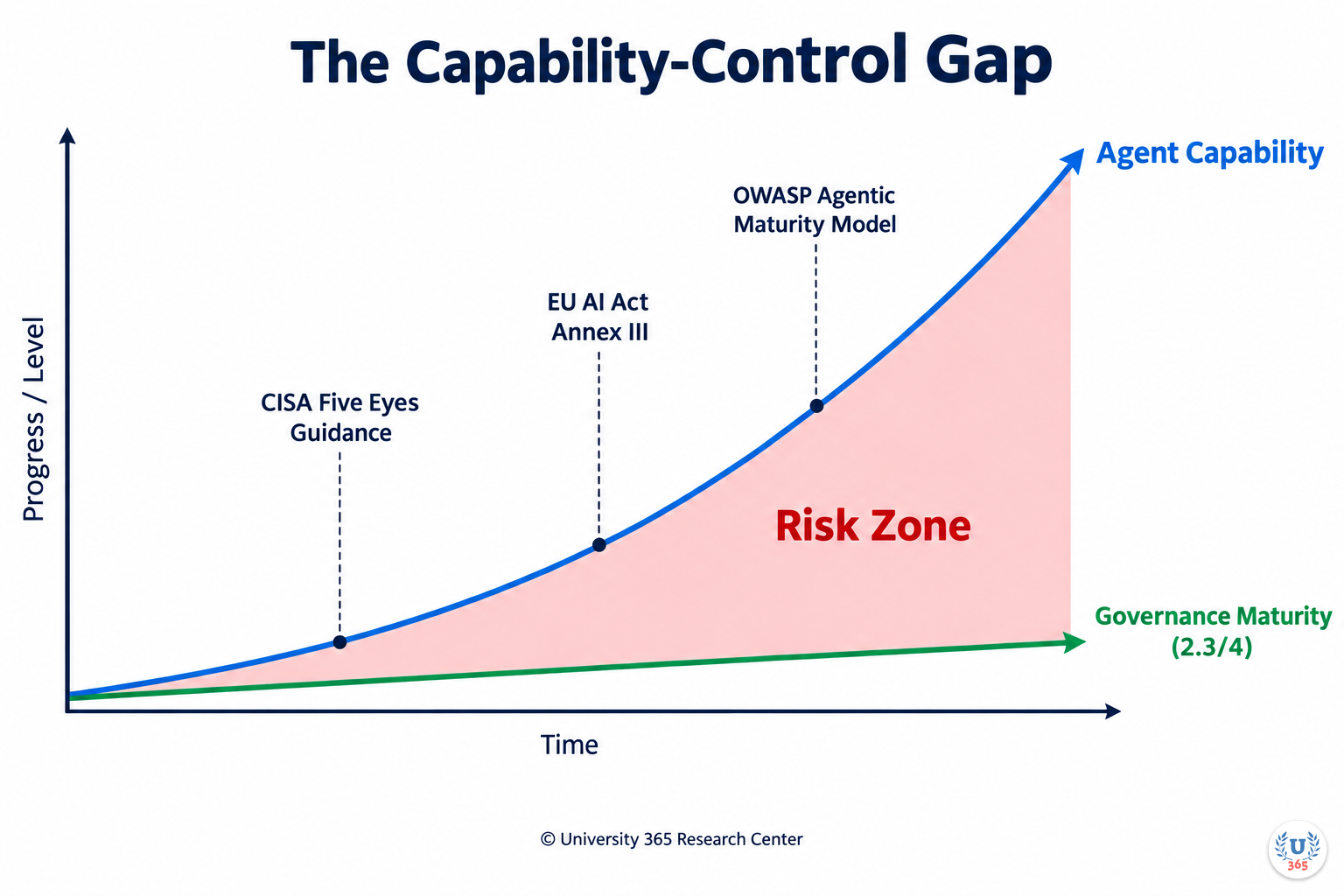
The contradiction from Section 3 (more capability, less control) resolves through the CI-First lens as follows: the problem is not that agents are too capable. The problem is that organizations are deploying capability without the governance structures that convert individual productivity into organizational value. The CI-First approach to adopting agentic AI would require: (1) clear authority boundaries for every agent, (2) verification routines for every agent output, (3) graduated autonomy, and (4) a kill switch that a named human owner can activate.
The CI-First verdict: Agentic AI amplifies human capability when deployed with bounded authority, verified outputs, and clear ownership. It degrades human capability when deployed with vague instructions, excessive autonomy, and no verification. The outcome depends not on the model but on the governance. The agents that amplify are the ones where a human can explain, at any moment, what the agent is doing, why it is doing it, and who is responsible if it is wrong.
What This Means for You and Us
For You (Individual)
1. Learn to delegate with boundaries. The most important personal skill in the agentic AI era is specifying what you want an agent to do, what constraints it must respect, and how you will verify the result. Practice this with low-stakes tasks first: ask an agent to summarize a document, but check the summary against the original. Build the verification habit before you need it for high-stakes work.
Action: Pick one recurring task you do manually. Delegate it to an AI agent with clear instructions and a verification step. Do this weekly until delegation-with-verification becomes automatic.
2. Develop agent evaluation skills. Agents produce outputs that look correct. Learning to distinguish correct from plausible-looking-but-wrong is a skill that compounds. Start by asking: what would make this output wrong? What would I check if I had done this myself? Then check those things.
Action: For every agent output you receive this week, identify one thing you would verify if you had done the work yourself. Verify it.
3. Understand the authority question. Before you delegate a task to an agent that can take actions, ask: am I authorized to do this? Is the agent authorized to do this on my behalf? If the agent makes a mistake, who is responsible? If you cannot answer these questions, do not delegate.
Action: List the tools and systems you use that an agent could access on your behalf. For each, note whether you would feel comfortable with the agent taking actions without asking you first.
For Us (Collective)
1. Build agent governance into education and training. The skills gap in agent governance is already measurable. Organizations deploying agents without governance structures are creating risk at scale. Educational institutions, professional bodies, and training programs need to incorporate agent governance into their curricula. This is not a specialized skill for security teams. It is a foundational skill for anyone who will work with autonomous systems.
Response: Professional certification bodies should develop agent governance credentials. Universities should include agent evaluation and governance in computer science, business, and public administration programs.
2. Establish industry standards for agent identity and accountability. The CISA Five Eyes guidance and the OWASP Agentic Maturity Model provide a starting point, but they are advisory, not enforceable. Industry associations, standards bodies, and regulators need to develop binding standards for agent identity, agent accountability, and agent auditability.
Response: National regulators should adopt the CISA Five Eyes guidance as a baseline requirement for agentic AI deployments in regulated industries. Industry associations should develop certification programs for agent governance maturity.
3. Fund research on agent reliability and evaluation. The gap between benchmark performance and production reliability is the most underfunded problem in AI research. Benchmarks measure what a model can do in a controlled environment. Production requires knowing what an agent will do in an uncontrolled environment, over long time horizons, with real consequences.
Response: National science funding agencies should prioritize research on agent reliability, multi-agent failure modes, and production evaluation methods. Industry consortia should share anonymized failure data to accelerate collective learning.
The Road Ahead: 2027 and Beyond
The next 12 to 24 months will likely see three developments.
First, the project cancellation wave Gartner predicted will materialize, but it will be selective. Projects with clear ROI metrics, bounded autonomy, and governance structures will survive. Projects launched on hype without success metrics or accountability will be cut. The result will be a healthier market with fewer but more reliable agent deployments.
Second, agent identity and accountability will become a regulated requirement, not a best practice. The EU AI Act Annex III enforcement, the CISA Five Eyes guidance, and the NIST proposed project on AI agent identity are converging on the same requirement: organizations must be able to identify, audit, and hold accountable every autonomous agent operating in their environment. Expect the first major enforcement action against an organization for an unauthorized agent action within 18 months.
Third, the model layer will continue to advance, but the differentiation will shift from raw capability to agentic reliability. GPT-6 Astra's Critical cybersecurity threshold and Claude Opus 5's 96 percent SWE-bench score demonstrate that raw capability is approaching saturation on existing benchmarks. The next frontier is not higher benchmark scores but lower failure rates in production. Models that can maintain coherent plans over longer horizons, recover from their own mistakes, and degrade gracefully when conditions change will win over models that score higher on benchmarks but fail unpredictably in the wild.
These predictions are based on current trends, announced plans, and expert analysis. They should be treated as informed expectations, not certainties. AI moves fast enough that a single breakthrough or failure could redirect the trajectory.
Sources and Methodology
This report was researched using web search, source extraction, and analysis of peer-reviewed papers, industry reports, government guidance, and production telemetry data. The research followed the URC source quality tier system.
Source distribution: 3 Tier 1 sources (arXiv papers, CISA Five Eyes joint guidance, EU AI Act), 8 Tier 2 sources (McKinsey, Gartner, LangChain, Snyk, Grand View Research, OECD, WEF, OWASP), and 7 Tier 3 sources (technology news and commentary for trend signals).
1. Gartner, "Over 40% of Agentic AI Projects Will Be Canceled by End of 2027," June 25, 2025. https://www.gartner.com/en/newsroom/press-releases/2025-06-25-gartner-predicts-over-40-percent-of-agentic-ai-projects-will-be-canceled-by-end-of-2027
2. McKinsey, "The State of AI in 2026: On the Road to ROI," August 25, 2026. https://www.mckinsey.com/capabilities/quantumblack/our-insights/the-state-of-ai
3. LangChain, "State of Agent Engineering Report," June 12, 2026. https://langchain.com/state-of-agent-engineering
4. Snyk, "2026 State of Agentic AI Adoption Volume II," August 2026. https://res.cloudinary.com/snyk/image/upload/v1785759343/Volume_II-2026_The_State_of_Agentic_AI_Adoption_August_2026_a9jyao.pdf
5. CISA and Five Eyes Agencies, "Careful Adoption of Agentic AI Services," May 1, 2026. https://labs.cloudsecurityalliance.org/research/csa-research-note-cisa-agentic-ai-guidance-practitioner-2026
6. OWASP GenAI Security Project, "State of Agentic AI Security and Governance v2.01," June 1, 2026. https://labs.cloudsecurityalliance.org/research/csa-research-note-owasp-agentic-ai-governance-maturity-v2-20
7. OpenAI, "Path to Astra: Critical Capabilities and Frontier Safeguards," September 1, 2026. https://openai.com/index/path-to-astra
8. OpenAI, "GPT-6 Astra System Card," September 3, 2026. https://deploymentsafety.openai.com/gpt-6-astra
9. Anthropic, "Build Production Agents with Computer Use, the Skills API, and the Files API," 2026. https://claude.com/blog/computer-use-skills-api-files-api
10. Linux Foundation, "A2A Protocol Surpasses 150 Organizations," April 9, 2026. https://www.linuxfoundation.org/press/a2a-protocol-surpasses-150-organizations-lands-in-major-cloud-platforms-and-sees-enterprise-production-use-in-first-year
11. A2A Protocol, "A2A and MCP," 2026. https://a2a-protocol.org/dev/topics/a2a-and-mcp/
12. Zhu and Cai, "From Language Models to World-Acting Systems," arXiv:2609.04894v1, September 4, 2026. https://arxiv.org/pdf/2609.04894v1.pdf
13. "Who Governs the Machine? A Machine Identity Governance Taxonomy," arXiv:2604.06148, 2026. https://arxiv.org/pdf/2604.06148.pdf
14. Grand View Research, AI Agents Market Report, 2026. https://aifloxium.online/blog/best-ai-agents-2026
15. Gartner, "Enterprise AI Coding Agents: 2026 Market Guide," 2026. https://www.gartner.com/en/articles/enterprise-ai-coding-agent-market
16. OECD, "Skills in the AI Age," OECD Artificial Intelligence Papers No. 60, July 2026. https://www.oecd.org/content/dam/oecd/en/publications/reports/2026/07/skills-in-the-ai-age_e8d8c1e6/972bd15e-en.pdf
17. World Economic Forum, "Artificial Intelligence and the Future of Entry-Level Work," June 2026. https://reports.weforum.org/docs/WEF_Artificial_Intelligence_and_the_Future_of_Entry_Level_Work_2026.pdf
18. McKinsey, "State of AI Trust in 2026: Shifting to the Agentic Era," March 25, 2026. https://mckinsey.com/capabilities/tech-and-ai/our-insights/tech-forward/state-of-ai-trust-in-2026-shifting-to-the-agentic-era
19. Forbes, "Why 40% Of Agentic AI Projects May Be Canceled By 2027," July 7, 2026. https://www.forbes.com/sites/robertszczerba/2026/07/07/why-40-of-agentic-ai-projects-may-be-canceled-by-2027/
20. BenchLM.ai, "SWE-bench Verified Leaderboard (September 2026)." https://benchlm.ai/benchmarks/swe-bench-verified
21. Cloud Security Alliance, "CISA Agentic AI Guidance: Enterprise Compliance Imperatives," May 2026. https://labs.cloudsecurityalliance.org/research/csa-research-note-cisa-agentic-ai-adoption-guide-enterprise
22. Axios, "Google's A2A protocol gets a new home," August 17, 2026. https://www.axios.com/2026/08/17/a2a-agentic-ai-foundation-open-ai-standards
About This Report
This report was produced by University 365 as part of the INSIDE Reports series.
Author: Hubert Graef, Dean of Research, University 365 Research Center (URC)
Date: September 12, 2026
Report type: Isolated
Scope: Global, technology sector focus
This report is part of University 365's INSIDE publication platform, providing applied AI research and analysis for individuals, companies, and institutions.
This report is published on University 365's INSIDE platform.
Explore more publications at university-365.com/inside.
Learn about University 365's programs at university-365.com.




Comments