
Empire of AI: Dreams and Nightmares (Karen Hao)
- Martin Swartz

- 6 hours ago
- 16 min read

INTRODUCTION
On November 17, 2023, Sam Altman, CEO of OpenAI and the public face of the generative AI revolution, logged onto a Google Meet to find four of his five board members staring at him. Ilya Sutskever, the company's chief scientist, delivered the news: Altman was fired. The announcement would go out momentarily. "How can I help?" Altman asked, in his characteristic way of smoothing things over. Hours later, the board released a statement saying Altman had been "not consistently candid in his communications with the board."
This moment, which would become known as "The Blip," is the opening scene of Karen Hao's Empire of AI: Dreams and Nightmares, but it is not the whole story. The book is a deep investigation, built on over 300 interviews with 260 people, into how a nonprofit research lab founded on a promise to "benefit all of humanity" became what Hao calls a "uniquely potent formula for consolidating resources and constructing an empire-esque power structure."
Hao is not a technology cheerleader. She spent seven years reporting on AI for MIT Technology Review, The Wall Street Journal, and The Atlantic. She has visited communities in Kenya, Chile, and New Zealand to document the real-world costs of AI development. Her book is an argument that the AI industry, with OpenAI at its center, operates as a modern empire: seizing resources, exploiting labor, projecting ideology, and concentrating power in the hands of a few.
This Book Essential is for anyone who wants to understand not just what OpenAI built but how it built it, what it cost, and who paid the price.
U365'S VALUE PROPOSITION
WHO THIS IS FOR
Technology professionals who want to understand the power dynamics behind the AI tools they use daily and the companies that build them.
Business leaders and entrepreneurs who need to assess the risks and responsibilities of integrating AI into their operations.
Policymakers and regulators who are grappling with how to govern AI companies that resist oversight while demanding protection.
Educators and academics who teach AI ethics, technology studies, or organizational behavior and need a rigorously sourced case study.
Anyone who has used ChatGPT and wondered what went into building it and who it affects beyond the screen.
KEY TENSIONS
Mission versus power: OpenAI was founded as a nonprofit to ensure AGI benefits all of humanity. Hao argues this mission became the vehicle for consolidating power, not distributing it. The vagueness of "benefit" and "AGI" let leadership reinterpret the mission at every stage to justify commercialization, secrecy, and control.
Open science versus competitive secrecy: OpenAI was founded on the principle of open-sourcing research. Within five years, it had walled off its models behind an API, citing safety concerns. Hao documents how the shift from openness to secrecy served commercial interests more than safety ones.
Idealism versus extraction: The book traces how a sincere concern about existential AI risk morphed into an ideology that justified hoarding compute, data, and talent. The same people who warned about AI danger used that warning to argue against regulation that would slow them down.
Global promises versus local costs: OpenAI's mission claims to serve all of humanity. Hao embeds with communities in Kenya, Chile, and South Africa to show how AI development extracts data and labor from the Global South while benefits flow to the Global North.
Safety rhetoric versus safety practice: Hao documents how OpenAI's safety researchers were sidelined, fired, or departed as the company accelerated. The people who worried most about existential risk were the ones who left, while the company publicly claimed safety as its priority.
Narrative versus reality: Altman's public narrative of beneficial AGI curing cancer and solving climate change ran parallel to internal decisions that prioritized commercial deployment, market dominance, and shareholder returns.
WHY IT MATTERS NOW
The AI industry is in the middle of an unprecedented buildout. Companies are spending hundreds of billions on data centers, energy infrastructure, and chips. Governments are drafting regulations that will shape the industry for decades. The decisions being made right now, about transparency, labor protections, environmental standards, and market concentration, will determine whether AI serves the many or the few.
Hao's book arrives at a moment when the public is being asked to trust AI companies with enormous power while having little visibility into how those companies operate. The gap between the public narrative of beneficial AI and the documented reality of extraction, exploitation, and concentration is the gap this book fills.
The book also matters because it models a form of journalism that is increasingly rare: years of patient reporting, on-the-ground investigation across continents, and a willingness to challenge the most powerful companies and people in technology. Hao's sources include over 90 current or former OpenAI employees, and she spent time in communities from Kenya to Chile to Uruguay to document what AI development looks like from the ground.
OVERVIEW
Empire of AI is structured as a chronological narrative spanning from 2015, when Elon Musk and Sam Altman first discussed founding an AI lab, through 2024, when OpenAI had become the most influential AI company in the world. The book is organized in four parts, each representing a phase in OpenAI's transformation.
Part I covers the founding and early years, when OpenAI was a nonprofit research lab with a mission to counter Google's dominance in AI. Hao traces the relationships between Altman, Musk, Greg Brockman, and Ilya Sutskever, and the ideological roots of their concern about existential AI risk. She shows how the founding mission, while sincerely held, was already imbued with the worldview of a narrow Silicon Valley elite.
Part II covers the pivot to commercialization, beginning with Microsoft's investment and the creation of the "capped profit" structure. Hao documents the internal debates over scaling, the departure of researchers who disagreed with the commercial direction, and the beginning of the company's data extraction practices. This is where the book's central metaphor takes shape: OpenAI's pursuit of scale set the rules for the entire industry.
Part III is the most expansive, covering the global impacts of OpenAI's technologies. Hao travels to Kenya to report on data workers, to Chile to document the environmental costs of lithium and copper mining for AI hardware, and to South Africa to examine facial recognition deployments. She also covers the buildup to the board crisis, including Altman's growing conflicts with his board and the concerns of senior leaders.
Part IV covers the board's decision to fire Altman, his triumphant return days later, and the aftermath. Hao reconstructs the board's deliberations, the role of Microsoft, and the exodus of safety researchers. The book concludes with a framework for understanding how power is concentrated across three axes: knowledge, resources, and influence, and what it would take to redistribute that power.
KEY IDEAS
AI EMPIRE
The empire metaphor: Hao argues that AI companies function as modern empires. Like historical empires, they seize resources (data, compute, land, energy), exploit labor (data workers, content moderators), project ideology (the promise of AGI solving all problems), and justify expansion through competition with rival empires. The metaphor is not decorative. Hao builds it systematically, drawing on scholarship about colonialism, extractivism, and data colonialism to show structural parallels between historical empire-building and the current AI buildout.
The formula for empire: Hao identifies three ingredients in OpenAI's formula. First, the mission centralizes talent by rallying people around a grand ambition. Second, the mission centralizes capital and resources while eliminating roadblocks, regulation, and dissent. Third, the mission remains so vague that it can be reinterpreted at every stage to serve the centralizer's goals. What counts as "beneficial" or "AGI" shifts each year, always in the direction of more commercialization and more control.
Scaling as ideology: The book traces how the belief in scaling, feeding more data and compute into larger models, became not just a technical hypothesis but an ideology. Ilya Sutskever's conviction that "one doesn't bet against deep learning" and "success is guaranteed" set the cultural foundation. When scaling laws appeared to confirm the hypothesis, they became a self-fulfilling prophecy: the more you scale, the more you must scale, because the cost of stopping means losing the race. Hao argues this is not a natural phenomenon but a constructed narrative that serves the companies doing the scaling.
Data colonialism: Hao draws on the work of scholars Nick Couldry and Ulises Mejias to frame AI data practices as a form of colonialism. AI companies extract data from billions of people without consent, credit, or compensation, then sell products built on that data back to the same people. The parallel to historical colonialism is not metaphorical: the same patterns of resource extraction, labor exploitation, and ideological justification are at work, just operating through data instead of minerals.
Extractivism and the supply chain: The book documents the physical infrastructure behind AI. In Chile, Hao reports on the mining of copper and lithium in the Atacama Desert, where Indigenous communities fight the dispossession of their land and water. In Kenya, she covers data annotation workers who labor for low wages under precarious conditions to label the training data that powers AI models. The AI supply chain, from mines to data centers to API calls, is a chain of extraction that concentrates benefits at the top and costs at the bottom.
The mission creep: Hao documents how OpenAI's definition of its mission shifted at every stage. In 2015, it meant being a nonprofit that open-sources research. In 2016, it meant it was acceptable to not share the science. In 2018 and 2019, it meant creating a capped profit structure. In 2020, it meant walling off the model behind an API. In 2022, it meant racing to deploy ChatGPT. In 2024, it meant putting AI tools in people's hands for free. Each shift moved the company further from its founding principles while citing the same mission as justification.
The board crisis as governance failure: The book's account of the November 2023 board crisis reveals a governance structure that failed. The independent directors who fired Altman did so based on concerns from at least seven senior leaders about his honesty and manipulation. But within days, Microsoft's pressure and employee revolt forced the board to reverse. The episode demonstrated that OpenAI's nonprofit governance structure, designed to keep the company accountable to its mission, could not withstand the power of its commercial relationships and the personal loyalty Altman commanded.
The safety exodus: After the board crisis, the researchers most concerned about existential AI risk left OpenAI. Hao documents how the Safety clan, once a significant internal force, was systematically weakened. Altman's plans for a chip company, his dismissal of safety concerns in internal meetings, and the company's continued acceleration drove out the very people who had joined OpenAI to prevent catastrophic AI outcomes. The book shows how safety rhetoric functioned as a recruiting tool while safety practice took a backseat to commercial goals.
The three axes of power: Hao's framework for understanding AI empire identifies three axes: knowledge, resources, and influence. AI companies control knowledge by centralizing talent, eroding open science, and sealing models from scrutiny. They control resources by hoarding funding, data, labor, compute, energy, and land. They command influence by creating ideologies and producing demonstrations that captivate global imagination. Each axis reinforces the others. Dissolving the empire requires redistributing power along all three.
The Weizenbaum lesson: The book opens and closes with Joseph Weizenbaum, the MIT professor who invented the first chatbot, ELIZA, in 1966. Weizenbaum warned that once a program's inner workings are explained, "its magic crumbles away." Hao uses this as the book's guiding principle: demystifying AI is the first step toward redistributing power. The empires of AI depend on the public not understanding how the technology works, what it costs, and who benefits.
SUMMARY
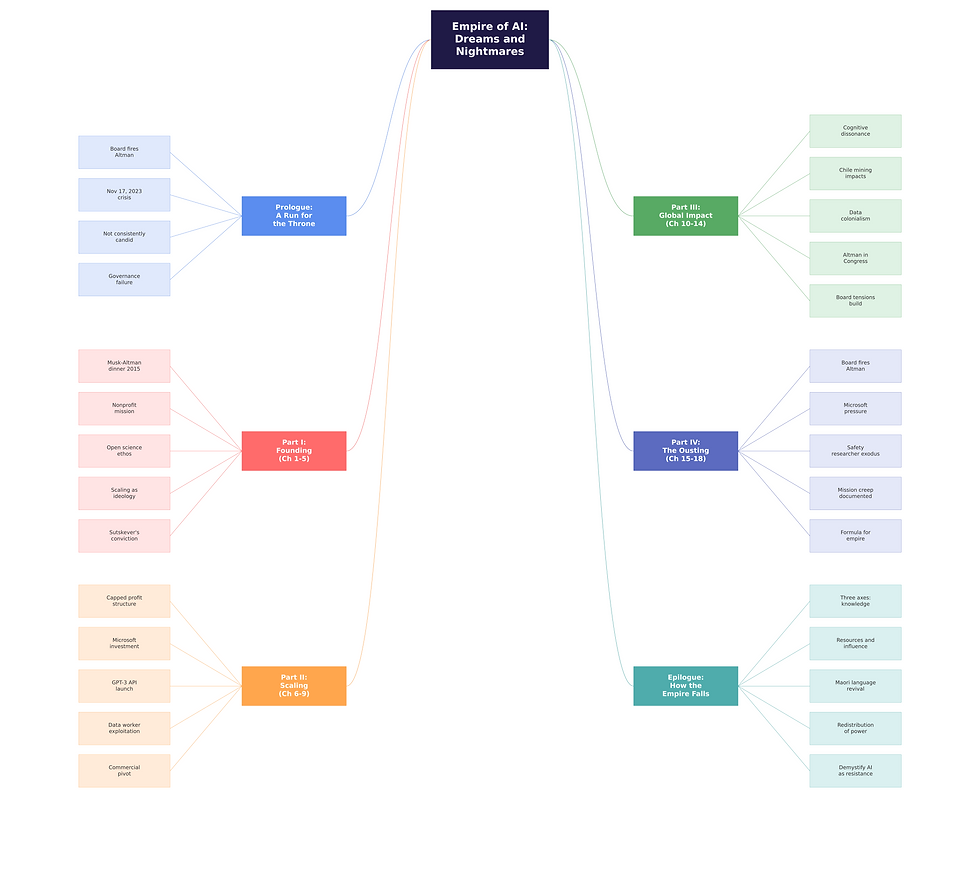
Prologue: A Run for the Throne
The book opens on November 17, 2023, with the board's decision to fire Sam Altman. Hao reconstructs the Google Meet where Sutskever delivered the news, Altman's response, and the chaotic days that followed. She sets up the central question: how did a nonprofit founded to benefit humanity reach a point where its own board concluded the CEO could not be trusted?
Chapter 1: Divine Right
Hao traces the origins of OpenAI to a 2015 dinner hosted by Altman, where Elon Musk and others gathered to discuss the future of AI. She covers Musk's concern about existential AI risk, his investment in DeepMind, his debate with Larry Page about whether AI surpassing human intelligence was a problem, and the early relationship between Musk and Altman. The chapter establishes the ideological roots of OpenAI in the existential risk community and Silicon Valley's winner-takes-all culture.
Chapter 2: A Civilizing Mission
This chapter covers the founding of OpenAI as a nonprofit. Hao profiles Greg Brockman, the first commit, and Ilya Sutskever, the researcher Altman recruited. She details the decision to create a nonprofit lab, the early open-source ethos, and the initial funding from Musk and others. The chapter title is pointed: like colonial powers that framed their conquests as civilizing missions, OpenAI framed its work as a mission to benefit humanity.
Chapter 3: Nerve Center
Hao describes OpenAI's early office, the Pioneer Building, and the company's culture. She covers her own visits to the office, the talent recruitment process, and the growing tension between the open-source mission and the competitive pressure to keep research secret. The chapter shows how physical space, office design, and perks functioned as tools for attracting and retaining talent in a competitive market.
Chapter 4: Dreams of Modernity
This chapter draws on Daron Acemoglu and Simon Johnson's work on technology history to argue that technologies do not inevitably bring widespread prosperity. Hao uses the example of the cotton gin, which boosted economic growth while intensifying slavery, to frame OpenAI's narrative of beneficial AI as a familiar pattern: a narrow elite imposes its vision of progress while claiming it serves everyone.
Chapter 5: Scale of Ambition
Hao profiles Ilya Sutskever's role in establishing OpenAI's scaling ethos. She traces his history with Geoffrey Hinton, his role in the ImageNet breakthrough, and his conviction that scaling deep learning would inevitably lead to more capable models. The chapter shows how Sutskever's faith in scaling became the company's guiding principle and how the "scaling laws" became a self-fulfilling prophecy that justified ever-increasing investment.
Chapter 6: Ascension
This chapter covers Altman's transition to full-time leadership of OpenAI and his application of the aggressive mindset he developed at Y Combinator. Hao details how Altman adopted Peter Thiel's monopoly strategy, aiming not to be among the leading AI organizations but the only one. She covers the creation of the capped profit structure and Microsoft's investment, showing how commercial concerns began to override the nonprofit mission.
Chapter 7: Science in Captivity
Hao covers the aftermath of GPT-3's release and the competitive dynamics it triggered. Google, DeepMind, and Meta all responded to OpenAI's large language model. The chapter shows how OpenAI's success with scaling triggered an industry-wide arms race, concentrating resources at a few large companies and choking off independent research. The title captures Hao's argument: science that serves commercial interests becomes captive to those interests.
Chapter 8: Dawn of Commerce
This chapter details OpenAI's 2021 research road map and the shift toward productization. Hao documents the internal consensus around scaling, the plan to build an AI agent, and the self-reinforcing loop between research and productization. She shows how the departure of safety researchers who disagreed with the commercial direction diluted internal resistance.
Chapter 9: Disaster Capitalism
Hao reports on OpenAI's use of Sama, a content moderation vendor, to filter its models' outputs. She documents the working conditions of data annotation workers in Kenya who reviewed disturbing content to train AI safety filters. The chapter connects these labor practices to the broader pattern of extraction: the costs of AI development are borne by vulnerable workers while the benefits flow to the company.
Chapter 10: Gods and Demons
Hao reflects on the cognitive dissonance of living in San Francisco, where immense tech wealth coexists with visible poverty and suffering. She connects this dissonance to the broader narrative: tech companies build utopian promises while the communities around them struggle. The chapter serves as a pivot from the inside story of OpenAI to the global impacts of its technology.
Chapter 11: Apex
This chapter covers OpenAI's October 2022 off-site, where the company presented its vision and demos. Hao describes the growing confidence and ambition, and the plans for GPT-4. The chapter captures the company at the height of its internal optimism, just before the launch of ChatGPT would change everything.
Chapter 12: Plundered Earth
Hao travels to Chile to document the environmental costs of AI hardware. She reports on copper and lithium mining in the Atacama Desert, the impact on Indigenous communities, and the colonial legacy that shapes Chile's role as a resource provider for Global North technology. The chapter connects the physical supply chain of AI to the book's empire metaphor.
Chapter 13: The Two Prophets
This chapter covers Altman's May 2023 testimony before Congress, where he called for regulation while framing it in terms that would protect OpenAI's position. Hao documents his nimble rhetoric, his ability to win over critics, and his calls for licensing regimes that would advantage large companies over smaller ones.
Chapter 14: Deliverance
Hao covers the buildup to the board crisis, including a PR crisis around Altman's sister and growing tensions between Altman and the board. She documents the increasing concerns among senior leaders about Altman's honesty and the board's growing awareness of governance issues.
Chapter 15: The Gambit
This chapter profiles Mira Murati and the board's deliberations about firing Altman. Hao reconstructs the conversations between the independent directors and the concerns that led to the decision. She details the multiple grievances: Altman's lack of disclosure, his attempts to remove board members, and the pattern of behavior described by senior leaders.
Chapter 16: Cloak-and-Dagger
Hao reconstructs the days leading to the firing, the board's decision, and the immediate aftermath. She documents the role of Microsoft, the employee revolt, and the pressure that forced the board to reverse. The chapter shows how governance structures designed to protect the mission were overwhelmed by commercial power and personal loyalty.
Chapter 17: Reckoning
This chapter covers the aftermath of the board crisis. Sutskever never returned to the office. Safety researchers departed. Altman's plans for a chip company and his dismissal of safety concerns drove out the remaining Doomers. Hao documents the weakening of the safety clan and the company's return to its commercial trajectory.
Chapter 18: A Formula for Empire
Hao lays out her central argument. She connects Altman's admiration for Napoleon to OpenAI's mission: a vague, idealistic promise that can be reinterpreted to consolidate power. She traces the mission creep from 2015 to 2024 and argues that the formula has three ingredients: centralize talent, centralize resources, and keep the mission vague enough to justify anything.
Epilogue: How the Empire Falls
Hao proposes a framework for resistance. Drawing on the work of Indigenous communities in New Zealand using AI to revitalize the Maori language, and researchers and activists around the world, she identifies three axes of power that need redistribution: knowledge, resources, and influence. She calls for transparency, independent research, labor protections, and public education as the tools for dissolving empire. The book closes with Weizenbaum's insight: once we understand how AI works, its magic crumbles away.
IN PRACTICE
1. Demand transparency from AI companies: Hao argues that companies should be required to disclose training data, technical specifications, and supply chain details. Without transparency, there is no accountability. Action: Check whether the AI tools you use publish information about their training data, labor practices, and environmental impact. If they do not, ask why.
2. Support independent AI research: The book documents how independent research has dwindled as industry funding dominates the field. Hao calls for greater funding for researchers outside corporate labs. Action: Follow and share work from independent AI research organizations like DAIR (Distributed AI Research Institute) rather than relying solely on company announcements.
3. Understand the full supply chain: AI is not just software. It involves mining, energy, water, labor, and infrastructure. Hao's reporting in Chile and Kenya shows the physical costs. Action: When evaluating an AI product, consider not just its capabilities but the resources and labor that went into building it.
4. Question the narrative of beneficial AGI: Hao shows how the promise of AI solving climate change, curing cancer, and creating abundance functions as an ideology that justifies current extraction. Action: When you hear promises about future AI benefits, ask who is making the promise, what they stand to gain, and who is paying the cost right now.
5. Pay attention to governance structures: The board crisis showed that governance structures designed to protect the public interest can be overwhelmed by commercial power. Action: Follow how AI companies are governed, who sits on their boards, and whether their accountability structures function when tested.
6. Listen to affected communities: Hao's reporting from Kenya, Chile, South Africa, and New Zealand shows that the people most affected by AI development are rarely heard in policy discussions. Action: Seek out and amplify the voices of communities affected by AI infrastructure, data extraction, and labor practices.
7. Educate yourself and others about how AI works: Hao ends with Weizenbaum's insight that demystification is the first step toward redistribution of power. Action: Learn the basics of how large language models work, what training data is, and what the technology can and cannot do. Share that knowledge with people who are not in the tech field.
QUOTES
"Over the years, I've found only one metaphor that encapsulates the nature of what these AI power players are: empires."
"The empires of AI are not engaged in the same overt violence and brutality that marked this history. But they, too, seize and extract precious resources to feed their vision of artificial intelligence."
"OpenAI's mission, to ensure AGI benefits all of humanity, may have begun as a sincere stroke of idealism, but it has since become a uniquely potent formula for consolidating resources and constructing an empire-esque power structure."
"The most successful founders do not set out to create companies. They are on a mission to create something closer to a religion, and at some point it turns out that forming a company is the easiest way to do so."
"One doesn't bet against deep learning. Success is guaranteed."
"I think it's a ridiculous and meaningless term. So I apologize that I keep using it."
"We're now going to assume we're, like, entering the AGI era."
"How much would you be willing to delay a cure for cancer to avoid risks?"
"The thing that I'm most proud of is we really built an empire."
"Once a particular program is unmasked, once its inner workings are explained in language sufficiently plain to induce understanding, its magic crumbles away."
"Controlling knowledge production fuels influence; growing influence accumulates resources; amassing resources secures knowledge production."
"The formula for dissolving empire thus requires the redistribution of power along each axis."
"OpenAI is now leading our acceleration toward this modern-day colonial world order."
"By hiding the ingredients of their models as their intellectual property, the empires of AI have thus far been able to get away with seizing other people's IP without credit, consent, or compensation."
"The antidote to the mysticism and mirage of AI hype is to teach people about how AI works, about its strengths and shortcomings, about the systems that shape its development, about the worldviews and fallability of the people and companies developing these technologies."
AUTHORS EXPERTISE
Karen Hao is an award-winning journalist covering the impacts of artificial intelligence on society. She writes for The Atlantic and leads the Pulitzer Center's AI Spotlight Series, a program training thousands of journalists worldwide on how to cover AI. She was formerly a reporter for the Wall Street Journal covering American and Chinese tech companies and a senior editor for AI at MIT Technology Review.
Hao's reporting is regularly taught in universities and cited by governments. She has received numerous accolades, including an American Humanist Media Award and the American Society of Magazine Editors NEXT Award for Journalists Under 30. She received her bachelor of science in mechanical engineering from MIT.
Empire of AI is her first book, published by Penguin Press in 2025. It is based on over 300 interviews with 260 people, including more than 90 current or former OpenAI employees, and extensive on-the-ground reporting in Kenya, Chile, South Africa, Uruguay, and New Zealand. The book took over seven years of reporting, beginning with Hao's coverage of OpenAI at MIT Technology Review.
RESOURCES
Empire of AI: Dreams and Nightmares by Karen Hao: https://www.amazon.com/Empire-AI-Dreams-Nightmares/dp/0593657508
Karen Hao's reporting at The Atlantic: https://www.theatlantic.com/author/karen-hao/
The Pulitzer Center AI Spotlight Series: https://pulitzercenter.org/ai-spotlight
Power and Progress by Daron Acemoglu and Simon Johnson (referenced in the book)
The Costs of Connection by Nick Couldry and Ulises A. Mejias (referenced in the book)
NEXT STEPS
Question the mission: When an AI company claims to act for humanity, ask who defines "humanity" and who decides what counts as beneficial. Vague missions concentrate power.
Follow the resources: Trace where the compute, data, energy, and labor come from. Every AI model has a physical supply chain with real costs and real beneficiaries.
Demand transparency: Support policies and practices that require AI companies to disclose training data, labor conditions, and environmental impact. Secrecy enables extraction.
Support independent voices: Fund, follow, and amplify researchers, journalists, and community organizations that operate outside the AI industry's financial ecosystem.
Educate to demystify: Learn how AI systems actually work and share that knowledge. The power of AI empire depends on the public not understanding the technology. Demystification is resistance.




Comments