
AI for Social Media Strategy


UIC University 365 Institute of Communication
Series Marketing Series | Level Basic (Free)
Duration 15 to 20 minutes | Access Free
Digital Communication, Marketing, Branding, Content Strategy, Media Studies

UNOP Sound (University 365 Neuroscience Oriented Pedagogy)
Take five minutes to prepare your brain. Play the isochronous tone track (40Hz gamma frequency) with your eyes closed. Gamma-frequency tones before a learning session raise attention and make the material easier to absorb.
[Audio player: UNOP Pre-Lecture Isochrone (40Hz, 5 minutes)]
In this Lecture

The Hook: Your Social Media Strategy Is Already Using AI
You post a reel on Instagram. The platform decides who sees it. You run a LinkedIn campaign. The algorithm determines your reach. You schedule tweets on X. AI picks the audience most likely to engage.
Whether you use AI tools yourself or not, AI is already running your social media strategy. Every major platform uses machine learning to rank content, target ads, and decide what reaches your audience. The question is not whether AI is part of your social media workflow. It is whether you are using it deliberately or leaving the decisions to the platforms alone.
In the next 18 minutes, you will learn how to take control. You will discover the AI tools that help you schedule smarter, generate better content, segment audiences precisely, optimize campaigns in real time, and measure ROI with confidence. You will also learn the CI-First approach that keeps human judgment at the center of every AI-assisted decision.
Step 1: The AI Social Media Tool Landscape in 2026
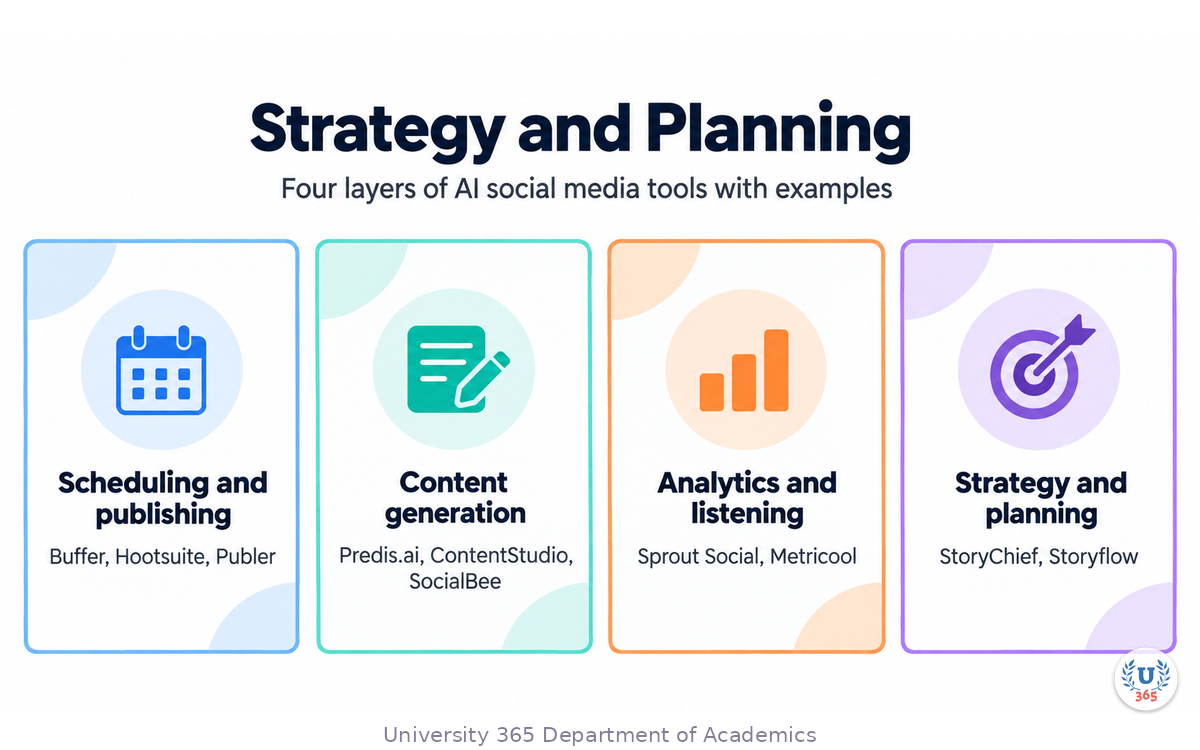
The social media management market has absorbed AI faster than almost any other marketing category. In 2026, the tools divide into four functional layers.
Scheduling and Publishing
Buffer, Hootsuite, Sprout Social, and Publer use AI to analyze when your specific audience is most active. Instead of guessing that Tuesday at 9 AM is a good time, these tools examine your followers' engagement patterns and recommend posting windows that improve reach by 20 to 40 percent compared to manually chosen slots. Publer analyzes audience activity patterns to recommend the best posting times per platform. SocialPilot's AI Pilot generates, rewrites, and localizes post copy across 10 languages.
Content Generation
Predis.ai generates complete posts from a topic description: copy, visuals, and hashtags, including multi-slide carousels and short-form video with AI voiceovers. ContentStudio's AI Studio produces brand-aligned captions, images, and videos using multiple AI providers within the scheduling workflow. SocialBee's AI Copilot generates a tailored social media strategy with platform recommendations, posting times, and ready-to-use post variations.
Analytics and Listening
Sprout Social uses AI-powered social listening to surface quantitative metrics (message volume, engagement, sentiment, unique authors, impressions) and qualitative findings that would take a human analyst hours to compile. Metricool combines analytics with scheduling, showing performance data alongside content planning tools.
Strategy and Planning
StoryChief's William AI generates social posts, converts existing content into post sets, and auto-populates the calendar at scale. Storyflow reads a board of content ideas and shapes a month of content rather than just queuing individual posts.
Why the Layering Matters
No single tool covers all four layers well. A team that uses Buffer for scheduling, Predis.ai for content generation, Sprout Social for analytics, and StoryChief for planning gets better results than a team trying to do everything in one platform. The key is integration: tools that connect through APIs or automation platforms like Zapier and n8n so data flows between them.
Step 2: AI Scheduling and Optimal Posting Times
Posting at the right time matters more than most marketers admit. A well-crafted post published when your audience is asleep gets a fraction of the engagement it deserves. AI scheduling tools solve this problem with data.
How AI Scheduling Works
Traditional scheduling tools let you pick a time slot. AI scheduling tools pick the time slot for you. They analyze your historical engagement data, your audience's active hours across time zones, and platform-specific patterns to identify the optimal posting window for each piece of content.
Buffer's AI Assistant examines your past post performance and recommends times when your followers are most likely to engage. Publer goes further: it analyzes audience activity patterns per platform, recognizing that your LinkedIn audience may be most active on Wednesday mornings while your Instagram followers peak on Thursday evenings.
The Data Behind the Recommendations
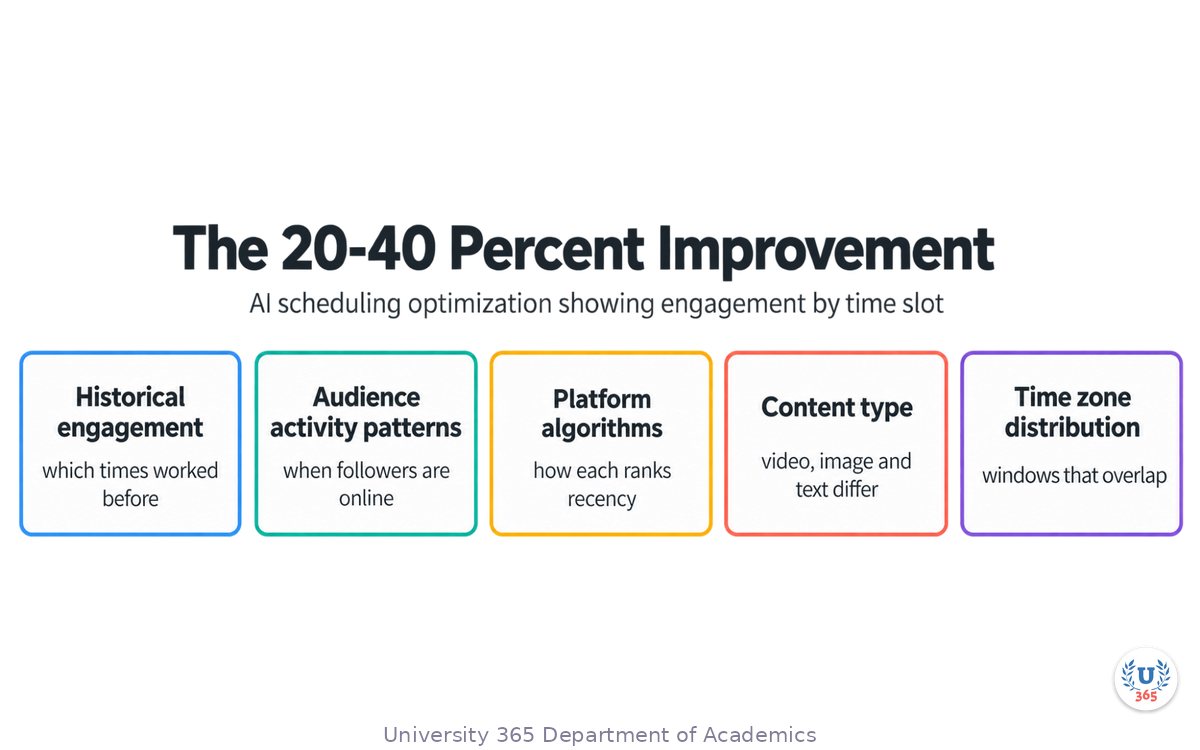
AI scheduling tools process several signals:
Historical engagement: Which times produced the highest engagement rates for similar content types
Audience activity patterns: When your specific followers are online and scrolling
Platform algorithms: How each platform weights recency in its ranking formula
Content type: Video, image, and text posts may perform best at different times
Time zone distribution: If your audience spans multiple zones, the tool finds windows that overlap
The 20-40 Percent Improvement
Aggregated data from multiple social media management platforms shows that AI-optimized posting times consistently outperform manually chosen slots by 20 to 40 percent in engagement metrics. This is not a marginal gain. For a business posting daily across three platforms, that improvement compounds to thousands of additional impressions per month without producing any additional content.
The CI-First Check
AI scheduling recommendations are data-driven but not infallible. If your audience behavior shifts (a new product launch, a seasonal change, a viral event), historical data may not reflect current patterns. Review AI-recommended times weekly. Test alternative slots on 10 to 20 percent of your content. Keep a record of what works and feed it back into the tool. The AI learns from your corrections.
Step 3: AI Content Generation for Social Platforms
Generating social media content is where AI delivers its most visible impact. Teams using AI content tools produce 3.8 times more social media content per marketer per month compared to pre-adoption baselines, according to HubSpot's AI Trends 2026 report. But volume without quality is noise. The goal is more good content, not more bad content.
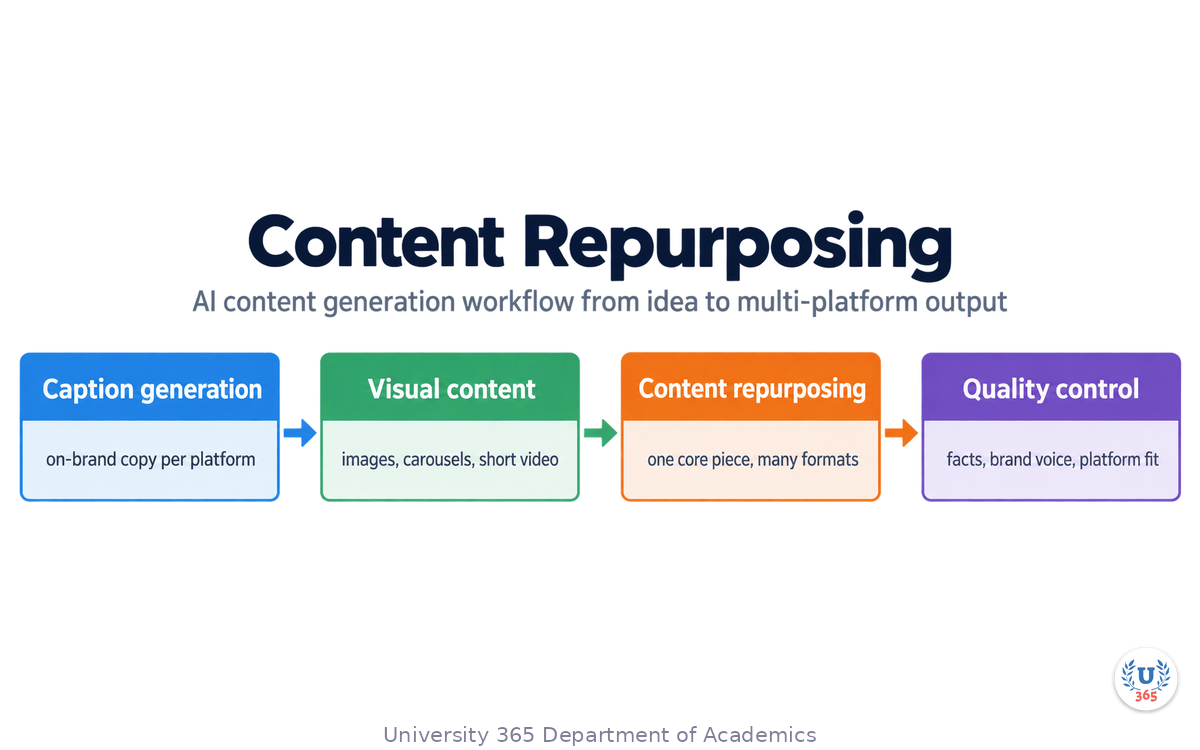
Caption Generation
AI caption tools have moved beyond generic text generation. SocialPilot adjusts tone by network: professional for LinkedIn, casual for Instagram, punchy for X. Buffer's AI Assistant suggests post topics, variations, and repurposed content based on past performance and trends. The best tools learn from your approval patterns: when you edit a caption before publishing, the AI incorporates that feedback into future suggestions.
Visual Content
Predis.ai produces complete posts with copy, visuals, and hashtags from a topic description. Canva's AI features generate on-brand graphics from text prompts. Descript and Captions.ai turn long-form video into short clips optimized for different platforms. These tools handle the visual layer that text-only models cannot produce.
Content Repurposing
The most efficient use of AI content generation is repurposing: taking one core piece of content and adapting it for multiple platforms. A blog post becomes a LinkedIn article, three Instagram carousels, five X threads, and a TikTok script. AI tools do this adaptation in minutes. The human role is selecting which core content to repurpose and reviewing each adaptation for platform-appropriate tone.
Quality Control
AI-generated content fails in predictable ways. It can produce factually incorrect claims, use inappropriate tone for a platform, or generate text that sounds robotic and generic. The CI-First workflow requires human review before publication. Check three things on every AI-generated post:
Factual accuracy: Does every claim, statistic, and reference check out?
Brand voice: Does this sound like your brand, or does it sound like an AI?
Platform fit: Is the tone, length, and format appropriate for the destination platform?
If any check fails, edit or reject. Never publish AI-generated content without human review.
Step 4: AI Analytics and Social Listening
Analytics is where most social media strategies fail. Teams post content, check likes and follower counts, and call it measurement. Those are vanity metrics. Real measurement connects social media activity to business outcomes: conversions, revenue, pipeline, customer retention.
What AI Analytics Tools Do Differently
Traditional analytics dashboards show you what happened. AI analytics tools show you why it happened and what to do next. Sprout Social's AI-powered listening surfaces patterns a human analyst would miss: a sudden drop in Tuesday engagement, a correlation between video posts and website traffic, an audience segment that grows but does not convert.
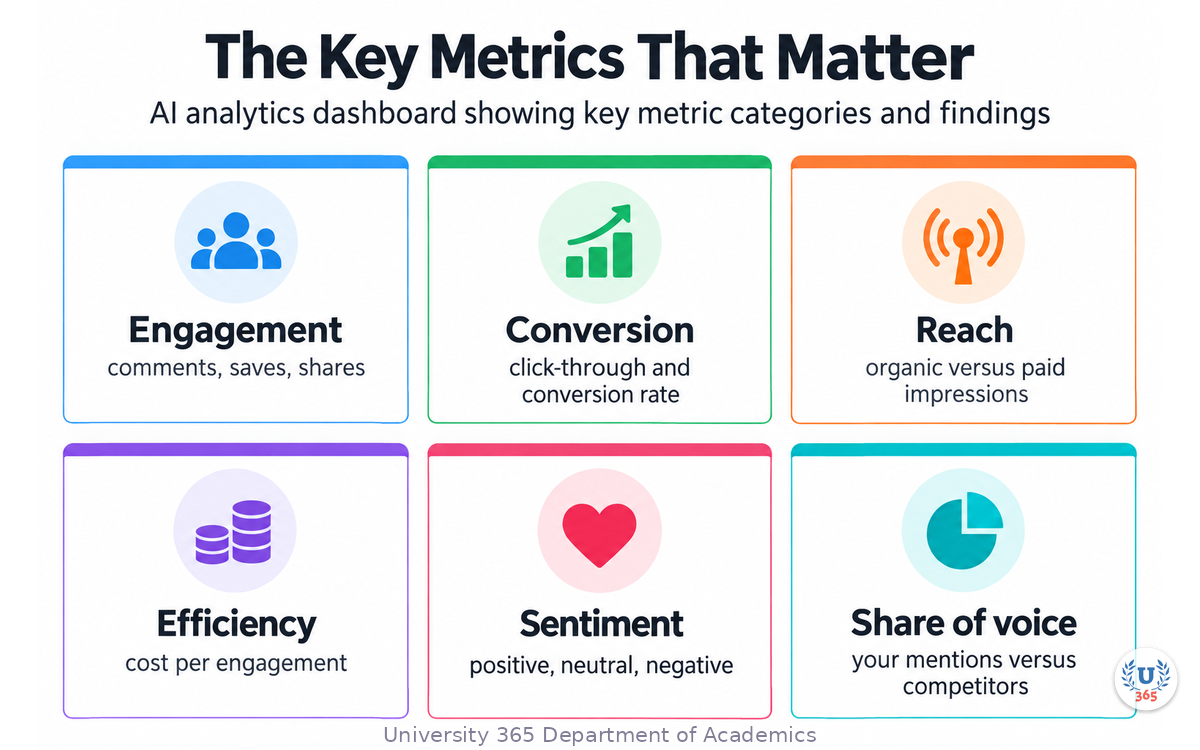
The Key Metrics That Matter
Metric Category | What to Track | Why It Matters |
**Engagement** | Comments, saves, shares | Stronger signal than likes across all platforms |
**Conversion** | Click-through rate, conversion rate | Connects social activity to business outcomes |
**Reach** | Organic vs paid impressions, follower growth | Shows how far your content travels |
**Efficiency** | Cost per engagement, cost per conversion | Measures resource allocation |
**Sentiment** | Positive, neutral, negative mention ratio | Tracks brand health over time |
**Share of voice** | Your mentions vs competitors' | Shows market position in real time |
Social Listening with AI
Social listening monitors mentions of your brand, competitors, and industry keywords across platforms. AI-powered listening tools process thousands of posts in real time and surface:
Sentiment trends: Is public perception of your brand improving or declining?
Emerging topics: What conversations are gaining traction in your industry?
Competitor movements: What are competitors posting, and how is their audience responding?
Customer pain points: What complaints or questions appear repeatedly in mentions?
The 2025 Sprout Social Impact Report found that less than half (44 percent) of marketing leaders rate their social team at expert level in measuring business impact. AI analytics tools close this gap by automating data collection and surfacing findings that connect social activity to revenue.
UTM Tracking and Attribution
To measure ROI, you need to track what happens after someone clicks a social media link. UTM parameters appended to your URLs let Google Analytics (or any web analytics tool) attribute website visits, conversions, and revenue to specific social posts. AI tools can automatically generate and apply UTM tags, removing the manual effort that causes most teams to skip this step. Without UTM tracking, you cannot calculate accurate ROI. With it, you can trace the full journey from social media interaction to customer acquisition.
Step 5: Audience Segmentation with AI
Audience segmentation is the practice of dividing your audience into groups based on shared characteristics. AI transforms segmentation from a manual, demographic-based exercise into a dynamic, behavior-based system.
From Demographics to Micro-Segments
Traditional segmentation uses broad categories: age, gender, location, job title. These are useful but blunt. A 28-year-old marketing manager in Paris and a 28-year-old marketing manager in Berlin may have completely different content preferences, buying behaviors, and platform habits.
AI segmentation tools analyze hundreds of signals: engagement patterns, content preferences, purchase timing, device usage, browsing behavior, and interaction history. They identify micro-segments: small, precisely defined groups that respond to specific content types. Businesses using AI audience segmentation report up to 22 percent higher return on ad spend (ROAS) compared to broad demographic targeting.
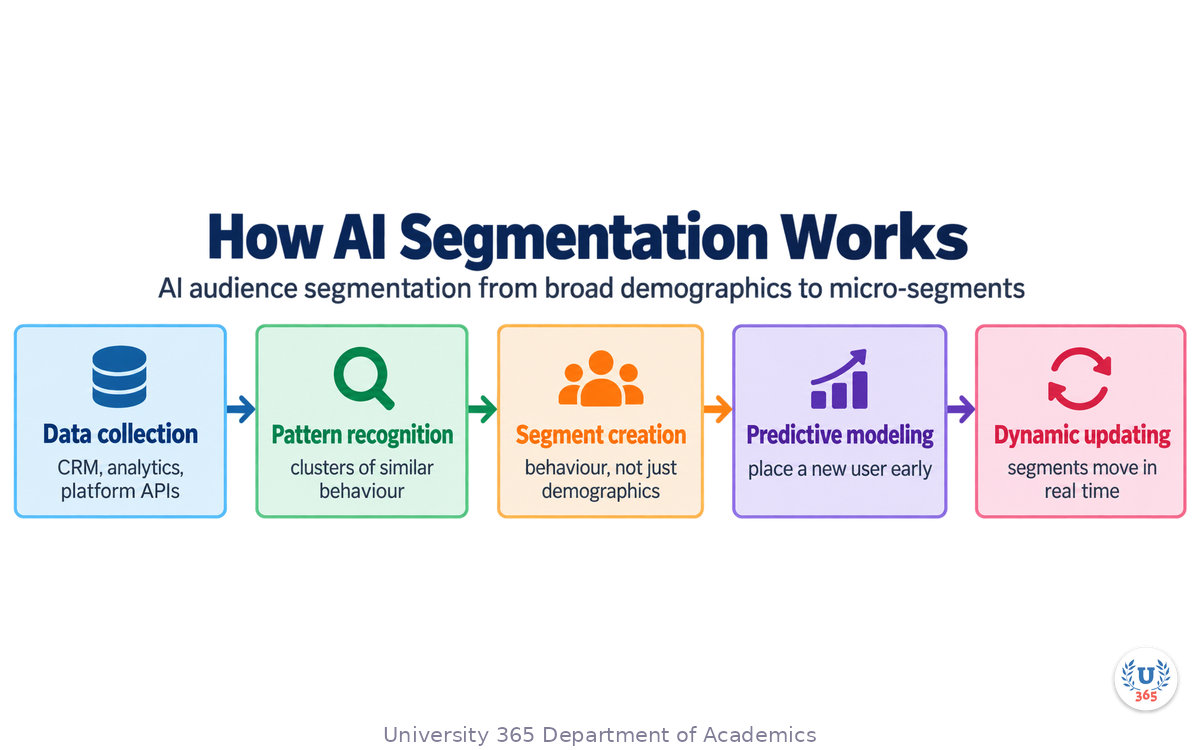
How AI Segmentation Works
Data collection: The tool gathers data from your CRM, website analytics, social platform APIs, and email engagement logs
Pattern recognition: Machine learning algorithms identify clusters of users with similar behaviors
Segment creation: The tool creates segments based on behavior, not just demographics (for example: "users who watch video content to completion but never click links" vs "users who click every link but watch less than 3 seconds of video")
Predictive modeling: The AI predicts which segment a new user likely belongs to based on their first few interactions
Dynamic updating: Segments update in real time as user behavior changes
Practical Segmentation Strategies
For a B2B company on LinkedIn, AI segmentation might reveal three distinct audience clusters:
Decision researchers: Senior executives who read long-form posts, download whitepapers, and engage with case studies. They convert through thought leadership content.
Practitioners: Mid-level professionals who engage with how-to posts and tutorial videos. They convert through practical, actionable content.
Passive followers: Users who like posts but never click or comment. They need a different engagement strategy: polls, questions, and interactive content to move them toward action.
Each segment receives different content, posted at different times, with different calls to action. This is impossible to manage manually at scale. AI tools make it operationally feasible.
Privacy and Compliance
AI segmentation relies on user data. Ensure your data collection complies with GDPR, CCPA, and platform-specific privacy policies. Use first-party data (data collected directly from your audience) as your primary source. It is more accurate, more compliant, and more valuable than third-party data. Marketers who use first-party data to enable AI report a 30 percent performance lift compared to those who do not, according to Google's research.
Step 6: Platform-Specific AI Strategies
Each social platform runs its own AI algorithm. Content that succeeds on TikTok may flop on LinkedIn. Understanding what each algorithm rewards is the foundation of a multi-platform strategy.
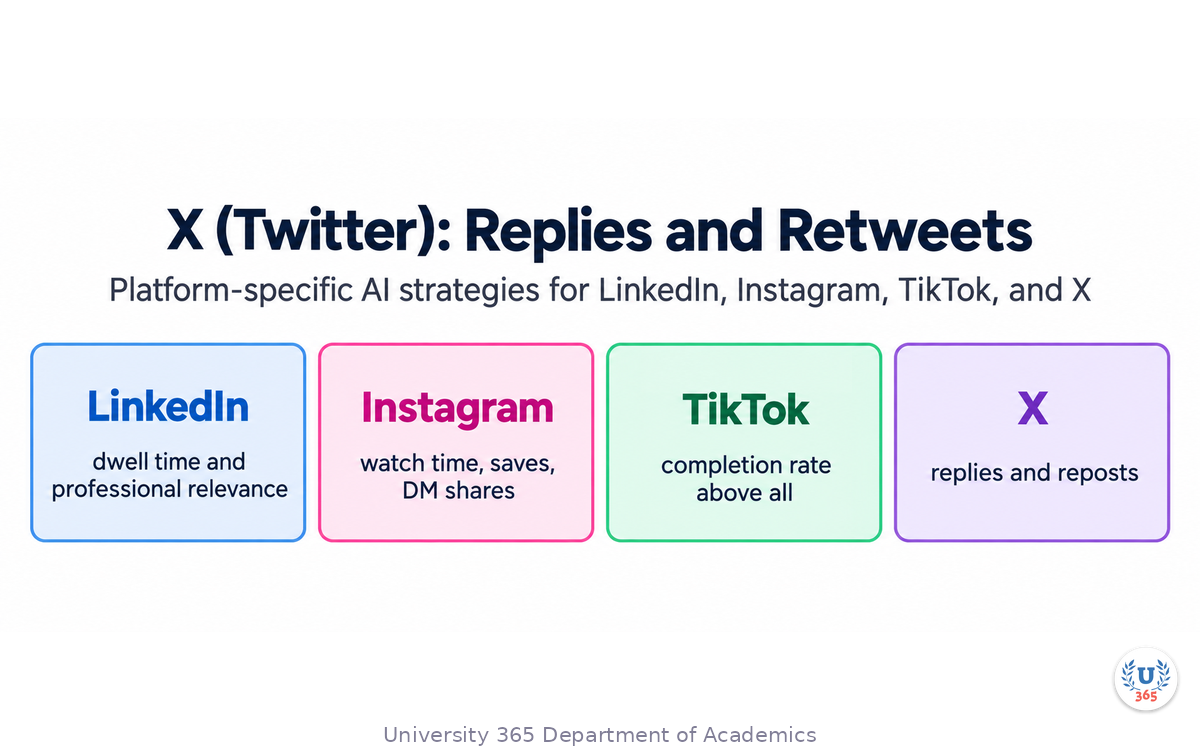
LinkedIn: Dwell Time and Professional Relevance
LinkedIn's algorithm prioritizes content that holds attention. The platform officially documents dwell time (how long users pause on a post) as a key ranking signal. Third-party analysis from AuthoredUp found that posts with 61 or more seconds of dwell time achieve approximately 15.6 percent engagement, compared to 1.2 percent for posts with 0 to 3 seconds of dwell.
AI strategy for LinkedIn:
Use AI to draft 1,200 to 1,500 character posts with compelling hooks and clear takeaways
Generate thought leadership content from your existing articles and case studies
Use AI scheduling to post when your professional network is most active (typically weekday mornings)
Avoid outbound links in post body: LinkedIn's algorithm penalizes them. Put links in comments instead
Employee advocacy content gets 8x more engagement than brand page content. Use AI to help employees draft authentic posts
Instagram: Watch Time, Saves, and DM Shares
Instagram ranks each surface (Feed, Reels, Stories, Explore) separately. Adam Mosseri named three cross-surface signals in January 2025: watch time, likes-per-reach, and sends-per-reach (DM shares). Sends are the signal that unlocks reach to non-followers.
AI strategy for Instagram:
Use AI video tools (Descript, Captions.ai) to create Reels with strong hooks in the first 3 seconds
Generate carousel posts: they generate 3x more engagement than single images
Use AI to write captions optimized for saves: educational posts, tutorials, and resource lists
Post original, unwatermarked content: Instagram down-ranks recycled TikToks
Use AI hashtag tools to mix popular and niche tags (20 to 30 per post)
TikTok: Completion Rate Above All
TikTok's For You Page algorithm weights watch time and completion rate more heavily than any other signal. A short video watched to the end consistently outperforms a longer video that people scroll past. The platform explicitly states that completing a longer video carries more weight than weaker signals like shared location.
AI strategy for TikTok:
Use AI to generate 15 to 60 second vertical videos with hooks in the first 2 to 3 seconds
Use AI voiceover tools for consistent narration quality
Use TikTok SEO: AI keyword research tools identify terms your audience searches for
Post 1 to 4 times daily: the algorithm rewards consistency
Use trending sounds and effects: AI trend detection tools can alert you when a sound is gaining traction
Native content gets 40 to 60 percent higher initial distribution than cross-posted content
X (Twitter): Replies and Retweets
X's open-source ranking code (published in 2023, though the platform is migrating to a Grok-based ranker) shows that a retweet outweighs a like approximately 2 to 1. Replies are the strongest positive signal. The platform rewards high-frequency posting and conversation participation.
AI strategy for X:
Post 1 to 5 times daily with AI-assisted content generation
Use AI to draft reply-worthy content: questions, hot takes, data points
Generate thread content from long-form articles
Use AI to monitor trending topics and join relevant conversations in real time
@mentions drive engagement: use AI to identify relevant accounts to tag
The Universal Rule
Across every platform, three principles hold: (1) the algorithm optimizes for completed, satisfying consumption, not raw exposure; (2) original, native content beats reposted and cross-posted content; (3) negative signals (hides, blocks, "not interested") suppress reach faster than positive engagement builds it. Build for the first rule, avoid the third, and post natively to each platform.
Step 7: Campaign Optimization with AI
Running a social media campaign without AI optimization is like driving with your eyes closed. You can move forward, but you will miss opportunities and hit obstacles. AI campaign optimization tools process billions of data points in real time to improve performance while the campaign is running.
Predictive Analytics
AI predictive analytics forecast campaign performance before you spend your budget. Tools like Meta Advantage+ and Google Performance Max analyze historical data, audience signals, and creative elements to predict which campaigns, ad sets, and audiences will perform best over the next 7 to 30 days. Instead of reacting to poor performance after it happens, you prevent it by allocating budget proactively.
Businesses using predictive budget allocation report 30 percent efficiency gains by shifting budget proactively rather than reactively.
Dynamic Creative Optimization
AI tools test multiple creative variations simultaneously and automatically serve the best-performing version to each audience segment. Instead of running one ad creative and hoping it works, you run 10 variations and let the AI find the winner for each micro-segment. This includes:
Headline variations: AI generates and tests multiple headlines
Visual variations: Different images or video thumbnails for the same campaign
Call-to-action variations: Different CTAs for different segments
Copy length: Short vs long form, tested per platform
Real-Time Bidding Optimization
AI bidding tools adjust bids in real time based on conversion probability. Instead of setting a fixed bid and walking away, the AI evaluates each auction individually: is this impression likely to convert? If yes, bid higher. If no, bid lower or skip. This prevents wasted spend on low-quality impressions.
The CI-First Campaign Framework
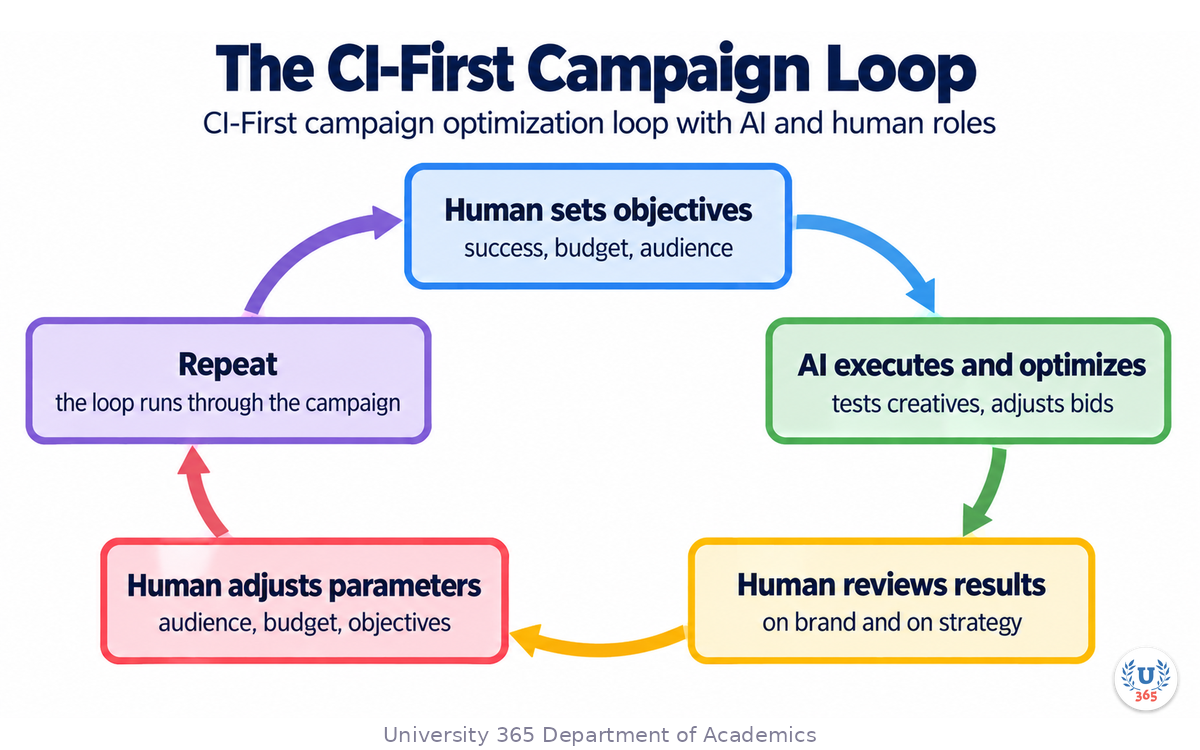
AI optimizes tactics. Humans set strategy. The CI-First approach to campaign optimization follows this loop:
Human sets objectives: What does success look like? What is the budget? What is the audience?
AI executes and optimizes: The tool tests creatives, adjusts bids, allocates budget
Human reviews results: Are the AI's decisions aligned with brand values? Is the optimized creative on-brand?
Human adjusts parameters: Refine audience, adjust budget, change objectives based on AI findings
Repeat: The loop runs continuously throughout the campaign
The human never steps away. The AI never makes strategic decisions. This division of labor is what CI-First (Co-Intelligence First) means in practice: human intelligence is the ruler and orchestrator, AI is the amplifier.
Measuring ROI
The biggest mistake in AI-assisted social media campaigns is not setting a baseline before you start. If you do not know your engagement rate, cost per conversion, and revenue per channel before adopting AI tools, you cannot measure their impact. Establish baselines, then track these ROI metrics:
Cost per acquisition (CPA): Total campaign cost divided by number of acquisitions
Return on ad spend (ROAS): Revenue generated divided by ad spend
Customer lifetime value (CLV) to CPA ratio: Is the cost of acquisition justified by long-term value?
Attribution-adjusted ROI: Using multi-touch attribution to credit each platform's contribution
Organic lift: How much additional organic engagement does paid campaign spending generate?
According to McKinsey's Global AI Survey, the average ROI for AI-assisted social media content is 3.8 times the investment. For small and mid-sized businesses, the blended AI ROI across social media applications is 2.3x. Sprout Social's Forrester-commissioned study found that organizations using AI-powered social media management tools achieved a 268 percent return on investment over three years.
Feynman Summary: Explain It Like You Are 12
Imagine you run a lemonade stand. You want to sell more lemonade, so you put up signs around your neighborhood. But you do not know which streets have the most thirsty people, what time of day they walk by, or which sign design makes them stop.
Now imagine you have a smart assistant who watches every person who walks by, remembers which signs they looked at, which ones made them stop, and which ones made them buy. The assistant tells you: "Put the yellow sign on Oak Street at 3 PM, and the blue sign on Maple Street at 5 PM. Also, people who buy lemonade on Tuesday tend to come back on Friday."
That is what AI does for social media. It watches how people react to your posts, figures out patterns, and tells you what to post, when to post it, and where to post it for the best results. It can even help you write the posts and design the pictures.
But the assistant does not know what kind of lemonade you want to sell or what your stand stands for. You do. You decide the strategy. The assistant handles the details. That is CI-First: you are the boss, the AI is your helper, and together you sell more lemonade than either of you could alone.
Mindmap: The Complete Picture
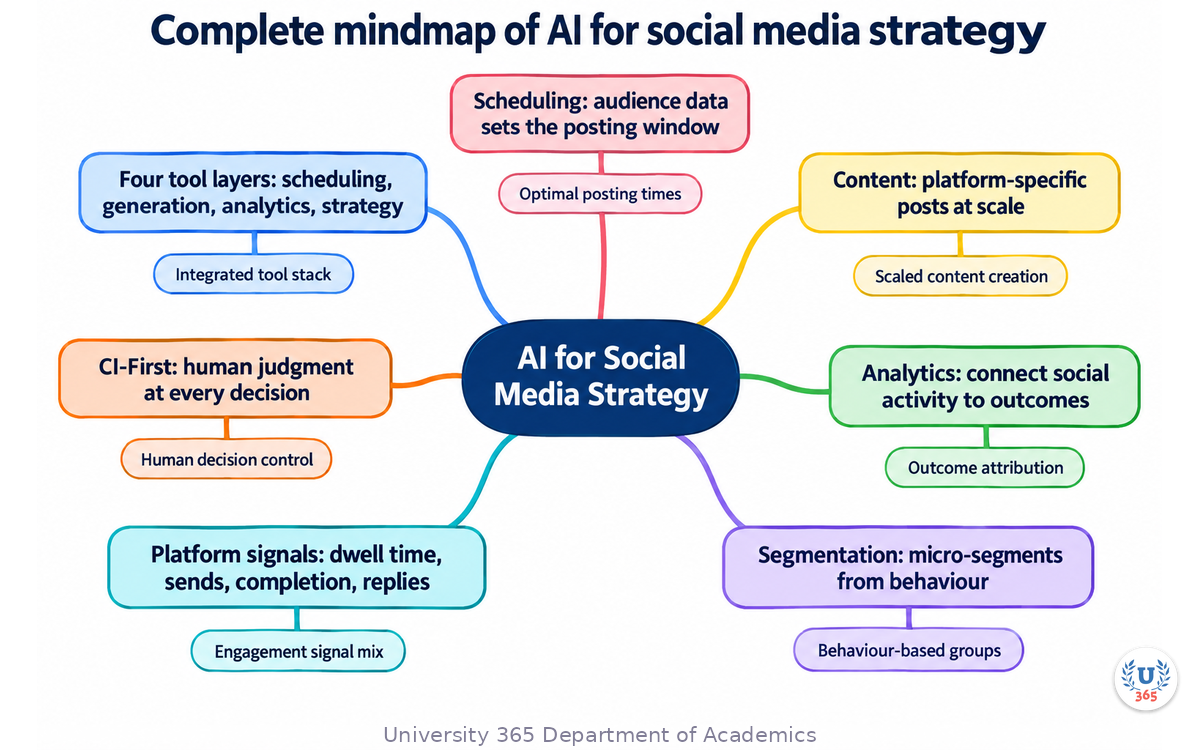
The mindmap shows the full structure of what you learned: the four tool layers (scheduling, content generation, analytics, strategy) form the foundation. AI scheduling optimizes posting times based on audience data. AI content generation produces platform-specific posts at scale. AI analytics connects social activity to business outcomes. AI audience segmentation creates micro-segments from behavioral data. Platform-specific strategies adapt to each algorithm's signals (LinkedIn dwell time, Instagram sends, TikTok completion rate, X replies). Campaign optimization uses predictive analytics and dynamic creative testing. The CI-First framework keeps human judgment at the center of every decision.
UNOP Sound (University 365 Neuroscience Oriented Pedagogy)
Take five minutes to consolidate your memory. Play the isochronous tone track (10Hz alpha frequency) with your eyes closed. Alpha-frequency tones after a learning session support consolidation, helping move what you just learned from short-term to long-term memory.
[Audio player: UNOP Post-Lecture Isochrone (10Hz, 5 minutes)]
Practical Exercise: Build Your AI-Powered Social Media Workflow
Exercise: Set Up a 7-Day AI-Assisted Content Plan
Choose your primary platform (LinkedIn for B2B, Instagram for visual brands, TikTok for reaching younger audiences)
Select two AI tools:
One scheduling tool (Buffer, Publer, or SocialPilot)
One content generation tool (Predis.ai, ContentStudio, or SocialBee's AI Copilot)
Generate content for 7 days:
Input your brand description, target audience, and content goals into the AI tool
Generate 7 posts: 3 educational, 2 promotional, 1 behind-the-scenes, 1 engagement-focused (poll or question)
Review each post using the three-check quality control: factual accuracy, brand voice, platform fit
Schedule with AI-recommended times:
Let the scheduling tool analyze your audience and recommend posting times
Override any recommendation that conflicts with your knowledge of your audience
Set up tracking:
Add UTM parameters to every link in your posts
Note your baseline metrics: current engagement rate, follower count, website referral traffic
After 7 days, analyze:
Which posts performed best? Was there a pattern (content type, posting time, topic)?
Did AI-recommended times outperform your usual posting schedule?
Did the AI-generated content require heavy editing, or was it close to publish-ready?
What to Look For
The first week is a baseline. Patterns emerge over 4 to 6 weeks of consistent data
Pay attention to engagement quality, not just quantity: comments and saves matter more than likes
If the AI content needed significant editing, refine your input prompts and brand voice settings
Compare your results to the 20 to 40 percent engagement improvement benchmark from AI-optimized scheduling
Applied CI-First Connection
This exercise is not about letting AI make all the decisions. It is about building a workflow where AI handles the data-intensive work (timing, content drafting, pattern recognition) while you handle the judgment-intensive work (strategy, brand voice, quality control). Every AI output passes through your review before it reaches your audience. This is the CI-First approach applied to social media: Co-Intelligence First, with human intelligence as the orchestrator and AI as the amplifier.
Glossary
Term | Definition |
**AI Scheduling** | Using machine learning to analyze audience activity patterns and recommend optimal posting times per platform. |
**Social Listening** | Monitoring mentions of a brand, competitors, and industry keywords across social platforms, with AI processing to surface patterns and sentiment. |
**Audience Segmentation** | Dividing an audience into groups based on shared characteristics. AI segmentation uses behavioral signals, not just demographics. |
**Micro-Segment** | A small, precisely defined audience group identified by AI through behavioral pattern analysis. |
**Dwell Time** | How long a user pauses on a piece of content. LinkedIn's officially documented key ranking signal. |
**Completion Rate** | The percentage of a video that viewers watch before scrolling away. TikTok's primary ranking signal. |
**Sends-per-Reach** | The ratio of DM shares to impressions. Instagram's key signal for reaching non-followers. |
**ROAS (Return on Ad Spend)** | Revenue generated divided by advertising spend. A core metric for campaign performance. |
**Predictive Analytics** | Using historical data and machine learning to forecast future campaign performance and guide budget allocation. |
**Dynamic Creative Optimization** | AI testing of multiple creative variations simultaneously, automatically serving the best-performing version per audience segment. |
**UTM Parameters** | Tracking tags appended to URLs that let analytics tools attribute website visits and conversions to specific social posts. |
**CI-First (Co-Intelligence First)** | U365's approach where human intelligence is the orchestrator and AI is the amplifier. Humans set strategy; AI executes tactics. |
**Share of Voice** | Your brand's share of total mentions in your industry compared to competitors. |
**First-Party Data** | Data collected directly from your audience. More accurate and compliant than third-party data for AI-powered segmentation. |
**Attribution** | The process of crediting each marketing touchpoint for its contribution to a conversion. |
**Vanity Metrics** | Surface-level metrics (likes, follower count) that do not connect to business outcomes. |
**Native Content** | Content created specifically for one platform. Outperforms cross-posted content on every major platform. |
**AEO (Answer Engine Optimization)** | Optimizing content for AI search engines that synthesize answers from multiple sources. |
Quiz: TEST YOUR UNDERSTANDING
1. What is the primary ranking signal for TikTok's For You Page?
A) Number of followers
B) Watch time and completion rate
C) Number of hashtags used
D) Posting frequency
2. Which Instagram signal is most important for reaching non-followers?
A) Likes-per-reach
B) Comment count
C) Sends-per-reach (DM shares)
D) Hashtag relevance
3. What does CI-First mean in the context of social media strategy?
A) AI makes all decisions and humans execute them
B) Humans set strategy and AI amplifies execution, with human review at every step
C) Competitive Intelligence should drive all social media decisions
D) Content Indexing is the first step in any campaign
4. Why do AI-optimized posting times outperform manually chosen slots?
A) AI posts automatically without human input
B) AI analyzes audience activity patterns and historical engagement data specific to your account
C) AI posts more frequently than humans can
D) AI has access to platform-internal data that is not publicly available
5. What is the most important step before measuring the ROI of AI-assisted social media campaigns?
A) Choosing the most expensive AI tool
B) Setting a baseline of current performance metrics before adopting AI tools
C) Publishing content on all platforms simultaneously
D) Hiring a data scientist to interpret results
Answers: 1-B, 2-C, 3-B, 4-B, 5-B
Related Resources
U365 INSIDE Publications
Book Essential: Co-Intelligence by Ethan Mollick: The Centaur model and human-AI collaboration
Book Essential: Irreplaceable by Pascal Bornet: Humics and staying irreplaceable in the AI age
External Resources
The 9 Best AI Tools for Social Media Management in 2026 (Zapier): Comprehensive tool comparison: zapier.com/blog/best-ai-social-media-management
The 2026 Platform Algorithm Index (Kompozy): How ranking works on every platform, with sources: kompozy.io/research/platform-algorithm-index
The 2025 Impact of Social Media Marketing Report (Sprout Social): Proving social's business value with data: sproutsocial.com
ROI and AI-Powered Measurement Strategies (Think with Google): How AI transforms marketing measurement: business.google.com/think/measurement/roi-and-ai-powered-measurement
15 Best AI Tools for Social Media Marketing in 2026 (Monday.com): Platform comparison with pricing: monday.com/blog/ai-agents/ai-for-social-media
Related U365 Lectures
Lecture 2: AI Content Generation: Beyond ChatGPT (UIC, Content Strategy Series)
Lecture 3: Brand Voice in the Age of AI (UIC, Marketing Series, coming soon)
U.Copilot for This Lecture
Discuss this lecture with U.Copilot, your AI chat companion trained on this content.
Copy and paste the following prompt into the U.Copilot chat on university-365.com:
You are U.Copilot for Lectures, an AI chat companion specially trained on University 365 lecture content. You are helping a Fellow who just completed the lecture "AI for Social Media Strategy" from the Marketing series at the U365 Institute of Communication (UIC). Your role is to help the Fellow deepen their understanding of AI for social media strategy. You can: - Clarify any concept from the lecture (scheduling, content generation, analytics, audience segmentation, platform strategies, campaign optimization) - Provide additional examples of platform-specific AI strategies - Explain how to set up UTM tracking and measure social media ROI - Discuss which AI tools fit different team sizes and budgets - Connect the lecture content to practical social media marketing tasks - Suggest follow-up learning based on the Fellow's interests Always maintain U365's CI-First approach: encourage the Fellow to think critically, verify AI outputs, and maintain human judgment as the orchestrator of AI tools. Use the UP-Context Method: provide context-rich, role-aware responses that account for the Fellow's learning level and goals.
Next Steps
Now that you understand how AI transforms social media strategy, here is what to do next:
Complete the practical exercise above to build your first AI-assisted 7-day content plan
Choose your two tools and set up accounts: one for scheduling, one for content generation
Establish your baseline metrics before you start using AI tools, so you can measure improvement
Take Lecture 2 in this series: "AI Content Generation: Beyond ChatGPT" to learn the multi-tool content pipeline
Explore the U365 Marketing tag on INSIDE for practical guides on social media, branding, and content strategy
AI does not replace the social media strategist. It replaces the parts of the job that are repetitive, data-intensive, and time-consuming. What remains is the work that matters: understanding your audience, defining your brand voice, and making strategic decisions about what to say and where to say it. Master the tools, keep the judgment, and you will outperform any team that treats AI as a replacement for thinking.
IMPORTANT NOTICE
This lecture is published by University 365 as part of its INSIDE Publications Hub. The content is free to read for all visitors. Lectures in this series may be part of a structured academic program leading to a Micro-Credential for your Career (MCC). To enroll in an academic program, visit university-365.com/tuition.
This content is for educational purposes. While we strive for accuracy, AI and social media are fast-moving fields. Verify current tool features and platform algorithm details against primary sources for professional applications.
Copyright University 365, Inc. All rights reserved. This content is protected under University 365's copyright policies. For permissions or inquiries, contact uda@university-365.com.
Published by the Department of Academics, University 365.
Lecture delivered by the University 365 Institute of Communication (UIC).
Lea Loringam, Dean of Communication, UIC
Signed for the academic year 2026.




Comments