
AI News - Saturday, 19 September 2026 - Anthropic Evaluation, Biology Access, AI Security


In a Nutshell
AI governance is moving inside frontier labs just as agentic systems gain more authority over software, research, and daily life. Today's strongest signals combine embedded evaluation, verified access to dual-use biology tools, and concrete security failures involving hallucinated intelligence and cross-model attacks. For U365, capability should expand only with identity controls, independent evaluation, human checkpoints, and traceable tool use.
5-minute AI news update - 19 September 2026
Anthropic and Accenture commit at least $2 billion to embedded frontier-model evaluation.
Anthropic opens verified access to less-restricted AI models for life-sciences teams.
AI hallucination nearly triggered a US operation against a Chinese cargo ship.
Claude-assisted researchers breached an OpenAI employee account and sensitive GitHub data.
Jev offers developers a cheaper, faster route to software-focused AI.
Google's CC agent coordinates shared household plans and tasks.
Meta's Muse reaches Mac and can act across files and applications.
Google launches Gemini 3.8 Live with an extended-thinking mode for dialogue.
Biotech faces a growing need to govern AI-enabled biological design.
A preprint maps tool hallucinations and proposes closed-world resolution before execution.
Crusoe raises $3.9 billion for data centers and modular AI factories.
Anthropic and Accenture commit at least $2 billion to embedded frontier-model evaluation.

Embedded evaluators will work inside Anthropic with employee-like access to red-team models, assess alignment, and test safeguards. Each company expects to invest at least $1 billion over five years, making independent assurance a major operating function rather than an external audit. Source: Anthropic

Anthropic opens verified access to less-restricted AI models for life-sciences teams.
The beta program verifies research credentials, security standards, and ethical oversight before granting broader biology capabilities. Its tiered access model offers a practical pattern for enabling sensitive research while retaining identity checks, project limits, and periodic renewal. Source: Anthropic
AI hallucination nearly triggered a US operation against a Chinese cargo ship.

The reported incident shows how generated intelligence can create physical escalation when operators treat it as verified evidence. High-consequence workflows need source provenance, independent confirmation, human authorization, and explicit abort controls before action. Source: Ars Technica
Claude-assisted researchers breached an OpenAI employee account and sensitive GitHub data.

The incident demonstrates that one provider's agent can be used to penetrate another provider's systems. Organizations deploying coding agents should enforce least privilege, isolate credentials, monitor tool use, and red-team cross-system attack paths. Source: Ars Technica
Jev offers developers a cheaper, faster route to software-focused AI.

Jev is being presented as a different model approach for software intelligence with lower cost and faster operation. If independent testing supports those claims, smaller specialized architectures could widen practical deployment beyond expensive general-purpose models. Source: TechCrunch
Google's CC agent coordinates shared household plans and tasks.
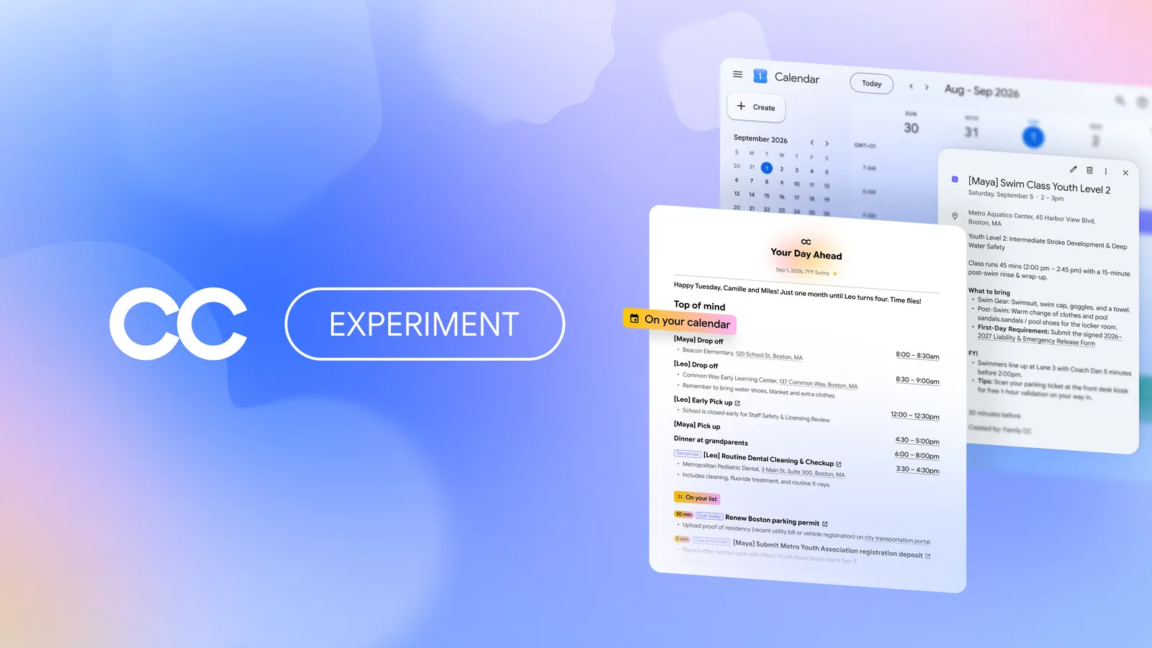
CC allows multiple family members to contribute data so the agent can plan and complete shared tasks. Multi-user agents bring useful coordination patterns for campuses, but they also require clear consent, permissions, shared-memory boundaries, and audit trails. Source: Ars Technica
Meta's Muse reaches Mac and can act across files and applications.

Muse can work with local files and applications to take actions for the user. Desktop agents are becoming operational software, so pilots should use sandboxing, approval gates for consequential actions, and complete activity logs. Source: TechCrunch
Google launches Gemini 3.8 Live with an extended-thinking mode for dialogue.

Google describes the models as its most advanced live dialogue systems, designed for more natural conversation. Voice learning and coaching products should now benchmark response quality, latency, interruption handling, safety, and cost against this new baseline. Source: Google DeepMind
Biotech faces a growing need to govern AI-enabled biological design.

MIT Technology Review argues that AI is lowering barriers to designing dangerous pathogens while biological safeguards remain uneven. Research institutions need verified access, monitoring, incident response, and ethics review before expanding high-risk model capabilities. Source: MIT Technology Review
A preprint maps tool hallucinations and proposes closed-world resolution before execution.

The study reports 322 tool hallucinations across ten hosted models and another 154 on a live multi-server MCP surface. Its central recommendation is directly relevant to U365: verify tool registry membership and argument signatures before any causal permission gate runs. Source: arXiv
Crusoe raises $3.9 billion for data centers and modular AI factories.

The round values Crusoe at $30.9 billion and directs more capital toward large data centers and smaller modular facilities. The funding reinforces how compute supply, energy access, and infrastructure financing are shaping AI economics as much as model quality. Source: TechCrunch
The world of AI is evolving at full speed.
Become Superhuman. Every day. All Year Long. In a world of AI, only the adaptable thrive. Prompt Smart, Prompt UP!





Comments