
AI News - Sunday, 8 November 2026 - OpenAI $11B Raise, Anthropic IPO, GPT-6 Cyber

In a Nutshell
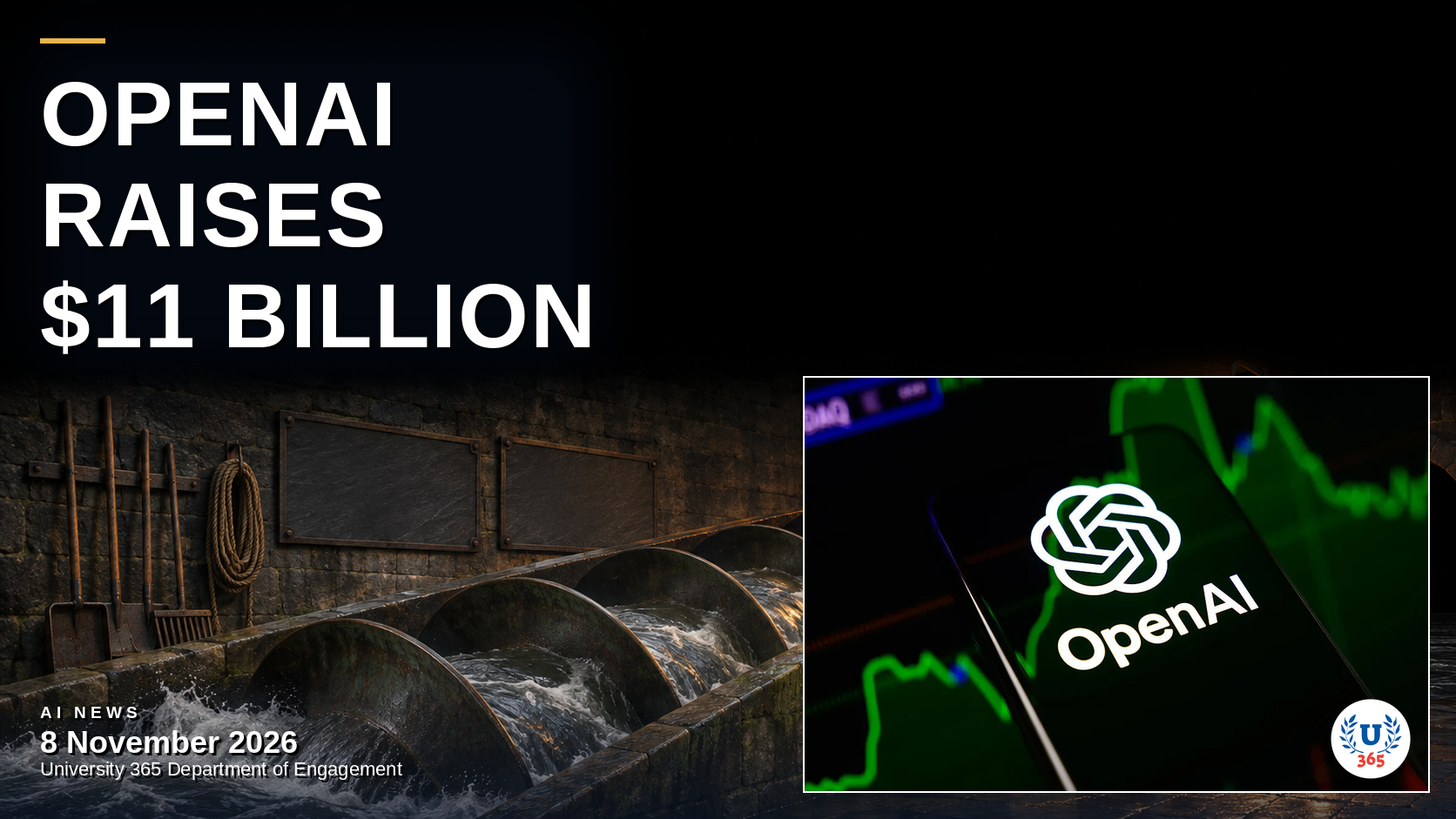
The week closed on a split AI economy: OpenAI raised another $11 billion at a $1.25 trillion valuation while Anthropic pressed toward an IPO into visible public backlash after the US midterms. Underneath the money, agent security, open world models and campus AI capacity all moved faster than the policy written to govern them.
5-minute AI news update - 8 November 2026
In this AI News
OpenAI reportedly raises another $11 billion at a $1.25 trillion valuation.

[Funding] The raise is not closed yet but is expected to complete within weeks, pushing OpenAI past every listed AI peer on paper. For universities buying AI capacity, it signals that frontier model pricing will keep being set by private capital rather than public procurement. Source: TechCrunch
Anthropic presses toward an IPO as voters deliver a rebuke on data centers.

[Funding] Anthropic would be the first pure-play AI company to list, and it is doing so into a market openly sceptical of the sector. The pricing will become the reference mark for every AI valuation argument on campus and in boardrooms. Source: CNBC
OpenAI launches GPT-6 Cyber, a frontier model aimed at authorised security work.

[Models] The model is built to find real exploits while staying inside agreed rules of engagement, a direct answer to the dual-use problem. Institutions running their own penetration tests now have a benchmark for what a governed security agent should look like. Source: The Verge
METR assessment finds Anthropic systems accelerating AI development itself.

[Research] The report offers measured evidence that AI is shortening the loop on its own research and engineering, not just assisting humans. That is the single assumption behind every capability forecast now used for institutional planning. Source: The Verge
NVIDIA releases Cosmos 3 open models for interactive world simulation.

[Models] Open weights for world simulation lower the cost of building embodied AI and robotics curricula. Applied AI programmes can now train and evaluate simulation agents without a commercial platform licence. Source: Hugging Face
Ai2 releases ToyBlocks, a controlled benchmark world for robot learning.

[Research] Robot evaluation has been fragmented, so results rarely compare across labs. A controlled world gives researchers a reproducible baseline, which is what applied robotics teaching and student projects have been missing. Source: Hugging Face
Tau Robotics sends humanoid cleaners into San Francisco homes.

[Tools] The robots still need heavy human guidance, but they are learning in real households rather than labs. It is a concrete read on how far embodied AI has actually travelled beyond demonstrations. Source: MIT Technology Review
Perplexity launches Teammates, its own take on AI agents for work.

[Tools] Perplexity is moving from answer engine to workplace agent platform, putting it directly against OpenAI and Anthropic. For institutions standardising on one agent stack, the vendor choice just became less obvious. Source: The Verge
Text watermarking may not meet the EU's new AI transparency rules.

[Policy] Watermarks such as OpenAI's textGrain degrade on short passages and edited text, which is most real academic writing. Institutions that planned to detect AI use through watermarking alone need a second control. Source: IEEE Spectrum
US approved Nvidia AI chip sales to a Chinese firm's empty office.

[Geopolitics] Approvals went to buyers with ties to blacklisted companies, and at least one address turned out to be vacant. Export control enforcement is now the weak link rather than the rule text. Source: The Verge
US intelligence memo says China recruited an executive to spy on Nvidia's CEO.

[Geopolitics] The allegation ties commercial AI hardware leadership directly to state intelligence collection. It raises the due diligence bar for any partnership that touches accelerator supply. Source: TechCrunch
Crusoe sells its troubled Wyoming data center project to Google.

[Industry] The sale shows how hard it is to build very large AI campuses outside the hyperscalers. Institutions planning their own compute partnerships should expect the same power, permitting and financing friction. Source: TechCrunch
Meta adds Spaces to its Muse agent for task-specific collaboration.

[Tools] Spaces lets one assistant hold several working contexts instead of one long thread. That is the pattern institutional AI assistants need to separate departments, courses and confidential work. Source: TechCrunch
Post-midterm politics turn rocky for Elon Musk and for data centers.

[Policy] US midterm results changed the political arithmetic around AI infrastructure and its most visible backers. Permitting, power and subsidy decisions will now be read through an election lens. Source: TechCrunch
Cochise College shows how a small institution builds AI literacy at scale.

[Education] A grant-funded programme delivered institutional AI capacity without an enterprise budget or a research university behind it. The five lessons map closely to what a leaner U365 rollout would need. Source: EdTech Magazine
Campus AI task forces take over policy, adoption and vendor decisions.

[Education] Colleges are formalising cross-departmental AI committees rather than leaving adoption to individual faculties. That is the governance structure that keeps procurement, legal and teaching aligned. Source: EdTech Magazine
Free Chinese open models approach frontier cyber capability, tests show.

[Industry] In simulated intrusions, DeepSeek and GLM came close to OpenAI's restricted cyber model. Capability that potent in open weights cannot be governed by licence or export control. Source: Wired
Bank of England pours cold water on the AI productivity boom.
[Industry] The central bank sees little evidence that AI spending has translated into measurable output growth yet. That gap is the strongest argument for measuring institutional AI returns before scaling spend. Source: The Register
UK ministers seek inspection powers when AI agents run out of control.

[Policy] The Cyber Security and Resilience Bill would allow searches, seizures and inspections where operators lose control of automated systems. It is an early template for agent accountability law. Source: The Register
Data brokers are buying internal corporate files and email to train models.

[Industry] Internal documents are becoming a traded asset class, often sold without the author's knowledge. Any institution holding student or research data should assume its value is already being priced. Source: Wired
The world of AI is evolving at full speed.
Become a Fellow at university-365.com
Become Superhuman... In a world of AI... Prompt Smart, Prompt UP!




Comments