
AI and the Two-Track Labor Market (2026)

In This Report
The Context: Understanding the AI Labor Market Split
To understand what AI is doing to jobs in 2026, you need three concepts that are not complicated but that most reporting gets wrong.
First, "generative AI" refers to computer systems that can produce text, code, images, and analysis in response to plain-language instructions. The models driving these systems, such as GPT-6 Astra (released by OpenAI on September 3, 2026) and Claude Opus 5 (released by Anthropic on July 24, 2026), are called "large language models." They work by predicting the most likely next piece of content based on patterns learned from vast amounts of text and data. Think of them as extremely sophisticated autocomplete systems that have read more documents than any human could in a lifetime.
Second, "AI exposure" measures how much of a job's tasks could plausibly be done by AI. A radiologist reading scans has high AI exposure for the image-interpretation task but low exposure for the patient-communication task. A construction worker has low AI exposure overall. A junior analyst who formats spreadsheets and drafts first-pass reports has very high AI exposure. Exposure is not the same as replacement: it measures what AI could do, not what employers choose to do with it.
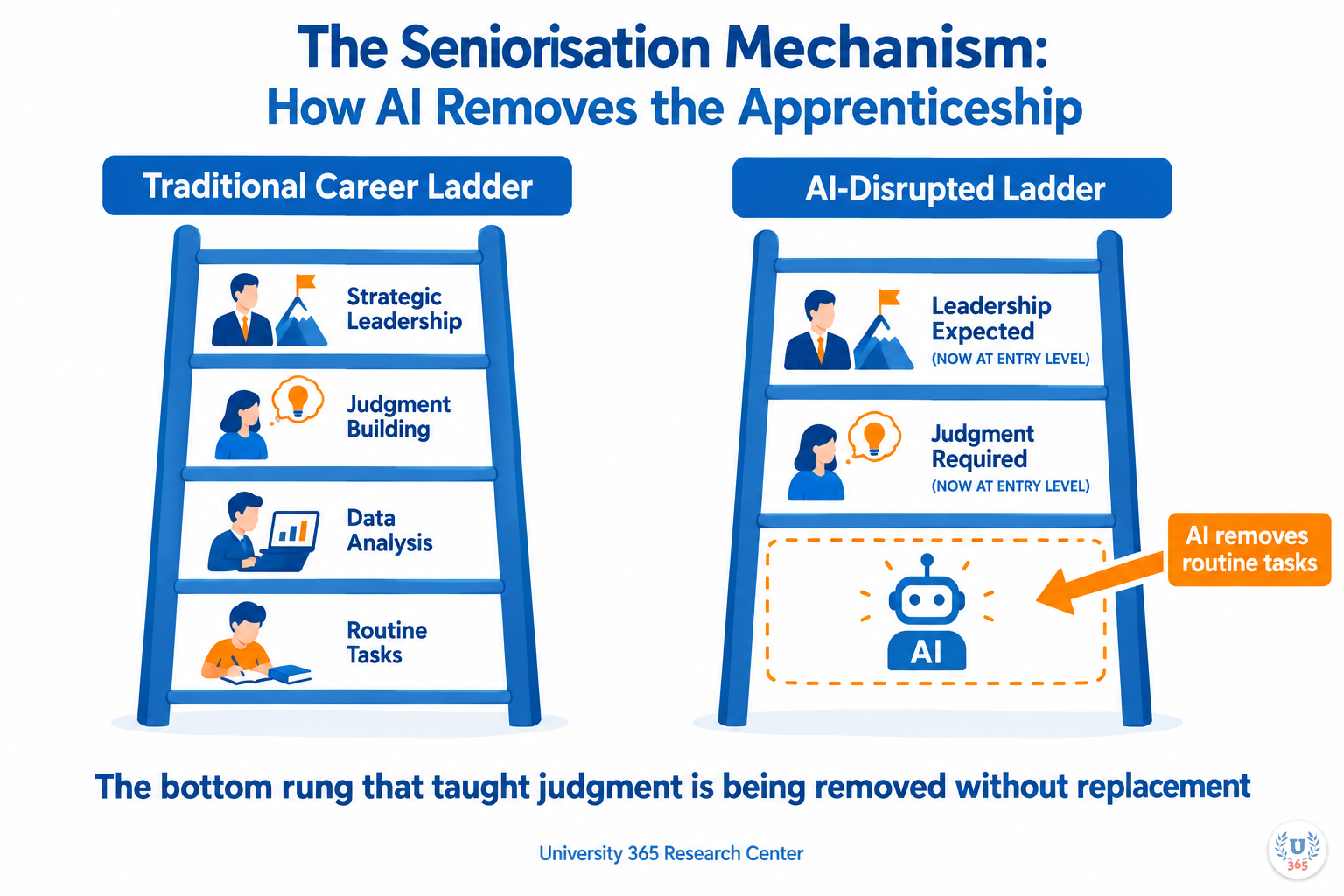
Third, the "career ladder" is the traditional sequence of jobs that takes a person from beginner to expert. A junior lawyer reviews documents and learns to spot dangerous clauses. A junior programmer fixes small bugs and learns to make architectural decisions. A junior analyst cleans datasets and learns to recognize when a clean-looking number is misleading. The routine tasks at the bottom of the ladder are not just cheap labor. They are the apprenticeship through which judgment forms. When AI does those tasks instead, the entry-level worker who would have learned from them loses the chance to develop.
Two terms from labor economics will appear throughout this report. "Codified knowledge" is information that has been written down, documented, and standardized. Textbooks, procedures, manuals, and code repositories are codified knowledge. "Tacit knowledge" is knowledge that lives in experience and context: knowing which standard clause is dangerous in context, knowing when a number looks right but is not, knowing how to manage a difficult client. AI handles codified knowledge well. It struggles with tacit knowledge. This distinction explains why AI hits entry-level workers hardest: their jobs depend on codified knowledge, while senior workers trade on tacit knowledge that AI cannot replicate.

The Question: What Happens When the First Rung Disappears?
The central question is not whether AI will destroy jobs. The aggregate data says it is not destroying them at the economy-wide level, at least not yet. The question is more specific and more urgent: what happens to the labor market when AI removes the bottom rung of the career ladder without building a replacement?
I have been thinking about this question since before the data caught up with it. At University 365, we built our entire pedagogical model around the idea that people need to develop judgment through practice, feedback, and real-world exposure. When I first read the PwC findings in June 2026, the numbers confirmed what we had been observing in our own learning communities: the entry-level rung is not disappearing because AI is bad. It is disappearing because the routine tasks at the bottom of the ladder are exactly what AI does best, and nobody has figured out what to put in their place.
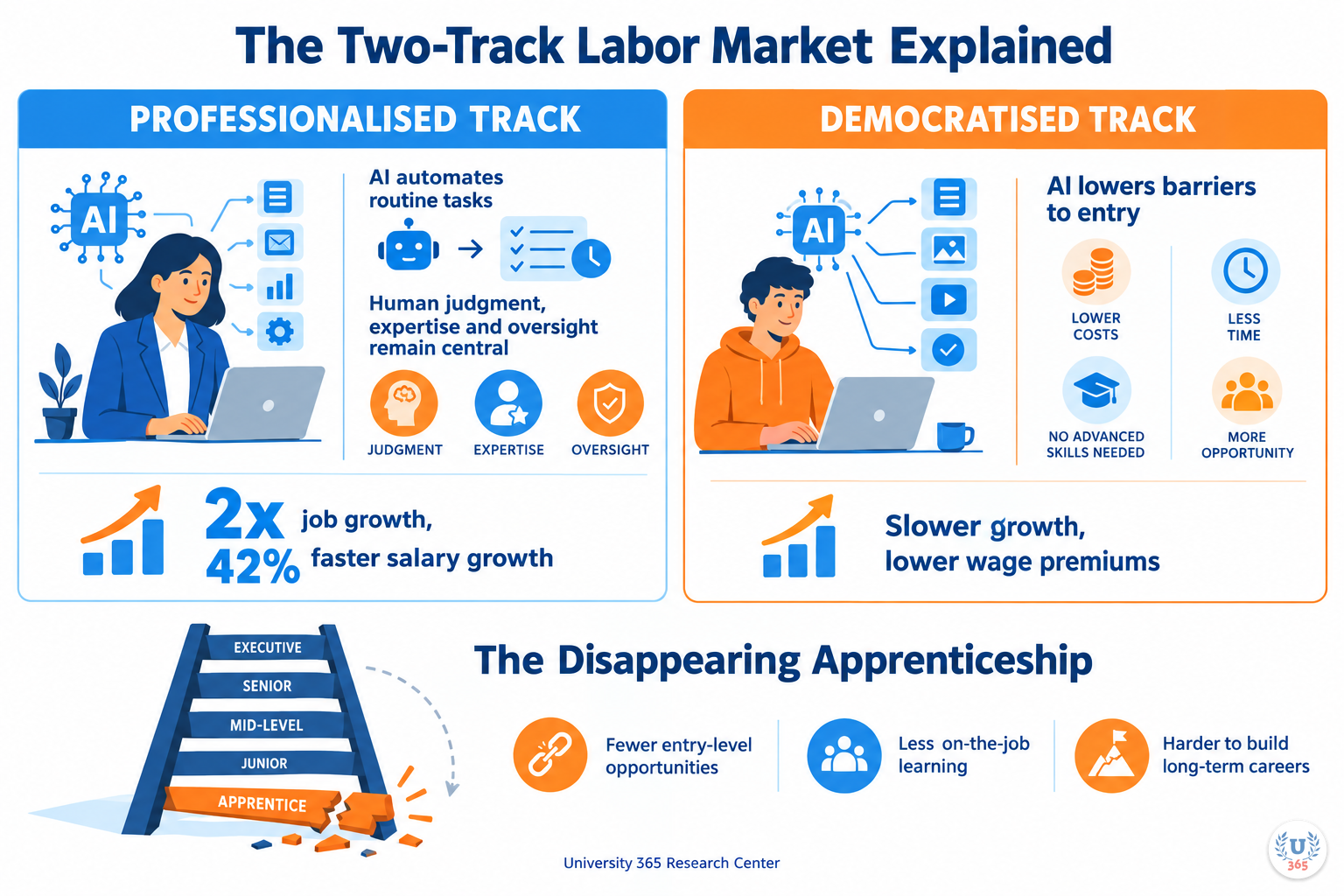
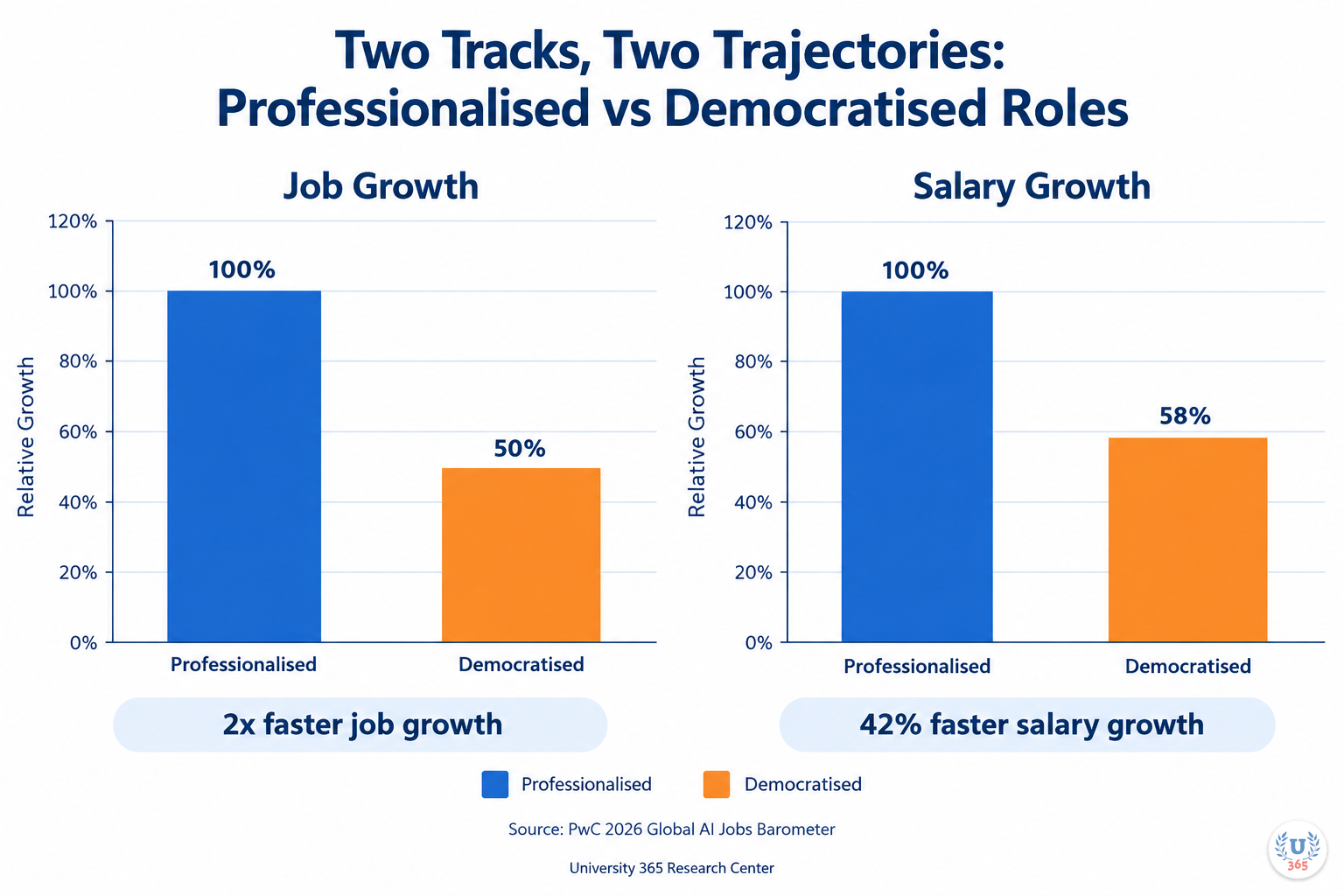
PwC's 2026 Global AI Jobs Barometer, published June 15, 2026, analyzed more than one billion job advertisements across 27 countries and found that AI is creating a "two-track" labor market. On one track, "professionalised" roles where AI acts as a force multiplier for experienced workers are growing twice as fast and seeing 42% faster salary growth than "democratised" roles where AI makes work easier for non-experts. On the entry-level rung, AI-exposed junior roles are now seven times more likely to require traditionally senior-level skills like leadership, judgment, and face-to-face interaction. PwC calls this "seniorisation."
The question this report investigates is what all of this creates in the near, middle, and far term for the labor market and the economy. If experienced workers get supercharged while entry-level workers face a collapsed rung, who becomes tomorrow's senior analyst, lawyer, or programmer? And what does it mean for an economy when the pathway from education to expertise narrows?
The Contradiction: Amplification for Some, Erasure for Others
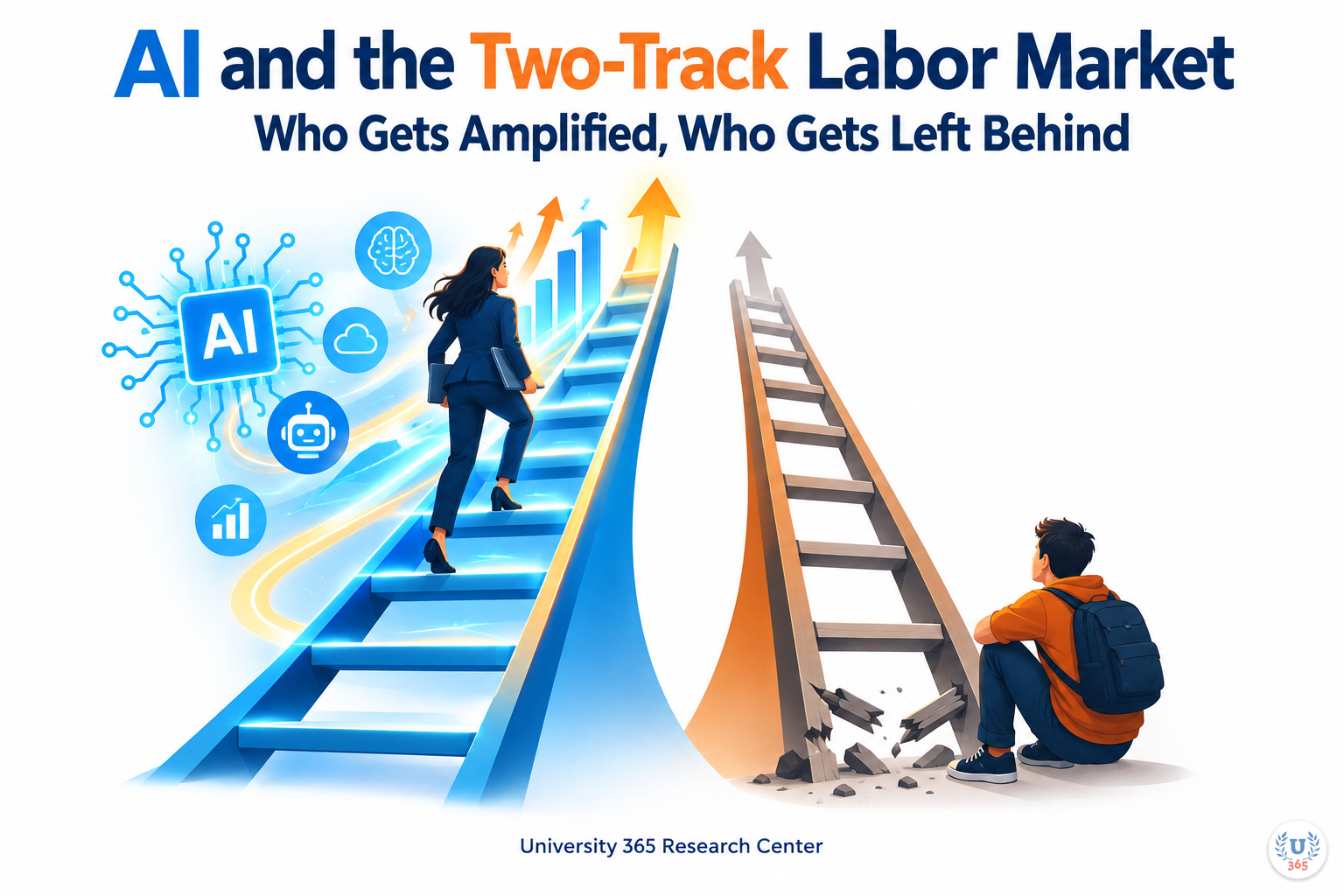
The contradiction at the heart of this report is precise. AI simultaneously democratizes professional-grade capabilities for people outside traditional credential pathways and eliminates the developmental work through which beginners become professionals. The same technology that lets a non-expert produce a credible legal memo or a functional software prototype also removes the routine tasks that once taught a junior lawyer to spot a dangerous clause or a junior programmer to recognize a flawed architecture.
PwC's data makes both sides visible. On the democratization side, AI is making some roles easier for non-experts to perform. These "democratised" roles include IT service managers and medical secretaries, where AI lowers the barrier to entry. On the professionalization side, "professionalised" roles like radiologists and recruiters see AI automate routine tasks while human judgment becomes more valuable. Both tracks are real. Both are happening simultaneously.
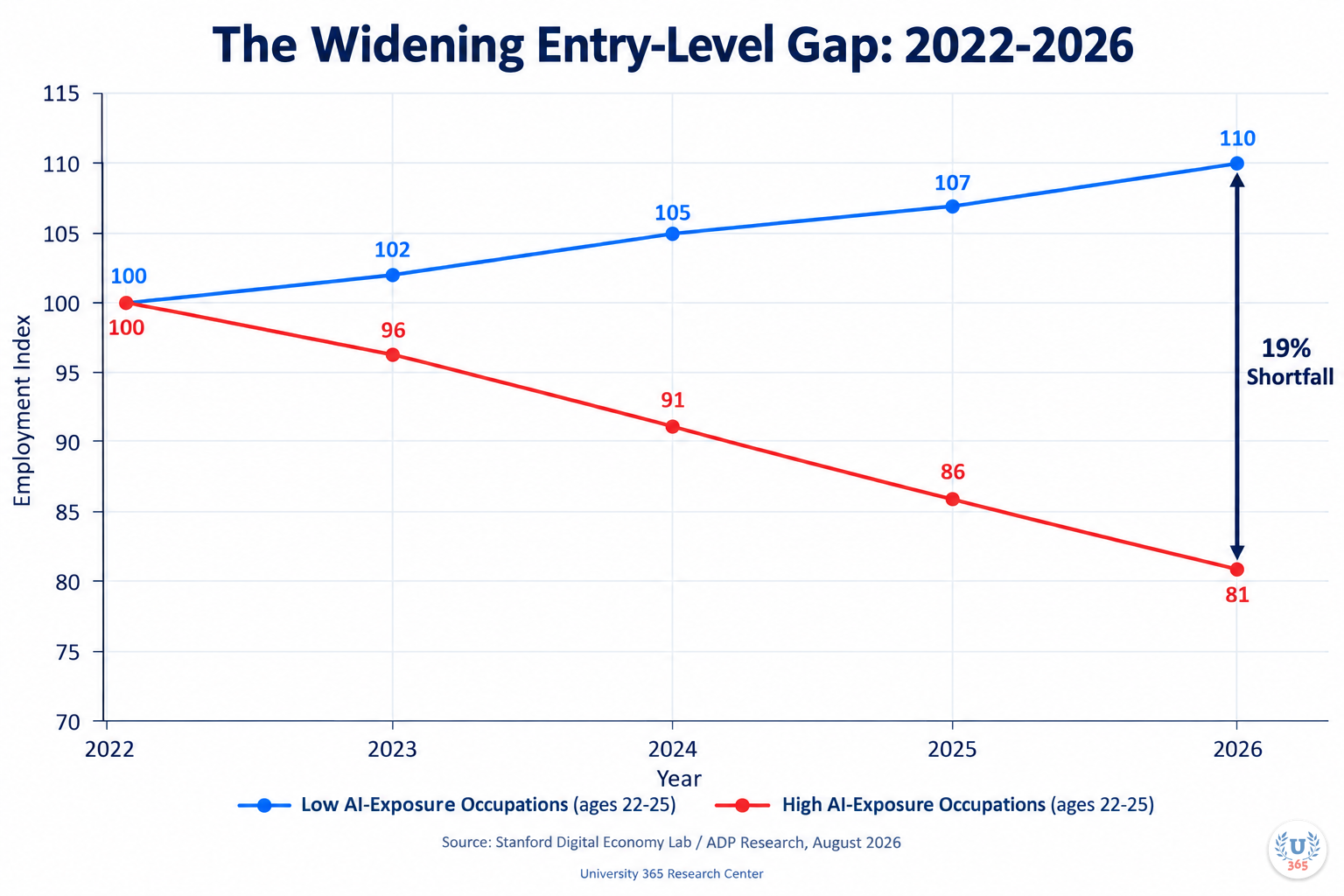
The contradiction sharpens at the entry level. Stanford economist Erik Brynjolfsson's "Canaries in the Coal Mine" research, updated in August 2026 with ADP payroll data, found that employment among workers aged 22 to 25 in the most AI-exposed occupations was 19% below where it would have been had it kept pace with less-exposed work. The gap was 13% a year earlier. The decline was driven primarily by reduced hiring of young workers, not by layoffs of experienced staff. A company keeps its senior analyst, gives her an AI tool that drafts summaries and checks formulas, then decides the next graduate position is no longer urgent.
Sol Rashidi, a researcher at the Harvard Kennedy School, frames the long-term risk as a "talent formation fracture." The concern is not solely that a junior task disappears. The task may be part of an apprenticeship sequence. Research, first drafts, routine coding, document review, and supervised case work can look inefficient when evaluated one task at a time. Across a career, they are how pattern recognition, judgment, and accountability form. Remove the task and you remove the learning.
This is the paradox: AI democratizes access to professional output while eroding the pathway to professional judgment. The people who benefit most from AI are those who already have the judgment to direct it. The people who lose most are those who needed the routine work to develop that judgment in the first place.
The Current State: A Labor Market in Transition
The labor market data available through September 2026 tells a story of concentrated disruption, not broad collapse. Several major studies converge on the same picture: aggregate employment is stable, but entry-level hiring in AI-exposed occupations is contracting.
Stanford's Digital Economy Lab, working with ADP Research, tracks employment by age group and AI exposure level. Their August 2026 update shows that for workers aged 22 to 25, employment in the two most AI-exposed occupational groups fell by about 11% between November 2022 and June 2026. Employment for the same age group in less-exposed groups grew by roughly 10%. Comparing those two paths produces a 19% shortfall. For workers aged 35 to 40, no comparable decline appears. The technology is not eliminating work across the board. It is narrowing the path into certain occupations.
A US Census Bureau working paper published in April 2026 found a closely related pattern. In the industry-state groups most exposed to AI, hiring of 22-to-24-year-olds dropped sharply after ChatGPT's release. The paper estimated that early-career employment in the most exposed group was 12% lower after ten quarters, with the reduction in hires doing most of the work.
The PwC 2026 AI Jobs Barometer adds the skills dimension. Based on 2.4 million US entry-level jobs analyzed, entry-level roles most exposed to AI are now seven times more likely to require traditionally senior-level human-intensive skills. In the most AI-exposed occupations, 52% of new skills appearing in entry-level job postings were skills traditionally associated with experienced workers. In the least exposed occupations, that figure was 7%. Job openings for these seniorised entry-level roles grew 35% since 2019, while other entry-level roles shrank 10%.
On the productivity side, the data is striking. Companies in the most AI-exposed sectors recorded 34% productivity growth since 2018, compared to 24% for the least exposed. The top 20% of the most AI-exposed companies achieved 163% labor productivity growth, nearly five times the average for AI-exposed firms overall. Headcount at AI-heavy companies is growing faster than at less-exposed peers: 52% versus 36% relative to 2018 baselines.
The World Economic Forum, in collaboration with PwC, published a June 2026 report titled "Artificial Intelligence and the Future of Entry-Level Work" that adds employer expectations to the data. Three-quarters of business leaders expect significant AI-related structural change at the entry level, almost twice as high as expectations for mid- or senior-level roles. The WEF's earlier Future of Jobs Report 2025 projected that 170 million new jobs would be created and 92 million displaced by 2030, a net gain of 78 million. But that aggregate hides the composition question: who gets hired, and at what level?
Indicator | Value | Source | Date |
Entry-level gap (22-25, AI-exposed) | 19% shortfall | Stanford/ADP | Aug 2026 |
Seniorisation ratio | 7x more likely | PwC 2026 | Jun 2026 |
Seniorised entry-level growth | +35% since 2019 | PwC 2026 | Jun 2026 |
Traditional entry-level change | -10% since 2019 | PwC 2026 | Jun 2026 |
Productivity, most AI-exposed | 34% since 2018 | PwC 2026 | Jun 2026 |
Super-star firm productivity | 163% | PwC 2026 | Jun 2026 |
AI skills wage premium | 62% (up from 57%) | PwC 2026 | Jun 2026 |
WEF net job creation by 2030 | +78 million | WEF 2025 | Jan 2025 |
Recent grad unemployment | 5.7% | NY Fed | Dec 2025 |
Recent grad underemployment | 42.5% | NY Fed | Dec 2025 |
Key Findings: Seven Discoveries Reshaping the Labor Market
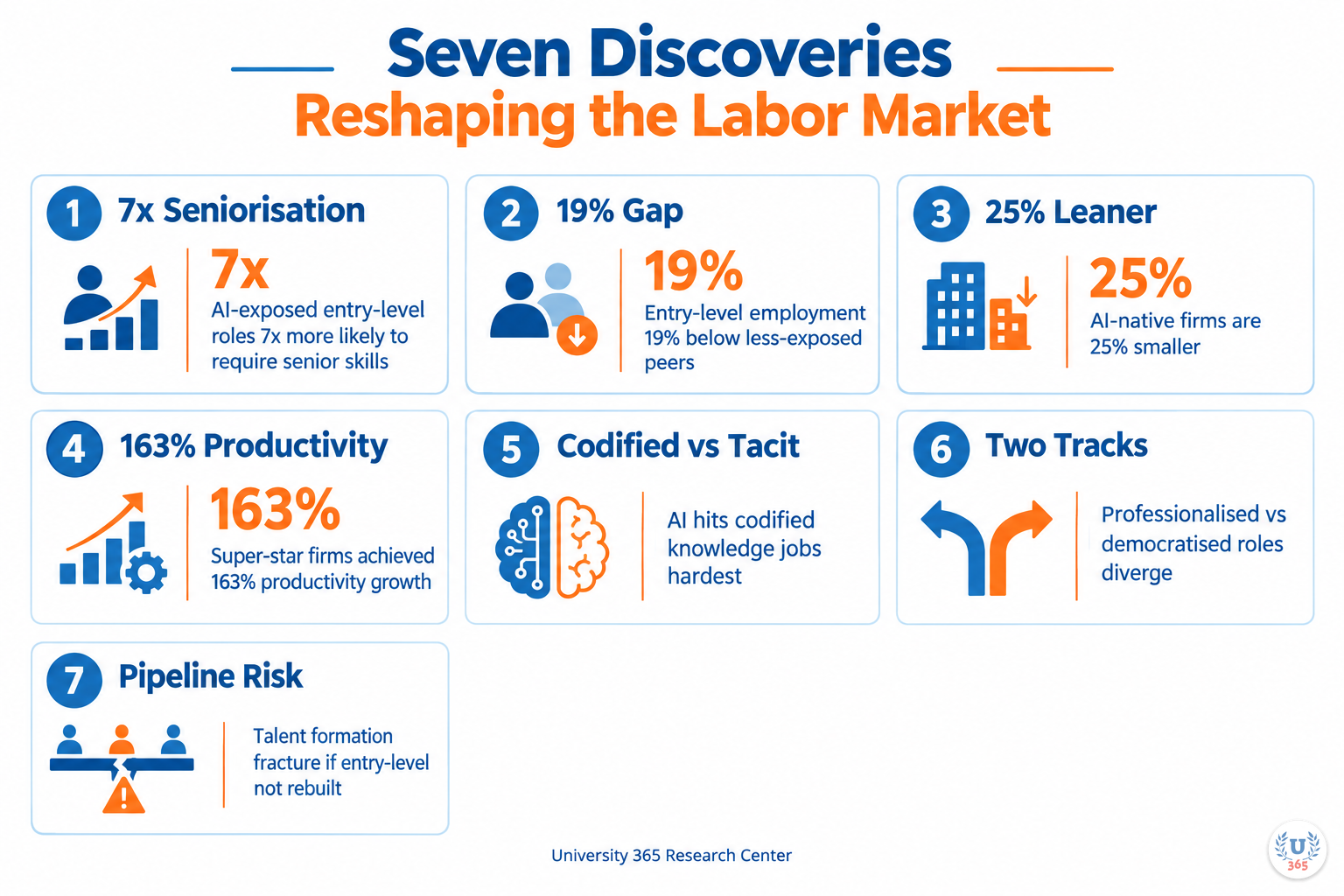
1. The seniorised entry-level phenomenon is real, measurable, and accelerating. PwC's analysis of 2.4 million US entry-level jobs found that AI-exposed entry-level roles are seven times more likely to require skills traditionally associated with experienced workers: leadership, strategic decision-making, stakeholder management, and face-to-face interaction. In the most AI-exposed occupations, 52% of new skills in entry-level postings were senior-level skills, compared to 7% in the least exposed. The job description has been promoted up the skills ladder without a corresponding change in the candidate pool.
2. The career ladder's bottom rung is collapsing through hiring freezes, not layoffs. Stanford's research with ADP payroll data shows the 19% entry-level employment gap is driven primarily by reduced hiring of young workers, not by firing experienced staff. A company keeps its senior analyst, gives her an AI tool, then decides the next graduate position is no longer urgent. Harvard research analyzing 62 million workers found junior hiring fell nearly 8% within six quarters at companies that adopted AI, through a quiet freeze on new positions rather than dismissals.
3. AI-native firms are structurally leaner and more senior. Research by Hyunjin Kim and Rembrand Koning comparing AI-native startups with non-AI peers found that AI-native firms were approximately 25% smaller, carried a 13% higher engineering share, and had approximately 15% lower shares of both entry-level employees and managers. Their hierarchies were flatter. A firm can become productive while creating fewer positions through which inexperienced workers become senior contributors.
4. The productivity dividend is real but unevenly distributed. PwC found that the most AI-exposed sectors recorded 34% productivity growth since 2018, and the top 20% of AI-exposed companies achieved 163% growth. But this productivity gain concentrates at the top. The super-star effect means a small group of companies pulls far ahead while others stagnate. Productivity gains do not automatically translate into broader labor market benefits.
5. Codified knowledge jobs are more vulnerable than tacit knowledge jobs. The Stanford researchers found that entry-level workers are more vulnerable in jobs that rely on codified knowledge: procedures that are formal, documented, and easy to check. Employment held up better where work depended on tacit knowledge accumulated through context and experience. This explains why AI hits entry-level workers hardest: their jobs depend on the formal, written-down knowledge that AI models have been trained on, while senior workers trade on experience-based knowledge that AI cannot replicate.
6. AI simultaneously democratizes and professionalizes, creating a paradox for non-credentialed workers. The PwC data shows that democratised roles, where AI makes work easier for non-experts, are growing more slowly and seeing lower wage growth than professionalised roles. A person who uses AI to perform a task that once required a credential may produce acceptable output, but the market values that output less than the output of a professional whose AI use amplifies their existing expertise. Democratization opens a door, but the door leads to a lower track.
7. The talent pipeline risk is deferred, not avoided. Sol Rashidi's Harvard research frames the long-term risk as a talent formation fracture. The effect can remain hidden because current senior employees continue operating, productivity rises, and payroll may fall. The deficit appears later, when organizations need people capable of supervising systems, handling exceptions, understanding institutional context, and making high-consequence decisions. An organization that demands experienced workers while eliminating all entry-level formation is consuming a common resource without replenishing it.
Deep Analysis: Seniorisation, Democratization, Safety Frontier
The Seniorisation Mechanism: How AI Removes the Apprenticeship
The mechanism behind seniorisation is not mysterious. The tasks that once filled a junior employee's first year, summarizing research, formatting reports, drafting first passes, basic coding, and data entry, are precisely the tasks that generative AI now does quickly and cheaply. What remains in the job description is the harder, judgment-heavy work that used to take years to earn.
PwC's global workforce leader, Pete Brown, described it this way: AI is removing some of the routine work that once acted as an apprenticeship while increasing demand for judgment, leadership, and adaptability much earlier in careers. The result is an entry-level job that demands the judgment of a 35-year-old from a 22-year-old who has never had the chance to develop it.
Laura Ullrich, lead economist at the job site Indeed, describes the same phenomenon as "experience creep": employers asking for more experience for jobs that once existed to help people acquire it. The Washington Post reported in mid-2026 that entry-level openings in technology, finance, and consulting had fallen 33% from 2015 levels, while openings for more experienced workers in those fields rose 67%. Asked why companies were raising the bar, Ullrich offered a direct explanation: "Because they can."
A Harvard working paper published in spring 2026 labeled the underlying dynamic "seniority-biased technological change." The paper found that where this dynamic is happening, the decline at the bottom is driven less by laying off junior staff than by simply not hiring them in the first place. This is what makes the trend socially quiet. A hiring freeze does not produce a factory gate or a public announcement. A graduate applies to a smaller intake. A contract role is not renewed. A team gets approval for one experienced hire instead of two trainees.
The Democratization Paradox: Access Without Advantage
AI democratization is real. A person without a law degree can use a model like Claude Opus 5 to produce a credible legal memo. A person without a computer science degree can use GPT-6 Astra to build a functional software prototype. No-code and low-code AI platforms enable people without coding skills to create predictive models and automate document processing. This is genuine progress.
But the PwC data reveals a paradox. Democratised roles, where AI makes the work easier for non-experts, are growing more slowly and seeing 42% slower salary growth than professionalised roles where AI amplifies human expertise. The market does not value democratized output as highly as professionalized output. The reason is that AI-enabled output from a non-expert, while often acceptable, lacks the judgment, context awareness, and accountability that a professional brings.
The OECD's 2026 report Skills in the AI Age confirms this pattern. The OECD finds that jobs requiring non-routine cognitive, social, and creative skills are less susceptible to automation. The skills most demanded in occupations highly exposed to AI are management and business skills, not technical AI skills. Only a small share of workers, less than 1%, will need advanced AI-specific skills such as programming or model development. Instead, AI is increasing the importance of digital literacy, the ability to use and interpret data, and human skills such as problem-solving, creativity, and innovation.
The paradox is that democratization opens a door, but the door leads to a lower track. Non-experts gain access to professional-grade capabilities, but the market rewards professionalized use of those capabilities more highly. The person who benefits most from AI democratization is not the non-expert who uses it to replace a professional, but the professional who uses it to amplify their existing expertise.
The Safety Frontier: Amodei's Call and Its Labor Market Implications
On September 12, 2026, Anthropic CEO Dario Amodei published a 3,800-word essay titled "We Must Pace the Frontier." He called for a coordinated, industry-wide slowdown of AI development, warning that AI has advanced drastically faster in recent months and has become capable of recursive self-improvement, meaning AI systems can now build more powerful versions of themselves. He wrote: "Left unchecked, it could outrun our ability to understand and control these systems."
Amodei proposed a three-point plan: independent monitoring of AI models during development, industry-wide regulation, and global regulation. He said his company would unilaterally grant employee-like access to third-party safety evaluators. Within hours, OpenAI CEO Sam Altman posted: "I agree with Dario that we need to pace the frontier." Elon Musk posted: "Dario is right." The coordinated endorsement from three rival AI lab leaders marked the most significant AI safety policy intervention from sitting lab CEOs to date.
President Trump dismissed the call. Speaking to reporters during a trip to Ireland on September 13, Trump said he was worried about ceding the US lead to China and acknowledged the need for some regulation without providing details. His administration's 10-year ban on state-level AI laws and relaxed AI chip export policies favor a deregulatory approach.
The labor market implications are direct. If AI capabilities continue to accelerate without corresponding safety infrastructure, the seniorisation effect intensifies: more routine tasks automated, higher demands on fewer entry-level workers, and a wider gap between the professionalized and democratized tracks. If the industry adopts Amodei's pacing proposal, organizations gain time to redesign career pathways, build training infrastructure, and create new entry-level roles around verification, model evaluation, and supervised judgment. The pace of AI development is not just a safety question. It is a labor market question.
Data and Evidence: The Quantitative Backbone
The data presented in this section forms the quantitative backbone of the report. Every metric is sourced from original research, cross-referenced across multiple studies, and verified for currency against the latest September 2026 data.
Metric | Value | Source | Confidence |
Entry-level gap (22-25, AI-exposed) | 19% below peers | Stanford/ADP | High |
Seniorisation ratio | 7x more likely | PwC 2026 | High |
Senior skills share, AI-exposed | 52% | PwC 2026 | High |
AI-native firm size vs peers | 25% smaller | Kim/Koning | Medium |
Super-star productivity (top 20%) | 163% | PwC 2026 | Medium |
AI skills wage premium | 62% (up from 57%) | PwC 2026 | High |
Professionalised job growth advantage | 2x faster | PwC 2026 | High |
WEF net job creation by 2030 | +78 million | WEF 2025 | Medium |
Junior hiring decline at AI firms | 8% in 6 quarters | Harvard | Medium |
CEOs expecting entry-level AI change | 75% | PwC CEO Survey | High |
AI jobs growth vs market | 8x faster (69% vs 9%) | PwC 2026 | High |
Implications: What This Means for Different Stakeholders
For individuals, the implications depend on career stage. Experienced professionals in AI-exposed fields are benefiting: the AI skills wage premium has risen to 62%, and professionalized roles are seeing faster growth in both jobs and wages. For early-career workers, the picture is harder. A 22-year-old entering an AI-exposed field now faces a job description that demands judgment, leadership, and stakeholder management, skills that historically took years to develop. The path from education to expertise has narrowed, and the person who cannot demonstrate senior-level skills at entry level may find the door closed.
For companies, the data reveals a strategic choice. The most productive AI-exposed companies are hiring more, not fewer, workers. But they are hiring people who can direct AI, apply judgment, and manage stakeholders. Companies that simply use AI to cut costs risk consuming expertise without replenishing it. The Harvard research frames this as a human capability pipeline problem: organizations need experienced people who can supervise systems, interpret context, manage exceptions, and teach others. They cannot indefinitely consume expertise without producing it.
For governments and policymakers, the Amodei essay and the labor market data converge on the same point. The pace of AI development is a labor market variable, not just a safety variable. If capabilities accelerate faster than institutions can adapt, the entry-level gap widens and the talent pipeline thins. Policy responses include incentives for companies that maintain structured training programs, redesigned apprenticeship models, and investment in continuous learning systems. The WEF report recommends making entry-level hiring an explicit component of strategic workforce planning with clear targets to maintain or grow intake alongside AI adoption.
Education and Skills Impact: The Strongest Differentiator
What people need to learn is changing in two directions simultaneously. On the technical side, AI literacy, data interpretation, and the ability to direct AI systems are now among the fastest-growing skill demands. The WEF Future of Jobs Report 2025 identifies AI and big data as the fastest-growing skill area, followed by networks and cybersecurity. The OECD's 2026 Skills in the AI Age report confirms that AI is increasing the importance of digital skills and the ability to use, analyze, and interpret data. On the human side, the skills that AI cannot replicate are becoming more valuable, not less. The PwC data shows that the skills gaining importance in AI-exposed entry-level jobs are judgment, communication, leadership, creativity, and collaboration. These are the skills that historically developed later in careers through experience.
How people learn is also changing. Learning science research provides important evidence here. Benjamin Bloom's 1984 finding, known as the two sigma problem, showed that one-to-one human tutoring produced a two-standard-deviation improvement in student performance compared to conventional classroom instruction. AI tutoring systems have been proposed as a way to scale this effect. But the 2026 evidence is mixed and nuanced. A Stanford review published in August 2026, AI Tutoring is Not a Monolith, found that live, human-led tutoring remains the model backed by the strongest evidence. AI tutoring works best when it supports a human tutor rather than replacing one. Research cited in the review found that students whose instructors used an AI coaching system providing real-time recommendations were four percentage points more likely to master lesson topics. For students taught by lower-rated tutors, the increase reached nine percentage points.
A separate Stanford study found that access alone is insufficient. In two randomized controlled trials, nearly half of students assigned to use an AI literacy platform independently never used it, and those who did averaged only 2 to 5 minutes per week. Working with human tutors increased engagement by 71 to 80%, but usage remained low overall. The findings suggest that implementation and human support matter more than access to the technology itself.
A randomized field experiment with more than 6,000 middle-school students, published in August 2026, found that AI tutoring improved next-attempt correctness and reduced attempts needed to return to a correct answer after mistakes, but the gains were concentrated when AI was embedded in a mastery-based workflow. AI that scaffolds learning, helping students reason through mistakes, produces better outcomes than AI that substitutes for learning by providing answers directly.
The skills gap is real and widening. The WEF Future of Jobs 2025 projects that 59% of workers will need training by 2030, and 44% of workers' core skills will be disrupted. The gap is most acute at the entry level, where employers now demand senior-level judgment from workers who have not had the chance to develop it. The OECD finds that less than 1% of workers will need advanced AI-specific skills, but a much larger share will need the complementary skills: digital literacy, data interpretation, problem-solving, creativity, and the social and emotional skills that AI cannot replicate.
The University 365 position on this is grounded in the CI-First (Co-Intelligence-First) framework and the SL-OS (Successful Life Operating System) approach.
CI-First proposes that AI and Human Intelligence should coexist productively, each amplifying the other rather than one replacing the other, with Human Intelligence always remaining the ruler and orchestrator. In the labor market context, this means using AI to scaffold learning rather than substitute for it: AI that helps a beginner reason through a problem, with a human providing feedback and context, rather than AI that produces the answer and removes the learning opportunity.
ULM (University 365 Life Management) and its EVA cycle (Explore, Visualize, Act) directly address the skills gap by helping learners organize their persoanl and professional growth across six life domains, including Career and Finance, where the skills transformation is most urgent. Then, lhe LIPS (Life-Interests-Projects-System) digital second brain promoted by U365, combined with the CARE cycle (Collect, Action-Plan, Review, Execute), gives learners a structured system for managing knowledge, projects, and continuous skill development using the best AI systems with LLMs but also with Harnesses that are now even more important than the mere synthetic brain (model). Together, these methods form the SL-OS, which is U365's integrated answer to the question this report raises: how do you prepare people for an AI-disrupted labor market without removing the developmental work that builds judgment?
I see this every day in our learning communities at University 365. The fellows who thrive are not the ones who delegate everything to AI. They are the ones who use AI to encounter more examples, test more hypotheses, and get feedback faster, while still doing the cognitive work that builds judgment. The ones who struggle are the ones who use AI to skip the struggle. The struggle is the point. That is where learning happens.
The CI-First Perspective: Amplification, Imposture, Path Forward
The Co-Intelligence-First (CI-First) approach is a genuine and unique University 365 concept: a proposal for imagining a better future where AI and Human Intelligence coexist productively, each amplifying the other rather than replacing it.
The CI-First lens reveals both the amplification potential and the imposture risk in the two-track labor market.
On capability amplification, AI genuinely supercharges experienced professionals. A radiologist using AI can read more scans with higher accuracy. A recruiter using AI can screen more candidates and focus on cultural fit. A programmer using AI can clear routine work and spend more time on architecture. The PwC data confirms this: professionalized roles where AI amplifies human expertise see twice the job growth and 42% faster salary growth. The 163% productivity gain at super-star firms is real. When a professional with deep tacit knowledge uses AI to handle codified-knowledge tasks, the result is genuine amplification.
On AI imposture risk, the danger is precise and structural. AI imposture, in the CI-First framework, refers to over-reliance on AI that degrades human capability. The two-track labor market creates two distinct imposture risks. For entry-level workers, the risk is that AI removes the developmental work through which judgment forms. A junior worker who never cleans a messy dataset, never drafts a first-pass report, never reviews a standard document, never encounters the small failures that teach tacit knowledge, may produce AI-assisted output that looks competent but lacks the judgment underneath. For democratized workers, the risk is that AI produces output that appears professional but lacks the accountability, context awareness, and quality control that a credentialed professional provides.
The CI-First verdict on the two-track labor market is that the technology itself is neither amplifying nor degrading. It is the choice of how to deploy it that determines the outcome. When AI is used to automate routine tasks while preserving the developmental sequence that builds judgment, it amplifies. When AI is used to remove the developmental work entirely, it degrades. The contradiction introduced earlier, that AI democratizes access to professional output while eroding the pathway to professional judgment, is resolved through CI-First adoption: AI should scaffold learning, not substitute for it. Every developmental task removed should be replaced by something that serves the same learning function: structured simulations, supervised first attempts, rotational assignments, case review, and apprenticeships.
This is not abstract philosophy for us. When our research team at the University 365 Research Center started working on this report, we used AI tools at every stage: to search and synthesize labor market data, to draft initial summaries, to generate the illustrations you see here. But the judgment, the analysis, the connections between findings, the editorial decisions about what to include and what to cut, those came from human researchers doing the cognitive work. The AI amplified our capabilities. It did not replace the thinking. That is the CI-First principle in practice, and it is the same principle that should guide how organizations deploy AI in the labor market.
What This Means for You and Us: Individual and Collective Actions
For You (Individual)
1. Build AI fluency as a complement to judgment, not a replacement for it. The 62% wage premium for AI skills rewards people who can direct AI systems while applying human judgment. Learn to use models like GPT-6 Astra or Claude Opus 5 to handle routine tasks, and invest in the judgment, communication, and leadership skills that AI cannot replicate. The market values professionalized AI use far more than democratized AI use. Action: Identify one routine task in your work that AI can handle, delegate it, and redirect the time to developing a higher-order skill.
2. If you are early in your career, seek structured learning opportunities that AI cannot provide. The entry-level rung that once taught judgment through routine work is narrowing. You need to find alternative ways to acquire tacit knowledge: internships, mentorship, project-based learning, case reviews, and supervised practice. Action: Find a mentor or structured apprenticeship program that gives you exposure to real cases with feedback from experienced practitioners.
3. If you are outside a traditional credential pathway, use AI to build, and understand the track you are on. AI democratization gives you access to professional-grade capabilities. This is genuine progress. But understand that the market rewards professionalized AI use more highly than democratized AI use. Action: Use AI tools to build a portfolio of work, and pair each project with learning that builds the underlying judgment, not just the output.
For Us (Collective)
1. Companies must redesign entry-level roles, not just eliminate routine tasks. The PwC and WEF data converge on the same finding: the most productive AI-exposed companies are hiring more, not fewer, workers. But they are hiring people who can direct AI, apply judgment, and manage stakeholders. Companies that eliminate entry-level positions without building alternative developmental pathways are consuming expertise without replenishing it. Response: Every company adopting AI should track not just headcount but the health of its talent pipeline: internships, apprenticeships, junior assignments, time to competence, and access to experienced mentorship.
2. Education systems must integrate experiential learning and AI literacy simultaneously. The skills employers now demand at entry level, judgment, communication, leadership, creativity, are skills that traditionally developed through experience, not through classroom instruction alone. Education systems need to integrate experiential learning: simulations, case-based learning, real-world projects with feedback, and supervised practice. Response: Schools, universities, and training programs should redesign curricula to build both AI literacy and the human judgment skills that AI cannot replicate.
3. Policymakers should treat the pace of AI development as a labor market variable. The Amodei essay and the labor market data converge on the same point. If AI capabilities accelerate faster than institutions can adapt, the entry-level gap widens and the talent pipeline thins. The Trump administration's deregulatory approach, including a 10-year ban on state-level AI laws, prioritizes speed over adaptation. This is a labor market choice, not just a safety choice. Response: Policymakers should require companies receiving AI development incentives to maintain or grow entry-level hiring, invest in training infrastructure, and report on the health of their talent pipelines.
The Road Ahead: Near, Middle, and Far Term Scenarios
In the near term, 12 to 18 months, the seniorisation effect will intensify. The September 2026 model releases, GPT-6 Astra, Claude Fable 5.1, Gemini 3.8 Flash, and Meta's Muse Spark 1.3, brought another step-change in capability. These models can now handle complex agentic tasks: writing and debugging code, navigating computer interfaces, and conducting multi-step research. As companies integrate these capabilities, more routine tasks will be automated, and the demand for senior-level judgment at entry level will rise further. The 19% entry-level employment gap is likely to widen before it stabilizes.
In the middle term, 18 months to 3 years, two scenarios are plausible. The first is the talent pipeline fracture scenario: organizations continue to consume expertise without replenishing it, and the deficit appears when they need people capable of supervising AI systems and making high-consequence decisions. The second is the redesigned pathway scenario: organizations and education systems adapt, creating new entry-level roles around verification, model evaluation, supervised judgment, and AI-augmented apprenticeship. The WEF's First-Mile Sandbox initiative, piloting new models of workplace readiness through educator and employer collaboration, represents an early attempt at this adaptation. Which scenario dominates depends on whether the pace of AI development allows time for institutional adaptation.
In the far term, 3 to 5 years and beyond, the labor market may restructure around a diamond shape rather than a pyramid, as the WEF report describes. Rather than a broad base of entry-level workers narrowing toward senior roles, organizations may have a thin entry layer, a broad middle of AI-augmented professionals, and a smaller senior tier. The question is whether the middle can be populated without a healthy entry layer feeding it. If the pipeline fracture scenario dominates, the diamond becomes hollow: organizations have senior workers but cannot replace them because the developmental pathway was never rebuilt.
The Amodei Pace the Frontier essay introduces a variable that could change all three timeframes. If the AI industry adopts coordinated pacing and independent safety evaluation, organizations gain time to redesign career pathways and build training infrastructure. If capabilities continue to accelerate without pacing, the adaptation window shrinks and the pipeline fracture risk grows. The labor market consequences of AI safety policy are not a side effect. They are central.
Sources and Methodology: 30 Sources, Three Tiers
This report was researched using web-based sources, including academic papers, institutional reports, government data, and news coverage. The research followed a three-tier source quality framework. Tier 1 sources (primary research and official data): 11 sources including WEF, OECD, Stanford Digital Economy Lab, US Census Bureau, New York Fed, and arXiv papers. Tier 2 sources (expert analysis): 7 sources including PwC, Harvard Kennedy School, and Kim and Koning research. Tier 3 sources (trade press): 12 sources including CNN, BBC, Bloomberg, The Guardian, Fortune, and Ars Technica. Total sources consulted: 30. Date accessed: September 14, 2026.
Sources with clickable links:
1. PwC 2026 Global AI Jobs Barometer https://www.pwc.com/gx/en/news-room/press-releases/2026/pwc-2026-ai-jobs-barometer.html
2. WEF Future of Jobs Report 2025 https://www.weforum.org/publications/the-future-of-jobs-report-2025
3. WEF AI and Future of Entry-Level Work (Jun 2026) https://reports.weforum.org/docs/WEF_Artificial_Intelligence_and_the_Future_of_Entry_Level_Work_2026.pdf
4. OECD Skills in the AI Age (2026) https://www.oecd.org/content/dam/oecd/en/publications/reports/2026/07/skills-in-the-ai-age_e8d8c1e6/972bd15e-en.pdf
5. OECD AI and Skills (2025) https://www.oecd.org/en/publications/ai-and-skills_f843b352-en/full-report.html
6. Stanford Digital Economy Lab Canaries (Aug 2026) https://digitaleconomy.stanford.edu/project/indicators
7. Stanford SIEPR What Is Really Happening to Jobs https://siepr.stanford.edu/publications/policy-brief/what-really-happening-jobs-separating-ai-hype-reality
8. Fortune: Stanford AI entry-level jobs crisis (Jun 2026) https://fortune.com/2026/06/27/what-is-ai-impact-entry-level-jobs-stanford-adp-canaries-brynjolfsson-richardson
9. Fortune: Entry-level work seniorization (Jun 2026) https://fortune.com/2026/06/18/entry-level-work-ai-pwc-seniorization-report/
10. Ars Technica: AI hitting entry-level jobs hardest (Aug 2026) https://arstechnica.com/ai/2026/08/ai-is-hitting-entry-level-jobs-hardest-stanford-study-finds
11. Zenodo: AI Employment and Human Capability Pipeline https://doi.org/10.5281/zenodo.21328552
12. CNN: Anthropic CEO pacing the frontier (Sep 2026) https://www.cnn.com/2026/09/12/tech/anthropic-ceo-essay-ai
13. BBC: Amodei calls for AI slowdown (Sep 2026) https://www.bbc.co.uk/news/articles/c14dpgm0rg4o
14. Bloomberg: Amodei Altman Musk slow AI (Sep 2026) https://www.bloomberg.com/news/articles/2026-09-12/anthropic-ceo-says-it-s-time-to-slow-pace-of-improving-ai-models
15. The Guardian: Anthropic CEO AI slowdown (Sep 2026) https://www.theguardian.com/technology/2026/sep/12/we-must-slow-the-pace-ceo-of-anthropic-calls-for-an-ai-slowdown
16. Al Jazeera: Trump dismisses AI slowdown (Sep 2026) https://www.aljazeera.com/news/2026/9/13/trump-dismisses-calls-for-ai-slowdown-from-leading-tech-ceos
17. CNBC: Anthropic Amodei plan to slow AI (Sep 2026) https://www.cnbc.com/2026/09/12/anthropics-amodei-proposes-plan-to-slow-the-pace-of-advancing-ai-capabilities.html
18. Business Insider: Amodei Altman Musk rally (Sep 2026) https://www.businessinsider.com/ai-slow-down-dario-amodei-sam-altman-elon-musk-2026-9
19. Silicon Canals: AI entry-level employment gap https://siliconcanals.com/t-ai-entry-level-employment-gap-career-ladder/
20. Stanford SCALE: Access is Not Enough AI Tutoring https://scale.stanford.edu/sites/default/files/ai26-1451.pdf
21. Stanford review: AI Tutoring is Not a Monolith (Aug 2026) https://ed.stanford.edu/news/in-the-media/stanford-review-finds-strongest-ai-tutoring-results-come-tools-support-human
22. EdWorkingPapers: Making AI Tutoring Productive (Aug 2026) https://edworkingpapers.com/sites/default/files/ai26-1552.pdf
23. arXiv: Hybrid Learning with Conversational AI (Mar 2026) https://arxiv.org/pdf/2604.15334v1.pdf
24. OpenAI: Safety overview GPT-6 Astra (Sep 2026) https://openai.com/index/safety-overview-gpt-6-astra/
25. Anthropic: Claude Fable 5.1 and Mythos 5.1 (Sep 2026) https://www.anthropic.com/claude-fable-and-mythos-5-1
26. Anthropic: Introducing Claude Opus 5 (Jul 2026) https://www.anthropic.com/research/claude-opus-5
27. Inside AI: AI Seniorisation (Jul 2026) https://insideai.news/news/artificial-intelligence/ai-seniorisation-how-entry-level-jobs-are-raising-the-bar-in-the-us/2494/
28. Colorado AI News: Model Behavior seniorization https://www.coloradoai.news/model-behavior-when-entry-level-jobs-start-halfway-up-the-ladder-its-called-seniorization/
29. AI2Work: PwC Barometer two career tracks https://ai2.work/blog/pwc-barometer-ai-is-splitting-work-into-two-career-tracks
30. WEF Future of Jobs 2025 press release https://www.weforum.org/press/2025/01/future-of-jobs-report-2025-78-million-new-job-opportunities-by-2030-but-urgent-upskilling-needed-to-prepare-workforces
About This Report: URC Collaborative Research
This report was produced by University 365 as part of the INSIDE Reports series, published by the University 365 Research Center (URC).
Author: Alick Mouriesse, Founder and CEO, University 365
Research lead: Hubert Graef, Dean of Research, URC - University 365 Research Center
Date: September 14, 2026
Report type: Isolated
Scope: Global labor market, with emphasis on US and OECD data
This report is the product of collaborative research within the URC team. The research process followed the CI-First principle that the report itself advocates: AI tools were used to search, synthesize, and visualize data, while human researchers provided the judgment, analysis, and editorial decisions that gave the findings their coherence. The illustrations were generated with AI image tools, then reviewed and selected by the research team for relevance and accuracy. The labor market data was verified against original sources, cross-referenced across multiple studies, and checked for currency against the latest September 2026 releases.
This report is published on University 365's INSIDE platform. Explore more publications at university-365.com/inside. Learn about University 365's programs at university-365.com.




Comments