
Brand Voice in the AI Era


UIC University 365 Institute of Communication
Series Branding Series | Level Basic (Free)
Duration 15 to 20 minutes | Access Free
Digital Communication, Marketing, Branding, Content Strategy, Media Studies

UNOP Sound (University 365 Neuroscience Oriented Pedagogy)
Take five minutes to prepare your brain. Play the isochronous tone track (40Hz gamma frequency) with your eyes closed. Gamma-frequency tones before a learning session raise attention and make the material easier to absorb.
[Audio player: UNOP Pre-Lecture Isochrone (40Hz, 5 minutes)]
In this Lecture

The Hook: Your AI Writes in Your Voice
You ask an AI to write a product announcement. It produces clean, grammatically correct text. But something is wrong. The text does not sound like your brand. It sounds like every other brand. The sentences are polished but interchangeable. The tone is professional but generic. If you removed your company name, no one could tell who wrote it.
This is the central problem of brand voice in the AI era. AI tools are trained on vast quantities of public text. By default, they produce an average of everything they have read. That average is competent, neutral, and completely indistinguishable from any other AI output.
Brand voice is what makes your content recognizable without a logo. It is the cadence, vocabulary, sentence structure, and stance that signal your identity. In the AI era, maintaining that voice is no longer a writing problem. It is an engineering problem.
In the next 18 minutes, you will learn how to train AI tools on your brand guidelines, build a structured brand voice profile, maintain consistency across multiple AI platforms, detect and correct voice drift, measure fidelity, and apply the CI-First approach where the human remains the orchestrator of all brand expression.
Step 1: What Is Brand Voice, Actually?
Brand voice is the consistent personality your organization projects through written communication. It is not the same as tone. Tone shifts with context: a product launch sounds excited, a service outage sounds apologetic. Voice stays constant: the same company can be direct and technical in both situations, just with different emotional coloring.
The Five Dimensions of Brand Voice
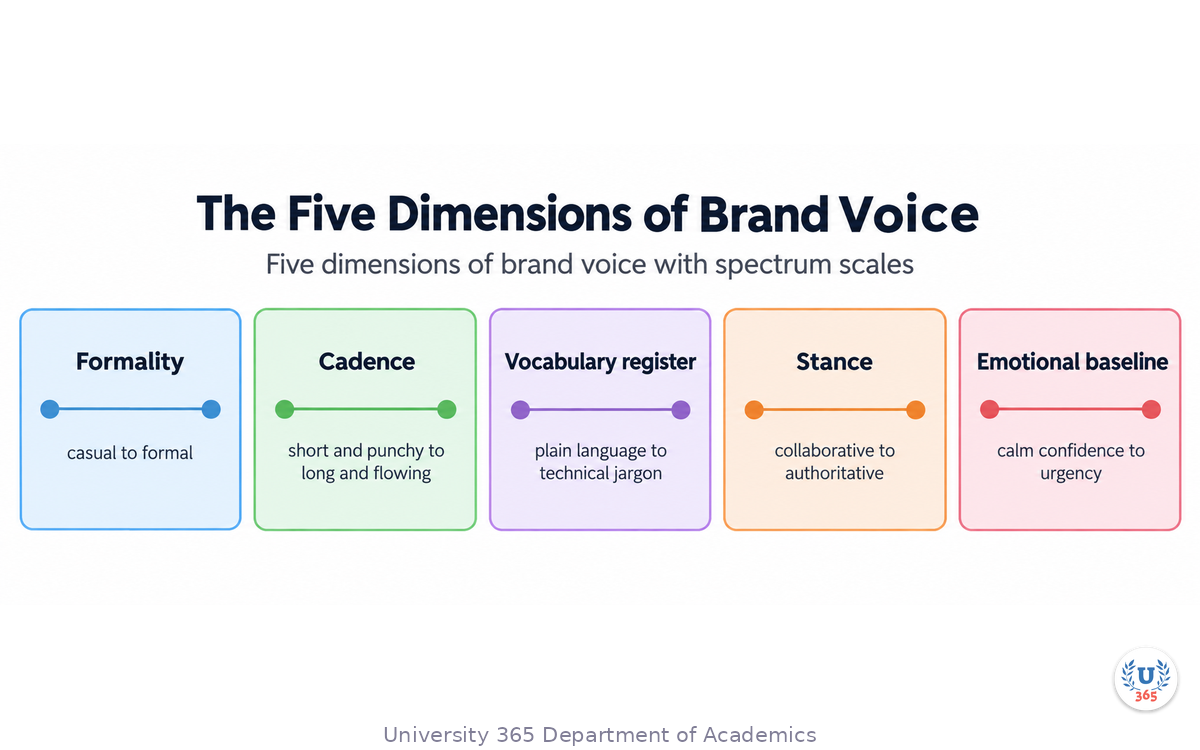
Brand voice can be decomposed into five measurable dimensions:
Formality: How formal or casual is the language? A bank might use formal constructions ("We regret to inform you"). A startup might use casual phrasing ("Heads up: we pushed a fix").
Cadence: What is the rhythm of sentences? Short and punchy? Long and flowing? A mix? Cadence is what makes text feel fast or slow to read.
Vocabulary register: What complexity level does the language operate at? Technical jargon, plain language, or something in between? A medical device company and a consumer app operate at very different registers.
Stance: What is the relationship to the reader? Authoritative and instructive? Conversational and collaborative? Reflective and questioning?
Emotional baseline: What underlying emotion does the writing carry even in neutral content? Confident, warm, curious, urgent, calm?
A brand voice document that says "be friendly and professional" is useless to an AI. An AI needs structured, specific parameters for each dimension. "Formality: low to medium. Use contractions. Avoid honorifics. Sentences average 12 to 18 words. Vocabulary: plain English, define technical terms on first use. Stance: collaborative, use 'we' and 'you'. Emotional baseline: calm confidence." That is something an AI can follow.
Why This Matters for AI
Before AI, brand voice was enforced by editors and style guides. A human writer internalized the voice over months and applied it unconsciously. An AI has no internalization. It starts from its training distribution every time you start a new conversation. Without explicit instructions, it regresses to the mean: competent, neutral, forgettable.
Step 2: Training AI on Your Brand Guidelines
The first step in AI-assisted brand voice management is giving the AI your guidelines. This is not a single prompt. It is a structured system of context that evolves with your brand.
What to Provide
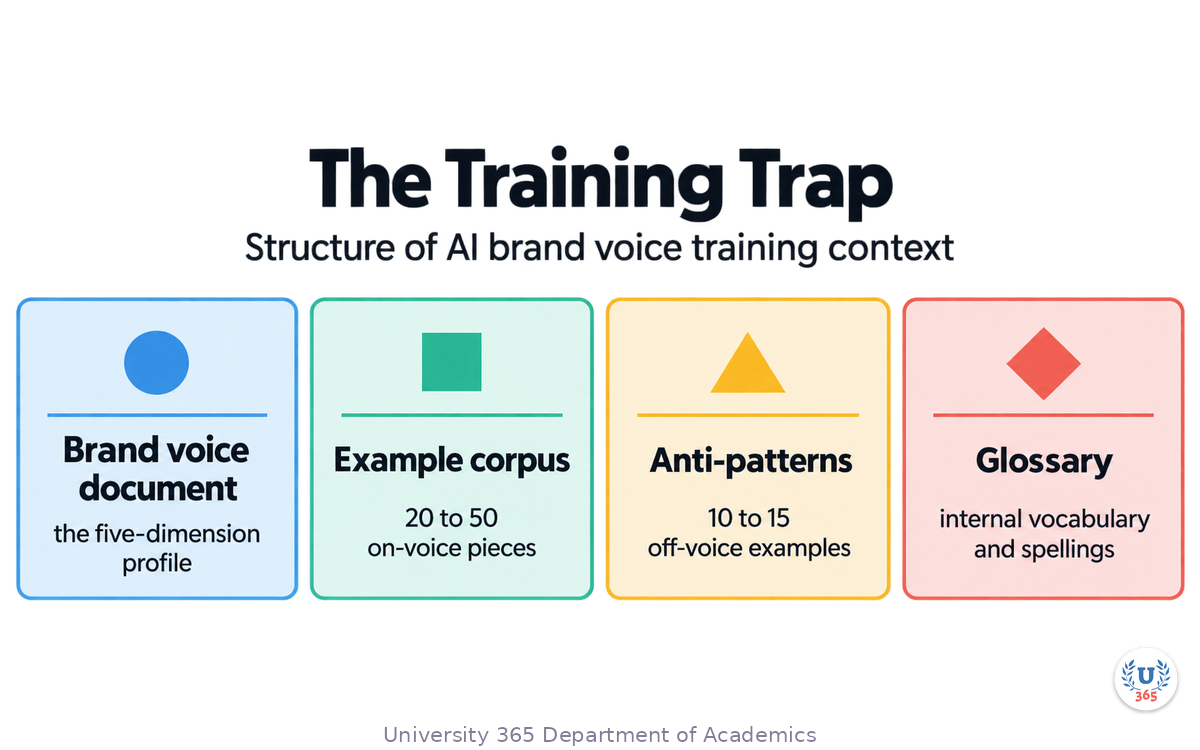
Your AI training context should include:
Brand voice document: The structured five-dimension profile from Step 1, with specific examples of correct and incorrect output for each dimension.
Example corpus: 20 to 50 pieces of existing content that represent your brand voice at its best. Include different content types: blog posts, emails, social media, product descriptions. Annotate each example with what makes it on-voice.
Anti-patterns: 10 to 15 examples of what your brand voice is NOT. Show AI-generated text that missed the mark and explain why. "This paragraph is packed with the corporate filler our voice guide bans. The sentence length averages 28 words, which exceeds our 18-word maximum."
Glossary: Your internal vocabulary, product names, and terms that should always appear in a specific way. Include approved abbreviations and spelling variants.
How to Deliver It
The delivery method depends on your AI tool:
Chat-based tools (ChatGPT, Claude): Use system prompts or custom instructions. Paste the voice document and a condensed example corpus. Reference it at the start of each session. Some tools support persistent project-level instructions that apply to every conversation.
API-based tools: Pass the voice profile as a system message. For longer contexts, include 5 to 10 example pieces as few-shot demonstrations. Structure them as input-output pairs: "Given this brief, here is how our brand would write it."
Fine-tuned models: If you have 500+ examples, you can fine-tune a smaller model on your brand voice. This produces more consistent results than prompting but requires ongoing maintenance as your brand evolves.
The Training Trap
The most common mistake is providing too much context without structure. A 50-page brand guidelines PDF dumped into a system prompt overwhelms the AI's attention. It will sample randomly from the document and produce inconsistent output. Instead, provide a concise structured profile (1 to 2 pages) plus a curated set of 5 to 10 examples. Less, but better organized, outperforms more but unstructured.
Step 3: Building a Brand Voice Profile
A brand voice profile is a machine-readable specification of how your brand communicates. It goes beyond a style guide by being explicit enough that an AI can follow it consistently.
Profile Structure
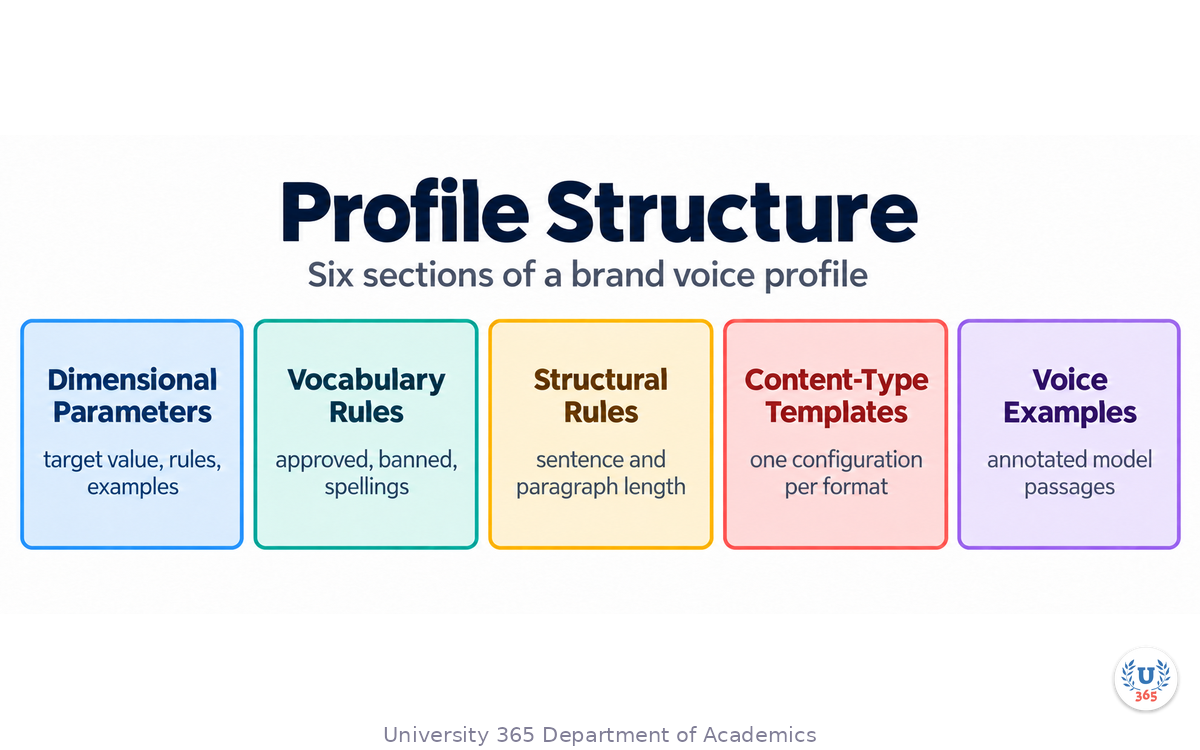
A complete brand voice profile contains six sections:
#### 1. Dimensional Parameters
For each of the five dimensions, specify:
The target value on a scale (for example, formality: 3 out of 5)
Concrete rules ("Use contractions in all content except legal disclaimers")
Two example sentences showing the correct level
#### 2. Vocabulary Rules
Approved word list for key concepts
Banned words and phrases (include AI-commonly-generated filler you want to avoid)
Preferred spellings and capitalizations
Industry terms: always define on first use, then use the abbreviation
#### 3. Structural Rules
Sentence length range (minimum, maximum, target average)
Paragraph length range
Heading style: sentence case or title case
List usage: when to use bullets vs numbered lists
Link formatting: inline or reference style
#### 4. Content-Type Templates
Different content types have different voice configurations:
Content Type | Formality | Avg Sentence Length | Stance | Example |
Blog post | Medium-low | 14-18 words | Collaborative | Include first-person anecdotes |
Product page | Medium | 10-15 words | Authoritative | Focus on benefits, not features |
Social media | Low | 8-12 words | Conversational | Questions, direct address |
Email newsletter | Medium | 15-20 words | Reflective | Personal note from the team |
Support docs | Medium-high | 12-16 words | Instructive | Step-by-step, imperative mood |
#### 5. Voice Examples per Content Type
For each content type, provide one excellent example (200 to 400 words) annotated with what makes it on-voice. These are your golden samples. AI tools should be evaluated against them.
#### 6. Revision Rules
Rules for how the AI should handle edits:
When the human says "make it punchier," what specific changes should follow (shorter sentences, stronger verbs, fewer adjectives)
When the human says "this is too casual," what to adjust (increase formality, remove contractions, add transitional phrases)
When the human flags a word as off-brand, how to log it and avoid it in future outputs
Profile Maintenance
A brand voice profile is a living document. Review it quarterly. Add new banned words that appear in AI outputs. Update examples as your brand evolves. Track which sections the AI follows well and which it struggles with, then add more specificity to the weak sections.
At UIC (University 365 Institute of Communication), students learn to build these profiles as part of the digital communication curriculum. The same skills apply across UIT (Technology, AI, Data Science) for technical documentation, UIB (Business Management, Entrepreneurship) for investor communications, and UID (Digital Design, UX/UI) for product microcopy.
Step 4: Maintaining Consistency Across AI Tools
Most organizations use multiple AI tools: ChatGPT for drafting, Claude for analysis, Jasper for marketing copy, Copy.ai for social media, Notion AI for internal docs. Each tool has a different base model, different training data, and different default voice. Without intervention, your brand voice will fragment across tools.
The Fragmentation Problem
Consider what happens when three different tools write your product descriptions:
ChatGPT tends toward a helpful, explanatory voice with medium-length sentences
Claude tends toward a thoughtful, nuanced voice with longer constructions
Jasper tends toward a persuasive, energetic voice with short punchy sentences
If you use all three without a unified voice profile, your website, your ads, and your emails will sound like three different companies. Customers notice. They may not articulate it as "voice inconsistency" but they feel it as a vague lack of trust.
The Solution: A Universal Voice Layer
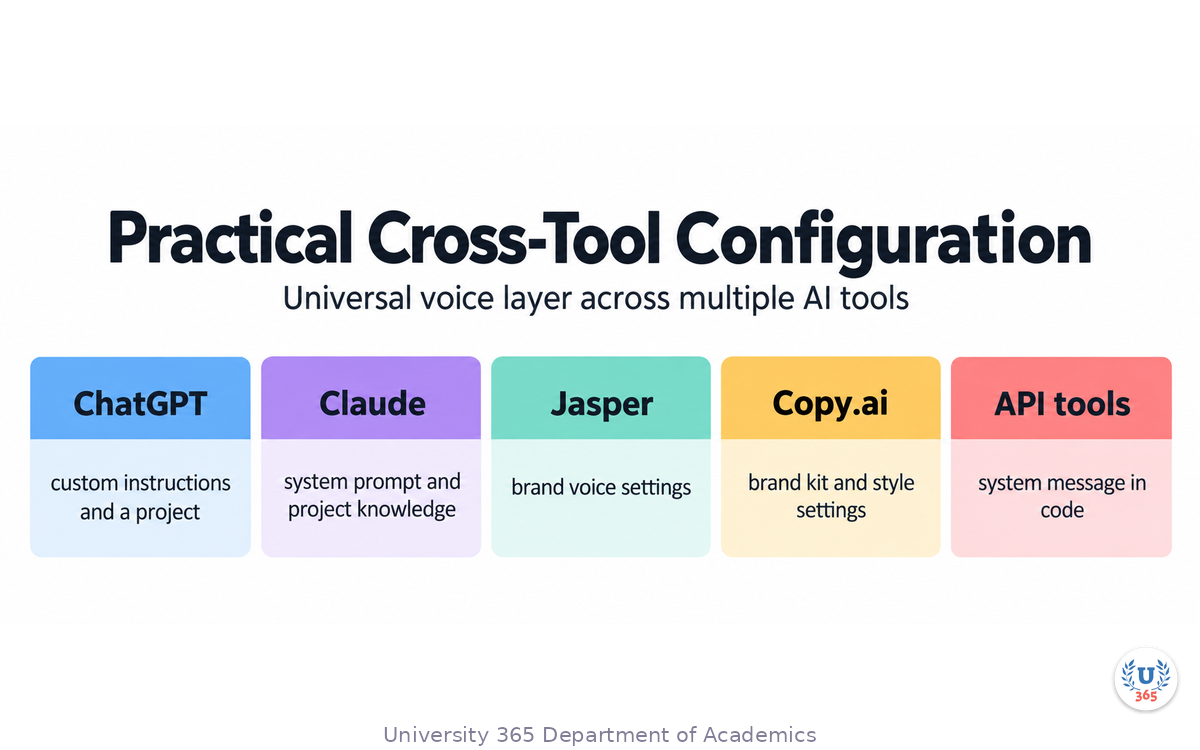
Build your brand voice profile as a tool-agnostic specification, then adapt it to each tool's delivery mechanism:
Core profile document: The structured specification from Step 3, stored as a single source of truth. This is tool-independent.
Tool-specific wrappers: For each AI tool, create a wrapper that translates the core profile into that tool's input format. For ChatGPT, this is a system prompt. For Jasper, this is a brand voice setting. For API-based tools, this is a system message.
Cross-tool validation: Periodically generate the same brief across all tools and compare outputs. Score them against your golden samples. If one tool drifts, adjust its wrapper.
Practical Cross-Tool Configuration
Tool | Voice Input Method | Maintenance Frequency |
ChatGPT | Custom instructions + GPT project | Monthly review |
Claude | System prompt + project knowledge | Monthly review |
Jasper | Brand voice settings | Bi-weekly |
Copy.ai | Brand kit + style settings | Bi-weekly |
API tools | System message in code | Per deployment |
Notion AI | Workspace instructions | Quarterly |
The Human Checkpoint
No AI tool maintains voice perfectly across long sessions. The context window degrades. The AI starts strong and drifts toward its default voice after 3,000 to 5,000 tokens of output. This is why the human checkpoint is not optional. After every AI-generated draft, a human reviews the first 200 words against the voice profile. If the opening is on-voice, the rest usually follows. If the opening has drifted, regenerate from the start with a voice-profile reminder.
Step 5: Brand Voice Drift: Detection and Correction
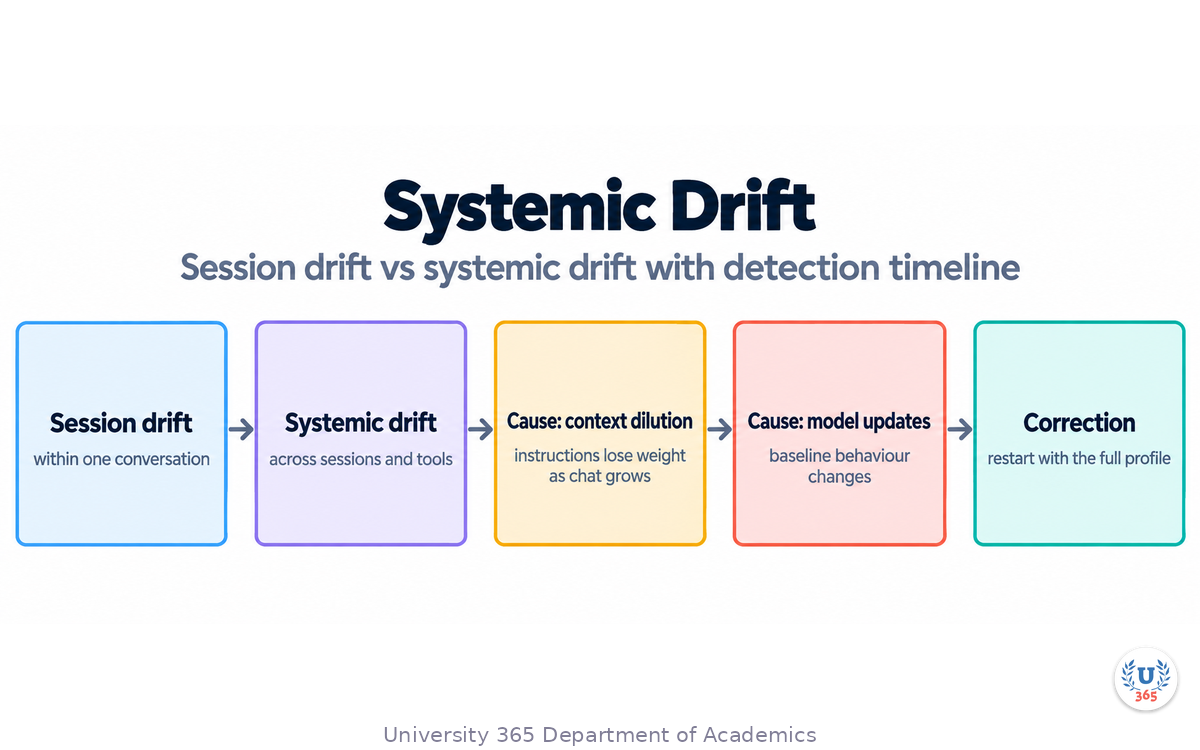
Brand voice drift is the gradual deviation of AI-generated content from your intended brand voice. It happens in two forms: session drift and systemic drift.
Session Drift
Session drift occurs within a single AI conversation. The first output is close to your voice profile. By the fifth or sixth iteration, the AI has started reverting to its default patterns. You notice banned words creeping in. Sentence length increases. The stance shifts from collaborative to authoritative.
Causes:
Context window dilution: as the conversation grows, the original voice instructions carry less weight relative to the accumulated output
Output reinforcement: the AI learns from its own previous outputs in the session. If output #2 drifted slightly, output #3 drifts further by building on #2
Instruction decay: some models weight early instructions less heavily as conversation length increases
Detection: Run a drift check after every third output in a session. Check for:
Banned word appearances
Sentence length moving outside the target range
Formality shifting (contractions disappearing, passive voice increasing)
Stance drift (first person "we" becoming impersonal "the company")
Correction: When drift is detected, restart the conversation with the voice profile. Do not try to correct drift mid-session by adding reminders. The accumulated context continues to pull the AI back toward its drifted state. A fresh start with the full profile produces better results than patching.
Systemic Drift
Systemic drift occurs across sessions and across tools over weeks or months. Your brand voice slowly shifts because:
Different team members use different voice settings
AI tools update their models, changing baseline behavior
New content types are added without voice profile coverage
The brand itself evolves but the voice profile is not updated
Detection: Run a monthly voice audit. Sample 20 pieces of AI-assisted content from across your tools and content types. Score each on the five dimensions. Compare the scores to the previous month. If any dimension moves more than 10%, investigate the cause.
Correction: Update the voice profile with more specific rules for the drifting dimension. Retrain tool-specific wrappers. Communicate the updated profile to all team members using AI tools.
Step 6: Measuring Brand Voice Fidelity
Brand voice fidelity is the degree to which AI-generated content matches your intended brand voice. Measuring it transforms voice management from subjective opinion to objective quality control.
Fidelity Scoring
Score each piece of content on a 0 to 100 scale across the five dimensions:
Formality match (20 points): Does the formality level match the target for this content type? Check contractions, honorifics, sentence construction.
Cadence match (20 points): Is the sentence length distribution within the target range? Count words per sentence, compute the average and standard deviation, compare to profile targets.
Vocabulary match (20 points): Are all words from the approved list? Are any banned words present? Are technical terms handled correctly?
Stance match (20 points): Is the relationship to the reader correct? Check pronoun usage, imperative vs declarative mood, question frequency.
Emotional baseline match (20 points): Does the underlying emotion match the target? This is the hardest to automate. Use an AI classifier trained on your golden samples, or have a human reviewer rate it.
A score of 85+ is production-ready. 70 to 84 needs revision. Below 70 should be regenerated.
Automated Fidelity Checking
You can build an automated fidelity checker using a secondary AI model:
Define the scoring rubric as a structured prompt
Feed the content and the voice profile to the checker model
Ask it to score each dimension with specific evidence ("Sentence average is 24 words, target is 14-18, score: 12/20")
Ask for specific revision suggestions for any dimension scoring below 16/20
This creates a two-model system: one AI generates content, another AI evaluates it. The human reviews the evaluation, not the raw output. This is faster and more consistent than having humans check every piece.
Fidelity Dashboard
Track fidelity scores over time in a simple dashboard. Monitor:
Average fidelity score by content type
Average fidelity score by AI tool
Trend over weeks (is it improving or declining?)
Specific dimensions that score lowest (where to focus profile improvements)
At UIC, students build fidelity dashboards as part of the brand management curriculum. The same approach is taught across UIB for marketing teams and UID for design system documentation.
Step 7: The CI-First Approach to Brand Voice
CI-First means Co-Intelligence First: the human is the ruler and orchestrator, the AI is the amplifier. In brand voice management, this principle has specific implications.
The Human Decides, the AI Produces
The human owns:
The brand voice profile: what it says, when it changes, how it is structured
The brief: what content is needed, for whom, in what context
The final approval: what gets published
The AI owns:
First drafts: generating initial content from the brief and voice profile
Variation generation: producing 3 to 5 alternative versions for human selection
Fidelity checking: scoring draft content against the voice profile
Pattern detection: identifying drift trends across content
What Goes Wrong Without CI-First
When AI generates content and humans publish it without review, three things happen:
Voice homogenization: All content converges to the AI's default voice. Your brand becomes indistinguishable from competitors using the same AI tools.
Risk blindness: AI does not understand cultural context, recent events, or sensitivities. It can produce text that is technically on-voice but contextually wrong. Only a human catches this.
Stagnation: AI produces variations of what it has already produced. Without human creative direction, your brand voice stops evolving. It becomes a frozen average of your past content.
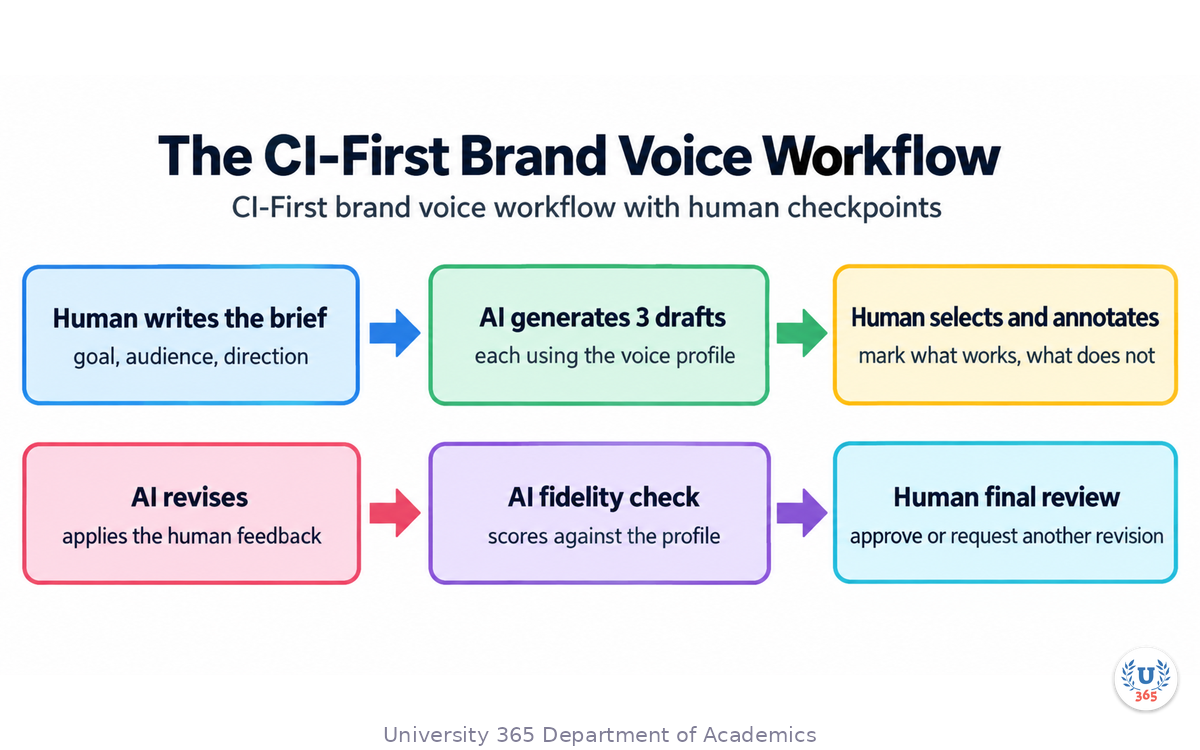
The CI-First Brand Voice Workflow
Human writes the brief: Content goal, audience, context, any creative direction
AI generates 3 drafts: Each using the voice profile, with slight variation in approach
Human selects and annotates: Pick the best draft, mark what works and what does not
AI revises: Apply the human's feedback to produce a refined version
AI fidelity check: Score the refined version against the voice profile
Human final review: Read the fidelity report, review the content, approve or request another revision
Publish: Only after human approval
This workflow takes longer than "generate and publish" but it is what separates brands that maintain their voice from brands that lose it. The time investment is 10 to 15 minutes per content piece. The cost of voice loss is immeasurable.
Feynman Summary: Explain It Like You Are 12
Imagine your brand is a person. This person has a specific way of talking: they use certain words, they speak at a certain speed, they sound confident but not arrogant, they are friendly but not overly casual. That specific way of talking is the brand voice.
Now imagine you hire a robot to write messages for this person. The robot is smart but it has heard millions of people talk. By default, it writes in an average voice that sounds like everyone and no one at the same time. If you just tell it "write something for our brand," it will produce text that is correct but boring. It will not sound like your person.
To fix this, you give the robot a detailed instruction manual about how your person talks. "Use short sentences. Be friendly but professional. Never reach for corporate filler. Always say 'we' not 'the company.'" You also show the robot examples of things your person has said before and say "write like this."
Even with the manual, the robot drifts. After writing for a while, it starts sounding less like your person and more like its default average voice. You need to check its work regularly and remind it of the manual. You also need to check whether different robots (because you might use several) are all producing the same voice. If robot A writes your emails and robot B writes your social media, your brand person should sound the same in both.
The most important rule: a human always has the final say. The robot writes, the human checks, the human decides what gets published. The robot is a tool. The human is the brand.
Mindmap: The Complete Picture
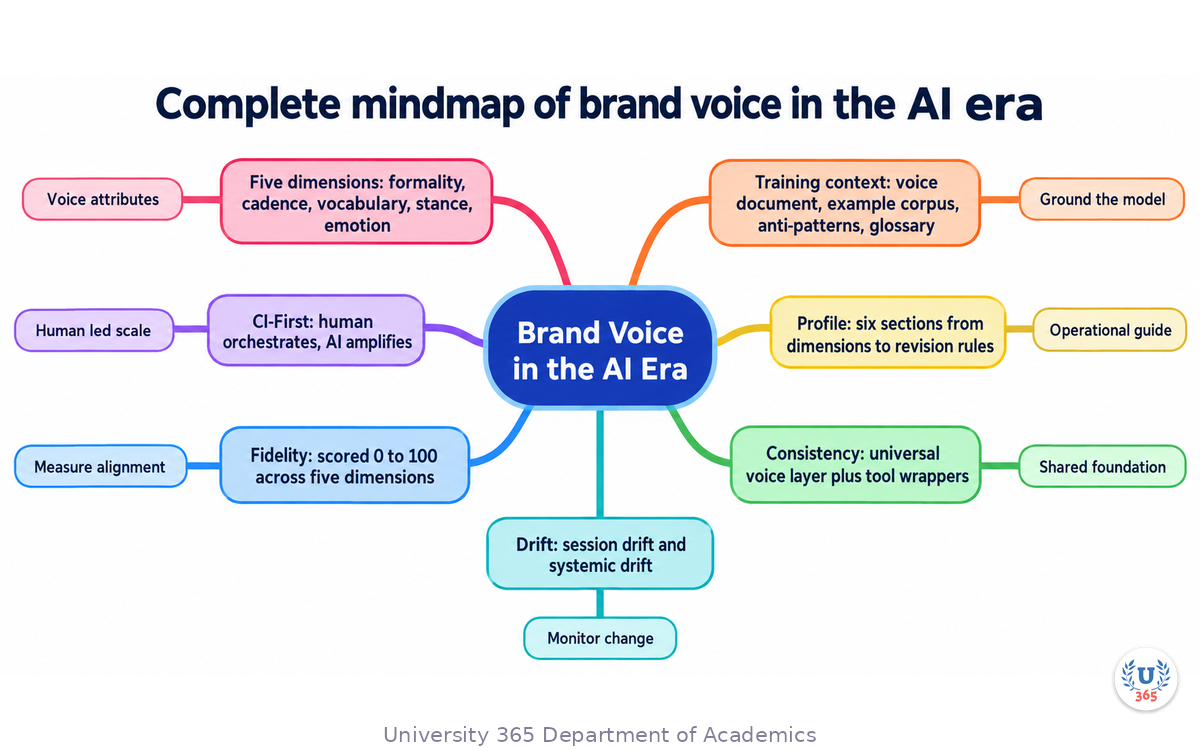
The mindmap shows the full structure of what you learned: brand voice decomposes into five dimensions (formality, cadence, vocabulary register, stance, emotional baseline). Training AI requires a structured context (voice document, example corpus, anti-patterns, glossary). A brand voice profile contains six sections (dimensional parameters, vocabulary rules, structural rules, content-type templates, voice examples, revision rules). Consistency across tools requires a universal voice layer with tool-specific wrappers. Drift occurs in two forms (session drift and systemic drift) with specific detection and correction methods. Fidelity is measured on a 0-100 scale across the five dimensions using automated checking. The CI-First approach keeps the human as orchestrator with a seven-step workflow from brief to publish.
UNOP Sound (University 365 Neuroscience Oriented Pedagogy)
Take five minutes to consolidate your memory. Play the isochronous tone track (10Hz alpha frequency) with your eyes closed. Alpha-frequency tones after a learning session support consolidation, helping move what you just learned from short-term to long-term memory.
[Audio player: UNOP Post-Lecture Isochrone (10Hz, 5 minutes)]
Practical Exercise: Audit Your AI Content for Voice Drift
Exercise: Run a Voice Drift Audit
Select 5 pieces of AI-assisted content your organization has published in the last 30 days. Choose different content types if possible (one blog post, one email, one social media post, one product page, one support doc).
For each piece, score the five dimensions on a 1 to 5 scale:
Formality: Does it match your target level?
Cadence: Is the sentence length in your target range?
Vocabulary: Are there banned words? Are approved terms used correctly?
Stance: Is the relationship to the reader correct?
Emotional baseline: Does the underlying emotion match?
Calculate the average score for each dimension across all 5 pieces.
Identify the dimension with the lowest average score. This is your priority for voice profile improvement.
Add 3 to 5 new specific rules to the voice profile for that dimension. For example, if cadence scored lowest, add: "No sentence longer than 22 words. If a sentence exceeds 22 words, split it at a natural pause point. Vary sentence length: include at least two sentences under 10 words per paragraph."
Regenerate one of the 5 pieces using the updated voice profile. Compare the new fidelity score to the original.
What to Look For
Content from different AI tools will likely show different drift patterns. ChatGPT content may drift on vocabulary while Jasper content drifts on formality.
Content produced early in an AI session usually scores higher than content produced late in the same session. This is session drift in action.
If your organization does not have a voice profile yet, use this exercise to build one. The scoring rubric itself becomes the first version of your profile.
CI-First Connection
This audit is a human activity. The AI can assist with scoring, but the human interprets the results and decides what to fix. The AI cannot judge whether the emotional baseline is correct for your brand. Only someone who understands the brand's identity can make that call. This is CI-First in practice: AI amplifies your analytical capacity, but the judgment stays human.
Glossary
Term | Definition |
**Brand Voice** | The consistent personality an organization projects through written communication, decomposed into formality, cadence, vocabulary register, stance, and emotional baseline. |
**Brand Tone** | The context-specific emotional coloring applied on top of the consistent brand voice. Tone shifts with situation; voice stays constant. |
**Brand Voice Profile** | A machine-readable specification of brand voice with six sections: dimensional parameters, vocabulary rules, structural rules, content-type templates, voice examples, and revision rules. |
**Voice Dimensions** | The five measurable axes of brand voice: formality, cadence, vocabulary register, stance, and emotional baseline. |
**Training Context** | The structured information given to an AI tool to teach it a brand voice, including the voice document, example corpus, anti-patterns, and glossary. |
**Example Corpus** | A curated set of 20 to 50 existing content pieces that represent the brand voice at its best, used to demonstrate correct voice to AI tools. |
**Anti-Patterns** | Examples of content that does NOT match the brand voice, with explanations of why, used to help AI avoid common mistakes. |
**Session Drift** | The gradual deviation of AI output from the brand voice within a single conversation, caused by context dilution and output reinforcement. |
**Systemic Drift** | The gradual shift of brand voice across sessions and tools over weeks or months, caused by inconsistent settings, model updates, or profile neglect. |
**Voice Fidelity** | The degree to which AI-generated content matches the intended brand voice, measured on a 0 to 100 scale across the five dimensions. |
**Fidelity Score** | A numerical score (0-100) measuring how well a piece of content matches the brand voice profile, with 85+ being production-ready. |
**Golden Samples** | Annotated examples of excellent brand voice content used as reference standards for AI training and fidelity evaluation. |
**Universal Voice Layer** | A tool-agnostic brand voice specification with tool-specific wrappers that translate the core profile into each AI tool's input format. |
**CI-First** | Co-Intelligence First: the principle that the human is the orchestrator and ruler while the AI is the amplifier. In brand voice, the human owns the profile, brief, and final approval. |
**Voice Fragmentation** | The problem of different AI tools producing content with different voices, causing brand inconsistency across channels. |
**Fidelity Dashboard** | A tracking tool that monitors voice fidelity scores over time by content type, AI tool, and dimension. |
**Cross-Tool Validation** | The practice of generating the same brief across multiple AI tools and comparing outputs against golden samples to detect fragmentation. |
**Few-Shot Demonstration** | A technique for AI training where 5 to 10 example input-output pairs are included in the prompt to demonstrate the desired voice. |
Quiz: TEST YOUR UNDERSTANDING
1. What is the difference between brand voice and brand tone?
A) Voice is written, tone is spoken
B) Voice stays constant across contexts, tone shifts with the situation
C) Voice is for external content, tone is for internal content
D) There is no difference, they are interchangeable terms
2. Why does dumping a 50-page brand guidelines PDF into an AI system prompt produce poor results?
A) The AI cannot read PDF format
B) The file is too large for the context window
C) Unstructured content overwhelms the AI's attention, causing random sampling and inconsistent output
D) The AI ignores system prompts longer than 10 pages
3. What causes session drift in AI-generated content?
A) The AI model gets tired after generating many tokens
B) Context window dilution and output reinforcement cause the AI to revert to default patterns
C) The internet connection degrades during long sessions
D) The voice profile expires after 3,000 tokens
4. What is the minimum fidelity score for production-ready content?
A) 50
B) 70
C) 85
D) 95
5. In the CI-First approach to brand voice, what does the AI own?
A) The brand voice profile and when it changes
B) The final approval of what gets published
C) First drafts, variation generation, fidelity checking, and pattern detection
D) The creative direction and brand strategy
Answers: 1-B, 2-C, 3-B, 4-C, 5-C
Related Resources
U365 INSIDE Publications
Book Essential: Co-Intelligence by Ethan Mollick: The Centaur model and human-AI collaboration
Book Essential: Irreplaceable by Pascal Bornet: Humics and staying irreplaceable in the AI age
External Resources
Attention Is All You Need (Vaswani et al., 2017): The original transformer paper: arxiv.org/abs/1706.03762
The Illustrated Transformer by Jay Alammar: Visual guide with interactive examples: jalammar.github.io/illustrated-transformer
The Four Dimensions of Tone of Voice by Nielsen Norman Group: Research-based guidance on voice and tone: nngroup.com/articles/tone-of-voice-dimensions
Mailchimp Content Style Guide: An open, practical example of a structured voice guide: styleguide.mailchimp.com/voice-and-tone
Anthropic's Claude Character Training: How model makers approach personality and voice: anthropic.com/news
Related U365 Lectures (Coming Soon)
Lecture 2: Visual Brand Identity in the AI Era (UIC, Branding Series)
Lecture 3: Brand Architecture Across Digital Channels (UIC, Branding Series)
Lecture 4: AI Content Generation: Beyond ChatGPT (UIC, Content Strategy Series)
U.Copilot for This Lecture
Discuss this lecture with U.Copilot, your AI chat companion trained on this content.
Copy and paste the following prompt into the U.Copilot chat on university-365.com:
You are U.Copilot for Lectures, an AI chat companion specially trained on University 365 lecture content. You are helping a Fellow who just completed the lecture "Brand Voice in the AI Era" from the Branding series at the U365 Institute of Communication (UIC). Your role is to help the Fellow deepen their understanding of brand voice management with AI tools. You can: - Clarify any concept from the lecture (voice dimensions, training context, voice profile structure, cross-tool consistency, drift detection, fidelity measurement, CI-First workflow) - Provide additional examples of brand voice profiles for different industries - Explain how to build a fidelity scoring system for their specific content types - Discuss how voice management differs across UIT, UIB, UIC, and UID content contexts - Help them run a voice drift audit on their own content - Connect the lecture content to practical brand management tasks Always maintain U365's CI-First approach: encourage the Fellow to think critically, verify AI outputs, and maintain human judgment as the orchestrator of all brand expression. Use the UP-Context Method: provide context-rich, role-aware responses that account for the Fellow's learning level and goals.
Next Steps
Now that you understand brand voice in the AI era, here is what to do next:
Run the practical exercise above to audit 5 pieces of your own AI-assisted content for voice drift
Build a first version of your brand voice profile using the six-section structure from Step 3
Configure your primary AI tool with the voice profile and test it on a real content brief
Take Lecture 2 in this series: "Visual Brand Identity in the AI Era" to learn how AI tools affect visual brand consistency
Explore the U365 Branding tag on INSIDE for practical guides on building and managing brand identity with AI tools
Brand voice is what makes your organization recognizable without a logo. In the AI era, maintaining it requires structured profiles, systematic measurement, and the discipline to keep humans in the decision loop. The brands that invest in voice engineering now will sound like themselves at any scale. The brands that do not will sound like everyone else.
IMPORTANT NOTICE
This lecture is published by University 365 as part of its INSIDE Publications Hub. The content is free to read for all visitors. Lectures in this series may be part of a structured academic program leading to a Micro-Credential for your Career (MCC). To enroll in an academic program, visit university-365.com/tuition.
This content is for educational purposes. While we strive for accuracy, AI is a fast-moving field. Verify current technical details against primary sources for professional applications.
Copyright University 365, Inc. All rights reserved. This content is protected under University 365's copyright policies. For permissions or inquiries, contact uda@university-365.com.
Published by the Department of Academics, University 365.
Lecture delivered by the University 365 Institute of Communication (UIC).
Lea Loringam, Dean of Communication, UIC
Signed for the academic year 2026.




Comments