
Build Your UP-Context USER-PERSONA File

Updated: 2 days ago
In this Prompting Publication
The psychographic interview on its own produces a real, usable UP-Context USER-PERSONA file, and every prompt you run afterwards stops being generic because it knows who it is talking to.


What this is, and what changes when you have one
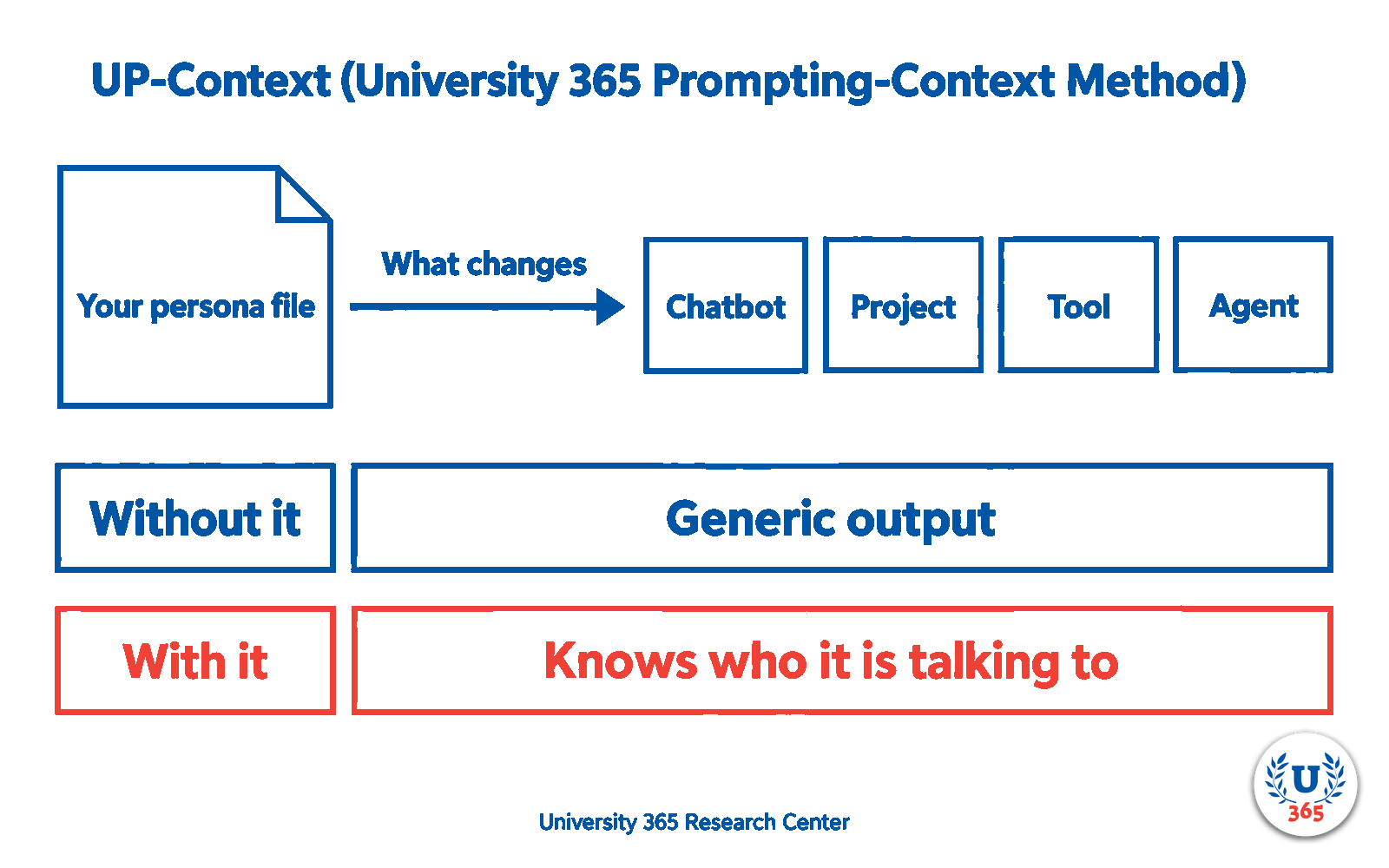
A UP-Context USER-PERSONA file is a written description of you, captured once, that you attach to the prompts you run. It is the difference between a prompt that guesses and a prompt that knows your situation, your constraints, how you decide, and how you prefer to be spoken to.
You build it by interview, not by filling in a form. You capture it once, you keep it, and you reuse it across every prompt, model and tool afterwards. It is not a profile you write about yourself in the abstract. It is a document assembled from your own answers, in your own words.
Two things worth stating before you invest any time:
It does not make the model smarter, and it does not make the model more factually accurate. It makes the output specific to you instead of generic. Those are different claims, and only the second one is true. See "What not to expect" below.
A finished file is identifying by nature. It is not anonymous, and no method can make it anonymous while it remains useful. Everything you write in it is material you will recognise as yours.
The path, in three levels
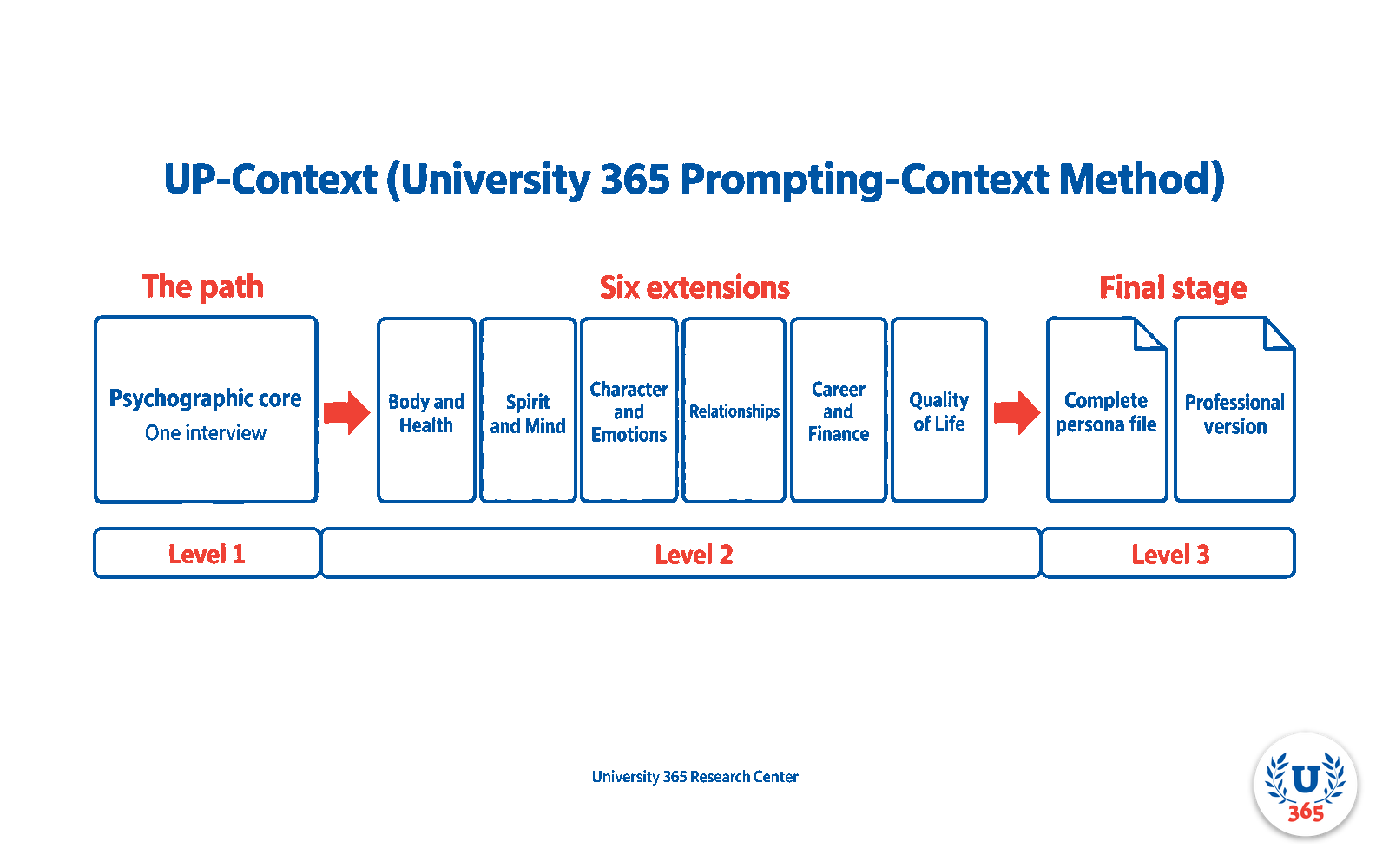
Read this part first. It is the whole shape of the method, and everything after it is detail.
How the levels map to the Publications: Level 1 is Step 1. Level 2 is Steps 2 to 7. Level 3 is Step 8.
Level | What you do |
Level 1: the psychographic core | ONE interview, about 90 minutes. You answer questions about your values, what drives you, what triggers you, how you decide, how you communicate, what you believe. You now hold a usable UP-Context USER-PERSONA file. Complete in itself. |
Level 2: the extensions | The six ULM life domains, one at a time, each about 60 to 90 minutes. Each is optional. Each is usable on its own and deepens one area: health, mind and spirit, character and emotions, relationships, career and finance, quality of life. |
Level 3: the final stage | Step 8 reads the complete file produced at Step 7. It creates two new files: a professional version with private material removed or generalised, and a separate redaction log. |
Level 1 is a real result, not an entry ticket. It is the psychographic interview, which is itself one of the method's own interviewers, so a Level 1 file is native to the method and simply partial. It is extensible, not incomplete. If you stop there, you still have something genuinely useful.
More interviews means a better persona. That is worth saying honestly, because it is true and it costs us nothing to admit. If your work is life-management in a specific domain, you need that domain's interview. What Level 1 buys you is the right to start now rather than after twelve hours of interviews.
The order below is a recommendation, not a rule. Two positions are fixed: the psychographic interview is Step 1, and the professional-version prompt is Step 8, after the six life-domain extensions.
Where this sits in the UP-Context method
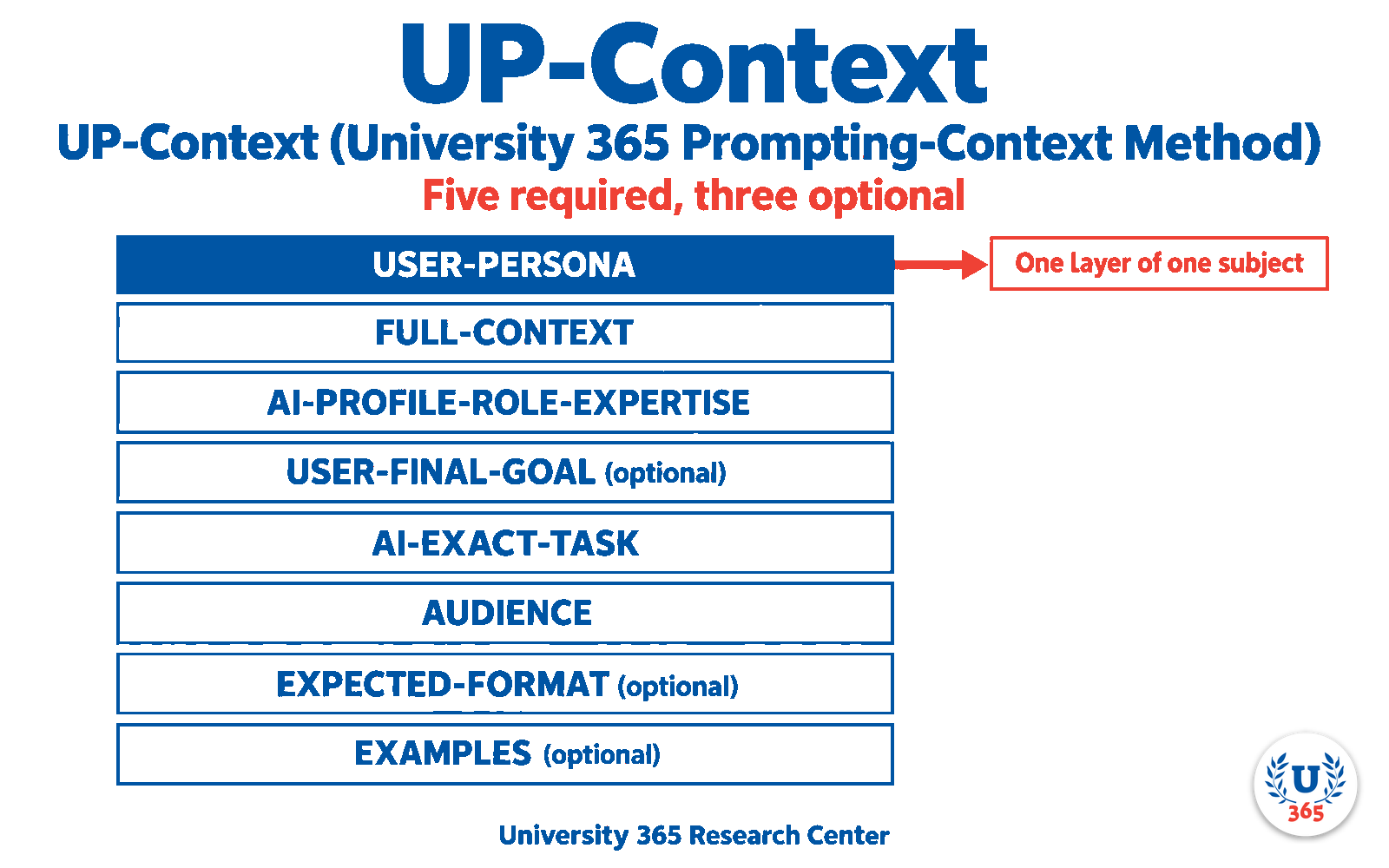
UP-Context works by breaking every prompt into eight layers, five required and three optional. The layers are USER-PERSONA, FULL-CONTEXT, AI-PROFILE-ROLE-EXPERTISE, USER-FINAL-GOAL (optional), AI-EXACT-TASK, AUDIENCE, EXPECTED-FORMAT (optional) and EXAMPLES (optional). A layer is text in the prompt first; any layer whose text is long enough and reused can live in a reusable file. The request-specific layers (AI-EXACT-TASK, sometimes USER-FINAL-GOAL) change most often.
The User-Persona File is built by concatenation. The complete file is your Psychographic File concatenated with one File per ULM life domain, six in total. The concatenation is cumulative: each step appends to the previous result and keeps the earlier sections verbatim, so nothing is rewritten along the way.
The User-Persona file is one layer of one subject. It is not the whole method. This publication covers that one layer, applied to the subject "you", in depth. The other layers are covered by the UP-Context Method explainer.
The eight layers, five required and three optional | What each one holds |
USER-PERSONA | You: values, motives, character, health, relationships, work, money, life |
FULL-CONTEXT | The situation, environment and background a task sits inside. Plural: there may be several |
AI-PROFILE-ROLE-EXPERTISE | The AI's profile, role and expertise, and its standards |
USER-FINAL-GOAL (optional) | The big-picture goal you are working toward; points every answer at the real target |
AI-EXACT-TASK | The exact job asked now; the layer that changes most often |
AUDIENCE | Who the output is for, and what they need from it; may cover several personas |
EXPECTED-FORMAT (optional) | The shape of the answer; makes the output usable as delivered |
EXAMPLES (optional) | Reference examples that set the standard |
FULL-CONTEXT layers are added, not concatenated. The USER-PERSONA layer is built by concatenation, but the FULL-CONTEXT layers are a set: separate files, one per subject, attached together as the need requires. For an organisation they may include a Business-Persona File, a Department or Service-Persona File, a Project File and a Customer-Persona File. Because they are added rather than merged, one subject can change without rewriting the others.
The layer files can also be combined. The method allows them to be mixed into one holistic, comprehensive unique UP-Context File for a task that needs the whole picture at once. That is a documented part of the method, and it is exactly what Level 3 does with your persona.
Why it is built by interview
The method's Explore stage is a structured interview, not a blank page. Asking you to write your own persona file produces a short, flattering and largely generic document, because most people describe themselves the way they would like to be described.
A question-by-question interview produces something different, for three reasons:
You answer things you would not have thought to write down. Structure reaches material a free-form page never surfaces.
Every answer is captured in your own words. The file reads as you, not as a form.
It is repeatable. A second interview in six months produces a comparable document, so you can see how you have changed.
How the interview is disciplined
Long interviews fail when they sprawl. The prompts control this with a two-tier question rule:
Tier | Rule |
Primary questions | Up to 70 per interview, asked one at a time, each answered in full |
Absolute ceiling | 150 questions, including every follow-up. The interview must not exceed this |
One question at a time. The interviewer asks, waits for your answer, and follows up before moving on. Answer in full: a one-line answer produces a one-line file.
If an interview is running long, the prompt must close it properly and record what remains, rather than truncating your answers to fit.
Which model to run these on
This matters more than it looks. These are long, reasoning-heavy interviews. Run them on a model that does not think, and you get a shallow persona, and you will reasonably blame the prompt. Use a thinking model:
Model | Setting |
GPT-5.6-Sol or GPT-6-Sol | Medium or high thinking |
Claude Opus 5 or 5.5 | Medium or high thinking |
DeepSeek-V4.1-flash | High thinking |
This requirement is not written inside the prompt files. It is stated here because this page is the only place it is carried.
How to run the interviews
Before you start: what this file will contain
These interviews deliberately collect sensitive personal material. That is the point of them, and it is why we state this before you begin rather than after. A completed persona file will cover, among other things:
Your health, medical and mental-health situation. Your finances, income and money decisions. Your relationships, family and private life. Your beliefs, religious and political. Your emotional vulnerabilities.
Before your first answer, decide where this file will live. It belongs in your own store, under your own control. It does not belong in shared tools, team chats, or third-party services you do not control.
Never put these in a shared or professional file: medical detail; sexual and intimate material; fidelity and private relationship conduct; identifying details about family, friends, partners or pets; religious and political conviction. Use the professional version for anything that leaves your own hands.
If you use this at work, scope it. A work persona file needs a named owner, one single source of truth, access limited to those who need it, and the same redaction judgement applied. An organisational file is not a bigger personal file; it is a different document with a different owner.
We state this clearly because no other offer in this market asks you to write these things down. A warning on a policy page you never read discharges nothing, so it sits here, on the page that asks you to do the work.
One prompt per interview. The eight prompts are listed at the end of this page, in the order they are meant to be run.
Start with Build Your UP-Context USER-PERSONA File - 1 of 7 - Psychographic. Attach nothing. It needs no prior file.
For each life domain after that, attach the file you produced at the previous step. This is the detail that makes the whole method work, and it is explained in the next section.
Answer in full, and save the file the prompt produces. Each prompt tells you the exact filename to use, and that filename records which step you are on.
The interviews are a chain, so they cannot contradict each other
This is the part most people expect to be a problem, and it is worth understanding before you start.
Seven independent interviews, merged at the end, will disagree. You will describe your health one way in March and another way in June, and a model asked to merge those two versions has no authority to decide which one is true about your own life. On health, finances, relationships or beliefs, a silent resolution is unacceptable.
So the interviews are chained instead. Each interview receives the file produced by the previous step, reads it as already-known context, and asks only what is new. What it returns is one file: everything from before, unchanged, plus its own new section, plus a short record of any correction you made.
Step | What happens |
Step 1 | Psychographic interview. Nothing attached. Produces your first usable file |
Steps 2 to 7 | The six life domains, in canonical order. Each attaches the file from the step before |
Step 7 output | The complete UP-Context USER-PERSONA file, covering all seven interviews |
Step 8 | Professional version and redaction log, from the complete Step 7 file |
If you contradict your own file, the interview stops and asks you which is correct. It states both versions, you decide, and it records your decision. Nothing is overwritten silently, and the correction stays visible in a revisions log. That is why two interviews cannot disagree: every difference is put to you at the moment it appears, while you are there to settle it.
The consolidated file is already the final file. You are not asked to concatenate anything by hand, and there is no separate merge step to perform later. Step 7 produces the complete document, because every step before it carried the earlier work forward.
The professional version, and the redaction log
Your persona file contains material you would not hand to an employer: health, money, relationships, beliefs. Step 8 reads the complete file produced at Step 7 and creates a professional version with that material removed or generalised, plus a separate redaction log.
At the end of Step 8, you keep three documents. Step 7 produced the complete file. Step 8 adds the professional file and the separate redaction log:
Document | What it is |
The complete file | Everything, including private material. It never leaves your own store, and it is the single copy of the sensitive content. |
The professional file | The persona with private categories removed or generalised. It carries no list of what was removed, so it is attachable exactly as it comes out, with nothing to edit first. |
The redaction log | A separate file recording what was removed or generalised, and why. It names the category, never the content itself, so the sensitive material still exists in exactly one place. |
Keep the log, and never send it with the professional file. It lists the private categories that were taken out, so attaching both together would undo the point. Its value is that you can check the redaction: too much removed and the persona weakens, too little and private material reaches someone it should not. The log is how you catch either failure.
The professional file is still a persona document. It is less private, not anonymous, and it remains identifying.
What not to expect
It does not make the model smarter, and it does not make it more factually accurate. It makes output specific to you. If a model does not know a fact, your persona file does not supply it.
It is not anonymous. A persona file is identifying by nature, and a professional version is less private, not unidentifiable.
It does not replace the other UP-Context layers. Your persona is one layer of one subject. A task with no AI-PROFILE-ROLE-EXPERTISE layer and no FULL-CONTEXT layer will still produce thin output.
It does not settle medical, legal or financial questions. The life-domain interviews help you think about those areas; they do not advise you on them. For health matters, consult a qualified professional. The interviews are not a diagnosis, and they are not medical care.
A Level 1 file will not support domain-specific prompts. Ask a health prompt to reason about your bloodwork from a psychographic file and it will guess. Run the interview for that domain first.
Licence, and how to handle what you write
Licence. The prompt text and the guidance published with it are released under Creative Commons Attribution 4.0 International (CC BY 4.0). You may use, adapt and redistribute them, including commercially, provided you attribute them.
U365 prompt catalogue, University 365 Department of Academics, licensed CC BY 4.0.
Two boundaries, stated plainly. The licence does not cover the University 365 name or marks. And it does not cover your own UP-Context files: those are yours, they stay yours, and you choose what happens to them.
Outputs may not be correct. As with any prompt library, you use these at your own risk and you check the output before relying on it.
The eight prompts
Run them in this order. Only the first and the last have a fixed position.
The prompt Publication | What it builds |
Start here. Needs nothing attached. Produces your first usable persona file. | |
Health, energy, habits and physical capacity. Attaches the Step 1 file. | |
Beliefs, purpose, inner life and how you make meaning. Attaches the Step 2 file. | |
Temperament, emotional patterns and how you handle pressure. Attaches the Step 3 file. | |
Close relationships, family and how you relate and attach. Attaches the Step 4 file. | |
Work, ambition, money and risk. Attaches the Step 5 file. | |
Environment, time, balance and what a good life looks like. Attaches the Step 6 file and completes the full file. | |
Reads the complete file produced at Step 7. Produces the professional persona and a separate redaction log. |


Sources and last reviewed
Built by the University 365 Department of Academics from the institutional UP-Context method definition. Last reviewed 2026-09-26. Review cycle: quarterly, in line with the method's own Evolve step.




Comments