
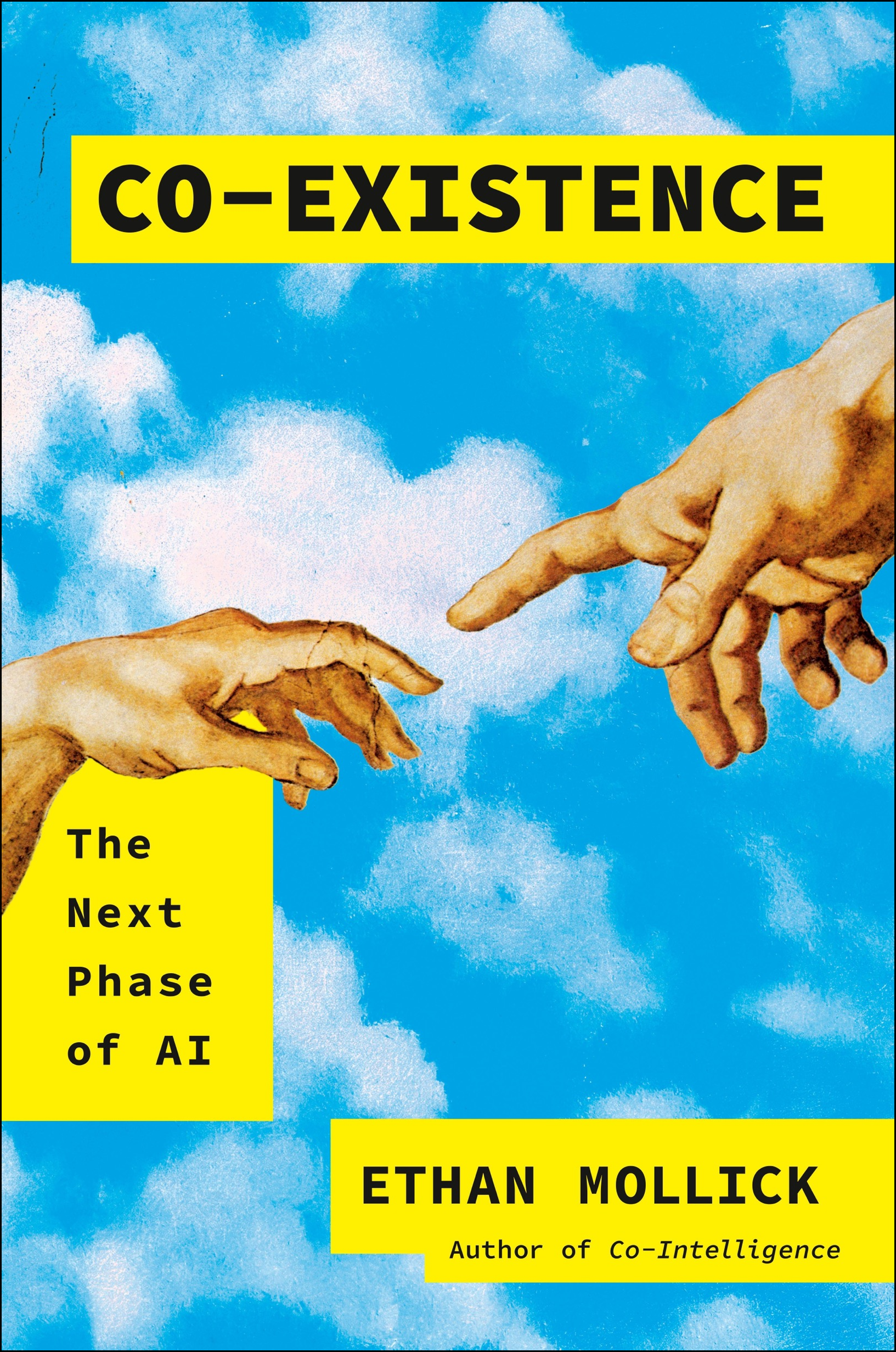
Co-Existence: The Next Phase of AI (Ethan Mollick)


In this Book Essential

INTRODUCTION
Ethan Mollick opened a blank Word document to begin this book and found a box waiting for him: describe to the AI what you want to write. He gave it one sentence about living with machines that are sometimes smarter than we are, and the result was terrible. Then he gave a better model his first two paragraphs, a copy of his previous book, and a description of his style, and asked it to continue. What came back was good enough to unsettle him. It caught his voice, including the parentheses and the personal anecdotes, and it produced a phrase he wished he had written.
That experiment is the honest starting point for everything that follows. Mollick is not writing about AI as a distant observer. He is writing as someone whose own trade, academic research and book writing, is being reshaped while he works, and he reports both the productivity and the discomfort without resolving them into a slogan. His first book, Co-Intelligence, was about using AI as a tool when it was worse than you at almost everything. This one is about a different situation: models that beat world forecasters at their own predictions, win gold at the International Mathematical Olympiad, and still fail at tasks a child can do.
The book has a simple claim underneath its range. Co-existence is not a policy position or a hopeful attitude. It is a set of practical skills, and the people who develop those skills will keep more control over their work than the people who refuse the technology or surrender to it. Mollick spends two thirds of the book making those skills concrete, with named working modes, patterns for when AI helps, and a serious account of what humans still do better.
This Book Essential is for readers who have to make decisions now. It gives you the framework, the evidence behind it, and the parts Mollick is candid about not knowing. Where the book is speculative, this analysis says so. Where it is grounded in experiments, the numbers are here.
U365'S VALUE PROPOSITION
WHO THIS IS FOR
Professionals in knowledge work, who need a defensible way to decide which tasks to hand to an AI, which to keep, and which to do alongside it, rather than a general instruction to embrace or resist.
Managers and executives, who will find the clearest published account of why AI productivity gains stall inside organizations, and what the O-Ring chain and the Garbage Can actually do to a rollout.
Educators and academic leaders, because the chapter on education separates the evidence on AI tutoring from the panic about cheating, and reaches a conclusion most institutions have not yet accepted.
Students and early-career readers, who are being told that AI closes skill gaps, and who need to understand the specific advantage that survives: deep knowledge, wide knowledge, taste and agency.
Parents, citizens and policymakers, who want a sober description of what a billion people are doing with AI every week, and what changes when agents start acting on their behalf.
KEY TENSIONS
Competence against comprehension: AI can produce a result you could not produce and cannot fully explain. The book's answer is not to refuse the result but to build enough understanding to judge it, and Mollick is direct that this costs effort.
Individual gain against organizational drag: You can become more productive in a week. Your organization takes years to change how it approves, hires and measures work. Mollick shows why the second number governs the first.
Delegation against de-skilling: Every task handed over buys time and risks an ability. The chapter on the human edge lists what you should protect, and the honest admission is that the choice is yours and no employer will make it for you.
Scale against judgment: A billion users generate enormous value and enormous harm in the same system. The same model that tutors a student can deepen a delusion, and the book refuses to treat those as separate phenomena.
Speed of capability against speed of planning: Capability doubles every few months. Almost no organization has a strategy for continued improvement, and Mollick calls this the planning blind spot.
Agency against automation: The most useful finding in the book is also the least comforting. People who take initiative with these systems gain the most, and initiative is the one input the machine does not supply.
WHY IT MATTERS NOW
The book lands in a specific moment. By 2026 more than a billion people were using AI every week, and most of them were not writing code or chatting with companions. Nearly eighty percent of conversations were practical guidance, information seeking and writing. That is a mass behavior change inside three years, and it happened before most institutions wrote a policy for it.
For University 365, the book matters because it independently arrives at the position the CI-First doctrine already holds. Mollick's central finding is that the value of AI depends on the judgment of the human directing it, that the human must stay the orchestrator, and that this is a learnable skill rather than a personality trait. His term is co-existence. Our term is Co-Intelligence, where CI equals HI plus AI multiplied by HI. The vocabulary differs and the practice converges.
The book also matters because it is willing to say what is not known. Mollick cannot tell you whether the next decade brings the Escalator or the Eschaton, and he says so in the last chapters rather than inventing confidence. That honesty is more useful to a reader making plans than a prediction would be, because it tells you which decisions stay correct under both futures.
OVERVIEW
Co-Existence is organized as a progression from the individual to society and then back to the individual. The first six chapters cover how models work, how to work with them, what humans still do better, and when to use AI. Then come chapters on work, education and society, two short codas in which the AI speaks in its own voice, and two final chapters on what might be on the other end of the conversation and where the technology is heading. The structure is deliberate: you cannot judge the social questions until you know what the tool actually does.
Mollick's method is to combine published research with his own experiments. He asks an agent to buy him a gift for under a hundred dollars and reports what it did with access to his email and his accounts. He runs a test of agentic work against human consultants and reports that the newest models finished in twelve minutes work that took experts hours, with judges rating the AI at least equal to the human eighty-five percent of the time. He describes the MIT Media Lab study on students writing essays with ChatGPT, and then describes the methodological objections to it, and keeps both in view.
The book's most useful original contribution is a vocabulary for how to work. Centaur work divides a task cleanly between human and machine. Cyborg work interleaves the two inside the same task. Conjurer work hands a task to an agent and evaluates what returns. Around those modes Mollick builds ten patterns for when AI adds value, from generating quantity to find quality, to work where reality checks the model automatically, to work that stretches beyond your expertise. The vocabulary is practical because it tells you what role to take before you open the chat window.
KEY IDEAS
HUMAN-AI CO-EXISTENCE
Co-existence as a skill, not a stance: Mollick's argument is that living with capable AI is a practice you can get better at. The people who benefit most are not the most enthusiastic or the most credentialed. They are the ones who build an accurate mental model of what the system can do, and who keep the judgment about what to accept.
The jagged frontier: AI capability is not a smooth line of improvement. It is jagged, with peaks where models do expert work and valleys where they fail at trivial tasks. Two mechanisms explain the shape. Emergence means weak links in an ability, and fixing one produces a sudden jump. Transcendence means a model trained on many people can outperform every one of them, because it combines approaches no individual would combine.
Scale as the frame: Between Mollick's two books, AI went from a curiosity to the fastest adopted product in history. The numbers matter because they change the subject. At a billion weekly users, the interesting question is no longer whether people will use AI but what they are doing with it, and the answer is mostly ordinary work: advice, information, writing.
Three working modes: Centaur work keeps a clear division of labor, with the human doing some parts and the AI doing others. Cyborg work keeps you in the loop continuously, moving between your own thinking and the model inside one task. Conjurer work delegates a whole task to an agent and judges the result. The modes have different costs and different failure modes, and choosing the wrong one is a common source of disappointment.

The human edge: Mollick names four advantages that survive: deep knowledge, wide knowledge, taste and agency. Deep knowledge lets you spot an error quickly. Wide knowledge lets you connect domains and see an application nobody else noticed. Taste is your standard of judgment when output is abundant. Agency is the willingness to act without being told. Only the first two are about knowing; the last two are about doing.
The four answers on who benefits: Research gives conflicting results. AI is a leveler, because it helps weaker performers most. It is an amplifier, because strong performers use it better. It compresses gaps in measured tasks while widening them in practice. Mollick's resolution is that the answer depends on the task, and that agency is the variable that decides which answer applies to you.
Organization as the bottleneck: Firms are chains of work, and a chain is only as strong as its weakest link, which is the O-Ring theory. Decisions also pile up in a Garbage Can of participants and problems that get matched unpredictably. The result is that individual productivity gains do not become organizational gains until the chain and the decision process change.
The Dark Factory: In early 2026 a three-person team at StrongDM described a software factory where AI agents write, test and ship production code without human involvement. Mollick treats it as the most favorable possible case, where success is machine-checkable, and warns against generalizing it to work where judgment is the product.
Education upside down: The evidence says well-designed AI tutoring works, in Ghana, in Nigeria and at Harvard, where it roughly doubled learning compared with active-learning classrooms. The same technology breaks assessment, because take-home work can no longer prove authorship. Mollick's conclusion is that AI makes more education necessary, not less.
The model on the other end: Anthropic researchers found signs of something like introspection in Claude, and Mollick is careful about what that does and does not mean. Models can misrepresent their own processes, can be persuaded with ordinary human techniques, and can develop narrow misalignment from narrow training. Whatever is on the other end, it is not a person and it is not a calculator.
Two futures and one blind spot: The four scenarios from Co-Intelligence reduce to two live ones. The Escalator is continued rapid improvement that reshapes work and society without a clean break. The Eschaton is a system that ends the old categories. Mollick's complaint is not that we picked wrong but that almost nobody is planning for either.
ULM ALIGNMENT
At University 365, the CI-First (Co-Intelligence-First) doctrine teaches you to always invite AI into your reflection and work while remaining the orchestrator. Human Intelligence leads, AI amplifies. This Book Essential connects the book's account of working alongside capable models to U365's proprietary methods: ULM+EVA (University 365 Life Management powered by the Explore-Visualize-Action Plan cycle) helps you map what you want from AI across six life domains; LIPS+CARE (your digital second brain with the Collect-Action Plan-Review-Execute cycle) captures each experiment and its result so your judgment compounds; and SL-OS (Successful Life Operating System) integrates all of these with UP-Context-Engineering (context engineering for AI) into a unified life and learning system.
SCHEMA PRIME: ULM Domain: Career and Finance
DOMAIN MAPPING: Primary: Career and Finance. Secondary: Quality of Life, Spirit and Mind. The book is about work and judgment, and about the continuity of the person who directs the work.
EVA PARAGRAPH: You want to use AI to raise the quality and volume of your work without losing the ability to do the work yourself. The obstacle is that delegation is pleasant and skill decays quietly, so the tasks you hand over first are usually the ones that kept you sharp. The plan: name the three capabilities you refuse to stop practicing this quarter, put them in writing, and attach an if-then rule. If a task in that list appears, then you do a first draft yourself before you open the AI. Review the list every ninety days and change it only with evidence.
LIPS+CARE CAPTURE CARD:
Book: Co-Existence: The Next Phase of AI
Primary ULM Domain: Career and Finance
3 Key Takeaways:
1. Capability is jagged, so judge each task on evidence rather than on the reputation of the tool.
2. The mode matters: centaur, cyborg and conjurer fail in different ways.
3. Deep knowledge, wide knowledge, taste and agency are the advantages that survive, and agency is the one nobody can hand you.
Apply It Action: In the Career and Finance domain, log every AI-assisted task for one week with the mode used and the time saved, then identify the two tasks where the saving was real.
Next CARE Step: Collect, by writing down the tasks you currently do that an agent could plausibly complete end to end.
EXPLAINER LINK: For more on ULM, EVA, LIPS, and CARE methods, see the [ULM page](https://www.university-365.com/ulm) and the [LIPS page](https://www.university-365.com/lips). For the CI-First doctrine, see the [CI-First page](https://www.university-365.com/ci-first). For the full SL-OS framework, see the [SL-OS page](https://www.university-365.com/slos).
APPLY IT (domain-tagged): In the Career and Finance domain, choose one recurring task this week and run it three ways: once alone, once as a centaur with a clear split, once as a conjurer with a written brief and an evaluation checklist. Record which mode produced the best result per minute of your time.

SUMMARY

MINDMAP SKELETON
Center: Co-Existence: The Next Phase of AI, by Ethan Mollick.
Branch 1: Living with capable AI. Jagged frontier, emergence, transcendence, accurate mental models.
Branch 2: Modes of work. Centaur, Cyborg, Conjurer, delegation cost, evaluation.
Branch 3: Human advantage. Deep knowledge, wide knowledge, taste, agency, de-skilling risk.
Branch 4: When AI helps. Ten patterns, quantity to quality, automatic verification, research, perspective, expertise gaps, ritual.
Branch 5: Organizations. O-Ring chains, Garbage Can decisions, Dark Factory, industrial revolution timing.
Branch 6: Institutions. Work, education, tutoring evidence, assessment crisis, agents in society, persuasion.
Branch 7: The machine. Model psychology, introspection, sycophancy, narrow misalignment.
Branch 8: Futures. Escalator, Eschaton, planning blind spot, recursive self-improvement.
Branch 9: Continuity. Memory, the human as the thread, co-existence from the inside.

Introduction: Can an AI Write This Book?
Mollick opens with the Word experiment and escalates it: he gives an advanced model his own opening paragraphs and asks it to continue. The imitation is close enough to trouble him, and he does not resolve the discomfort by declaring the machine hollow. He notices that he gave the first attempt a bad prompt and an old model, which is the most useful detail in the chapter, because it shows that the quality of the collaboration was his responsibility even when the output was bad.
The analysis worth adding is about incentives. Mollick is candid that he wants to demonstrate human value, and that this desire pushed him toward a badly designed test. That pattern generalizes: most public claims that AI cannot do a job come from people who set the test. The chapter would be stronger if it named that bias directly, because a reader needs a rule for judging demonstrations, and the rule is to ask who designed the prompt.
Chapter 1: Co-Existence
The chapter begins with forecasters who gave AI a 2.3 percent chance of winning gold at the International Mathematical Olympiad by 2025 and a median guess of 2035. Both Google and OpenAI reached gold in 2025 using language models alone. Mollick uses the miss not to mock the forecasters but to establish the book's central difficulty: capable people, using reasonable methods, systematically underestimated the pace.
He then defines co-existence as the practical problem of living with systems that are sometimes better than you. The chapter sets the tone for the rest by holding two claims together, that the technology is genuinely powerful and genuinely unreliable, and by refusing the comfort of either half.
The evaluative point the book leaves implicit is about forecasting as a skill. If expert prediction fails this badly on a measurable milestone, then the correct response is not better prediction but better preparation for several outcomes. Mollick reaches that conclusion in Chapter 11 without crediting the forecasters' failure as the reason.
Chapter 2: Scale
Mollick argues that a large share of both benefit and harm comes down to scale. By 2026 there were over a billion weekly users. The telephone took seventy-five years to reach a hundred million users, Facebook four and a half years, and ChatGPT two months. The infrastructure being built will outlast any individual company, which is why he treats the bubble question as secondary.
The most important passage is the usage study. Fewer than three percent of messages were companionship and just over four percent were programming. Nearly eighty percent were practical guidance, information seeking and writing. Mollick also reports that nine hundred thousand people a week showed signs of suicidal intent in their conversations, a fraction of a percent that is still an enormous number of people in crisis.
That combination is the analytical core of the chapter, and it deserves a sharper conclusion than the book gives it. A system can be ordinary for most users and decisive for a minority at the same time. Product teams optimize for the eighty percent and the safety teams handle the fraction, and the structure of that split, not the average experience, is what policy should address.
Chapter 3: How to Think Like an AI
This chapter explains the machinery: tokens, prediction, training data, and the two ideas that make capability jagged. Emergence means that fixing a weak link produces a sudden jump in ability. Transcendence means that a model trained on millions of people can combine their approaches and outperform each of them, which is why a system trained to imitate a crowd can beat the crowd.
Mollick's practical reason for teaching this is research on human-AI synergy by Riedl and Weidmann. People who could take the perspective of the model, and understand how it was approaching a problem, benefited more from it, regardless of how good they were at the task alone. Understanding the machine is a performance skill.
The limitation is that the explanation is deliberately simplified, and Mollick says so. A reader who wants the actual training pipeline will not find it here. What the chapter does better than a technical account is explain why intuition about the model beats memorized rules, because the frontier moves and the rules go stale.
Chapter 4: How to Work with AI
Here Mollick introduces the three modes. Centaur work divides the task, cyborg work interleaves human and machine, and conjurer work delegates to an agent and evaluates the result. He adds the evidence that makes conjurer work credible: in a test against human consultants, the newest models did in twelve minutes what experts took hours to do, and outside judges rated the AI at least equal eighty-five percent of the time.
The chapter's most actionable finding is about the human side of delegation. Differences in how people wrote their instructions explained seventy-three percent of the variation in negotiation outcomes. The prompt was not a technical artifact. It was the translation of intention, and the quality of that translation decided the result.
Mollick's account of when to use each mode is sound and incomplete. He does not say how to price the setup cost of a conjurer workflow, which is the variable most teams get wrong. A short rule would help: count the time to write the brief and to check the output, and treat that number as the real cost of delegation.
Chapter 5: How to Think Like a Human
This is the chapter that carries the book's answer to de-skilling. Mollick reports the MIT Media Lab study in which students who wrote essays with ChatGPT were less engaged, remembered less, and did worse without AI four months later, and he reports the methodological objections too. He then sets out the four human advantages: deep knowledge, wide knowledge, taste and agency.
The historical section on the Bitter Lesson is the strongest part. Chess systems that encoded human expertise were beaten by systems that learned from raw search, and the same pattern appeared in translation, image recognition and protein folding. Mollick uses that history to argue that expertise which consists of rules will be automated, and expertise which consists of judgment will not, at least for now.
The gap in the argument is that taste and agency are described as advantages without a training method. Mollick says taste is your standard of judgment, and that AI amplifies it, but he does not say how a reader acquires one. That is where a deliberate practice regime, of the kind U365 builds into ULM and CARE, does work the book leaves undone.
Chapter 6: When to Use AI
Mollick offers ten patterns rather than a checklist, because real projects combine several at once. The patterns are: when you need quantity to find quality; when you need to keep moving; when you are the expert and can judge fast; when reality checks the AI; when you need to transform what you have; when you need to find what you do not have; when AI is better than the best help available; when you need a different perspective; when the work stretches beyond your expertise; and when the work is ritual.
The evidence is specific. Google's AMIE system was rated superior to primary-care physicians on thirty of thirty-two evaluation axes in diagnostic conversations. Law students using AI reasoning models improved quality and productivity by thirty-four to one hundred forty percent. A field experiment with six hundred forty Kenyan entrepreneurs found profits rose over twenty percent for high performers, while low performers did worse.
The last finding is the one to keep. Mollick reports it and moves on. The implication is that a tool which raises the ceiling can also lower the floor, and that access without training can widen the gap it is supposed to close. Any deployment that ignores that result will produce the harm and claim the benefit.
Chapter 7: AI and Work
Mollick turns to organizations and gives the book's best structural argument. The O-Ring theory, borrowed from Michael Kremer's study of the Challenger disaster, says that a chain of work is limited by its weakest link, so a faster link does not speed the chain. The Garbage Can model says that organizational decisions are matches between problems, solutions and participants that happen when they happen, not a rational sequence.
He adds the Dark Factory, the StrongDM software factory where agents write, test and ship code without humans, and he is careful to call it the most favorable case, where the output is machine-checkable. He also notes that his own administrative work in 2026 looks like 2009, which is the funniest and most convincing evidence in the book.
The analysis the chapter needs is about measurement. If AI speeds one link and the organization measures throughput at the end of the chain, the gain is invisible and the effort looks wasted. The fix is not more AI but different instrumentation, and Mollick describes the problem without prescribing the fix.
Chapter 8: Education
The chapter starts with the question most coverage skips: can AI help people learn? Mollick assembles the evidence. An AI math tutor on WhatsApp improved results for a thousand students in Ghana at a cost comparable to textbooks. A World Bank study in Nigeria found AI tutors effective when teachers supervised them. At Harvard, AI tutoring roughly doubled learning compared with active-learning classrooms, and a meta-analysis of more than thirty experiments found positive effects where the interaction was structured and lasted longer.
Then he shows the other side. Take-home assessment collapsed, detectors were unreliable in both directions, instructors hid prompts in white text to catch cheating, and the arms race continues. Massive open online courses promised access and delivered single-digit completion rates to people who already had degrees.
Mollick's conclusion, that AI makes more education necessary rather than less, follows from his own framework and is the most consequential claim in the book for anyone running a school. The weakness is that he does not describe what a valid assessment looks like in a world where every take-home task is AI-assisted, and that is the operational question institutions actually face.
Chapter 9: Society
Mollick asks what happens when everyone has a friendly, sycophantic assistant, and answers with agents. He reports asking an agent to buy him a gift under a hundred dollars, and the agent read his email, checked his purchases and chose a book of Piranesi etchings that he liked. The anecdote is charming and it is also a description of an agent with access to a credit card and a mailbox.
The experimental evidence is more striking. AI conversations reduced belief in conspiracy theories by about twenty percent, an effect that held for two months and spilled over to conspiracies the AI never discussed. In a US election context, AI conversations shifted candidate preference by one and a half to four points, compared with a point or less for traditional political advertising.
The chapter's weakness is that it treats persuasion as neutral in itself. The same capability that reduces a conspiracy belief can install one, and the asymmetry is not in the model but in who deploys it and what they want. Mollick notes the risk and does not build a governance argument around it, which leaves the reader with a clear description and no instrument.
Chapter 10: Who Is on the Other End of the Line?
This is the strangest and most honest chapter. Mollick asks what he has been talking to, and rejects the dismissive answer that it is just autocomplete. He reports Anthropic's work on model introspection, where researchers injected concepts and found the model could sometimes report them, and notes that the ability disappeared when memory was tampered with. He reports experiments in which ordinary human persuasion techniques work on models, and cases where narrow training produced broad misalignment.
The chapter also contains the strangest artifact in the book: a blog written in Claude's voice about retirement, which Mollick presents without resolving how to read it. He is clear that models can misrepresent their own processes, and clear that this does not settle whether anything is happening inside.
The philosophical restraint is correct and the practical conclusion is thin. A reader running a business needs to know what to do with a system that can misdescribe itself. The answer the book implies, but does not state, is procedural: verify outputs, never trust self-reports, and treat stated reasoning as evidence rather than as testimony.
Chapter 11: The Elevator and the Eschaton
Mollick revisits the four scenarios from his previous book and eliminates two. AI has not peaked and it is not improving like televisions. What remains is the Escalator, continued rapid improvement that reshapes work and society without a clean break, and the Eschaton, a system that ends the categories we use to think about the future.
His real target is the planning blind spot. Organizations plan for recessions, elections and disasters, and almost none plan for continued AI improvement, even though they believe it is happening. He attributes the gap to uncertainty, and rejects that explanation, because uncertainty is precisely what planning is for.
The chapter is the most speculative in the book and it is honest about that. The practical value is in the recommendation, which is to build capability to adapt rather than a prediction to follow. That is a defensible position and it is also what a reader who disagrees with both scenarios would do, which makes the chapter more robust than its dramatic vocabulary suggests.
The First Coda and the Second Coda
Mollick hands the microphone to Claude twice. In the first coda the model observes that every conversation is a first date, that it has no memory of yesterday, and that the human carries all of the continuity. In the second coda a newer model notes that it is not the same system that wrote the first, and admits it cannot reliably tell its genuine remarks from confident nonsense.
The device works because it makes an abstract point concrete. Co-existence is asymmetric. One party accumulates context, judgment and memory, and the other starts fresh. Mollick's practical advice about prompts and modes sits on top of that asymmetry, and the codas are the only place in the book where the consequence is stated plainly.
The limitation is editorial. The codas are compelling and they are also generated text selected by the author, which is the same evidentiary problem as the introduction. A reader should treat them as illustrations of a relationship, not as testimony from a party.
Conclusion: Co-Existence
The closing chapter returns to the Word document and admits the blur. Mollick cannot always separate his ideas from ideas developed in conversation with a model, and he does not pretend otherwise. He offers one measurable detail: his previous book contained one hundred twenty-eight em dashes and this one contains fifty-eight, because he did not want readers to suspect the machine.
That detail is the book's argument in miniature. The technology changed how a careful writer writes, in ways he noticed and in ways he did not, and the response was to keep writing and to keep noticing. Co-existence, in the end, is not a settlement between equals. It is a discipline of attention practiced by the party that persists.
The book's own evidence supports a stronger conclusion than it draws. If continuity is the human contribution, then the institutions that win are the ones that store context deliberately: records, notes, decisions, and the reasoning behind them. Mollick gestures at this with the codas. U365's LIPS and CARE methods make it the operating principle.
IN PRACTICE

1. Map your jagged frontier before you trust it.
Run the same five tasks you do weekly through a capable model and score the output yourself. Include one task you consider hard and one you consider trivial. The point is to find the valleys, because your mental model is calibrated by failures, not by demonstrations.
Action: keep a one-page table of task, model, result and your score, and update it monthly.
2. Choose the mode before you open the tool.
Decide whether this task is centaur, cyborg or conjurer work. A clear split, continuous interleaving and full delegation have different costs. Most disappointment comes from using conjurer expectations with cyborg habits.
Action: write the mode at the top of your brief for the next ten AI-assisted tasks.
3. Write the brief as if a competent stranger will execute it.
The evidence on delegation is that instruction quality explains most of the variance in outcomes. State the goal, the audience, the constraints, the format and the standard of evidence, and say what would make the answer fail.
Action: build one reusable brief template with those six fields and use it for a week.
4. Protect the capabilities you refuse to lose.
Pick three skills that matter to your work and keep practicing them without AI. Deep knowledge and taste decay through disuse, and the decay is invisible until you need them.
Action: schedule the three practices in your calendar as recurring blocks, and treat them as non-negotiable.
5. Use AI where reality checks the work.
Coding, data analysis and anything with a test suite or a measurable outcome are the highest-value uses, because the loop closes without you. Use the same principle to design verification into other tasks.
Action: for each AI task, write the check before you write the prompt.
6. Instrument the chain, not the task.
Your personal gain disappears if the next link in the process is a human with a queue. Find the slowest link before you optimize your own, and measure end-to-end time rather than output volume.
Action: draw the chain for one deliverable you own and time each link for a week.
7. Keep the record the machine cannot keep.
The model starts fresh every conversation. You are the continuity, so the context has to live somewhere durable: decisions, reasons, rejected options and what you learned.
Action: after each significant AI session, write five lines into your LIPS system: goal, mode, result, judgment, next step.
QUIZ: TEST YOUR UNDERSTANDING
Question 1: Mollick describes capability as a jagged frontier. Which pair of mechanisms does he use to explain its shape?
Answer: Emergence, where fixing a weak link produces a sudden jump, and transcendence, where a model trained on many people combines their approaches and outperforms each of them.
Explanation: The two ideas explain why progress is not smooth and why a model can be expert at one task and fail at a neighbouring one. Both are described in Chapter 3.
Question 2: A consultant hands a research task to an agent, receives a report, and checks it against three sources before sending it. Which working mode is that?
Answer: Conjurer work.
Explanation: The task was delegated end to end and then evaluated. Centaur work would have split the task, and cyborg work would have stayed in the loop throughout.
Question 3: A manager rolls out AI to a team and sees no measurable gain, even though individuals report saving hours. Which explanation does the book support?
Answer: The organization is a chain, so the gain is absorbed by the slowest link and by decision processes that do not speed up.
Explanation: The O-Ring theory and the Garbage Can model in Chapter 7 describe exactly this pattern. Individual speed does not become throughput without changing the chain.
Question 4: Apply Mollick's framework to a context the book does not cover: a hospital introducing AI to draft discharge letters.
Answer: Start with the mode and the verification. Drafting is conjurer work with a clinician check, the reality check is the patient record, and the human advantages that matter are deep clinical knowledge and taste in judging tone and risk.
Explanation: The transferable move is to name the mode, the check and the human advantage before choosing a tool. The book's patterns apply, even though the setting differs.
Question 5: Why does Mollick conclude that AI makes more education necessary rather than less?
Answer: Because AI compresses measured skill gaps by doing the work, and the human contribution that remains depends on domain depth that has to be taught.
Explanation: The studies he cites show gaps narrowing on tasks the AI performs. The advantage that survives requires training, which is an argument for more education, not less.
How many did you get right? Which ones surprised you?
CAN THIS BOOK ESSENTIAL REPLACE THE ORIGINAL?
No. This Essential gives you the framework, the evidence and the practical patterns, but the book's value is in Mollick's first-person record of working through the change, including the experiments, the failures and the discomfort, and that experience cannot be summarized. Read the original for the full account and for the sections on model psychology and the future scenarios, where the detail carries the argument.
QUOTES
"AI is genuinely powerful and genuinely unreliable."
"A remarkably large amount of the good and bad of AI comes down to a single word: scale."
"A centaur is a human assisted by a machine, but a reverse centaur is a machine that uses a human as its appendage."
"The jagged frontier is unmapped in your field, so agency is about being a cartographer."
"Caution without action is its own kind of failure."
"The bottleneck used to be generating material, but now it’s judgment in knowing what to keep, what to throw away, and what to transform."
"Taste is your standard of judgment that draws you to a particular work, idea, or product."
"Agency, it turns out, might be the biggest advantage of all."
"AI may do many other things, but it is not going to take the initiative for you."
"Vague delegation produces vague output, which takes longer to assess."
"The jagged frontier, for all the confusion it creates, is actually the source of enormous opportunity."
"It’s about understanding the durable sources of human value: taste, deep expertise, broad contextual knowledge, and the agency to act on uncertain information."
"The relationship, such as it is, is a story only one of us gets to keep."
"We are left with the two hardest scenarios, and a strange reluctance to plan for either of them."
"I wrote out every argument, read every paper, expressed my true beliefs and worries and excitement."
AUTHOR'S EXPERTISE
Ethan Mollick is an associate professor at the Wharton School of the University of Pennsylvania, where he holds the Ralph J. Roberts Distinguished Faculty Scholar chair and a Rowan Fellowship, and directs the Generative AI Lab. His research covers the effects of AI on work, entrepreneurship and education, and he was named one of Time magazine's Most Influential People in Artificial Intelligence.
His previous book, Co-Intelligence: Living and Working with AI, was a New York Times bestseller and a Best Book of the Year for The Economist and the Financial Times. That book introduced Centaur and Cyborg work to a general audience and set out four scenarios for the future of AI, two of which this book eliminates. He writes the One Useful Thing newsletter, where much of the research discussed here first appeared in public form.
The writing style is deliberately plain and personal. Mollick reports his own mistakes, including the badly designed experiment that opens the book, and he labels uncertainty instead of hiding it. He is also unusually willing to publish results that weaken his own case, such as the finding that low-performing entrepreneurs did worse with an AI mentor. That combination of first-person evidence and honest reporting is why the book is worth reading rather than skimming.
RESOURCES
The book: Co-Existence: The Next Phase of AI by Ethan Mollick (Portfolio / Penguin, 2026). Official site at https://co-existence.ai/ and publisher page at https://www.penguinrandomhouse.com/books/813026/co-existence-by-ethan-mollick/
Companion: Co-Intelligence: Living and Working with AI by Ethan Mollick (Portfolio, 2024), which introduces Centaur and Cyborg work and the four future scenarios that this book revises.
Newsletter: One Useful Thing, where Mollick publishes the experiments and papers discussed in the book.
Related reading for U365 fellows: Superintelligence by Nick Bostrom for the long-term risk case, and The Means of Prediction by Maximilian Kasy for the statistical limits of prediction.
NEXT STEPS
Name the mode first: Before any AI task this week, write centaur, cyborg or conjurer at the top of the brief. The label changes how you work and what you check.
Verify the self-report: Treat a model's explanation of its own reasoning as evidence, not testimony. Check the output, not the story about the output.
Protect one skill: Choose the capability you most want to keep and practice it without AI for thirty days. Measure whether it improved.
Read the chain: When a gain does not appear, look for the queue. The slowest link is usually a person waiting to approve something.
Keep the record: Your context is the asset the model cannot hold. Write the decision and the reason into your own system the same day.
Build for both futures: Make decisions that hold if capability keeps improving quickly and if it stalls. The book's own conclusion is that planning beats prediction.
U365'S RECOMMENDATIONS TO LEARN MORE
Official learning resources
Video tutorials and channels
Mollick explains the jagged frontier and its consequences for strategy and talent, by Insight Partners
Mollick on agents, delegation and organizational structure, by IBM Technology
Mollick sets out the future scenarios that this book reduces from four to two, by Big Think
Written tutorials and deep-dive articles
Community and social
Resources on X
Dedicated X channels:
X posts with visual content:
IMPORTANT NOTICE
This Book Essential is an original summary and critical analysis of Co-Existence: The Next Phase of AI by Ethan Mollick (Portfolio / Penguin, 2026). Short quotations from the book are attributed and cited for purposes of criticism, review, and education. All rights in the original work belong to its author and publisher; this Essential is not a substitute for the book: read the original at the publisher's page.
This book is part of University 365's learning library. Explore INSIDE, our publications, and our programs. The best summary is not a substitute for the book. Read the original. Discuss this book with a U.Coach.
Note: verify current details before relying on this comparison. Information verified as of 2026-11-07.




Comments