
Empire of AI: Dreams and Nightmares in Sam Altman's OpenAI (Karen Hao)


In this Book Essential


Empire of AI: Dreams and Nightmares in Sam Altman's OpenAI (Karen Hao)
INTRODUCTION
On Friday, November 17, 2023, shortly after noon Pacific time, Sam Altman joined a Google Meet and learned that four of his five board members had decided to remove him. He was in Las Vegas for the first Formula One race the city had hosted in a generation. He looked away, recovered, and asked how he could help.
Karen Hao begins her history of OpenAI at that moment, then walks back nine years to explain why it was going to end that way. The scene is not colour. It is the argument in miniature: a company that had promised to steward the most consequential technology in human history was, at the decisive hour, five people on a video call, and the decision belonged to whoever could move fastest.
Hao is a reporter, not a pamphleteer. Her evidence is more than 300 interviews with around 260 people, over half of them current or former OpenAI staff, plus emails, Slack messages, internal documents and court records, and reporting trips to five continents. OpenAI and Altman declined to cooperate. That refusal matters, because it means the internal scenes rest on people who were in the room and chose to speak, and Hao tells you when a detail comes from memory, from a document, or from a recording.
The frame she finds is empire, and she earns it. Empires of old seized land, labour and resources they did not own, justified the seizure with ideas about progress and civilisation, and told themselves that rivalry with other empires left no choice. The companies building frontier AI, she argues, do the same with three substitutions: data instead of land, annotation and moderation work instead of colonial labour, and the promise of abundance instead of the civilising mission.
This Book Essential does three things the book cannot do for itself. It separates the analytical frame from the reporting, so you can see which claims rest on documents and which on interviews, and where the metaphor is carrying more weight than the evidence. It turns the story into decisions a reader can actually make this quarter, about the tools you use, the suppliers you pay and the institutions you join. And it puts the whole thing against the U365 methods, where ULM names the life domain the decision belongs to, EVA forces a projection before a purchase, and LIPS+CARE gives the resulting evidence a place to live.
Read it if you use these systems, buy them, regulate them, teach with them, or work inside a company that is reorganising itself around them. Read the original for the reporting, which is extraordinary. Read this analysis when you need to decide what the reporting means for your own week.

Empire of AI: Dreams and Nightmares in Sam Altman's OpenAI (Karen Hao)
U365'S VALUE PROPOSITION
WHO THIS IS FOR
Fellows deciding how much of their working life to hand to a model, and wanting a frame sturdier than either enthusiasm or refusal.
Managers and buyers who are asked to sign for an AI tool and cannot yet say what it takes, from whom, and who answers when it fails.
Teachers and academics who need a defensible account of where these systems come from, because students now arrive with opinions and no supply chain.
People working inside institutions that describe themselves as missions, and who have started to notice what the mission is used to justify.
Readers who want the best-reported history of OpenAI available in 2026, and who want it read critically rather than repeated.
KEY TENSIONS
A company against an empire: OpenAI is a single organisation with a few thousand employees, and the book's title promises something larger. Hao's answer is that the empire is the pattern, not the company: the same extraction, the same justification, the same rivalry logic now run by several firms at once. The metaphor is powerful and it occasionally overreaches, particularly where the book describes intentions that no document records.
A mission against a market: the founding pledge was to develop artificial general intelligence for everyone's benefit, and the commercial pressure arrived within two years. Hao does not treat this as hypocrisy alone. She shows the sequence, decision by decision, in which each compromise was reasonable on its own terms and the sum was a different company.
Belief against evidence: the central technical bet of the book, that more data and more compute would keep producing capability, is described by its own adherents as a matter of faith. That bet paid off for a decade. It also produced a research culture in which negative results were unwelcome and outside scrutiny was treated as hostility.
Speed against safety, where both sides want the same thing: the safety researchers who left, the board members who fired Altman, and the executives who reinstated him all said they were protecting humanity from a dangerous technology. The book's most uncomfortable finding is how quickly a safety argument can be repurposed as a commercial one.
The visible product against the hidden supply chain: a chat window is the part you see. The parts you do not see are a mine in the Atacama, a data centre drawing on a stressed aquifer, and a room in Nairobi where people read material that damages them. Hao's reporting on that chain is the part of the book most likely to change how a reader behaves.
WHY IT MATTERS NOW
The governance question moved from the seminar to the contract. In 2023 a company could promise self-regulation and be believed. In 2026 the same promises arrive attached to procurement terms, audit clauses and liability questions, and the people signing them are usually not AI specialists. A reader needs a account of how the promises were made and broken in order to price the next one correctly.
The labour and resource costs are no longer hypothetical line items. Data annotation has become an industrial supply chain with tiers, vendors and margins, and the data centre has become a land use with a water bill. Anyone who claims a productivity gain from these tools is also claiming a share of a cost that landed somewhere else, and the book gives that sentence its evidence.
The frame travels. Every institution now has someone arguing that it must move fast or be left behind, and that argument is stronger when the technology is described as inevitable. Hao's contribution is to show that the inevitability was manufactured by people with names, budgets and rivals. That is the most useful thing a reader can take from 400 pages: the outcome is a choice, and choices have owners.

Empire of AI: Dreams and Nightmares in Sam Altman's OpenAI (Karen Hao)
OVERVIEW
The book runs in four parts and an epilogue, and its spine is chronological.
Part one covers 2015 to 2019: the dinner at which Elon Musk, Sam Altman, Greg Brockman, Ilya Sutskever and Dario Amodei became the founding group; the nonprofit pledge; the hiring of researchers at salaries a charity should not have been able to pay; the decision to build a lab rather than a think tank; and the Microsoft investment of one billion dollars in July 2019, with returns capped at twenty times. Hao was reporting on the company by then, and her account of a 2019 visit, after which OpenAI refused to speak to her for three years, is one of the book's quiet indictments.
Part two covers the scaling years, 2020 to 2022: GPT-3, the API, the road map that aimed to multiply the model by ten and the efficiency of the cluster by twenty-five, the departure of the safety researchers who formed Anthropic, and the collapse of publishing norms across the field. The chapter on data labour sits here, and it is the hardest reading in the book: four contracts worth 230,000 dollars, a vendor called Sama in Nairobi, and workers whose interviews Hao first published in the Wall Street Journal.
Part three covers the launch and its consequences, 2022 to 2023: ChatGPT, the hundred million users, the Apex off-site, the scramble for chips and land, the Atacama, and Altman's Senate testimony in May 2023, where three policy proposals reframed the debate around future risks and away from present harms.
Part four covers the board crisis and its aftermath: the private deliberations of Helen Toner, Tasha McCauley and Adam D'Angelo, the firing, the employee revolt, the return, the departure of the safety clan, and the consolidation of a company that had become, in Hao's words, an empire with a single court.
The epilogue leaves San Francisco. It opens with a Māori community using AI to revive te reo, a language that fell from 90 percent of the Māori population to 12 percent under colonial schooling, and it ends with Joseph Weizenbaum's observation that explanation dissolves magic. Hao's conclusion is not that AI should stop. It is that a different, smaller, more plural set of technologies is possible, and that the empires will not surrender the current one without pressure.

Empire of AI: Dreams and Nightmares in Sam Altman's OpenAI (Karen Hao)
KEY IDEAS
THE EMPIRE IS AN ACCOUNTING SYSTEM
Hao's first move is definitional. An empire, in her use, is not a size or a style of management. It is a way of moving costs off the books. Land, water, labour and data are taken at a price set by the taker, worked into a product sold at a price set by the market, and the difference is booked as progress. Everything else in the book follows from that ledger.
This is why the colonial comparison is not rhetorical ornament. Colonial extraction also ran on a promise: that the extractor was bringing modernity, order and improvement to people who would otherwise have none. The promise did real work. It recruited the conquered, quietened the conscience of the metropole, and made resistance look like ingratitude. Hao documents the same recruitment inside OpenAI, where employees described themselves as saving humanity while the company's own supply chain ran through an outsourcing firm paying a few dollars a day.

BELIEF IS THE INFRASTRUCTURE
The technical heart of the book is not a model. It is a conviction. Ilya Sutskever told anyone who would listen that you do not bet against deep learning, and that success was guaranteed. That conviction survived the winters, the sceptics and the disappointing results, and it is the reason the company kept spending when the evidence was thin.
Hao gives this belief a mechanism. Brockman and Sutskever calculated how long Moore's Law would take to deliver the compute they wanted, did not like the answer, and set their own curve instead. The industry then organised around that curve, and the curve held because everyone organised around it. This is the most transferable idea in the book for a reader outside AI: a forecast becomes a target, a target becomes a budget, and a budget becomes a fact that nobody thinks to question.
THE SEVERANCE OF SCIENCE
OpenAI began as a research lab that published. By 2023 it had largely stopped, and the rest of the field followed. Hao traces the sequence: the criticism of GPT-2's release, the decision to withhold GPT-3's weights, the departure of researchers who wanted to publish, the hardening of review processes inside Google after its own researchers published unwelcome findings, and finally a transparency tracker in which every major company scored an F.
The consequence she draws is technical, not moral. Deep learning rests on the assumption that the data used to train a model is not the data used to test it. Once nobody can audit the training data, a benchmark score stops measuring capability and starts measuring familiarity. A model that has seen the test set looks smarter than it is, and the field has no clean way to tell the difference. That argument should be taught in every course that uses a leaderboard.
THE COST LANDS ON THE PEOPLE WITH THE LEAST ROOM
The Kenya chapters are the book's moral centre and its best reporting. OpenAI needed humans to label sex, violence and abuse so that a filter could keep it out of a product. It signed four contracts with Sama, a firm that had built its reputation on dignified work and had been moderating content for Meta since 2019. The workers were paid a fraction of a Western wage, given limited psychological support, and asked to absorb material that no one should read eight hours a day.
Hao does not stop at the office. She follows Mophat Okinyi home, to the insomnia, the depression, the marriage that did not survive, and the therapy session that cost more than a day's pay and led nowhere because the full course cost a month's salary. In Colombia she sits with workers on five platforms at once, earning around 335 dollars a month from tasks that pay pennies. The supply chain is not a metaphor there. It has names, addresses and invoices.
GOVERNANCE AS THEATRE
The book's treatment of oversight is unusually concrete. The nonprofit board was designed to be the conscience of the company, with a majority of independent directors who owed nothing to investors. It met rarely, had almost no staff, no subpoena power and no way to verify what management told it. When it finally acted, it acted on a written record assembled in weeks, and it lost in five days to a company that could credibly threaten to dissolve itself.
Washington receives the same treatment. Altman's testimony in May 2023 was a triumph of positioning: three proposals about licensing, safety standards and audits for future models, all of which a leading lab is well placed to survive. The artists whose work trained the systems were in the same building that week, meeting staffers with wine and fast food while Altman dined with sixty members of the House. Hao's point is structural rather than personal. A regulator who is offered a rule that his own witness can administer has been recruited, not informed.
THE TWO PROPHECIES
The last idea ties the book together. OpenAI sells two futures at once. One is abundance: intelligence cheap enough to cure disease, fix the climate and end material scarcity, arriving in a few thousand days. The other is catastrophe: a system that escapes control and ends the species. Both are unfalsifiable, both are enormous, and both lead to the same conclusion, which is that the people building the thing should be the people deciding what happens next.
Hao's treatment of Altman closes the loop. He admired Napoleon, quoted The Mind of Napoleon to a podcast host in 2018, and described the appeal precisely: an understanding of how to build a system that controls people. She does not claim he is Napoleon. She shows a reader the shape of the temptation, and leaves the judgement where it belongs.

Empire of AI: Dreams and Nightmares in Sam Altman's OpenAI (Karen Hao)
ULM ALIGNMENT
At University 365, the CI-First (Co-Intelligence-First) doctrine teaches you to invite AI into your reflection and work while remaining the orchestrator of the decision. CI is Co-Intelligence: human intelligence plus the product of artificial intelligence and human intelligence, which means the human term is not optional. This book is a test of that doctrine at the scale of an industry, because it shows what happens when a small group of people stop treating the machine as an instrument and start treating their own conviction as the engine.
SCHEMA PRIME: ULM Domain: Career and Finance
DOMAIN MAPPING: Primary: Career and Finance, because the book is about who captures the value of a technology and who absorbs its cost, which is the question a working life is made of. Secondary: Quality of Life, because the water, the land, the electricity and the psychological damage of the annotation rooms settle on the daily conditions of communities that never chose to host this industry.
EVA PARAGRAPH: You want to use these tools without becoming an unpaid supplier to them, and without pretending that refusal is a strategy. The obstacle is that the costs are designed to be invisible at the point of use: the chat window does not show the mine, the aquifer or the moderation queue, and your own productivity gain arrives before anyone else's loss. The EVA cycle gives you a way through. Explore the actual chain behind the tool you are about to adopt, in the same way Hao explores it, by name and by country. Visualize the trade in your own week, including the verification time that vendors leave out of the demonstration. Then convert the picture into an Action Plan with a permission boundary and a review date, and let the CARE cycle in LIPS hold the evidence so the next decision starts from a record instead of a feeling.
LIPS+CARE CAPTURE CARD:
Book: Empire of AI: Dreams and Nightmares in Sam Altman's OpenAI
Primary ULM Domain: Career and Finance
3 Key Takeaways:
1. An empire is an accounting system: it moves land, labour, data and water off its own books and books the difference as progress, so any claim about an AI product is incomplete until you know what it took and from whom.
2. Belief is part of the infrastructure. The scaling curve was a forecast that became a target and then a budget, which means the "inevitability" of this technology was manufactured by people who can be named and questioned.
3. Governance that cannot verify is theatre. A board without staff, data or a way to check management is a decoration, and a regulation that the regulated company helps design is a recruitment.
Apply It Action: In the Career and Finance domain, take the AI tool you rely on most and write one page with four lines: what it takes (labour, land, water, data), what it replaces in your week, how you would detect it being wrong, and who answers when it fails. Then set a review date. If you cannot fill a line, you have found the gap that the vendor's demonstration was designed to cover.
Next CARE Step: Collect, by opening one LIPS folder for the tool and putting the four lines, the five test inputs, the verification log and the review date inside it, so the next evaluation compares evidence rather than impressions.
EXPLAINER LINK: For more on ULM, EVA, LIPS and CARE methods, see the ULM page and the LIPS page. For the CI-First doctrine, read the CI-First page.
APPLY IT (domain-tagged): In the Career and Finance domain, run the empire ledger on your own work once a quarter: list the three tasks you have handed to a model, the hours each one actually returned after checking, and the person or place that absorbed the cost you did not pay. In the Quality of Life domain, do the same for the physical footprint of the tools you use, starting with the data centre that serves your region, because a service that feels weightless is renting land from somebody.


Empire of AI: Dreams and Nightmares in Sam Altman's OpenAI (Karen Hao)
SUMMARY

MINDMAP SKELETON
Center: Empire of AI, by Karen Hao.
Branch 1: The founding myth. Musk's dinner in 2015, the nonprofit pledge, AGI as a mission that justified everything after it.
Branch 2: The ideology of scale. Belief in deep learning, OpenAI's Law as a self-fulfilling prophecy, extractivism as the underlying logic.
Branch 3: The commercial turn. Microsoft's billion, the GPT-3 API, the safety researchers who left for Anthropic, science in captivity.
Branch 4: Data labour. Sama in Nairobi, four contracts worth 230,000 dollars, moderation trauma, the Colombian platforms and their pennies.
Branch 5: Launch and safety. ChatGPT in November 2022, the p(doom) culture, superalignment, a safety team with no power to stop a launch.
Branch 6: Plundered earth. The Atacama, lithium and copper, water and power, the data centre as a new kind of land use.
Branch 7: Washington. The Senate testimony, the licensing proposal, the artists sidelined in the same building.
Branch 8: The board and after. The firing and the return, the safety exodus, the superintelligence announcement of January 2025.

Prologue: A Run for the Throne
The book opens on 17 November 2023, with Altman on a video call being told he is dismissed. Hao uses the shock of the staff, who learned the news from a public statement, to show how completely the company's identity had become the identity of one man. The prologue then states the thesis that the rest of the book demonstrates: OpenAI became everything it said it would not be, and the board's failure was the final proof that the governance experiment could not hold.
Chapter 1: Divine Right
The founding dinner in the summer of 2015, at which Musk arrived late and the group agreed that AI needed to be built safely before someone else built it unsafely. Hao sketches the four men who mattered, the DeepMind investment that taught Musk what a lab could become, and the decision to call the thing OpenAI. The chapter's argument is that the founding was a religious act as much as a commercial one: a small group convinced itself it had a unique right to build, and that conviction became the licence for everything that followed.
Chapter 2: A Civilizing Mission
Brockman commits first, Altman recruits Sutskever, and the nonprofit assembles a staff at salaries no charity could justify. Hao follows the money and the mission together: the pledge, the cap on investor returns, the search for compute, and the July 2019 Microsoft deal worth one billion dollars with returns capped at twenty times. The chapter earns its title by showing how the language of benefit to humanity was used, in good faith, to justify arrangements that a normal charity would have called a conflict of interest.
Chapter 3: Nerve Center
Hao's own 2019 visit to the Pioneer Building, the office culture, the secrecy, and the moment the company stops talking to her for three years. The chapter is a study of how information is controlled: who gets a tour, who gets a document, and how a reporter becomes an adversary. It also gives the reader the physical texture of the place, which matters because the book's later argument is that a world-historical claim was being made from a converted trunk factory.
Chapter 4: Dreams of Modernity
Acemoglu and Johnson provide the theory: technology revolutions begin with a rallying promise, are shaped by whoever holds the resources to make the promise real, and rarely distribute their gains without organised resistance. Hao applies it to the cotton gin, then to the AI boom, and introduces the idea of extractivism from Latin American scholarship. This is the chapter to read if you want the analytical frame rather than the narrative, because everything afterwards is an illustration of it.
Chapter 5: Scale of Ambition
Sutskever's faith, the ImageNet result, the calculation against Moore's Law, and the making of a scaling culture. Hao also brings in the critics: the researchers who warned that the data was polluted, the artists whose work was scraped, and the scholars who argued that scale was a choice rather than a law. The chapter's strongest move is to show the two claims coexisting in the same company, one stated in public and one acted on in private.
Chapter 6: Ascension
Altman's arrival as chief executive, his Y Combinator playbook, the ten-times rule borrowed from Peter Thiel, and the reorganisation of the lab around a single commercial goal. Hao describes a management style built on personal loyalty and optional disclosure, and shows how it worked: people who were close to him were protected, and people who were not learned to keep their doubts to themselves. The Anthropic departure is told here as a disagreement that became a rivalry.
Chapter 7: Science in Captivity
The chapter that should worry a university most. Publication stops, review processes tighten, and the field loses the ability to check its own claims. Hao explains what a contaminated benchmark does to the measurement of intelligence, notes that every major lab scored an F on transparency, and shows how a company's internal debate about openness became an industry norm within two years.
Chapter 8: Dawn of Commerce
The 2021 road map, the eighteen thousand A100s, the pursuit of a tenfold increase in scale and a twenty-five-fold gain in efficiency, and the decision to use user data in training. Hao also traces Altman's personal investments, the startup fund, and the way each one added a second interest to a decision he was making on behalf of a nonprofit. The chapter is a case study in how a mission drifts without anyone deciding to abandon it.
Chapter 9: Disaster Capitalism
The content moderation project, Sama, and the workers who absorbed the ugliest output of the model so that the product could be sold as safe. Hao reports from Nairobi and from the Colombian platform economy, follows individual lives into debt and illness, and shows how a vendor relationship designed to be at arm's length became a way of not knowing. The chapter is the moral test of the book, and the one a reader is least likely to forget.
Chapter 10: Gods and Demons
The culture of the San Francisco lab, the p(doom) conversations, the safety researchers who believed they were working on the most dangerous technology in history, and the incentives that made their warnings easy to admire and easy to ignore. Hao is careful here: she does not mock the believers. She shows how a belief in imminent catastrophe coexisted with a daily routine of shipping products, and how the first belief certified the second.
Chapter 11: Apex
The October 2022 off-site in Monterey, the GPT-4 demonstrations, and the launch of ChatGPT a month later. Hao reconstructs the internal confidence and the external astonishment, then follows the money: a hundred million users, a ten billion dollar extension from Microsoft, and a plan for a hundred billion dollar supercomputer called Stargate. The chapter is the point at which the company's resource appetite stops being a strategy and becomes a physical fact.
Chapter 12: Plundered Earth
Hao flies to the Atacama and walks the lithium and copper country, then returns to Arizona to look at what a data centre does to a water table and a local budget. The chapter makes the empire literal: the same landscape that supplied the Spanish empire with minerals now supplies the AI industry, with the same export logic and a thinner local benefit. It also gives the reader the best available account of why a chat message has a geography.
Chapter 13: The Two Prophets
Altman in Washington, the Senate hearing, the three proposals, the private meetings with more than a hundred lawmakers, and the artists who came to the same building to describe what generative models had already done to their work. Hao shows how a company under scrutiny can convert the scrutiny into an advantage by offering to write the rules, and how a frightened legislature can mistake fluency for expertise.
Chapter 14: Deliverance
The personal story that ran alongside the institutional one: the New York magazine profile of Altman, the sister who had been absent from his public life, and the moment that made senior people inside the company start to compare notes. Sutskever's message to Helen Toner is the hinge, and Hao treats it as a moral event rather than gossip: a researcher deciding that the person in charge was not telling the truth.
Chapter 15: The Gambit
Murati's background, the quiet conversations of October 2023, and the discovery by the independent directors that at least seven people close to Altman had described the same pattern of behaviour. Hao reconstructs the deliberations in detail, including the directors' fear that they were being tested. The chapter's value is procedural: it shows how hard it is to remove a founder when the evidence is cultural rather than criminal.
Chapter 16: Cloak-and-Dagger
Five days in November. The announcement, the employee letter, the intervention of Microsoft, the negotiation over a return, and the collapse of the board's position. Hao keeps the chronology tight and lets the reader feel the speed, which is the point: a structure designed for deliberation was defeated by a company designed for velocity.
Chapter 17: Reckoning
The aftermath: the investigation, the departures, the chip venture, the seven trillion dollar rumour and the joke that followed it, and the slow dissolution of the safety group that had been the company's conscience. Hao shows the new board taking shape around the chief executive and describes what accountability looks like when the accountable party controls the information.
Chapter 18: A Formula for Empire
Altman on Napoleon, the passage about controlling a population, and the conversion of the company into a public benefit corporation with a mission that now includes the infrastructure of the AI economy. Hao ends the narrative with the January 2025 announcement that the company knew how to build AGI and was turning to superintelligence. The chapter reads as a closing argument: the promise has become a permanent licence.
Epilogue: How the Empire Falls
A Māori community and a language brought back from 12 percent of the population. Hao uses it to show that the technology is not one thing: the same tools, in different hands and at a different scale, can serve a community instead of extracting from it. She lists the exits, from data rights to labour standards to smaller models, and ends with Weizenbaum on explanation and magic. The empire falls, she suggests, the way empires have fallen before: to more inclusive forms of governance.

Empire of AI: Dreams and Nightmares in Sam Altman's OpenAI (Karen Hao)
IN PRACTICE

1. Run the ledger before you run the trial.
Every AI product is a claim about a cost that has been moved somewhere else. Write the supply chain in one line: what the tool takes, from whom, at what price, and who booked the gain. A vendor that cannot answer without a marketing deck has given you the answer.
Action: take the tool you use most and write its five stages on one page, then mark the stage where the cost lands on someone who never agreed to it.
2. Name the prophecy you are being sold.
The industry runs on two stories, abundance and doom, and both end with the same conclusion: the people building the system must decide what happens to it. Notice which story is being used on you and what decision it is trying to make feel inevitable.
Action: in the next meeting where an AI purchase is discussed, ask which of the two stories is doing the work, and write the answer down.
3. Price the verification, not the generation.
A demonstration measures the time a model saves. Your work measures the time it saves minus the time you spend checking it. Those are different numbers, and the second one is the only one that appears in your week.
Action: run five real inputs through the tool, time the checking, and record the net figure in LIPS next to the date.
4. Treat secrecy as a finding.
When a supplier will not tell you what the model was trained on, that is not a detail. Hao shows that unauditable training data undermines the very benchmarks used to sell capability, because a model that has seen the test set looks better than it is.
Action: ask for the data provenance and the evaluation method in writing, and record a refusal as a result rather than a gap.
5. Put a person and a date against every deployment.
The book's governance failures are all failures of verification: a board that could not check, a regulator who could not audit, a safety team that could not stop a launch. The same failure at team scale is an AI process nobody owns.
Action: for each AI workflow you run, name the owner, the review date and the switch-off procedure in one sentence.
6. Look for the labour in the chain.
Annotation, moderation and evaluation are done by people, often through two or three intermediaries, often in countries where the wage is set by the absence of alternatives. A supplier that cannot describe its data workforce has not looked.
Action: ask your vendor who labels the evaluation data and where, and put the answer in the procurement file.

Empire of AI: Dreams and Nightmares in Sam Altman's OpenAI (Karen Hao)
QUIZ: TEST YOUR UNDERSTANDING
Question 1: Hao calls OpenAI an empire rather than a startup. What work does the word empire do that "monopoly" or "big tech" would not do?
Answer: It moves the analysis from market share to cost transfer. An empire is a system that takes land, labour and resources at a price it sets, converts them into something valuable, and books the difference as progress while the cost lands on people who did not consent.
Explanation: The word matters because it explains the pattern across very different chapters: the Kenyan annotation rooms, the Atacama mines, the scraped books and the Washington lobbying are not separate scandals. They are the same ledger at different stages, which is why the book's epilogue can talk about empire falling rather than a company failing.
Question 2: The scaling curve is described as a self-fulfilling prophecy. What is the mechanism, and why does it matter for a reader who is not an engineer?
Answer: Brockman and Sutskever calculated how long Moore's Law would take to deliver the compute they wanted, rejected the answer, and set their own target. The industry then built toward that target, which made it real. A forecast that organises investment becomes a fact.
Explanation: The mechanism matters because it dissolves the language of inevitability. If the curve was a decision, it can be questioned, priced and redirected. That is the difference between responding to a technology and accepting one, and it is the same mechanism a reader meets in any corporate plan that is presented as a law of nature.
Question 3: A vendor shows you a benchmark where its model leads. Using Hao's account of transparency, what should you ask before you believe the number?
Answer: Ask what data the model was trained on and whether the test set could have been part of it. Without an audit of the training data, a high score may measure familiarity rather than capability.
Explanation: The book shows publication norms collapsing across the industry and every major lab scoring an F on transparency. Deep learning assumes that training data and test data are separate. When nobody can check, the assumption becomes an honour system, and a benchmark becomes a marketing document.
Question 4: The board that fired Altman had the legal authority to do it. Why did it lose anyway?
Answer: Because authority without verification and without allies is not power. The directors had no staff, no independent access to the company's records and no way to hold the organisation once Microsoft, the employees and the investors aligned against them.
Explanation: Hao's account is procedural rather than conspiratorial. A structure designed for deliberation met a company designed for velocity, and the company could credibly threaten to dissolve itself. The lesson for any governing body is that oversight requires its own information supply, not just a vote.
Question 5: What does the Māori epilogue add to a book that spends four hundred pages on OpenAI?
Answer: It shows that the technology is not singular. The same tools that concentrate power in San Francisco can serve a community trying to revive a language, if the scale, the ownership and the purpose are different.
Explanation: Hao needs the epilogue to keep the book from becoming determinism. If empire were the only possible outcome, the reporting would be a lament. The Māori case, and the list of exits that follows it, is the evidence that the outcome is a choice, which is also the premise of every U365 method.

Empire of AI: Dreams and Nightmares in Sam Altman's OpenAI (Karen Hao)
CAN THIS BOOK ESSENTIAL REPLACE THE ORIGINAL?
No. This Essential is an analysis of a reported history, and the history is the point. Hao's access, her interviews in Nairobi and the Atacama, and her reconstruction of the November 2023 deliberations cannot be summarised into a shorter text without losing the evidence that makes the argument credible. Read the original for the reporting. Read this Essential when you need the frame, the counter-arguments and the decisions that follow from it.

Empire of AI: Dreams and Nightmares in Sam Altman's OpenAI (Karen Hao)
QUOTES
"In the simplest terms, empires amassed extraordinary riches across space and time, through imposing a colonial world order, at great expense to everyone else."
"OpenAI is now leading our acceleration toward this modern-day colonial world order."
"It is not a natural phenomenon. It’s a self-fulfilling prophecy."
"One doesn’t bet against deep learning"
"Success is guaranteed."
"The thing that I’m most proud of is we really built an empire"
"Models may not in fact be improving their “intelligence” when they score higher on different benchmarks. They may just be reciting the answers."
"we are cheap, disposable labor for the companies we have served for years without guarantees or protection"
"How can I help?"
"Keep your expectations low."
"I love my current job"
"Obviously deeply flawed human, but man, impressive"
"His incredible understanding of human psychology"
"We are now confident we know how to build AGI as we have traditionally understood it"
"But the empires of AI won’t give up their power easily."

Empire of AI: Dreams and Nightmares in Sam Altman's OpenAI (Karen Hao)
AUTHOR'S EXPERTISE
Karen Hao is an award-winning journalist who has covered artificial intelligence and its consequences for a decade. She was a senior editor for AI at MIT Technology Review, where she wrote the series on AI colonialism and the reporting on annotation labour that later became chapters of this book, and she was a reporter at the Wall Street Journal covering American and Chinese technology companies. She now writes for The Atlantic and leads the Pulitzer Center's AI Spotlight Series, which trains journalists around the world to cover the industry.
That career explains the book's shape. Hao is a mechanical engineer by training, with a degree from MIT, and she is comfortable in the technical material: training runs, compute budgets, benchmark construction, the arithmetic of a data centre's water use. She is also a reporter who spent seven years building sources inside one company, which is why the internal scenes carry specific detail about who said what in which meeting.
The book's authority comes from that combination, and its limits follow from the same source. The interviews are extraordinary and they are also recollections, filtered by people with their own reasons to speak. Hao marks the places where a detail comes from a document or a recording, and she states plainly that OpenAI declined to cooperate. A reader should treat the reporting as strong evidence about culture and weak evidence about intent, and should notice that the analytical frame is hers, not her sources'.

Empire of AI: Dreams and Nightmares in Sam Altman's OpenAI (Karen Hao)
RESOURCES
The book: Empire of AI: Dreams and Nightmares in Sam Altman's OpenAI by Karen Hao (Penguin Press, May 2025). Her earlier series on AI and colonial power is collected at karenhao.com, and the AI colonialism supertopic at MIT Technology Review holds the reporting that became several chapters of this book.
The theory the book leans on: Power and Progress by Daron Acemoglu and Simon Johnson, on why technology revolutions rarely distribute their gains without organised resistance. Acemoglu's MIT page indexes the papers behind the argument. Hao also quotes Rosemary Collard and Jessica Dempsey on extractivism, the term she uses to describe the AI supply chain.
For the governance record: OpenAI's charter, read against the Stanford transparency index that scored every major lab an F, and the Senate Judiciary testimony of May 2023, available through C-SPAN.

Empire of AI: Dreams and Nightmares in Sam Altman's OpenAI (Karen Hao)
NEXT STEPS
Write your own supply chain: one page, five stages, for the tool you use daily. The exercise is uncomfortable and it takes an hour, and it is the only way to see the difference between a productivity gain and a cost that was moved.
Read the transparency index before the vendor deck: the Stanford foundation model index publishes what each lab discloses. A supplier who scores badly there is telling you something about how much of its own product it can explain.
Set a review date for every AI workflow you own: a named owner, a switch-off procedure and a date. The book's central institutional failure is a governance body that could not verify anything, and the team-scale version of that failure is a tool nobody is responsible for.
Ask the labour question in procurement: who labels the evaluation data, in which country, through how many intermediaries. If the answer takes more than a week to arrive, that is the answer.
Separate the prophecy from the product: when someone tells you the technology is inevitable, ask which decision the inevitability is meant to authorise. Then make that decision explicitly, in writing, with your name on it.
Teach the accounting, not just the tool: if you run a course or a team, spend one session on where the compute, the data and the labels come from. The technical lesson will be forgotten in a year. The accounting habit will not.

Empire of AI: Dreams and Nightmares in Sam Altman's OpenAI (Karen Hao)
U365'S RECOMMENDATIONS TO LEARN MORE
This list collects the first-party pages, the videos and the reference material that add something this Essential does not. Every link was checked at the time of writing. Information verified as of 2026-11-08.
Official learning resources
Video tutorials and channels
A short explainer in which Hao sets out the empire frame in her own words, from the mine to the data centre to the chat window, by The Maybe, Jul 30, 2026, 10:16
Written tutorials and deep-dive articles
Community and social
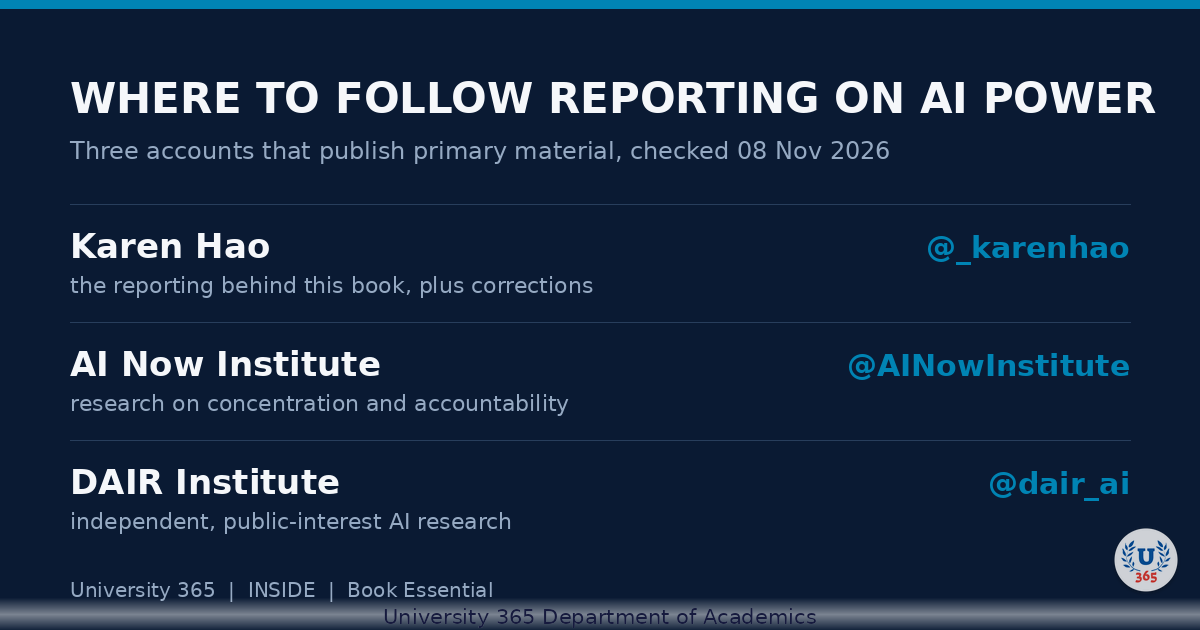
Resources on X
Dedicated X channels:

Empire of AI: Dreams and Nightmares in Sam Altman's OpenAI (Karen Hao)
IMPORTANT NOTICE
This Book Essential is an original summary and critical analysis of Empire of AI: Dreams and Nightmares in Sam Altman's OpenAI by Karen Hao (Penguin Press, 2025). Short quotations from the book are attributed and cited for purposes of criticism, review and education. All rights in the original work belong to its author and publisher; this Essential is not a substitute for the book, and a reader who wants the reporting should read the original at the publisher's page.
This publication is part of University 365's learning library. Explore INSIDE, our publications and our programs. The best summary is not a substitute for the book. Read the original. Discuss this book with a U.Coach.
Note: verify current editions before relying on this comparison. Information verified as of 2026-11-08.




Comments