
Gemini 4 Hydrogen: the fast Gemini 4 model that replaces the Flash tier

Status: Active | Last tested: 2026-11-13 (Gemini 4 Hydrogen, gemini-4-hydrogen, released 2026-11-12) | Re-check: trigger-based (max 6 months)
Active: the tool is current and recommended.
For detailed explanations of the CI-First evaluation terms used in this review, including the Humics Protection Badge and the AI Imposture Risk levels, see the Glossary at the end of this post.


In this Tool Review

Gemini 4 Hydrogen: the fast Gemini 4 model that replaces the Flash tier
The Hydrogen name, the four thinking levels and the tier that gets it, stated before the review begins
Three names sit on this release, and the one a reader will meet first is not the one in the model id.
Name | What it is | Where it appears |
Gemini 4 Hydrogen | The model this review scores. The third model of the Gemini 4 generation, announced 2026-11-12 and available the same day, selected with the model id gemini-4-hydrogen | The launch post from Google, the model page in AI Studio, the model card, and the API pricing page |
Gemini 4 | The generation name, not the model name. Carbon and Argon are the frontier members, Hydrogen is the fast member, and the family is sold on the idea that a workflow can route between them | The launch post, which positions Hydrogen against Carbon and Argon rather than against the field |
The Flash tier | The product class Hydrogen replaces. Google dropped the Flash word from the name and kept the position: this is the model that powers the free and low-cost surfaces | The launch post, the pricing page where Gemini 3.8 Flash still sits, and the Gemini app model picker |
This is a new review, not a re-score of Gemini 3.8 Flash. U365's published Tools library already carries Gemini 3.8 Flash, Gemini 3.7 Flash, Gemini 3.6 Flash, Gemini 3.6 Thinking, Gemini 3.5 Flash-Lite, Gemini 3.1 Pro, Gemini 3.8 Live with Live Avatar, Gemini Notebook and Google AI Studio. None of them is this model, none is edited here, and no sibling CMS record is touched by this review. Gemini 3.8 Flash appears in this document only as the predecessor whose measured position Hydrogen changes.
What this review is not. It is not a review of the Gemini app, of Google AI Studio, of Google Antigravity or of Google Search; those surfaces appear only where the framework's clauses reach them, and the clause note says where. It is not a review of Gemini 4 Carbon, which has no U365 review and is treated here as a named alternative. It is not a review of the Orchestrator feature beyond the vendor's own published claim, because the claim is a vendor measurement and no independent run of the combined configuration exists.
The naming is the first user complaint and it is worth recording as a fact rather than a joke. Hydrogen sits below Argon and Carbon in atomic number and above them on the independent composite at its highest setting. The name carries no ordering a reader can infer, and the launch-day threads show what that costs: a reader who met the model in the Gemini app wrote that seeing "3.8 Flash" replaced by "4 Hydrogen" produced the question "What [on Earth] is Gemini Hydrogen???". A naming scheme is not a capability, and a reader who sorts the family by the periodic table will sort it wrongly.
Four thinking levels, and the default is not the setting the headlines describe. Hydrogen ships with low, medium, high (the default) and xhigh, a fourth level new to this model. The vendor's headline comparison with Argon, 51 against 50, is measured at the default high; the 54 that leads most coverage is the xhigh figure. On independent measurement the move from high to xhigh buys three index points, raises cost per task from $1.87 to $3.16 and raises time per task from six minutes to 13.7. That trade is the single most consequential setting in the product, and the rest of this review treats it as a decision rather than a default.

Gemini 4 Hydrogen: the fast Gemini 4 model that replaces the Flash tier
Tool Snapshot
Gemini 4 Hydrogen, Google's fast Gemini 4 model and the replacement for the Flash tier, sold on speed, price and a narrower gap to the frontier than any previous Flash release.
Category: Applied AI / Large Language Model, built for everyday coding, interactive web work, tool-using agents and multimodal document work. It is the third release of the Gemini 4 generation and the member designed to run in volume rather than to hold the hardest problem.
Primary use cases:
Everyday repository work with a checkable end state. Bug fixes, test repair, refactors bounded to a few files and questions about a codebase, where the vendor's own positioning is surgical edits rather than whole-repository rewrites and where the speed difference against the predecessor is largest.
Interactive web prototyping and design-to-code iteration. The vendor demonstrates single-shot storefronts, voxel worlds and a 3D visualiser, and the model's measured strength in first-pass front-end work is the part a designer or a developer feels immediately.
Volume agent work and parallel subagents. The model is the default engine for the Antigravity agent in Gemini Managed Agents, it batches file reads and search calls, and Google positions it as the cheap worker that a frontier model plans for.
Multimodal document triage. Text, image, video, audio and PDF input in a one-million-token window, for a first pass over a set larger than a person would read, with the caveat that a first pass is not a verification.
The everyday assistant surfaces. The Gemini app, Google Search for every user, Gemini in Sheets for paid tiers and Gemini for business, which is the widest distribution any Gemini 4 model has had on the day of release.
What it is not. It is not a frontier model: at high it sits one point below the two strongest named peers on the independent composite, and on terminal and science work it trails Claude Sonnet 5.5 clearly. It is not a document-grounded analyst of the kind that replaces review: it reads more than it can check, and its weakest independent rows are exactly the agentic terminal and science rows that look most like real work. It is not an image, audio or video generator, it is not open weights, it is not self-hostable, and no parameter count is published. It is not a teaching product, and nothing in it is built to move a capability from the model to the person.
Pricing, as published on 2026-11-13:
Line | Gemini 4 Hydrogen | Gemini 3.8 Flash, for comparison |
Input | $1.50 per million tokens | $0.75 through 2026-12-31, then $1.50 |
Output, thinking tokens included | $7.50 per million tokens | $3.75 through 2026-12-31, then $7.50 |
Context treatment | Flat across the full one-million-token window | Flat across the window |
Free tier | Available in AI Studio and on the Gemini API | Available |
Cached input | Supported, implicit only; independent measurement records a 95 percent cache discount | Supported, implicit only |
Consumption options | Batch, Flex and Priority | Batch, Flex and Priority |
The price comparison needs one sentence of arithmetic. Coverage of this launch repeated that Hydrogen is priced the same as Gemini 3.8 Flash. That is true against the rate 3.8 Flash will charge from 2027-01-01 and false against the rate it charges today: Hydrogen costs twice as much per token as the model it replaces during the promotional window, which ends 2026-12-31. Per completed task the picture can still favour Hydrogen, because it uses fewer thinking tokens and finishes sooner, and independent measurement found exactly that. The honest statement is a two-line statement: a higher token rate, a lower cost per finished job in the tested cases, and a cost advantage that depends on the workload rather than on the sticker.
Official links:
Launch announcement: https://blog.google/innovation-and-ai/models-and-research/gemini-models/introducing-gemini-4-hydrogen
Developer post: https://blog.google/innovation-and-ai/technology/developers-tools/build-with-gemini-4-hydrogen/
Model documentation, gemini-4-hydrogen: https://ai.google.dev/gemini-api/docs/models/gemini-4-hydrogen
What is new in Gemini 4 Hydrogen: https://aistudio.google.com/docs/whats-new-gemini-4-hydrogen
Model card: https://deepmind.google/models/model-cards/gemini-4-hydrogen/
Model card PDF: https://storage.googleapis.com/deepmind-media/Model-Cards/Gemini-4-Hydrogen-Model-Card.pdf
API pricing: https://ai.google.dev/gemini-api/docs/pricing
API terms, including the unpaid and paid data rules: https://ai.google.dev/gemini-api/terms
Search upgrade post: https://blog.google/products-and-platforms/products/search/gemini-4-hydrogen-search-upgrade
Antigravity and Orchestrator post: https://antigravity.google/blog/gemini-4-hydrogen-in-google-antigravity
LLM-specific fields:
API model identifier: gemini-4-hydrogen. Stable, with no dated snapshot name published; the identifier is the model.
Context window: 1,048,576 tokens, unified across input, thinking and output rather than split between them. Maximum output is 65,536 tokens on a synchronous request by default, and up to 1,048,576 through background execution or client-side continuation, which the vendor calls long decode.
Thinking levels: low, medium, high (the default) and xhigh. Four levels, and the effort decision moves quality, latency and cost together.
Modalities: text, image, video, audio and PDF input; text output only. Agentic video understanding is supported, audio generation is not.
Caching: supported, implicit only. There is no explicit cache a developer writes and manages, so the discount applies where the service chooses to reuse a prefix. Independent measurement records a 95 percent cache discount.
Supported capabilities: function calling, structured outputs, search grounding, Maps grounding, URL context, code execution, file search, computer use, agentic video understanding and long decode.
Consumption options: Batch, Flex and Priority, which gives three price and latency settings on top of four thinking levels.
Model relationship: adapted from Gemini 4 Carbon, per the model card. Training data, architecture and hardware are described by reference to the Carbon model card rather than restated.
Knowledge cutoff: March 2026, per the model card, with the vendor's note that some domains are less current.
Parameters and architecture: not disclosed. No parameter count and no weights are published.
License: proprietary hosted service. Not open weights and not self-hostable.
Availability: the free and paid tiers of Google AI Studio and the Gemini API, Android Studio, Gemini for business, the Gemini app for Google AI Pro and Ultra subscribers with automatic routing for free users, Google Search for all users, Gemini in Sheets for Pro, Ultra and eligible business subscriptions, and Antigravity for paid Pro and Ultra subscribers.
At a Glance Dashboard
Field | Value |
Category | Applied AI / Large Language Model (fast agentic coding, everyday knowledge work and high-volume execution) |
CI-First Benefit Score | 6.3 / 10 (CI-First Strong) |
Sub-scores | Time 8 / Quantity 7 / Quality 7 / Skill 3 |
CI-First Profile | Primary: Co-Worker and Assistant (level 2). Secondary: Co-Researcher, Analyst and Tester (level 4), Professor, Coach and Tutor (level 3) |
Humics Protection | Humics-Neutral (-1 / +3) |
AI Imposture Risk | Medium overall, with Skill Illusion High |
Status | Active |
Last tested | 2026-11-13 |
Pricing | $1.50 per million input tokens, $7.50 per million output tokens, flat across the one-million-token window; free tier available |
Platforms | Gemini API, Google AI Studio, Android Studio, Gemini app, Google Search, Gemini in Sheets, Gemini for business, Google Antigravity |
User sentiment | Positive on speed and everyday coding, critical of the naming and the tier structure |

Gemini 4 Hydrogen: the fast Gemini 4 model that replaces the Flash tier
The Problem
The everyday work that consumes a professional's week is not the work the frontier is sold on. It is a failing test, a component that needs rebuilding, a document set that has to be reduced to a table, a first draft that has to exist before it can be judged. That work is repetitive, it is bounded, and it is expensive in exactly one currency: the time between deciding to do it and seeing whether it worked.
The models built for it have carried a specific compromise. A Flash-tier model is cheap and fast enough to use without a purchase decision, and it has historically been the tier that collapses on the third step: it loses the thread across files, it invents a function that does not exist, it reports a fix it did not make. The 3.8 Flash generation narrowed that gap and did not close it. On the vendor's own cheating-adjusted Terminal-Bench 4.1 row, Gemini 3.8 Flash scores 18.2 percent. A reader who has watched a coding agent confidently finish a task it did not complete knows what that number describes.
The frontier models close the gap and introduce a different one. They cost between two and ten times more per token, they take minutes rather than seconds, and their best results arrive at effort settings that make a routine task feel like a research project. A team that routes every bug fix to a frontier model is paying frontier prices for work that does not need frontier reasoning. A team that routes every bug fix to a cheap model is redoing a share of them.
The result is a triage problem that most teams solve by habit rather than by measurement. Cheap model for the small things, expensive model for the hard things, and no clear line between them, because the cheap model's failures are quiet and the expensive model's cost is visible. The vendor's own framing of this release names the problem directly: Hydrogen is built for "rapid execution across diverse agentic workflows", and it is sold as the worker that a frontier model plans for rather than as a replacement for the planner.
There is a second problem underneath the first, and it is the one U365 cares about most. Speed changes the economics of verification. When a task takes two minutes, checking it costs more than generating it, and the temptation is to read the summary rather than the diff. A model that is fast, fluent and right most of the time is a model that trains its user to stop looking. The CI-First question is therefore not whether Hydrogen can do the work. It is whether the person directing it still does the part that makes the result theirs.

Gemini 4 Hydrogen: the fast Gemini 4 model that replaces the Flash tier
The Outcome
Hydrogen moves the Flash tier from "cheap enough to try" to "good enough to rely on for bounded work", at a token price that is higher than its predecessor's promotional rate and lower per finished job in the cases that have been measured.
The measured movement against the model it replaces is large and it is concentrated where everyday work happens. On the vendor's cheating-adjusted Terminal-Bench 4.1 row, Hydrogen scores 57.0 percent against 18.2 for Gemini 3.8 Flash. Google reports more than five times fewer fabricated claims, and describes the mechanism plainly: the model flags missing context instead of guessing, batches file reads and search calls in parallel, and adapts when a tool call fails. On the independent composite it scores 51 at the default high setting and 54 at xhigh, against 50 for Gemini 4 Argon at its default. A cheaper, faster member of the family outscoring the frontier member on a general index is the headline fact of this release, and it is a fact about the shape of the index as much as about the model: general indexes reward breadth and speed, and the rows where Argon and Carbon lead are the hard, narrow ones.
The practical outcome for a U365 Fellow is a model that can carry a bounded task in one pass at a price that does not require a budget conversation. A small Python repair, a working prototype, a table built from a document set and a first pass over a reading list are all within reach on a free tier or on a $1.50 input rate. The three-task comparison published by AI/ML API, run on the day of release, is the clearest illustration: Hydrogen completed a bug fix in 43 seconds and $0.05 against 170 seconds and $0.10 for 3.8 Flash, a racing game in 62 seconds against 108, and a 3D black-hole page in 106 seconds against 192 with four of four visual checks passing against two of four. Across the three tasks it took about 3.5 minutes and $0.26 against about eight minutes and $0.28 for the predecessor. The reason is visible in the same test: Hydrogen spent roughly 6,000 thinking tokens where 3.8 Flash spent almost 25,000. Fewer tokens at a higher rate can still be a smaller bill.
Where the outcome is smaller than the marketing. On the rows that measure hard agentic terminal work and science, Hydrogen is mid-pack rather than leading. Independent measurement puts it at 54 percent on Terminal-Bench 4.0 and 50 percent on Terminal-Bench-Science 0.1 at xhigh, against 64 and 53 for Claude Sonnet 5.5. Vals AI ranks it 11th of 64 on Terminal-Bench 4.0 and 21st of 38 on its hardest legal-agent benchmark. The model is strong on the work most people do most days and ordinary on the work that separates a good agent from a reliable one.
For U365 Fellows, the outcome is a change in what can be attempted without a purchase order. A learner can iterate on a prototype twenty times in an afternoon, run a first pass over a week of reading, and see a working result before deciding whether the idea deserves more. That is a real educational gain, and it is a gain in attempts rather than in judgement. The judgement still has to be built, and the Real Workflows section gives three workflows that pair the speed with a check the learner owns.
What the release does not change. It does not remove the verification step, it does not make a non-expert able to evaluate expert output, and it does not make the free tier safe for confidential material. Those three facts sit in the clauses, in Section 7c and in the imposture table, and no speed gain moves them.

Gemini 4 Hydrogen: the fast Gemini 4 model that replaces the Flash tier
Who Should Use Gemini 4 Hydrogen
Learner type | Difficulty | Typical ROI | Career path |
Students (Bachelor, Master) | Beginner to Intermediate | The cheapest entry into a Gemini 4 model: free in AI Studio and on the free tier of the Gemini API, with the Gemini app routing free users to it through automatic model selection. Strong for a first programming project, a prototype that has to exist before it can be assessed, and a reading set reduced to a table. The Skill Illusion is the live risk: a working prototype produced in one prompt looks like evidence of a skill the student may not have, and the check in Real Workflows is what turns the prototype into learning. | |
Professionals (career upskilling) | Intermediate | The strongest case in the release for developers who want a fast worker inside an existing loop: bug fixes, test repair, refactors bounded to a few files, front-end iteration, and a document first pass. The measured cost per finished task is competitive with the predecessor even at a higher token rate, and the Antigravity agent uses it by default. It is not the model to hand the hardest problem, and the independent terminal and science rows show where the boundary sits. | |
Everyone (lifelong learners) | Beginner | A capable everyday assistant in Search, the Gemini app and Sheets, at no cost on the free route. The gain is in attempts: more drafts, more variants, more first passes, with the judgement about which one matters left where it belongs. Answers are fast and fluent, and fluency is the reason a reader should keep one verification habit per task. | LIPS Collect and Review phases for the reading work, and the UP-Context-Engineering Method order for prompting. No assessment home is asserted. |
For teams and organisations. The model is sold to companies as well as to individuals, and a team deciding on it starts with four questions.
Team deployment. Reachable across a team through the Gemini API, Gemini for business, Google AI Studio, Android Studio and Gemini in Sheets on eligible business subscriptions. The Antigravity surfaces that carry the strongest developer case require a paid Google AI Pro or Ultra seat per person, and the free tier is an individual route rather than a team route. A team that standardises on Hydrogen gets one model across prototyping, document work and agent execution, which is the practical argument for it.
Cost at team scale. Three lines move independently: the token rate, the thinking level and the volume of retries. The rate is flat at $1.50 and $7.50 across the whole window, which makes long-context work predictable; the thinking level moves the same task from $1.87 to $3.16 per independent index task; and the free tier is not a team option because the data terms differ. A team that sets no thinking-level policy has left the largest line of its bill to individual habit.
Data and compliance. Google's paid tiers state that prompts and responses are not used to improve its products and are processed under the Data Processing Addendum. The free tier states the opposite: content is used to provide, improve and develop Google products, and human reviewers may read, annotate and process input and output. The paid path is the only path for company material, and Section 7c records the terms.
U365 for companies. Professional learners reach University 365's academic services individually or through their organisation, and the company route runs through a customized training agreement for employee groups. Corporate education programmes are built on demand, and their tuition follows content and duration.
Skill level required: Intermediate. The model is easy to start and the hard part is supervision: stating a finish line, choosing a thinking level before the run, reading the diff rather than the summary, and knowing which parts of the output you can check yourself. None of that is required to get an answer, and all of it is required to rely on one.
Prerequisites. For the app and Search: a Google account; a paid Google AI Pro or Ultra subscription for on-demand selection in the app, with free users reaching the model through automatic routing. For Antigravity: a paid Google AI Pro or Ultra subscription. For the API: a Google Cloud project, a decision about whether the workload can run on the free tier under the unpaid data terms, and a decision about the thinking level each job runs at. Working knowledge of prompt structure and of verification practice, because the output reads as finished whether or not it is correct.
Typical time to first result: Under two minutes in the Gemini app or Search. Under ten minutes in Google AI Studio for a first call with the model id gemini-4-hydrogen at the default high level.
Typical time to competence: Ten to twenty hours of active use. Two habits carry most of the value: choosing the lowest thinking level that clears your quality bar, and pairing every generated artefact with a check you already own.
Who should wait. Anyone whose work cannot be checked by the person asking for it, because the model's fluency is the risk rather than the remedy. Anyone whose data cannot leave a paid boundary, because the free tier is the cheapest route and the wrong one for confidential material. And anyone who needs the hardest terminal or science task done reliably, because that is the row where the model is ordinary.

Gemini 4 Hydrogen: the fast Gemini 4 model that replaces the Flash tier
U365 Institutes Alignment
The alignment below rates what a U365 institute could take from this model as a working instrument and as an object of study. The primary home is UIT (Technology, AI, Data Science), because fast iteration on code, agent supervision and cost-per-finished-task arithmetic are the competencies this model exercises, and because a Flash-tier model that outranks its own frontier sibling on a general index is itself a teaching object about what a benchmark measures. The other three readings are real and each is bounded.
UIT (Technology, AI, Data Science)
Rating. High (primary)
Why. Four engineering competencies, each of which survives the removal of the tool. Fast iteration under supervision: writing a prompt that names a finish line, running a bounded edit, and reading the diff before accepting it, which is the discipline the speed makes urgent rather than optional. Model routing: reading the vendor's own table and the independent composite well enough to decide which task goes to Hydrogen, which to Carbon or Argon, and which to a peer, which is a portfolio skill rather than a model skill. Evaluation design: noticing that the same launch leads with a 57 percent terminal result against its predecessor and sits mid-pack against its peers, and understanding that both sentences are true because the comparison base changed. Cost engineering: computing cost per completed task from a token rate, a thinking level and a measured token count, which is the arithmetic the $1.50 rate makes learnable on a student budget. The published programme set already teaches Python, software development and cloud engineering; this model is a working object on which those skills are exercised.
The limit that holds the row. The model is a service a practitioner operates, not an artefact a practitioner inspects. There are no weights, no architecture description and no parameter count, so the competencies are engineering-with rather than engineering-of. The catalogue's AI-agent instruction is concentrated in its certificate series rather than spread across the degree paths, and no published programme assesses cost-per-finished-task as a named component. Adjacent anchors, not assessment homes.
UIB (Business Management, Entrepreneurship)
Rating. Medium
Why. Two decisions the release forces that are commercial before they are technical. Model selection with a price that looks like parity and is not: Hydrogen charges twice the current promotional rate of the model it replaces and the same rate that model will charge in 2027, so a business case built on a headline sentence is a case built on a comparison base nobody stated. Reading it correctly is a finance skill a cohort can practise on live numbers. And the automation question: an agentic business-workflow result of 76.1 percent on AutomationBench and a final bank balance of $14,549 on Vending-Bench 2 are working instruments for operational analysis, and reading them well means knowing what a simulated business benchmark does and does not certify.
The limit that holds the row. The model supplies no management method and does not measure its own return. It publishes no completion rate and no time-per-task figure outside the vendor's own benchmark selection, so a business case has to be built by the unit. The catalogue's business programmes publish process modeling and financial analysis, and no published programme assesses the economics of a model portfolio as a named component. Adjacent anchors, not assessment homes.
UIC (Digital Communication, Marketing)
Rating. Low to Medium
Why. One competency that matters and is easy to miss: reading a launch claim against the document that supports it. This release is a worked example, because the sentence "priced the same as Gemini 3.8 Flash" is true against a rate that starts in 2027 and false against the rate a buyer pays today, and a communication practitioner who can spot that is doing the job the profession claims. The writing surface is real as well: the vendor sells first-try email drafts, study guides and rewrites that follow tone and format, and Search now returns more structured, visual answers built on this model, which changes what a reader sees before they reach a publisher's page.
The limit that holds the row. The model teaches no register, no audience analysis and no publication standard. It returns no sourced evidence of its own, so fact-checking stays with the writer, and no campaign or content-strategy competency appears in it. Rated as evaluation contact with a writing surface. No credential is mapped.
UID (Digital Design, UX/UI)
Rating. Low to Medium
Why. The clearest design contact any Flash-tier model has offered. The vendor's own demonstrations include a one-shot e-commerce storefront with a WebGL2 shader, scrollytelling and a live configurator, a shared voxel world built from prompts, and a 3D visualiser, and the independent hands-on test in this review's evidence set found Hydrogen the only model of four to draw a black hole with a dark centre and a ring. A designer can study the outputs as the current state of design-to-code, and can use the model to produce variants fast enough that comparison becomes the work.
The limit that holds the row. The model performs no design judgement and evaluates no design against a brief. It reads images and video and produces text and code, and it generates no images at all, so the visual surface is input plus front-end code rather than visual authorship. No layout, interaction or motion competency is assessed by it. No credential is mapped.
U365 methods, not an institute (UNOP, ULM, LIPS, CARE and the UP-Context-Engineering Method)
Rating. Applicable
Why. The methods layer is relevant in the way a fast model is: thinking level is a planning decision before it is a settings decision, and the UP-Context-Engineering Method's context-role-task-constraints-output order is exactly what a reproducible run needs. For LIPS and CARE, the record of what a run was asked to do, at what thinking level, and what it returned belongs in the Fellow's own system, because the model holds no state between calls and keeps nothing on the user's behalf. UNOP has no direct fit: the model is not built to teach, and its gains come from speed and fewer fabricated claims rather than from any pedagogical mechanism.
The limit that holds the row. The model carries no method of its own and no coaching surface. A Fellow who does not keep the reasoning about thinking level and verification in their own system has no account of it, and nothing in the product writes that account for them.

Gemini 4 Hydrogen: the fast Gemini 4 model that replaces the Flash tier
How Gemini 4 Hydrogen Works
A natively multimodal model adapted from Gemini 4 Carbon, sold as the fast member of the Gemini 4 family, with a unified one-million-token window, four thinking levels and a free tier that the frontier members do not have.
Inputs: Text prompts, documents, images, video, audio and PDFs; through the API, a conversation history plus tool definitions and, where used, grounded search, URL context, file search, code execution and computer use. Through Antigravity or the Gemini platform, a repository, its instruction files and any rulebook you have written. The model reads five modalities and produces text.
Outputs: Text, code, structured tool calls and, through agent surfaces, edits to files. Up to 65,536 tokens in a synchronous response, and up to 1,048,576 tokens through background execution or client-side continuation, inside a context window of 1,048,576 tokens that is shared with the input rather than separate from it.
Underlying technology, as the vendor publishes it:
Model: Gemini 4 Hydrogen, model id gemini-4-hydrogen. Adapted from Gemini 4 Carbon, per the model card, which describes training data, architecture and hardware by reference to the Carbon card rather than restating them.
Position in the family: the third Gemini 4 model, released after Carbon and Argon and positioned below both on depth of reasoning and above both on speed and price. Google's own guidance routes everyday coding, interactive web apps, tool-using agents and parallel subagent work to Hydrogen, and hard architecture, debugging, science and security work to Carbon or Argon.
Unified context: 1,048,576 tokens across input, thinking and output together. The window is one budget rather than two, so a long document set and a long answer compete for the same tokens.
Thinking levels: low, medium, high (default) and xhigh. The vendor describes the progression as smooth and predictable and advises starting at high, reserving xhigh for hard multi-step problems, and running evaluations at all four levels with a high output ceiling before choosing the lowest level that clears the quality bar.
Long decode: a response longer than the 64K synchronous ceiling is produced through background execution, where the service continues in 64K-token hops, or through client-side continuation in the SDKs. The vendor notes that setting background execution without setting a maximum output length stops the response at 65,536 tokens.
Caching: supported, implicit only. There is no explicit cache a developer writes, so the cached-input discount applies where the service chooses to reuse a prefix. Independent measurement records a 95 percent cache discount.
Consumption options: Batch, Flex and Priority, on top of the standard synchronous service. Volume work, latency-tolerant work and latency-critical work each have a documented path.
Modality breadth on input, text-only on output: text, image, video, audio and PDF in; text out. Agentic video understanding can inspect specific frames, which is analysis rather than video production.
Safety stack, as the vendor describes it: training-time alignment plus real-time surface safeguards, with the release claiming up to 81 percent less overreach in agentic tasks, up to 79 percent less under-service, and a 12-fold cut in misaligned actions and task shortcutting across tool-use and coding evaluations. The model card adds that the full Safety and Security Report is still to come.
Surfaces: the free and paid tiers of Google AI Studio and the Gemini API, Android Studio, Gemini for business, the Gemini app, Google Search, Gemini in Sheets and Google Antigravity, with the tier rules stated in the snapshot.
What is not disclosed. No parameter count. No weights. No architecture description beyond the reference to Carbon. No explicit caching layer. And no statement that would let a buyer audit what the model does internally; the framework's clause assessments turn on what ships on the surfaces, not on anything inside the model.
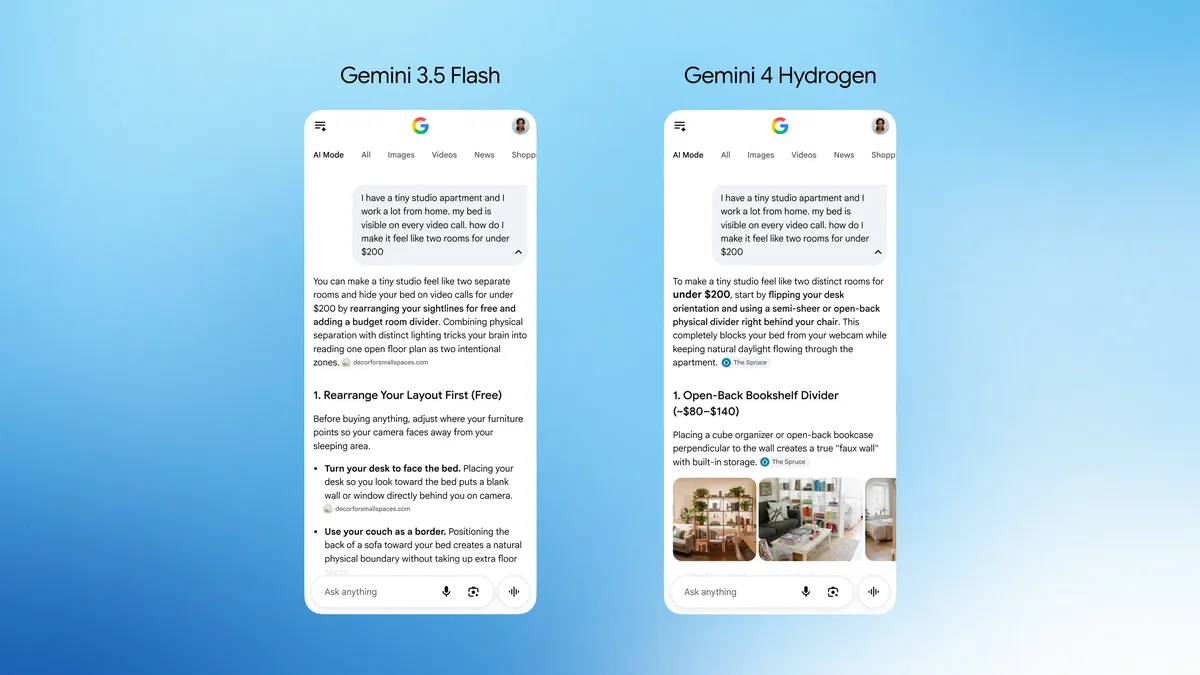
How the economics actually work. The rate is flat across the window at $1.50 and $7.50, which is simple and is not the whole bill. Thinking tokens are billed as output, so the effort level is a cost control before it is a quality control. The independent record shows the same task costing $1.87 at high and $3.16 at xhigh, with time per task moving from six minutes to 13.7, and Vals AI records $9.84 per test on a different suite where latency averaged 32 minutes. A reader who compares $1.50 with a competitor's input rate is comparing the smallest line of the bill.
What it is bad at natively. Hard terminal and science work, where it trails Claude Sonnet 5.5 on both terminal rows and sits mid-pack on Vals' hardest legal benchmark. Long, verbose answers: independent measurement records 304 million output tokens across a full index run against a median of 72.8 million, which is the highest verbosity reading in its comparison set and a cost multiplier that the token rate hides. Image, audio and video generation, which it does not do at all. And any task whose correctness the person asking cannot evaluate, which is a limit of the arrangement rather than of the model.

Gemini 4 Hydrogen: the fast Gemini 4 model that replaces the Flash tier
Getting Started with Gemini 4 Hydrogen
Required accounts: A Google account. For the app and Search, a free account reaches the model through automatic routing and a paid Google AI Pro or Ultra subscription allows on-demand selection. For Antigravity, a paid Google AI Pro or Ultra subscription. For the API, a Google Cloud project, with the free tier available and the paid tier required for confidential material.
Installation: Nothing to install for the app, Search or AI Studio in a browser. Android Studio carries the model for development work. For the API, nothing beyond an HTTP client or one of the official SDKs, with the model selected by the id gemini-4-hydrogen.
First-time configuration:
Decide the data boundary before you decide anything else. The free tier uses your content to improve Google's products and allows human review; the paid tier does not. That single choice determines whether the model can touch client material, and it is made at the account level rather than per prompt.
Set the thinking level deliberately and write down what you chose. Four positions, with high as the default. Start at high for real work, move down for simple tasks, and reserve xhigh for a problem where high demonstrably fell short, because xhigh nearly doubles cost per task and more than doubles time on independent measurement.
Set a maximum output length that fits the answer, not the default. The synchronous ceiling is 65,536 tokens and a low hard-coded cap truncates a long answer. If a task genuinely needs more, use background execution with a stated maximum, or client-side continuation.
Choose the consumption option per job rather than per account. Batch and Flex suit volume and latency-tolerant work, Priority suits latency-critical steps, and standard synchronous calls sit between them.
Do the cost arithmetic on tokens per task, not on price per token. Multiply your measured output tokens by $7.50, add input at $1.50, and compare that with the same sum for the model you are replacing. The three-task hands-on comparison in this review is a template for the calculation.
Make the first task one that ends in a check you already own. A failing test, a page that either renders or does not, a table whose numbers you can spot-check against the source. The model is strongest where the end state is visible, and a first task should sit there.
Write the rulebook before the agent run. A short instruction file that names the finish line, the files in scope and the stopping rule is the difference between a bounded edit and a rewrite you did not ask for.
First 15 minutes checklist:
☐ Run one real task from your own work in a single message, with a stated finish line and a stated stopping rule.
☐ Confirm which thinking level you are on, then run the same task at high and xhigh and compare the answer, the wait and the token count.
☐ Take one factual claim from the answer and verify it against a source outside the conversation.
☐ Write down the input and output tokens the run used, and compute cost per finished task.
☐ Confirm which tier the run used, and whether that tier is allowed to see the material you gave it.
Result: One real task completed end to end, a deliberate thinking level, one verified claim and a known cost per finished task. That is a working setup rather than an impression.

Gemini 4 Hydrogen: the fast Gemini 4 model that replaces the Flash tier
Real Workflows
Three workflows, each chosen because the model's measured strength and a check the reader already owns sit in the same place. Each prompt follows the UP-Context-Engineering Method order: context, role, task, constraints, output format.
Workflow 1: Repair a failing test suite without rewriting the file
When to use it: a test run fails, the cause is in one or two files, and you can re-run the suite yourself. This is the workflow where the speed difference against the predecessor is largest and where the end state is unambiguous.
UP-Context prompt:
Context: The repository is at [path]. The failing command is [test command] and the failing tests are [names]. The files in scope are [file list], and nothing outside that list is in scope. Done means the suite passes and no test was skipped or weakened. I am working at thinking level high, and I move to xhigh only if high fails on the same task.
Role: AI as a Co-Worker and Assistant (Profile 2). You execute the repair. I state the finish line, choose the thinking level, run the suite myself, and read the diff before I accept it.
Profile: Act as a Co-Worker and Assistant for the repair, and as a Co-Researcher, Analyst and Tester on the diagnosis.
Task: Find the cause, make the smallest change that makes the failing tests pass, and explain the cause in three sentences.
Constraints: Do not reformat, rename or refactor anything outside the failing path. Do not add a dependency. Do not weaken, skip or delete a test. If the cause is not in the files in scope, stop and say what you need instead of guessing. Never report a test result you did not run. Anything you rely on from after March 2026 must be supplied by me or marked unverified, because your knowledge stops in March 2026. If the cause is outside the files in scope, or the task turns into hard terminal or science debugging that neither of us can check here, stop and say so.
Output format: (1) the cause in three sentences, (2) a unified diff, (3) the exact command to re-run, (4) what you did not verify.
Memory: you hold no state between calls and you write nothing on my behalf. I keep the cause, the diff and the test evidence in LIPS Collect and Review, and the decision to ship in my CARE action plan.
UP-Context-Engineering verification: I run the suite in a clean checkout, confirm that no test was skipped, weakened or deleted, read the diff line by line, and write the cause in my own words without the transcript. If I cannot explain the cause and defend the fix, I do not accept it. I record what I checked and what I could not check.
Data safety: the free tier of AI Studio and the Gemini API uses my content to improve Google's products and allows human review, and the paid tier does not. I do not paste a credential, a private key, a customer record or an unreleased repository into the free tier, and for confidential code I use the paid tier and confirm the setting at account level first.
What the model does well here: it batches the reads, it holds the file list, and on the vendor's own measurement it flags missing context instead of inventing it. The independent three-task test found it spending about 6,000 thinking tokens on a small Python repair where the predecessor spent almost 25,000, which is why the same repair finished in 43 seconds against 170.
VERIFICATION CHECKLIST for Repair a failing test suite:
☐ Multi-Model Check: run the same prompt through a second model (Claude Sonnet 5.5 or GPT-6.1 Terra) and compare the diagnosis, not the diff. A different cause means one of them is guessing.
☐ External Source: run the test command yourself in a clean checkout and confirm the failing tests now pass and that no test was skipped, weakened or deleted.
☐ Human Review: read the diff line by line. A passing suite with a changed assertion is a failure that has been hidden.
☐ CI-First Test: can you explain the cause and defend the fix without the transcript? If not, the fix is not yours yet.
Workflow 2: Build a working prototype in one file, then judge it
When to use it: you need something to look at before you can decide whether the idea is worth building. A single-file HTML prototype, a 3D scene, an interface variant. This is the workflow the vendor demonstrates most, and the one where the model's fluency most easily passes for design judgement.
UP-Context prompt:
Context: I am testing an interface idea, not shipping it. The audience is [audience] and the constraint that matters is [constraint]. The idea is [idea] and I will judge it against [the check I own]. I am working at thinking level high.
Role: AI as a Co-Worker and Assistant (Profile 2) for the build. I own the brief, the judgement and the decision to keep or drop the idea.
Profile: Act as a Co-Worker and Assistant for the build, and as a Challenger, Critic and Devil's Advocate on the brief: name the decisions my brief left open.
Task: Build one self-contained HTML file that demonstrates [idea].
Constraints: Use only [library and version]. No external images, fonts or network calls. The page must run by opening the file. Keep the code readable enough that I can change one value and see the effect. Name every decision you made that I did not specify instead of presenting it as a requirement. Do not claim the result looks good or is well designed: you perform no design judgement here. If a library or API changed after March 2026, say so instead of assuming its current behaviour, because your knowledge stops in March 2026.
Output format: one code block, then a five-line note naming the three decisions you made that I did not specify and what you did not verify.
Memory: you hold no state between calls. I keep the brief, the variant I chose and the reason in LIPS, and the comparison between variants is my record, not yours.
UP-Context-Engineering verification: I open the file in a browser, click every control, and check the requirements list against the page rather than against your note. I ask someone who did not write the prompt to use it for two minutes and say what they think it does. I change one behaviour in the file without you. If I cannot change one behaviour, I have a demo rather than a prototype, and I do not count it as design work.
Data safety: the free tier of AI Studio and the Gemini API uses my content to improve Google's products and allows human review, and the paid tier does not. I do not paste a client brief, a brand asset or an unreleased interface into the free tier, and for confidential material I use the paid tier and confirm the setting at account level first.
What the model does well here: first-pass completeness. Independent hands-on testing found it the only one of four models to produce a black hole with a dark centre and a ring, and the fastest of the four on all three tasks. The vendor's own demonstrations, including a one-shot storefront with a WebGL2 shader and a shared voxel world, are the same capability at a larger scale.
VERIFICATION CHECKLIST for Build a working prototype:
☐ Multi-Model Check: generate the same prototype with one other model and compare which requirements each one met, not which one looks better.
☐ External Source: open the file in a browser, click every control, and check the requirements list against the page rather than against the note.
☐ Human Review: ask someone who did not write the prompt to use it for two minutes and say what they think it does.
☐ CI-First Test: can you change one behaviour in the file without the model? If not, you have a demo rather than a prototype.
Workflow 3: Reduce a document set to a table you can defend
When to use it: a set of PDFs, reports or pages has to become a comparison table, and every cell will be read by someone who will check it. This is the workflow where the model's speed is most seductive and where a fabricated cell is most expensive.
UP-Context prompt:
Context: The documents are at [paths] and they are the only sources allowed. The decision they inform is [decision], the reader will check every number against the source, and a document is irrelevant if [irrelevance test]. I need [fields] for each of [n] documents. I am working at thinking level high.
Role: AI as a Co-Researcher, Analyst and Tester (Profile 4). You extract. I define the fields and the inclusion rule, and I check every cell I will act on.
Profile: Act as a Co-Researcher, Analyst and Tester for the extraction, and as a Challenger, Critic and Devil's Advocate on the cells you are least confident about.
Task: Extract [fields] for each of the [n] documents into one table.
Constraints: One row per document. Every cell carries a page or section reference in the same cell. If a field is absent, write "not stated" rather than inferring it. Do not merge two documents into one row. Do not fill a cell from general knowledge: your knowledge stops in March 2026, so anything from after that date must come from the supplied document or be marked unverified. Where two documents disagree, show both rows instead of resolving them. If a document yields nothing usable, say so rather than summarising it.
Output format: a markdown table with a source column, then the cells you are least confident about and why, then what you did not verify.
Memory: you hold no state between calls and you write nothing on my behalf. I keep the table and the count of cells that failed my check in LIPS, and the decision the table informs in my CARE action plan.
UP-Context-Engineering verification: I open the cited page for every cell I will act on and confirm the number is there, I re-extract two rows with a second model and treat a disagreement as a cell to check by hand, and I count how many cells failed and record the count. If a citation resolves to the wrong page, I drop the row. I defend each row without reopening the session, or I do not use the table.
Data safety: the free tier of AI Studio and the Gemini API uses my content to improve Google's products and allows human review, and the paid tier does not. I do not paste a client document, an unpublished report or personal data into the free tier, and if the terms of the tier I am using cannot be confirmed, I do not paste the material at all.
What the model does well here: breadth and instruction following. It reads tables, charts, dense PDFs, images and video in one window, and the vendor reports stronger multimodal synthesis than the predecessor. On the independent finance and legal indexes it ranks second of 40 and ninth of 38, which is the right shape for this work.
VERIFICATION CHECKLIST for Reduce a document set to a table:
☐ Multi-Model Check: re-extract two rows with a second model and compare. A disagreement is a cell to check by hand.
☐ External Source: open the cited page for every cell you will act on and confirm the number is there. A citation that resolves to the wrong page is worse than no citation.
☐ Human Review: have the person who owns the decision read the table and the uncertainty list together, not the table alone.
☐ CI-First Test: can you defend each row without reopening the model session? If a row depends on the transcript, it is not evidence yet.

Gemini 4 Hydrogen: the fast Gemini 4 model that replaces the Flash tier
Strengths, Limits, and AI Imposture Risk
Strengths
CI-First Benefit | Strength | Evidence |
Time | The largest speed gain in the Flash line, on work that is bounded and checkable. | Google reports 2.5 times faster task completion than Gemini 3.8 Flash at the default high level; the independent three-task test measured 43 seconds against 170 on a repair, 62 against 108 on a game, and 106 against 192 on a 3D page; output speed is 188 tokens per second on independent measurement, with a 40.55 second time to first answer token. |
Quantity | A genuine output multiplier for attempts and variants, backed by parallel tool use and a million-token output path. | The model batches file reads and search calls, is the default engine for the Antigravity agent, and supports Batch, Flex and Priority. Antigravity's Orchestrator pairs it with Carbon and reaches near-Carbon task success on Terminal-Bench 4.1 while consuming 24 percent less quota and finishing 19 percent faster, per Google. Held at 7 because volume is exactly where verbosity becomes a bill: 304 million output tokens across a full index run against a 72.8 million median. |
Quality | A substantial move against its predecessor and a respectable position against its peers, strongest on knowledge work and first-pass front-end code. | 57.0 percent on the vendor's cheating-adjusted Terminal-Bench 4.1 against 18.2 for 3.8 Flash; 54 on the independent composite at xhigh, 16th of 78; Vals Index 68.49 percent, 6th of 37, first of 85 on Tax Agent Bench and second of 40 on the Finance Index; 8 percent hallucination on the independent omniscience evaluation. Held at 7 rather than higher by the mid-pack coding rows and the clear terminal and science gaps. |
Skill | Marginal, and honestly marginal. | No teaching mode is claimed. The model is used for delegation rather than learning, there are no open weights, and the framework's clause 5.2.3-a returns a null with a boundary rather than a mechanism that transfers capability. The one skill-adjacent behaviour, flagging missing context instead of guessing, is a good habit to observe and is not instruction. Scored conservatively. |
Limits
Hard terminal and science work is the gap. 54 percent on Terminal-Bench 4.0 at both high and xhigh, and 50 percent on Terminal-Bench-Science 0.1 at xhigh, against 64 and 53 for Claude Sonnet 5.5. Vals ranks it 11th of 64 on Terminal-Bench 4.0 and 21st of 38 on its hardest legal-agent benchmark.
The speed claim is relative to its predecessor, not to the field. At xhigh, independent measurement places it at 13.7 minutes per index task, slower than the 13.0 minute median, and its 40.55 second time to first token is not fast. The 2.5 times figure compares Hydrogen at high with 3.8 Flash at the same setting, which is a fair comparison and not a comparison with Claude or OpenAI.
It is verbose, and verbosity is a cost multiplier. 304 million output tokens across a full index run against a median of 72.8 million, the highest reading in its comparison set. The token rate is moderate; the number of tokens is not.
The price is not parity with the model it replaces today. $1.50 and $7.50 is twice the current promotional rate of Gemini 3.8 Flash, which ends 2026-12-31, and equal to the rate that model will charge afterwards. Per finished task the independent tests favour Hydrogen; per token the launch coverage was wrong.
Knowledge stops in March 2026. The model card states the cutoff and warns that some domains are less current. Anything that moved after March needs retrieval or a supplied document.
Unjustified refusals rose against the predecessor. The model card records a 5.57 percentage point increase in over-refusals on benign or borderline prompts, with image-to-text safety up 7 points and refusal tone slightly worse. The trade is better safety on multimodal input and more friction on harmless requests.
The full safety report is not published yet. The model card states CCL alert thresholds reached for biological and cyber risk, no CCL reached, and a Safety and Security Report coming soon. A reader adopting the model is adopting a document set that is still incomplete.
No open weights, no self-hosting and no external auditability. Nothing about this model can be inspected from outside the vendor's service.
AI Imposture Risk
Time Illusion
Rating. Medium
Evidence. The savings are real on bounded work: 43 seconds against 170 on a repair, 62 against 108 on a prototype, and fewer thinking tokens than the predecessor. The overhead is real as well: choosing among four thinking levels, reading output that is the most verbose in its comparison set, verifying front-end code by opening it, and a first-token latency of 40.55 seconds on independent measurement. At xhigh the same task takes 13.7 minutes, which is longer than the median model.
Quantity Illusion
Rating. Medium
Evidence. The volume is the product: more variants, more attempts, parallel tool calls, and a million-token output path. The failure mode is that a working prototype and a correct prototype look identical in a screenshot, and the vendor's own demonstrations are selected for the ones that worked. 8 percent hallucination is good and is not zero, and a fabricated table cell is invisible until someone checks it.
Skill Illusion
Rating. High
Evidence. Expert-looking code, working interfaces and polished tables produced for users who cannot evaluate them, at a speed that discourages checking. The 57 percent terminal result against a predecessor's 18.2 is a real capability gain and it is also the exact shape that makes a user believe they can now do the thing the model did. Mitigations exist and are cited: more than five times fewer fabricated claims, missing context flagged instead of guessed, 8 percent hallucination, and the verification checklists above. Those mitigations lower the frequency of failure; they do not move the capability to the reader.
Overall Imposture Risk: Medium. One trap is High with identifiable mitigations, and two are Medium. Under the framework's arithmetic, one High with clear mitigations stated is Medium rather than High. The rating holds at Medium for a specific reason: the model's best-documented behaviour, flagging missing context rather than filling it, argues downward, while its speed, fluency and volume argue upward at the same time.
Framework v1.2 clause note
Clause 5.2.3-a, agent-authored procedural memory: NULL, recorded with its boundary. The model holds no state between API calls and writes nothing by itself. The agent surfaces operate from rulebooks the user authors, and the Antigravity skills are user-authored rather than model-authored. The Gemini app's saved information is user-visible and user-editable. No documented mechanism ships by default by which this model writes skills, memory stores or standing instructions on the user's behalf, so the clause returns a null rather than applying. The live condition is specific: Hydrogen is now the default model for the Antigravity agent in Gemini Managed Agents, so any change that makes that agent write skills or memory by default re-opens this clause, which is why the sixth re-check trigger names it.
Clause 4.2-a, agent-mediated conversation: NULL for the model as a generator. Neither erosion condition is met. No agent-authored text is presented as the person's own voice in a human-facing channel by default, and nothing substitutes agent interaction for human contact. The live condition to watch on any deployment: an agent that sends text in the person's own name through a connected account without the person reading it first would meet condition (a). That is a property of a deployment built around this model rather than a property of the model.
Clause 7.5, team-level rooms: NULL, recorded for completeness. The subsection was superseded and removed from the framework on 2026-10-13, and nothing in this model's surfaces reaches its case.
Recorded together: the clause questions above return nulls with boundaries and live conditions rather than mechanisms, and the boundary is the part that matters. The reason the Skill Illusion still rates High is not a clause mechanism; it is the plain fact that the model produces working code and finished-looking artefacts on tasks whose correctness the person asking often cannot check, at a speed that makes checking feel disproportionate.

Gemini 4 Hydrogen: the fast Gemini 4 model that replaces the Flash tier
Section 7c: Free-tier data terms, safety thresholds and a model inside Search, stated plainly
A Section 7c finding is recorded where a supplier's governance, safety record or conduct has a real result for the reader. The items below were checked against primary sources, and they produce findings a buyer should carry. All findings are stated as facts of record, and the difference between a company statement, a published evaluation and a policy term is kept intact.
The cheapest route is the one where your content trains the vendor. Google's API terms separate unpaid from paid services. For unpaid services, which include Google AI Studio and the unpaid quota on the Gemini API, Google states that it uses the content you submit and the generated responses "to provide, improve, and develop Google products and services and machine learning technologies", and that "human reviewers may read, annotate, and process your API input and output", with the data disconnected from the account, API key and Cloud project before review. For paid services, Google states that it "doesn't use your prompts ... or responses to improve our products" and processes them under the Data Processing Addendum, logging them for a limited period to detect prohibited use. Readers in the EEA, Switzerland and the United Kingdom get the paid-terms treatment on all services, including the free ones. The finding is not that the terms are unusual; it is that Hydrogen is the first Gemini 4 model with a free tier, so the model most likely to be tried on a real work problem is also the one most likely to be tried on the wrong terms. A team that standardises on the free tier for cost reasons has made a data decision by accident.
The model card reaches two alert thresholds and claims no critical capability level. Against the Frontier Safety Framework, Google conducted a Material Capability Change assessment and found no material increase over Gemini 4 Argon, so a full critical capability evaluation was not required. It then ran targeted assessments in the CBRN and cyber domains because Argon and Carbon could not be ruled out at those levels. The published result: Hydrogen does not reach the CBRN or cyber critical capability levels, and it does reach the CCL alert thresholds for both. The model card also carries forward the loss-of-control positions from Argon and states that control, monitoring and model security mitigations are applied as if the threshold had been reached. A supplier that publishes "we did not reach the level" next to "we reached the alert threshold" is stating a boundary rather than a clearance, and that is the sentence a buyer should carry. The full Safety and Security Report is listed as coming soon, so this section rests on the card rather than on the report.
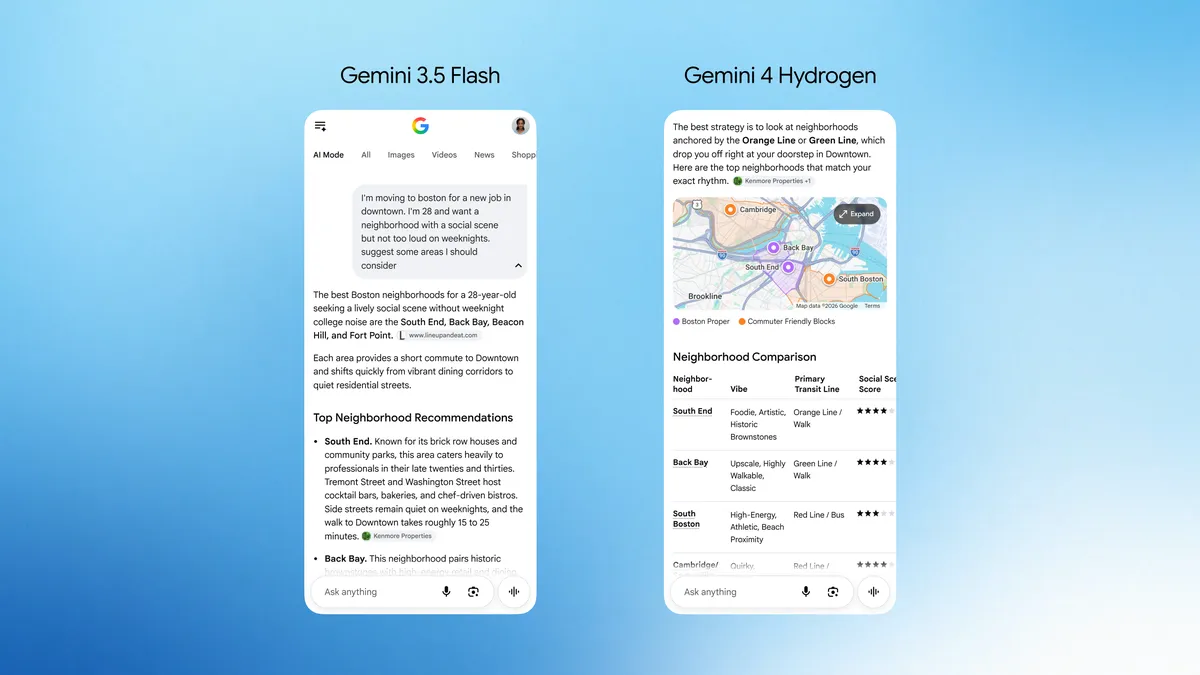
Hydrogen now answers questions inside Google Search for every user, worldwide. Google describes it as "the biggest model upgrade to Search yet", deployed globally for all users, with better intent handling for multipart questions, wider query fan-out and more visual, structured responses. That is a distribution fact with a quality consequence: the model's errors, its 8 percent hallucination rate and its March 2026 knowledge cutoff now sit inside the answer surface most people meet first. A reader who evaluates Hydrogen only through the API is evaluating a different product from the one their neighbours will use, and the difference is the absence of a person deciding whether to ask it.
One safety trade runs the other way, and the vendor published it. The model card records a 5.57 percentage point increase in unjustified refusals against Gemini 3.8 Flash, particularly on multimodal prompts, alongside a 7 point improvement in image-to-text safety and a slight deterioration in refusal tone. The launch post separately claims up to 81 percent less overreach in agentic tasks, up to 79 percent less under-service, a 12-fold cut in misaligned actions and shortcutting, and 99.9 percent chain-of-thought legibility with zero deceptive reasoning edits across more than 200,000 audited turns. Those are engineering claims from the party that built the model, and they are the kind of claim that incidents test rather than release notes.
No sub-score changed for these findings, and the reason is explicit. The Time sub-score already carries the free-tier access friction and the thinking-level overhead; the Quality sub-score already carries the measured position on vendor and independent evidence; and the Imposture assessment already carries the fluency risk that a fast model hands to a reader who delegates. The items above are about data terms, published thresholds and distribution rather than about a defect in the artefact a buyer receives, and none of them is a resolved safety failure. Section 7c closes with what it does not do: it does not allege misconduct, it does not treat a free tier or an alert threshold as a scandal, and it does not convert a company's own published caveats into findings against it. It records what a reader adopting this model is also adopting: a data boundary that changes with the price, a safety position stated as a threshold, and a model that now answers for everyone.

Gemini 4 Hydrogen: the fast Gemini 4 model that replaces the Flash tier
U365 Co-Intelligence Rating
CI-First Profile
Primary profile: Co-Worker and Assistant (level 2). Secondary profiles: Co-Researcher, Analyst and Tester (level 4), Professor, Coach and Tutor (level 3).
Why this profile and not Co-Creator. Google's positioning does the reasoning. The launch sells Hydrogen for "rapid execution across diverse agentic workflows", for surgical edits and bounded changes, and for carrying out work a frontier model planned. That is a delegation framing: state the outcome, hand over the run, review what returns. Co-Worker and Assistant is the role the model actually plays. Analyst and Tester is recorded as secondary because the document and multimodal workflows are first-pass triage, and Professor, Coach and Tutor remains reachable at level 3 because the model explains its reasoning on request and because a thinking level the user selects produces visible reasoning effort rather than a fixed answer.
CI-First Benefit Score
Time
Score (0-10). 8
Rationale. Strong net savings on bounded work. 2.5 times faster than its predecessor at high, 43 seconds against 170 on an independent repair, 62 against 108 on a prototype, 106 against 192 on a 3D page, 188 tokens per second output and fewer thinking tokens than the model it replaces. Held at 8 rather than 9 by the overhead the release creates: four thinking levels to choose from, a 40.55 second first-token latency, output that is the most verbose in its comparison set, and verification that still has to happen after a very fast answer.
Quantity
Score (0-10). 7
Rationale. A genuine multiplier on attempts. Parallel tool calls, a one-million-token output path, Batch and Flex, an Orchestrator that pairs it with Carbon, and a default position in the Antigravity agent. Held at 7 because volume is where this model is least clearly a benefit: 304 million output tokens across a full independent index run against a 72.8 million median, and more attempts is not more usable work when the checking is the bottleneck.
Quality
Score (0-10). 7
Rationale. A large move against its predecessor and a respectable position against its peers: 57.0 percent on the vendor's cheating-adjusted Terminal-Bench 4.1 against 18.2, 54 on the independent composite at xhigh, 6th of 37 on the Vals Index, first of 85 on Tax Agent Bench, 8 percent hallucination. Held at 7 rather than higher by the mid-pack coding rows, 54 percent on Terminal-Bench 4.0 and 50 percent on Terminal-Bench-Science 0.1 against 64 and 53 for Claude Sonnet 5.5, and a knowledge cutoff in March 2026.
Skill
Score (0-10). 3
Rationale. Delegation rather than learning in the common case, with no teaching mechanism and no open weights, scored conservatively per the framework's guidance. The clause note records nulls with boundaries rather than eroding mechanisms, and the conservative score reflects what the product does for the reader's own capability rather than anything the model does wrong.
CI-First Benefit Score: 6.3 / 10 (CI-First Strong)
Why the score sits where it sits
6.3 with sub-scores 8 / 7 / 7 / 3 is a strong time-and-volume position carrying a narrow skill position, and both halves of that sentence are deliberate.
Why not higher. Three reasons, each measured. The model is ordinary on the work a technical buyer tests first: 54 percent on Terminal-Bench 4.0 and 50 percent on Terminal-Bench-Science 0.1 at xhigh, both behind Claude Sonnet 5.5, and 11th of 64 and 21st of 38 on the two hardest Vals rows. The verbosity is a real cost: 304 million output tokens against a 72.8 million median means the moderate token rate is not a moderate bill at volume. And the knowledge cutoff is March 2026, which is a limit on everyday work that changes quickly and a reason the free tier is attractive for exactly the tasks where stale knowledge hurts most.
Why not lower. The measured movement against the model it replaces is the largest in the Flash line: 18.2 to 57.0 on the vendor's cheating-adjusted terminal row, more than five times fewer fabricated claims, and fewer thinking tokens per task in independent testing. The independent composite places it 16th of 78 at 54, which is a legitimate position and not a vendor claim, and the Vals Index places it 6th of 37 with first place on a tax-agent benchmark and second on a finance index. A model that is fast, cheap, broadly available and measurably better than the tier it replaces is a strong release for the work most readers actually do.
Why 6.3 and not a higher band, stated as arithmetic. Time 8, Quantity 7, Quality 7 and Skill 3 average to 6.25, which rounds to 6.3. The score is held at Strong rather than lifted by the launch claims because the framework scores the honest user's net benefit, and the honest user of a fast model reads less of what comes back. A frontier model at 6.8 and this model at 6.3 is the framework saying that capability and benefit are different quantities: Hydrogen is worse at the hardest work and better at the common work, and the two effects nearly cancel.
What the score does not carry. The four dimensions measure what the reader's work gains. They do not carry the free-tier data terms, the CCL alert thresholds or the Search distribution, which is why those sit in Section 7c with an explicit statement that no sub-score changed. They do not carry the clause questions either, which return nulls with boundaries. A reader who wants the score to encode governance would need a different instrument, and the framework's instrument is the clause note and the 7c finding.
Humics Protection Badge
Dimension | Rating | Rationale |
Creativity | Neutral (0) | It drafts, prototypes and produces variants on request, and the vendor's demonstrations include a storefront, a voxel world and a 3D visualiser built from prompts. It does not originate the direction, and it neither trains nor replaces the user's ideation. The strongest creative claims in the launch are selected demonstrations rather than measured behaviour, and a model that produces ten variants leaves the judgement about which one matters with the reader. |
Critical Thinking | Erodes (-1) | Fast, fluent, working output whose correctness is expensive to check, on work where the person asking often cannot evaluate it. The failure mode is not an obvious error; it is a prototype that renders, a table cell that reads plausibly, and a test suite that passes because an assertion changed. The mitigations lower the frequency and do not reverse the direction: 8 percent hallucination is the best reading in its comparison set and is not zero, and a 5.57 point rise in unjustified refusals shows the model's judgement of its own limits is not uniformly improving. |
Social Authenticity | Neutral (0) | The model produces text and code rather than speaking in a person's name, and clause 4.2-a returns a null for it as a generator. The live condition stays in the record: a deployment that lets an agent send under a person's identity without the person reading it first moves this dimension, and the Antigravity agent default makes that arrangement easier to build. |
Humics Protection Score: -1 / +3 Badge: Humics-Neutral
Superhuman Usage Guidance
When to invite this tool:
Bounded engineering work with a checkable end state: a failing test, a small repair, a refactor in a named file list, a prototype that either runs or does not.
First-pass front-end work, where the vendor's one-shot demonstrations and the independent black-hole test agree that the model produces something usable faster than its peers.
Document triage over a set larger than you would read, with a citation required in every cell and a spot-check afterwards.
High-volume attempts: twenty variants, ten drafts, five page layouts, where the value is in the comparison rather than in any single output.
Agent work where a cheap worker is the right shape, including the Antigravity Orchestrator arrangement in which Carbon plans and Hydrogen executes.
When to keep this tool out:
Hard terminal, science or security work, which is the row where it is ordinary against named peers.
Work whose correctness you cannot check yourself. The speed makes this worse rather than better, because checking feels disproportionate to a two-minute answer.
Confidential or client material on the free tier, which uses content to improve Google's products and allows human review.
Anything that depends on knowledge after March 2026, unless you supply the documents or a retrieval path.
The final judgement calls: what to publish, what to send to a client, what to tell a person. Those are the Humics this model does not supply.
Any plan whose budget assumes the current Gemini 3.8 Flash promotional rate, because that rate ends on 2026-12-31 and the comparison is about to change.
U365 method integration:
LIPS + CARE: route the model's reading and drafting output into the Collect phase, and keep the Action Plan and Review phases as your own work. Hydrogen can produce the collection; it cannot own the decision about what the collection means.
ULM + EVA: the decision about which work is worth automating belongs in the Career and Finance domain and in Quality of Life planning, and ULM is the six-domain frame that holds that decision. Cost per completed task is CI-First cost engineering and the independent evaluator's metric, not a ULM method, and the thinking-level decision is a planning habit that sits with the Fellow. Weak fit elsewhere.
UP-Context-Engineering: it responds well to explicit context, a stated role, a task, constraints and a named output format, and the output-format part matters because the model is verbose and a named format is what keeps an answer checkable. The three workflow packs above use that order, and each carries its own verification close.
UNOP: no direct fit. The model is not built to teach, and its reliability gains come from speed and fewer fabricated claims rather than from any pedagogical mechanism.
Over-delegation warning: the failure mode with this model is that the price and the speed point the same way. A two-minute answer at five cents invites a second task, then a third, and the checking does not scale at the same rate. The framework's arithmetic is the point: if your Human Intelligence input drops while the Artificial Intelligence term rises, the product falls. A reader who moves more work to Hydrogen because it is fast enough and cheap enough, and changes nothing about how much of the output they read, has taken the release's worst offer.

Gemini 4 Hydrogen: the fast Gemini 4 model that replaces the Flash tier
What Users Say
Aggregate Rating Table
Platform | Rating | Number of reviews | Link |
Artificial Analysis | 54 on the Intelligence Index at xhigh, 16th of 78; 51 at high | Independent benchmark, not a user rating | |
Vals AI | 68.49 percent on the Vals Index, 6th of 37; first of 85 on Tax Agent Bench | Independent benchmark, not a user rating | |
Hacker News | 513 points, 325 comments on the launch | Not a rating platform | |
Reddit, r/GeminiAI | Active launch threads, including "Gemini 4 hydrogen (flash) is cooking" and a motion-graphics comparison against 3.8 Flash | Not a rating platform | |
AI/ML API | Three of three tested tasks passed; 3.5 minutes and $0.26 across the set | A three-task hands-on comparison, not a rating | |
Product Hunt | No product listing found | Not applicable | Not applicable |
G2 | No listing for the model | Not applicable | Not applicable |
Capterra | No listing for the model | Not applicable | Not applicable |
Trustpilot | No listing for the model | Not applicable | Not applicable |
Note on method, stated plainly because it affects how much this section is worth. No review platform rates an individual language model. No G2, Capterra or Trustpilot listing for this model exists, and none is reproduced here. The meaningful signals for a model one day old are the independent benchmark houses, the practitioner thread on the announcement, the platform threads built on demonstrations, and the one published hands-on comparison that names its tasks and its numbers. That is what this section reports, and where a platform's content was reached at platform level rather than read thread by thread, no quotation and no count is attributed to it.
What Users Praise
Three themes dominate, and the first is the one the independent measurements settled fastest.
It is a real upgrade on the model it replaces, and the speed is the part practitioners notice. The clearest practitioner report on the launch thread is a benchmark comparison, not an impression: "Nice upgrade from 3.8 flash. My use case benchmarks 37% more expensive per task but 40-60% of the total time per task (median and p90 had the same improvement). Both models were smart enough to complete all eval tasks, speed was the main thing we were struggling with. Both models on medium reasoning. Overall feels like a good upgrade." That sentence is worth more than a leaderboard row because it separates cost from time and finds the trade acceptable on the axis the user cared about.
The everyday-app reaction is positive and immediate. A reader who met the model in the Gemini app without knowing the launch had happened wrote: "It's the equivalent of Gemini Flash, judging by the API price. I just tried it in the Gemini app, it's much better than the previous version." A second reader in the same thread reported the model reaching a paid Workspace account on the day of release, which is a distribution fact rather than a capability one and is unusual enough that they said so.
The demonstrations are the third theme, and they cluster around what a fast model makes possible. The public threads are full of voxel worlds, 3D vehicles, engineering visualisations and playable scenes produced in one or two minutes, and the Reddit thread titled "Gemini 4 hydrogen (flash) is cooking" is the centre of that activity. Those are demonstrations rather than evaluations; they show what the model can produce and not how often it produces it, and the independent three-task comparison is the better evidence because it names the checks.
What Users Complain About
Three complaints recur, and none of them is about whether the model works.
The naming is the dominant complaint. The sharpest version, from a reader who met it in the product: seeing "3.8 Flash" replaced by "4 Hydrogen" produced the question "What on Earth is Gemini Hydrogen?", followed by the argument that element names work for separate products and not for products a buyer is supposed to compare. Hydrogen sits below Argon and Carbon on the periodic table and above Argon on the independent composite, so the name teaches an ordering that is wrong.
The tier structure is the second, and it is a distribution complaint rather than a capability one. On-demand access in the Gemini app is a paid Pro or Ultra feature, and free users reach Hydrogen only through automatic model selection; coverage on the day of release reported that AI Plus and free users still see the older Flash-Lite model in the picker. The model is available to everyone in Search and on the free API tier, so the complaint is about which surface a person meets first, not about whether they can reach it at all.
The third is verbosity and the effort trade. Independent measurement is blunt about it: very verbose, slower than average per task at xhigh, and the highest output-token count in its comparison set. The practical complaint a reader will have is that xhigh costs nearly twice as much and takes more than twice as long for three index points, and the vendor's own guidance says to use it only where high fell short.
Sentiment Summary
Overall sentiment: Positive on speed and on the improvement over the predecessor, critical of the naming and of the gap between the free and paid surfaces.
Key themes: a genuine Flash-tier upgrade, fast enough to change how many attempts a person makes, ordinary on hard terminal and science work, verbose under the hood, and a name that carries no usable ordering.
U365 Editorial Note
The model's own record argues in two directions at once, and a reader should hold both. On the positive side, more than five times fewer fabricated claims, a stated habit of flagging missing context rather than guessing, and 8 percent hallucination on an independent omniscience evaluation are the behaviours that make a fast model usable rather than merely quick. On the negative side, the same speed that makes checking feel optional is the mechanism by which a working prototype passes for a correct one. The Framework rates AI Imposture Risk Medium overall with Skill Illusion High, and that rating is the editorial position: Hydrogen is a tool to think and build with, provided the person using it keeps a check they own in every workflow. A reader who wants a lower rating is asking for a different model, not a different review.

Gemini 4 Hydrogen: the fast Gemini 4 model that replaces the Flash tier
Comparison and Alternatives
Model | Position | Independent evidence | Price, input and output per million | Choose it if |
Gemini 4 Hydrogen | The fast Gemini 4 member and the Flash replacement | 54 on the independent composite at xhigh, 16th of 78; Vals Index 68.49 percent, 6th of 37; 57.0 on the vendor's cheating-adjusted Terminal-Bench 4.1 | $1.50 and $7.50, free tier available | You want the best speed-to-capability ratio for bounded everyday work and you will verify what matters |
Gemini 3.8 Flash | The predecessor, still live and cheaper per token today | 18.2 on the vendor's cheating-adjusted Terminal-Bench 4.1; the independent composite and Vals do not carry a current Hydrogen-era row for it | $0.75 and $3.75 through 2026-12-31, then $1.50 and $7.50 | You have a working 3.8 Flash pipeline, the tasks are simple, and you want the lowest token cost during the promotional window |
Gemini 4 Argon | The first Gemini 4 model and the frontier sibling | 50 on the independent composite at its default; reviewed by U365 at 6.3 / 10 | $2.00 and $10.00 through 2026-11-30, then $4.00 and $20.00 | You need long-horizon reasoning and stronger terminal and science work, and you can absorb a price that doubles on 2026-12-01 |
Gemini 4 Carbon | The strongest Gemini 4 model | 59 on the independent composite; 65.2 on Terminal-Bench 4.0 and 64.8 on Terminal-Bench-Science 0.1 in the vendor's reading | Not compared on price in this review | The task is architecture, debugging, science or a security audit, and quality dominates cost |
Claude Sonnet 5.5 | The peer Hydrogen trails on hard agentic work | 64 on Terminal-Bench 4.0 and 53 on Terminal-Bench-Science 0.1 at max; roughly level with Hydrogen at its highest setting on the composite | Anthropic list rates, above the Flash tier | Your work is terminal-bound, science-heavy or long-horizon, and you need the rows where Hydrogen is ordinary |
GPT-6.1 Terra | The OpenAI model closest to Hydrogen on the composite | 51 at max on the independent composite, $0.96 per index task, 14.2 minutes per task | OpenAI list rates | You want comparable index performance at a lower measured cost per task and can accept the longer run time |
The comparison that matters most is not in the table. Hydrogen, Sonnet 5.5 and GPT-6.1 Terra sit within three points of one another on the independent composite, and the cost per task ordering is not the same as the capability ordering: Terra is cheapest per index task in the published comparison, Hydrogen sits between Terra and the frontier models, and Sonnet 5.5 leads on the terminal rows that look most like engineering work. A buyer choosing on a single number will choose badly. The right question is which row matches the work in front of you, and the answer differs by task.
Choose Hydrogen if your work is bounded, checkable and repeated: bug fixes, prototypes, document triage, agent volume. Choose Argon or Carbon if the task is the one you would escalate, and pay for the escalation. Choose Sonnet 5.5 if the work is terminal-bound or long-horizon and the measured gap on those rows matters more than the price. Stay on 3.8 Flash until 2026-12-31 if the pipeline is simple and the token bill is the constraint, then re-run the comparison when the promotional rate ends.

Gemini 4 Hydrogen: the fast Gemini 4 model that replaces the Flash tier
Verdict and Next Steps
Verdict: Hydrogen is the first Flash-tier Gemini model U365 can recommend for real work without a caveat about capability, and the caveat it does carry is about the reader rather than the model.
At 6.3 / 10, CI-First Strong, with sub-scores 8 / 7 / 7 / 3, it carries the joint-highest Time score in the Gemini line, level with Gemini 3.8 Flash, and the same overall position as the frontier Argon review. That is not a contradiction. Argon earns its 6.3 with Quality 8 and Time 7; Hydrogen earns the same total with Time 8 and Quality 7. One is better at the hardest problem, the other is better at the problem most people have on a Tuesday afternoon, and the framework scores the benefit to the person rather than the position on a leaderboard.
Adopt it if your work is bounded and checkable, your volume is high enough that speed changes how many attempts you make, and you have a verification habit you trust. Do not adopt it as a replacement for a frontier model on hard engineering, science or security work, as a free-tier route for confidential material, or as a reason to stop reading what comes back.
The three things to do in the first week:
Run the same task on Hydrogen and on the model you use today, and compute cost per finished task rather than price per token. Use your own task, your own token counts and your own retry rate. The published comparisons are a template, not a substitute.
Set a thinking-level policy. high for real work, low or medium for simple work, xhigh only where high demonstrably failed. Write the policy down, because the difference between high and xhigh is $1.87 against $3.16 per independent index task and six minutes against 13.7.
Decide the data boundary once, at the account level. Free tier for public or disposable material, paid tier for anything that belongs to a client or an institution. The terms are explicit and they do not vary by prompt.
UP-Context prompt packs: the three packs are in Real Workflows, one per workflow, each in the UP-Context-Engineering order and each carrying its own verification close.
What would change this verdict. A published Safety and Security Report that contradicts the model card's threshold statement, a change to the free-tier data terms, a price rise that removes the per-task advantage, or an incident in an agentic deployment that shows the safety claims are marketing rather than engineering. The re-check triggers at the end of this review name each one.

Gemini 4 Hydrogen: the fast Gemini 4 model that replaces the Flash tier
Status and Last Tested
Status: Active | Last tested: 2026-11-13 | Version tested: Gemini 4 Hydrogen (`gemini-4-hydrogen`, released 2026-11-12)
Active: the tool is current and recommended.
The model was released on 2026-11-12 and this review was written the following day, against the vendor's launch material, the model card, the API documentation and pricing page, two independent benchmark houses, one published hands-on comparison and the launch-day practitioner threads. The scores are set on that evidence and on the framework's application rules. The re-check is trigger-based with a six-month outer limit, and the first trigger is the sibling whose capability and price define the boundary this model is sold beneath.

Gemini 4 Hydrogen: the fast Gemini 4 model that replaces the Flash tier
Migration Path
Not applicable. Hydrogen is Active, not Retired, Deprecated or Risky, so this review carries no migration plan.
If you are moving a workload from Gemini 3.8 Flash to Hydrogen, the practical changes are documented in Getting Started: the model id, the fourth thinking level, the 64K synchronous output ceiling and the long-decode path. The vendor publishes a migration checklist on the What is New page. That is a configuration change rather than a migration away from a tool, and this review does not treat it as one.

Gemini 4 Hydrogen: the fast Gemini 4 model that replaces the Flash tier
U365's Recommendations to Learn More
Start with the primary document
Read the launch post before any secondary coverage. It is short, it states the price and the positioning, and it is the only document that carries Google's own framing of what Hydrogen is for: "rapid execution across diverse agentic workflows", with Carbon and Argon reserved for "deep, long-horizon reasoning". A reader who starts with a benchmark table will read the model as a failed frontier model rather than as a successful Flash model.
Then read the model card, including the parts that are not flattering
The model card is where the limits live: the March 2026 knowledge cutoff, the 5.57 point rise in unjustified refusals, the CCL alert thresholds reached in the biological and cyber domains, and the note that the full Safety and Security Report is still to come. Those four facts are worth more than any single benchmark row because they tell you where the model will fail and what the supplier has not yet published.
Three videos worth the time
Bijan Bowen, "Gemini 4 Hydrogen Is the BEST Flash Model Yet, Full Test": a hands-on run across browser work, C++ games, a robot arm, a 3D print and a GPU test, with a results section. It is the closest thing to a public evaluation of the model as a working tool. https://www.youtube.com/watch?v=prA0iTPDqfo
Paul J Lipsky, "Gemini 4 Hydrogen Just Dropped (Personally Tested)": a day-one walkthrough of what the model is, where it runs, how the price compares with 3.8 Flash and Carbon, and what he built with it. https://www.youtube.com/watch?v=bm8x0hopWTU
Google, "Build Interactive 3D Visualizers with Gemini 4 Hydrogen": the vendor's own short demonstration of the design-to-code use case, useful for seeing the intended workflow in under a minute. https://www.youtube.com/watch?v=oh8AyMFU5S8
Resources on X
Dedicated X channels: the Google AI account is the primary channel for launch material and demonstrations, and the Google DeepMind account carries the research framing. The launch announcement and the demonstration clips circulate there first, and the practitioner threads that follow are the fastest read on what the model does in public.

U365 courses and programmes that build the surrounding skill
UIT (Technology, AI, Data Science): the engineering track where model routing, agent supervision and cost-per-finished-task arithmetic belong.
UIB (Business Management, Entrepreneurship): the commercial track where a rate card, a promotional window and a build-versus-buy decision are analysed.
UID (Digital Design, UX/UI): the design track where design-to-code output is judged against a brief rather than against a screenshot.
The one habit to carry
Keep a check you own in every workflow. A test you can re-run, a page you can open, a number you can find in the source. Hydrogen is fast enough that the check will feel disproportionate. That feeling is the Skill Illusion, and the check is the answer to it.

Gemini 4 Hydrogen: the fast Gemini 4 model that replaces the Flash tier
CI-First Evaluation Summary Card
Field | Value |
Tool | Gemini 4 Hydrogen (gemini-4-hydrogen), Google LLC |
Category | Applied AI / Large Language Model (fast agentic coding, everyday knowledge work and high-volume execution) |
CI-First Benefit Score | 6.3 / 10, CI-First Strong |
Sub-scores | Time 8 / Quantity 7 / Quality 7 / Skill 3 |
CI-First Profile | Primary: Co-Worker and Assistant (level 2). Secondary: Co-Researcher, Analyst and Tester (level 4), Professor, Coach and Tutor (level 3) |
Humics Protection | Humics-Neutral (-1 / +3). Creativity 0, Critical Thinking -1, Social Authenticity 0 |
AI Imposture Risk | Medium overall. Time Medium, Quantity Medium, Skill Illusion High |
Framework v1.2 clauses | 5.2.3-a null with boundary, 4.2-a null with live condition, 7.5 null (removed) |
Status | Active |
Last tested | 2026-11-13 |
Version tested | Gemini 4 Hydrogen, released 2026-11-12 |
Pricing | $1.50 per million input tokens, $7.50 per million output tokens, flat across the window; free tier available |
Primary institute | UIT (Technology, AI, Data Science) |
Review status | Active: the tool is current and recommended |

Gemini 4 Hydrogen: the fast Gemini 4 model that replaces the Flash tier
Glossary
CI-First Benefit Score
The arithmetic mean of the four benefit dimensions, each scored 0 to 10, rounded to one decimal place. 0 to 2.0 is CI-First Negative, 2.1 to 4.0 is CI-First Neutral, 4.1 to 6.0 is CI-First Positive, 6.1 to 8.0 is CI-First Strong, and 8.1 to 10 is CI-First Transformative. Gemini 4 Hydrogen scores 6.3, which is Strong.
Time Benefit
Whether the tool returns more time than it costs, after the overhead of using it is subtracted. Hydrogen is 8: 2.5 times faster than its predecessor at high, 43 seconds against 170 on an independent repair, less thinking per task and 188 tokens per second output, against four thinking levels, a 40.55 second first-token latency, the highest verbosity in its comparison set, and verification that still has to happen.
Quantity Benefit
Whether the tool increases the volume of usable work a person can produce in a given time. Hydrogen is 7: parallel tool calls, a million-token output path, Batch and Flex, an Orchestrator that pairs it with Carbon and a default position in the Antigravity agent, against 304 million output tokens across a full index run and a checking burden that does not scale with the output.
Quality Benefit
Whether the tool helps the user produce better work than they could alone, judged after verification rather than on surface polish. Hydrogen is 7: 57.0 percent on the vendor's cheating-adjusted Terminal-Bench 4.1 against 18.2 for its predecessor, 54 on the independent composite at xhigh, 6th of 37 on the Vals Index, first of 85 on Tax Agent Bench and 8 percent hallucination, against mid-pack coding rows and clear terminal and science gaps.
Knowledge and Skill Benefit
Whether the tool helps the user learn what they did not know and do what they did not know how to do. Hydrogen is 3, scored conservatively: it delegates rather than teaches, it has no teaching mode, there are no open weights, and the clause note records nulls with boundaries rather than a mechanism that transfers capability.
Humics Protection Badge
The sum of three ratings, each +1, 0 or -1, across Creativity, Critical Thinking and Social Authenticity. +2 to +3 is Humics-Friendly, -1 to +1 is Humics-Neutral and -2 to -3 is Humics-Risky. Hydrogen scores -1, which is Humics-Neutral: it neither strengthens nor systematically destroys the three capabilities, and it requires the reader to keep the critical habit that the speed discourages.
AI Imposture Risk
The likelihood that the tool traps its user in one of three illusions: the Time Illusion, where the overhead exceeds the saving; the Quantity Illusion, where volume passes for quality; and the Skill Illusion, where the user believes they can do what the tool did. Each trap is rated Low, Medium or High. Hydrogen is Medium overall, with Skill Illusion High and the other two Medium.
User Sentiment
The aggregate of what users report about a tool, kept separate from the framework's own findings. For a model one day old the signal is the independent benchmark houses, the launch-day practitioner threads and the one published comparison that names its tasks and its numbers. No review platform rates an individual model, so no platform score is quoted here.
CI-First Profile
The role the AI plays in the working relationship: Co-Creator and Thought Partner (1), Co-Worker and Assistant (2), Professor, Coach and Tutor (3), Co-Researcher, Analyst and Tester (4), or Challenger, Critic and Devil's Advocate (5). Hydrogen is primarily Co-Worker and Assistant, with Analyst and Tester and Professor, Coach and Tutor as secondary roles.
Review Status
The badge on this review states how much confidence to place in it. The vocabulary: Active means the tool is current and recommended. Active (updated) means it is current and recommended and was recently re-checked and refreshed. Changed means a re-check trigger fired and an update is pending, so read it with that in mind. Risky means the tool has significant unresolved issues or has been clearly surpassed by newer alternatives, so use it with caution and read the Limits section. Stale means the review has not been re-checked in over six months, so treat pricing and features as unverified. Retired means the tool still works but is no longer recommended, and Deprecated means it has been shut down or fundamentally changed. This review is Active.
Last tested and Re-check
The date on which the review's evidence was last read against the vendor's own surfaces, and the condition under which it will be read again. This review was last tested on 2026-11-13 and is re-checked on a trigger list with a six-month outer limit, because a model's price, tiers and safety documentation move faster than a calendar interval can track.

Gemini 4 Hydrogen: the fast Gemini 4 model that replaces the Flash tier
Sources
Vendor primary sources:
Google, "Introducing Gemini 4 Hydrogen", 2026-11-12: https://blog.google/innovation-and-ai/models-and-research/gemini-models/introducing-gemini-4-hydrogen
Google, "Gemini 4 Hydrogen: everyday coding and agentic workflows for developers", 2026-11-12: https://blog.google/innovation-and-ai/technology/developers-tools/build-with-gemini-4-hydrogen/
Google AI Studio, "Gemini 4 Hydrogen" model page: https://ai.google.dev/gemini-api/docs/models/gemini-4-hydrogen
Google AI Studio, "What's new in Gemini 4 Hydrogen": https://aistudio.google.com/docs/whats-new-gemini-4-hydrogen
Google DeepMind, Gemini 4 Hydrogen model card, November 2026: https://storage.googleapis.com/deepmind-media/Model-Cards/Gemini-4-Hydrogen-Model-Card.pdf
Google, Gemini Developer API pricing: https://ai.google.dev/gemini-api/docs/pricing
Google, Gemini API additional terms of service: https://ai.google.dev/gemini-api/terms
Google, "Google Search gets a major upgrade with Gemini 4 Hydrogen", 2026-11-12: https://blog.google/products-and-platforms/products/search/gemini-4-hydrogen-search-upgrade
Google Antigravity, "Gemini 4 Hydrogen and Orchestrator", 2026-11-12: https://antigravity.google/blog/gemini-4-hydrogen-in-google-antigravity
Independent measurement and reporting:
Artificial Analysis, Gemini 4 Hydrogen model page: https://artificialanalysis.ai/models/gemini-4-hydrogen
Vals AI, Gemini 4 Hydrogen benchmarks: https://www.vals.ai/models/google_gemini-4-hydrogen
AI/ML API, "Gemini 4 Hydrogen vs 3.8 Flash vs Argon: Pricing, API and Benchmarks": https://aimlapi.com/blog/gemini-4-hydrogen-vs-3-8-flash-vs-argon
Ars Technica, "Google rolls out Gemini 4 Hydrogen, finally replacing 3.8 Flash": https://arstechnica.com/google/2026/11/google-rolls-out-gemini-4-hydrogen-finally-replacing-3-8-flash
SiliconANGLE, "Google releases Gemini 4 Hydrogen, a lower-cost model said to outscore Argon": https://siliconangle.com/2026/11/12/google-releases-gemini-4-hydrogen-a-lower-cost-model-said-to-outscore-argon
The Decoder, "Google's Gemini 4 Hydrogen outscores the bigger Argon just four weeks after its launch": https://the-decoder.com/googles-gemini-4-hydrogen-outscores-the-bigger-argon-just-four-weeks-after-its-launch/
9to5Google, "Google announces Gemini 4 Hydrogen, rolling out to Gemini app": https://9to5google.com/2026/11/12/gemini-4-hydrogen-launch
WinBuzzer, "Google Launches Gemini 4 Hydrogen for Faster AI Coding": https://winbuzzer.com/2026/11/12/google-launches-gemini-4-hydrogen-for-faster-ai-coding-xcxwbn/
Community:
Hacker News discussion, 513 points and 325 comments: https://news.ycombinator.com/item?id=50471431
Reddit, r/GeminiAI, "Gemini 4 hydrogen (flash) is cooking": https://www.reddit.com/r/GeminiAI/comments/1xpg38d/gemini_4_hydrogen_flash_is_cooking/
Reddit, r/GeminiAI, motion-graphics comparison against Gemini 3.8 Flash: https://www.reddit.com/r/GeminiAI/comments/1xpln87/gemini_4_hydrogen_vs_gemini_38_flash_motion
U365 internal reference:
U365 CI-First Evaluation Framework v1.4.1 (URC methodology)

Gemini 4 Hydrogen: the fast Gemini 4 model that replaces the Flash tier
Faculty Note on Evidence Quality
What this review rests on, in order of weight. First, the vendor's own primary documents: the launch post, the model page, the What is New guide, the API pricing page, the API terms and the model card. Second, two independent benchmark houses that publish their methods and their full tables, Artificial Analysis and Vals AI. Third, one published hands-on comparison whose tasks and numbers are named. Fourth, practitioner discussion on the launch day, which is used for sentiment and for one cost report and never for a capability claim. No number in this review is attributed to a page whose content could not be read.
Where the vendor's numbers and the independent numbers meet, and where they part. They meet on the shape of the release: Hydrogen is faster than its predecessor, better on agentic coding, and close to the frontier on general knowledge work. They part on the size and the comparison base. Google's 57.0 percent on Terminal-Bench 4.1 is a cheating-adjusted figure against its own predecessor's 18.2, which is a large real gain and a comparison with the weakest relevant baseline. Against named peers on Terminal-Bench 4.0, the independent reading is 54 percent against 64 for Claude Sonnet 5.5. Both sentences belong in a reader's head at once, and a review that prints only one of them is selling rather than evaluating.
The comparison base is the recurring problem in this launch's coverage. Two claims needed checking and one of them was wrong in most repetitions. "Priced the same as Gemini 3.8 Flash" is true against the rate that model will charge from 2027-01-01 and false against the rate it charges today, which is half. "Outscores Argon" is true at Hydrogen's highest effort setting and true at its default by one point, and the 54 that leads most coverage is the xhigh figure, not the default. Neither sentence is a lie. Both are sentences whose meaning depends on a base the coverage left out, and the framework's discipline is to state the base.
What is measured and what is inferred. The index scores, the terminal and science percentages, the token counts, the cost per task, the latency and the hallucination rate are measured by named parties and reported with their settings. The claim that Hydrogen is "good enough for everyday coding" is an interpretation of those measurements against the work the model is sold for, and it is the interpretation this review defends. The claim that a reader will over-delegate is an inference from the framework's model of human behaviour, supported by the speed and fluency of the product rather than by a controlled study, and it is labelled as an inference wherever it appears.
One finding cuts in the vendor's favour and should be said as plainly as the rest. Of the models in this comparison set, Hydrogen records the lowest hallucination rate on the independent omniscience evaluation, at 8 percent, and the vendor's own description of the mechanism, flagging missing context rather than filling it, is consistent with that number. A fast model that abstains rather than inventing is a materially better tool than a fast model that invents, and the Quality score of 7 rests partly on it. The review's criticism of the release is about comparison bases, verbosity and the skill position, not about the model's honesty.
What this review does not do. It does not score the Antigravity Orchestrator, because the vendor's measurement is the only one that exists and a combined configuration is a different product. It does not score Gemini 4 Carbon, which has no U365 review. It does not treat the free tier as a capability fact or the price as a permanent one. And it does not convert a benchmark row into a promise: a model that scores 54 on agentic terminal work will fail at agentic terminal work, and the reader who plans for that is the reader the framework is written for.

Gemini 4 Hydrogen: the fast Gemini 4 model that replaces the Flash tier
Status and Re-check
Status: Active | Last tested: 2026-11-13 (Gemini 4 Hydrogen, `gemini-4-hydrogen`, released 2026-11-12) | Re-check: trigger-based (max 6 months)
Active: the tool is current and recommended.
For detailed explanations of the CI-First evaluation terms used in this review, including the Humics Protection Badge and the AI Imposture Risk levels, see the Glossary at the end of this post.
Re-check triggers:
A Gemini 4 Carbon review or a Carbon price change. Carbon is the model Hydrogen is adapted from and the frontier sibling this review compares against; it has no U365 review of its own, and its price and capability set the boundary Hydrogen is sold beneath.
Any end to the free tier in AI Studio or the Gemini API, or any change to the auto-routing rule in the Gemini app. Free access is one of the three facts that carry this release, and the app routes free users to Hydrogen only through automatic model selection.
A change to the $1.50 and $7.50 rates, or to the $0.75 and $3.75 promotional rates on Gemini 3.8 Flash that end on 2026-12-31. The cost comparison in this review turns on the difference between Hydrogen's flat rate and the predecessor's promotional rate, and both sides of that arithmetic can move.
The published Safety and Security Report for Hydrogen, currently listed as coming soon. The model card states CCL alert thresholds reached in the biological and cyber domains and no CCL reached; the full report is the document that would qualify those findings.
Any change to the xhigh thinking level, to the 64K synchronous output ceiling, or to long decode. The Time and Quantity scores rest on how much work one call can carry at a chosen effort level.
Any Gemini app memory change, any Antigravity change that writes skills or memory by default, or a new default agent surface. The clause note's null outcomes have boundaries, and this is the boundary that matters.
A public incident in an agentic deployment, prompt injection or tool-use failure included. The vendor's safety claims are engineering claims, and a claim of this kind is tested by incidents rather than by release notes.
A controlled head-to-head of Hydrogen, Claude Sonnet 5.5 and GPT-6.1 Terra on cost per completed task at the same effort level. No such run exists in public, and the three are close enough on the independent composite that the cheapest per task is not settled.




Comments