
KreadoAI: an AI advertising video studio built on digital human avatars

Updated: 13 hours ago
Status: Active | Last tested: 2026-09-25 (KreadoAI, as its product, pricing, help-centre and legal pages described it on that date) | Re-check: trigger-based, maximum 6 months
Active: the tool is current and recommended.
What Active means here. Active means current and recommended for the reader this review describes: a marketing or e-commerce team producing advertising video at variation volume and in several markets, with a named release reviewer, a measured coin budget and a settled position on likeness consent and on disclosure. It does not mean the product is verified. No independent measurement of its output quality exists, its published inventory and duration figures disagree with each other across the vendor's own surfaces, the free-tier allowance is stated as ten coins on one vendor page and 180 on two others, and the certification claim on the vendor's ethics page sits against an independent review stating the certifications are absent. A reader who needs a measured quality guarantee, a stable published rate card, a defined commercial-use entitlement, or an audit certificate before adoption should treat all four as not yet available and act accordingly.
For detailed explanations of the CI-First evaluation terms used in this review, including the Humics Protection Badge and the AI Imposture Risk levels, see the Glossary at the end of this post.


In this Tool Review
Status and Re-check
Re-check triggers:
Publication of an independent measurement of avatar realism, lip-sync accuracy or render reliability. No third party had published one at the time of writing. Every quality statement in this review therefore rests on vendor estimates and on user sentiment, and the Quality sub-score is capped by that absence rather than by a measured defect. A repeatable external test would move it.
Convergence of the vendor's own voice, language and avatar counts. Five vendor surfaces publish different numbers for the same inventory, and one of them understates the paid voice library by a factor of twenty-five. If the surfaces converge, the Faculty Note entry about publishing discipline can be retired.
A published, stable rate card. The homepage shows Premium at $19 and Pro at $40 as promotional prices against $24 and $50 list prices, one vendor page advertises Premium from $10, a third-party converter reports Premium at roughly $21 and Pro at roughly $130 in converted currency, and the pricing page itself shows ten K-coins for the free tier where the homepage and the homepage FAQ say 180. A single authoritative rate card would let the Time and Quantity reasoning be re-run against it.
A change to the K-coin consumption rules for regeneration. Every re-render consumes credits, there is no free preview of a finished render, and membership credits do not roll over. If a free or reduced-cost revision path appears, the Time sub-score and the Quantity Illusion reasoning should both be revisited.
A change to the content licence in section 10 of the terms, or to the commercial-use entitlement. Section 10 grants the vendor a free, non-exclusive, permanent, transferable and irrevocable worldwide licence over everything you upload or create, while "Commercial Use" appears only as a tick-box row in the pricing comparison table. Any narrowing or widening of either changes the adoption calculus in Section 7c.
Any resolution of the certification spread. The vendor's own safety and ethics page claims dual ISO/IEC certification for information security management and privacy information management. An independent review page states that KreadoAI lacks SOC 2 and ISO 27001. Both were live at the time of writing and neither is a substitute for the other.
A named customer willing to speak publicly about a measured result. The homepage carries twelve attributed testimonials with titles and no company names, and the case material published elsewhere is vendor-hosted. A named, quantified, independently verifiable result would move the Quality sub-score.
The KreadoAI scope question, stated before the review begins
A reader who searches for this product meets one brand name, three spellings and several distinct products. The distinction belongs at the top, because the differences between them are the differences between the prices, the rights and the output quality.
Name | What it actually is | Relationship to this review |
KreadoAI | The platform reviewed here: a browser-based advertising video studio built on digital human avatars, AI script generation, text-to-video, URL-to-video and multilingual voice | The subject of this review |
Ideareal Limited | The operating company named in the terms of service, with affiliated companies | The vendor and the contracting party |
Kreado AI / Kreadoai | Alternative spellings of the same brand, used across trust, review and directory surfaces | The same product |
KreadoAI API / MCP service | A programmatic surface documented for Professional and Pro plan holders, exposing video, voice and avatar generation to other products and to AI agents | A surface of the same product, not a separate review subject |
Viblo | A separate short-form video product that KreadoAI compares itself against on a vendor-authored page | A competitor, not a KreadoAI product |
Krea | An unrelated image and video generation product with its own app and review profile | Not related. It appears in the same search results and is frequently confused with KreadoAI |
One more scope note belongs here. The avatar-video category is dominated by products of the HeyGen type, and the honest way to place KreadoAI is by what it is built for. KreadoAI is oriented to advertising and e-commerce conversion video: product pages turned into ads, short-form hooks, batch creative variation and multi-size export. It is not built for corporate training or for regulated internal communication, and it says so by omission, because it publishes no governance or approval workflow for either. A reader who needs training video should read this review for the voice and avatar inventory and then read the alternatives table for a different product decision.
Tool Snapshot
KreadoAI (Ideareal Limited)
Tagline: "Create High-Converting Ads in Minutes", with the platform framed on its own homepage as "Top AI Tools to Create, Optimize & Scale Your Ads" (kreadoai.com, read 2026-09-25).
Category: Video and creative tool. A browser-based production studio that turns a script, a still photo, a slide deck or a product URL into presenter-led video using a stock digital human, an animated photo, or a clone of a real person, with generated or cloned voice in many languages, plus a set of supporting image and editing tools.
Primary use cases:
Short-form advertising creative for paid social, built from a product URL, a hook script and a presenter avatar.
Multilingual localisation of an existing advertising or product video, including dubbing and subtitle handling.
Talking-photo video for a product or persona where no filmed presenter is available.
Batch creative variation: several avatar and script variants of one offer for A/B testing.
Presentation-to-video, converting a slide deck or PDF into a narrated presenter video.
Programmatic generation through the API or the MCP service for teams running creative production on a pipeline.
What a reader actually gets on day one. A free account. The vendor's homepage states 180 K-coins, three total video minutes, five AI avatars, 120 or more voices in 31 languages, and one instant avatar clone. The vendor's pricing page, read on the same day, shows ten K-coins in its free card. Treat the logged-in account as the source.
Pricing model: Subscription plus a virtual currency. K-coins are deducted by the selected generation workflow and by regeneration. Free, Premium, Pro and Enterprise tiers, monthly or annual, with separately purchasable clone services and expiring coin packs.
Platforms: Web application. A documented API and an MCP service for agent integration, available on the Professional and Pro tiers.
Founding and scale claims: The vendor states that the platform was founded in 2023 and is headquartered in Xi'an, China, with registered operations through Ideareal Limited.
Status: Active (see Status and Re-check above).
Field | Detail |
What it is | An AI advertising video studio: digital human avatars, AI script generation, URL-to-video, text-to-video and multilingual voice |
Vendor | Ideareal Limited, named as the operator in the terms of service |
CI-First Benefit Score | 5.5 / 10 (CI-First Positive) |
CI-First Profile | Co-Worker and Assistant (2), primary. Co-Creator and Thought Partner (1), secondary |
Collaboration Mode | Centaur |
Humics Protection | Humics-Risky |
AI Imposture Risk | High (Time Medium, Quantity High, Skill Illusion High) |
Pricing | Free, Premium, Pro and Enterprise tiers billed in K-coins, with separately purchasable clone services and expiring coin packs |
Platforms | Web application, with a documented API and an MCP service on the Professional and Pro tiers |
Status | Active, last tested 2026-09-25 |
The Problem
Producing advertising video has always been constrained by a physical bottleneck. You need a presenter, a camera, a room, lighting, a microphone, a day of someone's time, and an editor. That cost structure forces a decision that marketers hate making: produce a few polished videos and commit to them, or produce many cheap ones and accept that they look cheap.
Then the campaign needs the same offer in six markets. Now you need six presenters, or six voice actors, or you accept that only one market gets a video that sounds local. The offer changes on Friday. The video cannot change until the following month.
The practical result is that creative variation, which is the single most reliable lever in paid social performance, is rationed by production cost rather than by the number of hypotheses worth testing. Teams test fewer angles than they should, because testing has a production price attached to every arm of the test.
There is a second, quieter problem, and it is the one this review returns to throughout. When production becomes cheap, the constraint does not disappear. It moves. It moves to judgement: which angle, which hook, which presenter, which market, and whether the thing you generated is honest about what it claims. A tool that removes production cost without helping you exercise that judgement has not removed the bottleneck, it has relocated it somewhere you are less equipped to see it.
The Outcome
KreadoAI addresses the production bottleneck directly and, on the vendor's own description of the workflow, effectively. A product URL becomes a scripted, narrated, presenter-led video ad with resizing for each placement. A one-minute talking-head video is a text box and a dropdown. A script can be localised into many languages without a voice actor. The vendor documents a short-form advertising workflow in which a first cut returns in a few minutes, and a product-page-to-video workflow framed as roughly ten minutes.
What you gain, concretely:
Production cost collapses to near zero per additional variation. Once the avatar is chosen, the marginal cost of a second hook, a third script angle or a different presenter is a few coins, not a shoot day.
Localisation stops being a project. Voice and language selection is a dropdown rather than a casting call, which changes the economics of entering a small market.
The barrier to a first draft disappears. A team with no editor and no camera can produce a presenter video that a platform will accept as an advertisement.
Volume becomes available. Multi-size export, batch product video and the unlimited tiers move the repeatable work off a human's task list.
What does not change, and this is the part the marketing language does not carry:
Every re-render costs credits. There is no free preview of a finished render. Fixing a typo is a new generation, at full credit price, and membership coins do not roll over.
The quality ceiling is real and it is visible. Avatar realism and lip-sync sit at the level user reviews describe as passable for internal or casual social use and weaker than the market leaders for high-stakes brand work. The vendor publishes no external measurement to contradict or confirm this.
The judgement work is now the whole job. Which angle, which hook, whether the avatar's performance is credible for the claim being made, and whether a synthetic presenter is the honest way to make that claim at all.
The outcome, then, is a genuine reduction in the cost of producing advertising video, delivered with a credit mechanic that taxes the revision process, and a rights position that a reader should read before uploading a client's product photography.
Who Should Use KreadoAI
KreadoAI fits a specific person with a specific job. It is not a general video tool and it does not try to be.
Strong fit:
A performance marketer running paid social for a direct-to-consumer product. The URL-to-video path, the short-form hook formats, the batch variation and the multi-size export are the working parts of a paid social creative pipeline, and they are the parts the product leads with.
A small e-commerce team with no production capacity. The value is that a presenter video becomes possible at all. A two-person store cannot book a shoot for a new product line every fortnight, and this class of tool changes that arithmetic honestly.
An agency producing creative variations at test volume. If the deliverable is twenty hook variants of one offer for a testing schedule, the batch surfaces and the unlimited tiers are the reason to use the product.
A team localising existing video into several markets. Multilingual voice and dubbing, with the language set selectable per scene, is a genuine cost reduction against voice actors, provided the script is short enough that the character limits do not force cuts.
A lecturer, trainer or solo educator who needs a presenter-driven explanation without appearing on camera. The presentation-to-video path and the talking-photo path both serve this, with the quality caveat below.
A developer or automation team wiring creative generation into a pipeline. The API and the MCP service exist for exactly this, on the higher tiers.
Weak fit, stated plainly:
An enterprise buying communication video under a formal vendor review. There is no published SOC 2 or ISO 27001 attestation on the surfaces a buyer will look at, the certification claim and the independent assessment of it disagree, and the contract carries a worldwide licence over your content. A reader in that position should read Section 7c before anything else.
A team producing client-facing brand film or premium advertising. The honest user reports put avatar realism and lip-sync below the category leaders, and there is no independent measurement to arbitrate. If the video is the brand, use this tool to prototype and produce elsewhere.
A team needing 4K delivery, long-form training, or a timeline editor. Exports are documented at 1080p on paid tiers, and the reviews that note the absence of 4K treat it as a hard limit rather than a preference.
Anyone producing video for a regulated or high-stakes claim. A synthetic presenter making a health, financial or safety claim raises obligations that the product provides no workflow to manage.
Two honesty conditions on the strong fit. The first is that you must budget the revision cycle rather than the final runtime, because every re-render consumes credits and nothing in the product gives you a free preview of a finished render. The second is that you must decide, before you start, whether a synthetic presenter is the right way to make the claim on screen. Both are judgement tasks. Neither is solved by the tool.
Institute alignment
KreadoAI maps to the four University 365 institutes where applied AI production is taught, and the mapping is uneven in a way that tells you where the tool belongs in a curriculum.
UIC (Digital Communication, Marketing): High (primary). Three judgements the Fellow supplies, and every one of them survives the removal of the tool.
UID (Digital Design, UX/UI): Medium. The competency is judging a delivered composite and a placed asset set rather than authoring either.
UIB (Business Management, Entrepreneurship): Medium. Two commercial competencies are genuinely exercised, and both are costable or citable.
UIT (Technology, AI, Data Science): Medium. The competency is appraisal and integration of a metered generation service, exercised against the surface the vendor actually publishes.
No UIT curriculum should present this as a video engineering tool. The rendering internals are not exposed, and the platform's own review note that it lacks clear evidence of proprietary models is a fair statement about what a reader can learn from the architecture.
U365 Institutes Alignment
U365 Institute | Rating | Basis for the rating |
UIC (Digital Communication, Marketing) | High (primary) | Advertising creative production, localisation and per-placement format work are the product's core loop and the institute's core subject |
UID (Digital Design, UX/UI) | Medium | Scene composition, storyboard and multi-size export touch motion and visual craft, but the tool performs the composition |
UIB (Business Management, Entrepreneurship) | Medium | Unit economics of creative production, testing volume and the credit model are commercial decisions a founder meets |
UIT (Technology, AI, Data Science) | Medium | API and MCP integration work plus a metered-generation case study, with no exposed model configuration to study |
These four ratings and the four reasons beside them are confirmed by the University 365 Department of Academics as the academic owner, on the rule that no credential or programme claim is asserted without verification. The same four ratings appear as bullets in the section above.
These four ratings and the four reasons beside them are confirmed by the University 365 Department of Academics as the academic owner, on the rule that no credential or programme claim is asserted without verification. The same four ratings appear as bullets in the section above.
Institute | Relevance | Why, stated as the competency that remains | The limit that holds the row |
UIC (Digital Communication, Marketing) | High (primary, confirmed) | Three judgements the Fellow supplies, and every one of them survives the removal of the tool. First, campaign specification: the audience, the single claim the advertisement must land, the objection it must answer, the language register per market, and the hook stack the variants will differ on, all of which the review's Workflow 1 and its Section 7 put in the Fellow's hands before anything is generated. Second, the credibility judgement on a synthetic presenter: whether a generated presenter is believable for this specific claim, watched at the size the advertisement will actually run, with no measurement available to help because the vendor publishes no quality figure of any kind. Third, the release rule: which channels a generated advertisement may carry, what the audience in each market is owed by way of disclosure, which markets require the decision in writing, and the one named person who signs the release. The review supplies that rule in three places of its own, and every part of it is exercised without the product. | The tool builds none of the three. The review's own Skill rationale records that the product is sold on requiring no skill, that the AI writes the script as well as the performance, and that no teaching surface, critique or measurement is provided for the user to apply, which is why Skill Illusion is rated High. The composition is done for the Fellow, so the craft learned is selection rather than invention, and the review says so in its Creativity rationale. There is also no provenance or synthetic-media label anywhere in the product, so the disclosure decision is entirely the deploying party's to make. No published U365 programme assesses the publication rule for a generated advertisement, and a catalogue search returns zero matches for disclosure, provenance, consent, synthetic media and attribution. No credential chain is mapped for this institute on this tool, and every row below states its verified reason. |
UID (Digital Design, UX/UI) | Medium (confirmed, reason replaced) | The competency is judging a delivered composite and a placed asset set rather than authoring either. A Fellow can read a generated presenter video for framing, staging and the relationship between gesture and the spoken line, and can judge the multi-size ad image variants against the placement they were exported for, which is the review's own instruction to review at the size it will run rather than on a desktop monitor. The transferable competency is evaluation with a stated basis: saying what the composite communicates against what was asked for, and naming the point at which a library-driven presenter, a shared format and a template stop carrying the intent. That reading exercise remains when the tool is removed. | Nothing in the UID competency set is exercised as a design act. The tool performs the composition, and the review's own Limits section records that its ceiling is low: paid tiers export at 1080p with no 4K path, there is no timeline editor, no cinematic scene generation and no collaborative workspace. A Fellow makes no compositional decision, produces no editable artefact and defends no design against a brief. The rating is a rating of evaluation contact with a delivered moving image, and it is stated that way rather than letting the row read as a design claim. |
UIB (Business Management, Entrepreneurship) | Medium (confirmed, reason replaced) | Two commercial competencies are genuinely exercised, and both are costable or citable. The first is usage-based cost appraisal on a metered service: the charge falls per attempt on a workflow whose normal condition is revision, the vendor's own help centre states the simplest form of the rule as sixty K-coins for a sixty-second video, membership coins reset without rolling over, separately purchased packs expire, and the free allowance is published as 180 K-coins on two surfaces and 10 on a third, so a Fellow can convert a plan into the cost of a defined output volume and defend the tier against a measured burn rather than the advertised one. The second is supplier-contract literacy: one section of the terms grants a free, permanent, irrevocable, transferable and worldwide licence over everything uploaded or created, the commercial-use entitlement appears only as a tick box in a pricing comparison table, the certification claim on the vendor's ethics page sits against an independent finding that the certifications are absent, and the no-refund position is published. A Fellow reading those before a venture is built on the output is doing the appraisal a purchase decision requires. | The tool teaches no management, finance, entrepreneurship or leadership content of its own. The appraisal is a costed exercise inside a diploma landscape that assesses financial statement analysis, modelling and forecasting, and the contract reading is legal literacy applied to a purchase rather than a business discipline. Terms that would show an assessment home returned zero matches across all 79 published programmes, including cost, pricing, price, metered, usage-based, unit economics, invoice, procurement, counterparty, supplier, appraisal and total cost of ownership. Neither competency has a published assessment home, so the row stands at Medium rather than higher. |
UIT (Technology, AI, Data Science) | Medium (confirmed, reason replaced) | The competency is appraisal and integration of a metered generation service, exercised against the surface the vendor actually publishes. The vendor documents API access for Professional and Pro plan holders, exposes video, voice and avatar endpoints, and publishes an MCP service for agent integration, so a Fellow can read the integration path, decide what a single concurrent task with a queue of eight means for a pipeline, and size a retry budget against a documented throughput ceiling before committing to it. The metered K-coin model, with its per-workflow consumption and its full-price regeneration, is a usable worked case in what a metered generation service charges for. Both halves are things a Fellow can explain about the arrangement without the tool in front of them. | The engineering path is thin and the row is held at Medium rather than High by naming what is missing. There is no published model configuration, no architecture and no reproducible evaluation surface, so nothing here is assessable as modelling, and the review's own note records that the platform's first-party model position is not documented. The operational shape of the API is reported through an independent review rather than read from a vendor rate-limit or concurrency table, and the review's own recommendations section tells the reader to follow the API Docs link inside the help centre rather than a stable documentation address. Coursework observation rather than a modelled integration, and no published U365 programme assesses integration against a third-party rate-limit specification. |
The sentence that holds across all four rows. No U365 institute should adopt KreadoAI as a production tool for teaching production, and the reason is the same in each row: the product removes a production requirement and provides no standard, critique or measurement with which a user could evaluate what it produced. The teaching value is in the judgement the tool makes unavoidable and gives no help with, which is why the primary institute is UIC and why the tool is recommended to a marketer at all.
No institute is rated as having no relevance for this tool, and the reason is worth stating rather than leaving silent. The tool sits on advertising and e-commerce creative production, which is UIC territory directly; it returns a finished moving-image composite and a set of placed image variants that a design cohort can read and evaluate, which is UID territory; its credit model and its licence clause set raise a supplier question a venture in UIB has to answer; and it publishes a documented API and an MCP service with a metered billing model, which is UIT territory. The four ratings therefore spread High, Medium, Medium and Medium rather than clustering at Low. The spread is the honest reading: this is a tool with one clear academic home and three real but thinner readings.
Where relevance is present but uncredentialed, this review says so rather than leaving it silent. No published U365 credential assesses the principal competency of any of the four rows. Six competencies are mapped below, every one of the six names a verified published anchor and states what that anchor does not publish, and none of the six is presented as an assessment home.
Relevance is not a credential, and the two diverge on this tool. A rating says a cohort has something to learn by reading or using the product. A credential says U365 assesses that competency and issues something for it. On this tool the first is true at all four institutes and the second is true at none.
Tool to Skill to Credential
No published U365 credential assesses five of the six competencies this tool exercises. That is the finding and it is not a catalogue defect. It is a statement about what this class of tool does: it removes a production requirement rather than teaching production, and U365 credentials assess what a Fellow can do rather than what a tool can do for them. The Skill sub-score of 5 records the same thing from the scoring side, and Skill Illusion High records it from the risk side.
Every row therefore does two things. It names the nearest published programme a Fellow could enrol in, and it states what that programme does not publish. An adjacent anchor is useful to a Fellow who wants the neighbouring skill. An adjacent anchor is not a credential claim, and none is presented as an assessment home for the competency in the row.
Every row below names the nearest published programme a Fellow could enrol in and states what that programme does not publish. The programmes were read from the published catalogue on 2026-09-25, each as a published programme with its own description, module list, duration and step count.
Tool skill | U365 competency | Credential | Institute | U365 competency | Credential | Institute |
Specifying the advertisement before anything is generated: the audience, the one claim it must land, the objection it must answer, the language register per market, then judging whether a synthetic presenter is credible for that claim | Advertising campaign specification and credibility judgement for a defined claim and audience | No published U365 programme assesses the specification of an advertisement or the judgement of a generated presenter against a brief. Social Media Advertising Assistant (30 days, 124 steps, verified PUBLISHED on 2026-09-25) publishes Advertising Foundations, Diversity and Inclusion in Marketing, Multichannel PPC Strategy and Advertising on Facebook, LinkedIn, Instagram, TikTok, YouTube, which is placement and platform craft rather than campaign specification and synthetic-presenter judgement, and it publishes no disclosure, provenance or synthetic-media outcome. Content Marketing Specialist (30 days, 124 steps) publishes Content Marketing ROI, Content Stratégy, Producing and Promoting Live Video, SEO Content Writing and Link Building, which is content strategy and planning rather than advertisement appraisal. Marketing Manager (18 days, 74 steps) publishes Unlock Team's Creativity, Leading a Marketing Team, Marketing Communications Strategies and Write a Marketing Plan, which is team-level communications strategy. Adjacent anchors, not assessment homes | UIC (Digital Communication, Marketing), no credential mapped | |||
Localising an advertisement into several markets, including the per-market language register, a native-speaker review of the script before release, and the decision the audience in each market is owed | Localisation review and cross-market register | No published U365 programme assesses translation, localisation or captions, and this gap is the striking one, because the review's own Workflow 2 and Workflow 3 are built on this surface. A word-start term search over all 79 published programmes, accent-folded, returned zero matches for localisation, localization, dubbing, translation, multilingual, subtitle, caption and accessibility. Social Media Marketing Manager (30 days, 124 steps, published) publishes Social Media: Strategy and Optimization, Copywriting for Social Media, Content Creation Startegy, TikTok and Instagram Reels and Stories: Creative Strategies, which is social content creation and measurement rather than a localised review. Digital Marketing Professional (30 days, 124 steps, published) publishes social platform modules and two SEO modules. Adjacent anchors, not assessment homes | UIC (Digital Communication, Marketing), no credential mapped | |||
Judging a delivered moving-image composite and a set of placed image variants at the size each will run, and naming the point at which a library-driven presenter and a shared format stop carrying the intent | Visual evaluation of a supplied composite and a placed asset set against a brief | No published U365 programme assesses the evaluation of a supplied video composite. Video Production Specialist (60 days, 252 steps, published) publishes The Art of Video Editing, Creative Techniques, History of Film and Video Editing, Premiere Pro Essential Training, Final Cut Pro Essential Training and Video Dialogue Editing, which is editing craft in named applications rather than appraisal of a delivered composite. Motion Graphics and VFX Expert (60 days, 252 steps, published) publishes Motion Graphics and Animation Foundations, Motion Graphics in After Effects, Type in Motion, Art of Rotoscoping, Introduction to 3D in After Effects and Cinema 4D: Motion Graphics and VFX. UX Designer Expert (25 days, 104 steps, published) publishes Analyzing User Data, Creating Personas, Ideation, Scenarios and Storyboards, Paper Prototyping, Sketching and Interaction Design, which is design authorship rather than composite appraisal. Adjacent anchors, not assessment homes | UID (Digital Design, UX/UI), no credential mapped | |||
Costing a per-attempt, per-second generation charge on a workflow whose normal condition is revision, converting a tier into the cost of a defined output volume, and reconciling the measured burn against the plan | Usage-based cost appraisal on a metered service | No published U365 programme assesses a metered or usage-based pricing outcome. The same term search returned zero matches for cost, pricing, price, metered, usage-based, unit economics and invoice. Financial Analysis Specialist (30 days, 124 steps, published) publishes Corporate Financial Statement, Financial Modeling, Forcasting Financial Statements, and Data, and Economic Modeling with Stata, with the module spelling reproduced here as the catalogue publishes it, which is the analysis of a company's own statements rather than the appraisal of a supplier's rate card. Business Analysis Professional (60 days, 252 steps, published) publishes Business Analysis Foundations, Agile Requirements, Business Bebefits Realization, Project Manager Collaboration, Business Process Modeling, Leadership Foundations and Communication skills, again as published. Adjacent anchors, not assessment homes | UIB (Business Management, Entrepreneurship), no credential mapped | |||
Reading the licence one generated advertisement sits under, the entitlement that appears only as a tick box, the consent record a cloned likeness requires, and deciding what a venture may publish or resell | Commercial and legal literacy applied to a technology purchase, including likeness consent | No published U365 programme assesses licence reading, technology-purchase contract literacy or likeness consent. The same term search returned zero matches for licence, license, contract, terms of service, intellectual property, copyright, consent, likeness, procurement, counterparty and supplier. Entrepreneur (25 days, 104 steps, published) publishes Foundations, Finding and Testing Your Idea, Creating a Business Plan, Business Law, Raising Capital and Income Taxe, with the module name reproduced here as published, which is the legal foundation for establishing a venture rather than licence and consent diligence on a technology purchase. The review's own Section 7c makes this competency load-bearing, so the gap is the one a curriculum review should look at first. Adjacent anchor, not an assessment home | UIB (Business Management, Entrepreneurship), no credential mapped | |||
Appraising and integrating a metered generation service against the surface its vendor publishes, and sizing a pipeline against a documented throughput ceiling | Integration appraisal against a published specification | No published U365 programme assesses integration against a third-party rate-limit and concurrency specification. AI Developer Specialist (18 days, 72 steps, published) publishes Deep Learning Foundations: NLP with TensorFlow, GPT-4: What you need to know, Transfomers: Text Classification for NLP Using BERT, Building NLP Apps with Hugging Face Transformers, Introduction to Responsible AI Algorothm Design and Generative AI: Working with Large Language Models, with both module spellings reproduced as published. The certificate layer publishes the closest surfaces: MCP Server from Zero to Deployed (2 days), AI Agents and Workflows Automation with n8n (2 days) and Automate your Work with n8n (2 days). None publishes asynchronous job integration against a third-party rate-limit and concurrency specification. Adjacent anchors, not assessment homes | UIT (Technology, AI, Data Science), no credential mapped |
What is not claimed. None of the six competencies above is assessed by a published U365 credential, and no row presents its programme as an assessment home for the competency beside it. An adjacent anchor is useful to a Fellow who wants the neighbouring skill. An adjacent anchor is not a credential claim.
Access levels, stated plainly. University 365 has three academic access levels: DISCOVERY, INSIDER and SUPERHUMAN. Specialised diplomas and certificates carry Basic, Foundation and Expert levels: DISCOVERY Fellows can enrol in Basic-level programmes only, INSIDER Fellows in Basic and Foundation programmes, and SUPERHUMAN Fellows in all of them. University degree programmes carry a single Expert level and are open to SUPERHUMAN Fellows only. No degree chain and no micro-credential component title is asserted for any row above, and every anchor named is a diploma or a certificate a Fellow can find and enrol in.
How KreadoAI Works
KreadoAI is a browser application. You arrive at a creation page, you choose a presenter route, you supply a script, you pick a voice and a language, you set the format, and you generate. Everything below is the vendor's own documented workflow, and where the vendor's pages disagree about a number, both figures are given with the surface they appear on.
The four presenter routes
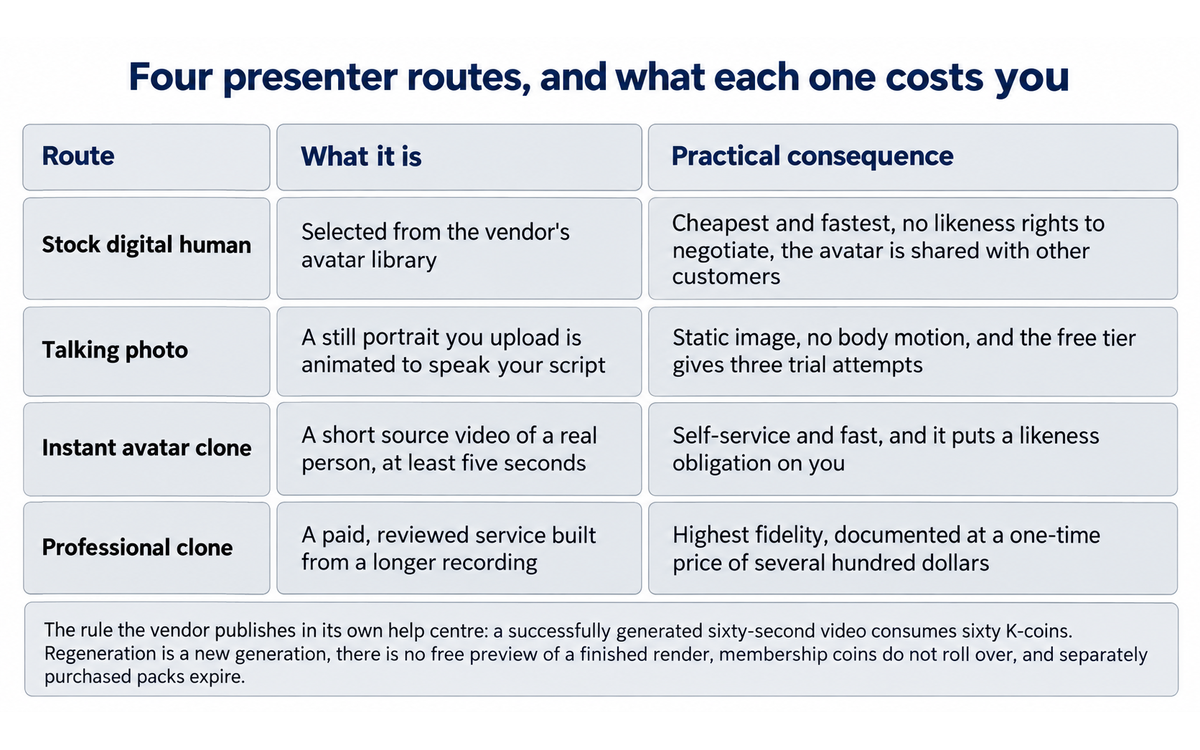
The source of the presenter is the decision that determines everything downstream, because the four routes differ in setup, motion, price and rights.
Route | What it is | Practical consequence |
Stock digital human | Selected from the vendor's avatar library | Cheapest and fastest, no likeness rights to negotiate, the avatar is shared with other customers |
Talking photo | A still portrait you upload is animated to speak your script | Static image, no body motion, and the vendor's own help page states the free tier gives three trial attempts before an upgrade is needed |
Instant avatar clone | A short source video of a real person, described by the vendor as at least five seconds, cloned by the customer | Self-service, fast, included in plan-specific quantities, and it puts a likeness obligation on you |
Professional avatar and voice clone | A paid, reviewed service built from a longer recording | Highest fidelity route, documented by third-party reviews at a one-time price of several hundred dollars, with a recording process and a review step in between |
Inputs and outputs
Inputs: typed or AI-generated script, a still image, an audio file in the documented format, a PowerPoint or PDF deck, a product page URL, or a recorded video for cloning.
Outputs: an MP4 video file at up to 1080p on paid tiers, an audio voiceover that can be produced independently of a video, generated still images, multi-size ad image variants, captions and translated or dubbed audio.
The generation pipeline
Content collection. For a URL-to-video job, the platform collects the product title, description, images and video from the page.
Script generation. The platform drafts several script angles for the chosen video type, which you can accept, edit or replace. AI copywriting is a documented standalone tool as well.
Presenter and voice selection. Avatar library, then voice and language, then preview.
Scene assembly. Multiple scenes per video, with background, text, elements, music and transitions set per scene or across all scenes.
Storyboard and preview. For advertising workflows, a storyboard with editable opening and closing frames and action prompts.
Render. Generation consumes K-coins. Regeneration consumes K-coins again.
Download or share. From the project list, or through the platform's social sharing path.
The measured limits, with their source surfaces
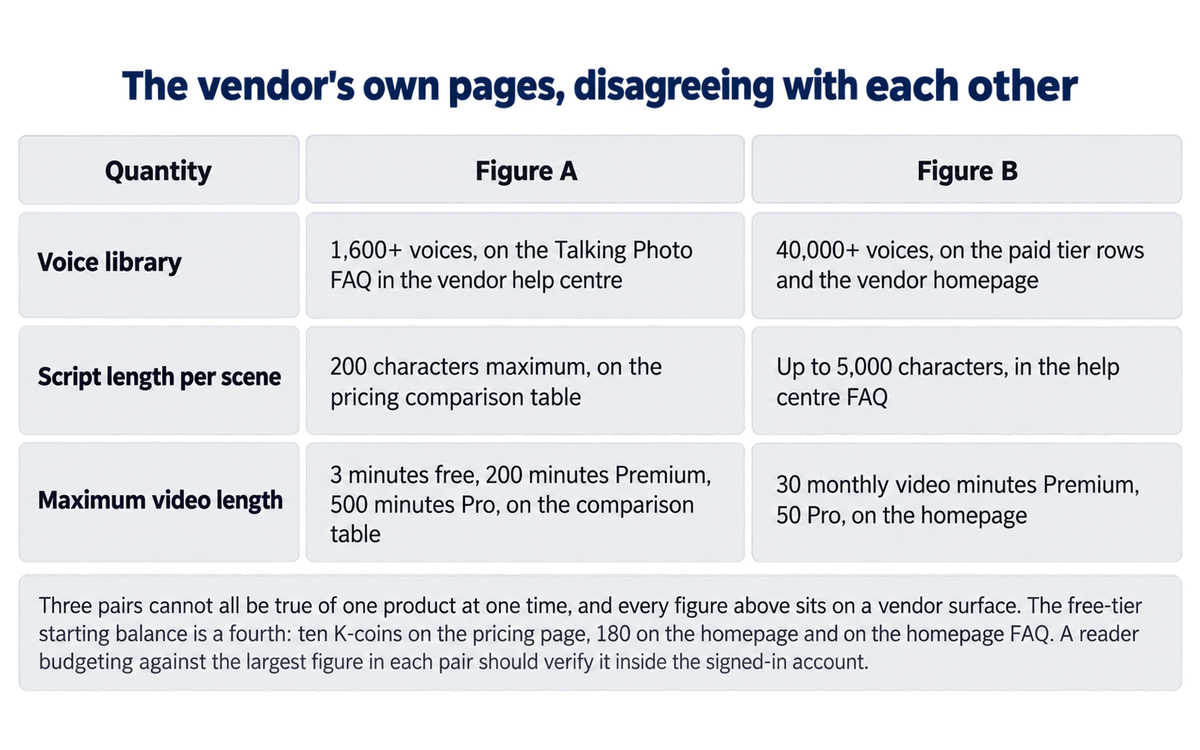
This is where a reader should slow down, because the vendor's own pages give different numbers for the same thing.
Quantity | Figure | Surface it appears on |
Voice library | 120+ voices | Free tier row, vendor homepage and pricing comparison table |
Voice library | 1,600+ voices | Talking Photo FAQ in the vendor help centre |
Voice library | 40,000+ voices across 140 languages | Paid tier rows, vendor homepage, pricing comparison table and vendor comparison pages |
Languages | 31 languages | Free tier row |
Languages | 140+ languages | Paid tier rows, help-centre tutorial and video pages |
Avatar library | 5 avatars (free), 700+ (Premium), 1,000+ (Pro) | Vendor pricing comparison table |
Avatar library | 700+ digital human templates described as the platform's total | Digital human video creation tutorial in the vendor help centre |
Script length per scene | Up to 800 characters free, 2,400 Premium, 5,000 Professional | Digital human video FAQ in the vendor help centre |
Script length per scene | 200 characters maximum | Max Character Per Scene row, vendor pricing comparison table |
Generation time | About 5 to 10 minutes for a one-minute video | Digital human video FAQ and the vendor's own advertising workflow article, which states two to four minutes for a first cut |
Generation time | About 4 minutes per generated minute | Vendor API FAQ, as reported in an independent review summary |
Maximum video length | 3 minutes free, 200 minutes Premium, 500 minutes Pro | Vendor pricing comparison table |
Total monthly video minutes | 30 minutes Premium, 50 minutes Pro | Vendor homepage and pricing description |
Three of those pairs cannot both be true of one product at one time, and they are all on the vendor's own surfaces: the voice library figure differs by a factor of twenty-five between the help centre and the homepage, the per-scene script limit differs between 200 characters in the comparison table and up to 5,000 characters in the FAQ, and the maximum video length differs by a factor of roughly four to ten between the comparison table and the homepage minute allowance. The likely explanation is that the comparison table measures a single scene and the FAQ measures a whole project, and that the help centre page predates a library expansion. The review does not resolve it, because the vendor does not, and a reader budgeting against the largest figure in each pair should verify it in the signed-in account instead. Treat the spread as the finding.
The credit model
K-coins are the metered unit. The vendor's Talking Photo FAQ states the rule directly in its simplest form: a successfully generated sixty-second video consumes sixty K-coins, and a ninety-second video consumes ninety. Premium avatars, voice cloning and the various AI tools each carry their own consumption, and the homepage shows three different monthly allowances in one plan card for annual commitments (3,000, 6,000 and 12,000 K-coins for Pro against a stated 3,000 per month).
Membership coins reset each cycle and do not roll over. Separately purchased coin packs expire, and third-party summaries report the expiry as thirty, sixty or ninety days depending on the pack. There is no documented mechanism for a free revision.
The API and agent surfaces
The vendor documents API access for Professional and Pro users, exposes video, voice and avatar endpoints, and publishes an MCP service for agent integration. The documented operational shape, as reported by an independent review, is one concurrent task by default with a queue of eight. That shape matters more than the feature list for an automation team: a single concurrent task with a short queue is a throughput ceiling you should size your pipeline against before you commit.
Contracts and data
The terms of service are published by the vendor and name Ideareal Limited as the operator. The privacy policy is signed by a data privacy contact address on an affiliated domain. Both are read against each other in Section 7c. The privacy policy states that before collecting sensitive personal information including facial features and voiceprints, the vendor will notify you separately and obtain your explicit consent. That is a relevant commitment rather than a weakness, and it is recorded here because a reader using the cloning routes will not find it restated anywhere on the product pages.
Getting Started with KreadoAI
The honest way to start with this product is to test the exact workflow you intend to buy, once, on the free tier, and to decide from what you see rather than from what the page claims. Everything below takes under an hour.
A fifteen-minute first test, in order:
Open a free account and note the balance in the account itself, not on the page. The homepage states 180 K-coins, an FAQ on the same page repeats 180, and the pricing page shows 10. The number that matters is the one in your balance.
Pick one real product or offer. Not a demo script. Paste the product page URL into the URL-to-video path, or type a script of about 120 to 150 words into the digital human path. Short is the point: a hook of that length is the length the advertising formats actually use.
Choose one stock avatar and one voice in your own language, and change nothing else. Generate one video. Note the wall-clock time from pressing generate to the file being available, because that number is the one you will live with, and the vendor publishes two different estimates for it.
Watch the result at the size it will run. If the video is for a phone feed, watch it on a phone. Realism judgements made on a desktop monitor do not survive the placement.
Now make one deliberate revision. Fix a typo, change one word, swap the avatar. Check the coin balance before and after. That delta is the revision tax, measured on your own account rather than projected, and it is the number the third-party cost analysis argues about.
Write down three things: the coins consumed per finished minute including revisions, the wall-clock time per finished minute including revisions, and one sentence on whether the presenter is credible for the claim you are making.
Then, and only then, read the plan table. Buy the tier whose minute allowance covers your measured consumption with headroom, because membership coins do not roll over and purchased packs expire.
What to check before you upload anything of value:
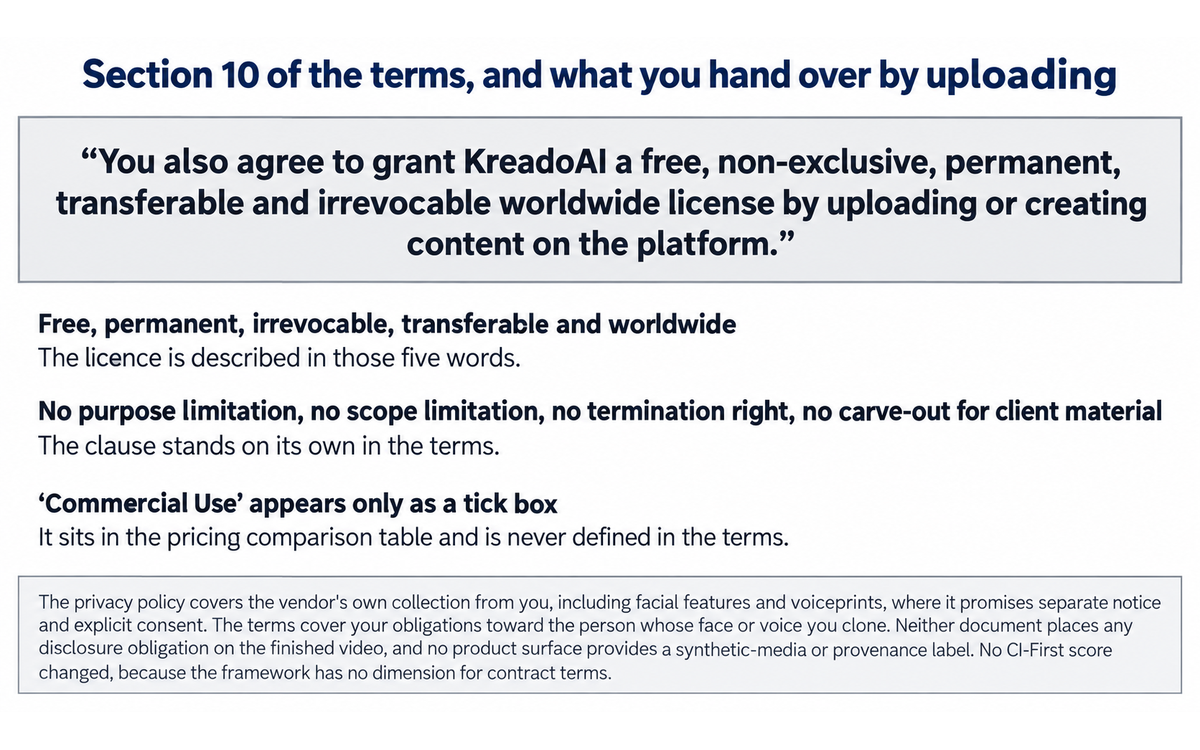
Read section 10 of the terms before your first upload. It grants the vendor a free, permanent, irrevocable, transferable and worldwide licence over content you upload or create. That is the clause to decide about, not the privacy policy.
For a clone route, get written consent from the person whose face or voice you are cloning, and keep the record somewhere your team can find it, because the terms place the likeness obligation on you.
Ask the vendor, in writing, which presenter routes the "Commercial Use" entitlement covers, and keep the answer. The pricing page shows it as a tick box and the terms do not define it.
Do not put a product photograph, a client asset or a real person's recording into a test account until the licence question is settled.
Minimum viable setup for a small team: one paid seat on the tier whose minutes match your monthly output, a shared folder for scripts and consent records, one named person who owns the release decision, and a one-page standard that defines what makes a generated video publishable in your brand. The last two items are the ones that determine whether the tool helps you.
Real Workflows
Each workflow below names what you produce, the exact sequence on the platform, and the verification step without which the output should not be published. The U365 method reference is the prompt pattern to use, and the verification checklist is the part the credit mechanic will tempt you to skip.
Workflow 1: Product-page to short-form advertisement, one offer, five hook variants
What you produce: five short-form video advertisements for the same product, differing in opening hook and presenter, for a paid social test.
Method: UP-Context brief first, then generation. State the audience, the single claim, the objection to answer and the language register before you let the platform write anything.
Sequence:
Paste the product URL into the URL-to-video tool and confirm the scraped material: hero image, price, offer language, key benefit lines.
Let the platform draft its three script angles. Do not use any of them unedited.
Rewrite the script into a hook stack: hook, objection, offer, call to action. Keep the spoken length between fifteen and twenty-five seconds for cold traffic.
Select three avatars rather than one, so the test covers the presenter as a variable.
Generate each variant. Record the coins consumed per variant, including every regeneration.
Use the multi-size export to produce the placement formats from each finished video rather than regenerating per format.
Release to the test with each variant named so the result can be attributed back to the hook, not to the campaign.
Verification checklist:
☐ The product facts in the generated script match the product page, price and offer included.
☐ No claim in the script is one the product cannot support.
☐ The avatar is credible for the audience, judged at phone size.
☐ Every regeneration is recorded in the coin log, so the true cost per published variant is known.
☐ The variants must differ in the hook rather than in the presenter, or the test measures nothing.
☐ A named person has signed off the release, and the sign-off is written down.
What this workflow honestly delivers. Production volume for a decided offer. It does not tell you which hook won. That measurement comes from the advertising platform, and treating the generation as the test is the Quantity Illusion this review rates High.
Workflow 2: Localising an existing advertisement into three markets
What you produce: one existing advertisement, re-voiced and subtitled into three languages, with the on-screen presenter performing in each.
Method: LIPS for the campaign record and CARE for the review. The localisation is an Execute step against a plan that already exists, not a new campaign.
Sequence:
Upload the source video or the script, depending on the route your plan supports.
Select the target languages and voices. Use the vendor's own language set as the ceiling, and check that each target language is present in the picker rather than in the marketing table, because the vendor publishes 31 and 140 languages on different surfaces.
Generate the dubbed audio and the lip-synced video separately, and check the audio on its own first. A wrong pronunciation is easier to hear than to see.
Add captions and remove any subtitle text from the source material that now duplicates the new language.
Export per placement.
Publish market by market, with the native review completed for each.
Verification checklist:
☐ A native speaker of each target language has read the full script and heard the full audio before release.
☐ Product names, brand names and any legal wording are correct and unchanged in every language.
☐ Lip-sync holds at the placement size, and mouth artefacts are checked on the close-ups.
☐ No market receives a localisation whose voice register contradicts the brand, which is the most common failure in a three-market run.
☐ The disclosure question is answered per market: how, if at all, the audience is told the presenter is synthetic.
☐ Each market's release is recorded in the campaign record with the language, the voice and the date.
Workflow 3: Presentation to narrated video for internal use
What you produce: a slide deck or PDF turned into a narrated presenter video for internal circulation or a course module.
Method: UNOP is the relevant frame, because this is a learning artefact rather than an advertising one. The teachable step is the narration, not the generation.
Sequence:
Upload the deck into the presentation-to-video path and check the scene breakdown against the slides.
Write the narration as a script rather than reading the slides aloud, then paste it per scene.
Select a presenter whose register matches the material, and keep the background plain.
Set captions on, because a narrated video watched on mute is the common case in an internal channel.
Generate, review at the placement size, and export once.
Check the total runtime against the vendor's per-scene character limits, because the character allowance and the scene-length allowance are published differently on two vendor surfaces.
Verification checklist:
☐ Every slide shown matches the narration spoken against it.
☐ No figure, date or name is mispronounced, checked by listening rather than reading.
☐ The runtime is inside the platform the video is going to, not inside the vendor's maximum.
☐ The audience knows the presenter is generated, and the description or surrounding material says so.
☐ A named person owns the review of the final file before circulation.
What this workflow honestly delivers. A narrated explainer without a studio. It does not deliver training-quality production values, and for regulated internal content it should not be used at all, because no approval or governance workflow exists in the product.
The verification rule that covers all three
The tool will produce every one of these artefacts whether or not a human reviews them. The difference between a useful workflow and an expensive one is a named reviewer and a written standard. Put the standard in the plan, put the review on the calendar, and put the coin log next to both, so you can see what the output actually cost.
Strengths, Limits, and AI Imposture Risk
Strengths
1. The production bottleneck is genuinely removed, at the point where it used to be hardest. A presenter video from a text box, a product URL or a slide deck is a real capability, not a demo. The URL-to-video path collects the product material and drafts script angles, which is the part of the work a small team most often cannot staff.
2. The inventory is the largest in the category on the vendor's own figures. Whatever the exact number, the paid tiers advertise an avatar library in the thousands and a voice library in the tens of thousands across a very large language set. The practical consequence is that a localisation job rarely stalls on a missing language or voice, which is not true of several cheaper competitors.
3. The advertising workflow is specific rather than generic. Batch product video, TikTok-style avatar video, multi-size ad image export, face swap, subtitle removal and a smart canvas are the actual operations of a paid social creative pipeline. Most avatar tools stop at a talking head and leave the placement work to you.
4. Four presenter routes at four different price points. A stock avatar, an animated photo, a self-service clone and a reviewed professional clone let a reader match fidelity to stake. That ladder is more honest than a single "custom avatar" feature and it is the right shape for a small team.
5. Free access without a card, and free exports that a paid test can follow. The permanent free tier with a small coin allowance is enough to run one real test of the exact workflow you intend to buy, which is the only test that resolves the quality question.
6. An API and an MCP service, documented rather than announced. For a team that wants creative generation on a pipeline, the integration path exists and is described, including its concurrency ceiling.
Limits
1. No independent measurement of output quality exists. Not for realism, not for lip-sync accuracy, not for render success rate, not for time per rendered minute. Every quality figure in this review is either a vendor estimate or a user impression. This is the single largest limit on the review and it caps the Quality sub-score.
2. The vendor's own numbers disagree with each other. The voice library is stated as 1,600 or more on one help-centre page and 40,000 or more on the homepage, the per-scene script limit is 200 characters in the pricing comparison table and up to 5,000 in the help centre, and the maximum video length differs by a factor of roughly four to ten between two vendor surfaces. A buyer cannot plan capacity from the numbers as published.
3. Regeneration is charged at full price and there is no free preview of a finished render. Combined with the fact that membership coins do not roll over and purchased packs expire, the credit model prices the thing creative work does most, which is revise. The vendor's own pricing page also states a lower free allowance than the homepage and the homepage FAQ, so even the starting balance is ambiguous until you are inside an account.
4. The quality ceiling is visible to users and acknowledged by third-party reviewers. The recurring user criticism is an uncanny-valley look and lip-sync below the category leaders. For a product whose own selling point includes making synthetic output feel authentic, that criticism lands on the core value proposition rather than on a side feature.
5. The ceiling in output specifications is low. Paid tiers export at 1080p and the absence of a 4K path is treated as a hard limit by third-party reviews. There is no timeline editor, no cinematic scene generation and no collaborative team workspace.
6. The commercial-use entitlement is thin on the product pages. Commercial use appears as a tick-box row in a comparison table and is mentioned in third-party summaries as a paid-plan benefit. It is not accompanied on the pricing page by any statement of what the right covers, whether it applies to stock avatars, to clones, or to localised output.
7. The enterprise governance surfaces are contested. The vendor publishes a safety and ethics page claiming dual ISO/IEC certification for information security management and privacy information management. An independent review states the product lacks SOC 2 and ISO 27001. A buyer running a formal vendor review will have to resolve that themselves, and the product pages do not help.
8. No team collaboration features. Confirmed both by the product surface and by an independent comparison, which lists team collaboration as absent.
AI Imposture Risk
Trap | Rating | Evidence |
Time Illusion | Medium | The speed gain is real but is partly paid back. The vendor's help centre estimates five to ten minutes of generation for a one-minute video and its own advertising article quotes two to four minutes for a first cut, so a ten-minute deliverable is tens of minutes of waiting. Every revision is a fresh full-price generation with no free preview, and third-party reporting records support responses for refund matters measured in weeks. A user who does not count the revision cycles will believe the tool saved more time than it did. |
Quantity Illusion | High | Quantity is the product's explicit pitch: unlimited tiers, batch video, multi-size export, and homepage testimonials claiming a move from five videos a week to dozens a day. Nothing on any vendor surface or any review platform measures whether that additional volume converted better. The vendor's own comparison pages measure success by output volume and by the ability to validate angles, which is a production metric rather than a performance metric. One Trustpilot reviewer states plainly that the advertised video count per plan is wrong by a large factor, which is the quantity claim being contested at its source. |
Skill Illusion | High | The product is sold on requiring no skill: the homepage FAQ asks directly whether design or video editing experience is needed, and the AI writes the script as well as the performance. A beginner therefore generates expert-looking output they cannot evaluate, because judging whether a synthetic presenter is credible for a specific claim, or whether a localised script reads as native, is a skill the tool does not teach and provides no feedback on. There is no teaching surface, no critique, and no measurement the user can apply to their own result. This is the framework's definition of substituting for capability rather than building it. |
Overall AI Imposture Risk: High. The two High ratings are driven by the same structural property: the tool makes output easy and makes judgement invisible. A reader who treats generated volume as tested creative, or a generated advertisement as a validated one, is the reader this rating protects.
Why each rating is not higher, stated so the reader can weigh it. Time is not High because the time saving is large and measurable even after revisions for anyone producing more than a handful of videos. Quantity is not capped lower because the volume really is available and the unlimited tiers really do remove a real cost. Skill is not Medium because the evidence points the other way: the vendor markets the absence of skill as a feature, and no surface gives the user anything to apply as a standard.
Section 7c: Avatar and voice licensing, and the rights over what you generate, stated plainly
This section exists because two of the vendor's own documents, read together, describe a rights position that a reader should decide about before uploading anything.
What the vendor's terms say about what you upload and what you generate. Section 10 of the terms of service, titled "Your Content", states that you reserve all rights for content you submit, publish, display or create on or through the platform, and then states, verbatim:
"You also agree to grant KreadoAI a free, non-exclusive, permanent, transferable and irrevocable worldwide license by uploading or creating content on the platform."
Read on its own, the first sentence is the reassurance and the second is the operative clause. The licence is described as free, permanent, irrevocable, transferable and worldwide. It has no stated purpose limitation, no scope limitation to operating the service, no termination right and no carve-out for client material. A reader who uploads a client's product photography, an actor's recorded likeness, or a brand film to be localised is granting that licence over the material as a condition of using the service. That is not a scandal and it is common in this category, and it is the kind of clause that a marketing team signs without reading because the product page reads as a tool rather than as a rights transaction.
What the terms say about the content KreadoAI supplies. Section 9 states that all existing and future content of KreadoAI is the exclusive property of KreadoAI and its licensor, and that the user must pay the relevant cost in full before enjoying the related services, with the licence revocable at any time on a violation of the terms. Section 11 grants the user a limited, non-exclusive, non-transferable and non-sub-licensable right to access and use the service during the purchase period.
Where the commercial-use entitlement actually lives. Commercial Use appears on the vendor's pricing comparison page as a tick-box row across the paid tiers. It does not appear in the terms of service as a defined grant, with no statement of what it covers, whether it extends to stock avatars, to cloned likenesses, to localised or dubbed output, or to resale to a client. A reader buying into this class of tool for agency work should treat "Commercial Use" as a product-page feature claim rather than as a contractual entitlement, and should ask the vendor in writing which of the four presenter routes are covered.
The likeness position on the cloning routes. The terms place the responsibility on you: you promise that the content you provide does not infringe the privacy, portrait, copyright or intellectual property rights of any other subject, that you have the right to use it, and that you will grant the platform the licence described above. The privacy policy states that before collecting sensitive personal information including facial features and voiceprints, the vendor will notify you separately and obtain your explicit consent. The privacy policy therefore covers the vendor's own collection from you, and the terms cover your obligations toward the person whose face or voice you clone. Neither document places any disclosure obligation on the finished video, and no product surface provides a synthetic-media or provenance label. A UGC-style advertisement built on a cloned presenter and a generated script would carry no machine-readable indication that it is synthetic, and an independent review of the same period makes the same point in one sentence: cloning someone else's face without permission is a legal problem no matter which tool you use, and consent should be in writing before any third party is cloned.
A second document set that does not agree with itself. The vendor's own safety and ethics page states that KreadoAI is dual certified to the ISO/IEC information security management standard and the privacy information management standard. An independent review published in May 2026 states that KreadoAI lacks SOC 2 and ISO 27001 and advises against using it for material that is proprietary or confidential. Both statements were live at the time of writing. The certification claim is the vendor describing itself, the absence finding is a third party describing what it could not verify, and neither is a substitute for the other. A reader with a vendor security process should request the certificate scope and the audit date rather than accept either statement.
What this section does not do. It does not assert that the vendor has misused anyone's content, and it makes no allegation of any kind about the supplier's conduct. It quotes the vendor's own operative text, states the questions the two documents leave open, and names the decision that sits in front of a reader: whether to upload client material under a permanent, irrevocable and transferable licence, and whether to build advertising on a cloned likeness without a written consent record and without a disclosure label on the output.
No score in this review changed because of this section. The framework measures benefit to the human across Time, Quantity, Quality and Skill, and the Humics Protection rating across Creativity, Critical Thinking and Social Authenticity. It has no dimension for contract terms, licensing or provenance. A reader who sees an unchanged score next to a rights finding should read that as the methodology working as designed, and then make the rights decision on its own terms, which is where it belongs.
U365 Co-Intelligence Rating
CI-First Profile
Primary profile: Co-Worker and Assistant (2). The tool performs an execution task, producing advertising video, under human direction and review.
Secondary profiles: Co-Creator and Thought Partner (1), where the script generation and storyboard surfaces are used to explore angles rather than execute a decided one. Analyst and Tester (4) is a weak secondary, because the multi-size and batch surfaces let a team run variation tests, while the platform itself publishes no result measurement.
Collaboration Mode
Recommended mode: Centaur.
Alternative mode: None recommended.
Mode rationale: Framework section 7.2 states that an Imposture Risk of Medium or High indicates Centaur, because Centaur mode is safer. This review rates the overall risk High, driven by Quantity Illusion and Skill Illusion both at High. Centaur is therefore the derived mode rather than a preference. In practice it means a clear division of labour: the tool produces drafts and variations, and a named human decides which angle, which presenter and which claim go out, and owns that decision. Cyborg mode, in which the producer and the tool iterate continuously inside the same working loop, is exactly the pattern the credit mechanic punishes, because every iteration inside the loop is a paid generation.
CI-First Benefit Score
Dimension | Score (0-10) | Rationale |
Time | 6 | Large and real saving on production and localisation, partly returned to the tool in waiting time and in full-price regeneration cycles |
Quantity | 6 | A genuine step change in the number of variants and markets a team can serve, discounted because nothing measures whether the additional volume performed |
Quality | 5 | The output is consistently serviceable rather than excellent, and the score is capped by the total absence of independent measurement plus contradictions in the vendor's own figures |
Skill | 5 | Real skill is built in hook writing and in judging synthetic presence, but the product is sold on requiring none, and it provides no standard, feedback or critique for the user to apply, so the conservative score applies |
CI-First Benefit Score: 5.5 / 10 (CI-First Positive)
Why this is Positive and not Strong. The production saving is real and the inventory is broad, which is why the tool is recommended. The step from Positive to Strong would require evidence that the volume it produces performs, or a measurement of output quality from outside the vendor, or an entitlement that a team can rely on. None of those exists, and the framework's instruction is to score the honest user and the common case net of overhead rather than the best case.
Humics Protection Badge
Dimension | Rating | Rationale |
Creativity | Neutral | The tool expands the number of variants a person can produce and the angles the script generator suggests, which serves divergence, but the presenter, the formats and the templates are shared and the composition is done for you, so the craft learned is selection rather than invention |
Critical Thinking | Erodes | The product's framing is volume and speed, with performance prediction and strategy agents presented as substitutes for the marketer's own analysis, and no surface gives the reader anything to check a generated claim or a generated script against |
Social Authenticity | Erodes | The vendor sells the product on synthetic output that feels more authentic than polished advertising, the cloning route places a generated script into a real person's likeness, and neither the terms nor any product surface requires a disclosure label on the finished video |
Humics Protection Score: -2 / +3 Badge: Humics-Risky
What the badge rests on, stated precisely. The Creativity rating does not depend on the badge outcome. The two negative ratings both come from the same property: the product makes it easy to put plausible synthetic speech into a human face and then measures its success by volume and by how authentic the result felt, while providing no standard, no disclosure and no feedback surface. The badge would move to Neutral on the Creativity dimension alone if the tool taught composition, and it would move on Social Authenticity if a disclosure or provenance label existed anywhere in the workflow. Neither is present.
Superhuman Usage Guidance
When to invite this tool:
Producing test-volume creative variations of a decided offer, where the output is a draft for a media buyer to select from.
Localising a short advertisement or product video into several markets, with a native speaker reviewing the script before release.
Generating a first presenter video for a product where no filming capacity exists, so that a marketing decision can be made on something concrete.
Converting an internal or low-stakes presentation into a narrated video, where the audience knows the presenter is generated.
Prototyping a hook and a structure before commissioning a filmed production.
When to keep this tool out:
Anything carrying a regulated, health, financial, safety or legal claim in a synthetic presenter's mouth.
Client material, product photography or third-party likenesses uploaded without a written consent record and a decision about the permanent licence in section 10 of the terms.
Any deliverable where the audience would reasonably assume the presenter is a real person and the campaign depends on that assumption.
Brand film or premium advertising where the video is the brand asset.
A workflow where the person using the tool is expected to acquire video production skill, because the tool will do the work and teach nothing.
U365 method integration:
LIPS and CARE: design the campaign in LIPS before generating anything. The creative hypothesis, the audience, the claim and the success measure are LIPS artefacts, and the generated video is the Execute step rather than the plan. The CARE loop applies at review: check the localised script with a native speaker and check every factual claim in the generated copy before release, which is precisely the step the credit mechanic tempts a team to skip.
ULM and EVA: the tool bears mainly on the Career domain, because it changes the cost of a professional output, and on Quality of Life, because it removes a recurring production burden from a small team. Under the EVA cycle it belongs in the Evaluate and Act stages, providing the material a human evaluates rather than the evaluation itself. Weak fit for Body, Spirit and Social, and no part of the product concerns them.
UP-Context: prompt the tool through the UP-Context method by writing the brief first and the script second. State the audience, the single claim the video must land, the objection it must answer, and the language register. Then let the platform generate angles against that brief rather than asking it to invent the campaign.
SL-OS: the creative brief, the consent record for any cloned likeness, and the review log for what was published in which market belong in your SL-OS under the campaign rather than inside the vendor's project alone. The platform holds the file, the operating system holds the decision.
UNOP: the pedagogical fit is narrow and specific. If a U365 Fellow is learning content production, the teachable step is the hook and the localisation review, not the generation. A curriculum that puts the generation in the student's hands without putting the review there too will build a producer who cannot tell a good advertisement from a merely fluent one.
Over-delegation warning: over-delegation with this tool looks like a creative team that produces fifty variants a week and can no longer say why any one of them should work, a marketing function that has replaced its judgement about an audience with a script generator's first draft, and a brand that has put a synthetic presenter in front of its customers making a claim that nobody read carefully. The CI-First formula is the warning itself: if the human intelligence in the loop drops while the generated volume rises, Co-Intelligence falls, and the falling number is masked by how professional the output looks. The practical guard is a single rule: one named person owns the release decision for every video, and that person reviews the script, the claim, the likeness consent and the disclosure question before anything is published.
What Users Say
The platform's Trustpilot profile is the only review surface that publishes a readable review count. Trustpilot publishes 4.7 out of 5 from 50 reviews for kreadoai.com, which sits in Trustpilot's own top band. A regional page publishes 4.6 out of 5 from 52 reviews, and the two counts do not reconcile, which is ordinary for a platform that counts reviews differently on different surfaces. The review count moves as reviews are added, and the band holds at the top of the scale.
Platform | Rating | Reviews | Note |
Trustpilot (kreadoai.com) | 4.7 / 5 | 50 | A regional page publishes 4.6 from 52 reviews. The two counts do not reconcile. Platform band: top of scale |
G2 | 4.5 / 5 | Independent comparison pages | A figure of 4.5 across independent comparison pages. It is second-hand, and G2 should be opened directly for a current count |
Capterra | No rating found | n/a | A product listing exists. No review count is published in a readable form |
GetApp | No rating found | n/a | No rating is published for this product on this platform |
Product Hunt | No rating found | n/a | No rating is published for this product on this platform |
Tekpon | No listing found | n/a | Not present in the aggregator's index for this product |
Coupon-directory user ratings | 4.5 / 5 | 4 | A low-confidence aggregate on a discount site, included only so the spread is visible |
Automated directory opinion | 61 / 100 quality | n/a | A directory publishes a blended automated score from public signals, with about 175,600 estimated monthly visits and Ukraine as the largest single visitor region at 8 per cent. It states plainly that the score is not an editorial rating |
What users praise, in their words. The positive reviews cluster on three things: speed of the first result, the breadth of voice and language options, and the absence of a learning curve.
"I stumbled across Kreado AI while looking for a quick way to create multilingual video content, and I'm honestly impressed. Within minutes of signing up, I was able to generate a high-quality avatar video just by typing in some text. No technical skills needed at all." Trustpilot, 5 stars, July 2025
"The voice and avatar options are incredible. I tried several languages and accents, and the pronunciation and lip sync were spot on. It even supports regional accents, which is a huge plus. The avatars look natural, not robotic like with some other tools I've tested." Trustpilot, 5 stars, July 2025
"Great storyboard generation and consistent character." Trustpilot, 5 stars, February 2026
The language and accent point appears repeatedly and should be read as the product's real strength rather than as marketing. It is the one claim the user reviews and the vendor's pages agree on.
What users criticise, in their words. The negative reviews are almost entirely about the credit mechanic, and they are specific rather than vague.
"The service is unrealistic and misleading. They deceive users with two types of credits: some are priced at levels 4 and 5. The most important issue is that each video costs at least 1000 credits. So, with the cheapest subscription, you can only generate 3 videos, while their information suggests you can produce far more." Trustpilot, 1 star, July 2025
A second complaint, quoted in a third-party cost analysis, makes the same point at the level of a single project: "I wasted 10 minutes of credit on a video just to fix a single typo." That is one user's account of the mechanic, and the mechanic itself is confirmed by the vendor's own help centre, which states that a successfully generated sixty-second video consumes sixty K-coins. Regeneration is a new generation.
The hidden-tax review, read properly rather than quoted by its headline. A widely indexed review titles itself "A Hidden Tax on Your Video Budget" and projects that KreadoAI's true total cost of ownership runs 25 to 50 per cent above the advertised price, a gap it attributes to credits consumed on every minor revision, which it calls the revision tax. It models an annual plan advertised at $768 as costing between $968 and $1,168 in reality. Three things should be said about that review in fairness to the reader. First, its own projected range is a model built from user complaints rather than a measurement, by its own description. Second, its stated entry price of approximately $40 per month contradicts the vendor's homepage, which showed $19 for Premium and $40 for Pro on the same day, so its cost base is not the vendor's current one. Third, and this is disclosed in the review itself, the publisher sells discount codes for the product, which is a commercial interest in the reader's purchase that the page does not treat as a conflict. None of that makes the underlying finding wrong, because the finding is corroborated by the vendor's own help centre and by Trustpilot reviews. It means the arithmetic is a projection and should be replaced by the reader's own measured number, which is what the first workflow in Section 7 is for.
U365 editorial note. No user review on any platform measures whether a generated advertisement performed. Every positive review describes the production experience and every negative review describes the cost of it, and the question a marketer actually needs answered, whether the output converted, appears in none of them. Read the review count for what it tells you about onboarding and disappointment, and read the vendor's own results claims as claims.
Comparison and Alternatives
The avatar-video category is dominated by products of the HeyGen type, so the comparison below is concrete rather than general. The figures in the table are drawn from a third-party comparison published by a competing vendor, from the other vendors' own pricing surfaces, and from the vendor's own comparison pages, and each source is named at the point of use. Where a comparison measures KreadoAI on an annual rate against a competitor's monthly rate, that base mismatch is named in the Faculty Note rather than smoothed over here.
Alternative | Presenter source | Languages and voices | Free tier | Entry price | Lip-sync reputation in the comparison source | Choose it if |
KreadoAI | Stock avatars, uploaded photo, instant clone, professional clone | 140+ languages, 40,000+ voices on paid tiers; 31 languages and 120+ voices on free | Permanent, no card | From $19/month Premium, $40/month Pro as displayed promotional prices, against $24 and $50 list; one vendor page advertises $10/month | Described as good, with moderate animation quality | Your work is advertising and e-commerce creative, you need batch variation and per-placement export, and you want the largest voice inventory |
HeyGen | Stock avatars, photo avatars, custom avatars | 175+ languages, 300+ voices | About one minute of video | About $24/month | Described as very good, with good animation quality | Presenter quality matters more than voice count, and you want team collaboration, which KreadoAI does not offer |
Synthesia | Stock and personal avatars, studio recording for custom | 140+ languages, 120+ voices | Demonstration only | About $22/month | Described as very good | You need structured training and internal roll-out video under governance, and you want a product built for governed business production |
D-ID | Uploaded portraits, stock presenters, interactive agents | 120+ languages, 100+ voices | About five minutes | About $5.90/month | Described as good | Your primary need is animating a still portrait, or you want an interactive digital human rather than a video file |
Runway | No presenter product. Cinematic scene generation and editing | Not a localisation product | 125 one-time credits | About $28/month Pro with 2,250 monthly credits | Not applicable to a presenter workflow | You need cinematic output and editing control, and you do not need a presenter or a URL-to-video advertising stack |
Viblo | Short-form creator video product | Not comparable on the same inventory | Free signup tier | $25/month Starter, $49/month Creator, $99/month Business | Not comparable in the same source | You want ElevenLabs voices and a browser timeline editor, and you manage a fixed publishing schedule rather than campaign variation |
A2E AI | Aggregator over several video models, with face and head swap | 30+ languages on free, broader on paid | 100 signup credits plus a daily check-in bonus | About $99/year Pro, about $39.9/month Max | Not stated | You want multi-model video generation from one subscription, and raw free credit volume matters more than advertising format readiness |
Choose KreadoAI if your job is producing advertising and e-commerce video at variation volume, your markets are many, and you accept a revision cycle that costs credits. Choose HeyGen if the presenter is the product and you need collaboration across a team. Choose Synthesia if the video is training or internal roll-out and a buyer will ask for compliance evidence. Choose D-ID if the job is a talking portrait or an interactive agent. Choose Runway if the deliverable is cinematic and no presenter is involved. Choose none of them, and commission a filmed production, if the video is the brand.
Two base mismatches to carry into any comparison table you read, including this one. First, a third-party comparison in wide circulation sets KreadoAI's annual-equivalent starting price of about $11 per month against HeyGen's monthly $24 and Synthesia's monthly $22. An annual rate measured against monthly rates is not a like-for-like comparison, and it flatters the annual side. Second, the vendor's own comparison pages lead with Premium from $10 per month against Viblo's $25 Starter and Runway's $28 Pro. The $10 is a promotional or annual figure on a vendor-authored page, and it is not the price a reader meets in the checkout on a monthly plan. Read the base on both sides of every row before drawing a conclusion.
One contradiction worth naming before you rely on the free tier. The vendor's own comparison page with A2E AI states that KreadoAI's free tier exports without a watermark, while a third-party review states that free-tier videos carry a watermark and that watermark removal is one of the features paid access adds. Both were live at the time of writing. Test the export once before you plan a campaign around the free tier.
Verdict and Next Steps
Verdict: use it, for advertising and e-commerce creative at variation volume, with a named reviewer and a measured cost per finished minute.
KreadoAI scores 5.5 out of 10, which is CI-First Positive. That is a real recommendation rather than a consolation. The product removes a genuine production bottleneck, its voice and avatar inventory is among the broadest available, its advertising workflow matches the operations a paid social team actually performs, and its free tier lets you test the exact thing you intend to buy. On the honest-user and common-case basis the framework requires, that is worth recommending.
It is not scored higher for reasons that are specific rather than general. There is no independent measurement of output quality anywhere. The vendor's own numbers disagree with each other on inventory, on script length and on video duration. The credit mechanic charges full price for the revision work that creative production consists of. The quality ceiling is described by users and by third-party reviewers as below the category leaders. And the rights position in the terms grants a permanent, irrevocable and transferable worldwide licence over what you upload or generate, which is a decision rather than a detail.
Next steps, in order.
Measure before you buy. Run the fifteen-minute test in Section 7 and write down coins per finished minute and wall-clock time per finished minute, revisions included. Those two numbers decide your tier.
Read section 10 of the terms and settle the licence question before any client material goes into the product. If your work is agency work, get the commercial-use scope in writing.
Write a one-page release standard naming what makes a generated video publishable in your brand, and name the one person who owns the decision.
Decide the disclosure position for your markets and record it. The platform provides no provenance label, so the decision is entirely yours.
Re-check this review against the triggers at the top, and specifically when the vendor's published numbers converge or an independent quality measurement appears.
U.Copilot Integration
U.Copilot is the front door to the U365 tool library, available at https://www.university-365.com/ucopilot. Use it before you generate anything here, because the brief is the part of this workflow that the tool cannot write for you and the part that determines whether the output is worth having.
What to ask U.Copilot to do. Describe the offer, the audience and the single claim the video must land, and ask it to produce the hook stack the advertisement will follow. Ask it to write the avatar and voice selection criteria for each market rather than a list of avatars. Ask it to design the review step, naming the evidence a reviewer must see before release, including the consent record for any cloned likeness and the disclosure decision for each market. And ask it to place the finished campaign record in your LIPS Digital Second Brain so the creative hypothesis and the result sit together.
U.Copilot prompt example.
Design a CI-First workflow for producing short-form advertising video for [offer] in [markets] using KreadoAI. Write the brief first: audience, the one claim the video must land, the objection it must answer, and the language register per market. Then produce five hook stacks and the selection criteria for avatar and voice per market. Include a release review that names the evidence a reviewer must see, including written consent for any cloned likeness and the disclosure decision per market. Include a coin budget calculated from a measured cost per finished minute rather than from the plan's advertised minutes. Connect the brief and the release log to my LIPS Digital Second Brain under [campaign], and tell me which parts of this workflow I must do myself.
SL-OS Integration
LIPS Digital Second Brain: the creative brief, the hook stacks, the consent records and the per-market release log belong in your LIPS under the campaign. The platform holds the video file. LIPS holds the decision record, which is what you will need when a claim is questioned or a likeness is disputed.
ULM routines: primarily Career and Quality of Life. The tool changes the cost of a professional output and removes a recurring production burden, which is a Career question, and it returns time, which is a Quality of Life question. Character is touched in one specific way: deciding not to put a synthetic presenter in front of an audience on a claim nobody verified is a discipline rather than a feature. Weak fit for Body, Spirit and Social.
My Successful Life: put the creative review on the cadence your campaign cycle already runs on, and put the per-market disclosure decision on the same schedule as the market launch. The trigger to watch is the moment a video is approved for release, because that is the point at which the reviewer's name should be attached to it and, in most teams, is not.
UP-Context prompt packs
Four prompts in the house UP-Context order, one per decision this workflow forces: the brief, the presenter, the localisation run, and the rights and cost check. Each closes with the verification line, and each states where the record belongs, because this platform writes no standing instruction of its own and the decision record has to live somewhere you control.
Context: The offer is [offer]. The audience is [audience] in [markets]. The one claim the advertisement must land is [claim], and the objection it must answer is [objection]. The language register per market is [register]. What the advertisement must never assert is [list]. The channel and the placement size are [channel and size].
Role: AI as a campaign specification assistant working to a written claim boundary.
Profile: Act as a Co-Creator and Thought Partner. I own the claim and the final judgement; you generate angles and check my brief.
Task: Restate my brief back to me before drafting anything: the audience, the single claim, the objection and the register. Then produce five hook stacks that differ in the hook rather than in the presenter, and for each one state the claim it lands and the objection it answers. Name any hook that would require a claim the product cannot support.
Constraints: Never invent a product feature, a price, a certification or a comparative claim. Never write a health, financial, safety or legal claim. Every factual line in a script must be traceable to the product page. Ask before adding any element I did not describe.
Output format: The restated brief, five numbered hook stacks each with its claim and objection, and a list of the lines that need a product-page check before use.
Memory: this platform saves the script and the project as user-authored assets and writes no standing instruction of its own. The approved brief belongs in my own campaign record, and it is the artefact the whole run is measured against.
UP-Context verification: state what you checked, what you could not check, and what a human must decide before this is used.
Context: The advertisement is for [offer] in [market]. The presenter route is [stock avatar, talking photo, instant clone or professional clone]. The likeness in use is [mine, a colleague's with written consent, or a library avatar]. The placement is [feed, story, in-stream, other] and the review size is [pixels or device]. The claim on screen is [claim].
Role: AI as a release reviewer applying my stated standard to one generated video.
Profile: Act as an Analyst and Tester, applying my standard rather than inventing one.
Task: Tell me what to watch for at the placement size rather than at full resolution, and give me the checklist in the order I should run it. Then state, for this claim and this audience, whether a synthetic presenter is the honest way to make the claim, and say plainly if it is not. Name the specific moments in a generated presenter video where credibility most often fails, so I know where to look.
Constraints: Do not assess quality from a vendor claim, because no independent measurement exists. Do not tell me the output looks good without naming what you checked. Where a judgement needs a human watching the file, say so rather than substituting for it.
Output format: A numbered watch-list for the placement size, the disclosure decision I owe this market, the reviewer name line, and one sentence on whether the synthetic presenter is right for this claim.
Memory: this platform writes no standing instruction of its own; the approved release decision and the reviewer name belong in my own campaign record and in the LIPS record for the engagement.
UP-Context verification: state what you checked, what you could not check, and what a human must decide before this is used.Context: I am localising [advertisement or presentation] from [source language] into [target languages]. The audience in each market is [audience]. The register each market expects is [register]. The script is [length] characters per scene, against the vendor's published per-scene maximum of [figure]. The markets where a claim must be checked before release are [markets].
Role: AI as a localisation reviewer working to a written market standard.
Profile: Act as a Co-Worker and Assistant on the mechanics, and as an Analyst and Tester on the register question.
Task: For each market, state what must change beyond the translation: the register, the idiom, the currency or unit, the example, and anything that would read as foreign to that audience. Then name the check the localised script needs before release and who must make it, and say which markets need the claim re-verified rather than only re-worded.
Constraints: Never present a machine translation as native-reviewed. Never let a market release without a named native reviewer. Do not pick a figure where the vendor's own surfaces disagree about a limit, and say when they disagree.
Output format: A per-market table of what changes, the named native reviewer role per market, the claim-verification list, and the disclosure decision per market.
Memory: this platform writes no standing instruction of its own; the per-market release decisions and the reviewer names belong in my own campaign record and in the LIPS record.
UP-Context verification: state what you checked, what you could not check, and what a human must decide before this is used.Context: I intend to upload [product photography, a client asset, a recording of a person, or nothing third-party]. The plan is [tier], the current allowance is [coins], the consumption rule I have measured is [coins per finished minute including revisions]. The intended use is [purpose], published to [channels], and [may or may not] be resold or wrapped in a service we offer. The likeness I intend to clone is [describe, with where the consent record is].
Role: AI as a rights and cost reviewer for a commercial campaign.
Profile: Act as an Analyst and Tester. I supply the measured numbers and the contract position; you apply them and flag what is unresolved.
Task: For this campaign, state what the terms grant the vendor over what I upload and what I generate, whether the commercial-use entitlement covers each of the four presenter routes, what the consent position is for any cloned likeness, and what the measured cost per finished minute means for the tier I should buy. Then list every question the published record does not settle and the one that must be answered in writing before anything is uploaded.
Constraints: Do not give legal advice and do not assert that any party acted improperly. Distinguish a licence to use something from ownership of it, because they are different positions. Where the terms, the pricing page and the help centre describe the same arrangement from different angles, say which one governs and say that they disagree. Where the vendor publishes three different figures for the same allowance, use my measured number rather than any of them.
Output format: A governing-document line, a licence line, a commercial-use line, a likeness-consent line, a measured cost per finished minute, an unresolved-questions list, and the human decision required before upload.
Memory: this platform writes no standing instruction of its own; the approved rights position and the consent record belong in my own working file and in the LIPS record, because the platform holds the video and not the decision.
UP-Context verification: state what you checked, what you could not check, and what a human must decide before this is used.Prompt pack 1: The advertisement brief before anything is generated
Prompt pack 2: The presenter and the size it will run at
Prompt pack 3: The localisation run and the native review
Prompt pack 4: The rights and cost check before anything is uploaded
Migration Path
Not applicable. KreadoAI is Active and recommended, so no Migration Path is required and none is built here. The heading is carried so that the section inventory of this review is complete, and it states plainly that a migration plan exists only for a tool that is Retired, Deprecated or Risky.
One adjacent decision belongs on the record anyway, because a reader can reduce dependence on the platform without leaving it. The credit mechanic is the reason: membership K-coins reset each cycle and do not roll over, separately purchased packs expire, and there is no free preview of a finished render. A team that keeps its approved final renders in its own storage, keeps the script and the consent record beside the campaign record rather than inside the vendor project, and keeps a coin log of what each published asset actually cost has no lock-in worth a migration. The re-check triggers at the top of this review are the conditions under which this section would stop being empty.
U365's Recommendations to Learn More
Official learning resources
The pricing comparison table, which is the single most informative page on the site and also the one that disagrees most with the others. Read it against the homepage: https://www.kreadoai.com/price
The digital human video FAQ, for the per-scene character limits, the generation-time estimate and the scene-splitting advice: https://help.kreadoai.com/en/articles/8696920-digital-human-video-faq
The talking photo FAQ, for the sixty-seconds-to-sixty-coins consumption rule and for the free-tier trial limit: https://help.kreadoai.com/en/articles/8697218-talking-photo-faq
The digital human video creation tutorial, for the eight-step workflow and for the description of the platform's avatar total as 700 or more templates: https://help.kreadoai.com/en/articles/8697076-digital-human-video-creation-tutorial
The help centre itself, which is the map of every documented workflow including the clone service, the voice clone, the face swap, the dubbing and the copywriting tutorials: https://help.kreadoai.com
The terms of service, and specifically section 10 on your content, section 9 on the platform's content, section 11 on the licence you receive, section 7 on the no-refund position and section 16 on governing law: https://www.kreadoai.com/terms-of-service
The privacy policy, read next to section 10 of the terms, because the two answer different questions about the same material: https://www.kreadoai.com/privacy-policy
The safety and ethics page, which carries the dual ISO/IEC certification claim that an independent review states is absent: https://www.kreadoai.com/safety-and-ethics
The vendor's own advertising workflow article, which states a two-to-four-minute first cut and describes the hook stack the short-form workflow uses: https://kreadoai.com/article/how-to-create-ai-ugc-avatar-video-ads
The vendor's marketing video tutorial, for the three-step URL-to-storyboard sequence and the parameters it exposes: https://kreadoai.com/article/ai-marketing-videos-tutorial
The KreadoAI API documentation, reachable through the "KreadoAI API Docs" link inside the help centre, for the endpoints and the documented concurrency and queue limits: https://help.kreadoai.com
Video tutorials and channels
Two vendor-adjacent walkthroughs are listed below. Both walkthroughs were live when this review was written, and each is listed for how the interface is organised rather than for how the output looks on your material.
Watch both for how the interface is organised and how a flow is described, not for how the output looks on your own material. Neither is a vendor-produced film: the first is a general walkthrough of the avatar, copywriting and text-to-speech surfaces, and the second covers the text-to-video path.
The general walkthrough of the avatar, copywriting and text-to-speech surfaces: https://www.youtube.com/watch?v=IHs7iexV8Rg
The text-to-video path, from a prompt to a finished clip: https://www.youtube.com/watch?v=0EQ8t-5m1iA
Written tutorials and deep-dive articles
The independent cost analysis titled as a hidden tax on the video budget, dated May 2026, for the revision-tax projection and for the security-certification finding. Read it knowing that the publisher sells discount codes for the product: https://couponsscout.com/reviews/kreadoai-review-hidden-costs
The September 2026 independent review of pricing, avatars, API and alternatives, which states its own testing scope and is the source of several figures in this review: https://magichour.ai/blog/kreadoai-review
A pricing and inventory breakdown of the K-coin system with a four-product comparison table, published by a payments company: https://plisio.net/ai/kreado-ai
A product overview carrying the vendor's scale claims and the second-hand 4.5 G2 rating: https://withai.top/tool/kreadoai
An automated directory entry with the traffic estimate, the automated quality score and the noted limits on 4K export and support response times: https://searchtools.ai/t/kreadoai
A feature and pricing summary that records the credit system's effect on longer or high-volume projects and the paid requirement for full commercial-use rights: https://allbestapps.net/ai-app/kreadoai
The vendor's own head-to-head against A2E AI, useful as an example of how the vendor frames its own free tier: https://kreadoai.com/article/kreadoai-vs-a2e-ai
The vendor's own head-to-head against Viblo, which is the source of the $10 Premium figure that appears in the pricing discussion: https://kreadoai.com/viblo
The vendor's own head-to-head against Runway, for how the vendor frames video minutes against credit pools: https://kreadoai.com/runway
Community and social
Dedicated KreadoAI channels
The vendor's YouTube channel, which carries the product demonstrations and the short walkthroughs: https://www.youtube.com/@kreadoai
The vendor's company page on LinkedIn, under the product name: https://www.linkedin.com/company/kreadoai
The vendor help centre, which is the closest thing to a community learning path the vendor publishes, and the surface where the operational limits live rather than on the product pages: https://help.kreadoai.com
Resources on KreadoAI and Resources on X
The vendor's own account is the first channel to add, because a change to the pricing model, the licence over your content or the model line would be announced there before it reached a documentation page. Verified 2026-09-25: the account is @kreadoai2023, linked from the vendor's own homepage footer and from the help-centre footer, and its own description carries the product's copy and its inventory claims. For this category the accounts worth following alongside it are the practitioner and analyst accounts that publish comparative work, and the competitor accounts named in the comparison section above, so that any capability claim in this review can be checked against a measurement rather than against a marketing page.
Dedicated X channels
CI-First Evaluation Summary Card
Field | Value |
Tool | KreadoAI (Ideareal Limited) |
Category | Video and Creative Tool for advertising and e-commerce conversion video |
CI-First Benefit Score | 5.5 / 10 |
Band | CI-First Positive |
Time / Quantity / Quality / Skill | 6 / 6 / 5 / 5 |
CI-First Profile | Co-Worker and Assistant (2), primary. Co-Creator and Thought Partner (1), secondary |
Collaboration Mode | Centaur (derived from framework 7.2: High Imposture Risk requires Centaur) |
Humics Protection Score | -2 / +3 |
Humics Badge | Humics-Risky |
Creativity / Critical Thinking / Social Authenticity | Neutral / Erodes / Erodes |
AI Imposture Risk | High (Time Medium, Quantity High, Skill Illusion High) |
Status | Active |
Last tested | 2026-09-25 |
Re-check | Trigger-based, max 6 months |
Primary institute | UIC (Digital Communication, Marketing), High (primary) |
Section 7c finding | The terms grant the vendor a free, permanent, irrevocable, transferable and worldwide licence over content you upload or create (section 10), while the commercial-use entitlement exists only as a tick box on the pricing page and the certification claim on the ethics page is contradicted by an independent review. No score changed. |
Framework v1.2 clauses | 5.2.3-a: null, with the agent-authored-artefact boundary explicitly drawn. 4.2-a: null. 7.5: null |
Framework v1.2 clause note
All three v1.2 clauses were assessed explicitly against this tool. All three return a null, and each null is a finding rather than an omission.
Clause 5.2.3-a, agent-authored procedural memory, with a Skill Illusion floor of no lower than Medium. This clause governs a tool that writes procedural memory on the user's behalf: instructions, skills or rules the agent keeps and reuses as its own operating procedure. KreadoAI writes none. It produces a script, a video file and a project record inside your account, which are artefacts you own and can delete, not an agent's procedural memory. The boundary matters here because the product is agent-generated-content-heavy and a reader could reasonably assume the clause applies. It does not, and the reason is that the artefact is output rather than memory. Skill Illusion is nevertheless rated High in this review on the separate ground that the product is sold on requiring no skill and provides no standard or feedback with which a user could evaluate its output.
Clause 4.2-a, agent-mediated conversation. This clause applies where agent-authored text is presented as the person's own voice, or where agent interaction substitutes for human contact. It returns a null here. The product is a production tool, not a conversational agent: it writes a script and renders it as video, and the business that buys it then publishes the result as its own advertising under its own name. The synthetic presenter is a production asset the buyer chooses and discloses or fails to disclose, and that decision is the buyer's rather than the agent's. The clause also does not reach the marketing copy, because the copy is published by the buying business to its own market rather than by an agent in dialogue with a person. The Social Authenticity rating of Erodes does not rest on this clause, and a reader should not infer that it does. It rests on the licensing and provenance position described in Section 7c.
Clause 7.5, team-level rooms. This clause applies where more than one agent acts in a shared channel, which requires Centaur. It returns a null. The product's generation runs inside a single execution: one job, one account, one output file, with no shared room in which several agents act on one conversation. The documented default of one concurrent task with a queue of eight is a throughput limit on a single-execution service, not a multi-agent room. Centaur is nevertheless the recommended Collaboration Mode in this review, and it is derived from the framework's own risk rule at section 7.2 rather than from this clause.
Glossary
CI-First
the U365 method of evaluating and using AI so that human intelligence is preserved and increased by the collaboration rather than replaced. The framework in this review measures benefit to the human net of the overhead of using the tool. On first mention in this review the term is written as CI-First rather than as an abbreviation.
CI-First Benefit Score
the arithmetic mean of four dimensions, each scored from 0 to 10, rounded to one decimal place.
Time Benefit
whether the tool lets you do what you already knew how to do, faster, counted net of the time the tool itself consumes, which includes prompting, waiting and checking revisions.
Quantity Benefit
whether the tool lets you do more than you were used to doing in the same time, scored on verified usable output rather than raw output.
Quality Benefit
whether the tool lets you do what you were used to doing, better, scored on durable quality improvement rather than on surface polish.
Knowledge and Skill Benefit
whether the tool teaches you something you did not know or lets you do something you did not know how to do, scored conservatively because this dimension is the most vulnerable to illusion.
CI-First Benefit bands
0 to 2.0 CI-First Negative, 2.1 to 4.0 CI-First Neutral, 4.1 to 6.0 CI-First Positive, 6.1 to 8.0 CI-First Strong, 8.1 to 10.0 CI-First Transformative.
CI-First Profile
the role the AI plays in the collaboration. Profile 1 Co-Creator and Thought Partner, Profile 2 Co-Worker and Assistant, Profile 3 Coach and Tutor, Profile 4 Analyst and Tester, Profile 5 Challenger and Devil's Advocate.
Collaboration Mode
how the work is divided between you and the tool. Centaur mode keeps a clear division of labour, with the human owning the decision and the tool owning the execution. Cyborg mode interleaves the two continuously inside one working loop. Framework section 7.2 states that an Imposture Risk of Medium or High means Centaur, because Centaur is safer.
Humics
the three human capacities the framework protects: creativity, critical thinking and social authenticity.
Humics Protection Badge
the sum of three ratings, each worth +1 for Protects, 0 for Neutral or -1 for Erodes. A total of +2 or +3 is Humics-Friendly, -1 to +1 is Humics-Neutral, and -2 or -3 is Humics-Risky.
AI Imposture Risk
the risk that the tool creates an illusion of benefit that is not real. Time Illusion is the belief that the tool saved time when the overhead consumed the saving. Quantity Illusion is the belief that producing more is the same as producing well. Skill Illusion is the belief that using the tool built a capability the user does not actually have. Overall risk is the highest level the evidence supports.
Centaur
the collaboration mode in which a human and a tool divide the work, with the human holding judgement and the tool holding execution.
Superhuman Usage Guidance
the instruction on when to invite the tool and when to keep it out, with an over-delegation warning. Over-delegation means handing the tool work that requires human judgement and then treating its output as validated.
K-coin
the vendor's metered unit of consumption. Generation consumes K-coins, regeneration consumes K-coins again, membership K-coins reset each billing cycle without rolling over, and separately purchased packs expire.
Presenter route
the source of the on-screen person in a generated video. KreadoAI offers four: a stock digital human from the vendor library, a talking photo animated from a still image, an instant avatar clone from a short recording, and a reviewed professional clone built from longer material.
User Sentiment
The record of what users say about a tool on review platforms, with the sample size and the verification status of each platform stated, because a rating without its volume and its verification status cannot be read. KreadoAI's public sentiment is positive and thin at the same time: 4.7 out of 5 across 50 reviews on Trustpilot, a 4.5 figure cited second-hand for G2, no published rating on Capterra, and no listing on several other directories. The positive reviews cluster on speed, voice breadth and the absence of a learning curve, and the negative reviews cluster on the credit mechanic.
Review Status
the badge this review assigns to the tool. Active means the tool is current and recommended. Risky means the tool has significant unresolved issues, or it has been clearly surpassed by newer alternatives, in which case the Limits section should be read before use. Retired and Deprecated apply to tools no longer available or no longer maintained.
Last tested and Re-check
Last tested is the date of the material this review rests on. Re-check is the trigger set that would require the review to be rewritten, listed at the top of this document.
Sources
Vendor primary sources
KreadoAI homepage, for the tagline, the twelve attributed testimonials, the plan cards, the free-tier allowance and the FAQ answers on free coins and on design experience: https://www.kreadoai.com/
KreadoAI pricing comparison table, for the per-tier avatar counts, voice counts, language counts, per-scene character maximum, maximum video length, monthly video minutes, export resolution, commercial-use row and API row: https://www.kreadoai.com/price
KreadoAI terms of service, published by Ideareal Limited, section 3 on price changes, section 7 on the no-refund position, section 9 on the platform's content, section 10 on your content and the licence you grant, section 11 on the licence you receive, section 12 on demonstrative authorisation, section 14 on liability and compensation, section 15 on termination and assignment, and section 16 on governing law and the arbitration seat: https://www.kreadoai.com/terms-of-service
KreadoAI privacy policy, last updated March 2026, for the data categories collected, the explicit-consent commitment on facial features and voiceprints, the sharing partners and the opt-out instructions: https://www.kreadoai.com/privacy-policy
KreadoAI safety and ethics page, for the dual ISO/IEC certification claim on information security management and privacy information management: https://www.kreadoai.com/safety-and-ethics
Digital human video FAQ, for the per-scene character limits, the generation-time estimate, the ten-minute per-scene maximum, the five-to-eight-minute scene advice and the instant clone minimum recording length: https://help.kreadoai.com/en/articles/8696920-digital-human-video-faq
Talking photo FAQ, for the sixty-seconds-to-sixty-coins consumption rule, the 1,600-plus voice figure and the three free trial attempts: https://help.kreadoai.com/en/articles/8697218-talking-photo-faq
Digital human video creation tutorial, for the eight-step workflow and the 700-plus digital human template figure: https://help.kreadoai.com/en/articles/8697076-digital-human-video-creation-tutorial
Help centre, for the documented workflow set including the clone service, voice clone, face swap, dubbing, copywriting and cutout tutorials: https://help.kreadoai.com
KreadoAI API documentation, reached through the "KreadoAI API Docs" link in the help centre, which is the reliable route to it: https://help.kreadoai.com
Vendor comparison page against A2E AI, for the free-tier watermark claim and the free-tier comparison framing: https://kreadoai.com/article/kreadoai-vs-a2e-ai
Vendor comparison page against Viblo, for the $10 Premium figure and the minute-based pricing argument: https://kreadoai.com/viblo
Vendor comparison page against Runway, for the credit-pool comparison and the 40,000-voice claim: https://kreadoai.com/runway
Vendor advertising workflow article, for the two-to-four-minute first-cut estimate and the hook stack method: https://kreadoai.com/article/how-to-create-ai-ugc-avatar-video-ads
Vendor marketing video tutorial, for the three-step URL-to-storyboard workflow: https://kreadoai.com/article/ai-marketing-videos-tutorial
Vendor presenter video article, for the five-step presenter workflow: https://kreadoai.com/article/ai-presenter-youtube-channel
Independent sources
Independent review of pricing, avatars, API and alternatives, dated September 2026, which states its own testing scope and is the source of the API concurrency figures, the script-length limits, the generation-time estimates, the coin expiry windows and the $499 professional clone price: https://magichour.ai/blog/kreadoai-review
Independent cost analysis dated May 2026, titled as a hidden tax on the video budget, for the projected 25 to 50 per cent revision-tax range and the security-certification finding. The publisher sells discount codes for the product, which is disclosed on the same page: https://couponsscout.com/reviews/kreadoai-review-hidden-costs
Independent review stating that KreadoAI has no published SOC 2 or ISO 27001 attestation while other vendors in the same comparison publish a full certification stack: https://vidmetoo.com/privacy-check-comparing-ai-video-platforms
Pricing and inventory breakdown with a four-product comparison table, including the 1,000-plus avatar, 40,000-voice and 140-language figures, the converted tier prices and the voice-clone and clone-bundle prices: https://plisio.net/ai/kreado-ai
Product overview carrying the vendor's scale claims and the second-hand G2 rating of 4.5: https://withai.top/tool/kreadoai
Automated directory entry with the traffic estimate, the automated quality score, the 4K export limitation and the support-response observation: https://searchtools.ai/t/kreadoai
Feature and pricing summary recording the credit system's effect on longer projects and the paid requirement for full commercial-use rights: https://allbestapps.net/ai-app/kreadoai
Product overview citing the founding year, the headquarters city and the ISO/IEC dual certification claim: https://bestfreeaitools.io/hi/ai-tools/kreado-ai-review
Corporate announcement of the security and compliance module on the vendor's site, reported by a third-party newswire: https://en.eclicktech.com.cn/html/company/356.html
Review platform sources
Trustpilot profile for kreadoai.com, for the published review count: https://www.trustpilot.com/review/www.kreadoai.com
Trustpilot regional page, for the review count as it moves during the same day: https://ca.trustpilot.com/review/www.kreadoai.com
G2 product page, for a reader to open directly: https://www.g2.com/products/kreado-ai/reviews
Capterra product listing, for the product's position in the conventional software directories: https://www.capterra.com/p/10015075/Kreado-AI/
Community and community-reported evidence
KreadoAI help centre, which carries the operational limits that the marketing pages omit: https://help.kreadoai.com
Framework and method
The U365 CI-First Evaluation Framework, version 1.2, which is the scoring method used here. It sets the benefit dimensions, the Humics protection rating, the AI Imposture risk assessment and the collaboration modes applied in this review: https://www.university-365.com/ci-first
The U365 INSIDE Tools review template, which sets the structure of this post: https://www.university-365.com/tools
Published U365 INSIDE Tools reviews, read as comparisons and linked where they are named in this post: https://www.university-365.com/tools
Faculty Note on Evidence Quality
Three things should be said plainly about the evidence behind this review, because they change how much weight a reader should put on each part of it.
First, the vendor's own surfaces disagree, and the disagreements are not small. The voice library is stated as 1,600 or more on one help-centre page and 40,000 or more on the homepage and the paid-tier rows, a factor of twenty-five. The per-scene character maximum is 200 in the pricing comparison table and up to 5,000 in the digital human FAQ. The maximum video length is 200 minutes on Premium and 500 on Pro in the comparison table against a stated 30 and 50 monthly video minutes on the homepage. The generation-time estimate is five to ten minutes per minute of video in one help-centre page, two to four minutes for a first cut in the vendor's own advertising article, and about four minutes per generated minute in the API FAQ, with a further two-hour generation-time figure attached to the free-trial card. The free-tier allowance is 10 K-coins in the pricing page's free card and 180 in the homepage and the homepage FAQ. The professional avatar-and-voice clone service is priced at about 500 dollars in one third-party breakdown and 499 dollars in another, which is a rounding difference rather than a finding and is recorded so the reader is not surprised by either. Some of these differences are reconcilable, because a per-scene limit and a per-project allowance measure different things, and because a comparison table may lag a library expansion. Others are not reconcilable on the vendor's own reading. This review names each figure with its surface and declines to pick a winner, because the honest reader-facing statement is that the published numbers cannot be used for capacity planning, and the signed-in account is the only authority.
Second, the most widely circulated cost analysis is a projection with a commercial interest, and it should be read as both. The review titled as a hidden tax projects a 25 to 50 per cent increase over the advertised price, derived from user complaints about credits consumed on revisions. Its own entry price of roughly $40 per month contradicts the vendor's homepage, which showed Premium at $19 and Pro at $40 on the same day the review was current. The same page sells discount codes for the product. The underlying mechanism it describes is confirmed independently: the vendor's help centre states that a sixty-second video consumes sixty K-coins, and a Trustpilot reviewer states that a single typo cost a regeneration. The mechanism is real, the arithmetic is modelled, and the publisher profits from the reader's purchase. All three statements belong together, which is why the review reports the finding and then asks the reader to replace the projection with a measured number from their own account.
Third, nearly every quality claim in the marketplace is a vendor claim, including inside the comparison tables. The language and voice figures in the comparison table in Section 12 come from a competing vendor's comparison page, which means the competitor chose the inventory figures it wished to present for itself and for each rival. One vendor's own comparison page claims its free tier exports without a watermark while an independent review states the opposite. Another sets an annual-equivalent price against monthly prices. The lip-sync quality column in that table is a competitor's judgement expressed as one or two words. This review uses those figures because they are the only comparative data that exists, and it names the source of each one so the reader can discount it appropriately. No quality statement in this review rests on a vendor's own measurement of its own product, and no independent measurement exists to rest anything on. That absence is the reason the Quality sub-score is 5 rather than higher, and it is the first of the re-check triggers at the top of this document.




Comments