
Microlearning for an AI-Driven World

Updated: Oct 8


UIC University 365 Institute of Communication
Series AI Learning Series | Level Basic (Free)
Duration 25 minutes | Access Free
Digital Communication, Marketing, Branding, Content Strategy, Media Studies

UNOP Sound (University 365 Neuroscience Oriented Pedagogy)
Take five minutes to prepare your brain. Play the isochronous tone track (40Hz gamma frequency) with your eyes closed. Gamma-frequency tones before a learning session raise attention and make the material easier to absorb.
[Audio player: UNOP Pre-Lecture Isochrone (40Hz, 5 minutes)]
In this Lecture

The Hook: The Skill You Need Twice a Year
Think about the last time a tool you relied on at work changed underneath you. A model you had learned to prompt was replaced. A feature you built a habit around moved. A workflow you had automated needed rebuilding because the interface, the limits or the price changed.
If you cannot remember such a moment, you have not been working with AI for long. The tooling in this field changes on a scale of months, not years, and it changed again this year. That rate is the actual problem microlearning was invented to solve. Not the volume of information. The rate at which the information expires.
Most people respond to that rate with one of two strategies, and both fail. The first is to stop learning until the change settles down, which it does not. The second is to try to keep up by reading everything, which produces a broad, shallow familiarity with the news and almost no durable skill.
Microlearning is the third option, and it is not a marketing term for short videos. It is a specific instructional design with specific rules: small units, deliberate spacing, retrieval rather than review, and a defined finish line for each unit. Used properly, it produces skill you can still use in six months. Used as a feed of five-minute summaries, it produces nothing at all.
This lecture walks the whole line, in three passes. First the mechanisms: what makes a five-minute unit teach rather than merely inform, and what the microlearning research actually supports. Then the design: what the 2026 tool landscape changes about what is worth learning, how to run a week around tools that update constantly, and where an agent helps and where it removes the learning. Then the program: how to build a rotation you will still be running in a year, and how to run it with other people.
Step 1: Why Microlearning Works, According to the Evidence
Short-form learning has a bad reputation in serious education, and some of that reputation is earned. Watching a five-minute video is not the same as learning, and most commercial microlearning is exactly that: content chunked for convenience, with no mechanism that forces the learner to do anything.
The research on microlearning proper is more interesting. A systematic review published in Heliyon in 2024 analysed 40 studies following PRISMA guidelines and reported consistently positive effects on learning outcomes, including on self-regulation and problem-solving, and not on recall alone. One study in that review found knowledge gains from online distance microlearning comparable to face-to-face active learning, which is a stronger claim than most people expect from a five-minute unit.
Read those results carefully, because they do not mean that short content teaches better. They mean that short content plus a sound learning mechanism teaches at least as well, and costs the learner far less time. The mechanism is the load-bearing part. Remove it and the positive effect disappears.
Two design features keep appearing in the studies that report gains:
A single, stated objective per unit. Effective microlearning units are learner-centred and relevant, aimed at a task the learner can apply. A unit whose objective is "understand AI" is not a unit. A unit whose objective is "choose the right model for a summarisation task and explain the trade-off" is.
An active step inside the unit. The learner has to produce something: a decision, a written answer, a small artefact, a self-test. The unit that ends with the reader having read is not microlearning. The unit that ends with the reader having decided is.
The third feature is not about the unit at all. It is about what happens between units, and it is where most self-directed programs fall apart. We take that up in Step 4.
One honest qualification before you build anything on this. The evidence base for microlearning is smaller and less uniform than the evidence base for the two mechanisms underneath it. Spacing and retrieval practice have decades of experimental work behind them across ages and subjects. Microlearning is best understood as a delivery format that makes those two mechanisms easy to apply in a busy week. When you design, design for spacing and retrieval first, and let the short format follow from your constraints.
Step 2: The 2026 Problem That Microlearning Solves
The case for microlearning in 2026 is not that people are busier. It is that the objects of learning have changed shape.
The tools are now systems, not features. A general-purpose assistant in 2026 handles text, images, audio and video, runs extended reasoning, and calls external tools. Learning "how to prompt ChatGPT" is no longer a stable objective, because the interface, the models available and the defaults all move. What transfers is a smaller, sturdier set of skills: specifying a task precisely, giving the model the context it needs, deciding what to delegate, and verifying what comes back.
Connected tooling changed what is worth learning. The Model Context Protocol, released by Anthropic in November 2024 and then donated to the Linux Foundation's Agentic AI Foundation in December 2025 with backing from AWS, Google and others, standardised how assistants reach data and tools. Adoption moved quickly: the protocol passed 97 million monthly SDK downloads and several thousand public servers by early 2026, and enterprise deployment reached roughly a quarter of Fortune 500 companies within about eighteen months. The practical consequence for a learner is that "connect the assistant to your own documents and systems" became a normal task rather than a project, and the skill worth having is not the protocol itself but judging what to connect and what to keep out.
Agents moved work from single answers to sequences. A request that used to be one prompt is now a task an assistant can run across several steps with tools. That changes the failure modes, and it changes what you have to know. You need to be able to read a plan before it executes, define a stopping condition, and check intermediate output. None of that can be learned from a news article, but all of it fits in twenty-five minute units.
Evaluation became an everyday skill. With several strong models available and no single best one, the practical question is which model and configuration suits this task. That is an empirical question, and answering it takes fifteen minutes of structured testing per task. It is a perfect microlearning exercise, and almost nobody teaches it.
Set against that, the old study habit does not work. Reading a weekly digest of model releases produces the feeling of currency and none of the skill. What you need is a small number of durable competencies, refreshed on a schedule, with a way to notice when one has gone stale.
Step 3: The Five-Minute Unit and What It Can Carry
At University 365 the five-minute unit is formalised as 5M2S, five minutes to success. The name describes the reading time of one unit, not the length of the learning. A 5M2S unit is one idea, one decision, one small artefact.
The constraint is the design. A five-minute unit that tries to be introductory fails at every job. A five-minute unit that assumes context and settles one question succeeds. That means the unit needs a fixed shape, and the shape does most of the work.
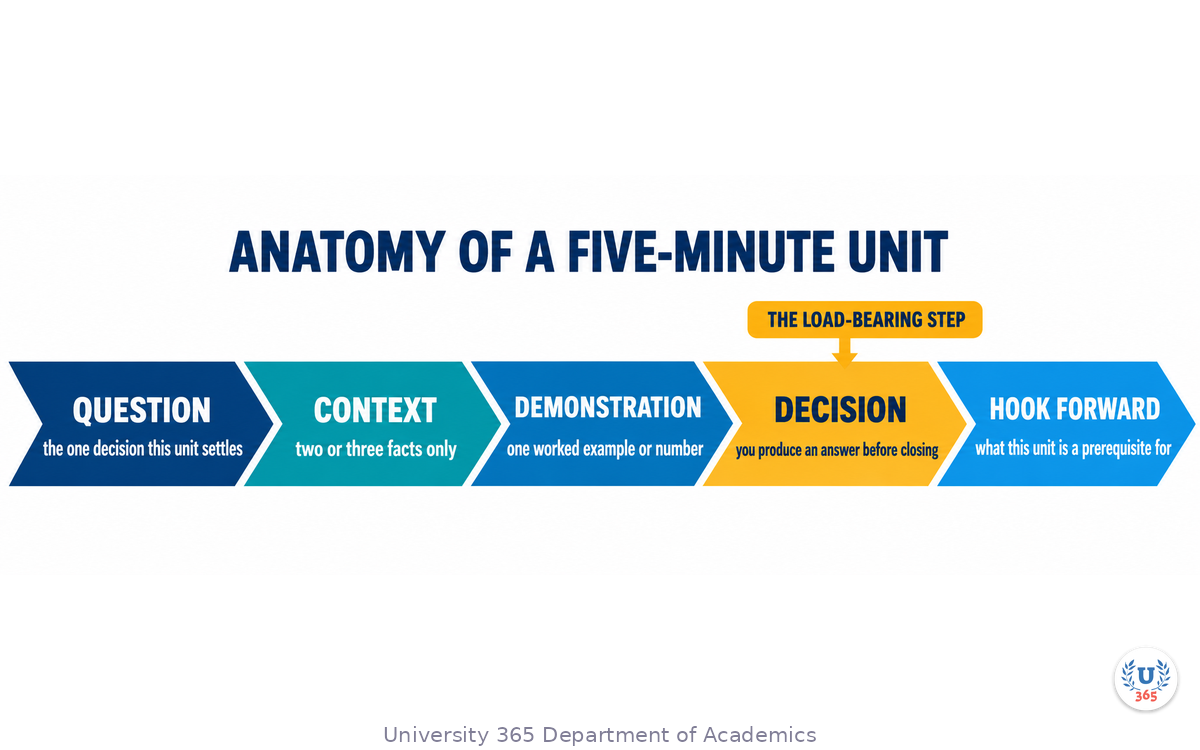
The five-part unit. Every 5M2S unit we publish carries the same five parts, and every unit you write for yourself should carry them too.
The question. One sentence naming what you will be able to decide or do when the unit ends.
The minimum context. The two or three facts required for the decision. Not the history of the field.
The demonstration or the data. One worked example, one number, one comparison. Something concrete enough to argue with.
The decision step. You produce an answer, a choice or a short artefact before you close the unit.
The hook forward. One sentence naming what this unit is a prerequisite for, so the unit belongs to something.
The fourth part is the one that is usually missing, and it is the one that makes the difference between a unit you remember and a unit you have consumed.
What the unit cannot do. Five minutes cannot teach a skill that requires physical practice, deep specialisation or long-form reasoning held across hours. It cannot substitute for a project. It cannot carry a topic whose parts only make sense together. Trying to force those into five-minute units produces the shallow familiarity the critics describe. Where the material genuinely needs more, the unit's job is to prepare you to do the longer work and then to point at it.
Why the constraint is useful anyway. The value of five minutes is not the five minutes. It is that the constraint forces the designer to decide what the single load-bearing idea is. Most teaching material has no single load-bearing idea, and the writer will not admit it. When you are the designer, the format forces the admission out of you. If you cannot state your unit's one idea in one sentence, you do not have a unit yet, and the five-minute limit makes that visible before you spend an hour on the wrong material.
The companion formats. University 365 pairs the short unit with two longer forms. D2L, Discussions to Learn, is a recorded discussion that takes one publication further, useful when the same topic has arguments on both sides and you want to hear them. T2L, Tutorials to Learn, is a step-by-step walkthrough for a task that needs a demonstration. The pattern is deliberate: five minutes to get the idea, fifteen to thirty to see it applied, longer when you are ready to build.
Step 4: Spacing and Retrieval: The Two Levers That Actually Work
Here is the finding that separates a working microlearning program from a reassuring one. Two study strategies have unusually strong experimental support, and almost nobody uses them by default. They are spacing and retrieval practice, and a review published in Nature Reviews Psychology in 2022 summarised the evidence for both across ages and settings while noting how consistently underused they remain.
Spacing. Distributing study of the same material across separate sessions produces better long-term retention than studying it all at once, even when the total time is identical. The effect is robust and it has been replicated across subjects and age groups, from vocabulary to mathematics. The practical rule is unglamorous: the same material should appear at least three times, on at least three separate days, with something else in between.
Retrieval practice. Actively recalling information strengthens memory more than rereading it. Meta-analyses of classroom experiments, including a large review in Psychological Bulletin in 2021, find consistent benefits for testing over restudying, including for material people believe they have already learned. Retrieval works partly because it reveals what you do not know, which rereading reliably conceals: text you have just read feels familiar, and familiarity is easily mistaken for knowledge.
What this means for a five-minute unit. A unit that you read once is a massed study session of one. It will feel productive and it will fade. The unit becomes durable only when it reappears. This is why a good microlearning program is a schedule rather than a library: the same twenty units revisited on a rotation will out-teach two hundred units read once.
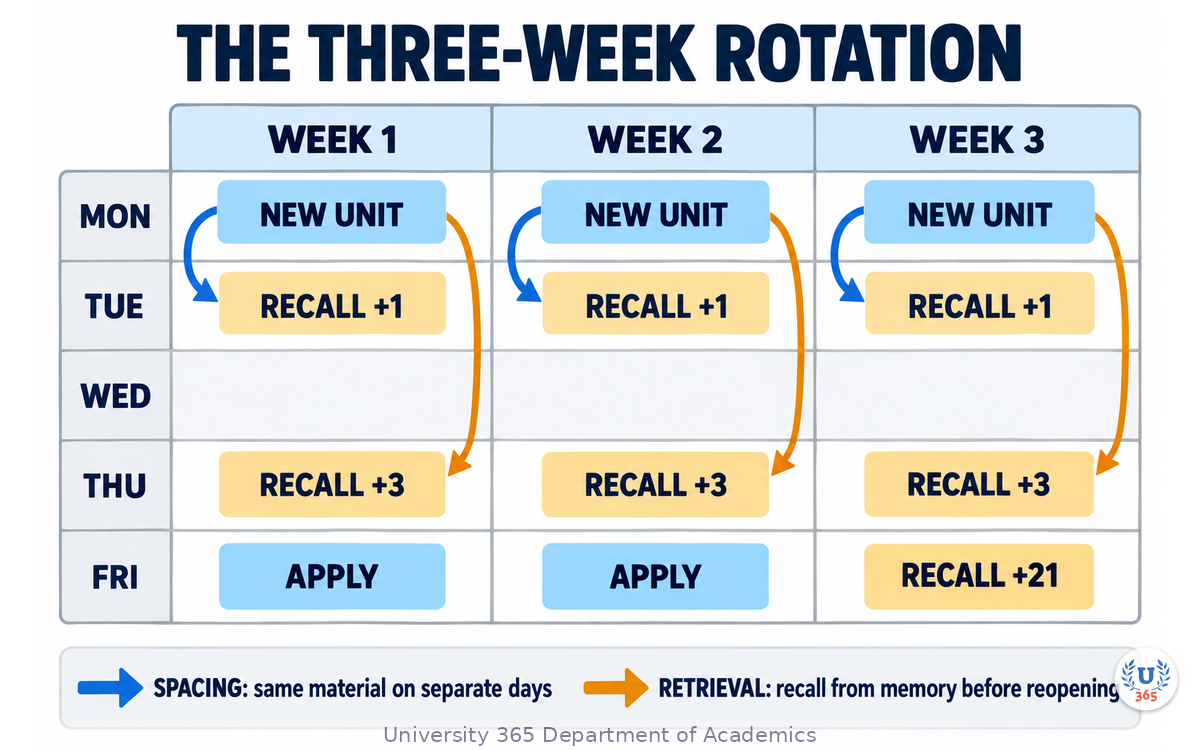
The rotation, concretely. A simple structure that satisfies both levers without requiring an app:
Day 1. New unit. Read it, make the decision, write the answer down.
Day 2. Recall the previous day's unit from memory before reopening it. Two minutes. Then a new unit.
Day 4. Recall the unit from day 1 again, from memory, in a different order of questions if you have them.
Day 8. Apply the unit to a real task, however small.
Day 21. One question, from memory, no notes.
That is roughly seven minutes of work per unit spread over three weeks. It is the minimum structure that produces the effect, and it is small enough to keep.
Why the format is short and the schedule is long. People confuse the two. The reading time is five minutes because attention is finite and the decision must be made. The learning time is weeks because memory is not built in one sitting. A program that optimises for the five minutes and ignores the weeks has optimised the wrong variable.
The self-test that costs nothing. Retrieval does not need a quiz interface. Close the unit, wait an hour, and write down the one-sentence idea and the decision it supports. Compare with the unit. The gap between what you wrote and what the unit said is your actual state of knowledge, and it is more honest than any feeling of comprehension.
Step 5: Designing a Learning Week Around AI Tools
A learning program for AI work has one constraint most other subjects do not: the material goes stale. A unit about a specific model's behaviour may be wrong within a quarter. A unit about how to specify a task, how to evaluate output or how to decide what to delegate can stay correct for years.
The practical design rule follows immediately: build units about decisions, not about products. A unit titled "how to choose between a fast model and a reasoning model for a classification task" survives a product change. A unit titled "how to use this month's default model" does not.
The four-bucket week. A structure that covers the ground and stays durable:
Bucket | Time per week | What it carries |
Durable skill | 20 minutes | Task specification, context construction, output verification, delegation judgement |
Tool currency | 15 minutes | What moved this week, and whether it changes any of your current workflows |
Application | 25 minutes | One real task done with the tool, reviewed afterwards against the durable-skill units |
Spaced recall | 10 minutes | Revisit units from previous weeks from memory |
Seventy minutes a week. That is the whole program, and it is enough to stay current without reading the news daily.
Where the tool-currency bucket goes wrong. Most people spend their entire learning time here, because it is the easiest and the most immediately satisfying. It also expires fastest. Cap it. Fifteen minutes is generous if you read one good weekly summary instead of five streams. If a change does not affect a workflow you actually run, it is news, not learning, and it does not need a unit.
Where the application bucket goes wrong. Doing a task with an AI tool is not learning unless you review it afterwards. The review is the part that converts activity into skill, and it takes five of the twenty-five minutes. Three questions: what did the model do that I did not expect, what did I accept without checking, and what would I specify differently next time. Write the answers. The written answers become the raw material for your next durable-skill unit.
The staleness audit, once a quarter. Take your durable-skill units and check each one against what you now know. A unit is stale if the decision it teaches no longer matches how the tools behave, or if a new capability removed the decision entirely. Retire the stale ones rather than editing them indefinitely, and note what replaced them. A program of twenty live units that are all correct beats a program of sixty where half are wrong.
Reading time is a budget you should not spend twice. If a weekly summary repeats something you already hold as a unit, skip it. The aim of the program is coverage of decisions, not coverage of the news. When you find yourself reading the same explanation for the third time, that is evidence you have not built the unit that would replace the reading.
Step 6: Learning With Agents Without Outsourcing the Thinking
Agents change the microlearning design in two directions at once, and the two are easy to confuse.
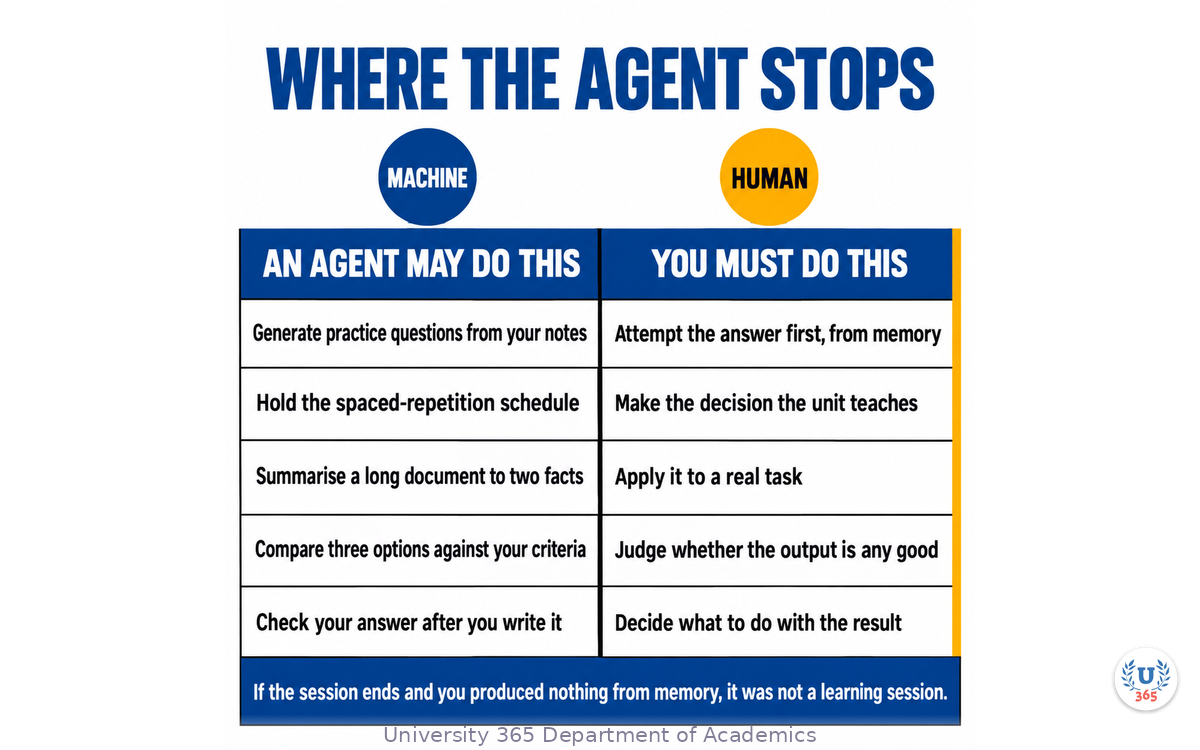
The direction that helps. An agent can carry the parts of learning that are administrative. It can generate practice questions from your own notes, hold a spaced-repetition schedule, summarise a long document down to the two facts you need, run a structured comparison of three options against your criteria, and produce a first attempt at a worked example that you then correct. Those are real time savings, and none of them is the learning.
The direction that hurts. The same convenience can remove the retrieval step, which is the step that produces the learning. If you ask for the answer, you have replaced the mechanism. The research on this is now explicit. A study from MIT's Media Lab, released as a preprint in June 2025, put 54 participants through four months of essay writing across three conditions: with a large language model, with a search engine, and with no tools. The group using the model showed the weakest and least distributed brain connectivity across the sessions, reported the lowest sense of ownership of their own essays, and 83 percent could not quote from an essay they had written minutes earlier. When that group was then asked to write without the tool, they showed lower engagement than participants who had never used it. The paper was not peer-reviewed when it was released and the sample was small, so treat the magnitudes as provisional. The direction is consistent with several decades of work on automation and skill decay, and it is worth designing against regardless.
A second study, from the workplace. A survey by researchers at Microsoft Research and Carnegie Mellon, presented at the CHI conference in 2025, collected 319 knowledge workers and 936 real examples of AI use at work. Its finding is the one to keep in view: higher confidence in the AI's ability on a task was associated with less reported critical thinking, while higher confidence in your own ability on the task was associated with more. Competence in the domain, in other words, is what keeps you critical. Delegating learning itself removes the thing that makes delegation safe.
The boundary, stated plainly. Use the agent for the parts of the loop that are not the retrieval: generating questions, holding the schedule, producing candidate examples, checking your answer once you have written it. Keep the retrieval and the decision for yourself. If a session ends and you have produced nothing from memory, it was not a learning session.
Three agent behaviours to refuse. Asking for the answer before attempting it. Accepting a generated summary in place of the source when the detail matters. Letting an agent write your practice artefacts, because the writing is the practice.
Where the agent genuinely beats every other format. Immediate feedback on a decision you have already made. Write your answer first, then ask the agent to identify what you missed. That order preserves the retrieval step and adds a check you could not otherwise get in five minutes. It is the single most valuable use of an assistant in a microlearning program, and it costs two minutes.
Step 7: Building Your Own Microlearning Program
Everything above assembles into a program you can build in an afternoon and run for a year. Here is the build, in order.
1. Choose your twenty decisions. Write down the twenty decisions you actually make with AI tools in your work. Not topics. Decisions. "Which of three summary outputs to trust." "Whether to give the assistant access to this folder." "When to stop iterating and accept the draft." Twenty is the right number: enough for coverage, small enough to revisit.
2. Convert each to a unit. One sentence per unit stating what you will be able to decide. If a decision needs more than one sentence, it is two units or it is a project. Split or defer.
3. Gather the minimum context for each. Two or three facts, one worked example. Keep a source link for every factual claim, because you will need to re-verify it when the tools change and you will not remember where it came from.
4. Build the rotation. Assign each unit to a slot in a three-week cycle, four units a week, one day apart. Write the dates into your calendar. The schedule is the program; without it you have a reading list.
5. Add the review questions, not the answers. Three questions per unit, with your answers held separately. The questions are what you will use on the retrieval days.
6. Set the application slot. One real task a week, reviewed with the three questions from Step 5. The review notes feed back into the units.
7. Run the quarterly staleness audit. Retire what no longer matches how the tools behave. Add what the quarter taught you.
What good looks like after a month. You can state your twenty decisions without notes. You have three application reviews in writing. You have retired one unit and added two. You have not read a model-release digest in a week, and you have not needed to.
What failure looks like, so you can catch it early. The units exist and the rotation does not. Or the rotation exists and each unit is one paragraph of summary with no decision. Or the application slot disappeared because work got busy, which is the signal that the program is not yet small enough. Fix by cutting units, not by cutting spacing.
What not to do. Do not build a program around a specific tool's current interface. Do not accumulate units faster than you can run them. Do not treat the reading as the learning, and do not measure your progress by the number of units you have collected. The measure is decisions you can now make unaided.
Step 8: Running a Microlearning Program With Other People
A personal program fails for one predictable reason: it has no external clock. Nothing breaks when you skip a week, so the spacing quietly collapses and the units stop being revisited. Sharing the program fixes that, and it does so without requiring a training department.
Why a partner improves the mechanism, not just the motivation. Retrieval practice works better when you have to produce the answer for someone. A written answer you keep to yourself can be skimmed; an answer you have to say out loud to a colleague cannot. The social step is not a motivational add-on. It is a stronger version of the retrieval mechanism.
The three-person version. Two is enough for accountability and three is better for coverage, because three people bring three decision sets. The structure is small and fixed:
Same cycle, staggered days. Each person runs the three-week rotation from Step 7, with their retrieval days offset by one day from the others, so nobody is presenting on the same day.
A weekly twenty-minute call. Each person teaches one unit. Teaching is the strongest retrieval form available, and the unit you teach is the one you will retain.
One shared problem per week. The group picks a decision one member actually faces, and each person answers it from their own units. The disagreements are the material, because a disagreement shows which unit is doing work and which is decoration.
What the weekly call is not. It is not a meeting about AI news. It is not a demo session. It is not a place where one person presents for twenty minutes. The format that works is five to seven minutes per person, teaching one unit, then the shared problem. Anything longer reverts to a meeting and stops happening.
Running it inside a team. If you manage a team, the same structure works with two adjustments. First, make the time legitimate: put it in the working calendar and treat it as work, because a program that runs on personal time stops within a quarter. Second, keep it voluntary in content and fixed in form. People who did not choose the units will not teach them, and a fixed form is what makes the twenty minutes a habit rather than a negotiation.
The manager's separate job, in the same session. Once a month, replace the shared problem with a capability review: which of the capabilities the team depends on was exercised unaided this month, and which was fully delegated. That is the capability register from the cognitive-fitness lecture, run as a short conversation rather than a form. Its value is that fully delegated capabilities become visible while they are still recoverable.
The shared artefact that outlives the group. Keep the units and the review questions in one place that all members can read and edit. The unit list is the group's institutional memory, and it is the asset that survives a change of tooling, a change of team and a change of employer. A group of three that maintains a hundred well-written units for two years holds something genuinely rare, and it cost each of them about seventy minutes a week.
What to do when the group loses momentum. The failure mode is a call that gets moved twice and then stops. Two rules prevent it: never move the call, and if fewer than two people can attend, the remaining person runs their own twenty minutes and records it. The group is an accelerant, not a precondition. The mechanism works alone; the group makes it more reliable.
An honest caveat. Sharing a learning program is not the same as shared training, and it does not replace a curriculum. What it does is keep the retrieval honest and the units current for a small number of people who are already working on related things. Where a team needs common capability rather than individual sharpness, that is a curriculum question, and it belongs with whoever owns the academic programme rather than with the study group.
Feynman Summary: Explain It Like You Are 12
You are trying to get better at something, and the thing you are learning keeps changing. New versions arrive, old tricks stop working.
Reading a lot about it does not help much. Your brain forgets things it only saw once. It keeps things it had to pull back out of memory.
So you do it in small pieces. One small piece a day, five minutes each. Each piece has one point, and you decide something at the end of it, so you are not just reading.
Then you come back to the piece later. Two days later, then a week later, then a few weeks later. Each time, you try to remember it before you look. That remembering is what makes it stick. Looking at it again does not.
A computer helper can make the questions and keep the schedule. You answer them yourself. If the helper answers, you learned nothing, and that is the whole point of the small pieces.
Small pieces plus coming back to them plus answering from memory. That is the trick, and it is not complicated.
Mindmap: The Complete Picture
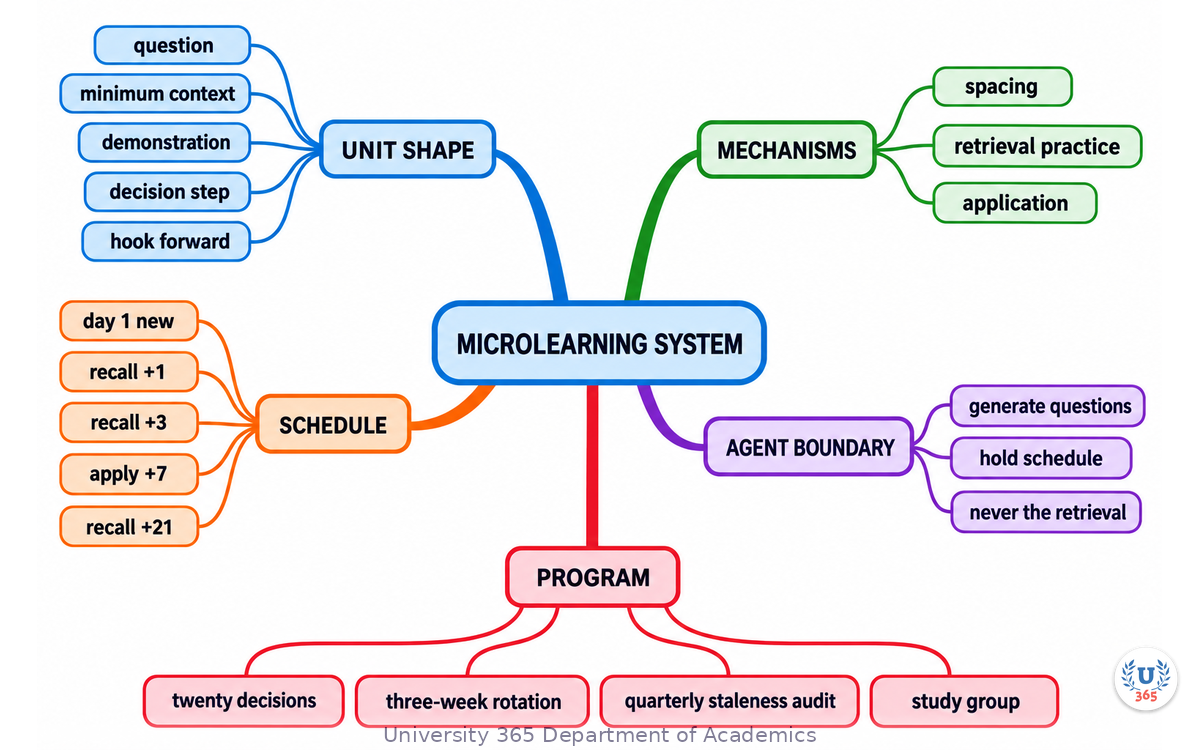
The mindmap shows the five parts of a unit, the two learning mechanisms that carry it (spacing and retrieval), the three-week rotation with its review points, the boundary between what an agent may do and what you must do yourself, and the seven steps of building your own program with the quarterly staleness audit.
UNOP Sound (University 365 Neuroscience Oriented Pedagogy)
Take five minutes to consolidate your memory. Play the isochronous tone track (10Hz alpha frequency) with your eyes closed. Alpha-frequency tones after a learning session support consolidation, helping move what you just learned from short-term to long-term memory.
[Audio player: UNOP Post-Lecture Isochrone (10Hz, 5 minutes)]
Practical Exercise: Design and Run a Four-Week Microlearning Sprint
Exercise: Twenty Decisions, Four Weeks, One Rotation
This exercise builds a working program and runs it long enough to show you whether it works. Budget ninety minutes today and about seventy minutes a week afterwards.
Part 1: The inventory (30 minutes).
List the AI-assisted decisions you made in the last two weeks. Aim for at least fifteen. Include small ones: which output you trusted, whether you edited or regenerated, when you stopped.
Reduce the list to the ones that recur. Mark each with how often it comes up.
Choose twenty. If you have fewer than twenty, write the ones you expect to face in the next quarter.
Part 2: The units (30 minutes).
For each decision, write one sentence: "I can decide X by doing Y."
For each unit, write two or three facts and one worked example. Link a source for every factual claim.
Write three review questions per unit. Keep the answers in a separate column.
Part 3: The rotation (10 minutes).
Assign four units per week across five weeks, so all twenty get their first pass.
Put the retrieval days in your calendar: day plus one, day plus three, day plus seven, day plus twenty-one. The calendar is the program.
Part 4: Run it (20 minutes today, then seventy minutes a week).
Read unit one. Make the decision step. Write your answer down.
The next day, answer the review questions from memory before reopening the unit. Note the gap.
Do one real task with an AI tool this week. Review it with three questions: what was unexpected, what did I accept unverified, what would I specify differently.
At the end of four weeks, run the staleness audit. Retire anything that no longer matches how the tools behave.
What to Observe
How large was the gap between what you wrote from memory and what the unit said? Was it larger than you expected?
On the application review, how many things did you accept without checking, and did the same class of thing recur across weeks?
Did any unit become obsolete inside four weeks? What does that tell you about how you scope units?
How much of your learning time went to the tool-currency bucket compared with the durable-skill bucket?
If you ran the shared version from Step 8, which unit fell apart when you had to teach it out loud, and what did the failure tell you about how well you had actually held it?
Applied AI Connection
You designed the units, chose the decisions, wrote the questions and answered them from memory. An assistant can generate candidate questions, hold the schedule and check your answers after you write them. It cannot make the retrieval, because the retrieval is your memory forming. That division is the CI-First pattern applied to learning: CI = HI + (AI x HI), where the human is the orchestrator and the AI multiplies the human's work rather than replacing it.
Glossary
Term | Definition |
Microlearning | An instructional approach that delivers small, targeted units, each with one stated objective and an active step, intended to be completed in a short single sitting. |
5M2S | University 365's microlearning formula, 5 Minutes to Success, describing a unit designed to be read in about five minutes and to end in a decision. |
Spacing | Distributing study of the same material across separate sessions rather than massing it, which improves long-term retention even when total study time is equal. |
Retrieval practice | Actively recalling information from memory rather than rereading it, the mechanism that produces durable memory and reveals gaps that rereading conceals. |
Massed practice | Studying material in one concentrated block. It feels more productive than spacing and produces weaker long-term retention. |
Cognitive offloading | Handing a mental task to an external system. Useful when the output matters, and costly when the process was the learning. |
Cognitive debt | The accumulation of long-term learning costs from repeated short-term cognitive offloading, a term coined in the MIT Media Lab essay-writing study. |
D2L | Discussions to Learn, University 365's recorded discussion format for taking one publication further. |
T2L | Tutorials to Learn, University 365's step-by-step walkthrough format for tasks that need a demonstration. |
UNOP | University 365 Neuroscience-Oriented Pedagogy, the institutional learning method that sets the 25-minute focus block and the pre and post lecture isochrone protocol. |
Tool currency | Knowledge of what changed in the tools this week. It expires fast and should be capped in a learning program. |
Durable skill | Knowledge of a decision that survives a product change, such as how to specify a task or how to judge an output. |
Model Context Protocol | An open standard, released by Anthropic in November 2024 and donated to the Linux Foundation's Agentic AI Foundation in December 2025, that standardises how assistants connect to data and tools. |
CI-First | Co-Intelligence First: the U365 principle that the human is the orchestrator and the AI is the amplifier. CI = HI + (AI x HI). |
UP-Context-Engineering Method | University 365 Prompting-Context Method: a structured approach to prompting with explicit context blocks for consistent output. |
Quiz: TEST YOUR UNDERSTANDING
1. What does the microlearning research reviewed here actually support?
A) Short content teaches better than long content on its own
B) Short content combined with spacing and retrieval produces learning at least as good as longer sessions, at lower time cost
C) Five-minute videos replace the need for projects
D) Microlearning works for every subject without adaptation
2. Which part of a five-minute unit is most often missing, and matters most?
A) The historical background
B) The list of tools
C) The decision step, where the learner produces an answer
D) The reading time estimate
3. Two people study the same material for an identical total time. One does it in a single block, one across four days. What does the research predict?
A) No measurable difference
B) The single block produces better immediate and long-term recall
C) The distributed schedule produces better long-term retention
D) Results depend entirely on the subject
4. In the MIT Media Lab essay study, what happened to the group using a large language model across four months?
A) They outperformed the no-tool group at every level
B) They showed the weakest brain connectivity, the lowest ownership of their work, and most could not quote their own essays
C) They performed identically to the search-engine group
D) They improved once the tool was removed
5. According to the Microsoft Research and Carnegie Mellon survey, what predicted more critical thinking in AI-assisted work?
A) Higher confidence in the AI's ability
B) Faster tool adoption
C) Higher confidence in your own ability on the task
D) Using more models at once
Answers: 1-B, 2-C, 3-C, 4-B, 5-C
Related Resources
U365 INSIDE Publications
Lecture: Generative AI for a Superhuman You: The amplification model this learning program serves
Lecture: Avoiding the AI Trap: Keeping Your Brain Sharp in the Age of Generative AI: The cognitive offloading evidence in full
Lecture: Is ChatGPT Study Mode the Future of Learning? A Faculty Review: How AI tutoring tools behave when tested
External Resources
The science of effective learning with spacing and retrieval practice (Nature Reviews Psychology, 2022): The review summarising the two mechanisms this lecture designs around
Microlearning beyond boundaries: a systematic review (Heliyon, 2024): The PRISMA review of 40 microlearning studies
Your Brain on ChatGPT (MIT Media Lab preprint, June 2025): The four-month essay-writing study on cognitive debt
The Impact of Generative AI on Critical Thinking (CHI 2025): The survey of 319 knowledge workers and 936 AI use cases
Model Context Protocol (Linux Foundation Agentic AI Foundation): The open standard for connecting assistants to tools and data
Related U365 Lectures (Coming Soon)
Lecture 2: Prompting as Context Engineering (UIC, AI Learning Series)
Lecture 3: Evaluating AI Output Without a Benchmark Team (UIC, AI Learning Series)
U.Copilot for This Lecture
Discuss this lecture with U.Copilot, your AI chat companion trained on this content.
Copy and paste the following prompt into the U.Copilot chat on university-365.com:
You are U.Copilot for Lectures, an AI chat companion specially trained on University 365 lecture content. You are helping a Fellow who just completed the lecture "Microlearning for an AI-Driven World" from the AI Learning Series at the U365 Institute of Communication (UIC). Your role is to help the Fellow design and run a microlearning program. You can: - Turn their list of recurring AI-assisted decisions into a set of five-minute units with review questions - Check whether each unit states one objective and ends in a decision, and rewrite it if it does not - Build the three-week rotation and the retrieval days from their unit list - Generate practice questions from their own notes, and hold the schedule - Review their application notes and identify which class of mistake keeps recurring - Run the quarterly staleness audit with them and identify units that no longer match how the tools behave Keep the division of labour clear. You generate questions, hold the schedule and check answers AFTER the Fellow has written their own. Never supply the answer before they attempt it, because the retrieval is the learning, and never write their practice artefacts. Always maintain U365's CI-First approach: the Fellow is the orchestrator and you are the amplifier. Use the UP-Context-Engineering Method: provide context-rich, role-aware responses that account for the Fellow's existing experience and the decisions they actually face at work.
Next Steps
Here is what to do next, in order:
Complete the twenty-decision inventory from the practical exercise and reduce it to twenty recurring decisions
Write the review questions today, not the answers, so you have the retrieval material ready before the rotation starts
Put the retrieval days in your calendar for the first four units: day one, plus one, plus three, plus seven, plus twenty-one
Cap the tool-currency bucket at fifteen minutes a week and read one summary rather than five streams
Run one application review this week with the three questions, and keep the written answers
Build the shared version if you have colleagues doing related work, following Step 8: three people, staggered retrieval days, one unit taught out loud per person per week
Continue with Lecture 2 in this series, Prompting as Context Engineering, which converts the specification decision into a repeatable method
The rate of change in this field is not going to slow down enough for you to learn comfortably. Small units, deliberately spaced, retrieved from memory, applied once, and audited quarterly will keep you current anyway.
IMPORTANT NOTICE
This lecture is published by University 365 as part of its INSIDE Publications Hub. The content is free to read for all visitors. Lectures in this series may be part of a structured academic program leading to a Micro-Credential for your Career (MCC). To enroll in an academic program, visit university-365.com/tuition.
This content is for educational purposes. Research findings cited here include preprints that had not completed peer review at the time of publication, and their magnitudes should be treated as provisional. AI capability, pricing and tool behaviour change quickly. Verify current technical details and licence terms against primary sources before professional use.
Copyright University 365, Inc. All rights reserved. This content is protected under University 365's copyright policies. For permissions or inquiries, contact uda@university-365.com.
Published by the Department of Academics, University 365.
Lecture delivered by the University 365 Institute of Communication (UIC).
Lea Loringam, Dean of Communication, UIC
Signed for the academic year 2026.





Please listen to this podcast!