
Qlip: the AI clip tool that became a webinar feature, and the selection claim nobody has measured

Updated: 14 hours ago

Status: Risky | Last tested: 2026-09-25 | Re-check: on general availability of Livestorm AI Studio, on any change to the euro 2,000 annual add-on price, or on publication of an independent measurement of clip-selection quality.
Risky: the tool has significant unresolved issues, or it has been clearly surpassed by newer alternatives. Use it with caution and read the Limits section.
What Risky means here. Two independent facts put this tool in the Risky band, and either is sufficient alone. The first is that the product identity, the pricing, the availability and the contract terms changed hands in June 2026: the address you are most likely to type, qlip.ai, is forwarded by its own infrastructure to the acquirer, and the capability is currently described by the vendor as private beta and sold as an add-on to a higher platform tier. The second is that the tool's central claim, that it can choose which part of a long recording deserves to be a clip, has no published measurement from the vendor and none from any independent party. Risky here does not mean the product fails at the task. It means the counterparty and the central claim are both unresolved, and a university planning a content workflow on top should read the Limits section before it commits.
Version reviewed: Qlip as documented on its own former surfaces, and the capability as it is now reached through the qlip.ai forwarding chain into Livestorm AI Studio, September 2026.
For detailed explanations of the CI-First evaluation terms used in this review, including the Humics Protection Badge and the AI Imposture Risk levels, see the Glossary at the end of this post.
Summary: Qlip reads a long video and returns short clips cut from it, usually vertical and usually captioned, with automatic selection of the moments worth keeping. The address qlip.ai no longer serves the Qlip product: it forwards, through livestorm.ai, to the Livestorm AI Studio feature page, following an acquisition in June 2026. The capability is sold today as an add-on to Livestorm Pro and Enterprise plans at euro 2,000 per year billed annually, and the vendor describes it as being in private beta.
Primary institute alignment: UIC (Digital Communication, Marketing), at High and primary, because the decisions that remain are the institute's own, above all what to publish and whether a clip is fair to the person speaking in it. UID (Digital Design, UX/UI) is rated Low, because the tool performs the reframing and the human chooses an aspect ratio from a menu.


In this Tool Review
Status and Re-check
Qlip is a tool that reads a long video and returns short clips cut from it, usually vertical, usually captioned. The category is real and useful. The specific address you are most likely to type, qlip.ai, no longer serves the Qlip product.
This review opens with that fact because it changes what you would actually be buying. As of 25 September 2026, a request to qlip.ai is forwarded by the site's own infrastructure to livestorm.ai, and from there to the Livestorm AI Studio feature page. The forwarding is not a marketing banner or a partnership link. It is the domain answering with a redirect, and the destination is the feature page of a webinar platform. Independent coverage dates the change to an acquisition in June 2026, when Livestorm, a webinar company, bought the company behind Qlip. Qlip as a standalone brand, standalone account, and standalone price list is no longer the thing at that address. What remains at the address is Livestorm AI Studio, which is currently labelled as being in private beta and sold as an add-on to Livestorm's Pro and Enterprise plans.
The badge is Risky because the tool has significant unresolved issues. The unresolved issue is not that the AI is bad. It is that the product identity, the pricing, the availability and the contract terms have all changed hands, and the current owner describes the capability as private beta with more editing options still to come. For a university planning a content workflow on top, that is material: the surface you plan around today is not the one that existed in the first half of 2026, and it is not yet the one that will exist after the beta closes.
A second unresolved issue is specific to the tool's core promise. Qlip's value proposition is not that it can cut video. Any editor can cut video. The proposition is that it can choose which part of a long recording deserves to be a clip. That claim is the product. No independent measurement of how well it performs that selection was found, and neither does the current vendor page offer one. The numbers that do appear on Qlip's own material, quoted in the Outcome section below, are outcome claims about engagement and cost, not accuracy claims about selection. A buyer cannot presently check the central claim of the tool.
The re-check triggers are concrete. Re-check when Livestorm AI Studio leaves private beta and its general availability terms are published. Re-check if the euro 2,000 annual add-on price changes, because an add-on priced for a webinar programme is a different decision from a self-serve subscription priced per seat. Re-check if anyone, vendor or independent, publishes a measurable evaluation of clip selection, for example a study reporting how many returned clips a human editor judged usable. Until one of those three happens, the posture is caution, and that is what Risky means here.
Status and Last Tested
Field | Value |
Status | Risky |
Last tested | 25 September 2026 |
Re-check | On Livestorm AI Studio general availability, add-on price change, or an independent clip-selection measurement |
Evidence basis | Vendor pages reached through the qlip.ai forwarding chain, the vendor's own beta FAQ, independent review coverage dated June to August 2026, third party tool directories |
Primary tool owner | Livestorm, following the June 2026 acquisition of the company behind Qlip |
The Qlip naming and the Livestorm redirect, stated before the review begins
Qlip needs a naming note, and the note has two parts. Both parts matter to anyone who searches for the tool before reading this review, because both parts are ways to end up at the wrong place.
Part one: the tool has moved house
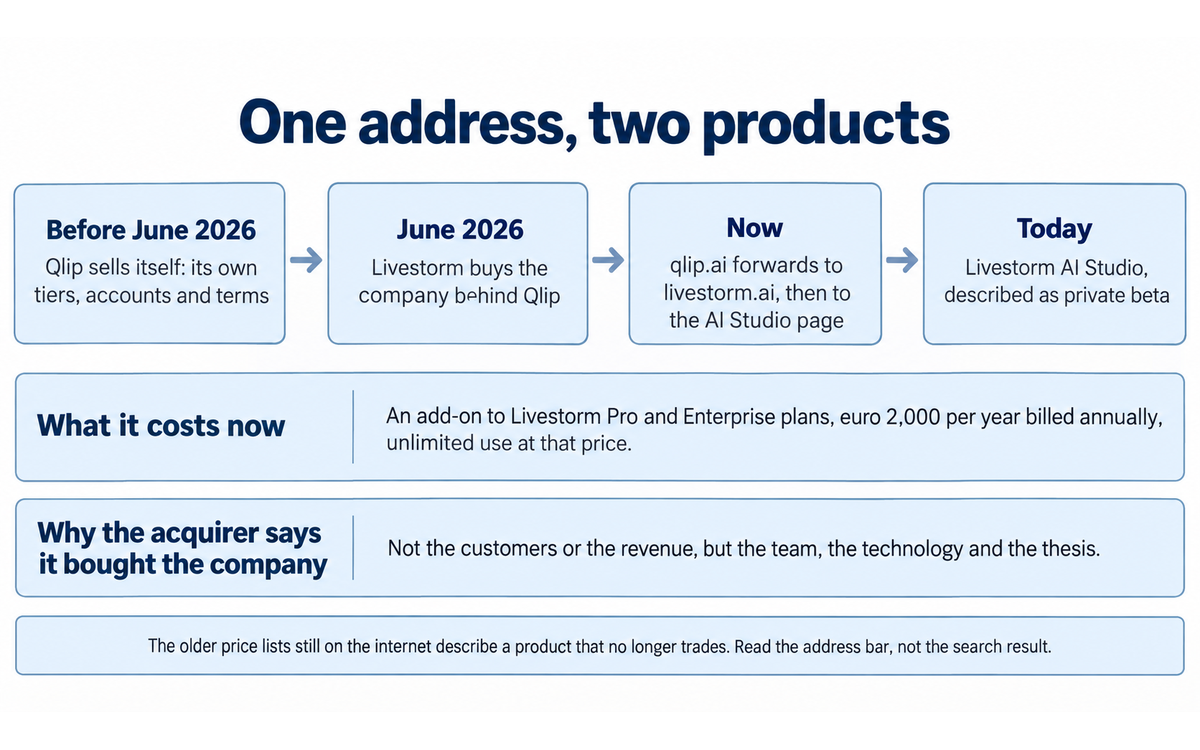
The name Qlip still appears on the internet as if it were a live product. Search results still surface pages describing Qlip as an AI video repurposing platform that takes long conversational video and returns short social clips. Several third party directories still list it, some with a pricing field, some with an editorial score. Those pages are not lies and they are not all stale. The company did build and sell that product. What changed is that the product's public front door, the exact domain qlip.ai, now forwards visitors to the acquirer. Independent coverage dated 22 August 2026 states it plainly: Livestorm acquired the company in June 2026 and the old address now forwards to Livestorm's site. Checks on 25 September 2026 confirm the forwarding from the domain itself, running from qlip.ai to livestorm.ai and on to the Livestorm AI Studio feature page. Any review written before June 2026 describes a product with its own pricing tiers, account system and terms of service. That product is not what you reach today.
Part two: the name is not unique
The second part is a collision warning. Qlip is a short, pronounceable, vowel-light string: attractive to founders, unfortunate for searchers. Independent coverage of the acquisition separates the acquired company from an unrelated business trading under a similar name. In practice a search returns a mixture of the acquired product, the unrelated namesake and the acquirer's page. If you are evaluating the tool, check the domain in the address bar rather than the word in the title. Material about a product that clips long video describes the acquired company. Material about something else under a similar name is a different organisation and tells you nothing about clip quality, pricing or terms. Treat the name as ambiguous and the domain as the identifier.
What this section does not do
This naming note is not a legal claim about trademarks and not an assertion that any party acted improperly. It records a navigation fact and a search fact. The navigation fact is that qlip.ai leads to Livestorm. The search fact is that the word alone does not identify one company. Neither changes the score in the rating section, because neither is about the quality of the tool's output. They change what you should do first: confirm which product you are looking at before reading a price or a review.
Tool Snapshot
Dimension | Detail |
Tool | Qlip, now reached through Livestorm as Livestorm AI Studio |
Vendor site | qlip.ai, which forwards to the Livestorm AI Studio feature page |
Category | Long video to short clip extraction with automatic moment detection, captioning, and vertical reframing |
Core claim | The tool finds the moments in a long recording worth publishing as short clips, so a person does not have to scrub the timeline to find them |
Current availability | Described by the vendor as private beta, with waitlist users and highly active accounts given priority |
Commercial route | Add-on purchase for Livestorm Pro and Enterprise plans, priced at euro 2,000 per year billed annually, with unlimited use at that price |
Languages at launch | Seven: English, French, Spanish, German, Dutch, Portuguese, Catalan, applying to both captioning and moment detection |
Output shapes | Multiple aspect ratios supported, including vertical for short form feeds, square, and horizontal |
Human control at the end | Clip review and approval, title refinement, caption editing |
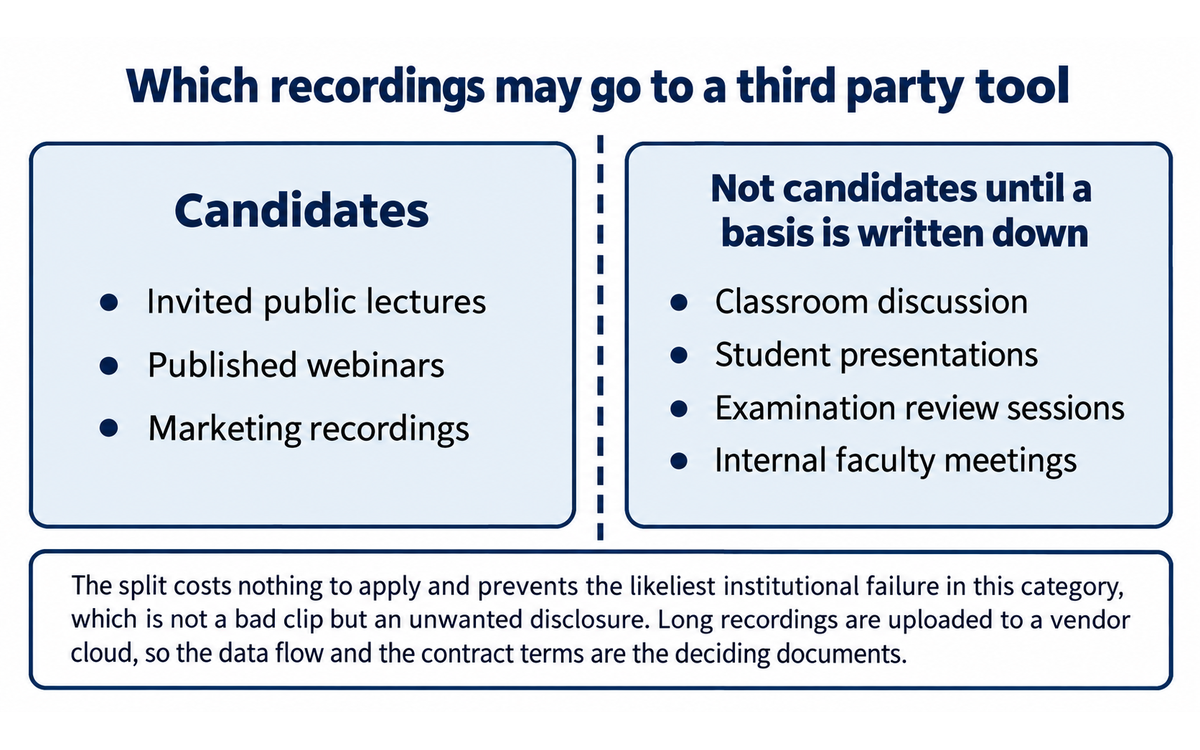
Data handling question | Long recordings are uploaded to a vendor cloud, so the data flow and the contract terms are the deciding documents for any institutional use |
Independent measurement of selection quality | None found in this review |
Alternatives worth naming | Livestorm AI Studio itself, plus specialist clip tools from adjacent vendors and manual editing in a general editor |
Status | Risky |
The snapshot compresses the review into one screen. Two rows deserve emphasis. Availability, because the price and the plan requirement mean you cannot walk up and buy a single seat. Measurement, because the tool's central claim is unmeasured in public. Everything else, the languages, the aspect ratios, the caption editing, describes a competent category standard rather than a differentiator.
The Problem
The problem Qlip was built for is not a video editing problem. It is a triage problem, and triage is where the time actually goes.
Consider what happens today when someone at a university records ninety minutes of a guest lecture, a faculty roundtable, or a long interview, and wants to publish three short clips from it. The expensive part is not the cutting or the captioning. The expensive part is watching or listening to ninety minutes of material to decide which three minutes matter. Someone has to hold the whole recording in mind, recognise the moment where an idea lands cleanly, find the exact sentence boundary where the clip should start and stop, and then repeat that judgement across three clips. That person is usually the person whose time is most expensive, because judging which moment matters requires knowing the subject, the audience, and the institutional voice. A junior editor can cut the clip. Only a knowledgeable person can choose it.
This is the bottleneck that clip tools advertise against, and the advertising is not wrong. The category exists because the selection step is genuinely the costly step, and because the selection step scales badly. One long recording is tedious. Ten long recordings, which is what a semester of recorded events looks like, is a production problem. Someone either spends days on triage or the recordings sit unpublished, and unpublished recordings have no value. Universities have a particular version of this problem because they generate long recorded speech constantly, in a form nobody outside the room ever sees, and they generate it in the institutional voice that most needs to reach audiences.
The second problem is what makes the first interesting. Selection is a judgement, not a calculation. Two competent people will choose different three minutes from the same lecture, and both choices can be defensible. A clip that lands depends on the audience, on what the institution wants to be known for that month, and on what the speaker was saying beneath the words. This is why the category is hard, and why its marketing uses engagement language rather than accuracy language. Engagement is measurable after publishing and influenced by a hundred factors beyond the clip. Selection accuracy is measurable in principle, by asking whether a human editor would have kept the returned clips, and it is almost never reported. That asymmetry is the hinge on which the honest assessment turns.
A third problem is institutional rather than editorial. Long recordings of teaching and internal discussion are not neutral data: student faces, unscripted faculty opinions, sometimes commercially sensitive discussion. The moment you route that material into a third party tool you have created a data flow, and a data flow needs a contract behind it. Any tool in this category is therefore two purchases, an editing capability and a data processing relationship. Qlip in its current home is sold by a European webinar company to webinar customers, which shapes both. Evaluate both, and expect the second to be forgotten until a compliance question arrives.
The Outcome
The promised outcome is straightforward and, on the vendor's own description, it is delivered in three steps. You give the tool a long recording. The tool analyses it, using the transcript, the speaker turns, the audience interaction, and the delivery of the speaker to decide where the moments worth keeping are. It returns each detected moment as a standalone clip with its own title and captions, and with the framing adjusted to the channel you are publishing to. Livestorm's own description of the outcome is that your best content is already recorded, and the job of the tool is to find the strongest moments inside it and return publish ready clips in minutes rather than weeks.
That is a good outcome if it holds. The qualification is what the word published means. The vendor confirms a person remains in the loop: you can refine titles, edit the AI captions and share to your channels, and you stay in control of every clip before it goes out. Read that as a description of the workflow, not a disclaimer. The tool proposes, a person disposes. The outcome is a shortlist with production applied to it, not a finished publication decision.
The vendor's public material also makes quantitative claims about the outcome, and a careful reader should look at what kind of claim each one is. Qlip's own site, as preserved on its older address, presents three headline benefits: a ninety percent reduction in the cost to produce short videos, three times more videos shared, and five point two times more engagement on social media. Livestorm's own feature page adds a timing claim, that clips and captions are ready the moment your webinar ends, and a separate note that processing a full video takes roughly the duration of the video itself because the system analyses the entire recording. Read those four numbers together and the shape of the evidence becomes clear. The cost, sharing, and engagement figures are outcome claims measured on the publishing side, where dozens of variables beyond the tool are at work. The timing figure is a mechanical claim about processing, and the second part of it is the honest one, because it tells you that a ninety minute recording costs you something like ninety minutes of machine time before anything is ready. Note also that no base is stated for the ninety percent figure. A reader cannot tell whether the comparison is against professional editing rates, against a previous in house baseline, or against a competitor's list price. Treat the number as directional, not as a budget input.
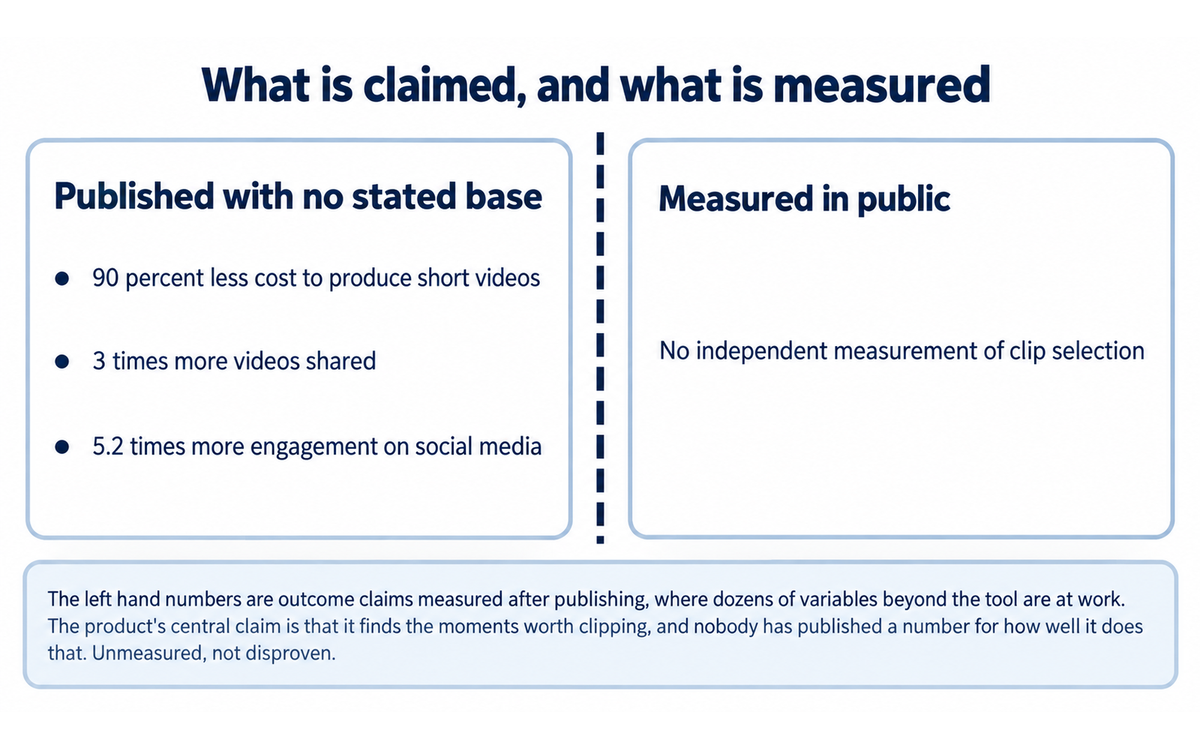
The real outcome is a change in where effort lands, not a removal of effort. Before the tool the effort sits in finding the moments. After it, the effort sits in reviewing what it found, fixing captions where they matter, and making the judgement that decides what is published. That is a genuine improvement, and a substantial one on long recordings. It is not the removal of the editorial step, and any institutional plan that treats it as such will produce a high volume of clips nobody wanted.
Who Should Use Qlip
This section is short by design, because the honest answer in September 2026 is narrower than the category marketing implies.
You should look at it if
You already run Livestorm for webinars or online events at institutional scale, and the euro 2,000 annual add-on is small relative to what the plan already costs. In that case the tool arrives inside a platform you are already using, on a contract you have already signed, which is the cheapest possible route to a clipping capability.
You have a genuine backlog of long recordings and no reasonable prospect of hiring editors to triage them. A university with a semester of recorded events and no production team has exactly the problem this category solves.
You are willing to fund a review step. The tool produces a shortlist, and a shortlist still needs a person with subject knowledge to accept or reject each item and to fix captions before publication.
You can answer the data question before you upload anything containing students. If the recordings are public lectures given by invited speakers, the compliance burden is lighter than if the recordings contain classroom discussion.
You should look elsewhere if
You are looking for a self serve tool at a self serve price. The route to Qlip today is an annual add-on tied to a higher tier plan, which is a programme purchase rather than a creator purchase.
You need to start today. The vendor describes the capability as being in private beta, with waitlist users and its most active accounts going first. That is not a general availability commitment.
You need the tool to make the editorial call for you. It will not, by the vendor's own description, and the underlying selection quality is unmeasured in public.
You need per language control. Three languages at launch would be a limitation; seven is enough for a European institution and not enough for a global one that publishes in, say, Arabic, Mandarin, Portuguese variants, or Turkish.
You need a measured guarantee on clip quality. Nothing in this review can give you one, and the absence is the finding.
The person this tool actually fits
The fit is a communications or content lead inside a European institution that already pays for a webinar platform, has more recorded material than editorial capacity, and will run a human approval step on every clip. That person gets a real reduction in triage, an acceptable data story where recordings are appropriate, and a price that is defensible because it rides on an existing contract. The misfit is a solo creator, a department with no webinar platform, and any team wanting to publish clips without someone reading them first. Those three should not buy this tool, not because it is bad, but because its commercial shape was designed for a webinar customer and two of those cases are not one.
U365 Institutes Alignment
The alignment question for a tool like Qlip is not whether it is clever. It is which University 365 activities it shortens, and which ones it must not touch.
The strongest alignment is with the outward facing work of the institutes. The four University 365 institutes all produce long form recorded teaching, workshop and event material, and all of them need that material to exist in short form if it is to reach anyone. UIT (Technology, AI, Data Science) records technical sessions, UIB (Business Management, Entrepreneurship) records founder-facing and management sessions, UIC (Digital Communication, Marketing) records the published-video work closest to what this tool produces, and UID (Digital Design, UX/UI) records critique and usability sessions. A recorded session on an IT topic, a business topic, a communication topic, or a design topic is exactly the kind of long conversational video this class of tool was built for: one speaker or a small group, reasonably clear audio, a clear idea somewhere inside it. The institutes that teach digital communication and content strategy have the clearest operational fit, because publishing short form is already part of what they teach rather than an extra step. There is a pleasing symmetry in a UIC cohort using the same class of tool the industry uses, provided the cohort also studies where the tool fails, which is a curriculum point rather than a procurement point.
The second alignment is with applied AI research and evaluation. Clip selection is a rare case of an AI judgement that can be measured against human judgement with reasonable effort. Take a long recorded lecture, run it through a tool, and ask three experienced editors independently which of the returned clips they would have chosen. That produces a real number. The absence of such a number in public is noted throughout this review, and it is also an opportunity: a small internal study would put a university in the position of having measured something the market has not measured. The tool's current status does not block that study. In fact an unmeasured claim is a better research subject than a well documented one.
The third alignment is the caution. The institutes must not route recordings that contain student voices or internal deliberation into a third party cloud without a documented basis for doing so, and this is not a tool specific warning. It is a data flow warning that applies to every tool in this category. The practical rule is a simple split. Invited public lectures, published webinars, and marketing recordings are candidates. Classroom discussion, student presentations, examination review sessions, and internal faculty meetings are not candidates until a lawful basis and a retention position are written down. This split costs nothing to apply and prevents the most likely institutional failure mode for this category, which is not a bad clip but an unwanted disclosure.
Finally, this is not a tool to hand to fellows as a study aid. Used in a UIC (Digital Communication, Marketing) or UID (Digital Design, UX/UI) module as a subject of inspection, with students arguing with its selections, it supports critical thinking. Used as an automatic publisher, it bypasses the thinking the module exists to build. The difference is in how the institute frames the exercise, not in the tool.
Institute alignment, rated by the competency that remains
A tool that performs a task cannot be chained to a competency in performing that task. It can be chained to the competency in judging, evaluating or directing it. The test applied to each row below is what remains when the tool is removed, and it matters more on this review than on most, because this tool performs the one act the institute teaches: it chooses which moment in a long recording deserves to be a clip.
Institute | Rating | Why, stated as the competency that remains | The limit that holds the row |
UIC (Digital Communication, Marketing) | High (primary) | The publication decision for a real person's recorded speech, and the verification procedure that protects it. The Fellow decides which returned moment carries the point the speaker was actually making, whether a clip cut at a chosen boundary is fair to that speaker, what a viewer who sees only the clip is owed, and who approves the set before it is scheduled. The review locates the human step in its own words, that the tool proposes and a person disposes, and it supplies the method: the selection agreement test, the sentence-boundary check, the caption check against the audio, the consent and retention checks, and a named approving owner. Every one of those is a communication professional's decision and none of them needs the tool present. | The tool performs the act the institute teaches: it chooses the moment. The review's own Humics table records Creativity -1 and Critical Thinking -1 on that ground, its Skill rationale records that the tool applies editorial judgement on the user's behalf, and its Quantity Illusion row at High records that a reviewer facing twenty candidates is more likely to accept plausible ones than to test each. The tool publishes no selection criterion, offers no critique of a returned clip, and builds no communication craft, so the row credits the publication decision and the verification procedure and not selection. The High is a curriculum rating and must not read as an adoption recommendation. |
UIB (Business Management, Entrepreneurship) | Medium | Two competencies, both read from published records, and both survive the tool. Route and price appraisal: the capability moved from a self-serve subscription to an annual add-on tied to a higher tier plan at euro 2,000, and three surfaces carry three different commercial stories, so the Fellow has to name which figure they will plan against, state what a plan tier adds to the true entry cost, and refuse a struck-out historical price list as current. Continuity appraisal: the acquiring company's own announcement states that the existing customer base was not the reason for the purchase, and a user report describes beta-created material being removed at the paywall, so a Fellow who has to decide whether to depend on this route is doing supplier appraisal from published documents. | The tool's subject is not a price and no contract is quoted in the review, so this is a cost and route exercise attached to a tool about something else, which is the case comparable tools in this series are rated Medium for. The tool teaches no management, finance, entrepreneurship or leadership content, and it produces nothing a business cohort could be assessed on. A word-start, accent-folded term search over all 79 published programme descriptions returned zero for procurement, contract, cost of ownership, total cost, licence, license, terms of service and intellectual property, and one unrelated match for vendor. No UIB credential chain is asserted beyond the adjacent anchor named in the credential table below. |
UIT (Technology, AI, Data Science) | Low to Medium | Measurement literacy applied to an AI judgement. The review's central finding is a measurement gap, and the fix it prescribes is itself a methodology: take one long recording, have two knowledgeable people independently name the moments they would have chosen, count the overlap with the returned clips, write the number down and repeat it on two more recordings before drawing a conclusion. A Fellow doing that is separating an outcome claim from an accuracy claim, refusing a figure with no stated base, and designing a human-agreement measurement for a system whose criterion is unpublished. That transfers to every system that returns a conclusion. | The vendor publishes no selection criterion, no accuracy figure, no model card, no parameter count, no benchmark and no interface, so the classifier cannot be instrumented, configured or measured from outside, and the appraisal has only the vendor's own prose to work against. Held at Low to Medium for the same reason the sibling video-model row is held there: an unexplained classifier with no published specification to appraise against. No UIT credential chain is mapped, and the credential table below states the verified reason. |
UID (Digital Design, UX/UI) | Low | A reading contact, not a design act. Two things remain that a design cohort can use: reading the boundary between a moving region and a frozen region at full resolution for a smear or a torn edge, which is quality inspection of a produced artefact, and judging whether the automatic vertical reframing kept the subject in frame for the channel it was published to. Both are evaluation of an artefact the Fellow did not make. | Nothing in the UID competency set is exercised as a design decision. The tool performs the reframing, the human selects an aspect ratio from a menu, and the review's own snapshot rates the framing operation as category standard rather than a differentiator. This is the correction applied to the comparable reviews in this series, where study interest was previously read as a design act. No UID credential chain is mapped, and the row is published so the judgement is visible rather than left silent. |
The sentence that holds across all four rows. No institute in the U365 system should adopt Qlip as a taught or institutional tool, and two reasons carry that separately. The data flow is the first: recordings of teaching, student voices and internal deliberation routed to a vendor cloud need a documented basis and a retention position before anything is uploaded, and the third workflow below says so. The unmeasured selection claim is the second: the tool's central promise cannot presently be checked by anyone. The teaching value is real and sits in three places: the verification procedure for a published clip, the measurement methodology this review prescribes, and the two published documents that describe the commercial route.
The primary marker is a separate decision from the rating. The primary institute is UIC (Digital Communication, Marketing), and the marker is a curriculum statement rather than an adoption recommendation. It is primary because the published output of this tool is short-form published content, and because the decisions that remain are the institute's own: what to publish, whether it is fair to the speaker, and who approves it.
Tool to Skill to Credential
No published U365 credential assesses the principal competency of any row above. That is the finding, and it is a statement about this class of tool rather than a defect in the catalogue. A clip tool removes a selection requirement rather than teaching selection, and a U365 credential assesses what a Fellow can do rather than what a tool can do for them. The Skill sub-score of 4 records the same thing from the scoring side.
Every row therefore does two things. It names the nearest published programme a Fellow could enrol in and states what that programme publishes, and it states what the programme does not publish. An adjacent anchor is not a credential claim, and none of the six rows below presents one as an assessment home for the competency in the row. Each named programme was read as PUBLISHED with its own published description and module list, and each public page was requested on 2026-09-25; a deliberately bogus programme address returned a not-found response on the same run, so the confirmed addresses are a finding rather than a default.
Tool skill | U365 competency | Credential | Institute | Published next step |
Deciding which moment in a long recording deserves to be published as a clip, and defending the choice against the argument the speaker was making | Editorial selection for published short-form content | Content Marketing Specialist (30 days, 124 steps), verified PUBLISHED on 2026-09-25. Its published programme carries Content Marketing ROI, Content Stratégy, Producing and Promoting Live Video, SEO Content Writing and Link Building, which is the published-video strand this competency sits beside. Limit: it publishes video production and promotion inside a marketing programme and publishes no moment-selection, clip-selection or editorial-judgement outcome. A word-start, accent-folded search over all 79 published programme descriptions returns zero for clip selection, selection quality, shortlist and editorial judgement | UIC (Digital Communication, Marketing) | Associate in Communication & Marketing (A.C) 1/2 and 2/2, then Bachelor in Communication & Marketing (B.C.), then Master in Communication & Marketing (M.C.) 1/2 and 2/2. Expert level, SUPERHUMAN only |
Deciding whether a clipped passage is fair to the speaker, and what a viewer who sees only that clip is owed | Publication fairness and disclosure for a real person's recorded speech | Nearest verified anchor: AI Creator Professional (30 days, 124 steps), verified PUBLISHED on 2026-09-25, whose published programme carries Opportunities, Issues, and Ethics beside its generative-tool modules. Limit: that module assesses the ethics of generating an image, not the fairness owed to a real person when their own recorded speech is cut and published. The search returns zero for disclosure, misrepresentation, consent, privacy, media literacy and editorial standards, so no published programme assesses this competency and it is recorded as a curriculum gap below | UIC (Digital Communication, Marketing) | None asserted for this competency beyond the adjacent anchor. The degree family that follows the content anchor is Associate, Bachelor and Master in Communication & Marketing, as published |
Deciding which recordings may be routed to a third party cloud at all, and the retention and consent basis for each | Data-basis and retention discipline for third-party processing of teaching material | None asserted. No published U365 programme assesses a data basis, a retention position or a consent rule for recorded teaching. The search returns zero for data protection, GDPR, privacy and consent, and the review's own third workflow requires all three of those decisions in writing before a recording is uploaded | UIC (Digital Communication, Marketing), because the eligibility split is a publication rule | None asserted. Recorded as a curriculum gap below |
Telling an outcome claim from an accuracy claim, and refusing a figure or a claim with no stated base | Measurement interpretation and human-agreement evaluation design | Data Analyst Expert (84 days, 348 steps), verified PUBLISHED on 2026-09-25. Its published programme carries Use Excel for Data Analysis, Data Fluency, Data Analytics Foundations, Statistics Essentials, Data Mining, Power BI, Data Visualization, Tableau Essentials, SQL, Data Reporting, Wrangling Data with R and Data Cleaning in Python, and it publishes critical thinking as a named skill. Limit: it teaches a measurement craft and publishes no human-agreement, rater-agreement, annotation or evaluation-design outcome. The search returns zero for benchmark, accuracy, human evaluation, inter rater and annotation | UIT (Technology, AI, Data Science) | Associate of Science in IT (A.Sc.) 1/2 and 2/2, then Bachelor of Science in IT (B.Sc.), then Master of Science in IT (M.Sc.) 1/2 and 2/2. Expert level, SUPERHUMAN only |
Judging what each channel actually needs from one approved moment, and correcting what the automatic caption pass got wrong | Multi-format delivery and caption integrity for short-form channels | Social Media Marketing Manager (30 days, 124 steps), verified PUBLISHED on 2026-09-25. Its published programme carries Social Media: Strategy and Optimization, Copywriting for Social Media, Content Creation Startegy (spelled as the catalogue publishes it), TikTok and Instagram Reels and Stories: Creative Strategies, which are the short-form channel surfaces this competency is exercised on. The adjacent anchor for the cutting craft is Video Production Specialist (60 days, 252 steps), published, whose programme carries The Art of Video Editing, Creative Techniques, History of Film and Video Editing, Premiere Pro Essential Training, Final Cut Pro Essential Training and Video Dialogue Editing. Limit: no published programme assesses captioning, caption integrity, subtitling, a transcript, accessibility, framing or an aspect-ratio decision, and the search returns zero for each of them | UIC (Digital Communication, Marketing) | Associate in Communication & Marketing (A.C) 1/2 and 2/2, then Bachelor in Communication & Marketing (B.C.), then Master in Communication & Marketing (M.C.) 1/2 and 2/2. Expert level, SUPERHUMAN only |
Appraising a route whose vendor changed hands: the spread of published prices, the plan-tier add-on, and the continuity position | Vendor route and continuity appraisal, and threshold specification before a recurring charge is accepted | Business Analysis Professional (60 days, 252 steps), verified PUBLISHED on 2026-09-25. Its published programme carries Business Analysis Foundations, Agile Requirements, Business Benefits Realization, Project Manager Collaboration, Business Process Modeling, Leadership Foundations and Communication skills, which is the requirement and benefit-specification craft a purchase standard is written in. Limit: it publishes requirements work inside a business-analysis programme and publishes no vendor appraisal, no continuity assessment and no procurement outcome. The search returns zero for procurement, contract, total cost, cost of ownership, licence, license, terms of service and intellectual property, with one unrelated match for vendor inside an automation certificate. The nearest adjacent anchor in the direction this row reaches is the Business Law module inside Entrepreneur (25 days, 104 steps), published, which publishes no technology-purchase or licence-reading outcome | UIB (Business Management, Entrepreneurship) | Associate of Business Administration (A.B.A.) 1/2 and 2/2, then Bachelor of Business Administration (B.B.A.), then Master of Business Administration (M.B.A.) 1/2 and 2/2. Expert level, SUPERHUMAN only |
The discipline that transfers across all six rows. Every anchor above is an adjacent programme and not an assessment home, and each row states the part of the competency its programme does not publish. The habit that transfers is the one the first workflow below prescribes: given an AI system that returns a shortlist, name the moments you would have chosen yourself, count the overlap, and write the number down.
The curriculum gaps this review records
Six gaps, each measured across the published programme set on 2026-09-25 with accents folded and word-start matching, so an inflection cannot hide a match. They are named so a curriculum conversation starts from evidence rather than from a placeholder, and so that no reader is told a credential exists where none does.
Clip and moment selection as its own assessed outcome. No published programme description carries clip selection, selection quality, shortlist or editorial judgement. The nearest anchor is the published-video strand inside Content Marketing Specialist, whose module on producing and promoting live video publishes the promotion of a recording rather than the choice of what belongs in a clip. This is the gap the tool's own unmeasured claim turns on.
Publication fairness and disclosure for a real person's recorded speech. No match for disclosure, misrepresentation, consent, privacy, media literacy or editorial standards. The nearest anchor is the ethics module inside AI Creator Professional, which assesses the ethics of generating an image rather than the fairness owed when a recording of a real person is cut.
A data basis and a retention position for third-party processing of recorded teaching. No match for data protection, privacy or consent. No published programme assesses the decision the third workflow below requires in writing before anything is uploaded, which is the decision that settles whether the tool may be used at all.
Caption integrity in the languages a U365 programme publishes in. No match for captioning, caption, subtitling, transcript or accessibility. The nearest anchor is video dialogue editing inside Video Production Specialist, which publishes dialogue editing rather than a caption-accuracy outcome, and this review notes that proper nouns are where every automatic captioner fails first.
Human-agreement and evaluation-design literacy. No match for human evaluation, rater agreement, annotation, benchmark or accuracy. The nearest anchor is statistics inside Data Analyst Expert, which publishes statistical reading rather than the design of an agreement measurement, and the test this review prescribes is exactly such a measurement.
Vendor route and continuity appraisal. No match for procurement, contract, cost of ownership, total cost, licence, terms of service or intellectual property. The nearest anchor is the business law module inside Entrepreneur, which publishes the legal position of a venture rather than the appraisal of a supplier whose product changed hands.
What these gaps do not claim. None of the six is a current programme and none is presented as one. A term match is not an assessment home either: editing craft, short-form channel strategy, content marketing, motion graphics, typography and colour all match published programmes, and the production craft this class of tool performs is genuinely taught at U365. What is not assessed is the selection judgement itself, the fairness rule its output requires, the data basis the route needs, and the measurement that would let a buyer check any of it.
How Qlip Works
The pipeline as the vendor describes it
Qlip's public description of its own machinery is specific at the level of inputs and vague at the level of method, which is normal for this category and worth stating plainly rather than glossing. The vendor describes detection that draws on the transcript, on speaker turns and handoffs, on audience interaction such as questions and engagement signals, and on the speaker's delivery, including intonation. Where a recording carries those signals, the tool has more to work with. Where it does not, for example a single speaker with no audience and a flat delivery, the tool falls back on the weaker signals of transcript content and topic change.
Selection
Selection is the part that matters and the part the vendor describes least. What can be stated with confidence is the shape of the operation: the tool reads the whole recording, forms a view of where the interesting moments are, and proposes a set of clips. What cannot be stated with confidence is the criterion. No published material from the vendor states what makes one moment score higher than another, whether the criterion is engagement prediction, semantic completeness, emotional intensity, or a blend, and no independent source in this review measures how well the criterion performs. This is the single largest evidence gap in the review and it is discussed again in the imposture risk section and in the faculty note.
Captioning and reframing
Captioning and reframing are more conventional. The tool generates captions per clip and the vendor treats them as editable: you can edit or restyle them and change the aspect ratio to fit the channel, vertical, square or horizontal. The vendor connects caption and detection quality to language, stating that both adapt to the language of the webinar across seven languages at launch, with more on the roadmap. Reframing is the familiar operation: a landscape recording becomes usable in a vertical frame by following or centring the speaker. Neither step is a differentiator in 2026. Both are table stakes, and the honest question is whether they are good enough that a person does not have to redo them, which brings us to the human step.
The human step, stated precisely
The vendor's own workflow description is the best source for what a person still decides, and it reads as a specification rather than a reassurance. A person decides whether each proposed clip is worth publishing at all. A person decides and refines the title. A person edits the captions where they matter. A person chooses the final aspect ratio for the channel. A person performs the publish. The tool's contribution is the shortlist and a first pass at production, and the vendor says so when it states that you stay in control of every clip before it goes out. That division locates the gain precisely: it is in the shortlist. If the shortlist is good, everything downstream is quick. If it is bad, the tool has added work, because a person now reviews bad proposals as well as doing the original triage. Whether it is good is the unmeasured question, which is why this review keeps returning to it.
That division of labour is honest and it is also the correct place to look for the tool's real value, because it locates the gain precisely. The gain is in the first step, the shortlist. If the shortlist is good, everything downstream is quick. If the shortlist is bad, the tool has added work, because a person now reviews bad proposals as well as doing the original triage. Whether the shortlist is good is the unmeasured question, and it is the reason this review keeps returning to it.
Formats, duration, and processing time
The category centres on long form conversational video: webinars, podcasts, recorded talks, interviews, internal sessions. The current product's framing is explicitly webinar shaped, unsurprising given the acquirer. On duration limits, the vendor publishes no headline maximum that could be verified, and any figure a third party directory lists should be treated as unverified. On processing time the vendor does publish a usable statement: processing clips is fast, but processing the full video takes roughly the duration of the video itself, because the system analyses the entire recording. A ninety minute recording therefore implies roughly ninety minutes before the full analysis is ready, which is fine overnight and awkward when the event ends fifteen minutes before you wanted to post.
The API question
This is where the acquisition shows most clearly. Qlip's own marketing surface included an API page addressed at qlip.ai/api, and the tool's earlier positioning, which included natural language processing of video content and programmatic access, suggests an integration story rather than a purely manual one. That address no longer serves Qlip material. It forwards, along with the rest of the domain, to the Livestorm AI Studio feature page. No public Qlip API documentation, endpoint reference, authentication scheme, or rate limit schedule survives at the address in a form a third party can read and rely on. Two consequences follow, and both are practical. First, do not build an integration plan against Qlip endpoints or Qlip rate limits, because the material that would document them is not being served and no successor documentation has been published. Second, if programmatic access matters to your use case, that requirement now belongs in a conversation with the current owner about the current product, and it should be treated as an open question rather than an assumption.
Pricing as it was and as it is
Qlip's earlier public position, as preserved in search results and third party directories, was a self serve product with a free tier or free trial and subscription tiers above it. Those listings are now historical. The current published commercial shape of the underlying capability is different in kind: an add-on to Livestorm's Pro and Enterprise plans, priced at euro 2,000 per year billed annually, with unlimited use at that price. Note what kind of product that is. It is not priced per minute, per clip or per seat and carries no visible consumption meter, which removes the minute limit anxiety that bedevils per credit clip tools. In exchange, the entry cost is an annual commitment tied to a platform tier, a poor fit for anyone wanting to try the capability in isolation. The earlier listings and the current add-on describe two products with two buying motions, and mixing them misjudges both. Where one number is needed, use the current one.
Getting Started with Qlip
What the starting path actually looks like in September 2026
Start with the honest sequence, because it has changed and the old instructions are still all over the internet. The old sequence was: open qlip.ai, create an account, get a free allowance measured in hours of uploaded video, upload a recording, receive candidate clips, edit, export. That sequence is what most listings still describe and what several directories still quote prices for. It no longer reflects what happens when you try it. The current sequence is narrower: a Livestorm account on a tier that can take add-ons, and a private beta prioritised for waitlist users and highly active accounts. The practical steps are these.
The current sequence is narrower. You need a Livestorm account on a tier that can take add-ons, and the vendor's own page describes the capability as being in private beta, with waitlist users and highly active accounts going first. The practical steps are therefore:
Confirm the address you are looking at. If your browser lands on a Livestorm feature page, you are in the right place and the product has moved. If you land on a page selling a clip tool at a monthly subscription with tiers named after plan sizes, you are reading a historical listing or an unrelated tool with a similar name.
Check whether you already have the platform relationship the product now requires. The capability is sold as an add-on to higher tier plans, so an existing customer relationship is the cheapest route in and, on the current published terms, close to the only route in.
Join the waitlist if you are not already a priority account, and treat the waitlist as a scheduling fact rather than a formality. Independent coverage as of August 2026 confirms the feature was still a waitlist with no date more specific than a season, and the acquirer's own page continues to say private beta.
Once you have access, decide which recordings are eligible before you upload anything. The acquirer's own description of the feature frames it around webinar replays, that is recordings that already live inside the platform account, rather than files uploaded from anywhere. That is a scope restriction, and it is the single most important thing to test early with your own material.
Run one recording end to end and time it. Record when you uploaded, when the analysis was ready, and roughly how long you spent reviewing the returned clips. That one measurement will tell you more than any vendor number in this review, because it is measured on your content and your reviewers.
Establish the review step in writing before you scale. Who approves a clip, who fixes captions, who holds the publishing decision, and where the approved files live.
What to test in the first week
Test three things, in this order. First, eligibility: does the tool accept the material you actually have, in the format and from the source you actually use. Second, selection agreement: take one long recording, ask two knowledgeable people to name the moments they would have chosen, and count how many of the returned clips fall in that set. Third, caption integrity in the languages you publish in, with particular attention to proper nouns, which is where every automatic captioner in every category fails first.
The cost of the current route
The published shape is an add-on to Livestorm's Pro and Enterprise plans at euro 2,000 per year billed annually with unlimited use. Plan against that number. For a small department the effective cost of the first clip is the add-on plus the plan tier, so if the tier did not otherwise exist in your budget the true entry cost is higher than the add-on suggests. For an institution already running the platform at scale the additional cost really is just the add-on, which is the case where the tool is most attractive.
Real Workflows
Each workflow below states what the tool does, what the person does, and what has to be verified before publication. The verification step is not decoration. In a clip workflow, the failure that matters is not a bad cut, it is a clip that misrepresents what a speaker said by starting or stopping in the wrong place, or a caption that changes the meaning of a sentence.
Workflow one: a recorded public lecture becomes a set of short clips
A sixty to ninety minute invited lecture with an audience and a speaker who has a clear argument in the middle of it. You upload, or under the current scope select the recording inside the platform. The tool analyses the full recording and returns candidate clips with captions and vertical framing. The person then reads the candidate titles, checks the chosen moments against the speaker's argument, fixes proper nouns in the captions, decides which three or four to publish, and writes the post text. The verification question is whether each clip stands alone: a viewer who sees only that clip should not come away with a claim the speaker did not make.
VERIFICATION CHECKLIST for "Recorded public lecture to short clips": [ ] Selection agreement: two knowledgeable people independently name their would-have-chosen moments, and the overlap with the returned clips is counted and written down [ ] Boundary check: every published clip starts and ends at a sentence boundary that does not invert the speaker's meaning [ ] Caption check: speaker names, course names, institution names and any numbers are read against the audio, not the screen [ ] Consent check: the speaker has agreed to short form publication of the recording
Workflow two: a webinar replay becomes a month of content
This is the workflow the vendor designed for and the strongest fit. A webinar ends, the replay already sits in the platform, and the tool proposes clips. The person selects the strongest and schedules them. The gain is real because the recording is already inside the system the tool reads, which removes the upload step and the eligibility question. The verification question is different: not whether each clip is fair to the speaker, but whether the selection reflects the event you ran. Moments that score well on audience reaction are often not the moments that carry the substantive message.
VERIFICATION CHECKLIST for "Webinar replay to scheduled clips": [ ] Message check: at least one published clip carries the event's substantive claim and not merely its most reactive moment [ ] Language check: detection and captions were reviewed in the language the webinar was held in [ ] Brand check: auto-generated titles and any auto-applied template colours match current institutional naming [ ] Approval check: the responsible content owner approved the final set before scheduling
Workflow three: an internal session is triaged before anything is published
The third workflow is the one most likely to be skipped and it should not be. An internal session, a faculty roundtable or a programme review, is recorded and someone wants to publish clips for staff or prospective students. Here the tool is used for triage only: the returned candidates show where the interesting material is, and the person then decides, with the participants, what may be shared at all. This is where the data question is sharpest, because internal recordings contain unscripted opinion and sometimes references to students, partners or commercial matters.
VERIFICATION CHECKLIST for "Internal session triage": [ ] Participants were told the recording may be processed by an external tool, and the basis for that is documented [ ] No clip containing a student's voice, image or performance is published without consent [ ] No clip references a partner, contract or commercial matter without an owner's approval [ ] Retention: the person responsible for deleting the source material after the review window is named
Workflow four, deliberately not recommended: volume publishing
There is a fourth workflow the category encourages and this review does not. It runs the tool across many recordings and publishes whatever comes back, on the logic that more clips mean more reach. The vendor's own outcome claims invite exactly this pattern. Resist it. Selection quality is unmeasured, so volume multiplies unverified choices, and in an institutional voice the cost of one clip that misrepresents a speaker is not offset by twenty that did not. If someone proposes volume publishing, the answer is one sentence: the shortlist has not been measured, and publishing it at scale is a decision to publish whatever the model happened to prefer.
Strengths, Limits, and AI Imposture Risk
Strengths
The problem it targets is the right problem. Selection, not cutting, is where the hours go, and a tool that shortens selection attacks the expensive step.
Limits
The central claim is unmeasured in public. No independent source found here measures clip selection quality, and the vendor publishes no accuracy figure. The strongest available claim, from the acquirer's own blog, is that the team trained on what makes a moment actually worth sharing, which describes intent and training, not measured performance.
AI Imposture Risk
The three traps are assessed here with the evidence for each rating, as the framework requires.
Trap | Rating | Evidence |
Time Illusion | Medium | The vendor states that clips and captions are ready the moment your webinar ends, and separately that processing a full video takes roughly the duration of the video itself. The first sentence sets an expectation the second one qualifies. Add the review and correction time, which the vendor's workflow description makes mandatory, plus current waitlist and beta friction, and the net time saving on a ninety minute recording is real but smaller than the headline suggests. |
Quantity Illusion | High | The proposition is volume: one recording in, many clips out. The vendor's own headline numbers invite volume thinking, with three times more videos shared and five point two times more engagement published without a stated base. Because selection quality is unmeasured, a larger set of returned clips is not evidence of a better selection, and a reviewer facing twenty candidates is more likely to accept plausible ones than to test each. |
Skill Illusion | Medium | The tool applies editorial judgement on the user's behalf, which means a person with no editorial training can produce a publishable clip set and appear to possess content judgement. The rating is Medium rather than High because the vendor's own workflow keeps a human in the publication decision, and the tool does not author voice content, so the user is not publishing words the model invented under their own name. |
Overall AI Imposture Risk: Medium. One trap is High and two are Medium. The framework sets the overall level at High only when two or more traps are High, and at Low only when all three are Low, so one High with two Medium resolves to Medium. That Medium should not be read as comfortable, because the High sits on Quantity, which is the trap this category is built around, and a single High is enough to make the safe mode Centaur. Section 7.2 requires Centaur whenever the overall risk is Medium or High, so the mode below is Centaur on either reading.
Superhuman Usage Guidance
When to invite it: triage of long recordings where selection is genuinely the bottleneck, first pass captions, first pass vertical reframing, and the mechanical work of turning one approved moment into a publishable file.
When to keep out it: the publication decision, any judgement about whether a clip is fair to a speaker, anything containing a student's voice or image without a documented basis, and any workflow where the output would be published without a reader who knows the subject.
Over-delegation warning: the characteristic failure of this category is not a bad clip, it is the slow transfer of editorial judgement to the shortlist. A team that starts by arguing with the returned clips and ends by publishing them uncritically has not saved time, it has moved the decision. The measurement that protects against this is the selection agreement check in Workflow one. If nobody can remember the last time a returned clip was rejected, the review step has become a formality.
Section 7c: Continuity, scope and price terms, stated plainly
This section is included because there is a real finding, and the finding is a contract-and-continuity finding rather than an allegation. It quotes the vendor's own surfaces against each other, which is what a continuity section is for. The relevant surfaces are the acquirer's acquisition announcement, the acquirer's feature page, and the third party listings left behind by the acquired product.
The finding, first, and the quotes, second
The finding in one sentence: the public material that describes Qlip as a product, its prices, its scope and its customers does not describe the thing that answers at qlip.ai today, and the acquirer's own announcement says the existing customer base was not the reason for the purchase. Treat the historical listings as descriptions of a product that no longer trades, and read the acquirer's announcement as the operative statement of intent.
The acquirer's own words, from its acquisition post, are these: "We didn't acquire Qlip for the customers or the revenue. We acquired them for the team, the technology, and the thesis: that AI should be webinar-native, trained on the format itself, not retrofitted from a generic video clipper." For an institution holding or considering a Qlip account, that sentence is the finding that matters. It is not a statement of wrongdoing. It is a statement that continuity for the acquired product's customers was not a stated priority of the transaction, which is exactly the kind of sentence a procurement reader needs to see verbatim rather than paraphrased.
The scope term, quoted against the older description
The second element is a scope term. The acquirer's feature page frames the capability around webinar replays, recordings of sessions run on the platform. The older third party description, still live on a directory as of August 2026, describes "an AI-powered video clipping tool that converts long-form videos into short, engaging clips for social media platforms like TikTok, Instagram Reels, and YouTube Shorts." Two documents, two different inputs: one takes a webinar replay already inside a platform account, the other takes long form video generally. A university holding recordings made outside the platform should assume the narrower input until it has tested the broader one.
The price spread, named by surface
The third element is the number spread the framework asks writers to report rather than resolve. Three surfaces carry three commercial stories. The current published position is an add-on to higher tier plans at euro 2,000 per year billed annually with unlimited use. Directory listings from the product's independent period describe a free allowance measured in uploaded hours, an expert tier at euro 100 per month with 250 gigabytes of storage, unlimited clips without watermarks and support for three users, and entry pricing described as from about twelve dollars a month. A third party page carries a bare free label with no number behind it. None contradicts another if separated by date: they are the old product's tiers, the new product's add-on and a directory's stale label. They contradict each other if treated as one price list, which is what a searcher skimming results will do. The finding is the spread itself, with its surface. Do not enter the older figures into a budget.
No score changed, and why
No score in this review changed because of this section, and the reason is that none of the three findings is about the quality of the tool's output. The benefit dimensions in the rating table measure what the user gets on the common case. The continuity, scope and price findings change what a reader should verify and what they should not assume, and those effects are already carried in the Risky badge and in the limits. If this review scored procurement risk as a dimension the score would move. It does not, so it should not.
What this section does not do
This section does not allege that any party acted improperly, and it does not read the acquisition as anything other than a normal commercial transaction in which a large platform bought a small product for its team and its technology. It makes no claim that historical customers were treated badly and no statement about any individual. It does not assert what the tool's current selection quality is, because nothing here measures it. It does not treat a beta label as a failure and does not predict the add-on's future pricing. Finally, it is not a contract review. If an institution signs anything, a qualified person reads the terms it is actually accepting, at the moment it accepts them.
U365 Co-Intelligence Rating
CI-First Profile
Primary: Co-Worker and Assistant (level 2). The tool does a defined production task inside a workflow the user owns. It proposes clips; you decide what is published. That is assistant work, and it is the honest label even though it applies judgement rather than only executing mechanical steps. Secondary: Analyst and Tester (level 4), partially. The tool does analyse the recording, but an analyst returns a finding a person can check, and this tool returns clips whose selection logic is not published. Where the analysis cannot be inspected, the profile is claimed only partially.
CI-First Benefit Score
Dimension | Score | Rationale |
Time | 6 | The gain is real and it lands on the expensive step. Selection by hand costs a knowledgeable person hours per long recording, and the tool returns a shortlist. The overhead is the analysis wait, stated by the vendor as roughly the duration of the video, plus the review and caption correction the vendor's own workflow requires. On a ninety minute recording the net saving survives that overhead, which is why this is not a 4. It does not reach 7 or 8 because the current route adds waitlist and beta friction, and because a bad shortlist costs more time than no shortlist. |
Quantity | 5 | One long recording does yield many candidate clips, and a team will publish more than it used to, which is a genuine quantity effect. The score is held at the middle because the quantity that matters is the number of usable clips, and usable is unmeasured. A tool that returns twenty candidates of which four are wanted has not produced twenty clips. |
Quality | 3 | This is the lowest score in the table and the reason the overall figure sits where it does. The output's form is competent: captions, titles and vertical framing are category standard and the vendor treats them as editable. The output's substance is unverified, because no independent measurement of clip-selection quality exists and the vendor publishes no accuracy figure. The rubric's conservative rule on the hardest-to-verify dimension applies directly. |
Skill | 4 | The tool builds some transferable judgement in the user, because reviewing a shortlist teaches you what your own strongest moments look like, and a team that argues with the selections sharpens its editorial standards. It also invites offloading of the exact judgement it demonstrates. Scored conservatively, as the framework instructs for this dimension. |
CI-First Benefit Score: (6 + 5 + 3 + 4) / 4 = 4.5 (CI-First Positive).
On the figure, stated plainly: the four dimensions govern, and the mean of 6, 5, 3 and 4 is 4.5, inside the 4.1 to 6.0 range that defines the CI-First Positive band.
Humics Protection Rating
Dimension | Rating | Rationale |
Creativity | -1 | Erodes in the common case. The tool does not help you conceive the clip; it selects content that already exists and applies a template to it. The creative act in this workflow, which is deciding what the institution should be known for this month and which moment expresses it, is precisely the act the tool performs on your behalf. The user's creative role narrows to choosing from a supplied set. |
Critical Thinking | -1 | Erodes. The tool applies content judgement and returns it without a published criterion, so there is nothing for the user to interrogate unless they go looking. The characteristic pattern is exactly the one a university should fear: accepting selection because it looks plausible, without ever testing whether the chosen moment carried the substantive point. |
Social Authenticity | 0 | Neutral in the common case. The tool republishes a real human speaking in their own words and in their own delivery, which is more authentic than synthesised content, and the clip remains the person's actual speech. The risk is contextual rather than verbal: a clip cut at a boundary that misrepresents a speaker damages authenticity even though every word is genuine. That is a real risk that the workflow checklists address, and it is a risk rather than an erosion in the ordinary case. |
Humics Protection Score: (-1) + (-1) + 0 = -2. Badge: Humics-Risky. The definition is -2 to -3, and the tool lands on the boundary. The two eroding dimensions are Creativity and Critical Thinking, which is the pattern to expect from any tool that performs an editorial judgement the user should be making.
AI Imposture Risk
The three traps are assessed in Section 11 with their evidence. Overall: Medium, with the Quantity Illusion rated High. See Section 11 for the full table and the reasoning behind each rating.
Collaboration Mode
Recommended mode: Centaur. Framework Section 7.2 requires Centaur whenever the overall Imposture Risk is Medium or High, and it is Medium here with a High Quantity Illusion, so the mode is Centaur on the rule rather than on preference. The division of labour should be clean: the tool proposes the shortlist and applies a first pass at captions and framing, and the human decides what is published, checks every clip boundary against what the speaker meant, and holds the institutional voice. Cyborg co-creation is not appropriate here, because the failure mode in this category is not a slow loop but a fast one that produces more plausible clips than any reviewer will critically test. The protection is the selection agreement check in the workflows: as long as someone can remember recently rejecting a returned clip, the human is still in the loop where they belong.
Superhuman Usage Guidance
When to invite it: triage of long recordings where selection is the bottleneck, first-pass captions, first-pass vertical reframing, and the mechanical conversion of one approved moment into a publishable file.
When to keep it out: the publication decision, any judgement about whether a clip is fair to a speaker, any recording containing a student's voice or image without a documented basis, and any workflow whose output would be published with nobody who knows the subject reading it first.
U365 method integration: LIPS and CARE fit at the Collect step, where long recordings are the raw interest material, and again at Review, where the shortlist is checked before anything enters the publishing plan. UP-Context applies as constraint discipline: the reason a clip is or is not acceptable is institutional, and supplying that context is what stops the tool optimising for reaction over substance. UNOP applies if clips are used for teaching material, with the caveat that any factual claim carried in a clip must be checked against the full recording rather than the clip.
Over-delegation warning: the trap in this category is the quiet transfer of editorial judgement to a shortlist. A team that begins by arguing with the returned clips and ends by publishing them uncritically has not saved time; it has relocated the decision to a model whose criteria nobody has seen. If nobody can remember the last rejected clip, the review step has become a formality.
Framework v1.2 clause note
5.2.3-a, agent-authored procedural memory. Null, and the reason is the clause's own scope. The clause holds Skill Illusion to a floor of no lower than Medium for a tool that writes procedural memory on the user's behalf, that is durable instructions, skills or memory stores that outlive the task and are reused without a per-write human decision. This tool writes no such thing. It produces clips, captions and titles, which are media artefacts inside the user's workflow, and it holds no memory of the user's standing preferences that a future task would inherit. Skill Illusion is therefore not held to the floor by this clause, and is rated Medium on the ordinary evidence in Section 11, which is at the floor in any case.
4.2-a, agent-mediated conversation. Null, and the clause's terms do not reach this tool. The clause addresses erosion of Social Authenticity when agents compose or mediate conversation: channel composition alone is neutral, and erosion requires either agent-authored text presented as the person's own voice in a human-facing channel, or agent interaction substituting for human contact. Qlip edits video in which a real person speaks in their own words. It does not draft anyone's messages, it does not mediate a conversation between people, and it does not stand in for human contact. The one adjacent risk, a clip cut at a boundary that misrepresents the speaker, is a content integrity risk that the workflow checklists address, and it is not the mechanism this clause describes. The clause returns a null, and Social Authenticity is scored 0 on the ordinary evidence rather than under this clause.
7.5, team-level multi-agent rooms. Null. The clause governs a shared channel in which more than one agent acts, each needing its own attributed profile, where Centaur is required because Cyborg is unavailable with several agents in the loop. This tool is a single service doing one job. Multiple separately profiled agents acting in a shared room were not found in the product, and a clip tool with a review queue is not such a room. The clause would apply if the vendor shipped standing, separately tasked agents sharing a channel with the user. It returns a null here, and Centaur is recommended on Section 7.2 grounds for the Imposture Risk level rather than on this clause.
One point of vocabulary, so the two findings are not read as one. The floor a clause sets, where its terms are met, sits on the Skill Illusion rating and never on the benefit score. Here the clause returns a null and Skill Illusion is rated Medium on the ordinary evidence, so the Skill sub-score of 4 is not the floor acting.
UNOP alignment notes
UNOP is University 365 Neuroscience-Oriented Pedagogy. Two notes support the method and one constrains it.
Supports. Naming the moments you would have chosen before seeing the machine's shortlist is a retrieval act, and this review makes it cheap by reducing the comparison to a count. A learner who writes that number down has produced a judgement of their own before the tool's answer arrives, which is the order the method favours.
Supports. The three verification checklists in the workflows turn an editorial habit into a procedure with a named owner at each step. A checklist that requires the responsible content owner to approve the final set is a pre-commitment, and pre-commitment is the mechanism the method uses to keep a decision with the person who is accountable for it.
Conflicts, and this is the controlling note. The tool performs the selection the curriculum exists to build, and it returns a plausible shortlist with no criterion attached. The review records the consequence in its own Humics table at Creativity -1 and Critical Thinking -1, and its Skill rationale states that a person with no editorial training can produce a publishable clip set and appear to possess content judgement. A learner who only publishes what comes back builds a library of clips and no account of why any of them work.
Recommendation. Treat the returned shortlist as the object of study and never as the publication decision. Name the moments first, run the tool second, and count the disagreement, because the comparison is where the learning is. Keep the rejection record, because a team that cannot remember the last clip it rejected has moved the decision rather than saved the time.
What Users Say
User evidence for Qlip is thin, and the two largest available samples should both be read with caution.
Capterra, which still lists the product, shows no user reviews at all. Independent coverage dated 22 August 2026 states this explicitly: the product appears with zero user reviews, which is not a bad score but the absence of a score. The listing description remains a fair statement of what the product was: conversion of long-form video into short clips for short form platforms.
The largest directory listing showing an aggregate score shows a perfect result on an unreliable sample. A directory lists Qlip at 5.0 out of 5 across 23 reviews. The aggregate is not usable, because the entries beneath it mix in commentary about entirely different products, including posts praising a rival clipper by name and posts that read as generic promotional text. A perfect score assembled from that material is not evidence about Qlip. Report it as present and plan nothing on it.
The substantive user comments that are about this category, rather than this product, are more useful than the aggregate. Three patterns recur in the older material and they are consistent with everything else here. First, audio and video sync problems are reported by at least one user describing the output. Second, expectation management is a recurring complaint: a user reported being asked to pay before they could see whether the tool could produce anything at all. Third, and most relevant to an institutional buyer, one commenter described material created during the beta period being removed from their account when the product moved to paid tiers, with support not answering their email. Treat that as one unverified user report rather than an established pattern, and note that it is exactly the continuity risk the acquirer's own announcement documents.
On the major review platforms, the honest statement is the negative one. No reviews found on G2. No reviews found on Trustpilot. No reviews found on Product Hunt. The independent sources that do exist are review or comparison pages written by other vendors in the category, and those have an obvious interest in the comparison, so they are used here for verifiable facts about the acquisition, the redirect behaviour and the scope change, and not for quality judgements about Qlip.
What the user evidence supports, and what it does not. It supports the conclusion that this was a small product with little public measurement, and that its commercial history included a beta that ended. It supports no conclusion about clip-selection quality in either direction, because nobody in public has measured it. That absence is repeated rather than smoothed over, because it is the single most important fact in this review.
Comparison and Alternatives
Three alternatives are named, and no more, because three is the useful ceiling. Each is described by the property that actually decides the choice, not by a feature list.
Livestorm AI Studio, the successor route
This is not strictly an alternative, because it is what Qlip became. It is listed first because for most institutional readers it is the only route to the capability that does not involve changing vendor. Its distinguishing property is integration: the recording already lives in the platform, so there is no upload step, no source eligibility question, and no separate contract to negotiate. Its constraints are equally clear. It is described as private beta, prioritised for waitlist users and highly active accounts, and sold as an add-on to higher tier plans at euro 2,000 per year billed annually. Its scope appears narrower than the original product, framed around webinar replays rather than arbitrary long form video. For a European institution already running the platform, that integration is worth more than any feature comparison. For anyone else, it is not an option at all right now.
Opus Clip, the self-serve specialist
The best known independent tool in this category, and the one most often named by users discussing the category rather than Qlip. Its distinguishing property is the opposite of the successor route: self-serve subscription access with published tiers, no platform dependency, no waitlist. That makes it the practical comparison for anyone not locked into a webinar platform. The trade is a second vendor relationship and a second data flow, and the selection-quality question is just as unmeasured there, because no tool in this category publishes an accuracy figure. Do not read this review as endorsing it. Read it as recording that the self-serve route exists elsewhere, which is the relevant fact if you cannot use the successor route.
Manual editing in a general editor, the honest floor
The third option is not a product and it should be the baseline for every decision in this section. A person who knows the subject opens the recording in an editor, cuts the three clips they want, captions them and publishes. The cost is that person's time, which is exactly the triage cost Section 4 describes. Its distinguishing property is that selection quality is perfect by definition, because the person who knows the material did the selecting, and the data flow is whatever your editing environment already is. If a department's real volume is four clips a month from one recording, the tool's saving is small and this option wins on simplicity. The tools above earn their price when the volume is many recordings, not many clips.
What the comparison actually turns on
Line the three up and two questions decide it, not features. The first is whether you already run the webinar platform, which decides whether the cheapest and most integrated route is open to you. The second is the volume of long recordings you need to triage, which decides whether the saving is worth the price and the review burden at all. Clip quality, the thing every vendor advertises, cannot decide the choice, because none of them has published a number that would let it. That is an uncomfortable sentence about a whole market, and it is the accurate one for September 2026.
Verdict and Next Steps
Qlip scores 4.5 out of 10, in the CI-First Positive band: a real net benefit on the common case, worth considering with disciplined use, not a tool that changes what a team can do.
The status is Risky for two independent reasons, either sufficient alone. The commercial identity changed hands in June 2026 and the product address now forwards to the acquirer, with the capability restricted to a platform tier and described as private beta. And the core claim remains unverified in public. Note which reason a given reader should weight. A team already inside the platform faces mostly the second, a measurement gap. A team outside faces both, and the first is currently disqualifying, because there is no way in.
Next steps
Decide the volume question first, in numbers. Count the long recordings you would have triaged in the last quarter, and the number of clips you would have published from them. Below roughly a dozen long recordings a quarter, the honest floor in Section 14 is probably enough and no purchase is warranted.
If you already run the webinar platform, ask the vendor directly for general availability, for the exact eligibility rule on recordings made outside the platform, and for whether programmatic access exists. Those three answers decide whether the tool fits, and none of them can be answered from public material today.
Run the selection agreement test before you commit anything. One long recording, two knowledgeable people naming their would-have-chosen moments independently, then a count of the overlap with the returned clips. Write the number down. Repeat it on two more recordings before drawing a conclusion, because one recording is an anecdote.
Apply the recording eligibility split above, before the first upload, in writing. Public lectures and published webinars are candidates. Anything with student voices, internal deliberation, or third party commercial references is not a candidate until a basis and a retention position exist.
If you go ahead, install the review step as a named responsibility rather than a habit, and keep the rejection record. The record is the only cheap evidence you will have that the human is still selecting.
Briefing the work, and keeping the record
The tool has no integration surface, no account-level configuration and no documented interface that survives at the current address, so the briefing surface is the front door and not a connector. What a Fellow can do is brief the work before opening the tool: the eligibility decision, the intended audience, the one claim the clip has to carry, and the approving owner.
The score and the risk publish together in that brief. 4.5 / 10, CI-First Positive, with the imposture level named beside all three trap ratings rather than on its own, because a reader who meets only the level does not know which trap sits at High. On this tool that is the Quantity Illusion, which is the trap the whole category is built around. The fairness decision belongs in the brief as well as in the prompt pack below, because whether a clip is fair to the speaker is the one decision this tool cannot make and the one the first workflow requires of every published clip.
The record worth keeping for a Qlip engagement holds five fields: the eligibility decision for each recording and the record it rests on; whether a clip was machine-selected or human-selected, and who approved it; the agreement count from the test in the second pack below; the caption corrections actually made; and the re-check trigger this review names. The field most likely to be omitted is the rejection record, and it is the one that decides whether a human is still selecting, which is the over-delegation warning in the limits section. CARE fits at Collect, where a long recording is raw interest material, and again at Review, where a shortlist is checked before anything enters a publishing plan. UP-Context applies as constraint discipline, because the reason a clip is or is not acceptable is institutional, and supplying that context is what stops the tool optimising for reaction over substance. There is no institutional account surface, so a Microsoft-centred team treats this as a personal production step with an institutional approval attached.
Three briefs are worth keeping. Each is written for a prompt box, and each closes by asking what was checked, what could not be checked, and what a human still has to decide.
Prompt pack 1. The eligibility decision, written before anything is uploaded
Context: The recording is [what it contains]. It was made at [event or session] on [date]. It contains [student voices / internal deliberation / a third party's commercial reference / public invited speech / none of these]. The people on it have been told [what they have been told about external processing]. The retention position is [who deletes the source, when, and where it is written down].
Role: AI as an eligibility reviewer applying a rule I already hold.
Profile: Act as a Co-Worker and Assistant. I own the decision; you state it back to me with the reasons attached.
Task: Say whether this recording may be processed by an external tool at all, name the one element that decides the answer, and list every question that has to be answered in writing before the file moves. Then state what a viewer could learn from a clip of this recording that the participants have not agreed to have published.
Constraints: No judgement about the recording's quality and none about the tool. Where a participant is identifiable, a student is present, or a commercial matter is discussed, treat the default as no until a position exists. Do not accept my summary of what people were told as the basis; name where that record is.
Output format: A yes, no or not-yet line, the deciding element in one sentence, an open-questions list, and the one thing that must be written down before upload.
Memory: this tool holds the recording and writes no standing instruction of its own, so the eligibility decision belongs in my own record and in the LIPS record rather than in the tool.
UP-Context verification: state what you checked, what you could not check, and what a human must decide before this is used.
Prompt pack 2. The agreement test on what the tool returned
Context: The recording is [length] long and covers [subject]. The tool returned [number] candidate clips with titles. I have asked [two knowledgeable people] to name the moments they would have chosen before seeing the returned set, and their list is [list]. The returned set is [list]. The intended publication is [channel] for [audience].
Role: AI as an analyst scoring a machine shortlist against human judgement.
Profile: Act as an Analyst and Tester. I supply both lists; you count the agreement and describe the disagreements rather than resolving them.
Task: Count how many returned clips fall inside the human set, and how many did not. For each returned clip outside the human set, state in one sentence what it captures that the human set did not, and whether that is a substantive point or a reaction. Then say which way the count has to move before I would plan a publishing cadence on this tool.
Constraints: Do not judge the tool's quality from one recording and do not state a conclusion the count does not support. One recording is an anecdote; say so where the count is too small to carry the claim. Where the returned titles describe a moment that is not in either list, say the set is unreadable rather than guessing.
Output format: The agreement count as a fraction, a two-column list of the overlap and the misses, one sentence on what the misses capture, and the number I would have to write down on three recordings before drawing a conclusion.
Memory: this tool keeps no record of the moments it rejected, and the rejection record is the only cheap evidence that a human is still selecting, so the count belongs in my own record.
UP-Context verification: state what you checked, what you could not check, and what a human must decide before this is used.
Prompt pack 3. The boundary and caption review before publication
Context: A clip of [length] is cut from a longer recording of [speaker] at [event]. The clip starts at [what the speaker says first] and ends at [what they say last]. The caption text is [text]. It will be published on [channel] on [date], and the approving owner is [name].
Role: AI as a publication reviewer working to a rule I already hold.
Profile: Act as a Co-Worker and Assistant. The publication decision is mine; you state whether the clip can stand alone without changing what the speaker meant.
Task: Say whether the clip makes a claim the speaker did not make, and name the sentence boundary that causes it if it does. Check every proper noun, course name, institution name and number in the caption against the audio rather than the screen. Then state what a viewer who sees only this clip would believe about [the subject], and whether that is what the speaker was arguing.
Constraints: Quote the minimum needed to make the point and no more. Do not restate the speaker's position beyond the clip. Where the caption changes the sense of a sentence, say which word does it. Where the clip needs a disclosure or a correction, write the line.
Output format: A publish, amend or do-not-publish line, the boundary that decides it, a caption corrections list, one sentence on what the standalone clip would leave a viewer believing, and the one check I have to make myself by listening to the recording.
Memory: no platform of this kind keeps a record of a rejected clip, so the approval decision and the corrections belong in my own record with the named approving owner beside them.
UP-Context verification: state what you checked, what you could not check, and what a human must decide before this is used.
Migration Path
This section applies, because Qlip is scored Risky and a reader who held a Qlip account, or who planned around Qlip's own pricing, has something to migrate from.
The capability no longer trades as Qlip. The acquirer's own announcement states why the company was bought, in its own words: "We didn't acquire Qlip for the customers or the revenue. We acquired them for the team, the technology, and the thesis: that AI should be webinar-native, trained on the format itself, not retrofitted from a generic video clipper." Read that sentence as the operative statement of intent for anyone who was a customer.
Recommended replacement, by position
Your position | Recommended replacement | Why |
You already run the webinar platform | Livestorm AI Studio | This is the successor route rather than an alternative. The recording already lives in the platform, so there is no upload step, no source eligibility question and no separate contract to negotiate. Its constraints are the private beta and the annual add-on. |
You do not run that platform | Opus Clip | The self-serve specialist: published tiers, no platform dependency, no waitlist. This is the practical comparison for anyone not locked into a webinar platform, and the selection-quality question is just as unmeasured there, because no tool in this category publishes an accuracy figure. |
Your real volume is small | Manual editing in a general editor | Four clips a month from one recording is cheaper by hand, the data flow is whatever your editing environment already is, and selection quality is perfect by definition because the person who knows the subject does the selecting. |
What transfers
The recordings themselves. They are files you hold, and they move to any other tool or to a manual workflow unchanged.
The verification procedure. Who approves a clip, who checks the boundary against what the speaker meant, who fixes captions and where the approved files live are decisions about your process, not about the vendor.
The selection agreement test. One long recording, two knowledgeable people naming their would-have-chosen moments independently, then a count of the overlap with the returned clips. It works on any tool in this category and on no tool at all.
The recording eligibility split. Which recordings may be processed externally and which may not is a rule about your material and it travels with you.
What does not transfer
A Qlip account, subscription or price list. The service no longer operates, and the listings that still carry its self-serve tiers describe a product that no longer trades. Strike those figures from any budget.
Any integration plan built against the old interface. The material that would document endpoints or rate limits is not being served and no successor documentation has been published. Treat programmatic access as an open question to put to the current owner.
The expectation of a self-serve buying motion. The route in is now an annual add-on attached to a higher platform tier, so anyone without that platform relationship is not the customer this product is now shaped for.
Migration steps
Decide the volume question first, in numbers. Count the long recordings you would have triaged in the last quarter and the number of clips you would have published from them. Below roughly a dozen long recordings a quarter, manual editing is probably enough and no purchase is warranted.
If you already run the webinar platform, ask the vendor directly for general availability, for the exact eligibility rule on recordings made outside the platform, and for whether programmatic access exists. None of those three can be answered from public material today.
Run the selection agreement test before you commit to anything, on one recording and then on two more, and write the number down.
Apply the recording eligibility split before the first upload, in writing.
Install the review step as a named responsibility rather than a habit, and keep the rejection record.
U365's Recommendations to Learn More
Start with the acquirer's own announcement rather than with any directory page about Qlip, because the announcement is the only public document that states the acquisition rationale in the parties' own words, and it is short. Then read the acquirer's feature page, which is what actually answers at the old address and carries the current commercial terms, the beta wording and the processing-time note. Only after those two should you read the third party material, and when you do, read it for facts about the redirect and the scope change rather than for quality judgements, because the strongest third party page in this category is written by a competitor.
Resources on Qlip
The video is the most useful single resource for seeing the original product in operation, because it shows the upload, the returned candidates and the studio review step. Read it as a demonstration of the workflow shape, not as evidence about clip-selection quality: a demonstration that a tool returns clips is not a measurement of whether they were the right ones, and no video review can settle that question.
Create clips and repurpose LONG videos with Qlip.ai, Staehle Media tool review, embedded for the original product walkthrough

Resources on X
Dedicated X channels
The reachable product surface is the acquirer's, and the acquirer's account on X is the one to watch for general availability announcements, because a change to the add-on price, the beta status or the scope of what the feature ingests would be announced there before it reached a documentation page. Name the domain carefully when you search: the word alone does not identify one company, which is the collision the naming section describes.

Independent reading
The independent sources that exist for this category are review and comparison pages written by other vendors in it, and they have an obvious interest in the comparison. Use them for verifiable facts about the acquisition, the redirect behaviour and the scope change, and not for quality judgements about Qlip. The sources list at the end of this post names each one with its surface. No independent measurement of clip selection quality exists in public for any tool in this category, which is the finding this review keeps returning to.
CI-First Evaluation Summary Card
Field | Result |
Tool | Qlip (qlip.ai, now Livestorm AI Studio) |
Primary use case | AI extraction of short clips from long video recordings, with automatic moment detection, captioning and vertical reframing |
Date | 2026-09-25 |
CI-First Profile | Primary Co-Worker and Assistant (level 2); secondary Analyst and Tester (level 4), partial |
Collaboration Mode | Centaur |
CI-First Benefit Score | 4.5 / 10 |
Band | CI-First Positive |
Time | 6 |
Quantity | 5 |
Quality | 3 |
Skill | 4 |
Humics Protection Score | minus 2 of plus 3 |
Humics Badge | Humics-Risky |
Humics: Creativity | minus 1, erodes |
Humics: Critical Thinking | minus 1, erodes |
Humics: Social Authenticity | 0, neutral |
AI Imposture Risk overall | Medium |
Trap: Time Illusion | Medium |
Trap: Quantity Illusion | High |
Trap: Skill Illusion | Medium |
Clause 5.2.3-a, agent-authored procedural memory | Null. The tool writes no durable instructions, skills or memory stores that outlive the task, so Skill Illusion is Medium on the ordinary evidence rather than at the clause floor |
Clause 4.2-a, agent-mediated conversation | Null. The clause's terms do not reach this tool, which edits video in which a real person speaks in their own words |
Clause 7.5, team-level multi-agent rooms | Null. A single service doing one job, with no separately profiled agents in a shared room |
Section 7c | Present. Continuity, scope and price terms, quoted from the vendor's own surfaces |
Institutes | |
Re-check trigger | Livestorm AI Studio general availability, the euro 2,000 annual add-on price, or any independent measurement of clip-selection quality |
Review Status | Risky |
Last tested | 2026-09-25 |
Framework | CI-First Evaluation Framework v1.2 |
Glossary
Co-Intelligence (CI-First)
The symbiosis of Human Intelligence and Artificial Intelligence, expressed as CI = HI + (AI x HI), with Human Intelligence as the ruler and orchestrator.
CI-First Benefit Score
The mean of the Time, Quantity, Quality and Skill sub-scores, to one decimal place. Bands: 0 to 2.0 CI-First Negative, 2.1 to 4.0 CI-First Neutral, 4.1 to 6.0 CI-First Positive, 6.1 to 8.0 CI-First Strong, 8.1 to 10.0 CI-First Transformative. Qlip is 4.5, in the CI-First Positive band.
CI-First Profile
The role the AI plays in the working relationship. (level 1) Co-Creator and Thought Partner, (level 2) Co-Worker and Assistant, (level 3) Coach and Tutor, (level 4) Analyst and Tester, (level 5) Challenger and Devil's Advocate. Lower level numbers indicate higher AI autonomy. Qlip is primarily Co-Worker and Assistant, level 2, and secondarily Analyst and Tester, partially.
Superhuman
A person whose cognitive, creative and strategic capacity is amplified through sustained Co-Intelligence while remaining decisively human and keeping control where machines fail.
Sub-human
What you become when Human Intelligence drops through over-delegation or cognitive atrophy, so the Co-Intelligence result falls even though the AI is unchanged.
AI Imposture Risk
The risk of becoming a zero in your own intelligence equation, delegating the judging as well as the making. Qlip is Medium overall, with the Quantity Illusion rated High.
The three illusions
Time Illusion, the appearance of speed while prompting, comparing and verifying consume the saving. Quantity Illusion, mistaking volume for verified quality. Skill Illusion, appearing to hold a capability the tool holds.
Humics
The three capabilities belonging to human intelligence alone: Creativity, Critical Thinking and Social Authenticity, each rated +1 protects, 0 neutral, -1 erodes.
Humics Protection Badge
The sum of the three ratings. +2 to +3 is Humics-Friendly, -1 to +1 is Humics-Neutral, -2 to -3 is Humics-Risky. Qlip is Humics-Risky at minus 2 of plus 3, on Creativity and Critical Thinking.
The five AI Profiles
Co-Creator and Thought Partner; Co-Worker and Assistant; Coach and Tutor; Analyst and Tester; Challenger and Devil's Advocate.
Centaur mode
Clear division of labour, with human judgment and machine execution held apart, required whenever Imposture Risk is Medium or High. Cyborg mode: continuous intertwined co-creation in a fast loop, permitted only where Imposture Risk is Low.
Clip selection quality
The property this review could not measure. It asks whether the clips a tool returns are the clips a knowledgeable human would have chosen from the same recording. It is distinct from caption accuracy or framing quality, both of which are visible in the output, and it is the property that determines whether a clip tool saves a knowledgeable person's time or adds work.
Forwarding domain
A domain whose own web server answers a request by sending the visitor to a different domain, rather than serving content. It is a deliberate configuration by whoever controls the domain, and it is the mechanism by which qlip.ai now leads to the acquirer's site. It is a stronger signal than a dead link or a stale listing, because it means the owner chose the destination.
User Sentiment
The aggregated public opinion from review platforms and community discussion, reported separately from the CI-First score because crowd sentiment can contradict a rigorous evaluation. For Qlip the sentiment record is thin and partly unusable, which is itself the reported finding.
Selection agreement
Used in this review for the measured overlap between a tool's returned clips and the clips knowledgeable people would have chosen. Shortlist is used for the set of candidate clips a tool proposes before a person decides. Eligibility split is used for the written rule separating recordings that may be processed externally from those that may not.
Review Status
Review Status records the standing of the tool at the time of the last test. Active: the tool is current and recommended. Risky: the tool has significant unresolved issues, or it has been clearly surpassed by newer alternatives. Use it with caution and read the Limits section. Retired: the tool still works but is no longer recommended. Deprecated: the tool has been shut down or fundamentally changed. Qlip is Risky, because the product no longer trades as its own service and its central claim is unmeasured in public.
U365 methods referenced
CI-First, the Co-Intelligence operating discipline this review is written under. LIPS, Life-Interests-Projects-System. CARE, Collect-Action Plan-Review-Execute. UNOP, University 365 Neuroscience-Oriented Pedagogy. UP-Context, the context supply method for Co-Intelligence work. ULM, EVA, SL-OS and U.Copilot are named in this review as the surfaces a Fellow uses to brief the work and to keep the record; the brief and the record fields are described in the verdict section.
Sources
All surfaces read on 2026-09-25 unless a date appears on the page itself.
Platforms checked and found to carry no reviews of Qlip: Capterra, which lists the product with no user reviews as of 22 August 2026; G2, no reviews found; Trustpilot, no reviews found; Product Hunt, no reviews found.
Faculty Note on Evidence Quality
This note exists so you can weigh the review rather than trust it.
The central measurement does not exist. Clip-selection quality, the property that determines whether the tool is worth its price, has no published measurement from the vendor and none from any independent party found here. Every vendor number available is an outcome claim measured after publishing, cost reduction, sharing and engagement, not an accuracy claim about the selection. The strongest statement the acquiring company makes about selection is that the team trained on what makes a moment actually worth sharing, which describes training intent, and that they took video AI seriously as a craft. Neither is a measurement and neither is treated as one. Which of the two this is: the absence is an absence of measurement, not a published negative result. Nobody has tested it and reported that it fails. The correct reading is unverified, not disproven, and the Quality score of 3 reflects unverified rather than poor.
Headline figures carried without a stated base. The ninety percent cost reduction, the three times more videos shared and the five point two times more engagement appear on the product's own marketing surface with no statement of what they are measured against, no sample size, and no period. A cost reduction figure in particular is meaningless without knowing the baseline, which could be professional editing rates, an in-house average, or a competitor's list price. The vendor's processing-time note, that a full video takes roughly the duration of the video itself, is the one quantitative statement in the material that is mechanically checkable and it is used here as a planning number for that reason.
The same number on several surfaces, and different numbers on the same thing. Prices for this capability appear in at least three incompatible forms: an annual add-on at euro 2,000 with unlimited use on the current product surface; an expert tier at euro 100 per month with 250 gigabytes of storage and three users on a directory describing the original product; and entry pricing described as from about twelve dollars a month on the same directory. These are not a contradiction, because they describe different products at different dates, and this review names each with its surface rather than picking one. A reader who takes any of the older figures as current will misjudge the purchase.
User evidence is thin and partly unusable. The largest aggregate found for this product sits on a directory at 5.0 out of 5 across 23 entries, and the entries beneath it mix in commentary about other products, including posts praising a rival clipper by name. A perfect score assembled from that material is not evidence about this product, so it is reported as present and nothing is planned on it.
What was not verifiable, and the limit of this evidence. No published measurement of clip selection, caption accuracy in any of the seven languages, framing behaviour, upload duration limits, or processing throughput was found for this review. The vendor's documentation surfaces for Qlip are no longer served, and no successor documentation has been published at the address the product now uses. Upload and duration limits quoted by third party directories are reported nowhere here as facts, because they could not be traced to a vendor surface. The evidence base is therefore vendor description plus third party observation, which supports the status findings and the commercial findings with confidence, and supports no quality judgement at all. Where this review relies on a vendor description, it says so in the sentence.




Comments