
Your First Memory Palace

Updated: 4 days ago
In this Neuroscience Publication
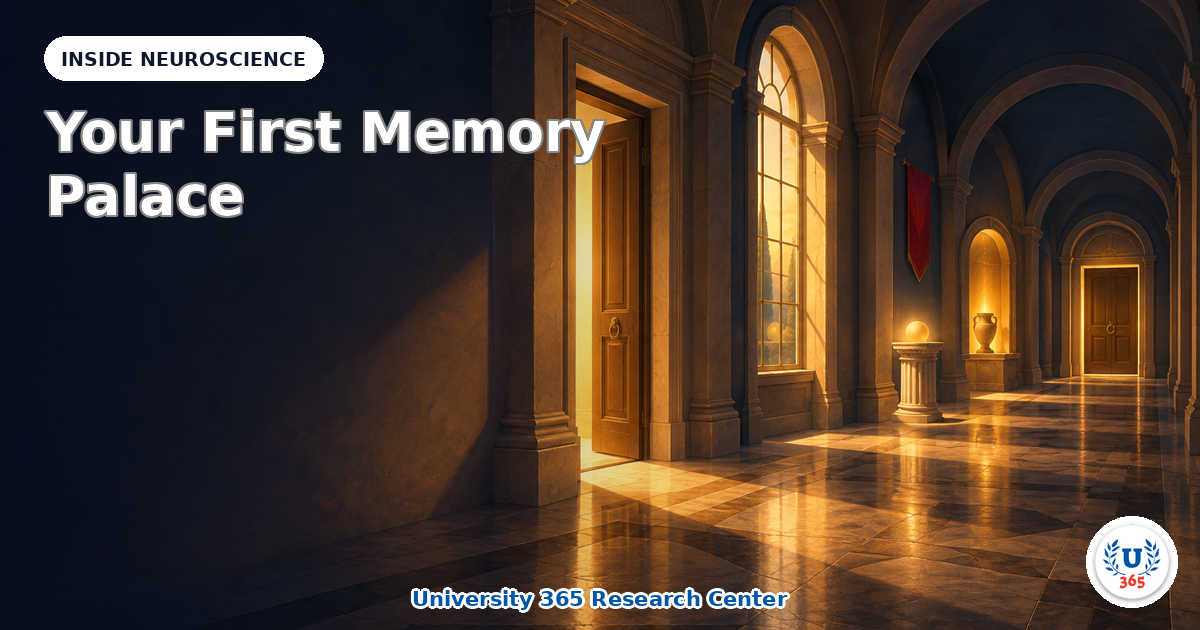
Picture the hallway you walk every morning. At the door, the cabinet, the window, you leave one fact at each stop. Later, walk the same route in your head and pick the facts up in order. Five rooms, five stops, a route you already know.


Your First Memory Palace
How to Do It
Five moves, about fifteen minutes, on a route you know:
Pick the palace (2 minutes). Choose a place you can walk with your eyes closed: your home, your building, the route from the bus stop. Five stops, one fixed route, always the same direction.
Fix the five stops (2 minutes). Walk the route once in your head and name five stops out loud: door, hallway, kitchen, desk, window. Write them down in order.
Store one fact per stop (5 minutes). Take five facts to keep, one per stop. Make each a moving or deliberately ridiculous image: a fridge-sized cell bursts open on the kitchen counter. The UNOP guide's instruction: funny and incongruous, touching the stop, never floating in the air.
Walk it twice (4 minutes). Close the list and retrace the route from stop one, reading each fact off its place. The first pass feels clumsy; run the second anyway. If a stop comes up empty, make the image stranger instead of adding a sixth fact.
Schedule the revisits (2 minutes). Walk the palace once tomorrow and once at the end of the week. Revisits matter as much as the build: a route you never walk fades.
The first build takes about fifteen minutes; afterwards the palace holds any five facts.

Your First Memory Palace
The 5M2S Key Point
One fact per stop, five stops on one route: what you place in a place, you can walk back to on demand.

Your First Memory Palace
Origin
The memory palace is the method of loci, older than the lecture hall: Greek and Roman orators placed each part of a speech at a fixed spot in a building they knew by heart. The standard history, Frances Yates's The Art of Memory (1966), is the reference both studies below cite.
The UNOP library carries the technique as a study instrument: the Mind Mapping guide says to take a place you know by heart, sweep it, and place your words in a funny and incongruous way. The Feynman Five: Explain It to Understand It covers explaining; the memory palace covers storing.

Your First Memory Palace
Science-Backed
Three studies shape this practice, each with a limit worth knowing.
Training works, and it lasts. Fifty-one adults with no mnemonics experience trained 30 minutes a day for 40 days with the method of loci. Their recall gains were significantly larger than an active control group (working-memory training) and a passive one, and still measurable four months later. Scores inside the training climbed from about 17 to about 42 words recalled in five minutes; brain scans showed trainees' connectivity moving toward the pattern seen in memory champions (Dresler et al., 2017). One six-week program with young adults: your pace is your own.
The palace does not need to be special. With 142 students, a palace built from a virtual space explored for at most five minutes worked as well as one based on a highly familiar real setting, and, among those who followed the instructions, better than uninstructed controls (effect sizes 0.33 to 0.47). Smaller gains than in extensive training, they note, but a few minutes of setup already paid (Legge et al., 2012).
The gift is optional. People renowned for outstanding memory feats, including World Memory Championship competitors, showed superior memory not driven by exceptional intellect or structural brain differences: they relied on a spatial strategy engaging regions such as the hippocampus (Maguire et al., 2003). Observational and small: it shows what experts did, not what training does.
What the evidence does not show: no study here tests a five-stop palace as a routine for real coursework. Gains come from word lists, mostly with young adults. Placing facts on a fixed route is the well-tested part; how far it carries your grades is not established.

Your First Memory Palace
Sources
All sources below were opened and read on 15 October 2026.
UNOP library. The Mind Mapping guide covers the method of loci; the Mind Tools series lists the memory palace among the UNOP study instruments, next to The Feynman Five: Explain It to Understand It, the companion episode. University 365 library.
Dresler et al. (2017). Mnemonic training reshapes brain networks to support superior memory. Neuron, 93(5), 1227-1235.
Legge et al. (2012). Building a memory palace in minutes: equivalent memory performance using virtual versus conventional environments with the Method of Loci. Acta Psychologica, 141(3), 380-390.
Maguire et al. (2003). Routes to remembering: the brains behind superior memory. Nature Neuroscience, 6(1), 90-95.
A U365 5M2S Microlearning 5 MINUTES TO SUCCESS UNOP Neuro-Hack |
Please Rate and Comment This Publication
How did you find this Publication? What has your experience been like using its content?
Let us know in the comments at the end of that Page!
If you enjoyed this publication, please rate it to help others discover it. Be sure to subscribe or, even better, become a U365 member for more valuable publications from University 365.
Do you have questions about that publication? Or perhaps you want to check your understanding of it. Why not try playing for a minute while improving your memory? For all these activities, consider asking U.Copilot, the University 365 AI agent trained to help you engage with knowledge and guide you toward success. U.Copilot is always available, even while you are reading a publication, at the bottom right corner of your screen. Alternatively, you can open a separate window with U.Copilot: www.u365.me/ucopilot.
Try these prompts in U.Copilot:
I just finished reading the publication "Your First Memory Palace", and I have some questions about it: Write your question.
I have just read the Publication "Your First Memory Palace", and I would like your help in verifying my understanding. Please ask me five questions to assess my comprehension, and provide an evaluation out of 10, along with some guided advice to improve my knowledge.
Or try your own prompts to learn and have fun...
Are you a U365 member? Suggest a topic you'd like to see as a Neuro-Hack,and we’ll add it for you! |
Save a crazy amount of time with our 5 MINUTES TO SUCCESS (5M2S) formula.
5M2S is University 365's Microlearning formula to help you gain knowledge in a flash. If you would like to make a suggestion for a particular topic that you would like to see as a Neuro-Hack, simply let us know as a member of U365 by providing the topic's details in the Human Chat located at the bottom left after you have logged in. Your request will be prioritized, and you will receive a notification as soon as it is added to our catalogue.
NOT A MEMBER YET?
DON'T FORGET TO RATE AND COMMENT ABOUT THAT PUBLICATION




Comments