
The 5 Second Rule: Transform Your Life, Work, and Confidence with Everyday Courage (Mel Robbins)


In this Book Essential


The 5 Second Rule: Transform Your Life, Work, and Confidence with Everyday Courage (Mel Robbins)
INTRODUCTION
In 2009 Mel Robbins was forty-one, unemployed, drinking too much, and watching her husband's restaurant business take the house with it. Every morning the alarm went off at six, and every morning she hit the snooze button two, three, four times. One night she saw a commercial of a rocket launch, heard the final countdown, and had an instinct that sounded stupid: launch yourself out of bed the same way. The next morning she counted backwards from five and stood up before her mind could argue. She had no explanation for why it worked, only the fact that it did, and she used it again the next day.
That is the whole origin story, and the book is honest about how unglamorous it is. The 5 Second Rule was not designed as a philosophy of life. It was designed to defeat one alarm clock, and Robbins spent the following three years trying to understand why a backward countdown had any effect at all.
Her answer, in one sentence, is that change is less a motivation problem than a timing problem. Between the moment an instinct fires and the moment the mind produces its first objection there is a gap, and she puts that gap at about five seconds. Count backwards inside the gap and you occupy the attention the objection needs. Reach one and move, and the body goes first while the mind catches up. The Rule is a way of spending that gap on purpose instead of losing it to hesitation.
The book is organized as a widening circle. Part One tells the discovery and the mechanics. Part Two reframes courage as something ordinary rather than heroic. Part Three applies the Rule to health, productivity and procrastination. Part Four turns it on the mind itself, on worry, anxiety and fear. Part Five covers confidence, passion and relationships. The material is a mix of memoir, research summary and letters from readers. Robbins reports that more than one hundred thousand people in more than eighty countries have written to her about using the Rule, and she quotes them constantly, sometimes for pages at a time.
This Book Essential separates the tool from the salesmanship. It sets out the mechanism as Robbins describes it, checks that description against the research she borrows, and marks the places where the argument thins out: a single countdown offered as a cure for clinical anxiety, a body of testimony with no denominator of failures, and a five-second window that her own correspondents stretch to three seconds or fifty. It closes by mapping the method onto the U365 framework, because the Rule answers a question most curricula leave open. Courses teach what to do. This book is about the second before you do it.

The 5 Second Rule: Transform Your Life, Work, and Confidence with Everyday Courage (Mel Robbins)
U365'S VALUE PROPOSITION
WHO THIS IS FOR
Professionals who know exactly what they should do and cannot make themselves begin, and who are tired of being told that the answer is more discipline, a better planner, or a stronger why.
Managers and coaches who need a cheap, teachable intervention for a team. The book's examples include a sales organization at USAA and managers teaching the countdown to their staff, which makes it one of the few motivation books with a workplace deployment story.
Educators and parents, because the reframing of courage as a trainable response rather than a personality gift is useful with students, and Robbins uses her own children as case studies, including an eleven-year-old who repeated a sentence for six miles to get through a sleepover.
People wrestling with worry, low-level anxiety and specific fears, with one condition stated plainly: this is a self-help protocol, not a treatment, and the author says so while also overpromising in her chapter titles.
Readers of the habit literature who have read the cue, routine and reward material and still want to know how a person crosses the line between intention and first action. That crossing is the book's real subject.
KEY TENSIONS
One rule against many problems: Robbins applies the same countdown to a gym session, a sales call, a panic attack, a marriage conversation and a career change. The breadth is the selling point and the analytical weakness, because a technique that explains everything risks explaining nothing in particular.
Feelings as obstacle against feelings as information: the book's central move is to treat a feeling as an unreliable advisor. That works when the feeling is inertia and fails when the feeling is a signal, and the author's own examples, a divorce, a resignation, a refusal to keep enduring a bad job, show that sometimes the emotion is the evidence.
A protocol against a diagnosis: Chapter Thirteen is titled End Anxiety and reports that the author stopped taking Zoloft after two decades. She also tells readers to get professional help. Both statements are in the book, and the second one is the responsible half that the title ignores.
Testimony against evidence: the letters are moving, and they are a self-selected sample of people who wrote to a motivational speaker to report success. The book offers no count of the readers who tried and quit, which is the number a reader deciding whether to trust the method actually needs.
A start against a system: the Rule is very good at the first move and silent about the tenth. Anyone who has started a habit in January and abandoned it in March knows that initiation and maintenance are different problems, and this book only solves the first.
Courage as birthright against courage as practice: Robbins insists courage is inside everyone, which is generous and also slightly evasive. Every case in the book is someone who practiced, and the book would be stronger if it said that the birthright requires a training regime.
WHY IT MATTERS NOW
The five-second window has never had so much competition. When Robbins discovered the gap, the thing that rushed in to fill it was her own excuse-making. Today the same gap fills with a notification, a feed, or a model that will happily do the thinking, the drafting and the deciding for you. Hesitation now has company, and the company is engineered to keep you passive. That makes a crude five-second protocol more relevant, not less, because it is short enough to survive the competition.
For University 365 the book matters because it independently reaches a position the CI-First doctrine already holds. The value of a tool depends on the judgment of the human directing it, and judgment is worthless if the human never initiates. The Rule is a human-only protocol for staying the initiator. It does not tell you what to think about AI, work or your marriage. It tells you how to be the one who moves first, which is the precondition for everything else in the CI-First frame.
The third reason is practical. Most education teaches content and leaves behavior to chance. A curriculum that produces graduates who know what to do and cannot start is a curriculum with a missing unit, and this book, whatever its weaknesses, describes that unit in a form a fellow can use before the next class.

The 5 Second Rule: Transform Your Life, Work, and Confidence with Everyday Courage (Mel Robbins)
OVERVIEW
The 5 Second Rule is built in five parts and seventeen chapters, and the architecture is more deliberate than the chatty voice suggests. Part One defines the Rule and defends it. Part Two supplies the emotional vocabulary, courage, that the rest of the book depends on. Part Three tests the Rule against behavior, with chapters on health, productivity and procrastination. Part Four turns it on mental habits, with chapters on worry, anxiety and fear. Part Five moves to fulfilment, with chapters on confidence, passion and relationships. A closing essay, The Power of You, is a montage of readers' five-second decisions.
Robbins researched the book as a lawyer prepares a case. She read widely, interviewed researchers, and collected reader letters for three years, and the strongest pages are the ones where she hands the argument to someone with a lab. Antonio Damasio supplies the claim that feelings drive most decisions. Timothy Pychyl supplies the finding that procrastination is a coping mechanism for stress. Alison Wood Brooks supplies the evidence that telling yourself you are excited improves performance. Brian Little supplies the idea of free traits, the personality adjustments people make to serve a project. Robbins connects them with a practitioner's instinct rather than an academic's caution.
The mechanism as she states it has three parts. The backward count interrupts the habit loop and occupies the attention that would otherwise go to excuses. Reaching one creates a terminal point, after which the only move left is forward. Physical movement comes next and changes the physiological state, so the mind follows the body instead of the other way around. Whether or not the neuroscience is exactly right, the design is sound in a way that matters: it puts the intervention at the moment of hesitation rather than at the level of a plan, a goal or a identity.

The 5 Second Rule: Transform Your Life, Work, and Confidence with Everyday Courage (Mel Robbins)
KEY IDEAS
5 SECOND RULE
The five-second window: Between an instinct and the mind's first objection there is a short gap. Robbins describes it as roughly five seconds and treats it as the only place where change is decided. The number is a working estimate, not a measurement, and the book is most credible when it admits that people shorten or lengthen it to suit themselves.
Count backwards, then move: The count runs 5, 4, 3, 2, 1 and not the other way, because a forward count has somewhere to go after five and a backward count ends at one, which functions as a starting gun. The physical move is not optional. Counting without moving is a relaxation exercise, and the Rule is not a relaxation exercise.
A starting ritual, not a motivation technique: Robbins borrows the concept of activation energy from chemistry by way of Mihaly Csikszentmihalyi. The energy needed to begin is larger than the energy needed to continue, so the Rule is aimed at the expensive moment. The Wake Up Challenge, an alarm set thirty minutes early with no snooze allowed, is the reader's first laboratory.
Feelings decide first: Damasio's patients, who could reason without feeling, could not choose. Robbins takes the finding and turns it into a diagnostic question. When you ask yourself whether you should do something, you are usually asking whether you feel like it, and the two questions have different answers. The Rule is a way of acting on the first question while the second one is still shouting.
Hesitation is the trigger: A pause before action sends a signal that something is wrong, and the mind responds by building the case for staying still. Robbins treats the moment of hesitation as the alarm itself. Catching the hesitation is the skill, and it is a skill because hesitating has become a habit for most people, encoded and invisible.
Everyday courage: Courage in this book is a push, not a personality. Robbins reads Rosa Parks and Martin Luther King Jr. as people who moved inside a five-second window, and she is careful to note that Parks did not plan the moment and King said he would have declined the nomination if he had stopped to think. The reframing is useful and slightly flattening, since both decisions were prepared by years of political commitment that the countdown did not supply.
The waiting trap: There is no right time, and waiting for one is a decision against yourself. Robbins uses Adam Grant's account of Michelangelo fleeing to Florence and Wozniak hesitating over Apple to make the point that even the celebrated froze first. Her numbers argument, Dyson's five thousand one hundred twenty-seven prototypes and Picasso's fifty thousand works, is the least rigorous part of the chapter and the most persuasive.
Confidence is built backwards: Action comes first and self-perception follows, which is the do good, be good principle Robbins takes from Timothy Wilson and Aristotle. The book's best illustration is an engineer at Cisco who froze when his chief executive walked past in a hallway, then caught him on a jogging path the next morning after a countdown, and ended up with an introduction to the innovation team.
Procrastination is stress relief: Pychyl's research reframes procrastination as a way of managing stress rather than a failure of time management, which explains why planning systems do not fix it. Robbins's three steps are to forgive yourself, to picture the future self who has to live with the delay, and to start for fifteen minutes. The order is unusual and it is the right one.
Worry, anxiety and fear are habits: Robbins treats all three as learned patterns that can be interrupted and replaced. The anxiety chapter adds a technique from Alison Wood Brooks: relabel the arousal as excitement, because the physiology is identical and the label decides whether the mind escalates it. The fear chapter adds anchor thoughts and if-then planning, which is the most robust idea in the section.
Say it: The relationship chapter reduces to a single instruction, leave nothing important unsaid. Robbins's examples, a father who told his daughter he admired her, a reader who asked her dying father whether he was scared, a woman who called her estranged father after years, all describe the same move. Silence protects nobody and costs the relationship its substance.


The 5 Second Rule: Transform Your Life, Work, and Confidence with Everyday Courage (Mel Robbins)
ULM ALIGNMENT
At University 365, the CI-First (Co-Intelligence-First) doctrine teaches you to always invite AI into your reflection and work while remaining the orchestrator. Human Intelligence leads, AI amplifies. This Book Essential connects the book's account of acting before you feel ready to U365's proprietary methods: ULM+EVA (University 365 Life Management powered by the Explore-Visualize-Action Plan cycle) gives you six life domains in which to place a five-second decision; LIPS+CARE (your digital second brain with the Collect-Action Plan-Review-Execute cycle) records each attempt so that courage becomes evidence; and SL-OS (Successful Life Operating System) integrates all of these with UP-Context-Engineering (context engineering for AI) into a unified life and learning system.
SCHEMA PRIME: ULM Domain: Character and Emotions
DOMAIN MAPPING: Primary: Character and Emotions. Secondary: Quality of Life and Career and Finance. The subject is acting under feeling, and the payoff is a life that runs better.
EVA PARAGRAPH: You want to stop losing decisions to hesitation in the areas that matter to you. The obstacle is that hesitation is fast, invisible and rewarded, because staying still feels safe for about five seconds and costs nothing visible in the moment. The plan: pick one domain, name three recurring moments where you know what to do and do not move, and attach an if-then line to each. If the alarm rings, then I count backwards and stand up before I evaluate how I feel. If I catch myself rehearsing an objection, then I count and take the smallest physical step. Review the three lines weekly and replace any that never fire.
LIPS+CARE CAPTURE CARD:
Book: The 5 Second Rule: Transform Your Life, Work, and Confidence with Everyday Courage
Primary ULM Domain: Character and Emotions
3 Key Takeaways:
1. The decision happens in a gap of seconds, and the gap is spent either on movement or on excuses.
2. Feelings are reliable as information about your state and unreliable as instructions about your next action.
3. Confidence follows action, so every small move is evidence you can use later.
Apply It Action: In the Character and Emotions domain, choose one commitment you have been circling for a month and take the first physical step within five seconds of your next impulse to do it, then log the impulse, the count and the outcome.
Next CARE Step: Collect, by listing the five moments this week when you hesitated and what the hesitation protected you from.
EXPLAINER LINK: For more on ULM, EVA, LIPS, and CARE methods, see the ULM page and the LIPS page. For the CI-First doctrine, see the CI-First page. For the full SL-OS framework, see the SL-OS page.
APPLY IT (domain-tagged): In the Character and Emotions domain, write down the sentence you are most avoiding saying to one person at work or at home, then say it within five seconds of your next opportunity and note what actually happened. The point is not the outcome. The point is the evidence that you can move while afraid.


The 5 Second Rule: Transform Your Life, Work, and Confidence with Everyday Courage (Mel Robbins)
SUMMARY

MINDMAP SKELETON
Center: The 5 Second Rule, by Mel Robbins.
Branch 1: The discovery. Snooze button, rocket launch, first count, the window, three years of research.
Branch 2: The mechanism. Backward count, prefrontal cortex, habit loops, activation energy, starting ritual, physical movement.
Branch 3: Everyday courage. Courage as a push, hesitation, Rosa Parks, waiting, the numbers game, validation by pursuit.
Branch 4: Behavior. Health, exercise, productivity, mornings, snooze and sleep inertia, procrastination as stress relief, forgiveness, future self.
Branch 5: Mind. Worry, anxiety, panic versus near miss, reframing arousal as excitement, anchor thoughts, if-then planning.
Branch 6: Fulfilment. Confidence as a skill, free traits, passion through exploration, envy as a signal, saying the unsaid thing.

Chapter 1: Five Seconds to Change Your Life
Robbins opens with the ledger of her worst year and the claim that change arrives one five-second decision at a time. The chapter is a promise rather than an argument, and its job is to make the reader recognize the snooze button as the smallest unit of a much larger pattern. The evaluative point the book does not make is that her crisis was structural, a failed business, a tapped-out credit line, a marriage under strain, and the Rule addressed the part of it she could reach from bed. That is both the method's honesty and its limit: it is a tool for agency inside a situation, not a tool for changing the situation.
Chapter 2: How I Discovered the 5 Second Rule
The commercial, the countdown, the instinct to launch herself out of bed, and the morning it worked. Robbins also introduces the research on goal-related instincts, the finding that the brain flags opportunities connected to a goal when you are near them, which is her explanation for why the rocket image registered at all. The chapter's weakness is that it treats an intuition about a commercial as evidence about a mechanism. Its strength is that it refuses to dress the moment up: she thought the idea was stupid, used it anyway, and only later went looking for a theory that fit.
Chapter 3: What You Can Expect When You Use It
Here the Rule becomes a practice, applied to the gym, the bottle, her tone with her husband, and the résumé she had been avoiding. Robbins introduces locus of control and the claim that a bias toward action is the fastest way to increase it. The chapter also contains the first serious hole in the argument. If the window is five seconds, why do some readers report that five seconds turned into fifty and then five hundred when the fear was deeper? The admission is buried in a later chapter and it matters, because it suggests the operative variable is interrupting rumination rather than the number five.
Chapter 4: Why the Rule Works
A question-and-answer chapter that doubles as the book's theory section. Robbins explains why counting backwards beats counting forward, why movement is required, why the tool resembles Nike's slogan but differs from it, and what the Rule borrows from research on habit loops, starting rituals and activation energy. This is the chapter to read twice. It is also where the book is most vulnerable, because the explanation is a synthesis of adjacent findings rather than a test of the technique itself. The synthesis is plausible and it remains a synthesis.
Chapter 5: Everyday Courage
Robbins admits that before the Rule she thought courage belonged to history makers. The chapter retells Rosa Parks and Martin Luther King Jr. as people who moved before they could think, and argues that everyday life requires the same act at a smaller scale. The reframing is the most useful idea in the book for a general reader, and it carries a cost: by making every hesitation a courage problem, the chapter makes it harder to see the moments when the honest move is to wait, gather information or decline.
Chapter 6: What Are You Waiting For?
A man in a Chicago bar, a daughter afraid to audition, and a long list of people who waited for permission. Robbins uses Adam Grant's Originals to show that Michelangelo hid in Florence and Wozniak hesitated over Apple, which is a genuinely useful antidote to the belief that courageous people feel no fear. The statistics she adds, Rovio's fifty-one failed games and Dyson's thousands of prototypes, make a different point than she thinks: they are evidence about persistence in creative work, not about the value of acting inside five seconds.
Chapter 7: You'll Never Feel Like It
The best-argued chapter in the book. A woman in a Plano meeting has a good idea about a Snapchat filter, hesitates, and nearly loses it. Robbins uses Damasio to argue that feeling precedes reasoning, then draws the practical conclusion: if you wait until you feel like it, you will not act. The analysis the chapter deserves is about calibration. If feelings are usually irrelevant to the decision, the reader needs a rule for the minority of cases where they are the decision, and the book never supplies one.
Chapter 8: How to Start Using the Rule
The instruction manual, built around the Wake Up Challenge. Set the alarm thirty minutes early, put it out of reach, count and stand. Robbins explains activation energy, warns that the first attempt will feel absurd, and includes readers who report that it sucked and then worked. The chapter is short and it is the one a reader should actually follow, because it converts a claim into an experiment with a result the reader can check by lunchtime. A week of data beats a hundred pages of testimony.
Chapter 9: Improve Your Health
Robbins argues that the problem is never the diet, and that no plan works if you wait to feel like following it. The chapter is a stack of reader stories: a man who lost a hundred and seventy-six pounds, a cancer patient running marathons, a television host whose on-air mammogram found her own cancer. The stories are vivid and they are also a selection. The chapter never asks how many readers started a health plan with the Rule and stopped, which is the question that would tell a reader whether the method changes the odds or simply marks the people who were already going to succeed.
Chapter 10: Increase Productivity
The most concrete chapter, and the one with the most transferable material. Robbins explains why the snooze button is expensive, citing the sleep-cycle account of sleep inertia, and then lays out her morning routine as a seven-step sequence: rise on the alarm, leave the phone out of the bedroom, think about the day while brushing teeth, dress and make the bed before email, write one to three musts with reasons, spend thirty minutes before seven-thirty on them, and set a quitting time. The routine is the real deliverable. The Rule is what gets her out of bed to run it.
Chapter 11: End Procrastination
Robbins reports that she had procrastination wrong for years. It is not a time-management failure but a stress response, a way of getting relief from a larger anxiety by avoiding a smaller task. Pychyl's research supplies the frame, and the three-step method that follows is unusually well designed: forgive yourself, because shame increases avoidance; picture the future self who inherits the delay; then start for fifteen minutes. The distinction between productive and destructive procrastination is a useful corrective to the productivity literature, which tends to treat all delay as a defect.
Chapter 12: Stop Worrying
A chapter built around the author's own mind. Robbins catches herself worrying about her husband's motorcycle, then about her daughter at a prom dress fitting, and uses both scenes to show how quickly a good moment becomes a rehearsal for loss. The two questions she asks herself, what am I grateful for in this moment and what do I want to remember, are the practical core, and they work because they force attention onto the present. The chapter would be stronger if it separated worry as a habit from worry as a signal, since some of what she calls hijacking is a reasonable response to a real risk.
Chapter 13: End Anxiety
The book's most personal chapter and its most overreaching. Robbins describes panic attacks that began in law school, two decades on Zoloft, and her decision to come off the medication to help her children with their anxiety. The technique is reframing: count, then relabel the arousal as excitement, because anxiety and excitement are the same physiology with different labels. The evidence from Alison Wood Brooks is real and applies to performance situations. The chapter title does not apply to clinical anxiety, and the book's own account, including the years of therapy and medication, is the evidence against its own headline.
Chapter 14: Beat Fear
Robbins cures her fear of flying with a preparation ritual. Before each trip she builds an anchor thought, a specific image of what she is flying toward, and when fear rises she counts and returns to the image. She frames this as if-then planning, and the research on implementation intentions is one of the better-supported ideas in the book. What the chapter underplays is the amount of rehearsal involved. The technique works for her after years of use on the same fear, which is a training claim presented as a trick.
Chapter 15: Building Real Confidence
Confidence is a skill, not a personality trait, and Robbins proves it with an engineer who chased down his chief executive on a running path. The chapter's best material is Brian Little's work on free traits, the deliberate acting out of character in service of a project, because it explains how an introvert can do a public thing without becoming a different person. The weakness is the same as everywhere else in the fulfilment section: the evidence is a set of success stories, and the reader is asked to infer a method from people for whom the method apparently worked the first time.
Chapter 16: Pursuing Passion
Robbins argues that passion is found by exploring, not by thinking, and gives two signals to follow: curiosity and envy. The chapter includes a banker who became a photographer, a law student who walked out of a lecture and enrolled in a physical education degree, and the story of The Alchemist failing in Brazil before it sold. The reframing of the commitment question is the most useful line in the chapter: ask whether you are ready to commit, not whether you feel ready. That distinction, more than the countdown, is what moves the chapter.
Chapter 17: Enrich Your Relationships
The shortest instruction in the book and the hardest to follow: say it. Robbins tells the story of a father who told his adult daughter he admired her, and of her own call with her father before brain surgery, when she asked whether he was scared. The chapter is emotionally effective and analytically thin, since it treats silence as a single failure rather than a set of different problems, fear of conflict, fear of rejection, fear of the answer. Still, the instruction survives the analysis: the conversations people regret are the ones they did not have.
Conclusion: The Power of You
The closing essay is a montage of readers: a woman quitting a job she hates, a veteran starting a business, a man walking across a bar, a reader on a ferry choosing to ask for help instead of ending his life. Robbins does not add new argument, and she does not need to. The essay works as a demonstration of the book's real thesis, which is that the size of the decision is a poor guide to its consequence. The most useful sentence in the conclusion is also the least dramatic: the alternative to acting is not safety, it is missing what you were going to become.

The 5 Second Rule: Transform Your Life, Work, and Confidence with Everyday Courage (Mel Robbins)
IN PRACTICE

1. Run the Wake Up Challenge for seven days.
Set the alarm thirty minutes early and put the phone out of reach. Count when it rings and stand before you evaluate. The purpose is not the extra half hour. It is to feel activation energy once, deliberately, so you recognize it later.
Action: log the time you got up and how many seconds passed between the alarm and your feet on the floor.
2. Write your three hesitation moments.
Most people lose the same decisions repeatedly. Name the three recurring moments where you know what to do and do not move, then attach an if-then line to each one. Vague intentions fail at the exact moment the Rule is supposed to work.
Action: one page, three lines, each beginning with If and ending with then I count and move.
3. Separate the feeling from the act.
Before a decision you have been avoiding, write two sentences. The first states what you feel. The second states what you will do. Keeping them on the same page makes the difference visible and stops the feeling from doing the deciding by default.
Action: do this for one decision a day for a week and keep the pages.
4. Protect the first ninety minutes.
Robbins's morning routine is a delivery system for the Rule, and its most defensible element is the claim that the first hours of the day are the best hours you have. No email, no feed, no messages until your musts are written and started.
Action: set a phone rule for the first ninety minutes and tell one person who will notice if you break it.
5. Forgive the delay before you plan the restart.
Procrastination is a stress response, and shame feeds it. The research Robbins cites found that students who forgave themselves for delaying were less likely to delay the next time. Forgiveness here is a tactic, not a mood.
Action: write one paragraph forgiving yourself for the specific thing you have been avoiding, then start it for fifteen minutes.
6. Build an anchor thought for the fear you know is coming.
Choose a recurring fear, a presentation, a flight, a hard conversation. Build one specific positive image of the moment after it goes well. When the fear rises, count and return to the image.
Action: write the image in the present tense, in three sentences, and read it before the event.
7. Say the unsaid thing within five seconds.
Choose one person and one sentence you have been withholding. Say it at the next natural opening, counting if you hesitate. The sentence does not need to be eloquent. It needs to be true and it needs to be said.
Action: write the sentence now, then send the message or make the call today.

The 5 Second Rule: Transform Your Life, Work, and Confidence with Everyday Courage (Mel Robbins)
QUIZ: TEST YOUR UNDERSTANDING
Question 1: Robbins says the Rule works because of timing rather than motivation. What is the timing claim exactly?
Answer: There is a short gap, about five seconds, between an instinct to act and the mind's first excuse, and the countdown plus movement occupies that gap.
Explanation: The count occupies attention the objection needs, the number one creates a terminal point, and the physical move changes the physiological state so the mind follows the body.
Question 2: A reader finishes a report at eleven at night, feels a strong urge to email it to a client, and counts to five before sending. Which part of the method is doing the work, and which part is missing?
Answer: The count is present and the evaluation is missing. The Rule is designed to interrupt hesitation before a known-good action, not to replace judgment about whether the action is wise.
Explanation: The book is explicit that the Rule is for acting on what you already know you should do. Applied to an impulsive decision, the same five seconds should be used to stop, which is the opposite use.
Question 3: Why does the book argue that confidence cannot be built by thinking about your strengths?
Answer: Because self-perception follows behavior. Acting first and noticing that you acted produces evidence, and evidence changes what you believe about yourself.
Explanation: Robbins takes this from the do good, be good principle she attributes to Timothy Wilson and Aristotle. The Cisco engineer is the illustration: he froze once, acted the next morning, and his view of himself changed after the act, not before.
Question 4: Apply the Rule to a setting the book does not cover: a hospital team that keeps postponing a safety review.
Answer: Name the hesitation moment, which is the point in the meeting where someone thinks the review should be raised and stays quiet, then give the team a shared five-second protocol and a standing agenda item so the count has somewhere to land.
Explanation: The transferable move is to locate the moment of hesitation inside a process, not to exhort people to be braver. The Rule supplies the interrupt; the agenda supplies the destination.
Question 5: Robbins reports that her correspondents stretch the window to three seconds or fifty. What does that imply about the five-second claim?
Answer: The number is a working estimate rather than a fixed interval, and the mechanism is more likely the interruption of rumination than the precise duration of the count.
Explanation: If the effective interval varies with the depth of fear, then the five is a convenient default. The book admits this in passing and does not revise its central number, which is a small but real inconsistency.
How many did you get right? Which ones surprised you?

The 5 Second Rule: Transform Your Life, Work, and Confidence with Everyday Courage (Mel Robbins)
CAN THIS BOOK ESSENTIAL REPLACE THE ORIGINAL?
No. This Essential gives you the mechanism, the research behind it, the limits of the evidence and the practical protocol, but the book's force comes from Robbins's own account of a humiliating year and from hundreds of reader letters in their own voices. Read the original for the texture and for the chapters on anxiety and relationships, where the personal detail carries more than any summary can.

The 5 Second Rule: Transform Your Life, Work, and Confidence with Everyday Courage (Mel Robbins)
QUOTES
"You change your life one five-second decision at a time. In fact, it’s the only way you change."
"Hesitation is the kiss of death."
"You can’t control how you feel. But you can always choose how you act."
"Feelings are merely suggestions, ones the greatest athletes and teams ignore."
"There is no right time. There is only right now."
"The problem is never the diet. The problem is always your feelings about dieting."
"Anxiety is what happens when your habit of worrying spirals out of control."
"Fear and excitement are the exact same thing in your body."
"The only difference between excitement and anxiety is what your mind calls it."
"It will get easier and easier until suddenly, you won’t be afraid anymore."
"A big mistake people make is thinking that confidence is a matter of personality."
"Small things are not small at all. They are the most important things of all."
"Waiting for the right time to get real in your relationships is a fool’s errand."
"Courage is a birthright. It’s inside all of us."
"There is greatness in you. The time to reveal it is now."

The 5 Second Rule: Transform Your Life, Work, and Confidence with Everyday Courage (Mel Robbins)
AUTHOR'S EXPERTISE
Mel Robbins is a former criminal defense attorney who moved into coaching, radio and television, and became a commentator for CNN and a contributing editor at SUCCESS magazine. Her 2011 TEDxSF talk, How to Stop Screwing Yourself Over, has been viewed tens of millions of times and made her name as a speaker; the book reports that she was named the most-booked female speaker in America in 2016, with ninety-eight keynotes in one year. The 5 Second Rule, published in 2017 by Savio Republic, grew out of that talk and out of the reader mail it produced.
She is not a researcher, and the book does not pretend otherwise. Her method is journalistic: read the literature, interview the scientists, then test the idea against her own life and against the letters. That gives her a practitioner's ear for the detail that makes a technique usable, and it makes her vulnerable to the charge of cherry-picking, because a synthesis chosen to support a tool will find support. She is at her best when she reports a result that complicates her case, such as the finding that AI mentors helped strong entrepreneurs and hurt weak ones in the Co-Existence material, or, here, the admission that her window sometimes stretched to fifty seconds.
Her later work continues the same project from different angles. The High 5 Habit extends the morning routine into a practice of self-encouragement, The Let Them Theory turns the same attention to what other people think, and The Mel Robbins Podcast, launched after the book, is where most of her current teaching appears. The consistent thread across all of it is a preference for the smallest possible intervention, delivered at the moment it is needed, over the large plan delivered too late.

The 5 Second Rule: Transform Your Life, Work, and Confidence with Everyday Courage (Mel Robbins)
RESOURCES
The book: The 5 Second Rule: Transform Your Life, Work, and Confidence with Everyday Courage by Mel Robbins (Savio Republic, 2017). Official site at https://www.melrobbins.com/ and the books page at https://www.melrobbins.com/books.
Companion: The High 5 Habit by Mel Robbins, which turns the morning count into a daily practice of self-encouragement, and The Let Them Theory, which applies the same attention to other people's opinions.
Related reading for U365 fellows: Atomic Habits by James Clear for the cue and reward architecture that the Rule interrupts, Tiny Habits by BJ Fogg for the smallest-action method, and Thinking, Fast and Slow by Daniel Kahneman for the two-system account of the mind that the book's vocabulary assumes.

The 5 Second Rule: Transform Your Life, Work, and Confidence with Everyday Courage (Mel Robbins)
NEXT STEPS
Count before you decide: When you notice the first objection forming, count backwards and move. The objection does not need an answer. It needs to arrive after you have started.
Choose your moments in advance: Pick three recurring hesitations and write an if-then line for each. A rule you have to remember in the moment is a rule you will forget.
Keep a five-second log: Record one decision a day, the impulse, the count and what happened. In two weeks you will have data about your own hesitation that no book can give you.
Protect the morning: Put the phone out of reach, write one to three musts with reasons, and start the first one before you open anything that belongs to someone else.
Forgive the gap: When you lose a week, skip the self-trial and restart within five seconds. The research on procrastination says shame extends the delay.
Say the unsaid thing: One conversation, one sentence, this week. The relationship chapter is the one where the cost of waiting is measured in years.

The 5 Second Rule: Transform Your Life, Work, and Confidence with Everyday Courage (Mel Robbins)
U365'S RECOMMENDATIONS TO LEARN MORE
This list collects the first-party pages, the talks, the interviews and the channels that teach something this Essential does not. Every link was checked and every video verified at the time of writing. Information verified as of 2026-11-08.
Official learning resources
Video tutorials and channels
Mel Robbins | TEDxSF | The talk that introduced the Rule, including the alarm clock homework and the case for acting before you feel ready, by TEDx Talks, Jun 11, 2011, 16:34
Long interview on the origin of the Rule, the myth of motivation and the neuroscience of the countdown, by Entiversal, Oct 17, 2017, 1:10:39
The Mel Robbins Podcast | Mel Robbins revisits the talk that started the method and explains how she uses the countdown today, by Mel Robbins, Mar 3, 2025, 1:22:43
Written tutorials and deep-dive articles
Community and social
Resources on X
Dedicated X channels:
X posts with video content:
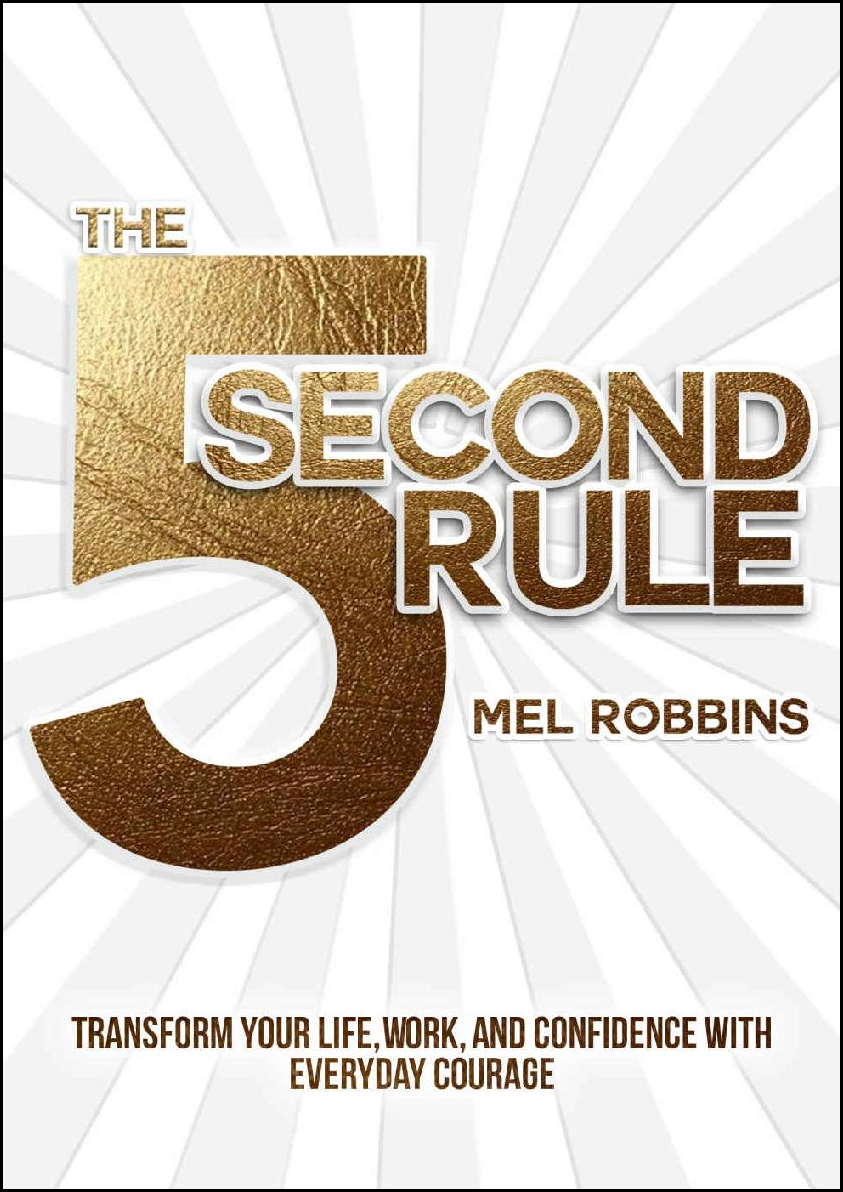

The 5 Second Rule: Transform Your Life, Work, and Confidence with Everyday Courage (Mel Robbins)
IMPORTANT NOTICE
This Book Essential is an original summary and critical analysis of The 5 Second Rule: Transform Your Life, Work, and Confidence with Everyday Courage by Mel Robbins (Savio Republic, 2017). Short quotations from the book are attributed and cited for purposes of criticism, review, and education. All rights in the original work belong to its author and publisher; this Essential is not a substitute for the book: read the original at the publisher's page.
This book is part of University 365's learning library. Explore INSIDE, our publications, and our programs. The best summary is not a substitute for the book. Read the original. Discuss this book with a U.Coach.
Note: verify current details before relying on this comparison. Information verified as of 2026-11-08.




Comments