
AI First, Human Always: Embracing a New Mindset for the Era of Superintelligence (Sandy Carter)


In this Book Essential


AI First, Human Always: Embracing a New Mindset for the Era of Superintelligence (Sandy Carter)
INTRODUCTION
A chief executive asks the room a simple question: if every competitor will have the same models, the same cloud and the same data brokers by next year, what is left that is yours? Sandy Carter's answer is the thesis of this book. What is left is the way the organization decides, the speed at which it learns, and the people who are willing to trust the machine with part of the work and to be accountable for the part it should never touch.
AI First, Human Always arrives with an unusual amount of executive credibility behind it. Carter has run businesses inside IBM during the Watson years, inside Amazon Web Services during the cloud build-out, and she now leads at Unstoppable Domains while sitting on the boards of Altair and two AI start-ups. She has watched several technology waves move from demo to budget line, and she writes as someone who has had to defend the numbers.
The book covers seven forces: the AI-first operating posture, exponential growth in compute and data, multimodal learning models, the experiential age, digital twins, the tokenization of assets, and technological convergence. Around those seven it places a second argument that gives the book its title. The machine should take the routine, the analysis at scale and the first draft. The human keeps the judgement, the relationship and the accountability. Carter repeats that claim in every chapter, and the repetition is deliberate: she is trying to stop executives from treating AI adoption as a tools purchase.
This Book Essential gives you the argument chapter by chapter, the cases she uses, and the numbers she cites. It also marks where the evidence thins out. Several of the seven trends are presented through pilot projects and vendor surveys rather than through measured outcomes, and a reader who is deciding where to spend a budget needs to know which chapters can carry that weight and which cannot.
The practical question underneath the book is not whether AI enters your organization. It already has, through the tools your teams installed without asking. The question is whether the entry is governed by a strategy or by an accumulation of subscriptions, and Carter's eight leadership characteristics and two frameworks are aimed squarely at that question.

AI First, Human Always: Embracing a New Mindset for the Era of Superintelligence (Sandy Carter)
U365'S VALUE PROPOSITION
WHO THIS IS FOR
Executives and board members who are being asked to approve an AI programme and need a map of the seven technologies that will appear in those proposals over the next three years.
Managers who have to explain to their teams what changes and what does not, because the book's repeated claim about human judgement is a practical communication tool, not a slogan.
Product, marketing and customer-experience leaders, who will find the experiential age chapter and the PULSE framework the most immediately usable material in the book.
Risk, compliance and ethics officers, because Chapter 8 collects the trust, copyright, environmental and data challenges in one place and gives a usable list of controls.
Fellows building a career plan, because the chapter on AI-first leadership reads as a competency model that can be turned into a two-year development plan.
KEY TENSIONS
Tools against operating posture: most organizations buy AI and keep their decision rights unchanged. Carter argues that the posture comes first, and that a company which installs models without changing how it decides has bought cost, not capability.
Speed against governance: the exponential curve rewards early movers, and the same curve punishes institutions that deploy before they can explain a decision. The book wants both and does not fully resolve the trade-off.
Technology breadth against evidence depth: seven technologies in ten chapters means each one gets a tour rather than a trial. Convergence, tokenization and digital twins are described through pilots, and a reader should treat those chapters as orientation rather than proof.
Automation against identity: the productivity case for AI is strongest where work is repetitive, and the human case is strongest where work carries judgement. Most jobs contain both, and the book's answer is augmentation, which is easier to state than to schedule.
Culture against structure: Carter repeats that culture eats strategy for lunch. The book offers fewer instructions on changing incentives, promotion criteria and budget ownership, which are the levers that actually move culture.
Optimism against cost: the book is candid about energy use, copyright and job displacement, then returns to a capability frame. The honesty is real and the optimism is also real, and the reader has to hold both.
WHY IT MATTERS NOW
The book was published in February 2025, and its subject has moved faster than its examples. Agents that execute multi-step work, multimodal models that read screens and video, and enterprise data platforms that ship with retrieval built in have all become ordinary purchases since the manuscript closed. That makes the framework chapters more valuable than the product chapters: the map of what to do with AI survives a model upgrade, and the specific vendor examples do not.
For U365 fellows the stake is career and money. The World Economic Forum forecast Carter quotes, 170 million jobs created and 92 million displaced, describes a labour market where the middle of the job market is rebuilt rather than deleted. The people who move into the rebuilt middle are the ones who can specify a task precisely, judge an output and explain a decision. Those are trainable skills, and every chapter of this book is a rehearsal in them.
The third reason is institutional. Universities and training providers are now asked to certify AI competence, and most of them certify tool familiarity. Carter's list of leadership characteristics points at something harder to certify and more durable: curiosity, data literacy, ethical judgement and the willingness to be accountable for a system you did not build.

AI First, Human Always: Embracing a New Mindset for the Era of Superintelligence (Sandy Carter)
OVERVIEW
The book is organized as a tour of seven forces rather than as a single argument. Chapter 1 sets out what AI-first means as a posture and what it does not mean. Chapter 2 explains why the current period feels unlike previous technology cycles, and gives the four factors Carter says decide whether an AI programme succeeds. Chapters 3 to 7 take one force each: multimodal models, the experiential age, digital twins, tokenization and convergence. Chapter 8 is the counterweight, a catalogue of trust, data, employment, environmental and copyright problems. Chapter 9 turns to leadership and Chapter 10 to the near future. Two appendices supply the practical scaffolding: a reference architecture Carter calls the AI marketecture, and a first-principles method for planning under rapid change.
The method is consistent across chapters. Carter defines the technology, lists its characteristics, walks through industry cases, then closes with strategic actions for leaders. That repetition is a feature for a reader using the book as a reference, and a weakness for a reader looking for an argument, because the case studies rarely carry numbers that would let you compare them.
The strongest original material is not the technology tour. It is the experience-value matrix in Chapter 4, which plots experiential richness against functional value and names the two failure corners, over-simplification and experiential overkill. It is the most portable instrument in the book: any product team can place its own offering on that grid in an afternoon. The four success factors in Chapter 2, a data strategy, change management, a business problem rather than an AI project, and starting small, are the second most useful pages, and they are easy to miss because they sit in the middle of a chapter about exponential growth.
Carter's writing is direct and example-heavy. She uses her own career as evidence, including the Watson years and the Genius Group decision to appoint an avatar as chief AI officer, and she names companies freely. The cost of that style is that the reader cannot always tell which claims rest on a published study and which rest on a conversation, because the citation style moves between footnoted research and anecdote without signalling the difference.

AI First, Human Always: Embracing a New Mindset for the Era of Superintelligence (Sandy Carter)
KEY IDEAS
AI-FIRST LEADERSHIP
AI-first as a posture, not a project: Carter contrasts AI-first with the earlier cloud-first and mobile-first cycles, which were about technology placement. AI-first means the technology is assumed in every strategy conversation, the way electricity is assumed in factory design. The test she implies is simple: if your strategy document would read the same with the AI paragraphs removed, you are not AI-first.
The four success factors: a data strategy, real change management, a business problem rather than an AI project, and a small first deployment that produces a visible win. Carter presents these almost in passing, and they are the most reliable content in the book. They also imply a governance rule: a programme that cannot name its business problem in one sentence has no business case, whatever the model benchmark says.
Multimodal as the capability shift: text-only AI reads what you type. Multimodal models read images, audio, video and sensor streams together, which moves them closer to how a person assesses a situation. The five superpowers Carter lists, richer context, better personalization, real-time adaptation, cross-domain reasoning and stronger engagement, are business framing rather than measurable capabilities, and the reader should convert each one into a metric before approving investment.
The experiential age: consumers increasingly pay for experiences rather than for objects, and AI makes personalization cheap enough to deliver at scale. Carter's PULSE framework, predictive personalization, ubiquitous integration, learning environments, symbiotic interactions and ethical experience design, is a checklist for designing that delivery. The matrix she pairs with it is the more valuable half, because it also tells you when to stop adding experience.
Digital twins as decision infrastructure: a twin is a live model of a physical asset or process, fed by real-time data, used to simulate before acting. Carter's cases run from dentistry to entire cities, and the honest lesson sits in the Virtual Singapore section: the hard parts are standardised data formats, privacy protocols and compute cost, not the modelling. A twin is a data governance project with a 3D interface.
Tokenization as ownership infrastructure: putting an asset on a blockchain as a token changes how ownership can be proven, split and transferred. Carter's cases include event ticketing, car titles, education credentials, music royalties and voting. The chapter is the most speculative in the book, and its most useful contribution is the set of paradoxes she names, starting with the transparency paradox: a tokenized supply chain produces so much data that you need AI to find the irregularities.
Convergence as the actual story: the value arrives when AI, blockchain, IoT, spatial computing and quantum computing are combined. Energy trading is her clearest case, because AI forecasts demand, IoT meters it and blockchain settles peer-to-peer transactions. Convergence is also the chapter where the gap between pilot and scale is widest, and a reader should ask which of the combined technologies is production-ready in their own setting.
Trust as the binding constraint: Carter reports that AI-specific trust fell from 62 percent to 54 percent over five years, and lists the causes, opacity, errors, bias, privacy and job fear. Her answer is a responsible AI framework with governance, education, data management and public engagement. The list is sound and the enforcement question is left open, which is the gap a board should close.
The eight leadership characteristics: visionary, curious learner, adaptable, ethical, collaborative, data literate, resilient and empathetic. As a list it is unobjectionable and slightly generic. As a self-assessment it works, because each characteristic suggests a behaviour you can observe in a meeting: does this leader ask what was measured, do they say what they got wrong, do they protect the person who raises a problem with a model.
Culture as the operating system: Carter's line that culture eats strategy for lunch is borrowed and correct. The mechanisms she recommends, experimentation, transparency, ethics committees and cross-disciplinary teams, are the visible surface of culture. The deeper mechanisms, what gets funded, what gets promoted and what gets forgiven after a failed pilot, decide whether the surface behaviours survive a bad quarter.
Planning under uncertainty: Appendix B applies first-principles thinking to AI planning, breaking the business down to fundamentals, questioning inherited assumptions, then rebuilding with a return-on-transformation grid that scores initiatives by complexity and stakeholder risk. It is the most actionable planning tool in the book and it deserves to be in Chapter 1 rather than in an appendix.


AI First, Human Always: Embracing a New Mindset for the Era of Superintelligence (Sandy Carter)
ULM ALIGNMENT
At University 365, the CI-First (Co-Intelligence-First) doctrine teaches you to invite AI into your reflection and work while remaining the orchestrator. Human Intelligence leads, AI amplifies. This Book Essential connects the book's seven forces to U365's proprietary methods: ULM+EVA (University 365 Life Management powered by the Explore-Visualize-Action Plan cycle) helps you map which of the seven forces actually touches your own goals across six life domains; LIPS+CARE (your digital second brain with the Collect-Action Plan-Review-Execute cycle) captures the cases, numbers and vendor claims you gather while you evaluate them; and SL-OS (Successful Life Operating System) integrates all of these with UP-Context-Engineering (context engineering for AI) into a unified life and learning system.
SCHEMA PRIME: ULM Domain: Career and Finance
DOMAIN MAPPING: Primary: Career and Finance. Secondary: Quality of Life, Spirit and Mind. The book governs how you work with AI, what you delegate, and the judgement you keep.
EVA PARAGRAPH: You want to use AI to move faster in your work without becoming the person who forwards a machine's answer without checking it. The obstacle is that the tools arrive faster than your judgement about them, and every vendor demo makes delegation feel safer than it is. The plan is to pick one recurring task this month, write down what you currently decide inside it, and delegate only the part you could audit afterwards. If the output cannot be checked against a source or a known outcome, then you keep that step and delegate the drafting around it. Review the split every quarter and move one more auditable step to the machine only after the previous one produced a result you can defend.
LIPS+CARE CAPTURE CARD:
Book: AI First, Human Always: Embracing a New Mindset for the Era of Superintelligence
Primary ULM Domain: Career and Finance
3 Key Takeaways:
1. AI-first is an operating posture, not a tools purchase, and it changes decision rights rather than only costs.
2. Four factors decide whether an AI programme works: data strategy, change management, a business problem, and a small first win.
3. The eight leadership characteristics are observable behaviours, so they can be assessed in meetings rather than in surveys.
Apply It Action: In the Career and Finance domain, take one task you do every week and split it into the part a model can draft and the part only you can judge, then run that split for four weeks.
Next CARE Step: Collect, by listing every AI tool already in your workflow and the decision each one influences.
EXPLAINER LINK: For more on ULM, EVA, LIPS, and CARE methods, see the ULM page and the LIPS page. For the CI-First doctrine, see the CI-First page. For the full SL-OS framework, see the SL-OS page.
APPLY IT (domain-tagged): In the Career and Finance domain, write a one-page delegation charter for your own role: the three tasks you will let AI draft, the two decisions you will never delegate, the check you run on each drafted output, and the date you will review the split. Send it to one colleague who will notice if you break it.


AI First, Human Always: Embracing a New Mindset for the Era of Superintelligence (Sandy Carter)
SUMMARY

MINDMAP SKELETON
Center: AI First, Human Always, by Sandy Carter.
Branch 1: The AI-first posture. Cloud-first and mobile-first history, decision rights, adoption curve, the chief AI officer question, the new C-suite.
Branch 2: Exponential growth. Quantum, blockchain, IoT, spatial computing, data volume, workforce impact, the four success factors.
Branch 3: Multimodal models. Five superpowers, the data flywheel, cases in health care, retail, banking and education, actions for leaders.
Branch 4: The experiential age. From products to experiences, the internet of senses, the experience-value matrix, the PULSE framework.
Branch 5: Digital twins. Real-time data, Virtual Singapore, health care, automotive, retail, supply chain, agriculture, dentistry.
Branch 6: Tokenization. Ownership and provenance, ticketing, credentials, royalties, voting, the six paradoxes, regulation as catalyst.
Branch 7: Convergence. AI with blockchain, IoT and quantum, energy trading, agriculture, diagnostics, finance, marketing, urban planning.
Branch 8: Challenges. Trust deficit, black box, bias, data scarcity, job fear, energy and cooling, copyright, deepfakes, responsible AI framework.
Branch 9: Leadership. Eight characteristics, the AI road map, culture, ethics committees, human-AI collaboration, resilience.
Branch 10: The future horizon. Omnisensory AI, reality as a service, quantum twins, explainable and causal AI, humanoid robots.

Foreword by Mark Schaefer
Schaefer frames Carter through a conversation he had with Walter Isaacson about what makes a genius: insatiable curiosity and the ability to connect dots in a new way. It is a flattering frame and an accurate one for her career, which runs from early websites through Watson, e-commerce and Web3. The foreword is short and sets the book's tone, which is executive-friendly rather than technical.
Chapter 1: Embracing the AI-First Era
Carter opens by contrasting AI-first with cloud-first and mobile-first, then defines the posture through what it changes: strategy formation, investment rhythm, the shape of the C-suite and the tolerance for experimentation. She uses the Genius Group avatar appointment as a provocation about the chief AI officer role and concludes that the role depends on size, complexity and AI maturity rather than on fashion.
The evaluative point the chapter avoids: an AI-first posture redistributes decision rights, and the book discusses roles without discussing authority. A chief AI officer who owns the roadmap but not the data budget will fail politely. The question a board should ask is not whether the role exists but whether it controls the three things that decide AI outcomes: data access, deployment authority and the right to stop a project.
Chapter 2: Exponential Baby!
This chapter supplies the book's vocabulary: quantum computing, blockchain, IoT and spatial computing, followed by the data explosion and its effect on work. Carter's data figures are large, and she translates them into a memorable comparison about the number of phones the new data would fill. The four success factors arrive here, quietly, as a list of what separates programmes that work from programmes that stall.
The critical observation is about framing. Exponential language is motivating and it hides a distribution: data grows exponentially, organizational absorptive capacity grows linearly at best. Carter's own success factors are linear-capacity remedies, which means the chapter's real message contradicts its title. That is a useful contradiction, because it tells a leader where to spend the next quarter.
Chapter 3: The Rise of Multimodal Learning Models
Multimodal models combine text, image, audio and video, and Carter argues that this is the shift that makes AI useful outside the chat window. She lists five superpowers, walks through health care, customer service with Autodesk's virtual agent, retail, banking with HSBC, entertainment, education and personal use, then closes with the data flywheel: more modalities produce better models, which produce more usage.
The chapter is the strongest technology tour in the book and the weakest measurement chapter. The Autodesk case is a support-ticket system that reads screenshots, which is useful and much narrower than the perception language around it. A reader should translate every superpower into a metric before funding it, and should ask which modality actually carries the signal in their own use case rather than assuming that more modalities mean more accuracy.
Chapter 4: The Experiential Age Unfolds
Carter describes a shift from products to experiences, supported by the claim that over 90 percent of businesses expect customer experience to improve the bottom line. She introduces the internet of senses, then the experience-value matrix, which plots experiential richness against functional value and names over-simplification and experiential overkill as the two failure corners. The PULSE framework follows: predictive personalization, ubiquitous integration, learning environments, symbiotic interactions and ethical experience design.
This is where the book contributes an original instrument. The matrix is portable, cheap to apply and honest about the cost of experience, which most customer-experience writing is not. The weakness is in the evidence for the shift itself: the chapter concedes that the move is uneven across demographics and markets, then writes as if it were general. A product leader should read the matrix as the chapter and the trend claim as a hypothesis to test with their own cohort data.
Chapter 5: Everything Is Being Digitally Twinned
A digital twin is a live virtual counterpart of a physical asset or process, kept current by real-time data. Carter explains the characteristics, distinguishes twins from ordinary analytics, then tours banking, health care, automotive, retail, supply chain, agriculture, dentistry, consumer electronics and city planning. Virtual Singapore, with its network of sensors and its integration problems, is the most instructive case.
The instructive part is the cost side. Carter reports that the city-state project needed standardised data formats, privacy protocols and heavy distributed compute, which is an honest description of what a twin actually requires. The lesson she does not draw explicitly is a sequencing rule: twin one asset with a measurable decision attached, prove the data pipeline, then expand. A twin without a decision attached is a visualisation project with an ambitious name.
Chapter 6: Tokenization of Everything
Tokenization puts an asset on a blockchain so that ownership, provenance and transfer can be verified. Carter tours ticketing, car titles, education credentials, music royalties, supply-chain traceability, voting, fashion authenticity, real estate and space debris, then names six paradoxes, including transparency that creates opacity, regulation that accelerates adoption, and scalability that surprises.
This is the most speculative chapter and the most intellectually interesting one. The cases are mostly pilots, and the paradoxes are where the author's experience shows. The gap is the demand side: a reader is told how tokenization works and not why a customer would prefer a token to a database record. The honest answer, which the chapter circles, is that tokens matter when trust must cross an organizational boundary, and that is a much narrower market than the phrase tokenization of everything implies.
Chapter 7: The Convergence Concept
Convergence is the combination of AI, blockchain, IoT, spatial computing and quantum computing, where the combined system does what no single technology can. Carter's clearest case is energy: AI forecasts consumption, IoT meters it in real time, and blockchain settles transactions between peers. She adds agriculture, diagnostics, financial services with HSBC and quantum-hardened keys, marketing, sales, immersive retail and urban planning.
The argument is a portfolio argument, and it is correct in principle and under-evidenced in practice. Most of the cases are small firms or research programmes, and the chapter does not test its central claim that convergence multiplies value. The practical use of the chapter is diagnostic: for each convergence case, ask which of the component technologies is already production-grade in your organization, because the chain is only as strong as its least mature link.
Chapter 8: Challenges Brought on by AI
The chapter collects the objections: a trust deficit measured as a fall from 62 percent to 54 percent, the black box problem, errors and bias, privacy and security, data scarcity, job displacement, energy and cooling costs, copyright, and deepfakes. Carter answers with mitigation sections, including synthetic data, labelling, transfer learning, augmentation, sustainability practices and a responsible AI framework, and cites diagnostic gains such as faster lung-nodule detection to keep the balance.
This is the chapter risk officers should read first, and it is also the chapter where the book's optimism is least examined. The environmental section reports energy and cooling demands and then recommends renewable-powered data centres, which addresses the source of electricity and not the growth in demand. The copyright section reports the legal uncertainty accurately and leaves the reader without a decision rule. Both are places where an executive needs a policy, and the book stops at a preference.
Chapter 9: How to Become an AI-First Leader
Carter defines the AI-first leader through eight characteristics, then turns to implementation: the AI road map, resistance, measurable impact, cross-disciplinary teams, culture, ethics committees and human-AI collaboration models including swarms and transparency dashboards. The culture section carries the book's most quoted line about culture eating strategy for lunch, and the chapter closes with five practical steps and five bolder initiatives.
The eight characteristics work as a self-assessment and not as a model, because the chapter never says which two matter most. A reader who has to choose should weight data literacy and ethical responsibility, because those two produce observable behaviour in a meeting and the others can be delegated to a capable team. The ethics committee recommendation is also under-specified: who appoints it, what it can veto and where its minutes go decide whether it is governance or decoration.
Chapter 10: The Future Horizon: AI's Transformative Path
The final chapter is a scenario set: omnisensory AI beyond multimodality, an experience economy that sells reality as a service, quantum digital twins, sentient economics built on tokenization, convergence in cities and health care, then five technology trends including explainable AI, neuromorphic computing, causal AI, humanoid robots and AI-powered robotics. Figure, with its industrial humanoid and its partnerships with model and chip providers, is the recurring example.
Predictions in this chapter cannot be verified and should not be used as a plan. Their value is as a scenario set for planning exercises, and Appendix B supplies the method that makes them usable: identify the core objective, break it into fundamentals, question inherited assumptions, then score initiatives on a return-on-transformation grid. Read together, the two chapters turn futurism into a planning input, which is the most defensible use of either.
Appendix A and Appendix B
Appendix A describes the AI marketecture, the layered stack from infrastructure through models, data platforms, applications and the operating model around them. It is the clearest short description in the book of what an enterprise actually has to assemble, and it answers the question executives ask most often, which is where a given vendor sits. Appendix B applies first-principles thinking and gives the return-on-transformation grid.
Both appendices are more useful than several chapters, and their placement is the book's main structural mistake. A reader who stops after Chapter 3, as many will, misses the two tools that would let them act on what they just read.

AI First, Human Always: Embracing a New Mindset for the Era of Superintelligence (Sandy Carter)
IN PRACTICE

1. Write the business problem before the technology choice.
Carter's second success factor is the one most programmes fail. A proposal that begins with a model family and ends with a hoped-for efficiency has no owner and no stopping rule.
Action: draft a one-page problem statement with the decision affected, the current cost of that decision, and the number that would prove improvement.
2. Audit the decision rights before the pilot.
AI-first changes who decides, and the change is where resistance comes from. Map the decisions the system will touch and name the human who remains accountable for each one.
Action: list every decision in the pilot's path, mark each as advisory or decisive, and attach a named owner to every decisive step.
3. Choose the modality that carries the signal.
Multimodal capability is not a reason to use every modality. In most enterprise cases one input carries the information and the others add cost and failure modes.
Action: for your top use case, write which input actually predicts the outcome, then test whether adding a second modality improves the metric or only the demo.
4. Twin one asset with one decision attached.
Digital twins fail as visualisation projects. They succeed when a specific operating decision, maintenance, load balancing or inventory, reads from the twin and improves.
Action: pick one asset, one decision and one metric, and set a three-month review date before you build anything.
5. Place every experience on the matrix.
The experience-value matrix tells you when added richness destroys value. Over-simplification and experiential overkill are both failures, and both are visible to customers before they are visible in the numbers.
Action: plot your three main customer journeys on the matrix, then remove one experiential element that scores high on richness and low on functional value.
6. Treat regulation as a design input.
Carter's regulatory paradox is real: strict rules forced better tokenization designs. The same holds for privacy and for AI documentation. Compliance work done early becomes a product feature.
Action: list the three obligations that apply to your next AI release, and write how each one changes the design rather than the legal memo.
7. Run the culture check quarterly.
Experimentation, transparency and ethics committees are the visible surface. What gets funded, promoted and forgiven decides whether they hold.
Action: once a quarter, ask three questions in a team meeting: what did we try and stop, what did we learn from a failure, and who was rewarded for raising a problem.

AI First, Human Always: Embracing a New Mindset for the Era of Superintelligence (Sandy Carter)
QUIZ: TEST YOUR UNDERSTANDING
Question 1: Carter distinguishes AI-first from cloud-first and mobile-first. What is the difference?
Answer: Cloud-first and mobile-first were about where technology sits. AI-first is about how the organization decides, learns and invests, with AI assumed in every strategy conversation.
Explanation: The test she implies is whether the strategy would change if the AI paragraphs were removed. If it would not, the posture is still a tools purchase.
Question 2: Why do the four success factors matter more than the exponential growth figures in Chapter 2?
Answer: Because they describe organizational capacity, which grows far more slowly than data volume or compute.
Explanation: The chapter's framing is exponential and its actionable content is linear: data strategy, change management, a business problem, and a small first win. A leader who plans on the curve and staffs for the list will stall.
Question 3: A retailer wants to add video analysis to a customer-service chatbot. What does the book's multimodal chapter suggest you ask first?
Answer: Which modality carries the signal for the decision, and whether the added modality improves a measurable outcome rather than the demonstration.
Explanation: The Autodesk case works because the screenshot contains the answer to the ticket. Adding video to a text problem raises cost and failure modes without improving the decision.
Question 4: Apply the experience-value matrix to a context the book does not cover: a university's online course platform.
Answer: Plot the platform on experiential richness against functional value, then remove the elements that add production value without improving learning.
Explanation: The transferable move is the two failure corners. A course with cinematic video and no working assignment submission sits in experiential overkill, and students experience it as friction.
Question 5: Why is the tokenization chapter more useful as a set of questions than as a set of cases?
Answer: Because the cases are pilots, while the paradoxes describe the conditions under which a token is worth having at all.
Explanation: The strongest condition is trust across an organizational boundary. Where a single database already provides trust, a token adds cost rather than value, which is why the phrase tokenization of everything overstates the market.
How many did you get right? Which ones surprised you?

AI First, Human Always: Embracing a New Mindset for the Era of Superintelligence (Sandy Carter)
CAN THIS BOOK ESSENTIAL REPLACE THE ORIGINAL?
No. This Essential gives you the frameworks and the critical reading, but the book's value is in the cases: dozens of named deployments across banking, retail, health care, agriculture and city planning, each with the company, the technology mix and the stated result. Read the original if you need those cases as reference material for a business case, and read Chapters 9 and 10 together with Appendix B if you are planning rather than evaluating.

AI First, Human Always: Embracing a New Mindset for the Era of Superintelligence (Sandy Carter)
QUOTES
"AI is a powerful tool, but it works best when combined with human insight."
"Organizations must focus on how AI can augment human capabilities rather than replace them."
"Leaders must recognize that AI is a complement to human abilities, not a replacement."
"Change management, empathy, and continuous education are the pillars of effective leadership in the exponential age."
"Empathy is a critical component of effective leadership, especially in times of significant change."
"The goal is to balance the incredible potential of AI with the irreplaceable value of human creativity and empathy."
"As we move forward, the key to success will be balancing the power of AI with the irreplaceable value of human intuition and creativity."
"AI‐specific trust has dropped from 62% to 54% over the past five years."
"The question of whether you need a chief AI officer (CAIO) depends largely on your organization's size, complexity, and AI maturity."
"A thorough understanding of your target audience is essential for designing experiences that resonate and engage."
"Ignoring the human element: An AI‐first strategy that overlooks the importance of human intuition, creativity, and empathy is incomplete."
"One of my favorite quotes is that culture eats strategy for lunch!"
"The issue wasn’t AI’s capability but rather a trust gap, as many physicians hesitated to fully rely on the tool."
"The AI revolution is not just coming; it's here, reshaping our world with breathtaking speed."
"The question “reskill to what?” looms large, especially in industries facing widespread automation."

AI First, Human Always: Embracing a New Mindset for the Era of Superintelligence (Sandy Carter)
AUTHOR'S EXPERTISE
Sandy Carter has worked on AI since 2013 and on blockchain since 2019, with leadership roles as chief operations officer, chief product officer and chief sales officer at Amazon Web Services and IBM. She led business development inside Fortune 100 companies during the Watson years and later at Amazon Web Services during the cloud build-out, which is why her examples carry operating detail rather than vendor language. She holds an MBA from Harvard and a computer science and mathematics degree from Duke.
She is the author of The Tiger and the Rabbit, a business fable about the metaverse, Web3 and AI, and she writes a Forbes column on the chief AI officer role, where several of this book's arguments first appeared. She sits on the board of Altair and of two AI start-ups, Geminos and Authentrics, and she founded Unstoppable Women of AI and Blockchain, an organization she describes as having 55 thousand members.
Her writing style is that of a practitioner briefing other practitioners: short sections, named companies, checklists and a repeated return to the human argument. The strength is usability. The limitation is that the evidence is often a single case or a survey, and the reader has to supply the discipline of asking what was measured. She is candid about her own career as a source, which makes the anecdotes easy to place and easy to discount.

AI First, Human Always: Embracing a New Mindset for the Era of Superintelligence (Sandy Carter)
RESOURCES
The book: AI First, Human Always: Embracing a New Mindset for the Era of Superintelligence by Sandy Carter (Wiley, 2025). Publisher page at https://www.wiley.com/en-us/AI+First%2C+Human+Always%3A+Embracing+a+New+Mindset+for+the+Era+of+Superintelligence-p-9781394189823
Author site: Sandy Carter's own page for the book, with speaking material and current work, at https://sandycarter.net/books/ai-first-human-always/
Companion: The Tiger and the Rabbit by Sandy Carter, the earlier business fable on metaverse, Web3 and AI, which supplies the narrative version of several arguments here.
Related reading for U365 fellows: Co-Intelligence by Ethan Mollick, the practical case for working alongside generative AI, summarized in the U365 Book Essential library.
Planning companion: Good Strategy Bad Strategy by Richard Rumelt, for the discipline of naming the problem before choosing the tool, which is the weakest habit in most AI business cases.

AI First, Human Always: Embracing a New Mindset for the Era of Superintelligence (Sandy Carter)
NEXT STEPS
Name the posture: Write one page on how your organization decides differently because of AI. If nothing changes except the tooling, you have a project, not a posture.
Keep a delegation charter: List the tasks AI drafts and the decisions you keep. Review it quarterly and move one auditable step only after the last one produced a result you could defend.
Test modalities before buying them: For each use case, name the input that carries the signal. Add a second modality only when it improves the metric you already track.
Twin one thing: Choose one asset and one decision, and build the data pipeline before the visualisation. A twin with no decision attached is a dashboard.
Read the matrix before the trend: Place your customer journeys on the experience-value grid. Richness that does not serve a function is cost with a nicer interface.
Use the appendices: Read Appendix A before any architecture conversation and Appendix B before any planning cycle. They are the two most reusable tools in the book.

AI First, Human Always: Embracing a New Mindset for the Era of Superintelligence (Sandy Carter)
U365'S RECOMMENDATIONS TO LEARN MORE
Official learning resources
Video tutorials and channels
Conversation on why AI programmes stall and what the four success factors change, by Sarder TV
Conference session on the AI-first posture and the myths that block adoption, by SXSW Sydney
Exponential Africa ft. Sandy Carter | Long-form interview on the seven forces and the human-always argument, by Exponential Africa
Written tutorials and deep-dive articles
Community and social
Resources on X
Dedicated X channels:
X posts with visual content:
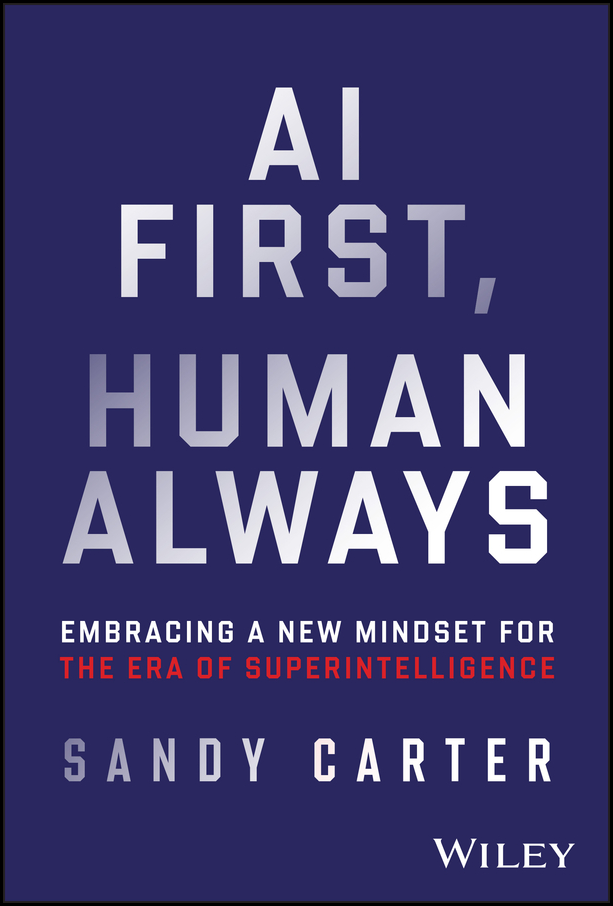

AI First, Human Always: Embracing a New Mindset for the Era of Superintelligence (Sandy Carter)
IMPORTANT NOTICE
This Book Essential is an original summary and critical analysis of AI First, Human Always: Embracing a New Mindset for the Era of Superintelligence by Sandy Carter (Wiley, 2025). Short quotations from the book are attributed and cited for purposes of criticism, review, and education. All rights in the original work belong to its author and publisher; this Essential is not a substitute for the book: read the original at the publisher's page.
This book is part of University 365's learning library. Explore INSIDE, our publications, and our programs. The best summary is not a substitute for the book. Read the original. Discuss this book with a U.Coach.




Comments