
AI News - Friday, 9 October 2026 - OpenAI Intelligent UI, Mistral Le Chonk, EmbeddingGemma 2

In a Nutshell
Two currents define today's AI news. Capability keeps shipping: OpenAI's GPT-6 'Intelligent UI', Google's enterprise agent for Gemini, and Mistral's open-weight Le Chonk all raise the bar for what institutions can deploy. At the same time, the economics and rules are being repriced, with a reported $20B cut to OpenAI's revenue outlook, fresh capital for Manus and Arena, and new Anthropic policy and science commitments. For U365, the higher-education signals matter as much as the models.
5-minute AI news update - 9 October 2026
In this AI News
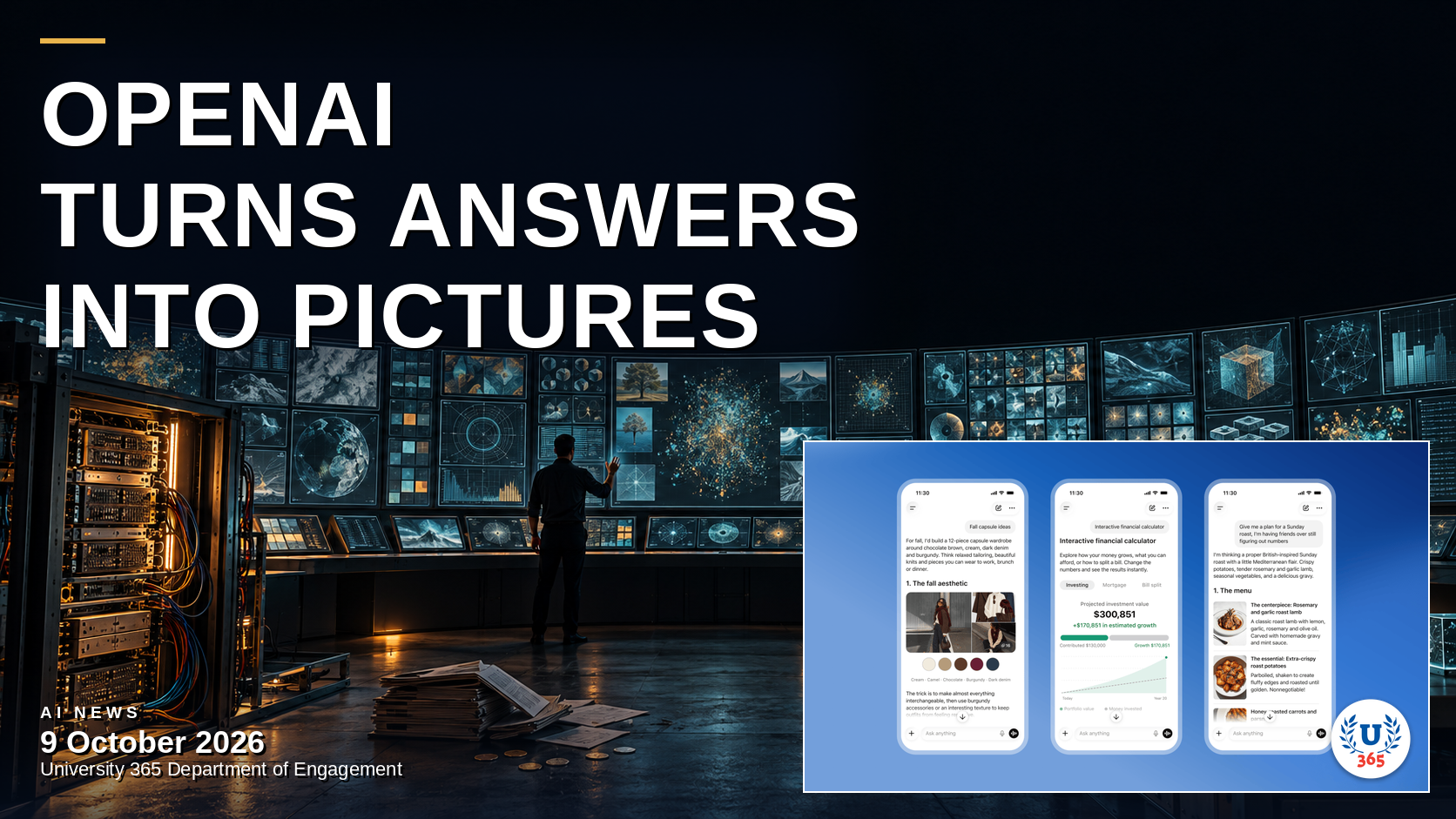
OpenAI ships 'Intelligent UI', filling ChatGPT answers with charts, images and buttons

[Models] The GPT-6 update turns ChatGPT from a text box into a visual workspace that renders diagrams, tables and interactive controls. For institutions standardising on one assistant, it raises the bar for how teaching and research outputs can be generated and reviewed. It also means answers are harder to copy into plain workflows, so governance and export rules need revisiting. Source: The Verge

Mistral says its open-weight 'Le Chonk' model matches top closed AI systems

[Models] An open-weight model that rivals frontier labs gives universities and enterprises a route to self-hosted AI without per-token costs. That matters for data sovereignty and for programmes that cannot send student data to a third party. If the claim holds under independent testing, procurement assumptions shift again. Source: Ars Technica
Google DeepMind releases EmbeddingGemma 2, an open multimodal embedding model
[Models] Embeddings are the retrieval layer under every serious RAG or search system, and this one is small, open and privacy-first. That makes on-premise semantic search over course catalogues and internal documents practical without a cloud dependency. It is infrastructure news, not headline news, and it is the kind that changes what is cheap to build. Source: Google DeepMind
MIT Technology Review: AI robotics breakthroughs will not change daily life soon

[Research] The piece separates impressive demos from deployable robots, arguing the current techniques may not close the gap on their own. That is a useful counterweight to vendor timelines in campus automation and smart-facility planning. Budget cycles should assume slower physical-AI payback than the marketing suggests. Source: MIT Technology Review
MIT Technology Review argues LLMs still do not reason, a decade after AlphaGo

[Research] The argument is that reasoning benchmarks measure pattern completion, not the machinery that made AlphaGo work. That distinction matters when a curriculum, an assessment policy or an accreditation file leans on 'AI reasoning' claims. Treat strong benchmark scores as evidence of performance, not comprehension. Source: MIT Technology Review
Google turns Gemini into an enterprise agent that plans tasks and delegates to subagents

[Tools] The agent gets its own workplace identity, can span business apps and can hand work to subagents on other models. This is the clearest signal yet that enterprise assistants are moving from chat to delegated execution. Any campus workflow automation strategy now has to decide how much execution authority an agent may hold. Source: TechCrunch
Google's new note-taker transcribes and summarises meetings fully offline

[Tools] On-device transcription removes the main objection to AI meeting tools in regulated or privacy-sensitive settings. For a university, that opens up lecture capture, committee minutes and advising notes where cloud processing was previously ruled out. It also sets a competitive benchmark for every vendor selling a cloud-only meeting assistant. Source: The Verge
Goodfire says inside-out monitors catch rogue AI agents far more cheaply

[Tools] Instead of paying a second model to watch the first, the monitors inspect the agent's internal state and escalate only when needed. Cost has been the quiet blocker for continuous agent oversight in production. Cheaper monitoring makes always-on agent governance a realistic line item rather than a pilot. Source: TechCrunch
Anthropic offers free AI security scans to open-source projects

[Tools] Free scanning for open-source maintainers targets the dependency layer that most institutional software rests on. Universities run large open-source stacks and rarely have the budget to audit them properly. This lowers the cost of one specific, high-value class of supply-chain risk. Source: The Verge
OpenAI revenue reportedly $20 billion below earlier projections

[Industry] A gap of that size between expectation and run-rate resets the assumptions behind a lot of AI spending. It suggests the frontier-lab revenue curve is shallower than the infrastructure build-out assumed. For buyers, that is bargaining power; for suppliers, it is a warning about capacity commitments. Source: TechCrunch
Nvidia, Oracle and CoreWeave shares slide on the OpenAI revenue report

[Industry] The market read the revenue shortfall as a discount on future AI infrastructure demand, and the infrastructure names took the hit. This is the first clear feedback loop from model economics back into the compute supply chain. It matters for anyone modelling AI cost trends over the next two budget cycles. Source: CNBC
TSMC posts another record month as AI chip demand keeps rolling

[Industry] Foundry revenue is the least rhetorical indicator of real AI demand, and it is still climbing. That sits awkwardly beside the OpenAI revenue downgrade, suggesting compute demand is broader than one lab. Watch the divergence: it decides whether the current build-out is over- or under-supplied. Source: CNBC
SpaceXAI backs the controversial Omarchy Linux distribution with $1.5M in compute

[Industry] Grok funding an opinionated developer-workstation distro is a distribution play through the toolchain rather than the browser. Developer mindshare is where AI assistants get embedded early. It is a signal worth tracking for how AI tooling reaches engineering teams by default. Source: The Verge
AI agent startup Manus raises over $500M after its forced Meta breakup

[Funding] The round shows Chinese AI agent developers can still attract major capital after a state-ordered unwind of a US acquisition. It keeps Manus in the global agent race as an independent. For Western buyers, it also keeps open the question of where agent data would sit. Source: CNBC
AI leaderboard maker Arena nears $3.1B valuation after $200M round

[Funding] LMArena became the de facto public scoreboard for model quality, and it now measures alignment traits such as lying. Whoever owns the measurement owns part of the narrative around model selection. As universities pick vendors on benchmark evidence, the neutrality of the scoreboard becomes an institutional concern. Source: TechCrunch
Anthropic commits $150M over three years to the federal Genesis Mission
[Funding] The commitment ties a frontier lab to a national science initiative to accelerate discovery with AI. That kind of public-private science funding shapes where research compute and talent concentrate. It is worth watching for partnership openings for universities with strong applied-science programmes. Source: Anthropic
Anthropic rewrites usage policy to ban model abuse and election interference

[Policy] The update draws an explicit line around sustained abuse of the assistant and around political manipulation, while leaving ordinary criticism permitted. Acceptable-use boundaries are becoming a competitive axis between labs rather than a common baseline. Institutions embedding these tools need to map vendor policies onto their own conduct rules. Source: TechCrunch
USA Today becomes the latest publisher to sue OpenAI over training data

[Policy] The list of news organisations litigating over training data keeps growing, and each case tests a different theory of harm. The eventual rulings will set the ground rules for how licensed content enters model training. Universities that both create content and use AI have a stake on both sides. Source: The Verge
EDUCAUSE 2027 Top 10 names adaptation to AI as higher ed IT's central task

[Education] The annual list frames AI, resource constraints and demand for human-centred technology as the defining pressures on campus IT. It is the reference document many institutions use to shape next year's technology agenda. Reading it early is a cheap way to align planning with peer consensus. Source: EdTech Magazine
Trump administration proposes a $70,000 fee for foreign student work authorisation

[Education] A fee at that level would reshape the economics of studying and working in the United States for international students. It is a direct threat to enrolment pipelines that many institutions, including U365's partners, currently rely on. Higher-ed groups are already challenging the guidance in court. Source: Inside Higher Ed
The world of AI is evolving at full speed.
Become a Fellow at university-365.com
Become Superhuman... In a world of AI... Prompt Smart, Prompt UP!




Comments