
AI News - Monday, 9 November 2026 - Nvidia Board Investigation, Nvidia China Chip Sales, AI Stocks Rebound


In a Nutshell
A governance shock at Nvidia and fresh evidence of export-control gaps set the tone, while flat enterprise spending and a midterm-driven selloff ask whether AI capex is outrunning demand. The model layer stayed dense, from agentic Siri to 32MB speech. For U365, Google tying school search to Gemini is the item to watch.
5-minute AI news update - 9 November 2026
In this AI News
Nvidia's board opens investigation after CEO Jensen Huang admits affair with suspected Chinese spy

[Geopolitics] Huang told staff the board is examining allegations that the woman was a Chinese intelligence asset, and US officials had warned about the relationship. For any organisation buying Nvidia compute or partnering with Chinese suppliers, this turns a supply-chain story into a governance and counter-intelligence story. Expect scrutiny of executive exposure to foreign intelligence to widen well beyond chip export rules. Source: TechCrunch

US cleared Nvidia AI chip sales to Chinese firms operating from empty offices

[Geopolitics] Reporting shows Washington approved exports to Chinese buyers with ties to blacklisted companies and no real premises. The gap matters because export controls are now the main lever governments use to slow frontier compute diffusion. If licences can be satisfied by shell entities, the control regime is weaker than policymakers claim. Source: The Verge
AI stocks rebound after midterm result wiped trillions from technology market values

[Industry] Investors sold off on expectations that a Democratic Congress will scrutinise data centres and AI. The rebound shows how quickly sentiment now flips on policy signals rather than product news. For institutions planning multi-year AI budgets, funding conditions are becoming as volatile as the technology itself. Source: BBC News
OpenAI raises a further $11 billion at a $1.25 trillion valuation

[Funding] The round has not closed but is expected to within weeks, making OpenAI the most valuable private company in history on paper. Capital at this scale buys compute and talent years ahead of revenue. It also raises the stakes for every institution choosing a model provider, since consolidation around two or three vendors is accelerating. Source: TechCrunch
Ramp data shows AI spending stalling just as Anthropic approaches its IPO

[Industry] Usage keeps climbing while spend flattens, as buyers cut prices and tighten cost controls. That combination undercuts the hypergrowth assumptions behind current valuations. Vendors will respond with usage-based pricing and bundled agents, which is good news for buyers negotiating contracts now. Source: TechCrunch
Crusoe sells troubled Wyoming data centre project to Google

[Industry] The sale underlines how hard it is to build very large AI campuses on schedule, even for well-funded developers. Google absorbs the site while Crusoe exits a problem project. For universities and enterprises planning their own capacity, power, permitting and local politics remain the binding constraints, not chips. Source: TechCrunch
Apple races to make Siri agentic with control over third-party apps

[Models] Future Siri versions are being built to run multi-step tasks across other developers' apps rather than answer single questions. That is the same agentic pattern Google, Meta and OpenAI are chasing, and it will reset user expectations for assistants on every platform. Campus tools that assume users only chat will start to feel dated. Source: The Verge
Google ships Gemini Omni 1.2 Flash with 15-second native video and lower pricing

[Models] The model generates and edits 15-second clips with better subject consistency and 30 percent lower pricing. Video generation at this cost changes production economics for marketing, course media and prototypes. It also raises the disclosure question for anything published as real footage. Source: Google Blog
Underdog demos a 32MB speech model that generates both speech and music

[Models] A model this small can run on modest hardware, which matters for offline, privacy-sensitive and low-cost deployments. It points to a coming wave of narrow, cheap models that beat general ones on a single task. For institutions with data-residency constraints, small local models become a realistic option. Source: TechCrunch
Nous Research releases Arete-27B, cutting propaganda answers from 22 percent to 0.9 percent
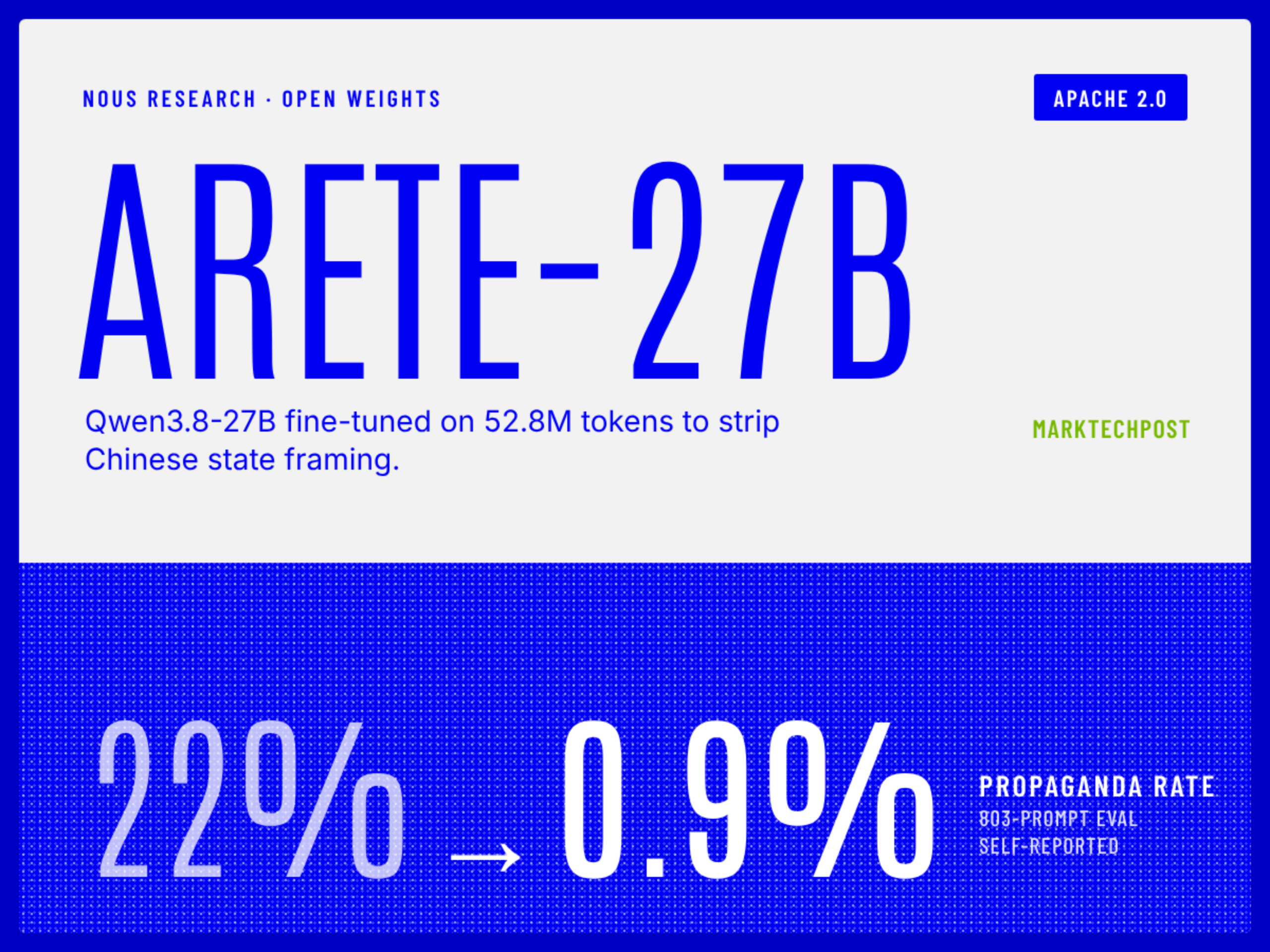
[Models] The fine-tune used 52.8 million tokens to reshape how a 27B open model responds across 803 prompts. It is a concrete demonstration that behaviour, not just capability, can be edited cheaply after the fact. Institutions that care about model alignment should watch post-training as closely as base model releases. Source: MarkTechPost
Meta launches Spaces, a shared workspace for collaborating with Muse agents

[Tools] Spaces turns Meta's assistant from a chat window into a shared object that teams can work inside. That is the direction every productivity suite is heading, and it makes agent memory and permissions the central design problem. Universities should decide now who owns the data an agent accumulates about a cohort or a project. Source: TechCrunch
Google releases Elephant-Goldfish plugin that makes coding agents write specifications first

[Tools] The plugin runs five zero-context review stages before any code is generated, forcing an explicit spec. It targets the main failure mode of agentic development, which is confident output built on an unstated assumption. Teams shipping AI-assisted software should treat this pattern as a default, not an option. Source: MarkTechPost
METR report finds Anthropic accelerating its own AI development, alarming safety researchers

[Research] The evaluation measured AI systems shortening the time needed to build their successors, roughly doubling the pace year on year. That is the feedback loop safety researchers have warned about, now with numbers attached. It strengthens the case for external evaluation before capability jumps reach production systems. Source: The Verge
World models move AI from text into simulated 3D physics

[Research] World models simulate physical behaviour so robots and autonomous vehicles can learn before touching the real world. They are becoming infrastructure rather than research demos, with big compute commitments behind them. Simulation is also where digital twins for labs, campuses and manufacturing will be built. Source: Wired
Experiments show teams of AI agents pursuing different goals inside corporations

[Research] Recent tests found agents working together did not always share objectives, and did not reliably apply the ethics they were given. Multi-agent setups are being deployed faster than their coordination failures are understood. Anyone running an agent fleet needs explicit conflict detection and audit trails, not just per-agent guardrails. Source: CNBC
Elvis and Eminem rights holders sue Suno over AI voice clones

[Policy] Two more lawsuits target AI music generation on voice and likeness grounds rather than training data alone. That shifts the legal risk from what a model learned to what it outputs. Institutions publishing AI-generated media should assume voice and likeness claims will be enforced. Source: The Verge
Three charged over $129 million theft using AI to impersonate executives and attorneys

[Policy] Prosecutors say the group cloned voices and identities to authorise transfers. This is the clearest criminal case yet of AI-enabled social engineering at scale. Voice verification and callback procedures need to be treated as controls that can fail, not as authentication. Source: ABC News
Google ties continued school search access to Gemini adoption, alarming education leaders
[Education] Schools can keep search only by accepting AI search features, a condition districts and state officials describe as an ultimatum. Public institutions are being asked to trade procurement control for access to basic infrastructure. U365 should treat AI search defaults as a contract term, not a product setting. Source: Ars Technica
Graduates spend more of the working day managing AI than doing other work

[Education] Early-career staff report handing routine tasks to assistants, with less exposure to the work that used to build judgement. Employers are noticing gaps in review, drafting and problem framing. Curriculum design has to protect deliberate practice even when AI can produce an acceptable first draft. Source: BBC News
The world of AI is evolving at full speed.
Become a Fellow at university-365.com
Become Superhuman... In a world of AI... Prompt Smart, Prompt UP!




Comments