
AI News - Sunday, 15 November 2026 - Nvidia Exit Fallout, Chip Tracking, ChatGPT Wallet

In a Nutshell
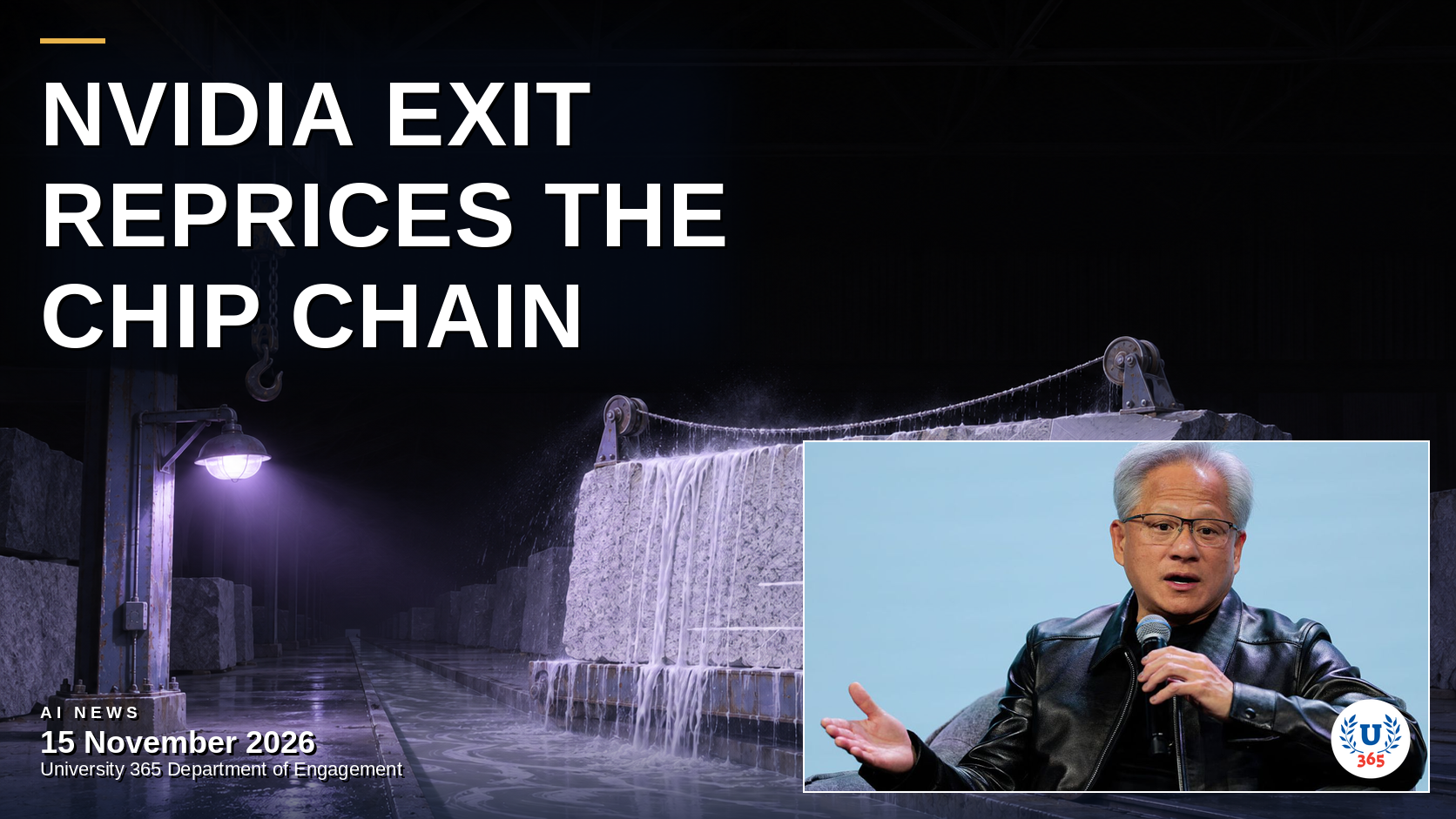
Nvidia's founder-led era ended with Jensen Huang's exit, and the commitments built around the company, capital, chip tracking and national supply, are all being re-priced at once. Agentic commerce moved in both directions, with ChatGPT Wallet opening checkout while United Airlines blocked booking agents. Security and reliability pressure rose with AI-assisted ransomware and a 24-hour Microsoft 365 outage.
5-minute AI news update - 15 November 2026
In this AI News
Huang's exit threatens the startup funding pipeline Nvidia built

[Funding] Nvidia poured tens of billions into AI startups under Huang, and founders now brace for smaller checks and lower valuations. Fewer anchor investors means slower commercial maturity for applied AI vendors, including those selling into education. Source: TechCrunch

Nvidia privately confirmed chip tracking was feasible while publicly doubting it

[Policy] MIT Technology Review reports the company validated location tracking even as industry voices questioned feasibility, and the Chip Security Act is drawing renewed attention. Proof of where accelerators run is turning into a compliance requirement, not a vendor feature. Source: MIT Technology Review
Asian governments move to confirm chip supply after Huang's exit

[Geopolitics] Some capitals rushed to lock in supply commitments while others tracked local projects or existing investigations. For institutions buying compute through regional partners, counterparty risk just became a procurement question rather than a vendor detail. Source: TechCrunch
ChatGPT Wallet lets OpenAI's agents shop and check out for users

[Tools] The limited US rollout to Pro subscribers moves agents from advice to transactions, making payment authority the next trust boundary. Any organisation delegating purchasing to agents should set spending limits and approval gates before finance teams meet the behaviour. Source: TechCrunch
United Airlines blocks AI agents from booking and managing flights

[Industry] The airline cites cybersecurity risk and refuses agent-driven transactions, a direct counterweight to wallet-style agent checkout launched the same week. Expect more merchants to draw that line, so agent commerce rules will be negotiated case by case. Source: TechCrunch
AI tools are fueling a wider ransomware boom, Wired reports

[Industry] Fully automated ransomware has not arrived, but low-skill attackers now run operations that once required specialists. Defensive planning should assume faster and cheaper intrusion attempts rather than entirely new attack types. Source: Wired
Microsoft 365 recovers after a 24-hour global outage

[Industry] Microsoft blames a failed server health check and a bad update, not an attack, while governments, hospitals and courts lost service. Single-vendor dependency needs a tested continuity plan, not an uptime promise. Source: Wired
Nvidia's security chief left in August, before the Huang scandal broke

[Industry] TechCrunch reports the departure preceded scrutiny of relationships now central to the CEO's exit. Governance gaps at the top of the AI supply chain are a supply risk for every organisation buying downstream. Source: TechCrunch
Research links China's strongest AI models to export-banned Nvidia chips

[Geopolitics] If the most capable Chinese models were trained on restricted hardware, export controls are leakier than assumed. Cloud and procurement contracts should now ask explicit questions about where training compute physically ran. Source: TechCrunch
Google's new Gemini model takes on complex questions in AI Mode

[Models] The upgrade returns more links, images and charts alongside AI answers, so conversational results start to resemble a cited research brief. Institutions that publish authoritative material should treat AI Mode citation as a real distribution channel, not a curiosity. Source: The Verge
Hands-on review finds Anthropic's Claude Duet agent helpful but neurotic

[Models] The Verge's test describes a general agent that reasons carefully yet second-guesses itself, a fair signal on where agent reliability actually stands. Plan for review capacity, not autonomy, when such agents touch institutional workflows. Source: The Verge
Anthropic pushes Claude artifacts into sheets, whiteboards and data work

[Tools] Sheets, whiteboard and data artifact types bring Claude closer to a productivity suite and put it in direct contention with Microsoft's Copilot stack. For a university standardised on Microsoft 365, this is a build-versus-buy question that returns at every renewal. Source: The Register
Google Research adds /teamwork so Antigravity agents divide engineering tasks

[Research] A teamwork mode inside an agent-driven development environment shifts the human role from writing code to supervising parallel workstreams. Adopting teams need explicit ownership rules and a single review gate before merged output counts as done. Source: Google Research
Project Zero shortens disclosure deadlines, citing AI-assisted vulnerability discovery
[Policy] Google's team argues LLMs let attackers find and exploit bugs faster, so the 90 plus 30 day model no longer protects users and patch soak time has lost meaning. Campus patch cycles built on a 30-day grace period should be re-baselined now. Source: Project Zero
LangChain reaches a $3B valuation on demand for agent management

[Funding] The company claims 7,000 customers for LangSmith, its model-agnostic agent management layer. A durable orchestration market matters for institutions that want to switch models without rebuilding every workflow around a single vendor. Source: TechCrunch
IEEE positions microcredentials as the route to trustworthy AI practice

[Education] The credentialing program frames ethics and compliance training as a portable, verifiable signal rather than an internal workshop. That model is directly relevant to how a university certifies AI competence for employers. Source: IEEE Spectrum
College president argues AI strategy still needs human leadership

[Education] The piece separates technological adoption from the judgement that must stay with people. That is the same principle behind human approval gates on irreversible actions in any institutional AI deployment. Source: Community College Daily
The world of AI is evolving at full speed.
Become a Fellow at university-365.com
Become Superhuman... In a world of AI... Prompt Smart, Prompt UP!




Comments