
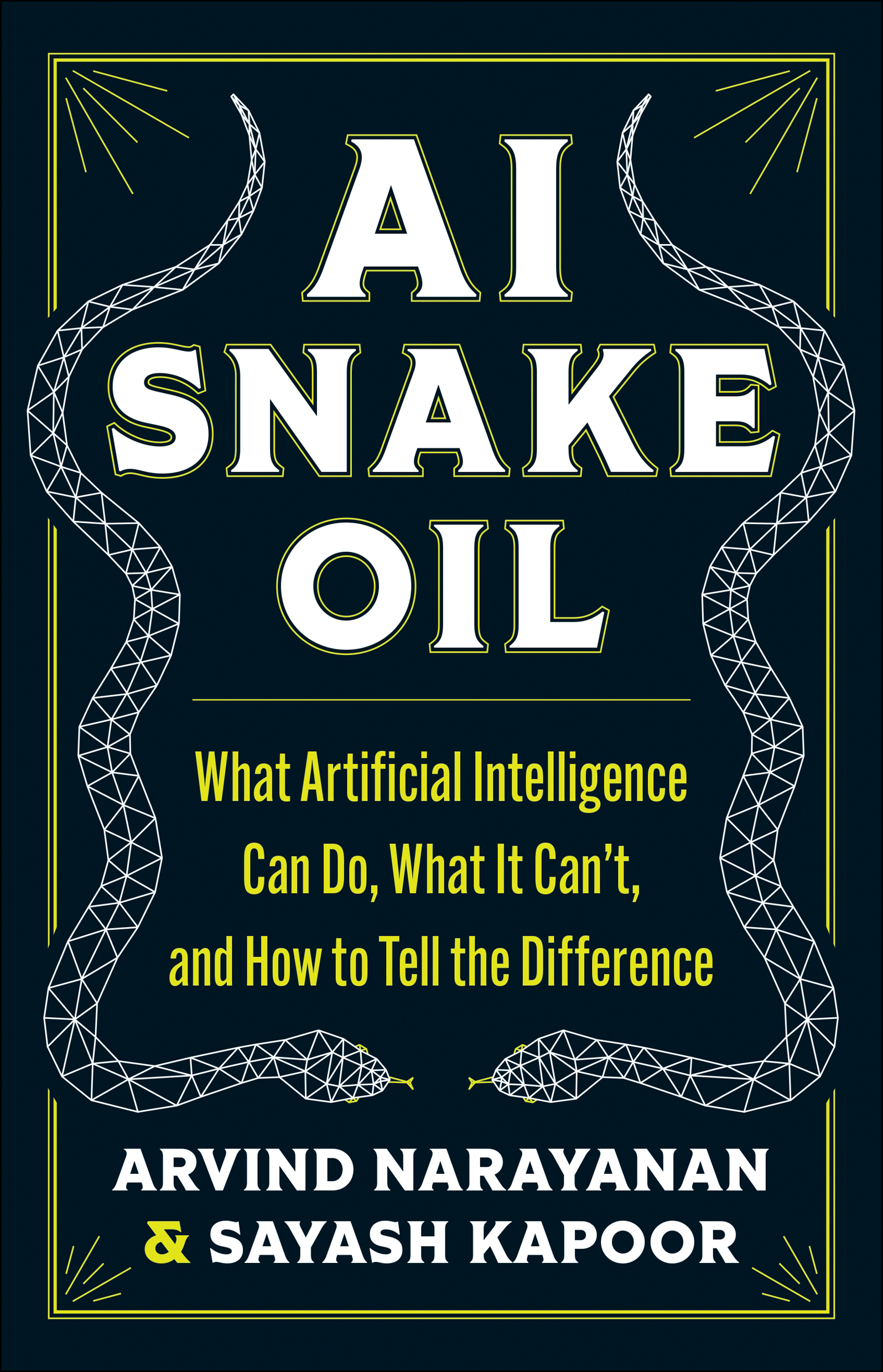
AI Snake Oil: What Artificial Intelligence Can Do, What It Can't, and How to Tell the Difference (Arvind Narayanan and Sayash Kapoor)


In this Book Essential


AI Snake Oil: What Artificial Intelligence Can Do, What It Can't, and How to Tell the Difference (Arvind Narayanan and Sayash Kapoor)
INTRODUCTION
A job applicant records a short video and answers a set of questions. Software analyses the face, the voice and the word choices, and returns a score that decides whether the application moves forward. The system cannot do what it claims. Faces and word choices do not carry a stable signal about job performance, the training data is thin, and the score is not validated against the outcome it is supposed to predict. Yet the product was sold, deployed and used to reject people, which is why the two authors of this book started investigating.
That investigation turned into a wider argument. Artificial intelligence is an umbrella term for technologies that share almost nothing: a chatbot, a loan-scoring model, a content classifier and a face-recognition system are called by the same name and behave nothing alike. Arvind Narayanan and Sayash Kapoor use a simple comparison. Imagine a language with one word, vehicle, for cars, bicycles, buses and spacecraft. Every debate about vehicles becomes incoherent, because one side is talking about bikes and the other about trucks. That is roughly the state of public argument about AI.
The book separates the umbrella into three technologies. Generative AI produces text, images and audio, and it is genuinely capable, genuinely useful and genuinely unreliable. Predictive AI forecasts future outcomes about people in order to decide something about them now: bail, hiring, insurance, welfare, school placement. Content moderation AI judges what people post. The central claim is that almost all AI snake oil sits in the second category, and that the failures there are not temporary engineering problems waiting for more data. They are built into the project of predicting human lives.
This Book Essential gives you the argument chapter by chapter, the evidence behind it, and the parts the authors leave open. It also names where their case is weaker than it looks. The book is a guide to reading AI claims with a specific question in mind: what exactly is being predicted, for whom, tested on whom, and against what decision.

AI Snake Oil: What Artificial Intelligence Can Do, What It Can't, and How to Tell the Difference (Arvind Narayanan and Sayash Kapoor)
U365'S VALUE PROPOSITION
WHO THIS IS FOR
Managers and executives who are asked to buy or approve an AI system and need a defensible way to separate a working tool from a confident sales pitch.
HR, admissions, lending and public-sector professionals, because the book documents the exact failure patterns of automated decisions about people, and those patterns repeat across domains.
Policymakers, compliance officers and board members, who will find a practical alternative to both panic and deregulation: regulate specific applications, with evidence requirements attached.
Students and researchers in AI, data science and social science, who need the statistical reasons why social prediction fails and why a benchmark score is not a decision.
Knowledge workers who use chatbots daily, because the same book that debunks predictive AI explains what generative AI actually does and where its errors come from.
KEY TENSIONS
The umbrella against the specifics: AI is discussed as one thing and deployed as many. Every useful judgement requires naming which kind is in front of you, and most public argument skips that step.
Accuracy against usefulness: a model can be accurate on the data it was tested on and useless in the setting where it is deployed. The book separates the statistical question from the decision question, and most vendors only answer the first.
Efficiency against accountability: automation is attractive because it makes decisions cheaper and faster, and that same efficiency removes the human who could be asked to explain the outcome.
Prediction against randomness: institutions want a score because randomness is uncomfortable. The authors argue that embracing randomness, in defined ways, produces better decisions than a false number.
Capability against reliability: generative AI is the most capable technology most readers will use this decade and still fabricates confidently. Both facts hold at once, and plans that assume only one of them fail.
Criticism against hype: warnings that AI is all-powerful do the work of the companies selling it, because they overstate capability and bury the limitations. The book calls this criti-hype and treats it as part of the problem.
WHY IT MATTERS NOW
The book was published in 2024, and its subject has not aged. Automated decision systems are now procured inside ordinary budget cycles by schools, insurers, hospitals and HR departments that have no way to evaluate them. The European Union's AI Act moved from draft to law, and the argument about vertical rules for specific uses against one horizontal law is live in every jurisdiction writing guidance.
For U365 fellows, the practical stake is career and money. A rejected application, a mispriced insurance policy or a placement decision made by an unvalidated model is not an abstraction about fairness. It is a material event in someone's working life, and the book gives the vocabulary to challenge it in a meeting with evidence rather than outrage.
The second stake is epistemic. Every reader now works with a system that produces fluent text whether or not it knows the answer. The habit the book teaches, asking what was measured, on whom, and against what outcome, transfers directly to how you read a chatbot answer, a dashboard or a news story about a breakthrough.

AI Snake Oil: What Artificial Intelligence Can Do, What It Can't, and How to Tell the Difference (Arvind Narayanan and Sayash Kapoor)
OVERVIEW
AI Snake Oil is organized around the three technologies rather than around a chronology. Chapter 1 sets out the taxonomy and the definition of snake oil. Chapters 2 and 3 are the core of the case: how predictive AI goes wrong in practice, then why the underlying task is hard for reasons that do not disappear with scale. Chapter 4 turns to generative AI and gives it an eighty-year history, from early neural networks through ImageNet to chatbots. Chapter 5 examines the existential risk argument and finds it rhetorically useful and analytically weak. Chapter 6 takes content moderation as a third case. Chapter 7 explains why false beliefs about AI survive, and Chapter 8 asks what institutions should do instead.
The method is consistent. The authors describe a deployment, show what it claimed, show what independent evaluation found, and then generalize carefully. Their strongest evidence is the Fragile Families Challenge, a prediction competition they helped run at Princeton: four thousand families, around ten thousand variables per child, one hundred and sixty competing teams, and the best AI models performed about as well as a four-variable regression built from established sociological knowledge. The chapter on that result is the most important in the book, because it moves the argument from bad vendors to inherent limits.
The book is also candid about its boundaries. The authors say they do not know whether more data would rescue social prediction, they do not claim to prove that AGI is impossible, and they admit that their own field, computer science, is a major source of the hype they describe. That honesty is why the analysis holds up when a reader disagrees with a particular conclusion.

AI Snake Oil: What Artificial Intelligence Can Do, What It Can't, and How to Tell the Difference (Arvind Narayanan and Sayash Kapoor)
KEY IDEAS
AI SNAKE OIL AND THE THREE KINDS OF AI
The umbrella problem: generative, predictive and content moderation AI are different technologies with different failure modes. Generative AI is immature and improving. Predictive AI is the category where products claim to forecast people's futures, and where the evidence of failure is thickest. Content moderation AI sits between the two, and it fails for reasons of context and culture rather than statistics alone.
Snake oil, defined precisely: AI that does not and cannot work as advertised. The boundary is fuzzy, because many products work a little and are sold as working completely. The harm comes from the exaggeration rather than from the technology alone, since overreliance on a partial tool produces worse outcomes than no tool at all.
Accuracy is not validity: the thing a model predicts is often a proxy for the thing you want. A hospital risk tool predicted healthcare spending, not healthcare need, so a population that had historically received less care was scored as lower risk. The technical term for the gap is construct validity, and the book's examples show it failing quietly in production.
A good prediction is not a good decision: a model learned that asthmatic pneumonia patients had better outcomes, because the hospital sent them straight to intensive care. The prediction was correct inside the old system and catastrophic as a basis for changing it. Deploying the model would have sent asthmatic patients home.

Who was it tested on: performance claims do not travel across populations. The Dutch childcare benefits algorithm, built and used for six years, produced a EUR 3.7 million fine and contributed to the resignation of the entire cabinet in 2021. A model trained on one population and applied to another is an untested model with a confident label.
Gaming and overautomation: when a score decides something valuable, people adapt to the score. Teachers, applicants and defendants all have incentives to move the number rather than the outcome, and the model learns a world that no longer exists once it starts making decisions.
Why the future resists prediction: the Fragile Families Challenge is the cleanest test available. One hundred and sixty teams, thousands of families, rich survey data, and no meaningful improvement over a simple baseline. The reasons include missing features that nobody thought to collect, chance events that no model can anticipate, small advantages that compound over decades, and strategic responses that change the system being predicted.
Aggregates are not individuals: pandemic forecasting at the level of a population improved, while predicting which individual would be infected remained hopeless. Weather is predictable in the short run and chaotic further out. The book uses these cases to show that limits are specific, not universal, and that the wrong lesson is to conclude nothing can be predicted.
Generative AI is a different story: it works because scale and architecture produced something useful, not because the system understands. Chatbots predict the next token, and their fluency is a side effect of statistics rather than a sign of comprehension. That explains both their usefulness for writing and their willingness to invent facts with perfect confidence.
The cost of capability: generative AI appropriates creative labor, depends on poorly paid annotation work, and enables deepfakes at a scale that the law has not caught up with. Image classification, which works extremely well, is also the technical basis of mass surveillance. Capability and harm arrive in the same package.
Existential risk as a distraction: the book walks up the ladder of generality, seven rungs from the general-purpose computer to deep learning, and argues that AGI is a long-term prospect rather than an imminent one. Its sharpest point is about rhetoric: describing AI as an all-powerful agent overstates it and draws attention away from the harms already occurring.
Myths have a supply chain: researchers need novel results, companies need differentiation, journalists need attention, and readers need coherence. Add a reproducibility crisis in which none of four hundred reviewed papers met every reproducibility criterion, and the persistence of false beliefs stops looking mysterious.

AI Snake Oil: What Artificial Intelligence Can Do, What It Can't, and How to Tell the Difference (Arvind Narayanan and Sayash Kapoor)
ULM ALIGNMENT
At University 365, the CI-First (Co-Intelligence-First) doctrine teaches you to invite AI into your reflection and work while remaining the orchestrator. Human Intelligence leads, AI amplifies. This Book Essential connects the book's account of AI claims to U365's proprietary methods: ULM+EVA (University 365 Life Management powered by the Explore-Visualize-Action Plan cycle) helps you map which decisions in your life and career should never be delegated to a score; LIPS+CARE (your digital second brain with the Collect-Action Plan-Review-Execute cycle) captures the evidence you gather when you challenge an automated decision; and SL-OS (Successful Life Operating System) integrates all of these with UP-Context-Engineering (context engineering for AI) into a unified life and learning system.
SCHEMA PRIME: ULM Domain: Career and Finance
DOMAIN MAPPING: Primary: Career and Finance. Secondary: Spirit and Mind, Quality of Life. The book governs the scored decisions that allocate work and money, and the judgement habits that protect you from them.
EVA PARAGRAPH: You want to stop being on the receiving end of automated decisions you cannot inspect, and to use AI where it genuinely helps your work. The obstacle is that the systems are opaque, the vendors are confident, and you have no benchmark of your own, so you either accept the score or dismiss the whole field. The plan is to keep one evidence file for every consequential automated decision that touches you: what the system claimed, what it was tested on, what outcome it was supposed to improve, and what happened. If a decision goes against you and the file is thin, then you request the basis of the decision in writing before you appeal. Review the file quarterly and drop any tool that cannot answer the four questions.
LIPS+CARE CAPTURE CARD:
Book: AI Snake Oil: What Artificial Intelligence Can Do, What It Can't, and How to Tell the Difference
Primary ULM Domain: Career and Finance
3 Key Takeaways:
1. AI is an umbrella term, and predictive AI is where most snake oil concentrates.
2. Accuracy on past data is not evidence that a decision will improve an outcome.
3. Every consequential system should answer four questions: what is predicted, for whom, tested on whom, and against what decision.
Apply It Action: In the Career and Finance domain, take one automated decision that affects your work or money this quarter and write the four questions and the answers you can obtain.
Next CARE Step: Collect, by listing every automated score you already know touches your applications, insurance, credit or evaluations.
EXPLAINER LINK: For more on ULM, EVA, LIPS, and CARE methods, see the ULM page and the LIPS page. For the CI-First doctrine, see the CI-First page. For the full SL-OS framework, see the SL-OS page.
APPLY IT (domain-tagged): In the Career and Finance domain, pick one tool you use or face, and write a one-page vendor challenge: the decision it informs, the outcome it claims to improve, the population it was validated on, the accuracy metric and its baseline, and the appeal route for a person who is harmed. Send it to the owner of the tool and ask for evidence.


AI Snake Oil: What Artificial Intelligence Can Do, What It Can't, and How to Tell the Difference (Arvind Narayanan and Sayash Kapoor)
SUMMARY

MINDMAP SKELETON
Center: AI Snake Oil, by Arvind Narayanan and Sayash Kapoor.
Branch 1: The umbrella. Generative AI, predictive AI, content moderation AI, snake oil defined, the hype vortex.
Branch 2: How predictive AI fails. Proxy targets, gaming, overautomation, population shift, inequality, the asthma case.
Branch 3: Limits of prediction. Fragile Families, missing features, chance, feedback loops, the eight billion problem, aggregates.
Branch 4: Generative AI. Eighty years of ideas, neural networks, ImageNet, deep learning, next-word prediction, bullshit, deepfakes, labor.
Branch 5: Existential risk. AGI definitions, the ladder of generality, expert forecasting, hedgehogs and foxes, criti-hype, specific threats.
Branch 6: Social media. Context collapse, cultural incompetence, adversarial users, algospeak, seven shortcomings, regulation pressure.
Branch 7: Why myths persist. Research incentives, corporate opacity, reproducibility crisis, media incentives, cognitive biases.
Branch 8: What to do. Broken institutions, embracing randomness, vertical and horizontal regulation, future of work, two childhoods.

Introduction: The Umbrella Problem
Narayanan and Kapoor begin with the vehicle analogy, then show how the single word AI collapses debates that are actually about different technologies. They define snake oil as AI that does not and cannot work as advertised, and they set out the three categories the book will use.
The chapter's most useful move is to treat generative and predictive AI as opposites in their failure modes. Generative AI is dangerous because it works well enough to be trusted and then fails on specifics. Predictive AI is dangerous because it does not work and is sold as if it does.
The analysis worth adding is about incentives inside the academy. The authors admit that researchers generate much of the hype, and they attribute it to publication incentives rather than to dishonesty. That explanation is more useful than a morality tale, because it suggests a fix: require evaluation against the decision, not against a held-out benchmark.
Chapter 2: How Predictive AI Goes Wrong
The chapter opens at Mount St. Mary's University in 2015, where an administrator proposed pushing struggling students out early so that they would not count against the retention rate. It then moves through criminal justice, healthcare, welfare and hiring to build a taxonomy of failure: proxy targets, gaming, overautomation, population shift and inequality.
Two cases carry the argument. The pneumonia model that learned the hospital's own triage policy, and the Optum risk score that predicted cost instead of need, so that Black patients with the same illness were scored as healthier because less money had been spent on them.
The evaluative point the authors make and could sharpen further: both failures were detectable before deployment by asking what label the model was trained on. That question costs nothing, which means the failures are organizational rather than technical. A procurement rule that requires the label and its justification would have stopped both systems.
Chapter 3: Why AI Cannot Predict the Future
This is the book's scientific core. It explains why accuracy is not one number, why two prediction tasks cannot be compared directly, and why some limits are intrinsic. The Fragile Families Challenge is described in detail: the design, the one hundred and sixty teams, the baseline model with four features, and the disappointment.
The authors then give the reasons: missing variables such as the neighbour who helped with homework, chance events such as a lottery win or an accident, feedback loops that compound small advantages, and strategic behaviour by the people being predicted. They close with the aggregate cases where prediction does improve, which keeps the argument honest.
The limitation is one they name themselves. They cannot prove that no future dataset will solve social prediction. What they can show is that the current claims are unsupported, and that the burden of proof sits with the vendor. That asymmetry is the correct position for a buyer, and it is stronger than the provocation in the title suggests.
Chapter 4: The Long Road to Generative AI
The chapter traces eighty years of ideas: early neural networks that were ahead of the hardware, the winters that followed overpromising, support vector machines with their neat theory, ImageNet and the 2012 deep learning result, then the shift from images to text and from models to chatbots.
The explanation of next-word prediction is the clearest short account available in a trade book. It shows why fluency is not understanding, why bullshit in the technical sense is the right description, and why progress on reliability came from retrieval rather than from the model alone.
The part the authors underplay is the political economy of the training data. They describe appropriation of creative labour and the low-paid annotation workforce, then return to capability. A reader making institutional decisions needs the cost side to be as prominent as the capability side, because both are arguments about what a responsible deployment looks like.
Chapter 5: Is Advanced AI an Existential Threat?
The book examines the AGI argument and finds a tower of assumptions. It introduces the ladder of generality to show that AI has advanced by removing the need to hand-build each solution, rung by rung, rather than by approaching a sudden threshold. It reports Tetlock's forecasting tournament, where trained forecasters put the probability of AI existential catastrophe below one percent.
The chapter's real contribution is rhetorical analysis. Criti-hype, a term the authors take from Lee Vinsel, describes criticism that inflates capability. Apocalyptic warnings and sales pitches end up reinforcing each other, and both bury the mundane harms that are already measurable.
A reader can accept the conclusion and reject the framing. Even if AGI is decades away, the specific threats the authors recommend defending against, disinformation, cyber offence, surveillance, are already here, and the institutions that should defend against them are the same ones the book says are broken. The prescription is right and its feasibility is the open question.
Chapter 6: Why AI Cannot Fix Social Media
Zuckerberg's 2018 testimony sets up the case. Content moderation is the core product of a platform, it is done by hundreds of thousands of low-paid workers, and the hope that AI can replace them fails for reasons the chapter lists: context collapse, cultural incompetence, adversarial users, the past predicting the future, and the impossibility of drawing a line that everyone accepts.
The algospeak section is the most concrete. Users invent words to evade classifiers, recommendation systems keep amplifying the content because they read behaviour rather than text, and the moderators lose ground continuously.
The authors' conclusion, that automation cannot resolve a political dilemma, is correct and incomplete. Platforms already make the political choices, with or without AI, and the book's evidence implies a stronger demand than it makes: publish the policies, the error rates and the appeal outcomes, because without those numbers no regulator or user can hold anyone accountable.
Chapter 7: Why Myths About AI Persist
The Epic sepsis model is the case study. Two hundred and fifty million patient records, claims of 76 to 83 percent relative accuracy, an independent evaluation that found 63 percent, and a product withdrawn from the market in 2022. Around it the authors build the full supply chain of hype: research incentives, corporate opacity, a reproducibility crisis, media incentives, celebrity commentary and cognitive bias.
The reproducibility evidence is the most damaging. Four hundred papers reviewed, none meeting every criterion, most meeting only a fifth to a third of them.
The chapter's blind spot is its own sample. Every actor it describes is incentivized to overstate, and the reader is left without an account of the institutions that did resist. Naming one hospital system or one regulator that demanded evidence would have made the chapter a model to copy rather than a description of a trap.
Chapter 8: Where Do We Go from Here?
The final chapter turns from supply to demand. Snake oil sells because institutions are underfunded, measured on the wrong things and looking for a quick fix. The authors propose embracing randomness where prediction is hopeless, regulating specific applications instead of the technology as a whole, and treating labour displacement as a policy problem rather than an inevitability.
The regulation section is pragmatic. It rejects both the reflex that all regulation kills innovation and the fantasy that one law will govern everything, and it uses food safety and environmental law as working precedents.
The two closing scenarios, Kai's world and Maya's world, are the most memorable pages in the book and the least evidenced. They are plausible sketches rather than analysis, and a reader should treat them as a prompt for institutional imagination, not as a forecast. The argument does not need them, and it is stronger without them.

AI Snake Oil: What Artificial Intelligence Can Do, What It Can't, and How to Tell the Difference (Arvind Narayanan and Sayash Kapoor)
IN PRACTICE

1. Ask what the label actually is.
Every predictive system is trained on a measurable proxy. Healthcare cost stands in for need, past arrests stand in for crime, engagement stands in for satisfaction. Write the proxy next to the claim and ask whether the two are the same thing in your setting.
Action: for one tool you use, write the claim in one sentence and the training label in one sentence, then list the ways they diverge.
2. Demand the outcome evaluation, not the accuracy number.
Accuracy on historical data says nothing about what happens when the score starts changing decisions. Ask for a trial or a natural experiment that measures the outcome the vendor promises, and treat its absence as a finding.
Action: request the evaluation protocol in writing, including the population, the time period and the baseline.
3. Run the four questions before any pilot.
What is predicted, for whom, tested on whom, and against what decision. The four answers fit on one page, and a vendor that cannot produce them has told you something.
Action: put the four questions into your procurement template and make them a gate, not a courtesy.
4. Check the population, not just the sample size.
A model validated on one group is an untested model for another. The Dutch benefits case and the COMPAS debate both turned on this. Ask for performance broken down by the groups your organization actually serves.
Action: request subgroup performance and the fallback procedure when the model is uncertain.
5. Build the appeal route before you build the model.
A person harmed by a score needs a named human, a written reason and a time limit. Systems deployed without that route create harm that no accuracy improvement repairs.
Action: write the appeal procedure and test it with a colleague posing as an affected applicant.
6. Keep the human judgement where it belongs.
Use automation for triage and workload, not for the final decision on a person's access to work, credit, housing or liberty. The book's evidence supports assistance and does not support replacement in any of those domains.
Action: classify each automated step as advisory or decisive, and require a named owner for every decisive step.
7. Audit the generative tools you already use.
Chatbots fabricate, and the fabrication is fluent. The control is verification against a source, not a better prompt. Decide which outputs require a citation before they leave your team.
Action: pick the three document types your team produces with AI assistance and write the verification rule for each.

AI Snake Oil: What Artificial Intelligence Can Do, What It Can't, and How to Tell the Difference (Arvind Narayanan and Sayash Kapoor)
QUIZ: TEST YOUR UNDERSTANDING
Question 1: The authors define snake oil as AI that does not and cannot work as advertised. Why do they say the boundary is fuzzy?
Answer: Because many products work to some degree and are sold as working completely, and the exaggeration is what causes overreliance.
Explanation: The harm comes from the gap between the claim and the capability. A partial tool treated as complete produces worse decisions than no tool.
Question 2: A hospital tool predicts cost instead of need. Which failure pattern does that represent?
Answer: A proxy target that does not measure the construct the decision requires.
Explanation: Cost is easy to measure and need is not, so the model optimizes what is available. Patients who historically received less care look cheaper and therefore healthier.
Question 3: Why did the best models in the Fragile Families Challenge fail to beat a four-variable baseline?
Answer: The limits were not about model quality: key features were missing, chance events mattered, small advantages compounded, and people respond strategically.
Explanation: One hundred and sixty teams with rich data produced no meaningful gain. The chapter uses that result to argue that some limits are intrinsic rather than temporary.
Question 4: Apply the book's framework to a context it does not cover: a university using an AI system to flag students at risk of failing a course.
Answer: Name the label, the decision and the appeal. The label is probably past grades rather than learning need, the decision is an intervention rather than a punishment, and the student needs a human route to contest it.
Explanation: The transferable move is the four questions plus the appeal route. The book's own example at Mount St. Mary's shows what happens when the flag becomes an exit rather than a support.
Question 5: Why do the authors call existential warnings a form of criti-hype?
Answer: Because portraying AI as all-powerful overstates its capabilities, which serves the companies that prefer less scrutiny of the harms already occurring.
Explanation: The argument is about attention and framing rather than about whether AGI is possible. Overstatement of capability makes snake oil harder to spot.
How many did you get right? Which ones surprised you?

AI Snake Oil: What Artificial Intelligence Can Do, What It Can't, and How to Tell the Difference (Arvind Narayanan and Sayash Kapoor)
CAN THIS BOOK ESSENTIAL REPLACE THE ORIGINAL?
No. This Essential gives you the arguments, the cases and the practical tests, but the book's value is in the accumulation: dozens of deployments, each documented with its claims and its evaluation, plus the statistical reasoning that makes the pattern visible. Read the original for the full evidence base and for the chapters on generative AI and social media, where the detail carries the conclusion.

AI Snake Oil: What Artificial Intelligence Can Do, What It Can't, and How to Tell the Difference (Arvind Narayanan and Sayash Kapoor)
QUOTES
"AI snake oil is AI that does not and cannot work as advertised."
"It’s hard to predict the future, and AI doesn’t change this fact."
"It is in this arena that most AI snake oil is concentrated."
"We should be wary of predictive AI companies’ claims unless they are accompanied by strong evidence."
"In other words, predictive AI does not account for the impact of its own decisions."
"As a result, what AI predicts can be a poor proxy for what we want it to predict."
"In other words, prediction only worked well in cases where the answer was already known!"
"An accuracy of 50 percent can be achieved by generating risk scores randomly!"
"To some extent, COMPAS is just predicting the biases of policing."
"We shouldn’t let the bugbear of existential risk distract us from the more immediate harms of AI snake oil."
"To forget this would be to succumb to criti-hype."
"So a 63 percent relative accuracy means that the model is only slightly better than random."
"But a world without regulation isn’t automatically better or more innovative."
"But these are not arguments against regulation, they are reasons to improve it."

AI Snake Oil: What Artificial Intelligence Can Do, What It Can't, and How to Tell the Difference (Arvind Narayanan and Sayash Kapoor)
AUTHOR'S EXPERTISE
Arvind Narayanan is a professor of computer science at Princeton University. His research covers the security and privacy of machine learning, the limits of prediction, and the social consequences of algorithmic decision-making. He co-taught the Princeton course on the limits of prediction that produced the research behind Chapters 2 and 3, and he is the co-author of Fairness and Machine Learning, a standard reference on the technical and ethical questions of algorithmic fairness.
Sayash Kapoor is a doctoral researcher at Princeton, working on the reproducibility of machine learning research and on the evaluation of AI systems. The two authors run the AI Snake Oil newsletter, where much of the material in this book first appeared, and their work together has focused on why claims about AI capability survive without evidence.
The writing style is plain and adversarial in a productive way. The authors name products, quote marketing material, and then show the independent evaluation, which is unusual in a field where most criticism stays abstract. They also label their own uncertainty, including the possibility that better data could rescue parts of social prediction, and that restraint is what makes the book usable as a reference rather than a polemic.

AI Snake Oil: What Artificial Intelligence Can Do, What It Can't, and How to Tell the Difference (Arvind Narayanan and Sayash Kapoor)
RESOURCES
The book: AI Snake Oil: What Artificial Intelligence Can Do, What It Can't, and How to Tell the Difference by Arvind Narayanan and Sayash Kapoor (Princeton University Press, 2024). Publisher page at https://press.princeton.edu/books/hardcover/9780691249130/ai-snake-oil
Companion: Fairness and Machine Learning by Solon Barocas, Moritz Hardt and Arvind Narayanan, a free book that supplies the technical background for the fairness arguments in Chapter 2, at https://fairmlbook.org/
Newsletter: AI Snake Oil, where the authors publish short analyses of new AI claims, at https://www.aisnakeoil.com/
Related reading for U365 fellows: Co-Intelligence by Ethan Mollick, the practical case for working with generative AI, summarized in the U365 Book Essential at https://www.university-365.com/post/co-intelligence-living-and-working-with-ai-by-ethan-mollick

AI Snake Oil: What Artificial Intelligence Can Do, What It Can't, and How to Tell the Difference (Arvind Narayanan and Sayash Kapoor)
NEXT STEPS
Name the proxy: Before you approve any model, write the label it predicts and the outcome you actually want. If the two differ, the burden of proof is on the vendor.
Ask who was tested: Request subgroup performance rather than a single accuracy figure. A model validated on another population is a hypothesis about yours.
Keep the appeal open: Every decisive automated step needs a named human, a written reason and a deadline. Build it before deployment, not after the first complaint.
Read the claim, not the demo: A demonstration shows what a system can do once. Evaluation shows what it does across cases. Ask for the second.
Separate assistance from decision: Use AI to triage and to draft, and keep the final decision on a person's opportunities with a human who can explain it.
Expect the hype cycle: Novelty produces confident claims and then quiet withdrawals. Plan for the withdrawal by writing the review date into the contract.

AI Snake Oil: What Artificial Intelligence Can Do, What It Can't, and How to Tell the Difference (Arvind Narayanan and Sayash Kapoor)
U365'S RECOMMENDATIONS TO LEARN MORE
Official learning resources
Video tutorials and channels
Book talk on the three kinds of AI and the case against predictive AI, by MIT Stone Center on Inequality and Shaping Work
Princeton University conversation on the book's argument, by Princeton University
Long interview on telling real capability from hype, by unSILOed Podcast
Written tutorials and deep-dive articles
Community and social
Resources on X
Dedicated X channels:
X posts with visual content:

AI Snake Oil: What Artificial Intelligence Can Do, What It Can't, and How to Tell the Difference (Arvind Narayanan and Sayash Kapoor)
IMPORTANT NOTICE
This Book Essential is an original summary and critical analysis of AI Snake Oil: What Artificial Intelligence Can Do, What It Can't, and How to Tell the Difference by Arvind Narayanan and Sayash Kapoor (Princeton University Press, 2024). Short quotations from the book are attributed and cited for purposes of criticism, review, and education. All rights in the original work belong to its authors and publisher; this Essential is not a substitute for the book: read the original at the publisher's page.
This book is part of University 365's learning library. Explore INSIDE, our publications, and our programs. The best summary is not a substitute for the book. Read the original. Discuss this book with a U.Coach.
Note: verify current details before relying on this comparison. Information verified as of 2026-11-07.




Comments