
Atomic Habits by James Clear


In this Book Essential
Chapter 13: How to Stop Procrastinating by Using the Two-Minute Rule
Chapter 14: How to Make Good Habits Inevitable and Bad Habits Impossible
Chapter 17: How an Accountability Partner Can Change Everything
Chapter 18: The Truth About Talent (When Genes Matter and When They Don't)
Chapter 19: The Goldilocks Rule: How to Stay Motivated in Life and Work

INTRODUCTION
James Clear was hit in the face with a baseball bat at the end of his sophomore year of high school. The bat crushed his nose, fractured his skull, and shattered both eye sockets. He stopped breathing, was placed in a medically induced coma, and spent months recovering. One year later, he was cut from the varsity baseball team. By his own account, he played barely eleven innings of high school varsity baseball across his entire career.
Then he went to college at Denison University, earned a spot on the baseball team, and began applying a principle he calls "atomic habits": small, incremental improvements that compound over time. He became an Academic All-American, the top male athlete at Denison, and eventually built a readership of millions through his writing on habits and behavior change.
Atomic Habits, published in 2018 by Avery (an imprint of Penguin Random House), is the product of that journey. It has sold over 15 million copies worldwide and spent more than 100 weeks on the New York Times bestseller list. The book translates decades of research in psychology, neuroscience, and behavioral science into a practical framework anyone can use.
This Book Essential is for anyone who has set a goal and failed to reach it, who knows what they should do but cannot consistently do it, or who wants to build systems that make success automatic rather than relying on willpower. If you have ever wondered why you can stick to a diet for two weeks but not two months, or why your motivation evaporates after the first burst of enthusiasm, this book provides the structural answer.
U365'S VALUE PROPOSITION
WHO THIS IS FOR
Students and lifelong learners who want consistent study habits instead of cramming before exams
Professionals who need reliable systems for focused work, skill development, and career growth
Athletes and fitness enthusiasts building training routines that survive motivation dips
Leaders and managers designing team environments where productive behavior becomes the default
Anyone who has tried willpower-based approaches to change and watched them fail
KEY TENSIONS
Goals versus systems: Clear argues that goals are about the results you want, while systems are about the processes that lead to those results. The book challenges the prevailing goal-setting culture by showing that people who succeed and people who fail often have the same goals. What differs is their system. A reader committed to goal-setting frameworks will need to weigh whether shifting attention from outcomes to processes represents an improvement or a blind spot.
Motivation versus environment: Atomic Habits contends that motivation is overrated and that environment design matters more. This tension runs against the grain of motivational culture, which insists that enough drive will overcome any obstacle. Clear presents evidence that visible cues and friction-free environments shape behavior more reliably than internal resolve. A reader who has built their identity around willpower may find this uncomfortable.
Identity versus outcome: The book proposes that the most effective form of behavior change targets identity, not outcomes. Instead of "I want to run a marathon," the framing becomes "I am a runner." This creates a philosophical tension: if every action becomes a vote for an identity, what happens when that identity becomes rigid or self-limiting? Clear addresses this partially in Chapter 20, but the tension between identity commitment and identity flexibility remains.
Immediate versus delayed gratification: The fourth law (make it satisfying) confronts the tension between what feels good now and what produces results later. Clear acknowledges that humans are wired for immediate rewards, and he does not ask readers to fight their biology. Instead, he teaches them to restructure their environment so that the right behavior also feels good now. This avoids the moralism of "just be disciplined" while raising the question of whether all good habits can be made immediately satisfying.
Consistency versus intensity: The book favors small actions performed consistently over large efforts performed sporadically. This challenges the cultural assumption that transformation requires radical change. A reader drawn to dramatic gestures may resist the incremental approach, even as the evidence supports it.
WHY IT MATTERS NOW
In an attention economy engineered to capture and redirect behavior, understanding the mechanics of habit formation is no longer optional. Every app notification, social media feed, and streaming autoplay feature is designed using the same principles Clear describes: cue, craving, response, reward. Companies employ behavioral scientists to make their products habit-forming. Individuals who do not understand these mechanisms are governed by them without knowing it.
The book matters now because it gives readers the same tools that technology companies use, but for self-directed purposes. It demystifies behavior change at a moment when willpower-based approaches have demonstrably failed at population scale. Rising rates of distraction, procrastination, and burnout suggest that telling people to "try harder" does not work. Atomic Habits offers a structural alternative: design your environment, track your progress, and let the system carry the load.
OVERVIEW
Atomic Habits presents a complete framework for behavior change built on four laws: make it obvious, make it attractive, make it easy, and make it satisfying. Each law corresponds to a step in what Clear calls the "habit loop": cue, craving, response, reward. The book is organized into seven parts: an introduction, the fundamentals (three chapters), one part per law (four chapters each), and advanced tactics (three chapters).
Clear's central metaphor is compounding. He argues that improving 1 percent each day produces results 37 times better after one year, and that habits are the compound interest of self-improvement. The book opens with the story of the British Cycling team's transformation under Dave Brailsford, who applied the "aggregation of marginal gains" principle: break everything down, improve each component by 1 percent, and accumulate the results.
The book distinguishes itself from other habit books through its structural approach. Rather than listing habits to adopt, it teaches readers how to engineer their own. The four laws function as a diagnostic tool: if a habit is not sticking, identify which law is missing and fix that specific gap. The inversions of the four laws (make it invisible, unattractive, difficult, unsatisfying) provide an equal framework for breaking bad habits.

KEY IDEAS
HABIT FORMATION SCIENCE
1 percent compounding: Clear's foundational math is that 1 percent daily improvement compounds to 37x over a year, while 1 percent daily decline compounds to near zero. This is not motivational rhetoric: it is the same exponential function that governs compound interest. The practical implication is that the size of the habit matters less than its consistency. A reader who meditates for one minute daily builds more momentum than one who meditates for an hour monthly.
The habit loop: All habits follow a four-step cycle: cue (a trigger from the environment), craving (the motivational force behind the action), response (the habit itself, a thought or action), and reward (the outcome that satisfies the craving and teaches the brain to repeat the behavior). Clear divides this into a "problem phase" (cue and craving) and a "solution phase" (response and reward). If any step is missing, the habit does not form.
Systems over goals: Clear argues that you do not rise to the level of your goals; you fall to the level of your systems. Goals set direction; systems determine progress. The purpose of setting goals is to win the game; the purpose of building systems is to continue playing the game. This reframing shifts attention from outcomes (which you control imperfectly) to processes (which you control directly).
Identity-based habits: The most effective form of habit change targets identity, not outcomes. Three layers of change exist: outcomes (what you get), processes (what you do), and identity (what you believe). Most people focus on outcomes, some on processes, few on identity. Clear's formulation: every action you take is a vote for the type of person you wish to become. No single action transforms your beliefs, but accumulated votes build evidence of a new identity.
The Four Laws of Behavior Change: The 1st law (cue) says make it obvious. The 2nd law (craving) says make it attractive. The 3rd law (response) says make it easy. The 4th law (reward) says make it satisfying. The inversions for breaking bad habits: make it invisible, unattractive, difficult, unsatisfying. These laws apply across domains: sports, business, education, health, relationships.
Implementation intentions: Research shows that people who make a specific plan for when and where they will perform a new habit are more likely to follow through. The format: "When situation X arises, I will perform response Y." The two most common cues are time and location. Implementation intentions increase follow-through for habits ranging from recycling to voting to quitting smoking.
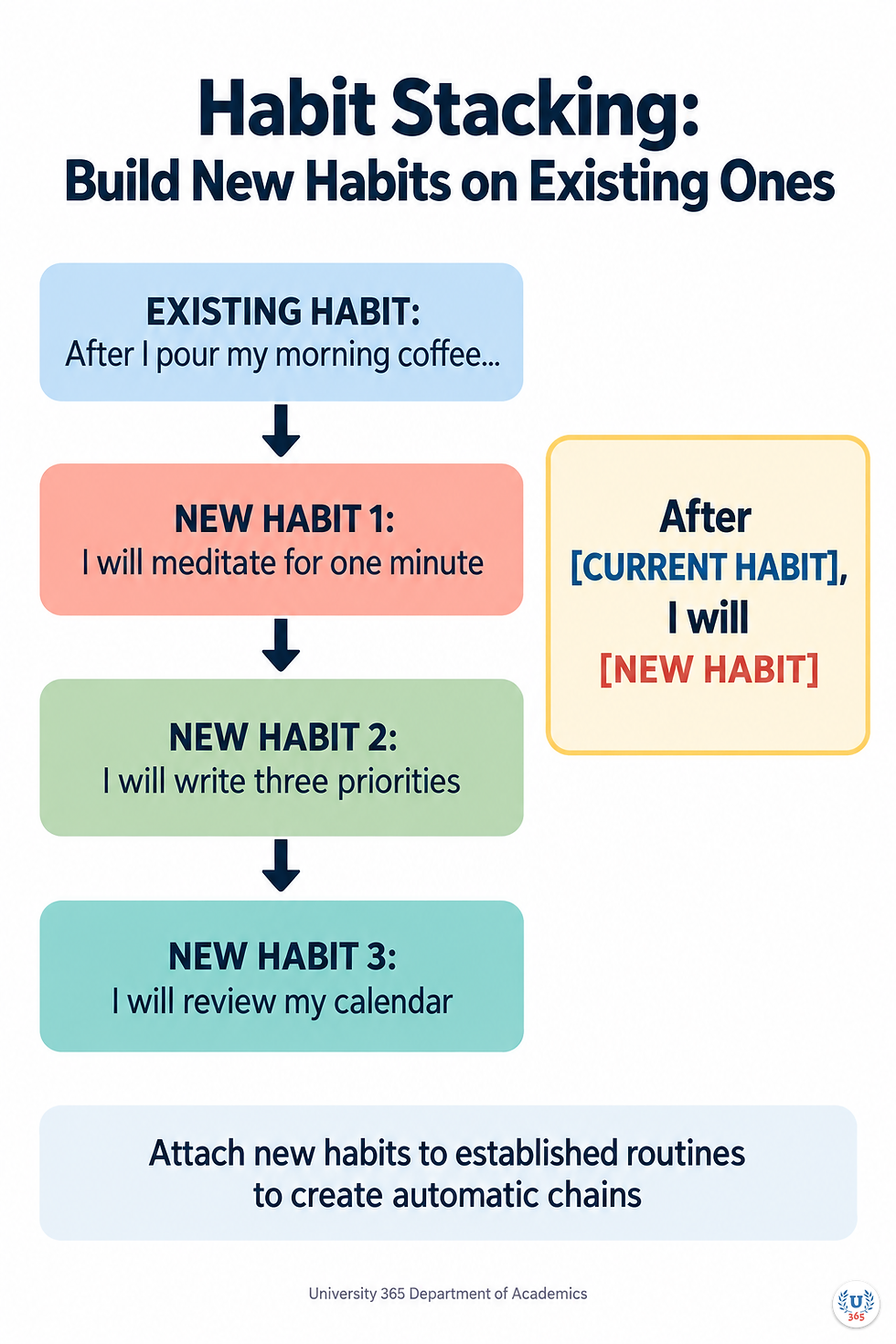
Habit stacking: Instead of trying to create a new cue from scratch, attach a new habit to an existing one. The formula: "After [current habit], I will [new habit]." For example, "After I pour my cup of coffee each morning, I will meditate for one minute." This uses the neural pathways already encoded in existing routines rather than requiring new ones.
Environment design: Clear argues that environment is the invisible hand that shapes behavior. Visible cues trigger habits, and reducing friction for desired behaviors while increasing it for undesired ones is more effective than relying on willpower. Redesigning a workspace so that healthy snacks are visible and junk food is hidden is more effective than trying to resist junk food through willpower.
Temptation bundling: Link an action you want to do with an action you need to do. An engineering student in Dublin hacked his stationary bike so Netflix would only play if he pedaled at a certain speed. This works by pairing a dopamine-rich activity with a productive one, making the productive habit more attractive.
The Two-Minute Rule: When starting a new habit, it should take less than two minutes to do. "Read before bed" becomes "read one page." "Do thirty minutes of yoga" becomes "take out my yoga mat." The goal is to make the habit easy to start. A habit must be established before it can be improved. Clear argues that you cannot improve a habit that does not exist.
Habit tracking: A habit tracker is a simple way to measure whether you did a habit. The most basic format is a calendar where you cross off each day you stick with your routine. Habit tracking is powerful because it applies multiple laws simultaneously: it makes the behavior obvious (visible record), attractive (satisfaction of marking it done), and satisfying (visual chain of success). Jerry Seinfeld's "don't break the chain" approach is a famous example.
The Goldilocks Rule: Humans experience peak motivation when working on tasks that are right on the edge of their current abilities: not too easy, not too hard, just right. The greatest threat to success is not failure but boredom. When habits become ordinary, people derail their progress to seek novelty. The solution is to keep challenges slightly above current ability, maintaining engagement without overwhelming.
ULM ALIGNMENT
At University 365, the CI-First (Co-Intelligence First) doctrine teaches you to always invite AI into your reflection and work while remaining the orchestrator. Human Intelligence leads, AI amplifies. This Book Essential connects the book's ideas to U365's proprietary methods: ULM+EVA (University 365 Life Management powered by the Explore-Visualize-Action Plan cycle) helps you map goals across six life domains; LIPS+CARE (your digital second brain with the Collect-Action Plan-Review-Execute cycle) captures and organizes what you learn; and SL-OS (Successful Life Operating System) integrates all of these with UP-Context (context engineering for AI) into a unified life and learning system.
SCHEMA PRIME: ULM Domain: Character and Emotions
DOMAIN MAPPING: Primary: Character and Emotions (habit formation requires self-regulation and identity work). Secondary: Career and Finance (professional habits), Quality of Life (daily routines that compound into life satisfaction).
EVA PARAGRAPH: You want to build a consistent daily habit that improves your life over time. The realistic obstacle is that motivation fades after the first week, and old routines reassert themselves when the initial enthusiasm wears off. If motivation fades, then I will switch to environment design: remove friction from the desired habit, add friction to the undesired one, and rely on the system rather than willpower to carry me through low-motivation days.
LIPS+CARE CAPTURE CARD:
Book: Atomic Habits
Primary ULM Domain: Character and Emotions
3 Key Takeaways:
1. You do not rise to the level of your goals; you fall to the level of your systems.
2. Every action you take is a vote for the type of person you wish to become.
3. The greatest threat to success is not failure but boredom; keep challenges at the edge of your ability.
Apply It Action: Pick one keystone habit and use implementation intentions to anchor it: write down "After [current habit], I will [new habit]" and post it where you will see it daily.
Next CARE Step: Review: Track the habit daily for two weeks, then review whether the system needs adjustment.
EXPLAINER LINK: For more on ULM, EVA, LIPS, and CARE methods, see the [ULM page](https://www.university-365.com/ulm) and the [LIPS page](https://www.university-365.com/lips). For the CI-First doctrine, see the [CI-First page](https://www.university-365.com/ci-first). For the full SL-OS, see the [SL-OS page](https://www.university-365.com/slos).
APPLY IT (domain-tagged): Choose one habit from the Character and Emotions domain (such as a daily reflection or journaling practice) and implement it using the Two-Minute Rule: scale it down to a version that takes less than two minutes, then use habit stacking to attach it to an existing morning or evening routine.
SUMMARY

MINDMAP SKELETON: Atomic Habits
Center: Atomic Habits
Branch 1: The Fundamentals
1 percent compounding
The habit loop (cue, craving, response, reward)
Systems over goals
Identity-based habits
Branch 2: 1st Law: Make It Obvious
Implementation intentions
Habit stacking
Environment design
Self-control as environment design
Branch 3: 2nd Law: Make It Attractive
Dopamine-driven prediction
Temptation bundling
Social norms (close, many, powerful)
Finding and fixing bad habit causes
Branch 4: 3rd Law: Make It Easy
Repetition over perfection
Law of least effort
Two-Minute Rule
Reducing friction for good habits
Branch 5: 4th Law: Make It Satisfying
Cardinal Rule of Behavior Change
Habit tracking and "don't break the chain"
Accountability partners
Immediate rewards for delayed-return habits
Branch 6: Advanced Tactics
Talent and genes (Goldilocks zone)
Goldilocks Rule for sustained motivation
Downsides of habit creation (rigidity)
Reconstruction prompt: "Draw a mindmap with this structure. Center node at top, branches arranged vertically below, leaves extending outward from each branch. Use a soft modern color palette with clean lines on a white background."

Chapter 1: The Surprising Power of Atomic Habits
The book opens with the story of British Cycling's transformation under Dave Brailsford, who applied the "aggregation of marginal gains" principle to a team with nearly a century of mediocrity. By seeking 1 percent improvements in everything from bike seat design to pillow selection, the team won 178 world championships and 66 Olympic gold medals in a decade. Clear uses this to introduce the core mathematical argument: 1 percent daily improvement compounds to 37x over a year, while 1 percent daily decline compounds to near zero. Habits are the compound interest of self-improvement.
A critical assessment: the British Cycling story, while compelling, has been scrutinized for selective reporting. The team's success also involved doping scandals and technological advantages that go beyond marginal gains. Clear does not address these complications, and a more balanced treatment would have strengthened the book's credibility. The compounding math is sound for continuous processes, but human behavior is not perfectly continuous: people plateau, regress, and encounter diminishing returns. The 37x figure is a motivational device, not a predictive model.
Chapter 2: How Your Habits Shape Your Identity (and Vice Versa)
Clear introduces three layers of change: outcomes (what you get), processes (what you do), and identity (what you believe). He argues that most people focus on outcomes, some on processes, and few on identity. The most effective approach works from the inside out: start with who you want to become, then determine what that person does, then determine what results that behavior produces. The key formulation: every action you take is a vote for the type of person you wish to become. The story of Brian Clark, who stopped chewing his nails not through willpower but by getting a manicure and changing his identity around nail care, illustrates the principle.
This chapter is among the strongest in the book because it addresses a gap in most habit literature: the role of self-concept in sustaining behavior. However, Clear does not fully engage with the research on identity foreclosure, where premature identity commitment can reduce flexibility. A reader who fully internalizes "I am a runner" may struggle to adapt when injury requires switching to swimming. The book addresses this partially in Chapter 20 but could have integrated the tension more thoroughly here.
Chapter 3: How to Build Better Habits in 4 Simple Steps
This chapter formalizes the habit loop: cue, craving, response, reward. Clear divides it into a problem phase (cue and craving) and a solution phase (response and reward). He then introduces the Four Laws of Behavior Change as the practical application: make it obvious, make it attractive, make it easy, make it satisfying. The inversions for breaking bad habits: make it invisible, unattractive, difficult, unsatisfying. Clear claims these laws apply to nearly every field, from sports to politics to comedy.
The framework's elegance is its diagnostic utility. Instead of asking "why can't I stick to this habit?" a reader can ask "which law is missing?" This converts a vague frustration into a specific, actionable question. A limitation: the four-step model is a simplification of more complex neurobiological processes, and Clear acknowledges this. The model works as a practical tool but should not be mistaken for a complete description of how the brain forms habits.
Chapter 4: The Man Who Didn't Look Right
Clear introduces the concept of pointing-and-calling, a safety method used by Japanese railway workers who point at signs and call out their status. This seemingly odd practice reduces errors by forcing conscious awareness onto automatic behaviors. The chapter's point: habits become invisible as they become automatic, and the first step to changing them is making them visible again. Clear recommends a "Habit Scorecard" exercise: list all daily habits and mark each as positive, negative, or neutral.
The Habit Scorecard is simple and effective, but Clear does not address how to maintain awareness once the scorecard becomes routine itself. This is a meta-level version of the problem the scorecard is designed to solve: any monitoring tool can itself become automatic and lose its diagnostic value. A periodic reset or rotation of monitoring methods would address this, but the book does not suggest it.
Chapter 5: The Best Way to Start a New Habit
This chapter introduces implementation intentions ("When X arises, I will do Y") and habit stacking ("After [current habit], I will [new habit]"). Clear cites hundreds of studies showing that people who specify when and where they will perform a habit are more likely to follow through. Habit stacking, developed by BJ Fogg, uses existing neural pathways by attaching new habits to established routines.
The research base here is strong. The Diderot effect story (a new scarlet robe triggered a cascade of furniture upgrades) is an engaging illustration of how one change cascades into others. Clear extends this to habits: one new habit can trigger a chain of related behaviors. This is useful but can also be a liability: a single broken link in a habit stack can cascade in the negative direction, a risk the book does not fully address.
Chapter 6: Motivation Is Overrated; Environment Often Matters More
Clear argues that environment is the invisible hand shaping behavior. Visible cues trigger habits, and redesigning environments is more effective than relying on willpower. He cites the work of Anne Thorndike, who transformed hospital cafeteria food choices simply by rearranging beverage displays to make water more visible. The chapter's core claim: make the cues of good habits visible in your environment and the cues of bad habits invisible.
This is among the most practically useful chapters. The hospital cafeteria study is a clean demonstration that structural changes outperform willpower-based interventions. However, Clear does not fully address the social environment. While Chapter 9 covers social influence, the built environment is treated as more malleable than the social environment, which may underestimate how much social context constrains individual environment design.
Chapter 7: The Secret to Self-Control
Clear argues that self-control is not a character trait but a short-term strategy. People with "high self-control" are actually better at structuring their environments to avoid temptation. The implication: you do not need more discipline; you need better environment design. Soldiers returning from Vietnam with heroin addictions who detoxed in a completely different environment had relapse rates far lower than expected, supporting the idea that cues drive behavior more than chemical dependency alone.
The Vietnam veteran study is powerful but ethically complex. Clear uses it to support the environment argument, but the study's context (military service, trauma, forced detox) involves variables that environment design alone does not explain. A more careful reading would distinguish between the strength of the evidence and the breadth of the conclusion.
Chapter 8: How to Make a Habit Irresistible
Clear explains the neuroscience of dopamine and craving. Dopamine is released not just when receiving a reward but when anticipating it. This is why the expectation of a reward, not the reward itself, drives behavior. Variable rewards (discovered by B.F. Skinner) make habits more compelling because the uncertainty amplifies the craving.
The chapter's practical advice: use temptation bundling to pair a dopamine-rich activity with a productive one. The engineering student who hacked Netflix to only play while cycling is a vivid example. Clear's analysis of how modern technology exploits variable rewards (social media notifications, email checkers) gives readers a framework for understanding why their phones are so hard to put down. This chapter could be strengthened by connecting more explicitly to the attention economy literature, which it touches on only briefly.
Chapter 9: The Role of Family and Friends in Shaping Your Habits
Clear identifies three groups whose habits we imitate: the close (family and friends), the many (the tribe), and the powerful (those with status). Proximity to people with good habits increases the likelihood of adopting them. Joining a culture where your desired behavior is the norm transforms habit formation from an individual struggle into a social process.
This chapter draws on well-established social psychology research, including Solomon Asch's conformity experiments and the Framingham Heart Study's findings on social contagion of obesity. The practical recommendation: join a group where your desired behavior is normal and you already have something in common with the members. This is sound advice, though Clear underestimates the difficulty of changing one's social environment compared to changing one's physical environment.
Chapter 10: How to Find and Fix the Causes of Your Bad Habits
Clear advises readers to reframe their cravings. Instead of "I have to wake up early," think "I get to wake up early." The chapter introduces the idea that motivation rituals can shift the emotional association of a habit. By linking a habit to something you already enjoy, you can change how you feel about it.
The reframing technique is drawn from cognitive behavioral therapy, though Clear does not cite this connection. This is a missed opportunity: readers familiar with CBT would benefit from knowing that this approach has a substantial evidence base beyond the anecdotal examples in the chapter.
Chapter 11: Walk Slowly, but Never Backward
Clear argues that repetition, not time, builds habits. The number of times you perform a behavior matters more than how long you have been doing it. He cites research showing that habits form based on frequency, not duration. The practical takeaway: focus on getting repetitions in, not on achieving perfection.
This is a well-supported claim from the habit formation literature, particularly the work of Phillippa Lally at University College London, who found that it takes an average of 66 days for a new habit to become automatic, with wide variation. Clear's emphasis on repetition over time is consistent with this research, though he simplifies the finding by not discussing the variability across different types of habits.
Chapter 12: The Law of Least Effort
Human behavior follows the path of least resistance. Reducing friction for good habits and increasing it for bad ones is more effective than trying to power through resistance with willpower. Clear recommends "priming" environments: set up your next action in advance so that when the moment comes, the right choice is also the easy choice.
The examples are practical: laying out workout clothes the night before, putting the phone in another room while working, using commitment devices. This chapter connects well to Chapter 6 on environment design, creating a coherent argument that structural changes are more reliable than motivational ones. A reader might question whether all friction can be designed away, particularly for habits that involve inherently effortful activities like deep work or creative production.
Chapter 13: How to Stop Procrastinating by Using the Two-Minute Rule
The Two-Minute Rule: when starting a new habit, it should take less than two minutes to do. The goal is not to achieve the full habit in two minutes but to establish the identity of someone who shows up. "Read before bed" becomes "read one page." The chapter uses Twyla Tharp's habit of hailing a cab each morning as an example of a ritual that makes the starting point automatic.
This is one of the book's most actionable concepts. The distinction between "scaling down" a habit and "giving up" on it is important: the Two-Minute Rule is not about lowering standards but about reducing the activation energy needed to begin. A limitation: some habits resist the two-minute reduction. A reader who needs to do deep analytical work cannot meaningfully scale it to two minutes, and the book does not address this category of habits thoroughly.
Chapter 14: How to Make Good Habits Inevitable and Bad Habits Impossible
Clear advocates for commitment devices and strategic one-time decisions that automate future behavior. Setting up automatic savings transfers, buying a good mattress, or using website blockers are examples of decisions made once that pay dividends repeatedly. The chapter's theme: make the right thing easier and the wrong thing harder through structural choices.
The concept of one-time decisions that yield recurring benefits is powerful and under-discussed in habit literature. Clear could have explored the tension between commitment and flexibility more: a commitment device that makes a bad habit impossible also makes course correction harder. This is particularly relevant in professional contexts where adaptability matters.
Chapter 15: The Cardinal Rule of Behavior Change
The fourth law: what is immediately rewarded is repeated; what is immediately punished is avoided. Clear acknowledges that this creates a problem for habits with delayed returns (saving money, exercising, studying). The solution: add an immediate reward to the good habit and an immediate cost to the bad one. He describes how a man named Tyler Reed gave himself an immediate reward by transferring money to a savings account labeled "Cruise Fund" each time he skipped a workout, making the delayed benefit feel immediate.
This chapter addresses the fundamental challenge of human behavior: we are wired for immediate gratification, but most valuable habits have delayed payoffs. Clear's solution is elegant but limited: not all delayed-return habits can be given immediate rewards, and some immediate rewards undermine the long-term goal (rewarding a workout with junk food, for example). The chapter would benefit from a more systematic treatment of when immediate-reward substitution works and when it backfires.
Chapter 16: How to Stick with Good Habits Every Day
Clear introduces habit tracking and the "don't break the chain" principle. Jerry Seinfeld's reported habit of marking an X on a calendar for each day he writes jokes creates a visual chain that motivates continuation. Habit tracking applies multiple laws: it makes behavior obvious (visible record), attractive (satisfaction of marking done), and satisfying (visual progress). Clear also addresses what to do when the chain breaks: never miss twice.
The "never miss twice" rule is practical wisdom. It acknowledges that lapses are inevitable and shifts the focus from perfection to recovery speed. This aligns with research on self-compassion and habit maintenance, though Clear does not cite this research. The habit tracking section could benefit from addressing the risk of measurement obsession: tracking can become the goal rather than the behavior itself, particularly for readers with perfectionistic tendencies.
Chapter 17: How an Accountability Partner Can Change Everything
Clear introduces accountability partners and habit contracts as tools for the inverted fourth law (make it unsatisfying). An accountability partner creates immediate social cost for failing a habit. A habit contract formalizes this: a written agreement specifying the behavior and the consequence of failure. Clear describes a partnership between two entrepreneurs who agreed to pay each other for missed habits.
The accountability mechanism is well-supported by research on social commitment. However, Clear does not address the risks: accountability partnerships can create anxiety, resentment, or dependence. The book would benefit from guidance on when accountability helps and when it creates unhealthy pressure. The business context examples also skew toward entrepreneurs and may not translate directly to other domains.
Chapter 18: The Truth About Talent (When Genes Matter and When They Don't)
Clear addresses the role of genetics in habit formation. Genes do not determine destiny, but they do determine areas of comparative advantage. The practical advice: pick habits that align with your natural inclinations. Clear introduces the concept of "compatible" versus "incompatible" habits and argues that matching habits to temperament increases the odds of success.
This chapter is a needed corrective to the "anyone can do anything" narrative in self-help literature. Clear acknowledges that genetics matter while maintaining that effort and system design remain within individual control. The Goldilocks concept (finding the zone where your abilities meet the challenge) is introduced here and expanded in Chapter 19. A reader might wish for more specific guidance on how to identify which habits are compatible with their temperament, as the chapter is more conceptual than practical.
Chapter 19: The Goldilocks Rule: How to Stay Motivated in Life and Work
The Goldilocks Rule: humans experience peak motivation when working on tasks right on the edge of their current abilities. Too easy produces boredom; too hard produces anxiety. Clear argues that the greatest threat to success is not failure but boredom. When habits become ordinary, people derail their progress to seek novelty. The solution: keep challenges slightly above current ability.
The chapter uses the story of a young comedian who spent decades performing increasingly longer sets, from two minutes to twenty, eventually becoming Steve Martin. This illustrates the principle of continuous marginal challenge. Clear connects this to the concept of flow (from Mihaly Csikszentmihalyi) and argues that sustained motivation requires continuous difficulty adjustment. This is one of the book's most original contributions, as most habit literature focuses on starting habits rather than sustaining motivation once they are established.
Chapter 20: The Downside of Creating Good Habits
Clear acknowledges that habits can become rigid. When habits become fully automatic, they can prevent adaptation to changing circumstances. He recommends periodic reflection and review to ensure habits remain aligned with current goals. The chapter introduces the concept of "identity flexibility": holding identities loosely enough to adapt when circumstances change.
This chapter addresses the tension introduced in Chapter 2 (identity-based habits) and provides a partial resolution. The recommendation to conduct annual reviews and integrity reports (which Clear himself does) is practical. However, the chapter is brief and could explore more deeply the trade-offs between automaticity and adaptability, particularly in fast-changing professional environments where rigid habits can become liabilities.
Conclusion: The Secret to Results That Last
Clear returns to the compounding metaphor and the satisfaction of small, consistent improvements. He argues that the real reason habits matter is not that they produce better results but that they change your beliefs about yourself. The book closes with an encouragement to focus on the system, not the goal, and to let the process carry the load.

IN PRACTICE
1. Start with a habit scorecard
List every habit in your typical day, from waking to sleeping. Mark each as positive (+), negative (-), or neutral (=). This makes invisible habits visible and creates awareness of your current behavioral baseline. Action: Spend one day documenting your habits on paper. Do not change anything yet; just observe.
2. Design implementation intentions for your top three habits
For each habit you want to build, write: "I will [behavior] at [time] in [location]." For habit stacking, write: "After [current habit], I will [new habit]." Keep the statements specific and attach them to existing routines. Action: Write three implementation intention statements and post them where you will see them daily.
3. Apply the Two-Minute Rule to your hardest habit
Identify the habit you keep failing to start. Scale it down to a version that takes less than two minutes. "Exercise for 45 minutes" becomes "put on workout shoes." "Read for 30 minutes" becomes "open the book and read one sentence." The goal is to establish the identity of someone who shows up, not to achieve the full behavior on day one. Action: Rewrite your hardest habit as a two-minute version and do it daily for one week.
4. Redesign one environment for a keystone habit
Pick one habit and redesign the physical space where it occurs. Make the cue for the good habit visible and the cue for the bad habit invisible. If you want to read more, put a book on your pillow each morning. If you want to watch less TV, unplug the television after each use and remove the remote from the room. Action: Change three objects in your environment to support one habit.
5. Start a habit tracker
Use a calendar or notebook to track one habit daily. Mark each day you complete the habit with an X. Focus on not breaking the chain. If you miss a day, follow the "never miss twice" rule: get back on track immediately. Action: Choose one habit and track it for 30 days using a visible calendar.
6. Create a temptation bundle
Pair an activity you want to do with an activity you need to do. Only allow yourself the enjoyable activity while performing the productive one. Listen to a favorite podcast only while doing dishes. Watch a favorite show only while on the treadmill. Action: Write one temptation bundle and implement it this week.
7. Conduct a quarterly habit review
Every three months, review your habits against your identity goals. Ask: Are these habits still serving the person I want to become? Which habits should I upgrade, downgrade, or eliminate? This prevents the rigidity that Clear warns about in Chapter 20. Action: Schedule a 30-minute calendar block for your first quarterly review.
QUIZ: Test Your Understanding
1. Clear argues that "you do not rise to the level of your goals" but rather do what?
Answer: You fall to the level of your systems. Clear's point is that goals set direction but systems determine outcomes. A person who succeeds and a person who fail often share the same goals; what differs is the system they use to pursue them.
2. According to the habit loop, what are the four steps of every habit?
Answer: Cue, craving, response, reward. The cue triggers the craving, the craving motivates the response, and the response delivers the reward. Together they form a feedback loop that creates automatic behavior.
3. A colleague says: "I want to build a reading habit but I keep failing. I set a goal to read 30 books this year." How would you apply the Two-Minute Rule to help them?
Answer: Scale the habit down to "read one page each day" and use habit stacking: "After I sit down with my morning coffee, I will read one page." The goal is to establish the identity of a reader first, then expand the habit once it is automatic. The 30-book goal focuses on outcomes; the system focuses on process.
4. What is the Goldilocks Rule, and how does it explain why people abandon good habits?
Answer: The Goldilocks Rule states that peak motivation occurs when a task is on the edge of current ability: not too easy, not too hard. People abandon good habits not because they fail but because they become bored. When habits stop delighting us, we derail our progress to seek novelty. The solution is to keep challenges slightly above current ability.
5. Transfer question: You are managing a team that has adopted a new weekly reporting habit, but compliance is dropping after two months. Using the four laws, what might be wrong and how would you diagnose it?
Answer: Check each law. Is the cue obvious (do they know when and where to file the report)? Is it attractive (is there any immediate benefit, or does it feel like bureaucracy)? Is it easy (does the template take five minutes or two hours)? Is it satisfying (does anyone acknowledge or act on the reports)? The diagnosis identifies which law is missing and tells you exactly what to fix.
How many did you get right? Which ones surprised you?
CAN THIS BOOK REPLACE THE ORIGINAL?
This Book Essential captures Clear's framework, key examples, and practical recommendations, but it cannot reproduce the density of stories, research citations, and detailed exercises that make the full book effective. Readers who want the complete British Cycling narrative, the full set of chapter summaries, the appendix on applying habits to business and parenting, and the specific worksheets Clear provides should read the original. This Essential is an analysis and synthesis, not a substitute.
QUOTES
"You do not rise to the level of your goals. You fall to the level of your systems."
"Every action you take is a vote for the type of person you wish to become."
"Habits are the compound interest of self-improvement."
"Behavior that is incongruent with the self will not last."
"What is immediately rewarded is repeated. What is immediately punished is avoided."
"The greatest threat to success is not failure but boredom."
"Professionals stick to the schedule; amateurs let life get in the way."
"The purpose of setting goals is to win the game. The purpose of building systems is to continue playing the game."
"You should be far more concerned with your current trajectory than with your current results."
"Success is the product of daily habits, not once-in-a-lifetime transformations."
"Becoming the best version of yourself requires you to continuously edit your beliefs."
"Environment design is powerful because we rarely do it."
AUTHOR'S EXPERTISE
James Clear is an American author and speaker specializing in habits, decision-making, and continuous improvement. He studied biomechanics at Denison University, where he was an Academic All-American and the top male athlete. His writing career began with a blog on habits and productivity, which grew to a newsletter with over 2 million subscribers.
Clear's work draws on research in psychology, neuroscience, and behavioral economics, citing studies from researchers including B.J. Fogg, Phillippa Lally, and B.F. Skinner. His approach is influenced by the "aggregation of marginal gains" concept popularized by Dave Brailsford in British Cycling. Atomic Habits (2018) is his first book and has sold over 15 million copies worldwide.
Clear speaks at major conferences and Fortune 500 companies. His website (jamesclear.com) hosts a substantial archive of articles on habits, creativity, and performance. He produces an annual review and an integrity report, both publicly available, modeling the reflection practices he advocates in the book.
RESOURCES
NEXT STEPS
Stop relying on motivation: Motivation is a finite resource that depletes under stress. Replace it with environment design that makes the right behavior the easy behavior. When you notice yourself reaching for willpower, ask: what structural change would eliminate the need for willpower here?
Stack one habit today: Pick one existing daily routine and attach one new habit to it. Use the formula: "After [current habit], I will [new habit]." Keep the new habit under two minutes for the first two weeks. Expand only after the habit feels automatic.
Track one thing: Choose one habit and track it visibly for 30 days. Use a calendar and mark each completion with an X. Focus on the chain, not the outcome. If you miss a day, never miss twice.
Review quarterly: Every three months, audit your habits against your identity. Ask whether each habit is still serving the person you want to become. Eliminate habits that have become rigid or misaligned. This prevents the automation trap Clear warns about in Chapter 20.
Join a culture: Find a group where your desired behavior is normal. The social environment does more work than individual willpower. If your peer group does not support the habits you want, the friction will be constant. Changing your social environment may be more impactful than changing your physical one.
Design for failure: Expect lapses and design your system to recover quickly. The "never miss twice" rule is more sustainable than perfectionism. Build recovery into your system rather than treating lapses as moral failures.
U365'S RECOMMENDATIONS TO LEARN MORE
Official learning resources
Video tutorials and channels
James Clear presents the core ideas of Atomic Habits, by APB Speakers, Aug 7, 2018, 52:45
Animated summary of Atomic Habits, by After Skool, Nov 22, 2022, 16:29
Written tutorials and deep-dive articles
Community and social
Resources on X
Dedicated X channels:
X posts with video content:

EVERGREEN FOOTER BLOCK
This Book Essential is an original summary and critical analysis of Atomic Habits by James Clear (Avery, Penguin Random House, 2018). Short quotations from the book are attributed and cited for purposes of criticism, review, and education. All rights in the original work belong to its author and publisher; this Essential is not a substitute for the book: read the original: [buy Atomic Habits on Amazon](https://www.amazon.com/dp/0735211299). Rights concerns: takedown@university-365.com.
This book is part of University 365's learning library. Explore INSIDE, our publications, and our programs. The best summary is not a substitute for the book. Read the original. Discuss this book with a U.Coach.




Comments