
The Psychology of Money: Timeless Lessons on Wealth, Greed, and Happiness (Morgan Housel)


In this Book Essential

INTRODUCTION
A gifted technology executive can understand complex systems and still destroy his finances. A janitor can build an eight-million-dollar estate through modest saving, patient investing, and time. Morgan Housel opens The Psychology of Money with this contrast to establish his central claim: managing money is a behavioral task before it is a mathematical one.
The book examines what happens when fear, greed, envy, confidence, personal history, and family responsibility enter financial decisions. Housel does not offer a single portfolio formula. He presents 20 short chapters about the conduct that allows a plan to survive uncertainty, changing goals, market declines, and the pressure to compare your life with someone else's.
This Book Essential is for readers who want a durable relationship with money rather than a quick route to higher returns. It is especially useful for students, professionals, investors, entrepreneurs, and families who need to define enough, preserve room for error, and use wealth to gain control over time.
The book's storytelling is accessible, but its claims still require judgment. Many examples come from US markets, wealthy investors, and unusual winners or failures. This Essential therefore preserves Housel's arguments while testing their limits, connecting them to financial planning, behavior, inequality, and changing life circumstances.
U365'S VALUE PROPOSITION
WHO THIS IS FOR
Students and early-career professionals building money habits before lifestyle commitments become difficult to reverse.
Investors who understand basic finance but struggle to maintain a plan during volatility, fear, or social comparison.
Entrepreneurs and leaders who need to separate skill from luck, define acceptable risk, and protect against ruin.
Families seeking a shared definition of enough, a practical safety margin, and greater control over their time.
Lifelong learners who want to connect behavioral finance with ULM+EVA, LIPS+CARE, and the Career and Finance domain.
KEY TENSIONS
Behavior versus knowledge: Housel argues that intelligence cannot compensate for destructive conduct. Yet knowledge still matters. The useful conclusion is not that expertise is irrelevant, but that expertise must be converted into repeatable behavior under stress.
Luck versus skill: Outcomes contain both. Humility protects you from treating success as proof of infallibility, while process review prevents luck from becoming an excuse for every failure.
Enough versus ambition: Defining enough protects freedom, reputation, health, and relationships. The boundary must still adapt to dependants, inflation, health costs, and changing responsibilities.
Optimization versus endurance: A mathematically superior plan can fail if you cannot maintain it. A reasonable plan needs behavioral sustainability plus minimum standards for diversification, liquidity, fees, and protection against ruin.
Visible success versus hidden wealth: Consumption is easy to observe, while restraint, savings, and future options remain hidden. This makes imitation unreliable and encourages status spending.
Long-term optimism versus short-term caution: Progress can continue across decades while individuals fail during a single crisis. The practical stance is confidence in long-run human capacity combined with preparation for immediate disruption.
WHY IT MATTERS NOW
Financial choices now occur amid instant market commentary, algorithmic comparison, easy credit, digital trading, and public displays of consumption. These systems can shorten attention, intensify envy, and reward action even when patience is the better decision. Housel's emphasis on time, restraint, and personal context directly addresses that pressure.
The book also matters because uncertainty has not disappeared. Employment, markets, health costs, technology, and family duties can change faster than a fixed financial plan. You need a plan that can absorb error, survive surprises, and adjust when your future self wants something different.
OVERVIEW
The Psychology of Money is organized as 20 independent lessons followed by a postscript on the modern US consumer. Housel begins with personal experience, luck, risk, enough, compounding, survival, and tail outcomes. He then shifts toward autonomy, invisible wealth, saving, reasonable decisions, historical surprise, safety margins, changing goals, volatility, conflicting time horizons, pessimism, and financial narratives.
The book's method is narrative rather than technical. Housel uses Ronald Read, Richard Fuscone, Bill Gates, Warren Buffett, Jesse Livermore, Benjamin Graham, Disney, Microsoft, and ordinary household decisions to show how similar choices can produce different outcomes. The stories make abstract concepts memorable, but they do not replace empirical financial planning or advice suited to a reader's jurisdiction and circumstances.
The final chapters consolidate the argument into operating rules. Save the gap between income and ego. Avoid ruin. Choose a strategy that lets you sleep. Define the game you are playing. Accept volatility as a cost when the expected reward justifies it. Use money to gain control over time. Leave enough flexibility for a future you cannot fully predict.
KEY IDEAS
FINANCIAL BEHAVIOR
Behavior converts knowledge into outcomes: Financial rules work only when you can follow them during fear, excitement, envy, and uncertainty. Housel's opening cases show that technical ability does not guarantee emotional control, while modest knowledge paired with patience can produce strong results.

Personal history shapes financial beliefs: People raised during inflation, unemployment, market booms, war, or stability develop different risk preferences. Understanding this history encourages empathy, but explanation does not make every decision sound.
Luck and risk share the same structure: Forces outside individual control influence success and failure. Judge decisions by the quality of the process, compare several cases, and use base rates before copying a famous winner.
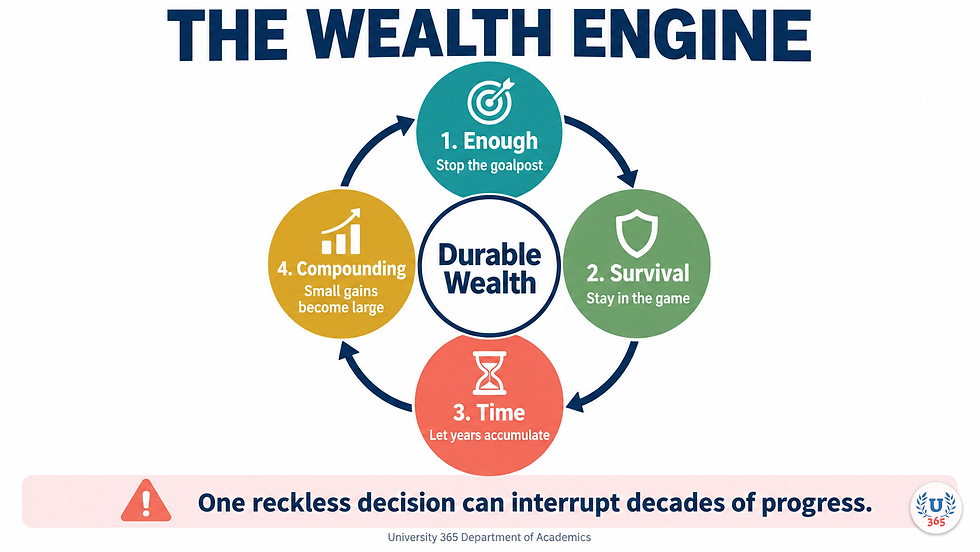
Enough is a stopping rule: Ambition becomes dangerous when each gain raises the next target. Define security, optional goals, and status wants separately. Do not risk legal freedom, reputation, health, or core relationships for money you do not need.
Time drives compounding: Warren Buffett's result reflects skill plus extraordinary duration. Prefer a sound process you can maintain after costs, taxes, inflation, and losses over spectacular returns that threaten survival.
Survival precedes optimization: Getting wealthy and staying wealthy require different conduct. Cash reserves, diversification, insurance, low debt, and adaptable skills can keep one error or crisis from ending future participation.
Tail outcomes dominate totals: A small number of investments, products, or decisions can produce most gains. This supports diversified exposure and repeated low-cost attempts, not unlimited failure or risks with irreversible downside.
Money's highest dividend is control over time: Savings can let you leave a harmful job, wait for a better opportunity, handle an emergency, or reduce unwanted obligations. Wealth is useful when it expands choice rather than status display.
Wealth is largely invisible: Visible possessions show spending, not necessarily assets, resilience, or freedom. Track net worth, savings rate, liquidity, and months of essential expenses rather than using someone else's lifestyle as your benchmark.
Reasonable can outperform rational: The best plan is one that meets sound financial standards and remains tolerable during stress. Personal preferences are acceptable when they do not create concentration, excessive fees, illiquidity, or ruin.
Room for error protects the plan: Forecasts will fail. Conservative assumptions, liquid reserves, insurance, redundancy, and flexible commitments allow the plan to continue when outcomes differ from expectations.
Volatility is a price when it serves a justified long-term plan: Market declines, doubt, and regret are part of earning uncertain returns. Decide whether the reward is worth that cost, then avoid strategies that promise the reward without the discomfort.
ULM ALIGNMENT
At University 365, the CI-First (Co-Intelligence First) doctrine teaches you to always invite AI into your reflection and work while remaining the orchestrator. Human Intelligence leads, AI amplifies. This Book Essential connects the book's ideas to U365's proprietary methods: ULM+EVA (University 365 Life Management powered by the Explore-Visualize-Action Plan cycle) helps you map goals across six life domains; LIPS+CARE (your digital second brain with the Collect-Action Plan-Review-Execute cycle) captures and organizes what you learn; and SL-OS (Successful Life Operating System) integrates all of these with UP-Context (context engineering for AI) into a unified life and learning system.
SCHEMA PRIME: ULM Domain: Career and Finance
DOMAIN MAPPING: Primary: Career and Finance. Secondary: Quality of Life (time and autonomy), Character and Emotions (fear, greed, patience, and enough).
EVA PARAGRAPH: You want financial security that gives you time, choice, and independence. The realistic obstacle is that fear, social comparison, or an unexpected expense can push you to abandon the plan. If uncertainty triggers an urgent financial decision, then pause for 48 hours, review your definition of enough, test the decision against your safety margin, and act only after checking its effect on long-term survival.
LIPS+CARE CAPTURE CARD:
Book: The Psychology of Money
Primary ULM Domain: Career and Finance
3 Key Takeaways:
1. Financial outcomes depend on behavior under uncertainty, not knowledge alone.
2. Define enough, avoid ruin, and preserve room for error so time can work.
3. Use savings to gain control over your time rather than to display status.
Apply It Action: Calculate your autonomy reserve in months of essential expenses and choose one step to increase it this week.
Next CARE Step: Review your spending, debt, savings, and risk rules against your current definition of enough.

EXPLAINER LINK: For more on ULM, EVA, LIPS, and CARE methods, see the [ULM page](https://www.university-365.com/ulm) and the [LIPS page](https://www.university-365.com/lips). For the CI-First doctrine, see the [CI-First page](https://www.university-365.com/ci-first). For the full SL-OS, see the [SL-OS page](https://www.university-365.com/slos).
APPLY IT (domain-tagged): In the Career and Finance domain, write a one-page financial behavior policy covering enough, emergency reserves, maximum debt, acceptable portfolio decline, and the conditions that require a 48-hour pause before acting.
SUMMARY

MINDMAP SKELETON: The Psychology of Money
Center: The Psychology of Money
Branch 1: Money Stories
Personal experience
Luck and risk
Humility
Branch 2: Enough and Compounding
Stop the goalpost
Time is the force
Long horizons
Branch 3: Survival and Tails
Stay in the game
Few wins dominate
Endurance
Branch 4: Freedom and Wealth
Control your time
Wealth is unseen
Save without a goal
Branch 5: Human Behavior
Reasonable decisions
Future surprise
Room for error
Branch 6: Price and Context
Volatility is the fee
Different money games
Know your horizon
Branch 7: Stories and Pessimism
Bad news is vivid
Narratives fill gaps
Uncertainty
Branch 8: Principles and History
Personal rules
Consumer history
Independence
Reconstruction prompt: "Draw a mindmap with this structure. Place the center node at the top, arrange eight branches vertically below in two columns, and extend three leaves from each branch. Use a soft modern color palette, clear lines, and a white background."
Introduction: The Greatest Show on Earth
Housel contrasts a gifted technology executive who loses control of his spending, Ronald Read who builds an eight-million-dollar estate through patient saving and investing, and Richard Fuscone who enters bankruptcy after heavy borrowing. The cases establish the book's thesis that financial outcomes depend heavily on conduct, especially when emotion and debt pressure a plan.
The contrast is memorable but compressed. Structural opportunity, market timing, income, and luck also shape results. These stories should generate questions about behavior, not prove that expertise or circumstances are secondary in every case.
Chapter 1: No One's Crazy
People interpret money through a small sample of history: their own lives. Inflation, employment, family income, market conditions, and geography create different beliefs about risk. The chapter asks you to understand why a choice appears reasonable to the person making it before you judge it.
Context explains decisions without making every decision sound. Misinformation, coercive marketing, addiction, and unequal bargaining power still matter. Empathy should precede analysis, not replace it.
Chapter 2: Luck & Risk
Bill Gates had unusual ability and drive, but he also attended one of the few schools with early computer access. His talented friend Kent Evans died in a rare mountaineering accident. Housel uses their opposite outcomes to show that forces outside effort can redirect an entire life.
The chapter corrects outcome bias, yet humility alone is not a measurement method. Use base rates, comparison groups, repeated observations, and decision journals to distinguish a sound process from a fortunate result.
Chapter 3: Never Enough
Rajat Gupta, Bernie Madoff, and the partners of Long-Term Capital Management already possessed money, access, and prestige. Their desire for more exposed assets that could not be replaced. Housel argues that social comparison creates a contest with no attainable ceiling.
Enough cannot be one permanent number. Dependants, health, inflation, and insecure income change prudent needs. Define security, optional goals, and status desires separately, then review those boundaries without letting comparison set them.
Chapter 4: Confounding Compounding
Small gains become extraordinary when they remain invested for long periods. Warren Buffett's result reflects strong returns and an investing career that began in childhood. Most of his wealth arrived late because the accumulated base had decades to grow.
Compounding is not automatic. Fees, taxes, inflation, excessive borrowing, forced selling, and persistent mistakes can interrupt or reverse it. Time magnifies a sound process and any cost embedded inside it.
Chapter 5: Getting Wealthy vs. Staying Wealthy
Jesse Livermore made a fortune during the 1929 crash, then lost it through larger bets and debt. Housel argues that accumulation can reward optimism and risk-taking, while preservation demands humility, frugality, caution, and acceptance that part of prior success came from luck.
Survival requires more than caution. Diversification, insurance, governance, liquidity, adaptable skills, and stable income also matter. Excessive caution can create another failure by preventing reasonable risk and long-term growth.
Chapter 6: Tails, You Win
A small number of outcomes often determine the total result. A few masterpieces shaped Heinz Berggruen's art collection, Snow White changed Disney's finances, and a small portion of public companies produced most index gains. You can be wrong often and still succeed when losses are limited and winners remain available.
Power-law thinking does not justify unlimited failure. It works when attempts are numerous, downside is capped, and one winner can offset many losses. It is unsuitable when one error is fatal, illegal, or irreversible.
Chapter 7: Freedom
Housel argues that money's highest personal value is control over time. Savings can let you wait for a suitable job, leave a harmful one, absorb a medical cost, choose flexible work, or retire on your own schedule. Derek Sivers's first savings mattered because they let him leave paid employment and pursue music.
Autonomy depends on more than money. Health, caregiving, labor conditions, discrimination, and family resources affect how much freedom the same savings balance can purchase. Financial reserves remain valuable because they increase options within those constraints.
Chapter 8: Man in the Car Paradox
As a hotel valet, Housel imagined himself inside expensive cars rather than admiring their drivers. He concludes that status purchases often fail to produce the respect their owners expect because observers redirect attention toward their own aspirations.
The claim is strongest when approval is the purchase's main purpose. A costly object may also provide function, craft, identity, or a professional signal. Diagnose the motive before treating every visible luxury as failed status seeking.
Chapter 9: Wealth Is What You Don't See
Being rich often means having high current income. Being wealthy means retaining assets and options that remain unspent. Cars, homes, and clothing show consumption but reveal little about debt, liquidity, savings, or resilience.
The distinction corrects consumption bias but does not measure all forms of security. Skills, pensions, health, dependable relationships, and public benefits can also expand future options. Use a broader resilience scorecard while keeping Housel's warning against judging wealth by appearance.
Chapter 10: Save Money
Housel argues that savings rate is more controllable than income or investment returns. Savings also have value without a named purchase because they buy flexibility: time to change careers, wait for an opportunity, learn a skill, or avoid a desperate decision.
The argument restores agency to spending, but discretion is unequal. Rent, healthcare, caregiving, debt, and low wages can leave little removable spending. Apply the principle where genuine margin exists and do not turn structural limits into personal blame.
Chapter 11: Reasonable > Rational
A financially optimal plan has little value if a person cannot maintain it. Harry Markowitz initially divided his retirement contributions between stocks and bonds to reduce regret, even though later research offered more precise optimization. Housel favors strategies that real people can sustain.
Reasonableness needs guardrails. Familiar holdings, emotional attachment, and comfort can conceal concentration or delay necessary change. A reasonable plan should still meet standards for diversification, fees, liquidity, and protection against ruin.
Chapter 12: Surprise!
Financial history reveals recurring behavior, but it cannot map the next decisive event. Wars, crises, inventions, and institutional changes often create consequences that past samples did not contain. Benjamin Graham repeatedly revised his own formulas as competition and markets changed.
The chapter leaves a real planning tension. Long history contains rare disasters, while recent data reflects current institutions. Combine stable behavioral patterns, current structural evidence, and stress scenarios that exceed the historical record.
Chapter 13: Room for Error
A blackjack card counter can hold favorable odds and still lose many hands. Betting every available dollar can destroy a valid strategy before its advantage appears. Housel applies this to finance: use conservative assumptions, reserves, redundancy, and protection against permanent ruin.
Buffers have opportunity costs. An undefined demand for more safety can produce chronic caution or too much idle cash. Size the margin by downside severity, income stability, recovery time, liquidity, dependants, and access to support.
Chapter 14: You'll Change
People recognize how much they changed in the past while assuming their current goals are nearly final. Careers, family duties, prestige, health, and time can change what a good financial life means. Housel recommends avoiding extreme plans and abandoning obsolete goals without obeying sunk costs.
Quick revision can still impose costs on families, colleagues, finances, and developing expertise. Use scheduled reviews, reversible trials, and explicit obligations to distinguish a lasting change from temporary dissatisfaction.
Chapter 15: Nothing's Free
Worthwhile financial outcomes carry prices that may be psychological rather than monetary. Long-term market returns require living through volatility, doubt, regret, and uncertainty. Investors often fail when they treat this cost as a punishment to avoid rather than a condition they chose to accept.
The fee framing is useful only when the expected reward, time horizon, diversification, and personal capacity justify the exposure. Some losses are evidence of a poor asset or bad plan, not a fee that deserves endless patience.
Chapter 16: You & Me
Market prices reflect people playing different games. A short-term trader, employee receiving stock, retiree, and long-term index investor can act rationally under different horizons. Trouble begins when you copy a decision without knowing the game that made it sensible.
A written horizon can become stale as careers, families, liquidity needs, and institutions change. Define the game, risk budget, and decision rules, then review the conditions that would require a change.
Chapter 17: The Seduction of Pessimism
Bad news is immediate, visible, and easy to explain. Progress usually accumulates slowly and becomes normal before people notice it. This makes pessimistic forecasts sound more urgent and credible even when long-run growth continues.
Optimism should not deny setbacks. A useful stance expects improvement over long periods while preparing for recessions, job loss, market declines, and failed plans. Compare alarming short-term data with longer series before changing a long-term strategy.
Chapter 18: When You'll Believe Anything
People use stories to explain a world that contains gaps, uncertainty, and incomplete information. The larger the gap between what someone wants and what can be controlled, the more attractive a confident narrative becomes. Financial forecasts gain power because they offer coherence when outcomes feel threatening.
Narratives can coordinate useful action, but confidence is not evidence. Ask what is known, what is assumed, what would disconfirm the story, and which incentives reward the storyteller for certainty.
Chapter 19: All Together Now
Housel condenses the book into practical rules: show humility in success and compassion in failure, save the gap between income and ego, choose a plan that permits sleep, use money to control time, save without requiring a specific purchase, accept uncertainty, leave room for error, avoid ruin, and define the game being played.
These rules are broadly useful but must remain personal. Taxes, currencies, pensions, family structures, healthcare, and legal systems change how each principle should be applied. The transferable element is the decision process, not one universal portfolio.
Chapter 20: Confessions
Housel explains his household's own approach. Independence is the primary goal. Lifestyle expectations stayed close to early-career levels while income grew, so raises increased the savings rate. His family paid off its house, keeps substantial cash, and uses low-cost index funds for long-term investing.
The chapter is valuable because it separates personal preference from universal instruction. Housel acknowledges that another informed household can choose differently. His conservative cash position and debt aversion may sacrifice expected return, but he accepts that cost for simplicity, sleep, and independence.
Postscript: A Brief History of Why the U.S. Consumer Thinks the Way They Do
The postscript traces household expectations after the Second World War. Shared growth, policy support, rising home ownership, consumer credit, inequality, inflation, and changing labor markets shaped what Americans came to view as a normal middle-class life. Expectations often persisted after the economic conditions that created them changed.
This history is specific to the United States and cannot be transferred unchanged to other countries. Its broader lesson is useful: financial expectations are historical products. Examine which beliefs came from parents, peers, policy, and past prosperity before treating them as permanent personal needs.
IN PRACTICE

1. Write your money autobiography: Record the inflation, unemployment, debt, property, investing, and family events that shaped your beliefs. Action: Identify one belief that reflects past conditions more than your current situation.
2. Define enough: Separate essential security, optional goals, and status wants. Include a list of assets you will not risk, such as legal freedom, reputation, health, and core relationships. Action: Write one clear stopping rule for a high-risk opportunity.
3. Calculate your autonomy reserve: Divide liquid savings by essential monthly expenses. The result estimates how many months of choice your reserve provides. Action: Choose a realistic target and automate a contribution toward it.
4. Build room for error: Stress-test your plan with lower returns, delayed income, higher expenses, and a longer recovery period. Action: Add one reserve, insurance policy, backup, or debt limit that protects the plan from permanent failure.
5. Grade process and outcome separately: After a major decision, record what was known, what was uncertain, and which rule guided the choice. Action: Review the outcome later without rewriting the quality of the original process.
6. State the game you are playing: Write your time horizon, liquidity needs, maximum acceptable loss, and reasons for owning each major asset. Action: Ignore advice designed for a different horizon unless you deliberately change your game.
7. Use a 48-hour rule: For large discretionary purchases, panic selling, speculative trades, or new debt, delay action for 48 hours. Action: During the pause, review enough, room for error, and the effect on future time and choice.
QUIZ: TEST YOUR UNDERSTANDING
1. Career and Finance recall: Why can a moderate, repeatable return create more wealth than a higher return? Answer: A repeatable return can remain invested longer, allowing gains to accumulate. A high return that causes ruin, forced selling, or abandonment ends the process.
2. Career and Finance recall: What is the difference between being rich and being wealthy in Housel's framework? Answer: Rich often describes current income or visible spending. Wealth consists largely of assets and options that remain unspent and therefore stay hidden.
3. Career and Finance application: Your portfolio falls 25 percent, but your income is stable and your horizon is 20 years. Which questions should you ask before selling? Answer: Confirm the game and horizon, check whether the asset still fits the plan, test your safety margin, and decide whether the decline is an accepted cost or evidence that the original plan was unsound.
4. Career and Finance transfer: A founder can double company value by personally guaranteeing debt that would consume family savings if sales fall. Which principles apply? Answer: Define enough, protect irreplaceable assets, cap downside, and avoid ruin. A large possible gain is not useful if the loss ends future participation.
5. Career and Finance transfer: Two colleagues disagree about whether to pay off a low-interest mortgage. One values maximum expected return; the other values freedom from debt. Can both be reasonable? Answer: Yes, if each understands the financial cost, preserves liquidity, avoids ruin, and chooses a plan they can sustain. Personal goals change what counts as reasonable.
How many did you get right? Which ones surprised you?
CAN THIS BOOK REPLACE THE ORIGINAL?
This Book Essential presents the book's argument, chapter structure, principal cases, and a critical evaluation of its limits. It cannot replace Housel's full storytelling, the cumulative effect of the examples, or the personal reflection created by reading each chapter in sequence. Read the original if you want to examine your own money history against the complete set of stories.
QUOTES
"Finance is different. It’s guided by people’s behaviors."
"Nothing is as good or as bad as it seems."
"The hardest financial skill is getting the goalpost to stop moving."
"His skill is investing, but his secret is time."
"If I had to summarize money success in a single word it would be “survival.”"
"Tails drive everything."
"Controlling your time is the highest dividend money pays."
"But wealth is hidden. It’s income not spent."
"Things that have never happened before happen all the time."
"You have to plan on your plan not going according to plan."
"Same with investing, where volatility is almost always a fee, not a fine."
"Pessimism just sounds smarter and more plausible than optimism."
"Expectations always move slower than facts."
AUTHOR'S EXPERTISE
Morgan Housel is an author focused on financial behavior, history, risk, and decision-making. His official biography identifies him as a partner at Collaborative Fund and a director at Markel. He previously wrote for The Motley Fool and The Wall Street Journal.
Housel has received the Society of American Business Editors and Writers Best in Business Award twice and the New York Times Sidney Award. The publisher also identifies him as a two-time finalist for the Gerald Loeb Award for Distinguished Business and Financial Journalism.
His books include The Psychology of Money, Same As Ever, and The Art of Spending Money. His writing style uses short historical cases to examine decisions under uncertainty. That approach makes behavioral finance accessible, though readers should supplement narrative arguments with data, local financial rules, and qualified advice when making consequential decisions.
RESOURCES
NEXT STEPS
Define enough: Write the level of security you need, the optional goals you value, and the status spending you can reject.
Protect survival: Build liquidity, insurance, diversification, and debt limits before seeking a higher return.
Buy time: Judge savings and major purchases by the options and schedule control they create or remove.
Separate process from outcome: Record why you made an important decision before the result becomes known.
Name your game: State your horizon and risk budget so short-term opinions do not control a long-term plan.
Accept justified costs: If a long-term investment fits your plan, prepare for volatility instead of expecting reward without discomfort.
Review the future self: Revisit goals annually and change the plan when your priorities, duties, or constraints genuinely change.
U365'S RECOMMENDATIONS TO LEARN MORE
University 365 searched first-party, academic, professional, community, video, and social sources to extend the book's lessons. The links below were verified as of 2026-09-19.
Official learning resources
Video tutorials and channels
Morgan Housel discusses saving, spending, independence, and purpose with Andrew Huberman, by Andrew Huberman, Dec 2, 2024, 2:15:35
A visual explanation of compounding, enough, freedom, and safety margins, by Verbal to Visual, Jan 12, 2024, 13:49
The Psychology of Money | Morgan Housel discusses financial behavior, writing, and the use of money, by Rask, Sep 1, 2021, 41:40
Written tutorials and deep-dive articles
Community and social
Resources on X
Dedicated X channels:
X posts with video content:


University 365 includes resources that teach beyond this Essential. First-party sources come first, serious independent analysis follows, and community material is labeled by source.
IMPORTANT NOTICE
This Book Essential is an original summary and critical analysis of The Psychology of Money: Timeless Lessons on Wealth, Greed, and Happiness by Morgan Housel (paperback edition, Harriman House, 2020, ISBN 978-0-85719-768-9). Short quotations from the book are attributed and cited for purposes of criticism, review, and education. All rights in the original work belong to its author and publisher; this Essential is not a substitute for the book: read the original at [Harriman House](https://harriman-house.com/authors/morgan-housel/the-psychology-of-money/9780857197689).
This book is part of University 365's learning library. Explore INSIDE, our publications, and our programs. The best summary is not a substitute for the book. Read the original. Discuss this book with a U.Coach.




Comments