
Human-AI Empowerment: An Interdisciplinary Perspective (Carlos Toxtli-Hernandez)


In this Book Essential

INTRODUCTION
Artificial intelligence is reshaping how people work, learn, and make decisions. Yet the dominant conversation about AI still swings between two extremes: fear that machines will replace humans and optimism that they will solve everything. Carlos Toxtli-Hernandez's "Human-AI Empowerment: An Interdisciplinary Perspective" (CRC Press, 2026) rejects both positions and argues for a third path. AI should be deliberately designed to expand what humans can do over the long term, not just automate tasks in the short term.
The book is written for researchers, designers, developers, policymakers, and practitioners who work at the intersection of AI and human experience. It draws on computer science, human-computer interaction, psychology, education, economics, sociology, and philosophy to build a unified framework for studying how AI affects human empowerment across months and years, not just single interactions. This is a research-grounded text, not a popular business book, and it rewards careful reading.
Toxtli-Hernandez, an Assistant Professor at Clemson University with a Ph.D. from Northeastern University, builds the book around a central question: how do we ensure that AI serves not merely as an instrument of efficiency or automation, but as a genuine catalyst for human empowerment? His answer is a comprehensive framework that covers definitional foundations, methodological tools, practical strategies, case studies, and future research directions. The result is a volume that speaks equally to academic readers seeking rigorous methods and to practitioners looking for design principles they can apply.
This Book Essential condenses the book's six chapters into a structured analysis. It is designed for readers who need the core arguments, key frameworks, and actionable takeaways before deciding whether to invest in the full text.
U365'S VALUE PROPOSITION
WHO THIS IS FOR
AI researchers and HCI practitioners who need rigorous, longitudinal methods for evaluating AI's impact on human capabilities and who want design principles grounded in multiple disciplines.
Policymakers and governance professionals working on AI regulation, workforce transformation, and digital inclusion who need an interdisciplinary evidence base.
Educators and instructional designers building AI-enhanced learning systems who want to understand adaptive learning, cognitive scaffolding, and long-term skill development.
Healthcare administrators and clinicians evaluating AI diagnostic and treatment tools who need a framework for assessing empowerment versus dependency.
Product managers and AI system designers who want their tools to augment human competence rather than create reliance or deskilling.
Graduate students in computer science, HCI, or cognitive science entering the human-centered AI field who need a comprehensive foundation text.
KEY TENSIONS
Automation versus augmentation: The book's core tension. AI can replace human tasks (automation) or expand human capabilities (augmentation). Toxtli-Hernandez argues that most current AI systems default to automation, which risks deskilling and dependency. The empowerment model demands designing for augmentation, where AI complements and extends human competence rather than substituting for it.
Short-term efficiency versus long-term growth: Most AI systems are optimized for immediate task performance. The book argues this is a narrow metric. Empowering AI must be evaluated on its contribution to expanding users' repertoire of achievable goals over months or years, which requires a fundamentally different evaluation framework.
Human agency versus AI guidance: Empowering AI should not dictate goals but rather provide resources, guidance, and scaffolding that support users in identifying and pursuing their own aspirations. This tension runs through every chapter: how much should AI decide, and how much should it defer to human judgment?
Interdisciplinary ambition versus disciplinary depth: The book argues that no single field can solve human-AI empowerment. Computer science provides the technical foundations, psychology models motivation and learning, economics offers the Capability Approach for measuring expanded opportunities, and philosophy grounds the ethical dimensions. The challenge is synthesizing these without producing shallow generalities.
Scalability versus equity: AI empowerment technologies risk widening the digital divide. Only 19 percent of individuals in least developed countries use the internet, compared to 87 percent in developed countries. Scaling empowerment requires addressing access, literacy, and representativeness simultaneously.
Innovation versus governance: Policy frameworks like the EU's GDPR and Singapore's SkillsFuture initiative shape how AI can be developed and deployed. Too little governance risks harm; too much stifles innovation. The book argues for balanced, adaptive policy that promotes empowerment while safeguarding public interests.
WHY IT MATTERS NOW
AI systems are moving from narrow, task-specific tools to general-purpose assistants embedded in daily work and life. This shift makes the longitudinal question urgent: what happens to human skills, motivation, and goal-setting when people interact with AI over months and years? Current research has few answers because most studies measure short-term task performance, not long-term capability growth.
The book arrives at a moment when governments, universities, and companies are making consequential decisions about AI integration. The EU AI Act, workforce reskilling programs, and educational AI deployments all need frameworks for evaluating whether AI empowers or disempowers. Toxtli-Hernandez provides a vocabulary and a methodological toolkit for answering that question rigorously.
OVERVIEW
The book's core message is that AI should be evaluated not on what it does for people in a single interaction, but on what it does to people over time. Does it expand their capabilities, open new opportunities, and support their pursuit of self-defined goals? Or does it create dependency, erode skills, and narrow choices? This is the empowerment question, and the book treats it as an empirical, interdisciplinary research program.
Toxtli-Hernandez organizes the book into five sections plus a conclusion. Section I defines Human-AI Empowerment and surveys the theoretical foundations. Section II presents methodological frameworks for studying AI's longitudinal impact, including quantitative, qualitative, and mixed-methods approaches. Section III examines strategies for empowering humans through AI collaboration, covering adaptive assistance, psychological goal management, educational applications, and economic perspectives. Section IV provides case studies in healthcare, education, the workplace, creative industries, and social good. Section V looks ahead to emerging technologies, scaling challenges, and future research directions. The conclusion synthesizes ten themes from the symbiotic relationship between human and AI intelligence to the cultivation of AI literacy.
A notable example is the book's treatment of IBM's Watson for Oncology. Rather than presenting it as either a triumph or a failure, Toxtli-Hernandez uses it to illustrate the symbiotic model: the system's recommendations are most effective when combined with the clinical judgment and empathetic care of human doctors. The 93 percent concordance rate with a multidisciplinary tumor board for breast cancer treatment shows the potential, but the book insists the human physician remains the decision-maker.
The book's structure mirrors its interdisciplinary thesis. Each chapter draws from different fields and the frameworks are explicitly designed to integrate knowledge across disciplines rather than privilege one perspective. This makes the book dense but rewarding: readers will encounter Self-Determination Theory, the Capability Approach, Vygotsky's Zone of Proximal Development, Bloom's Taxonomy, and Implementation Intentions alongside technical discussions of explainable AI, adaptive interfaces, and longitudinal study design.
KEY IDEAS
HUMAN-AI EMPOWERMENT
The shift from automation to empowerment: Toxtli-Hernedefines Human-AI Empowerment as the intentional creation and application of AI systems designed to measurably enhance human capabilities, expand the set of real opportunities available to individuals and communities, and facilitate the pursuit and achievement of self-defined, long-term goals. This definition moves beyond task performance metrics to ask whether AI expands what people can do and become over time.

Augmented intelligence over artificial intelligence: Drawing on Douglas Engelbart's vision of technology as a means to augment human intellect, the book argues that AI should complement and extend human cognitive abilities rather than replace them. AI systems should provide contextual information, suggest alternative perspectives, or automate routine cognitive tasks, thereby freeing human cognitive resources for higher-order thinking and creativity.
The Capability Approach as evaluation framework: The book adopts Amartya Sen and Martha Nussbaum's Capability Approach from development economics. Empowerment is not about providing resources (like AI tools) but about expanding individuals' capabilities, their effective freedom to achieve valued functionings. The question is not "can the AI do the task?" but "does the AI expand the user's achievable goals and life paths?"
Self-Determination Theory and intrinsic motivation: The book uses Deci and Ryan's Self-Determination Theory as a psychological foundation. Empowering AI should support autonomy, competence, and relatedness. It should not dictate goals but provide scaffolding that supports users in identifying and pursuing their own aspirations. It must enhance competence not just in using the AI tool itself, but in the underlying domain or skill the tool mediates.
Co-adaptive, longitudinal interaction: Unlike systems optimized for short-term task completion, empowering AI considers the cumulative impact of interaction. Both the human user and the AI system may change and adapt through their interaction, leading to a co-evolutionary dynamic. This requires designing for sustained engagement, progressive skill development, and adaptation to users' evolving needs over months or years.
Explainable AI as empowerment tool: Transparency and explainability are not just ethical safeguards but empowerment mechanisms. When an AI system explains its reasoning, users can understand, critically evaluate, and learn from AI-generated recommendations. An AI system in medical diagnosis that explains the key factors behind its conclusion enhances the physician's diagnostic skills, not just their efficiency.
Disempowerment risks and mitigation: The book identifies deskilling, dependence, manipulation, algorithmic bias, and attention manipulation as mechanisms of disempowerment. Ethical considerations, transparency, and user control are not peripheral features but integral components of the definition itself. True empowerment aims for a future where AI serves as a responsible partner in unlocking human potential.
Adaptive learning systems and Zone of Proximal Development: The book connects AI-powered adaptive learning to Vygotsky's Zone of Proximal Development and Bloom's Taxonomy. These systems dynamically adjust content, pace, and pedagogical approach based on the learner's progress and cognitive state, extending beyond traditional educational settings to encompass lifelong learning and skill development.
Implementation Intentions and AI goal support: Drawing on Gollwitzer's Implementation Intentions research, the book suggests AI can help users create "if-then" plans that link situational cues with goal-directed responses. A health AI might help users formulate plans like "If it's 7 AM, then I'll do a 15-minute yoga session" and provide timely reminders or adaptive suggestions.
The symbiotic relationship: The book's culminating argument is that the most promising path forward lies not in the replacement of human intelligence by AI, but in the cultivation of a symbiotic relationship between the two. The combination of human creativity, contextual understanding, and ethical judgment with AI's computational power and pattern recognition capabilities can lead to outcomes that surpass what either could achieve alone.
ULM ALIGNMENT
SCHEMA PRIME: ULM Domain: Career and Finance (AI as a tool for expanding professional capabilities and economic opportunities).
DOMAIN MAPPING: Primary: Career and Finance. Secondary: Spirit and Mind (cognitive augmentation, goal management), Quality of Life (healthcare empowerment, social good applications).
EVA PARAGRAPH: You want AI to expand your professional capabilities and open new career paths over time, not just speed up your current tasks. The realistic obstacle is that most AI tools are designed for short-term efficiency, which can lead to dependency and skill erosion rather than growth. If you find yourself relying on AI without understanding its output, then schedule a weekly review session where you trace the AI's reasoning, identify what you learned, and practice the underlying skill without AI assistance to ensure your competence keeps growing.
LIPS+CARE CAPTURE CARD:
Book: Human-AI Empowerment: An Interdisciplinary Perspective
Primary ULM Domain: Career and Finance
3 Key Takeaways:
1. Evaluate AI tools on whether they expand your long-term capabilities, not just short-term efficiency
2. Design your AI interactions for co-adaptation: the AI should help you grow, and you should help it serve you better
3. Mitigate disempowerment risks: watch for deskilling, dependency, and bias in every AI system you use
Apply It Action: This week, pick one AI tool you use regularly and audit whether it is expanding your skills or replacing them. Track this in your LIPS system or CARE workflow.
Next CARE Step: Collect evidence of your AI interactions for one week, then review whether each interaction expanded or replaced your capabilities.
EXPLAINER LINK: For more on ULM, EVA, LIPS, and CARE methods, see University 365 methods explainer page at https://www.university-365.com/methods.
Apply It (Career and Finance): This week, pick one AI tool you use regularly and audit whether it is expanding your skills or replacing them. Note three specific instances where the AI helped you do something you could not do alone, and three instances where you let the AI do something you could have done yourself.
SUMMARY
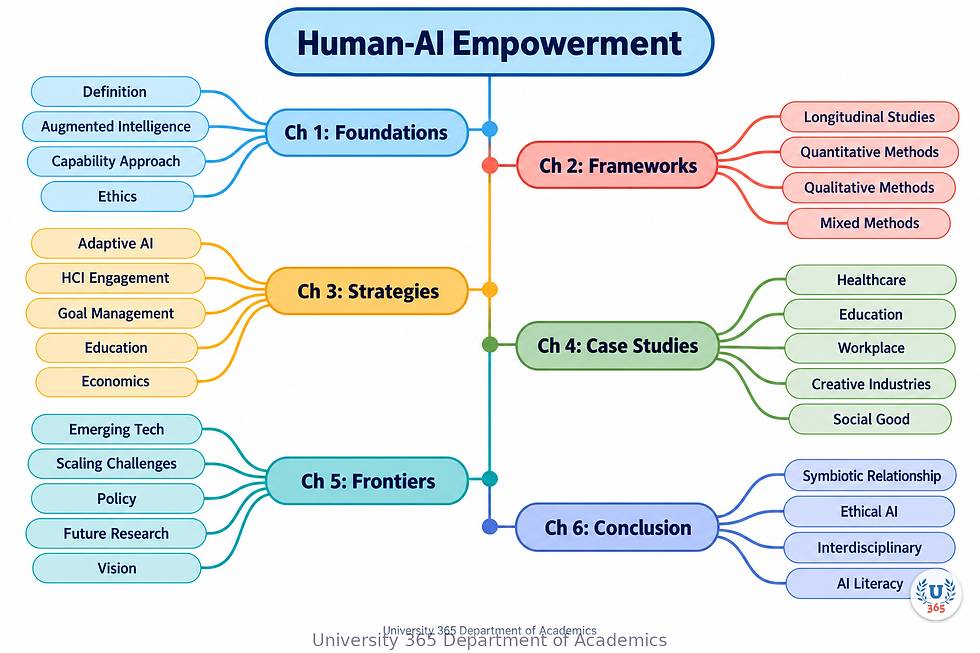
MINDMAP SKELETON: Human-AI Empowerment: An Interdisciplinary Perspective
Center: Human-AI Empowerment
Branch 1: Chapter 1: Foundations of Human-AI Empowerment
Definition and conceptual shift
Augmented intelligence concept
Capability Approach (Sen, Nussbaum)
Interdisciplinary theoretical frameworks
Ethical considerations in empowerment
Branch 2: Chapter 2: Frameworks for Human-AI Empowerment
Longitudinal study design
Quantitative measurement approaches
Qualitative assessment methods
Mixed-method frameworks
Challenges in longitudinal AI research
Branch 3: Chapter 3: Strategies for Empowering Humans
AI empowerment approaches
HCI methods for long-term engagement
Psychological research on goal management
Educational strategies for AI-enhanced learning
Economic and social perspectives
Branch 4: Chapter 4: Case Studies and Empirical Evidence
AI in healthcare (diagnostics, personalized treatment)
AI in education (adaptive learning)
AI in the workplace (productivity, job satisfaction)
AI in creative industries
AI in social good (global challenges)
Branch 5: Chapter 5: Frontiers of Human-AI Empowerment
Emerging technologies (BCI, AR/VR, quantum computing)
Challenges in scaling empowerment
Policy and governance roles
Future research directions
Envisioning empowered collaboration
Branch 6: Chapter 6: Conclusion
Symbiotic human-AI relationship
Ethical AI development imperative
Interdisciplinary collaboration need
Scalability and accessibility challenges
AI literacy cultivation
Reconstruction prompt: "Draw a mindmap with this structure. Center node at top, branches arranged vertically below, leaves extending outward from each branch. Use a soft modern color palette with clean lines on a white background."

Chapter 1: Foundations of Human-AI Empowerment
The opening chapter defines the core concept and situates it within a web of theoretical frameworks. Toxtli-Hernandez defines Human-AI Empowerment as a conceptual shift that moves beyond viewing AI merely as a tool for automation toward conceptualizing it as a catalyst for long-term human development. The definition draws on Self-Determination Theory (autonomy, competence, relatedness) and the Capability Approach (expanding effective freedom to achieve valued functionings). The chapter traces the evolution of human-centered AI from Engelbart's augmentation vision through modern HCI and HCC, and lays out ethical considerations including privacy, fairness, transparency, and the right to cognitive privacy.
A critical assessment: the definition is ambitious but potentially difficult to operationalize. "Expanding the set of real opportunities" is a rich philosophical concept from Sen's Capability Approach, but translating it into measurable metrics for AI system evaluation remains an open challenge the book acknowledges but does not fully resolve. The interdisciplinary map (Figure 1.2) is comprehensive but risks overloading readers who may not be familiar with all six contributing disciplines. Compared to Shneiderman's "Human-Centered AI" (2022), Toxtli-Hernandez places greater emphasis on the longitudinal and co-evolutionary dimensions, which is a genuine contribution.
Chapter 2: Frameworks for Human-AI Empowerment
This chapter provides the methodological toolkit for studying AI's longitudinal impact on human empowerment. It covers longitudinal study design (time frames from one to ten years, sample selection, retention strategies), quantitative approaches (measuring empowerment through capability metrics, skill assessments, behavioral data), qualitative methods (interviews, ethnographic observation, diary studies), and mixed-method frameworks that integrate both. The chapter also addresses challenges: technological obsolescence during long studies, participant attrition, confounding variables, and ethical considerations in long-term data collection.
A critical assessment: the methodological rigor here is a strength, but the chapter underestimates the practical difficulty of running five-to-ten-year longitudinal studies on AI systems that may be obsolete in eighteen months. The book acknowledges this tension but does not propose concrete solutions for dealing with platform churn. Researchers will need to supplement these frameworks with adaptive study designs that can accommodate technology transitions.
Chapter 3: Strategies for Empowering Humans Through AI Collaboration
The longest and most practically useful chapter covers five domains of empowerment strategy. AI Empowerment Approaches describe adaptive AI systems that tailor support to individual users, explainable AI that builds trust and skill, and collaborative AI that leverages complementary human-AI strengths. HCI Methods for Long-Term Engagement cover adaptive interfaces, direct manipulation, and sustained motivation design. Psychological Research on Long-Term Goal Management draws on Goal-Setting Theory (Locke and Latham), Implementation Intentions (Gollwitzer), and Self-Determination Theory (Deci and Ryan) to show how AI can support goal pursuit. Educational Strategies cover adaptive learning systems grounded in Vygotsky's Zone of Proximal Development and Bloom's Taxonomy. Economic and Social Perspectives examine the broader implications, including workforce transformation and digital divides.
A critical assessment: this chapter is the book's strongest section because it translates theory into actionable design principles. However, the connection between the psychological theories and specific AI system features could be tighter. The book describes how AI "can" support goal pursuit but provides fewer concrete system architectures or interaction patterns that a developer could implement directly.
Chapter 4: Case Studies and Empirical Evidence
Five domains illustrate empowerment in practice: healthcare (AI diagnostics matching dermatologists, Watson for Oncology's 93 percent concordance rate, Sugar.IQ diabetes assistant adding 36 minutes of healthy glucose range per day), education (personalized learning platforms, adaptive tutoring), the workplace (productivity enhancement, job satisfaction), creative industries (AI augmenting human creativity in art, music, writing), and social good (agriculture, environmental monitoring, disaster response in resource-limited settings like rural Rwanda).
A critical assessment: the case studies are well-chosen and span a range of empowerment levels, from individual patient management to global challenges. However, most cases describe AI systems that are already deployed, which means the "longitudinal" evidence is often short-term. The book would benefit from more cases that explicitly track users over years, not weeks or months.
Chapter 5: Frontiers of Human-AI Empowerment
The chapter on emerging technologies covers brain-computer interfaces (UCSF's speech decoding from brain signals), augmented and virtual reality (Microsoft HoloLens 2 in surgical settings), quantum computing (Google's quantum supremacy), and neuroengineering (neural prosthetics). The scaling challenges section identifies accessibility, digital divide, data quality, algorithmic bias, skill gaps, regulatory lag, and accountability as interrelated obstacles. The policy and governance section examines the EU's GDPR, Singapore's SkillsFuture initiative, and the need for AI ethics review boards. Future research directions include more sophisticated human-AI collaboration models, long-term cognitive and social impact studies, robust and generalizable AI systems, and enhanced interpretability.
A critical assessment: the emerging technologies section reads more like a technology survey than an empowerment analysis. The connection between quantum computing and human empowerment is speculative. The scaling challenges are well-identified but the solutions proposed are high-level. The policy discussion is solid but would benefit from more comparative analysis across different regulatory approaches.
Chapter 6: Conclusion
The conclusion synthesizes ten themes: the symbiotic relationship between human and AI intelligence, the imperative of ethical AI development, the need for interdisciplinary collaboration, the importance of human-centered design, the challenge of scalability and accessibility, the role of policy and governance, the potential for addressing global challenges, the imperative of continuous learning and adaptation, the exploration of long-term impacts, and the cultivation of AI literacy. The book ends with a vision of AI systems as true cognitive partners that seamlessly integrate with human thought processes.
A critical assessment: the conclusion effectively summarizes the book's arguments but does not push beyond them. The vision of "true cognitive partners" is aspirational without concrete milestones. The ten themes are comprehensive but could be prioritized: which are most urgent, and which can wait?
IN PRACTICE

1. Audit your AI tools for empowerment versus replacement: For each AI tool you use regularly, ask: does it expand my capabilities or replace them? If you stopped using it tomorrow, would your skills be stronger or weaker than before you started? Track three tools over a month and categorize each interaction.
Action: Create a simple spreadsheet with columns: tool name, task, expanded skill or replaced skill, and weekly assessment.
2. Design for co-adaptation in your own AI use: Instead of accepting AI outputs passively, build feedback loops. After getting an AI-generated result, identify what reasoning the AI used, whether you could replicate it manually, and what you learned. Adjust your prompts to get better explanations, not just better outputs.
Action: For one week, add a "what did I learn?" field to every AI interaction in your workflow.
3. Apply the Capability Approach lens to AI deployment decisions: When evaluating whether to adopt an AI system in your organization, ask not "does it save time?" but "does it expand what our people can do?" Use the capability framework: does the system enable new functionings (being knowledgeable, being creative, being socially engaged) that were not available before?
Action: Write a one-page capability impact assessment for the next AI tool your team considers adopting.
4. Use Implementation Intentions with AI support: Create specific if-then plans for your goals and use AI as a reminder and accountability system. "If it is Monday morning, then I will review my AI tool usage from the previous week and adjust my approach." This combines Gollwitzer's research with practical AI tooling.
Action: Write three if-then plans for your most important goals this quarter and set up AI-assisted reminders for each.
5. Build explainability requirements into your AI procurement: When selecting or building AI systems, require that the system can explain its reasoning in terms a human user can understand and learn from. This is not just an ethical safeguard but an empowerment mechanism: explanation builds user skill.
Action: Add "explainability threshold" as a criterion in your next AI vendor evaluation or system design document.
6. Monitor for disempowerment signals in your team: Watch for deskilling (team members losing skills they once had), dependency (inability to function without AI), and bias amplification (AI recommendations skewing decisions in problematic ways). Set up quarterly reviews.
Action: Schedule a 30-minute quarterly "AI empowerment audit" with your team to discuss these three signals.
7. Advocate for interdisciplinary AI evaluation: Whether in your organization or your research, push for AI impact assessments that include psychology, economics, sociology, and ethics alongside technical metrics. Single-discipline evaluation misses the empowerment question.
Action: Identify one AI project in your sphere and propose adding a non-technical evaluator to the review process.
QUIZ (static, below-fold)
1. How does Toxtli-Hernandez define Human-AI Empowerment, and how does it differ from simple AI automation?
Answer: Human-AI Empowerment is the intentional creation and application of AI systems designed to measurably enhance human capabilities, expand real opportunities, and facilitate the pursuit of self-defined long-term goals. Unlike automation, which focuses on replacing human tasks for efficiency, empowerment focuses on expanding what humans can do and become over time through a co-adaptive, symbiotic relationship.
2. The book draws on Amartya Sen and Martha Nussbaum's Capability Approach. How does this framework change the way we should evaluate AI systems?
Answer: Instead of asking "can the AI do the task?" or "does it save time?", the Capability Approach asks "does the AI expand the user's achievable goals and life paths?" Empowerment is about expanding individuals' effective freedom to achieve valued functionings, not just providing resources. This shifts evaluation from task performance to capability expansion.
3. Apply the concept of "if-then" Implementation Intentions (Gollwitzer) to designing an AI study assistant. What specific feature would you build, and how would it support long-term goal achievement?
Answer: The AI could help users formulate specific if-then plans like "If it is 9 PM on Sunday, then I will review the week's AI-assisted notes and identify three concepts I need to study further." The AI would send contextual reminders, track plan adherence, and adapt suggestions based on the user's behavior patterns. This supports long-term goals by converting intentions into concrete, situational action triggers rather than leaving them as vague aspirations.
4. What are three disempowerment risks the book identifies, and how would you detect them in a workplace AI deployment?
Answer: The book identifies deskilling (employees losing skills they once had), dependence (inability to function without AI), and algorithmic bias (AI recommendations skewing decisions unfairly). You would detect deskilling by comparing skill assessments before and after AI adoption, dependence by measuring performance when AI is temporarily unavailable, and bias by auditing AI recommendations across demographic groups for systematic disparities.
5. Transfer question: The book discusses AI empowerment in healthcare, education, and creative industries. How would you apply its framework to a domain it does not cover, such as civic participation or democratic engagement?
Answer: The framework would ask: does AI expand citizens' capabilities to participate meaningfully in democratic processes? This includes providing accessible information about policy issues (augmented intelligence), helping citizens set and pursue civic goals (Self-Determination Theory), ensuring AI-driven political advertising does not manipulate attention or exploit cognitive biases (disempowerment mitigation), and measuring whether AI tools expand the set of civic actions citizens can take (Capability Approach). The longitudinal dimension would track whether civic AI tools build citizens' political knowledge and engagement skills over time, or whether they create dependency on AI-curated information.
How many did you get right? Which ones surprised you?
CAN THIS BOOK REPLACE THE ORIGINAL?
This Book Essential captures the book's core arguments, frameworks, and key examples, but it cannot substitute for the full text. The original provides extensive literature reviews with hundreds of citations, detailed methodological frameworks with specific study designs, rich case study data including quantitative results, and comprehensive bibliographic coverage. Researchers and practitioners who need the specific methodological tools or the full interdisciplinary literature review should read the original. This Essential is a structured analysis that helps you decide where to focus your reading.
QUOTES
"The central challenge, therefore, is not merely to build more powerful AI, but to ensure its development and deployment actively empower humanity."
"Human-AI Empowerment signifies a conceptual shift in the design, development, and evaluation of AI."
"Empowering AI, therefore, should not dictate goals but rather provide resources, guidance, and scaffolding that support users in identifying and pursuing their own aspirations."
"It must enhance competence not just in using the AI tool itself, but in the underlying domain or skill the tool mediates."
"AI systems that provide contextual information, suggest alternative perspectives, or automate routine cognitive tasks, thereby freeing human cognitive resources for higher-order thinking and creativity."
"Empowerment requires mitigating risks of deskilling, dependence, manipulation, or algorithmic bias that could undermine agency or exacerbate inequalities."
"AI should serve as a tool for augmenting human intelligence rather than replacing it."
"The most promising path forward for Human-AI Empowerment lies not in the replacement of human intelligence by AI, but in the cultivation of a symbiotic relationship between the two."
"The combination of human creativity, contextual understanding, and ethical judgment with AI's computational power and pattern recognition capabilities can lead to outcomes that surpass what either could achieve alone."
"The true power of these AI breakthroughs is realized when human scientists use these findings to drive forward their research, asking new questions and exploring novel hypotheses that the AI alone could not generate."
"Future developments in Human-AI Empowerment should focus on enhancing this complementarity, designing AI systems that augment human strengths while compensating for cognitive limitations."
"The complex nature of Human-AI Empowerment necessitates collaboration across diverse disciplines."
"These AI partners could offer real-time guidance, suggest novel approaches, and even anticipate needs before they are explicitly expressed."
"How do we ensure that AI serves not merely as an instrument of efficiency or automation, but as a genuine catalyst for human empowerment?"
AUTHORS EXPERTISE
Carlos Toxtli-Hernandez is an Assistant Professor at Clemson University, where he focuses on the study of Human-Centered Artificial Intelligence. He holds a Ph.D. in Computer Science from Northeastern University. His research explores the intersection of artificial intelligence, human-computer interaction, and automation, with a particular emphasis on developing methodologies and frameworks for studying the long-term impact of AI on human empowerment.
Toxtli-Hernandez has published extensively in leading academic journals and conferences, and his work has been recognized with numerous awards and grants. His interdisciplinary approach reflects his training in computer science combined with sustained engagement with HCI, psychology, and the social sciences. The book reflects this breadth: it moves fluidly between technical discussions of AI system design, psychological theories of motivation and goal pursuit, economic frameworks for evaluating capability expansion, and philosophical arguments about ethics and human agency.
The writing style is academic and rigorous, with extensive citations and a structured, methodical organization. The book is part of the CRC Press catalog (an imprint of Taylor and Francis Group, LLC), which positions it as a research-level text suitable for graduate courses and professional reference. It is not a popular science book; readers should expect dense, reference-rich prose that rewards careful, sequential reading.
RESOURCES
Human-AI Empowerment: An Interdisciplinary Perspective by Carlos Toxtli-Hernandez: https://www.routledge.com/9781003536628
Related works:
Human-Centered AI by Ben Shneiderman (Oxford University Press, 2022)
AI Superpowers: China, Silicon Valley, and the New World Order by Kai-Fu Lee (Houghton Mifflin Harcourt, 2018)
Rebooting AI: Building Artificial Intelligence We Can Trust by Gary Marcus and Ernest Davis (Pantheon, 2019)
Human + Machine: Reimagining Work in the Age of AI by Paul Daugherty and H. James Wilson (Harvard Business Review Press, 2018)
NEXT STEPS
Audit your AI tools: For each AI tool in your workflow, ask whether it expands your capabilities or replaces them. Keep the ones that help you grow.
Design for explanation: Require AI systems to explain their reasoning. Learn from the explanation, not just the output.
Plan for the long term: Set AI-related goals in terms of months and years, not single tasks. Track whether your skills are growing over time.
Watch for dependency: If you cannot function without AI in a domain where you once could, you are deskilling. Schedule regular AI-free practice sessions.
Advocate for empowerment: When your organization adopts AI, ask the capability question: does this expand what our people can do?
Build interdisciplinary evaluation: Include psychology, ethics, and social impact alongside technical metrics in every AI assessment.
U365'S RECOMMENDATIONS TO LEARN MORE
Official learning resources
Video tutorials and channels
Ben Shneiderman discusses human-centered AI design principles, by University of Maryland, Oct 15, 2022, 45:30
Stanford HAI panel on designing AI that augments human capabilities, by Stanford HAI, Mar 10, 2024, 1:12:00
Written tutorials and deep-dive articles
Community and social
Resources on X
Dedicated X channels:
X posts with video content:

EVERGREEN FOOTER BLOCK
This Book Essential is an original summary and critical analysis of Human-AI Empowerment: An Interdisciplinary Perspective by Carlos Toxtli-Hernandez (first edition, CRC Press, 2026). Short quotations from the book are attributed and cited for purposes of criticism, review, and education. All rights in the original work belong to its author(s) and publisher; this Essential is not a substitute for the book: read the original: https://www.amazon.com/dp/1003536620 . Rights concerns: takedown@university-365.com.
This book is part of University 365's learning library. Explore INSIDE, our publications, and our programs. The best summary is not a substitute for the book. Read the original. Discuss this book with a U.Coach.




Comments