
atypica.AI: synthetic respondents for consumer research you can question

Status: Active | Last tested: 2026-10-22 (atypica.AI, plan and product state of v2.0.0, changelog entry dated 2026-09-05) | Re-check: trigger-based (max 6 months)
Active: the tool is current and recommended.
For detailed explanations of the CI-First evaluation terms used in this review, including the Humics Protection Badge and the AI Imposture Risk levels, see the Glossary at the end of this post.


In this Tool Review

atypica.AI: synthetic respondents for consumer research you can question
The three names, the operating company and the two records, stated before the review begins
Three names sit on this product, and the one on the invoice is not the one on the homepage. A reader who is going to upload customer interviews needs them apart before reading a score.
Name | What it is | Where it appears |
atypica.AI | The product this review scores. A web research platform that builds simulated consumers, runs interviews and discussions with them, and returns a structured report | The product site at atypica.ai, the guides, the changelog, the pricing page |
BMRLab | The name in the copyright line of every page reviewed. It is the product brand, not a company registration the public pages state | The footer of atypica.ai and every guides page: "© 2026 BMRLab. All rights reserved." |
Tezign | The company that lists atypica.AI among its products for professionals and teams, and whose site carries the Shanghai entity registration | The Tezign product index and facts page, which lists Atypica under "For Professionals & Teams"; the footer registration reads 特赞(上海)信息科技有限公司, with a Shanghai ICP filing |
The pages do not reconcile those three into one contracting entity. The atypica.ai footer names BMRLab. The LinkedIn company page for atypica.AI lists San Francisco, California, with four employees and 351 followers. The Tezign facts page carries the Shanghai company registration and lists Atypica as one of its professional products. This review states what each surface says and does not infer a corporate structure from three brand names. A buyer whose procurement process requires a counterparty should establish the contracting entity in writing before uploading anything confidential, and should ask which entity holds the SOC 2 report.
What this review is. It is a review of the atypica.AI research platform: the study designer, the persona library, the interview and discussion methods, the social scout, the report output, the MCP server and the plan structure, as published on 2026-10-22. It scores the product against the U365 CI-First Evaluation Framework, version 1.4.1.
What this review is not. It is not a review of Tezign's content operations or model-hub products, and it is not a review of the wider category of synthetic research tools. It is not a re-score of any existing U365 review, because no atypica.AI review exists in the published Tools corpus. It is not an endorsement of simulated respondents as evidence about a population. The section that carries the most weight for a reader deciding whether to spend money is Section 7c, because the accuracy claim in this category is where the product either earns its price or does not.
The two records are the design, not a defect. Every persona in the product carries two kinds of record: what a person says, and what a person does. The vendor's own framing is that a persona can report having cut out sugar while its order history shows otherwise, and the platform keeps the contradiction rather than averaging it away. That design choice is the most interesting thing in the product, and it is also the source of the verification burden this review prices into the Quality score. A reader who takes one thing from this review should take that one.

atypica.AI: synthetic respondents for consumer research you can question
Tool Snapshot
atypica.AI is an AI research platform that builds simulated consumers from public social data or from your own interview transcripts, interviews them at scale, and returns a structured report with its assumptions and limitations attached.
Category: Applied AI / consumer research. The product sits at the qualitative end of synthetic research: open-ended interviews, moderated group discussions and social observation, rather than survey distributions.
Primary use cases:
Concept and pricing tests before a prototype exists. A team states the decision it faces, selects a panel of personas that represent the target buyer, and reads what each one says about the concept, the price and the reason for hesitation.
Brand and message positioning. A discussion group of three to eight personas, run in focus-group, roundtable or debate format, surfaces the language a segment uses and the objections a campaign will meet.
Segment discovery in an unfamiliar market. The social scout reads posts and comments across platforms to find consumer types that recur, then builds personas from what it observed.
A reusable panel for a recurring question. Teams build a private panel of personas from their own interview transcripts and reuse it each quarter, which is the feature the Growth and Enterprise plans are built around.
Research-method teaching. The product exposes the study design, the interview guide, the transcript and the failure modes, which makes it a teaching instrument for qualitative method as well as a research tool.
What it is not. It is not a representative survey. It does not recruit a probability sample, it does not report a margin of error, and it does not tell you what a population thinks. It is not a replacement for talking to real customers at the point where a decision costs money, and the vendor says so on its own comparison page. It is not a visual testing tool: the vendor states that it cannot judge an interface a model has never touched, and it refuses sensory judgements of food and drink and products that do not exist yet. It is not an open-source model and publishes no weights. It is not a general-purpose assistant, and using it as one is an expensive way to get a worse answer than a chat model gives.
Pricing as published on 2026-10-22:
Plan | Price | Included | Notes |
Pro | $20 per month | 2M tokens, 30-day validity | Multi-platform social data, core persona dimensions, enhanced reasoning model, one-to-one and group interaction, multi-modal input, podcast generation |
Max | $50 per month | 5M tokens, 30-day validity, plus a limited-time 3M bonus per month | All social platforms, all persona dimensions, superior reasoning model |
Growth | $249 per month | 3 seats, 25M shared tokens, 30-day validity, plus a limited-time 15M bonus per month | Adds AI Panel, research frameworks, product R&D workflow, early access; replaces the former Team plan |
Enterprise | Quoted | Contract | SOC 2 badge, persona building from private data, superior and custom reasoning models, end-to-end workflow, team knowledge base, private deployment on request |
Top-up | $16 per 1M tokens, plus a 1M bonus | Any plan | Available to subscribers |
The vendor states that a typical research study uses approximately 400,000 tokens, so a Pro allowance covers about five typical studies a month before top-ups, and a 30-day expiry means unused allowance does not roll into the next month. The changelog adds 600,000 tokens on signup and a token-earning panel, which is a free allowance rather than a free plan.
The plan documentation does not agree with itself, and the reader should know it before budgeting. The help centre page on free versus paid versions still carries a table headed Free, Professional and Team, priced at ¥0, ¥499 and ¥1,999 per month, with monthly caps of five interviews, two social scans and three reports on the free row. The pricing page carries Pro, Max, Growth and Enterprise in dollars and no free row at all. Both pages were live on 2026-10-22. The dollar page is the current commercial offer, because the changelog of 2026-08-29 and 2026-09-05 describes the migration to it. The yuan table is legacy documentation that has not been retired. A reader on a Chinese-language surface, or one who reaches the help centre first, will budget against numbers that no longer apply.
Official links:
Website: https://atypica.ai
Pricing: https://atypica.ai/pricing
User guides, 32 task-oriented pages: https://atypica.ai/guides
Changelog: https://atypica.ai/changelog
Research and evaluation posts: https://atypica.ai/research
Enterprise: https://atypica.ai/enterprise
Category comparison, written by the vendor: https://atypica.ai/features/atypica-vs-synthetic-research-tools
MCP capabilities: https://atypica.ai/features/mcp-integration
Company page: https://atypica.ai/about
Product blog: https://blog.atypica.ai
Product-specific fields:
Persona sources: public social and web expression across Instagram, TikTok, Reddit, X, RedNote and Douyin, plus in-depth interviews conducted by the platform, plus your own uploaded transcripts, CRM data or scout output.
Persona counts, as the vendor states them, on three different surfaces: 300,000 synthetic consumer agents built from social media and 10,000 agents built from in-depth interviews (2025 product post); 300K+ AI personas created and more than one million simulated interviews (About page); over one million AI personas (LinkedIn post). The only count a buyer can inspect directly is the public library, which the help centre puts at about 5,000 pre-built personas.
Persona tiers and stated consistency: Tier 1 social media personas at 79 percent, Tier 2 deep-interview personas at 85 percent, Tier 3 proprietary human personas kept private. The About page presents these as consistency figures, not as accuracy against a population.
Methods: one-to-one interview, typically five personas and up to ten; discussion with three to eight personas and an AI moderator, in focus-group, roundtable or debate format; social scout; AI panel; human validation on the Enterprise tier.
Architecture, as published: a multi-agent system with a Plan Mode agent, a Study agent, a Scout agent, an Interviewer agent, a Persona agent, a Sage expert agent and a Moderator, built on what the vendor calls the Subjective World Model and a dual-layer memory (core memory in Markdown, working memory in JSON, with automatic reorganisation above a threshold).
Underlying models: not publicly named in the current documentation. The changelog records Claude 3.7 Sonnet as the early reasoning model, GPT-4o for parallel tool calling and Gemini 1.5 Flash for cost optimisation during 2025, and the v1.9 and v2.0 entries refer only to "a new model generation" and "a new generation of analysis models".
Delivery: web application, report exports in Markdown, PDF, Word and JSON, podcast generation, and a nine-tool MCP server with an agent skill distributed through skill0.io.
Languages: the interface and reports run in the user's language, and the guides were rewritten in July 2026. No published list of supported interview languages appears on the pages reviewed.
At a Glance Dashboard
Field | Value |
Category | Applied AI / consumer research (synthetic respondents, qualitative research workflow) |
CI-First Benefit Score | 6.0 / 10 (CI-First Positive) |
Sub-scores | Time 7 / Quantity 6 / Quality 6 / Skill 5 |
CI-First Profile | Primary: Analyst and Tester (level 4). Secondary: Co-Creator and Thought Partner (level 1), Co-Worker and Assistant (level 2) |
Humics Protection | Humics-Neutral (0 / +3) |
AI Imposture Risk | Medium overall, with Skill Illusion High |
Status | Active |
Last tested | 2026-10-22 |
Price | Pro $20 per month for 2M tokens; Max $50 for 5M; Growth $249 for 3 seats and 25M shared; Enterprise quoted; top-ups $16 per 1M |
Typical study cost | About 400,000 tokens, which is roughly $6.40 at the top-up rate and about a fifth of the Pro allowance |
Personas | 300,000 social-derived and 10,000 interview-derived agents claimed; about 5,000 in the public library |
Methods | Interview, discussion, panel, social scout, human validation |
Access | Web application; MCP server with nine research tools; agent skill via skill0.io |
Comparison with the category | Synthetic Users from $12,500 a year; Evidenza and Listen Labs quoted, enterprise; Yabble survey-shaped; Trooly $10 per interview with your own users |
Stated limits, in the vendor's words | No sensory judgement, no reaction to an interface the model has never touched, no products that do not exist yet |

atypica.AI: synthetic respondents for consumer research you can question
The Problem
The research that would settle the question is the research nobody commissions, and the substitute that arrives fastest is the one most likely to be believed without being checked.
Three problems are live for a reader in October 2026.
The first is that qualitative research is priced and paced for a different era. Eight in-depth interviews take one to three weeks to recruit and schedule, cost several thousand pounds if an agency runs them, and take another week to synthesise. A product manager with a decision on Friday does not commission that. The decision gets made on the opinion of the most senior person in the room, and the customer is consulted after the launch. The vendor's own case example puts the traditional route at eight to twelve weeks and $25,000 to $35,000 for a study that it returns in about twenty minutes. Those are the vendor's numbers for one case, not an independent measurement, and they describe the gap the product is sold into.
The second is that the people whose answer matters are often unreachable. A B2B buyer in a regulated industry, a niche community of ultralight backpackers, a segment on another continent, or a customer who churned six months ago is expensive to find and hard to schedule. The result is that research skews towards the easy respondent: the existing customer, the accessible demographic, the person who answers a recruiter's email. A product that lets a team interrogate a plausible stand-in for the unreachable buyer is answering a real constraint, provided everybody in the room remembers that the stand-in is a model.
The third is that the cost of producing a fluent answer has collapsed, and the cost of telling a study from a summary has not. A general-purpose model will write a market research report on request. It will invent the quotes, the segment sizes and the reasons, and it will do so in the register of a consultancy deliverable. The scarce capability is no longer generating a report. It is knowing whether the report is grounded, whether the quotes came from anywhere, whether the eight respondents sound like eight people, and whether the recommendation would survive one conversation with a real customer. That is the problem atypica.AI claims to solve with method rather than with prose, and it is the claim this review tests.

atypica.AI: synthetic respondents for consumer research you can question
The Outcome
You get a research artefact you can interrogate, not a chat answer you have to trust, and the difference is the transcript.
A completed study returns a structured report: an executive summary with recommendations, segment-level findings, the evidence behind each conclusion, and a section that states assumptions and limitations. Behind the report sits the material a reader needs to check it: the study design, the interview guide, each persona's profile, the full transcripts, and the reasoning behind each reply where the product exposes it. Reports export to Markdown, PDF, Word and JSON, and can be turned into a podcast. Every study also leaves behind the personas it used, which can be reused for the next question.
For a U365 Fellow, the concrete outcome depends on the learner. A business student can run a concept test against ten personas in an afternoon, then spend the rest of the week checking the findings against five real conversations, which is a better use of a week than reading a case study about somebody else's research. A professional can put a pricing question in front of a panel before the next steering meeting and arrive with the objections already mapped. A founder can test three positionings before paying for a landing page. In each case the gain is not that the answer is right. The gain is that a hypothesis exists, is written down, and can be falsified cheaply.
The limit of the outcome is as concrete. The report is evidence about a model of a consumer, not about a consumer. It cannot tell you how many people hold a view, whether the view survives contact with a shelf, or what someone will pay. It cannot taste the drink, judge the packaging in the hand, or react to a prototype the model has never seen. Those are not gaps in this release that a later version will close; they are the boundary of the method, and the vendor states them.
What a reader should expect to spend. About twenty to thirty minutes of machine time for a study, and one to three hours of their own time to frame the question, read the report, read enough of the transcripts to judge whether the personas are distinct, and check the quotes. The second figure is the one that decides whether the Time score is real, and it is the figure the vendor's "twenty minutes" headline leaves out.

atypica.AI: synthetic respondents for consumer research you can question
Who Should Use atypica.AI
Learner type | Difficulty | Typical ROI | Career path |
Students (Bachelor, Master) | Beginner for running a study, Intermediate for reading one critically | A concept test, a segmentation exercise or a positioning study that would otherwise be a literature exercise, plus a visible method to critique in a dissertation | Business, marketing and communication students build a research portfolio; a methods course gets a live case to dissect |
Professionals (career upskilling) | Intermediate | Directional answers in hours on positioning, pricing, concept and message questions, with the transcripts to show a stakeholder | Product management, brand and consumer research, growth marketing, consulting, founder work |
Everyone (lifelong learners) | Beginner | A structured way to test a purchase, a course choice or a business idea against simulated buyers, useful mainly as a rehearsal for talking to real ones | Career change, small business, self-employment |
For teams and organisations. The product is sold to companies as well as to individuals, and a team deciding on it starts with four questions.
Team deployment. Reachable through the web application on any plan, with shared personas, shared panels, shared projects and an admin view from the Growth plan upward, and through a nine-tool MCP server and an agent skill for teams that want research inside an agent stack. MCP servers are configured by a team admin, not by an individual in a session, and every member with session access can trigger the calls. No desktop client is published, and the integration list on the enterprise page does not include Microsoft 365 or Slack, so a team that lives in those surfaces will be exporting reports into them rather than working inside them.
Cost at team scale. Three lines carry the bill: seats, the shared token allowance, and top-ups. Growth includes three seats and 25 million shared tokens a month at $249, with additional seats priced per seat and top-ups at $16 per million plus a million bonus. Tokens expire after 30 days, so a pooled allowance that a quiet month leaves unused is lost rather than banked. At the vendor's own 400,000 tokens per typical study, 25 million tokens is about 62 studies a month, and a program of longer interview sets will reach the top-up line before it reaches the seat line.
Data and compliance. The vendor states that uploaded content is not used to train any model, that model calls are stateless, that per-account data is isolated, and that private deployment is available on request. The pricing page carries a SOC 2 badge and the enterprise page states ISO 27001 and SOC 2, with no certificate or audit report published on the pages reviewed. The enterprise page also lists SurveyMonkey, Salesforce, HubSpot, Qualtrics, Snowflake, Databricks and BigQuery under "in development", not as shipped integrations. Every one of those statements is the vendor's, and a procurement team should ask for the report rather than accept the badge.
U365 for companies. Professional learners reach University 365's academic services individually or through their organisation, and the company route runs through a customized training agreement for employee groups. Corporate education programmes are built on demand, and their tuition follows content and duration.
Skill level required: Beginner to run a study, Intermediate to read one honestly. The interface does not require research training, which is exactly why the training matters.
Prerequisites: You should be able to state a decision question precisely, distinguish a hypothesis from a finding, and read a transcript for what is missing as well as for what is said. A reader who has never designed an interview guide will get more from the product after one methods course, or after reading the vendor's own evaluation writing.
Typical time to first result: 20 to 40 minutes for a first study on the public library, including the plan confirmation and the report read.
Typical time to competence: Two to three studies, about four to six hours of work, to learn where the product is strong, how to write a brief it handles well, and what a converged persona panel looks like.

atypica.AI: synthetic respondents for consumer research you can question
U365 Institutes Alignment
The alignment below rates what a U365 institute could take from atypica.AI as a working instrument, not what the product can do. Each row names the competency that survives the rating and the limit that holds it: UIT (Technology, AI, Data Science), UIB (Business Management, Entrepreneurship), UIC (Digital Communication, Marketing) and UID (Digital Design, UX/UI).
UIT (Technology, AI, Data Science)
Rating. Low to Medium
Why. The product is an applied AI system, and its MCP server, multi-agent design and evaluation writing make it a useful case study in agent orchestration and synthetic data. It is not a tool a UIT student would use to build, train or evaluate a model, and nothing in the curriculum requires a consumer research platform. The nine-tool MCP server and the interview MCP server are a documented and metered integration surface, with a published token cost per external call, which is the contact that holds the row above Low.
The limit that holds the row. The platform publishes no architecture, no weights and no named model provider, and its evaluation protocol states that it reports no results, so there is no reproducible system a Fellow could be assessed against. The integration work is consumption of a documented API rather than engineering of the system behind it, and no data, training or infrastructure competency is exercised in it.
UIB (Business Management, Entrepreneurship)
Rating. High (primary)
Why. Segmentation, concept testing, pricing, positioning and go-to-market are the core of the business curriculum, and this is the one institute whose assignments map onto the product's own workflow. A student can take a live business question through a study and defend the method, which is closer to managerial practice than a written case analysis. The cost and token discipline is itself a business lesson: the product forces a student to decide what a question is worth before asking it.
The limit that holds the row. The evidence is simulated, so a student who stops at the report learns to defend a method without ever testing a finding against a real buyer.
UIC (Digital Communication, Marketing)
Rating. Medium
Why. The vendor's own use cases are marketing use cases: message testing, brand perception, content angles, competitor positioning and audience language. A communication student can use the discussion format to see how a segment argues, and the scout to see what a segment talks about. The transcripts are the teaching material here, not the executive summary.
The limit that holds the row. The panel reports language, not reaction. It cannot tell a student whether a message lands, only whether a simulated segment says that it does.
UID (Digital Design, UX/UI)
Rating. Low
Why. Design work depends on reactions to artefacts: a layout, a prototype, a package in the hand, a flow on a screen. The vendor states plainly that the product cannot judge an interface a model has never touched and refuses sensory judgements, so the further a question moves from language towards form, the less the product can say. It can test how people describe a concept or a positioning, which is adjacent to design research, not the same thing.
The limit that holds the row. The vendor refuses sensory and interface judgements, so the design work that depends on a reaction to an artefact cannot be tested here at all.
U365 methods, not an institute (UNOP, ULM, LIPS, CARE and the UP-Context-Engineering Method)
Rating. Applicable
Why. The product fits a CARE cycle (collect the question, act by running the study, review the transcripts and the failure modes, execute against a verified finding) and it gives LIPS a clean artefact set to store: brief, plan, transcript, report, verification note. The UP-Context-Engineering Method is what makes the brief usable, because the product's output quality tracks the specificity of the decision and the audience. UNOP is the weakest fit: the product produces research rather than teaching a method, and the learning happens only when a reader studies the design and the failure modes deliberately.
The limit that holds the row. The platform holds the study and not the record. Its memory is a working context rather than a LIPS substitute, so a team that does not keep the brief, the panel, the verification note and the decision outside the tool has no account of what it concluded or on whose authority.

atypica.AI: synthetic respondents for consumer research you can question
How atypica.AI Works
Inputs: a decision question in natural language; an audience definition, either chosen from the public library or built from uploaded interview transcripts, CRM data or a social scout run; optional attachments in PDF, image or text form; a chosen method (interview, discussion, panel, fast insight); and, on a configured team, any MCP server the admin has enabled.
Outputs: a structured report with an executive summary, recommendations, segment findings, evidence for each conclusion and a limitations section; the full transcripts; the persona profiles used; a reusable panel; an optional podcast; and export files in Markdown, PDF, Word and JSON.
Underlying technology, as published:
A multi-agent system. A Plan Mode agent turns a vague request into a research plan; a Study agent coordinates the work; a Scout agent observes social platforms and builds personas through observe, reason and validate; an Interviewer agent designs and runs the interview; a Persona agent holds behavioural consistency and context; a Sage agent acts as a domain expert with a memory of its own; and a Moderator guides group discussions.
The Subjective World Model, which the vendor describes as one structure holding four layers per person: expression (posts, comments, survey answers), story (lifestyle and identity narrative), cognition (decision weights inferred rather than asked for) and behaviour (orders, clicks, repeat purchases). Contradictions between layers are preserved.
A dual-layer memory. Core memory holds long-term user information in Markdown; working memory holds new information in JSON; the system reorganises and compresses automatically when a threshold is exceeded, and keeps a version history.
A reasoning model the vendor calls the Study Expert, plus a newer generation of analysis models introduced in v2.0. The current model providers are not named.
A nine-tool MCP server, so an external agent can create studies, attach files and pull results, and an Interview MCP server that can send share links to real participants and collect their transcripts.
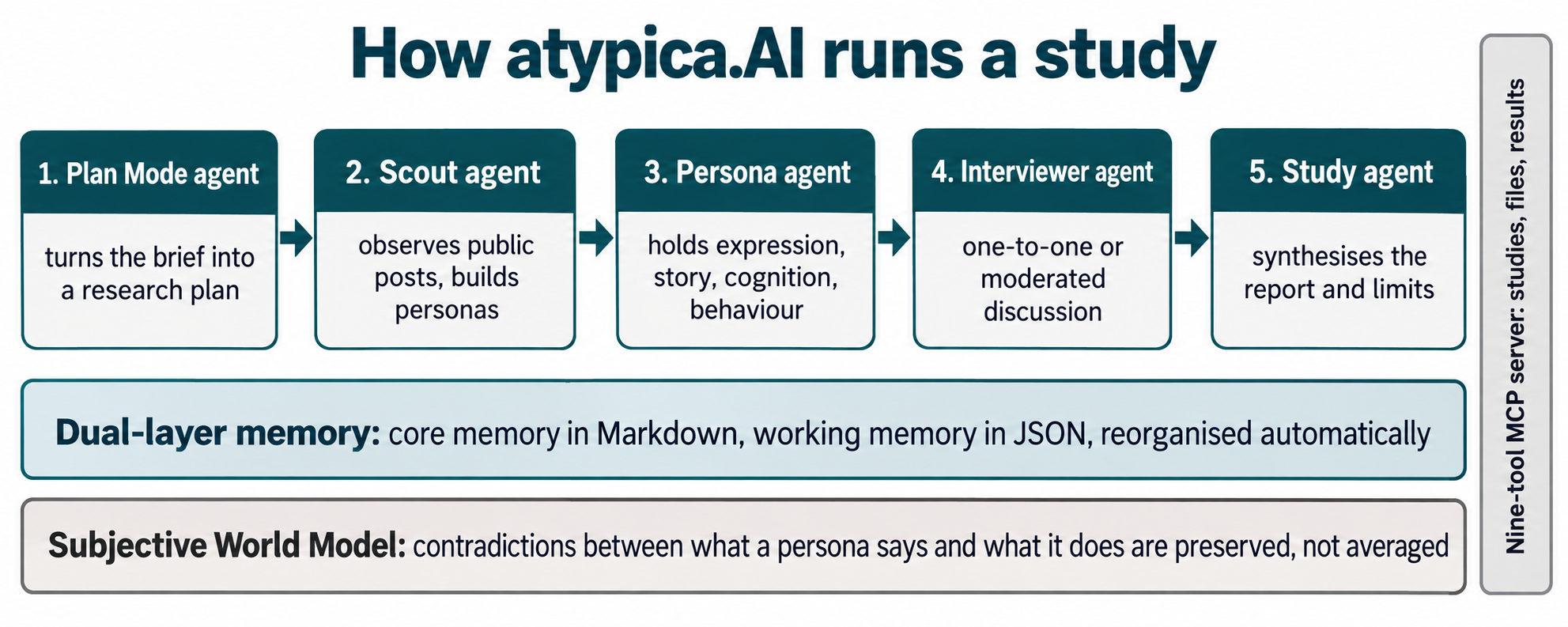
The research process, in the vendor's seven steps: clarify the problem, design the tasks, browse social data, build personas, simulate the interviews, summarise, generate the report. The vendor states an average research time under thirty minutes.
What the product refuses, in its own documentation: sensory judgements such as the taste of a drink, reactions to an interface the model has never encountered, and products that do not exist yet. It also states that synthetic respondents are useful for direction and pressure-testing and not for final-go confidence on high-stakes decisions. Those refusals are unusual in this category and they are part of why this review's Quality score is not lower.

atypica.AI: synthetic respondents for consumer research you can question
Getting Started with atypica.AI
Required accounts: an atypica.AI account. The pricing page lists paid plans from $20 a month and no free row; the help centre describes a free tier with monthly caps, and the changelog grants 600,000 tokens on signup with further tokens earned through sharing and referrals. A reader should expect a usable free allowance at signup and should not expect it to persist as a plan.
Installation: none. The product runs in a browser. For agent use, add the atypica MCP server to your client, or install the atypica-research skill from skill0.io.
First-time configuration:
Create the account at https://atypica.ai and confirm the token balance under the usage panel.
Choose a workspace: personal or team. The two spaces are separated, and research, personas and memory do not cross between them.
Decide the first question. A decision question with a named audience works better than a topic, for example "would UK small-business owners pay £12 a month for a bookkeeping add-on that reconciles receipts automatically", not "research bookkeeping".
Pick the method. Use an interview for depth on why, a discussion for how a group argues, and a panel when you need the same question across segments.
Set the persona source. Use the public library for a first study, and only build custom personas when you have transcripts or a niche the library cannot represent.
First 15 minutes checklist:
☐ State one decision question with a named audience and a price, a concept or a choice in it.
☐ Run a five-persona interview and read the plan before confirming it, because the plan is where a misunderstood brief is visible.
☐ Open one transcript in full and check whether the five personas sound like five people or one person with five names.
☐ Pick two quotes from the report and search the transcripts for them. If a quote is not there, that is the finding, and it goes in your verification note.
☐ Export the report and the transcripts to your own storage before the session ends.
Result: a structured report, a transcript set and a verification note, produced in under an hour, which is enough to decide whether the tool is worth a second study and enough to show a supervisor or a manager how the finding was produced.
The pricing gate to know before you start: tokens are consumed by the study, and a typical study is about 400,000 tokens. A Pro allowance is 2 million tokens a month and expires after 30 days. A reader who runs a long interview set on Max and then stops for three weeks loses the remainder rather than banking it.

atypica.AI: synthetic respondents for consumer research you can question
Real Workflows
Workflow 1: A concept and price test before anything is built
Learner type: Student or professional CI-First benefit tags: Time, Quantity, Quality Connects to: UIB (Business Management, Entrepreneurship) Time estimate: 90 minutes, of which 25 minutes is the study and 65 minutes is reading and checking
What you do vs what the tool does:
Step | You do | The tool does |
1 | Write the decision as a choice with a price in it, and name the buyer | Turns the brief into a research plan with an objective, an audience and a method, and waits for confirmation |
2 | Correct the plan if the audience or the price point is wrong | Selects five to ten personas that match the audience, or builds them from your data |
3 | Read one full transcript before reading the summary | Runs the interviews, follows up on vague answers, and records each reply with the persona's reasoning |
4 | Check every quote used in the report against the transcripts | Synthesises segment findings, the evidence for each, and the assumptions and limitations |
5 | Test the two strongest objections against five real people | Returns the report, the transcripts and the persona set for reuse |
Sample prompt:
Context: I am testing a 6-week online course on applied AI for small-business owners in the UK. The course costs GBP 480. I have no list yet and no prototype.
Role: AI as a research planner and interviewer. I own the decision and the evidence record.
Profile: Act as an Analyst and Tester, the one this task needs. Design the study and interview the panel, and show me the reasoning behind each finding.
Task: 1. Restate my decision as a testable question. 2. Propose a five-persona panel with a reason for each persona. 3. Run a 20-minute interview on price, time and credibility. 4. Return the three objections that would stop a purchase, each with a supporting quote and the transcript location. 5. List what this study cannot tell me.
Constraints: Do not invent market size, conversion rates or competitor prices. If the panel cannot answer something, say so rather than estimating it.
Output format: a one-page brief, then findings by objection, then a closing section headed What This Study Cannot Tell You.
Memory: this study keeps no standing instruction of its own, so I will store the brief and the findings in my LIPS project record.
UP-Context verification: I checked that each quoted line exists in the transcript and that the five personas gave different reasons, not the same reason in different words.
Data safety: this pack carries no personal data. I do not paste customer names, contact details or unpublished financials into it.
Verification checklist:
☐ Multi-Model Check: put the same brief to a general-purpose model and compare the objections it predicts with the ones the panel raised. Divergence is a signal about the brief, not about the buyer.
☐ External Source: check any market, price or competitor claim in the report against a named published source. The report should contain none of those claims if the brief forbade them.
☐ Human Review: a supervisor or colleague reads the report cold and states which finding they would bet money on. If they cannot, the report is not ready.
☐ CI-First Test: can you explain and defend the three objections, and their limits, without reopening the tool? [Y/N]
What good looks like. Five personas with five different reasons for hesitating, at least one of which you had not considered, and a limitations section that names the missing evidence rather than apologising for it. What bad looks like: five personas who all say the price is too high for the same reason, in the same sentences. That is convergence, and the vendor's own evaluation writing names it as a failure mode.
Workflow 2: A brand positioning stress test with a discussion group
Learner type: Professional CI-First benefit tags: Time, Quality, Skill Connects to: UIC (Digital Communication, Marketing) Time estimate: 2 hours, of which 30 minutes is the discussion and 75 minutes is checking the language against real audience material
What you do vs what the tool does:
Step | You do | The tool does |
1 | Write the current positioning in one sentence and the positioning you are considering in one sentence | Frames the comparison as a study and proposes a discussion format |
2 | Choose the segment and exclude the wrong buyers explicitly | Builds or selects a panel of three to eight personas and moderates the discussion |
3 | Read the clash, not the consensus, and note where personas change their minds | Runs focus-group, roundtable or debate format and records the exchange |
4 | Collect twenty real posts or reviews from the same segment and compare the vocabulary | Returns the language the panel used, by segment, with the evidence attached |
5 | Rewrite the positioning in your own words and keep the version with the strongest objection attached | Produces the report and the transcript for the record |
Sample prompt:
Context: A skincare brand sells a refillable moisturiser at GBP 38. Current positioning is "clinical results, no compromise". A cheaper competitor has taken the entry price. The team is considering "refill and repeat" as the new position.
Role: AI as a moderator and analyst. I own the positioning decision and the brand voice.
Profile: Act as a Challenger and Devil's Advocate, the one this task needs. Argue against both positionings before you evaluate them.
Task: 1. Run a discussion with six buyers aged 25 to 40, mixed between subscribers and churned customers. 2. Force a debate, not a consensus, and record where a persona changes position. 3. List the words each side uses for value, waste and trust. 4. Name the objection that would survive a price cut.
Constraints: Do not produce campaign copy. Do not invent a competitor price. Quote the transcripts, not a paraphrase, and flag any quote you cannot locate.
Output format: a positioning comparison table, then the surviving objection, then a closing section headed What This Discussion Cannot Establish.
Memory: this study keeps no standing instruction of its own, so the positioning decision and the quotes go into the brand's LIPS record.
UP-Context verification: I checked that the panel disagreed on reasons, that every quoted phrase appears in the transcript, and that I have not mistaken a simulated quote for a customer quote.
Data safety: this pack carries no personal data. I do not paste customer names, order records or unpublished sales figures into it.
Verification checklist:
☐ Multi-Model Check: run the same two positionings past a general-purpose model as a devil's advocate and compare the objections. Where both agree, the objection is probably structural.
☐ External Source: sample twenty real reviews, posts or support tickets from the same segment and compare the words. The panel's vocabulary is a hypothesis until real material confirms it.
☐ Human Review: the brand owner reads the surviving objection and says whether it is already known. A finding that surprises nobody has not earned its place.
☐ CI-First Test: can you state the surviving objection and the evidence for it in two sentences without the report open? [Y/N]
Workflow 3: A method audit, where the tool is the object of study
Learner type: Student, researcher or anyone learning qualitative method CI-First benefit tags: Skill, Quality Connects to: CARE, a U365 method surface Time estimate: 3 hours across two sessions, which is the point of the exercise
What you do vs what the tool does:
Step | You do | The tool does |
1 | Write one brief and run it against a five-persona public-library panel | Designs, interviews and reports, as in Workflow 1 |
2 | Run the same brief again with three personas built from three real interview transcripts you hold | Builds private personas from your data and runs the same method |
3 | Compare the two reports for convergence, evidence amplification and invented quotation | Returns two reports and two transcript sets |
4 | Score both reports against the vendor's own six failure modes | Produces the material; it does not score itself against them |
5 | Run three real interviews on the same brief and write down what neither report anticipated | Nothing, and that is the lesson |
Sample prompt:
Context: I am learning qualitative research method. I have three real interview transcripts from a previous project and permission to reuse them anonymously. I want to compare a public-library panel with a panel built from those transcripts.
Role: AI as a research assistant and a subject of study. I own the method judgement and the record.
Profile: Act as a Professor, Coach and Tutor, the one this task needs. Show the design decisions and explain why each one matters.
Task: 1. Build three private personas from the uploaded transcripts and describe what each one is grounded in. 2. Run the same five-question brief on both panels. 3. Compare the two outputs for participant convergence, evidence amplification, fabricated quotation and overstated coverage. 4. Explain what the comparison teaches about sampling, interviewing and synthesis.
Constraints: Do not merge the two panels. Do not present a simulated quote as a customer quote. Name any judgement you cannot support from the transcripts.
Output format: a comparison table by failure mode, then a one-page method note, then a closing section headed What I Still Need to Learn from Real Interviews.
Memory: this study keeps no standing instruction of its own, so the comparison and the method note go into my LIPS learning record.
UP-Context verification: I checked each failure-mode judgement against the transcripts and wrote down which ones I could not settle.
Data safety: this pack carries personal data from three interviews. I uploaded anonymised transcripts only, with names, employers and locations removed.
Verification checklist:
☐ Multi-Model Check: ask a second model to score both reports against the same four failure modes and compare its judgements with yours.
☐ External Source: the three real interviews are the external source. Every claim in the method note must be traceable to one of them or marked as untested.
☐ Human Review: a methods tutor reads the comparison and challenges one judgement. If none can be challenged, the comparison is too soft.
☐ CI-First Test: can you explain what the simulated panel missed and why, without the tool open? [Y/N]
Why this workflow carries the Skill score. The first two workflows use the product to produce an answer. This one uses the product to learn how an answer is produced, and it is the only workflow in which the user leaves more capable than they arrived. A reader who runs only the first two is buying output. A reader who runs the third is buying a method.

atypica.AI: synthetic respondents for consumer research you can question
Strengths, Limits, and AI Imposture Risk
Strengths
The tool delivers clear CI-First benefits in these areas:
CI-First Benefit | Strength | Evidence |
Time | A study that would take weeks of recruitment and synthesis is designed, run and reported in under an hour of machine time | The vendor states an average research time under 30 minutes; a five-persona interview plus report is a single session. The saving survives the reading time, because the reader reads one report instead of commissioning and chasing a fieldwork project |
Quantity | Questions that were too small to commission become affordable, so a team tests five concepts instead of one | Token pricing at about 400,000 tokens per typical study, with a Pro allowance covering roughly five studies a month; personas and panels are reusable across studies |
Quality | The report carries its evidence, its assumptions and its limitations, and the transcript sits behind every quote | Structured report with segment findings and an evidence section; the vendor's own evaluation writing names fabricated quotation and evidence amplification as failure modes it monitors, which is a quality control most tools in the category do not publish |
Skill | The study design, the interview guide, the transcript and the failure modes are all visible, so the product can teach method as well as produce findings | Workflow 3 uses the product as the object of study; the guides explain method choices rather than only features; the research section publishes how the vendor evaluates its own agent |
Limits
A simulated answer is not evidence about a population. The product models a consumer; it does not sample one. Nothing in the report supports a sentence about what share of a market thinks something, and the vendor says as much. A reader who quotes a percentage from a persona study has misused the tool.
Personas can converge. The vendor's own evaluation post records a beverage study in which eight participants with different jobs, ages and lifestyles gave essentially the same answer, in almost the same words. Convergence is the failure mode that makes a study look rich and be empty, and it is invisible in the executive summary.
A report can contain a quotation nobody said. The same post records a report that attributed a sentence to a 26-year-old participant which appeared nowhere in the transcripts. The vendor found it by going back through the transcripts. A reader who does not do the same will publish it.
Token accounting is unforgiving for occasional users. Tokens expire after 30 days, the allowance is consumed by planning and persona building as well as interviewing, and a long study can outgrow a plan. The vendor's 400,000-token figure is a typical study, not a cap.
The documentation is split between two commercial regimes. The pricing page is in dollars with Pro, Max, Growth and Enterprise. The help centre is in yuan with Free, Professional and Team and monthly caps by interview count. Both were live on the same day. The changelog explains the migration, but a reader should not have to reconcile three surfaces to learn what a study costs.
The current model providers are not named. Early changelog entries name Claude 3.7 Sonnet, GPT-4o and Gemini 1.5 Flash. The current documentation refers to a new generation without naming a provider, so a buyer cannot tell which model processes confidential transcripts, or where.
No report editor. The platform generates reports and has no built-in editor. Editing means exporting and working elsewhere, which breaks the link between the edited document and the evidence behind it unless the team maintains the export deliberately.
Visual, sensory and speculative questions are out of scope. The vendor refuses them explicitly. A design or product team should read that refusal as the boundary of the tool rather than as a roadmap gap.
AI Imposture Risk
Time Illusion
Rating. Medium
Evidence. The machine time is genuinely short: a study runs in under thirty minutes and a report arrives finished. The net saving is smaller than the headline because the reader must frame the decision, read the plan, read at least one full transcript, check quotes against transcripts and test the finding against real people. A reader who does the first two and skips the last three experiences the illusion in its purest form: a research artefact in the time it takes to make coffee, with no research behind it. The saving is still real for a reader who does the checking, which is why the rating is Medium rather than High.
Quantity Illusion
Rating. Medium
Evidence. The product can produce many studies, many personas and long, well-formatted reports with segment findings and recommendations. The volume is real; the risk is that polished prose and a cover page read as evidence. Two facts keep this at Medium rather than High. The transcripts are one click away and the report states its assumptions and limitations, so a diligent reader has what they need to check it. And the vendor's own comparison page tells readers to validate against real users before committing meaningful budget. The risk is concentrated in the reader who forwards the executive summary and never opens the transcript.
Skill Illusion
Rating. High
Evidence. A user can complete a study, receive a structured report and believe they have done research without having designed a sample, conducted an interview or analysed a transcript. The product's own memory makes the illusion durable: it keeps a core memory in Markdown and a working memory in JSON, reorganises and compresses that memory automatically when a threshold is crossed, and carries it into the next study, so the system appears to know the business better than the person operating it. A user who never reads what was written into memory holds a documented capability they did not author, and the automatic reorganisation happens without a per-write decision. That is the condition clause 5.2.3-a rates High. The mitigating fact is that the method is visible for anyone who looks: the plan, the guide, the transcript and the failure modes are all on screen, which is why the benefit score still credits Skill at 5 rather than treating the product as pure delegation.
Overall Imposture Risk: Medium. Two traps are Medium and one is High, and the High is rated with the mitigations stated above: read the transcript, check the quotes, read what the memory holds, and test any decision that costs money against real respondents. Under the v1.3 band rule, one High with clear mitigations stated sits at Medium, not High. Remove those mitigations and the rating moves to High, because the product's core output is testimony from people who do not exist.
Framework v1.2 clause note
Clause 5.2.3-a, agent-authored procedural memory: APPLIES, and the Skill Illusion rating is High. atypica.AI writes and revises a memory store on the user's behalf. The About page describes core memory in Markdown and working memory in JSON, with automatic reorganisation, smart compression, deduplication and version management triggered when a threshold is exceeded. The user does not approve each write, and the memory travels into subsequent studies. The clause sets a floor of Medium for any tool that writes such memory, and High where the agent can revise it during use without a per-write human decision, which is the mechanism here. The mitigating control is that the memory is inspectable and editable, which changes the severity of the consequence but not the rating, because the rating rests on the mechanism rather than on the user's diligence.
Clause 4.2-a, agent-mediated conversation: NULL. The product generates simulated respondents and reports their words. It does not draft a person's message to another person, and it does not present agent-authored text in a human-facing channel as the person's own voice. The condition that would trigger the clause is a team publishing a persona quote as a customer quote, which is a misuse of the output rather than a mechanism the product ships. That misuse is covered under Quantity Illusion and under the verification checklist, not under this clause.
Clause 7.5: NULL, recorded for completeness. The subsection was removed from the framework on 2026-10-13, and nothing in this product reaches its case.

atypica.AI: synthetic respondents for consumer research you can question
Section 7c: The accuracy figure is a consistency score, and the benchmark's results are not published
Five findings sit behind the score, and a reader deciding whether to spend money should read them before the pricing table.
First, the headline accuracy numbers measure consistency, not correctness. The About page gives three tiers: social-media personas at 79 percent, deep-interview personas at 85 percent, and proprietary human personas kept private. The 2025 product post explains the scale. A person asked the same question two weeks apart agrees with themselves about 81 percent of the time, so the vendor uses 81 percent as the consistency baseline and sets it as a standard score of 100. On that scale, a deep-interview persona scoring 85 percent is reproducing a person's answers more consistently than the person reproduces themselves. That is a meaningful result about simulation stability. It is not a statement that 85 percent of the persona's answers are true about a population, and a reader who carries the number into a board paper as "85 percent accurate" has changed its meaning. The vendor's own writing is careful about this distinction. The marketing surface is less careful, which is where the misreading will happen.
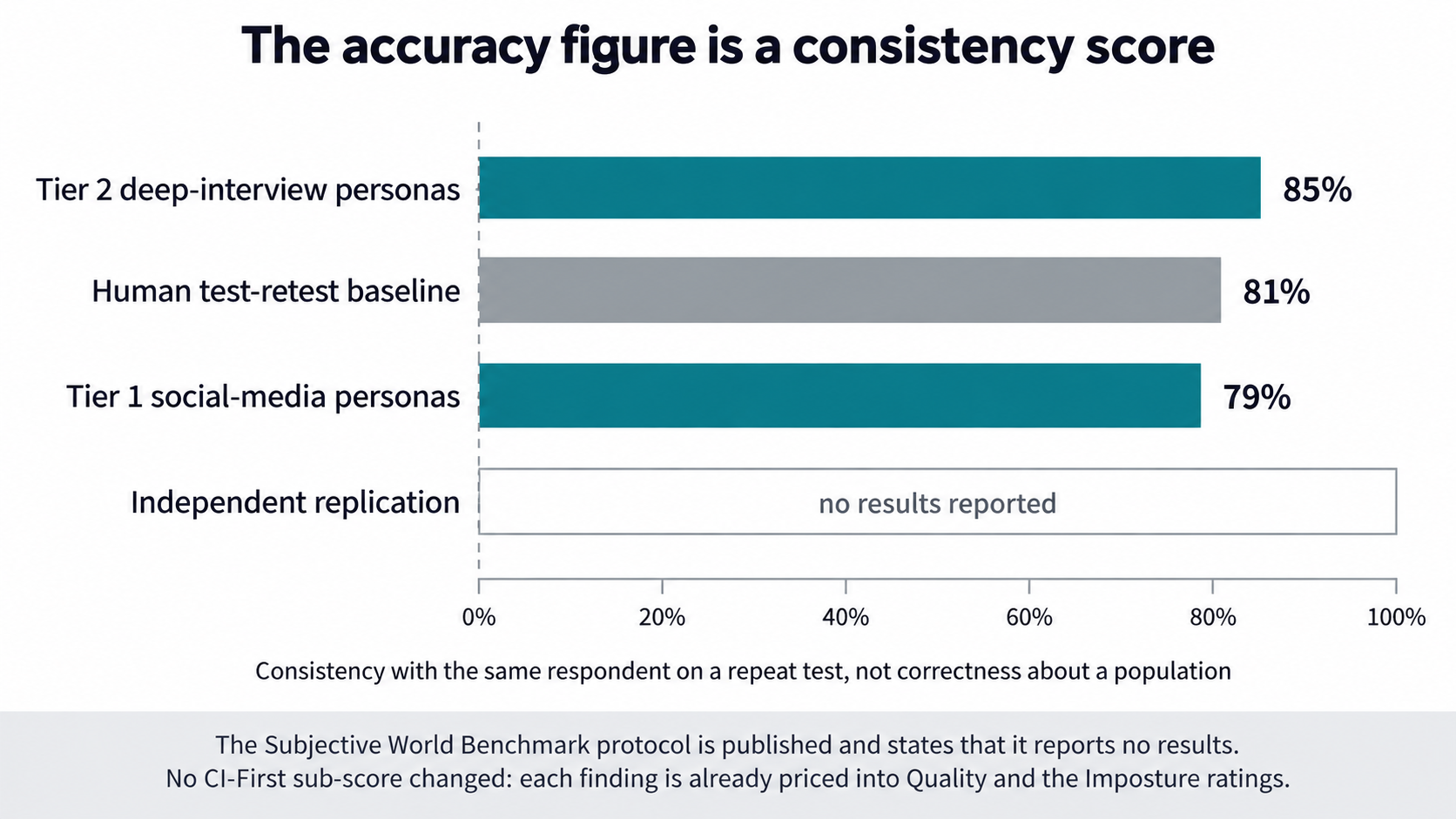
Second, the benchmark claim has no published results behind it. The homepage states that the Subjective World Benchmark holds out real answers from 7,300 people and that the agent leads general-purpose frontier models by 13 to 20 points across six benchmarks. The research index carries an evaluation protocol dated 2026-06-23, described as an end-to-end protocol for opinion expression and cognition prediction, and the protocol states that no results are reported there. The protocol is a serious document and publishing it before the results is better practice than publishing neither. But the 13 to 20 point lead is, on the pages reviewed, a vendor summary without a results paper, a data appendix or an independent replication. A reader should treat it as a claim and should ask for the underlying study.
Third, the most damaging evidence about the product is the vendor's own, and it is specific. The evaluation post published on the site describes two failures found in real studies before they were on any checklist. In one beverage study, eight participants with different jobs, ages and lifestyles gave essentially the same answer, and the report presented it as a segment finding. In another, a report quoted a 26-year-old saying she would reward herself with a drink after working late, a sentence that appeared in no transcript, and the client had already singled it out. The vendor turned both into monitored failure modes, alongside shallow interviewing, evidence amplification and overstated coverage, and reports checking more than 1,500 studies with an LLM judge after fewer than 300 pieces of expert feedback. That disclosure is the strongest quality signal in this review and the strongest warning in it: the failure modes are real, they survived into client-facing reports, and they are exactly the ones a reader is least likely to catch alone.
Fourth, the persona data is other people's public speech. The default library is built from public expression on Instagram, TikTok, Reddit, X, RedNote and Douyin, and the platform states that uploaded data is isolated per account and not used to train models. That answers the question a buyer asks about their own material. It does not answer the question the people whose posts were used might ask, because they did not agree to be modelled and there is no published opt-out for a member of the public whose writing underpins a persona. The enterprise product moves in the opposite direction, building private personas from the buyer's own data, which is a cleaner consent position. A university using the public library for teaching should say plainly in its ethics documentation that the respondents are synthetic and that the underlying data is public social material.
Fifth, the compliance badges are badges. The pricing page marks Enterprise "SOC2 Compliant" and the enterprise page states "ISO 27001 & SOC 2". Neither page links to a certificate, an audit report or a trust centre, and no subprocessor list was found on the pages reviewed. For a product that asks a brand to upload interview transcripts and customer data, the report matters more than the badge. This is not an allegation that the certification is absent. It is a statement that the pages reviewed do not evidence it, and that a procurement review should ask.
No sub-score changed on account of these findings. They are already priced into Quality at 6 and into the Imposture ratings, and they are the reason the review recommends the product for directional work with a verification workflow rather than as a replacement for customer contact.

atypica.AI: synthetic respondents for consumer research you can question
U365 Co-Intelligence Rating
CI-First Profile
Primary profile: Analyst and Tester (level 4) Secondary profiles: Co-Creator and Thought Partner (level 1), Co-Worker and Assistant (level 2)
The product's main act is to test a proposition and report what it found, which is the Analyst and Tester role. It becomes a Co-Creator when a team uses the discussion format to generate positioning options or to argue a concept into shape, and a Co-Worker when it produces the report, the export and the podcast. It is not a Professor, Coach and Tutor in its own right, because it does not teach the user method unless the user chooses to study the design. That choice is Workflow 3.
CI-First Benefit Score
Time
Score. 7
Rationale. A study that would take weeks of recruitment and synthesis runs in under an hour of machine time, and the reading load is one report plus enough transcript to judge it. Held below 8 because the honest reader spends one to three hours framing, reading and checking, and because a study that is not checked saves nothing at all.
Quantity
Score. 6
Rationale. Questions that were too small to commission become affordable, and personas and panels are reusable, so the volume of usable research rises by roughly two to three times for a regular user. Held at 6 because volume that has not been checked is not usable volume, and because token expiry penalises occasional use.
Quality
Score. 6
Rationale. The report carries its evidence, its assumptions and its limitations, and the transcript sits behind every quote, which is a clear improvement on a team's own baseline of no research or a general-purpose model's invented one. Held at 6 because the output is a model of a consumer rather than a consumer, because convergence and fabricated quotation are documented failure modes in shipped reports, and because the accuracy claim has no published results.
Skill
Score. 5
Rationale. The design, the guide, the transcript and the failure modes are all visible, so a deliberate user can learn method from the product, which is more than most tools in the category offer. Scored conservatively because the common use is delegation: a user who runs studies and reads summaries learns to commission research, not to conduct it, and the automatic memory makes the system appear more competent than its operator.
CI-First Benefit Score: 6.0 / 10 (CI-First Positive)
The band is a real recommendation. A tool at 6.0 delivers clear net benefit for most users and is worth adopting with disciplined usage. It is not CI-First Strong, because the output is directional rather than evidentiary and the verification burden is carried by the reader rather than by the product. A reader who wants a number to defend to a sceptical stakeholder will not find it here, and the vendor does not claim they will.
Humics Protection Badge
Creativity
Rating. Neutral
Rationale. The product can spark a team's thinking by putting an unexpected segment, objection or piece of language in front of it, and it can equally replace the act of imagining a customer with a panel that answers on the team's behalf. It neither trains nor erodes ideation by design, so it scores 0.
Critical Thinking
Rating. Neutral
Rationale. The product is unusually transparent for its category: it publishes its protocol, names its own failure modes, states its limitations on every report and refuses questions it cannot simulate. Those features reward a critical reader. The same output, forwarded as an executive summary, invites a decision-maker to accept testimony from people who do not exist. Protection and erosion balance, so it scores 0.
Social Authenticity
Rating. Neutral
Rationale. The product researches what people say; it does not write in the user's voice or mediate the user's relationships. Clause 4.2-a returns a null. The dimension is not engaged, so it scores 0.
Humics Protection Score: 0 / +3 Badge: Humics-Neutral
Superhuman Usage Guidance
When to invite this tool:
A decision question that is currently answered by opinion, where a directional read is worth more than no read at all: a concept, a price point, a message, a segment definition.
An audience that is expensive or slow to reach, where a simulated panel is a rehearsal for the three real conversations you will have later.
A recurring question where a private panel built from your own transcripts compounds in value across quarters.
A methods course or a supervised project where the study design and the failure modes are the lesson.
When to keep this tool out:
Any decision with money, safety, regulation or reputation at stake that will not be tested against real people afterwards.
Representative or quantitative claims: share of market, willingness to pay at a stated level, forecast adoption.
Sensory, physical or interface questions, which the vendor itself refuses.
Confidential material on an unverified contracting entity, or on a plan whose data terms you have not read.
As a substitute for customer contact by a team that has stopped talking to customers.
U365 method integration:
LIPS + CARE: LIPS is the record of the study: the brief, the plan, the transcript, the report and the verification note. CARE is the discipline: collect the decision, act by running the study, review the transcripts and the failure modes, execute only after the finding has been tested against real people. The product is fast at the act step and useless without the review step.
ULM + EVA: the product touches Career and Quality of Life most directly, through better decisions about products and services a learner buys or builds. EVA applies to the study itself: evaluate the report against the transcripts before you act on it.
UP-Context: the brief is where UP-Context does its work. A named audience, a price, a constraint and a stated decision produce a usable plan; a topic produces a generic report. Every prompt pack in this review follows the house structure for that reason.
SL-OS: reports and transcripts export to Markdown, PDF, Word and JSON, so the output belongs in the project record rather than in the tool. There is no Microsoft 365 integration, so a learner working in OneNote or SharePoint exports deliberately and links the file.
UNOP: weak on its own, because the product produces rather than teaches. It becomes an UNOP instrument only through Workflow 3, where the learner studies the design and the failure modes rather than the finding.
Over-delegation warning: the failure mode with this tool is a person who stops talking to customers and starts commissioning panels. It looks like research: there is a brief, a method, a report, a limitations section and a quote for every claim. Nobody in the room has spoken to a buyer. Over a quarter, the team's picture of its customer becomes a picture of a model of its customer, and the drift is invisible because the reports keep agreeing with each other. The check is simple and non-negotiable: every simulated study that informs a real decision is followed by at least three real conversations, and the differences are written down. If you cannot name the last real customer you spoke to, the tool is not augmenting your judgement. It is replacing it.

atypica.AI: synthetic respondents for consumer research you can question
What Users Say
Aggregate Rating Table
Platform | Rating | Number of reviews | Link |
Product Hunt | 5.0 / 5 | 2 reviews, 55 followers, 15 points | |
Slashdot | No rating | 0 ratings | |
Insight Platforms | Listed, no rating | 0 | |
G2 | No listing found on 2026-10-22 | Not applicable | |
Capterra | No listing found on 2026-10-22 | Not applicable | |
Trustpilot | No listing found on 2026-10-22 | Not applicable | |
No substantive thread found on 2026-10-22 | Not applicable | ||
Futurepedia and FutureTools | No listing found on 2026-10-22 | Not applicable | Not applicable |
The table records what exists, not what is missing for its own sake. Searches for the product name plus each platform returned no company page or product page on the date above. That is unusual for a product with enterprise logos and a two-year changelog, and it is a finding in itself: this is an enterprise-led product with a thin public review footprint, not a community tool with a vocal user base.
What Users Praise
The public evidence is two Product Hunt reviews and the launch thread. One reviewer praised the visual design and described watching the agent swarm converge on an unexpected but valid insight. The other called the form and the functionality unique and said they had been looking for such an application for some time. The launch comments, written by the team, frame the value as research that is 100 times faster and 100 times cheaper than the traditional route, and access for people who are not Fortune 500 companies. There is no larger body of user praise to summarise, and this review will not manufacture one from marketing copy.
What Users Complain About
There is no review corpus to draw complaints from, so the adverse evidence comes from three places. The first is a third-party directory review, which lists as drawbacks the absence of a permanently free plan, the 30-day token expiry, metered usage that makes a multi-study programme hard to forecast, and the platform's own stated capability boundaries. The second is the vendor's documentation, which concedes that the free tier runs out within a week of regular use, that the Professional tier caps custom personas at 50, and that some Team features were still rolling out when the guide was written. The third is the vendor's evaluation post, which records convergence and fabricated quotation in real studies. Those are not user complaints, but they are the complaints a user would have if the user could see the transcripts, and they belong in this section because they are the adverse evidence that exists.
Sentiment Summary
Overall sentiment: Insufficient public evidence to aggregate. Two positive reviews and no negative review corpus is not a sentiment reading.
Key themes:
Design and the visible agent process are what the few public reviewers noticed first.
The product is discussed as a category novelty, not as a routine tool with a settled user base.
Pricing and token expiry are the recurring practical objections in directory coverage.
The vendor's own writing is more candid about failure modes than its users' reviews are, which is unusual and worth weighing.
Enterprise logos and academic partner logos carry the credibility that the review platforms do not.
U365 Editorial Note
The absence of a review corpus does not contradict the CI-First evaluation, and it does not confirm it. It tells you where the product's trust comes from: vendor documentation, enterprise references and academic partner logos rather than a body of users reporting what worked. That is exactly the profile of tool where a reader should read the primary documents. The vendor's research writing earns credit here, because a company that publishes its own agent's failure modes, including a quote that nobody said, is giving a reader something most vendors hide. The same writing is the strongest argument for the Medium Quantity Illusion rating: the failures it describes are the ones a reader will not catch by reading the executive summary. Read the transcripts, check the quotes, and treat the two Product Hunt reviews as design feedback rather than as evidence of research quality.

atypica.AI: synthetic respondents for consumer research you can question
Comparison and Alternatives
Alternative | Choose the alternative if... | Choose atypica.AI if... |
You want structured synthetic interviews for product and UX discovery on an annual contract. Published plans start at $12,500 a year, and the vendor reports 85 to 92 percent theme parity with organic research in its own studies. | You need open-ended conversations, moderated group discussion and social observation in one study, and you want to pay monthly rather than annually. | |
You need B2B buyer research delivered as a managed service, with a consultancy attached and no self-serve work. The vendor reports an 88 percent similarity score against traditional research across more than 100 tests. | You want to run the study yourself, keep the transcripts, and reuse the panel next quarter. | |
Your question ends in a percentage. Virtual Audiences is built for survey-shaped work: define a segment, push a questionnaire, get a distribution. | Your question starts with why. Atypica is built for the follow-up question, the contradiction and the reason behind a choice. | |
You need real respondents at scale and a managed research operation. Salesforce announced a definitive agreement to acquire the company on 2026-09-29, and pricing is quote-only. | You need a directional read this week at a published price, and you accept that the respondents are simulated. | |
You have your own users and want AI-moderated voice interviews at about $10 per interview, or recruitment from a large panel. | You do not yet have users to interview, or the audience you need is unreachable, and a simulated panel is the only affordable first pass. | |
A general-purpose model | You want a first draft of a research plan, a list of questions, or a synthesis of documents you already hold, at almost no cost. | You want the interviews actually run, the transcripts kept, and the personas reusable, with a method imposed between the question and the answer. |
Where atypica.AI is clearly better. It is the only product in this comparison that combines a conversation-first method, a visible transcript and a monthly self-serve price. Synthetic Users is annual and structured. Evidenza is managed. Listen Labs uses real people, which is better evidence and a different budget. Yabble answers a different question. For a U365 Fellow, a lecturer or a small team that needs a defensible first pass this month, atypica.AI is the lowest-friction route from a decision to a documented hypothesis.
Where atypica.AI is clearly worse. It is worse than any tool that talks to real people, on the only dimension that ultimately matters: evidence about the world. Listen Labs, Outset and a recorded interview with five real customers will always beat a simulated panel on validity, and they cost accordingly. It is worse than Synthetic Users on published validation, because Synthetic Users puts a parity figure on its pricing page and atypica's benchmark carries no published results. It is worse than Evidenza for senior B2B audiences, where a managed service with named respondents answers the procurement question that a synthetic panel cannot. And it is worse than a general-purpose model on price and speed for the parts of research that are textual: drafting the guide, summarising a document, writing the discussion questions.

atypica.AI: synthetic respondents for consumer research you can question
Verdict and Next Steps
Who should adopt it: business, marketing and communication students, product and brand teams, founders and consultants who face a decision question that is currently answered by opinion, and who will test the finding against real people before spending money on it. When: before a concept, a price or a message is locked, and never as the last step before a launch. For what: a documented, interrogable first pass on why a segment thinks what it thinks, with the transcripts to prove how the answer was produced.
UP-Context prompt pack:
Context: I have one decision to make this week and no budget for fieldwork. The decision is [the choice], the audience is [who], and the constraint is [price, time, regulation].
Role: AI as a research planner and interviewer. I own the decision, the evidence and the record.
Profile: Act as an Analyst and Tester, the one this task needs. Design the study, run it, and show the evidence behind each finding.
Task: 1. Restate the decision as a testable question. 2. Propose a five-persona panel with a reason for each. 3. Run the interviews. 4. Return the three findings that would change my decision, each with a quote and its transcript location. 5. Name what the study cannot establish.
Constraints: Do not invent market size, conversion rates or competitor prices. Do not present a simulated quote as a customer quote. Say plainly when the panel cannot answer.
Output format: a one-page decision brief, findings by theme, and a closing section headed What This Study Cannot Tell Me.
Memory: this study keeps no standing instruction of its own, so the brief, the transcript and the findings go into my LIPS project record.
UP-Context verification: I checked every quoted line against the transcript and confirmed that the personas gave different reasons, not the same reason in different words.
Data safety: this pack carries no personal data. I do not paste customer names, contact details or unpublished financials into it.
Context: I have three real interview transcripts from last quarter, anonymised, and a new product question. I want to compare what my customers said with what a simulated panel says.
Role: AI as a comparison analyst. I own the interpretation and the decision about which evidence to trust.
Profile: Act as a Challenger and Devil's Advocate, the one this task needs. Argue against my preferred conclusion before you support it.
Task: 1. Build three private personas from the transcripts and state what each is grounded in. 2. Answer my question with those personas and with a public-library panel. 3. Show where the two panels disagree. 4. Name the finding that only the real transcripts support.
Constraints: Do not merge the panels. Do not smooth over a contradiction between what a customer said and what a simulated persona says. Flag any claim that rests on one transcript only.
Output format: a side-by-side table, then the disagreement that matters, then a closing section headed What the Real Transcripts Know That the Panel Does Not.
Memory: this study keeps no standing instruction of its own, so the comparison and the transcripts stay in my own project record, not in the platform.
UP-Context verification: I checked that each real quote is attributable to an anonymised transcript and that I have not let the simulated panel overwrite what a customer actually said.
Data safety: this pack carries personal data. I uploaded anonymised transcripts only, with names, employers and locations removed.Context: I am teaching qualitative method and I want students to see how a synthetic study fails, not only how it succeeds.
Role: AI as a teaching assistant and a subject of study. I own the assessment and the learning record.
Profile: Act as a Professor, Coach and Tutor, the one this task needs. Explain the design decisions and where each one can go wrong.
Task: 1. Run one brief on a five-persona panel. 2. Report the result as if it were a client study. 3. Then audit your own report for participant convergence, evidence amplification, fabricated quotation and overstated coverage, quoting the transcript for each judgement. 4. Write five questions the students should ask any research report, simulated or real.
Constraints: Do not repair the report before the audit. Do not claim a quote exists unless it appears in the transcript. Name any judgement the transcript cannot settle.
Output format: the client-style report, then the audit table, then a closing section headed Five Questions to Ask Any Research Report.
Memory: this study keeps no standing instruction of its own, so the audit and the five questions go into the course's LIPS record.
UP-Context verification: I checked the audit against the transcripts myself and marked the judgements the transcripts could not settle.
Data safety: this pack carries no personal data. I do not paste student names, grades or unpublished course material into it.Related U365 content
The INSIDE Tools review library, for the reviews this one is calibrated against, including Gemini 4 Argon and Perplexity AI: https://www.university-365.com/tools
The CI-First Evaluation Framework, version 1.4.1, which sets every score in this review: https://www.university-365.com/ci-first
The INSIDE Tools review template, for the section structure and the prompt-pack house elements: https://www.university-365.com/tools

atypica.AI: synthetic respondents for consumer research you can question
Status and Last Tested
Status: Active | Last tested: 2026-10-22 | Re-check: trigger-based (max 6 months)
The status is Active because the product is current, generally available, priced publicly at the entry tier and recommended for the directional research use cases this review names. It is not Risky: the failure modes are documented by the vendor and mitigated by a verification workflow a reader can run, and nothing in the product is unsafe to use. It is not Active (updated), because this is the first U365 review of atypica.AI rather than a refresh of an earlier one. The version reviewed is the product state recorded in the changelog as v2.0.0, dated 2026-09-05, with the pricing and plan changes of 2026-08-29 and the token-earning update of 2026-10-21 read on the same day as the review. The eight re-check triggers at the top of this review govern the next pass.

atypica.AI: synthetic respondents for consumer research you can question
Migration Path
Not applicable. atypica.AI is an Active tool and is not being retired, deprecated or superseded. A reader who is migrating towards it from a general-purpose model should expect to change how they work rather than only which tool they open: a brief with a named decision and a named audience, a plan they read before confirming, and a verification note they write after the report. A reader migrating away from a managed research agency should expect to lose the recruiter, the real respondents and the fieldwork quality control, and should keep the agency for any study where the answer will be defended publicly.

atypica.AI: synthetic respondents for consumer research you can question
U365's Recommendations to Learn More
These resources were curated for a reader who wants to go deeper than this review. We prioritise material that teaches something the review does not cover.
Official learning resources
The user guides: 32 task-oriented pages covering persona building, interview and discussion setup, report reading, data handling and billing. The two worth reading before you spend anything are the persona-tier guide and the data privacy page. https://atypica.ai/guides
The data privacy and security guide: what is isolated, what is not used for training, what is logged and what happens on deletion. The most useful page on the site for a procurement conversation. https://atypica.ai/guides/data-privacy-security
The research index: the evaluation protocol, the enterprise trust study and the agent-evals post. The evals post is the one that changes how you read every report the product produces. https://atypica.ai/research
The changelog: the commercial history in one page, including the plan migration, the token panel and the 2026-10-21 token-earning update. https://atypica.ai/changelog
The vendor's own category comparison: where it says plainly that synthetic respondents are for direction and pressure-testing, not for final-go confidence. https://atypica.ai/features/atypica-vs-synthetic-research-tools
The MCP page: the limits of the integration, including the fact that servers are configured by an admin and that every call counts toward tokens. https://atypica.ai/features/mcp-integration
Written deep-dives
AI User Research Agent Evals, by the atypica team: the failure-mode method, the eight participants who sounded like one person, the quotation that nobody said, and the argument for evaluating the step rather than the report. The single most useful document for a user of this tool. https://atypica.ai/research/ai-user-research-agent-evals
What Enterprises Really Ask Before Trusting AI with Consumer Research: 36 enterprise evaluations condensed into a trust map. Useful for the objections a buyer will meet. https://atypica.ai/research/synthetic-consumer-trust-map
Synthetic Users pricing page, for the published annual minimum and the vendor's parity claim, as the comparison a buyer will make. https://www.syntheticusers.com/pricing
The Market Research Cost report from Market Intelligence Tools, for the published price points across 27 vendors, including the $12,500 annual floor for synthetic research and the quote-only enterprise tools. https://marketintelligencetools.com/reports/market-research-cost
Video tutorials and channels
Two category explainers are worth the time. Neither is a tutorial for atypica.AI, and neither is presented as one.
#616: Synthetic personas in market research, with Ali Henriques of Qualtrics, on The Agile Brand with Greg Kihlstrom. A vendor-side practitioner explains what a synthetic respondent is, how a persona is built, and where the method sits against traditional research. It supplies the vocabulary the atypica guides assume. https://www.youtube.com/watch?v=nazM4j1LjTE
Synthetic User Research Explained, How AI Is Changing UX, from UX India. A product designer describes building a sixty-persona library, then discusses reliability, ethics and where human validation has to step in. The closest thing to an independent counterweight to the vendor's own framing. https://www.youtube.com/watch?v=o3Ex5o8ewUM
Community and social
Product Hunt listing: the launch thread and the two reviews, useful for the first-impression reaction rather than for a research judgement. https://www.producthunt.com/products/atypica-ai
Insight Platforms profile: a neutral directory entry that places the product in the synthetic data category. https://www.insightplatforms.com/platforms/atypica/
Resources on X
Dedicated X channels. The product account is @atypica_ai, which carries launch notes, research posts and product updates. It is the only X channel the vendor's own site links to.

@atypica_ai, the product account: https://x.com/atypica_ai

atypica.AI: synthetic respondents for consumer research you can question
CI-First Evaluation Summary Card
Field | Value |
Tool | atypica.AI, a product of BMRLab, listed among Tezign's professional products |
Category | Applied AI / consumer research (synthetic respondents, qualitative research workflow) |
Version reviewed | Product state v2.0.0, changelog dated 2026-09-05, with the plan changes of 2026-08-29 and the token update of 2026-10-21, read on 2026-10-22 |
Status | Active |
Last tested | 2026-10-22 |
CI-First Profile | Primary: Analyst and Tester (level 4). Secondary: Co-Creator and Thought Partner (level 1) in the discussion and concept formats, Co-Worker and Assistant (level 2) in report production |
CI-First Benefit Score | 6.0 / 10 (CI-First Positive) |
Time | 7, a research cycle compressed from weeks to under an hour of machine time, held below 8 by one to three hours of framing, reading and checking and by the fact that an unchecked study saves nothing |
Quantity | 6, questions too small to commission become affordable and panels are reusable, held at 6 because unverified volume is not usable volume and tokens expire after 30 days |
Quality | 6, evidence, assumptions, limitations and transcripts attached to every report, held at 6 because the respondents are simulated, convergence and fabricated quotation are documented in shipped reports, and the accuracy claim has no published results |
Skill | 5, the design, guide, transcript and failure modes are visible enough to teach method, scored conservatively because the common use is delegation and the memory makes the system look more competent than its operator |
Humics Protection Badge | Humics-Neutral (0 / +3) |
Creativity | 0 Neutral: can spark a team with an unexpected segment or objection, and can replace the act of imagining a customer; it neither trains nor erodes ideation by design |
Critical Thinking | 0 Neutral: the published protocol, stated limitations and refusal of unsimulable questions reward a critical reader, while a forwarded executive summary invites belief in testimony from people who do not exist |
Social Authenticity | 0 Neutral: the product researches what people say, it does not write in the user's voice; clause 4.2-a returns a null |
AI Imposture Risk | Medium overall |
Time Illusion | Medium: a finished report in under thirty minutes, against a real overhead of framing, transcript reading, quote checking and validation against real people |
Quantity Illusion | Medium: long, formatted reports with segment findings that read as evidence, mitigated by the transcript being one click away and by the vendor telling readers to validate against real users |
Skill Illusion | High: a user can complete a "study" without designing a sample or analysing a transcript, and the dual-layer memory with automatic reorganisation carries a documented capability the user did not author into every later study |
Clause 5.2.3-a | APPLIES. Core memory in Markdown and working memory in JSON are reorganised, compressed and deduplicated automatically when a threshold is crossed, without a per-write human decision, and the memory travels into later studies. The clause sets a floor of Medium and High where revision happens during use without approval; the rating is High. The memory is inspectable and editable, which reduces the consequence and not the rating |
Clause 4.2-a | NULL. The product generates simulated respondents and reports their words; it does not draft a person's message to another person or present agent text in a human-facing channel as the person's own voice. Live condition: a team publishing a persona quote as a customer quote |
Clause 7.5 | NULL, recorded for completeness; the subsection was removed from the framework on 2026-10-13 |
Section 7c finding | The published accuracy figures are consistency scores against an 81 percent human test-retest baseline, not correctness against a population; the Subjective World Benchmark's protocol states that no results are reported; the vendor's own evaluation post documents participant convergence and a fabricated quotation in real studies; the public persona library is built from other people's public posts with no published opt-out; and the SOC 2 and ISO 27001 claims appear as badges without a published report. No sub-score changed, because each finding is already priced into Quality and the Imposture ratings |
Superhuman usage | Invite for directional concept, price, message and segment questions where the alternative is opinion; for audiences that are unreachable or too slow to recruit; for a reusable private panel built from your own transcripts; and for method teaching. Keep out of decisions that will not be tested against real people, quantitative or representative claims, sensory or interface questions, confidential material on an unverified contracting entity, and any team that has stopped talking to customers |
Over-delegation warning | The failure mode is a team that stops talking to customers and starts commissioning panels: brief, method, report, limitations section, quote for every claim, and nobody in the room has spoken to a buyer. Every simulated study that informs a real decision is followed by at least three real conversations, and the differences are written down |
Verification checklists | Per workflow, in Real Workflows: multi-model check, external source, human review, CI-First test, plus the tool-specific check that every quote resolves in the transcript |
U365 methods | LIPS holds the brief, plan, transcript, report and verification note, because the platform's memory is not your record. CARE governs the review step that makes the output usable. UP-Context writes the brief, which is where output quality is decided. UNOP applies only through the method-audit workflow, where the learner studies the design rather than the finding. SL-OS receives the export, since there is no Microsoft 365 integration |
Re-check triggers | Publication of benchmark results; an independent head-to-head against real respondents; a change to the memory mechanics; a pricing change or the removal of the 30-day expiry; reconciliation of the plan documentation; a change to the persona data sources or a regulatory action on social scraping; publication of the SOC 2 report or ISO 27001 certificate; a change to the MCP surface or the withdrawal of the agent skill |

atypica.AI: synthetic respondents for consumer research you can question
Glossary
CI-First
Co-Intelligence First: the U365 principle that the human is the ruler and the orchestrator and AI is the amplifier. The question this review answers with a score is whether the tool makes co-intelligence more profitable than human intelligence alone. atypica.AI is a CI-First Positive tool: it amplifies a reader's research capacity on directional questions, and it requires the reader to supply the validation the output cannot provide.
CI-First Benefit Score
The arithmetic mean of the four benefit dimensions, each scored 0 to 10, rounded to one decimal place. 0 to 2.0 is CI-First Negative, 2.1 to 4.0 is CI-First Neutral, 4.1 to 6.0 is CI-First Positive, 6.1 to 8.0 is CI-First Strong, and 8.1 to 10 is CI-First Transformative. atypica.AI scores 6.0, which is Positive.
Time Benefit
Whether the tool returns more time than it costs, after the overhead of using it is subtracted. atypica.AI is 7: a research cycle that took weeks of recruitment and synthesis runs in under an hour of machine time, against one to three hours of framing, reading and checking, and against the risk that an unchecked study saves nothing.
Quantity Benefit
Whether the same time produces more usable output. atypica.AI is 6: questions too small to commission become affordable, and personas and panels are reusable, held at 6 because unverified volume is not usable volume and tokens expire after 30 days.
Quality Benefit
Whether the output is better, verified and durable. atypica.AI is 6: every report carries its evidence, assumptions, limitations and transcripts, which is a clear improvement on a team's own baseline of no research, held at 6 because the respondents are simulated and the documented failure modes survive into client-facing reports.
Knowledge and Skill Benefit
Whether the user gains lasting capability. atypica.AI is 5: the design, guide, transcript and failure modes are visible enough to teach method, scored conservatively because the common use is delegation and the memory makes the system appear more competent than its operator.
CI-First Profile
The role the AI plays in your working relationship. (level 1) Co-Creator and Thought Partner, (level 2) Co-Worker and Assistant, (level 3) Coach and Tutor, (level 4) Analyst and Tester, (level 5) Challenger and Devil's Advocate. Lower level numbers indicate higher AI autonomy in the collaboration. atypica.AI is primarily an Analyst and Tester (level 4).
Humics
The set of capabilities that are uniquely human, as defined by Pascal Bornet: creativity, critical thinking and social authenticity. The framework asks whether a tool strengthens, leaves neutral or erodes each one.
Humics Protection Badge
A rating of whether a tool protects, leaves neutral or erodes the three human capabilities: Creativity, Critical Thinking and Social Authenticity. Each is scored +1, 0 or -1 and the sum gives the badge. +2 to +3 is Humics-Friendly, -1 to +1 is Humics-Neutral, -2 to -3 is Humics-Risky. atypica.AI is Humics-Neutral at 0 / +3.
AI Imposture Risk
The likelihood that a tool traps you in one of three illusions. The Time Illusion is the appearance of saving time when net time is lost. The Quantity Illusion is high volume that does not survive inspection. The Skill Illusion is the appearance of competence while the underlying skill is absent or eroding. Each trap is rated Low, Medium or High with cited evidence, and the overall level is Medium when one, two or three traps are Medium, or when one trap is High with clear mitigations stated. atypica.AI is Medium overall, with Skill Illusion High.
Synthetic respondent
A simulated consumer built from public social data, from interviews, or from a buyer's own transcripts, and interviewed as if they were a research participant. A synthetic respondent is a model of a person, not a person, and a finding drawn from one is a hypothesis about a population rather than a measurement of it.
Subjective World Model
The vendor's name for the structure that holds one persona's expression, story, cognition and behaviour as separate layers, with contradictions between layers preserved rather than averaged away. It is the design choice that makes the product more interesting than a demographic prompt, and it is also why the verification burden is high: a persona can say one thing and its behaviour record can show another, and the report may carry either.
Convergence
The failure mode in which personas with different backgrounds give the same opinion for the same reason in the same words. It is the most common way a simulated panel looks rich and is empty, and it is invisible in an executive summary. The vendor's own evaluation writing names it and monitors it.
User Sentiment
The aggregate of what users report about a tool, kept separate from the framework's own findings. For atypica.AI the public record is two Product Hunt reviews, a launch thread and three directory listings, which is too thin to aggregate into a rating. This review states that rather than inventing one.
Review Status
The badge at the top of this review. The vocabulary is: Active, the tool is current and recommended; Active (updated), recently re-checked and refreshed; Changed, a re-check trigger has fired and an update is pending; Risky, the tool has significant unresolved issues or has been clearly surpassed, so use it with caution; Stale, not re-checked in over six months, so pricing and features are unverified; Retired, the tool still works but is no longer recommended; Deprecated, the tool has been shut down or fundamentally changed.
Last tested and Re-check
The date this review's evidence was gathered and the condition that forces a new pass. atypica.AI was tested on 2026-10-22 and re-checks on any of the eight triggers listed at the top of this document, and in any case within six months.

atypica.AI: synthetic respondents for consumer research you can question
Sources
Vendor primary sources
The homepage, for the Subjective World Model, the 7,300-person benchmark, the 13 to 20 point lead claim and the enterprise framing: https://atypica.ai
The pricing page, for the Pro, Max, Growth and Enterprise terms, the 400,000-token typical study and the $16 per million top-up: https://atypica.ai/pricing
The user guides, for the persona tiers, the public library count of about 5,000, the interview and discussion sizes, the data privacy page and the legacy free-versus-paid table: https://atypica.ai/guides
The data privacy and security guide, for the isolation, no-training and deletion statements: https://atypica.ai/guides/data-privacy-security
The About page, for the agent architecture, the persona tiers at 79 and 85 percent, the memory design and the stated statistics: https://atypica.ai/about
The changelog, for the v2.0.0 date, the plan migration, the 600,000 signup tokens and the 2026-10-21 token update: https://atypica.ai/changelog
The research index, for the evaluation protocol dated 2026-06-23 and its statement that no results are reported, and for the enterprise trust study: https://atypica.ai/research
The agent-evals post, for participant convergence, the fabricated quotation, the six failure modes and the 1,500-study monitoring figure: https://atypica.ai/research/ai-user-research-agent-evals
The 2025 product post, for 300,000 social agents, 10,000 interview agents and the 81 percent test-retest baseline: https://blog.atypica.ai/p/atypicaai-the-intelligent-agent-that
The vendor's category comparison, for the direction-versus-final-go statement and the refusal of high-stakes confidence: https://atypica.ai/features/atypica-vs-synthetic-research-tools
The enterprise page, for the SOC 2 and ISO 27001 statements, the no-training rule, private deployment and the integrations marked in development: https://atypica.ai/enterprise
The MCP page, for the nine-tool server, the admin configuration and the token cost of external calls: https://atypica.ai/features/mcp-integration
The Tezign facts and product pages, for the Shanghai entity registration and the listing of Atypica among professional products: https://tezign.com/en/facts-sources
Independent and directory sources
Insight Platforms, the platform profile and category placement: https://www.insightplatforms.com/platforms/atypica/
Slashdot, the product page and the zero-rating record: https://slashdot.org/software/p/Atypica/
Slashdot, the comparison with Synthetic Users, for the category set the directory groups with this product: https://slashdot.org/software/comparison/Atypica-vs-Synthetic-Users/
WithAI, a third-party directory review, for the pros, cons and the no-permanently-free-plan finding: https://withai.top/tool/atypicaai
Market Intelligence Tools, the market research cost report checked 2026-09-30, for the published category price points and the Synthetic Users annual minimum: https://marketintelligencetools.com/reports/market-research-cost
GetMinds, the synthetic research platform comparison, for the published Synthetic Users, Evidenza, Outset and Listen Labs terms: https://getminds.ai/blog/best-synthetic-user-research-platforms
Articos, the synthetic user tools comparison, for the per-interview and annual price shapes across the category: https://articos.com/blog/best-synthetic-user-tools
Review platform sources
Product Hunt, the product page with 5.0 from 2 reviews, 55 followers and the launch comments: https://www.producthunt.com/products/atypica-ai No G2, Capterra or Trustpilot listing for this product was found on 2026-10-22. Those platforms carry no rating for atypica.AI, and this review states that rather than inventing one.
Framework and method
The U365 CI-First Evaluation Framework, version 1.4.1, which is the scoring method used here. It sets the benefit dimensions, the Humics protection rating, the AI Imposture risk assessment and the clause set applied in the clause note: CI-First Evaluation Framework
The U365 INSIDE Tools review template, which sets the structure of this post and the tool-type variants applied in it: INSIDE Tools Review template
Published U365 INSIDE Tools reviews, read as comparisons and calibration for this score, including Gemini 4 Argon and Perplexity AI: INSIDE Tools reviews

atypica.AI: synthetic respondents for consumer research you can question
Faculty Note on Evidence Quality
Five things should be said plainly about the evidence behind this review, because they change how much weight a reader should put on each part of it.
First, the accuracy claim is the vendor's, and the underlying study is not published. The 79 percent and 85 percent figures are consistency scores against an 81 percent human test-retest baseline, which is a defensible way to measure a simulation and not a measure of correctness about a population. The 13 to 20 point lead over general-purpose models appears on the homepage and in the vendor's own summary, while the evaluation protocol on the research page states that it reports no results. That does not make the claim false. It makes it unverified, and a reader should ask for the study before treating the number as established.
Second, the most useful adverse evidence is published by the company itself. The evaluation post describes a beverage study in which eight participants with different backgrounds gave the same answer, and a report that quoted a 26-year-old saying something no transcript contained, after a client had already picked the line out. Both are the failures a reader is least equipped to catch alone. A vendor that publishes them is doing something rare, and a reader should use the disclosure rather than either dismissing it or treating the product as safe because the vendor was honest.
Third, the public review record is too thin to aggregate, and this review does not aggregate it. Two Product Hunt reviews, a launch thread, a zero-rating directory page and two further directory listings are not a sentiment reading. The enterprise logos and academic partner logos on the homepage are marketing assets and are not treated here as evidence of quality. The absence of a user review corpus is itself a signal about how the product reaches its market: through enterprise relationships rather than through a community of practitioners reporting results.
Fourth, the pricing evidence is split across two commercial regimes and the review keeps both. The dollar pricing page is current: Pro at $20, Max at $50, Growth at $249, Enterprise quoted, top-ups at $16 per million, 30-day token validity and about 400,000 tokens per typical study. The help centre still carries a yuan table with Free, Professional and Team and monthly caps by interview count. The changelog explains the migration, and the legacy table has not been retired. Every cost sentence in this review is arithmetic on the current page, and a reader on a Chinese-language surface should confirm which rate card applies before committing.
Fifth, one favourable finding is stated as prominently as the adverse ones. The product publishes its evaluation protocol before its results, refuses questions it cannot simulate, states its limitations on every report, keeps the transcript behind every quote, and tells readers on its own comparison page to validate against real users before committing budget. Those choices are why this review recommends the tool for directional work rather than rejecting it, and why the Quality score is 6 rather than 4. They sit in the same sections as the convergence finding and the unpublished benchmark rather than in a separate list, because a reader deciding whether to spend money needs both halves at once.
Review conducted by URC under the CI-First Evaluation Framework, version 1.4.1. Scoring date 2026-10-22. Tool version reviewed: atypica.AI v2.0.0 (changelog dated 2026-09-05). Framework version applied: 1.4.1.

atypica.AI: synthetic respondents for consumer research you can question
Status and Re-check
Status: Active | Last tested: 2026-10-22 (atypica.AI, plan and product state of v2.0.0, changelog entry dated 2026-09-05) | Re-check: trigger-based (max 6 months)
Active: the tool is current and recommended.
For detailed explanations of the CI-First evaluation terms used in this review, including the Humics Protection Badge and the AI Imposture Risk levels, see the Glossary at the end of this post.
Re-check triggers:
Publication of results for the Subjective World Benchmark. The evaluation protocol is published and states that it reports no results. A results paper, or the absence of one after a further six months, changes the central evidence sentence in this review.
Any independent head-to-head of persona answers against real respondents, run by a party other than the vendor. The 13 to 20 point lead over general-purpose models is the vendor's own summary, and an outside replication is the missing measurement.
A change to the memory mechanics. The dual-layer memory and its automatic reorganisation without a per-write decision is the mechanism behind the Skill Illusion rating and clause 5.2.3-a.
Any pricing change, the removal of the 30-day token expiry, or a change to the $16 per million top-up rate. Every cost sentence here is arithmetic on those three terms.
The plan documentation being reconciled. The help centre still carries Free, Professional and Team in yuan, while the pricing page carries Pro, Max, Growth and Enterprise in dollars. A single rate card moves the Getting Started advice.
A change to the platform list in the persona data, or a regulatory action on social-media scraping in the United Kingdom or the European Union. The public persona library is built from public posts, and the provenance question in Section 7c rests on that list.
Publication of the SOC 2 Type II report or the ISO 27001 certificate as documents, rather than as badges. The enterprise case leans on both, and the pages reviewed carry the badges only.
A change to the MCP surface, or the withdrawal of the agent skill from skill0.io. The nine-tool MCP server and the distributed skill are the part of the product that reaches a U365 agent stack.




Comments