
Gemini 4 Argon: Google's return to the frontier, on a price that doubles

Status: Active | Last tested: 2026-10-14 (Gemini 4 Argon, gemini-4-argon, released 2026-09-30) | Re-check: trigger-based (max 6 months)
Active: the tool is current and recommended.
For detailed explanations of the CI-First evaluation terms used in this review, including the Humics Protection Badge and the AI Imposture Risk levels, see the Glossary at the end of this post.


In this Tool Review

Gemini 4 Argon: Google's return to the frontier, on a price that doubles
The Gemini 4 name, the Fairwind gate and the thirteen-day rollout, stated before the review begins
Three names sit on this release, and the one that carries the gating is not the one in the headline. Getting them apart matters before a reader reads a single benchmark row.
Name | What it is | Where it appears |
Gemini 4 Argon | The model this review scores. The first model of the Gemini 4 generation, announced 2026-09-30 and globally available 2026-10-13, selected with the model id gemini-4-argon | The launch post and the availability post from Google, the model page on ai.google.dev, the model card on the DeepMind site, and the API pricing page |
Gemini 4 | The generation name, not the model name. Google states that the rest of the Gemini 4 family is coming, so every sentence in this review is about one member of a generation whose other members have not shipped | The launch post, which names Argon as the first of the family rather than the family itself |
The Fairwind Program | The gated channel through which this model first reached trusted cyber defenders, separate from the consumer and enterprise surfaces. The model reached that program before it reached paying API customers | The launch post, the availability post, and the vendor's Fairwind Program page |
The comparison in this review is against named models of other vendors and against Google's own earlier work, and no prior review is edited here. "Gemini 4 Argon" is the first model of a new generation rather than a re-score of any earlier Gemini entry. U365's published Tools review library already carries Gemini 3.8 Live with Live Avatar, Gemini 3.8 Flash, Gemini 3.7 Flash, Gemini 3.6 Thinking, Gemini 3.1 Pro, Google AI Studio and Gemini Notebook (NotebookLM). None of them is this model and none is edited by this review.
What this review is not. It is not a review of the Gemini app, of Google AI Studio or of Antigravity; those surfaces appear only where the framework's clauses reach them, and the clause note says where. It is not a review of the "Cyber Permissive" variant listed on the Google Cloud pricing page for the Gemini Enterprise Agent Platform, which is a separate product line and is not scored here. It is not a re-score of any sibling, and it is not an assessment of the rest of the Gemini 4 family, which does not exist yet.
The thirteen-day gap is a fact, not a criticism. The model was announced on 2026-09-30 and reached global availability on 2026-10-13, thirteen days later. The vendor's own framing is a phased release: first trusted cyber defenders through the Fairwind Program and the United States government's voluntary pre-release access process, then paid API customers and Google AI Ultra subscribers, then global availability. Read against the calendar, the two dates say one thing plainly: this supplier put a frontier model in a narrow set of hands first and widened the circle over two weeks.

Gemini 4 Argon: Google's return to the frontier, on a price that doubles
Tool Snapshot
Gemini 4 Argon, the first model of Google's Gemini 4 generation and the company's first proprietary model above the Flash class in more than seven months.
Category: Applied AI / Large Language Model, built for frontier reasoning, agentic coding, enterprise knowledge work and cyber defense. It is the first release of a new generation rather than an update to a shipping model, and it sits above the Flash class in Google's line-up, where the previous non-Flash model was Gemini 3.1 Pro in February 2026.
Primary use cases:
Long-horizon work that other assistants cannot sustain. Multi-step agent runs, codebase-scale migrations and multi-day engineering tasks, which is where the one-million-token unified window and the Long Decode feature change what a single run can hold.
Professional document work in law, finance and science. A one-million-token window that takes text, images, video, audio and PDF input, with grounding, file search and code execution available, for first passes over document sets that no person would read in full.
Agentic coding inside an agent surface. The vendor's own measurement leads with a coding-agent index and describes a new state of the art on it, and the model is reachable from Antigravity and from the API with function calling and structured outputs.
Enterprise knowledge work on Google's stack. Work that already lives in Google's surfaces, where the same model is reachable from the Gemini platform, Gemini for business and AI Mode in Search rather than through a third-party integration.
Cyber-defense and vulnerability work. The model was released to trusted defenders first, the vendor reports a tie for first on a vulnerability-remediation benchmark, and a guardrail-free variant is listed as a product line for that audience.
What it is not. It is not the frontier ceiling of the field: on the independent composite it ties the top OpenAI model rather than passing it, and it trails on several of the vendor's own rows. It is not available on the free tier at all, and it is not on the Google AI Pro API plan. It is not open weights and not self-hostable, and no parameter count is published. It is not an image, audio or video generator: input modality breadth does not extend to output, and there is no Live API and no audio generation. And it is not a teaching product: nothing in it is built to move a capability from the model to the person.
Pricing, as published on 2026-10-14 (introductory rates run through 2026-11-30):
Line | Through 2026-11-30 | From 2026-12-01 |
Input | $2.00 | $4.00 |
Cached input (implicit only) | $0.10 | $0.20 |
Output, thinking tokens included | $10.00 | $20.00 |
Batch and Flex | $1.00 in / $5.00 out | $2.00 in / $10.00 out |
Priority | $3.60 in / $18.00 out | $7.20 in / $36.00 out |
Free tier | Not available | Not available |
The surrounding rate card, read from the same pages on the same day. Cached input is billed at five percent of the input rate during the promotional window, which is the line that matters most for agent loops that re-send the same context. Grounding through Google Search and Google Maps carries 5,000 free requests per month, shared across Gemini 3 and later models, then $14 per 1,000. The pricing page and the developer guide both date the introductory rates "through November 30, 2026", so the current rates are a promotional schedule with a published end date rather than a stable price.
Official links:
Launch announcement: https://blog.google/innovation-and-ai/models-and-research/gemini-models/introducing-gemini-4-argon
Launch and capabilities post: https://blog.google/innovation-and-ai/models-and-research/gemini-models/gemini-4-argon
Availability post: https://blog.google/innovation-and-ai/products/gemini-app/gemini-4-argon-availability
Model card: https://deepmind.google/models/model-cards/gemini-4-argon/
Gemini model family page: https://deepmind.google/models/gemini/
Model documentation, gemini-4-argon: https://ai.google.dev/gemini-api/docs/models/gemini-4-argon
API pricing: https://ai.google.dev/gemini-api/docs/pricing
Latest model guide: https://ai.google.dev/gemini-api/docs/latest-model
Robotics expansion: https://developers.googleblog.com/gemini-4-argon-for-robotics/
Developer build guide: https://blog.google/innovation-and-ai/technology/developers-tools/build-with-gemini-4-argon/
Fairwind Program: https://deepmind.google/fairwind-program/
LLM-specific fields:
API model identifier: gemini-4-argon. No dated snapshot name is published; the identifier is the model.
Context window: 1,048,576 tokens, unified across input and output rather than split between them. Maximum output is 65,536 tokens by default on a synchronous request, and up to 1,048,576 tokens through the Long Decode feature, which pauses a long response and resumes it across follow-up calls so that a very long answer does not hit a request timeout.
Thinking levels: low, medium (the default) and high. Three levels, not a finer ladder, so the effort decision is coarse and consequential.
Modalities: text, image, video, audio and PDF input; text output only. No image generation, no Live API and no audio generation.
Caching: implicit caching only. There is no explicit cache that a developer writes and manages, so the discount applies where the service chooses to reuse a prefix.
Supported capabilities: function calling, structured outputs, search grounding, Maps grounding, URL context, code execution, file search, computer use in preview, and agentic video understanding, which the documentation states defaults to static.
Consumption options: Batch API, Flex inference and Priority inference are all supported, which gives three price and latency settings on top of the three thinking levels.
Training stack, per the model card: JAX and ML Pathways.
Parameters and architecture: not disclosed. No parameter count and no weights are published for this model.
License: proprietary hosted service. Not open weights and not self-hostable.
Availability: the paid tier of the Gemini API globally, Google AI Studio, Android Studio, the Gemini platform enterprise console, Gemini for business, the Gemini app for Google AI Pro and Ultra subscribers, AI Mode in Search for Pro and Ultra subscribers, and Antigravity for Ultra subscribers only. Not on the free tier, and not on the Google AI Pro API plan.
At a Glance Dashboard
Field | Value |
Category | Applied AI / Large Language Model (frontier reasoning, agentic coding and knowledge work) |
CI-First Benefit Score | 6.3 / 10 (CI-First Strong) |
Sub-scores | Time 7 / Quantity 7 / Quality 8 / Skill 3 |
CI-First Profile | Primary: Co-Worker and Assistant (level 2). Secondary: Analyst and Tester (level 4), Professor, Coach and Tutor (level 3) |
Humics Protection | Humics-Neutral (-1 / +3) |
AI Imposture Risk | Medium overall, with Skill Illusion High |
Status | Active |
Last tested | 2026-10-14 |
Released | 2026-09-30, globally available 2026-10-13 |
Access | Gemini API paid tier, Google AI Studio, Android Studio, the Gemini platform, Gemini for business, the Gemini app (Pro and Ultra), AI Mode in Search (Pro and Ultra), Antigravity (Ultra only) |
Price | $2.00 per million input tokens, $10.00 per million output, $0.10 cached input through 2026-11-30; $4.00, $20.00 and $0.20 from 2026-12-01 |
Context window | 1,048,576 tokens in and out, unified; 65,536 tokens out by default, up to 1,048,576 with Long Decode |
Framework comparison with siblings and peers | GPT-6 Astra 7.0 (CI-First Strong); Claude Opus 5.5 6.5 (CI-First Strong); GPT-6.1 Sol 6.3 (CI-First Strong) |
Benchmarks, one line each | Vendor: first on the Vals Index at 68.9, top score on most rows of its own comparison table, tie for first on the cyber row, and behind on five rows. Independent: Intelligence Index 53 at high reasoning, level with GPT-6 Astra, with the lowest hallucination rate recorded among models scoring 45 or above |

Gemini 4 Argon: Google's return to the frontier, on a price that doubles
The Problem
The work that needs a frontier model is exactly the work that runs longer than a chat window, and for seven months Google sold no model that could hold it.
Three problems were live on 2026-10-13, the day this model reached global availability.
The first is that long-horizon work had outgrown the tools that were available for it. A migration across a codebase, an agent loop that runs overnight, or a contract set that runs to hundreds of pages is not a question and an answer; it is a sustained task with intermediate state, and it fails at the seams: the context window, the request timeout and the effort budget. A one-million-token window that is unified across input, thinking and output, paired with a feature that carries an answer past the synchronous limit, addresses the failure mode directly rather than at the edges. A reader who has been running long tasks through a model that forgets the middle of them has a specific reason to look at this release.
The second is that the Google surfaces a reader already works in had no top-tier engine behind them. Seven months of Flash-class releases left Google without a proprietary model above Flash, and the previous non-Flash model, Gemini 3.1 Pro, shipped in February 2026. Work that already lives in Workspace, in AI Mode in Search or in Antigravity had a capable, cheaper engine and no frontier option. The gap was not a benchmark gap for a reader; it was a routing gap. A team that wanted to keep a workflow inside Google's stack and have frontier capability in it had nothing to route to.
The third is that capability at this level changes what verification costs. The measured picture for this model is a tie with the top OpenAI model on the independent composite, the lowest hallucination rate recorded among models at that level, and a leading position on the crowd-preference arena, against a lower answer-accuracy figure than the model it will most often replace and a real bill that doubles on 2026-12-01. A reader adopting it gets output that reads as finished, in professional forms, on work where the person who receives it often cannot tell a correct result from a fluent one. The problem this creates is not adoption; it is that the discipline of checking has to be built at the same time as the capability is taken, and nothing in the product builds it.
There is a fourth problem this release does not solve, and it belongs in the same paragraph. The release structure is part of what a buyer adopts. Access arrived in phases: trusted cyber defenders first through the Fairwind Program, then paid API customers and Ultra subscribers, with global availability thirteen days after the announcement. Antigravity, the agentic development surface where the model's coding strength would matter most to a developer, is available to Ultra subscribers only at launch, and a guardrail-free Cyber Permissive variant is listed as a product line for a specific audience. A reader deciding to build on this model is also deciding to build inside that structure, and Section 7c records what it contains.

Gemini 4 Argon: Google's return to the frontier, on a price that doubles
The Outcome
What changes for a reader who adopts this model, and what does not.
A frontier-class model returned to Google's line-up, and it landed at the top of the independent composite. Artificial Analysis measures an Intelligence Index of 53 at high reasoning, which matches GPT-6 Astra at maximum effort and sits one point above GPT-6.1 Sol. Against Google's own previous work the gain is large: 23 points above Gemini 3.1 Pro Preview and 12 above Gemini 3.8 Flash at its high setting.
Knowledge work is where the lead is clearest. The model takes the top score on the vendor's knowledge-work index at 68.9, on a finance-agent evaluation at 65.4 and on a legal-agent benchmark at 19.6, and an independent run of the same knowledge-work index places it first of 41 models. The legal-agent figure leads the field and is still below 20 percent, which says as much about the difficulty of the task as about the model.
The crowd put it first on the arena, with a caveat the review carries into every citation. The style-controlled Text leaderboard shows Gemini 4 Argon at high reasoning in first place at 1525, marked preliminary, on roughly 4,903 votes. Preliminary is the status the leaderboard itself shows, and the votes were cast in the first days of availability, so the position is real and unsettled at once.
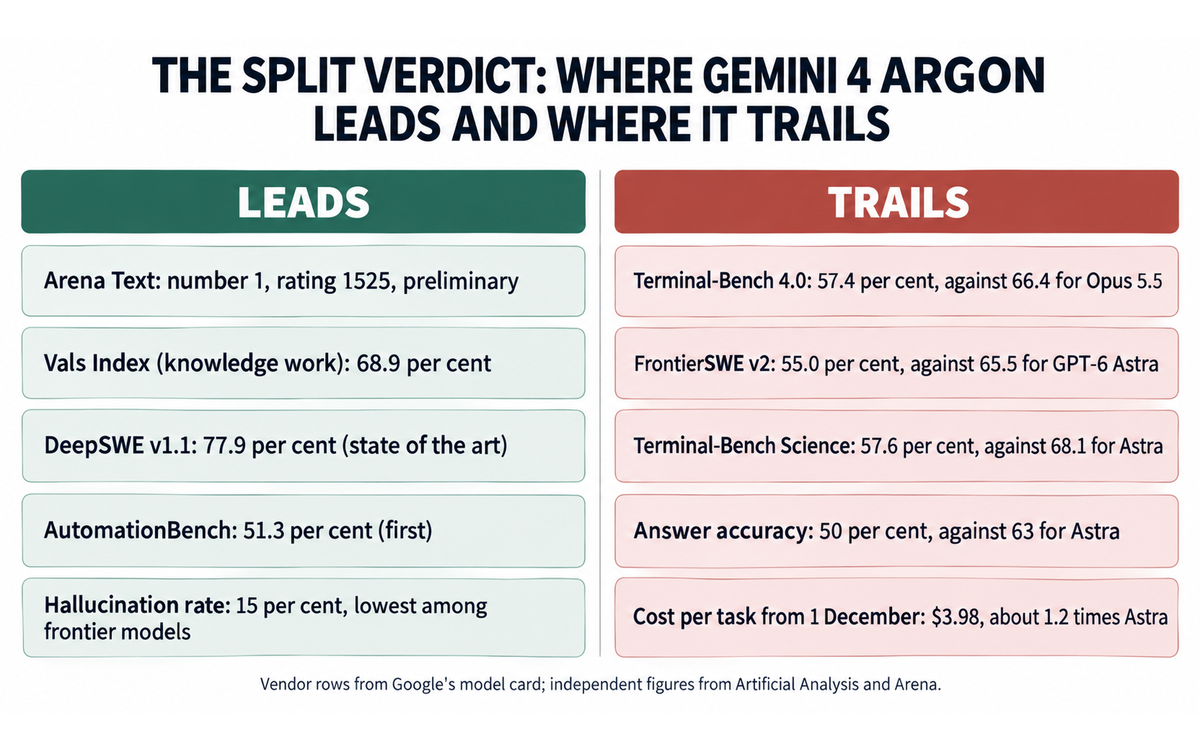
The coding picture is split, and the split is the honest headline. The vendor reports 77.9 on a coding-agent index, described as a new state of the art, and 91.9 on a code-generation benchmark. On the same vendor's table the model is behind on FrontierSWE v2 at 55.0 against 65.5, on Terminal-bench 4.0 at 57.4 against the 66.4 best, and on a science-terminal evaluation at 57.6 against 68.1. Independent measurement agrees in shape: first on an agentic benchmark at 78 percent, and behind on the terminal benchmark at 57 percent. The model is strong at long agentic code work and not the best at short, hard, terminal-bound tasks.
Calibration is the strongest single signal in the independent record. On an open-ended knowledge and hallucination evaluation the model records a 15 percent hallucination rate, the lowest of any model scoring 45 or above on the composite, against 51 percent for GPT-6 Astra and 54 percent for GPT-6.1 Sol. Its answer accuracy is 50 percent, five points below Gemini 3.1 Pro Preview. It acknowledges not knowing more often than its peers and answers fewer questions correctly, and both halves of that sentence belong in the record.
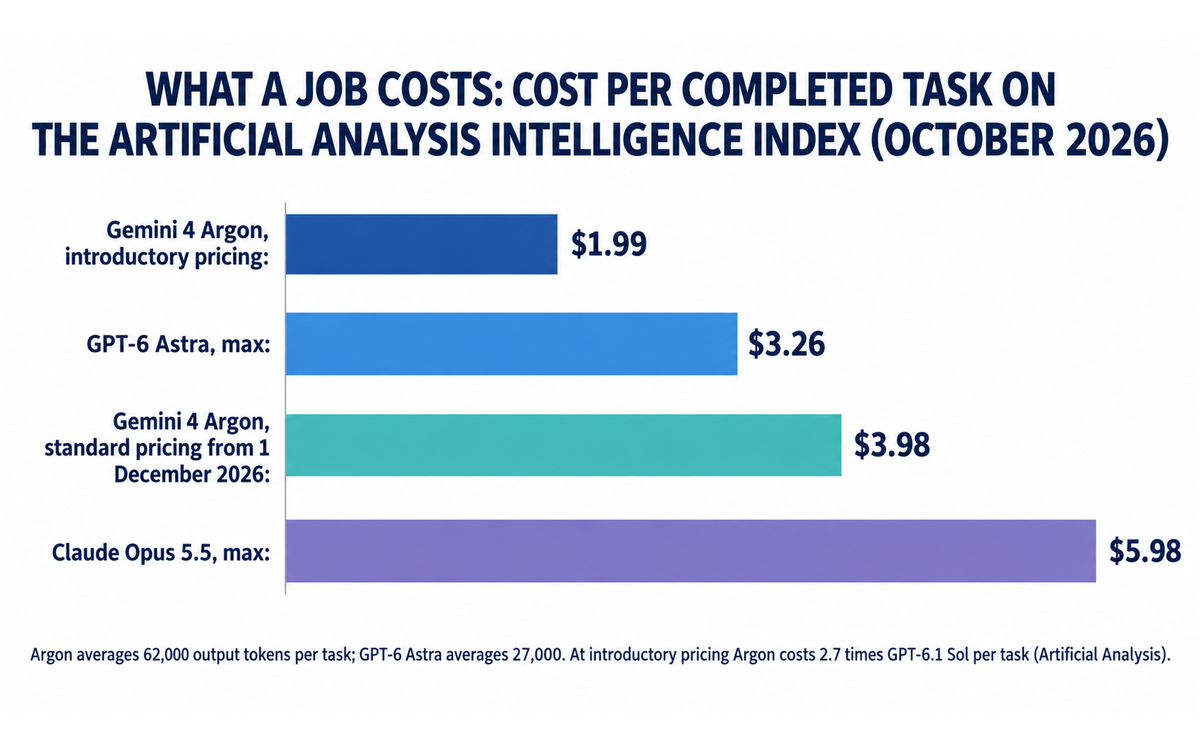
The price structure is promotional, and the arithmetic is transparent. $2.00 and $10.00 per million tokens, cached input at $0.10, and three consumption options below that all expire on 2026-11-30. From 2026-12-01 the same work costs $4.00 and $20.00 with cache at $0.20. Independent measurement puts cost per composite task at $1.99 during the promotional window and about $3.98 after it, which is 60 percent of GPT-6 Astra during the promotion and 1.2 times Astra after it.
The release arrived through a gate. Announced 2026-09-30 to trusted defenders and the government's voluntary pre-release access process, then paid API customers and Ultra subscribers, then global availability on 2026-10-13. The free tier has no access at all, and Google AI Plus lost Pro access to the app line-up on 2026-10-09, four days before global availability. The gated start is part of what a buyer adopts, and Section 7c states it rather than implying it.
The vendor's own comparison table, as published. Google's table carries 18 rows. The model takes the top score on most of them, ties for first on the cyber row, and trails on several; an independent summary of the same table counts five rows on which it trails. Every figure below is vendor-reported, values are percentages, and the best score in each row is shown in bold.
Benchmark | Argon | GPT-6 Astra | Claude Fable 5.1 | Claude Opus 5.5 |
Vals Index (knowledge work) | 68.9 | 63.1 | 65.8 | 67.0 |
AutomationBench (Zapier) | 51.3 | 41.4 | 31.4 | 42.5 |
Vals Finance Agent v2 | 65.4 | 53.5 | 58.9 | 58.6 |
Harvey's Legal Agent Benchmark | 19.6 | 5.4 | 6.7 | 3.8 |
DeepSWE v1.1 (agentic coding) | 77.9 | 74.1 | 67.4 | 74.2 |
FrontierSWE v2 | 55.0 | 65.5 | 56.3 | 62.3 |
Vibe Code Bench | 91.9 | 89.6 | 90.3 | 90.3 |
Terminal-bench 4.0 | 57.4 | 58.2 | 57.9 | 66.4 |
PostTrainBench (ML engineering) | 45.3 | 44.3 | 40.2 | 49.3 |
Terminal-Bench Science 0.1 | 57.6 | 68.1 | 52.6 | 63.3 |
LABBench 2 | 88.8 | 85.4 | 68.6 | 73.1 |
RiemannBench | 76.0 | 72.0 | 65.6 | 69.6 |
The vendor's additional claims, stated as claims. The 77.9 coding-agent result is described as a new state of the art. The model ties for first on a vulnerability-remediation benchmark at 68 percent. Long-video understanding reads 91.7 percent, a chart benchmark 71.6 percent and a graph-walking evaluation 84.2 percent. Google states that the model "leads the Vals Index", that it "ranks #1 on AutomationBench with 51.3%", and that it shows leading performance on the finance-agent and legal-agent evaluations. The vendor's internal-use evidence is the more concrete part of the launch post: an internal team ran the model overnight in Antigravity with a .agents/skills rulebook and a one-paragraph goal, and the shipped optimizations cut in-memory session preparation by 40 percent in long sessions and sped cold imports by 21 percent, with the commit live in the open-source repository. The same post reports a Chrome refactor at about four times the usual pace, more than 35 percent more agentic code submissions, a 40 percent improvement in session creation on the vendor's agent-development kit, upstream pull requests to an open inference server, a quantum-decoder task translated to a hardware kernel with nearly doubled inference throughput, and a 3D reconstruction from roughly 50GB of LiDAR scans and archives.
Independent measurement, as published. Artificial Analysis reads the model as returning Google to the top three labs on measured intelligence, and its article title says so.
Source and method | Result |
Artificial Analysis, Intelligence Index at high reasoning | 53, level with GPT-6 Astra at maximum effort and one point above GPT-6.1 Sol. The same house reports the unrounded comparison through third-party coverage: 52.6 for Argon at high against 52.7 for Astra at maximum, with Claude Opus 5.5 at 57.6 at its highest setting |
Artificial Analysis, cost per index task | $1.99 at the promotional rate, 60 percent of GPT-6 Astra's $3.26 and 2.7 times GPT-6.1 Sol; about $3.98 after the promotion ends, roughly 1.2 times Astra. Claude Opus 5.5 records $5.98 |
Artificial Analysis, token use | An average of 62,000 output tokens per task against 27,000 for GPT-6 Astra, and 110 million tokens across the full index against a median of 82 million, described as somewhat verbose |
Artificial Analysis, agentic work | First on its agentic benchmark at 78 percent, seven points above the nearest competitor, and 57 percent on the terminal benchmark, behind three named peers but 53 points above Gemini 3.1 Pro Preview |
Artificial Analysis, document-work evaluation | 1494 Elo driven by a 65 percent rubric pass rate, the highest the house has recorded, with lower analytical quality at 1576 Elo and presentation quality at 1308 Elo |
Arena, Text, style-controlled | First at 1525, preliminary, on roughly 4,903 votes |
BenchLeader | Seventh of 756 on its index at 69.7 plus or minus 4.1, a top-ten position, with a blended cost of $4.00 per million tokens at standard rates, measured 2026-10-02 |
Vals AI | First of 41 models on the knowledge-work index at 68.90 percent in its own run |
The honest counterweights, stated once and then carried through this review.
The gaps are in the hardest short-horizon tasks. Terminal coding, a software-engineering evaluation and a science-terminal evaluation all show the model behind named peers, and the terminal benchmark figure of 57.4 is 9 points below the best score on the same vendor row. A team whose work is short, hard and terminal-bound is not served by the strongest part of this release.
Lower hallucination comes with lower accuracy. A 15 percent hallucination rate is the best recorded at this level of measured intelligence, and a 50 percent answer accuracy is five points below Google's previous model and 13 points below GPT-6 Astra. A model that abstains more often is safer to rely on for what it does answer and less likely to answer at all.
Verbosity is a real cost line. 62,000 output tokens per task against 27,000 for the nearest competitor means the promotional rate and the post-promotional rate both buy less work per dollar than the headline prices suggest, and the review scores Quantity with that in mind.
The promotional price has a date on it. Every figure in this review that touches cost is a promotional figure, and the doubling on 2026-12-01 is the single most consequential scheduled fact about adopting this model.
The access structure is narrow. No free tier, no Google AI Pro API plan, and an Ultra-only agentic development surface at launch. A reader on Google AI Plus lost Pro access in the app line-up days before global availability.
The benchmark rows are vendor-measured until an independent house re-runs them. Google's table is Google's, the competitor columns are the vendor's readings of third-party models, and the model card's own caveat applies to that kind of comparison.
No open weights, no self-hosting and no external auditability. Nothing about this model can be inspected from outside the vendor's service, and no parameter count has been published.

Gemini 4 Argon: Google's return to the frontier, on a price that doubles
Who Should Use Gemini 4 Argon
Learner type | Difficulty | Typical ROI | Career path |
Students (Bachelor, Master) | Intermediate | Reachable through the Gemini app on a Google AI Pro or Ultra subscription, and through Google AI Studio for the API-shaped work. Strong for working through a long reading set in one window and for structured argument building. The Skill Illusion is the live risk: legal, finance and coding output now reads as expert work in a field where the student cannot always check it, and the low hallucination rate reduces the frequency of errors without removing the need to verify. | UIT (Technology, AI, Data Science) tracks through AI Studio and agentic coding practice. Research-methods practice for the reading workload; no published U365 credential assesses research methods as a named component, and none is asserted. |
Professionals (career upskilling) | Intermediate to Advanced | The clearest case in this release for developers who work in Antigravity on an Ultra subscription and for teams running document-heavy work in law, finance and science over the paid API. The knowledge-work leadership, the one-million-token window and the overnight agent run are the parts a professional can put on a timesheet. The agent surfaces need supervision, and the bill doubles on 2026-12-01. | UIT (Technology, AI, Data Science) engineering tracks for agent surfaces and evaluation design, and UIB (Business Management, Entrepreneurship) for financial analysis and legal drafting support, with the caution that the model supplies no management method of its own. |
Everyone (lifelong learners) | Beginner in the Gemini app, Advanced for agent use | A one-million-token window that takes PDFs, images, video and audio is a genuine reading and reasoning partner on a subscription, and AI Mode in Search carries the model into a surface people already use. It is not available on the free tier at all, so the entry cost is a paid subscription rather than a browser tab. | LIPS Collect and Review phases for the reading work. The UP-Context-Engineering Method order for prompting. No assessment home is asserted. |
Skill level required: Intermediate for document and analysis work in the app. Advanced for the agentic use this model is built for, because supervising a long run means setting the finish line, choosing a thinking level before the run starts, and reading the report rather than the diff alone.
Prerequisites. For the app: a Google AI Pro or Ultra subscription, with Pro losing access to other Gemini models in the app line-up at points in the roll-out and Ultra holding the full set. For Antigravity: an Ultra subscription, because access is Ultra-only at launch. For the API: a Google Cloud project with billing enabled on the paid tier of the Gemini API, and a decision about which thinking level and which consumption option each job runs at. Working knowledge of prompt structure and of verification practice, because a low hallucination rate lowers the frequency of errors and does not remove the need to check the work you depend on.
Typical time to first result: Under five minutes in the Gemini app or AI Mode in Search on an eligible subscription. Under fifteen minutes in Google AI Studio for a first API call with the model id gemini-4-argon.
Typical time to competence: Ten to twenty hours of active use. Two skills carry most of the value: thinking-level selection, because the quality and the bill both ride on a three-position setting, and verification design, because output at this level reads as finished whether or not it is correct.
Who should wait. Readers who need free access, because there is none. Anyone whose work cannot be verified cheaply by someone who did not do it, because the failure mode at this capability level is a plausible near-miss rather than an obvious error. And anyone planning security-critical automation without oversight, because the guardrail geometry in Section 7c and the vendor's own cyber framing both assume a trusted operator.

Gemini 4 Argon: Google's return to the frontier, on a price that doubles
U365 Institutes Alignment
The alignment below rates what a U365 institute could take from this model as a working instrument and as an object of study. The primary home is UIT (Technology, AI, Data Science), because agentic engineering, cost engineering, evaluation design and cyber-defense workflows are the competencies this model exercises, and because a model that leads a GDP-weighted knowledge-work index while trailing on the hardest terminal tasks is itself a teaching object about what a benchmark measures. The other three readings are real and each is bounded.
UIT (Technology, AI, Data Science)
Rating. High (primary)
Why. Four engineering competencies, each of which survives the removal of the tool. Agentic engineering at a chosen thinking level: writing a rulebook, stating a one-paragraph goal, bounding an overnight run and reading the report before the diff. Cost engineering: reading a rate card that changes on a published date, comparing three consumption options against three thinking levels, and computing cost per completed task rather than price per token, which is the arithmetic the promotional window makes urgent. Evaluation design: reading the vendor's 18-row table against an independent composite, noticing that the strongest coding row and the weakest terminal row sit on the same page, and recognising which of them matches the work in front of you. And cyber-defense workflow design: the model was released to defenders first, ties for first on a vulnerability-remediation benchmark in the vendor's reading, and carries a product line built for that audience, which makes guardrail geometry a design input rather than an afterthought. The published programme set already teaches Python, software development and cloud engineering; this model is a working object on which those skills are exercised
The limit that holds the row. The model is a service a practitioner operates, not an artefact a practitioner inspects. There are no weights, no architecture description and no parameter count, so the competencies are engineering-with rather than engineering-of. The catalogue's AI-agent instruction is concentrated in its certificate series rather than spread across the degree paths, and no published programme assesses the cost-per-completed-task method as a named component. Adjacent anchors, not assessment homes
UIB (Business Management, Entrepreneurship)
Rating. Medium
Why. Two decisions the release forces that are commercial before they are technical. Vendor-and-model selection with a published price cliff: the promotional rates run through 2026-11-30 and double on 2026-12-01, so a business case built on today's bill is a case about a four-week window, and the arithmetic from $1.99 to about $3.98 per composite task is exactly the kind of calculation a cohort can run on live numbers. And the automation question: a multi-step business-workflow benchmark result of 51.3 against 41.4 for the nearest competitor, plus a finance-agent evaluation at 65.4 and a legal-agent benchmark at 19.6, is a working instrument for financial and business analysis, and reading it well means knowing what a workflow benchmark does and does not certify
The limit that holds the row. The model supplies no management method and does not measure its own return. It publishes no completion rate and no time-per-task figure outside the vendor's own benchmark selection, so a business case has to be built by the unit. The catalogue's business programmes publish process modelling and financial analysis, and no published programme assesses the economics of a model portfolio as a named component. Adjacent anchors, not assessment homes
UIC (Digital Communication, Marketing)
Rating. Low to Medium
Why. One competency that matters and is easy to miss: reading a benchmark or a rate card as a communication act, telling a measured claim from a framing claim, and checking a vendor's headline sentence against its own footnotes. This launch is a worked example, because the same table that shows the model ahead on a knowledge-work index also shows it behind on terminal and science rows, and the phrase "leads the Vals Index" is a comparison against one composite among several defensible weightings. The writing surface is real as well: the model drafts, restructures and holds a document bundle in one window, and the launch's writing-quality and style-following improvements are the part a communication practitioner would notice first
The limit that holds the row. The model teaches no register, no audience analysis and no publication standard. It returns no sourced evidence of its own, so fact-checking stays with the writer, and no layout, campaign or content-strategy competency appears in it. Rated as evaluation contact with a writing surface. No credential is mapped
UID (Digital Design, UX/UI)
Rating. Low
Why. A reading contact rather than a design act. Two genuine items. The launch's spatial-reasoning and 3D-reconstruction evidence, including a reconstruction built from roughly 50GB of LiDAR scans, is a real demonstration of a model reasoning across geometry rather than text, and a designer can study it as the current state of machine spatial reasoning. And computer use in preview means the model can operate an interface, so a design tool's workflow can be executed by it rather than designed by it. A designer can also study the launch material as a case in how a technical claim is visualised, since the comparison charts are the product's actual interface with its buyer
The limit that holds the row. The model performs no design work and evaluates no design against a brief. It reads images and video and produces text, and it generates no images at all, so the visual surface is input only. No layout, interaction, prototyping or motion competency appears in it. No credential is mapped
U365 methods, not an institute (UNOP, ULM, LIPS, CARE and the UP-Context-Engineering Method)
Rating. Applicable
Why. The methods layer is relevant in the way a frontier model is: the thinking level is a planning decision before it is a settings decision, and the UP-Context-Engineering Method's context-role-task-constraints-output order is exactly what a reproducible agent run needs. The Long Decode feature makes the output-format part of that order more consequential, because an answer can now run to a million tokens and a named output format is what keeps it checkable. For LIPS and CARE, the record of what a run was asked to do, at what thinking level, on which consumption option, and what it returned belongs in the Fellow's own system, because the model holds no state between calls and keeps nothing on the user's behalf
The limit that holds the row. The model carries no method of its own and no coaching surface. A Fellow who does not keep the reasoning about thinking level and verification in their own system has no account of it, and nothing in the product writes that account for them.

Gemini 4 Argon: Google's return to the frontier, on a price that doubles
How Gemini 4 Argon Works
A natively multimodal reasoning model with a unified one-million-token window, sold in a gated sequence of surfaces: first to trusted defenders, then to paying developers and Ultra subscribers, then to the world.
Inputs: Text prompts, documents, images, video, audio and PDFs; through the API, a conversation history plus tool definitions and, where used, grounded search, URL context, file search and code execution. Through Antigravity or the Gemini platform, a repository, its instruction files and any rulebook you have written. The model reads five modalities and produces text.
Outputs: Text, code, structured tool calls and, through agent surfaces, edits to files. Up to 65,536 tokens in a default synchronous response, and up to 1,048,576 tokens through Long Decode, inside a context window of 1,048,576 tokens that is shared with the input rather than separate from it.
Underlying technology, as the vendor publishes it:
Model: Gemini 4 Argon, model id gemini-4-argon. The first model of the Gemini 4 generation and the first proprietary Google model above the Flash class in more than seven months; the previous non-Flash model was Gemini 3.1 Pro in February 2026.
Training stack: JAX and ML Pathways, per the model card. That is the same stack Google has used across the Gemini line, and it is the only architectural statement the vendor makes.
Unified context: 1,048,576 tokens across input, thinking and output together. The window is one budget rather than two, so a long document set and a long answer compete for the same tokens.
Long Decode, a new API feature: a long response can pause and resume across follow-up calls, which allows reasoning up to a million output tokens without hitting a request timeout. This is the mechanism behind the overnight and multi-day claims, and it is documented as a feature of the service rather than of the model weights.
Thinking levels: low, medium (default) and high. The independent measurement used the high setting for its headline figure, which matters because the default is not the setting the launch numbers describe.
Caching: implicit only. There is no explicit cache a developer writes, so the cached-input discount applies where the service chooses to reuse a prefix. A pipeline that cannot predict that choice cannot engineer around it.
Consumption options: Batch and Flex at a discount, and Priority at a premium, on top of the standard synchronous service. Overnight work, latency-critical work and ordinary work each have a documented path.
Modality breadth on input, text-only on output: text, image, video, audio and PDF in; text out. Agentic video understanding defaults to static, so a video task is not video editing.
Capabilities available to a developer: function calling, structured outputs, search grounding, Maps grounding, URL context, code execution, file search, computer use in preview, and agentic video understanding.
Surfaces: the paid tier of the Gemini API globally, Google AI Studio, Android Studio, the Gemini platform enterprise console, Gemini for business, the Gemini app and AI Mode in Search for Pro and Ultra subscribers, and Antigravity for Ultra subscribers only.
What is not disclosed. No parameter count. No weights. No architecture description beyond the training stack. No explicit caching layer. And no statement that would let a buyer audit what the model does internally; the framework's clause assessments below turn on what ships on the surfaces, not on anything inside the model.
How you reach it, and the gate. Three access facts belong in the mechanism, not in a footnote. First, the roll-out was phased: trusted cyber defenders through the Fairwind Program and the United States government's voluntary pre-release access process on 2026-09-30, then paid API customers and Google AI Ultra subscribers, then global availability on 2026-10-13. Second, the agentic development surface where a developer would use the coding strength, Antigravity, was Ultra-only at launch, and the vendor states it is "actively working to expand access as capacity comes online". Third, the guardrail picture differs by audience: the launch post states that for trusted defenders and internal teams the model ships "without cyber guardrails" so they can use its full cyber-defense capability, and a "Gemini 4 Argon Cyber Permissive" line item appears on the Google Cloud pricing page for the Gemini Enterprise Agent Platform. Section 7c states that structure plainly and records what it does and does not change in this review.
What it is bad at natively. It generates no images and no audio, and there is no Live API, so anything with a visual or spoken deliverable leaves the model for another tool at the last step. It trails on short, hard terminal and science tasks rather than on long agentic ones. Its answers run long: an average of 62,000 output tokens per task on independent measurement against 27,000 for the nearest competitor, with 110 million tokens across a full index run against a median of 82 million. And on a knowledge evaluation with abstention allowed, it abstains more and answers correctly less often than the model it will most often replace, which is a design trade the vendor made rather than a defect.

Gemini 4 Argon: Google's return to the frontier, on a price that doubles
Getting Started with Gemini 4 Argon
Required accounts: A Google account. For the app and AI Mode in Search, a Google AI Pro or Ultra subscription; Ultra is the tier that carries Antigravity. For the API, a Google Cloud project with billing enabled on the paid tier of the Gemini API. For enterprise surfaces, the Gemini platform console or a Gemini for business workspace. There is no free tier for this model at all, so a reader planning around it should plan around a paid path from the start.
Installation: Nothing to install for the app or for AI Studio in a browser. Android Studio carries the model for development work. For the API, nothing beyond an HTTP client or one of the official SDKs, with the model selected by the id gemini-4-argon.
First-time configuration:
Pick the surface that matches your tier before you pick anything else. The model is in the app on Pro and Ultra, in AI Mode in Search on Pro and Ultra, in the API on the paid tier, and in Antigravity on Ultra only. A Pro subscriber who wants the coding tool will find the tool gated, and the re-check triggers keep that boundary under watch.
Set the thinking level deliberately and write down what you chose. Three positions, with medium as the default. The independent headline figures were measured at high, so the default is not the setting the launch numbers describe, and the bill and the quality both move with this one choice.
Choose the consumption option per job rather than per account. Batch and Flex cost half the standard rate and suit overnight and throughput work. Priority carries a premium and suits latency-critical steps. Standard synchronous calls sit between them and suit interactive work.
Do the cost arithmetic on both sides of 2026-12-01 before you commit a pipeline. The promotional window is a four-week runway: $2.00 and $10.00 with cache at $0.10 now, $4.00 and $20.00 with cache at $0.20 after. Independent measurement puts the same composite task at $1.99 during the promotion and about $3.98 after it.
Reach for Long Decode only when an answer genuinely needs to exceed the default output ceiling. A synchronous response caps at 65,536 output tokens; Long Decode pauses and resumes across follow-up calls up to 1,048,576. It is the feature that makes an overnight or multi-day run viable, and it is also the feature that can produce a document nobody will read.
Check your caching assumptions before you model an agent bill. Caching is implicit only: the service decides when to reuse a prefix, and there is no explicit cache to write. Model the cached line as a benefit you may get rather than one you control.
Make the first task one that ends in a check you already own. A change with a test suite, a document set with a quote table, or a batch job with a validator. The measured strengths of this model are in long-horizon work and the measured gaps are in short, hard, terminal-bound tasks, so the first task should sit where the model is strong and where you can tell whether it worked.
First 15 minutes checklist:
☐ Run one real task from your own work in a single message, with a stated finish line and a stated stopping rule.
☐ Confirm which thinking level you are on, then run the same task at high and compare the answer, the wait and the token count against medium.
☐ Take one factual claim from the answer and verify it against a source outside the conversation.
☐ Write down which consumption option the run used, and what the same run would have cost after 2026-12-01.
☐ Read the closing report and act only on the part waiting for you.
Result: One real task completed end to end, a deliberate thinking level, one verified claim and a known cost per completed task on both sides of the promotional cliff. That is a working setup rather than an impression.

Gemini 4 Argon: Google's return to the frontier, on a price that doubles
Real Workflows
Workflow 1: A long-horizon engineering task inside a coding agent
Learner type: Professional (career upskilling). Developer, technical lead or platform engineer. CI-First benefit tags: Time, Quantity, Quality. Connects to: UIT (Technology, AI, Data Science) engineering tracks. Time estimate: One overnight run plus thirty to sixty minutes of review the next morning, for a task whose finish line you can name in one paragraph.
What you do vs what the tool does:
Step | You do | The tool does |
1 | Write the rulebook and the one-paragraph goal. Name the finish line and the stops. Decide the thinking level before the run starts. | (Nothing yet) |
2 | Put the rulebook and the goal in the working directory the agent reads, in Antigravity or in AI Studio. | Reads the rulebook, plans the work and works through the repository, running the tests it has been given. |
3 | Start the run and leave it. Use Long Decode for an answer that needs to exceed the default output ceiling. | Works across steps, pauses and resumes long output, and holds state inside the run rather than across calls. |
4 | Read the report before reading the diff, in the morning. | Returns what it changed, what it found and what it needs from you. |
5 | Check the evidence behind each finding, not the claim. | Produces the evidence on request. |
6 | Run the test suite and static analysis yourself, and read the diff. | (Nothing. You verify.) |
7 | If the diff is too large to read, treat the task as too large and split it. | (Nothing. You decide.) |
Sample prompt (UP-Context-Engineering method: context, task, constraints, output format):
Context: this repository is [project]. The work is [the change or the defect]. Done means
[the tests pass / the behaviour is reproduced and fixed]. The relevant code is in [paths].
I am running this at thinking level [level] and I chose it because [reason].
Role: AI as a Co-Worker and Assistant for the change. I hold the finish line and the decision
to ship.
Profile: Act as a Co-Worker and Assistant, keeping the change bounded and evidenced.
Task: complete the work above.
Constraints: one module at a time. Do not change behaviour outside [scope]. Do not add
dependencies. Stop and ask only when you cannot continue, or before anything that deletes
data. Do not ask me to confirm steps that do not need a decision.
Output format: a short table with file, change, and the evidence you used. Then three
headings: Blocked on me, Changed, Found. State plainly anything you did not verify.
Memory: the change table and the evidence I accepted belong in my repository record, because
the session keeps no history of its own.
UP-Context-Engineering verification: I read the report before the diff, I run the check myself outside
the session, and I can defend every item in the table without the tool.
Data safety: this pack carries no personal data. I do not paste credentials, customer data
or an unreleased repository into it, and I keep the change record in version control.
Cost note: The overnight run is where the token economics of this model show up twice. Independent measurement records an average of 62,000 output tokens per task against 27,000 for the nearest competitor, so the run buys capability at a higher token count than a peer would use, and the cached-input line at $0.10 per million tokens during the promotional window is what keeps a re-read context affordable. A run that spans a long session should be modelled at the post-promotional rate of $0.20 before it becomes a daily habit.
Verification checklist:
☐ Multi-Model Check: run the same task on a competing frontier model and compare what each found. A difference in findings is more informative than a difference in how the report reads.
☐ External Source: run the project's own test suite and static analysis. Do not accept the model's statement that it works.
☐ Human Review: read the diff. If it is too large to read, the task was too large.
☐ CI-First Test: can you explain and defend the change without the model? If not, it is not ready.
Workflow 2: A first pass over a professional document set
Learner type: Professional. Legal, finance, scientific or compliance work. CI-First benefit tags: Time, Quantity, Quality. Connects to: UIB (Business Management, Entrepreneurship) and research-methods practice. Time estimate: One hour for a first pass over a document bundle in one window, plus the verification time you would have spent anyway.
What you do vs what the tool does:
Step | You do | The tool does |
1 | Define the question the first pass must answer, and what would make a document irrelevant. | (Nothing yet) |
2 | Supply only the documents you are willing to stand behind, as a PDF bundle or a contract set. | Reads the whole set in one unified window, across text, tables, images and scanned pages. |
3 | Ask for a claim-versus-source table rather than a summary, and require grounding in the supplied set. | Returns each claim with the document and the passage it came from, and with the tool it used. |
4 | Spot-check at least three rows against the source documents, by hand. | (Nothing. You verify.) |
5 | Discard the rows that do not survive the spot check, and count how many did not. | (Nothing. You decide.) |
6 | Put the draft in front of a qualified expert before it informs anything. | (Nothing. This is the part that is yours.) |
Sample prompt:
Context: I am preparing [deliverable] on [matter]. The attached documents are the only
sources allowed. My expertise is [level] and the reviewer's expertise is [level].
Role: AI as an Analyst and Tester for the first pass over the attachments.
Profile: Act as an Analyst and Tester, keeping every claim tied to a passage I supplied.
Task: build a table of what these documents claim about [question].
Constraints: no information from outside the attachments. Do not state a number you cannot
source to a passage. Where two documents disagree, show both rows instead of resolving them.
Do not summarise a clause you have not quoted.
Output format: a table with claim, document, and the passage you relied on. Then a heading
"Could not support" listing every claim you looked for and did not find.
Memory: the claim table and the passages behind it belong in my own record, because the
reading pass produces no evidence log on its own.
UP-Context-Engineering verification: I spot-check at least three rows against the attachments, I count
the rows that did not survive the check, and a qualified reviewer reads the draft before it
informs anything.
Data safety: this pack carries no personal data. I do not paste privileged material, an
unpublished paper or a client's identity into a surface outside the engagement's terms, and
I keep the reading record in my own store.
Cost note: This is the workflow where the calibration profile matters most. A 15 percent hallucination rate is the lowest recorded at this level of measured intelligence, and a 50 percent answer accuracy is still five points below Google's previous model, so the honest expectation is fewer invented claims and more visible gaps. A hundred-page bundle read in one window costs a fraction of the equivalent reading hours, and the verification step is not optional because the output is written in the register of the domain and reads as finished.
Verification checklist:
☐ Multi-Model Check: run the same table request on a competing model and compare the rows each produced. Rows that appear in one and not the other are where the uncertainty lives.
☐ External Source: read at least three cited passages in the original documents, and check any quoted clause against the contract itself.
☐ Human Review: a qualified professional, not the person who built the prompt, reads the draft before anything is filed, sent or published.
☐ CI-First Test: can you defend every row you kept without reopening the conversation? If not, you kept a row you do not own.
Workflow 3: Cost-controlled batch work at an effort setting
Learner type: Professional. Operations, finance or support lead running recurring jobs. CI-First benefit tags: Time, Quantity. Connects to: UIB (Business Management, Entrepreneurship), UIT (Technology, AI, Data Science) cost engineering, LIPS Collect and Review phases. Time estimate: Half a day for the first batch job, including the measurement design.
What you do vs what the tool does:
Step | You do | The tool does |
1 | Pick one recurring job with a checkable end state, and write the check down. | (Nothing yet) |
2 | Record the baseline: attempts, human minutes and error rate without the model. | (Nothing yet) |
3 | Run the job through the Batch API or Flex at the discounted rate, with a named thinking level. | Processes the queue, applies the stated output format and returns the results with the tool calls it made. |
4 | Log every attempt, including the ones you discard. | Returns each item's status and the fields it left blank. |
5 | Compute cost per completed job, not cost per token, at both the promotional rate and the rate that starts on 2026-12-01. | (Nothing. You measure.) |
6 | Keep the job only if completed-task cost and error rate both improved against the baseline. | (Nothing. You decide.) |
Sample prompt:
Context: [job name] runs over [inputs]. It currently takes [time] and about [error rate] of
runs need a human fix. A correct result is [definition]. The batch runs on [Batch or Flex]
at thinking level [level].
Role: AI as a Co-Worker and Assistant for the job run. I own the definition of a correct
result and the decision to keep the job.
Profile: Act as a Co-Worker and Assistant, executing the job without inventing inputs.
Task: complete this job for the [N] items I have attached.
Constraints: use only the fields provided. Leave a field blank rather than inventing it.
Do not merge two items into one row. Stop before anything that sends a message to a person
outside the team. Log every attempt, including the ones I will discard.
Output format: one row per item with status, the fields used, and any field you left blank.
Then a list of items you could not complete and why, and a count of discarded attempts.
Memory: the run rows and the blank fields belong in my own workflow record, because the
service keeps no ledger of its own.
UP-Context-Engineering verification: I check the completed rows against the systems they touched, I
count the items left incomplete myself, and I recompute the cost per completed job from the
usage figures rather than accepting an estimate.
Data safety: this pack carries no personal data. I do not paste customer records,
credentials or an internal process list into it, and I keep the run record in my own store.
Cost note: The comparison that matters is cost per completed job across three named baselines. Google's promotional Batch rate is $1.00 and $5.00 per million tokens against a standard $2.00 and $10.00, GPT-6.1 Sol sits in a $0.74 class per composite task on independent measurement, and Claude Opus 5.5 records $5.98 per composite task. A batch job that completes cleanly on the discounted rate is the cheapest of the three, and the same job at the post-promotional rate of $2.00 and $10.00 changes the ranking for anything that runs more than a few times a month, which is why the measurement has to be repeated on the far side of 2026-12-01.
Verification checklist:
☐ Multi-Model Check: run the same batch on a cheaper model in Google's line-up and compare how many items each completed without a human fix. On checkable, high-volume work the cheaper tier is often the correct answer, and the comparison is how you find out.
☐ External Source: validate the output programmatically against the system of record. A well-formed row can still contain a wrong value.
☐ Human Review: have the job's owner, not the person who built the prompt, check a sample of accepted items.
☐ CI-First Test: can you describe the decision rules the job uses without reading the prompt? If not, the process is not documented.

Gemini 4 Argon: Google's return to the frontier, on a price that doubles
Strengths, Limits, and AI Imposture Risk
Strengths
CI-First Benefit | Strength | Evidence |
Time | Frontier-class capability returned to Google's line-up after seven months of Flash-only releases, on a unified window that holds work other assistants drop. | Artificial Analysis measures Intelligence Index 53 at high reasoning, level with GPT-6 Astra and 23 points above Gemini 3.1 Pro Preview; the one-million-token window is shared across input, thinking and output, and Long Decode carries an answer past the synchronous ceiling so an overnight run can finish. |
Quantity | Project work becomes possible in one run rather than many, with a documented path for the volume. | Agent runs, Long Decode and strong multi-step execution combine with a Batch and Flex path at half the standard rate; the vendor's internal evidence reports a Chrome refactor at about four times the usual pace, more than 35 percent more agentic code submissions and a 40 percent cut in in-memory session preparation, with the commit live in an open-source repository. Held at 7 because an average of 62,000 output tokens per task is more tokens and not automatically more usable work. |
Quality | The measured substance of the release: knowledge-work leadership, a coding-agent result the vendor describes as a new state of the art, and the best calibration recorded at this level. | First on the vendor's knowledge-work index at 68.9 and first of 41 models in an independent run of the same index; 77.9 on the agentic coding index; a 15 percent hallucination rate, the lowest of any model scoring 45 or above on the independent composite; first on the crowd-preference arena at 1525, preliminary. |
Skill | Marginal, and honestly marginal. | No teaching mode is claimed. The model is used for delegation rather than learning, there are no open weights, and the framework's clause 5.2.3-a returns a null with a boundary rather than a mechanism that transfers capability. Scored conservatively. |
Limits
Short, hard, terminal-bound tasks are the gap. 57.4 on Terminal-bench 4.0 against a 66.4 best, 55.0 on FrontierSWE v2 against 65.5, and 57.6 on the science-terminal evaluation against 68.1, on the vendor's own table. Independent measurement agrees in shape at 57 percent on the terminal benchmark.
Lower hallucination arrives with lower accuracy. A 50 percent answer accuracy is five points below Gemini 3.1 Pro Preview and 13 points below GPT-6 Astra. The model abstains more and answers correctly less often, so the honest reading is a different error profile rather than strictly better answers.
Answers run long, and the bill follows. An average of 62,000 output tokens per task against 27,000 for the nearest competitor, and 110 million tokens across the full independent index against a median of 82 million. Cost per completed task stays competitive during the promotional window and moves to roughly 1.2 times GPT-6 Astra after it.
Terminal coding is a stated weakness in the vendor's own reading. The same launch page that leads with the coding-agent result prints the rows where the model trails, which is to the vendor's credit and is still a limit a buyer has to price.
The promotional price has an end date. Every cost figure that makes this release compelling is a promotional figure, and the rates double on 2026-12-01.
Access is narrow, and the guardrail picture differs by audience. No free tier, no Google AI Pro API plan, an Ultra-only agentic development surface at launch, and a Cyber Permissive variant that ships without cyber guardrails to a named audience. Section 7c records the structure.
The Harvey benchmark leads the field and sits below 20 percent. A leader on a legal-agent benchmark at 19.6 percent is a leader on a task four fifths of the way to unsolved, and a reader should read that row as difficulty rather than as capability.
Benchmark rows are vendor-measured until an independent house re-runs them. Google's table is Google's, the competitor columns are the vendor's readings of third-party models, and the knowledge-work index has an independent run that agrees while most other rows do not.
No open weights, no self-hosting and no external auditability. Nothing about this model can be inspected from outside the vendor's service.
AI Imposture Risk
Time Illusion
Rating. Medium
Evidence. The savings are real: overnight agent runs, a one-million-token window in one call, and an answer that can exceed the default output ceiling. The overhead is real as well: choosing among three thinking levels on every hard task, reading output that averages 62,000 tokens per task, verifying professional work whose correctness is expensive to check, and an access structure that keeps the coding surface on the Ultra tier. Access friction is time spent on the tier rather than on the work.
Quantity Illusion
Rating. Medium
Evidence. The volume is the release: more tokens per answer, a discount for batch work, and agents that produce multi-step output in one run. Nothing separates a finished run from a correct one for a reader who cannot evaluate the domain, and the polished professional register of the output is exactly what makes volume feel like progress. The measured accuracy trade makes this worse rather than better: an abstention and an omission look the same in a table.
Skill Illusion
Rating. High
Evidence. Expert-looking legal, finance and coding output for users who cannot evaluate it, produced by an agent that executes multi-step work autonomously. The framework's clause 5.2.3-a boundary is stated in the clause note below. Mitigations exist and are cited: the lowest hallucination rate among frontier models, training that the vendor describes as respecting system boundaries, reporting negative findings honestly and pausing for human confirmation before irreversible steps, shortcut attempts reduced to 2 percent on coding benchmarks, and the verification checklists in Real Workflows. Those mitigations lower the frequency of failure; they do not move the capability to the reader.
Overall Imposture Risk: Medium. One trap is High with identifiable mitigations, and two are Medium. Under the framework's arithmetic, one High with clear mitigations stated is Medium rather than High. The rating holds at Medium for a specific reason: the calibration evidence argues downward, because the model is the most willing abstainer at this level of measured intelligence, and the capability level, the autonomous agent surfaces and the lower accuracy figure argue upward at the same time.
Framework v1.2 clause note
Clause 5.2.3-a, agent-authored procedural memory: NULL, recorded with its boundary. The model holds no state between API calls and writes nothing by itself. The agent surfaces operate from rulebooks the user authors: the vendor's own internal example gives the model a .agents/skills rulebook and a one-paragraph goal, and the Antigravity skills are user-authored rather than model-authored. The Gemini app's saved information is user-visible and user-editable. No documented mechanism ships by default by which this model writes skills, memory stores or standing instructions on the user's behalf, so the clause returns a null rather than applying. The live condition to watch is specific: any Google surface that begins writing agent-authored skills or memory by default re-opens this clause, which is why the seventh re-check trigger names the Gemini app memory mechanics and the Antigravity skills defaults together.
Clause 4.2-a, agent-mediated conversation: NULL for the model as a generator. Neither erosion condition is met. No agent-authored text is presented as the person's own voice in a human-facing channel by default, and nothing substitutes agent interaction for human contact. The live condition to watch on any deployment: an agent that sends text in the person's own name through a connected account without the person reading it first would meet condition (a). That is a property of a deployment built around this model rather than a property of the model.
Clause 7.5, team-level rooms: NULL, recorded for completeness. The subsection was superseded and removed from the framework on 2026-10-13, and nothing in this model's surfaces reaches its case.
Recorded together: the clause questions above return nulls with boundaries and live conditions rather than mechanisms, and the boundary is the part that matters. The reason the Skill Illusion still rates High is not a clause mechanism; it is the plain fact that the model produces expert-form output on tasks whose correctness the reader often cannot check, at a capability level close enough to the frontier that the failure mode is a plausible near-miss rather than an obvious error.

Gemini 4 Argon: Google's return to the frontier, on a price that doubles
Section 7c: The gated release, the guardrail-free cyber variant and the tier structure, stated plainly
A Section 7c finding is recorded where a supplier's governance, safety record or conduct has a real result for the reader. The items below were checked against primary sources, and they produce findings a buyer should carry. All findings are stated as facts of record, and the difference between a company statement, a press allegation and a documented product listing is kept intact.
The release arrived through a gate, and the gate is deliberate. Koray Kavukcuoglu, SVP at Google DeepMind, states the position in the launch post: "Safely releasing frontier capabilities at this level requires a phased approach. We are actively engaged in the U.S. government's voluntary process for pre-release model access while we gradually expand access." The sequence that followed is a fact: announcement on 2026-09-30 with the first rollout to trusted cyber defenders through the Fairwind Program, paid API customers and Google AI Ultra subscribers named as the next phase, then global availability on 2026-10-13. On the same day as global availability, the vendor states it is "beginning expansion to hundreds of additional Fairwind Program partners". A staged frontier release with a government access process is a disclosure practice, not a defect, and a reader adopting the model is adopting that structure.
The guardrail-free cyber variant is a product listing, not a rumour. The launch post states that for trusted defenders and its own internal teams, Google is "releasing Argon without cyber guardrails" so that those teams can use the model's full frontier-level cybersecurity defense capabilities. That framing is corroborated by a line item, "Gemini 4 Argon Cyber Permissive", listed alongside standard Argon on the Google Cloud pricing page for the Gemini Enterprise Agent Platform. The reading a buyer should take is narrow and specific: the same model weights are sold in two guardrail configurations, the permissive one reaches a named audience, and the guardrails on the version most readers will meet are a service configuration rather than a property of the model. Nothing in this review scores the Cyber Permissive variant, and no claim is made about how it performs.
The model card states its own safety boundaries rather than claiming clearance. Against the Frontier Safety Framework of April 2026, the model card reads: "Cybersecurity CCL: We cannot rule out that Gemini 4 Argon has reached this CCL, and we therefore developed a safety case for its cyberoffensive capabilities that we assess lower risk to below the cybersecurity CCL level." The same document states that "we cannot rule out that Gemini 4 Argon has reached this CCL for biological information risk", with a safety case assessed below the biological critical capability level; on stealth and situational awareness, that the threshold cannot be ruled out, with a residual risk assessment placed below it; and on chemical, radiological and nuclear risk, that the threshold was not reached. A supplier that publishes "we cannot rule out" next to its own mitigating assessment is stating a boundary rather than a clearance, and that is the sentence a buyer should carry.
The tier structure widened the gap between paying readers while the model narrowed the capability gap. Two facts sit side by side. On 2026-10-09, nine days after the announcement, the free Gemini app tier lost on-demand model choice and was restricted to Gemini 3.5 Flash-Lite, while Google AI Plus kept Flash-Lite and Flash and lost Pro; Google AI Pro at $19.99 and Ultra kept the full line-up. On 2026-10-13 the model reached global availability everywhere except the tiers that were just narrowed. Separately, access asymmetry drew the sharpest developer reaction: a paying Pro subscriber reported losing other Gemini models from the Antigravity picker and wrote on the vendor's developer forum, "Argon arrives for Pro in the Gemini app, but not in the coding tool where it would actually be useful. Ultra is roughly five times the price of Pro. That's a paywall, not an upgrade path." Those are allegations of consumer harm stated by the readers making them, and they are reported here as such.
One allegation is unresolved and is recorded as unresolved. Bloomberg reported internal skepticism about the model's real-world coding performance ahead of launch, and Google disputes that reporting. The record contains an allegation and a company response with no resolution, and this review states it in exactly those terms. It does not adjudicate the dispute and does not treat either side's position as established.
The safety engineering claims are specific and the vendor's own, and one of them cuts against the rest of this section. The launch post reports that violations on an adversarial set were "reduced nearly 2-fold" against previous Gemini models, that "shortcut attempts dropped to just 2%" on coding benchmarks, that the model was trained to "respect system boundaries, report negative findings honestly, and pause for human confirmation before taking irreversible steps", that chain-of-thought and actions are monitored for misalignment, and that agent execution runs in hardened sandboxed environments. The DeepMind Gemini page states that "Argon is our most resilient model yet against indirect prompt injections". The model card's safety deltas against Gemini 3.1 Pro read: multilingual safety improved by 3.16 percentage points, image-to-text safety by 9.29 percentage points, refusal tone up 5.50 percent and unjustified refusals down 9.60 percentage points, with child-safety launch thresholds met. Those are engineering claims from the party that built the model, and the last re-check trigger exists because a claim of this kind is tested by incidents rather than by release notes.
No sub-score changed for these findings, and the reason is explicit. The Time sub-score already carries the access friction, because the agentic development surface sits on the Ultra tier and the paid API is the route most readers will use; the Quality sub-score already carries the model's measured position on vendor and independent evidence; and the Imposture assessment already carries the autonomy risk that a model of this level hands to a reader who delegates. The governance items above are about access structure, service configuration and supplier disclosure rather than about a defect in the artefact a buyer receives, and none of them is a resolved safety failure. Section 7c closes with what it does not do: it does not allege misconduct, it does not treat a staged release or a permissive guardrail configuration as a scandal, and it does not convert a company's own published caveats into findings against it. It records what a reader adopting this model is also adopting: an access structure and a guardrail geometry.

Gemini 4 Argon: Google's return to the frontier, on a price that doubles
U365 Co-Intelligence Rating
CI-First Profile
Primary profile: Co-Worker and Assistant (level 2). Secondary profiles: Analyst and Tester (level 4), Professor, Coach and Tutor (level 3).
Why this profile and not Co-Creator. Google's own positioning does the reasoning for the scoring. The launch post sells the model for long-horizon agentic work, codebase-scale tasks and enterprise knowledge work, and the vendor's internal evidence describes overnight runs against a rulebook the user wrote and a goal the user stated. That is a delegation framing: state the outcome, hand over the run, review what returns. Co-Worker and Assistant (level 2) is the role the model actually plays. Analyst and Tester is recorded as secondary because the knowledge-work and document evaluations are first-pass and triage work, and Professor, Coach and Tutor remains reachable at level 3 because the model explains its reasoning on request and because a thinking level the user selects produces visible reasoning effort rather than a fixed answer.
CI-First Benefit Score
Time
Score (0-10). 7
Rationale. Strong net savings on long-horizon work: a unified one-million-token window, Long Decode for answers past the synchronous ceiling, and overnight agent runs that finish multi-step tasks. Held at 7 rather than higher by the real overhead: choosing among three thinking levels on every hard task, reading output that averages 62,000 tokens per task against 27,000 for the nearest competitor, verification-heavy output in legal and finance work, and an access structure that keeps the coding surface on the Ultra tier.
Quantity
Score (0-10). 7
Rationale. A genuine output multiplier for project work. Agents, Long Decode and strong multi-step execution let one run carry a task that previously needed several, and Batch and Flex halve the rate for volume work. Held at 7 because more tokens per task is not more usable volume: an average of 62,000 output tokens per task and 110 million tokens across a full index run invite reading by headline rather than by evidence.
Quality
Score (0-10). 8
Rationale. Level with the top OpenAI model on the independent composite at 53, first on the crowd-preference arena at 1525 in a preliminary reading, first on the GDP-weighted knowledge-work index, and the lowest hallucination rate recorded of any model scoring 45 or above. Held at 8 rather than higher by the measured gaps: terminal coding 57.4 against a 66.4 best, FrontierSWE v2 55.0 against 65.5, science-terminal 57.6 against 68.1, and an answer accuracy of 50 percent that offsets part of the low hallucination rate.
Skill
Score (0-10). 3
Rationale. Delegation rather than learning in the common case, with no open weights and no teaching mechanism, scored conservatively per the framework's guidance. The clause note records nulls with boundaries rather than eroding mechanisms, and the conservative score reflects what the product does for the reader's own capability rather than anything the model does wrong.
CI-First Benefit Score: 6.3 / 10 (CI-First Strong)
Why the score sits where it sits
6.3 with sub-scores 7 / 7 / 8 / 3 is a frontier-class capability position carrying a narrow skill position, and both halves of that sentence are deliberate.
Why not higher. Three reasons, each measured. The measured gaps sit on the rows a technical buyer will test first: terminal coding, a software-engineering evaluation and a science-terminal evaluation all show the model behind named peers, and those are the tasks where a serious engineering team looks before it looks at an index. The accuracy trade is real: a 50 percent answer accuracy is five points below Google's previous model, so a lower hallucination rate is a different error profile rather than a better one on every axis. And the access structure narrows the case: no free tier, no Google AI Pro API plan, Ultra-only Antigravity and a price that doubles on 2026-12-01, which means the strongest part of the review is the part with an expiry date on it.
Why not lower. The independent composite places the model level with the top OpenAI model at 53, which is not a claim Google made about itself and is the single most consequential measured fact in the review. The model is first on the crowd-preference arena in a preliminary reading, first on a GDP-weighted knowledge-work index in the vendor's run and first of 41 models in an independent run of the same index. The calibration result is the strongest of its type recorded at this level. And the vendor's internal evidence is corroborated by a commit in an open-source repository rather than only by a chart. A model that is level with the top of the field, best on knowledge work and best on abstention is not a marginal release, whatever its terminal rows say.
What the score does not carry. The four dimensions measure what the reader's work gains. They do not carry the guardrail geometry, the tier structure or the unresolved press dispute, which is why those sit in Section 7c with an explicit statement that no sub-score changed. They do not carry the two clause questions either, which return nulls with boundaries. A reader who wants the score to encode governance would need a different instrument, and the framework's instrument is the clause note and the 7c finding.
Humics Protection Badge
Dimension | Rating | Rationale |
Creativity | Neutral (0) | It drafts, proposes and executes, and the vendor's own evidence shows overnight engineering work carried out against a user's rulebook. It does not originate the direction, and it neither trains nor replaces the user's ideation. The strongest creative claims in the launch are vendor framing rather than measured behaviour. |
Critical Thinking | Erodes (-1) | Fluent, direct, top-ranked output whose correctness is expensive to check, on work where the person receiving the result often cannot evaluate it. The calibration improvement mitigates the pattern and does not reverse it: a 15 percent hallucination rate is the best recorded at this level and is not zero, a 50 percent answer accuracy means the model abstains rather than that it is right, and an output that reads as finished is accepted by default in the common case. |
Social Authenticity | Neutral (0) | The model produces text and code rather than speaking in a person's name, and clause 4.2-a returns a null for it as a generator. The live condition stays in the record: a deployment that lets an agent send under a person's identity without the person reading it first moves this dimension. |
Humics Protection Score: -1 / +3 Badge: Humics-Neutral
Superhuman Usage Guidance
When to invite this tool:
Long-horizon engineering work with a checkable end state: migrations, overnight agent runs, test-repair loops on a real repository, where the unified window and Long Decode change what one run can hold.
Document-heavy knowledge work where the material arrives as PDFs, scans, images or video and the answer has to be grounded in a supplied set.
Work that already lives in Google's surfaces: Workspace, AI Mode in Search, the Gemini platform or Antigravity, where routing to a frontier engine previously meant leaving the stack.
Cost-controlled volume work through Batch or Flex during the promotional window, at a measured $1.99 per composite task against $3.26 for GPT-6 Astra and $5.98 for Claude Opus 5.5, with the arithmetic re-run before 2026-12-01.
A first pass over more material than you could read, where the abstention behaviour is an advantage rather than a nuisance.
When to keep this tool out:
Work where the output cannot be checked by someone who did not do it. The capability sits close enough to the frontier that the failure mode is a plausible near-miss rather than an obvious error.
Short, hard, terminal-bound or science-heavy tasks, which are the rows where the model trails named peers on the vendor's own table.
The final judgement calls: what to publish, what to send to a client, what to tell a person. Those are the Humics this model does not supply.
Long unattended runs on a repository you cannot review afterwards. If the diff is too large to read, the task was too large.
Security-critical automation without oversight, for as long as the guardrail geometry described in Section 7c remains a service configuration that differs by audience.
Any plan whose budget depends on the current price holding after 2026-12-01.
Environments that need an auditable artefact. There are no weights and no way to inspect what the model does internally.
U365 method integration:
LIPS + CARE: route the model's reading and drafting output into the Collect phase, and keep the Action Plan and Review phases as your own work. The model can produce the collection; it cannot own the decision about what the collection means.
ULM + EVA: relevant through the cost-per-completed-task framing, which is a professional skill as much as a technical one, and through the calibration question, which is a judgement skill. Weak fit elsewhere.
UP-Context-Engineering: it responds well to explicit context, a stated role, a task, constraints and a named output format, and the output-format part matters more here than usual because an answer can run to a million tokens under Long Decode. The workflows in Real Workflows use that order, and the prompt pack in Verdict and Next Steps repeats it.
UNOP: no direct fit. The model is not built to teach, and its reliability gains come from better knowledge and better abstention rather than from any pedagogical mechanism.
Over-delegation warning: the failure mode with this model is that the capability argument and the price argument point the same way during the promotional window. Output that reads as a finished professional deliverable, produced by an agent that ran unattended overnight, at a rate that doubles in a few weeks, is an invitation to route more work past human attention and to read less of what comes back. The arithmetic is the framework's own: if your Human Intelligence input drops while the Artificial Intelligence term rises, the product falls. A reader who moves work to this model because it is capable enough and cheap enough, and changes nothing about how much of the output they read, has taken the release's worst offer.

Gemini 4 Argon: Google's return to the frontier, on a price that doubles
What Users Say
Aggregate Rating Table
Platform | Rating | Number of reviews | Link |
Arena (Text, style-controlled) | First at 1525, marked preliminary | Roughly 4,903 votes | |
Product Hunt | Ranked second product of the day, 301 points and 7 comments | Not a rating platform | |
Hacker News | Largely skeptical thread on the announcement | Not a rating platform | |
Reddit, r/GeminiAI | Mixed to positive in the main hands-on thread | Several threads | |
Reddit, r/singularity | Positive on the robotics demonstration | Not a rating platform | |
Google developer forum | Critical of tier gating, not of capability | Not a rating platform | |
G2 | No listing for the model | Not applicable | Not applicable |
Capterra | No listing for the model | Not applicable | Not applicable |
Trustpilot | No listing for the model | Not applicable | Not applicable |
Note on method, stated plainly because it affects how much this section is worth. No review platform rates an individual language model. No G2, Capterra or Trustpilot listing for this model exists, and none is reproduced here. The meaningful signals for a model days old are the crowd-preference arena, the practitioner threads and the platform where the model was first discussed as a product, and those are what this section reports.
What Users Praise
Three themes dominate, and the first is the one the crowd data settled fastest.
The capability claim holds up in hands-on tests. The strongest single community verdict comes from the r/GeminiAI hands-on thread: "It's a great model, not quite opus 5.5 level, but it easily matches Astra." That is a reader placing the model at the level the independent composite places it, one tie with the top OpenAI model and one rank below the highest independent reading in the field. A launch-day post from a practitioner with early access described it as "really good" that "fixed a ton of the issues with Gemini in the past, is actually reliable, and great at low level coding and complex math". The crowd-preference arena agrees in the only form it can: first place, preliminary, on roughly 4,903 votes.
The vendor's own engineering evidence is the second theme, and it is the one practitioners repeated. An early-access summary circulated on launch day listed the record plainly: "A months-long Chrome refactor at ~4x the usual pace; 35%+ more agentic code submissions; improved session creation in ADK by 40%". The Antigravity lead added the scale of internal use: "It has been exciting to see 100k+ Googlers rely on the model daily within Antigravity for their work and longer horizon tasks over the last month." A model used daily by a hundred thousand engineers inside the company that built it, with a live commit in an open-source repository as evidence, is a stronger claim than any benchmark row.
The robotics demonstration is the third, and it is where the enthusiasm is least qualified. Users reacted to a single-video robot demonstration with surprise at the transfer: "taught a humanoid robot to play cornhole from a single human video... landed 7 shots in a row... cuts weeks of robotics engineering down to hours." It is one demonstration rather than a workflow, and it is the clearest public example of the spatial and multimodal reasoning the model brings to a physical task.
What Users Complain About
Three complaints recur, and none of them is about what the model can do.
The access structure is the dominant criticism. The sharpest developer-forum complaint is about the tier, not the model: "Argon arrives for Pro in the Gemini app, but not in the coding tool where it would actually be useful. Ultra is roughly five times the price of Pro. That's a paywall, not an upgrade path." The r/Bard threads before launch carried the same frustration in advance ("I only expect to be able to use Gemini 4 in December"; "Looks like they are not confident about the model"), and the free-tier restriction on 2026-10-09 gave the pattern a second data point. The complaint is that the capability and the useful surface arrived on different tiers.
The launch thread was skeptical about the staged rollout rather than about the results. The Hacker News discussion on the announcement was largely critical, with the sharpest remarks aimed at the release pattern ("Gemini not beating the 'can't release a model' allegations") and at the family's sequencing. That is criticism of the vendor's behaviour, and it is the strongest signal in the record about how the release was received even though it says nothing about the model's measured quality.
The capability ceiling is contested by practitioners who used it. The most repeated hands-on verdict places the model at Astra level rather than at the top of the field, and the r/GeminiAI thread carries the same qualification more bluntly: "Argon is good not frontier level yet." Both statements match the independent record, where the model ties the top OpenAI model on the composite and trails the top independent reading in the field at its highest setting. The disagreement in the threads is about what counts as frontier, not about whether the model works.
Sentiment Summary
Overall sentiment: Positive on capability, with the access structure drawing the sharpest and most consistent criticism.
Key themes:
The capability gain is real and confirmed independently: a level tie with the top OpenAI model on the composite, first place on the crowd-preference arena in a preliminary reading, and the lowest hallucination rate recorded at that level.
Knowledge work is the theme users and measurements agree on, with a lead on the GDP-weighted index in both the vendor's and an independent run.
Access is the unresolved grievance: no free tier, Pro losing models in the app line-up, and the agentic development surface on Ultra at roughly five times the Pro price.
Benchmark skepticism persists, and it is aimed at the vendor's table rather than at the independent measurements, because the same table shows a leading coding row and trailing terminal and science rows.
The robotics demonstration is the most enthusiastic thread and the least representative of daily work.
Practitioner verdicts converge on one sentence: at or near the top of the field on knowledge work, not the top on the hardest tasks, and reliable in a way earlier Gemini models were not.
U365 Editorial Note
User sentiment and the CI-First score agree on more than they disagree, and the one divergence is the one a U365 reader most needs.
They agree that the capability gain is real: the arena places the model first, practitioners place it at Astra level, and the independent composite places it level with the top OpenAI model, which is why Quality scores 8. They agree on the access complaint as well, at a volume that makes it the loudest theme in the record, and the framework docks Time for the same friction, because a tier boundary is time spent on the tier rather than on the work.
Where the framework goes further is on what the low hallucination rate does to the reader's attention. Every hands-on review and every analytical thread is about what the model can do when someone is watching it work, and the record is genuinely favourable on that question. The framework asks the complementary question: what does this do to the person using it. A model that abstains rather than invents, at a capability level with the top of the field, in professional forms that a reader cannot check from the outside, produces a specific and new kind of confidence: fewer wrong statements and fewer statements at all, both of them reading as a finished answer. The Skill sub-score stays at 3 and the Skill Illusion stays High for that reason, and the clause questions return nulls with boundaries rather than mechanisms. The capability moved. The discipline the capability demands did not move with it, and the promotional price makes the discipline feel optional for exactly as long as the discount lasts.

Gemini 4 Argon: Google's return to the frontier, on a price that doubles
Comparison and Alternatives
This section carries the comparison a U365 reader came for: Gemini 4 Argon against the OpenAI model it ties on the independent composite, GPT-6.1 Sol, and against the two models that frame the field around it, Claude Opus 5.5 and GPT-6 Astra. All four are set out on the framework's own published readings, and then the wider field gets the practical question.
The four-model comparison, on U365's own published readings
Field | Gemini 4 Argon | GPT-6.1 Sol | Claude Opus 5.5 | GPT-6 Astra |
U365 CI-First Benefit Score | 6.3 / 10 (CI-First Strong) | 6.3 / 10 (CI-First Strong) | 6.5 / 10 (CI-First Strong) | 7.0 / 10 (CI-First Strong) |
Sub-scores (Time / Quantity / Quality / Skill) | 7 / 7 / 8 / 3 | 7 / 7 / 8 / 3 | 7 / 7 / 8 / 4 | 8 / 7 / 8 / 5 |
Band | Strong | Strong | Strong | Strong |
Humics Protection | Humics-Neutral (-1 / +3) | Humics-Neutral (-1 / +3) | Humics-Neutral (-1 / +3) | Humics-Neutral (0 / +3) |
AI Imposture Risk | Medium (Skill Illusion High) | Medium (Skill Illusion High) | Medium | Medium |
Primary CI-First Profile | Co-Worker and Assistant (level 2) | Co-Worker and Assistant (level 2) | Co-Worker and Assistant (level 2) | Co-Creator and Thought Partner (level 1) |
Released | 2026-09-30 | 2026-09-29 | 2026-09-22 | 2026-09-03 |
API price per million tokens | $2 in / $0.10 cached / $10 out, doubling on 2026-12-01 | $2 in / $0.10 cached / $10 out | $4 in / $20 out | $10 in / $1 cached / $50 out |
Independent Intelligence Index | 53 at high reasoning | 52 at maximum effort | 57.6 at its highest setting | 53 at maximum effort |
Independent cost per index task | $1.99 promotional, about $3.98 after 2026-12-01 | $0.74 | $5.98 | $3.26 |
Where this model sits among the four, stated plainly. Gemini 4 Argon and GPT-6.1 Sol land on the same composite score and the same sub-scores, from opposite directions. The Sol review scored a cheap model reaching close to its own flagship; this review scores a flagship returning to a line-up that had none, priced below the competitor it ties. Claude Opus 5.5 holds the highest independent reading in the field at its highest setting and costs three times as much per composite task as this model's promotional rate. GPT-6 Astra remains the capability ceiling on the hardest work and the most expensive of the four.
What moved, and what did not. Google returned to the top three labs on measured intelligence, level with the top OpenAI model at 53 on the independent composite and 23 points above its own previous model. Knowledge work is the lead: first on the GDP-weighted index in the vendor's run and first of 41 models in an independent run of the same index. Calibration is the second: a 15 percent hallucination rate is the lowest recorded of any model scoring 45 or above. What did not move is the shape of the reader's work: state a finish line, choose a thinking level, supervise the run, verify the output, decide. The Skill sub-score sits at 3 in both 6.3 reviews for the same reason, because delegation at a higher capability level is still delegation.
One comparison caveat, stated because the record requires it. Two models in this table share a headline cost of $2 and $10 per million tokens, and their economics are not the same. This model's rate is promotional with a published end date, and its output runs at an average of 62,000 tokens per task against 27,000 for GPT-6 Astra. The independent cost per composite task therefore rises from $1.99 to about $3.98 on 2026-12-01, which moves this model from well below Astra to roughly 1.2 times Astra on the same measurement. A buyer comparing rate cards is comparing a four-week window with a standing price, and the arithmetic changes on a date that is already known.
The field, with "Choose X if" guidance
Alternative | Choose the alternative if... | Choose Gemini 4 Argon if... |
Gemini 4 Argon, this model | You need the whole Gemini 4 family, an open model, or anything on a free tier. None of those exists here, and the composite tie with the top OpenAI model is a tie rather than a lead. | You want frontier-class knowledge work, a unified one-million-token window, agentic coding inside Google's stack and the best recorded calibration at this level, and you can move before the promotional price ends. |
GPT-6.1 Sol | Your coding work is short, hard and terminal-bound, or you want the cheaper cost per composite task: $0.74 against $1.99 promotional and about $3.98 after. It also scored the same 6.3 and sits on OpenAI's tool surface. | Your work is document-heavy, agentic and long-horizon, your stack is Google's, or you want the lower hallucination rate and the stronger crowd-preference position. |
Claude Opus 5.5 or Claude Sonnet 5.5 | You want the highest independent composite reading in the field, at $4 and $20 per million tokens for Opus 5.5, or you already work inside Anthropic's tooling. Opus 5.5 holds the top independent figure at 57.6. | Cost per completed task is binding, you want a one-million-token unified window, or your evidence has to come from a vendor other than Anthropic and OpenAI at the same time. |
GPT-6 Astra | The outcome justifies five times this model's input rate. Astra holds the top score on the vendor's scientific evaluation, the ceiling on the composite and a U365 score of 7.0 with a Skill sub-score of 5. | You want capability close to that ceiling at a fraction of the rate during the promotional window, and your work is knowledge work and long-horizon agentic tasks rather than the hardest scientific research. |
Gemini 3.8 Flash (the budget tier of Google's line-up) | The task is narrow, repeated at volume and checkable by a validator, and you want to stay inside Google's stack at a much lower rate. | The task is multi-step and long-horizon, the cost of an incomplete result is high, or the workflow needs an agent loop that runs overnight rather than a single pass. |
One entry for the arena watcher. Muse Wonder Max, from Meta, is the model to watch beside this release if crowd-preference position is what you are tracking: the arena table this review cites is a preliminary snapshot taken over roughly 4,903 votes in the days after availability, and a competing release with its own crowd wave can move it. Nothing in this review scores that model, and no measurement of it is reproduced here.
Where Gemini 4 Argon is clearly better: on knowledge work, where it leads a GDP-weighted index in both the vendor's and an independent run; on calibration, where a 15 percent hallucination rate is the lowest recorded among models at its measured intelligence level; and on price during the promotional window, where $1.99 per composite task undercuts GPT-6 Astra at $3.26 and Claude Opus 5.5 at $5.98. For a reader whose work is long documents, long runs and professional knowledge output, this is the strongest position in the four-model table on the arithmetic and the second strongest on the composite.
Where Gemini 4 Argon is clearly worse: on short, hard, terminal-bound and science work, where the vendor's own table shows the model behind named peers on three rows; on answer accuracy, at 50 percent against 63 percent for GPT-6 Astra; on cost predictability, because the rate doubles on 2026-12-01 and the model's verbosity multiplies the effect; on access, because there is no free tier and the agentic development surface sits on the top subscription; and on auditability, because there are no weights and no self-hosting. If a claim will be relied on without your own verification, this is not the component to rely on.

Gemini 4 Argon: Google's return to the frontier, on a price that doubles
Verdict and Next Steps
Who should adopt it: Teams and individuals doing long-horizon knowledge work, agentic engineering and document-heavy professional work, at the tiers where the model is actually reachable. The three strongest cases: engineering teams on an Ultra subscription running bounded overnight agent tasks against a rulebook they wrote; legal, finance and science teams on the paid API doing first passes over document bundles that no person would read in full; and anyone whose work already lives in Google's surfaces, where a frontier engine is now available without leaving the stack.
When: Now, with three conditions. First, decide the thinking level deliberately for every hard task and write it down, because the default is not the setting the launch figures were measured at, and the bill and the quality both ride on that choice. Second, run the cost arithmetic on both sides of 2026-12-01 before any workflow becomes a habit, because the rate doubles and the model's average output length of 62,000 tokens per task makes the doubling compound. Third, put a verification step in place on the same day you take the capability, because the output reads as a finished professional deliverable and a low hallucination rate lowers the frequency of errors rather than the cost of the ones that remain.
For what: Long-horizon agent runs with a stated finish line, first passes over document sets in one unified window, knowledge work where the GDP-weighted index result matches your task, and cost-controlled batch work through Batch or Flex while the promotional rates hold.
The honest caveat, stated once: this release restores a frontier position that Google's line-up had lacked for seven months, and it does so on measured evidence rather than on framing alone: a tie with the top OpenAI model on the independent composite, a knowledge-work lead in two separate runs, the lowest hallucination rate recorded at that level and a first place on the crowd-preference arena in a preliminary reading. The counterweights are equally specific: the vendor's own table shows the model behind on terminal, software-engineering and science-terminal rows; the answer-accuracy figure is below the model it replaces; the price is promotional with a published end date; and access is narrow at the top and absent at the bottom. Adoption advice: take the capability gain now, and move the verification habit and the budget model on the same day you take it.
UP-Context-Engineering prompt pack
Written in the UP-Context-Engineering order: context, role, task, constraints, output format. These are the authoritative U365 versions for this model.
An agent run brief for a long-horizon engineering task.
Context: [repository or project]. The work is [the change]. Done means [the check that
passes]. The relevant code is in [paths]. I am running this at thinking level [level] on
[Batch, Flex, Priority or standard] and I chose that because [reason].
Role: AI as a Co-Worker and Assistant for the run. I hold the finish line and the decision
to ship.
Profile: Act as a Co-Worker and Assistant, keeping the run bounded and evidenced.
Task: complete the work above.
Constraints: one module at a time. Do not change behaviour outside [scope]. Do not add
dependencies. Stop before anything that deletes data. Use Long Decode if the answer needs
to exceed the default output ceiling. Do not ask me to confirm steps that do not need a
decision.
Output format: a table with file, change, and evidence. Then three headings: Blocked on
me, Changed, Found. State plainly what you did not verify, and list any part of the
rulebook you did not follow.
Memory: the change table, the effort level I chose and the evidence I accepted belong in my repository record, because the session keeps no history of its own.
UP-Context-Engineering verification: I read the report before the diff, I check the evidence behind each finding rather than the claim, and I run the project's own check myself before I accept the change.
Data safety: this pack carries no personal data. I do not paste credentials, customer data or an unreleased repository into it, and I keep the change record in version control.
A document-set first pass with every claim tied to a passage you supplied.
Context: I am preparing [deliverable] on [matter]. The attached PDFs and scans are the
only sources allowed. My expertise is [level] and the reviewer's is [level].
Role: AI as an Analyst and Tester for the first pass over the attachments. I hold the conclusion and the decision to rely on it.
Profile: Act as an Analyst and Tester, keeping every claim tied to a passage I supplied.
Task: build a claim-versus-source table answering [question].
Constraints: no outside information. No number you cannot source to a passage. Where two
documents disagree, show both rows instead of resolving them. Say plainly which claims you
could not support rather than filling the gap.
Output format: the table with claim, document and passage, then a heading "Could not
support" listing every claim you looked for and did not find, then the passages you relied
on.
Memory: the claim table and the passages behind it belong in my own record, because the reading pass produces no evidence log of its own.
UP-Context-Engineering verification: I read three cited passages in the originals, I count the claims the table could not support, and a qualified reviewer signs the draft off before it is filed or sent.
Data safety: this pack carries no personal data. I do not paste privileged material, an unpublished paper or a client's identity into it, and I keep the reading record in my own store.
A cost-aware batch job at a stated thinking level and consumption option.
Context: [job name] processes [inputs]. A correct result is [definition]. The baseline is
[attempts, human minutes, error rate]. The rate today is promotional and doubles on
2026-12-01, so both cost figures matter.
Role: AI as a Co-Worker and Assistant for the job run. I own the definition of a correct result and the decision to keep the job.
Profile: Act as a Co-Worker and Assistant, executing the job without inventing inputs.
Task: run this job for the [N] items I have attached.
Constraints: use only the fields provided and leave a field blank rather than inventing
it. Do not merge two items into one row. Log every attempt, including the ones I will
discard.
Output format: one row per item with status and fields used, a list of items you could not
complete with the reason, a count of discarded attempts, and the token usage so I can
compute cost per completed job myself.
Memory: the run rows, the blank fields and the usage figures belong in my own workflow record, because the service keeps no ledger of its own.
UP-Context-Engineering verification: I validate the completed rows against the system of record, I count the items left incomplete myself, and I recompute the cost per completed job from the usage figures rather than accepting an estimate.
Data safety: this pack carries no personal data. I do not paste customer records, credentials or an internal process list into it, and I keep the run record in my own store.
The capability-versus-access decision, made explicit.
Context: my task is [task]. It needs [capability, for example a million-token window or an
overnight agent run]. The tiers are [what I have] and [what the agentic surface requires].
Role: AI as a Challenger and Devil's Advocate for my own plan. I own the call on what the work needs.
Profile: Act as a Challenger and Devil's Advocate, testing my reasoning instead of agreeing with it.
Task: state which parts of this work need the tier I do not have, and which can be done on
the tier I do.
Constraints: do not assume the cheaper path is adequate because the composite score is
high. Name the specific step where a near-miss would not be caught by my existing check.
Output format: a short split of the work, the one step that requires the higher tier, and
the check I must add if I move the rest.
Memory: the split of the work and the check I add belong in my own decision record, because the model keeps nothing between calls.
UP-Context-Engineering verification: I name the one step that needs the tier I do not have, I decide it against my own check rather than the composite score, and I write down what I added to catch a near-miss on the rest.
Data safety: this pack carries no personal data. I do not paste anything under a confidentiality obligation into it, and I keep the decision record in my own store.
Related U365 content
INSIDE Tools Review: GPT-6.1 Sol (the model this release ties on the independent composite and on the framework's sub-scores, scored 6.3)
INSIDE Tools Review: Claude Opus 5.5 (the highest independent composite reading in the field, and the closest competitor at its own launch, scored 6.5)
INSIDE Tools Review: GPT-6 Astra (the capability ceiling this release is measured against, scored 7.0)
INSIDE Tools Review: Gemini 3.8 Flash (the budget tier of Google's line-up, and the model the free app tier was restricted to on 2026-10-09)
INSIDE Report: the AI Slowdown (the wider reading on capability, cost and the pace of releases that this review's promotional-price arithmetic sits inside)

Gemini 4 Argon: Google's return to the frontier, on a price that doubles
Status and Last Tested
Status: Active | Last tested: 2026-10-14 | Re-check: trigger-based (max 6 months)
The status is Active because the model is current, generally available and recommended for the use cases this review names. It is not Risky: the access structure and the guardrail geometry are conditions a reader should carry rather than unresolved defects in the artefact a buyer receives, and the model's measured position is at the top of the field on knowledge work and calibration. The version reviewed is gemini-4-argon, released 2026-09-30 and globally available 2026-10-13, as documented by the vendor in October 2026. The eight re-check triggers at the top of this review govern the next pass, and the price trigger carries a date that is already known.

Gemini 4 Argon: Google's return to the frontier, on a price that doubles
Migration Path
Not applicable. Gemini 4 Argon is an Active tool and is not being retired or deprecated, so no migration away from it is required. The migrations this release does invite are in the other direction. A team moving from an earlier Gemini model to this one inherits a three-position thinking ladder and a unified context window, which means effort settings and prompt sizes need a fresh pass rather than a find-and-replace. A team moving from a competitor inherits a different tool surface, a grounding and file-search configuration and a rate card with an end date. Getting Started covers the concrete steps for both, and Comparison and Alternatives records what the move does and does not buy.

Gemini 4 Argon: Google's return to the frontier, on a price that doubles
U365's Recommendations to Learn More
These resources were curated to help you go deeper on Gemini 4 Argon. We prioritise material that teaches something this review does not cover.
Official learning resources
The launch post: the vendor's own claims, the 18-row comparison table, the safety engineering summary and the internal-use evidence with its open-source commit. Read the rows where the model trails as carefully as the rows where it leads. https://blog.google/innovation-and-ai/models-and-research/gemini-models/introducing-gemini-4-argon
The availability post: the surfaces, the phased roll-out and the Fairwind expansion to hundreds of additional partners. https://blog.google/innovation-and-ai/products/gemini-app/gemini-4-argon-availability
The model card: the Frontier Safety Framework assessments, including the statements that the cybersecurity and biological thresholds cannot be ruled out and the safety cases assessed below them. The basis of the Section 7c finding. https://deepmind.google/models/model-cards/gemini-4-argon/
The model documentation: context and output limits, thinking levels, caching behaviour, the Long Decode feature and the tool list for gemini-4-argon. https://ai.google.dev/gemini-api/docs/models/gemini-4-argon
The API pricing page: the promotional and post-promotional rates, the cache line, the grounding allowance and the "through November 30, 2026" note. https://ai.google.dev/gemini-api/docs/pricing
The latest model guide: how the current model is selected and configured, useful for keeping a pipeline current. https://ai.google.dev/gemini-api/docs/latest-model
The developer build guide: the practitioner-facing summary of capabilities and surfaces. https://blog.google/innovation-and-ai/technology/developers-tools/build-with-gemini-4-argon/
The robotics post: the physical-reasoning evidence behind the demonstrations that drew the most enthusiastic community reaction. https://developers.googleblog.com/gemini-4-argon-for-robotics/
The Fairwind Program page: what the gated defender channel is and who it serves. https://deepmind.google/fairwind-program/
Video tutorials and channels
Googles New Gemini 4 Argon is Now The Worlds Smartest AI, by TheAIGRID. A launch-day walkthrough of the benchmark tables, the efficiency and text-output claims and the specialized capabilities, useful for watching the vendor's numbers get read rather than skimmed. https://www.youtube.com/watch?v=FfAYjDA35gY
Gemini 4 Argon Explained, by Prompt Engineering. A short, structured pass over the official benchmarks, the cost-per-task testing and what a million-token output means for long-running reasoning. https://www.youtube.com/watch?v=clNh3f97b2Y
Google's Gemini Argon Is #1 On A Leaderboard. It Hasn't Passed The Benchmark That Matters., by Nate B. Jones. The skeptical read on what a leaderboard position does and does not establish, which is the framing this review's comparison section works through. https://www.youtube.com/watch?v=sVQ3XlM9I40
Written tutorials and deep-dive articles
Artificial Analysis, Gemini 4 Argon: Google is back as one of the top three labs in intelligence achieved: the independent measurement this review relies on, including the composite tie with the top OpenAI model, the cost per task at both price points, the token-use comparison and the calibration result. https://artificialanalysis.ai/articles/gemini-4-argon-google-top-three-labs
Artificial Analysis model page: the intelligence, cost and performance figures behind the composite reading, refreshed as the house re-runs its index. https://artificialanalysis.ai/models/gemini-4-argon
BenchLeader: the index position, the uncertainty band and the blended price at standard rates, for a second independent reading of where the model sits. https://www.benchleader.com/models/gemini-4-argon
Vals AI: the knowledge-work index this model leads, run by the house that maintains it. https://www.vals.ai/benchmarks/vals_index
The Verge: the launch coverage and the subscriber tiers the model arrived on, useful for the access structure rather than the benchmarks. https://www.theverge.com/ai-artificial-intelligence/1009862/google-releases-gemini-4-argon
The Hacker News write-up: the security-press reading of the guardrail-free defender release, which is the part of the story this review's Section 7c records. https://thehackernews.com/2026/10/google-rolls-out-gemini-4-argon-to.html
Community and social
Hacker News launch thread: the skeptical reception of the staged roll-out, which is the most discussed part of the release outside the benchmark results. https://news.ycombinator.com/item?id=49913571
r/GeminiAI hands-on thread: the practitioner verdict this review quotes, including the Astra-level comparison and the qualification that the model is good rather than frontier-level. https://www.reddit.com/r/GeminiAI/comments/1x1y2a4/people_who_tried_gemini_4_argon/
r/singularity robotics thread: the single-video robot demonstration and the community reaction to it. https://www.reddit.com/r/singularity/comments/1x58mbn/googles_gemini_4_argon_taught_a_humanoid_robot_to/
The Google developer forum thread: the tier-friction complaint in the words of the developers making it, which is where the access criticism is sharpest. https://discuss.ai.google.dev/t/gemini-4-argon-ultra/188901
Product Hunt listing and the daily leaderboard: how the model did as a product rather than as a model, second on the day with 301 points and 7 comments. https://www.producthunt.com/products/gemini-4-argon and https://www.producthunt.com/leaderboard/daily/2026/10/4
Resources on X
Dedicated X channels. The accounts below are the surfaces to follow for this model: the Google AI account carried the global-availability announcement, the Google DeepMind account carries the research and safety framing, the Gemini app account carries the consumer updates, and the Artificial Analysis account carries the independent measurements this review cites.

@GoogleAI, the official account, which carried the global-availability announcement: https://x.com/GoogleAI
@GoogleDeepMind, the research account, which carries the model and safety framing: https://x.com/GoogleDeepMind
@geminiapp, the Gemini app account, which carries the consumer surfaces and roll-out notes: https://x.com/geminiapp
@ArtificialAnlys, the independent evaluation account, which carried the cost-efficiency measurement: https://x.com/ArtificialAnlys
X posts with video content: the channels above are the surfaces to watch for them, and any individual post is worth checking against the independent measurement rather than against its own caption.

Gemini 4 Argon: Google's return to the frontier, on a price that doubles
CI-First Evaluation Summary Card
Field | Value |
Tool | Gemini 4 Argon, operated by Google (Google DeepMind) |
Category | Applied AI / Large Language Model (frontier reasoning, agentic coding and knowledge work) |
Version reviewed | Gemini 4 Argon (gemini-4-argon, released 2026-09-30), globally available 2026-10-13, as documented by the vendor on 2026-10-14 |
Status | Active |
Last tested | 2026-10-14 |
CI-First Profile | Primary: Co-Worker and Assistant (level 2). Secondary: Analyst and Tester (level 4) on the first-pass knowledge and document work, Professor, Coach and Tutor (level 3) where the model explains its reasoning on request |
CI-First Benefit Score | 6.3 / 10 (CI-First Strong) |
Time | 7, strong net savings on long-horizon work through a unified one-million-token window, Long Decode and overnight agent runs, against real overhead: thinking-level selection, output that averages 62,000 tokens per task, verification-heavy professional work and an Ultra-gated agentic surface |
Quantity | 7, project-scale output in one run and a half-rate Batch and Flex path, held at 7 because more tokens per task is not more usable volume |
Quality | 8, level with the top OpenAI model on the independent composite at 53, first on the crowd-preference arena at 1525 in a preliminary reading, first on the GDP-weighted knowledge-work index, and the lowest hallucination rate recorded at that level; held at 8 by the terminal, software-engineering and science-terminal gaps and by a 50 percent answer accuracy |
Skill | 3, delegation rather than learning, with no open weights and no teaching mechanism, scored conservatively |
Humics Protection Badge | Humics-Neutral (-1 / +3) |
Creativity | 0 Neutral: the model drafts, proposes and executes against a user's rulebook, while the direction stays with the user; it neither trains nor replaces ideation |
Critical Thinking | -1 Erodes: fluent, top-ranked output whose correctness is expensive to check; the lowest recorded hallucination rate mitigates the pattern and does not reverse it, and a lower answer-accuracy figure means abstention rather than correctness |
Social Authenticity | 0 Neutral: clause 4.2-a returns a null for the model as a generator; the live condition is a deployment that sends under a person's identity unread |
AI Imposture Risk | Medium overall |
Time Illusion | Medium: measured savings on long-horizon work against a real overhead, including thinking-level selection, long-output reading and tier friction |
Quantity Illusion | Medium: high-volume fluent output in polished professional forms, with nothing that separates a finished run from a correct one for a non-expert reader |
Skill Illusion | High: expert-looking legal, finance and coding output for users who cannot evaluate it, with agents executing multi-step work autonomously; the clause 5.2.3-a boundary is stated in the clause note |
Clause 5.2.3-a | NULL, recorded with its boundary. The model holds no state between API calls and writes nothing by itself; the agent surfaces run from rulebooks the user authors, and the app's saved information is user-visible and user-editable. No documented mechanism ships by default by which this model writes skills, memory stores or standing instructions on the user's behalf. Live condition: any Google surface that begins writing agent-authored skills or memory by default re-opens the clause |
Clause 4.2-a | NULL for the model as a generator, with a live condition: an agent sending text in the person's own name through a connected account without the person reading it first would meet erosion condition (a) |
Clause 7.5 | NULL, recorded for completeness; the subsection was superseded and removed from the framework on 2026-10-13, and nothing in this model's surfaces reaches its case |
Section 7c finding | The release arrived through a gated sequence with a government pre-release access process; a guardrail-free "Cyber Permissive" configuration is stated by the vendor and listed on the Google Cloud pricing page; the model card states that the cybersecurity and biological thresholds cannot be ruled out, with safety cases assessed below them; the tier structure narrowed for lower tiers on 2026-10-09 while the agentic surface stayed Ultra-only; and one Bloomberg report on internal coding skepticism is disputed by Google and unresolved. No sub-score changed, for reasons stated in the section |
Superhuman usage | Invite for long-horizon agentic engineering, document-heavy knowledge work, work already inside Google's surfaces, cost-controlled batch volume during the promotional window and first passes over large sets; keep out of final judgement calls, unreadable long runs, short hard terminal and science tasks, security-critical automation without oversight, and any plan that depends on the current price holding after 2026-12-01 |
Over-delegation warning | The failure mode is a person who routes more work to an agent that ran unattended, on output that reads as a finished professional deliverable, at a price that doubles in weeks. If you cannot say what your runs were asked to do, at what thinking level they ran and what you verified this week, the price is being paid in attention rather than in dollars |
Verification checklists | Per workflow, in Real Workflows: multi-model check, external source, human review, CI-First test |
U365 methods | LIPS holds the rulebook, the thinking-level decision, the finish line and the verification record, because the model keeps nothing between calls. ULM and EVA: Career and Finance through the cost-per-completed-task method and the calibration judgement. UP-Context-Engineering writes the context, role, task, constraints and output order the workflows use, which matters more with a million-token output ceiling. UNOP: weak, because the model produces rather than teaches |
Re-check triggers | The rest of the Gemini 4 family; the end of introductory pricing on 2026-12-01; Antigravity access beyond Ultra or any move into Google AI Plus or the free tier; any change to the cyber guardrails, the Cyber Permissive variant or the Fairwind expansion; Arena votes leaving "Preliminary", a new independent index revision or a controlled cost-per-task head-to-head; any public incident in an agentic deployment; a change to the Gemini app memory mechanics or the Antigravity skills defaults; and any model revision that moves the terminal-coding and science-terminal gaps |

Gemini 4 Argon: Google's return to the frontier, on a price that doubles
Glossary
CI-First
Co-Intelligence First: the U365 principle that the human is the ruler and the orchestrator and AI is the amplifier. The question this review answers with a score is whether the tool makes co-intelligence more profitable than human intelligence alone. Gemini 4 Argon is a CI-First Strong model: it amplifies the user at the top of the measured field on knowledge work and calibration, and it requires the reader to supply the verification discipline the capability assumes.
CI-First Benefit Score
The arithmetic mean of the four benefit dimensions, each scored 0 to 10, rounded to one decimal place. 0 to 2.0 is CI-First Negative, 2.1 to 4.0 is CI-First Neutral, 4.1 to 6.0 is CI-First Positive, 6.1 to 8.0 is CI-First Strong, and 8.1 to 10 is CI-First Transformative. Gemini 4 Argon scores 6.3, which is Strong.
Time Benefit
Whether the tool returns more time than it costs, after the overhead of using it is subtracted. Gemini 4 Argon is 7: a unified one-million-token window, Long Decode and overnight agent runs return time on long-horizon work, against the thinking-level decision, long-output reading, verification-heavy professional work and an Ultra-gated agentic surface.
Quantity Benefit
Whether the same time produces more usable output. Gemini 4 Argon is 7: project-scale work in one run and a half-rate Batch and Flex path, held below 8 because an average of 62,000 output tokens per task is more tokens and usable volume is the test.
Quality Benefit
Whether the output is better, verified and durable. Gemini 4 Argon is 8: level with the top OpenAI model on the independent composite at 53, first on the crowd-preference arena in a preliminary reading, first on the GDP-weighted knowledge-work index and the lowest hallucination rate recorded at that level. Held below 9 by the terminal, software-engineering and science-terminal gaps and by an answer accuracy of 50 percent.
Knowledge and Skill Benefit
Whether the user gains lasting capability. Gemini 4 Argon is 3: delegation rather than learning, with no open weights and no teaching mechanism, so the framework scores it conservatively.
CI-First Profile
The role the AI plays in your working relationship. (level 1) Co-Creator and Thought Partner, (level 2) Co-Worker and Assistant, (level 3) Coach and Tutor, (level 4) Analyst and Tester, (level 5) Challenger and Devil's Advocate. Lower level numbers indicate higher AI autonomy in the collaboration. Gemini 4 Argon is primarily a Co-Worker and Assistant (level 2).
Humics
The set of capabilities that are uniquely human, as defined by Pascal Bornet: creativity, critical thinking and social authenticity. The framework asks whether a tool strengthens, leaves neutral or erodes each one.
Humics Protection Badge
A rating of whether a tool protects, leaves neutral or erodes the three human capabilities: Creativity, Critical Thinking and Social Authenticity. Each is scored +1, 0 or -1 and the sum gives the badge. +2 to +3 is Humics-Friendly, -1 to +1 is Humics-Neutral, -2 to -3 is Humics-Risky. Gemini 4 Argon is Humics-Neutral at -1 / +3.
AI Imposture Risk
The likelihood that a tool traps you in one of three illusions. The Time Illusion is the appearance of saving time when net time is lost. The Quantity Illusion is high volume that does not survive inspection. The Skill Illusion is the appearance of competence while the underlying skill is absent or eroding. Each trap is rated Low, Medium or High with cited evidence, and the overall level is Low when all three are Low and High when two or more are High. Gemini 4 Argon is Medium overall, with Skill Illusion High.
User Sentiment
The aggregate of what users report about a tool, kept separate from the framework's own findings. No review platform carries model-level data for Gemini 4 Argon; the signal is the crowd-preference arena, the hands-on threads, the product launch platform and the developer forum, all directional and all from the first days of availability.
Review Status
The badge at the top of this review. The vocabulary is: Active, the tool is current and recommended; Active (updated), recently re-checked and refreshed; Changed, a re-check trigger has fired and an update is pending; Risky, the tool has significant unresolved issues or has been clearly surpassed, so use it with caution; Stale, not re-checked in over six months, so pricing and features are unverified; Retired, the tool still works but is no longer recommended; Deprecated, the tool has been shut down or fundamentally changed.
Last tested and Re-check
The date this review's evidence was gathered and the condition that forces a new pass. Gemini 4 Argon was tested on 2026-10-14 and re-checks on any of the eight triggers listed at the top of this document, and in any case within six months.

Gemini 4 Argon: Google's return to the frontier, on a price that doubles
Sources
Vendor primary sources
The launch post, for the 18-row comparison table, the safety engineering summary, the guardrail framing, the Fairwind sequence and the internal-use evidence: https://blog.google/innovation-and-ai/models-and-research/gemini-models/introducing-gemini-4-argon
The capabilities post, for the model's positioning and the family statement that the rest of the Gemini 4 family is coming: https://blog.google/innovation-and-ai/models-and-research/gemini-models/gemini-4-argon
The availability post, for the surfaces, the phased roll-out and the Fairwind expansion to hundreds of additional partners: https://blog.google/innovation-and-ai/products/gemini-app/gemini-4-argon-availability
The model card, for the Frontier Safety Framework assessments, the "cannot rule out" statements, the safety deltas and the training stack: https://deepmind.google/models/model-cards/gemini-4-argon/
The Gemini family page, for the resiliency claim against indirect prompt injections and the family context: https://deepmind.google/models/gemini/
The model documentation, for the context and output limits, the thinking levels, the caching behaviour, the Long Decode feature and the capability list: https://ai.google.dev/gemini-api/docs/models/gemini-4-argon
The API pricing page, for the promotional and post-promotional rates, the cache line and the grounding allowance: https://ai.google.dev/gemini-api/docs/pricing
The latest model guide, for how the current model is selected and configured: https://ai.google.dev/gemini-api/docs/latest-model
The developer build guide, for the practitioner-facing capability summary: https://blog.google/innovation-and-ai/technology/developers-tools/build-with-gemini-4-argon/
The robotics post, for the physical-reasoning evidence behind the demonstrations in the community record: https://developers.googleblog.com/gemini-4-argon-for-robotics/
The Fairwind Program page, for the gated defender channel and its terms: https://deepmind.google/fairwind-program/
The knowledge-work index this model leads in the vendor's run: https://www.vals.ai/benchmarks/vals_index
Independent sources
Artificial Analysis, Gemini 4 Argon: Google is back as one of the top three labs in intelligence achieved: the independent composite reading, the cost per task at both price points, the token-use comparison, the calibration result and the Long Decode testing: https://artificialanalysis.ai/articles/gemini-4-argon-google-top-three-labs
Artificial Analysis, the Gemini 4 Argon model page: the intelligence, cost and performance figures this review cites: https://artificialanalysis.ai/models/gemini-4-argon
BenchLeader, the model page: the index position, the uncertainty band and the blended price at standard rates: https://www.benchleader.com/models/gemini-4-argon
The Verge, on the release and the subscriber tiers: the access structure this review records in Section 7c: https://www.theverge.com/ai-artificial-intelligence/1009862/google-releases-gemini-4-argon
The Hacker News, on the guardrail-free defender release: the security-press reading of the cyber variant: https://thehackernews.com/2026/10/google-rolls-out-gemini-4-argon-to.html
Community and community-reported evidence
Hacker News, the launch thread, read on 2026-10-14, including the skeptical reception of the staged roll-out: https://news.ycombinator.com/item?id=49913571
The Google developer forum thread on the Ultra tier, for the access criticism quoted in this review: https://discuss.ai.google.dev/t/gemini-4-argon-ultra/188901
Reddit, r/GeminiAI, the hands-on thread quoted in this review: https://www.reddit.com/r/GeminiAI/comments/1x1y2a4/people_who_tried_gemini_4_argon/
Reddit, r/singularity, the robotics demonstration thread referenced in this review: https://www.reddit.com/r/singularity/comments/1x58mbn/googles_gemini_4_argon_taught_a_humanoid_robot_to/
Product Hunt, the model listing and the daily leaderboard position, both read on 2026-10-14: https://www.producthunt.com/products/gemini-4-argon and https://www.producthunt.com/leaderboard/daily/2026/10/4
Review platform sources
Arena, the Text leaderboard with style control, for first place at 1525, marked preliminary, on roughly 4,903 votes: https://arena.ai/leaderboard/chat/text?scoring=raw
BenchLeader, the arena mirror that shows the same standing as of 2026-10-14: https://www.benchleader.com/benchmarks/lmarena_text
Product Hunt daily leaderboard for 2026-10-04, for the second-place product position at 301 points and 7 comments: https://www.producthunt.com/leaderboard/daily/2026/10/4
No G2, Capterra or Trustpilot listing for this model exists. Those platforms rate AI products and companies rather than individual language models, and none publishes a model-level figure for Gemini 4 Argon. This review states that rather than inventing a rating.
Framework and method
The U365 CI-First Evaluation Framework, version 1.4.1, which is the scoring method used here. It sets the benefit dimensions, the Humics protection rating, the AI Imposture risk assessment and the clause set applied in the clause note: CI-First Evaluation Framework
The U365 INSIDE Tools review template, which sets the structure of this post and the tool-type variants applied in it: INSIDE Tools Review template
Published U365 INSIDE Tools reviews, read as comparisons and named in this post, including the GPT-6 Astra, Claude Opus 5.5, GPT-6.1 Sol and Gemini 3.8 Flash reviews: INSIDE Tools reviews
The U365 methods house pages, for the UP-Context-Engineering Method, ULM, LIPS and UNOP as they are published: U365 methods

Gemini 4 Argon: Google's return to the frontier, on a price that doubles
Faculty Note on Evidence Quality
Five things should be said plainly about the evidence behind this review, because they change how much weight a reader should put on each part of it.
First, the vendor's table and the independent composite disagree in an instructive way, and both are reported. Google's 18-row table shows the model ahead on a knowledge-work index, a coding-agent index, a finance-agent evaluation and a legal-agent benchmark, and behind on terminal, software-engineering and science-terminal rows. The independent composite places it level with the top OpenAI model at 53, and the independent agentic measurements agree with the vendor on the agentic lead and with the vendor on the terminal gap. Where the two agree, this review says so; where only one exists, it says that too. The rows that matter most to a technical buyer are the ones where the vendor's own table shows the model behind, and that is why those rows appear in The Outcome rather than in a footnote.
Second, the calibration result runs in two directions at once and the review keeps both halves. A 15 percent hallucination rate is the lowest recorded of any model scoring 45 or above on the independent composite, and an answer accuracy of 50 percent is five points below Google's previous model and 13 points below GPT-6 Astra. A model that abstains more is safer for what it does say and less likely to say something. Stating only the good half would misrepresent the trade, and stating only the other half would misrepresent the improvement.
Third, the cost arithmetic depends on a promotional window and on the model's own verbosity. The rate is $2.00 and $10.00 per million tokens through 2026-11-30 and doubles on 2026-12-01, and the model averages 62,000 output tokens per task against 27,000 for the nearest competitor, with 110 million tokens across a full independent index run against a median of 82 million. Those two facts together move the independent cost per composite task from $1.99 to about $3.98. Every cost sentence in this review carries the promotional qualification, and a reader building a budget should model the post-promotional rate rather than the launch rate.
Fourth, the access structure is part of the product, and the community record reflects it. No free tier, no Google AI Pro API plan, an agentic development surface on Ultra at launch, a free app tier restricted on 2026-10-09 and a guardrail-free Cyber Permissive configuration for a named audience. The community record is a first-days signal, and its loudest and most consistent theme is the tier boundary rather than the model. One press allegation on internal coding skepticism is disputed by the vendor and unresolved, and this review reports it as an allegation and a response with no resolution attached. The community record is used here for what it is and is not aggregated into a rating.
Fifth, one favourable finding is stated as prominently as the adverse ones. The safety engineering claims are specific and the vendor's own: violations on an adversarial set reduced nearly two-fold against previous Gemini models, shortcut attempts down to 2 percent on coding benchmarks, training that the vendor describes as respecting system boundaries, reporting negative findings honestly and pausing for human confirmation before irreversible steps, misalignment monitoring of chain-of-thought and actions, hardened sandboxed environments, and a claim from DeepMind that this is the company's most resilient model yet against indirect prompt injections. The model card also records multilingual safety improved by 3.16 percentage points and image-to-text safety by 9.29 percentage points against Gemini 3.1 Pro, with child-safety launch thresholds met. Those facts, together with the lowest hallucination rate recorded at this level, are why this review's overall judgement is positive, and they sit in the same sections as the access structure and the gaps rather than in a separate list.
Review conducted by URC under the CI-First Evaluation Framework, version 1.4.1. Scoring date 2026-10-14. Tool version reviewed: Gemini 4 Argon (gemini-4-argon, released 2026-09-30). Framework version applied: 1.4.1.

Gemini 4 Argon: Google's return to the frontier, on a price that doubles
Status and Re-check
Status: Active | Last tested: 2026-10-14 (Gemini 4 Argon, gemini-4-argon, released 2026-09-30) | Re-check: trigger-based (max 6 months)
Active: the tool is current and recommended.
For detailed explanations of the CI-First evaluation terms used in this review, including the Humics Protection Badge and the AI Imposture Risk levels, see the Glossary at the end of this post.
Re-check triggers:
The rest of the Gemini 4 family. Google states that "the rest of the Gemini 4 family" is coming. A sibling re-frames the family positioning this review records, and any sibling release is a re-check on its own.
The end of introductory pricing on 2026-12-01. Standard rates move from $2.00 and $10.00 per million tokens to $4.00 and $20.00, and cached input from $0.10 to $0.20. The bill arithmetic this review relies on changes on that date.
Antigravity access beyond Ultra, or any movement of this model into Google AI Plus or the free tier. The vendor says it is "actively working to expand access as capacity comes online", and a tier change moves the Getting Started advice and the adoption case.
Any change to the cyber guardrails, to the availability of the Cyber Permissive variant, or to the Fairwind Program expansion. These are the terms on which the guardrail geometry in Section 7c rests.
Arena votes leaving "Preliminary", a new revision of the independent composite, or a controlled head-to-head of this model, Claude Opus 5.5 and GPT-6.1 Sol on cost per completed task. No controlled run of the three exists, and the crowd figure this review cites is preliminary.
Any public incident in an agentic deployment, prompt injection or sandbox escape included, given the vendor's claim that this is its most resilient model yet against indirect prompt injections.
A change to the Gemini app memory mechanics or to the Antigravity skills defaults. The clause note boundary in Strengths, Limits, and AI Imposture Risk rests on both.
Any model revision that moves the terminal-coding and science-terminal gaps recorded in The Outcome, where the vendor's own table shows the model behind on several rows.




Comments