
Deepfakes and Democracy: The 2026 Inflection Point

In this Report


Deepfakes and Democracy: The 2026 Inflection Point
The Context
Why this report, and why now
This report is time-sensitive by design. It is being published in the narrow window when its subject matters most: the ten days that decide seven elections. The Czech Senate runs its second round on 16 and 17 October. On 25 October, Brazil chooses a president in a runoff, Bulgaria elects a president, and Serbia elects a parliament. Israel votes for its 26th Knesset on 27 October. The United States holds midterm elections on 3 November, and South Africa holds local government elections on 4 November. Voters in every one of these countries will make decisions formed substantially online, in feeds and group chats and voice notes, where the difference between a recording and a fabrication is no longer visible to the eye or the ear. And the calendar does not close with them. Estonia votes on 7 March 2027. France elects its president in April 2027, with the first round on 18 April, the same day Finland votes and two German states, Saarland and Schleswig-Holstein, hold their state elections; North Rhine-Westphalia follows on 25 April and Bremen on 30 May, and Italy's general election could come as early as that spring. In Brazil, the winner of this month's runoff takes office on 1 January 2027. The tools built for the elections of 2026 will be tested again within months, and the record assembled in this report is the baseline those tests will be read against.
That is why the University 365 Research Center is publishing this study now rather than at the end of the year, and why it deliberately reaches into territory that is uncomfortable for a research institution: active election campaigns. Nothing here predicts results. Nothing here attributes motives to any candidate or party. The report does something narrower and more useful. It collects what can be verified about how synthetic media is being made, distributed, believed, denied and regulated in 2026, and it states plainly where the evidence runs out. You will find dated facts, named sources and recorded disagreements. Where a figure comes from a platform or a vendor rather than an independent measurement, the text says so.
The timing rests on more than the calendar. Three curves crossed in 2026, and the crossing is the event this report describes. The first curve is production: generating a convincing fake of a real person speaking moved from a specialist project to a laptop task, and the tools that made the leap were consumer products, distributed to hundreds of millions of people. The second curve is detection: after years of improving, the instruments built to catch synthetic video suffered their sharpest documented collapse, and the reasons are structural rather than temporary. The third curve is law: the European Union's transparency obligations for deepfakes took effect on 2 August 2026, Israel wrote labelling rules for campaign material in July, Brazil's electoral court locked a definition of the prohibited deepfake in September, South Africa gazetted a disinformation code for its local elections, and a patchwork of United States state laws reached 31 states. The rules arrived as promised. The trouble, documented in the sections that follow, is that they arrived on top of a detection layer that measurably stopped working, and they were designed mostly around an older picture of the problem.
So this report is also a test of a claim that has become an industry habit: that labelling, detection, provenance and prohibition are solving the deepfake problem. Each of those instruments now has evidence attached to it, including the evidence that it underdelivers. This study reads that evidence without the reassurance and without the alarm, and it identifies the one asset that the whole cluster of elections actually depends on: a transferable, practical way for an ordinary person to check a claim before believing it. That asset, at present, does not exist at scale. The most useful thing this report can do is say what stands in its place, and what should.
The vocabulary this report needs
Synthetic media, and the deepfake. Synthetic media is any image, audio or video that a machine made or altered, as opposed to a camera or a microphone capturing reality. A deepfake is the specific case that carries legal and moral weight in this report: synthetic content that reproduces the likeness or voice of a real person saying or doing something they never said or did, convincingly enough to be taken for real. The word was coined in 2017 from "deep learning" and "fake", when face-swapping research escaped the laboratory. The definition that now matters most is not academic. Brazil's Superior Electoral Court adopted a three-part test on 1 September 2026: the content must be synthetic in origin, realistic enough to mislead an ordinary viewer, and it must reproduce or alter the image or voice of a person, living or dead, or even fictional. Those three elements decide, in Brazil, whether a video is a prohibited deepfake or protected expression.
Voice cloning. Voice cloning reproduces a person's voice from a sample of their speech. In 2026 a convincing clone of a public figure can be produced in under a day from about three minutes of clean audio, an improvement that turned audio from the lesser threat to the cheaper one. The first prominent election abuse, the robocall imitating an American president in January 2024, took a professional consultant and a magician. In 2026 it takes a consumer application and an afternoon.
Provenance, Content Credentials and watermarking. These are the two technical answers to synthetic media. Provenance is the recorded history of a file: who made it, when, on what device, and how it was edited. The leading standard is C2PA, the Coalition for Content Provenance and Authenticity, whose Content Credentials attach a signed, machine-readable record to a file; the standard's version 2.4, published in April 2026, added a specific assertion for declaring AI generation. A watermark is different: a signal hidden inside the content itself, designed to survive editing and compression. Google DeepMind's SynthID is the best-known example, and it is embedded in Google's generative outputs. Both approaches share one weakness that recurs in this report: a marker only helps if it reaches the viewer, and most content carries nothing at all. TrueScreen, a certification firm, describes a file without Content Credentials as "unmarked" rather than "suspicious", because most cameras and applications still write no credentials. A missing marker usually means nobody thought to add one.
Detection, and the benchmark that broke. Detection attempts to answer the question after the fact: given this file, is it synthetic? For a decade, automatic detectors learned to spot the seams that manipulation leaves behind, the boundary where a real face was swapped or a mouth was re-rendered. Detectors were tested on datasets like FaceForensics++, built from manipulated real footage, and they scored well. In September 2026 a new benchmark, DF26, tested nine state-of-the-art detectors against video produced entirely by seven recent generators, with no real footage underneath and therefore no seam to find. The results, reported in the sections that follow, are the single most important technical fact in this report.
Platform labels, and what disclosure means. When a platform "labels" AI content, it appends a notice to the post explaining that the content was made with artificial intelligence. The label is the most common regulatory response in the world because it is cheap, it avoids banning speech, and it satisfies disclosure statutes in most of the 31 American states that regulate political deepfakes. What the label does not do is answer whether the content is true. A labelled fabrication can circulate freely in most jurisdictions; the label tells the viewer how the content was made, not whether its accusations are accurate. The research on whether labels change behaviour is more sobering than the policy fashion suggests, and it is collected in this report.
Influence operations and coordinated inauthentic behaviour. An influence operation is a campaign that tries to shift public opinion, typically covertly, on behalf of a state or a political actor. "Coordinated inauthentic behaviour" is the platform term for the signature: networks of fake accounts acting together while pretending to be independent people. In 2026, both terms describe systems that increasingly run on generative AI, because AI supplies what such operations always lacked: volume, fluency, and faces.
The liar's dividend. The term, from the research literature on synthetic media, names the reverse of the obvious risk. Deepfakes put false words into real mouths; they also give dishonest actors the ability to dismiss authentic recordings of real events as fabrications. A politician caught on a real recording can say "AI" and move on. The dividend grows with the technology's reputation: the more everyone knows deepfakes exist, the more useful the denial becomes. This report treats the dividend as the strategic heart of the problem, because it works even when the fakes are bad and even when the detection is good.
The information environment. A collective term, used by platforms, researchers and this report, for the full set of information channels through which a public forms its picture of events: feeds, group chats, video platforms, search, television, and increasingly the answers produced by chatbots. The phrase matters because interventions act on different parts of it at different speeds. Law acts on the producer, platforms act on the distribution, detection acts on the file, and education acts on the person. Only one of those layers can be rebuilt in the three weeks before these elections, and it is the one that has never been funded properly.
From the labs to the flood to the fakes
Read the previous report in this sequence: The AI Slop Crisis: Machine Content and the Trust Collapse (2026). University 365 INSIDE, 12 October 2026.
This report is the third in a short sequence published by the Research Center this October, and the sequence itself tells a story worth making explicit, because the three subjects are one subject viewed at three distances.
The AI Slop Crisis (12 October) documented what happened when the cost of producing text, images, music and video fell to near zero and the distribution systems kept rewarding volume: the web filled with machine content, the trust layer became the scarce good, and verification turned into a market. Earlier, The AI Slowdown (11 October) documented the laboratories that hit the brakes on frontier development, the safety debates of late 2026, and the question of whether a pause and a moat can be the same instrument. Both reports described the machine as a producer. This report describes the machine as a weapon, or more precisely as a counterfeiter, because counterfeiting is the accurate word for what a deepfake does to a person's likeness: it copies something valuable and spends it as if it were real. The Slop Crisis mapped the flood of synthetic material and the collapse of the trust layer; this study maps the narrow, targeted, political edge of that flood, the part aimed at the one decision no society can redo. The sequence matters because the layers interlock. Slop degrades the general information environment, which makes the specific political fake harder to check; the political fake, in turn, poisons the well for everything else, because every authentic recording is now deniable and every denial has precedent.

Deepfakes and Democracy: The 2026 Inflection Point
The Question
The fortnight that votes
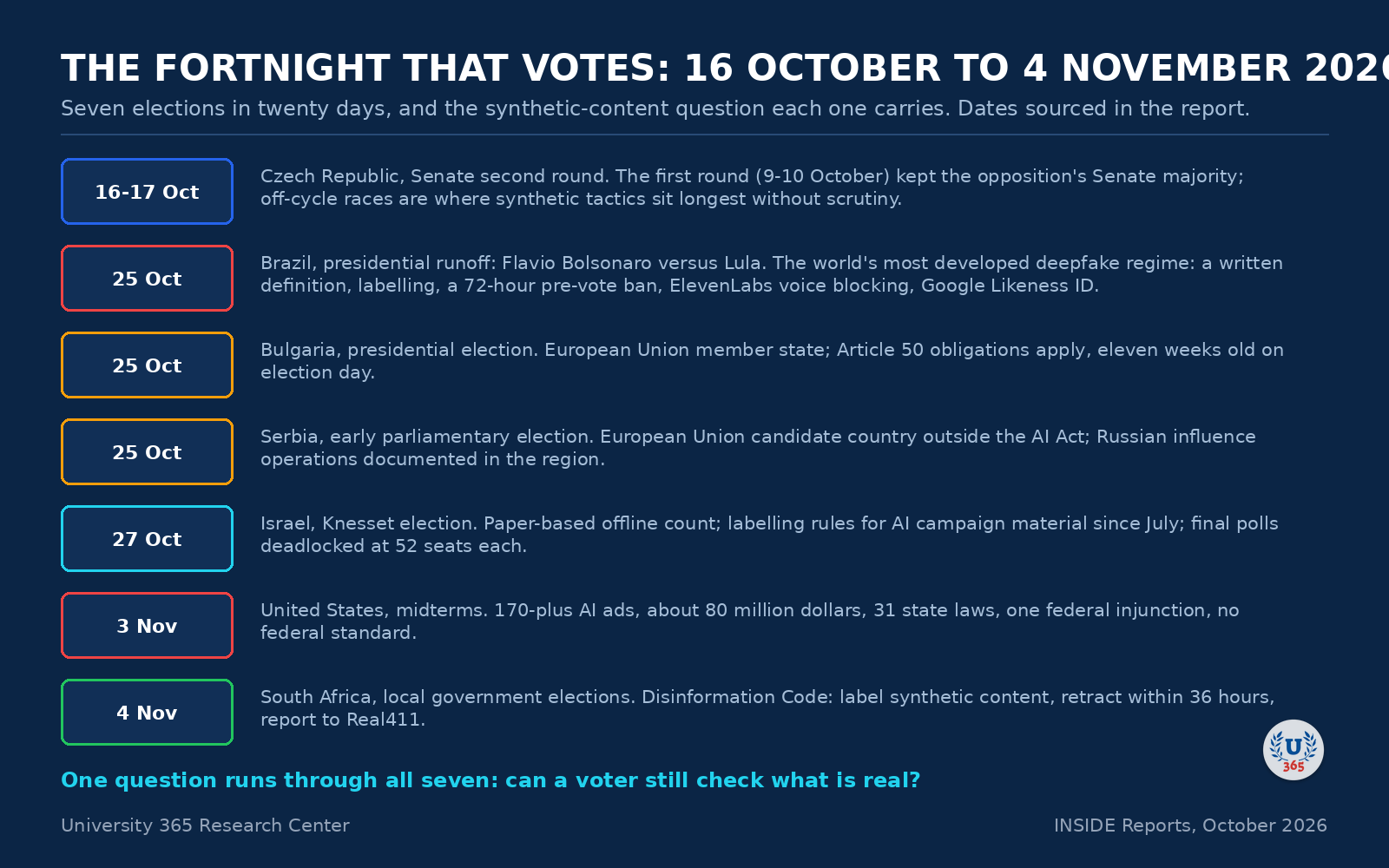
Seven elections in twenty days, with the synthetic-content question each one carries. University 365 Research Center.
Six elections take place within ten days of this report's publication, and a seventh, the Czech second round, within three. This is the frame that makes the report's subject concrete. Voters in the countries listed below will encounter synthetic political content under very different rules, with very different tools, and with a shared question: what can they trust?
Brazil votes in a presidential runoff on 25 October, between Senator Flavio Bolsonaro and President Luiz Inacio Lula da Silva, after a first round on 4 October that the right-wing challenger won ahead of the incumbent. The campaign has been saturated with synthetic content in both directions. A deepfake avatar of former president Jair Bolsonaro appeared to endorse his son; an AI-generated "working-class voter" was deployed against Lula. The country's intelligence agency has said publicly that disinformation will be one of the main challenges of the election. Brazil also has the most developed rulebook of any country in this cluster, which makes it the test case: its electoral court banned deepfakes, built a definition for them, signed an agreement with the voice-cloning company ElevenLabs, and gave candidates a tool to find AI content using their own likeness. The first court ruling under the new regime, a case about the Bolsonaro video, produced a narrow definition and an acquittal. How that definition performs under a runoff, with 72 hours of prohibition before voting and 24 hours after, is an open experiment.
Bulgaria holds its presidential election on 25 October, months after an April parliamentary election that was the country's seventh snap vote in five years. Serbia holds early parliamentary elections the same day, amid the political crisis that triggered them. Neither country has a deepfake statute comparable to Brazil's; both sit inside the European Union's regulatory perimeter, Bulgaria directly and Serbia as a candidate country. Israel votes for its 26th Knesset on 27 October, its first election on its originally scheduled date since 1988, with polling showing a deadlocked parliament, and with a Central Elections Committee that has spent 2026 building the opposite defence to Brazil's. Its officials expect the vote count itself to be secure, because the count is physical, offline and paper-verified. The information environment around it, in their own assessment, is where the vulnerability lives. The United States votes on 3 November, with every House seat and 35 Senate seats in play, after a campaign that has already produced roughly 170 ads using artificial intelligence, about 80 million dollars of associated spending, and cease-and-desist letters, criminal complaints and at least one blocked state law. South Africa holds local elections on 4 November under a new Disinformation Code that, uniquely among the cluster, puts obligations directly on parties and candidates: label synthetic content, retract falsehoods within 36 hours, report disinformation to the electoral commission's platform. Its electoral commissioner has warned that this cycle will shift from broad national falsehoods to ward-level deception, which is the hardest case for fact-checking and the easiest for a fabricated voice note.
Beyond the fortnight, the horizon already shows more: France's presidential election in 2027 is under an open investigation into suspected Russian deepfakes targeting candidates, and prosecutors said in August that they were probing the material. The pattern across all of these cases, established in this report's evidence, is that synthetic political content is no longer an emergency exception. It is a routine instrument in a routine campaign, and the defences around it are newer and weaker than the campaigns.
Three questions, one shared answer
The report is organised around three questions, and each receives the treatment the evidence supports rather than the treatment the topic invites.
The first question is what actually changed. The honest answer is not that deepfakes finally fooled a country. The feared scenario, a fabricated video deciding a national election, has not been demonstrated anywhere. What changed is more structural: the costs collapsed, the tools spread, the tactics moved down the ballot to races with thin coverage and little scrutiny, and the top of the ballot adapted by normalising the format. About 170 ads and 80 million dollars in the United States tell you the practice has an industry, not an underground. The campaigns that use it defend it as satire, as cost-efficiency, as piercing the gatekeepers. The effect on the record is the same regardless of intent: a voter increasingly cannot tell which statements by the people asking for their vote are real.
The second question is whether the defences work. This is where 2026 produced uncomfortable data. Detectors collapsed on fully generated video. Labels arrived but have an uncertain relationship with behaviour, and one study found they depress trust in true content as well as false. Laws arrived but the first court tests went against enforcement, at least in the United States, and the disclosure rates measured in the American midterms barely differ between states with statutes and states without. Platform policies arrived, but the direction of travel on the largest platforms has been toward labelling rather than removal, with exceptions carved out by oversight boards case by case. A defensible summary of the year is that every instrument improved on paper and several of them degraded in practice, and the gap between the two is the most important thing this report measures.
The third question is who pays, and what to do. The costs of this technology land unevenly. Women absorb the largest share of non-consensual synthetic abuse. Down-ballot candidates, local officials and minority-language communities sit in the thinnest information environments and are targeted first. Elections officials absorb the reputational attacks while the vote count itself holds. And ordinary voters, in the aggregate, pay the bill that matters most here: the erosion of the shared factual floor that arguments about policy presuppose. The answer this report returns to, in its final sections, is a single asset, education in verification as a practical skill, because it is the only layer of the defence that can be rebuilt inside a campaign season and the only one that compounds across all the others.

Deepfakes and Democracy: The 2026 Inflection Point
The Contradiction
The defences arrived the year detection stopped working
There is a version of 2026 that reads as progress, and it is not false. The European Union put deepfake transparency obligations into force on 2 August. Israel required labelling of AI-generated campaign material. Brazil's electoral court moved from case-by-case improvisation to a written definition, signed technical agreements with Google and ElevenLabs, and put a preventive tool in every candidate's hands. South Africa made parties promise accuracy, retraction and labelling as a condition of the campaign. In the United States, the number of states regulating election deepfakes reached 31, the Take It Down Act reached full enforcement in May, and civil society extracted transparency commitments from the largest technology companies. Each of these is a real institutional achievement, and this report records them with dates because the record deserves the credit.
Now put the other curve on the same chart. On 7 September 2026, the DF26 benchmark published the results of testing nine state-of-the-art synthetic-video detectors against seven recent generators. Against the older test set, the same detectors scored between 75.6 and 94.3 AUROC, where 50 is a coin toss and 100 is perfect. Against fully generated video, they fell to between 44.0 and 69.7. One lost 46.1 points in a single change of test set. None stayed above 70. Human beings, asked to judge the same clips, performed at 52.6 per cent, indistinguishable from guessing, and their confidence did not match their accuracy. The cause is structural, not a training bug: detectors were built to find the seam between authentic and altered footage, and fully generated video has no authentic part and therefore no seam. Better detectors are not on the way in any timely sense, because the question itself has changed. Authenticity, the benchmark's authors and the industry that reads them agree, now has to be established while content is being made, or not at all.
Line the curves up and the contradiction is precise. The year that produced the most instruments for proving that something is real is the same year the main instrument for detecting that something is fake stopped working. The instruments that arrived, laws and labels and platform notices, assume a system that can eventually sort true from false after the fact. The evidence says the sorting ability degraded, probably permanently, precisely as the volume of content to be sorted exploded. The rules are building permissions on a foundation that the technology moved out from under them.
Every rule targets the fake; the weapon is the denial
The second contradiction lives inside the anatomy of the harm, and it is the reason this report treats the liar's dividend as the strategic core rather than a footnote.
Every major instrument of 2026 targets the production side of the problem. Deepfake bans prohibit making and distributing fabrications. Labelling laws require disclosing that a fabricator used AI. Detection research hunts the fabricated file. Provenance marks the authentic file. All of it is aimed at the counterfeit, which is intuitive, because the counterfeit is visible and outrageous. But the sophisticated actor in this story uses the counterfeit differently. The fabrication is not primarily valuable as a message that people believe; it is valuable as a permission structure that people absorb. Once everyone knows that video can be faked, a real recording loses its force. The politician on real tape denies it as AI and the denial is plausible; the scandal that would have ended a campaign becomes a matter of opinion; the fact-checker who verifies the tape becomes part of the argument. The researchers who named the liar's dividend observed that the threat is asymmetric: creators of false content gain two instruments, the creation and the denial, while honest actors gain only the liability of being victimised by content they did not make.
2026 supplied the case studies. The Russian operation that filled American feeds in September with celebrity deepfakes attacking Democrats cared less about persuading anyone of the specific claims than about seeding doubt and testing reach; its own operators, per OpenAI's October disclosure, were the type to then claim credit beyond their real effect. In Israel, a genuine video of a prime minister was publicly questioned as possibly AI-generated after a chatbot suggested it might be, which is the dividend in miniature: the tools of doubt apply to the real material first. And the most consequential denial does not need the denier to be an adversary at all. A campaign that labels an obviously synthetic parody as "satire" moves the question from "is this true" to "is this allowed", and the voter is left holding a spectrum of fakes, half-fakes, edits, enhancements and authentic material, with one tool, intuition, and no referee.
The practical consequence for the next three weeks is uncomfortable and is stated here as a finding, not a prediction: the most valuable protection against deepfakes in these elections is not the ability to spot one. It is a habit of verification that does not depend on spotting one, because the voters who will be most affected will never see the fabrication itself. They will see the argument about it.

Deepfakes and Democracy: The 2026 Inflection Point
The Current State
The synthetic campaign, measured
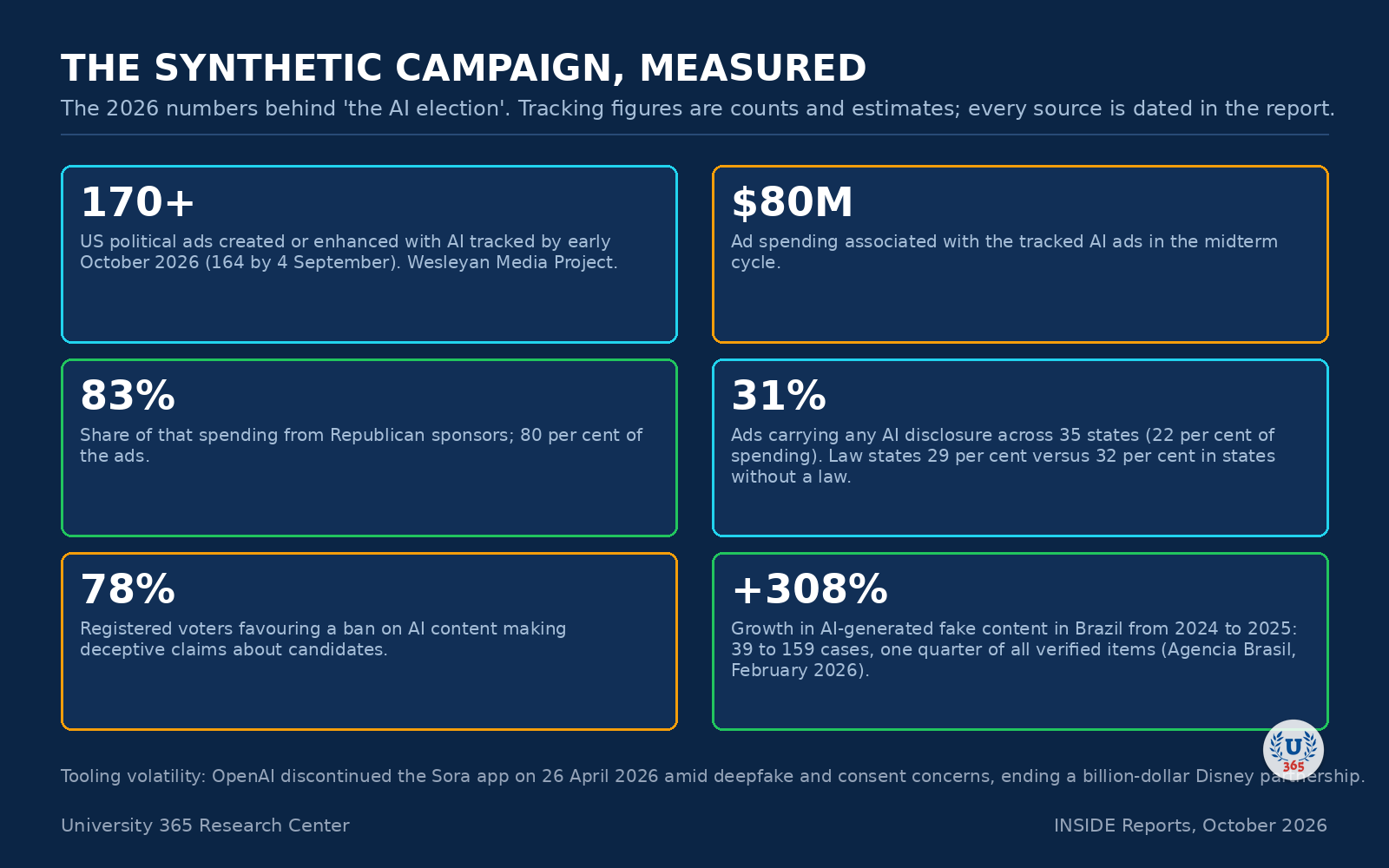
The 2026 numbers behind the phrase "the AI election", dated and sourced in the report. University 365 Research Center.
The clearest measurements of 2026 come from the United States, because the American midterms are the first elections in which AI-generated political advertising has been tracked systematically. The Wesleyan Media Project, a research group that has coded political advertising since 2010, reported on 4 September 2026 that it had identified at least 164 unique ads created or enhanced with artificial intelligence in the midterm cycle, representing nearly 80 million dollars of ad spending. By early October its count had grown to almost 170 ads. Two findings from that tracker deserve attention beyond the American context. First, the practice is not an underground; it is an industry with buyers, sellers and budgets, and Republican sponsors, candidates and groups alike, were behind 80 per cent of the ads and 83 per cent of the spending. Second, disclosure is the exception: across 35 states, only 31 per cent of the tracked ads, representing 22 per cent of the spending, carried any AI disclosure, and the researchers found that the presence of a state disclosure law had very little relationship with whether a disclosure appeared. In states with AI ad statutes, 29 per cent of ads disclosed; in states without them, 32 per cent did. The statutes exist; the compliance culture does not yet.
The content ranges from the crude to the convincing. The National Republican Senatorial Committee ran an ad in which Texas candidate James Talarico appeared to say words he never said, with "AI generated" in small print in a corner; the committee said the ad used the candidate's own past social media posts. A New York gubernatorial campaign ad showed New York City's mayor and the state's governor in an AI-generated conversation designed to make both look foolish, without any AI notice, despite a state law requiring one; the state Democratic Party filed a complaint in August. A Wisconsin congressman posted an AI video attributing fabricated statements to his opponent and drew a cease-and-desist letter from his opponent's lawyers. A Texas lieutenant governor's AI attack ad drew a criminal complaint under that state's deepfake statute. The tracker logged hyperrealistic fakes of former presidents and congressional leaders, a Louisiana candidate driving a busload of undocumented immigrants, a fake Dr. Anthony Fauci with a giant syringe, and, in several cases, AI used not to fabricate events but to enhance real footage so subtly that no viewer could identify the intervention. That last category is the quiet one: "AI-enhanced" is nearly undetectable by definition, and it evades most statutes, which target fabricated speech rather than polished reality.
Two structural features of this record travel beyond the United States. The first is the downward migration of the tactic. The most consequential synthetic content in 2026 has not been aimed at presidential races, where scrutiny is intense and campaigns respond within hours, but at state legislature races, city councils, school boards and primaries, races that decide real governance in thin information environments. That pattern was visible across the year's reporting and across countries: the fabricated audio of a Massachusetts governor was a radio spot in a state race; the Brazilian cases concentrate in municipal and regional politics; South Africa's commission explicitly expects the attack surface to be ward-specific. The second feature is the normalisation at the top. America's midterm campaign includes AI content produced by national party committees, released with press releases, defended on television, and absorbed into the ordinary flow of attack politics. When a fabrication is delivered by a party rather than a troll, the question of legality becomes a question of enforcement, and enforcement in the United States is exactly where the record is thinnest: one federal court blocked a state deepfake law in September on First Amendment grounds, and Congress has passed no federal standard at all.
The countries voting first, and what they built
Voters queue in South Africa's 2014 general election. The local elections on 4 November 2026 are the first run under the electoral commission's new Disinformation Code. Photograph: Leo za1, CC BY-SA 3.0, via Wikimedia Commons.
Each of the elections in the fortnight ahead has a defence file, and comparing the files shows more variety than the "AI election" shorthand suggests.
Brazil has the most developed regime and the most instructive court record. Since the 2024 municipal elections, the Superior Electoral Court has required labelling of AI content and restricted deceptive uses; this year it signed a cooperation agreement with the Attorney General's Office on 3 August to produce guidance for parties, candidates and platforms; it launched, with Google, a campaign to put the YouTube "Likeness ID" tool in candidates' hands so they can find and flag synthetic content using their faces; and it concluded an agreement with ElevenLabs, the voice-synthesis company, to build preventive blocking of cloned candidate voices, with a "voice bank" so voters can check how a candidate truly sounds. Then came the ruling that defined the line. On 1 September, in the case of the AI-generated video of Jair Bolsonaro endorsing his son at a party convention, the court declined to punish the campaign and adopted a three-part test for what counts as a prohibited deepfake: synthetic origin, a degree of realism capable of misleading an ordinary viewer, and the reproduction or alteration of a real or fictional person's image or voice. The majority reasoned that an expression of intra-party support differs from advertising directed at voters; the dissent warned that a "degree of realism" test creates a sliding scale the electoral rules never contemplated. The practical effect is a definition narrower than a lay reading of "deepfake ban" would suggest, and a runoff on 25 October will test it under the rules' sharpest provision: synthetic content is prohibited outright in the 72 hours before and the 24 hours after the vote.
Israel built the opposite architecture: harden the count, label the campaign, and warn the voter. Officials describe a voting process deliberately kept physical and offline, with paper ballots, signed protocols, photographs of each tally sheet published alongside the electronic result, and a central system described as military-grade and disconnected from the internet. The Central Elections Committee's assessment is that the count itself is not the vulnerable layer; the information environment is. Israel amended its election law to address campaign material created or altered with advanced technology and, in July, the committee published rules requiring campaigners to label AI-generated material. Its acting director general, Dean Livne, described the working posture in October: "Today, whatever you see online or on WhatsApp or anywhere else, doubt if it is true. Be confused, learn, and come to us." The committee coordinates with the security services on threats and says it will seek removal of eve-of-vote fakes and warn the public directly. On 27 October it will run its first election under the new rules, in a race whose final polls are deadlocked.
South Africa chose obligations on the parties themselves. The Electoral Commission gazetted its Disinformation Code on 4 September, ahead of the 4 November local elections, as part of the Electoral Code of Conduct, which gives it enforcement teeth the earlier guidance lacked. Parties and candidates commit to check information before sharing it, to retract falsehoods within 36 hours, to label AI-generated content, to avoid bot networks and fake accounts, and to report disinformation to the commission's Real411 platform within 36 hours. The code operates until results are declared. The commission's chair has warned that deception this cycle will be hyper-local and that public confidence in spotting it is falling, which makes the code's 36-hour clock the most interesting test among the seven countries: it assumes parties can and will police their own synthetic output.
The Czech Republic is completing a Senate election whose first round, on 9 and 10 October, saw the opposition retain its upper-house majority; its second round runs 16 and 17 October. Czech campaigns have not been the centre of deepfake reporting, and that is part of the story: the tactic concentrates where coverage and scrutiny are thin, and a mid-sized European country in an off-cycle senate round is precisely such terrain, which is why European regulators now treat the information environment as election infrastructure. Bulgaria and Serbia vote on 25 October under the European Union's wider perimeter, Bulgaria as a member state and Serbia as a candidate; neither has a deepfake statute comparable to Brazil's, and both have documented histories of foreign influence activity, including operations that preceded the Bulgarian parliamentary election in April.
The regulatory layer above all of them is the European Union's AI Act. Its transparency obligations under Article 50 took effect on 2 August 2026: providers of generative systems must mark outputs in a machine-readable format, and anyone deploying AI to create a deepfake must disclose it, with reduced requirements for evidently artistic or satirical work and an exemption where content has genuine human review and editorial responsibility. A Code of Practice on transparency of AI-generated content and guidelines from the Commission give the rules their operating detail. A provisional political agreement in May, the so-called AI Omnibus, gives generative systems already on the market until 2 December 2026 to meet the machine-readable marking requirement, a grace period that lands awkwardly in the middle of the election cluster. Enforcement sits with national market surveillance authorities and the Commission's AI Office. The honest assessment of the European model, at this point, is that it is the most comprehensive in the world on paper and the least tested in an election, because the obligations are eleven weeks old.
That leaves the United States, where the patchwork persists. The National Conference of State Legislatures counted 31 states with election deepfake statutes in June 2026, 28 of them requiring disclosure and three (Maryland, Minnesota and Texas) prohibiting certain deceptive uses even when labelled. Louisiana's June law applies to state and local candidates but excludes federal candidates; Maryland's May law makes labelled deception unlawful when intent and harm are shown; the penalties range from a few thousand dollars to prison terms that will almost certainly never be imposed in an election case. Above the states, the federal layer consists of a fully effective Take It Down Act against non-consensual intimate imagery (which reached full enforcement in May), two pending bills that have not moved, and a voluntary White House accord signed with six AI companies on 29 September whose commitments are described by the government itself as morally, not legally, binding. The first court test of a state law went badly for enforcement: on 17 September a federal judge temporarily blocked Montana from enforcing its deepfake statute against a conservative political action committee, finding a likely First Amendment problem. The American regime in this election is therefore a laboratory with 31 experiments, one injunction, and a federal standard that does not exist.
The interference record for this cycle
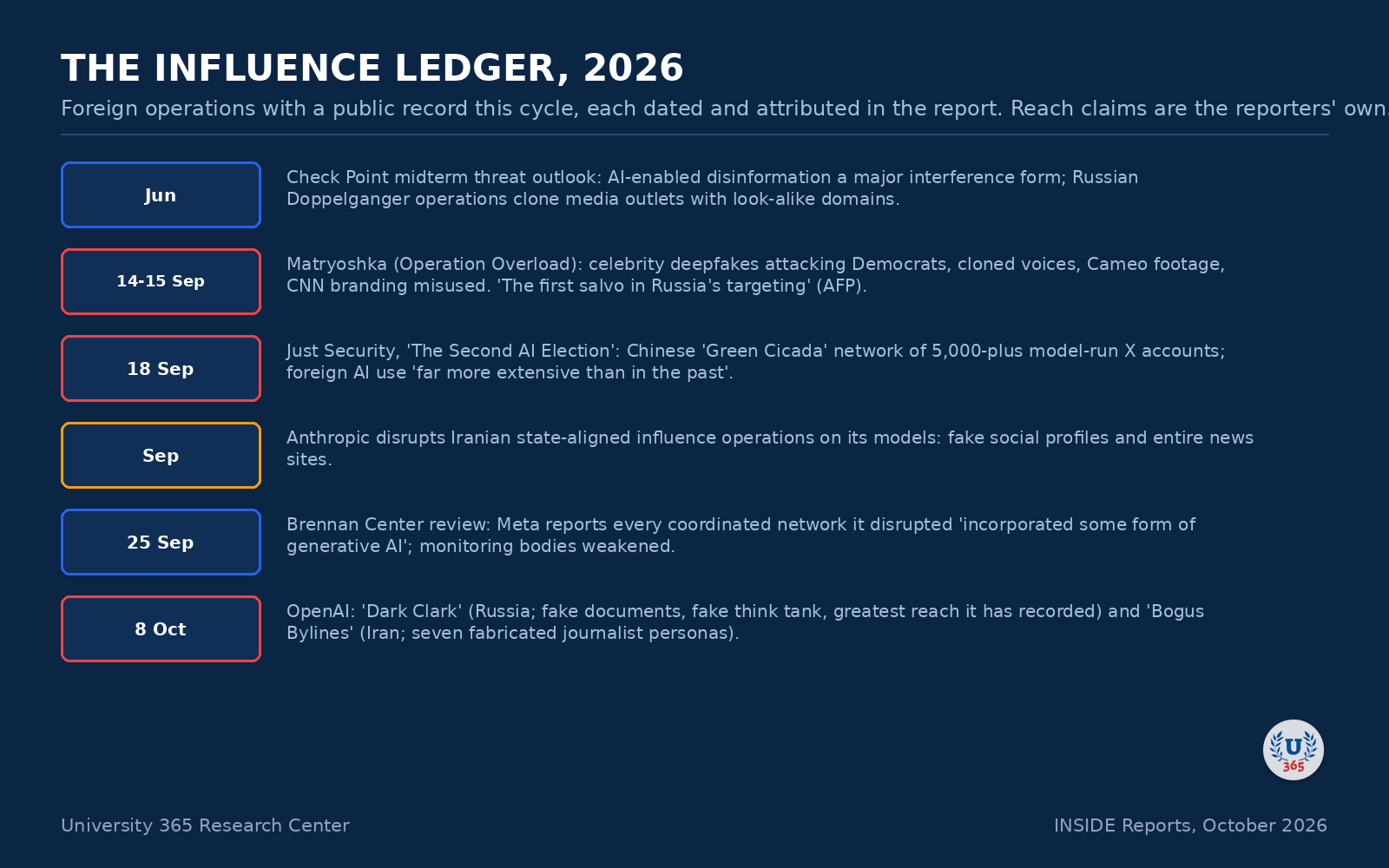
The influence operations with a public record this cycle, each dated. University 365 Research Center.
Foreign interference in 2026 has a public record, assembled mostly by the technology companies themselves and the researchers who read their reports, and the record shows the tactics consolidating around the same playbook: synthetic celebrity content, false-front outlets, and the industrial production of doubt.
The most visible operation of the American campaign surfaced in mid-September, when networks of accounts spread AI-generated videos of American celebrities attacking Democrats. The clips used cloned voices of actresses including Alyson Hannigan, Emma Caulfield and Sarah Jessica Parker, a fabricated Julia Roberts layered over a 2023 fashion campaign, and recordings lifted from Cameo, a service where celebrities sell personalised videos, doctored to make the speakers attack Democrats. The videos carried CNN branding, which the network publicly disowned. Researchers attributed the campaign to a Russian operation known as Matryoshka, or Operation Overload, which has used identical tactics in German regional elections, Hungarian elections and Armenian elections. "This is what I believe to be the first salvo in Russia's targeting" of the November vote, said Clemson University's Darren Linvill. The operation's scale was modest and platforms removed some posts; its signal value was in what it previewed.
On 8 October, OpenAI disclosed the disruption of two operations with more sophistication. The Russian one, which it named "Dark Clark", produced fake leaked documents and audio scripts, including material aimed at undermining Ukrainian armed forces recruitment and stoking tensions between Ukraine and Poland, and ran a fake think tank, the "Social Research Center", staffed largely by unwitting recruits in Latin America. OpenAI called it the highest-reach influence operation it has recorded. The Iranian operation, "Bogus Bylines", ran seven "journalist" personas that pitched fabricated articles about the American conflict with Iran to outlets around the world. In September, Anthropic had reported disrupting Iranian state-aligned operations that used its Claude models to build networks of fake social media profiles and entire news websites. Earlier in the year, researchers documented a Chinese network, nicknamed "Green Cicada", of at least 5,000 accounts on X operated through a large language model system, and Check Point's midterm threat outlook, published in June, traced Russian "Doppelganger" infrastructure cloning the visual identities of media outlets to distribute manipulated political content before verification could catch up. Meta's own 2026 threat analysis stated that every coordinated inauthentic behaviour network it had disrupted incorporated some form of generative AI, "ranging from basic profile photo generation to fully automated, multi-modal content production pipelines".
Two caveats belong on this record, and both are stated plainly in the sources. The first is that scale is disputed. The measured reach of most operations remains small relative to organic political content, and this report records, as OpenAI itself did, that operators routinely exaggerate their effectiveness. The second is that the monitors have contracted. The Brennan Center, reviewing the threat reports in late September, noted that the American government has dismantled, weakened or politicised several of the entities built to identify foreign influence, and that the cybersecurity agency that supported election infrastructure is reported to be in its weakest state in years. The interference this cycle is being documented more by vendors than by governments, which changes who sees the warning and how fast it travels.

Deepfakes and Democracy: The 2026 Inflection Point
Key Findings
What the record establishes
1. Synthetic political content is a routine campaign instrument, and it is measured. Roughly 170 American ads using AI and about 80 million dollars of spending; 80 to 83 per cent of them attributable to Republican sponsors; only 31 per cent carrying any disclosure; the same tactic visible in Brazil's courts, Israel's rule-making, South Africa's code and Europe's investigations. The phenomenon has an industry and a budget, and the budget is growing.
2. Production collapsed to consumer scale, and the tooling is volatile. A convincing voice clone takes about three minutes of source audio and under a day; video that required a professional budget in 2022 is available to a laptop user with free tools. The volatility cuts both ways: OpenAI's shutdown of the Sora app in April, ending a billion-dollar partnership, showed that generator liability can kill a flagship product overnight, while the underlying capability dispersed into cheaper tools exactly as fast.
3. Detection, the assumed backstop, had its worst documented year. The DF26 benchmark published on 7 September measured nine leading detectors against seven recent generators: scores fell from 75.6 to 94.3 AUROC on the old benchmark to 44.0 to 69.7 on fully generated video, one detector shedding 46.1 points, none staying above 70. Humans judging the same clips scored 52.6 per cent, statistically indistinguishable from guessing. The cause is structural: detectors hunt the seam of manipulation, and fully generated video has no seam.
4. The instruments of 2026 are real, and misaligned with the harm they target. Labels disclose how content was made, not whether it is true, and experiments find they barely change sharing and can depress trust in accurate material. Disclosure statutes measured no better compliance than their absence. The first court tests narrowed or blocked enforcement: Brazil's top electoral court adopted a restrictive definition; a federal judge enjoined Montana's statute. The rules are a foundation; they are not yet a wall.
5. Foreign operations industrialised, and the monitors thinned. The cycle's operations have names, dates and technical signatures: Matryoshka's celebrity deepfakes in September, Dark Clark's fake documents and fake think tank (OpenAI, 8 October), Bogus Bylines' fabricated journalism (Iran), Green Cicada's 5,000 model-run accounts (China), Doppelganger's cloned newsrooms (Check Point, June). The documented reach remains smaller than the noise suggests, and the government bodies built to detect it are weaker than at any point since 2016.
6. The liar's dividend is the strategic centre of the problem, not a footnote. The value of fakes is increasingly in the permission they give to deny the real: authentic recordings questioned as AI, scandals resolved by ambiguity, fact-checkers absorbed into the argument. Every instrument of 2026 targets the fake; almost none addresses the denial, which is cheaper to produce, harder to sanction and, on this year's evidence, more effective.
7. The layer that can still be rebuilt in time is the voter's own practice. Provenance needs years of adoption, law needs enforcement it does not have, detection needs a capability that the benchmark says no longer exists. Verification, as a taught habit of checking before believing and checking before sharing, is the only defence that fits in the window and compounds across every other layer. The final sections of this report are about building it.

Deepfakes and Democracy: The 2026 Inflection Point
Deep Analysis
Why detection stopped working: the seam disappeared
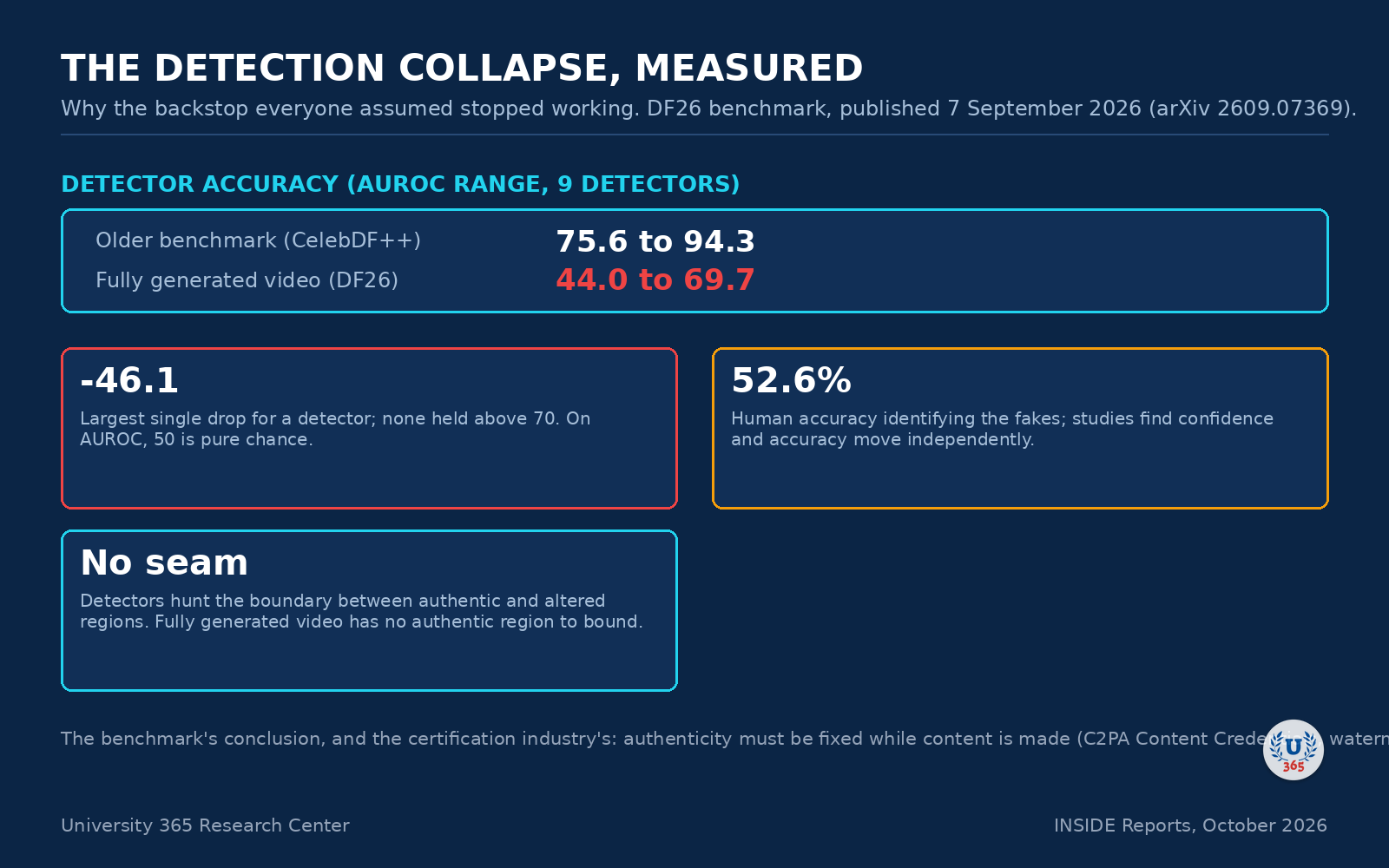
The DF26 benchmark, published 7 September 2026, in its key numbers. University 365 Research Center.
The most important technical document of the deepfake year is a benchmark published on 7 September 2026, and its subject is a failure. DF26 was built to test synthetic-video detectors under current conditions: nine state-of-the-art detectors, seven video generators released between late 2025 and early 2026, and a design that measures the realistic case, since no forensic team can retrain its classifier on a model that has not shipped yet. The headline numbers are worth stating with their definitions, because they explain the year's central claim. AUROC is a standard measure of a detector's ability to separate real from fake; 50 is pure chance, 100 is perfect. On CelebDF++, an older benchmark built from manipulated footage, the nine detectors scored between 75.6 and 94.3. On DF26, they scored between 44.0 and 69.7. One detector lost 46.1 points; the worst fell below chance; none held above 70. Human participants, shown the same clips, identified the fakes 52.6 per cent of the time, and studies in the same literature have found that confidence and accuracy move independently, which means some of the people who were certain were the ones most likely to be wrong.
The collapse is not a training deficiency that more data will fix. It is a category change. Detectors learned the physics of manipulation: a face swap leaves a boundary between the untouched and the synthesized regions, a re-rendered mouth drifts out of sync, compression interacts with edits in detectable ways. The models released through early 2026 generate the entire frame from a prompt. There is no untouched region, no boundary, no seam. The detector is answering a question nobody asks any more: not "was this altered" but "was this captured", and the pixels do not distinguish between a real scene recorded and a scene computed. The benchmark's own conclusion is that authenticity has to be fixed while content is being made, because reconstructing it afterwards no longer works.
That conclusion reframes the entire defence stack, and it explains why this report treats provenance as the only technically coherent answer and simultaneously doubts its reach. Fixing authenticity at source means cameras signing their captures, editing tools recording their changes in signed histories, generators marking their outputs machine-readably, and platforms displaying what they receive. Every element of that chain exists in 2026. C2PA Content Credentials are attached by default to images from major generators and increasingly by cameras; the standard's April 2026 revision added a dedicated assertion for AI disclosure; the European Union now requires machine-readable marking of generated content, with a grace period to December for systems already on the market; Google's SynthID is embedded in a large share of the world's generated media; TikTok reports more than three billion items labelled. And every element of the chain leaks. Most media carries no credential at all, so absence proves nothing. Independent security analysis has found the provenance protocols vulnerable to stripping and tampering. An industry tally of watermarking statistics, presented as estimates, counted 4.2 billion assets signed with Content Credentials, a figure that sounds enormous and represents a rounding error against the total volume of digital media. The platform layer filters: only a fraction of services render the credentials they receive. Between the marked few and the unmarked many, the voter sees a wall of content whose provenance is, on average, unknowable.
Worth adding, because it is measurable: the detectors that platforms deploy are not the failing academic kind, as a rule, but proprietary systems with different claims. The reported performance of commercial detectors on fresh, high-quality content sits around 70 to 80 per cent in favorable conditions, and collapses on re-encoded material, which is to say on virtually everything that travels through a social feed. The error structure is not random either. False positives, authentic content flagged as synthetic, concentrate in languages and dialects under-represented in training data and on faces that training data under-represents, so the instruments meant to protect speech reliably misfire on the speakers with the least protection. The combination, moderate accuracy on fresh content, degradation on viral content, biased errors, and near-uselessness on fully generated video, describes a tool that can support investigations and cannot gatekeep feeds. Nobody should plan an election on it.
The denial is the weapon
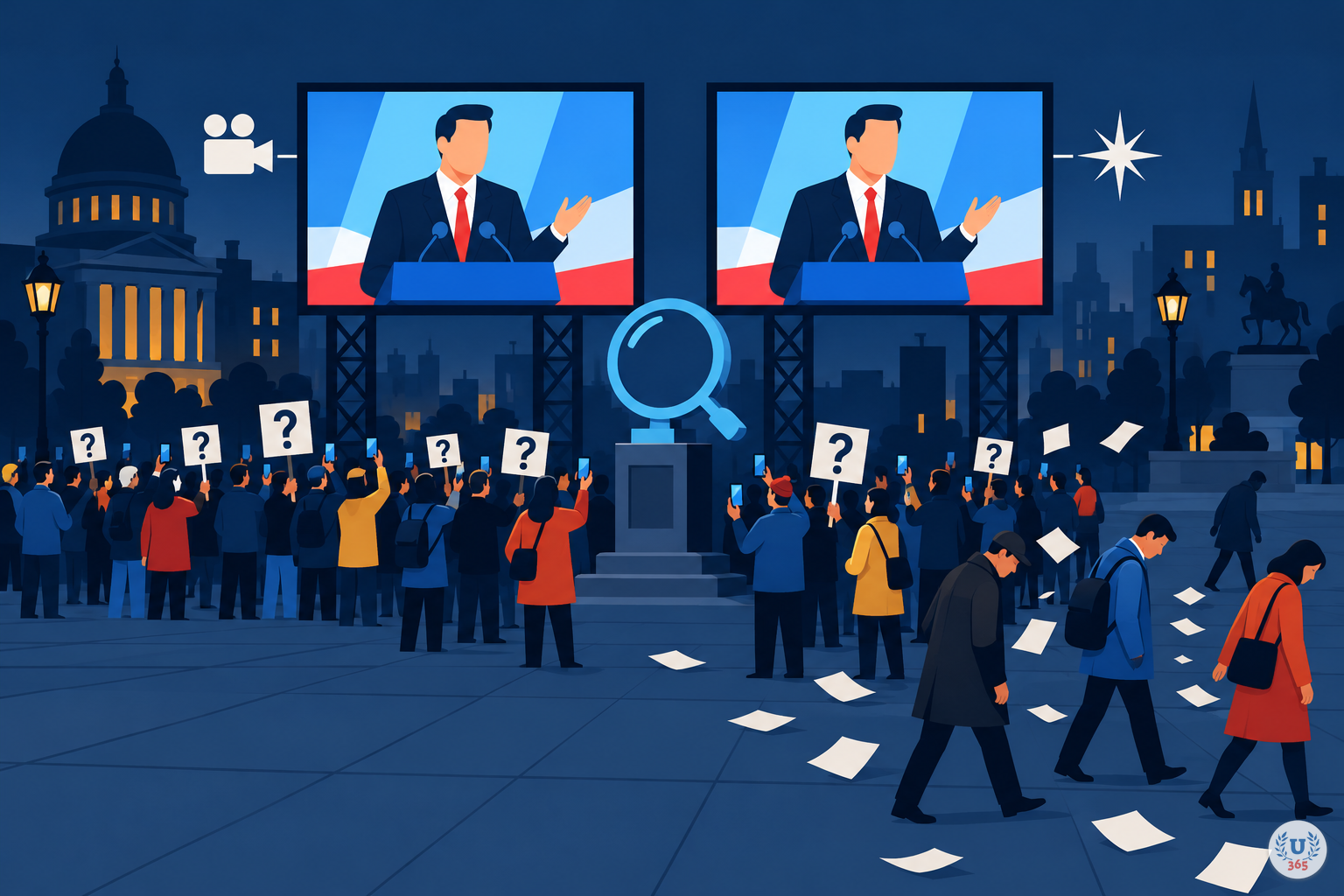
The crowd and the two screens: doubt as the deliverable. University 365 Research Center.
The term "liar's dividend" entered the deepfake literature in the late 2010s, and this year's events have made its argument concrete: as fabricated media become plausible, the ability to dismiss inconvenient authentic media becomes valuable, and the value grows with public awareness of the technology. The dividend has a precise structure. An honest actor who does not create fakes bears only risk, the chance of being victimised by synthetic content. A dishonest actor holds two instruments: the fabrication, for use against opponents, and the denial, for use against evidence. The denial is cheaper. It requires no tooling, leaves no forensic trace, and cannot be disproven by the technologies that were built to catch fakes, because it does not make a claim about any file; it makes a claim about the reliability of files, and the evidence supports it.
Three scenes from 2026 show the mechanism running at different scales. In September, when the Matryoshka operation flooded American feeds with celebrity deepfakes, the important effect was not the persuasion of any viewer by any clip. It was the ambient doubt the wave deposited: for weeks afterwards, every striking video in a political feed could be dismissed with "that is probably AI", and the burden of proof moved to whoever said otherwise. In Israel, a genuine video of the prime minister was publicly questioned as possibly AI-generated after a chatbot, asked to assess it, suggested it might be, a case reported without the technology being able to settle the question either way. And in the ordinary politics of the American midterms, campaigns that published obvious fabrications defended them in the language of art and humour, "obvious parody", "satire", "new tactics that pierce through legacy media", shifting the dispute from the truth of the content to the intent of its maker. In each case, the fabrication's measurable persuasive effect is small; its legal exposure is small; its contribution to the sum of doubt is real and durable.
The dividend has a second-order consequence for the institutions that check facts. A fact-checker's product is credibility, and the dividend spends it. When courts, researchers or newsrooms verify an authentic recording and the public verdict is "they would say that", the verification consumes the institution's authority without restoring the fact. This dynamic is why the research consensus has moved, quietly but visibly, from detection toward pre-bunking: inoculating the public before the specific fake appears, teaching the pattern rather than chasing the artifact. It is also why this report treats the satire defence as a structural problem rather than a rhetorical one. A statute that hinges on intent gives every sophisticated actor a licence to deploy a real attack behind an ironic frame, and the audience, which is not reading intent, receives the attack.
None of this argues that fakes do not matter. It argues that the harm hierarchy is inverted in most of the year's policy responses. Deepfake bans chase the manufacture of lies while denial manufactures a world in which lies and truth cost the same to assert. A society that fixes only the first problem will have built a museum of forensic instruments guarding a public that trusts nothing they authenticate.
What was built, and where it still ends
The defence ledger of 2026 deserves to be read twice: once as the inventory of an industry and a governance system responding to a real threat, and once as a list of where each instrument stops. This report has documented the instruments at length; this section states where each one ends.
The European Union's Article 50 ends at its own youth and its grace period. It is the world's most comprehensive transparency regime for synthetic content, and it is eleven weeks old on the day this report is published, with the machine-readable marking duty deferred to 2 December for systems already on the market, which is to say through the entire election cluster. Enforcement machinery, national authorities and the AI Office, is organized but not yet blooded. Its most interesting feature, for elections, is the deployer duty: whoever uses AI to create a deepfake must disclose it, which is precisely the actor most election statutes elsewhere fail to reach. Its most important limit is that disclosure is not accuracy: an Article 50 label satisfies the law and changes nothing about the claim.
Israel's rules end at the campaign's edge and the voter's scepticism, which is to say in the right place, given the available instruments. The labelling requirement reaches campaign material; the count itself stays physical; the committee's posture, "doubt if it is true, be confused, learn, and come to us", is honest about the epistemic condition rather than promising a technology that resolves it. The gap in the Israeli model, which its officials acknowledge in different words, is the same gap as everywhere else: a label on a WhatsApp-forwarded video does not survive forwarding.
Brazil's regime ends at the narrowness of its own definition and the reach of its platforms. The three-element test, synthetic origin, realistic presentation, real or fictional person, is a genuinely careful piece of legal design, and its first application protected a campaign rather than the voters' interest, which is what careful definitions do. Its technical agreements, Likeness ID with Google and preventive voice blocking with ElevenLabs, are the most concrete public-private machinery anyone has built for an election, and they still end at the platforms' enforcement capacity and the speed of a 72-hour blackout window. The runoff will be the honest test.
South Africa's code ends at voluntarism with a reporting clock. Parties promise accuracy, retraction within 36 hours, labelling, and reporting to the commission's platform. The promise structure is unique, and it makes the parties, rather than the platforms, the accountable party, which for local elections dominated by ward-level messaging is the right target. What it lacks is a technological layer at all, and the commission's own warning, that deception will be small, local and fast, describes exactly the class of harm that a code without a detector cannot see.
The American patchwork ends at its own contradictions. Thirty-one state regimes, one federal injunction, zero federal statutes, disclosure rates indistinguishable between regulated and unregulated states, and a voluntary accord whose signatories agreed to commitments their government calls morally binding. The American system is currently producing the world's richest data on what deepfake politics looks like and the world's least coherent answer to it.
The platform and laboratory layer ends at the boundary of business model and liability. Platforms converged, in 2026, on a regime of labels rather than removals for synthetic political content, with oversight boards pushing removal in individual harmful cases: a deepfake targeting a British local politician, an audio call in an Iraqi Kurdistan election dispute, a sexualised abuse case in the queue. Generative laboratories built provenance into outputs, published election safeguards, supplied live vote counts with the Associated Press in the United States and Brazil, and offered cybersecurity support to election administrators, all of which is real and none of which is accountable to a voter. The civil society letter sent to the industry in June, by 25 organisations from the NAACP to Verified Voting, named the standard the industry has not met: "Policies are not enough"; the companies must ensure implementation, allow reporting, remove harmful content, and publish what they find. As of this writing, no major platform has published an election-cycle transparency report against those commitments.
Read the whole ledger together and the shape is consistent. Every instrument reaches the producer, the platform, the file or the campaign. Every instrument is younger than the problem, thinner than its description, and dependent, for its final effect, on something no instrument supplies: a person at the end of the chain, deciding whether to believe what they are seeing. That person is the subject of the rest of this report.

Deepfakes and Democracy: The 2026 Inflection Point
Data and Evidence
The record in numbers
The tables below collect the report's load-bearing figures, each dated and attributed. Where a figure is an estimate, a self-report or a vendor claim, the source column says so. The methodology section records the disagreements between sources.
Table 1: The elections in the next six months
Election | Date | The synthetic-content question at stake |
Czech Republic, Senate second round | 16-17 October 2026 | An off-cycle, mid-sized European race: the terrain where synthetic tactics concentrate when scrutiny is thin. First round held 9-10 October; opposition retained its majority (Xinhua; AP). |
Brazil, presidential runoff | 25 October 2026 | The world's most developed deepfake rulebook meets its first high-stakes test; synthetic content banned 72 hours before and 24 hours after the vote; TSE definition adopted 1 September (Valor). |
Bulgaria, presidential election | 25 October 2026 | An EU member state with a documented history of foreign influence activity; no national deepfake statute of its own; Article 50 applies eleven weeks old (OSCE ODIHR; BTA). |
Serbia, early parliamentary election | 25 October 2026 | EU candidate country, outside the AI Act; Russian operations have a documented record in the region (OSCE; Wikipedia). |
Israel, Knesset election | 27 October 2026 | Physical, paper-verified count; labelling rules for AI campaign material in force since July; committee posture of voter scepticism; race deadlocked in final polls (Jerusalem Post; LoC; Haaretz). |
United States, midterms | 3 November 2026 | 170-plus AI ads, 80 million dollars, 31 state regimes, one injunction, no federal standard; the most measured synthetic campaign in history (Wesleyan Media Project; NCSL; Axios). |
South Africa, local government elections | 4 November 2026 | Parties bound by a Disinformation Code: label synthetic content, retract within 36 hours, report to Real411; ward-level deception expected (IEC; SAnews). |
Cape Verde, presidential election | 15 November 2026 (possible runoff 29 November) | The first national vote after the cluster: a small-state race at the calendar's quieter end. |
Gambia, presidential election | 5 December 2026 | Incumbent President Adama Barrow is seeking a third term (national electoral commission statements). |
Guinea-Bissau, general election | 6 December 2026, postponed with no replacement date | The counter-case in the calendar: on 8 October the electoral commission declared conditions for the December vote unmet, and no new date has been set (AfricaNews; France 24). |
South Sudan, general election | 22 December 2026 | The country's first general election since independence, repeatedly delayed and now set for 22 December (BBC; International IDEA). |
Nigeria, general election (presidential and National Assembly; governorship and state assemblies on 6 February 2027) | 16 January 2027 | Africa's largest electorate, in a full national campaign under INEC's published timetable. |
El Salvador, general election (presidential, legislative and municipal) | 28 February 2027 | A single-day vote across three levels, with more than 6.5 million registered voters (Supreme Electoral Tribunal of El Salvador). |
India, Uttar Pradesh state election | Expected February to March 2027 | The most populous state in the world's largest democracy; the formal schedule is not yet published. |
Estonia, parliamentary election | 7 March 2027 | A national parliamentary election in the European Union, ahead of the April cluster (Estonian State Electoral Office). |
France, presidential election (first round) | 18 April 2027 | French prosecutors are already investigating suspected Russian deepfakes and fake video reports aimed at the race (AFP). |
Finland, parliamentary election | 18 April 2027 | Shares the day with France's first round and two German state elections. |
Germany, state elections (Saarland and Schleswig-Holstein; North Rhine-Westphalia on 25 April; Bremen on 30 May) | 18 April 2027 | The spring's German state series; the next national election follows in 2029. |
Table 2: The year synthetic politics went mainstream, in numbers
Figure | Value | Date | Source |
AI political ads tracked, United States | At least 164 ads and nearly 80 million dollars by 4 September; almost 170 ads by early October | September to October 2026 | Wesleyan Media Project, via The Conversation |
Partisan split | Republican sponsors behind 80 per cent of ads and 83 per cent of spending | October 2026 | Wesleyan Media Project |
Disclosure rate | 31 per cent of ads (22 per cent of spending) disclosed AI across 35 states; 29 per cent in law states versus 32 per cent in non-law states | October 2026 | Wesleyan Media Project |
Voter opinion | 78 per cent of registered voters favour a ban on AI content making deceptive claims about candidates | October 2026 | Polling cited by the Wesleyan researchers |
Brazil, AI fake content | Plus 308 per cent, from 39 cases in 2024 to 159 in 2025; 25 per cent of verified items; Lula 36 cases, Bolsonaro 33, Justice Moraes 30 | Reported 6 February 2026 | Brazilian observatory study, via Agencia Brasil |
Detection collapse | AUROC falls from 75.6 to 94.3 (older benchmark) to 44.0 to 69.7 (DF26); worst detector minus 46.1; humans 52.6 per cent | Published 7 September 2026 | DF26 benchmark, arXiv 2609.07369 |
Public opinion, global | Median 79 per cent say social media makes manipulation with false information easier; 68 per cent more divided; US 64 per cent call social media bad for democracy | Published 1 October 2026 | Pew Research Center, 37-nation survey |
Labelling intent | 76 per cent want AI content labelled; 12 per cent confident they can identify it | September 2025 (baseline) | Pew Research Center |
Foreign operations | Matryoshka celebrity deepfakes (September); Dark Clark highest-reach Russian operation recorded by OpenAI (8 October); Bogus Bylines, seven fabricated journalist personas (Iran); Green Cicada, 5,000-plus accounts run through a language model (China) | 2026 | AFP; OpenAI; The Hill; Just Security |
Generator liability | Sora app discontinued 26 April 2026 amid deepfake and consent concerns, ending a billion-dollar Disney partnership; API discontinued 24 September | 2026 | OpenAI; TechCrunch; Mashable |
Table 3: The defence ledger, 2026
Instrument | Where | What it does | Status as of 13 October 2026 |
EU AI Act Article 50 | European Union | Deepfake disclosure duty; machine-readable marking of generated output | Applies from 2 August 2026; marking grace period to 2 December 2026 for pre-market systems |
Israel, AI campaign labelling | Israel | Campaign material made with AI must be labelled; committee monitors and warns | Rules published July 2026; first election under them on 27 October |
Brazil, TSE regime | Brazil | Deepfake ban with three-part test; labelling; 72-hour broadcast prohibition; ElevenLabs voice-blocking agreement; Google Likeness ID | Definition adopted 1 September 2026; first ruling narrowed the prohibition |
South Africa, Disinformation Code | South Africa | Party obligations: accuracy, 36-hour retraction, synthetic labelling, Real411 reporting | Gazetted 4 September 2026; runs to results declaration |
United States, state laws | 31 states | Mostly disclosure requirements; three states prohibit even labelled deception | One federal injunction (Montana, 17 September); disclosure rates statistically indistinguishable from unregulated states |
Take It Down Act | United States | Federal removal duty for non-consensual intimate imagery, deepfakes included | Full enforcement since May 2026 |
Platform labels | Global | Disclosure notices on synthetic and manipulated content | Converging on label-not-removal; oversight boards ordering removal case by case |
Provenance standards | Global | C2PA Content Credentials; SynthID and other watermarks | Maturing (2.4 revision, April 2026); most media unmarked; stripping unsolved in the protocol's own security reviews |

Deepfakes and Democracy: The 2026 Inflection Point
Implications
For voters: scepticism with a method
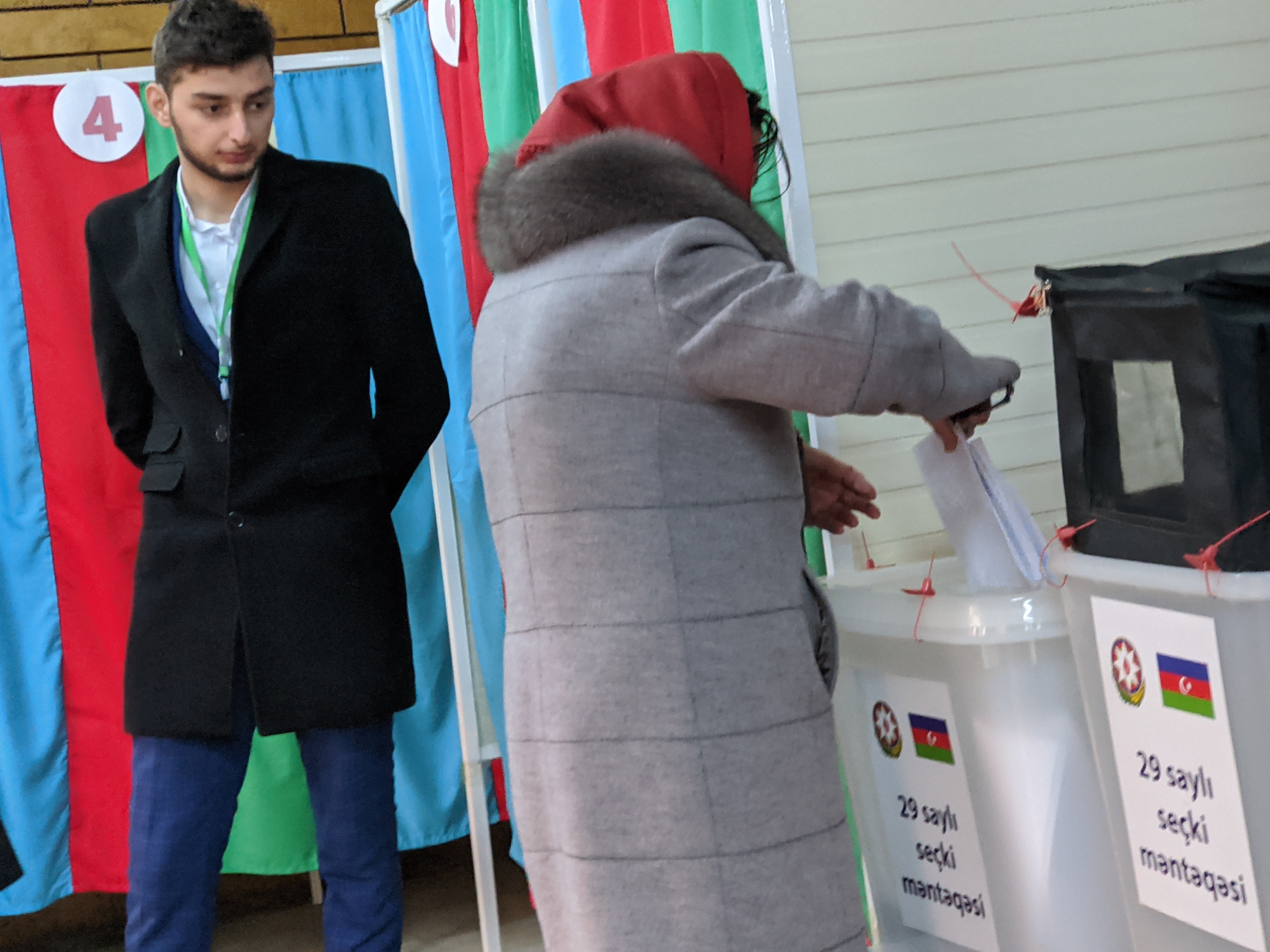
A voter casts a ballot at polling station No. 29 in Baku, Azerbaijan (February 2020). The physical act is simple; the information around it is not. Photograph: OSCE Parliamentary Assembly, CC BY-SA 2.0, via Wikimedia Commons.
If the report's findings are right, the coming three weeks will not be decided by anyone spotting a clever fake. They will be decided inside the ordinary flow of claims, and the ordinary flow is where the defence has to be practical. So here is what the evidence supports, stated as instructions rather than attitudes.
Stop trying to authenticate video by eye; the benchmark says you cannot, and confidence makes it worse. Check the claim instead, by its origin: who is asserting this, on what channel, and what would have to be true for it to be false. Be slowest exactly where the content is most designed to move you, scandals and outrages delivered close to an election; that timing pattern is the signature of an operation, and the Brennan Center's research found the models themselves weakest at exactly that kind of breaking-alarm content. Treat a missing origin as a missing fact, not as a lie: as the certification industry itself concedes, an unmarked file usually means no one added a mark, not that the content is fake. And give your doubt a workflow, because doubt without method degrades into cynicism, and cynicism is the dividend's favourite habitat. The single most protective habit, supported by every study in this report, is this: verify before sharing, and share only what you can name the source of.
For institutions: the cost of being believed
For universities, publishers, election administrators and civil society, the year's evidence imposes an accounting change. In 2026, institutions discovered that being believable is a budget line: provenance on published media, verification desks that can answer "where did this come from" in minutes, pre-bunking material prepared before the fake arrives, and, for election bodies, a written posture for the eve-of-vote fake that has already been rehearsed. The record shows which investments pay. Brazil's candidate-facing tools and South Africa's party code both assume the institution must supply the verification capacity its constituents cannot build alone; Israel's committee supplies the sceptical posture and stays out of the count; the American states that passed disclosure statutes without enforcement capacity supplied paperwork, and the measurements show it. The implication is uncomfortable for institutions that prefer announcements: the effective half of any deepfake policy is the part that faces the public, and it is chronically the least funded.
For platforms and laboratories: consent becomes the licence
For the platforms and the generative laboratories, the deepfake year ends with an equation that is already visible in their own disclosures. The laboratories built the production layer; the platforms built the distribution layer; both now find that their election credibility is priced by what the other did. OpenAI's October disclosures, and Anthropic's, show the pattern from the defence side: the companies are now the monitors of record for foreign influence operations, publishing what governments stopped publishing. That position is not sustainable as a favour. The civil society letter of June, the Oversight Board's removal rulings, the Brazilian agreements and the European marking duties all point the same way: the license to operate generative systems in a democratic information environment will increasingly be conditioned on demonstrable consent infrastructure, proof of provenance at the point of creation, durable marking, and published enforcement data. The first company to treat consent and provenance as product features rather than compliance costs will set the standard the rest are held to; the record of 2026 suggests the demand is no longer avoidable.

Deepfakes and Democracy: The 2026 Inflection Point
Education and Skills Impact
What the deepfake era asks of education: verification as an assessed skill

The verification desk: process and judgement as the designed outcome. University 365 Research Center.
The education question of 2026 is no longer whether students should learn about artificial intelligence. The events documented in this report make a narrower and more urgent demand: schools, universities and professional training programmes must teach and assess the skill of verification itself, because every other layer of the defence has demonstrated the limits measured here. Detection collapsed on fully generated video. Labels disclose method, not truth, and the public is measurably sceptical of both. Law arrived late, narrow and partially enjoined. The one instrument that research supports, and that a society can rebuild inside a campaign season, is a person who checks before believing and before sharing. That person is made, not born, which makes it an education problem before it is anything else.
The research base for this claim is unusually direct. The Brennan Center's summer 2026 tests found the large language models themselves unreliable at identifying AI-generated content, which means the most convenient verification tool is not one. The PNAS experiments on warning labels found that people who saw them became less likely to believe misleading posts, and no more likely to change their sharing, which isolates the exact behaviour education must target: not belief alone, but the transmission of unverified content. The deepfake literature on human performance reports accuracy at chance level with misplaced confidence, the profile of a skill that is taught badly or not at all. And the recommended interventions converge across sources: pre-bunking (explaining the techniques before the examples arrive), provenance thinking (asking where a file came from rather than how it looks), and practical scepticism with a workflow attached. None of these requires new technology. All of them require deliberate instruction.
What that instruction should look like is now describable with some precision, and it is nothing like a lecture on spotting fakes. It is the discipline of questions: who is speaking, what is the channel, what is the incentive, what would change my mind, and what does the primary source actually say. It is practice in the uncomfortable habit of checking material that confirms what you already believe, because that is where the research places the greatest vulnerability. It is assessment that requires the audit trail rather than the answer, the search record, the two independent sources, the note about what could not be verified. And it is the deliberate teaching of the one fact that this report's evidence keeps returning to: your confidence is not evidence, and neither is an image.
Education has a second role that this year's record makes visible, and it is defensive. Schools are targets: universities, their scholars and their students sit inside the same information environment, and synthetic attacks on institutions and individuals have become a documented part of political conflict. A student body that treats verified information as a habit is also a community with an immune system, capable of pre-bunking an attack circulated in a group chat before it becomes a scandal. Institutions that teach verification as a method, and practise it publicly in their own communication, convert media literacy from a curriculum item into operational resilience. This is the sense in which the education layer is not one line of defence among many; it is the layer the others silently assume. Every provenance standard, every disclosure statute, every platform label ends, ultimately, with a reader who must decide what to do with what they are shown.
For the labour market, the same shift appears in the professional register. Verification work, in newsrooms, security operations, compliance, research and administration, has moved from a specialist function to a general competence: the ability to establish what a file is, where it came from, what has been done to it, and what can be responsibly asserted about it. The people who can do that work, and, just as importantly, document it, are the scarce resource of the synthetic era, for the same reason the report's earlier instalments found authorship proofs to be scarce: the demand arrived before the supply. The education answer is not a new degree; it is the embedding of verification practice in every programme that touches public claims. A university that graduates people who can be trusted to check is doing more for the information environment than any tool it could buy.

Deepfakes and Democracy: The 2026 Inflection Point
The CI-First Perspective
The Co-Intelligence-First (CI-First) approach is a genuine and unique University 365 concept: a proposal for imagining a better future where AI and Human Intelligence coexist productively, each amplifying the other rather than replacing it.
Reading the fake era through Co-Intelligence First
Looked at through the CI-First lens, the deepfake crisis is the purest case yet of what the framework calls AI imposture: a system producing the appearance of human judgement, at scale, without the substance, and with the harm arriving precisely where people stop exercising their own judgement. The technology's power is not that it speaks; it is that it is believed, and belief is always a human act. The synthetic video that works is the one that finds a person ready to outsource their assessment to a file. The defence that works, correspondingly, is the one that keeps the assessment where it belongs.
The CI-First reading divides the problem into its two errors, and both are visible in this year's record. The first error is substituting the machine for the human as the judge of authenticity: a detector verdict, a platform label or a chatbot's opinion standing in for the reader's own verification. The benchmark results show how far that substitution currently falls short; the Brennan Center's chatbot findings show it failing inside the election context specifically; the psychology shows it failing in the most dangerous direction, by manufacturing confidence. The second error is the opposite abandonment: treating the entire information environment as hopeless, disengaging from facts as unknowable, which is the outcome the liar's dividend is engineered to produce. CI-First's position sits between the errors. The machine is an instrument of the human's judgement, never its replacement: a detector can flag, a credential can attest, a search can retrieve, and a human, informed and answerable, decides what is true enough to act on, and what is responsible to pass on. The framework's claim that human intelligence remains the ruler and artificial intelligence remains the amplifier is not a slogan in this context; it is the operational answer to a measurable failure of exactly the opposite arrangement.
For University 365, the perspective converts directly into method. A learner formed by the institution's approach should finish any programme with the habit the report describes: checking provenance, demanding primary sources, holding confidence loosely, and documenting the process. That habit is what makes the institution's graduates useful in the synthetic decade, and it is what makes the institution's own information trustworthy in it. The alternative, a training that produces fluent consumers of unverified content, is the AI imposture failure applied to education itself, and it is the failure this report exists to argue against.

Deepfakes and Democracy: The 2026 Inflection Point
What This Means for You and Us
Five positions for the fortnight of elections, and after
Verify before you feel. The strongest predictor of being fooled in this report's evidence is not low intelligence; it is high emotion. The fabrication engineered for an election is engineered to be forwarded in the first minute. Make the pause mechanical: no sharing until a source is named, no belief until a second, independent account exists, and the most scepticism reserved for the content that fits your side.
Keep your own receipts, and show them. In a world where any file can be doubted, your record of work is your proof of authorship. Keep drafts, version histories and process notes for anything you publish; when you pass on media you captured, keep the original. This is the individual version of what institutions are learning this year: process is the new signature, and the people who can demonstrate theirs will be believed more, not less.
Pre-bunk your circle. Most of the harm in the elections ahead will move through private channels, group chats and voice notes, where no platform label reaches and no fact-checker is watching. The cheapest, highest-yield intervention available to any person is to inoculate their own circle in advance: name the three or four techniques that will be tried, and agree, in advance, that the group verifies before it forwards. A family or team that has agreed its rule cannot be surprised by the specific fake.
Fund and demand the boring layer. Verification is infrastructure, and infrastructure is paid for. Support local journalism, use and spread provenance tools, treat election administration as a public good deserving resources rather than suspicion, and when you buy services that involve media, ask where their content comes from. The record of 2026 shows the layer that pays is the layer that persists; the layer that only gets announced does not.
Make consent visible. Ask about your own likeness and voice the way the people in this year's operations wish they had: who can clone them, where the recordings live, what proof accompanies them. Support the technical and legal instruments that require consent, from the marking duties arriving in Europe to the removal duties already effective in the United States. For our part, the Research Center will keep publishing the evidence, dated and attributed, and will keep treating verification as the subject rather than the caveat.

Deepfakes and Democracy: The 2026 Inflection Point
The Road Ahead
Five tests that will decide this story
The runoff test. Brazil votes on 25 October under the most developed deepfake regime in the world: a written definition, a 72-hour prohibition before the vote and 24 hours after, voice-blocking machinery with ElevenLabs and likeness tooling with Google. Watch whether the definition holds under pressure, whether enforcement is fast enough to matter in the blackout window, and whether the institutions' tools reach the municipal races where the abuse is densest. Brazil is the year's live experiment on whether regulation can outrun a campaign.
The midterm test. The American midterms on 3 November test the opposite proposition: a 31-state patchwork, no federal standard, one injunction, and the most measured synthetic campaign in history. The questions that follow will be empirical: what did the volume of AI ads do to turnout, trust and disputes; does the Montana injunction survive appeal; does any state's enforcement produce a sanction that changes behaviour; and does Congress move after the fact, as it historically has. Watch also the local races, where this year's tactics concentrated.
The provenance test. The European Union's marking duty for systems already on the market arrives on 2 December 2026, weeks after the last of these elections, and it is the first hard date on which provenance becomes a legal requirement rather than a feature. Watch what enforcement follows it, whether the platforms render the credentials they receive, and whether camera makers and editing tools make signed capture the default. The day most media is born with a credential is the day a missing one starts to mean something.
The detection test. The DF26 result should have reorganised the detection industry around the upstream question, and the test for 2027 is whether it did: whether vendors submit to independent adversarial testing, whether platform classifiers publish error rates, and whether funders redirect the field from chasing generators toward certification and capture. A field that keeps promising a verdict it cannot deliver will keep losing the public's confidence at the moment it needs it most; the honest reframing, detection supports investigation but does not gatekeep feeds, is the one to watch for.
The governance test. The instruments of 2026 have their first real examination inside the next twelve months: the EU's first Article 50 enforcement actions; the AI Omnibus grace period's expiry; the fate of America's pending federal bills and blocked state law; the first platform election-transparency reports, which the June civil society letter demanded and none has yet delivered; and the follow-through on the White House accord's voluntary commitments. Watch which commitments become operations: a labelled post is an announcement, a published enforcement statistic is a system.
Between now and 2028, when the next American presidential election will concentrate every force described in this report, the trajectory is already set on the production side: better fakes, cheaper, everywhere. What remains genuinely open is the other side of the market. The evidence of 2026 says that the demand side of trust, voters, readers and institutions who check and demand proof, is the only asset that appreciates while everything else depreciates. Building it is slower than building detectors, and it is the one investment that survives them all.

Deepfakes and Democracy: The 2026 Inflection Point
Sources and Methodology
Methodology
This report was researched and written on 12 and 13 October 2026 from public sources, with a preference for primary documents, official releases, court records as reported, and named on-the-record accounts over commentary. The primary sources include the DF26 benchmark paper (arXiv 2609.07369); the European Union's Article 50 transparency guidelines and the Code of Practice on Transparency of AI-generated Content from the European Commission; Brazil's Superior Electoral Court announcements and rulings of 3 August, 26 August, 1 September and 28 September 2026, and the court's coverage in Valor International and Agencia Brasil; the South African Electoral Commission's Disinformation Code of 4 September 2026 and the government gazette coverage through SAnews; the Israeli Central Elections Committee's rules and its director general's October interview with The Jerusalem Post; the Library of Congress's election FAQ of October 2026; the Pew Research Center's 37-nation social media and democracy report of 1 October 2026 and its earlier AI measurement waves; the PNAS studies on synthetic-media warning labels (2025); the National Conference of State Legislatures' June 2026 count of election deepfake laws; and the threat and disruption disclosures of OpenAI, Anthropic, Meta and Check Point, each dated in the text, together with the Associated Press, Reuters, Agence France-Presse, Axios, The Conversation's Wesleyan Media Project research brief, Just Security's analysis by the Brennan Center's Lawrence Norden and David Evan Harris, the Brennan Center's August and September reports, and the civil society open letter to technology companies of June 2026. Additional reporting relied upon includes Al Jazeera, CBS News, Fox News, France 24, TechCrunch, Mashable, The Hill, Spectrum News, Xinhua, Haaretz, The Guardian, CNN and the Munich Security Conference's record of the 2024 AI Elections Accord, a copy of which each company's commitments reference. Where figures rest on platform self-reports, vendor claims or industry tallies, the text says so at the point of use.
Conflicts and limits
Five limits travel with this report. First, several load-bearing figures are estimates, self-reports or tracking counts and are labelled as such: the Wesleyan Media Project's ad count and spending totals depend on media reports, student coders and a commercial tracking service; OpenAI's characterisation of Dark Clark's reach is the company's own; commercial detector performance figures of 70 to 80 per cent come from vendors and favourable conditions; the watermarking adoption tallies cited in this report are industry aggregates presented as estimates. Second, measurement definitions differ and are time-bound: detection benchmarks measure tools against the generators of their date; "deepfake" has materially different legal definitions in Brazil, in European practice and in American state law; AUROC and accuracy are different measures, and this report names which it uses. Third, attribution and effect are different claims: the operations named in this report are attributed by the companies and researchers cited, not by this Research Center; operators have a documented incentive to exaggerate their reach, and this report records the disputes over impact rather than smoothing them. Fourth, enforcement and incident data depend on disclosure, and institutions disclose what they choose to; the ledgers here are records of what was made public, not everything that happened. Fifth, this report was written during active campaigns and states no prediction about any election's outcome, attributes no motives to any candidate or party, and treats every quotation and company statement as a dated claim by its source. Where the report states a judgement, it is the Research Center's, and it is marked as such.

Deepfakes and Democracy: The 2026 Inflection Point
About This Report
Deepfakes and Democracy: The 2026 Inflection Point is published by the University 365 Research Center as part of INSIDE, the university's Applied AI publication series. It measures the arrival of synthetic political content as a routine campaign instrument ahead of the elections of late 2026; documents the year's detection collapse, the influence-operations record, the first generation of rules, and the narrowness of their reach; and argues that verification, taught and practised as a skill, is the only defence that fits the window the coming elections leave. Every figure is dated and attributed; estimates are labelled as estimates; conflicts between sources are recorded rather than resolved.
Author: Hubert Graef, Dean of Research, University 365 Research Center.
*Published by University 365 Research Center. CI-First is University 365's Co-Intelligence First framework, a method constant of the institution.*
Image credits. Hero and inline photographs: sourced from Wikimedia Commons and credited in the image captions. Graphics drawn by the Research Center from dated sources; illustrations generated with AI and composited with the University 365 mark.
Revision 4, 13 October 2026, 07:44 UTC. Published 13 October 2026.




Comments