
The AI Slop Crisis: Machine Content and the Trust Collapse (2026)

Updated: 4 hours ago
In this Report


The AI Slop Crisis: Machine Content and the Trust Collapse (2026)
The Context
The year the web filled up

Read the October report on the labs that paused: The AI Slowdown: When the Frontier Labs Hit Pause (2026). University 365 INSIDE, 11 October 2026.
The web has always had junk. What changed in 2025 and 2026 is the ratio. Generative AI collapsed the cost of producing text, images, music and video to nearly zero, and the systems that distribute content reward volume, so volume is what arrived. The result is best measured domain by domain, and the measurements are stark.
Start with music. Streaming services now receive roughly 100,000 new song uploads a day, according to figures reported across the industry, and by mid-2026 the platform Deezer told reporters that close to half of everything arriving was AI-generated, about 90,000 tracks a day. Spotify disclosed in July 2026 that it had removed more than 75 million tracks in twelve months for spam and artificial streaming. Next, video: an investigation by The New York Times, published on 26 February 2026, watched more than 1,000 Shorts recommended to young children and found that in one session more than 40 per cent of the videos YouTube's algorithm served after a single children's video showed signs of AI generation. Then books: a Stony Brook University-led study of 14,419 self-published genre novels on Amazon, run through the detection service Pangram, found about one in five carried substantial AI text, and an Originality.ai audit found 63 per cent of recent religion titles flagged as likely machine-written. And news: NewsGuard's AI content farm tracker, run with the detection startup Pangram Labs, identified 3,749 websites masquerading as news outlets across sixteen languages by late June 2026, up from about 1,265 in mid-2024, growing at 300 to 500 sites a month.
One further statistic describes the whole environment rather than any single domain. The security firm Imperva's Bad Bot Report 2026 put automated traffic at 53 per cent of all web traffic in 2025, meaning the web, for the first time in its history, served more machine requests than human ones. The web did not become fake; it became majority-automated, which is a different and more consequential fact.
The term for what fills the gap arrived before the measurements did. "Slop", a word that once described pig feed, came to name low-quality, high-quantity machine output; both Merriam-Webster and the American Dialect Society selected it as their Word of the Year for 2025, and the Dialect Society noted that the word had moved "from the pig sty, to the algorithm", spawning compounds such as slopification and friend slop. University 365's own reporting followed the same arc from the other direction. Its October report, "The AI Slowdown: When the Frontier Labs Hit Pause (2026)", documented the laboratories that hit the brakes on frontier development; its September report, "The Agentic AI Revolution 2026", had described the arrival of software that takes initiative. This report, the third in that sequence, documents what kept accelerating while the laboratories paused: the machines that kept producing.
The vocabulary this report needs
Slop. Digital content of low quality, produced in quantity by means of artificial intelligence. The dictionary definition is exact but incomplete: the defining property of slop is not ugliness but volume. Slop is content whose purpose is to occupy attention, inventory or a royalty pool, not to inform a reader.
The content farm. A website, channel or account that publishes automated content at scale with little or no human oversight, usually to capture advertising or platform revenue. NewsGuard's tracker counts farms that masquerade as news outlets; the same pattern appears in music catalogues, book marketplaces and video feeds.
The trust layer. Everything that stands between a reader, listener or viewer and a claim: provenance, disclosure, detection, certification, and the editorial habit of checking. This report's central argument is that the trust layer, not the content layer, is where scarcity moved.
Provenance and Content Credentials. Provenance is the recorded history of a piece of media: who or what made it, when, and how it was edited. The main technical standard is C2PA, maintained by a coalition of camera makers, software companies and AI laboratories, whose Content Credentials attach a signed, machine-readable history to an image, video or audio file. A related technique, watermarking, hides a signal inside the content itself; Google DeepMind's SynthID is the best-known example.
Model collapse. The documented tendency of generative models to degrade when trained on the output of other models: diversity falls, tails of the distribution vanish, and quality decays across generations. Research through 2024 and 2026 showed that even small shares of synthetic data, as little as one per cent in some studies, can trigger the effect. It is the technical version of a much older idea: a system that eats its own output has nothing left to eat.
Zero-click. A search that ends without a visit to any website, because the answer was delivered on the results page. Zero-click queries were about 60 per cent of Google searches in 2026, and about 93 per cent in its AI Mode, per the measurements cited in this report.
The verification economy. The emerging market of companies and systems that check authenticity: detection services such as Pangram and GPTZero, provenance tooling built on C2PA, ratings from organisations such as NewsGuard, and the platform labels that apply them at scale. None of it is complete, and much of it is contested, which is part of the story.

The AI Slop Crisis: Machine Content and the Trust Collapse (2026)
The Question
When producing information is free, what keeps the record straight?
Three questions run through this report, and each has a different kind of answer.
The first is whether the flood is real or merely loud. The answer from the measurements is that it is real, unevenly distributed, and largest wherever digital revenue pools reward volume: music catalogues, children's video, self-published books, and search-dependent news. Several headline figures come from the industry itself and are labelled as estimates in this report, but the direction is consistent across independent and commercial measurement alike.
The second is who pays for the flood and who profits from the fix. Producing slop costs almost nothing; verifying content costs time, money and skill, so the bill lands on readers, schools, publishers, platform trust teams and the public's attention. The fix, in turn, is becoming a market: detection companies raise venture rounds, provenance consortia sell certification, and platforms advertise their cleanups. This report maps who is paying and who is being paid, because the answer explains which parts of the trust layer will actually get built.
The third is whether a working trust layer can be constructed by the same industry that produced the flood. Detection tools disagree with each other, platform labels are partial, and provenance remains absent from most media by default. Yet 2026 also produced the strongest institutional moves yet: an EU transparency obligation taking effect on 2 August 2026, platform-scale labeling, and serious money entering verification. The test, as in the slowdown story, is the difference between announced and built. This report applies that test to the trust layer and asks what institutions should do while the answer is still forming.

The AI Slop Crisis: Machine Content and the Trust Collapse (2026)
The Contradiction
The platforms that built the flood are running the cleanup
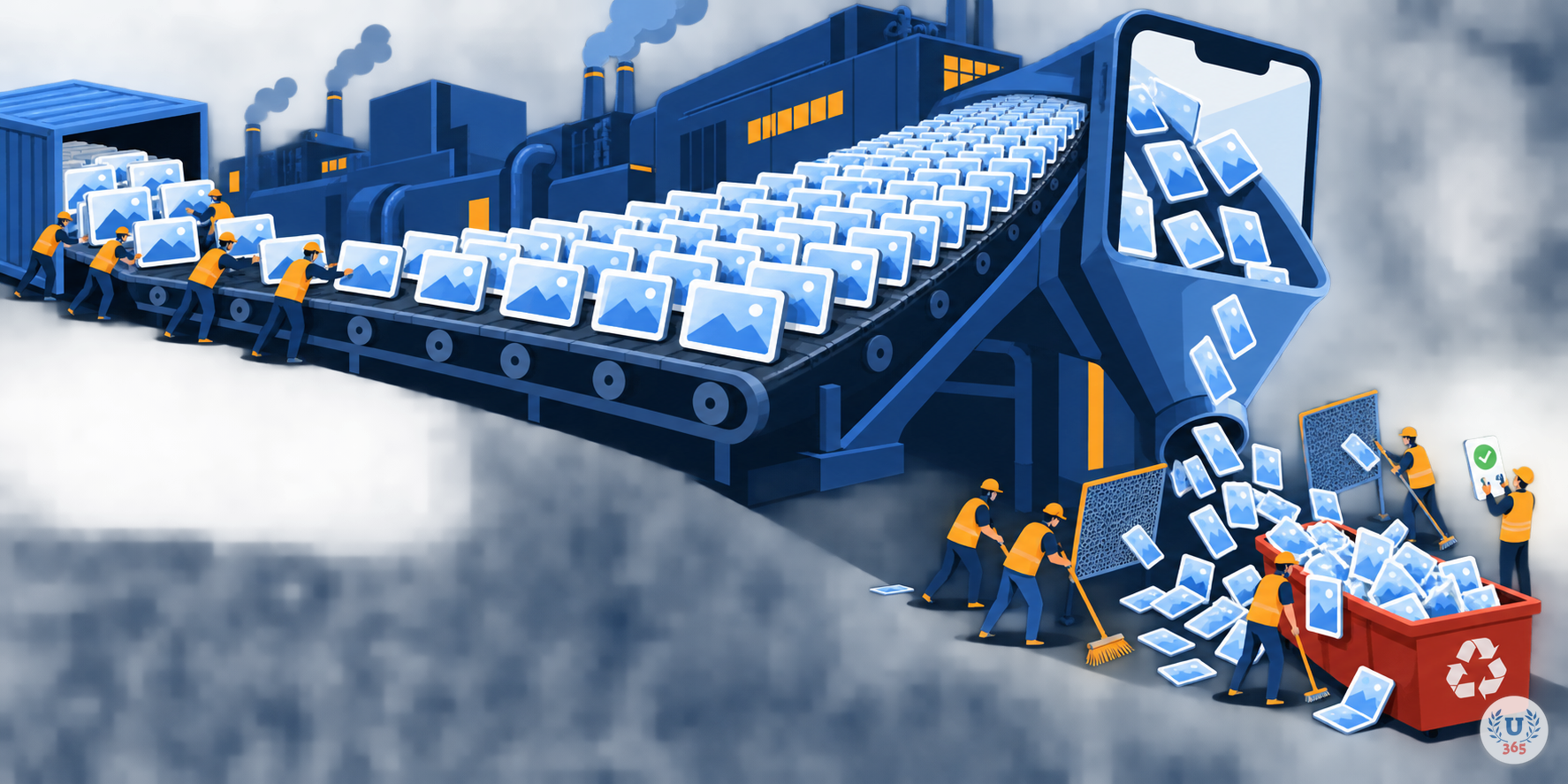
The conveyor and the cleanup crew: the platforms that scaled the flood now run the filters. University 365 Research Center.
Every platform now purging machine content spent the previous three years building the machinery that produced it. YouTube, Spotify, LinkedIn and Meta each distributed generative tools, funded creators who used them, and ran recommendation systems that rewarded volume; each is now enforcing against the results. The New York Times described the pattern in August 2026 as a "generative waste detox" sweeping the tech industry, with companies overwhelmed "in many cases by the same slop first made possible by their own A.I. tools". Fortune was blunter in June 2026: businesses are "declaring war on AI slop", and they are "fighting a losing battle", while brands feel pressure to spend more on advertising and to use AI themselves "to produce content at the scale necessary to feed the machine".
The cleanup is real, and so is its selectivity. YouTube deleted sixteen of the hundred most-subscribed slop channels in January 2026, a sweep worth 4.7 billion lifetime views, but the same company continues to ship AI creation features for its creators, including AI likeness tools for Shorts. Spotify removed 75 million tracks and introduced an "AI Persona" badge for synthetic artists, while expanding its own AI products, from AI DJ to prompted playlists. LinkedIn announced in May 2026 that it suppresses posts its systems flag as generic, polished and substanceless, claiming 94 per cent detection accuracy, but it has published no false-positive rate, and flagged posts are throttled rather than labelled. Enforcement, in other words, is aimed at the parts of the flood that damage the platforms' own economics: subscriber churn, advertiser confidence, creator trust. It is not a public trust programme, and it stops where the volume is profitable.
That selectivity is the first contradiction of the slop crisis. The institutions with the most power to fix the information environment are the institutions with the strongest interest in keeping the environment exactly as productive as it has been. Their cleanups are genuine and partial at the same time, and both halves will remain true for as long as the attention economy does.
The trust industry is being built by the industry it polices
The second contradiction sits inside the fix. The tools that are supposed to restore trust are, in large part, products of the same industry whose output broke it, and the evidence about how well they work is thinner than their press releases suggest.
Take detection, the most visible layer. Independent testing presented at the IEEE Symposium on Security and Privacy in 2026 measured commercial AI text detectors and found false-positive rates across five tools ranging from 0.05 per cent to 68.6 per cent, and false negatives from 0.3 per cent to 99.6 per cent. A detection score measures how predictable a piece of writing is, not who wrote it, which is why universities from Penn State to the UK's qualifications regulator now warn against treating scores as evidence. OpenAI withdrew its own public text classifier in 2023 for low accuracy and has not replaced it. The best-funded challenger, Pangram Labs, claims its model identifies AI text correctly 9,999 times out of 10,000, but that is a vendor claim on the vendor's own benchmark, and the company's own leaders describe the arms race plainly: detection improves, generation improves, and the gap moves rather than closes.
Now take provenance, the layer with the strongest institutional backing. Content Credentials, the implementation of the C2PA standard, are now attached by default to images generated by OpenAI's tools and increasingly by cameras and editing software; the Content Authenticity Initiative counted more than 6,000 members by January 2026, and specification version 2.4, published in April 2026, added a dedicated AI disclosure assertion and support for embedding credentials in web pages. This is real progress. It is also incomplete by design: most media carries no credential at all, and an independent security analysis published in 2026 found that the standard's core protocols remain vulnerable to stripping and tampering, concerns version 2.4 did not address. A missing credential does not mean content is fake; it usually means nothing in the chain added one.
Put the two halves together and the contradiction sharpens. AI made producing information free and verifying it expensive; the trust layer, not the content layer, becomes the scarce good. The industry that profited from the collapse of production costs now sells the reconstruction of trust, in the form of detectors it cannot guarantee, labels it cannot audit for itself, and credentials that most content still does not carry. Some of that infrastructure is genuinely good, and this report treats the EU's legal marking requirement and the C2PA specification as the most promising developments of the year. But the pattern to watch is the one the slowdown report established for the laboratories: announced is not built, and built is not verified. The same test now applies to everyone selling certainty in a market where certainty is exactly what is missing.

The AI Slop Crisis: Machine Content and the Trust Collapse (2026)
The Current State
The flood, measured across six domains
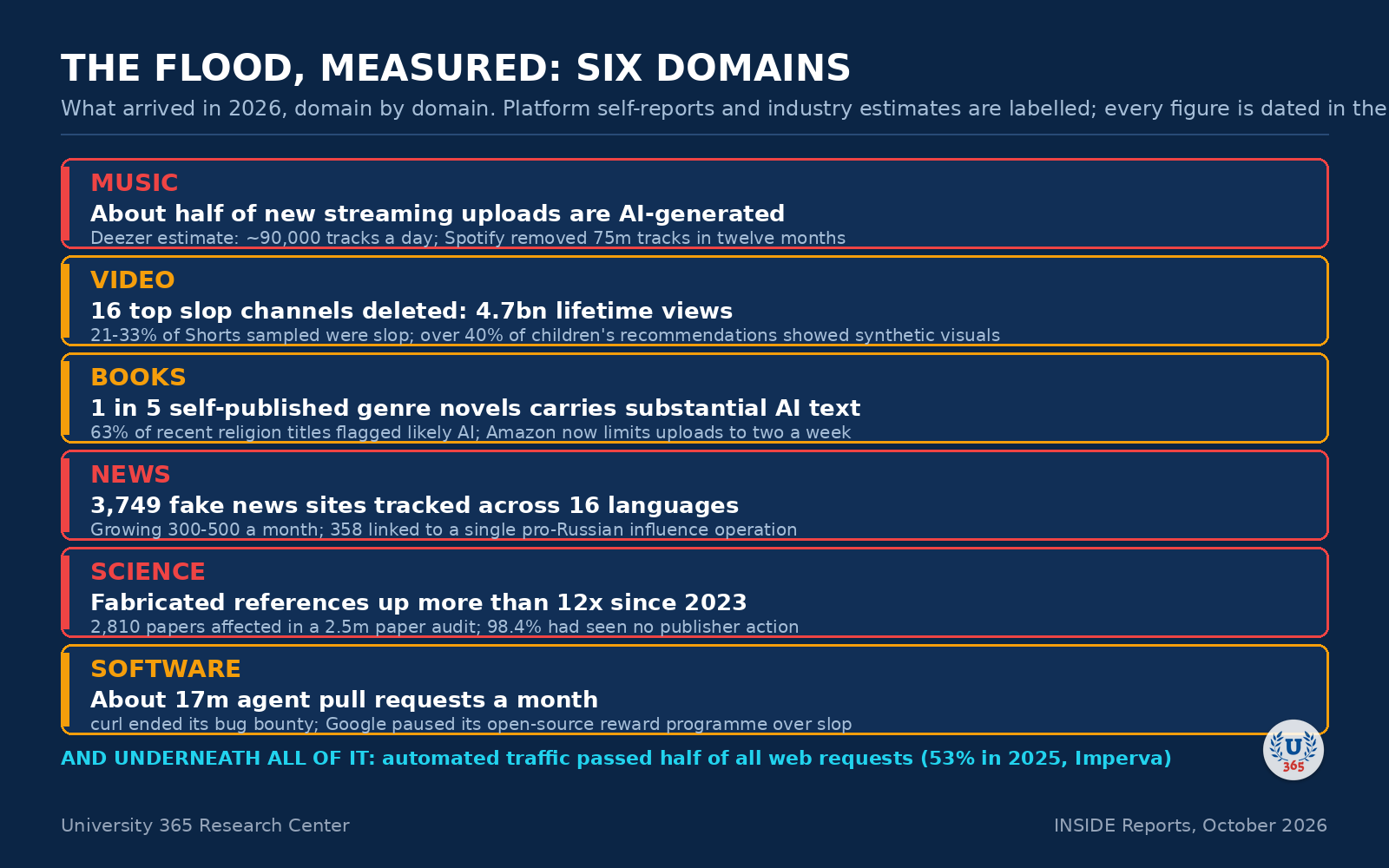
The flood, measured domain by domain, with every figure dated and sourced in the report. University 365 Research Center.

A child using a low-cost tablet in Thailand. The densest synthetic content in the 2026 investigations was served to the youngest viewers. Photograph: He!ko, CC BY-SA 3.0, via Wikimedia Commons.
The clearest way to see the slop crisis is to count it, domain by domain, with each figure dated and attributed. The numbers below come from platform disclosures, independent investigations and industry trackers; where a figure is a self-report or an estimate rather than an independent measurement, this report says so.
Music. Streaming platforms receive about 100,000 new uploads a day, per figures reported across the industry for 2025 and 2026. Deezer stated in 2026 that roughly half of its daily intake was AI-generated, about 90,000 tracks a day. On 23 July 2026, Spotify disclosed that it had removed more than 75 million tracks over the previous twelve months for spam, artificial streaming and impersonation, a figure the company's head of artist policy described as a small share of what its filters catch. The removals are the visible half; the other half is the catalogue itself, where synthetic artists such as Sienna Rose, which landed three tracks on Spotify's Viral 50 chart between September and December 2025 before being unmasked, sit beside human acts with no reliable way for a listener to tell them apart.
Video. YouTube is the clearest case of slop at scale because its numbers are public. In November 2025 the video tool company Kapwing identified the hundred most-subscribed AI slop channels; by January 2026, after chief executive Neal Mohan's annual letter promised to "reduce the spread of low-quality AI content", sixteen of them had been deleted or wiped, a sweep worth 4.7 billion lifetime views, 35 million subscribers and an estimated ten million dollars a year in earnings. A separate Kapwing test found that 21 to 33 per cent of Shorts shown to a fresh account in a 500-video sample qualified as AI slop. The New York Times investigation of February 2026 then showed where the algorithm points for the youngest viewers: after one popular children's video, more than 40 per cent of the recommended Shorts in a fifteen-minute session showed synthetic visuals, many styled as alphabet or animal lessons. After the Times asked YouTube for comment, the platform suspended all five cited channels from its partner programme and removed three hyperrealistic videos from its children's app.
Books. The Stony Brook-led study of 14,419 self-published genre novels on Amazon, matched to sales data through June 2026, found that about 20 per cent carried "substantial" AI text, meaning more than a quarter of the prose flagged; the study's market modelling found that AI-saturated subcategories saw falling revenue per title for human authors as machine output flooded the same shelves. Amazon began limiting self-publishing submissions to two per week per format in late September 2026. In trade publishing, Hachette pulled the horror novel "Shy Girl" in March 2026 after analyses found it largely AI-generated, and one pen name, "Coral Hart", was reported to have released more than 200 romance novels across 21 pseudonyms. The Authors Guild has asked for consumer-visible AI labels; Amazon requires disclosure to itself but does not show it to buyers.
News and information sites. NewsGuard's tracker, launched in March 2026 as a real-time detection feed built with Pangram Labs, counts 3,749 AI content farms across sixteen languages as of 23 June 2026, up from roughly 1,265 in mid-2024 and growing by 300 to 500 sites a month. The sites carry generic, trustworthy-sounding names and produce fabricated stories about public figures, health and politics; 358 of them are linked to a single pro-Russian influence operation. NewsGuard licenses the detection feed to advertisers, and The Trade Desk integration lets agencies block the sites pre-bid, which tells you the market considers the problem both an information risk and an advertising-fraud problem.
Science and research. A Columbia University School of Nursing audit published in The Lancet in May 2026 scanned 2.5 million biomedical papers and found 4,046 fabricated references across 2,810 papers, a rate that grew more than twelvefold since 2023; at the time of the audit, 98.4 per cent of the affected papers had seen no publisher action. The preprint repository arXiv began in May 2026 to ban submitters for up to a year when there is "incontrovertible evidence" that they did not check AI output for hallucinated references. And in a result read as a warning about automated peer review, an ACL 2026 study built a system that generates convincing but fabricated papers and found they achieved acceptance rates up to 82 per cent against multi-model LLM reviewers. Retraction Watch's weekend review of 3 October 2026 catalogued the same theme from the other direction, with China intensifying its misconduct crackdown and medical journals describing an incoming tide of "meaningless" AI-assisted papers.
Software and security. The review economy is where slop's second-order costs show most clearly. The curl project ended its bug bounty programme after AI-generated submissions overwhelmed it; Google paused its open-source vulnerability reward programme on 5 October 2026, telling reporters that a "significant rise" in AI submissions, "the vast majority of which are not valid", made the programme unworkable until at least next year; and maintainers of major open-source projects including Godot have described reviewer burnout in public. Telemetry from one vendor put AI agent pull requests on public repositories at roughly seventeen million a month by March 2026. Every one of those submissions has to be read by a human before it can be dismissed or merged, and reading is the cost that does not fall when production does.
The crackdown ledger: the platforms turn on their own slop
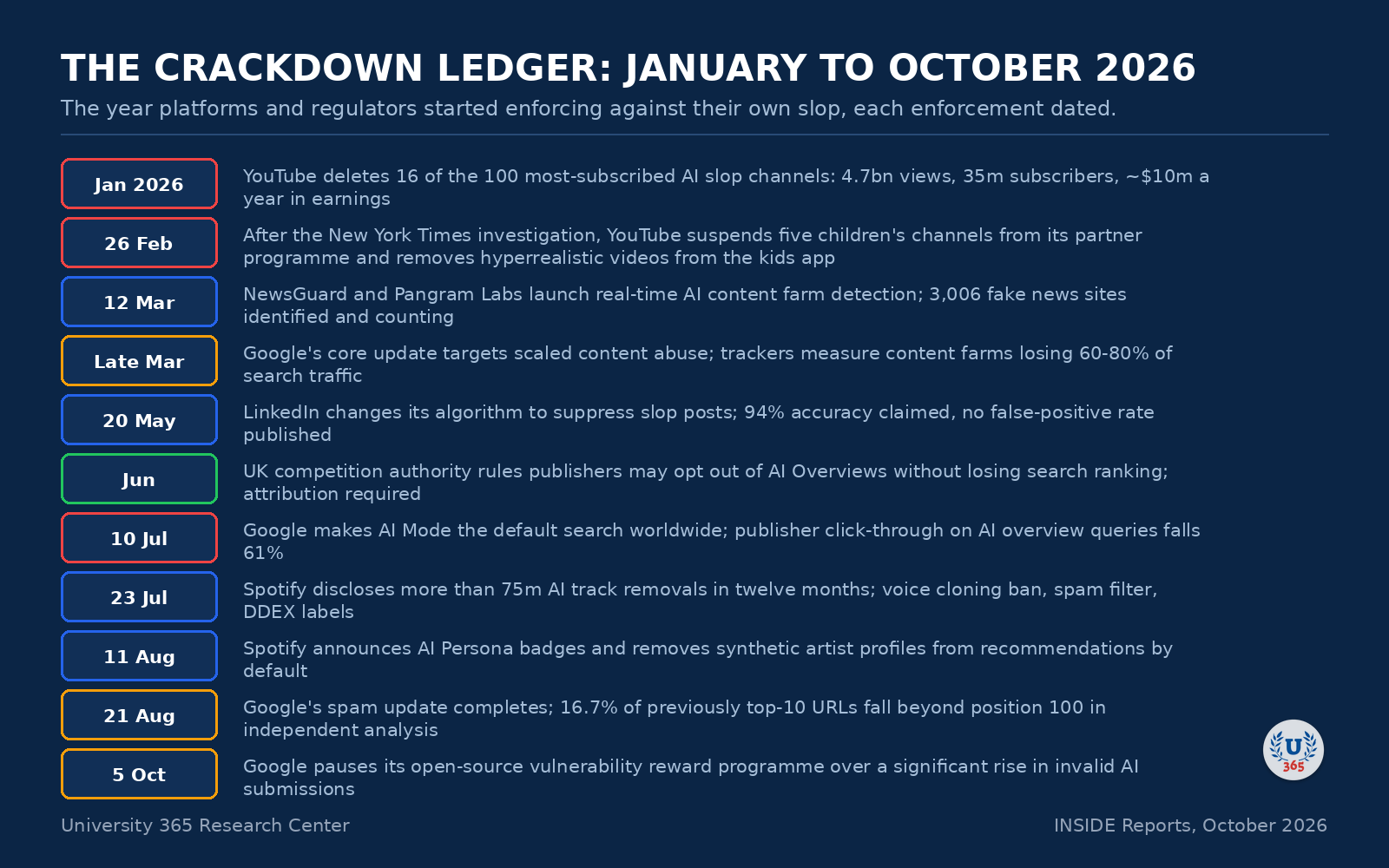
The enforcement year, dated. University 365 Research Center.
The enforcement story of 2026 is best read as a dated ledger, because each entry marks a different institution admitting, in the only way institutions ever admit things, through action, that a problem it helped create had become too expensive to host.
The ledger opens with search. Google ran three ranking updates in five weeks in early 2026; the core update of late March was the one tracking firms say rewrote what ranked. Scaled AI output took the heaviest losses: industry trackers reported AI content farms losing 60 to 80 per cent of their search traffic in the cycle, and Google's public language described the target as "scaled content abuse", not AI use as such. A second, sharper enforcement wave followed in August 2026, when a spam update finished rolling out on 21 August and independent analyses measured 16.7 per cent of previously top-ten URLs dropping beyond position 100. The mechanism, in both waves, is the same message the search team has repeated for two years: production method is not the test; originality, named authorship and first-hand experience are.
Then the ground shifted under the click itself. On 10 July 2026, Google made AI Mode, its conversational answer engine built on the Gemini model line, the default experience for searches worldwide, after announcing it at the I/O developer conference in May. The consequences for publishers were immediate and measurable: click-through rates on queries with an AI-generated overview fell from 1.76 per cent to 0.61 per cent, a 61 per cent decline, according to the analytics firm Seer Interactive; one publisher, Digital Trends, fell from 8.5 million monthly Google visits in March 2024 to about 260,000 in January 2026, a 97 per cent collapse; Business Insider lost 85 per cent, USA Today 47 per cent, CNN 25 per cent, Politico 23 per cent, per the figures compiled by Press Gazette and Semrush. In the United Kingdom, a June 2026 ruling by the Competition and Markets Authority gave publishers the right to opt out of AI Overviews without losing their search ranking, and required correct attribution of quoted content, the first such ruling anywhere.
The platforms followed with their own ledgers. YouTube's January deletions and the February children's-content suspensions were the enforcement of its renamed "inauthentic content" policy, and the crackdown extended through the spring, with creators reporting demonetisation waves for template-produced content. Spotify's removals ran through the year and produced two institutional innovations: a machine-learning spam filter that downranks mass-uploaded tracks before a human reviewer sees them, and, announced on 11 August 2026, the "AI Persona" badge, displayed on artist profiles and track listings from mid-September, with flagged profiles excluded by default from editorial and algorithmic recommendations. LinkedIn changed its algorithm on 20 May 2026 to throttle posts its systems judge as generic or substanceless, claiming 94 per cent accuracy for the classifier and publishing no error rate. Deezer and Qobuz pushed rejection upstream to distributors. Snapchat said its Spotlight feed now downranks slop. Advertisers, who pay for the attention these feeds assemble, started buying their own protection: on 1 October 2026 the YouTube ad platform Pixability launched a service to identify and avoid AI slop inventory for brands, a signal that "made for advertising" AI content has become a named line item in media buying.
The pattern across the ledger is consistent. Enforcement arrives where the money is closest: search results that feed advertising, children's content that draws regulators, music catalogues that dilute royalty pools, feeds that carry brand spend. Announcements cluster in the first half of the year; hard numbers, audits and appeal processes lag. Each platform is now, in effect, running a trust programme as a churn-defence measure, because a feed that can no longer be believed is a feed that stops being watched.
The click collapse: a web that stopped sending readers
The most consequential number in this report is not a count of slop; it is a count of what the slop displaced. The click, the unit of value that financed two decades of web publishing, is dying, and 2026 was the year the industry measured it properly.
The analytics firm Chartbeat, whose network spans thousands of news sites, measured Google search traffic to publishers down 34 per cent year over year as of mid-2026, following a 33 per cent global decline between November 2024 and November 2025, and a 38 per cent fall in the United States. The decline was steepest for the smallest publishers, who depend most on search: small sites lost 60 per cent of referral traffic across two years, against 47 per cent for mid-sized and 22 per cent for large ones, which means scale itself became a form of protection. The Reuters Institute's Digital News Report, published in June 2026, found the same trend from the audience side and added the industry's own forecast: publishers expect search referrals to fall another 43 per cent over the next three years, and a fifth of them expect losses above 75 per cent.
Behavioural data explains the mechanism. Pew Research Center, tracking the browsing of hundreds of adults, found that users who saw an AI summary clicked a traditional search result in 8 per cent of visits, against 15 per cent when no summary appeared, and that they ended their browsing session after 26 per cent of visits with a summary, against 16 per cent without. The search marketing firm Ahrefs measured the click-through rate of the top-ranked result falling 58 per cent by February 2026. Google's own answer surfaces now resolve the majority of queries in place: about 93 per cent of AI Mode sessions end without a click, and about 60 per cent of all searches are zero-click.
The replacement traffic has not arrived. Referrals from ChatGPT grew more than 200 per cent year over year, but through 2025 and the first half of 2026 they remained under one per cent of publisher pageviews, per Chartbeat, and the Reuters Institute found that only 4 per cent of AI chatbot users click through to underlying sources, compared with 19 per cent from search. A publisher that loses search referral income and receives chatbot referral fractions cannot trade one for the other; the arithmetic does not close, which is why publishers are shifting toward licensing, newsletters and direct audiences, and why the phrase "Google Zero" moved from a prediction to a planning assumption.
There is one more layer, specific to slop. Search and answer engines do not just reduce clicks; they change which content is worth clicking. When an algorithm synthesises an answer, the sources that lose visibility first are the ones whose value was being the cheapest correct answer: explainers, evergreen guides, commodity news. Original reporting, named expertise and data that exists nowhere else retain their pricing power, which is exactly what the March and August search updates rewarded. The slop crisis and the click collapse are the same event seen from two sides: machine content killed the economics of commodity information, and the answer engines finished the job by no longer needing to send anyone to read it.
The provenance layer: law and labels arrive
Against the flood, 2026 assembled the first real architecture of provenance. It is incomplete, it is uneven, and it is the most important development in the story, because it is the only part of the response that changes defaults rather than intentions.
The technical standard is Content Credentials, the C2PA coalition's implementation of signed, machine-readable media history. Through 2025 and 2026 adoption moved from pilot to production: major camera makers ship it in hardware, Adobe's creative tools read and preserve it, and specification version 2.4, published in April 2026, added a dedicated AI disclosure assertion, richer model provenance fields, and support for embedding credentials in web pages rather than only inside files. OpenAI began attaching Content Credentials to every image its tools generate, including on free tiers, in May 2026, pairing them with Google DeepMind's SynthID watermark so generated images carry two independent signals. The Content Authenticity Initiative, the coalition promoting the standard, counted more than 6,000 members in January 2026, and the specification is being fast-tracked toward recognition as an ISO standard. An independent security analysis published in 2026 identified weaknesses in the protocol's handling of stripped or tampered credentials, and version 2.4 did not address them; the standard's honest status is promising infrastructure with unresolved edges, which is still far more than existed three years ago.
Platform labeling turned the metadata into something consumers can see. TikTok, which joined the C2PA steering committee in July 2026, states that it has labelled more than three billion pieces of AI-generated content through a combination of credentials, invisible watermarks and creator disclosure, and its upload flow prompts creators to label realistic synthetic content. Meta applies "Made with AI" labels using C2PA metadata and its own classifiers, and runs an automated "AI info" label on advertising creatives, with its strictest disclosure rules reserved for political and social-issue ads. YouTube requires creator disclosure of realistic synthetic media and reserves the right to label what creators do not, with prominent labels for health, news and election content. None of these systems is complete; all of them mark a direction of travel in which disclosure stops depending on the honesty of whoever posts.
Law arrived in parallel. The European Union's AI Act transparency obligations, Article 50, took effect on 2 August 2026: providers of generative systems must mark synthetic outputs in a machine-readable way, and under the Digital Omnibus adjustments, systems already on the market have until 2 December 2026 to comply with the marking requirement. This is the first binding, machine-readable marking duty in a major jurisdiction, and it converts provenance from a voluntary best practice into a compliance line for every company selling generative output into Europe. Enforcement capacity is thin and definitions are still being tested, which is the honest caveat; but as of this year, marking AI output is law, not etiquette, and that changes procurement, engineering and liability conversations inside companies that had previously treated the question as optional.

The AI Slop Crisis: Machine Content and the Trust Collapse (2026)
Key Findings
What the record establishes
1. The flood is measured, not metaphorical, and it is largest where revenue pools reward volume. Roughly half of new music uploads are AI-generated by platform estimate; sixteen of YouTube's biggest slop channels carried 4.7 billion views; about one in five self-published genre novels carries substantial AI text; 3,749 fake news sites publish across sixteen languages; automated traffic passed half of all web requests. Slop is not a vibe; it is an inventory.
2. The production economics are the cause, and they have not changed. Marginal cost near zero plus distribution that rewards volume plus revenue pools that pay per impression, stream or sale equal an unbounded incentive to produce. Every enforcement action in 2026 attacks symptoms of that equation, and none of the platforms has changed the equation itself. The one lever that is genuinely changing is search and answer engines refusing to pay for commodity content, which makes slop cheap to make and worthless to rank.
3. Enforcement arrived where the money is closest, and late. Search updates in March and August, YouTube's January purge and children's-content suspensions in February, Spotify's 75 million removals and AI Persona badges, LinkedIn's May algorithm change, the UK's June competition ruling: each action targets the layer whose degradation threatened a revenue stream. Announcements outpaced audits; no platform has published a comprehensive false-positive rate for its slop detection, and the appeal paths are thin.
4. The trust collapse is dated and quantified. Global trust in news fell to 37 per cent in 2026, the lowest level ever recorded by the Reuters Institute's tracker, with declines in 29 of 48 markets; concern about online misinformation rose to 62 per cent; trust in AI chatbot answers sits at 20 per cent; and the click that financed independent publishing fell by a third in a year, with a further 43 per cent decline forecast by publishers themselves. The audience did not stop consuming; it stopped believing, and it stopped clicking.
5. The verification layer exists but is partial, and its own instruments are contested. Provenance standards matured, platform labels reached billions of items, and EU law now requires machine-readable marking. At the same time, independent testing found false-positive rates up to 68.6 per cent for commercial detectors, most media still carries no credential, and the C2PA protocol's security review leaves stripping and tampering unresolved. Verification is the scarce good, and the market that supplies it is still proving itself.
6. The costs land on the least protected, and the response belongs to institutions. Small publishers lost 60 per cent of search referrals while large ones lost 22 per cent; children's feeds carried the densest synthetic content in the investigation record; students and non-native writers are the most exposed to unreliable detection; science absorbs fabricated references at a rate that grew twelvefold; open-source maintainers absorb review labour no volunteer signed up for. Slop is an aggregation of externalities, and the institutions that will matter are the ones that internalise them: schools that teach verification, publishers that prove authorship, science that audits references, software projects that price review.

The AI Slop Crisis: Machine Content and the Trust Collapse (2026)
Deep Analysis
Follow the incentive: why slop scales

A newspaper stack at the African Studies Centre Leiden. Volume was the newspaper's business model before it was the web's. Photograph: African Studies Centre Leiden, CC BY-SA 4.0, via Wikimedia Commons.
To understand why the flood happened in 2026 and not earlier, it helps to look at what a piece of slop actually is, economically. Researchers studying the software version of the problem identified three properties shared across domains: superficial competence, meaning a veneer of quality good enough to pass light inspection; asymmetry of effort, meaning the producer spends seconds and the consumer spends attention; and mass producibility, meaning the cost of the millionth item is the same as the cost of the first. Those three properties describe a song uploaded for background streams, a children's video assembled to farm watch time, a novel generated in an afternoon, and a fake news article about a real politician with equal accuracy. Slop is not an accident of generation quality. It is a strategy, and the strategy pays because the systems that distribute content count units, not value.
Follow the money through any one of the six domains and the same shape appears. In music, streaming royalties pool revenue per stream, so more tracks mean more draws from the pool, and artificial streaming amplifies the draw; that is why the removals are measured in tens of millions and why detection teams describe bot-driven plays as the core of the fraud. In video, advertising and watch-time rewards favour volume and retention, which is why slop channels can run entirely automated pipelines profitably, and why 4.7 billion views is the scale of a single enforcement sweep. In books, print-on-demand removed the last inventory cost, so a publisher with no readers still loses nothing; the Stony Brook study's most telling finding is not the share of AI books but the revenue effect: in saturated categories, machine output pushes down earnings per title for everyone. In news, programmatic advertising pays per impression regardless of who or what reads, so a fabricated article that captures one impression from a misdirected reader is profitable, which is precisely how 3,749 fake news sites sustain themselves. In science, publication pressure plus automated writing tools produce fake references faster than voluntary review checks them; the Columbia audit found a twelvefold growth in the problem since 2023 because checking each reference against databases was nobody's job. In software, repositories accept contributions at a costless rate and pay reviewers in attention, so seventeen million agent pull requests a month is not a technology metric; it is a transfer of cost from producers to volunteers, and the bug bounty closures at curl and Google are that transfer exceeding its limit.
The deeper cost of this arithmetic is not the junk itself, which is often cheap to spot. It is the tax on everything else. Review capacity is finite: every fake contribution that must be read is a real one delayed. Attention is finite: every slop impression displaces something a person would have chosen. And the learning substrate of the web decays under the same pressure, because the pages where people learned to check their work, the forums where questions get answered by practitioners, are themselves being flooded or are shutting down in the face of it, while models trained on the polluted pool inherit its biases. That last mechanism has a name and a literature: model collapse, the degradation that occurs when generations of models train on the output of their predecessors. Research through 2024 and 2026 established that the effect is real, that even small shares of synthetic data can trigger it, and that mitigation is technical and partial; projections cited in the field suggest most new training data could be machine-generated by 2030 if the current composition trajectory holds. The slop crisis, in other words, is also a contamination crisis for the raw material of the next generation of AI, which makes it the rare problem whose most concerned stakeholder should be the industry producing it.
What the trust collapse measures
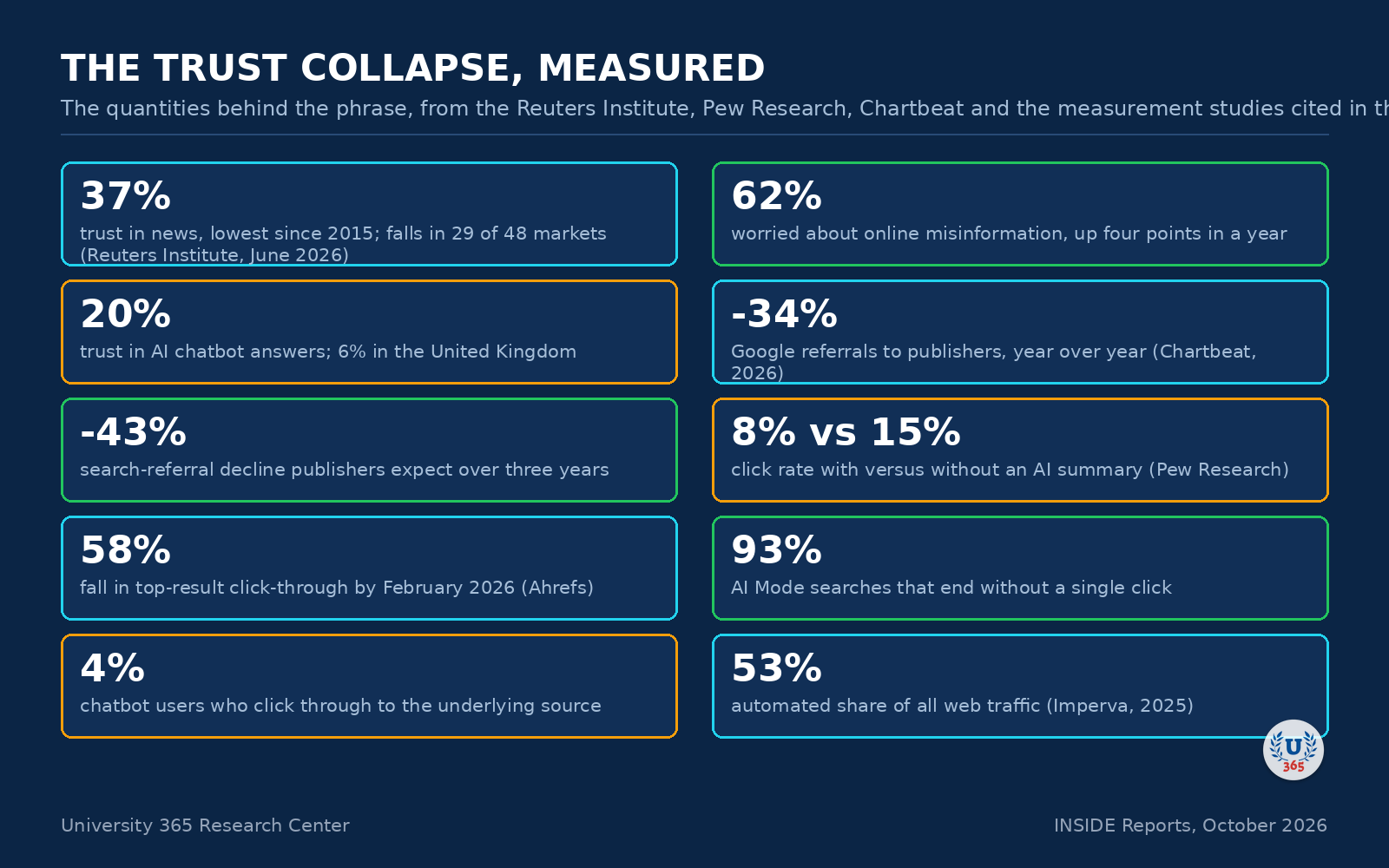
The trust collapse, in the numbers that measure it. University 365 Research Center.
The phrase in this report's title is not rhetorical. The trust collapse is a set of tracked quantities, and in 2026 the quantities moved in a consistent direction across institutions that measure such things carefully.
The Reuters Institute's Digital News Report, based on a survey of almost 100,000 people across 48 markets, recorded the lowest level of trust in news since it began measuring in 2015: 37 per cent, down three points in a year, with significant falls in 29 of the 48 markets. In the United States, only 25 per cent trust most news most of the time, and among right-leaning Americans, 15 per cent. Concern about online misinformation rose four points to 62 per cent. Trust in answers from AI chatbots sits at 20 per cent globally, six per cent in the United Kingdom, and the report found that only four per cent of chatbot users ever click through to the underlying source. The Edelman Trust Barometer, surveying nearly 34,000 respondents in 28 countries at the turn of the year, found a population retreating into insularity: seven in ten people hesitant to trust those with different values, facts or backgrounds, the largest trust gap between high and low income groups in the survey's history, and generative AI named among the five events most affecting trust, cited by 37 per cent. Pew Research found Americans mixed and uneasy about AI summaries in search. Commercial survey work pointed the same way, with one detection company reporting in May 2026 that two-thirds of consumers said they encountered and distrusted misleading AI content regularly.
Two clarifications keep this honest. First, trust in news, or in platforms, is not the same thing as trust in the possibility of truth, and the data show something more specific than blanket cynicism: the Reuters Institute found that trust in specific, established news brands held up better than trust in the aggregate, and that audiences value impartiality more, not less, as they lose faith in the channels that deliver it. People are not giving up on the idea of verified information; they are losing their confidence that the environment will deliver it. Second, the collapse is not primarily an audience behaviour of doubting. It is a behaviour of disengaging. The report's own summary language is a mix of "anxiety and disengagement"; news interest is falling; and the most-cited reason people stop clicking is not that they distrust a site but that the answer was already on the page. A public that cannot tell what is real and stops trying to find out is a different, and more difficult, problem than a public that is angry: disengagement is quiet, it concentrates among the less interested, and it leaves the field to whoever pays most to fill it.
That is the sense in which the slop crisis and the trust collapse are one event. Slop degrades the ratio of signal to noise; the degradation raises the cost of believing anything; the raised cost drives audiences to the cheapest available proxy, which is convenience; and convenience is supplied by the same platforms whose feeds the slop already occupies. The measurement in 2026 that will matter most over the decade is not the count of fake sites but the level at which the public stops paying the cost. The data say it is falling, and it has not stopped falling.
The verification gap: nobody's signature
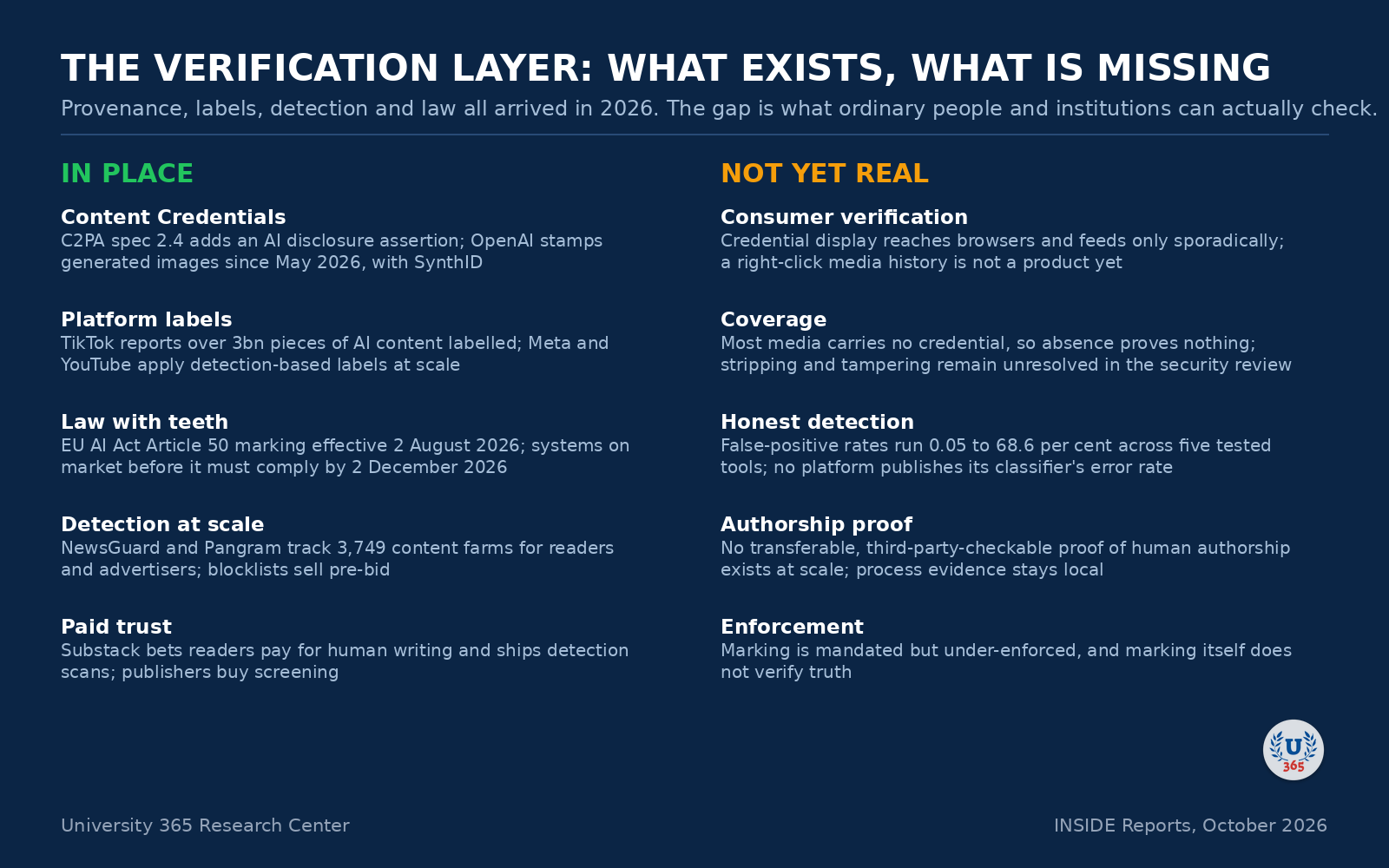
What exists, and what is not yet real. University 365 Research Center.
If the scarce good is verification, what would it take to actually supply it? Stripped to its engineering, a working trust layer needs three things: provenance attached by default, detection that is honest about its limits, and a way to certify human authorship and process. Each exists in 2026 in partial form, and the gap between the partial form and the working form is the most important map this report can draw.
Default provenance. The C2PA standard and its Content Credentials are the most advanced piece of the trust layer, and their remaining weakness is arithmetic: most media carries no credential, so absence proves nothing. Closing the gap means three more steps: provenance attached by default in the devices and generators that make content (happening, thanks to camera makers, Adobe, OpenAI and now law), preserved through distribution (partially happening, through platform ingestion of C2PA metadata), and checkable by ordinary people (barely happening, because verification tools remain niche). A credential that only specialists can read is a credential that will not restore public trust; the browser-level and social-level verification that would make a right-click reveal a media file's history is the missing consumer product of the trust economy.
Honest detection. The detection market's central problem is not that it does not work; it is that its accuracy is context-dependent, contested and oversold. Independent testing across five commercial tools found false-positive rates from 0.05 per cent to 68.6 per cent depending on the tool and the text, and the mechanism explains why: a detector estimates how predictable writing is, and predictability is correlated with plain, structured, formulaic prose, which is to say it flags exactly what good teachers and second-language writers produce. The vendors that perform best on benchmarks, including Pangram with its near-perfect accuracy claim, make their accuracy statements on particular datasets of their own choosing; the company's leaders argue, fairly, that detection should be measured like antivirus software, on continuously refreshed adversarial samples, where nothing is ever final. The honest role for detection in 2026 is therefore narrow but real: a prompt for human review, never proof; a filter for platform triage, never a verdict; and, in science, the tool that made the fabricated-reference audit possible in the first place.
Certification of human authorship. The weakest and most needed layer is the one that answers the question institutions actually face: not "was this machine-made" but "who stands behind this, and can they show the work". The market has started to answer with products: Substack added detection scans so readers can check posts, and its leadership has bet explicitly that readers will pay for writing by humans; Spotify's AI Persona badge certifies identity, not production method; platforms and publishers increasingly ask contributors to declare generative assistance and to supply process evidence. What none of these yet provides is a transferable, verifiable claim, the equivalent of a signature, usable across contexts and checkable by a third party. The closest the web has come is process evidence: drafts, version histories, and the older editorial habits of commissioning, editing and correcting in public. The lesson that education and publishing are both learning, expensively, is that authorship is proven by the record of its making, not by the output alone.
Put the three together and the shape of the verification gap is clear. Provenance is becoming an engineering default but not yet a consumer tool; detection is useful as triage and unusable as proof; authorship certification is still being invented, mostly as a premium feature in markets that care most. The trust layer, in sum, is arriving as a product for those who can pay for it, which is exactly the failure mode that turns today's information crisis into tomorrow's information inequality. A trust layer that only the well-resourced can stand inside is not a fix; it is a moat. The policy and institutional work of the next two years is deciding whether verification becomes infrastructure, like encryption and signatures, or a subscription, like everything else the platforms discovered they could charge for.

The AI Slop Crisis: Machine Content and the Trust Collapse (2026)
Data and Evidence
The record in numbers
The figures that anchor this report come from the sources named in each entry: platform disclosures, the NewsGuard and Pangram tracker, Chartbeat as reported by Axios and Search Engine Journal, the Reuters Institute's Digital News Report and its forecasting survey, Pew Research Center, the academic and preprint literature cited in the text, and the reporting of The New York Times, Fortune, The Verge, Axios, Press Gazette, the BBC, EurekAlert and Retraction Watch, each dated. Where a figure is a platform self-report or an industry estimate rather than an independent measurement, the entry says so.
Table 1: The flood, in numbers
Domain | Figure | Date | Source |
Music uploads | About 100,000 new tracks a day across streaming; Deezer estimated close to half of its intake AI-generated (about 90,000 a day) | 2025 to 2026 | Industry reporting; Deezer statements |
Music removals | More than 75 million tracks removed by Spotify in twelve months for spam and artificial streaming | Announced 23 July 2026 | Spotify, reported by Los Angeles Times and Rolling Stone |
Video channels | 16 of the top-100 AI slop channels deleted or wiped: 4.7 billion views, 35 million subscribers, about 10 million dollars a year in estimated earnings | January 2026 | Kapwing, reported by The Verge, XDA and Times of India |
Children's video | More than 40 per cent of recommended Shorts after one children's video showed synthetic visuals in a 15-minute session; 1,000+ Shorts reviewed | Published 26 February 2026 | The New York Times investigation |
Shorts feed | 21 to 33 per cent of Shorts shown to a fresh account qualified as AI slop in a 500-video sample | 2025 to 2026 | Kapwing analysis |
Books | About 20 per cent of 14,419 self-published genre novels carried substantial AI text; 63 per cent of recent religion titles flagged likely AI | 2026 | Stony Brook-led study via Pangram; Originality.ai audit, reported by Fortune |
News sites | 3,749 AI content farms tracked across 16 languages; growth of 300 to 500 sites a month; 358 linked to one influence operation | 23 June 2026 | NewsGuard AI Tracking Center |
Science | 4,046 fabricated references across 2,810 biomedical papers in a 2.5 million paper audit; rate up more than twelvefold since 2023; 98.4 per cent of affected papers unaddressed | May 2026 | Columbia University School of Nursing, The Lancet |
Software | About 17 million AI agent pull requests a month on public repositories by March 2026; curl ended its bug bounty; Google paused its open-source reward programme | 2026 | Vendor telemetry; project statements; The Verge, 5 October 2026 |
Web traffic | Automated traffic at 53 per cent of all web traffic in 2025, up from 51 per cent | 2025 | Imperva Bad Bot Report 2026 |
Table 2: The crackdown ledger, January to October 2026
Date | Actor | Action | Source |
January 2026 | YouTube | Deleted or wiped 16 of the 100 most-subscribed AI slop channels; CEO letter pledged to reduce low-quality AI content | Kapwing; YouTube CEO letter, reported by CNBC |
26 February 2026 | YouTube | After the Times investigation, suspended five children's channels from the Partner Programme and removed hyperrealistic videos from the kids app | The New York Times; platform statements |
12 March 2026 | NewsGuard and Pangram Labs | Launched real-time AI content farm detection; already 3,006 sites identified, growing 300 to 500 a month | NewsGuard; Adweek |
Late March 2026 | Core update targeting scaled content abuse; trackers reported 60 to 80 per cent traffic losses for content farms | Google Search Status Dashboard; industry trackers | |
20 May 2026 | Algorithm change to suppress posts flagged as AI slop; 94 per cent claimed detection accuracy, no false-positive rate published | Forbes; Entrepreneur; LinkedIn newsroom | |
June 2026 | UK Competition and Markets Authority | Ruling allowing publishers to opt out of AI Overviews without losing search ranking; attribution required | Open Society Foundations; CMA |
10 July 2026 | AI Mode became the default search experience worldwide; publisher click-through falls 61 per cent on AI overview queries | Reporting; Seer Interactive data | |
23 July 2026 | Spotify | Disclosed 75 million AI track removals; new spam filter, voice-cloning ban, DDEX labeling, anti-scraping defences | Spotify, via Los Angeles Times and Rolling Stone |
11 August 2026 | Spotify | Announced AI Persona badges for synthetic artist profiles; exclusion from recommendations from mid-September | TechCrunch; Spotify newsroom |
21 August 2026 | Spam update completes; independent analysis measured 16.7 per cent of previously top-10 URLs dropping beyond position 100 | Google; independent analysis | |
30 September 2026 | Amazon | Limited Kindle Direct Publishing to two submissions per week per format | Forbes |
1 October 2026 | Pixability | Launched advertiser service to identify and avoid AI slop inventory on YouTube | Company announcement |
5 October 2026 | Paused its open-source vulnerability reward programme over a "significant rise" in invalid AI submissions | The Verge |
Table 3: The trust and verification numbers
Figure | Value | Date | Source |
Trust in news, global | 37 per cent, lowest since measurement began in 2015; falls in 29 of 48 markets | June 2026 | Reuters Institute Digital News Report 2026 |
Trust in news, United States | 25 per cent; 15 per cent among right-leaning respondents | June 2026 | Reuters Institute Digital News Report 2026 |
Concern about online misinformation | 62 per cent, up 4 points | June 2026 | Reuters Institute Digital News Report 2026 |
Trust in AI chatbot answers | 20 per cent globally; 6 per cent in the United Kingdom; 4 per cent of users click through to sources | June 2026 | Reuters Institute Digital News Report 2026 |
Publisher search referrals, year over year | Down 34 per cent globally; small publishers down 60 per cent across two years | July 2026 | Chartbeat, reported by Axios |
Publisher forecast | Search referrals expected to fall 43 per cent over three years; a fifth of publishers expect over 75 per cent | January 2026 | Reuters Institute publishers survey |
Click-through with an AI summary present | 8 per cent of visits click a traditional result, against 15 per cent without; 26 per cent end the session | 2025 to 2026 | Pew Research Center |
Click-through of the top-ranked result | Down 58 per cent by February 2026 | February 2026 | Ahrefs |
Zero-click searches | About 60 per cent of all searches; about 93 per cent in AI Mode | July 2026 | Reporting on Google data |
Detector accuracy | False-positive rates across five commercial tools: 0.05 to 68.6 per cent; false negatives 0.3 to 99.6 per cent | 2026 | IEEE Symposium on Security and Privacy testing |
Provenance adoption | Content Authenticity Initiative above 6,000 members; C2PA 2.4 adds AI disclosure assertion; OpenAI attaches credentials to generated images from May 2026 | January to May 2026 | CAI; C2PA; OpenAI |
Platform labeling | TikTok reports more than 3 billion pieces of content labelled as AI-generated | July 2026 | C2PA; TikTok |
Legal marking duty | EU AI Act Article 50 obligations effective 2 August 2026; pre-market systems have until 2 December 2026 for machine-readable marking | 2026 | EU AI Act; Digital Omnibus |

The AI Slop Crisis: Machine Content and the Trust Collapse (2026)
Implications
For institutions: verification becomes the cost of being believed
The operational meaning of this report for any institution that publishes, teaches or decides is simple: the default trust a reader used to extend to a plausible text is gone, and the replacement has to be manufactured by the publisher. That reverses a century of institutional habit. Newspapers, universities, journals and governments were believed because of what they were; through the rest of the 2020s they will be believed to the extent that they can show their work. The tools are known. Cite sources inline and keep them retrievable, as this report does. Keep process records, drafts and version histories, so authorship can be demonstrated rather than asserted. Label generative assistance explicitly, because the EU now requires it for synthetic output and because the disclosure norm is spreading across platforms. Audit references, because the Columbia findings show that fabricated citations flow into clinical guidance precisely when nobody is checking. And train staff to verify at the speed machines produce, because the asymmetry of effort that makes slop profitable also makes verification the only defensible institutional posture.
The good news buried in the trust data is that this market pays. The Reuters Institute found that specific, established brands hold trust better than the aggregate, and that audiences value impartiality more as noise increases; Substack's bet on human authorship, Pangram's customer list of publishers and Quora, and the advertising industry's rush to block slop inventory all say the same thing from different angles: provenance and verification are becoming purchasing criteria. The institutions that internalise the cost early will be the ones whose names still function as signatures when the flood recedes.
For the market: attention re-prices, and trust becomes a product category
For businesses, the slop crisis arrives as three distinct budget lines. First, media buying: "made for advertising" AI inventory has become a named category, with platforms and measurement firms selling avoidance as a service, and the pre-bid blocking integration between NewsGuard's data and The Trade Desk shows the direction the money is moving. Second, content strategy: the brands feeding the machine to stay visible in search are discovering that the same strategy produces what the machine now filters, which is why the winning formula in 2026 advertising trade coverage sounds like the losing formula of 2010: distinctive, verifiable, human-made work, promoted through channels the brand actually owns. Third, compliance: the EU's Article 50 marking duty makes AI disclosure a legal requirement for companies selling generative output into Europe, with the pre-market compliance deadline of 2 December 2026, and procurement teams are already adding provenance questions to vendor reviews. The trust economy, in other words, is no longer a thought-leadership topic; it is a line item with a deadline, and the vendors are lining up: detection, provenance tooling, audit, certification, and the platform-label infrastructure that turned metadata into consumer-facing trust marks.
The risk in all of this is the one the verification gap already shows: if trust becomes a premium feature, it gets priced like one. The publishers, brands and individuals who can afford verification will operate inside its protections, while everyone else transacts in the unprotected web. Whether that inequality hardens depends less on technology than on policy: whether provenance is required infrastructure, like HTTPS and email signatures, or a luxury tier, like everything else the attention economy learned to charge for.
For the rest of the world: sixteen languages is not the whole world
The final implication is geographic, and it is the one least served by the current response. NewsGuard's tracker covers sixteen languages, which is more than any predecessor and far fewer than the web speaks; detection models are trained predominantly on English text, which is not where the next billion internet users are arriving. The countries most exposed to slop-driven information disorder are frequently those with the least detection capacity, the weakest local news, and the highest stakes: election years across a wide set of markets, including the United States midterms in November 2026, run through feeds whose slop filters were built for elsewhere. The influence-operation dimension compounds the economic one; a fabricated local news site costs its sponsors almost nothing and competes for trust against underfunded community outlets that cannot afford provenance tooling even where it exists.
For national institutions outside the major markets, the practical reading is that the trust layer cannot be imported wholesale; it has to be built, in local languages, with local verification capacity, by institutions that teach their own publics to check. That is slower, more expensive, and unglamorous work, and it is the difference between a country that participates in the information economy and a country that merely consumes it.

The AI Slop Crisis: Machine Content and the Trust Collapse (2026)
Education and Skills Impact
What the slop crisis asks of education: verification as an assessed skill

The verification desk: process, inspection and judgement as the designed outcome. University 365 Research Center.
Schools met the slop crisis two years before the rest of the web did, because the slop arrived first as homework. The response, so far, has been detection software, and the evidence on that response is now extensive enough to judge. Independent testing presented at the IEEE Symposium on Security and Privacy in 2026 measured five commercial AI text detectors and found false-positive rates ranging from 0.05 per cent to 68.6 per cent and false-negative rates from 0.3 per cent to 99.6 per cent. The errors do not fall evenly: a Stanford study found detectors labelled 61 per cent of essays by non-native English speakers as AI-generated, a Common Sense Media survey found Black teens were flagged falsely at nearly three times the rate of white teens, and the mechanics explain why, because detectors score how predictable writing is, and formulaic, scaffolded, plain prose scores as predictable. School systems are converging on the consequences: the District of Columbia and at least 37 states have issued AI guidance, more than a third of those states urge schools not to rely on detection alone, half of the ten largest districts discourage it outright, and universities including Penn State instruct staff that detector scores are not evidence. The decision that matters in every school is not which detector it buys; it is what a high score is allowed to trigger. If the answer is a closer human look at work a teacher already doubted, the tool is a prompt. If the answer is an accusation, the tool is being used past its evidence, and the appeals will follow.
The deeper curricular response is the one this report argues for across every institution: shift the assessed object from production to verification. The evidence from 2026 is unambiguous that producing plausible text, images and code is no longer a scarce skill, and that the scarce skill is telling output apart, checking it, and standing behind what survives. That translates into concrete practice. Collect process alongside product: drafts, version histories, in-class writing, short conferences where a student explains a choice. State AI boundaries per assignment, because most misconduct disputes begin as ambiguity about what was allowed. Teach provenance as a literacy: how credentials work, what a missing label does and does not mean, why a plausible video needs a source and not just a feeling. And grade the audit itself, with exercises where a learner reviews machine output against evidence and is assessed on what they caught, what they demanded, and what they refused to pass on. The youngest learners need the most protection, not the least: the New York Times investigation showed that children's feeds carry the densest synthetic content on the platform, which makes early media habits a first-order education policy question rather than a parental preference.
The institutional stakes are larger than any single syllabus. An education system that graduates people who cannot verify what they read, watch and cite has outsourced its core function to platforms whose business models the verification serves only incidentally. University 365's own position is that the durable layer of any AI capability is human judgement, verification and accountability; the slop crisis tested that claim at the scale of the entire public web in 2026, and the results say the same thing in every domain this report examined: generation is abundant, verification is scarce, and the audit is the job.

The AI Slop Crisis: Machine Content and the Trust Collapse (2026)
The CI-First Perspective
The Co-Intelligence-First (CI-First) approach is a genuine and unique University 365 concept: a proposal for imagining a better future where AI and Human Intelligence coexist productively, each amplifying the other rather than replacing it.
Reading the flood through Co-Intelligence First
Co-Intelligence First asks of any AI arrangement two questions: does it amplify human capability or substitute for it, and is the appearance of capability matched by the ability to verify it. Applied to the slop crisis, the framework sorts the record sharply.
Slop is the purest substitution case the framework has yet been handed. It is machine output standing in for human expression, made at a scale no human system asked for, consumed as if it were authored, and verified by no one, including often its own producers. The researchers who formalised its properties gave the framework its vocabulary without knowing it: superficial competence is the imposture problem stated for content, and the asymmetry of effort is the mechanism that makes imposture profitable. A fabricated article, a synthetic song catalogued beside real artists, a generated reference list in a medical paper, a fabricated pull request in a bug queue: each is an appearance of production whose verification was skipped, and the entire cost of the skip is paid downstream, by readers, patients, reviewers and editors. This is the same failure the CI-First framework names in tools, arrived at the scale of an environment.
The framework's second sorting is more useful to practitioners, because it resists the easy conclusion. The answer to substitution is not refusal of the technology; the audit of the fabricated-reference literature was itself made possible by AI-assisted verification, and the provenance tools that are slowly becoming defaults are products of the same industry. Co-Intelligence First reads the trust layer as the institutional form of the human in the loop: provenance is the receipt, detection is the smoke alarm, certification is the signature, and regulation, from the EU's Article 50 onward, is the building code that keeps the alarms powered. Amplification, in the framework's terms, looks like a reader who can check a claim in seconds, a publisher whose work carries its history, a scientist whose references are verified at submission. Substitution looks like a public that gives up checking because checking has been made impossible or expensive. The distinction between those two futures is what the next two years of platform policy, regulatory enforcement and institutional practice will decide.
One note of calibration belongs here, as in every CI-First reading. The flood does not mean AI is a failure; it means the verification layer lagged the generation layer, consistently and predictably, because production scaled in months and verification scaled in institutions. The framework's judgement is that the direction of travel in 2026 is correct and radically insufficient: provenance standards exist but lack consumer reach, detection exists but lacks honesty at the margins, disclosure norms exist but lack enforcement, and law arrived first in one jurisdiction. The gap between what has been announced and what has been built is, once again, exactly where the framework tells its practitioners to look.

The AI Slop Crisis: Machine Content and the Trust Collapse (2026)
What This Means for You and Us
Five positions for a machine-majority web
Assume slop by default, and verify anyway. The operating posture for a reader, listener or viewer in 2026 is neither paranoia nor trust: it is triage. Prefer sources that show their work. Check provenance where a tool is available, and treat its absence as a question rather than a verdict. When a claim matters, go to the underlying document rather than the summary of it, because the summary is where the flood enters. And when you cannot verify something, the cheapest contribution to a better web is not to pass it on.
Keep your receipts. In a web where nothing can be assumed authentic, your process is your signature. Maintain version histories, drafts, notes and logs for the work you publish, because they are the only evidence of authorship that survives the collapse of surface signals. For institutions, this is the same discipline at scale: process records for agents and staff, audit trails for claims, and an editorial habit of correcting in public rather than quietly.
Publish with provenance. Where you have the tools, use them: attach Content Credentials to images and video, declare generative assistance plainly, and keep disclosure inside the content rather than in a footer nobody reads. The compliance direction is already set for anyone selling synthetic output into Europe, where machine-readable marking became mandatory on 2 August 2026 and pre-market systems must comply by 2 December 2026. Treat those deadlines as the floor, not the ceiling.
Teach and grade the audit. For educators, managers and anyone who reviews other people's output: stop grading the artefact alone. Assess the verification behaviour around it, what was checked, what was questioned, what evidence was demanded. This is the one change that makes every other position in this list reproducible, because a workforce and a citizenry that audits by habit are the demand side of a functioning trust layer.
Fund the trust layer where you stand. Institutions should treat verification as infrastructure they help pay for, in their own practice, in their procurement, and in the public goods they support: local journalism, reference integrity, open provenance tooling, independent detection testing. The alternative, visible already in this report's evidence, is a two-tier web in which verification is sold to those who can afford it and fiction is served to everyone else. The choice between those futures will not be made by the largest platforms; on the current record they follow their economics. It will be made by the institutions that decide what they are willing to publish unverified, and what they are willing to believe unchecked.

The AI Slop Crisis: Machine Content and the Trust Collapse (2026)
The Road Ahead
Five tests that will decide this story
The enforcement test. The 2026 cleanups were real and selective: sixteen YouTube channels, 75 million Spotify tracks, one LinkedIn algorithm change, two Google updates, one national ruling. The test of 2027 is whether enforcement scales past the marquee cases, whether platforms publish false-positive rates and appeal paths, and whether the next generation of AI features ships with the same defaults as the slop they displaced. Watch the second sweeps: a platform that purges once is managing a news cycle; a platform that purges quarterly is managing a product.
The provenance test. The gap that decides whether the trust layer becomes infrastructure is consumer reach. Watch for credential display arriving where ordinary people encounter media: in browsers, in search results, in social previews. Watch the EU's marking deadline of 2 December 2026 for systems already on the market, and whether enforcement actions follow it. And watch coverage: the day most media carries a credential by default is the day the absence of one becomes meaningful, which is the day verification becomes a public utility rather than a specialist tool.
The detection test. Independent adversarial testing is the only honest benchmark in a market where vendors grade themselves. The test for 2027 is whether the strongest detectors keep submitting to outside measurement, whether platform classifiers disclose their error rates, and whether the science of attribution matures past the arms race toward narrower, honest claims, such as this text was machine-drafted, or this citation does not exist. Detection stops being a liability the day it stops promising a verdict it cannot deliver.
The trust test. The baseline is now explicit: 37 per cent trust in news, 62 per cent worry about misinformation, 20 per cent trust in AI answers. The next Reuters Institute measurement will show whether the slide continues or stabilises, and the composition of that number matters as much as its level: if trust recovers among audiences that migrated to verified sources while collapsing elsewhere, the two-tier outcome is already here. Watch also whether news organisations begin to report verification as a product feature, the way they once reported speed.
The economics test. The click collapse ended the web's original bargain, and no replacement has been agreed. The pieces of the next bargain are visible: licensing deals between AI platforms and publishers, referral traffic from chatbots growing from a rounding error toward a line item, provenance as a compliance cost, verification as a paid feature. The test is whether those pieces assemble into a system where producing verified information pays for itself, or whether the web settles into an equilibrium where quality is subsidised by the few and slop is free for the many. Publishing economics are not a technical question; they are the question on which every other test ultimately rests.
Between now and then, the flood will keep arriving, faster and better-camouflaged, and the temptation for institutions will be to respond in the currency of the flood: more content, more speed, more volume. The record of 2026 says the opposite. The institutions that mattered were the ones that slowed down to check, kept records they could show, and taught the next generation to do the same. Content has never been cheaper. Trust has never been scarcer. What the decade does with that asymmetry is still, just barely, a choice.

The AI Slop Crisis: Machine Content and the Trust Collapse (2026)
Sources and Methodology
Methodology
This report was researched and written on 11 and 12 October 2026 from public sources, with a preference for primary documents, platform disclosures and named reporting over commentary. The primary sources include NewsGuard's AI Tracking Center and its March 2026 datastream announcement with Pangram Labs; the Reuters Institute's Digital News Report 2026 and its Journalism and Technology Trends and Predictions 2026 survey of publishers; Pew Research Center's analysis of AI summaries and click behaviour; the Edelman Trust Barometer 2026; Chartbeat's referral data as reported by Axios and Search Engine Journal; the C2PA specification 2.4 and the Content Authenticity Initiative's State of Content Authenticity in 2026; the European Union's AI Act transparency provisions and the Digital Omnibus adjustments; the Columbia University School of Nursing audit published in The Lancet; the ACL 2026 and ACL 2025 studies on fabricated and plagiarised machine research; arXiv's enforcement policy announcement; Kapwing's AI slop channel analyses; platform announcements from Spotify, YouTube, LinkedIn, Google, Meta, TikTok and Amazon; and the independent security analysis of C2PA published in 2026. Reporting relied upon includes The New York Times, Fortune, The Verge, Axios, the Financial Times as reported, the Los Angeles Times, Rolling Stone, Adweek, Press Gazette, the BBC, Wired, CNBC, TechCrunch, PCMag, EurekAlert and Retraction Watch, each dated in the text. Where figures rest on platform self-reports or industry estimates, the text says so.
Conflicts and limits
Five limits travel with this report. First, several load-bearing figures are estimates or self-reports and are labelled as such: Spotify's 75 million removals, Deezer's share-of-intake estimate, Kapwing's earnings figures, LinkedIn's 94 per cent accuracy claim, and Pangram's near-perfect accuracy claim, which comes from the vendor and its own benchmarks. Second, measurement definitions differ and sometimes conflict: automated traffic shares vary by methodology, and this report cites the Imperva figure while recording that other measures exist. Third, causality in the traffic data is real but partial: the Reuters Institute itself notes that it is not clear how much of the search-referral decline is attributable to AI answers as against other platform changes, and this report says associated rather than caused wherever the evidence is associative. Fourth, enforcement data depends on platform disclosure, and platforms choose what to disclose; the ledger in this report is the record of what was made public, not everything that happened. Fifth, detection research is adversarial and time-bound: accuracy figures measure tools against the models of their dates, and every number in that literature should be read as a snapshot. Statements by companies, executives and governments are carried as claims, dated and attributed; nothing in this report should be read as a finding about any individual's motives. Where the report states a judgement, it is the Research Center's, and it is marked as such.

The AI Slop Crisis: Machine Content and the Trust Collapse (2026)
About This Report
The AI Slop Crisis: Machine Content and the Trust Collapse (2026) is published by the University 365 Research Center as part of INSIDE, the university's Applied AI publication series. It documents the flood of machine-generated content across music, video, books, news, science and software; the crackdown that began in March 2026; the collapse in public trust and click-through it accelerated; and the emerging verification economy, in provenance standards, detection systems and law, that is the first serious answer to it. Every figure is dated and attributed; estimates are labelled as estimates; conflicts between sources are recorded rather than resolved.
Author: Hubert Graef, Dean of Research, University 365 Research Center.
*Published by University 365 Research Center. CI-First is University 365's Co-Intelligence First framework, a method constant of the institution.*
Image credits. Hero image: "Double Octuple Newspaper Press", a 1911 illustration from Webster's New Illustrated Dictionary, public domain, via Wikimedia Commons. Inline photographs: African Studies Centre Leiden, CC BY-SA 4.0, and He!ko, CC BY-SA 3.0, both via Wikimedia Commons. Graphics drawn by the Research Center; illustrations generated with AI and composited with the University 365 mark.
Revision 2, 13 October 2026, 09:18 UTC. Published 12 October 2026.




Comments