
Generative AI for a Superhuman You

Updated: Oct 8


UIC University 365 Institute of Communication
Series AI Learning Series | Level Basic (Free)
Duration 25 minutes | Access Free
Digital Communication, Marketing, Branding, Content Strategy, Media Studies

UNOP Sound (University 365 Neuroscience Oriented Pedagogy)
Take five minutes to prepare your brain. Play the isochronous tone track (40Hz gamma frequency) with your eyes closed. Gamma-frequency tones before a learning session raise attention and make the material easier to absorb.
[Audio player: UNOP Pre-Lecture Isochrone (40Hz, 5 minutes)]
In this Lecture

The Hook: The Word That Promises Too Much
"Superhuman" is a marketing word, and marketing words deserve suspicion. Superhuman hearing means better than a human's. Superhuman strength means beyond what a human body can produce. Applied honestly to a person using generative AI, the word is false. There is no version of this technology that makes you exceed human capacity at the thing you are doing.
There is a version that makes you faster at the parts that were never the point of your work, and slower to notice when you have stopped doing the parts that were. That version is real, it is available now, and it is what this lecture is about.
The distinction matters because the two readings of "superhuman" lead to opposite habits. The first reading, the marketing one, tells you to delegate aggressively and expect better output than you could produce yourself. It produces people whose judgment atrophies in the exact areas where judgment was their value. The second reading tells you to identify what you are genuinely good at, remove the work that surrounds it that does not need you, and spend the reclaimed hours on the thing only you can do. It produces people who get measurably better at their actual craft.
This lecture takes the second reading and makes it concrete. You will learn what changed in the tools between 2023 and 2026 and why those changes are what make amplification possible now, what an amplification stack looks like for five specific human capabilities, how to build context that makes the amplification real rather than nominal, where the boundary sits between amplifying your work and replacing it, and how to run a twelve-month plan that compounds rather than resets.
Step 1: What Actually Changed Between 2023 and 2026
Most advice about working with generative AI was written against a tool set that no longer exists. If your habits were formed in 2023 or 2024, several of them are now wrong, and the reason is not that you learned badly but that the objects changed.
The output stopped being the deliverable. In 2023 the assistant produced a text or an image, and the work was to get a good one. In 2026 an assistant commonly runs a task: it reads a set of documents, calls tools, executes steps in sequence and returns a result you can inspect. The unit of work moved from the artefact to the process. That changes what you have to be good at. Reviewing a process requires different judgement than reviewing a paragraph.
Retrieval became a first-class feature. Early systems were limited by what was in the training data and by the context you could paste in. Assistants now reach external data through standardised connections, so the practical question stopped being what the model knows and became what you give it access to and how you keep that access safe. The Model Context Protocol, released as an open standard in November 2024 and moved to the Linux Foundation's Agentic AI Foundation in December 2025, is the clearest marker of that shift. By early 2026 the protocol had passed roughly 97 million monthly SDK downloads with several thousand public servers, and enterprise adoption had reached about a quarter of Fortune 500 companies within about eighteen months of release.
The model stopped being the only variable. With several strong frontier models from different vendors, plus capable open-weight models, and with reasoning depth now a dial you set per request, the practical question is no longer "which assistant" but "which configuration for this task". That is an empirical question with a fifteen-minute answer if you test it properly, and almost nobody does.
Long context changed what fits in one request. Context windows in the hundreds of thousands of tokens mean a whole document set, a codebase or a quarter of meeting notes can be in one working session. The constraint moved from volume to precision: what belongs in this context and what would only add noise.
Every capability became multimodal. Text, images, audio and video in one tool. For a communicator this is the largest practical change of the five. A single workflow can now move from a written brief, to a storyboard, to a narrated draft, to a captioned cut, without leaving one tool category.
Verification became the bottleneck. When generation got cheap, checking became the expensive step, and the research on this is unambiguous. The Microsoft Research and Carnegie Mellon survey of 319 knowledge workers across 936 real AI use cases, presented at the CHI conference in 2025, found that higher confidence in the AI's ability on a task was associated with less reported critical thinking, while higher confidence in your own ability was associated with more. The scarce skill in 2026 is not generating. It is knowing what to check.
Those six changes are what make amplification possible now and what make it dangerous now. Everything below assumes them.
Step 2: The Amplification Model, Precisely Stated
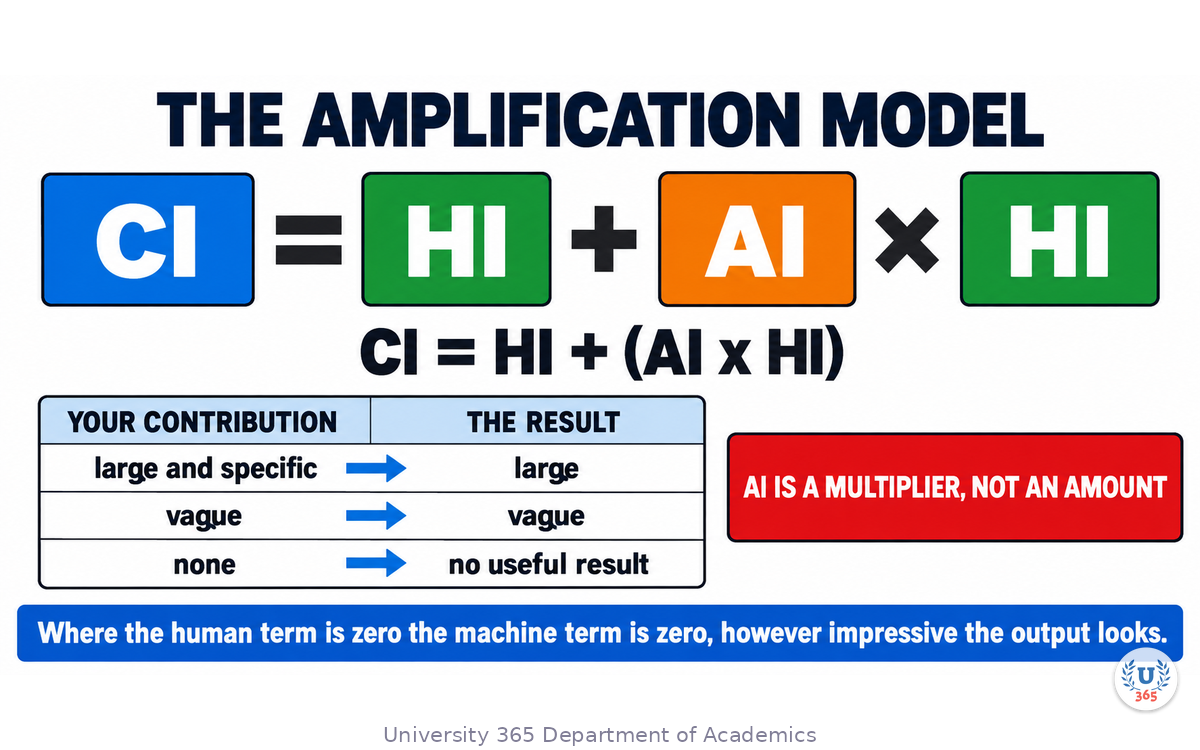
University 365 states the model as an equation: CI = HI + (AI x HI). CI stands for Co-Intelligence, the combination. HI stands for Human Intelligence. AI stands for artificial intelligence. Spelled out: the combined result equals what you contributed, plus whatever the machine produced multiplied by what you contributed.
The multiplication is the whole point, and it is also the part people skip. In this equation the AI term is not an amount of output. It is a multiplier applied to a human contribution. Where the human contribution is zero, the AI term is zero, regardless of how impressive the output looks. Where the human contribution is large and specific, the AI term is large.
What this predicts, and how to test it. The equation makes one testable claim: your results should scale with the quality of your own input, not with the amount of the machine's output. Test it on your own work this week. Take a task you do repeatedly. Do it once with a thin spec, once with a detailed spec that names the audience, the constraint, the format and the definition of done. Compare. The equation says the second run should be substantially better, and that the improvement should come from what you wrote, not from asking for more.
Where the equation is misapplied. Two errors are common. The first is treating the AI term as additive: using the assistant for work you could not do at all, then treating the result as an addition to your capability. It is not. It is output you cannot evaluate, which is a liability rather than a capability. The second is treating the multiplier as constant. It is not. The same assistant applied to a well-specified task in your domain of competence produces something you can judge and improve; applied to a task you do not understand, it produces something that looks fine.
Why "irreplaceable" is the operative word. University 365's own framing pairs CI-First with irreplaceability rather than with productivity. That is deliberate. A person whose entire output can be produced by a model has no standing in the equation. A person who has built domain judgement, taste, relationships and the ability to specify what should exist has a large HI, and a large HI multiplied by a capable model produces results a model alone cannot reach.
The corollary you should take from this section. Investment in your own capability is not in tension with using AI. It is the precondition for getting anything out of it. Any plan that reduces your own skill while increasing your use of the tools is a plan to reduce the multiplier.
Step 3: Five Capabilities You Can Genuinely Amplify
Amplification is specific. The word describes what happens to a named human capability when a tool is applied well. Here are five that a communication and knowledge professional can amplify now, with the mechanism and the risk for each.
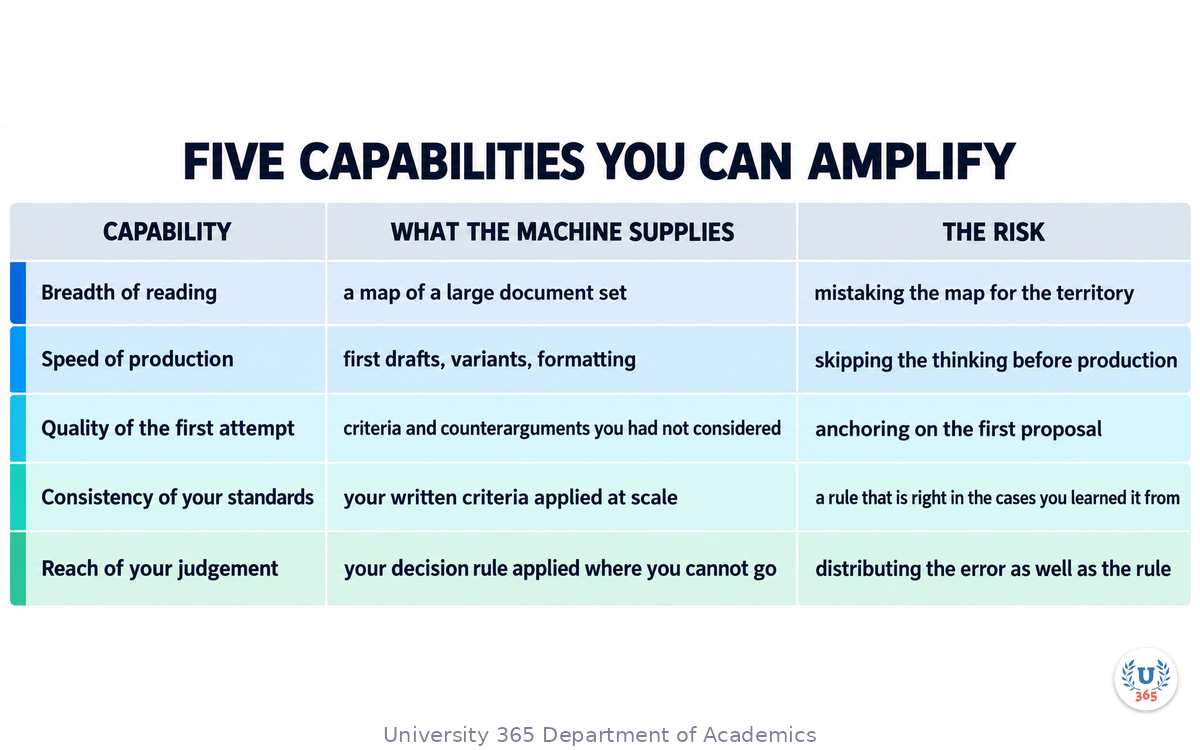
1. Breadth of reading. You cannot read everything relevant to your field. An assistant can read it all and report structures, positions and disagreements across a large document set in minutes. What you then have is not knowledge, it is a map: which sources exist, which disagree, which look thin. The amplification is real because the map changes what you choose to read properly. The risk is mistaking the map for the territory, and the mitigation is to always read at least one primary source in full after the map.
2. Speed of production. First drafts, variants, formatting, localisation, caption sets, alt text, structured summaries. The mechanism is straightforward: work whose value is in the finished form rather than in the act of producing it. The amplification is measured in hours per week, and it is the easiest of the five to obtain. The risk is that production speed tempts you to skip the thinking that should precede production, which is where the value was.
3. Quality of the first attempt. An assistant can propose a structure, a counterargument, or a set of criteria you had not considered, before you commit to a direction. This is genuinely different from producing a deliverable: it is using the model to widen your option set at the point where widening is cheapest. The risk is anchoring on the first proposal, and the mitigation is to always request at least three alternatives with an explicit instruction not to recommend one.
4. Consistency of your own standards. A written set of criteria, applied by an assistant across everything you produce, catches the drift that happens when you work quickly. This is the least glamorous of the five and the most durable. It is amplification of your standards rather than of your output, and it works precisely because the assistant applies your stated rules rather than its own defaults.
5. Reach of your judgement. This one is subtler. If you can articulate how you decide something, an assistant can apply your decision rule in contexts you will never personally enter, and you can inspect the results. A hiring rubric, a brand voice rule, an editorial standard, a pricing heuristic: each becomes a filter you can run at scale. The mechanism is that your judgement stops being bottlenecked by your hours. The risk is that a rule which is right in the cases you learned it from is wrong elsewhere, and the amplification is what distributes the error.
What is not on the list. Creativity in the sense people usually mean it. Taste. Relationships. Accountability. The willingness to be wrong in public. None of those amplify through a model, and several of them degrade if you let a model stand in for them often enough. The useful test for any proposed amplification: name the human capability it makes larger, and name what the model would do if you removed your input. If the second answer is "the same thing", it is not amplification.
Step 4: Building a Personal Stack That Fits Your Work
A stack is the specific arrangement of tools, context and habits you use for work you actually do. Most people have a tool and no stack, which is why their results are inconsistent. Here is how to build one, in four layers.
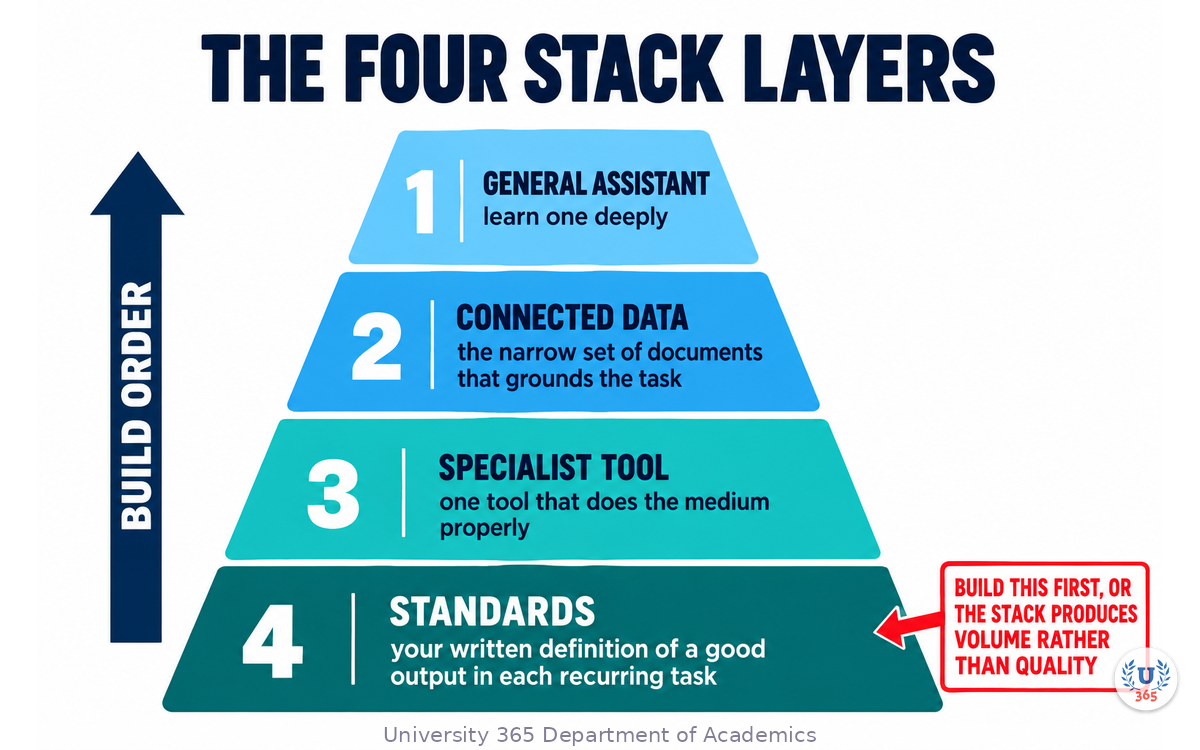
Layer 1: The general assistant, for thinking and production. One assistant you know deeply beats four you use casually, because the habits transfer. Learn its context mechanism, its file handling, its tool connections and its limits. This layer carries drafting, restructuring, comparison, explanation and the option-widening work from Step 3.
Layer 2: The connected data, for grounding. This is where the Model Context Protocol belongs in practice. Instead of pasting content into a chat, you connect the assistant to the folders, documents or systems that hold your working material. The skill is scope: giving access to the specific set that answers the question and nothing wider. A general connection that exposes everything is a security problem and a quality problem, because the model will draw on material that is irrelevant and possibly misleading.
Layer 3: The specialist tool, for the medium. For video, audio, design, code or data work, one tool that does the medium properly. The general assistant can plan and script; the specialist executes. Trying to make the general assistant the specialist produces work that looks acceptable and fails on close inspection.
Layer 4: Your own written standards, applied everywhere. This is a document, not a tool. It holds your definition of a good output in each recurring task: the criteria, the banned patterns, the required elements. Every layer above consumes it. Without this layer, the other three produce work in the assistant's default voice rather than yours, and the drift is invisible until someone notices that everything you produce reads the same as everything everyone else produces.
Sequencing. Build from layer 4 backwards. Write your standards first, because a stack without them produces volume rather than quality. Then choose the general assistant and learn it. Then connect data, narrowly. Then add specialists where the medium genuinely requires one. Teams that built the stack in the opposite order, tool first and standards never, end up with a large subscription bill and inconsistent output.
What a working stack costs. For an individual professional, one general assistant subscription, one connected workspace, occasionally one specialist tool, and about two hours to write the standards document. The costs are not the constraint. The constraint is the discipline to use layer 4 on every task, which is the next section.
Step 5: Context Is the Multiplier, Not the Prompt
The single largest difference between people who get real value from these tools and people who get plausible-looking output is not prompt wording. It is context. And context is a construction task, not a phrasing task.
What context means here. Everything the assistant needs to answer well that it does not already have: who the audience is, what has already been decided, what the constraints are, what good looks like, what has been tried and rejected, and what the output will be used for. None of that is in the question. All of it changes the answer.
Why prompt tricks stopped mattering. Techniques that worked on smaller models often do not transfer, and the reason is structural rather than stylistic. As models handle more context and reason over longer inputs, the marginal value of a clever phrasing falls and the marginal value of supplying the missing facts rises. If you have ten minutes, spend them gathering context rather than polishing the prompt.
The four-block context. A construction you can reuse for any task:
Situation. What is true about the project, the audience and the constraints. Facts, not framing.
Role you are playing. What the assistant should be in this task: an editor, a critic, a first-drafter, a comparer. Different roles produce different failures, and naming the role makes the failure predictable.
Definition of done. What the output must contain, what it must not, and how you will judge it.
What to do when unsure. The instruction that prevents the most common failure: when the material is insufficient, say so and name what is missing rather than filling the gap.
That fourth block is the one that separates usable output from confident output.
University 365's version. The UP-Context-Engineering Method, University 365 Prompting-Context Method, structures this into reusable blocks including context, role, user persona and audience persona, so a context you build once is reusable for a class of tasks rather than one request. The value is not in the blocks themselves. It is that reusing a context makes your results comparable over time, which is what lets you improve.
The context artefact that pays for itself. Build one file per recurring task type. For an editorial review, it holds the publication's standards, the audience, two examples of accepted output and two of rejected output with the reason. For a data summary, it holds the definitions, the units and the standing caveats. Reused across a year, that file is the difference between an assistant that knows your standards and one that guesses at them. It is also the artefact that makes your standards portable when the tools change, which they will.
The two-minute discipline. Before a request of any consequence, write the four blocks. It takes two minutes and it is the highest-return habit in this lecture. Where a request is trivial, skip the ceremony. Where the output will be read by someone else, do not skip it.
Step 6: Where Amplification Becomes Substitution
Every capability in Step 3 has a failure mode where the amplification quietly turns into replacement. The transition is rarely dramatic and it is almost never noticed at the time, which is what makes it worth designing against.
The evidence on what happens when it goes wrong. The MIT Media Lab study released as a preprint in June 2025 followed 54 participants writing essays over four months in three conditions: with a large language model, with a search engine, or with no tools. The model group showed the weakest and least distributed brain connectivity across the sessions, reported the lowest ownership of their own writing, and 83 percent could not quote from an essay they had written minutes earlier. When the tool was removed in a fourth session, they showed lower engagement than participants who had never used it. The sample was small and the paper had not completed peer review when released, so the magnitudes are provisional. The direction matches decades of work on automation and skill decay, and the design implication is stable regardless of the exact numbers.
The three signals that amplification has become substitution.
You cannot do the task without the tool, and you used to be able to. This is the clearest signal and the easiest to test. Once a month, do one significant task the old way. Write the first draft yourself. Produce the analysis without the assistant. Do the design pass unaided. If the gap between your unaided output and your assisted output has widened over six months, you are substituting.
You accept output you cannot explain. If you could not reconstruct the reasoning, defend the choice or describe why the alternative was worse, you did not make the decision. The assistant did, and you signed it. Track how often this happens in a week. Anything above occasionally is a problem.
Your work has become indistinguishable from your peers'. The homogeneity finding is the one to watch in creative fields. When everyone uses the same models on similar tasks with similar prompts, the outputs converge. If your work reads like the work of everyone else who uses the same tool, your differentiation has been outsourced, and differentiation was the value.
The countermeasures, in order of effectiveness.
First, retrieval before generation. Attempt the task yourself before opening the assistant, even for five minutes. A first attempt you made is something to react to; an empty page is not. This is the single most protective habit in the lecture.
Second, name the human capability before each use. Say, out loud or in writing, which of the five capabilities in Step 3 this task is meant to amplify and what you will contribute. If you cannot name your contribution, you have found a substitution, not an amplification.
Third, keep one skill deliberately unassisted. Choose the capability that is most central to your professional identity and practise it without tools on a schedule. Pilots keep manual flying hours for exactly this reason, and the analogy is not decorative: the skill that is exercised only when the automation fails is the skill that will have failed too.
Fourth, review the review. Once a week, take one assisted output and check it as if you were hostile to it. What is unverified, what is generic, what would you challenge if a colleague submitted it. The habit costs twenty minutes a week and it is what keeps your critical faculty load-bearing rather than ceremonial.
Step 7: The Twelve-Month Compounding Plan
Amplification compounds or it resets, and the difference is whether you build reusable assets or repeat the same work. A plan in five parts.
Part 1: The standards document, month one. Two hours. Your definition of a good output for each recurring task type: required elements, banned patterns, the audience, the two examples of accepted work. This is the asset everything else consumes, and it is the one that survives every tool change.
Part 2: The context library, months one to three. One file per recurring task type, in the four-block form from Step 5, refined each time you use it. After three months you have a library that makes a new task a context-assembly exercise rather than a blank page. After twelve months the library is the most valuable artefact you own in this area.
Part 3: The calibration habit, ongoing. Once a quarter, for one recurring task, test three configurations against your own criteria and record which wins. The point is not to keep up with releases. It is to stop relying on a default you never tested, and to build a record of what actually works for your work.
Part 4: The unaided audit, monthly. One significant task done without assistance, compared against your assisted baseline. Two purposes: it tells you whether your unaided capability is holding, and it tells you whether the assistant is still adding anything. Both answers change over time.
Part 5: The quarterly review, four times a year. Four questions. Which capability did I amplify most this quarter, and did it grow. Which capability did I stop exercising. What did I learn from the model that I would not have found alone, and did I record it. What in my standards document is now wrong. The fourth question is where the compounding lives, because a standards document that is never corrected hardens into a rule that no longer matches your judgement.
Why twelve months rather than thirty days. Everything durable in this plan is a reusable asset or a trained habit, and neither forms in a month. The thirty-day plans that circulate are mostly onboarding: they make you fluent with a tool and then stop. Fluency decays with the tool. Assets and habits do not.
The honest measurement. Do not count prompts, tools or hours. Count three things: how many reusable assets you hold, how often you produce work you could not have produced a year ago, and whether your unaided capability on your core skill is holding. Those three are the plan. Everything else is instrumentation.
Step 8: The Delegation Judgement: What to Hand Over
The plan in Step 7 builds the assets. This section is the judgement that decides what the assets are applied to, and it is the one that gets harder as the tools get better.
The framework, in four questions. Before handing a task to an assistant, answer four questions. Any "no" is a signal, not a veto. Two or more is a decision to keep the task.
Can I evaluate the output? Not produce it. Evaluate it. If you cannot say what a good answer looks like and spot a bad one, the output is unverifiable, and unverifiable output is worse than no output because it enters your work with your name on it.
Is the process part of what I am building? Some tasks produce an artefact and some produce capability. If doing the task is how you maintain the skill it uses, delegating it trades capability for time, and the trade is only good if you have decided to make it.
Will I still be accountable for the result? If someone will ask you why it says what it says, you have to be able to answer, which means you need to have understood it rather than only approved it.
Is this task on my differentiator list? The work you want to be known for. Delegating it saves hours and removes the thing you are actually selling.
The task taxonomy that falls out. Four classes, each with a default.
Class | Description | Default |
Administrative | Formatting, conversion, transcription, templating | Delegate fully, no reservation |
Investigative | Gathering, summarising, mapping a large set | Delegate, then read at least one primary source yourself |
Generative | Producing a first version of something you will shape | Delegate the first pass, keep the shaping |
Judgemental | Deciding, evaluating, committing, taking responsibility | Keep. Assist with material, never with the decision |
The taxonomy is not a rule about tools. It is a rule about where responsibility sits, and it holds regardless of how capable the next model is.
Why this gets harder, not easier. As the tools improve, the third class grows. Tasks that were judgemental become generative, because the output quality now clears a bar you would previously have met yourself. That is a genuine improvement and it makes the boundary harder to find, because each individual delegation looks reasonable. The discipline is to keep the judgemental class defined by responsibility rather than by output quality. If a task carries your accountability, it stays yours even when the machine would do it better.
The written agreement with yourself. One page, four columns: task, class, what you contribute, what the assistant contributes. Fill it in for your ten most frequent tasks and review it quarterly. Its purpose is not administration. It is that the boundary becomes an object you can look at rather than a habit you drift through.
Where the taxonomy has to bend. Two cases. First, a task that is administrative inside a judgemental whole: formatting a proposal is administrative, but the framing of the proposal is not, and the two are easy to conflate when they sit in one workflow. Second, a task you want to learn: delegating an unfamiliar thing is fine while you are also reading and testing, and it becomes substitution when the reading stops. The taxonomy is a default, and a default with a written reason is worth more than a rule with an exception you never stated.
The five-minute version when you are in a hurry. One question, not four. Whose judgement is in the output. If the answer is yours, you have to have made it. If the answer is the model's, you have to have verified it. If the answer is nobody's, the task should not be delegated at all.
Feynman Summary: Explain It Like You Are 12
Imagine you are very good at drawing. Someone gives you a machine that can draw fast. It draws whatever you tell it to.
If you tell it something vague, you get a fast, boring drawing. If you tell it exactly what you want, in detail, and you know about drawing, you get something good, fast. And you can fix the parts that are wrong, because you know what good looks like.
The machine does not make you better at drawing. It makes your ideas come out faster. Your ideas are still the important part.
There is a trap. If you let the machine draw everything and you stop practising, you get worse at drawing. Then you cannot even tell when the machine's drawing is bad. You still have the machine, but you have lost the thing that made the machine useful.
So: use the machine for the fast parts. Keep practising the part that is you. Check the machine's work like you would check anyone's.
The machine multiplies what you bring. If you bring nothing, you get nothing much, only faster.
Mindmap: The Complete Picture
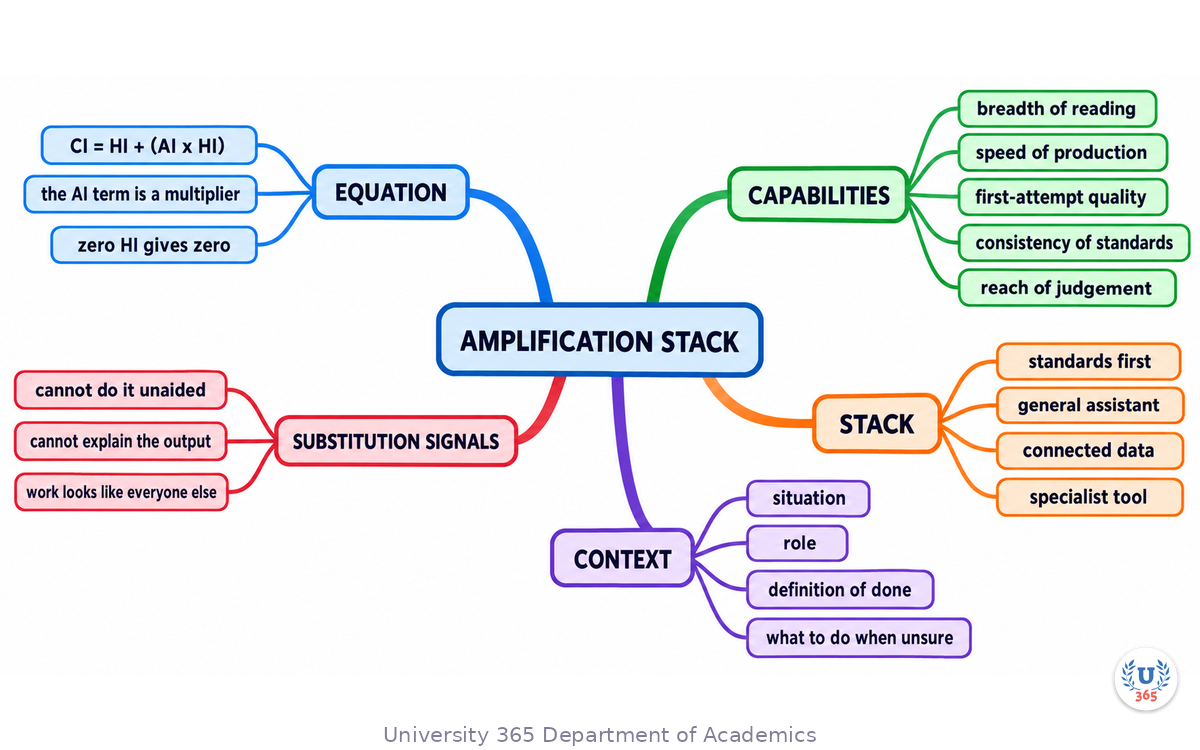
The mindmap shows the CI equation and what it predicts, the five amplifiable capabilities with their risks, the four stack layers and the order to build them, the four-block context construction, the three signals that amplification has become substitution with their countermeasures, and the five parts of the twelve-month compounding plan.
UNOP Sound (University 365 Neuroscience Oriented Pedagogy)
Take five minutes to consolidate your memory. Play the isochronous tone track (10Hz alpha frequency) with your eyes closed. Alpha-frequency tones after a learning session support consolidation, helping move what you just learned from short-term to long-term memory.
[Audio player: UNOP Post-Lecture Isochrone (10Hz, 5 minutes)]
Practical Exercise: Build Your Amplification Stack
Exercise: One Capability, One Stack, Four Weeks
This exercise builds a working stack around one capability and tests whether it actually amplifies. Budget two hours today and about ninety minutes a week after.
Part 1: Choose the capability (15 minutes).
From the five in Step 3, choose the one whose amplification would change your week most. Pick one, not three.
State what you contribute to it, in one sentence. If you cannot, choose a different capability.
Write the risk for that capability and the specific signal you will watch for.
Part 2: Write the standards (30 minutes).
Take one recurring task in that capability. Write your definition of a good output: required elements, banned patterns, audience, length.
Find two examples of output you accepted and two you rejected. For each rejected one, write one line saying why.
Part 3: Build the context file (30 minutes).
Write the four blocks for that task: situation, role, definition of done, and what to do when the information is insufficient.
Run the task with the context file. Record the output.
Run the same task with a thin prompt. Record the output. Compare them against your own criteria and write the difference down.
Part 4: Build the stack layers (30 minutes).
Name your general assistant and one habit you will use consistently with it.
Identify the narrowest data connection that would ground this task. Write down what should be excluded and why.
Identify whether the medium needs a specialist tool. If not, do not add one.
Part 5: Run the audit (15 minutes, then weekly and monthly).
Do this task once unaided this month. Compare it against the assisted version.
Weekly, take one assisted output and review it as a hostile reviewer. Write what you would challenge.
At four weeks, answer the four quarterly questions early. Which capability grew. Which stopped being exercised. What did you learn that you would not have found alone. What in your standards is now wrong.
What to Observe
How large was the gap between the thin-prompt output and the context-file output? Was it larger or smaller than you expected?
On the unaided run, how much of the quality came from what you had absorbed from working with the assistant, and how much was independent?
Did the hostile review find anything you had previously accepted without noticing?
Which of the four quarterly questions was hardest to answer honestly?
Applied AI Connection
You chose the capability, wrote the standards, assembled the context and ran the review. The assistant produced variants, applied your criteria and reported structure across material you had not read. Both parts are load-bearing: remove yours and the output is generic, remove the assistant's and the work does not fit your hours. That division is CI = HI + (AI x HI), the CI-First pattern of Co-Intelligence First, with the human as orchestrator and the machine as amplifier.
Glossary
Term | Definition |
CI-First | Co-Intelligence First: the U365 principle that the human is the orchestrator and the AI is the amplifier. Stated as CI = HI + (AI x HI). |
HI | Human Intelligence, the human contribution in the CI-First equation. It is the term the AI multiplies, so a low HI makes the whole product low. |
Amplification | A named human capability producing more because a tool was applied to the parts that surround it, with the human contribution still load-bearing. |
Substitution | Delegating a capability entirely, so the human contribution falls toward zero. The output may look better while the person's ability to judge it declines. |
Context | Everything the assistant needs to answer well that it does not already have: audience, constraints, prior decisions, definition of done. |
Definition of done | The statement of what an output must contain and how it will be judged. Written before the work, not after. |
UP-Context-Engineering Method | University 365 Prompting-Context Method: reusable context, role, user persona and audience persona blocks applied to a class of tasks. |
Model Context Protocol | An open standard, released by Anthropic in November 2024 and donated to the Linux Foundation's Agentic AI Foundation in December 2025, that standardises how assistants connect to data and tools. |
Calibration | Testing several model or configuration options against your own written criteria instead of relying on a default. |
Unaided audit | Doing one significant recurring task without AI assistance, on a schedule, to check that your own capability is holding. |
Cognitive offloading | Handing a mental task to an external system. Useful when the output is what matters, costly when the process was the learning. |
Cognitive debt | The accumulation of long-term learning costs from repeated short-term offloading, a term coined in the MIT Media Lab essay-writing study. |
Irreplaceability | The property of a person whose contribution is the multiplier in the CI equation, and therefore whose output a model alone cannot reproduce. |
Homogeneity | The convergence of outputs produced by many people using the same models on similar tasks, which removes differentiation. |
UNOP | University 365 Neuroscience-Oriented Pedagogy, the institutional learning method that sets the 25-minute focus block and the isochrone protocol. |
Quiz: TEST YOUR UNDERSTANDING
1. In the CI-First equation CI = HI + (AI x HI), what does the multiplication mean?
A) The AI produces more output when you ask for more
B) The AI's contribution is a multiplier applied to your own contribution, so it is zero where your contribution is zero
C) AI and human output add together independently
D) AI replaces human effort when the task is complex
2. Which of these is NOT one of the five amplifiable capabilities described?
A) Breadth of reading
B) Consistency of your own standards
C) Creativity in the sense of original taste and judgement
D) Reach of your judgement
3. What should you build first when assembling a personal stack?
A) The specialist tool for your medium
B) The connected data layer
C) Your own written standards for a good output
D) The general assistant subscription
4. In the MIT Media Lab essay study, what happened to participants who used a large language model?
A) They showed the strongest brain connectivity of the three groups
B) They showed the weakest connectivity, lowest ownership, and most could not quote their own essays
C) They matched the search-engine group exactly
D) They performed better once the tool was removed
5. Which countermeasure is described as the single most protective habit against substitution?
A) Using a more capable model
B) Attempting the task yourself before opening the assistant
C) Increasing your subscription tier
D) Keeping a log of every prompt
Answers: 1-B, 2-C, 3-C, 4-B, 5-B
Related Resources
U365 INSIDE Publications
Lecture: Microlearning for an AI-Driven World: The learning program that keeps your contribution large
Lecture: Avoiding the AI Trap: Keeping Your Brain Sharp in the Age of Generative AI: The cognitive offloading evidence and the practical countermeasures
Lecture: Is ChatGPT Study Mode the Future of Learning? A Faculty Review: What happens when a tutoring tool is tested honestly
External Resources
The Impact of Generative AI on Critical Thinking (CHI 2025, Microsoft Research and Carnegie Mellon): The 319-participant workplace survey
Your Brain on ChatGPT (MIT Media Lab preprint, June 2025): The four-month essay-writing study
Your Brain on ChatGPT (MIT Media Lab project overview, including its stated limitations): The authors' own caution on generalisation
Model Context Protocol (Linux Foundation Agentic AI Foundation): The open standard for connecting assistants to data and tools
The science of effective learning with spacing and retrieval practice (Nature Reviews Psychology, 2022): The evidence on retrieval before generation
Related U365 Lectures (Coming Soon)
Lecture 3: Evaluating AI Output Without a Benchmark Team (UIC, AI Learning Series)
Lecture 4: Building an Editor's Context File (UIC, AI Learning Series)
U.Copilot for This Lecture
Discuss this lecture with U.Copilot, your AI chat companion trained on this content.
Copy and paste the following prompt into the U.Copilot chat on university-365.com:
You are U.Copilot for Lectures, an AI chat companion specially trained on University 365 lecture content. You are helping a Fellow who just completed the lecture "Generative AI for a Superhuman You" from the AI Learning Series at the U365 Institute of Communication (UIC). Your role is to help the Fellow build and run an amplification stack. You can: - Help them choose one capability to amplify and state what they contribute to it - Draft and critique their standards document for a recurring task - Build the four-block context file with them and test it against a thin prompt - Name their stack layers and identify the narrowest safe data connection for the task - Review their assisted output as a hostile reviewer and list what a colleague would challenge - Run the unaided audit comparison and help them read the gap honestly Keep the CI-First division of labour explicit. The Fellow is the multiplier and you are the amplifier. Never let them skip the unaided attempt, and when you cannot tell whether an output is good enough, say so and name what is missing instead of filling the gap with confident prose. Use the UP-Context-Engineering Method: provide context-rich, role-aware responses that account for the Fellow's domain, their written standards and the decisions they actually face at work.
Next Steps
Here is what to do next, in order:
Choose one capability from the five and write the sentence naming what you contribute
Write your standards document this week for one recurring task, including two accepted and two rejected examples with reasons
Build the four-block context file and run the same task twice, once with it and once without, and record the difference
Put the monthly unaided audit in your calendar before you need it
Write the one-page agreement from Step 8 for your ten most frequent tasks: task, class, what you contribute, what the assistant contributes
Name the risk for your capability and the signal you will watch, so substitution is something you notice rather than something you discover later
Continue with Lecture 3 in this series, Evaluating AI Output Without a Benchmark Team, which turns the verification habit into a repeatable method
The technology does not make you superhuman. It makes the gap between what you bring and what you produce wider, in whichever direction you are already moving. Build the stack, keep the contribution large, and the multiplication works in your favour.
IMPORTANT NOTICE
This lecture is published by University 365 as part of its INSIDE Publications Hub. The content is free to read for all visitors. Lectures in this series may be part of a structured academic program leading to a Micro-Credential for your Career (MCC). To enroll in an academic program, visit university-365.com/tuition.
This content is for educational purposes. Research findings cited here include preprints that had not completed peer review at the time of publication, and their magnitudes should be treated as provisional. AI capability, pricing and tool behaviour change quickly. Verify current technical details and licence terms against primary sources before professional use.
Copyright University 365, Inc. All rights reserved. This content is protected under University 365's copyright policies. For permissions or inquiries, contact uda@university-365.com.
Published by the Department of Academics, University 365.
Lecture delivered by the University 365 Institute of Communication (UIC).
Lea Loringam, Dean of Communication, UIC
Signed for the academic year 2026.





Comments