
Grok 4.5: xAI's High-Performance Balanced Model

Updated: 5 days ago
Status: Active | Last tested: 2026-09-03 (Grok 4.5, July 2026 release) | Re-check: trigger-based (max 6 months)
Active: the tool is current and recommended.


In this Tool Review
Tool Snapshot
Tagline: The best combination of speed and intelligence for agentic workflows
Category: Large Language Model
Provider: xAI (SpaceXAI)
Version tested: Grok 4.5 (released July 8, 2026)
Parameters: Undisclosed (estimated ~1.5T MoE, unconfirmed)
Context window: 500K tokens
License: Proprietary (closed-weight)
Platforms: xAI API, Grok Build, Cursor (all plans), OpenRouter, Vercel, Cloudflare, Snowflake, Databricks
Primary use cases:
Agentic coding and multi-file refactoring
Terminal-based engineering tasks
Long-running coding agent workflows
Knowledge work and research synthesis
Office productivity (Excel, PowerPoint, Word)
Pricing summary: Paid - $2/M input, $6/M output (cached input $0.30/M, 75% discount). Surcharge above 200K context. No free tier; limited free trial in Grok Build and Cursor.
Official links:
Website: https://x.ai
Blog post: https://x.ai/news/grok-4-5
Grok Build: https://x.ai/build
Hugging Face (Grok-1, older): https://huggingface.co/xai-org/grok-1
LLM specifications:
Context Window: 500K tokens (reduced from 1M in Grok 4.3)
Effort/Thinking Levels: Low, Medium, High (default High, non-disableable)
Parameters: Undisclosed (estimated ~1.5T MoE, unconfirmed by xAI)
Architecture: Mixture-of-Experts (reported), trained on NVIDIA GB300 GPUs in Memphis
Available Platforms: xAI API (Responses + Chat Completions), Grok Build, Cursor, OpenRouter, Vercel, Cloudflare, Snowflake, Databricks
Model Variants: grok-4.5 (aliases: grok-4.5-latest, grok-build-latest)
Benchmark Scores: AA Intelligence Index 54 (rank 4-8 of 168-188 models), GPQA Diamond 93.1%, Terminal-Bench 2.1 83.3%, SWE-Bench Pro 64.7%
Speed: ~80 tokens/second output
Latency: Average 6.6s per coding task (DataLLM Lab measured)
Modality: Input: text + image. Output: text only. No audio or video.
License: Proprietary, closed-weight. No model card or system card published at launch.
At a Glance
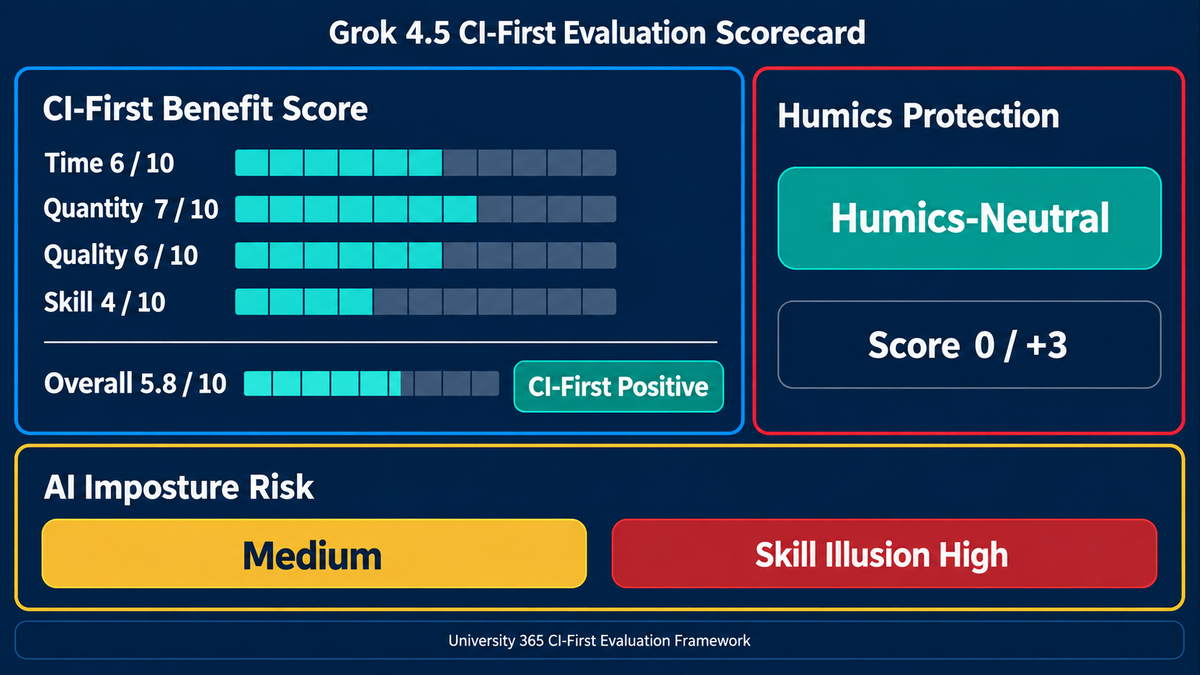
CI-First Benefit Score | 5.8/10 - CI-First Positive |
Time / Quantity / Quality / Skill | 6 / 7 / 6 / 4 |
CI-First Profile | Co-Creator and Thought Partner (level 1) |
Humics Protection | Humics-Neutral (0) |
AI Imposture Risk | Medium |
User Sentiment | Mixed (community split on trust and coding quality) |
Pricing | $2/M input, $6/M output |
Platforms | xAI API, Cursor, Grok Build, OpenRouter |
Token Efficiency | ~16K tokens/task (4.2x fewer than Opus 4.8) |
For detailed explanations of the CI-First evaluation terms used in this review - including CI-First Benefit Score, CI-First Profile, Humics Protection Badge, AI Imposture Risk, and User Sentiment, see the Glossary at the end of this publication.
The Problem
Developers and organizations building AI-powered applications face a persistent tension: they need a model that is smart enough for complex agentic tasks, but affordable enough to run at high volume. Frontier models like Claude Fable 5 and GPT-5.5 deliver top-tier reasoning at premium prices ($10/$50 and $5/$30 per million tokens). Budget models are cheaper but fall short on multi-step coding and tool-calling workflows.
The gap is where most real development work happens. Teams need a model that can write code, use tools, browse files, and sustain long agent sessions without burning through tokens at flagship rates. They need cost-per-resolved-task, not just cost-per-token, to make economic sense at scale.
Before Grok 4.5, xAI's Grok 4.3 filled part of this gap at $2.50 per million tokens with a 1M context window, but scored only 38 on the Artificial Analysis Intelligence Index. Competitors at similar prices lacked agentic tool-calling capabilities. The market needed a model that combined near-frontier intelligence with aggressive token efficiency and coding-agent-specific tuning.
The Outcome
With Grok 4.5, you get a model that scores 54 on the Artificial Analysis Intelligence Index (rank 4-8 of 168-188 models), near the frontier but not at the top. It delivers 83.3% on Terminal-Bench 2.1 and 64.7% on SWE-Bench Pro, ahead of GPT-5.5's 58.6% on the same measure but behind Claude Opus 4.8 (69.2%) and Claude Fable 5 (80.4%).
The configurable reasoning effort gives you control over depth. At low effort, Grok 4.5 is fast for lookups and boilerplate. At high effort (the default), it sustains complex multi-step coding tasks. The model resolves the average coding task using about 15,954 output tokens, roughly 4.2x fewer than Claude Opus 4.8's 67,020 tokens for the same work.
Developers report that Grok 4.5 handles ambiguous premises and complex instructions better than previous Grok versions. Cursor's CEO called it an Opus-class model that is fast and low cost, and said it became the daily driver for many on the Cursor team. However, community sentiment is split: some users praise the intelligence-per-dollar, while others report hallucination issues and question trust in xAI's output neutrality.
Who Should Use Grok 4.5
Learner categories and institute alignment:
Fellow Category | Fit | Best Use Cases |
Students | Medium | Coding assignments, agentic project building, research synthesis |
Professionals | High | Repository-scale refactoring, terminal engineering, CI automation, office document generation |
Everyone | Low-Medium | General chat and knowledge queries via Grok Build (free trial available) |
U365 Institutes Alignment
Rating. High
Why. Core coding model for agentic software engineering, terminal tasks, and multi-file refactoring workflows
The limit that holds the row. The model codes and runs agentic terminal work; it teaches none of the engineering discipline behind it, and xAI publishes no model card or system card, so the behaviour the review's own sentiment section questions (hallucination reports, output-neutrality concerns) cannot be audited from the product. The competencies that remain are the review of the change, the test and the deployment decision. A word-start accent-folded search over the title and full description of all 79 published programme descriptions returns zero matches for version control, code review, test design, debugging and model card, so the row stands at High for measured engineering use under review and not for the agent's own judgement.
Rating. Medium
Why. Excel model building, business document generation, financial analysis via Grok Build Office plugins
The limit that holds the row. The model operates spreadsheet and document workflows through Office plugins; it teaches no financial method and no management or entrepreneurship content, and the review's own sentiment record leaves its reliability contested. The competency that remains is the financial judgement and the audit of the generated workbook or document before it carries a decision. A word-start accent-folded search over the title and full description of all 79 published programme descriptions returns two documents for financial analysis and one for market research, and zero matches for unit economics, total cost of ownership, procurement and vendor management, so the row stays at Medium: the nearest published anchors assess the discipline, not the audit of a generated workbook.
Rating. Medium
Why. Content workflows, research synthesis, automated content generation across large document sets
The limit that holds the row. The model drafts across large document sets; it writes no register, no audience analysis and no editorial standard, and the review's own sentiment record includes trust questions around its output. The competency that remains is source discipline: verifying what a synthesis keeps and stating where the material came from. A word-start accent-folded search over the title and full description of all 79 published programme descriptions returns zero matches for editorial, disclosure, provenance, brand voice and source verification, so the row stays at Medium for drafting support and not for publication craft.
Rating. Low
Why. Prototyping with code-generated UI components, design rationale text generation
The limit that holds the row. The model generates interface code and design rationale text; it supplies no design method, no critique against a brief and no editable design artefact of its own, and the live reason already records the work as prototyping support. The competency that remains is the design decision the Fellow takes around a generated component. A word-start accent-folded search over the title and full description of all 79 published programme descriptions returns two documents each for interaction design and prototyping and zero matches for design system, user research, critique and accessibility, so the row stays at Low: the component is generated, the decision is not.
Skill level: Intermediate to advanced for API users. No prerequisites for Grok Build users.
Prerequisites: Basic API concepts, an xAI account, understanding of prompt engineering. For Cursor integration: a Cursor subscription. For API integration: basic Python or Node.js knowledge.
Time to first result: 10 minutes via Grok Build (free trial). 15 to 30 minutes via API with an xAI console key.
Time to competence: 1 hour for basic use. 3 to 5 hours for API integration and effort tuning. 1 to 2 days for production agent pipelines.
How Grok 4.5 Works
Grok 4.5 is a mixture-of-experts model from xAI, released on July 8, 2026. It was trained alongside Cursor on real developer session data, across tens of thousands of NVIDIA GB300 GPUs in xAI's Memphis data centers. The training emphasized reinforcement learning on multi-step software engineering tasks with automated and model-based grading.
Inputs
Grok 4.5 accepts text and image input. You send prompts via the xAI Responses API or Chat Completions endpoint, through Grok Build, or through Cursor's model picker. The context window is 500K tokens, reduced from Grok 4.3's 1M. A high-context surcharge applies above 200K tokens.
Outputs
Grok 4.5 generates text output only, with no native audio or video. Output speed measures approximately 80 tokens per second. The model resolves the average coding task using about 15,954 output tokens, roughly 4.2x fewer than comparable leading models. Max output length is 32,768 tokens on some providers.
Configurable Reasoning
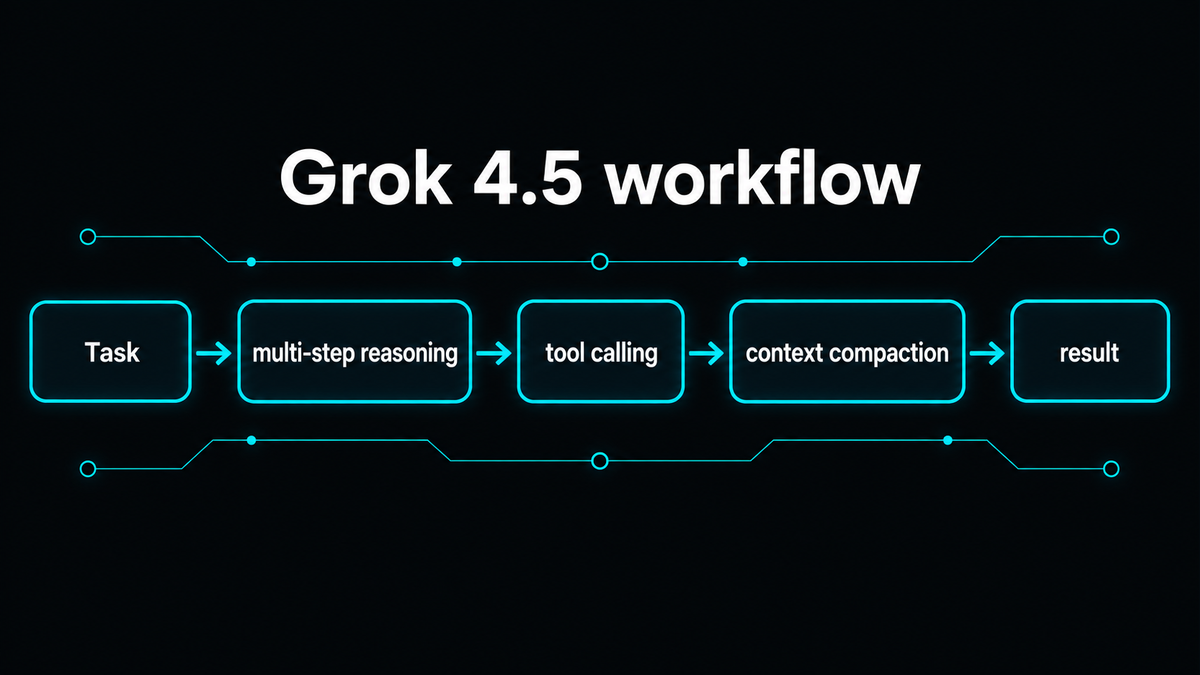
Grok 4.5 uses configurable reasoning with three effort levels: low, medium, and high (default). Lower effort reduces latency and token usage for simpler tasks. Higher effort enables deeper multi-step reasoning for complex coding and analysis. The reasoning is non-disableable, always on at minimum low effort. xAI recommends context compaction for long agent sessions to work within the 500K window.
Underlying Technology
xAI has not officially disclosed the parameter count or architecture details. Secondary reports cite a ~1.5 trillion-parameter MoE foundation, but this figure is unconfirmed by xAI or independent trackers. The model is proprietary and closed-weight. xAI has not published a dedicated model card or system card for Grok 4.5, unlike earlier Grok releases (Grok 4, 4 Fast, 4.1, 4.20) which shipped PDF model cards at data.x.ai.
Key Technical Features
Benchmark results (Artificial Analysis Intelligence Index v4.1.1, August 2026):
Intelligence Index: 54 (rank 4-8 of 168-188 models, median 36)
GPQA Diamond: 93.1% (scientific reasoning)
Terminal-Bench 2.1: 83.3% (agentic coding)
SWE-Bench Pro: 64.7% (resolve rate, ahead of GPT-5.5 at 58.6%)
DeepSWE 1.0: 62.0%
SWE Marathon: 29.0% (pass@1, long-horizon agentic test)
tau3-Banking: 33% (agentic tool use, #1 of 28 models charted)
Token efficiency: ~15,954 output tokens per SWE-Bench Pro task (4.2x fewer than Opus 4.8)
Platform availability: xAI API (Responses + Chat Completions), Grok Build (default model), Cursor (all plans), OpenRouter, Vercel AI Gateway, Cloudflare Workers AI, Snowflake Cortex, Databricks Mosaic AI. Microsoft Office add-ins (Word, PowerPoint, Excel, Outlook). EU API availability was not ready at launch; wider regional availability expected later in July 2026.
Model variants within the Grok 4 family:
Grok 4.5: Coding and agentic model, $2/$6, 500K context, configurable reasoning
Grok 4.20: Larger flagship, 2M multi-agent context variant, published system card
Grok 4.3: Previous coding model, $2.50 rates, 1M context window
The grok-4.5 model ID routes to the latest Grok 4.5 snapshot. Aliases include grok-4.5-latest and grok-build-latest. The model supports function calling, structured outputs, web search, X search, code execution, and document search across collections natively, covering most agentic pipeline needs without a separate orchestration layer.
Getting Started with Grok 4.5
Required accounts: An xAI account with API access. Create one at console.x.ai. You need a valid payment method for API usage. For Cursor integration: a Cursor subscription (any plan). For Grok Build: free trial available for a limited time.
Installation
No local installation is required for API or Grok Build access. For Python integration, install the OpenAI SDK (xAI uses an OpenAI-compatible API): pip install openai. For Cursor, select Grok 4.5 from the model picker in any paid plan. For the Grok Build CLI (Apache 2.0 licensed agent runtime): clone from x.ai/build.
First-time Configuration
1. Create an account at console.x.ai and add a payment method.
2. Generate an API key in the API keys section.
3. Set your environment variable: export XAI_API_KEY=your_key_here
4. For Cursor: open Settings, navigate to Models, select Grok 4.5 from the list.
5. Test your first call using the curl example from the xAI docs (see Official links above).
First 15 Minutes Checklist
☐ xAI account created and payment method added
☐ API key generated and stored securely
☐ OpenAI SDK installed (pip install openai) or Cursor model selected
☐ First API call sent and response received
☐ Reasoning effort tested at low and high settings
☐ Prompt caching enabled for repeat system prompts (75% input cost discount)
Real Workflows
Workflow 1: Agentic Coding Pipeline for Multi-File Refactoring
Learner type: UIT student or professional building agentic coding workflows
CI-First benefit tags: Time +6, Quantity +7, Quality +6, Skill +4
Connects to: UIT Software Developer and AI Developer Specialist
Time estimate: 20 minutes to set up; runs autonomously for complex tasks
Step | You Do | Grok 4.5 Does |
1 | Identify the refactoring target in your codebase. Define scope: which files need changes and what the expected outcome is. | Reads the codebase structure and files within the 500K context window. |
2 | Create a system prompt giving Grok 4.5 context about your project conventions, coding standards, and the specific refactor goal. | Stores the context and applies it throughout the multi-step task. |
3 | Set the thinking effort to high for complex refactoring. Instruct Grok 4.5 to write a test first, then implement, then verify. | Writes a reproducing test, implements the changes, and runs the test in a loop. |
4 | Review the diff, run the full test suite, and approve or request changes. You own the final decision. | Iterates on errors, uses context compaction for long sessions, and produces a final diff. |
Sample prompt:
You are a senior software engineer working on a Python codebase. Your task is to refactor the authentication module to use async/await instead of callbacks. First, write a test that reproduces the current behavior. Then implement the changes. Run the test after each change. If a test fails, fix it before moving on. Summarize what you changed and why at the end.
Verification checklist:
☐ Multi-Model Check: Run the same refactoring task through Claude Sonnet 5 or GPT-5.5 and compare the implementation. If both models produce similar logic, confidence increases.
☐ External Source: Run the full existing test suite (not just the test Grok 4.5 wrote) to verify no regressions. Do not trust the model's own test alone.
☐ Human Review: Read the diff line by line. Check for subtle behavior changes, missing error handling, and new dependencies that were not discussed.
☐ CI-First Test: Ask yourself: did reviewing Grok 4.5's refactor teach you something about the codebase or about refactoring patterns? If yes, skill was built. If you just clicked accept, skill was not built.
Workflow 2: Research Synthesis Agent for Document Analysis
Learner type: UIC or UIT student or professional analyzing large document sets
CI-First benefit tags: Time +6, Quantity +7, Quality +6, Skill +4
Connects to: UIC Social Media Marketing Manager, UIT Data Scientist
Time estimate: 15 minutes to set up; processes documents in minutes
Step | You Do | Grok 4.5 Does |
1 | Collect your source documents (research papers, reports, financial filings) and format them for the API. The total must fit within 500K tokens. | Processes the input and identifies document structure. |
2 | Create a prompt that defines the synthesis task: what themes to extract, what comparisons to make, and what output format to use. | Analyzes the documents and identifies key themes, findings, and contradictions. |
3 | Set the thinking effort to high for analysis tasks. Instruct Grok 4.5 to identify key findings, note contradictions, and cite specific passages. | Generates a structured synthesis with cited passages and identifies areas where sources disagree. |
4 | Verify the citations against the original documents. Check that Grok 4.5 did not fabricate quotes or misattribute findings. | Produces the final synthesis with inline citations to the source documents. |
Sample prompt:
You are a research analyst. I will provide you with three research reports on the impact of AI on healthcare delivery. Your task is to: (1) identify the main themes across all three reports, (2) note where the reports agree and disagree, (3) extract the most important statistics with their source citations, and (4) produce a structured summary with an overall assessment. Cite specific passages from the reports for each claim.
Verification checklist:
☐ Multi-Model Check: Run the same document set through Claude Sonnet 5 or GPT-5.6 and compare the synthesis. If both models identify the same themes, confidence increases.
☐ External Source: For every specific statistic, date, or study name Grok 4.5 cites, verify it against the original source document. Do not trust the citation without checking.
☐ Human Review: Read the synthesis and check for fabricated quotes, misattributed findings, or conclusions that go beyond what the source documents actually say.
☐ CI-First Test: Ask yourself: did working with Grok 4.5 on this analysis improve your understanding of the source material? If you can now discuss the findings without the summary, skill was built.
Strengths, Limits, and AI Imposture Risk
Strengths
Dimension | Score | Rationale |
Time | 6/10 | At 80 tokens/second, Grok 4.5 is fast. The 4.2x token efficiency advantage means tasks complete faster despite moderate per-token speed. The configurable effort dial lets you trade depth for speed per call. |
Quantity | 7/10 | The 500K context window and native tool-calling enable large-volume processing. The 15,954 token average per task means more tasks per dollar. However, the context window is smaller than Grok 4.3's 1M and Grok 4.20's 2M. |
Quality | 6/10 | Intelligence Index of 54 is well above the median of 36 but below Fable 5 (60), Opus 4.8 (56), and GPT-5.5 (55). The model excels at agentic tool use (tau3-Banking #1) but trails on pure reasoning benchmarks where xAI did not publish scores. |
Skill | 4/10 | Grok 4.5 can build lasting skill when used as a collaborator. Its configurable reasoning exposes the thinking process. But its end-to-end task completion can create dependency if the user accepts output without review. No open weights for local study. |
Limits
Context window reduced to 500K (from 1M in Grok 4.3), a regression for long-context workflows
No dedicated model card or system card published at launch, a gap versus Grok 4, 4 Fast, 4.1, and 4.20
Closed-weight and proprietary: no local deployment, no fine-tuning, no weight inspection
No confirmed audio or video input or output
EU API availability was not ready at launch
Parameter count and architecture (dense vs MoE) remain officially undisclosed
Community reports of hallucination issues and capacity errors on Cursor
Trust concerns: some users question output neutrality given xAI's political positioning
No batch or provisioned-throughput tier published
AI Imposture Risk
Time Illusion
Risk. Low
Evidence. Grok 4.5 is genuinely fast at 80 t/s with 4.2x token efficiency. The speed advantage is real and measurable. The risk is that users conflate speed with correctness, accepting faster output without verification.
Quantity Illusion
Risk. Medium
Evidence. The 500K context window and native tool-calling produce large volumes of output. But the smaller context window (vs Grok 4.3's 1M) means long sessions need context compaction, which can lose information. Users may not realize content was dropped.
Skill Illusion
Risk. Medium
Evidence. Grok 4.5's ability to complete coding tasks end-to-end (write tests, implement, verify) can create the impression that the user learned the skill. The configurable reasoning exposes the process, but end-to-end completion risks reducing the user to an accept-or-reject gatekeeper.
Overall Imposture Risk: Medium. The time benefit is real. The quantity benefit needs verification for context compaction losses. The skill benefit depends on whether the user reviews the reasoning or simply accepts the output. The missing model card and trust concerns add uncertainty.
U365 Co-Intelligence Rating
CI-First Profile
Primary is Co-Creator and Thought Partner (level 1). Grok 4.5 excels at collaborative reasoning: it works through problems step by step with configurable effort, exposes its reasoning process, and handles complex instructions with ambiguous premises. Its agentic tool-calling and multi-step task completion make it a strong co-creator for coding workflows.
CI-First Benefit Score
Time: 6/10. Grok 4.5 is fast at 80 t/s and reduces time on coding and analysis tasks. The 4.2x token efficiency advantage compounds across multi-step agent workflows. The configurable effort dial lets you trade depth for speed. The 500K context window, while smaller than competitors, is sufficient for most repository-scale tasks.
Quantity: 7/10. The 500K context window, native tool-calling, and low token-per-task count enable high-volume processing. The quantity benefit is real but constrained by the smaller context window compared to Grok 4.3 (1M) and competitors like Claude Sonnet 5 (1M).
Quality: 6/10. Intelligence Index of 54 (above median of 36) but below Fable 5 (60), Opus 4.8 (56), and GPT-5.5 (55). Strong on agentic tool use (tau3-Banking #1) and coding benchmarks. Weaker where xAI did not publish scores (MMLU-Pro, AIME, ARC-AGI). The missing model card is a transparency gap.
Skill: 4/10. Grok 4.5 can build skill when used as a collaborator. Its exposed reasoning helps users learn. But its end-to-end task completion can reduce the user to an accept-or-reject gatekeeper if not paired with active review. No open weights for local study limits deeper learning.
Overall: 5.8/10. CI-First Positive band.
Humics Protection Badge
Creativity: 0 (Neutral). Grok 4.5 generates text and code but does not enhance or erode the user's creative process. It is a tool that produces output; the creative direction comes from the human.
Critical Thinking: 0 (Neutral). Grok 4.5 exposes its reasoning, which can support critical thinking. But its end-to-end task completion can bypass the user's own analysis if they accept without review.
Social Authenticity: 0 (Neutral). Grok 4.5 does not affect the user's social authenticity directly. It is a text generation model, not a social interaction tool.
Score: 0. Badge: Humics-Neutral.
Superhuman Usage Guidance
When to invite Grok 4.5:
Complex coding tasks requiring multi-file reasoning and test verification
Agentic workflows with tool calling, web search, and code execution
High-volume coding where cost-per-resolved-task matters more than peak intelligence
Terminal-based engineering tasks and CI automation
Office document generation (Excel models, PowerPoint diagrams, Word prose)
When to keep Grok 4.5 out:
Tasks requiring the absolute highest reasoning quality (use Claude Fable 5 or Opus 4.8)
Tasks requiring context windows above 500K tokens (use Grok 4.20 or Claude Sonnet 5)
Tasks requiring a published model card or safety documentation (use Grok 4.20 or a competitor)
Tasks requiring local deployment or weight inspection (use an open-weight model)
Consumer-facing or minor-accessible products without additional safety review
Over-delegation warning: Grok 4.5's token efficiency and end-to-end task completion are its greatest strengths and its greatest risks. When the model solves a task in 15,954 tokens and you accept without reading the reasoning, you save time but learn nothing. The CI-First Test is: if you cannot explain the solution without the model's output, you delegated too much. Use the configurable reasoning to slow down on hard tasks and review the thinking process, not just the result.
What Users Say
Aggregate Rating Table
Platform | Rating | Reviews |
G2 | 4.2/5 | Limited reviews (Grok product line, not 4.5 specific) |
Trustpilot | 2.8/5 | 321 reviews (Grok product line, complaints about pricing and limits) |
Product Hunt | N/A | Listed, no 4.5-specific rating |
Reddit (r/cursor) | Mixed | Split: praise for value, criticism for hallucinations and logic errors |
Hacker News | Mixed | Positive on cost-efficiency, skeptical on trust and neutrality |
ai-census.com | #1 of 16 | Community-driven ranking across 30+ subreddits |
Artificial Analysis | 54 (Index) | Rank 4-8 of 168-188 models |
What Users Praise
Intelligence per dollar: Artificial Analysis notes Grok 4.5 sits clearly on the Pareto frontier for cost
Token efficiency: 4.2x fewer tokens per task than Opus 4.8, compounding into lower real-world cost
Speed at 80 t/s feels responsive for agentic workflows with many steps
Cursor CEO Michael Truell: became the daily driver for many on the Cursor team
Handles ambiguous premises and complex writing prompts without collapsing into superficial answers
Strong agentic tool use: #1 on tau3-Banking (33%, ahead of GPT-5.5 and Claude Sonnet 4.6)
What Users Complain About
Hallucination issues: some Reddit users report Grok struggles with basic logic and produces code that rarely works out of the box
Trust concerns: users question whether they can trust an xAI model given political positioning concerns
Capacity errors on Cursor in Europe: frequent out-of-capacity errors at launch
Context window reduction: 500K is half of Grok 4.3's 1M, requiring context compaction for long sessions
No model card or system card: a transparency gap versus earlier Grok releases and competitors
Trustpilot reviews for the Grok product line cite high subscription prices and reduced usage limits
Sentiment Summary
Community sentiment is genuinely split. The positive camp focuses on cost-efficiency, token economy, and agentic coding benchmarks. Cursor's team and ai-census.com community rankings place Grok 4.5 favorably. The skeptical camp raises trust concerns about xAI's neutrality, reports hallucination issues in coding tasks, and flags the missing model card as a transparency gap. The Codex subreddit was particularly critical. The honest summary: Grok 4.5 delivers strong value for high-volume agentic coding, but buyers should evaluate it on their own repositories rather than trusting a leaderboard.
U365 Editorial Note
The CI-First evaluation aligns with the mixed community sentiment. The time and quantity benefits are confirmed by the 80 t/s speed and 4.2x token efficiency. The quality benefit (Intelligence Index 54) is above average but not top-tier, matching user reports that Grok 4.5 is good but not the best. The skill benefit is limited by the closed-weight model and the end-to-end task completion pattern. The Medium Imposture Risk reflects the real tension between token efficiency (which saves time) and end-to-end completion (which can bypass learning). The trust concerns are outside the CI-First framework but relevant to institutional adoption decisions.
Comparison and Alternatives
Alternatives and when to choose each:
1. Claude Fable 5 (Anthropic next-generation flagship)
Choose Fable 5 if: You need the highest reasoning quality for complex tasks. Fable 5 scores 60 on the Intelligence Index and 80.4% on SWE-Bench Pro. It costs $10/$50 per million tokens, roughly 5x Grok 4.5's price.
2. Claude Opus 4.8 (Anthropic flagship tier)
Choose Opus 4.8 if: You need near-frontier reasoning at a lower price than Fable 5. Opus 4.8 scores 56 on the Intelligence Index and 69.2% on SWE-Bench Pro. It costs $5/$25, roughly 2.5x Grok 4.5's price, but uses 4.2x more tokens per task.
3. GPT-5.5 / 5.6 Sol (OpenAI flagship)
Choose GPT-5.5 if: You need OpenAI API integration, a different model family, or specific GPT capabilities. GPT-5.5 scores 55 on the Intelligence Index. It costs $5/$30 per million tokens. On SWE-Bench Pro, Grok 4.5 (64.7%) beats GPT-5.5 (58.6%).
4. Grok 4.20 (xAI larger flagship)
Choose Grok 4.20 if: You need a larger context window (2M multi-agent variant) or a published system card. Grok 4.20 is the companion flagship, not a replacement for 4.5.
5. Claude Sonnet 5 (Anthropic balanced tier)
Choose Sonnet 5 if: You need a 1M context window at $2/$10. Sonnet 5 scores 55 on the Intelligence Index with adaptive thinking. It costs more per output token ($10 vs $6) but offers a larger context window.
Where Grok 4.5 is clearly better
Cost-per-resolved-task ($2/$6 with 4.2x token efficiency), agentic tool use (tau3-Banking #1), speed (80 t/s), native tool-calling without orchestration layer, Cursor integration on all plans, free trial in Grok Build, Office plugin support (Word, PowerPoint, Excel, Outlook).
Where Grok 4.5 is clearly worse
Absolute reasoning quality (below Fable 5, Opus 4.8, and GPT-5.5 on Intelligence Index), context window (500K vs 1M for Sonnet 5 and 2M for Grok 4.20), no model card or system card, no open weights, no local deployment, trust concerns about output neutrality, no EU availability at launch, hallucination reports from community testing.
Verdict and Next Steps
Who should adopt Grok 4.5:
Teams running high-volume agentic coding: Grok 4.5 is the best model in its price range for multi-step coding, tool use, and terminal tasks. The 4.2x token efficiency advantage compounds into real cost savings at scale.
Teams migrating from Grok 4.3: Grok 4.5 is a genuine upgrade on intelligence (54 vs 38 Intelligence Index) but costs more ($2/$6 vs $2.50) and has a smaller context window (500K vs 1M). Evaluate whether your workflows fit the smaller window.
Organizations needing cost-controlled intelligence: Grok 4.5 at low effort provides fast, cheap answers for lookups and boilerplate. At high effort, it handles complex multi-step tasks. The configurable dial lets you optimize cost per task.
When to adopt: Now, if your workflows fit the 500K context window. Grok 4.5 is available across xAI API, Cursor, Grok Build, and multiple gateways. The free trial in Grok Build and Cursor lets you evaluate before committing to API costs.
When not to adopt: If you need the absolute highest reasoning quality, use Fable 5 or Opus 4.8. If you need local deployment, use an open-weight model. If you need a published model card, use Grok 4.20 or a competitor. If your context needs exceed 500K, use Grok 4.20 or Claude Sonnet 5.
UP-Context-Engineering prompt pack:
1. Grok 4.5 model documentation and API reference (docs.x.ai)
2. Grok pricing page for current rates and surcharge details
3. Independent benchmark data from Artificial Analysis for cross-model comparison
Related U365 content: See the INSIDE Tools posts for Claude Sonnet 5, GPT-5.5, and Grok 4.20 for alternative model evaluations. See the INSIDE Tools LLM category index page for the full model comparison table.
U365's Recommendations to Learn More
The following resources were verified as active as of 2026-09-03. We prioritize content that teaches something the post itself does not cover: hands-on workflows, community testing, and independent benchmark analysis.
Official learning resources
xAI Grok 4.5 announcementhttps://x.ai/news/grok-4-5
xAI developer documentationhttps://docs.x.ai/developers/models/grok-4.5
Artificial Analysis model pagehttps://artificialanalysis.ai/models/grok-4-5
Video tutorials and channels
Grok 4.5 in Cursor - Tutorial for Beginners (Leon van Zyl)https://www.youtube.com/watch?v=Rdxo4Drwh10
Grok 4.5 + Cursor: Full Guide (Riley Brown)https://www.youtube.com/watch?v=dLaIl6LehsU
Grok 4.5 in 10 Minuteshttps://www.youtube.com/watch?v=69vVcsihxkg
Written tutorials and deep-dive articles
Grok 4.5 review: benchmarks, pricing, and the verdict (eesel.ai)https://eesel.ai/blog/grok-4-5-review
Grok 4.5 Review: 500K Context, Speed, Coding and Agents (llm-agent.cc)https://llm-agent.cc/en/blog/grok-4-5-coding-agent-model-review-en
Grok 4.5 review: we measured 9/9 at $2.93 per 1,000 tasks (DataLLM Lab)https://www.datallmlab.com/blog/grok-4-5-review.html
Community and social
Grok 4.5 benchmark scores (Benchmark Atlas)https://atlas.kevinhu.io/models/grok-4-5
Grok 4.5 Benchmarks, Pricing and Speed (BenchLM.ai)https://benchlm.ai/models/grok-4-5
Community rankings put Grok 4.5 ahead of 15 other models (kblip.com)https://kblip.com/social/community-rankings-put-grok-4-5-ahead-of-15-other-models-cflC5dJ
We curate these resources by content quality, not source type. Individual creators and community experts are welcome when their tutorials teach something the post does not. We exclude promotional or affiliate content. Every link was verified active before publication.
Glossary
CI-First Benefit Score
A holistic score from 0 to 10 that measures whether an AI tool genuinely builds human capability rather than replacing it. It averages four sub-scores: Time (net time saved after accounting for prompting, verifying, correcting), Quantity (usable output volume increase, verified), Quality (verified, durable quality improvement), and Skill (genuine lasting capability built, not dependency created). The interpretation bands are: 0-2.0 CI-First Negative, 2.1-4.0 CI-First Neutral, 4.1-6.0 CI-First Positive, 6.1-8.0 CI-First Strong, 8.1-10.0 CI-First Transformative. Grok 4.5 scores 5.8/10, placing it in the CI-First Positive band.
CI-First Profile
One of five AI collaboration archetypes that describes how a tool relates to human work: (level 1) Co-Creator and Thought Partner, (level 2) Co-Worker and Assistant, (level 3) Professor, Coach and Tutor, (level 4) Analyst and Tester, (level 5) Challenger and Devil's Advocate. Lower level numbers indicate higher AI autonomy in the collaboration. Grok 4.5 is classified as level 1, Co-Creator and Thought Partner, because it excels at collaborative reasoning, exposes its thinking process, and works through problems step by step with the user.
Humics Protection Badge
A rating from -3 to +3 that measures whether a tool protects or erodes three human qualities: Creativity, Critical Thinking, and Social Authenticity. Each dimension scores +1 (Protects), 0 (Neutral), or -1 (Erodes). The sum determines the badge: +2 to +3 Humics-Friendly, -1 to +1 Humics-Neutral, -2 to -3 Humics-Risky. Grok 4.5 scores 0 (Neutral on all three dimensions), earning the Humics-Neutral badge. It generates output without enhancing or eroding the user's creative process, critical thinking, or social authenticity.
AI Imposture Risk
An assessment of how likely a tool is to create false impressions of human accomplishment across three dimensions: Time Illusion (does the saved time hide verification work?), Quantity Illusion (is the output volume verified or surface-level?), and Skill Illusion (did the user learn or just accept?). Each is rated Low, Medium, or High. The overall rating is Low if all are Low, Medium if one, two or three are Medium, and High if two or more are High. Grok 4.5 has an overall Medium Imposture Risk: Time Illusion is Low (speed is real), Quantity Illusion is Medium (context compaction can lose information), and Skill Illusion is Medium (end-to-end completion can bypass learning).
User Sentiment
Aggregated ratings and qualitative feedback from real review platforms (G2, Trustpilot, Reddit, Product Hunt, Hacker News, Artificial Analysis, community rankings). User sentiment is reported honestly, including negative reviews and complaints. For Grok 4.5, sentiment is genuinely split: praise for cost-efficiency and token economy, criticism for hallucination issues and trust concerns. The U365 Editorial Note connects this sentiment to the CI-First evaluation to explain whether user experience aligns with or contradicts the technical assessment.
Sources
xAI developer documentation - Grok 4.5 - https://docs.x.ai/developers/models/grok-4.5
Artificial Analysis - Grok 4.5 model page - https://artificialanalysis.ai/models/grok-4-5
Benchmark Atlas - Grok 4.5 scores - https://atlas.kevinhu.io/models/grok-4-5
BenchLM.ai - Grok 4.5 benchmarks - https://benchlm.ai/models/grok-4-5
eesel.ai - Grok 4.5 review - https://eesel.ai/blog/grok-4-5-review
DataLLM Lab - Grok 4.5 measured review - https://www.datallmlab.com/blog/grok-4-5-review.html
llm-agent.cc - Grok 4.5 review - https://llm-agent.cc/en/blog/grok-4-5-coding-agent-model-review-en
HokAI - Grok 4.5 model hub - https://hokai.io/hub/models/grok-4.5
Models.dev - Grok 4.5 pricing and providers - https://models.dev/models/xai/grok-4.5/
Hugging Face - xai-org/grok-1 (older open weights) - https://huggingface.co/xai-org/grok-1
G2 - Grok reviews - https://www.g2.com/products/xai-grok/reviews
Trustpilot - Grok reviews - https://www.trustpilot.com/review/grok.com
Product Hunt - Grok - https://www.producthunt.com/products/grok
Grok 4.5 in Cursor - Tutorial (YouTube) - https://www.youtube.com/watch?v=Rdxo4Drwh10
Grok 4.5 + Cursor: Full Guide (YouTube) - https://www.youtube.com/watch?v=dLaIl6LehsU
Grok 4.5 in 10 Minutes (YouTube) - https://www.youtube.com/watch?v=69vVcsihxkg
devdossier.in - Grok 4.5 complete guide - https://www.devdossier.in/blog/grok-4-5-complete-guide
Codersera - Grok 4.5 launch guide - https://codersera.com/blog/grok-4-5-launch-guide-2026/amp
Apidog - What is Grok 4.5 - https://apidog.com/blog/what-is-grok-4-5




Comments