
How to Teach Anything (Peter Hollins)


In this Book Essential


How to Teach Anything (Peter Hollins)
INTRODUCTION
Someone asks you to show them how to do the thing you are good at. They know nothing. You have twenty minutes, a whiteboard, and no lesson plan. Most of us have been in the student's chair far more often than the teacher's, and the request exposes something uncomfortable: knowing a skill and transferring it to another person are two different competences, and only one of them is rewarded in most careers.
That gap is the subject of Peter Hollins's How to Teach Anything. The book takes the perspective most learning books ignore. Instead of asking how you absorb information, it asks how you arrange information so that someone else can absorb it, and what has to be true about the room, the sequence and the relationship for that to happen. The premise is that teaching is a craft with rules you can learn, not a personality trait you either have or lack.
Hollins writes as a synthesizer rather than a researcher. He draws on cognitive load theory from John Sweller, the SQ3R reading method from Francis Robinson, the taxonomy Benjamin Bloom built in 1956, Manu Kapur's work on productive failure, John Hattie's research on feedback, and the six question types R. W. Paul derived from Socrates. None of this is new. The value is in the assembly: each method is attached to a situation, given a procedure, and tested against a practical case, from teaching a brother magnetism to teaching a group of recruits how to run a machine.
The book's quiet argument is that teaching makes you a better learner. Preparing an explanation forces you to find the holes in your own model, and every technique in these pages works on the person who applies it. This Book Essential walks through the five chapters, adds the critique the book does not offer, and marks the places where the research is thinner than the confidence of the prose.

How to Teach Anything (Peter Hollins)
U365'S VALUE PROPOSITION
WHO THIS IS FOR
Managers and senior individual contributors who are expected to bring other people up to speed and have never been taught how to do it.
Teachers, trainers and instructional designers who want the research base under their practice in one short book, with the citations named.
Founders and consultants who have to explain a complex product to a client who has no context and limited patience.
Parents and friends who end up as the unofficial tutor for a subject they once studied and half remember.
Self-directed learners who have noticed that the fastest way to understand something is to prepare to explain it to someone else.
KEY TENSIONS
Expertise against teachability: The book opens with the trap. An expert's knowledge is organized in large, compressed chunks, and a beginner cannot receive chunks that size. "Nothing will reveal gaps in your own knowledge like trying to teach someone else," Hollins writes, and the sentence cuts both ways: the expert must unpack, and the unpacking is uncomfortable because it exposes what the expert never consciously knew.
Simplification against accuracy: Every teaching method here asks you to cut. The map is smaller than the territory, and Hollins is explicit that the map must still be true. The failure mode is a simplification that the student later has to unlearn, which is more expensive than starting from the full version.
Structure against struggle: Half the book says reduce load, sequence the steps, scaffold the difficulty. The other half says let the student flounder, because productive failure produces deeper understanding than a clean explanation. The two claims are compatible only if you know which problems deserve scaffolding and which deserve struggle, and the book gives you the criteria rather than a rule.
Motivation from outside against motivation from inside: Gamification works, and the book spends a chapter showing how. It then spends several pages admitting that reward systems can displace genuine interest, and that some students perform worse when a prize appears. The honest position is that external structure gets attention and internal interest keeps it, and the teacher has to know which one is missing.
Feedback as judgment against feedback as information: Feedback is the most powerful lever in the book and the easiest to get wrong. The research Hollins cites found that in more than a third of the studies, feedback made performance worse, usually because it addressed the person rather than the task. Giving information instead of a verdict is a discipline, not a kindness.
The map against the clock: You cannot build a perfect concept map before every conversation. The reflective approach, the fifth of the pedagogical methods, is the answer the book offers: act, watch what happens, adjust. It is a good answer and it demands a teacher who is willing to be wrong in front of the student.
WHY IT MATTERS NOW
Explaining has become the bottleneck of knowledge work. The information is available. A model will produce a definition of almost anything in seconds, at whatever reading level you ask for. What remains scarce is the sequence: which idea comes first, what gets left out, which example lands with this particular person, and when to stop talking and let them try. That sequence is what Hollins is teaching, and it is the part that no tool can supply for you, because it depends on the person in front of you.
The second reason is that teaching has quietly become part of almost every job description. Senior engineers run design reviews, analysts present to executives, nurses precept juniors, consultants walk clients through a system they will have to operate without them. In each case the material is complex, the audience is short of context, and the cost of a bad explanation is measured in wasted weeks. The five pedagogical approaches in the first chapter are a checklist for those situations, not a curriculum for a school of education.
The third reason is institutional. Universities teach subject matter and assume the teaching skill arrives by imitation, which is why most academics reproduce the lecture they sat through. Hollins's contribution is to treat teaching as a design problem with inputs, constraints and testable outputs, which is exactly how U365 thinks about curriculum. A teacher who can name the method, the load and the feedback loop can improve on purpose instead of by accumulating years.

How to Teach Anything (Peter Hollins)
OVERVIEW
The book has five chapters and a summary guide, and the order is deliberate. The first chapter gives the vocabulary: five pedagogical approaches, cognitive load theory, and scaffolding. The second explains what the teacher has that the student does not, which is a map of the territory, and how to build one. The third is the toolbox of study methods: SQ3R, Bloom's taxonomy, spaced repetition, Cornell notes, purposeful annotation. The fourth moves to methods that require more from the learner: problem-based learning, the Socratic method, critical thinking, and a set of group and visual activities. The fifth turns to the student's inner environment: motivation, gamification, academic buoyancy, productive failure, freedom from judgment, and feedback.
The method behind each chapter is consistent. Hollins states the principle, explains the mechanism, names the researcher, then gives a worked example with enough detail to copy. The magnetism lesson in chapter two is the clearest: sketch a map with the brother, discover that the missing piece is atomic structure, then plan a route from atomic structure to electrical charge to magnetism, starting with the parts the student half knows. The souffle in chapter one does the same for scaffolding, moving from watching a demonstration to doing it with help to doing it alone.
Two things make the book more useful than its length suggests. First, every chapter ends with a list of takeaways that are written as instructions rather than summaries, so the book can be used as a reference after the first read. Second, the summary guide at the end repeats the whole argument in a compressed form, which is a deliberate design and a demonstration of the spaced repetition the book recommends.
The limitation is the evidence. Hollins is a practitioner writing a synthesis, and he sometimes states a contested finding with more confidence than the literature supports. The Losada ratio, the mathematical model of positive to negative feedback that he presents in chapter five, has been seriously criticized and effectively withdrawn by the field, which he does mention, and then still uses. The reader should take the procedures seriously and the numbers as pointers to the research rather than as findings.

How to Teach Anything (Peter Hollins)
KEY IDEAS
TEACHING TECHNIQUES
Start with the five approaches and name the one you are using: Teaching, Hollins says, is a kind of conversation. Before you choose a technique, decide which conversation you are having. The constructivist approach builds new knowledge out of what the student already has. The integrative approach embeds the knowledge in a real task, which is why a language class does role play instead of vocabulary drills. The collaborative approach uses students as each other's teachers. The inquiry-based approach puts a question where the explanation would be. The reflective approach is the one that keeps the other four honest: stop, ask whether this is working for this student on this topic today, and change something. Most failed explanations are not a failure of technique but a failure to notice that the technique is wrong for the person.
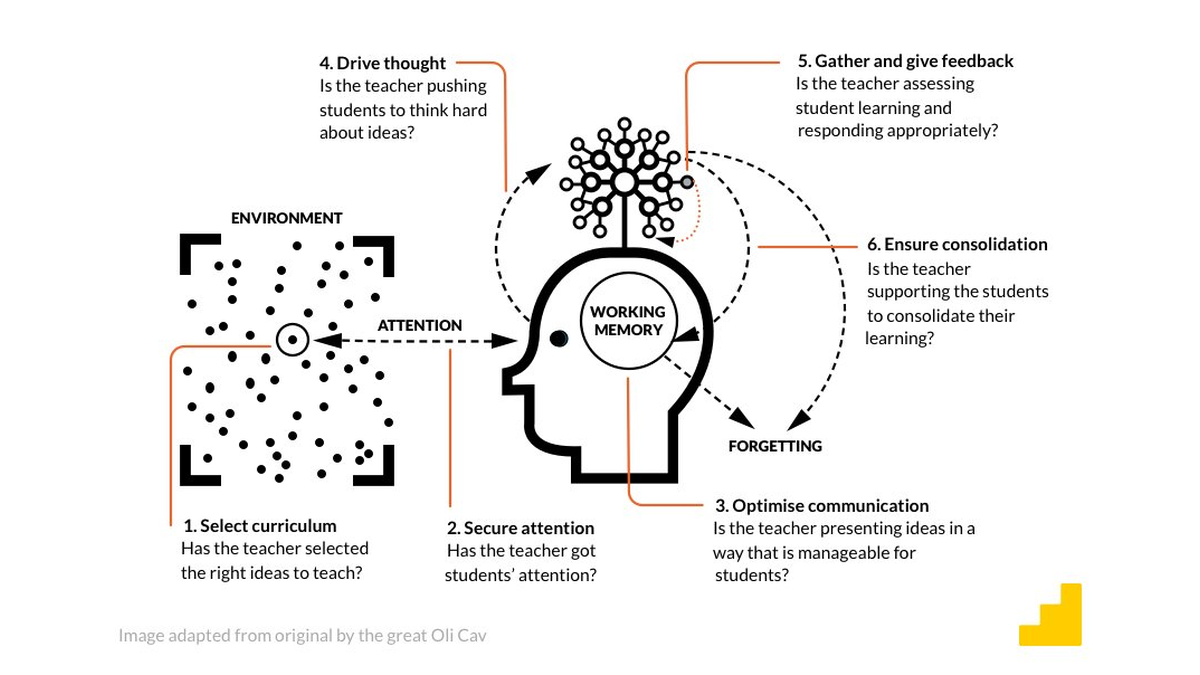
Cognitive load is the constraint everything else works within: Sweller's theory, stated in 1998, says working memory holds roughly two or three new items for around twenty seconds. Anything beyond that does not enter long-term memory, and a lesson that ignores the limit does not produce partial learning, it produces none. Hollins draws the practical conclusions: chunk the content, sequence it, cut what is decorative, give the student a partial solution when the whole is too large, and stop every ten or fifteen minutes to let the material settle. The chemistry example in the chapter is precise: a student reading about optical chirality meets three undefined terms in a paragraph, stops to look them up, meets three more, and the working memory budget is gone before any schema forms. The teacher's job is to supply the definitions in the right order and to say which one to learn first.
Scaffolding is the method that makes the sequence teachable: Build the complex skill out of smaller units and hand over control gradually. Hollins gives the sequence a name that survives in memory: I do, we do, you do. In the souffle example the teacher first demonstrates and narrates, then supervises while the student does part of the work, then leaves the kitchen. The chapter also breaks the middle stage into its parts: providing knowledge, demonstration, modeling, questioning, instructing, correcting, and restructuring the task. The point of the breakdown is that "help" is not one behavior. A teacher who only demonstrates never finds out what the student can do, and a teacher who only corrects never lets the student build a run of successes.

A map is not the territory, and the teacher's advantage is the map: The second chapter's claim is that the teacher's real asset is perspective, not knowledge. The student sees a small unclear section of the field; the teacher sees the whole and knows which parts matter now. That advantage becomes a method when you write the map down as a concept map, including what the student already knows, with the links between the parts made explicit. Hollins gives a seven-question check for the map: are the chunks small enough, are the relationships shown, is it as simple as it can be, does it have a destination, does every part connect to that destination, are there gaps where you assumed knowledge, and does it include what the student already has.
The Feynman technique turns explanation into a diagnostic: Choose the concept, write an explanation in plain English, find where the explanation fails, then build an analogy to repair the failure. The step that matters is the second one, because a short plain explanation is hard to fake. If you cannot do it in two sentences a five-year-old would follow, the gap is yours. Hollins's own example is gravity, and the exercise exposes how many people can describe what gravity does and not how it works. The fourth step, the analogy, is the test of whether the repair took: an analogy requires knowing the central traits of both things being compared.
Analogies work best when you use several and know why each one fits: The chapter gives four rules. Use multiple analogies for the same idea, because each one stresses a different feature. Use examples constantly, because novices learn from the case and experts can skip it. State the purpose of the analogy, because most students remember "the powerhouse of the cell" without knowing what a powerhouse does. And reserve analogies for the difficult material, since an analogy for something easy adds clutter. The deeper claim, which Hollins attributes to Douglas Hofstadter, is that analogy is the basis of categorization and therefore of thought, which is why a good analogy does more than decorate an explanation.
SQ3R is a reading protocol that treats a textbook as a structure to be surveyed: Survey the chapter titles, headings, figures and conventions; turn the headings into questions; read slowly and deliberately; recite the answers in your own words; review with flashcards, a rewritten table of contents and a mind map. Robinson designed it for textbooks, and Hollins extends it to any body of material, including film and online courses. The value is front-loaded: most readers start at page one and run out of attention by page forty, while the survey step gives them a destination before the reading begins.
Bloom's taxonomy is a ladder you can use to place a student: Remember, understand, apply, analyze, evaluate, create, in that order, each level depending on the one below. Hollins's use of it is diagnostic rather than academic. When a student who cannot yet recall the facts tries to evaluate a theory, the failure is not a lack of critical thinking, it is a missing rung. The taxonomy tells the teacher what to build next and tells the learner where to aim.
Spaced repetition wins on frequency, not duration: Memory has three parts, encoding, storage and retrieval, and most study advice works on the first two. Spaced repetition works on retrieval, and the rule is to revisit the material often over a long period rather than once for a long time. Hollins gives a one-week schedule that adds seventy-five minutes of review to an initial lesson and produces six additional exposures. He also gives the honest version for people who have left it late: three one-hour sessions in a day beat one three-hour session, and reviewing in a different order each time beats reviewing in the same order.
Cornell notes and purposeful annotation are the same idea applied to paper: Cornell splits the page into notes, cues and a summary, so that the student takes the messy notes once and then distills them twice, first into cues and then into a summary. Purposeful annotation applies the same discipline to reading: set the purpose before you start, decide what task follows the reading, and annotate toward that task. The enemy in both cases is the same, which is the activity that feels like work and leaves nothing behind. "Taking notes is not a lazy, passive activity. That's the real secret of great notes," Hollins writes, and the test he applies is whether the notes let you reconstruct the idea without rereading the text.
Problem-based learning makes the problem do the teaching: Set a goal that cannot be reached with what the student currently knows, and the learning becomes a by-product of solving it. Hollins's examples run from a broken toaster to meal planning to a medical student working up a case of shortness of breath. The method has five steps: define the problem, list what you already know, propose solutions, break the work into actions, and identify what you still need to learn and where you will get it. The advantage over studying is that the student has to construct the whole route rather than follow one.
The Socratic method is a stress test for understanding: Ask questions about the answer, then questions about the assumptions behind the answer, then questions about the evidence, the alternatives, the consequences, and finally the question itself. Hollins uses the claim that the sky is blue to show how quickly the chain exposes an explanation that was only a sentence long. The six question types come from R. W. Paul, and the reason to keep the list is that most people stop after the first type, which is clarification, and never reach the assumptions.
Motivation follows an expectancy calculation, and you can work on all three terms: People act when they believe effort will produce performance, performance will produce an outcome, and the outcome is worth having. Hollins's advice follows the model: make the value visible in the student's terms, make the path to success clear, keep the challenge in the band between boredom and despair, and make the process feel fair, because an unpredictable rule destroys effort faster than a hard task. Gamification is the industrial version of the same model, with levels, narrative, control, immediate feedback and collaboration, and the chapter is honest that it produces engagement more reliably than it produces lasting interest.
The environment decides whether effort survives: Academic buoyancy is the book's name for the set of habits that keep a learner going when the material gets hard, and Hollins organizes it around five Cs: composure, confidence, coordination, commitment and control. Productive failure is the finding that students who struggle with a problem before being taught the solution often understand the structure better than students who are helped, provided the problem challenges without frustrating, the students explain their process, and they compare good and bad solutions. Freedom from judgment is the condition that makes both possible: when a mistake threatens the student's identity, the student stops taking the risks that learning requires.

How to Teach Anything (Peter Hollins)
ULM ALIGNMENT
At University 365, the CI-First (Co-Intelligence-First) doctrine teaches you to always invite AI into your reflection and work while remaining the orchestrator. Human Intelligence leads, AI amplifies. This Book Essential connects Hollins's teaching methods to U365's proprietary methods: ULM+EVA (University 365 Life Management powered by the Explore-Visualize-Action Plan cycle) places the person you are teaching, and the skill you are teaching them, inside the six life domains; LIPS+CARE (your digital second brain with the Collect-Action Plan-Review-Execute cycle) keeps the lesson plans, the concept maps and the feedback you promise to give; and SL-OS (Successful Life Operating System) integrates all of these with UP-Context-Engineering (context engineering for AI) into a single system for learning and for teaching.
SCHEMA PRIME: ULM Domain: Career and Finance
DOMAIN MAPPING: Primary: Career and Finance. Secondary: Spirit and Mind, Social and Love Relationships. Teaching is how work capability travels between people, and how understanding grows in the mind.
EVA PARAGRAPH: You want to be the person in your team who can make a difficult subject land, and you want the next explanation you give to be measurably better than the last. The obstacle is that explanation feels like a talent, so you never practise it deliberately and never ask what actually landed. The plan: choose one subject you already know well and one person who needs it. Before the next session, write the seven-question map check from chapter two. If the session ends without the other person doing something on their own, then you cut one explanation from the next session and add one supervised attempt. Review what you cut and what they did at the end of each week.
LIPS+CARE CAPTURE CARD:
Book: How to Teach Anything: Break Down Complex Topics and Explain with Clarity, While Keeping Engagement and Motivation
Primary ULM Domain: Career and Finance
3 Key Takeaways:
1. Working memory holds two or three new items at a time, so the sequence matters more than the content.
2. Scaffolding is a handover, not a demonstration: I do, we do, you do, with the last stage done without you.
3. Feedback about the task changes performance, and feedback about the person changes the relationship.
Apply It Action: In the Career and Finance domain, take one procedure you own at work and write the seven-question map for it, then hand the procedure to a colleague with one supervised attempt and one unassisted attempt.
Next CARE Step: Collect, by listing every explanation you gave last month that the other person had to ask for twice.

EXPLAINER LINK: For more on ULM, EVA, LIPS, and CARE methods, see the ULM page and the LIPS page. For the CI-First doctrine, see the CI-First page. For the full SL-OS system, see the SL-OS page.
APPLY IT (domain-tagged): In the Career and Finance domain, pick the one explanation you repeat most often at work and rebuild it as a scaffold: ten minutes of demonstration with narration, ten minutes of the other person doing it with you beside them, ten minutes of doing it alone with you silent. Write down where they stopped and why.

How to Teach Anything (Peter Hollins)
SUMMARY

MINDMAP SKELETON
Center: How to Teach Anything, by Peter Hollins.
Branch 1: Five pedagogical approaches. Constructivist, integrative, collaborative, inquiry-based, reflective.
Branch 2: The brain's limits. Cognitive load, working memory, chunking, sequencing, the information processing model.
Branch 3: Scaffolding. Simplification, demonstration, questioning, correction, I do we do you do, the souffle.
Branch 4: Seeing the landscape. The map, concept maps, prior knowledge, problematizing, the Feynman technique, analogy.
Branch 5: The nuts and bolts. SQ3R, Bloom's taxonomy, spaced repetition, Cornell notes, purposeful annotation.
Branch 6: Advanced techniques. Problem-based learning, the Socratic method, critical thinking, group activities, visual diagrams.
Branch 7: The student environment. Expectancy theory, gamification, the five Cs of academic buoyancy, productive failure.
Branch 8: Judgment and feedback. Fixed and growth mindsets, the Losada ratio, the eight qualities of useful feedback.

Chapter 1: Lessons from the Science of Pedagogy
The chapter does three things. It gives five approaches to teaching, a theory of why the brain limits what can be taught at once, and a method for turning a complex skill into a sequence. The five approaches are constructivist, integrative, collaborative, inquiry-based and reflective. The load theory is Sweller's: working memory holds a small number of new items for a short time, so the teacher's first job is to decide what the student is holding. The method is scaffolding, summarized as I do, we do, you do, and the souffle example carries the sequence from demonstration to supervision to independence.
The evaluative point the chapter avoids is that it never tells you how to choose between the five approaches. It says everything later refers back to them, but the only selection mechanism it offers is the reflective approach, which says to notice what works and adjust. That is true and it is circular: you need experience to select, and the chapter is supposed to be what gives you experience. A reader would be better served by a decision rule, even a crude one, such as: use the integrative approach when the skill will be performed in a real setting, constructivist when the student has relevant prior knowledge, inquiry when curiosity is the bottleneck, collaborative when the group has mixed strengths, and reflective always.
The load theory section is the most portable part of the book, and its number is also its weakest point. Hollins states that working memory holds two or three new items for around twenty seconds. The research tradition behind that figure runs from Miller's seven plus or minus two through Cowan's four, and the exact capacity is contested. The practical rule survives the dispute, because the rule is to reduce what you present at once and to sequence the rest, and that holds whether the capacity is two, four or seven. The reader should keep the procedure and treat the number as an illustration.
Chapter 2: Seeing the Landscape
This is the best chapter in the book. Its claim is that the teacher's advantage is not knowledge but perspective, and that the perspective becomes a method when it is written down as a map. Hollins gives the map a purpose, a set of components and a check. The purpose is to decide what the student needs next. The components are the chunks of the subject and the links between them, including the chunks the student already owns. The check is a list of seven questions about size, relationships, simplicity, destination, gaps and prior knowledge.
The magnetism example is the clearest teaching sequence in the book, and it is worth reading twice. A brother is failing at magnetism. The map shows that the missing piece is atomic structure, which is missing because electrical charge was never secure, which is missing because electrons were never understood. The plan that follows is not a lesson about magnetism. It is a route from atomic structure to charge to magnetism, starting with the part the brother half knows. That is what a map is for, and the example shows the difference between answering the question the student asked and teaching the thing the student needs.
The Feynman technique and the analogy rules complete the chapter, and here the book contradicts itself in a productive way. It says to use as many analogies as possible, then says to reserve analogies for difficult concepts because an analogy for easy material adds clutter. Both can be true if the instruction is read as: for a genuinely difficult concept, use several analogies, and for an easy one, use none. The book does not say that, and a reader who takes either sentence alone will misuse the tool. The Hofstadter claim that analogy is the basis of thought is the intellectual justification, and it is also the reason to be careful: a bad analogy does not just fail to teach, it installs a wrong category.
Chapter 3: The Nuts and Bolts
Five methods: SQ3R for reading, Bloom's taxonomy for placing a learner, spaced repetition for retention, Cornell notes for capture, purposeful annotation for active reading. The chapter is the most practical in the book and the most uneven in its evidence. Spaced repetition sits on one of the strongest findings in cognitive psychology, and the schedule Hollins gives, seventy-five extra minutes spread across a week for six additional exposures, is a fair illustration of the principle. Bloom's taxonomy is a classification, not a finding, and the book uses it correctly as a diagnostic ladder rather than as evidence.
SQ3R is presented as a protocol with no cost. Survey, question, read, recite, review is a genuinely better way to read a textbook than starting at page one, and it is also slow, and the book never says how slow. A student who applies it to five courses in one semester will run out of time in week three. The honest version is to use the survey and question steps on everything, the recite step on the material that will be examined, and the review step only where retrieval is scheduled. Hollins gives all the parts and leaves the rationing to the reader.
The notes chapter contains the sentence that justifies the whole section: taking notes is not a lazy, passive activity, and the real secret of great notes is that they let you rebuild the idea without rereading the source. Cornell's three zones are a machine for forcing that rebuild, since the cue column and the summary cannot be filled in by copying. The chapter's blind spot is handwriting. Hollins states that writing by hand is key and gives no evidence, and the comparison studies between longhand and laptop notes are more contested than the confident sentence suggests.
Chapter 4: Advanced Techniques
Problem-based learning, the Socratic method, critical thinking, and a set of group and visual activities. The problem-based section is the strongest, because the method has a real history, from Dewey's learning by doing through the medical schools of the 1960s, and because the procedure is explicit: define the problem, list what you know, propose solutions, plan the actions, find what you still need. The toaster and the meal plan show the method applied to ordinary life, which is where most readers will use it.
The Socratic section is the most interesting and the most dangerous. Hollins gives R. W. Paul's six question types and walks the sky-is-blue example through them, which shows how a sentence-long explanation collapses under four questions. What the chapter does not name is the failure mode: interrogation presumes a student with enough confidence to be wrong repeatedly, and the book's own fifth chapter argues that judgment destroys learning. A teacher who adopts the Socratic method without the chapter five environment will produce a student who can defend a position and a student who stops volunteering, and the book gives no test for which one is happening.
The activities section is a catalogue: think-pair-share, mini quizzes, student teachers, projects, essays and debate, synthesis tasks, observation, concept maps, flowcharts, storyboards, fishbone diagrams, Venn diagrams, KWHL charts. The catalogue is useful and the criterion is stated once: the preferred technique is the one that best lets this student understand this material. The weakness is that a catalogue invites selection by familiarity, and teachers default to the activity they have seen before. The criterion needs to be applied before the activity is chosen, not after it fails.
Chapter 5: The Student Environment
This is the chapter that changes behaviour. Motivation is modelled as an expectancy calculation: effort leads to performance, performance leads to outcome, and the outcome has to be worth something to this person. Gamification is the industrial application, with levels, narrative, control, immediate feedback and collaboration, and the chapter is unusually honest about its limits. Reward systems produce engagement and can displace interest, and some students do worse when a prize appears.
Academic buoyancy, the five Cs of composure, confidence, coordination, commitment and control, is a useful checklist and the thinnest evidence base in the book. The claim is that researchers at the University of Sydney and the University of Oxford identified these five factors, and the reader should notice that a five-item list from one research program is a hypothesis about resilience rather than a settled finding. The feedback section that follows is the opposite: Hattie's three questions, where am I going, how am I going, where to next, and Kluger and DeNisi's finding that feedback made performance worse in over a third of the studies, are among the most replicated results in education research.
The chapter also contains the book's one clear factual problem. The Losada ratio, the claim that teams flourish at three to eleven positive statements per negative one, is presented and then debunked in the next paragraph, and then used anyway. Hollins handles it better than most popular writers, because he names the criticism. He still leaves the reader with the number, and numbers survive their refutation in memory. The safe reading is the qualitative one: most learners need more success than failure, and the ratio is not a target.
Summary Guide
The book ends with a summary guide that repeats every chapter's takeaways in compressed form. Read as a design choice, it is the book demonstrating its own advice: a second exposure, spaced after the first, at a lower resolution. Read as a reader's shortcut, it is a trap, because the takeaways are the conclusions without the procedures, and the procedures are what the book is for.
The guide is useful in one specific way. After you have read a chapter and tried one method, the guide is a good checklist for what you have not yet used. In that role it functions as a review instrument rather than a summary, which is consistent with the research the book cites.

How to Teach Anything (Peter Hollins)
IN PRACTICE

1. Name the approach before you prepare anything
Five approaches are available: build on what the student knows, embed the lesson in a real task, use the group, put a question in place of the explanation, or reflect and adjust. Choosing in advance stops you from defaulting to the method you were taught with. The choice also determines what you prepare: a constructivist lesson needs a diagnosis of prior knowledge, an integrative lesson needs a real setting, and an inquiry lesson needs a question good enough to carry the session.
Action: write one sentence before your next explanation that names the approach and why it fits this person and this subject.
2. Cut the material until the working memory fits
Take the thing you want to teach and split it into chunks that can each be understood in a few minutes. Then order them so that each one only depends on chunks that came before. Anything that is interesting but not required goes into a separate list for later, not into the lesson. The test is whether the student can hold the current chunk and the previous one at the same time.
Action: take your last explanation and mark every idea the student had to hold simultaneously. If the count is above three, split it.
3. Build the map, including what they already know
Draw the subject as chunks and links. Add the parts the student already owns, and mark the links between the old and the new. Then run the seven-question check: are the chunks small, are the links shown, is it simple, does it have a destination, does each part connect to that destination, are there gaps where you assumed knowledge, and does it include what they already have.
Action: sketch the map on one page and ask the student to correct it. Their corrections are the diagnosis.
4. Hand over in three stages and do not skip the middle one
Demonstrate while narrating what you are doing and why. Then do it together, with the student's hands on the task and your voice guiding. Then sit back and let them do it alone, including the parts they will get wrong. The middle stage is where most teaching fails, because helping feels useful and the student's competence is never tested.
Action: in your next session, time the three stages. If the middle stage is longer than the other two combined, you are supervising, not teaching.
5. Make the practice schedule, not the practice session
Frequency beats duration. A lesson reviewed five times for ten minutes across a week produces more retention than the same lesson reviewed once for an hour. Put the reviews in a calendar before the lesson, and vary the order so that the recall is not carried by the sequence.
Action: book four short review slots in the week after your next lesson and put them in the calendar as appointments.
6. Give feedback about the task, close in time, and make it actionable
Name what happened, against which standard, and what to change next time. Keep it near the event. Use the sandwich only if the compliments are sincere. Avoid feedback about the person, including praise about talent, because it moves attention from the task to the identity and makes the next mistake expensive.
Action: before your next feedback conversation, write the sentence you will say in the form: what I saw, the standard it missed, the change to make.

How to Teach Anything (Peter Hollins)
QUIZ: TEST YOUR UNDERSTANDING
Question 1: A colleague asks you to explain a process. You open with the full diagram and then walk through it step by step. Using cognitive load theory, what is likely to happen, and what would you change?
Answer: The diagram presents the whole structure at once, so the working memory budget is spent before any single step is understood. Change the order: give the purpose in one sentence, then one step at a time, and introduce the full diagram only after the steps are secure.
Explanation: The theory limits how many new items can be held at once, not how much can be learned in a session. The same content in a different sequence fits the limit.
Question 2: You teach a student who can recite the definitions but cannot judge which method applies to a new case. Where does the student sit on Bloom's taxonomy, and what is the next rung?
Answer: The student is at remember and possibly understand, not at evaluate. The next rung is apply: give a series of cases and require a method choice with a reason, before asking for any judgment about quality.
Explanation: The taxonomy is cumulative. A student asked to evaluate before applying will produce an opinion instead of an assessment, which is the failure the chapter describes.
Question 3: A manager says the presentation "went badly" and stops there. Which type of feedback is that, and what does the research predict about its effect?
Answer: Outcome feedback with no information about what to change, and it is the type most likely to reduce performance. The prediction is that the team member will feel judged without knowing what to do differently.
Explanation: Feedback that addresses the person rather than the task damages performance, and the effect appears in a large share of the studies the chapter cites.
Question 4: You have one evening to prepare someone for a test tomorrow. Spaced repetition is impossible in the textbook sense. What is the best available approximation, and why?
Answer: Split the evening into three short sessions with gaps, use active recall rather than rereading, and change the order each time. The material only has to survive into working memory and partial long-term encoding for one day, so frequency still helps.
Explanation: The principle is retrieval over time, and a compressed schedule reproduces the shape of it. The book gives this as the honest version for people who left it late.
Question 5: Apply the scaffold sequence to a context the book does not cover: a hospital ward teaching a new nurse to hand over a patient at shift change.
Answer: Demonstrate one handover while narrating the order and the reason for each item, then run a handover together with the nurse leading and you prompting, then observe a full handover in silence and give task-level feedback afterwards against the ward's standard.
Explanation: The transferable move is the handover of control, not the content. The middle stage is where the nurse's gaps become visible while the patient is still safe.
How many did you get right? Which ones surprised you?

How to Teach Anything (Peter Hollins)
CAN THIS BOOK ESSENTIAL REPLACE THE ORIGINAL?
No. This Essential gives you the five approaches, the load theory, the map, the methods and the feedback rules, and it adds the critique the book does not make. The original gives you the worked examples at length, the cases from Hollins's own teaching, and the tone of a practitioner talking you through a session, which is what makes the procedures stick. Read the book for the examples and keep this Essential as the checklist.

How to Teach Anything (Peter Hollins)
QUOTES
"Teaching is in essence a kind of conversation, where new information is communicated and conveyed to a person who doesn’t possess it."
"There are no topics too difficult or students too stupid, only methods that are unsuitable."
"Experts always start out as novices, and the path from one to the other is filled with incremental changes rather than giant leaps."
"Teachers possess knowledge, but their main skill is in their conveying or communication of that knowledge."
"Nothing will reveal gaps in your own knowledge like trying to teach someone else!"
"The simpler and shorter the explanation, the harder this is to do."
"It isn’t enough to simply remember the analogy; you must know why it is an appropriate one to use as well"
"you will remember something far better if you study it for one hour a day versus twenty hours in one weekend"
"taking notes is not a lazy, passive activity. That’s the real secret of great notes."
"good questions end up allowing us to triangulate understanding"
"the preferred technique or activity is always the one that best allows your student to really understand the material"
"Knowledge isn’t power because it helps you achieve certain outcomes, but because it ensures that you become an informed individual"
"Failure doesn’t have to be your friend, but it will be your occasional companion, like it or not."
"Feedback is information on how we are doing relative to our goal."
"It is not judgment, advice, praise or criticism without meaningful elaboration on the learning process itself."

How to Teach Anything (Peter Hollins)
AUTHOR'S EXPERTISE
Peter Hollins is a psychology graduate, with a bachelor's degree and a master's degree in the subject according to his own site, and the author of a long list of practical books on psychology, habits and mental performance. He writes at petehollins.com, where he describes himself as one of the most widely read modern psychology authors, with an average of 4.5 stars across more than twenty-two thousand Amazon reviews. That is a marketing claim rather than a peer-reviewed one, and it is included here because it is his own description of his position.
How to Teach Anything belongs to his Learning How to Learn series, and two earlier volumes in that series are in the U365 library: The Science of Self-Learning, which covers how to learn when you are both teacher and student, and The Self-Learning Blueprint, which covers breaking down a complex topic before you study it. This book is the teaching half of the same project, and it reuses the same structure: a short conceptual chapter followed by named methods, worked examples and a summary of takeaways.
The style is worth describing because it determines how to read him. Hollins is a synthesizer, not a researcher. He names the scholars he draws on, from Sweller and Bloom to Robinson, Kapur, Hattie and Paul, and he turns their findings into procedures. He is generous with citations and sparing with caveats, and he will state a contested number with the confidence of a settled one. The right posture is to use the procedures and check the numbers, which is what the analysis in this Essential does.

How to Teach Anything (Peter Hollins)
RESOURCES
The book: How to Teach Anything: Break Down Complex Topics and Explain with Clarity, While Keeping Engagement and Motivation by Peter Hollins, first published in 2021. The Amazon edition is at https://www.amazon.com/dp/B08TVXZYCP and the author's site is at https://petehollins.com.
The research the book leans on: Cognitive load theory comes from John Sweller's work on working memory, and the readable entry point is Sweller's own writing on the subject. Bloom's taxonomy is Benjamin Bloom's classification of educational objectives, revised in 2001. The SQ3R method is Francis P. Robinson's, published in Effective Study in 1946. Productive failure is Manu Kapur's research program, and the feedback findings are from John Hattie's synthesis and from Kluger and DeNisi's meta-analysis.
Companion volumes in the U365 library: The Science of Self-Learning by Peter Hollins for the learner's side of the same problem, and The Self-Learning Blueprint by Peter Hollins for the analysis that precedes study. Both are Book Essentials on this site.
Related reading for fellows: Make It Stick by Peter C. Brown, Henry L. Roediger and Mark A. McDaniel for the retrieval and spacing research that chapter three depends on, and Ultralearning by Scott H. Young for a self-directed learning method that pairs well with Hollins's teaching method.
For the teaching side specifically, The Learning Scientists at https://www.learningscientists.org publish short, referenced guides to retrieval practice, spaced practice and dual coding, which are the three techniques most often misapplied from this book.

How to Teach Anything (Peter Hollins)
NEXT STEPS
Name the approach before you prepare: Say out loud which of the five pedagogical approaches you are using and why, and if you cannot name one, you are about to default to a lecture.
Cut to three items: Before any explanation, decide what the student must hold at once. If it is more than three ideas, the sequence is wrong, not the student.
Draw the map and let them correct it: Put the subject on one page with its links and the student's existing knowledge included, then hand them the pen. What they change is the diagnosis.
Hand over in three stages: Demonstrate with narration, do it together with your voice guiding, then watch in silence. The middle stage is the teaching.
Schedule the reviews, not the hours: Four short recalls across a week beat one long session, and the calendar entry is what makes it happen.
Make every feedback sentence actionable: What you saw, the standard it missed, the change to make next time, delivered close to the event and about the task rather than the person.

How to Teach Anything (Peter Hollins)
U365'S RECOMMENDATIONS TO LEARN MORE
Every link below was checked on 2026-11-08. The list is short on purpose: these are the sources that teach something this Book Essential does not, and each one is either first-party or a serious independent treatment of the book's subject.
Official learning resources
Video tutorials and channels
A chapter-by-chapter review of the book's five chapters and its main methods, by 9Natree, Jan 27, 2026, 13:38
Education needs to embrace the science of learning | The originator of cognitive load theory on why teaching must respect working memory, by Knowledge Society, Sep 25, 2023, 43:30
A demonstration of the SQ3R protocol that chapter three builds on, by Mike and Matty, Apr 20, 2020, 8:41
Written tutorials and deep-dive articles
Community and social
Resources on X
Dedicated X channels:
X posts with visual content:
This list is curated rather than exhaustive. Every candidate was searched, opened and checked for relevance, and sources that only restate the book were left out. Community sources are labelled as community sources so that you know what you are reading.

How to Teach Anything (Peter Hollins)
IMPORTANT NOTICE
This Book Essential is an original summary and critical analysis of How to Teach Anything: Break Down Complex Topics and Explain with Clarity, While Keeping Engagement and Motivation by Peter Hollins (first published 2021). Short quotations from the book are attributed and cited for purposes of criticism, review, and education. All rights in the original work belong to its author and publisher; this Essential is not a substitute for the book: read the original at https://www.amazon.com/dp/B08TVXZYCP.
This book is part of University 365's learning library. Explore INSIDE, our publications, and our programs. The best summary is not a substitute for the book. Read the original. Discuss this book with a U.Coach.
Note: verify current details before relying on this comparison. Information verified as of 2026-11-08.




Comments