
Mind-Map Any Chapter: One Page, Three Branches, Five Minutes
In this Neuroscience Publication
You close the chapter and the highlighter is the only evidence that you read it. The page is covered, the argument is not yours yet, and the exam will ask for the argument. Five minutes with one sheet of paper and a hard limit of three branches changes what you carry out of the chapter: not a marked page, but a skeleton you can redraw.


Mind-Map Any Chapter: One Page, Three Branches, Five Minutes
How to Do It
Take one chapter you have already read once, one sheet of paper and one pen. Run the six steps in order and keep the clock. Five minutes, start to finish:
Name the chapter in six words (40 seconds). At the top of the page, write the one claim the chapter exists to deliver, in six words or fewer. Use the chapter title only if it already states a claim. Circle it.
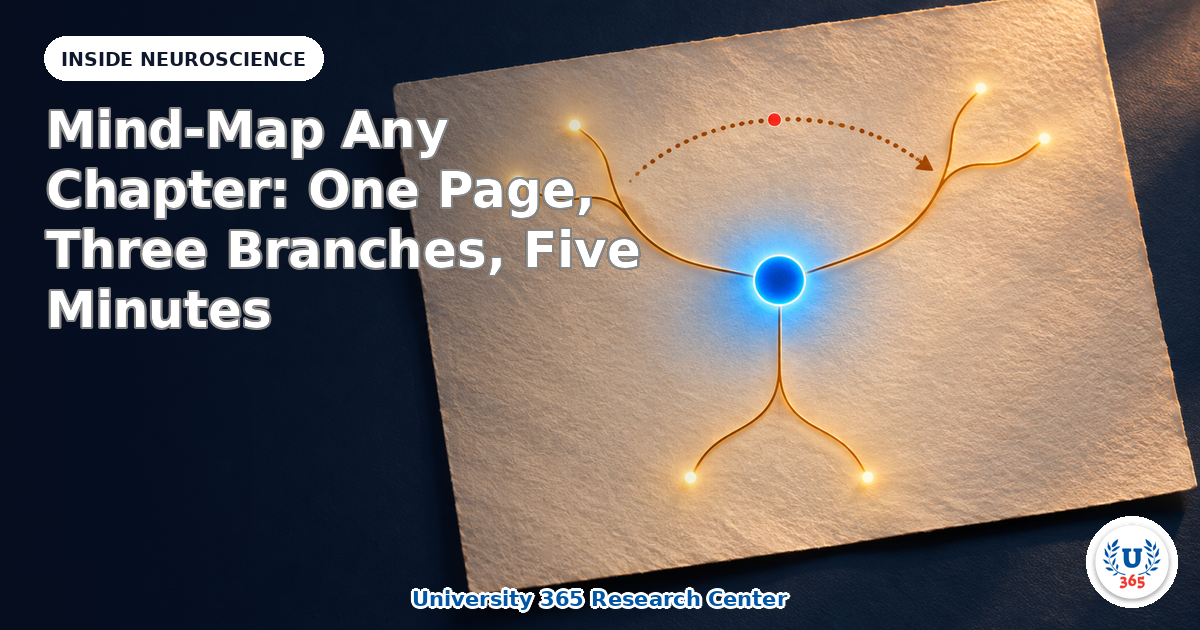
Draw three branches from the headings (70 seconds). Skim the headings, the bold terms and the summary box. Group what you find into three headings, no more. Label each branch in two words and draw it out from the circle.
Hang two twigs on each branch (90 seconds). Under each branch, write the two facts, terms or distinctions you could be asked about. Keywords, one line each. Six twigs in total, no sub-twigs.
Mark the link you cannot explain (30 seconds). Find two branches whose relation you could not state out loud. Draw a dotted arrow between them and write the question on the arrow. That arrow is your next study task.
Redraw the skeleton from memory (60 seconds). Turn the page over. Without looking, draw the centre, the three branches and the six twigs. Compare with the first side, then correct in a second colour. What you had to look up is what you do not know yet.
Date it and file it (10 seconds). Write the date in the top right corner and put the sheet where you will revise from. The map is a revision sheet, not a poster.
If the chapter runs long, map the section you were assigned and give the rest a second sheet. Twelve thin branches on one page is a diagram, not a map: the limit is what keeps the page readable at a glance in the week before an exam.

Mind-Map Any Chapter: One Page, Three Branches, Five Minutes
The 5M2S Key Point
One chapter, one centre, three branches, six twigs: the map is finished when you can redraw its skeleton without opening the book.

Mind-Map Any Chapter: One Page, Three Branches, Five Minutes
Origin
Mind mapping was invented in the 1970s by the British psychologist Tony Buzan, and the UNOP library treats it as a standing instrument rather than an optional tip. The library's Mind Mapping guide gives three steps: define the central idea, add the branches, then add the sub-branches it calls twigs. The guide is explicit that the map is not a summary you read once. It is a representation you rebuild, which is why the third step asks what each branch makes you think of, not what the chapter said.
The guide names the tools too: paper and pen first, a reusable notebook if you want to digitise the page later, and a digital mapper for the version you keep. This hack keeps the paper and adds a budget the guide does not set: one chapter, three branches, six twigs, five minutes. That budget is the difference between mapping a chapter and designing a poster.
Two companion hacks cover the practices next to this one. Your First Memory Palace stores facts in places; a mind map stores them in relations. Chunk It groups material into bites; the three branches are the bites you will actually revise.

Mind-Map Any Chapter: One Page, Three Branches, Five Minutes
Science-Backed
Three research families bear on the method. None of them tested a five-minute map of a course chapter, so read the numbers as support for the parts, not for the exact budget.
Maps that learners build themselves carry the larger effect. Nesbit and Adesope (2006) pooled 55 studies with 5,818 participants and 67 independent effect sizes. The weighted mean effect was 0.60 standard deviations, with a 95 percent confidence interval from 0.55 to 0.66. Studies in which students constructed maps averaged 0.82; studies in which they only studied a prepared map averaged 0.37. The authors report significant heterogeneity, so the average hides wide variation between classrooms.
One exposure to one text held for a week when students mapped it. Farrand, Hussain and Hennessy (2002) trained 25 medical students in mind mapping for 30 minutes and compared them with 25 students using their own method on a 600-word passage. A week later, after adjusting for the baseline score, the map group recalled 10.7 percent more (95 percent CI minus 1.1 to 22.5, p = 0.07). When the analysis also adjusted for motivation, the gap was 15.3 percent (95 percent CI 3.3 to 27.3, p = 0.013). The map group was less motivated by the technique, 2.8 against 3.2 on a five-point scale, which is why the second figure exists.
Drawing the map by hand adds a memory advantage over writing the same words. Wammes, Meade and Fernandes (2016) report seven free-recall experiments in which drawn words were recalled better than written ones. The advantage survived controls for deeper processing, visual imagery and picture superiority, and it held when encoding time was cut and the lists were lengthened.
What the evidence does not show: no study assigns a five-minute, three-branch map of a chapter and then measures the exam result. Farrand's students mapped for 10 minutes after a 30-minute lesson, on a popular-science text, and answered 15 factual questions. Nesbit's pool mixes school and university classes with heterogeneous effects. Wammes tested single words, not arguments. The five-minute budget is a design choice that makes the practice repeatable; treat the gain as plausible, not guaranteed.

Mind-Map Any Chapter: One Page, Three Branches, Five Minutes
Sources
All sources below were opened and read on 4 November 2026.
UNOP library. University 365 library index. The Mind Mapping guide used for this hack, le guide en 3 etapes, sits in the same library.
Farrand, Hussain & Hennessy (2002). The efficacy of the 'mind map' study technique. Medical Education, 36(5), 426-431.
Nesbit & Adesope (2006). Learning with concept and knowledge maps: a meta-analysis. Review of Educational Research, 76(3), 413-448.
Wammes, Meade & Fernandes (2016). The drawing effect: evidence for reliable and robust memory benefits in free recall. Quarterly Journal of Experimental Psychology, 69(9), 1752-1776. Read at the PubMed record.
UNOP guide. Mind Mapping. The 3-step guide. University 365 library, URC-Research/UNOP.
A U365 5M2S Microlearning 5 MINUTES TO SUCCESS UNOP Neuro-Hack |
Please Rate and Comment This Publication
How did you find this Publication? What has your experience been like using its content?
Let us know in the comments at the end of that Page!
If you enjoyed this publication, please rate it to help others discover it. Be sure to subscribe or, even better, become a U365 member for more valuable publications from University 365.
Do you have questions about that publication? Or perhaps you want to check your understanding of it. Why not try playing for a minute while improving your memory? For all these activities, consider asking U.Copilot, the University 365 AI agent trained to help you engage with knowledge and guide you toward success. U.Copilot is always available, even while you are reading a publication, at the bottom right corner of your screen. Alternatively, you can open a separate window with U.Copilot: www.u365.me/ucopilot.
Try these prompts in U.Copilot:
I just finished reading the publication "Mind-Map Any Chapter: One Page, Three Branches, Five Minutes", and I have some questions about it: Write your question.
I have just read the Publication "Mind-Map Any Chapter: One Page, Three Branches, Five Minutes", and I would like your help in verifying my understanding. Please ask me five questions to assess my comprehension, and provide an evaluation out of 10, along with some guided advice to improve my knowledge.
Or try your own prompts to learn and have fun...
Are you a U365 member? Suggest a topic you'd like to see as a Neuro-Hack,and we’ll add it for you! |
Save a crazy amount of time with our 5 MINUTES TO SUCCESS (5M2S) formula.
5M2S is University 365's Microlearning formula to help you gain knowledge in a flash. If you would like to make a suggestion for a particular topic that you would like to see as a Neuro-Hack, simply let us know as a member of U365 by providing the topic's details in the Human Chat located at the bottom left after you have logged in. Your request will be prioritized, and you will receive a notification as soon as it is added to our catalogue.
NOT A MEMBER YET?
DON'T FORGET TO RATE AND COMMENT ABOUT THAT PUBLICATION




Comments