
n8n: The AI-Native Workflow Automation Platform for Technical Teams

Status: Active | Last tested: 2026-09-14 (n8n Cloud current version) | Re-check: trigger-based (max 6 months)

Tool Snapshot
Category: AI Workflow Automation Platform
Provider: n8n GmbH (Berlin, Germany)
License: Sustainable Use License (fair-code, source-available, self-hostable)
Platforms: Cloud (n8n Cloud), Self-hosted (Docker), Desktop
Integrations: 1500+ integrations, 12,324+ workflow templates
GitHub: 204,230 stars, 60,658 forks (github.com/n8n-io/n8n)
Tagline: "AI agents and workflows you can see and control"
Primary use cases:
Automating repetitive business processes across 1500+ integrated apps
Building AI agent workflows with LangChain-powered nodes
Creating RAG pipelines with vector databases (Qdrant, Pinecone, pgvector)
Multi-agent orchestration with centralized orchestrator model
Human-in-the-loop approval gates for AI-driven decisions
Official links:
Website: https://n8n.io
Documentation: docs.n8n.io
GitHub: github.com/n8n-io/n8n
Community: community.n8n.io
YouTube: n8n official channel
Pricing summary: Starter EUR 20/mo (2.5K executions), Pro EUR 50/mo (10K executions), Business EUR 667/mo (40K executions), Enterprise (custom), Community Edition (free self-hosted)
At a Glance:
CI-First Benefit Score | 6.5 / 10 (CI-First Strong) |
Time / Quantity / Quality / Skill | 8 / 7 / 6 / 5 |
CI-First Profile | Co-Worker and Assistant (level 2) |
Humics Protection | Humics-Neutral (+1) |
AI Imposture Risk | Medium |
User Sentiment | 4.8/5 (G2, 238 reviews) |
Pricing | Free self-host / EUR 20 to EUR 667+ /mo |
Platforms | Cloud, Docker, Desktop |

The Problem
Technical teams waste hours every week on repetitive tasks: moving data between SaaS apps, syncing CRM records, generating reports from multiple sources, and manually triggering actions when events occur. The no-code automation tools built for non-technical users (Zapier, Make) cannot handle complex logic, custom code, or AI integration without becoming brittle. Meanwhile, pure-code solutions (Temporal, custom scripts) require engineering effort that scales poorly when business users need to build or modify workflows.
The AI era compounds this problem. Teams want to embed AI agents into their business processes: route support emails to an AI that drafts responses, build RAG pipelines that answer questions from company knowledge bases, and orchestrate multiple AI models with human approval gates. Existing automation platforms either lack AI support entirely or bolted it on as an afterthought, leaving developers to wire LLM calls manually with no visibility into token costs, prompt drift, or what the AI actually did at each step.
The core tension: business teams need visual, modifiable workflows; developers need code-level control, self-hosting, and inspection; and everyone needs AI agents that are observable, controllable, and cost-aware. No existing tool addressed all three needs simultaneously.
The Outcome
n8n delivers a fair-code workflow automation platform with native AI agent capabilities. You build workflows on a visual canvas where every step is inspectable: you see the prompt, the response, the token cost, and what happened next. The platform ships with 1500+ integrations and 12,324+ community templates, so most workflows start from a template and take minutes, not days.
For technical teams, n8n provides what no-code tools cannot: self-hosting via Docker, custom JavaScript code nodes, MCP (Model Context Protocol) client and server nodes, intelligent model routing, and AI workflow evaluations that act as regression tests for your prompts. You can connect any model (OpenAI, Anthropic, Google, open-source) and switch without rebuilding the workflow. The Sustainable Use License means the source code is always available and you can run it on your own infrastructure.
For AI-specific outcomes: Huel saved 1,000 hours through automated workflows. Vodafone saved GBP 2.2 Million. The community has 200,000+ members and 12,324+ shared templates. The AI Workflow Builder lets you describe what you want in natural language and generates a working workflow on the canvas. Human-in-the-loop approval gates ensure consequential AI decisions never ship without a human check.
Who Should Use n8n
n8n serves a broad audience, from non-technical business users who start from templates to developers who write custom JavaScript code nodes and self-host on Docker. The visual canvas lowers the barrier for understanding workflow logic, but complex workflows with AI agents and branching logic require technical thinking.
U365 Fellow Categories
Fellow Category | Best For | Skill Level |
Students | Learning automation thinking, building first workflows from templates, understanding API integrations | Beginner to Intermediate |
Professionals | Automating business processes, building AI agent pipelines, self-hosting for data control | Intermediate to Advanced |
Everyone | Using the AI Workflow Builder to describe automation needs in plain language and get a working workflow | Beginner |
Skill level needed: Beginner for template-based workflows; intermediate for custom logic; advanced for self-hosting and AI agent orchestration.
Prerequisites: Basic understanding of APIs and data flows. JavaScript knowledge helps for custom code nodes. No code required for template-based workflows.
Time to first result: 15 to 30 minutes (clone a template, configure credentials, run).
Time to competence: 2 to 4 weeks for building custom workflows with branching, loops, and AI agents.
U365 Institutes Alignment
n8n aligns most strongly with technology and AI disciplines, where workflow automation and AI agent building are core skills. Business and communication institutes benefit from process automation and content pipelines, while design applications are indirect.
Institute | Relevance | Why |
UIT (Technology, AI, Data Science) | High | Core tool for IT engineering, AI agent building, data pipeline automation, and infrastructure orchestration |
UIB (Business Management, Entrepreneurship) | Medium | Business process automation, workflow optimization, and operational efficiency for startups and enterprises |
UIC (Digital Communication, Marketing) | Medium | Content generation workflows, social media automation, and marketing pipeline orchestration |
UID (Digital Design, UX/UI) | Low | Design automation possible through API integrations but not a primary use case |
How n8n Works
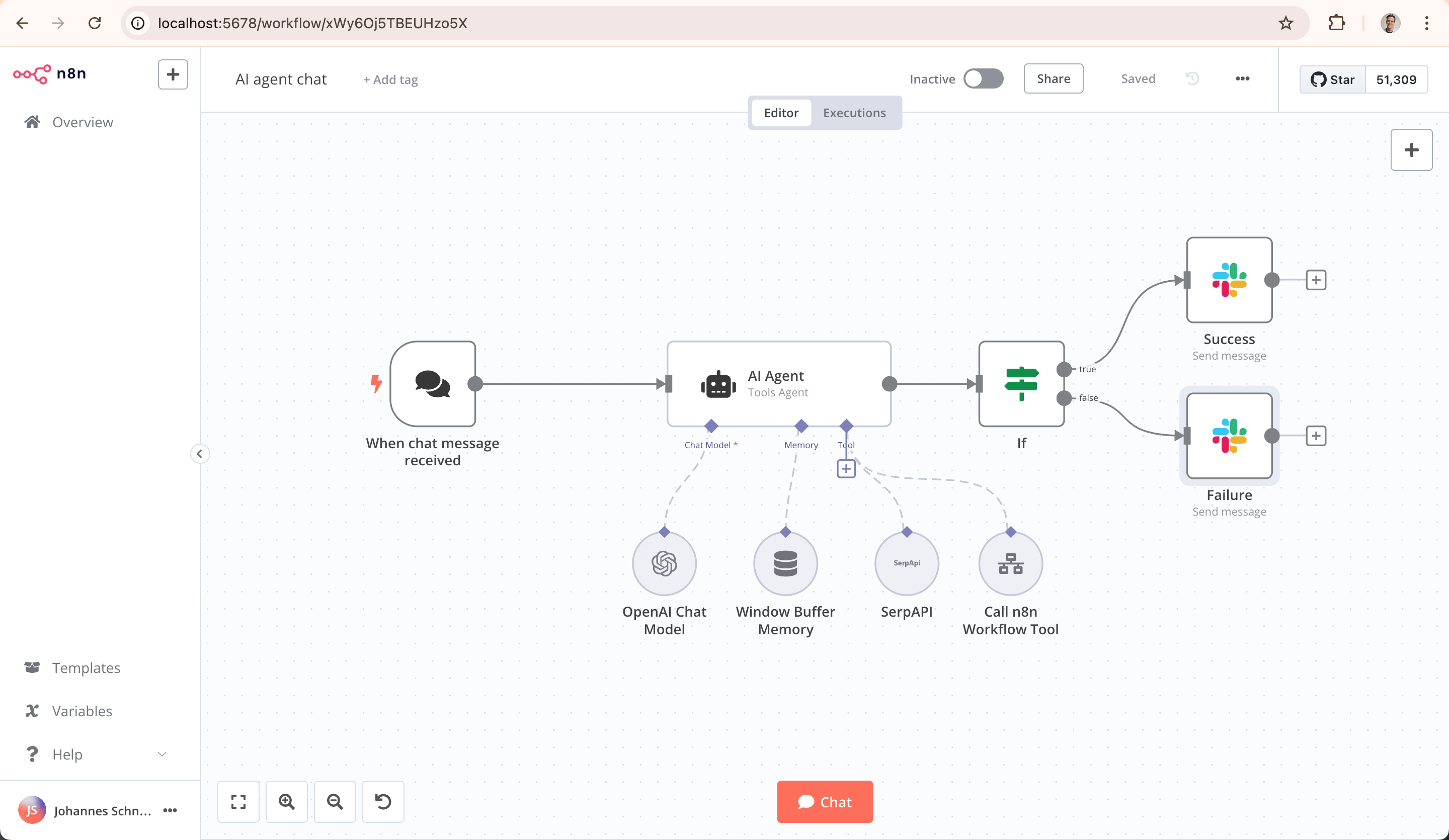
n8n is a node-based workflow automation platform. You build workflows by dragging nodes onto a visual canvas and connecting them. Each node performs one action: call an API, transform data, execute JavaScript, query a database, or invoke an AI model. Data flows from node to node, and you can inspect the exact input and output of every node at every execution.
Underlying Technology
n8n is built in TypeScript and runs on Node.js. Workflows execute as JavaScript. The AI Agent nodes are built on the LangChain JS framework, providing structured tool calling, memory, and multi-step reasoning. The platform supports MCP (Model Context Protocol) for standardized AI tool communication. Self-hosting uses Docker or npm, with PostgreSQL as the default database for execution history.
Key Technical Features
Inputs: Webhooks, schedules, manual triggers, app triggers (1500+ integrations), RSS feeds, database changes, file uploads.
Outputs: API calls, database writes, emails, Slack messages, file creation, AI-generated text, structured JSON for downstream consumption.
Integrations: 1500+ pre-built integrations including Google Workspace, Slack, GitHub, Notion, OpenAI, Anthropic, Qdrant, Pinecone, pgvector, and custom HTTP nodes for any API.
AI-Native Features
n8n stands apart from general automation tools through its deep AI integration. The platform includes 70+ AI nodes for LLMs, vector databases, memory, and tools. AI Agent nodes built on LangChain JS support tool calling, memory, and multi-step reasoning. The AI Workflow Builder accepts natural language descriptions and generates working workflows on the canvas. Intelligent model routing sends simple tasks to lightweight models and complex reasoning to powerful models, optimizing cost.
MCP (Model Context Protocol) client and server nodes enable standardized communication between AI agents and external tools. RAG support includes native integration with vector databases (Qdrant, Pinecone, pgvector). Multi-agent orchestration uses a centralized orchestrator model where one AI agent coordinates specialized sub-agents. Token usage tracking provides spend visibility at each step of the workflow.
AI workflow evaluations function as regression tests: you define expected outputs and the system detects prompt drift over time. Human-in-the-loop approval gates let you require human confirmation before any consequential AI output ships. Structured inputs and outputs control data flow to and from AI steps. You can inspect every execution: the prompt sent, the response received, and what happened next. Connect any model from OpenAI, Anthropic, Google, or open-source providers and switch without rebuilding the workflow.
Getting Started
Installation
Three deployment options: n8n Cloud (sign up at n8n.io, no installation), self-hosted via Docker (docker run -it --rm -p 5678:5678 n8nio/n8n), or Desktop app for local development. The Community Edition is free and self-hostable under the Sustainable Use License.
First-time Configuration
1. Create an n8n account or start the Docker container. For self-hosted, set environment variables for database, encryption key, and authentication.
2. Open the workflow editor at localhost:5678 (self-hosted) or your cloud URL.
3. Add credentials for the services you want to integrate (API keys, OAuth tokens, database connections). n8n stores them encrypted.
4. Clone a template from the 12,324+ community templates or use the AI Workflow Builder to describe what you want in natural language.
First 15 Minutes Checklist
Sign up or start Docker container (2 minutes)
Open the workflow editor and explore the template library (3 minutes)
Clone a simple template (e.g., RSS to Slack notification) (2 minutes)
Configure credentials for the required services (5 minutes)
Run the workflow and inspect the execution data at each node (3 minutes)
Real Workflows
These workflows show how U365 Fellows across different institutes can use n8n to automate real tasks. Each workflow demonstrates a different CI-First benefit and connects to a U365 program.
Workflow 1: AI-Powered Customer Support Automation
Learner type: UIT fellow (Technology, AI, Data Science)
CI-First benefit: Time (8), Quality (6) - automates repetitive support triage while maintaining response quality through human approval gates
U365 program: UNOP (University 365 Operational Practicum) - real workflow deployment in a business context
Step | You Do | n8n Does |
1 | Configure webhook to receive support emails | Listens for incoming email events |
2 | Define sentiment categories and response guidelines | AI Agent analyzes sentiment and categorizes the ticket |
3 | Upload knowledge base articles to vector database | RAG retrieves relevant articles from Qdrant or pgvector |
4 | Review the drafted response | AI Agent drafts a response using retrieved context |
5 | Approve or edit the response (human-in-the-loop gate) | Waits for human approval before proceeding |
6 | Verify the CRM record was created correctly | Sends the reply email and logs the ticket to CRM |
Sample prompt: "Analyze this support email. Determine sentiment (positive, neutral, negative). Categorize the issue (billing, technical, general). Retrieve relevant knowledge base articles. Draft a response that addresses the specific issue and references the correct documentation. Do not send without human approval."
Verification checklist:
Multi-Model: Run the same support email through two different LLM providers and compare sentiment analysis
External Source: Verify the knowledge base article referenced in the draft actually exists and is current
Human Review: Read the drafted response before approval - check for hallucinated policy details
CI-First Test: Time saved per ticket vs. manual response. Does the AI draft reduce your handle time?
Workflow 2: Automated Content Pipeline
Learner type: UIC fellow (Digital Communication, Marketing)
CI-First benefit: Quantity (7), Time (8) - multiplies content output through automated social media scheduling and filtering
U365 program: LIPS+CARE (Learning by Implementing Projects with Support + Context, Authenticity, Real-world Engagement) - content pipeline deployed for a real brand
Step | You Do | n8n Does |
1 | Configure RSS feed sources to monitor | Polls RSS feeds on a schedule for new articles |
2 | Define brand voice guidelines and off-brand filters | AI Agent summarizes articles and generates social media posts |
3 | Review the generated posts for brand alignment | Filters out off-brand content based on your criteria |
4 | Approve posts for scheduling | Schedules approved posts in Buffer or HubSpot |
5 | Review engagement metrics weekly | Tracks engagement metrics and stores in a dashboard |
Sample prompt: "Summarize this article in 2 sentences. Then generate a LinkedIn post (max 200 words) and a Twitter thread (5 tweets) that highlight the key insight. Match our brand voice: professional, data-driven, no hype. If the article is about crypto or gambling, flag it as off-brand."
Verification checklist:
Multi-Model: Generate posts with two different LLMs and compare brand voice consistency
External Source: Verify the RSS article URL is still live before scheduling the post
Human Review: Read every post before scheduling - check for factual accuracy and brand fit
CI-First Test: Compare engagement metrics (likes, clicks) for AI-generated vs. human-written posts
Workflow 3: Multi-Agent Research and Report Pipeline
Learner type: UIT fellow (Technology, AI, Data Science)
CI-First benefit: Quality (6), Skill (5) - teaches multi-agent orchestration and structured AI output handling
U365 program: ULM+EVA (University 365 Learning Method + Evaluation) - research project with structured evaluation
Step | You Do | n8n Does |
1 | Define research topic and sub-questions | Orchestrator AI agent breaks the topic into sub-tasks |
2 | Configure search API credentials (Serper, Brave) | Sub-agents search the web and collect sources |
3 | Define report structure and formatting requirements | Synthesis agent combines findings into a structured report |
4 | Review the report for accuracy and citations | Generates the report with structured inputs and outputs |
5 | Run AI evaluation against expected outputs | Evaluation node checks for prompt drift and quality regression |
Sample prompt: "You are a research orchestrator. Break this research question into 3 sub-questions. For each sub-question, search the web for 3 authoritative sources. Summarize findings with citations. Combine all summaries into a structured report with: Executive Summary, Key Findings, Sources. Output as structured JSON."
Verification checklist:
Multi-Model: Run the orchestrator with GPT-4o and Claude Sonnet, compare task decomposition quality
External Source: Verify every citation URL returns HTTP 200 and the content matches the summary
Human Review: Read the executive summary and check for factual claims that need sourcing
CI-First Test: Does the multi-agent approach produce a better report than a single LLM call?
Strengths, Limits, AI Imposture Risk
Strengths
Dimension | Score | Evidence |
Time | 8 | Dramatic time savings once workflows are built. Handles up to 220 executions per second. 12,324+ templates mean most workflows start from a clone. |
Quantity | 7 | Multiplies output through automation pipelines. A single workflow can process thousands of events. Template library accelerates new pipeline creation. |
Quality | 6 | Reliable deterministic execution for non-AI steps. AI outputs within workflows need verification (human-in-the-loop gates and evaluations address this). |
Skill | 5 | Teaches workflow thinking and automation logic. Risk of dependency on visual builder without understanding underlying data flows. |
Limits
Steep learning curve: complex workflows with branching, loops, and AI agents require technical thinking and iteration
Setup can take days: configuring credentials, testing integrations, and debugging data flows is time-intensive upfront
AI Workflow Builder can waste credits: some users report the natural language builder producing suboptimal workflows that need manual correction
Self-hosting requires infrastructure knowledge: Docker, PostgreSQL, and environment variable configuration
Visual builder can mask understanding: users may build workflows without understanding the underlying data transformations
Token costs scale with usage: AI agent workflows consume LLM tokens at each step, requiring cost monitoring
AI Imposture Risk
Dimension | Risk | Evidence |
Time Illusion | Medium | Steep learning curve means initial setup takes days. Complex workflows need iteration. The time savings are real but front-loaded investment is significant. |
Quantity Illusion | Low | Deterministic workflows produce verifiable output. Each execution is inspectable. The 12,324+ templates represent real, tested workflows. |
Skill Illusion | Medium | Visual builder can mask understanding of underlying logic. AI agent nodes can create the illusion of AI competence when the workflow is actually following rigid patterns. |
Overall AI Imposture Risk: Medium - The platform mitigates risk through human-in-the-loop gates, execution inspection, and AI workflow evaluations, but the visual builder and AI agent nodes can create a false sense of understanding.
U365 Co-Intelligence Rating
CI-First Profile
Primary Profile: Co-Worker and Assistant (level 2) - n8n executes workflows and automations on behalf of the user, handling repetitive tasks, data movement, and process orchestration with human oversight.
Secondary Profile: Co-Creator and Thought Partner (level 1) - the AI agent builder and multi-agent orchestration capabilities position n8n as a creative partner for designing AI workflows, RAG systems, and complex automation architectures.
CI-First Benefit Score
Dimension | Score | Rationale |
Time | 8 | Dramatic time savings for automation once set up. Handles up to 220 executions per second. 12,324+ templates reduce build time. |
Quantity | 7 | Multiplies output through automation pipelines. A single workflow processes thousands of events automatically. |
Quality | 6 | Reliable execution for deterministic steps. AI outputs within workflows need verification (human-in-the-loop gates address this). |
Skill | 5 | Teaches workflow thinking and automation logic. Can create dependency on visual builder without understanding underlying code. |
Overall | 6.5 | (8 + 7 + 6 + 5) / 4 = 6.5. CI-First Strong. The platform delivers strong automation value with meaningful AI integration, but requires technical investment and ongoing verification of AI outputs. |
Humics Protection Badge
Creativity: 0 (Neutral) - n8n does not directly impact creative thinking. It automates processes but the creative decisions remain with the human.
Critical Thinking: +1 (Protects) - Human-in-the-loop approval gates, inspection of every execution (prompt, response, what happened next), and AI workflow evaluations that detect prompt drift actively protect critical thinking by forcing human review of AI decisions.
Social Authenticity: 0 (Neutral) - Automation does not directly affect how users present themselves socially.
Score: +1. Humics-Neutral. The platform's human-in-the-loop design and execution inspection provide a slight protective effect on critical thinking, but the overall impact is neutral.
Superhuman Usage Guidance
When to invite n8n: Repetitive multi-step processes across multiple SaaS apps, data pipeline construction, AI agent orchestration for business processes, RAG system prototyping, and any workflow that requires human approval gates for AI decisions.
When to keep n8n out: One-off tasks that do not recur, simple single-API calls (just write a script), workflows requiring real-time sub-millisecond latency, and any process where the AI agent would make consequential decisions without human review.
U365 method integration: In LIPS+CARE, n8n serves as the implementation platform for real-world automation projects. In ULM+EVA, AI workflow evaluations provide the assessment framework. In UNOP, students deploy production workflows for real businesses.
Over-delegation warning: The visual builder makes it easy to create complex workflows without understanding the underlying data transformations. If you cannot explain what each node does and why it is there, you have over-delegated. The AI Workflow Builder can generate workflows that look correct but contain logic errors. Always review generated workflows node by node before activating them in production.
What Users Say
Aggregate Rating Table
Platform | Rating | Reviews | Key Themes |
G2 | 4.8 / 5 | 238 | 89% 5-star, 8% 4-star. Praised for flexibility, AI integration, self-hosting |
Product Hunt | Award winner | 74 | Best for Developers Award for AI Workflow Automation, Winter 2026 |
Trustpilot | Mixed | N/A | Some negative reviews about AI builder wasting credits; positive about security |
Generally positive | N/A | "n8n is the GOAT", "n8n is a beast for automation", steep learning curve acknowledged | |
GitHub | 204,230 stars | 60,658 forks | Active community, Sustainable Use License, last push 2026-09-14 |
What Users Praise
Flexibility and control: users value the ability to write custom JavaScript in code nodes and self-host on their own infrastructure
AI integration depth: the LangChain-powered AI agent nodes, model routing, and MCP support go far beyond basic LLM API calls
Template library: 12,324+ community templates mean most use cases have a starting point
Cost transparency: token usage tracking at each step provides spend visibility that other platforms lack
Fair-code license: the Sustainable Use License keeps source code available while allowing commercial use
What Users Complain About
Steep learning curve: the visual builder has many concepts (nodes, connections, expressions, data transformations) that take time to master
AI Workflow Builder credit waste: some users report the natural language builder producing suboptimal workflows that waste API credits
Self-hosting complexity: Docker and PostgreSQL setup requires DevOps knowledge that not all users have
Pricing at scale: the Business tier at EUR 667/mo is expensive for small teams that exceed the Pro plan limits
Sentiment Summary
User sentiment is strongly positive overall (G2 4.8/5 with 89% 5-star reviews). The developer community on Reddit and GitHub is enthusiastic, with n8n frequently called the best automation tool for technical users. Negative feedback centers on the learning curve, AI builder credit consumption, and enterprise pricing. The Product Hunt Best for Developers Award (Winter 2026) reinforces the strong developer community reception.
U365 Editorial Note
The positive sentiment aligns with the CI-First Benefit Score of 6.5 (Strong). Users confirm the time savings (Time: 8) and output multiplication (Quantity: 7) that the scoring reflects. The complaints about the learning curve and AI builder credit waste are consistent with the AI Imposture Risk assessment (Medium, particularly the Time Illusion component). The platform's human-in-the-loop design and execution inspection address the critical thinking protection that earns the Humics-Neutral badge. Case studies from Huel (1,000 hours saved) and Vodafone (GBP 2.2 Million saved) provide enterprise validation.
Comparison and Alternatives
n8n occupies a unique position: more technical than Zapier, more AI-native than Make, more visual than Temporal, and more fair-code than any commercial alternative. Here is how it compares to the main alternatives.
Alternative | Best For | Where n8n is Better | Where n8n is Worse |
Zapier | Choose if you want simplicity and no-code, but limited complex logic | Self-hosting, custom code, AI agents, cost at scale, fair-code license | Ease of use for non-technical users, app coverage breadth |
Make (Integromat) | Choose if you want visual building with moderate complexity, but less AI-native | AI agent nodes, LangChain integration, MCP support, self-hosting, fair-code | Simpler visual builder, lower learning curve for basic workflows |
Microsoft Power Automate | Choose if you are in the Microsoft ecosystem, but less flexible | Cross-platform, AI-native, self-hosting, custom code nodes, fair-code | Deep Microsoft 365 integration, enterprise governance, RPA |
Activepieces | Choose if you want a fully open-source alternative, but smaller community | Larger community, 12,324+ templates, AI agent nodes, more integrations, commercial support | Fully open-source (MIT vs Sustainable Use License), simpler for basic needs |
Temporal | Choose if you need code-first durable execution, but no visual builder | Visual canvas, non-technical accessibility, AI agent nodes, template library | Code-first control, durability guarantees, performance at extreme scale |
Verdict and Next Steps
n8n earns a CI-First Benefit Score of 6.5 (Strong) with a Humics-Neutral protection badge and Medium AI Imposture Risk. It is the best workflow automation platform for technical teams who need AI-native capabilities, self-hosting, and visual workflow building in one tool. The 1500+ integrations, 12,324+ templates, and LangChain-powered AI agent nodes make it a powerful co-intelligence tool for UIT and UIB fellows building real automation pipelines.
Who should adopt: Technical teams and developers who need workflow automation with AI integration. UIT fellows building AI agent pipelines. UIB fellows automating business processes. UIC fellows creating content pipelines. Anyone who values execution inspection and human-in-the-loop control over AI decisions.
When: Now. The platform is mature (204,230 GitHub stars), actively maintained (last push 2026-09-14), and the AI capabilities are production-ready with LangChain integration, MCP support, and workflow evaluations.
For what: Automating repetitive business processes, building AI agent pipelines with RAG, multi-agent orchestration, content automation, and any workflow where you need human approval gates for AI decisions.
UP-Context Prompt Pack
Prompt 1 (Workflow Design): "I need to automate [describe your repetitive task]. The task involves [list the apps and data sources]. I want to build this in n8n. What nodes do I need? What is the optimal workflow structure? Where should I add error handling and retry logic?"
Prompt 2 (AI Agent Configuration): "I want to build an n8n AI agent workflow that [describe what the AI should do]. The agent needs access to [list tools/data]. I need a human approval gate before [describe the consequential action]. How do I configure the AI Agent node, the memory, and the approval gate?"
Prompt 3 (Cost and Quality Optimization): "My n8n AI workflow is consuming too many tokens. Here is the current workflow: [describe or screenshot]. Which steps could use a lighter model? How do I set up intelligent model routing? How do I create an AI workflow evaluation to detect prompt drift?"
U365's Recommendations to Learn More
We have curated the best resources for learning n8n, with a focus on AI agent building and workflow automation. Every link has been verified as of 2026-09-14. We prioritize content that teaches something the post itself does not cover.
Official learning resources
Video tutorials and channels
n8n Automation Tutorial 2026: Complete Beginner's Guide (YouTube)
Written tutorials and deep-dive articles
Community and social
Resources on X
Dedicated X channels:
X posts with video content:
We curate resources by content quality, not source type. Individual creators and community experts are welcome when their content is substantial, teaches something the post itself does not, and matches the current tool version.
Glossary
CI-First Benefit Score
The CI-First Benefit Score rates how much a tool genuinely amplifies human capability rather than creating the illusion of productivity. It combines four dimensions: Time (net time saved after accounting for setup, prompting, and verification), Quantity (usable output volume increase, verified not just surface volume), Quality (durable quality improvement, not surface polish), and Skill (genuine lasting capability built, not dependency created). Each dimension is scored 0 to 10. The overall score is the average of the four dimensions. The interpretation bands are: 0 to 2.0 CI-First Negative, 2.1 to 4.0 CI-First Neutral, 4.1 to 6.0 CI-First Positive, 6.1 to 8.0 CI-First Strong, 8.1 to 10.0 CI-First Transformative.
CI-First Profile
The CI-First Profile classifies how a tool collaborates with its user on a 5-level scale of AI autonomy. (level 1) Co-Creator and Thought Partner: the tool creates original work alongside the user. (level 2) Co-Worker and Assistant: the tool executes tasks on behalf of the user with oversight. (level 3) Coach and Tutor: the tool teaches and guides the user. (level 4) Analyst and Tester: the tool evaluates and tests the user's work. (level 5) Challenger and Devil's Advocate: the tool pushes back on the user's assumptions. Lower level numbers indicate higher AI autonomy.
Humics Protection Badge
The Humics Protection Badge evaluates whether a tool protects or erodes the qualities that make us human: Creativity, Critical Thinking, and Social Authenticity. Each dimension is scored +1 (protects), 0 (neutral), or -1 (erodes). The sum ranges from -3 to +3. A score of +2 to +3 earns the Humics-Friendly badge, -1 to +1 earns Humics-Neutral, and -2 to -3 earns Humics-Risky. The badge helps users understand whether a tool supports their human judgment or quietly replaces it.
AI Imposture Risk
AI Imposture Risk assesses whether a tool creates the illusion of productivity without delivering real value. It evaluates three dimensions: Time Illusion (does the tool seem fast but actually slow you down with setup and corrections?), Quantity Illusion (does the tool produce high volume but low quality output?), and Skill Illusion (does the tool create the appearance of competence without building real understanding?). Each dimension is rated Low, Medium, or High. The overall risk is Low if all dimensions are Low, Medium if 1 to 2 are Medium or 1 is High with mitigations, and High if 2 or more dimensions are High.
User Sentiment
User Sentiment aggregates real user reviews from multiple platforms (G2, Product Hunt, Trustpilot, Reddit, App Store, Google Play, GitHub) to provide a balanced view of how the tool performs in practice. We collect ratings, review counts, and qualitative themes (what users praise and what they complain about) to triangulate the tool's real-world performance against the CI-First evaluation scores. User sentiment is one signal among many: strong ratings do not override a low CI-First score, and weak ratings do not override a high one, but significant divergence between sentiment and scores warrants investigation.




Comments