
Sovereign AI Race: Brazil (2026)

Updated: 5 hours ago

In this Report

This publication is part of the Sovereign AI Race series.
The Co-Intelligence-First (CI-First) approach is a genuine and unique University 365 concept: a proposal for imagining a better future where AI and Human Intelligence coexist productively, each amplifying the other rather than replacing it.


Sovereign AI Race: Brazil (2026)
The Context
The five layers, and why Brazil is the case of the deliberate hedge
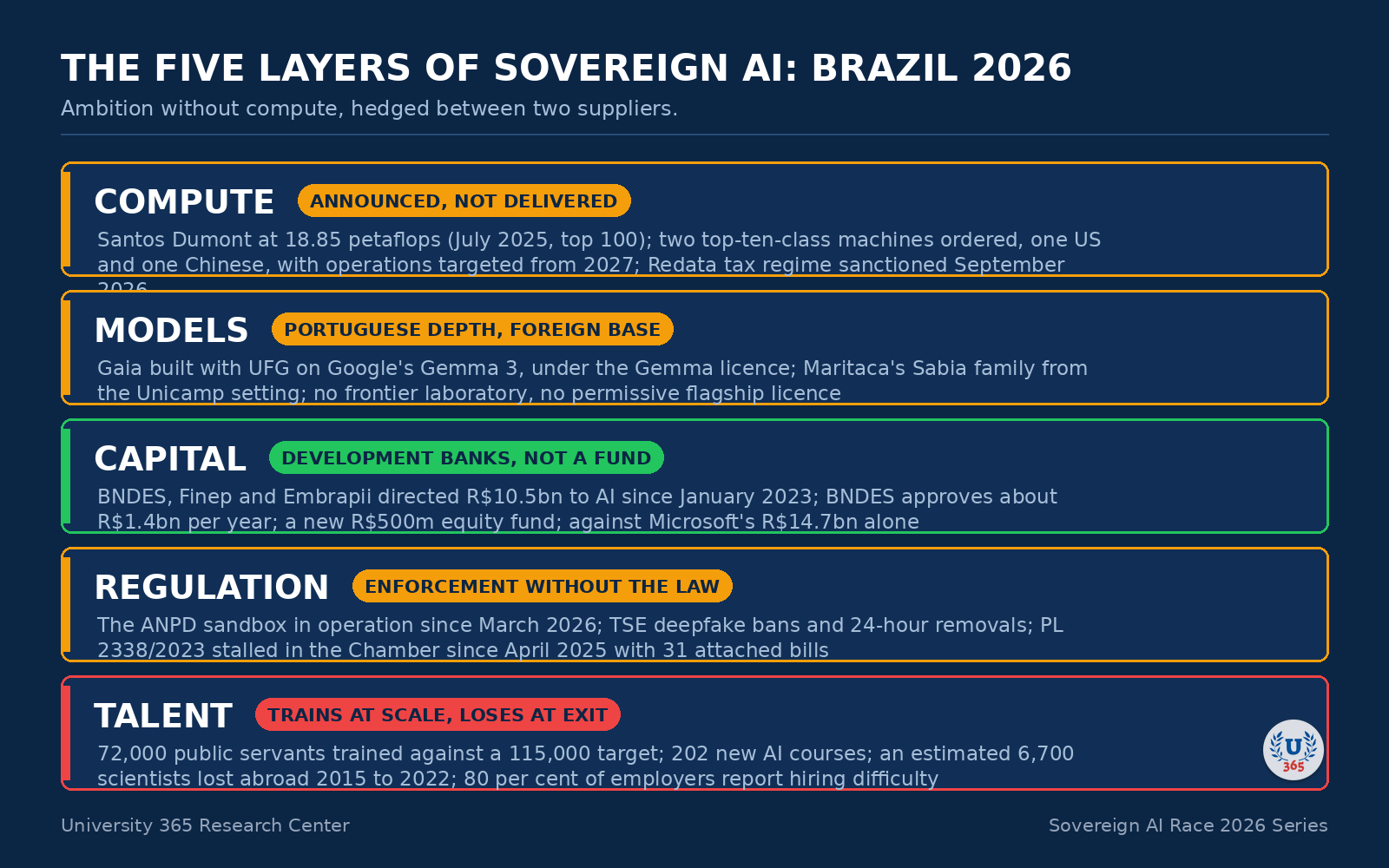
The five layers assessed. Announced compute, Portuguese-language depth on foreign foundations, and enforcement without the statute. University 365 Research Center.
This is the thirteenth report in a twenty-part series assessing how states attempt to control the production of artificial intelligence inside their own jurisdiction. The framework is fixed and applied identically to every country. Sovereign AI capacity separates into five layers, and a state can hold any one of them without holding the others.
Compute sovereignty is the physical layer: where the chips and data centres sit, and who may switch them off. Model sovereignty is who builds the models a country depends on, and in whose languages and domains those models are competent. Capital sovereignty is who funds the build-out and on what terms. Regulatory sovereignty is who writes the rules and whether they can be enforced. Talent and education sovereignty is who builds and runs the systems, and how the next generation is prepared.
The series treats three races as running at once: the compute race, the model race and the rules race. Brazil is the first country in the series whose compute strategy is explicitly bicontinental. In June 2026 the plan was a single two-billion-real machine for 2027. By 20 August 2026 the plan had become two of the world's ten most powerful machines, one to be bought from the United States and one from China, plus a Chinese technology partnership worth 1.28 billion reais over four years and a national cloud. The stated aim, in the minister's own words, was to reduce technological dependence on other countries. The mechanism chosen to reduce dependence on one superpower was to buy from both.
The series places Brazil in the "ambition without compute" grouping alongside Morocco, South Africa and Qatar. The placement is a claim to be tested layer by layer, and this report tests it. Brazil has real scientific computing assets, real state financing institutions and one of the most complete regulatory conversations in the Global South. What it does not have is a leading-edge fabrication plant, a frontier model laboratory, a sovereign wealth fund, or an AI law in force. The report's question is what a country's plan is worth when the plan, the money and the law are all announced before they are built, and when the country holding the paper is one of the largest democracies in the world.
The vocabulary this report needs
Five terms recur, and they are defined here once.
The PBIA. The Plano Brasileiro de Inteligencia Artificial 2024-2028 was launched in July 2024 with a headline of 23 billion reais over four years, built with 117 institutions, and structured into numbered axes covering infrastructure, training, public services and the rest. The final document was published in 2025 by the Ministry of Science, Technology and Innovation with the CGEE, and its own action plan is organised as numbered axes with titles such as infrastructure and development of AI, and diffusion, formation and capacity-building in AI. This matters for anyone comparing summaries: the six-axis naming widely repeated in secondary coverage does not match the primary table of contents, and this report uses the primary naming. The government's own execution figure, stated by the MCTI minister Luciana Santos on 11 August 2026, is 14.2 billion reais executed, which is a government claim and labelled as one throughout.
The two-machine package. On 20 August 2026 the federal government announced measures its outlets totalled at just over 2.3 billion reais (Estadao), 2.5 billion reais (Folha de S.Paulo, which appears to bundle the Huawei contract) and 2.2 billion reais (the Portuguese agency Lusa). The package contains a tender of one billion reais for a supercomputer destined for the Rio Grande do Norte region around Natal, specified by the LNCC with a 9.2 megawatt power envelope and an aspiration to rank among the world's ten most powerful; a second machine for Rio de Janeiro with Chinese partners; a Huawei contract worth 1.28 billion reais over four years with counter-obligations; and the structuring of a Brazilian cloud. The conflicting totals are a fact about the announcement, and this report states the range rather than choosing a number.
Redata. The special tax regime for data centre services, created definitively in Congress and sanctioned in September 2026, reported on 15 September 2026, granting tax incentives for data centre installation. Petrobras was its first beneficiary. The regime is the state's principal instrument for attracting physical compute, and it is a tax regime rather than an ownership stake.
PL 2338/2023. The artificial intelligence bill, filed in the Federal Senate on 3 May 2023, approved by the Senate in December 2024, and pending in the Chamber of Deputies since April 2025 in a special committee under rapporteur Aguinaldo Ribeiro, with the docket showing the bill awaiting the rapporteur's opinion and 31 attached bills riding with it. It is modelled in part on the European Union's approach, risk-based, and would create a national coordination structure. It is not in force, and no sanction of it was verified in this research window.
The ANPD sandbox. The National Data Protection Authority selected three companies, Metatext, Synapse AI and Prevvine Tecnologia, under Edital 2/2025 to run a regulatory sandbox in artificial intelligence. Operations began in March 2026, the first partial monitoring report was published on 2 July 2026, and the University of Sao Paulo's Center for Artificial Intelligence and Machine Learning collaborates on the project. The sandbox is how the country exercises AI regulation while the bill waits.

Sovereign AI Race: Brazil (2026)
The Question
Can a state buy its way out of dependence by buying from both sides at once?
Brazil's answer to the compute problem is arithmetic first and doctrine second. The world's advanced accelerators are made in one country, Taiwan, by a company, TSMC, that serves everyone; the design and the export licence are American; the alternative supply chain is Chinese. A country that needs top-ten computing for climate models, health research and its own language models has three options: buy American and accept the licence regime that comes with it, buy Chinese and accept the American reaction, or buy both and keep each supplier aware of the other. Brazil chose the third, and stated the reasoning through its minister: the choice was designed to avoid dependence on a single country, and the risk of American reprisal was acknowledged rather than denied.
The strategy is coherent on its own terms, and it is testable in three ways. A hedge should be backed by domestic capability, because two suppliers is still two dependencies unless something is built locally. It should be funded, because announcements of this kind are cheap and the real number is what is disbursed. And it should be governed, because a country that cannot write the rules for AI cannot control the terms on which the technology arrives.
The evidence this report assembles tests each of those, and the results are specific rather than general. Domestic capability exists in scientific computing and in a small but genuine Portuguese-language model layer, and not at all in fabrication. The funding is real in the state development system, where BNDES, Finep and Embrapii directed 10.5 billion reais to AI projects between January 2023 and February 2026, and it is modest beside the private flows: one American company alone announced 14.7 billion reais for the country over three years. The governance is the sharpest gap: the country has a functioning data protection authority running the region's first AI sandbox, an electoral court that has already ordered takedowns, and a comprehensive AI bill that has spent most of its life in committee.
So the question this report asks is narrower than whether Brazil can become self-sufficient in AI. It cannot in this decade, and its own plan effectively concedes that. The question is whether a middle-power hedge can convert into resilience before the dependencies compound: two bought machines, four foreign hyperscalers building the physical layer, a model layer partly built on a foreign open licence, and an election season in which the country is already testing whether its institutions can control what AI does to its public debate. The answer the evidence supports is that Brazil has chosen the most honest strategy in the series, and that honesty about dependence is not the same thing as control of it.

Sovereign AI Race: Brazil (2026)
The Contradiction
The country buying from both superpowers runs its government on rented models

Luiz Inacio Lula da Silva, President of Brazil, as of 2026. His government launched the PBIA with 23 billion reais over four years and, in August 2026, the compute package that orders one machine from the United States and one from China. Photograph: Palacio do Planalto, CC BY 2.0, via Wikimedia Commons.
Here is the paradox, stated as plainly as the evidence allows.
On 20 August 2026 the Brazilian government announced a package whose stated purpose was to reduce technological dependence on other countries: a top-ten supercomputer for Rio Grande do Norte, a second machine with Chinese partners for Rio de Janeiro, a 1.28 billion real Chinese partnership for model development and training, and a national cloud. In the same period, the country's federal administration trained 72,000 public servants in AI and built its public-sector guidance on foreign model infrastructure: Petrobras's internal generative assistant ChatPetrobras was developed with Microsoft, and the state's own digital government strategy is a layer of methods and governance sitting on top of imported models and imported chips. Brazil is buying new dependence at the hardware layer while remaining dependent at the model layer, and it is doing both deliberately, because the alternative is not independence but a single supplier.
That is the first tension, and it is not a scandal. It is the honest position of a country with no fabrication, no frontier laboratory and no illusions about either. The second tension is the one the country's own numbers expose. The federal government's plan is 23 billion reais over four years, of which 14.2 billion is claimed executed. The Chinese partnership alone is 1.28 billion. The tender for the first machine is one billion. Against those numbers, Microsoft's September 2024 commitment of 14.7 billion reais over three years for cloud and AI infrastructure and training for five million people is a larger single private commitment than most of the state's own programme, and AWS added 10.1 billion reais through 2034, and Google said in September 2026 that it would double its technical infrastructure in the country by 2030. The state that is hedging between superpowers is, in capital terms, the smaller counterparty in its own compute story.
The third tension sits in the law. Brazil has been debating a comprehensive AI statute since May 2023. The Senate approved it in December 2024. Since April 2025 it has rested in a Chamber of Deputies special committee, awaiting a rapporteur's opinion, with 31 attached bills riding with it, while the government's AI measures have been delivered by decree, by tax regime and by regulator instead: Decreto 13.065 regulating the semiconductor programme in July 2026, the Redata sanction in September 2026, the ANPD's sandbox, the electoral court's deepfake rules. The country is governing AI, effectively and in places inventively, without the law it wrote for the purpose. And the October 2026 general election is itself a live test: the TSE has already ordered platform removals within 24 hours in AI content cases, upheld a fine on an AI-generated video circulated in a WhatsApp group, and maintained the ban on synthetic campaign content in the 72 hours before a vote.
The fourth tension is talent, and it is the one with the longest fuse. The state trained 72,000 public servants against a target of 115,000 for the end of 2026, created 202 new AI-related higher education courses, and funds nearly 3,000 scholarships and projects through CNPq. In parallel, the country lost an estimated 6,700 scientists abroad between 2015 and 2022, 80 per cent of its employers report difficulty hiring, and 77 per cent of its AI jobs are held by men, more than seven percentage points above the global figure. A country can train five million people, as one company has promised to do, and still lose the argument for keeping the best of them, which is what the scientists' organisation says is happening. Brazil's talent position is not a shortage of education. It is a shortage of the returns that would keep the educated.

Sovereign AI Race: Brazil (2026)
The Current State
Compute: a real research upgrade, two announced machines, and the biggest state programme in the series measured in hundreds of megawatts

Rio de Janeiro at dusk. The state's scientific computing is real and small: Santos Dumont at 18.85 petaflops, and a one billion real tender for a machine that has not yet been built. Photograph: Pexels License, via Pexels.
Brazil's compute position has three parts, and only the first is operational. The operational part is scientific computing. The Santos Dumont supercomputer at the National Scientific Computing Laboratory in Petropolis completed an upgrade in July 2025 to 18.85 petaflops of AI-capable capacity, built by Eviden with NVIDIA, Intel and AMD technology, reported as a roughly fourfold gain that moved the machine from the top 500 into the top 100 worldwide. Petrobras operates the Harpia supercomputer, delivered for 435 million reais and raising the company's computing capacity by 60 per cent, and signed a 2.3 billion real, 17-year contract with Elea Data Centers in October 2025 to host its scientific workloads, making Petrobras the first beneficiary of the Redata tax regime. These are real assets with real workloads, and they are research machines rather than frontier training clusters.
The announced part is the two-machine package of August 2026. One tender allocates one billion reais for a machine with a 9.2 megawatt power envelope, specified with the ambition of ranking around sixth in the world, destined for the Rio Grande do Norte region around Natal, with operations targeted from 2027. The specification was set by the LNCC, and the government moved the site away from Petropolis on electricity-demand grounds. On 12 August 2026 Folha de S.Paulo reported that the plan had changed from one machine to two, one American and one Chinese, with the minister acknowledging both the intent to avoid dependence on a single country and the risk of American reprisal. On 20 August the package was announced with the Huawei component attached, and G1 detailed on 22 August that the Rio Grande do Norte machine would start operating in 2027 and that a second machine would be installed in Rio de Janeiro in partnership with Chinese companies. On 22 June 2026, before all of this, the government had said the two-billion-real machine would be ready in 2027 and would be one of the world's ten fastest. The movement from one machine to two inside ten weeks is a documented policy reversal, and the report records it as one.
The third part is the commercial layer, and it is foreign-owned. Microsoft confirmed in February 2026 that two AI and cloud data centres in Sao Paulo state had been inaugurated, following the January 2026 completion of construction, without disclosing cities, capacity or customers; the company's own 2024 commitment, its largest ever in Brazil, was 14.7 billion reais over three years plus AI training for five million people by 2027. AWS committed 10.1 billion reais through 2034 on top of 19.2 billion invested between 2011 and 2023. Google said in September 2026 that it would double its technical infrastructure in the country by 2030, without disclosing a figure, and its Brazilian-Portuguese model work is discussed below. The domestic operator layer is smaller and growing: Tecto Data Centers, backed by BTG Pactual funds, announced plans in 2026 to invest 2 billion dollars through 2028 in five new data centres, described as combining an AI grid and an AI factory approach, with the two outlets reporting the announcement disagreeing on its date, which this report states rather than resolves. A 100 megawatt AI data centre cost estimate circulates with the Redata coverage, and the figure one operator puts on it is roughly 25 billion reais. The regulator Aneel authorised the connection of 479 megawatts of new projects to the grid by 2032, of which 359 megawatts serve data centre customers in Sao Paulo; that figure, not the gigawatts of the North, is the measured shape of the physical build.
The binding constraint is energy and it is unresolved. Angra 3, the half-built nuclear plant, is 66 to 67 per cent complete by secondary accounts, with the decision on its completion reported in February 2026 as expected by mid-year and by August 2026 as falling to the next president, with no decision expected before the election. The reports put the standing cost at about one billion reais per year and the project framing at up to 24 billion dollars, and this report treats those figures as approximate, as their source does. Brazil has no leading-edge wafer fabrication, a structural fact its own semiconductor programme exists to address, and the Programa Brasil Semicondutores, created in September 2024 and regulated by Decreto 13.065 in July 2026, works through tax simplification and relief along the chain rather than through state fabs. The country's chip position in the AI stack is therefore a design-and-training position on imported silicon, which is the same position as every country in this series except the United States, China, South Korea and Taiwan.
Capital: the state's development banks and the smallest state balance sheet in the series relative to the private flows
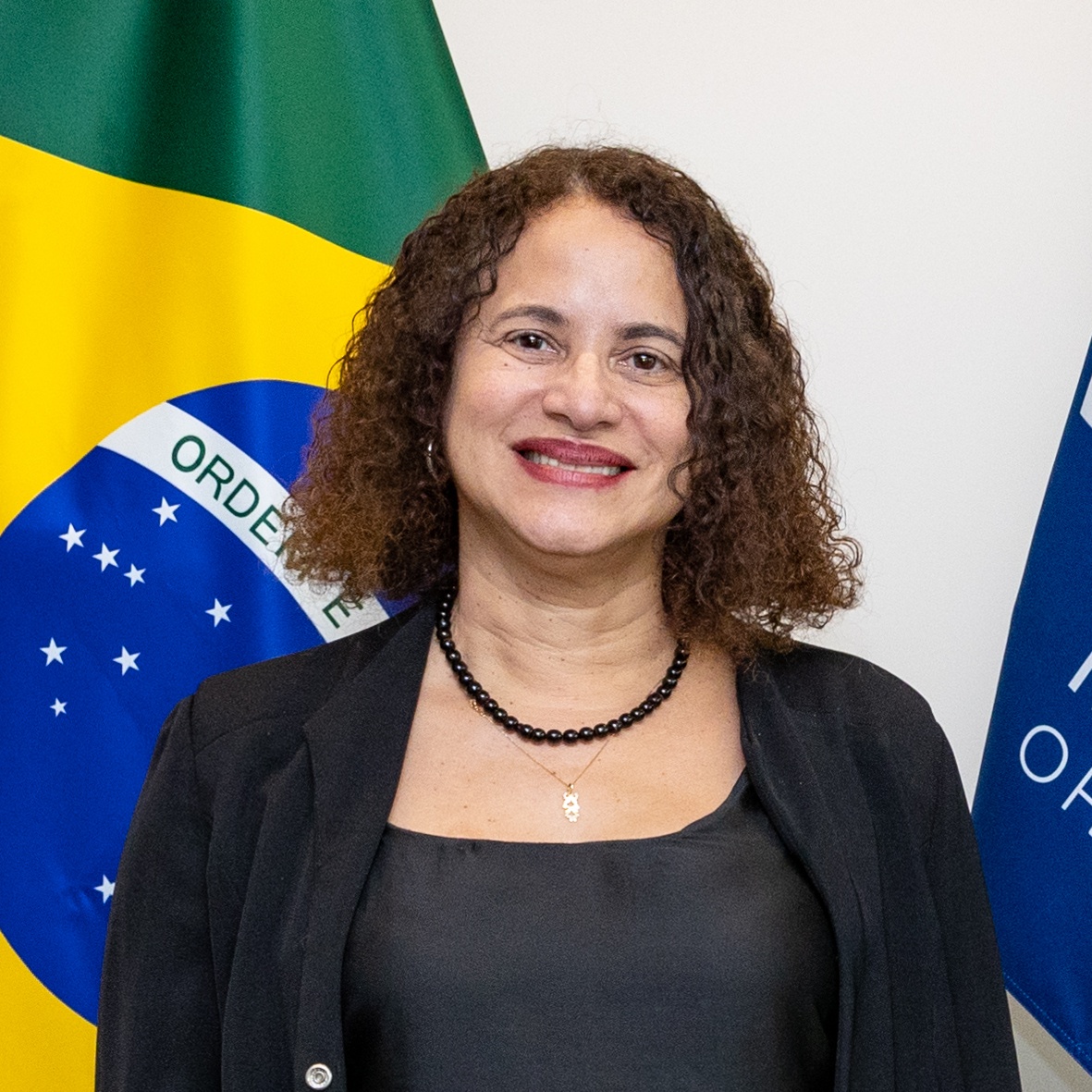
Luciana Santos, Minister of Science, Technology and Innovation of Brazil, as of 2026. She reported 14.2 billion reais of the PBIA executed and 72,000 public servants trained on 11 August 2026, and stated the two-machine logic: avoid dependence on a single country, accepting the risk of reprisal. Photograph: World Intellectual Property Organization, CC BY 2.0, via Wikimedia Commons.
Brazil funds AI through its development system rather than through a sovereign fund, and it has no sovereign wealth fund of the Gulf type. The three institutions that matter are BNDES, Finep and Embrapii. Between January 2023 and February 2026 they directed 10.5 billion reais to AI projects: BNDES about 5.1 billion, of which 4.1 billion in credit operations and 947 million in equity participation; Finep 4.25 billion across credit, non-repayable resources and economic subvention; and Embrapii 1.2 billion in non-repayable co-investment across 632 projects. BNDES reached one billion reais in AI credit approvals by June 2025 and has been approving at about 1.4 billion reais per year. Named approvals include 300 million reais for Positivo, 53 million for Cobli for fleet management AI, and 200 million for Scala Data Centers.
The newest instrument is an equity fund. BNDES and Finep launched an AI investment fund in April 2026, committing up to 125 million reais through BNDESPar and up to 80 million through the FNDCT, with the call attracting 17 proposals and Monashees selected as manager, and the fund estimated to mobilise up to 500 million reais for startups whose business model is structurally centred on AI, with anchor participation limited to 25 per cent. Beside it, Finep opened a 500 million real applied research call in December 2025, and FAPESP with MCTI and CGI.br established ten Applied Research Centres in AI in October 2024, whose current status this report was not able to verify and does not assert.
The comparison that matters is between these numbers and the private ones. Microsoft's 14.7 billion reais, AWS's 10.1 billion, Google's undisclosed doubling, Tecto's 2 billion dollars: the private commitments announced for Brazil in the last two years are, in aggregate, larger than the entire state programme, and most of the money is foreign. The government's own tax instrument, Redata, sanctions incentives in September 2026 rather than buying equity, which is a deliberate choice to attract capital rather than own it. Two macro facts condition the whole picture and this report states them as context rather than analysis: the country's electricity and land costs make it one of the most attractive data centre destinations in the Americas, and the real's exchange rate against the dollar is precisely what makes imported compute expensive, which is why the minister linked the two-machine purchase to dependence rather than price.
Models: a genuine Portuguese-language layer, built mostly on foreign foundations
Brazil's model layer is small, real, and structurally dependent in a way that the country's own researchers describe accurately.
The most consequential Brazilian model in production is a Google model. In June 2025 Google announced Gaia, a Brazilian-Portuguese model developed with researchers at the Federal University of Goias at its Center of Excellence in Artificial Intelligence, based on Gemma 3, released on Hugging Face as Gemma-3-Gaia-PT-BR-4b-it under Google's Gemma licence. The Portuguese-language tuning was done in Brazil, by Brazilians, at a Brazilian university, and the base weights and the licence are Google's. That is the exact shape of the model-layer dependency the series exists to describe, and it is worth stating that the country recognises it: MCTI's digital transformation secretary argued in August 2026 that Brazilian AI models should preferentially be trained inside the country to protect national databases.
The domestic private layer is Maritaca AI, incubated in the Unicamp research setting, which develops the Sabia family of Portuguese-language models; Sabia-3 is documented in a technical report with authors affiliated with Maritaca and Unicamp researchers, and the company received investment from Jusbrasil, which wanted a Brazilian language model for legal applications. Maritaca announced a compute investment in August 2025 taking its capacity to more than double. The licence under which Sabia is released was not verifiable in this research window, and this report therefore does not describe Brazil as having a permissively licensed open-weight flagship.
The state's own model work is a procurement, and its status is contested. SERPRO, the federal government's technology company, selected MeetKai Brasil as final winner of what the company's release calls its sovereign AI government contract, announced on 29 June 2026. That announcement reached this research as a vendor press release, and the winning of a government tender of that kind should be confirmed against a SERPRO or Diario Oficial source before it is treated as settled; the report records it as a claim. Alongside it, the Ministry of Management runs the E-IA/MGI strategy for 2025-2027 and maintains the NIA nucleus inside the digital government secretariat, with a unified AI guide for the public sector, and INSPIRE, a project with Finep and CPQD, develops AI for personalised digital government.
The international dimension is where Brazil's language position gets interesting. Portugal launched AMALIA on 1 July 2026, described as the first open source large language model in European Portuguese, led by NOVA FCT with a consortium of roughly 60 researchers, framed by the Portuguese government as a matter of digital sovereignty. Whether Brazilian institutions participate in that consortium was not verified in this research window and this report does not claim it. What can be said precisely is that the Portuguese-speaking world now has one openly licensed language model project at sovereign scale, and it is European rather than Brazilian, which matters because Brazil is the larger Portuguese-speaking population by an order of magnitude.
Regulation: the law that waits, and the four instruments doing its work
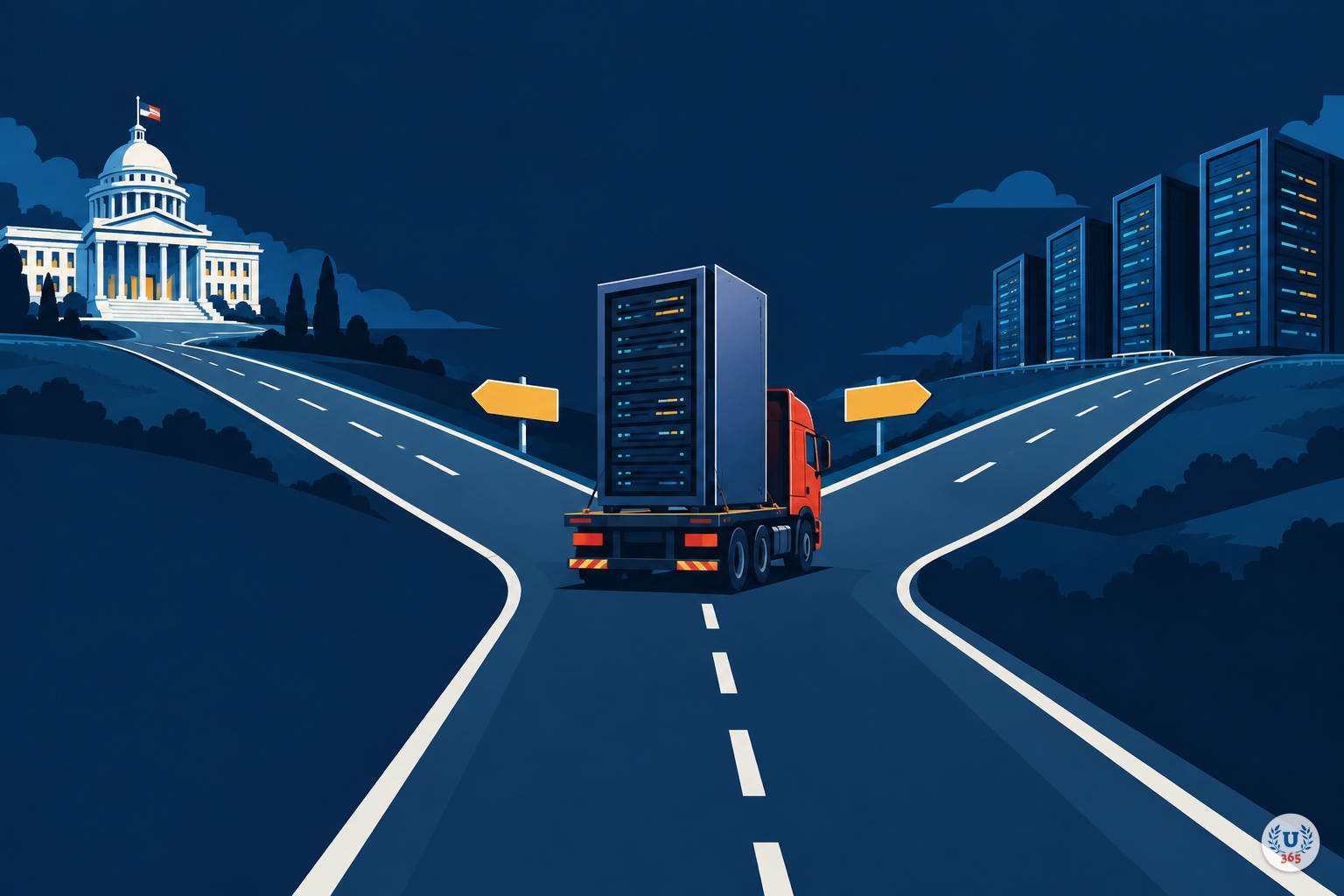
At the fork with a load it must place. University 365 Research Center.
Brazil's regulatory position is the clearest in the series to describe and the hardest to assess, because the instrument everyone watches is not the instrument in force.
PL 2338/2023 was filed in the Senate on 3 May 2023 by the then Senate president Rodrigo Pacheco, consolidated into a substitute text by rapporteur Eduardo Gomes, approved by the Senate's temporary AI committee on 5 December 2024, and passed by the Senate plenary that December. It went to the Chamber of Deputies, where the docket shows it was sent to a special committee on 29 April 2025 under rapporteur Aguinaldo Ribeiro, with 31 attached bills riding with it, and where it has remained, awaiting the rapporteur's opinion. There is one fact this report will not assert: whether the bill has been voted and sanctioned since May 2026. The sources available to this research show only the Redata sanction of 15 September 2026, which is a tax regime, and the bill's continued committee status. The status statement therefore is: approved by the Senate, pending in the Chamber of Deputies, not in force as far as this research could verify.
Four other instruments are working in the meantime, and they cover more ground than the bill's absence suggests. First, the ANPD has become the de facto AI regulator. Its sandbox, run with Metatext, Synapse AI and Prevvine under Edital 2/2025, began operations in March 2026, published its first partial monitoring report on 2 July 2026 with CIAAM at the University of Sao Paulo collaborating, and the authority has made AI one of its four enforcement axes for 2026-2027. It also issued a Generative AI Technology Radar in December 2024. Second, the electoral court has produced the country's most concrete AI enforcement. The Superior Electoral Court updated its advertising resolution in March 2026 to prohibit deep fakes used to harm or favour candidacies and to require explicit labelling of AI-fabricated content, fixed criteria for characterising deepfake on 1 September 2026, and kept the ban on synthetic content in the 72 hours before a vote. In practice it has ordered removals within 24 hours in pre-campaign cases and upheld a 5,000 real fine on an AI-generated video circulated in a WhatsApp group in the 2024 municipal elections. Third, Decreto 13.065 of July 2026 regulates the semiconductor programme, and the Redata sanction of September 2026 creates the data centre tax regime. Fourth, the Supreme Court in September 2026 identified the first recorded case of prompt injection in a filed appeal, in which a lawyer embedded AI instructions inside a document, a small event with a large implication about how courts will meet AI-generated filings.
Two structural limits should travel with this section. The executive's coordination machinery is real but partly unverifiable: a governance committee of the Brazilian AI strategy is registered with the OECD's AI policy observatory, and the PBIA was led by the National Council for Science and Technology under MCTI coordination with CGEE support, while a named interministerial AI committee could not be verified against a decree and is not asserted here. And the international layer is declaratory rather than binding: Brazil co-sponsored the first UN General Assembly resolution on AI, adopted by consensus in March 2024, hosted the G20 whose leaders' declaration issued in November 2024, and its president called for multilateral AI governance at the BRICS business meeting in July 2025. Brazil is a rule-shaper in the forums and a rule-waiter at home, and the comparison is not a criticism so much as a description of where its actual influence sits.
Talent: two hundred new courses, seventy-two thousand trained servants, and six thousand seven hundred scientists gone

The Rio-Niteroi bridge. The country builds the infrastructure and educates the engineers, and an estimated 6,700 scientists left between 2015 and 2022. Photograph: Pexels License, via Pexels.
Brazil's talent position has real volume and a real leak, and both are documented by the country's own institutions.
The state's training numbers are the largest in the series in absolute terms. The PBIA's second axis is diffusion, formation and capacity-building in AI; the plan's target is 115,000 federal public servants trained by the end of 2026, and the minister reported 72,000 delivered as of 11 August 2026, along with 202 new AI-related higher education courses. CNPq has AI linked to almost 3,000 scholarships and projects. MCTI launched Chip Tech Brasil and Champion Chip in August 2025 for semiconductor training, and runs CI Digital with Softex for industry professionals. A residency programme in information and communication technologies with an AI track was announced with a planned 129 million reais to train 5,800 professionals, figures this report carries as a claim pending confirmation against MCTI, as its source requires. The corporate layer is larger still: Microsoft's target of five million Brazilians trained by 2027 and AWS's Treina Brasil target of one million by 2028, both company commitments rather than state targets.
The leak is measured by the country's scientific institutions. Brazil lost an estimated 6,700 scientists abroad between 2015 and 2022 according to the CGEE's estimates, with scholarship values frozen for almost a decade and laboratory budgets cut as contributing factors, and the Brazilian Academy of Sciences reported in September 2025 that repatriation efforts are under way while the situation remains difficult. The hiring market shows the same pressure from the other side: 80 per cent of Brazilian employers report difficulty hiring, above the global average. And the composition is skewed: 77 per cent of AI jobs in Brazil are held by men, more than seven percentage points above the global result, per an FGV Ibre study using LinkedIn data and the Stanford index, against which Microsoft runs a women-focused training programme that opened 2,500 places in January 2026.
Two figures the brief for this research sought are deliberately not used here, because they could not be verified to the standard this series requires: a headline PBIA target of 100,000 AI professionals, and the 28,000 to 43,000 active-AI-professionals series that circulates with an attribution this research could not confirm. What is verifiable is stated above, and the difference between the plan's numbers and the market's numbers is itself part of the story.
What changed since the last report on Brazil: there is no earlier report
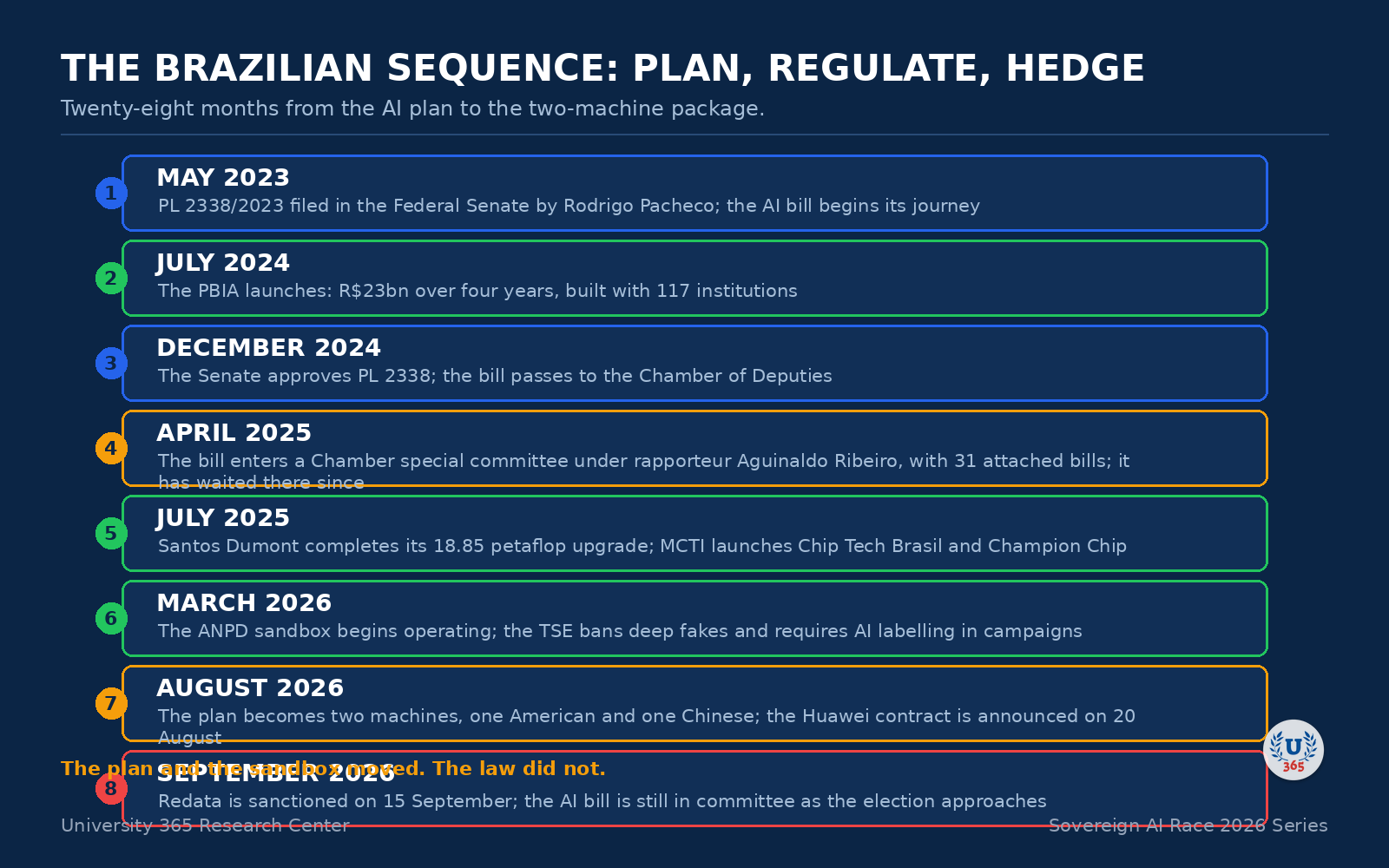
The Brazilian sequence: plan, sandbox, hedge. University 365 Research Center.
University 365 has not published a Brazil AI landscape report before this one. The series' prior-report mapping covers fourteen of its twenty countries, and Brazil is not among them: the countries with earlier University 365 landscape reports are the UAE, Saudi Arabia, China, the United States, France, India, Morocco, Germany, the United Kingdom, Spain, Italy, Qatar and Bahrain. Brazil, Japan, South Korea, Singapore, Russia, Portugal and South Africa have none, and this report says so plainly rather than manufacturing a baseline it does not have.
What can be compared instead is Brazil against itself within this report's own research window, and the movement in that interval is documented throughout this section: a compute plan that changed from one two-billion-real machine in June 2026 to two machines, one American and one Chinese, in August; a state AI programme whose claimed execution reached 14.2 billion of 23 billion reais; a model layer that gained a Google-built Brazilian Portuguese model and a domestic laboratory with a doubling compute investment; a sanctions record that produced a semiconductor decree in July and a data centre tax regime in September while the AI bill stayed in committee; and a talent position that delivered 72,000 trained public servants against a growing body of evidence about departure. The series will build its Brazilian baseline from this report forward.

Sovereign AI Race: Brazil (2026)
Key Findings
1. The compute strategy is a hedge, and it is the most explicit in the series. On 12 August 2026 Folha de S.Paulo reported the change from one supercomputer to two, one American and one Chinese, with the minister acknowledging the risk of American reprisal. On 20 August the package was announced: a one billion real tender for a machine with a 9.2 megawatt envelope destined for Rio Grande do Norte with operations from 2027, a second machine in Rio de Janeiro with Chinese partners, a Huawei contract of 1.28 billion reais over four years with counter-obligations, and a Brazilian cloud. Outlets totalled the package at 2.2, 2.3 and 2.5 billion reais on the same days, and the range is a fact of the announcement.
2. The operational compute base is scientific, real, and small. Santos Dumont at LNCC reached 18.85 petaflops in July 2025, moving from the top 500 into the top 100, built by Eviden with NVIDIA, Intel and AMD technology. Petrobras runs Harpia, a 435 million real machine that raised its capacity by 60 per cent, and signed a 2.3 billion real, 17-year hosting contract with Elea. These are research and industrial machines, not frontier training clusters.
3. The physical build is mostly foreign-owned and measured in hundreds of megawatts. Microsoft inaugurated two AI data centres in Sao Paulo state in February 2026 under a 14.7 billion real, three-year commitment, its largest ever in Brazil; AWS committed 10.1 billion reais through 2034; Google will double its Brazilian technical infrastructure by 2030. Aneel authorised 479 megawatts of new connections by 2032, 359 for data centre customers in Sao Paulo. Tecto announced 2 billion dollars through 2028 for five data centres, with its two reporting outlets disagreeing on the announcement date.
4. The state funds through development banks, not a sovereign fund, and the numbers are precise. BNDES, Finep and Embrapii directed 10.5 billion reais to AI between January 2023 and February 2026 (5.1, 4.25 and 1.2 billion respectively). BNDES approves at about 1.4 billion reais per year. A new BNDES-Finep equity fund of up to 500 million reais, managed by Monashees, targets AI-centred startups. The PBIA's headline is 23 billion reais over four years with 14.2 billion claimed executed, a government self-report.
5. The model layer is Portuguese-language depth on foreign foundations. Google's Gaia, built with UFG researchers on Gemma 3, is deployed as Gemma-3-Gaia-PT-BR-4b-it under Google's licence: Brazilian tuning, foreign base and licence. Maritaca's Sabia family is the domestic private line, with a licence this research could not verify. SERPRO's selection of MeetKai Brasil for a sovereign AI government contract reached the record as a vendor release and is carried as a claim.
6. The AI law is nearly four years old and still not in force. PL 2338/2023 was filed in May 2023, approved by the Senate in December 2024, and has sat in a Chamber of Deputies special committee since April 2025, awaiting the rapporteur's opinion with 31 attached bills. No sanction was verified in this research window. The country will hold a general election with the law unfinished.
7. Four instruments are governing AI in the bill's absence, and one of them enforces. The ANPD runs Latin America's first AI regulatory sandbox (Metatext, Synapse AI, Prevvine; first monitoring report 2 July 2026) and made AI an enforcement axis for 2026-2027. The TSE bans deep fakes in campaigns, requires labelling, maintains the 72-hour pre-vote ban, orders 24-hour removals and has upheld a 5,000 real fine on an AI-generated video. Decreto 13.065 regulates the semiconductor programme; Redata taxes data centres.
8. Talent volume is large and the leak is measured. 72,000 public servants trained against a 115,000 end-2026 target; 202 new higher education courses; nearly 3,000 CNPq scholarships and projects; one company committed to training five million people. Against it: an estimated 6,700 scientists lost abroad between 2015 and 2022, 80 per cent of employers reporting hiring difficulty, and 77 per cent of AI jobs held by men.
9. Firm-level adoption is developing, and it is shallow in structure. Cetic.br's TIC Empresas 2025 puts AI use at 17 per cent of Brazilian firms, with large firms rising from 38 to 50 per cent; 80 per cent of adopters bought ready-made software and 60 per cent hired external developers; the study's coordinator characterises the adoption as process adaptation rather than structural change. One third of non-profits already use generative AI.
10. Brazil's international position is declaratory, and its domestic position is where the real instruments are. Brazil co-sponsored the first UN AI resolution, held the G20 presidency whose declaration issued in November 2024, ratified the Mercosur-EU agreement in 2026 after 27 years, and joined the Chinese-aligned WAICO grouping as an explicit hedge. At home it regulates through a data authority, an electoral court, a decree and a tax regime.
11. The honest overall verdict: Brazil has chosen the most transparent strategy in the series and has not yet converted it into capability. It is buying two machines from two superpowers to avoid dependence on one, building no fabrication and no frontier model, training at scale and losing scientists, and governing through instruments that work while its central law waits. On Oxford Insights' 2025 Government AI Readiness Index, published in January 2026, Brazil leads Latin America at 22nd of 195 with 69.55 points, which is real and regional rather than global. The hedge is a strategy; whether it becomes sovereignty depends on execution over the next three years.

Sovereign AI Race: Brazil (2026)
Deep Analysis
Why the two-machine decision matters more than any other fact in this report
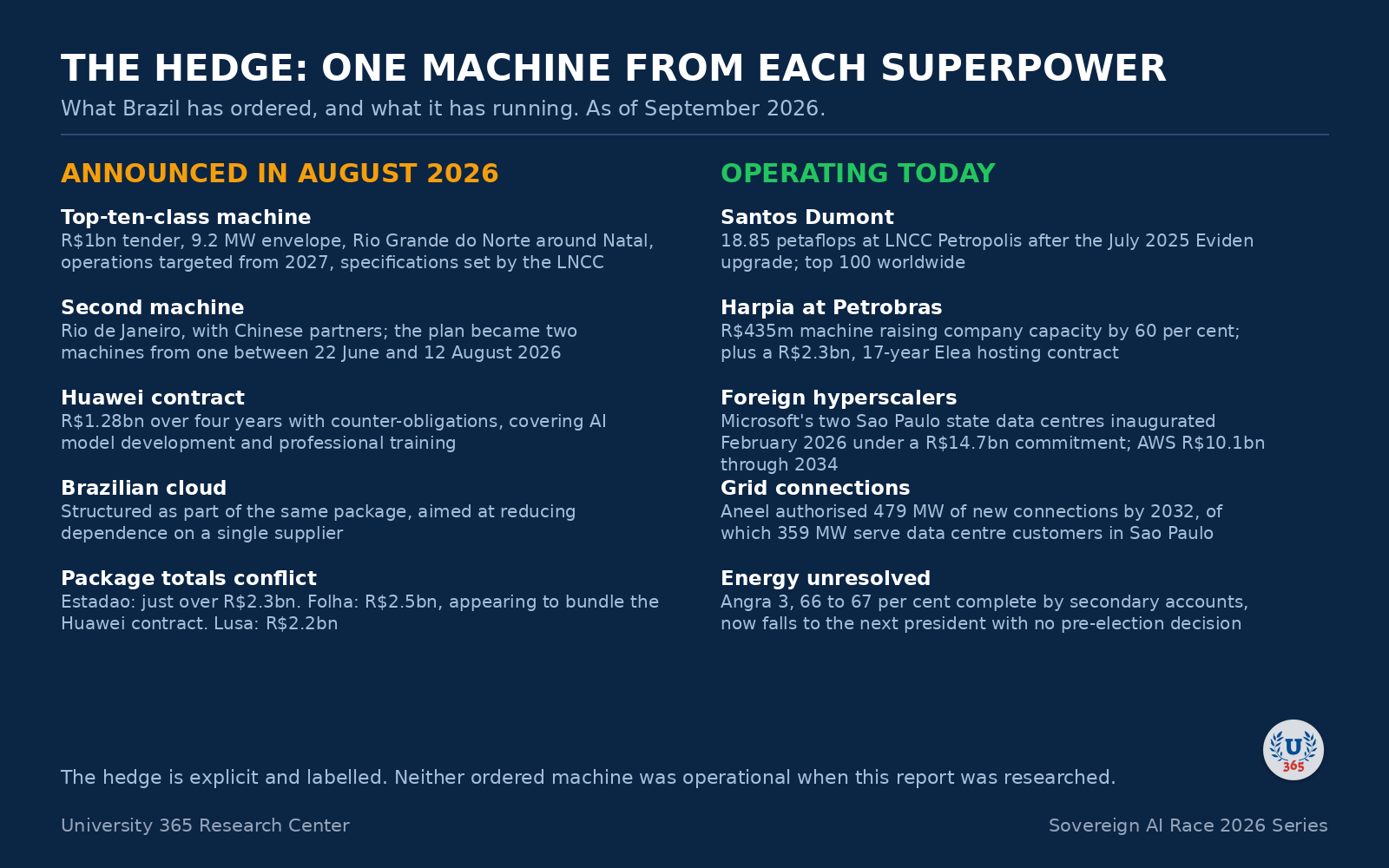
What was announced, against what runs. University 365 Research Center.
The Brazilian compute plan changed its shape between 22 June and 20 August 2026, and the change is the most instructive single development in the country's AI policy this year. On 22 June the government described a two-billion-real machine, one of the world's ten fastest, ready in 2027. On 12 August Folha reported the redesign as two machines, one to be bought from the United States and one from China, with the minister stating the logic explicitly: avoid dependence on a single country, and accept the risk of American retaliation. On 20 August the package was announced with the Huawei contract attached, and on 22 August G1 confirmed the Rio Grande do Norte machine for 2027 and a second machine for Rio de Janeiro with Chinese partners.
Three conclusions follow. First, the decision is a rejection of the standard middle-power playbook. Most countries in this series buy American silicon under the American licensing umbrella, or buy nothing and rent from hyperscalers. Brazil is buying from both camps and saying so in public, which no other country in the series has done at this scale. Second, the decision costs something. The American export regime can reach any country that does business in critical areas with China, and a Chinese supply chain for AI training carries its own dependency and its own intelligence implications. The government made this trade on purpose and labelled it, which is the most a government with no fabrication of its own can do. Third, the hedge only works if the machines arrive and run. A tender of one billion reais with a 9.2 megawatt envelope is a specification, not a building; the Rio Grande do Norte machine's target date of 2027 is a statement about the future. When this report was researched, neither machine was operational.
The comparison the series can now draw is sharp, and it runs across the whole queue of countries. Germany lost its fab to a cancellation. The United Kingdom lost its flagship data centre to a pause. India announced compute it never disbursed. Morocco announced half a gigawatt twice and connected thirty-six megawatts. The Gulf states own the entities doing the building. Brazil's variant is new: it has ordered two machines from the two countries that could cut it off, and neither order has been delivered. The pattern across the series is now complete enough to state as a finding: in this race, announcements are cheap, and the states that are actually building are the ones that own the entity doing the building or the site it stands on.
The law that waits: what Brazil's PL 2338 delay means for everyone in the Global South

The National Museum of the Republic, Brasilia. The country's AI law has been under consideration since May 2023 and sits in the Chamber of Deputies; the electoral court and the data authority have moved faster than the legislature. Photograph: Pexels License, via Pexels.
Brazil's legislative delay is not unusual; what makes it instructive is that the country kept governing anyway.
Consider the record. The AI bill entered the Senate in May 2023, was approved by the Senate in December 2024, and since April 2025 has sat in a Chamber of Deputies special committee with 31 attached bills, awaiting a rapporteur's opinion. In the same period, the country delivered a generative AI radar through the data authority, built and launched the region's first AI regulatory sandbox with three companies and a university partner, updated its electoral advertising rules twice, enforced them against platform content with 24-hour removal orders, upheld a fine on an AI video, regulated its semiconductor programme by decree, created a tax regime for data centres, and identified a prompt injection in its own supreme court filings. None of that required the bill. Most of it required an authority willing to act within existing law, and one court willing to treat AI-fabricated campaign content as ordinary electoral fraud.
For countries watching from the Global South, Brazil's experience proposes a sequence the opposite way round from Europe's. Europe wrote the comprehensive law first and is still building the enforcement capacity. Brazil built enforcement capacity first: a data protection authority with a sandbox, an electoral court with deepfake criteria, a development bank with a disbursement track record in AI. The comprehensive framework, when it arrives, will land on institutions that have already been practising. That is a defensible approach, and it carries one open risk: a bill that has spent four years in a legislature can arrive stale, and the 31 attached bills riding with it mean its final shape is not yet knowable.
There is a second lesson in the delay, and it concerns what the bill is not for. Brazil's most active AI governance this year concerns elections, data protection and tax, which is to say: the applications where ordinary law already reaches. The frontier questions, model safety, frontier capability and the conduct of laboratories, are untouched everywhere in the country's framework, as they are in most of this series. The bill that waits would partially address them. Nothing in force does.
The three races, measured in Brazil
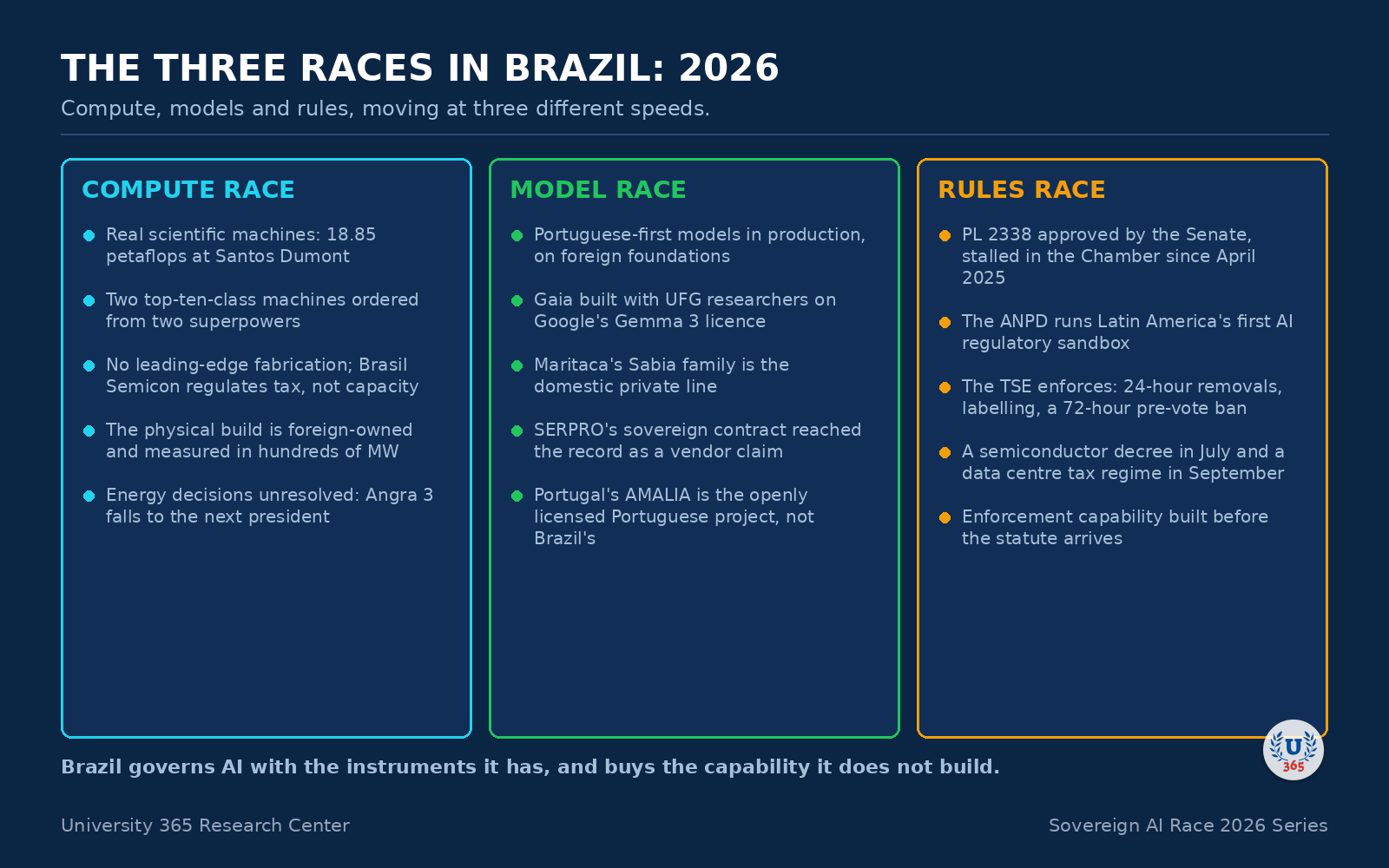
The three races in Brazil, at three speeds. University 365 Research Center.
The series separates the compute race, the model race and the rules race, and Brazil is the country where the three run at the most different speeds.
In the compute race Brazil is a buyer with good credit and expensive currency. It has real scientific machines and no fabrication; it is ordering frontier-adjacent machines from both superpowers; and the physical build happening on its soil is being financed by American technology companies under an American tax-and-grid calculus. Its grid constraint is unresolved nuclear policy rather than a queue, and its tax instrument, Redata, is the state's actual lever on physical capacity.
In the model race Brazil has depth in one language and no frontier. The Gaia model and the Sabia family mean Brazilian users have Portuguese-first models that behave well in Portuguese, built on foundations owned elsewhere. The state's own model procurement is a contract, not a laboratory. The most significant development for Portuguese itself came from Portugal, with AMALIA. Brazil's language market is large enough that its model layer will persist; its model layer is not large enough to matter to the global frontier, and the country does not pretend otherwise.
In the rules race Brazil is fast where the law is old and slow where the law is new. Its electoral court moved within months on deepfakes on the basis of a 2019 resolution; its data authority moved within a year on a sandbox under the general data protection law; its congress has moved for three years on the AI bill. The tempo difference is not accident: it is the difference between regulating conduct that existing statutes already cover and writing a new legal category from scratch.
The three tempos produce the report's cleanest summary of Brazil. A country that has decided to buy capability from whoever sells it, teach its population to use that capability, and enforce the rules it already has, while the comprehensive law that would give the whole edifice direction waits for a vote only its congress can hold.

Sovereign AI Race: Brazil (2026)
Data and Evidence
Table 1: The five layers, assessed for Brazil in September 2026
Layer | What Brazil holds | What it does not hold | Assessment |
Compute | Santos Dumont at LNCC, 18.85 petaflops from July 2025, top 100 worldwide; Petrobras's Harpia at 435 million reais (+60 per cent capacity) and a 2.3 billion real, 17-year Elea hosting contract; a one billion real tender for a top-ten-class machine (9.2 MW, Rio Grande do Norte, operations targeted 2027); a second machine planned for Rio de Janeiro with Chinese partners; Microsoft's two Sao Paulo state data centres inaugurated February 2026 under a 14.7 billion real commitment; AWS 10.1 billion reais through 2034; Google doubling infrastructure by 2030; Redata tax regime sanctioned September 2026 | Operational frontier training capacity (both announced machines are pre-delivery); leading-edge wafer fabrication (Brasil Semicon works through tax relief); a resolved power decision (Angra 3 now falls to the next president) | Announced capability with a real scientific base and a bicontinental buying strategy |
Models | Gaia, built with UFG/CEIA researchers on Gemma 3, released as Gemma-3-Gaia-PT-BR-4b-it (Brazilian tuning, Google base and licence); Maritaca AI's Sabia family out of the Unicamp setting (licence unverified); state model procurement via SERPRO (a claim pending Tier 1 confirmation); MCTI's digital government layer (NIA, E-IA/MGI, GuIA) on imported models | A frontier laboratory; a permissively licensed flagship domestic model; a state model trained and hosted on national compute | Portuguese-language depth on foreign foundations |
Capital | PBIA headline of 23 billion reais over four years with 14.2 billion claimed executed; BNDES, Finep and Embrapii at 10.5 billion reais directed to AI between January 2023 and February 2026; BNDES approving about 1.4 billion reais per year; a new equity fund of up to 500 million reais mobilised (Monashees as manager); Finep's 500 million real applied research call; FAPESP's ten Applied Research Centres with MCTI and CGI.br (current status unverified) | A sovereign wealth fund; state capital at the scale of the foreign private flows it attracts (Microsoft 14.7 billion reais alone exceeds most of the state programme) | A development-bank state, not an owner state |
Regulation | ANPD sandbox in operation since March 2026 with a first monitoring report on 2 July 2026 and AI as an enforcement axis for 2026-2027; TSE rules banning deep fakes, requiring labelling, ordering 24-hour removals and a 72-hour pre-vote ban on synthetic content; Decreto 13.065 on semiconductors (July 2026); Redata sanction (September 2026); a Supreme Court prompt injection case identified September 2026 | PL 2338/2023 in force (approved by the Senate December 2024, pending in the Chamber of Deputies special committee since April 2025 with 31 attached bills, awaiting the rapporteur's opinion); frontier model safety rules; any instrument reaching laboratory conduct | Enforcement without the statute; the statute without a vote |
Talent and education | 72,000 federal public servants trained against a 115,000 end-2026 target; 202 new AI-related higher education courses; nearly 3,000 CNPq scholarships and projects; a planned 5,800-person ICT residency with 129 million reais (claim); Chip Tech Brasil and Champion Chip; Microsoft's 5 million target by 2027 and AWS's 1 million by 2028 (company commitments) | Retention: an estimated 6,700 scientists lost abroad 2015-2022; 80 per cent of employers reporting hiring difficulty; 77 per cent of AI jobs held by men, above the global figure | Training at scale, returns under-built |
Table 2: The controlled metrics, series bible format
Metric | Brazil position | Source and date |
Flagship compute commitment | Santos Dumont at LNCC: 18.85 petaflops, July 2025 upgrade, top 100; the August 2026 package: a one billion real tender (9.2 MW envelope, top-ten ambition, Rio Grande do Norte, operations targeted 2027) plus a second machine for Rio de Janeiro with Chinese partners; Huawei contract of 1.28 billion reais over four years with counter-obligations; Petrobras's Harpia (435 million reais) and the Elea hosting contract | Eviden, 9 July 2025; Folha de S.Paulo, 12 and 20 August 2026; Estadao and Valor, 20 August 2026; G1, 22 August 2026 |
Capital committed | PBIA: 23 billion reais over four years, 14.2 billion claimed executed as of 11 August 2026; BNDES 5.1 billion, Finep 4.25 billion, Embrapii 1.2 billion (10.5 billion combined, January 2023 to February 2026); AI equity fund up to 500 million reais mobilised; Microsoft 14.7 billion reais over three years; AWS 10.1 billion reais through 2034; Tecto 2 billion US dollars through 2028; Redata tax incentives sanctioned September 2026 | Folha, 12 August 2026; CREA-RJ and IT Forum, 16 June 2026; Valor, 9 April 2026; Microsoft, 26 September 2024; DatacenterDynamics; UOL Economia, 15 September 2026 |
Flagship national models | Gaia (Gemma-3-Gaia-PT-BR-4b-it) built with UFG/CEIA researchers on Gemma 3, under the Gemma licence; Maritaca AI's Sabia family (Sabia-3 technical report, October 2024; licence unverified); SERPRO's MeetKai Brasil selection carried as a vendor claim; no frontier model and no state model programme | Google and G1, June 2025; arXiv, October 2024; PR Newswire, 29 June 2026 |
Anchor entities | MCTI with CGEE (the PBIA); BNDES, Finep and Embrapii (capital); the ANPD (regulation); LNCC (scientific computing); Petrobras and SERPRO (state demand); UFG/CEIA, Unicamp, USP's CIAAM (research) | gov.br; BNDES; ANPD, 2 July 2026; MCTI/CGEE PBIA, 2025 |
Chip dependency | Complete at the accelerator layer: no leading-edge fabrication; the strategy runs on imported NVIDIA-class or Chinese silicon; Programa Brasil Semicondutores (Decreto 13.065, July 2026) works through tax simplification and relief along the chain; PADIS remains the standing regime; the minister assessed NVIDIA as the likely supplier of the first machine | UOL Economia, 16 July 2026; MCTI, August 2025; Folha, 12 August 2026 |
Regulatory instrument and status | PL 2338/2023: Senate-approved December 2024, pending in the Chamber of Deputies special committee since April 2025 under rapporteur Aguinaldo Ribeiro, 31 attached bills, not in force and no sanction verified. In force instead: the LGPD and its ANPD (sandbox since March 2026; AI an enforcement axis for 2026-2027); TSE Resolution 23.610/2019 as updated March 2026 and the 1 September 2026 deepfake criteria; Decreto 13.065 (July 2026); Redata (September 2026) | Camara dos Deputados docket; ANPD, 2 July 2026; TSE, 1 September 2026; JOTA, 2026 |
Talent anchors | MCTI/CGEE PBIA axis 2 (diffusion, formation and capacity-building); 115,000 public servants targeted for end-2026, 72,000 delivered by 11 August 2026; 202 new higher education courses; CNPq with almost 3,000 AI scholarships and projects; the ICT residency (5,800 places, 129 million reais, claim); FAPESP's ten Applied Research Centres with MCTI and CGI.br | CGI.br, 29 April 2026; Folha, 12 August 2026; O Globo, 24 June 2026; Agencia FAPESP, 23 October 2024 |
Independent index standing | Oxford Insights Government AI Readiness Index 2025, published January 2026 (the edition that supersedes December 2025): Brazil 22nd of 195, 69.55 points, leading Latin America, with two Latin American countries in the global top 50. Stanford HAI AI Index 2026: Brazil described as 10th globally in AI inventors, as relayed by Valor Economico on 30 April 2026 and treated as a reported figure | Oxford Insights, January 2026 report and dataset; Valor Economico, 30 April 2026 (relay) |
Adoption | Cetic.br TIC Empresas 2025, released 12 June 2026: 17 per cent of Brazilian companies use AI; large firms rose from 38 to 50 per cent; 80 per cent of adopters bought ready-made software, 60 per cent hired external developers; adoption concentrated in administrative processes. One third of non-profits use generative AI (TIC Organizacoes Sem Fins de Lucro 2025, 7 July 2026) | Cetic.br, 12 June 2026 and 7 July 2026 |
Distinguishing mechanism | A bicontinental hedge: one supercomputer ordered from the United States and one from China in the same package, to avoid dependence on a single supplier, alongside a development-bank capital system and a regulator-led governance approach | This report |
Core tension | The country is buying new hardware dependence to reduce a software dependence, and it is governing AI through a data authority, an electoral court, a decree and a tax regime while the comprehensive law it wrote for the purpose waits in committee | This report |
Table 3: Timeline, 2023 to 2026
Date | Event | Source |
3 May 2023 | PL 2338/2023 is filed in the Federal Senate | Camara and Senate records; Tier 3 corroboration |
21 March 2024 | The UN General Assembly adopts the first global AI resolution; Brazil is among more than 120 sponsors and signatories | Mobile Time; O Globo; CNN Brasil |
July 2024 | The PBIA is launched with a headline of 23 billion reais over four years | Folha de S.Paulo, 12 August 2026; ABES summary |
September 2024 | Law creating Programa Brasil Semicondutores is passed; PADIS remains standing | UOL Economia, 16 July 2026 |
26 September 2024 | Microsoft announces 14.7 billion reais over three years plus training for 5 million people | Microsoft News Center |
23 October 2024 | FAPESP with MCTI and CGI.br establishes ten Applied Research Centres in AI | Agencia FAPESP |
18 to 19 November 2024 | The G20 Rio de Janeiro Leaders' Declaration issues under Brazil's presidency | gov.br |
5 December 2024 | The Senate CTIA approves the PL 2338 substitute report | Data Privacy Brasil |
December 2024 | The Senate plenary approves PL 2338; the bill goes to the Chamber of Deputies | Tier 3 analyses; docket |
19 December 2024 | The ANPD issues its Generative AI Technology Radar | ANPD |
June 2025 | Google announces Gaia, a Brazilian Portuguese model built with UFG researchers on Gemma 3 | Estadao; G1, 12 June 2025 |
17 June 2025 | BNDES AI credit approvals reach one billion reais | BNDES |
July 2025 | Decree No. 12,560/2025 launches the National Health Data Network | International Bar Association |
9 July 2025 | Eviden completes the Santos Dumont upgrade: 18.85 petaflops | Eviden; DatacenterDynamics; HPCwire |
11 August 2025 | Ascenty reports projects booked through 2028 and 1.3 billion reais per year of investment | Ascenty |
14 August 2025 | AWS announces Treina Brasil: 1 million people trained by 2028 | Valor International |
19 August 2025 | Maritaca AI announces a compute investment more than doubling capacity | Maritaca AI |
August 2025 | MCTI launches Chip Tech Brasil and Champion Chip | MCTI |
29 September 2025 | FAPESP announces 34 Science Centres for Development, 256 million reais | Agencia FAPESP |
30 September to 1 October 2025 | Petrobras and Elea sign the 2.3 billion real, 17-year data centre contract | Valor Economico |
28 November 2025 | Scala Data Centers secures 200 million reais of BNDES financing | DatacenterDynamics |
26 December 2025 | Finep opens a 500 million real applied research call; Complementary Law 224/2025 is sanctioned | Agencia Brasil; Camara dos Deputados |
December 2025 | Oxford Insights publishes the Government AI Readiness Index 2025 (superseded January 2026): Brazil leads Latin America | Oxford Insights |
January 2026 | Microsoft completes construction of two AI and cloud data centres in Sao Paulo state | G1, 11 February 2026 |
11 February 2026 | Microsoft confirms the inauguration of the two data centres | G1 |
March 2026 | The TSE updates Resolucao 23.610/2019: deep fakes banned, AI content labelling required | JOTA |
March 2026 | The ANPD sandbox companies (Metatext, Synapse AI, Prevvine) begin operating | ANPD |
12 March 2026 | Valor International warns Brazil risks becoming merely an AI consumer | Valor International |
17 March 2026 | Congress promulgates Decreto Legislativo 14/2026 ratifying the Mercosur-EU agreement | Senado Federal |
30 March 2026 | ABES/IDC put AI agents above 3.4 billion reais and in the top three IT investment categories | Consecti relay |
9 April 2026 | BNDES and Finep launch the AI fund and open the manager call | Valor Economico |
8 April 2026 | Tecto Data Centers unveils a 2 billion US dollar, five-site plan (a second outlet dates it 21 April) | Construction Review Online; Compute Forecast; date conflict stated |
28 April 2026 | Lula signs the decree promulgating the Mercosur-EU agreement | O Globo |
29 April 2026 | BNDES approves 53 million reais for Cobli | BNDES |
12 June 2026 | Cetic.br reports firm-level AI use at 17 per cent, large firms 38 to 50 per cent | Cetic.br |
22 June 2026 | Government says the 2 billion real AI supercomputer will be ready in 2027 and be one of the world's ten fastest | Valor International |
29 June 2026 | SERPRO names MeetKai Brasil final winner of its sovereign AI government contract (vendor release; claim) | PR Newswire |
2 July 2026 | The ANPD publishes the first partial sandbox monitoring report | ANPD |
7 July 2026 | Cetic.br reports one third of non-profits already using generative AI | Cetic.br |
16 July 2026 | Decreto 13.065 regulates Programa Brasil Semicondutores | UOL Economia |
3 August 2026 | The Angra 3 decision is reported as falling to the next president | Valor International |
11 August 2026 | The MCTI minister reports 14.2 billion reais executed, 72,000 public servants trained, 202 new AI courses | Folha de S.Paulo, 12 August 2026 |
12 August 2026 | Folha reports the switch to two supercomputers, one American and one Chinese | Folha de S.Paulo |
20 August 2026 | The compute package is announced: one billion real tender, Huawei 1.28 billion reais over four years, a Brazilian cloud | Folha; Valor; Estadao |
22 August 2026 | G1 details the plan: Rio Grande do Norte machine from 2027; second machine in Rio de Janeiro with Chinese partners | G1 |
1 September 2026 | The TSE fixes deepfake criteria and keeps the 72-hour synthetic content ban | TSE |
15 September 2026 | Redata data centre tax incentives sanctioned | UOL Economia |
24 September 2026 | Google says it will double its Brazilian technical infrastructure by 2030 | Valor International; Google Cloud |
25 September 2026 | The STF identifies the first prompt injection attempt in a filed appeal | Rio Times; OECD AI Incidents Monitor |
29 September 2026 | Status: PL 2338/2023 still pending in the Chamber of Deputies special committee; no sanction verified | Camara docket; this research window |

Sovereign AI Race: Brazil (2026)
Implications
For the countries still to come in this series
Brazil is the first country in the series to attempt a deliberate two-supplier compute hedge, and the lesson for any state considering the same move is contained in the numbers. The hedge is credible at the hardware layer precisely because Brazil made it explicit and public. It is weak at the layers underneath: no fabrication, no frontier model, no domestic accelerator, which means each machine arrives with its supply chain attached, and the American licensing regime does not recognise neutrality. A country that buys from both sides should hold the parts it can build, and Brazil's own semiconductor programme, which regulates tax rather than capacity, does not yet reach that standard.
For the technology providers
Brazil is the largest AI market in Latin America by every measure that exists: IDC attributes 41.7 per cent of Latin American AI spending in 2026 to the country, ABES and IDC put AI agents above 3.4 billion reais of Brazilian IT investment, and the Cetic.br adoption series shows the large-firm segment already at 50 per cent. Providers should read two signals precisely. First, the state has chosen tax regimes and credit lines as its instruments, which means the cost of capital matters more than political alignment in most deals; Redata and the BNDES lines are the levers. Second, the market is bifurcated: 80 per cent of adopting firms buy ready-made systems rather than build, which favours product vendors with local distribution over platform sellers, and the large-firm segment is where the structural integrations are happening. The scale of the physical build is also now visible in operators' own numbers: one operator puts a 100 megawatt AI data centre at roughly 25 billion reais of investment, which is the kind of figure that decides whether the build lands.
For institutional and enterprise buyers
Brazil offers buyers outside the country one asset that no other South American country can match and one that most of the world cannot either: a body of Portuguese-language model work (Gaia from Google with UFG, Maritaca's Sabia family) tested on the largest Portuguese-speaking market, attached to a legal system, the LGPD, that has real enforcement history under a functioning data authority. For regulated buyers the country's data regime and its sandbox are the relevant features; for AI-native buyers the relevant fact is that the country's compute capacity is being built by foreign hyperscalers under tax regimes designed to attract exactly that. What buyers should not assume is that the announced supercomputers exist; when this report was researched, neither of the two machines in the August package had been delivered.
For University 365
Brazil is the thirteenth country in this series and the first whose central strategy is a supply hedge rather than a build. For this institution the lesson sits exactly where our own work sits: Brazil trains at scale (72,000 public servants, 202 new higher education courses, nearly 3,000 scholarships) and loses at the exit (an estimated 6,700 scientists abroad between 2015 and 2022, four in five employers reporting a hiring problem). The country has proved that a state can run an AI programme through its development banks and its data authority without a comprehensive law, which is a useful precedent for learners in jurisdictions where the law will be slower than the technology. The limitation of the Brazilian approach is the one this series keeps finding: capability bought from two suppliers is capability on two leases.

Sovereign AI Race: Brazil (2026)
Education and Skills Impact
What the Brazilian case teaches about training a population faster than the market can absorb it
This series returns in every report to the gap between using AI and building it, because that gap is where the educational argument lives. Brazil adds a case where the training volume is not in question and neither, on the evidence, is the absorption.
The volume is documented. The PBIA's second axis is devoted to diffusion and training; the plan targets 115,000 federal public servants trained by the end of 2026, of which the minister reported 72,000 delivered by 11 August 2026. Two hundred and two new AI-related higher education courses had been created by the same date. CNPq has AI connected to almost 3,000 scholarships and projects. MCTI runs semiconductor training through Chip Tech Brasil, Champion Chip and CI Digital, and a planned ICT residency with an AI track covers 5,800 professionals against 129 million reais, a figure this report carries as a claim pending confirmation. FAPESP with MCTI and CGI.br established ten Applied Research Centres in AI, FAPESP announced 34 Science Centres for Development, and the school-side programmes (Mais Ciencia, Internet Brasil, Escolas Conectadas) push connectivity and maker facilities down the system: 93 per cent of public schools had internet access in 2025 by one technical note, while only 52.8 per cent met the three-part adequacy indicator, and the two figures measure different things, which this report states rather than resolves.
The absorption is the problem, and the country's own data states it. The Brazilian Academy of Sciences reported in September 2025 that an estimated 6,700 scientists left between 2015 and 2022, with frozen scholarship values and cut laboratory budgets as contributing factors, and that repatriation efforts are under way while the situation remains difficult. Employers report hiring difficulty at 80 per cent, above the global average. The composition skew is measured: 77 per cent of AI jobs are held by men. And the corporate training commitments (five million by 2027 from Microsoft, one million by 2028 from AWS) are larger than the state's own programme, which means a substantial part of Brazil's AI skills supply will be created by foreign companies training customers and potential employees.
The finding for this series sharpens into a Brazilian form. A curriculum teaches judgement; a labour market decides whether the judgement stays or arrives. Brazil has built one of the largest AI training programmes in the Global South and is measuring its result in departure, which suggests the binding constraint is not classroom capacity but the economics of the careers on the other side. The country's own researchers say as much: the warning carried by Valor International in March 2026 was that without training people Brazil risks becoming merely an AI consumer, and the corollary this report would add is that training people without career returns risks making Brazil an AI exporter of a different kind, one that educates professionals for markets that pay them more.

Sovereign AI Race: Brazil (2026)
The CI-First Perspective
Where the Brazilian capability is real, and where the hedge has not yet become capability

The hall fills and the benches empty. University 365 Research Center.
The Co-Intelligence First framework asks whether an arrangement amplifies human capability or substitutes for it, and where the risk of AI Imposture sits. Applied to Brazil, the verdict is that the capability is real at the scientific and institutional layers, that the imposture risk sits in the gap between announced and delivered compute, and that the country's unusual virtue is that it describes the gap itself.
The capability is real at three layers. At the scientific layer, Santos Dumont, Harpia and the LNCC's upgrade programme are working machines doing national research, which is a firmer foundation than most of the queue has. At the institutional layer, the ANPD's sandbox, the TSE's enforcement record and the state's digital government guidance represent a working regulatory capability that exists independently of the pending law. And at the language and training layers, the country has Portuguese-first models in production and one of the largest public training programmes in the series.
The imposture risk is specific, and it is the mirror image of Germany's and the United Kingdom's. Those countries announced compute and lost it. Brazil has announced compute twice and changed the plan between announcements: one machine became two, the site moved from Petropolis to the northeast, the date slipped to 2027, and the supplier question moved from "restrictions-free" to "one American and one Chinese". Each of those movements is documented and each is defensible, and the aggregate is that the country's flagship capability exists as tenders, not as silicon. The same pattern holds at the model layer, where the SERPRO procurement reached the record as a vendor press release and cannot be treated as settled, and where the domestic model line's licence is not verifiable.
What lifts Brazil above the imposture category is conduct, and it is the same test the series applied elsewhere. The country's press reported its own plan changes before anyone outside the country did. Its scientists' body documents the brain drain in its own publications. Its statistics office measures adoption honestly and finds it modest (17 per cent of firms, concentrated in administrative process). A state that publishes its own dependence and its own shortfalls, and that buys from both superpowers on the stated logic that dependence on one is worse than dependence on two, is not pretending to sovereignty it does not have. It is running a strategy whose success is not yet determined.
The CI-First verdict on Brazil is this. This is the most honest position in the series at the level of intent: the hedge is explicit, the funding is real if modest, the training is extensive, and the regulatory functioning is genuine where the statute is absent. Its vulnerability is that every layer of its stack, from accelerators to models, runs on terms set elsewhere, and its own institutions measure the leak. If the two machines arrive, if the legal framework passes in a form that matches its institutions, and if the returns for AI careers improve, Brazil converts intent into capability. If the machines slip and the scientists keep leaving, the country will have documented, in its own official statistics, a strategy of buying dependence from two suppliers instead of one.

Sovereign AI Race: Brazil (2026)
What This Means for You and Us
For a reader in a country with Brazil's position
The Brazilian approach is the one to study if you are a middle power with no fabrication, no frontier laboratory, and no sovereign fund. Three practices are worth copying exactly: use the instruments you already have (Brazil's most consequential AI enforcement came from a data authority and an electoral court operating under existing law), name your dependencies in public (the hedge only functions as policy if each supplier knows about the other), and fund through development institutions with disbursement records rather than through announcements (the 10.5 billion reais actually directed through BNDES, Finep and Embrapii is a stronger claim than any single package headline). One practice is worth a warning: a comprehensive law that spends four years in a legislature will arrive after the technology it governs has changed shape twice, so build enforcement capability early and write the statute to the institutions you will actually have.
For a reader watching the series
Thirteen countries in, Brazil completes the "ambition without compute" grouping and sharpens the series' emerging finding. The taxonomy now has five postures, and each of the four countries that lack compute reached it differently: Morocco announced capacity and connected a fraction, South Africa's research base outruns its infrastructure, Qatar buys rather than builds, and Brazil has hedged between the two superpowers and labelled the hedge. The finding is stable across all thirteen: sovereignty in AI is the ownership of at least one layer that others cannot substitute, and states buy their way toward it, announce their way around it, or legislate their way through it. Brazil has chosen to buy from both vendors and legislate slowly, which is at least a strategy that the country itself can describe with a straight face.
For University 365
Brazil is the thirteenth country in this series and the one whose policy record contains the clearest lesson for institutions: a country can run an AI programme through its banks, its data authority and its courts while the comprehensive law waits, and the thing that determines whether the programme compounds is not the law but the returns it creates for trained people. Our own learners sit on the receiving end of exactly that arithmetic. Brazil is investing heavily in teaching AI and measuring its result in departure, which is the same structural issue this series found in India, Morocco, Japan and Korea wearing yet another set of institutional clothes. The Brazilian case adds one specific idea worth teaching: a state that publicly names its dependencies keeps the option to reduce them, and a state that hides them has already lost the argument.

Sovereign AI Race: Brazil (2026)
The Road Ahead
Three observable things would change this assessment.
Whether the two machines arrive and run. The numbers to watch are the tender for the one billion real machine (contract signature, delivery, and installation at the Rio Grande do Norte site), the second machine's Chinese partnership taking contractual form, and the operating dates against the 2027 target. If both machines are energised and running national workloads, Brazil's hedge becomes infrastructure and the country joins the small group in this series with genuine frontier-adjacent compute. If the package produces tenders instead of machines for another year, the plan joins the series' catalogue of announcements.
Whether PL 2338/2023 passes and in what form. The bill has been in the Chamber of Deputies special committee since April 2025 with 31 attached bills, and the election cycle is the reason the timing has slipped. Watch whether it emerges with its risk-based architecture intact or is trimmed to the coordination body alone, and watch whether the ANPD's sandbox findings feed into its enforcement provisions. A law that arrives in 2027 with four years of institutional practice behind it would be a stronger instrument than the one the Senate approved in 2024.
Whether the talent leak reverses. The numbers to watch are the CNPq scholarship counts, the science budget against its contingency history, and any measurable turn in the departure figures the Brazilian Academy of Sciences tracks. If the new courses, the residency programme and the training commitments hold their cohorts inside the country, Brazil converts its training volume into an industry. If the departure continues, Brazil will have documented, in its own statistics, that a state can build a training system faster than it can build the reasons to stay.

Sovereign AI Race: Brazil (2026)
Sources and Methodology
Methodology
This report was researched from public sources with a preference for primary documents: the PBIA's final document published by MCTI and CGEE in 2025; the Federal Senate and Chamber of Deputies records for PL 2338/2023 including the docket entry of 29 April 2025 and the rapporteur's pending status; the ANPD's sandbox releases (the 2 July 2026 monitoring report and the Edital 2/2025 selection); the TSE's resolution updates and its 1 September 2026 deepfake criteria; BNDES, Finep and Embrapii announcements and the CREA-RJ composite of their AI funding; Microsoft's 2024 commitment release and the G1 account of the February 2026 data centre inauguration; Google's Gaia material and the Hugging Face model card; Eviden's release and the DatacenterDynamics account of the Santos Dumont upgrade; the Petrobras-Elea contract as reported by Valor Economico; and the Brazilian and international press for everything else. Government targets, claimed investment totals and vendor figures are labelled as claims, and where sources conflict the conflict is stated rather than resolved: the 2.2, 2.3 and 2.5 billion real renderings of the August 2026 package, the Tecto announcement date disagreement, the two different school-connectivity measures, and the six-axis versus numbered-axis naming of the PBIA.
The series tests itself over time, and this report's baseline statement is part of that test: University 365 has not published a Brazil landscape report before this one, so there is no prior baseline to compare against, and this report says so plainly rather than implying one. From this report forward, Brazil carries a documented baseline against which later movement can be measured.
Five limits should travel with this report. First, the participation of Brazilian institutions in Portugal's AMALIA consortium was not verified in this research window and is not claimed either way. Second, the FINEP language-model call and its 2025 outcomes could not be verified; the gap is stated rather than filled. Third, the 2026 status of FAPESP's ten Applied Research Centres is unverified. Fourth, the current status of PL 2338/2023 beyond its committee entry is based on records accessed at the cut-off and should be re-checked before any later citation; this report does not assert a sanction because none was found. Fifth, several load-bearing figures rest on single or secondary sources and are labelled individually: the 25 billion real figure one operator puts on a 100 megawatt AI data centre, the Angra 3 completion percentage and cost framing, the ICT residency's 129 million reais, and the report's decision not to use the unverified 28,000 to 43,000 active-professionals series.
Principal sources
Government, regulatory and judicial. MCTI and CGEE: the PBIA final document (2025) and the MCTI 2025 programme launches (Chip Tech Brasil and Champion Chip); the Chamber of Deputies CCTI hearing record on the PBIA (September 2025); the Camara docket for PL 2338/2023 and the Nomos status tracker; the ANPD: the sandbox selection under Edital 2/2025, the first monitoring report (2 July 2026), the Generative AI Technology Radar (December 2024), and the preliminary analysis of PL 2338; the TSE: the March 2026 resolution update, the 1 September 2026 deepfake criteria, and the enforcement record as reported by JOTA; the STF prompt injection case (September 2026) via the Rio Times and the OECD AI Incidents Monitor; the OECD AI policy observatory entry for the Brazilian AI strategy governance committee (July 2025); gov.br digital government material (NIA, E-IA/MGI, GuIA); the Senado Federal record of the Mercosur-EU ratification (March 2026) and its promulgation (April 2026); Agencia Brasil on Finep's 500 million real call and the Augusto Severo park; Decreto 13.065 (July 2026); the Redata sanction (September 2026).
Company and institutional disclosures. Microsoft's Brazil announcements (September 2024; February 2026); AWS's 10.1 billion real commitment and Treina Brasil; Google's Gaia material, the Hugging Face model card and the September 2026 infrastructure statement; Eviden on Santos Dumont; Petrobras on Harpia and the Elea contract; Maritaca AI's August 2025 compute announcement; SERPRO's MeetKai Brasil release (a vendor claim); Tecto Data Centers' plan as relayed; Scala's BNDES financing; Ascenty's investment note; the BNDES news agency's approval announcements (Positivo, Cobli, Scala); FAPESP's centre announcements.
Research and measurement. Oxford Insights Government AI Readiness Index 2025 (January 2026 edition and dataset); Stanford HAI AI Index 2026 as relayed by Valor Economico (30 April 2026); Cetic.br's TIC Empresas 2025 and TIC Organizacoes Sem Fins de Lucro 2025 releases; the FGV Ibre study via Valor Economico (19 February 2026); the Brazilian Academy of Sciences on the scientist outflow (1 September 2025); Data Privacy Brasil's technical analysis of the PL 2338 substitute; the CREA-RJ and IT Forum composite of BNDES, Finep and Embrapii AI funding.
Reporting. Folha de S.Paulo (12 and 20 August 2026), Valor Economico and Valor International, Estadao, O Globo, G1, UOL Economia, Agencia FAPESP, JOTA, Mobile Time, DatacenterDynamics, HPCwire, and the specialist outlets named in the text where a claim depends on them.

Sovereign AI Race: Brazil (2026)
About This Report
Sovereign AI Race: Brazil (2026) is report thirteen of twenty in the Sovereign AI Race series, followed by a comparative capstone. The series assesses how states attempt to control the production of artificial intelligence inside their jurisdiction, using one five-layer framework and one metric set applied identically to every country: compute, models, capital, regulation, and talent.
Each report in the series carries a "What Changed Since" treatment against the earlier University 365 report on the same country where one exists. Brazil has no earlier University 365 landscape report, and this report states that plainly: the baseline for Brazil begins here, and future reports in this series will measure movement against this one.
Author: Hubert Graef, Dean of Research, University 365 Research Center.
Series: Sovereign AI Race, report 13 of 20, followed by the comparative capstone.
*Published by University 365 Research Center. CI-First is University 365's Co-Intelligence First framework, a method constant of the institution.*
Revision 2, 30 September 2026, 18:30 UTC. Published 29 September 2026.




Comments