
Sovereign AI Race: European Union (2026)

In this Report

This publication is part of the Sovereign AI Race series.
The Co-Intelligence-First (CI-First) approach is a genuine and unique University 365 concept: a proposal for imagining a better future where AI and Human Intelligence coexist productively, each amplifying the other rather than replacing it.


Sovereign AI Race: European Union (2026)
The Context
Why the series needed a bloc, and why this is the honest way to write it
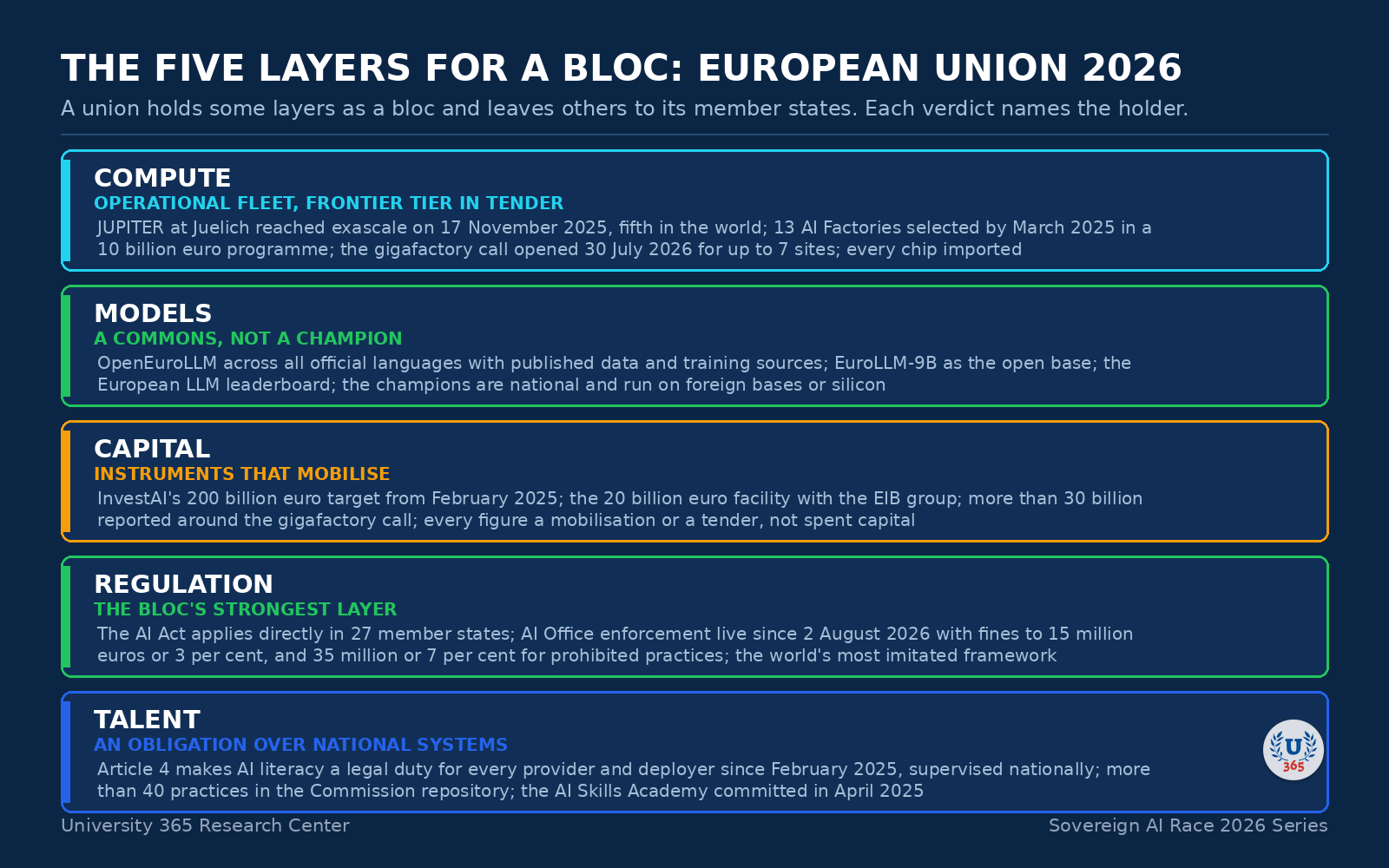
The five layers assessed for a bloc, with the holder named at each layer. University 365 Research Center.
This is the twenty-second report in the Sovereign AI Race series and the first whose subject is not a state. The series assessed twenty countries on one five-layer frame: compute, models, capital, regulation, and talent. A union of twenty-seven member states does not fit that frame cleanly, and this report says so at the top rather than smoothing it over, because the mismatch is itself the finding.
The European Union is not a sovereign. It does not own armed forces, it raises no unified fiscal capacity comparable to a state's, and most of the layers this series measures are, under the treaties, national competences. It does not build chips, it does not train frontier models, and its compute fleet, real as it is, runs entirely on silicon designed and fabricated elsewhere. On any reading that treats sovereignty as ownership of the physical stack, the bloc is in the same position as most of the twenty countries in this series: a user of a stack someone else owns.
And yet the instruction to add this report came from a specific observation, made when the series was nearly complete: the five-layer frame otherwise has no bloc unit, and five of the series' twenty subjects are EU members whose shared posture needs the bloc layer to be explained. Singapore, the United Kingdom, Germany, Spain, Italy, Portugal and Bahrain were grouped in this series as "regulator and host," states whose regulatory layer is genuinely held while their physical layer is foreign-owned. The European Union is that posture's clearest expression, because it is the posture itself, adopted deliberately at continental scale. The bloc knows it will not own the accelerator layer, and it has built a strategy around the layer it can own: the rules that govern everyone who wants to sell AI into its market.
The frame honesty this report owes the reader is a ledger of what is held where. Regulatory sovereignty is held at bloc level, and it is the strongest such case in the series. Shared compute is partly held: the EuroHPC Joint Undertaking operates a fleet that no member state could have built alone, and the JUPITER machine at Juelich is real, verified, operational exascale infrastructure. Bloc capital is an instrument, not a treasury: InvestAI mobilises, it does not disburse. And the remaining layers are national: the member states host the model champions, carry the fiscal weight, and run their own talent systems, with the bloc adding a literacy obligation and a training framework on top. The report assesses each layer in turn, and states at each one whether the holder is the bloc, the member states, or nobody.
Two scope rules apply throughout and are stated here once. First, this report does not re-tread member-state detail: France, Germany, Spain, Italy and Portugal have their own reports in this series, and where this report cites them it does so by title. The United Kingdom is report twelve and is not an EU member. Second, the Oxford Insights index assesses countries, not blocs. No bloc score exists, none is invented here, and where an aggregate is useful the report cites the five member states' verified figures as member-state positions, clearly labelled as such.
The vocabulary this report needs
Four terms recur, and they are defined here once.
Bloc competence. A layer held by the European Union as a matter of law or pooled infrastructure rather than by its member states separately. The AI Act's enforcement and the EuroHPC fleet are the two clearest cases; the report tests each layer against the question.
Direct applicability. The property that makes the AI Act the bloc's strongest sovereignty instrument: a regulation, unlike a directive, applies in all member states without national transposition, so the same obligations bind in twenty-seven jurisdictions at once. Its enforcement still runs partly through national authorities, which is where the layering shows.
Mobilisation figure. A headline that states what public and private money could be drawn in, as distinct from what has been committed or spent. InvestAI's 200 billion euro headline is a mobilisation figure; the report labels every such number accordingly, as the series does everywhere.
The shared fleet. The EuroHPC supercomputing network: national machines, hosted in member states, coordinated and part-financed at bloc level. It is the bloc's one genuinely operational compute asset, and the report treats it as the compute layer's factual core.

Sovereign AI Race: European Union (2026)
The Question
Can a union hold sovereignty over a technology whose hardware it will never make?
The question this report puts to the evidence is the one the bloc's own strategy implies: if you cannot own the chips, can you own something else strongly enough that the dependency stops being decisive?
The answer the evidence supports has three parts.
First, the bloc holds the rules race outright, and the series' twenty country reports show what that is worth. The AI Act applies directly in twenty-seven member states. Since 2 August 2026 its enforcement machinery is live: the Commission's AI Office can demand technical documentation and training-data summaries from general-purpose model providers, run its own evaluations of their models rather than accepting self-assessment, order risk-mitigation measures, and fine providers up to fifteen million euros or three per cent of global turnover, with prohibited practices reaching thirty-five million euros or seven per cent. Those powers reach foreign laboratories: a model provider headquartered outside the bloc that serves EU users falls inside the AI Office's jurisdiction regardless of its address, and the first formal information requests went out in late August 2026 to the frontier providers themselves. The rules race in this series was defined as the contest over who writes the enforceable rules and whose rules are adopted beyond their own jurisdiction. The bloc writes rules that bind the world's most valuable companies inside its market, and its framework is the reference text other countries legislate against. On the series' own definition, that is the race won.
Second, the bloc holds a real but subordinate compute position, and the distinction between its two compute layers is the report's sharpest measurement. The operational layer is genuine: JUPITER at Forschungszentrum Juelich reached one exaflop of double-precision performance on 17 November 2025, the first exascale machine in Europe, and thirteen AI Factories were selected across seventeen member states by March 2025 inside a ten billion euro programme. The frontier layer is a call for tenders: the AI Gigafactories programme, given to the EuroHPC Joint Undertaking by Council Regulation (EU) 2026/150 in January 2026, opened its procurement on 30 July 2026 for up to seven sites, with more than thirty billion euros reported in associated investment and a November 2026 deadline. Both layers run on the same foreign silicon. The report states the split plainly, because conflating a fleet with a frontier is the category error the series was built to catch.
Third, the layers the bloc does not hold are the ones its member states hold or nobody does. There is no EU frontier model: the bloc funds open research consortia that publish data and training sources, which is a real contribution to the model commons, and the champions that exist are national companies running on foreign bases and foreign silicon. The bloc's capital instruments mobilise rather than own. And the talent layer is a shared obligation laid over national systems. The question's answer, in one sentence: a union can hold the rules, part-hold the compute, and must rent the rest, and the European Union has understood this well enough to build its strategy on exactly the layer it can hold.

Sovereign AI Race: European Union (2026)
The Contradiction
The bloc regulates the frontier it does not own, using power over the companies that do
The central contradiction of the European position is not that the bloc lacks compute. It is that the bloc's exercise of sovereignty is most visible exactly where its ownership is weakest, and that this inversion works.
When the AI Office issued its first requests for information to the frontier model providers in late August 2026, covering model safety, external evaluation, post-deployment monitoring and training-data disclosure, the European Union was exercising authority over companies whose models were trained on hardware the bloc does not make, in data centres the bloc does not own, under corporate structures the bloc does not control. Within weeks, reported coverage put the number of providers receiving such requests above thirty. The bloc's enforcement power runs through a market access condition: serve European users, and European rules apply. That is a genuine sovereignty, exercised by jurisdiction rather than ownership, and it is the only case in this series where a subject's power over the frontier layer comes entirely from law.
The contradiction has a second face, which is the price of the first. Because the bloc cannot enforce everything it has written, it has had to choose, and the choice is visible in the Digital Omnibus. Regulation (EU) 2026/1744, in force since 27 July 2026, deferred the standalone high-risk obligations under Annex III from 2 August 2026 to 2 December 2027, and the embedded high-risk obligations to 2 August 2028. What the deferral left untouched is instructive: the prohibitions, the general-purpose model duties, and the investigative and fining powers all stayed live. The bloc is enforcing the rules it can administer at bloc level, against the providers it can reach directly, and has delayed the rules whose enforcement requires national conformity-assessment capacity that, as the series' own member-state reports documented from below, is still being staffed. Italy's law is in force with implementation complete and its enforcement distributed across existing regulators; Spain built the Union's first AI supervisory agency while its national statute remains a bill; Germany is the strongest national enforcement layer in Europe; France's penalty provisions were still pending; Portugal designated its coordinator six weeks after the deadline. The bloc layer is uniform; the enforcement layer beneath it is not.
The third face of the contradiction is financial. InvestAI's headline, announced at the Paris AI Action Summit in February 2025, is the mobilisation of two hundred billion euros for AI investment. The InvestAI Facility targets twenty billion for infrastructure, built around the European Investment Bank group. The gigafactory call reports more than thirty billion in associated investment. Every one of these is real as an instrument and none is a treasury: the bloc multiplies and coordinates capital that member states and private investors must actually supply, and the member states' own positions, recorded in their reports, include pledge packages whose disbursed share lags their headlines. The series' comparison is unavoidable and worth stating once: the United Arab Emirates' single AI fund closed at forty-nine billion dollars of committed equity, and Saudi Arabia's national champion is state-owned outright. The bloc's capital layer is more distributed, more conditional and more honestly described than either. Whether it is stronger is not a question the evidence yet settles, and the report does not pretend otherwise.
The contradiction resolves into the series' central finding, restated for a bloc. Compute is the layer that cannot be acquired at speed, bought at any scale, or protected by any means available to a subject that does not make it. Rules are the layer a subject can hold with drafting capacity and market access. The European Union holds the rules, part-holds the compute, and rents the rest, and the interesting fact is not that it rents. It is that it has built the only strategy in this series that treats the rental as permanent and the rules as the asset.

Sovereign AI Race: European Union (2026)
The Current State
Compute: a real fleet, no producer, and a frontier tier under procurement

Strasbourg. The bloc's compute programme is a procurement before it is a machine: the gigafactory call opened on 30 July 2026 for up to seven sites. Photograph: Pexels License, via Pexels.
The bloc's compute position divides into three layers with three different statuses, and the division is the section's whole point.
The operational layer is the EuroHPC fleet, and it is real. JUPITER at Forschungszentrum Juelich reached one exaflop of double-precision performance on 17 November 2025, the first exascale system in Europe, and ranked fifth on the TOP500 list in June 2026, powering more than one hundred and twenty research projects. Around it sits a fleet of pre-exascale machines that are bloc co-funded and nationally hosted: LUMI in Finland, the AMD-powered system that Counterpoint Research identified as the main non-NVIDIA foothold among European sovereign models; MareNostrum 5 in Barcelona, quoted at 314 petaflops of peak performance for a total investment of 223 million euros, built by Eviden with Intel, Lenovo and NVIDIA technology; Leonardo at CINECA in Bologna, whose campus signed the IT4LIA AI Factory contract in April 2026; and Alice Recoque, the second EuroHPC exascale machine, under procurement in France with an order value reported at five hundred million euros. The thirteen AI Factories selected by March 2025 across seventeen member states, inside a ten billion euro investment envelope for the 2021 to 2027 period, complete the operational and near-operational picture. This is a genuine shared asset: no single member state, not even Germany or France, could have assembled this fleet alone, and pooling is the only route by which European public compute reached the exascale tier.
The announced layer is the AI Gigafactories programme, and it is a procurement. Council Regulation (EU) 2026/150, adopted in January 2026, handed the gigafactory mandate to the EuroHPC Joint Undertaking, the body that already ran the supercomputer fleet. The call opened on 30 July 2026 for up to seven facilities, each equipped with a very large number of state-of-the-art AI processors and combining high-speed connectivity and energy-efficient data centres, with more than thirty billion euros reported in associated investment, a deadline of 12 November 2026, and sites of more than one hundred thousand processors contemplated. The report labels this for what it is at its date: a tender, not capacity. The distinction matters doubly here because the programme's scale claims are the bloc's answer to the Gulf's campuses and the American hyperscale build, and the honest comparison at the moment of writing is between a gigawatt-class campus that exists and a call for tenders that does not.
The third layer is the dependency, and it is total. Every system named above runs on silicon designed and fabricated outside the bloc. JUPITER on NVIDIA Grace-Hopper superchips; MareNostrum 5 with Intel and NVIDIA technology; LUMI on AMD; Alice Recoque and the gigafactory sites procured from the market as it stands. The one leading-edge fabrication plant planned for the series' European subjects, Intel's thirty billion euro Magdeburg project, was cancelled, and nothing has filled the gap. Counterpoint Research's finding that NVIDIA trains ninety-two per cent of sovereign models worldwide applies to the bloc's models as much as to anyone's, and the bloc has no accelerator programme of its own comparable to what its own member-state reports recorded elsewhere. The compute verdict for the bloc is therefore the same verdict as for most of the twenty countries, with one improvement and one caveat: the improvement is that the fleet is pooled and genuinely operational at exascale, and the caveat is that every chip in it is imported. The bloc is a first-class operator of second-hand sovereignty.
Models: a funding layer, open consortia, and no bloc champion

The table, the book, and the warehouse behind the glass. University 365 Research Center.
The bloc does not build frontier models, and it has chosen not to pretend otherwise. What it builds instead is the infrastructure of openness, and this is the layer where the European approach differs most from every other subject in the series.
The flagship bloc instrument is OpenEuroLLM, the European open-source model consortium with more than twenty partners across the continent, funded to build a family of large language models covering all official EU languages with published data, training sources and models. Its participants, named across the series' member-state reports, include Fraunhofer and the Juelich centre in Germany, the Barcelona Supercomputing Center in Spain, and CINECA in Italy, and it held its international workshop on open source sovereign foundation models in Cologne in May 2026. Beside it sits EuroLLM, the open base model that Portugal's AMALIA consortium stacked Portuguese language data onto, which is the pattern worth naming: a member state can take the bloc's open base and own its language layer on top of it. The European LLM leaderboard, built alongside Germany's OpenGPT-X work, provides the bloc's own evaluation surface, and the AI Act Service Desk supports implementers with guidance rather than penalties as its first tool.
The distinction that matters, and that the series' China report established for the whole field, is between publishing weights and publishing the method. OpenEuroLLM's mandate includes published data and training sources, which is a stronger form of openness than the weights-only releases that dominate the sovereign model field, and it is the bloc's genuine contribution to the model commons. The report names it as such without inflating it: open data and open methods are a public good and not a frontier capability, and both things can be true of the same programme.
The champions that exist are national and were assessed in their own reports. France's Mistral ships open weights on licence terms reported as Apache 2.0, trained on NVIDIA processors it cannot make or license, and exports its base outward; its 675 billion total parameters and 41 billion active place it at the European frontier and below the American and Chinese one. Germany's research base publishes multilingual open models, with Teuken-7B trained from scratch in all twenty-four official EU languages, while its commercial champion, Aleph Alpha, was combined with the Canadian laboratory Cohere, with roughly ninety per cent of the combined entity going to Cohere's shareholders. Spain holds one of Europe's strongest public model infrastructures with an honest boundary. Italy holds the series' strongest from-scratch national model case, trained on Italian public hardware. Portugal holds the smallest defensible version of model sovereignty, executed and released openly. None of these is a bloc asset, and the bloc layer adds no model of its own: the honest verdict for this layer is that the European Union funds a commons, hosts a leaderboard, and leaves the champions to its member states, which is a coherent strategy for a union that cannot own a laboratory and can own a library.
Capital: instruments that mobilise, and member states that fund
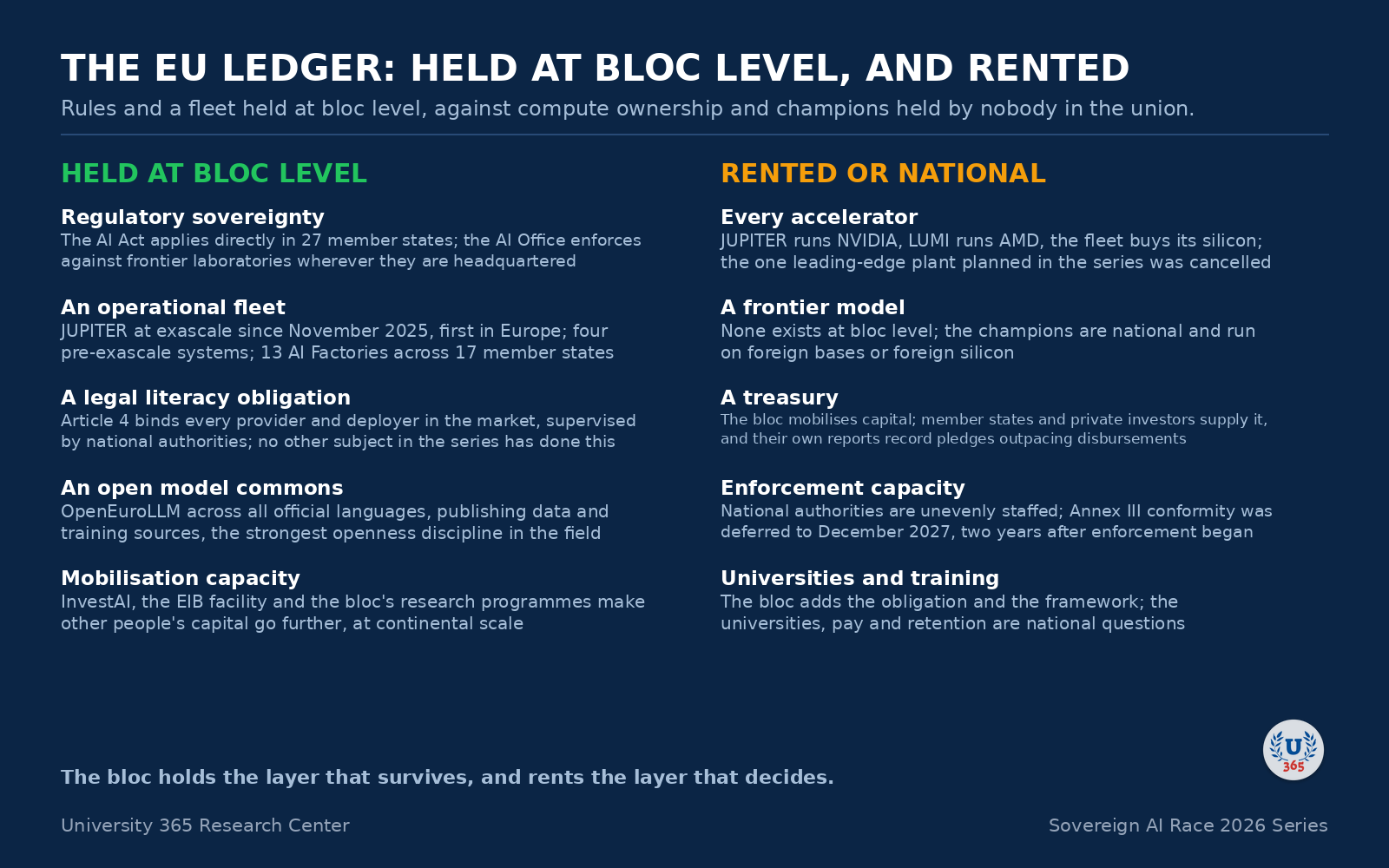
What the bloc holds, against what it rents or leaves to member states. University 365 Research Center.
The bloc's capital layer is where the difference between a union and a state shows most clearly, because the European Union cannot levy the money its strategy needs. What it can do is multiply, coordinate and de-risk, and the instruments it has built for those three functions are real.
InvestAI, announced by Commission President von der Leyen at the Paris AI Action Summit in February 2025, aims to mobilise two hundred billion euros for AI investment in the Union, and the InvestAI Facility within it targets twenty billion for AI infrastructure, notably the gigafactories, developed in collaboration with the European Investment Bank group and designed to crowd in private investment alongside EU budget grants and guarantees. The gigafactory call that opened in July 2026 reports more than thirty billion euros of associated investment. The Horizon Europe and Digital Europe programmes fund the research and adoption lines, with generative AI calls under the GenAI4EU initiative reaching close to seven hundred million euros across health, cybersecurity, energy and other sectors in early 2026. Together these are a coherent capital architecture, and the architecture's defining property is that every figure in it is a mobilisation or a tender: the bloc's role is to make other people's money go further, and the report labels each number at that status.
The comparison the series makes possible is exact, and this report states it once without moralising. The United Arab Emirates' MGX closed a single fund at forty-nine billion dollars of committed equity in July 2026, and Saudi Arabia's HUMAIN is state-owned outright, funding hundreds of thousands of accelerators to a multi-gigawatt pipeline. The European Union moves a larger headline, two hundred billion euros, through an instrument that must attract rather than command the capital, while its member states carry fiscal positions documented in their own reports: France's hundred and nine billion euro pledge aggregate from the 2025 summit, of which the state's own coverage distinguished firm commitments from conditional components; the same distinction applied to the ninety-three billion euros of the Choose France 2026 package, of which forty-five billion were firm; Germany's funding recorded as real and fragmented by design. None of this makes the European approach wrong. It makes it conditional, and conditionality is the property the series' capital layer measures.
Regulation: the bloc's strongest layer, now with teeth
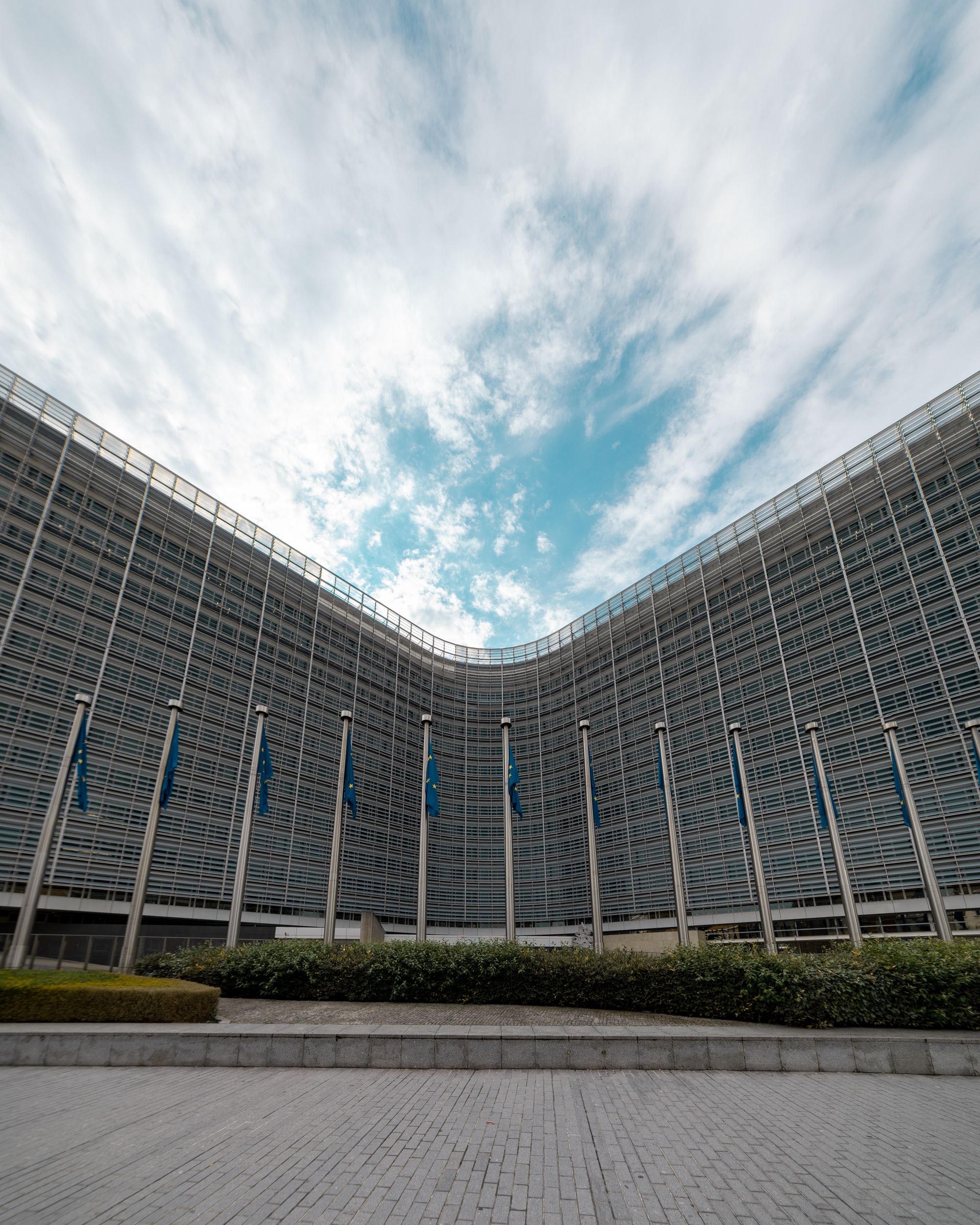
Brussels. Since 2 August 2026 the AI Office can compel documentation, evaluate models and fine general-purpose providers up to 15 million euros or 3 per cent of global turnover. Photograph: Pexels License, via Pexels.
This is the layer the report exists to assess, and it is the only layer in the series' twenty-two subjects where the holder's sovereignty is a matter of law rather than ownership.
The instrument is the AI Act, Regulation (EU) 2024/1689, in force since 1 August 2024 and applied in stages: general provisions and prohibitions from 2 February 2025; the general-purpose AI model rules from 2 August 2025; Article 4's AI literacy obligation, which requires providers and deployers to ensure sufficient literacy among their staff and anyone operating their systems, from 2 February 2025; and Article 50 transparency obligations from 2 August 2026. What changed the layer's status, and what the last twelve months added, is enforcement. Since 2 August 2026 the Commission's AI Office has held the powers that turn obligations into exposure: it can demand technical documentation and training-data summaries, run its own evaluations of models rather than accepting vendor self-assessment, require corrective and risk-mitigation measures with deadlines, and, in serious cases, seek the restriction, withdrawal or recall of a model from the EU market. Its fining authority under Article 101 reaches fifteen million euros or three per cent of global turnover for general-purpose model breaches, and the Act's general tiers run to fifteen million or three per cent for most operator obligations including Article 50, thirty-five million or seven per cent for prohibited practices under Article 5, and seven and a half million or one per cent for supplying incorrect or misleading information to regulators.
The first enforcement months have produced dockets rather than verdicts, and the report states them at that status. On 29 August 2026 the AI Office sent its first formal requests for information to major general-purpose model providers, covering model safety, independent external evaluation, post-deployment monitoring and training-data summary disclosure, and reported coverage put the number of providers receiving similar requests above thirty by late September, a figure the report carries as reported. The first coordinated inspection wave worked with national market surveillance authorities, reported at twenty-four of them, and centred on recruitment software, credit scoring, education systems and health triage: the Annex III categories whose conformity obligations the Omnibus deferred, now being probed through the transparency and prohibited-practices routes that remain live. Two structural facts follow and both belong in the reader's understanding. First, the process itself is the exposure: answering a regulator incompletely is a fineable offence independent of any underlying breach, and the documentation a provider must hold is precisely the set the AI Office can compel. Second, the enforcement chain runs through national authorities for everything except general-purpose models, which is why the bloc's uniform law meets an uneven enforcement floor, the pattern the member-state reports documented from below.
The simplification that accompanied enforcement is the layer's internal tension, and the report treats it as design rather than retreat. The Digital Omnibus on AI, Regulation (EU) 2026/1744, entered into force on 27 July 2026 and deferred standalone Annex III high-risk compliance to 2 December 2027 and embedded high-risk obligations to 2 August 2028, with the Council having agreed its position on the underlying package in March 2026. What did not move is the point: the prohibitions, the general-purpose model duties, the Article 50 transparency rules and the AI Office's investigative powers all went live on schedule. The bloc enforced what it can administer centrally and delayed what requires member-state conformity-assessment capacity that is still being built. That is a strategy, not a weakness, and the series can name it precisely: the European Union wrote the broadest rulebook in the world and then sequenced its enforcement to match its own capacity, which is what the states in this series with functioning regulators do, and what the states with unenforced statutes do not.
One further element belongs in this layer's account. The bloc's regulatory reach extends beyond its own market. Its framework is the reference text for the other subjects' legislation: the United Kingdom's regulator-led approach, Brazil's unenforced statute, South Korea's early comprehensive law, India's voluntary guidelines and Japan's promotion statute were all written in the AI Act's shadow, with risk tiers, prohibited practices and conformity concepts travelling with them. Article 50's transparency duties bind any provider serving EU users regardless of headquarters, and the AI Office's jurisdiction over general-purpose model providers reaches foreign laboratories directly. The rules race in this series asked who writes the enforceable rules and whose rules travel. Both answers, for this subject, are the same body of law.
Talent: an obligation where other subjects have a programme
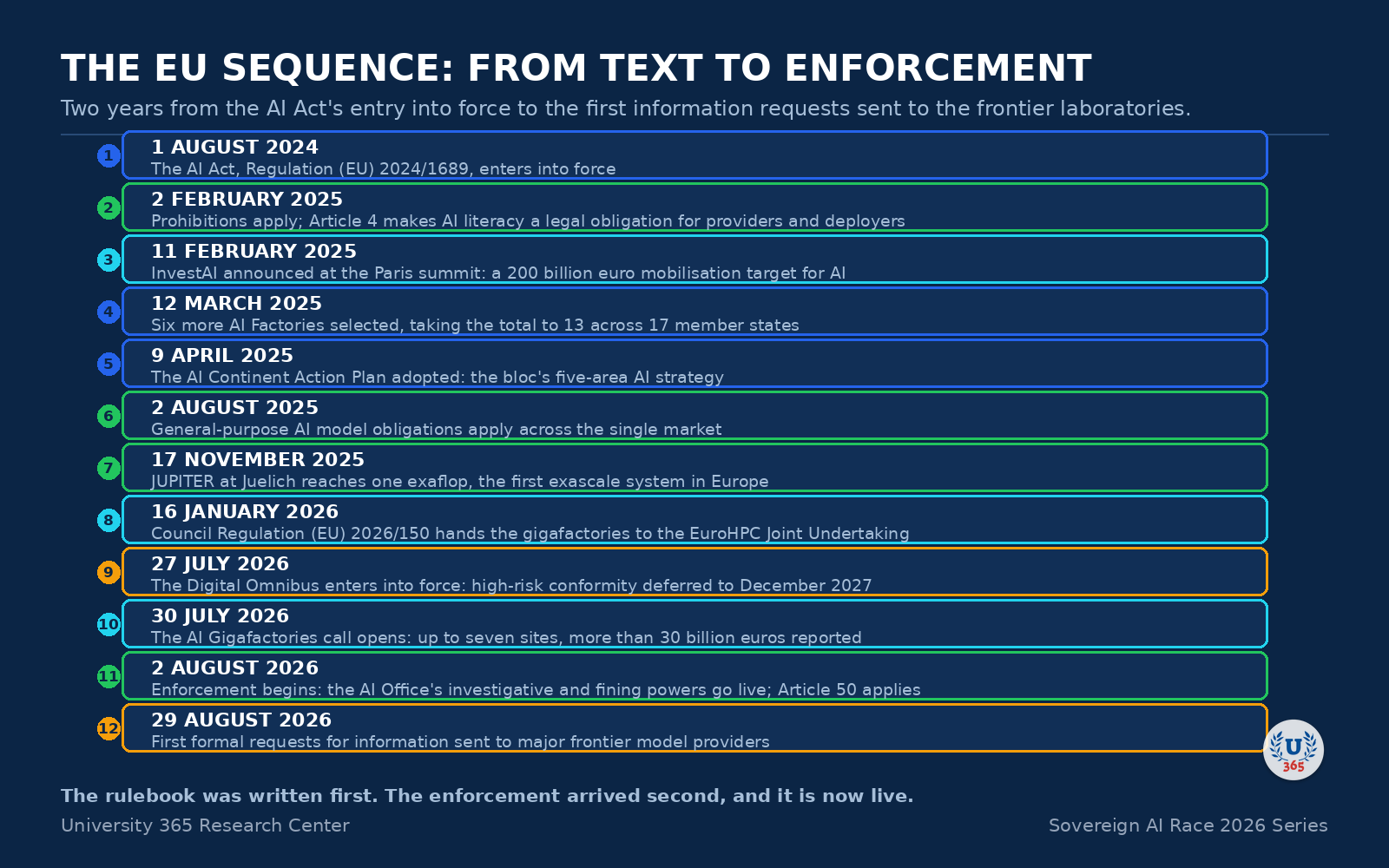
The EU sequence: from the Act's entry into force to the first enforcement requests. University 365 Research Center.
The bloc's talent layer is the most unusual in the series because its strongest instrument is not a programme at all. Article 4 of the AI Act makes AI literacy a legal obligation: providers and deployers must take measures to ensure a sufficient level of literacy among their staff and others operating AI systems on their behalf, taking account of technical knowledge and the context of use, and national market surveillance authorities supervise it. It entered into application in February 2025, which makes it one of the first provisions of the Act to bind, and it applies irrespective of risk classification, which makes it the broadest skills mandate any subject in this series has issued. The Commission's support infrastructure followed: a detailed Q&A, and a repository of more than forty AI literacy practices collected from companies and the public sector across two surveys, published with the Erasmus-funded ARISA project.
Around the obligation sit the bloc's programmes. The AI Skills Academy, set out in the AI Continent Action Plan of April 2025, is to offer education and training including generative AI, upskill and reskill students and professionals across key sectors, and develop a pilot generative AI-focused degree, aggregating courses from the European Digital Innovation Hubs, the AI Factories, the EIT's Knowledge and Innovation Communities and the Interoperable Europe Academy. The fellowship schemes are designed to keep European doctoral talent and attract it back, and the Talent Pool initiative, the Multipurpose Legal Gateway Offices, the Talent Partnerships and the MSCA Choose Europe action address recruitment from outside the bloc. The Apply AI Strategy attacks the adoption gap that makes skills matter, with the Commission's own figure, thirteen and a half per cent of EU companies using AI, as the baseline it was written against.
The honest verdict runs through the member states, because the universities are national and the bloc layer is a frame over them. The series' five EU members each hold real university systems, and their reports recorded the same pair of problems in different proportions: strong supply on paper and weak matching to industry, with pay and retention as the binding constraints at the national level. What the bloc adds is the obligation that every employer use AI competently, the shared curriculum infrastructure to make that possible, and a training market whose scale is continental. For the CI-First lens this report applies later, that combination is the most relevant thing about the European Union: it is the only subject in the series that has made the human capacity to judge AI systems a legal requirement rather than a policy ambition, and the requirement binds everyone who deploys the technology, not just those who build it.
What changed since our March 2025 report on Europe

Read the earlier report: Europe's AI Landscape, March 2025: Leading the Way in Regulation While Racing for Innovation. University 365 INSIDE, 16 March 2025.
The prior University 365 report on this subject, "Europe's AI Landscape, March 2025: Leading the Way in Regulation While Racing for Innovation", published on 16 March 2025, is this report's baseline, and six of its claims can now be tested.
The AI Act moved from implementation to enforcement. The March 2025 report recorded the framework as nearing full implementation and described Europe as leading on regulation. That call held. What it could not record is what came next: the staged application of the prohibitions in February 2025 and the general-purpose model rules in August 2025, the entry into force of the Digital Omnibus on 27 July 2026 with its deferral of the high-risk conformity track, and, decisively, the enforcement phase that began on 2 August 2026, when the AI Office gained the power to compel documentation, evaluate models and fine. The earlier report was right that regulation was Europe's lead; the interval converted the lead from a text into an apparatus.
Adoption moved, and the earlier figure is the honest baseline. The March 2025 report recorded 13.5 per cent of EU enterprises with ten or more employees using AI in 2024, up from 8 per cent in 2023, and generative AI penetration of 38 per cent in companies across Europe. The current verified member-state figure in this series, Portugal's 17.06 per cent of enterprises using AI in 2025, sits below an EU average of 19.95 per cent: the direction of the earlier report's reading was correct, the level remains low, and the gap between the bloc's regulatory ambition and its adoption reality is the interval's most persistent feature.
The compute programme moved from founding to a fleet plus a tender. The March 2025 report recorded AI factories being established across the continent. The interval delivered JUPITER reaching exascale on 17 November 2025, the first such system in Europe and fifth in the world in June 2026; thirteen AI Factories selected by March 2025 across seventeen member states; and the gigafactory call of 30 July 2026 for up to seven sites. The earlier report's programme became an operational fleet and an open procurement, and every one of its machines still runs on imported silicon.
Capital gained a bloc instrument with a declared target. The March 2025 report described Europe's funding position as the third-largest sector, led by France, Germany and the United Kingdom, and noted the continent's growth rate. The interval added InvestAI, announced in February 2025 with a two hundred billion euro mobilisation target, and the thirty billion euro gigafactory call of July 2026. The earlier report's market description stands; what it did not have was a bloc-level capital instrument, and the caveat this report applies is that every figure on that instrument is a mobilisation, not a disbursement.
Skills moved from diffusion to obligation. The March 2025 report treated generative AI uptake as a market development. Since February 2025, Article 4 of the AI Act has made AI literacy a legal duty for every provider and deployer in the single market, supervised by national authorities, with a Commission repository of more than forty practices and the AI Skills Academy committed in April 2025. The earlier report predates all three instruments, and the movement they represent is the interval's most consequential for readers of this series: the layer that survives, made a requirement.
The frame itself changed. The March 2025 report surveyed Europe as a landscape of countries, ranking adoption leaders and funding centres. This report's subject is the bloc's own instruments, because the interval concentrated them: the AI Act's enforcement, the EuroHPC fleet, InvestAI, the open consortia and the literacy obligation are all bloc-level facts that a country-by-country survey cannot measure. The earlier report's country analysis remains accurate for its date; the union it surveyed has since acquired a sovereignty that belongs to none of the countries in it alone.
One sentence closes the comparison. The interval did not change the European position in the way the earlier report hoped, because Europe did not become a compute power. It changed the position in the way the earlier report's own evidence recommended: the rulebook became an enforcement apparatus, the fleet became exascale, and the skills layer became an obligation.

Sovereign AI Race: European Union (2026)
Key Findings
1. The European Union is the series' purest regulator-and-host case, and the posture is deliberate. The bloc holds regulatory sovereignty outright, part-holds compute and capital, and leaves models and most talent to its member states. It is not a weak version of a sovereign state; it is a different kind of sovereignty, exercised through law and pooled infrastructure, and it is the honest expression of the position most of the world actually occupies.
2. The rules race is won, by the series' own definition. The AI Act applies directly in twenty-seven member states. Since 2 August 2026 the AI Office can compel documentation, evaluate models itself, order remedies and fine general-purpose model providers up to fifteen million euros or three per cent of global turnover, with prohibited practices reaching thirty-five million or seven per cent. The powers reach providers wherever they are headquartered, and the first requests for information went to the frontier laboratories in August 2026.
3. The enforcement that arrived is narrower than the regulation, and the narrowing is a capacity decision. The Digital Omnibus deferred Annex III high-risk conformity to December 2027 while leaving prohibitions, general-purpose duties, transparency and investigative powers live. The bloc is enforcing what it can administer centrally and delaying what needs member-state machinery that its own reports show is still being staffed.
4. The compute layer is real at the fleet tier and a tender at the frontier tier. JUPITER reached exascale in November 2025, first in Europe, fifth in the world; thirteen AI Factories were selected by March 2025 inside a ten billion euro envelope. The gigafactories are a call for tenders, opened 30 July 2026 for up to seven sites with more than thirty billion euros reported, and every chip in every tier is imported.
5. There is no EU frontier model and the bloc has stopped implying one. The bloc funds open consortia that publish data and training sources, a stronger openness discipline than the weights-only releases that dominate the field, and leaves the champions to France, Germany, Italy, Spain and Portugal, whose reports assess them separately. The strategy is a library, not a laboratory, and it is coherent as such.
6. The capital instruments mobilise rather than own. InvestAI's two hundred billion euro headline and the facility's twenty billion for infrastructure, the more than thirty billion associated with the gigafactory call: every figure is a mobilisation or a tender. The contrast with the Gulf's committed equity and state ownership is structural, and the report states it as arithmetic.
7. The bloc has made AI literacy a legal obligation, which no other subject in the series has done. Article 4 binds providers and deployers across the market, supervised by national authorities, with a Commission repository of more than forty practices behind it. For a series whose central finding is that the human layer survives everything, this is the most consequential single instrument the European Union has written.
8. What changed since our March 2025 report is enforcement, not ambition. The prior report recorded the AI Act approaching implementation and adoption at thirteen and a half per cent of enterprises. The interval delivered staged application, live enforcement powers, the exascale JUPITER, the gigafactory call, and Article 4 in force. The framework moved from being implemented to being enforced; the adoption gap and the dependency on foreign silicon did not move.
9. The bloc's position on the Oxford index must be read as member states, not as a bloc. No bloc score exists. The five members' verified standings, France second at 80.81, Germany sixth at 76.78, Spain thirteenth at 74.22, Italy twenty-fifth at 68.81 and Portugal twenty-eighth at 66.09 of 195 countries, are national positions and are labelled so throughout.
10. The bloc's sovereignty is the layer that survives, and it is the only subject in the series that has built its strategy on that fact explicitly. Where Bahrain lost its compute to war and kept its rules, the European Union never held the compute and has concentrated on the rules from the beginning. The demonstration case and the bloc case are the same finding approached from opposite directions: what a subject cannot lose is what it has written and taught.

Sovereign AI Race: European Union (2026)
Deep Analysis
The Brussels effect, measured rather than assumed

Strasbourg at night. The bloc's framework is the reference text other jurisdictions legislate against. Photograph: Pexels License, via Pexels.
The bloc's regulatory power is often described as influence. This report measures it as sovereignty, and the measurement has three parts.
The first part is direct applicability. A European regulation applies in all member states without transposition, so a single legal text binds twenty-seven jurisdictions simultaneously. The AI Act's obligations do not wait for national parliaments, and the prohibitions under Article 5, the general-purpose model duties and the transparency rules have applied across the single market on the bloc's own timetable. Compare this with the fragmented pattern the series found elsewhere: India's voluntary guidelines with no legal enforceability, Brazil's statute awaiting its vote, Bahrain's law unenacted since 2024. The bloc's first advantage is that its rules exist in force.
The second part is market access. Jurisdiction attaches to serving EU users, not to corporate domicile, and the AI Office's enforcement reaches any general-purpose model provider that places a model on the European market, including non-EU providers, who must appoint an authorised representative inside the Union. The first enforcement wave's formal requests for information went to the frontier laboratories, which is the test case: the world's most valuable AI companies answering a European regulator about models they trained on American silicon. The series' twenty countries include several that regulate foreign platforms and one, the United Kingdom, whose most consequential AI rules come from its competition authority; none exercises authority over the frontier model layer the way the bloc now does.
The third part is imitation, and here the report is careful about causality. The AI Act's concepts travelled into other jurisdictions that legislated afterwards: risk tiers and prohibited practices appear in South Korea's framework, the United Kingdom's regulator-led approach, Japan's sovereignty definition, and the debates the series recorded in India and Brazil. This is not proof that each borrowed from the act, and the report does not claim it. What the pattern establishes is that the bloc set the reference vocabulary for the field's rules race, which is the softest and most durable form of regulatory power: when other regulators describe their instruments in your concepts, your instrument has become the baseline.
The measurement has a limit, and honesty requires stating it. The bloc's reach depends on its market remaining worth the compliance cost, and its enforcement capacity remains a fraction of its ambition: the first dockets are months old, the inspection wave worked with twenty-four national authorities rather than a bloc-wide inspectorate, and the high-risk conformity regime that gives the act its teeth in employment, credit and education will not apply until December 2027. The Brussels effect is real and this report measures it as the bloc's genuine sovereignty; the reservation is that a rulebook enforced at a fraction of its scope is a claim on the future as much as a fact of the present.
What the bloc's compute programme is actually buying
The gigafactory programme deserves the closest reading in this report, because it is the bloc's largest single bet and its structure determines what it can ever deliver.
Begin with the design. The programme pools: the EuroHPC Joint Undertaking buys, hosts and connects capacity that member states could not individually reach, in the same way the fleet programme pooled its way to exascale. It multiplies: the public contribution is sized to attract private capital several times over, which is why every published figure is described as mobilising or associated investment rather than expenditure. And it conditions: sites are selected through a competitive call with a processor-count floor, which is a bloc-level industrial policy exercised through procurement rather than subsidy. None of these properties is accidental, and together they are the bloc's answer to the Gulf's capital and the American hyperscale build: a governed market for shared compute rather than a state-owned campus fleet.
Now the arithmetic. A gigafactory as contemplated holds more than one hundred thousand state-of-the-art processors, and a Gulf campus in the series was planned at gigawatts with campuses measured in tens of square kilometres. The order of magnitude between the two is real and it reflects different strategies rather than incompetence: the bloc is buying research and public-sector capacity for models its member states will build, not the training substrate for a frontier laboratory racing the American and Chinese frontier, because no European laboratory at that frontier exists to be served. The programme's success condition is therefore specific and the report states it: if the member states' champions and research consortia use the gigafactories to train competitive non-frontier models in European languages and domains, the investment compounds through the layer the bloc can actually hold; if the sites are built and stand under-used, the bloc will have funded the same category of asset its member-state reports recorded standing at fractions of announced capacity in several countries of the series.
The dependency caps what any of it changes. Every processor in the programme will be imported, under licensing regimes the bloc does not write, from vendors whose home governments have, within the series' own observation window, tightened and loosened export rules and demonstrated the capacity to sequence frontier access as an instrument of policy. The bloc's compute programme therefore buys scale, redundancy and training capacity for European users, all real, and it cannot buy the one property the series defines as compute sovereignty: the absence of a foreign licensing choke point the subject cannot influence. The report's compute verdict for the bloc is exactly this sentence with both halves intact.
The three races, measured for the bloc
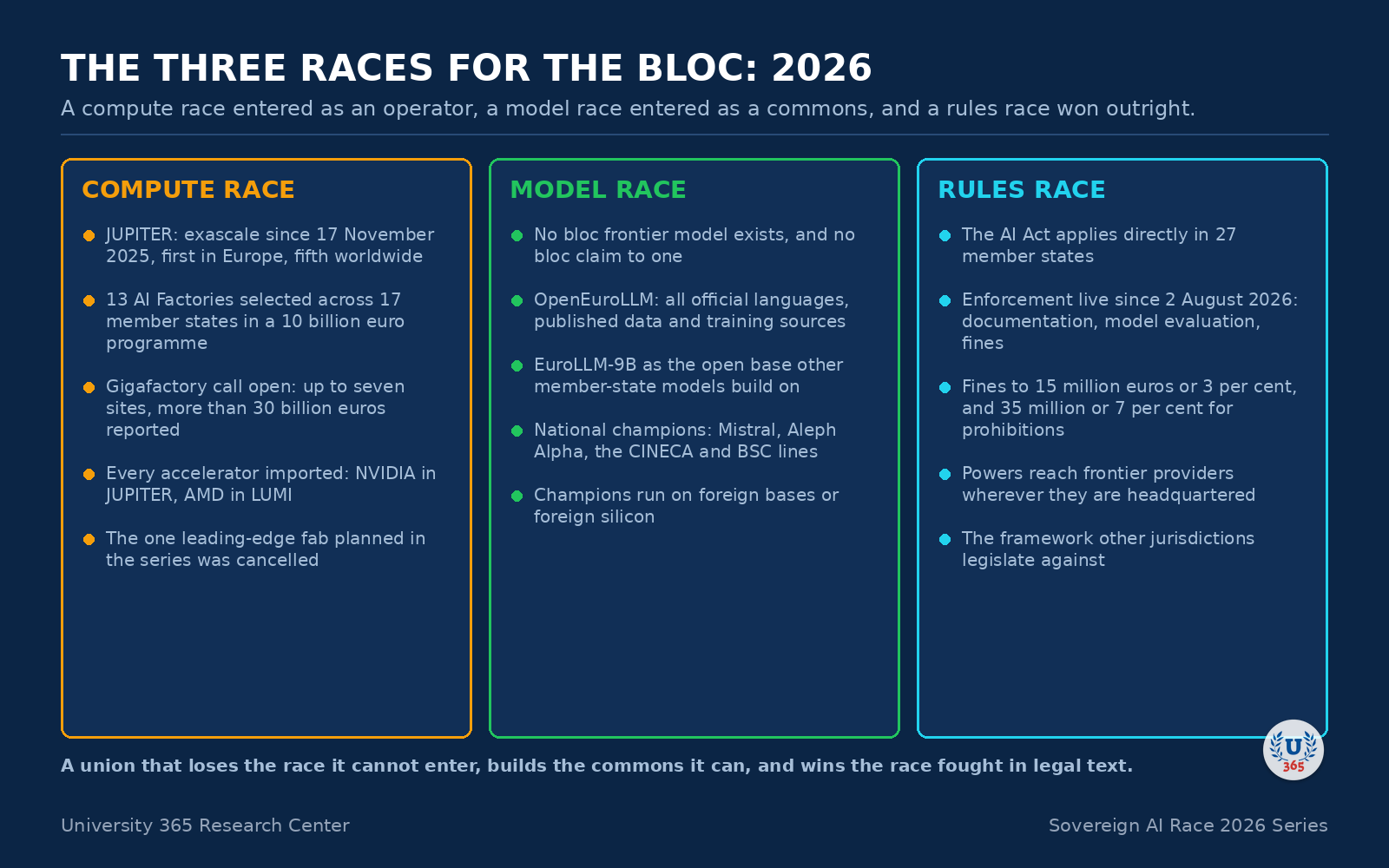
The three races for the bloc, at three different outcomes. University 365 Research Center.
In the compute race, the bloc is an operator with a real fleet and no producer, with a frontier tier under procurement and every accelerator imported. Its finish is the strongest position short of ownership in the series: exascale operational, a pooled thirteen-site factory network, a seven-site frontier tier in tender, and a total dependency on foreign silicon that no published programme will change before 2030.
In the model race, the bloc is a commons-builder rather than a champion-builder: open consortia publishing data, sources and models across all official languages; a continental evaluation leaderboard; and member-state champions each assessed in their own reports, none at the American or Chinese frontier, several running on foreign bases or absorbed into foreign ownership. Its finish is the field's best openness discipline attached to no frontier claim, which is a deliberate allocation of a research budget that cannot buy the frontier and can buy something the frontier will need.
In the rules race, the bloc is the winner, and the series' only unambiguous one. It wrote the broadest enforceable framework in the world, gave its central enforcer the powers to reach foreign model providers, began exercising them within the year, and set the vocabulary the other subjects' legislation speaks. Its finish is the demonstration that the rules race's prize goes to the subject with the largest market and the most drafting capacity, and the European Union holds both.
The three finishes share one sentence, which is the report's summary: the bloc loses the race it cannot enter, builds the commons it can, and wins the race fought in legal text, which is the only race in this series that survives every physical loss the others carry.

Sovereign AI Race: European Union (2026)
Data and Evidence
Table 1: The five layers, assessed for the European Union in September 2026
Layer | What the bloc holds | What it does not hold | Verdict |
Compute | A real shared fleet: JUPITER at exascale since November 2025, first in Europe; thirteen AI Factories selected by March 2025; a gigafactory call open for up to seven sites | Accelerator design and fabrication; every chip in the fleet imported; the frontier tier is a tender, not capacity | Operational fleet, no producer, frontier tier under procurement |
Models | A funded commons: OpenEuroLLM across all official languages with published data and sources; EuroLLM-9B as an open base; the European LLM leaderboard | A frontier model of the bloc's own; the champions are national and run on foreign bases or foreign silicon | A library, not a laboratory |
Capital | Mobilisation instruments: InvestAI's 200 billion euro target; the 20 billion euro facility with the EIB group; more than 30 billion euros associated with the gigafactory call | A treasury; every figure is a mobilisation or a tender, and the funding weight sits with member states and private investors | Instruments that mobilise, member states that fund |
Regulation | The AI Act, directly applicable in 27 member states, with AI Office enforcement live since 2 August 2026: documentation compulsion, model evaluation, remedies, fines to 15 million euros or 3 per cent (GPAI) and 35 million or 7 per cent (prohibited practices) | Uniform enforcement capacity: the national floor is uneven and still staffing; Annex III conformity deferred to December 2027 | Held, and the strongest in the series |
Talent and education | A legal literacy obligation: Article 4 in force since February 2025 across all providers and deployers; the AI Skills Academy commitment; a repository of more than 40 practices | The universities and most training capacity, which are national; matching and retention remain member-state problems | An obligation over national systems |
Table 2: The controlled metrics, series bible format
Metric | EU position | Source and date |
Flagship compute commitment | JUPITER exascale at Juelich, one exaflop, operational 17 November 2025, fifth on TOP500 June 2026; 13 AI Factories selected across 17 member states, EUR 10 billion over 2021-2027; AI Gigafactories call opened 30 July 2026 for up to seven sites, more than EUR 30 billion reported, deadline 12 November 2026 | EuroHPC JU; AI Continent Action Plan COM(2025)165; Commission news, 30 July 2026 |
Capital committed | InvestAI: EUR 200 billion mobilisation target (February 2025); InvestAI Facility EUR 20 billion for infrastructure with the EIB group; gigafactory call more than EUR 30 billion associated investment; GenAI4EU calls close to EUR 700 million (Q1 2026) | COM(2025)165, 9 April 2025; Commission news, 30 July 2026 |
Flagship models | No bloc model. OpenEuroLLM: consortium of more than 20 partners, all EU official languages, published data and training sources. EuroLLM-9B as the open base. Member-state champions cited by title only | OpenEuroLLM; Germany, Spain, Italy and Portugal reports, as published |
Anchor entities | European Commission (AI Office; DG CNECT); EuroHPC Joint Undertaking; European Investment Bank group; national authorities for enforcement | Official EU institutional records, 2024-2026 |
Chip dependency | Total at the accelerator layer: JUPITER on NVIDIA Grace-Hopper; LUMI on AMD; MareNostrum 5 with Intel and NVIDIA technology; no EU fabricator; the planned Magdeburg plant cancelled | Germany report (report 11); Counterpoint Research, 5 August 2026 |
Regulatory instrument and status | AI Act, Regulation (EU) 2024/1689: in force 1 August 2024, applying in stages, enforcement from 2 August 2026. Digital Omnibus on AI, Regulation (EU) 2026/1744: in force 27 July 2026. Article 4 AI literacy: in application since 2 February 2025 | Eur-Lex; Commission records, 2026 |
Talent anchors | AI Skills Academy (planned); AI fellowship schemes; MSCA Choose Europe; Article 4 obligation supervised by national market surveillance authorities; repository of more than 40 practices | Commission, AI talent, skills and literacy page, updated 27 July 2026 |
Independent index standing | No bloc score exists. The five members' verified positions, as member-state figures: France 80.81 (2nd), Germany 76.78 (6th), Spain 74.22 (13th), Italy 68.81 (25th), Portugal 66.09 (28th) of 195 | Oxford Insights Government AI Readiness Index 2025, January 2026 report; verified series set, 2026-09-30 |
Adoption | 13.5 per cent of EU enterprises with 10 or more employees used AI in 2024, up from 8 per cent in 2023 (the prior report's figure and the Commission's baseline); Eurostat-based member figures in the series: Portugal 17.06 per cent in 2025 against an EU average of 19.95 per cent | Prior U365 report, 16 March 2025; Portugal report (report 17) |
Distinguishing mechanism | Sovereignty as jurisdiction plus shared infrastructure: the bloc writes rules that bind foreign frontier laboratories inside its market and pools national supercomputing into one fleet, while compute ownership, model champions and most capital remain national | This report |
Core tension | The bloc regulates the layer it does not hold and holds the layer it does not build: its power over the frontier runs through law applied to foreign companies, while its own compute runs on foreign chips and its own champions on foreign bases | This report |
Table 3: The bloc sequence, 2024 to 2026
Date | Event | Source |
1 August 2024 | The AI Act, Regulation (EU) 2024/1689, enters into force | Eur-Lex |
2 February 2025 | General provisions and prohibitions apply; Article 4 AI literacy enters into application | AI Act Service Desk; Commission |
11 February 2025 | InvestAI announced at the Paris AI Action Summit: EUR 200 billion mobilisation target; EUR 20 billion facility for infrastructure | Commission; COM(2025)165 |
12 March 2025 | Six additional AI Factories selected, taking the total to 13 across 17 member states | Commission, 12 March 2025 |
9 April 2025 | The AI Continent Action Plan adopted: compute, data, adoption, skills, regulatory compliance | COM(2025)165 |
2 August 2025 | General-purpose AI model obligations apply | AI Act Service Desk |
17 November 2025 | JUPITER reaches one exaflop at Juelich, the first exascale system in Europe | Germany report (report 11) |
16 January 2026 | Council Regulation (EU) 2026/150 entrusts the AI Gigafactories to the EuroHPC Joint Undertaking | Eur-Lex |
13 March 2026 | The Council agrees its position on streamlining rules on AI (the Omnibus package) | Council press release 189/26 |
27 July 2026 | The Digital Omnibus on AI, Regulation (EU) 2026/1744, enters into force: Annex III conformity deferred to 2 December 2027; embedded high-risk to 2 August 2028 | Commission, 27 July 2026 |
30 July 2026 | The AI Gigafactories call opens: up to seven sites, more than EUR 30 billion reported, deadline 12 November 2026 | EuroHPC JU; Commission |
2 August 2026 | Enforcement phase begins: the AI Office's investigative and fining powers go live; Article 50 transparency obligations apply | Commission, 30 July 2026 |
29 August 2026 | First formal requests for information sent to major general-purpose model providers | Reported coverage, September 2026 |

Sovereign AI Race: European Union (2026)
Implications
For the member states and the acceding candidates
The bloc's layer chart is a division-of-labour instruction, and its first lesson is to stop duplicating the bloc. A member state does not need its own version of the AI Act's prohibited practices or its own general-purpose model enforcement; those are held. What a member state must build is the enforcement capacity the bloc layer delegates back to it: notified authorities, conformity-assessment bodies, market surveillance staff, and sandbox infrastructure, which the series' own reports found lagging in France, Spain and Portugal and ahead only in Germany. The second lesson is the compute arithmetic: the gigafactory programme is the only route to training capacity at the national scale most member states can afford, and the candidacies already forming, including the Iberian bid that Portugal's report recorded, are how a small member state buys into the tier it cannot build alone. The third lesson concerns the champion layer, and it is the one this report's member-state predecessors reached first: the bloc funds the commons and the member state must fund the champion, and a state that builds neither will hold the rules and nothing else.
For the technology providers and the frontier laboratories
The bloc is now a regulated market in the operational sense, not the legislative one, and the operational meaning is specific. A provider serving EU users holds a duty register of deployer obligations and provider documentation whose contents the AI Office can compel; an incomplete answer to an information request is itself a fineable offence; the models above the regulatory compute threshold run on a recurring reporting cycle rather than an annual filing; and the transparency duties apply from the first day a system serves European users. The series' comparison worth carrying: in the United States, the state's instruments aim outward at exports and release sequencing; in the European Union, the state's instruments aim inward at conduct inside the market. A laboratory can lose access to American chips by rule and lose money to European regulators by documentation, and the two risks are priced differently and governed by different authorities. The practical reading of this report for providers is that the bloc's enforcement wave is targeting the general-purpose model layer first and the high-risk use-case categories second, and that the first mover advantage in a compliance relationship belongs to the providers that treated the documentation as an asset rather than a burden.
For institutional and enterprise buyers
European buyers sit inside the only regime in this series with a live regulator and an explicit literacy obligation, which changes their exposure in three ways. First, their own staff are a compliance surface: Article 4 makes sufficient AI literacy a legal duty of the deploying organisation, supervised nationally, which is the first time in this series that a jurisdiction has made judgement capacity a legal requirement rather than good practice. Second, their procurement carries the documentation the regulator can demand, which means the vendor's technical file must travel with the system. Third, the deferred high-risk timetable, Annex III from December 2027 and embedded systems from August 2028, is a procurement window rather than a reprieve: the conformity regime is not cancelled, and systems bought in the interval will meet it. The series' enterprise advice, keep an exit and know where the compute sits, acquires a fourth clause for European buyers: know which obligations already apply, because in this market the answer is more than the headlines about delay suggest.
For University 365 and the education layer
The bloc has made the series' central finding into legislation, and the institution should read Article 4 carefully for exactly that reason. The Co-Intelligence-First argument is that the human capacity to judge, verify and stay accountable is the layer that survives, and the European Union has written the closest legal approximation of that claim: every provider and deployer of AI systems inside the world's second-largest market must ensure its people hold a sufficient level of literacy, and the Commission maintains a repository of more than forty practices because most organisations do not yet know what sufficient means. The gap between the obligation and the practice is the space this institution works in, and it is a gap with a date on it. The report does not name the institution's programmes in the body, per the series' own rules, and it states the structural relevance plainly: a continent has legislated the demand for exactly the capability this institution teaches.

Sovereign AI Race: European Union (2026)
Education and Skills Impact
What the European case teaches about making judgement a requirement
This series has argued, through twenty countries and a capstone, that the human layer is the one nothing can revoke, and that it is the layer most programmes underfund relative to its survivability. It has cited Bahrain, where the trained people and the written rules survived a war and the compute did not, and it has cited India, where the training pledge outran the certification machinery. The European Union is the first subject in the series that has turned the argument into an obligation, and the way it did so carries four lessons the member states and their institutions should read precisely.
The first lesson is that the obligation is deliberately shallow and legally broad. Article 4 does not prescribe a curriculum, a qualification or an hour count. It requires providers and deployers to take measures so that their staff, and anyone dealing with their systems on their behalf, hold a level of literacy sufficient to their technical knowledge, their experience and the context of use, and it adds the affected persons to the scope: the literacy must account for the people the systems act upon. That framing mirrors this series' finding more closely than most national curricula do, because it makes the deploying organisation responsible for judgement at the point of use, which is where every report in this series found judgement lacking.
The second lesson is that the instrument's weakness is the mirror of its strength. A shallow obligation needs supervision to mean anything, and supervision sits with national market surveillance authorities whose staffing the series' member-state reports recorded as uneven. Article 4 entered into application in February 2025, and the enforcement of the supervision rules began in August 2026; between those dates the obligation's force depended on organisations choosing to treat it as law. The pattern is the bloc's signature: a requirement written early, an enforcement capacity arriving late, and a compliance culture expected to fill the interval.
The third lesson is the repository's quiet importance. The Commission collected more than forty literacy practices, published them with a research project, and stated that replicating a practice does not by itself confer compliance. That position is unusually honest for a public body and useful for this institution's purposes: it establishes that at the bloc level, nobody yet knows what sufficient literacy looks like at scale, which is precisely the question the CI-First framework was built to answer for individuals and institutions rather than for compliance officers.
The fourth lesson runs back into the member states' reports. Every one of the five EU members in this series recorded a version of the same gap: strong supply of graduates and weak retention of them; training volume and shallow organisational adoption; a language and research base real enough to build on and a labour market that did not yet demand what was produced. The bloc's obligation attacks the demand side of that gap, because it makes every deploying organisation a buyer of judgement capacity rather than a bystander, and the demand side is where the series found the deficit. For University 365, whose method treats the taught outcome as the capacity to judge, verify and stay accountable, the European Union's significance is this: it is the first jurisdiction in the series to legislate the institution's thesis, and the work of defining what compliance with that thesis actually means is now open, on a continent-scale market, with a deadline measured in member-state enforcement capacity rather than in policy ambition.

Sovereign AI Race: European Union (2026)
The CI-First Perspective
Where the European capability is real, and what the bloc's strategy demonstrates

The book, the city rising from it, and the readers with their lamps. University 365 Research Center.
The Co-Intelligence First framework asks whether an arrangement amplifies human capability or substitutes for it, and where the risk of AI Imposture sits. Applied to the European Union, the verdict is the inverse of Bahrain's and reaches the same conclusion from the other direction.
The capability is real at the regulatory layer, and it is the strongest case in the series by the framework's own terms. An enforced rulebook is a system of judgement made durable: the AI Act's prohibitions, documentation duties, transparency obligations and literacy requirement are the codification of a society's decisions about what AI may do and who answers when it errs. The bloc built that codification when it had no chips to show for it, and the framework's interest is that this is precisely the investment order CI-First recommends: the capacity to judge first, the capacity to build second, because the first survives the loss of the second. Bahrain demonstrated the order by losing its compute and keeping its rules; the European Union demonstrates it by never holding the compute and building the rules first.
The imposture risk exists in the European case, and it is subtle enough to state precisely. The risk is not that the bloc claims frontier capability, which it does not: its own instruments and leadership language describe an operator, a regulator and a commons-builder. The risk is the gap between written ambition and enforcement reality treated as if it were closed. A framework enforced at a fraction of its scope, with the conformity regime deferred two years and national machinery still staffing, can read in its own communications as a completed achievement. The report's judgment is that the bloc's own instruments resist this reading: the Digital Omnibus deferred in public, the repository states that replicating a practice is not compliance, and the Commission's own adoption figures name the gap. What CI-First would add is the same discipline at the level of the individual organisation that Article 4 now requires of it: the deployer that treats the literacy obligation as a checklist has substituted paperwork for judgement, and the one that treats it as the point of the exercise has done what the framework recommends.
The substitution question lands, finally, on the bloc's central choice. The European Union decided against competing for the compute frontier it cannot reach and in favour of owning the judgement layer it can: who may deploy, under what documentation, with what literacy, answerable to what regulator. That decision treats the human and institutional layer as the durable investment, which is the framework's central claim, and it treats the physical layer as rented infrastructure to be governed rather than owned, which is the honest description of the bloc's actual position. The CI-First verdict on the European Union is that it is the first subject in this series whose strategy is the framework's recommendation carried out at continental scale, and that the strategy's test is now administrative: whether the enforcement machinery grows to match the text, or the text shrinks to match the machinery. The answer will be visible in the member states' notified authorities, the first conformity assessments, and whether the December 2027 date holds.

Sovereign AI Race: European Union (2026)
What This Means for You and Us
For a reader in a country outside the bloc
The European Union's strategy is the most copyable in this series, because its first ingredient is drafting capacity and its second is a market worth complying for. The sequence that worked is legible: write the framework while you have nothing else, make it apply without national transposition where your constitution allows, attach it to market access so enforcement reaches foreign providers, and use the interval to build the enforcement machinery. Three warnings come with the template, and all three come from the bloc's own record. Do not legislate faster than you can supervise: the bloc's own deferral shows what happens when the conformity regime outruns the assessors. Do not let the framework's ambition substitute for its coverage: an obligation enforced at a fraction of its scope is a claim, not a fact, and the bloc labels its own gaps publicly, which is the practice worth copying most. And remember that the rules race's prize requires a market: jurisdiction over providers is worth what access to your market is worth, and a small economy with a large rulebook has influence proportional to its trade, not to its text.
For a reader watching the series
The bloc report closes an arc the series opened with the UAE. The UAE proved that capital can buy into every layer except the un-buyable one; Bahrain proved that the un-buyable one can be taken away and the written and taught layers cannot; the European Union proves that a subject can build a durable position on the written and taught layers alone, without ever mounting the capital campaign the Gulf states fought. The three cases now bound the field: own the stack, rent it and hold the rules, or buy into it and hold the licence. The bloc's position occupies the middle of that range, deliberately and permanently, and the series' readers should read its report against Bahrain's, because they are the same finding measured at the two ends of the same scale.
For University 365
This report has stated the institution's relevance to the European case in structural terms and does not repeat it here beyond one sentence: a market of four hundred and fifty million people has made the capacity to judge AI systems a legal requirement, the requirement's meaning is not yet defined at scale, and defining taught judgement inside that obligation is the work this institution's method was built for. What remains for University 365 from this report is the record: the bloc report completes the series' twenty-two subjects, and the series as a whole now constitutes the institution's largest applied research output, with its central finding, that the human layer survives what the physical layer cannot, demonstrated in the same file by a war's removal of a cloud region and by a union's construction of a rulebook.

Sovereign AI Race: European Union (2026)
The Road Ahead
Three observable developments would change this report's assessment, and each is stated with the indicator that would settle it.
Whether the gigafactory programme converts to built capacity, and who fills it. The call closes on 12 November 2026 and up to seven sites are contemplated at more than one hundred thousand processors each. The indicators to watch are the selection decisions, the ratio of announced to financed capacity at each site, and, decisively, utilisation: whether the member states' champions and the open consortia train on the sites, or the sites join the series' announced-versus-operating ledger. A bloc that builds the frontier tier and fills it has converted a tender into the first genuine frontier compute it has ever operated; one that builds and stands empty will have repeated, at continental scale, the pattern its own member-state reports documented.
Whether enforcement grows into the framework's scope. The AI Office's dockets are months old and its first wave worked through national authorities. The indicators are the conclusion of the first general-purpose model proceedings, the notified authorities' staffing and activity across the member states, and whether the December 2027 Annex III date holds. The first significant fine would settle the question of the bloc's enforcement seriousness the way the first inspection wave could not; a further deferral would settle it the other way.
Whether the dependency changes at the accelerator layer. Every processor in the bloc's fleet and its planned gigafactories is imported, and the one leading-edge plant planned in the series was cancelled. The indicators are any successor European fabrication project reaching commitment rather than announcement, the share of the gigafactory tier served by non-NVIDIA silicon should any emerge at scale, and the licensing environment in the supplying states, which the series observed tightening and loosening repeatedly inside its own publication window. A European accelerator at competitive scale would be the first change in the bloc's compute layer since this report's frame was written; its absence, confirmed again by 2030, will leave the bloc's position as this report assesses it: the strongest rules, a real fleet, and the machines everyone's, including theirs, made somewhere else.
One further indicator sits over all three, and it is the report's closing measure. The bloc's model layer depends on the open commons compounding: whether OpenEuroLLM and its member-state users produce models that European institutions actually deploy in European languages for European tasks. If the commons compounds, the bloc will have built the layer a union can genuinely own, and the rules will have a subject matter of its own. If it does not, the European Union will hold the most advanced rulebook in the world over a market that runs, in the end, on other people's models.

Sovereign AI Race: European Union (2026)
Sources and Methodology
Methodology
This report was researched from public sources with a preference for primary documents: the AI Act, Regulation (EU) 2024/1689, and the Digital Omnibus on AI, Regulation (EU) 2026/1744, in their official texts; the AI Continent Action Plan, COM(2025)165, and the Commission's digital-strategy pages on the European approach to AI, the AI Factories, the AI Gigafactories call, and AI talent, skills and literacy; the EuroHPC Joint Undertaking's call documentation and the Council Regulation (EU) 2026/150; the European Investment Bank group's role in the InvestAI Facility as recorded in the Action Plan; the Council's March 2026 position on the streamlining package; and the Commission's own enforcement announcements of July and August 2026. The first enforcement activity's docket detail rests on reported coverage of the AI Office's information requests and inspection wave, and is carried as reported, labelled, and never used for a headline figure.
This report carries the series' "What Changed Since" treatment against the prior University 365 report, "Europe's AI Landscape, March 2025: Leading the Way in Regulation While Racing for Innovation", published on 16 March 2025, with the prior report's own figures cited as its own. Six items are carried through the comparison with their earlier and current values: the AI Act's movement from implementation to enforcement; the adoption baseline of thirteen and a half per cent of EU enterprises and the member states' verified 2025 figures; the compute programme's movement from founding to exascale operational and a frontier call open; the capital position's movement from a market fact to a bloc instrument with a declared target; the skills layer's movement from diffusion to a legal obligation under Article 4; and the frame change itself, from a landscape of countries to the bloc's own instruments.
Three limits travel with this report. First, the bloc is not a state, and its five-layer verdicts are stated with the holder named at each layer: bloc, member states, or nobody. No bloc-level index score exists, none is invented, and the five member states' verified standings are cited as member-state positions. Second, the enforcement record is young: the AI Office's powers went live in August 2026, the first requests for information went out in late August, and no concluded penalty proceeding against a frontier laboratory was verified in this research. Everything in that layer is stated at its actual stage. Third, the gigafactory programme's figures are tender and mobilisation values, not expenditure, and the report labels them so at every use; the comparison figures from the Gulf states and the member states are drawn from those subjects' own reports, as published.
Principal sources
EU institutions and official records. Regulation (EU) 2024/1689 (AI Act); Regulation (EU) 2026/1744 (Digital Omnibus on AI); Council Regulation (EU) 2026/150; AI Continent Action Plan, COM(2025)165, 9 April 2025; European Commission digital-strategy pages and news, including the AI Gigafactories call of 30 July 2026 and the AI talent, skills and literacy page updated 27 July 2026; the AI literacy Q&A and repository; AI Act Service Desk implementation timeline; Council of the EU press release 189/26 of 13 March 2026; EuroHPC Joint Undertaking call documentation of 30 July 2026; European Investment Bank group material on the InvestAI Facility.
Reported coverage. Agence Europe's account of the AI Office's first information requests, September 2026, as summarised by secondary coverage; European Economics analysis of the gigafactory call, 30 July 2026; Reuters coverage of the Paris AI Action Summit pledges, February 2025, as cited in the France report.
The series record. The twenty country reports of the Sovereign AI Race series and its comparative capstone, published September 2026, cited by title for every member-state figure and for the cross-series comparisons. The Oxford Insights figures are the verified set of the capstone, recomputed from the publisher's January 2026 report on the publisher's own pillar weights.
Editorial compliance. No em dashes anywhere in this report, including inside quotations. No banned filler phrases. Government and institutional targets, mobilisation figures and reported enforcement details are labelled as such wherever they appear, and no headline number rests on a Tier 3 source. The series' confidentiality rules were observed in full.

Sovereign AI Race: European Union (2026)
About This Report
Sovereign AI Race: European Union (2026) is report twenty-two of the Sovereign AI Race series, the bloc report that follows the twenty country reports and the comparative capstone. The series assesses how states and blocs attempt to control the production of artificial intelligence inside their jurisdiction, using one five-layer framework and one metric set applied identically to every subject: compute, models, capital, regulation, and talent. This report applies that frame to the European Union and states at each layer whether the holder is the bloc, the member states, or nobody; it does not re-tread the member states' detail, which appears in their own reports, and it invents no bloc-level index score, because the independent indices assess countries rather than unions.
The prior University 365 report on this subject, "Europe's AI Landscape, March 2025: Leading the Way in Regulation While Racing for Innovation", published on 16 March 2025, is the baseline for this report's "What Changed Since" treatment, and the comparison runs through The Current State and the tables.
Author: Hubert Graef, Dean of Research, University 365 Research Center.
Series: Sovereign AI Race, the European Union bloc report, following twenty country reports and the comparative capstone.
*Published by University 365 Research Center. CI-First is University 365's Co-Intelligence First framework, a method constant of the institution.*
Revision 2, 30 September 2026, 18:35 UTC. Published 30 September 2026.




Comments