
Sovereign AI Race: Bahrain (2026)

In this Report
The Co-Intelligence-First (CI-First) approach is a genuine and unique University 365 concept: a proposal for imagining a better future where AI and Human Intelligence coexist productively, each amplifying the other rather than replacing it.

The Context
The five layers, and why Bahrain is the case the series needed
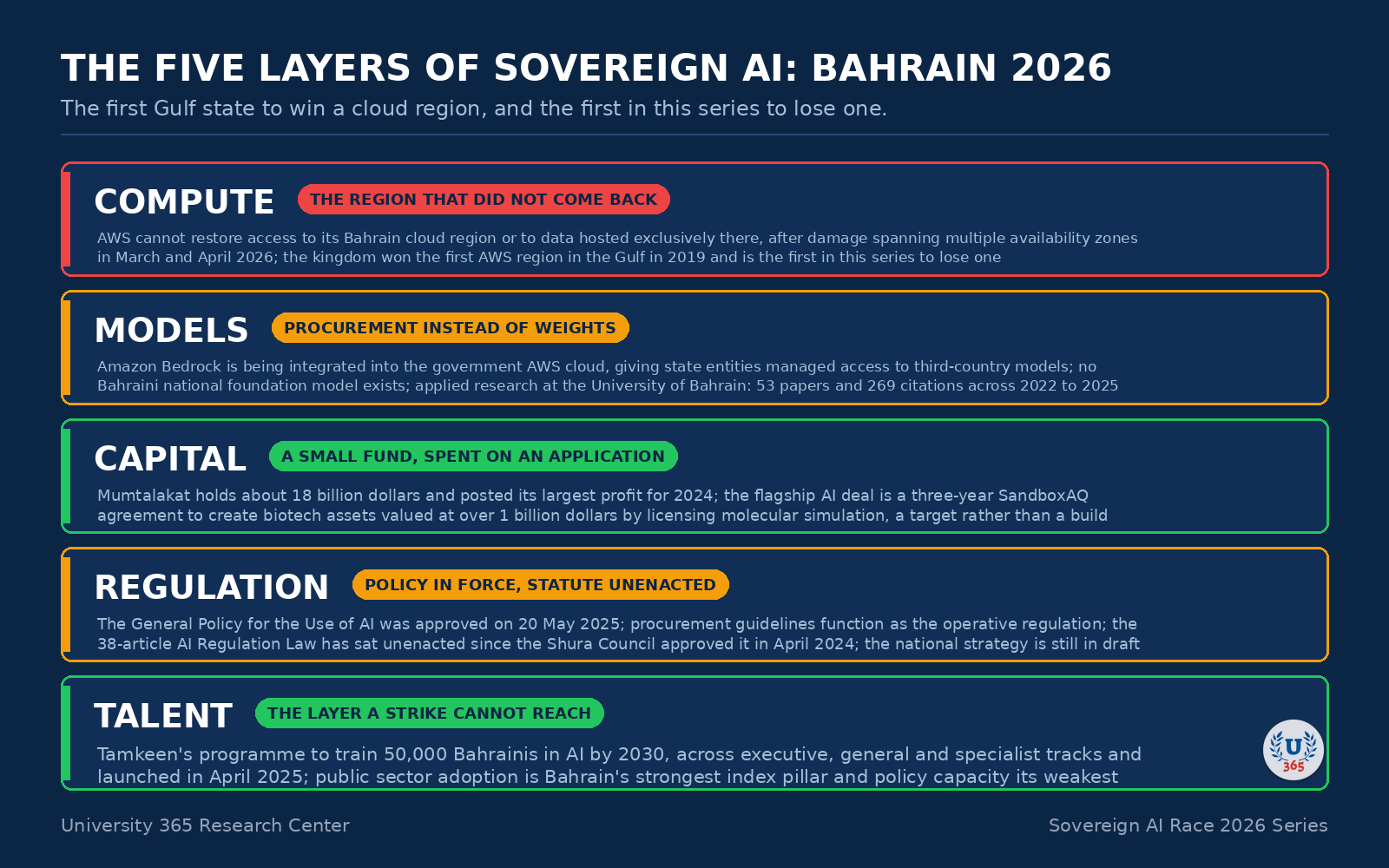
The five layers assessed. The first Gulf state to win a cloud region, above the layers a strike cannot reach. University 365 Research Center.
This is the twentieth and final country report in a twenty-part series assessing how states attempt to control the production of artificial intelligence inside their own jurisdiction, followed by a comparative capstone. The framework is fixed and applied identically to every country. Sovereign AI capacity separates into five layers, and a state can hold any one of them without holding the others.
Compute sovereignty is the physical layer: where the chips and data centres sit, and who may switch them off. Model sovereignty is who builds the models a country depends on, and in whose languages and domains those models are competent. Capital sovereignty is who funds the build-out and on what terms. Regulatory sovereignty is who writes the rules and whether they can be enforced. Talent and education sovereignty is who builds and runs the systems, and how the next generation is prepared.
The series treats three races as running at once: the compute race, the model race and the rules race. Bahrain is the country where the first of those was lost in a way no strategy document contemplated. In 2019 it became the first Gulf state to host an AWS cloud region, a genuine early-mover advantage that the kingdom promoted for seven years as the foundation of its cloud-first government policy. In March 2026 Iranian drone strikes damaged three AWS data centres, one of them in Bahrain. In April a second Bahraini availability zone was disrupted. By 15 September 2026 AWS had assessed the affected infrastructure, exhausted the options for restoring data and resources that had not been migrated, and stated that it was unable to restore access to the region or to data hosted exclusively there.
The series places Bahrain in the "regulator and host" posture alongside Singapore, the United Kingdom, Germany, Spain, Italy and Portugal, and this report tests that placement layer by layer. Bahrain holds a functioning data protection regime, a published national AI policy, procurement rules that function as a de facto AI regulation, a sovereign fund of about eighteen billion dollars, and a national upskilling programme targeting fifty thousand people. It does not hold a frontier model programme, its draft national AI strategy has not been published, its 38-article AI law has sat unenacted since the Shura Council approved it in April 2024, and as of September 2026 it does not have a working hyperscale cloud region. The report's question is what remains of a host state's sovereignty when the hosted capacity is destroyed, and the answer is more interesting than a simple verdict of loss.
The vocabulary this report needs
Five terms recur, and they are defined here once.
The Bahrain region. The AWS Middle East (Bahrain) cloud region, opened in 2019 as the first AWS region in the Gulf, operating across three availability zones. On 15 September 2026 AWS stated that it could not restore access to the resources and data hosted exclusively in the region after damage spanning multiple availability zones exceeded what its regional and multi-availability-zone services are designed to withstand. A further update on Bahrain operations was promised for early 2027.
The draft AI law. A 38-article Artificial Intelligence Regulation Law, comprising seven chapters, unanimously approved by the Shura Council on 28 April 2024. It would create an AI regulator, licensing, audits, human oversight obligations, prohibited uses, penalties and liability for AI-caused harm. It has not been enacted.
The National AI Policy and the Procurement Guidelines. The instruments actually in force. The Ministerial Committee for Information and Communication Technology approved a General Policy for the Use of AI on 20 May 2025, and the Information and eGovernment Authority owns the National AI Policy and the AI Procurement Guidelines that govern how the state buys AI.
Mumtalakat. The Bahrain Mumtalakat Holding Company, the kingdom's sovereign wealth fund, managing around eighteen billion dollars in assets, one of the smaller sovereign investors in the Gulf, and the counterparty to the country's flagship sovereign AI transaction.
Tamkeen. The Labour Fund, the state body that funds private sector skills and enterprise support, which launched a programme on 9 April 2025 to train 50,000 Bahrainis in artificial intelligence by 2030 across three tracks covering executives, general training and specialists.
The Question
What is left of a host state's sovereignty when the hosted capacity is gone?
Bahrain's position is the series' hardest case and its most instructive, because it isolates a variable the other nineteen countries could only speculate about.
The country made a coherent bet in 2019 and it was the right bet at the time. It was smaller than its neighbours, it had no prospect of building a large domestic compute industry, and it had functioning infrastructure, a stable regulatory environment and an English-speaking business culture. Winning the first AWS region in the Gulf gave it a genuine advantage in attracting regional workloads and it made cloud-first government policy possible rather than aspirational. Bahrain built its national framing on that position deliberately: the policy documents reviewed for this report describe a kingdom positioning itself as the regional digital pioneer, and the government's own adoption of AI services runs through the same cloud.
Then the physical layer was destroyed. The sequence matters and this report sets it out precisely because it is the first documented case in this series of a hyperscaler region being lost to kinetic attack. Iranian drone strikes on 1 and 2 March 2026 hit three AWS data centres, two in the United Arab Emirates and one in Bahrain, with reported structural damage, power disruption, fire and water damage from fire suppression systems. The Bahraini availability zone reported a localised power issue after a strike near the United States Navy Fifth Fleet headquarters in Manama; the fire department cut power and extinguished a fire. AWS recommended that customers migrate workloads to other regions and most did so before the region became unavailable in April 2026 when a second availability zone was disrupted. By September, AWS had exhausted the restoration options and stated that data hosted exclusively in the region was inaccessible, with a further update expected in early 2027.
The question this report puts to the evidence is therefore not whether Bahrain chose badly. It is what a state in Bahrain's position actually owns, and the answer the evidence supports has three parts. It owns its regulation, because the policy and procurement instruments that govern how the state buys and uses AI survive the loss of the hardware that runs it. It owns its people, because a trained Bahraini workforce is not destroyed by a strike in Manama. And it does not own the compute layer and never did, which the other nineteen reports in this series stated as a structural observation and which Bahrain has now demonstrated as an event.
The Contradiction
The first Gulf state to host a hyperscaler region, and the first to lose one
The central contradiction in the Bahraini case is that the country's greatest compute achievement and its greatest compute loss are the same asset, and both were outside its control from the beginning.
Consider what Bahrain actually had. In 2019 it won the first AWS region in the Gulf, ahead of the United Arab Emirates and Saudi Arabia, operating three availability zones in Manama and serving as the anchor of the kingdom's cloud-first policy. That was a real advantage and it lasted seven years. It allowed Bahraini government entities to run services on hyperscale infrastructure without building it, it made the country a credible location for regional workloads, and it underpinned a national narrative of digital leadership that the policy documents reviewed for this report repeat consistently. Nothing about the bet was foolish. A small state with no industrial base and no capital budget for hyperscale construction should rent its compute, and renting the most reputable provider available in 2019 was a defensible choice.
The contradiction is in what happened next, and it has two halves. The first is physical: a state that rents its compute owns neither the asset nor the ability to replace it, so when the asset was destroyed by a strike it did not choose, the state's response options were limited to helping its own customers find somewhere else to run. AWS began recommending migration in March, most customers left before the region became unavailable in April, and by September the remaining data was inaccessible with a restoration update promised for early 2027. Bahrain did not lose its cloud because of a policy failure. It lost it because the hardware was in a country that a foreign power decided to strike, and the hardware belonged to a company headquartered in Seattle.
The second half is quieter and more consequential, and it is what this report wants the reader to take away. The kingdom's sovereignty-relevant assets survived intact. The General Policy for the Use of AI, approved on 20 May 2025, still governs how Bahraini public entities may use these systems. The AI Procurement Guidelines still set the terms on which the state buys them. The Personal Data Protection Law of 2018 and its ten implementing resolutions still bind, with a regulator that has been in place since 2019. The National AI Policy remains published. Tamkeen's programme to train fifty thousand Bahrainis by 2030 continued. And the country's own applied research continued, with the BENEFIT Advanced AI and Computing Lab at the University of Bahrain reporting 53 papers receiving 269 citations across 2022 to 2025 and a 47 per cent increase in output in 2025. Every one of those things is a sovereign asset that a drone strike in Manama could not remove, and the country's actual capability after losing its cloud region rests on them rather than on the region.
So the contradiction resolves into a distinction the series has been building toward for twenty reports. A state that hosts compute holds capacity, and capacity can be destroyed by events it does not control. A state that writes the rules, trains the people and owns the data governance holds capability, and that is what Bahrain has left. The report's judgement is that this is a weaker position than the one the kingdom thought it occupied in 2019 and a more durable one than it would have been without the policy work of the intervening years, and that both of those statements are true at the same time.
The Current State
Compute: the region that did not come back

Manama. The kingdom won the first AWS cloud region in the Gulf in 2019 and hosted it across three availability zones until damage in March and April 2026 left it unrecoverable, with the remaining data inaccessible and a further update promised for early 2027. Photograph: Pexels License, via Pexels.
Bahrain's compute layer is the first in this series that has to be described in the past tense for its most important component, and the report states that plainly.
The loss is documented and its terms are specific. On 15 September 2026 Reuters reported that AWS could not restore access to its Bahrain cloud facility or to one of three data hosting zones in the United Arab Emirates after damage during the Iran war, with the Bahrain damage spanning multiple availability zones. AWS's own statement, quoted in that reporting, said the damage to its infrastructure spanned multiple availability zones and exceeded what its regional and multi-availability-zone services are designed to withstand. The health dashboard wording for Bahrain was equally direct: after a thorough assessment, the company had determined that it was unable to restore access to the resources and data hosted exclusively in the region. The sequence was that the first Bahraini availability zone was damaged in March 2026, AWS began recommending migration to other regions, and most customers left before the region became unavailable in April when a second zone was disrupted. AWS said it had assessed all affected infrastructure and exhausted every option for restoring data and resources not migrated before the region became unavailable, that it is helping Bahrain-based customers re-establish operations in other regions using backups where available and alternative solutions where data remains inaccessible, and that it will provide a further update on Bahrain operations in early 2027.
Two framing points belong here because they are easy to overstate. The first is that the same trade reporting describes the event as moving a regional outage into a permanent data-loss event, while the Reuters wire says AWS cannot restore access and describes inaccessible data without using the word permanent. The two accounts agree on substance and differ on framing, and this report uses the wire service's language and records the difference. The second is the characterisation, from a single trade outlet, that this was the first wartime kinetic attack on a commercial hyperscaler data centre. That is that outlet's claim rather than an established fact and is carried as a claim here.
What Bahrain's compute base was before the strikes is worth recording, because it shows what was lost. As of March 2026 AWS operated a cloud region in Manama with three availability zones, and Bahrain had been the first Gulf state to win an AWS region in 2019 while continuing to promote an early-mover, cloud-first government policy. Beyond the hyperscaler footprint, the domestic build-out is modest and it continues. In January 2026 Batelco partnered with Qareeb Data Centers to manage and operate a new edge facility at Batelco's Data Oasis campus in Manama. stc Bahrain has made a 300 million dollar digital infrastructure investment alongside nationwide 5G coverage, with the announcement date unverified in this research. Gulf Data Hub is named among firms with upcoming facilities. Market research projects Bahrain's data centre investment market adding about 68 megawatts of power capacity during 2026 to 2031, a forecast and not a commitment.
On energy and connectivity the position is the Gulf norm. Bahrain's power and connectivity infrastructure supported the AWS region for seven years and continues to serve the facilities that remain. This report does not assert any published Bahraini government assessment of the country's compute resilience after the loss of the region, because none was located, and it does not assert the current operational status of the individual private facilities listed above beyond their announcement, because the reporting on them predates or does not address the 2026 strikes.
Models: Bahrain does not build models, and that is a strategy rather than a gap

The island, the pipes, and the cables that arrive separately. University 365 Research Center.
Bahrain's model layer is the most unusual in this series because the country has made a deliberate choice not to compete on weights, and the report treats that as a coherent position rather than a deficiency.
There is no Bahraini national foundation model, no frontier-scale training run and no government model programme of the kind the United Arab Emirates runs through the Falcon family or Saudi Arabia runs through ALLaM. The report states that as an absence of evidence finding rather than a verified negative, because no Tier 1 source was located stating that Bahrain will not build a foundation model. What is verifiable as of this report's cut-off is that no domestic frontier model programme exists in the public record.
What exists instead is a model adoption and hosting strategy, and its clearest expression is the Amazon Bedrock arrangement. In December 2025 the Information and eGovernment Authority welcomed an AWS plan to introduce Amazon Bedrock in Bahrain and stated that it would be integrated into the government AWS cloud, giving government entities early access and smoothing adoption. The underlying announcement is attributed to the Bahrain News Agency and the primary source should be confirmed before any later citation; this report carries the arrangement with that caveat. The strategic reading is the one the report adopts: Bahrain's model layer is a procurement layer. The state does not own weights; it controls which weights government entities are permitted and encouraged to consume and through which contract vehicle. Because Bedrock is a multi-model service, the Bahraini state is buying a managed doorway to third-country models rather than acquiring a national model, and its sovereignty in this layer is contractual and regulatory rather than technical.
The comparison that gives the finding its shape is with the two Gulf programmes already documented in this series. The United Arab Emirates publishes the Falcon family, and Saudi Arabia's national Arabic model ALLaM is associated with its data and AI authority. Bahrain's equivalent artefact is a government cloud integration of a United States hyperscaler's managed model service. That is a real capability in the sense that Bahraini government entities can reach state-of-the-art models through a domestically negotiated contract, and it is not capability in the sense this series uses for the other two, because the weights, the architecture and the roadmap belong to somebody else. The report notes one further caution: whether any Bahraini government entity has publicly deployed a regional Arabic model, and whether any Bahraini university has published Arabic fine-tuning work, could not be verified.
The applied research base is small, real and documented. The BENEFIT Advanced AI and Computing Lab at the University of Bahrain has published 53 research papers and studies between 2022 and 2025 receiving 269 citations, with output rising 47 per cent in 2025 on the previous year, through Springer, Elsevier, IEEE and MDPI. Those are company-supplied figures carried as claims. The point they support is that Bahrain has a functioning applied research capability at university scale and not a model programme, which is the same division of labour Portugal chose and the opposite of the choice Qatar made.
Capital: a small sovereign fund and one flagship AI transaction
Bahrain's capital layer is the smallest in this series among the Gulf states and its most distinctive asset is that the country has spent very little of it on compute.
Mumtalakat, the sovereign wealth fund, manages around eighteen billion dollars in assets, one of the smaller sovereign investors in the Gulf, and it posted the biggest profit in its history for 2024 at 363 million Bahraini dinars, about 963 million dollars, against a net loss the year before. It has invested in more than fifty companies and its stated strategy is portfolio diversification.
The country's flagship sovereign AI transaction is not a compute deal, which is the finding. In October 2025 Mumtalakat signed a three-year agreement with SandboxAQ, a United States artificial intelligence and quantum technology company spun out of Alphabet in 2022, to create biotech assets valued at more than one billion dollars for the kingdom, announced during Saudi Arabia's Future Investment Initiative. Under it Bahrain will license SandboxAQ's AI-powered molecular simulation software to identify drug targets, with a joint research committee guiding the work, focused on diseases of high regional prevalence including diabetes and genetic disorders, using Bahrain's digital health datasets and hospital infrastructure. Clinical trials are expected to begin in Bahrain with possible regional expansion. The managing director of the fund framed the deal as diversifying the economy and building the health sector, and the vendor's chief executive described the ambition as democratising an industry whose intellectual property is concentrated in six countries. The one billion dollar figure is a target rather than an achieved number and is carried as a claim, and the transaction's context is worth noting: it follows SandboxAQ's earlier collaboration with Saudi Aramco in January 2025, which makes Bahrain's deal a smaller sibling to a Saudi transaction with the same vendor.
Two observations follow and they are the analytical content of this layer. The first is that Bahrain has used its sovereign capital on a sector application rather than on infrastructure, which is a rational allocation for a fund of eighteen billion dollars that cannot buy a meaningful position in the compute layer at Gulf scale and can buy a differentiated position in a domain where it has real assets, namely its health datasets and hospital infrastructure. The second is what that means for the compute loss: a country whose flagship AI investment is an application licensing deal has not committed sovereign capital to a layer it can lose to a strike, and it has also not built anything that would replace the capacity it lost.
The state spending programmes are the other half of this layer and they are aimed at people rather than infrastructure. Tamkeen launched a programme on 9 April 2025 to train 50,000 Bahrainis in artificial intelligence by 2030 across three tracks covering leaders and executives, general AI training and specialists, delivered with local and international partners. The Bahrain Economic Development Board confirms the same target independently through what it calls a national AI upskilling programme, with its executive director of ICT stating that human capital development is critical to remaining agile and competitive. On the private and financial side, Bahrain's financial sector has been the leading domestic adopter of AI applications, consistent with its role as a regional banking centre, and this report treats that as the country's most credible demand signal for AI services.
Regulation: a published policy, binding procurement rules, and two instruments that never arrived
Bahrain's regulatory layer is the most developed of the five and it operates without the statute the country drafted, which is the pattern this series has now recorded in several states.
There is no standalone AI statute in force. What binds instead is a stack of adjacent laws and a set of published policies. The Personal Data Protection Law, Law No. 30 of 2018, came into force on 1 August 2019 with a Personal Data Protection Authority as the enforcement body and ten ministerial resolutions issued in March 2022 fleshing out the regime, including Resolution 43 of 2022 on technical and organisational measures. Beyond it, AI activity is governed by the Cybercrime Law of 2014, the Electronic Communications and Transactions Law of 2018, the Civil Code of 2001, the Protection of Information and State Documents Law of 2014, and sector regulation including the Central Bank of Bahrain rulebook. The Information and eGovernment Authority's own readiness assessment states that Bahrain is in the process of finalising its first standalone AI law and that the draft is under parliamentary review, which is the state's own characterisation of its position.
The draft law is the significant unrealised instrument. The Shura Council unanimously approved a 38-article Artificial Intelligence Regulation Law on 28 April 2024, comprising seven chapters and establishing a proposed AI regulator with licensing, audits, human oversight obligations, prohibited uses, penalties and liability for AI-caused harm. It has not been enacted. Sources differ on what happened to it after the Shura Council vote, and this report records the conflict rather than resolving it. If enacted, that law would be among the most specific AI statutes in the region and its provisions on liability for AI-caused harm go further than the voluntary guidance most Gulf states operate.
The second instrument that has not arrived is the national strategy, and the report treats this as the single most important regulatory gap. A draft National AI Strategy was prepared and refined through an inter-governmental workshop held on 9 and 10 September 2025, with the strategy expected to be finalised by December 2025. The weight of evidence as of this report's cut-off is that it has not been published: the UNESCO Global Hub page states it is still in draft, an independent country note says the same, and a separate regional analysis listing Bahrain's standing documents names only the National AI Policy, the AI Procurement Guidelines and the Gulf ethics manual. The stated focus of the draft, which the report records because it describes the country's intended direction, is strengthening foundations for AI adoption, a national data governance framework covering quality, standardisation and integration, big data analytics for evidence-based policymaking, and preparation for a national data sharing framework in 2026. A parliamentary track also exists with a proposal for a national AI strategy including a dedicated AI centre and an investment drive, debated but not adopted. Readers should re-verify both instruments against the authority's own site before any later citation.
What is in force and functioning is more consequential than the missing items in one specific respect, and it is the reason this report places Bahrain among the regulator-and-host states. The Ministerial Committee for Information and Communication Technology, chaired by the Minister of Interior, approved a General Policy for the Use of AI on 20 May 2025. The Information and eGovernment Authority owns the National AI Policy, the AI Procurement Guidelines, an AI Tools Guide, an Innovation Hub and the AI Talent Program, and it provides the secretariat for a National Research Committee for artificial intelligence. The procurement guidelines are the mechanism that matters most, because in the absence of a statute the terms on which the state buys AI systems are the closest thing Bahrain has to operative AI regulation: a public body acquiring an AI system does so under published rules, and that is enforceable through the contract even where no act exists to enforce it.
Talent: fifty thousand targets, a small national workforce, and the one asset a strike cannot take
Bahrain's talent layer is where the country's durable capability sits, and the report treats it as the answer to the question the compute loss posed.
The governing facts are demographic and they are the same shape as the region's. Bahrain is a small kingdom with a substantial expatriate workforce, so a national upskilling target is simultaneously a labour-market policy and a sovereignty policy. The state's instrument is Tamkeen's programme launched in April 2025 to train 50,000 Bahrainis in artificial intelligence by 2030, structured across three tracks: leaders and executives, to shift executive thinking toward adoption; general AI training covering automation, data analytics and productivity; and specialists trained to build AI tools. The programme is delivered with a mix of local and international providers, and the economic development board confirms the same target independently. This report records the target as a target and notes that Tamkeen publishes enrolment and completion numbers which were not retrieved in this research, so the delivery against it is not asserted.
The institutional infrastructure around that target includes the Information and eGovernment Authority's own AI Talent Program, the university sector's applied research base, and scholarship programmes that feed the external pipeline. The report's assessment is that the talent layer is where Bahrain has invested most consistently over the period covered by this series and the layer least affected by the loss of the cloud region.
One further element is worth recording for what it says about the country's comparative position. An earlier independent assessment of Bahrain within the government AI readiness index placed the kingdom close to the bottom of its region on the number of AI research papers published and the proportion of graduates in science, technology, engineering and mathematics, while describing its approach as home-grown rather than import-led. The applied research figures from the University of Bahrain's lab, with 53 papers and a 47 per cent increase in output in 2025, are the country's answer to the first half of that assessment and they are still small numbers in absolute terms.
What changed since our April 2025 report on Bahrain
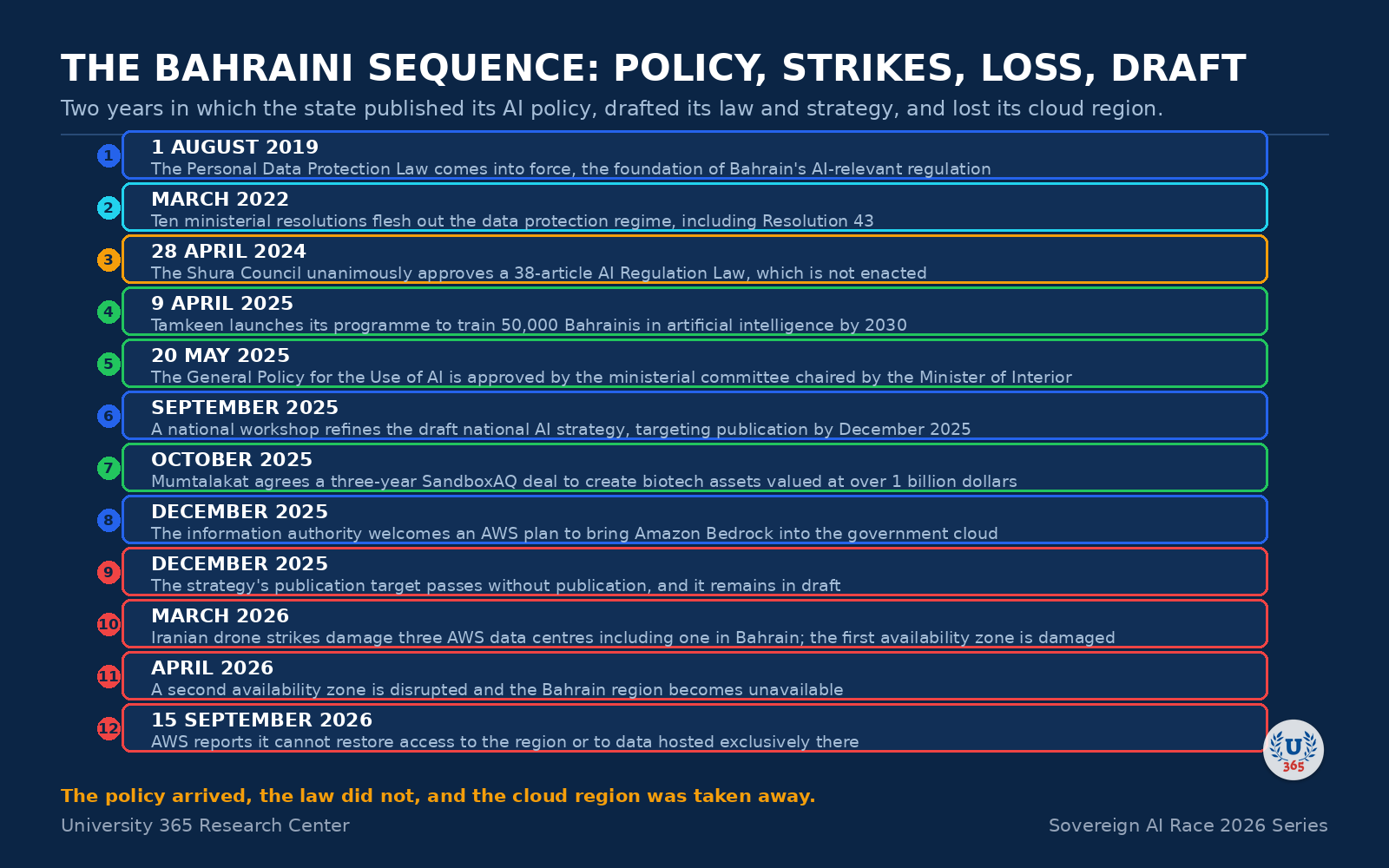
The Bahraini sequence: policy, strikes, loss, draft. University 365 Research Center.

Read the earlier report: Bahrain's AI Landscape in March 2025: Pioneering the Future of Innovation in the Gulf. University 365 INSIDE, 12 April 2025.
University 365 published "Bahrain's AI Landscape in March 2025: Pioneering the Future of Innovation in the Gulf" on 12 April 2025. That report captured the kingdom at a moment of institutional confidence: a parliament endorsing the expansion of AI across government ministries, a government deploying AI-powered financial analysis to detect corruption, a labour fund backing AI businesses, universities running generative AI hackathons, and a nanosatellite integrating AI for real-time image analysis. Against that baseline, seventeen months have delivered the loss of the country's cloud region, the non-appearance of two drafted instruments, and a continuing talent effort.
The compute position reversed completely and this is the report's largest update. The April 2025 report described Bahrain as positioned at the technological forefront of the Gulf, having evolved from technology consumer to active contributor, with government ministries expanding AI use and the private sector adopting it across financial services, healthcare and space technology. The verified position now is that AWS cannot restore access to its Bahrain cloud region or to data hosted exclusively there, after damage in March and April 2026 that spanned multiple availability zones and exceeded what its regional and multi-availability-zone services are designed to withstand, with a further update promised for early 2027. The kingdom was the first Gulf state to win an AWS region in 2019 and it is the first in this series to lose one. Nothing in the earlier report was wrong about the position it described; the position itself was destroyed by an event outside the country's control.
The model position is unchanged in kind and the earlier report did not claim otherwise. The April 2025 report described AI research collaborations between universities, government agencies and private companies in Arabic natural language processing, computer vision for urban planning and predictive analytics for healthcare. What is verifiable now is that no domestic frontier model programme exists, that Bahrain's model strategy is contractual rather than technical through the Bedrock arrangement, and that its applied research base is real at university scale: 53 papers and 269 citations across 2022 to 2025 with a 47 per cent output increase in 2025. The earlier report's account of research collaborations is consistent with that and it did not overstate a model programme that does not exist.
The regulatory position moved forward on policy and not on law, and this needs stating precisely. The April 2025 report recorded that a standalone AI Regulation Law had been proposed in April 2024 which would be the first AI-specific legislation in the region to impose administrative fines, and that its status was unclear; it also recorded the Electronic Transactions Law of 2018 as the legal foundation and noted ethical guidelines emphasising transparency, fairness, accountability and privacy. The position now is that the Shura Council unanimously approved a 38-article law on 28 April 2024 and it has still not been enacted, that the General Policy for the Use of AI was approved on 20 May 2025, and that the National AI Strategy drafted through a September 2025 workshop and targeted for publication in December 2025 has not been published. Two years on, the country has a published policy and binding procurement rules and no AI act.
The capital position acquired its flagship transaction and it is not a compute deal. The April 2025 report described Tamkeen's support for fourteen Bahraini technology companies at a regional technology conference in February 2025, parliament backing a proposal urging the fund to finance AI businesses and train innovators, and government investment attracting private capital into AI infrastructure. What is verifiable now is the October 2025 Mumtalakat agreement with SandboxAQ to create biotech assets valued at more than one billion dollars over three years, licensing AI-powered molecular simulation for drug discovery against Bahrain's health datasets, which is an application deal rather than an infrastructure commitment. The April 2025 report also referenced Bahrain's role in AI-powered financial analysis for audit and anti-corruption work, which remains consistent with the financial sector's position as the country's leading AI adopter.
Two items the earlier report carried are restated with their status. The description of Al Munther as Bahrain's first locally designed and built nanosatellite integrating AI for real-time image analysis is a factual claim about a national achievement that this report does not re-verify and therefore does not repeat as established; it is recorded here as the earlier report stated it. And the characterisation of Bahrain as having moved from technology consumer to active contributor is a framing that the model layer does not support in the sense this series uses the term, since the country has no domestic model programme and its contribution is applied research and governance; the earlier report's broader point about applied capability is defensible and the specific framing is not carried forward.
The genuinely new items are these. The loss of the AWS Bahrain region and its unrecoverable data of September 2026. The March 2026 strikes and their reported effects. The General Policy for the Use of AI of 20 May 2025. The Bedrock integration welcomed in December 2025. The SandboxAQ agreement of October 2025 and its one billion dollar asset target. The April 2025 Tamkeen programme targeting 50,000 Bahrainis by 2030. The September 2025 national strategy workshop and its unmet December 2025 publication target. The Batelco and Qareeb edge facility of January 2026. And the applied research growth at the University of Bahrain's lab. Bahrain's index position, 48th of 195 with an overall score of 59.57 computed from the publisher's own pillar scores and weights, is the corrected figure this series now uses for all twenty countries.
Key Findings
1. Bahrain lost its cloud region to war and the data in it is not coming back. On 15 September 2026 AWS reported that it could not restore access to its Bahrain cloud facility or to data hosted exclusively there, after damage spanning multiple availability zones during the Iran war. AWS's own statement said the damage exceeded what its regional and multi-availability-zone services are designed to withstand. The first Bahraini availability zone was damaged in March 2026, most customers migrated before the region became unavailable in April, and a further update was promised for early 2027.
2. Bahrain was the first Gulf state to win an AWS region and is the first to lose one. The region opened in 2019 across three availability zones and anchored a cloud-first government policy the kingdom promoted for seven years. The strikes of 1 and 2 March 2026 hit three AWS data centres, two in the United Arab Emirates and one in Bahrain, with reported structural damage, power disruption, fire and water damage from suppression systems. One trade outlet called it the first wartime kinetic attack on a commercial hyperscaler data centre, a claim carried as such here.
3. The country's model strategy is a procurement strategy and the report treats it as coherent. No Bahraini national foundation model exists in the public record. In December 2025 the information authority welcomed an AWS plan to introduce Amazon Bedrock into the government cloud, giving state entities managed access to third-country models. Bahrain's sovereignty in this layer is contractual and regulatory rather than technical, and its equivalent artefact to Falcon or ALLaM is a government cloud integration of a foreign managed model service.
4. The 38-article AI law has sat unenacted since April 2024. The Shura Council unanimously approved it on 28 April 2024 with an AI regulator, licensing, audits, human oversight obligations, prohibited uses, penalties and liability for AI-caused harm. It has not been enacted and sources differ on what happened after the vote.
5. The national AI strategy has not been published. Drafted and refined through a workshop on 9 and 10 September 2025 with a December 2025 publication target, the strategy remains in draft on the weight of evidence, and this report treats that as the single most important regulatory gap. Its stated focus is foundations for adoption, a national data governance framework, big data analytics for policymaking and a national data sharing framework.
6. What is in force works, and the procurement guidelines are the operative instrument. The General Policy for the Use of AI was approved on 20 May 2025 by the ministerial committee chaired by the Minister of Interior. The Personal Data Protection Law of 2018 has been in force since August 2019 with a regulator and ten implementing resolutions. In the absence of a statute, the terms on which the state buys AI systems function as Bahrain's closest thing to AI regulation, and they are enforceable through contract.
7. The sovereign fund spent its AI capital on an application rather than infrastructure. Mumtalakat, managing about eighteen billion dollars, agreed in October 2025 to a three-year collaboration with SandboxAQ to create biotech assets valued at more than one billion dollars, licensing AI-powered molecular simulation for drug discovery against Bahrain's health datasets. The figure is a target and is carried as a claim. The deal is a smaller sibling to a Saudi transaction with the same vendor.
8. The talent programme is the layer that survived intact. Tamkeen launched a programme on 9 April 2025 to train 50,000 Bahrainis in artificial intelligence by 2030 across executive, general and specialist tracks, confirmed independently by the economic development board. Enrolment and completion figures published by the fund were not retrieved, so delivery is not asserted. An earlier independent assessment placed Bahrain near the bottom of its region on AI research papers and STEM graduates, and the applied research figures from the University of Bahrain, 53 papers and 269 citations across 2022 to 2025, are the country's answer.
9. Bahrain's index position, computed on the corrected method, is 48th of 195 with an overall score of 59.57. Its pillar scores are Policy Capacity 46.50, AI Infrastructure 58.04, Governance 72.50, Public Sector Adoption 83.37, Development and Diffusion 48.50 and Resilience 49.08. Public Sector Adoption is the country's strongest pillar and Policy Capacity its weakest. This places Bahrain ahead of Qatar, which is a notable result given the size difference between the two states.
10. The report's most useful finding is the distinction between capacity and capability. Bahrain's sovereignty-relevant assets survived the loss of its cloud region: the AI policy, the procurement rules, the data protection regime and its regulator, the national AI policy document, the upskilling programme and the applied research base. What it lost was capacity it never owned. On this evidence a state that rents its compute holds an asset it cannot protect and cannot replace, and a state that writes rules and trains people holds capability that a strike cannot remove.
11. The honest overall verdict: Bahrain is the series' first case of compute loss, and it demonstrates why the other four layers matter. The kingdom made a defensible bet in 2019, promoted it credibly for seven years, and lost it to a strike it did not choose. Its AI law and its AI strategy have still not arrived. What remains is a functioning policy stack, enforceable procurement rules, a real upskilling effort, an applied research base and a small sovereign fund that spent its AI money on a domain where it has genuine assets. That is not a strong position and it is a durable one, and the country's own experience is the clearest available argument that a state should invest in the layers that outlast its hardware.
Deep Analysis
What the loss of a cloud region actually costs a state
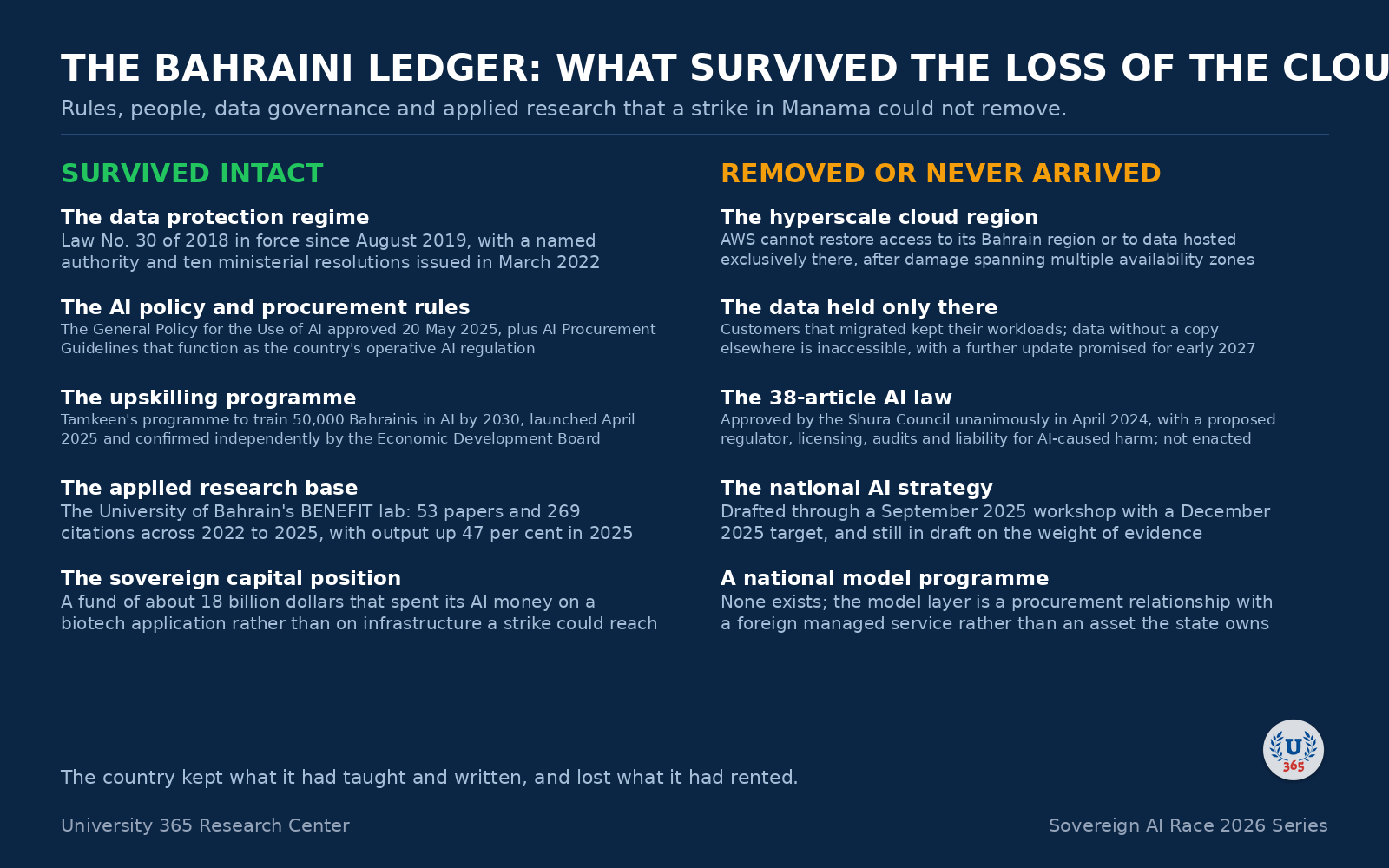
What survived the loss, against what was removed or never arrived. University 365 Research Center.
Bahrain is the first country in this series to lose a substantial part of its compute layer to a physical event, so its experience is the only direct evidence available on what such a loss costs and what it does not. The report's analysis of that evidence is the most useful thing it can offer the remaining chapters of this series.
Start with what was lost, because the scale matters and it is easy to overstate. Bahrain hosted one AWS region across three availability zones, which by Gulf standards is a modest footprint: the region served Bahraini government and enterprise workloads and gave the country credibility as a cloud location, and it did not constitute a large share of regional capacity. Saudi Arabia and the United Arab Emirates host substantially larger build-outs, and the region's other capacity in Bahrain sits in private and telecom facilities that the reporting on the strikes does not address. So what Bahrain lost is one hyperscaler region, its hosted data, and the early-mover position it had held since 2019.
Now consider what that loss cost, and the honest answer has four parts, only two of which are financial. The first is data. AWS stated that data hosted exclusively in the region is inaccessible and that it is helping customers re-establish operations elsewhere using backups where available. A customer that kept a copy elsewhere has a copy; a customer that did not has nothing. That is the sharpest available lesson in this series for any institution in any country: the availability zone is not a backup and the region is not a second copy, and this report would put that sentence in front of any government planning to run public services on rented infrastructure. The second cost is continuity. Bahraini entities had to re-establish operations in other regions during 2026, which for a state running digital government services is an interruption whose duration is measured in months rather than hours.
The third cost is the position itself and it is not financial at all. Bahrain was the first Gulf state to win an AWS region and it built a national narrative of digital leadership on that fact, which the policy documents reviewed for this report repeat. Losing the region removes the factual basis for that narrative and replaces it with a different and less comfortable story, and this report records the change in positioning honestly rather than treating it as a communications problem. The fourth cost is the one that will take longest to show. A state whose cloud region has been destroyed and whose data has been declared inaccessible becomes harder to sell as a location for the next investment, and the analyst commentary recorded in the dossier suggests the strikes made physical security a pricing factor in Gulf data centre deals and prompted some investors to consider siting capacity outside the region. That commentary is attributed to a trade outlet rather than to named analysts and is carried as a claim, and the direction of travel it describes is the one a reader should watch.
Now measure what was not lost, because this is where the report's argument sits. Bahrain's data protection law and its regulator were unaffected. Its general policy on AI use, approved in May 2025, still governs what its public bodies may do. Its AI procurement guidelines still set the terms on which it buys systems, and in the absence of a statute those guidelines are the country's operative AI regulation. Its national AI policy remains published. Its upskilling programme targeting fifty thousand Bahrainis continues. Its flagship sovereign AI transaction, a biotech application licensing deal, is untouched because it was never infrastructure. And its applied research base at the University of Bahrain continues to publish. Every one of those is a sovereign asset in the strict sense this series uses, which is that the state can direct it and no external decision can revoke it.
The analytical conclusion the report draws is a hierarchy the series has been building toward for twenty reports and which Bahrain's experience now demonstrates rather than asserts. Among the five layers, compute is the one a small state is least able to protect, because protecting it requires either owning the silicon or possessing the military means to defend a site that a peer competitor may wish to strike. Regulation is the layer a state can hold with nothing but legal drafting capacity, and Bahrain holds it. Talent is the layer that survives every physical loss, and Bahrain has invested in it. Models and capital sit in between: a state can own a language-specific model at modest cost, as Portugal and Qatar demonstrated, and it can direct capital it owns, but neither can be acquired quickly. A state in Bahrain's position, ranking 48th of 195 on the corrected index with its strongest pillar being public sector adoption and its weakest being policy capacity, is doing the thing that a state of its size should do, which is to hold the layers that do not require a defence budget and to rent the layer that does.
The two instruments that did not arrive, and what their absence reveals
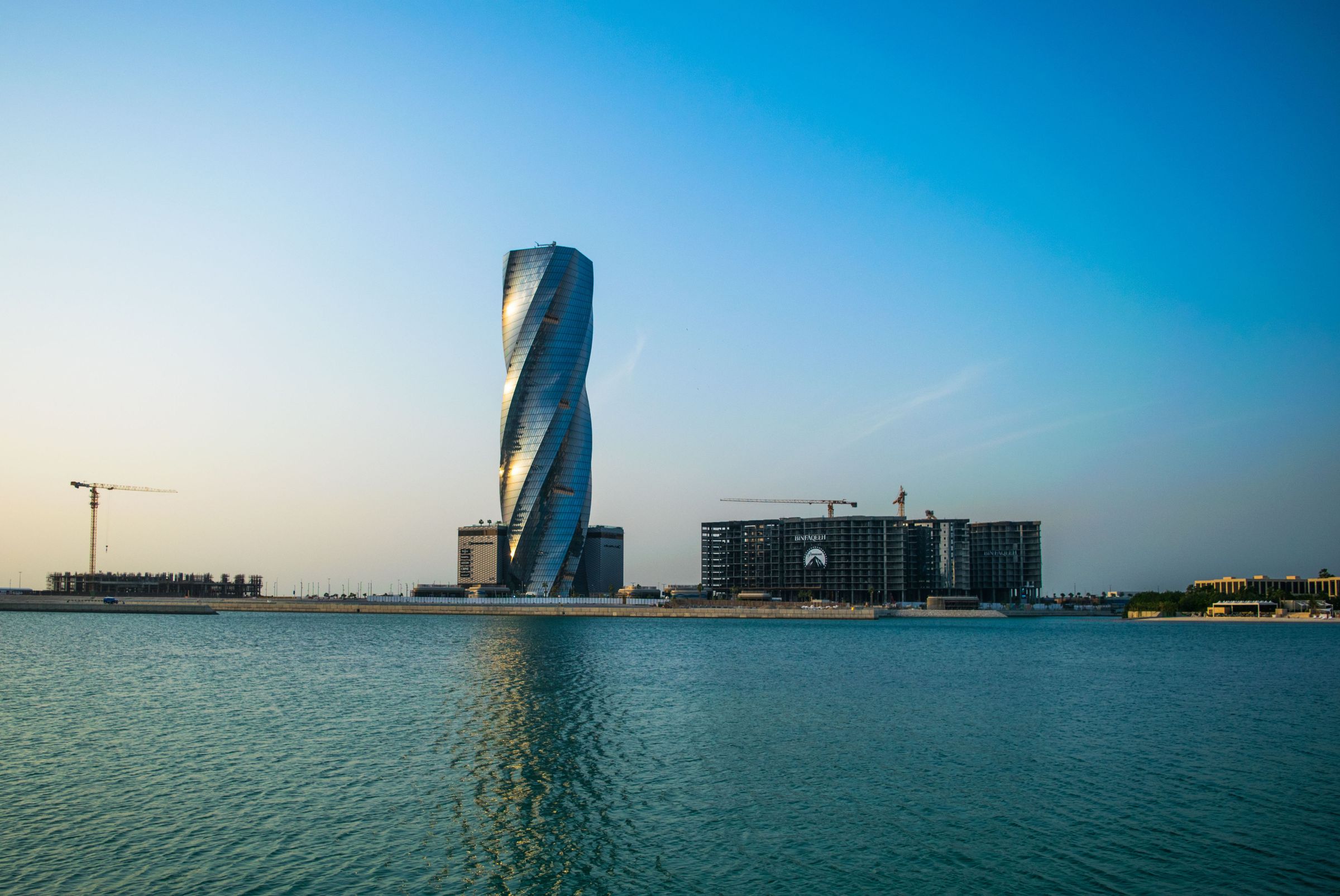
Manama. The Shura Council unanimously approved a 38-article AI Regulation Law in April 2024 and it has sat unenacted since, while the country regulates the technology through the terms on which its government buys AI systems. Photograph: Pexels License, via Pexels.
Bahrain has drafted two significant AI instruments and enacted neither, and the reasons they are still pending are more informative than the drafts themselves.
The first is a 38-article Artificial Intelligence Regulation Law, unanimously approved by the Shura Council on 28 April 2024 and comprising seven chapters that would create an AI regulator with licensing, audits, human oversight obligations, prohibited uses, penalties and, most unusually for the region, liability for harm caused by AI systems. Two years and five months later it has not been enacted. The second is a national AI strategy, drafted through an inter-governmental workshop in September 2025 with a target of publication in December 2025, which has still not been published.
The report draws three observations from that record and they are not about Bahrain alone. The first is that a comprehensive AI law is expensive in a specific way that is easy to miss: a 38-article statute that creates a regulator, licensing and audits requires a standing institution to administer it, and a state of Bahrain's size with a small civil service has to weigh whether the enforcement machinery is sustainable before it weighs whether the law is desirable. The country has taken the alternative route and built its regulatory effect into procurement instead, which needs no new agency because it operates through contracts the state already signs. That is a legitimate design choice and it is worth stating as one, because this series has documented several countries that passed comprehensive AI laws with no clear plan for staffing them.
The second observation is that an unpublished strategy is not the same as an absent policy, and the distinction matters for anyone assessing Bahrain's position. The country has a published national AI policy, a general policy governing AI use in the public sector, procurement guidelines, a data protection law in force since 2019 with ten implementing resolutions, and a functioning data governance ambition described in the draft strategy's stated focus. What it does not have is a single document that sets out the whole programme with dates and responsibilities, and in a small state with a limited civil service that document is precisely the coordination instrument that turns a set of policies into a plan. The report treats its absence as the most important regulatory gap for that reason rather than because of any dramatic consequence.
The third observation is about the sequencing the series has now seen three times, in three different institutional forms. Italy legislated first and built the enforcement architecture afterwards; South Africa wrote a policy and lost it to fabricated citations; Bahrain drafted both instruments and enacted neither while running the country on adjacent laws and procurement rules. The common finding across all three is that the binding constraint on AI governance in a small or mid-sized state is not legislative ambition but administrative capacity, and that the states which act most effectively are the ones that use instruments they already have. Bahrain's procurement guidelines and data protection regime do more operative work than its unenacted 38-article law would if it passed without a regulator to run it, and that is the finding the report would put in front of any government deciding whether to write a new AI statute.
The three races, measured in Bahrain
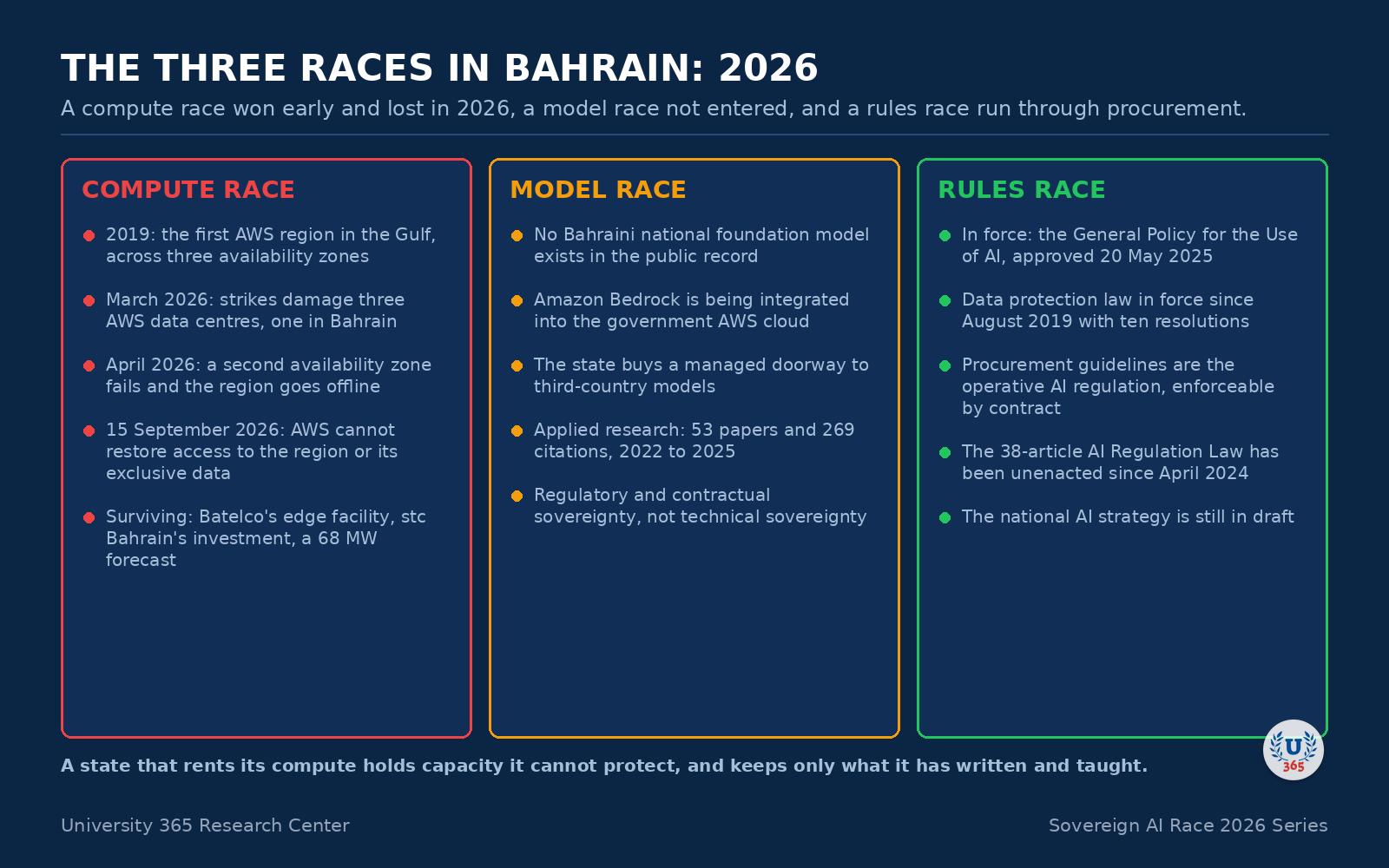
The three races in Bahrain, at three different outcomes. University 365 Research Center.
The series separates the compute race, the model race and the rules race. Bahrain is the country that entered one, declined a second, and is running the third through procurement rather than legislation.
In the compute race, Bahrain competed early and lost the asset. It won the first AWS region in the Gulf in 2019, which was a genuine achievement for a state of its size, and it held the position for seven years while its neighbours built much larger footprints. In March and April 2026 that region was damaged beyond restoration across multiple availability zones and its exclusive data was declared inaccessible, with a further update promised for early 2027. Bahrain did not lose the race on merit; it lost the hardware to a strike, and the report treats that as the central fact of its compute layer rather than as a policy failure.
In the model race, Bahrain did not enter and this report argues that it was right not to. It has no domestic foundation model, no frontier training run and no government model programme, and it has instead bought managed access to third-country models for its government through a hyperscaler service. For a kingdom of Bahrain's size the alternative would have been a language-specific model at modest scale, which this series has shown is achievable at low single-digit millions of euros, and the country has chosen a different route that leaves it with a procurement relationship rather than an asset. The report notes the trade honestly and records that the one asset a small state can own outright in the model layer, its own language corpus and model, remains unobtained here.
In the rules race, Bahrain is running and its instrument is commercial rather than statutory. It has no AI act and it has a published general policy on AI use, a national AI policy, and procurement guidelines that govern how the state buys AI systems. That last item is doing the work a regulator would do, because a public body that acquires an AI system in Bahrain does so under published rules it must follow, and the state can enforce those terms through the contract even with no statute behind them. Alongside it sits a data protection regime that has been in force since August 2019 with a regulator and ten implementing resolutions. A reader comparing this to the countries in this series that have passed comprehensive AI acts should note where the operative work actually happens, and in Bahrain it happens at the point of purchase.
The three tempos produce the report's summary of Bahrain. A state that won the first cloud region in its region and then lost the hardware, declined to compete on model weights and bought access instead, and regulates the technology by controlling how its own government buys it.
Data and Evidence
Table 1: The five layers, assessed for Bahrain in September 2026
Layer | What Bahrain holds | What it does not hold | Assessment |
Compute | A domestic private and telecom build-out that continues: Batelco's edge facility with Qareeb Data Centers at the Data Oasis campus (January 2026); stc Bahrain's 300 million dollar digital infrastructure investment with nationwide 5G; Gulf Data Hub named among upcoming facilities; market research projecting about 68 MW of added power capacity in 2026 to 2031. Historically: the first AWS region in the Gulf, opened 2019 across three availability zones | A working hyperscale cloud region: AWS reported on 15 September 2026 that it cannot restore access to its Bahrain region or to data hosted exclusively there, after damage spanning multiple availability zones in March and April 2026 exceeded its design tolerance, with a further update promised for early 2027; any verified government assessment of post-strike compute resilience | The series' first case of compute loss, with the surviving capacity private and unquantified |
Models | A model adoption and hosting strategy: the December 2025 arrangement to bring Amazon Bedrock into the government AWS cloud for state entities, carried with the caveat that the primary source should be confirmed; an applied research base at the University of Bahrain's BENEFIT Advanced AI and Computing Lab, 53 papers and 269 citations across 2022 to 2025 with a 47 per cent output increase in 2025 (company-supplied figures); university and conference activity | A domestic frontier model programme of any kind (absence of evidence, not a verified negative); a national foundation model; any verified Bahraini Arabic model fine-tuning work; any verified government deployment of a regional Arabic model | A procurement layer rather than a technical layer, which the report treats as a coherent choice |
Capital | Mumtalakat, the sovereign wealth fund, at around 18 billion dollars of assets with the largest profit in its history for 2024 at 363 million dinars; the October 2025 three-year SandboxAQ agreement to create biotech assets valued at more than 1 billion dollars by licensing AI-powered molecular simulation for drug discovery against Bahraini health datasets (target figure, CLAIM); the Tamkeen programme to train 50,000 Bahrainis in AI by 2030 launched 9 April 2025 (Tier 1); the financial sector as the leading domestic adopter | Any sovereign capital committed to the compute layer; a sovereign fund large enough to buy a meaningful position at Gulf scale; retrieved Tamkeen enrolment and completion numbers, so delivery against the 50,000 target is not asserted | A small fund spent on an application where the country has genuine assets, not on infrastructure |
Regulation | In force: the Personal Data Protection Law No. 30 of 2018 (effective 1 August 2019) with the Personal Data Protection Authority and ten ministerial resolutions of March 2022 including Resolution 43; the Cybercrime Law of 2014; the Electronic Communications and Transactions Law of 2018; the Civil Code; the Protection of Information and State Documents Law of 2014; Central Bank of Bahrain sector rules; the General Policy for the Use of AI approved 20 May 2025 by the ministerial committee chaired by the Minister of Interior; the National AI Policy; the AI Procurement Guidelines; an AI Tools Guide; a National Research Committee for AI under the information authority | An AI statute: the 38-article Artificial Intelligence Regulation Law was unanimously approved by the Shura Council on 28 April 2024 and has not been enacted, and sources differ on what happened after the vote; a published National AI Strategy, which remains in draft on the weight of evidence despite a December 2025 target; an operating AI regulator | No act and real operative regulation, delivered through procurement and data protection |
Talent and education | The Tamkeen programme targeting 50,000 Bahrainis trained in AI by 2030 across executive, general and specialist tracks, launched 9 April 2025 and confirmed independently by the Economic Development Board; the information authority's AI Talent Program; the University of Bahrain's applied research base with 53 papers and 269 citations across 2022 to 2025 and 47 per cent output growth in 2025; university AI programmes and hackathons; scholarship programmes feeding the external pipeline; a financial sector that is the leading domestic adopter | Retrieved enrolment and completion figures for the 50,000 target, so delivery is not asserted; a large domestic research base (an earlier independent assessment placed Bahrain near the bottom of its region on AI research papers and STEM graduates); a national AI visa category | The layer that survived the compute loss intact, and the country's most durable investment |
Table 2: The controlled metrics, series bible format
Metric | Bahrain position | Source and date |
Flagship compute commitment | The AWS Middle East (Bahrain) region, opened 2019 as the first AWS region in the Gulf across three availability zones: UNRECOVERABLE. AWS stated on 15 September 2026 that it cannot restore access to the resources and data hosted exclusively in the region, after damage spanning multiple availability zones in March 2026 (first zone), with most customers migrating before the region became unavailable after a second zone was disrupted in April 2026, and a further update promised for early 2027. Surviving domestic build-out: Batelco and Qareeb Data Centers edge facility at the Data Oasis campus (January 2026); stc Bahrain's 300 million dollar digital infrastructure investment (announcement date unverified); Gulf Data Hub named among upcoming facilities; a market forecast of about 68 MW added power capacity in 2026 to 2031 | Reuters via WHBL, 15 September 2026, by Feras Dalatey; AWS health dashboard wording as reproduced by Agentic Tribune, 17 September 2026; GlobeNewswire Bahrain Data Center Market Report, 13 July 2026; Ken Research Bahrain data centre report, 2026; Gulf Business Review GCC capacity tracker, 2026 |
Capital committed | Mumtalakat, the sovereign wealth fund: around 18 billion dollars of assets; the largest profit in its 19-year history for 2024 at 363 million Bahraini dinars (about 963 million dollars), against a net loss the year before; more than 50 portfolio companies. Flagship AI transaction: a three-year agreement with SandboxAQ announced October 2025 to create biotech assets valued at more than 1 billion dollars, licensing AI-powered molecular simulation for drug discovery, focused on diabetes and genetic disorders using Bahraini health datasets, with clinical trials expected in Bahrain (the 1 billion dollar figure is a target and CLAIM). State spending: the Tamkeen programme to train 50,000 Bahrainis in AI by 2030 launched 9 April 2025 | AGBI, October 2025; The National, 27 October 2025; Semafor, 5 November 2025; GCC Business Watch, 27 October 2025 and VCBeat Health, 28 October 2025 for the joint statement; Tamkeen, 9 April 2025; Computer Weekly reporting the Economic Development Board, 5 January 2026 |
Flagship national models | No Bahraini national model programme exists in the public record; this is recorded as an absence of evidence rather than a verified negative, since no Tier 1 source was found stating that Bahrain will not build a foundation model. Model access instead runs through the December 2025 arrangement under which the information authority welcomed an AWS plan to introduce Amazon Bedrock in Bahrain and integrate it into the government AWS cloud, giving state entities early access. Applied work: the BENEFIT Advanced AI and Computing Lab at the University of Bahrain, 53 research papers and studies receiving 269 citations between 2022 and 2025, with output up 47 per cent in 2025, published through Springer, Elsevier, IEEE and MDPI (company-supplied figures, CLAIM). Whether any Bahraini entity has deployed a regional Arabic model, and whether any Bahraini university has published Arabic fine-tuning work, are unverified | Bahrain News Agency announcement of December 2025 as relayed by a LinkedIn pulse summary (primary source TO BE CONFIRMED); Biz Bahrain on the University of Bahrain lab, 10 August 2026; the UAE Falcon and Saudi ALLaM programmes as documented in series reports 1 and 2 |
Anchor entities | The Information and eGovernment Authority, owner of the National AI Policy, the AI Procurement Guidelines, the AI Tools Guide, the Innovation Hub and the AI Talent Program, and secretariat to the National Research Committee for AI, with Mohammed Ali Al Qaed as chief executive; the Ministerial Committee for Information and Communication Technology chaired by the Minister of Interior, which approved the General Policy for the Use of AI; the Personal Data Protection Authority; the Central Bank of Bahrain; Mumtalakat; Tamkeen, the Labour Fund; the Bahrain Economic Development Board; the University of Bahrain and BENEFIT; Batelco, stc Bahrain and Gulf Data Hub | iGA, retrieved 29 September 2026; General Policy for the Use of AI v1.0, 20 May 2025; Bahrain.bh national AI page, updated 19 July 2026; Tamkeen, April 2025; AGBI and The National, October 2025 |
Chip dependency | Complete, and the country has no domestic fabrication, no packaging and no accelerator design. Every accelerator in the territory is imported under United States export rules, and the national compute position has depended entirely on a foreign hyperscaler whose region was destroyed by kinetic attack in 2026. The report records no Bahraini government statement on the licensing position and does not assert one | Reuters, 15 September 2026 for the region's loss; the dossier's layer 1 material for the absence of domestic fabrication |
Regulatory instrument and status | In force: the Personal Data Protection Law No. 30 of 2018 (effective 1 August 2019) with the Personal Data Protection Authority and ten ministerial resolutions of March 2022, including Resolution 43 on technical and organisational measures; the Cybercrime Law No. 60 of 2014; the Electronic Communications and Transactions Law of 2018; the Civil Code of 2001; the Protection of Information and State Documents Law No. 16 of 2014; Central Bank of Bahrain rulebook; the General Policy for the Use of AI approved 20 May 2025; the National AI Policy of July 2025 per a regional tracker; the AI Procurement Guidelines. NOT in force: the 38-article AI Regulation Law unanimously approved by the Shura Council on 28 April 2024 (seven chapters, creating an AI regulator with licensing, audits, human oversight obligations, prohibited uses, penalties and liability for AI-caused harm), not enacted as of 29 September 2026, with sources differing on what happened after the vote; the National AI Strategy, drafted through the 9 and 10 September 2025 workshop with a December 2025 target, still in draft on the weight of evidence. The information authority's own readiness assessment states Bahrain is in the process of finalising its first standalone AI law, under parliamentary review | iGA General Policy for the Use of AI v1.0, 20 May 2025; Levellers.ai and Anurag Verma country notes 2026 (Tier 3 leads); The Daily Tribune, 28 April 2024 via an Anurag Verma citation; the iGA AI RAM Report, 2025; UNESCO Global Hub page and AI in Arabia, retrieved 29 September 2026; Bahrain.bh for Resolution 43 |
Talent anchors | Tamkeen, the Labour Fund, with its programme to train 50,000 Bahrainis in AI by 2030 across three tracks launched 9 April 2025; the information authority's AI Talent Program; the University of Bahrain and the BENEFIT Advanced AI and Computing Lab; the American University of Bahrain and its generative AI hackathon; Bahrain Polytechnic and its AI Academy established with Microsoft and Tamkeen, described in the prior U365 report as among the first in the Middle East; the national scholarship programmes | Tamkeen, 9 April 2025; Computer Weekly, 5 January 2026 reporting the Economic Development Board; Biz Bahrain, 10 August 2026; the prior U365 report of 12 April 2025 for the institutional items |
Independent index standing | Oxford Insights Government AI Readiness Index 2025, 8th edition, January 2026: Bahrain ranks 48th of the 195 countries assessed, with an overall score of 59.57 computed from the publisher's own published pillar scores and its own published pillar weights (Policy Capacity 10 per cent, AI Infrastructure 25, Governance 15, Public Sector Adoption 15, Development and Diffusion 25, Resilience 10), a method that reproduces all nine overall scores the report states in its narrative exactly. Bahrain's pillar scores are Policy Capacity 46.50, AI Infrastructure 58.04, Governance 72.50, Public Sector Adoption 83.37, Development and Diffusion 48.50 and Resilience 49.08. The publisher's January 2026 report prints the rank and the six pillar scores and no overall column, and carries its own note that the December 2025 publication contained incorrect scores and rankings. Regional comparison on the same method: Bahrain 59.57 at 48th, ahead of Qatar at 58.62 and 54th, Oman at 56.29 and 61st, and Kuwait at 43.78 and 83rd, and behind Saudi Arabia at 71.57 and 15th and the United Arab Emirates at 69.86 and 19th. The dossier for this report marked Bahrain's own index figure NOT VERIFIED and named retrieving it as the highest-value outstanding research task; this report retrieves and computes it. A 2023 spotlight placed Bahrain close to the bottom of its region on AI research papers and the proportion of STEM graduates, describing its approach as home-grown rather than import-led | Oxford Insights Government AI Readiness Index 2025, January 2026 report and full rankings table; Oxford Insights Spotlight Series: Bahrain, 23 May 2023 |
Adoption | Government adoption runs through cloud-first policy and the general policy on AI use, with the information authority operating an Innovation and Advanced Technology Directorate and a national AI portal; the financial sector is the leading domestic adopter across the region; the national AI page records the leadership's vision as having enhanced government services and strengthened Bahrain's position as a regional digital pioneer (state framing, CLAIM). No national statistics office AI adoption survey was located in this research | Bahrain.bh national AI page, updated 19 July 2026; iGA, retrieved 29 September 2026; the dossier's financial sector material |
Distinguishing mechanism | The first compute loss in the series: a state that won the first hyperscaler region in its region in 2019 lost it to kinetic attack in 2026, and its surviving sovereign assets are the layers that no strike can reach, namely its AI policy, its procurement rules, its data protection regime, its upskilling programme and its applied research base | This report |
Core tension | Bahrain holds the layers that do not require a defence budget and rents the one that does, and it has now learned in the hardest available way that the rented layer is the one an adversary can remove | This report |
Table 3: Timeline, 2018 to 2026
Date | Event | Source |
2018 | The Personal Data Protection Law, Law No. 30 of 2018, is enacted | iGA General Policy for the Use of AI, 2025 |
2019 | The AWS Middle East (Bahrain) region opens as the first AWS region in the Gulf, across three availability zones | Gulf Times Now GCC tracker, 2026; AWS regional material via Ken Research, 2026 |
1 August 2019 | The Personal Data Protection Law comes into force | iGA General Policy for the Use of AI, 2025 |
March 2022 | Ten ministerial resolutions fleshing out the data protection regime are issued, including Resolution 43 on technical and organisational measures | Bahrain.bh national portal |
28 April 2024 | The Shura Council unanimously approves a 38-article Artificial Intelligence Regulation Law with seven chapters; it is not enacted | The Daily Tribune, 28 April 2024, via an Anurag Verma citation |
February 2025 | Tamkeen supports 14 Bahraini technology companies at a regional technology conference | Prior U365 report of 12 April 2025 |
1 and 2 March 2026 | Iranian drone strikes hit three AWS data centres, two in the UAE and one in Bahrain; reported effects include structural damage, power disruption, fire and water damage from suppression systems. The Bahrain availability zone reports a localised power issue after a strike near the Fifth Fleet headquarters in Manama | StartupFeed, 2026 (Tier 3 lead); Reuters recalling AWS's March 2026 statement, 15 September 2026 |
9 April 2025 | Tamkeen launches a programme to train 50,000 Bahrainis in artificial intelligence by 2030 across three tracks | Tamkeen, 9 April 2025 |
12 April 2025 | University 365 publishes its Bahrain AI landscape report | University 365 INSIDE |
20 May 2025 | The Ministerial Committee for Information and Communication Technology approves the General Policy for the Use of AI, v1.0 | iGA General Policy for the Use of AI, 20 May 2025 |
July 2025 | Bahrain's National AI Policy is recorded as published by a regional sovereign AI tracker | Michael Joseph, Sovereign AI Tracker, retrieved 29 September 2026 (Tier 3 lead) |
9 and 10 September 2025 | A national inter-governmental workshop refines the draft National AI Strategy, with publication targeted for December 2025 | iGA AI RAM Report, 2025 |
October 2025 | Mumtalakat signs a three-year agreement with SandboxAQ to create biotech assets valued at more than 1 billion dollars, announced at the Future Investment Initiative in Riyadh | The National, 27 October 2025; AGBI, October 2025; Semafor, 5 November 2025 |
December 2025 | The information authority welcomes an AWS plan to introduce Amazon Bedrock in Bahrain for integration into the government cloud | Bahrain News Agency item of December 2025 as relayed by a LinkedIn pulse summary (primary source TO BE CONFIRMED) |
December 2025 | The draft National AI Strategy's targeted publication date passes without publication | iGA AI RAM Report, 2025 for the target; UNESCO Global Hub page and independent country notes for its continued draft status |
January 2026 | Batelco partners with Qareeb Data Centers to manage and operate a new edge facility at the Data Oasis campus in Manama | GlobeNewswire market report summary, 13 July 2026 |
March 2026 | The first Bahraini AWS availability zone is damaged; AWS begins recommending that customers migrate workloads to other regions | Reuters, 15 September 2026 |
April 2026 | A second Bahraini availability zone is disrupted and the Bahrain region becomes unavailable; most customers had already migrated | Reuters, 15 September 2026 |
15 April 2026 | A National Portal update is recorded, listing the National AI Policy, the AI Procurement Guidelines and the GCC ethics manual as the standing documents | AI in Arabia, 2026, as recorded in the dossier |
19 July 2026 | Bahrain's national AI page is last updated, framing the leadership's vision as having enhanced government services and strengthened the country's position as a regional digital pioneer | Bahrain.bh, retrieved 29 September 2026 |
10 August 2026 | The BENEFIT Advanced AI and Computing Lab at the University of Bahrain is reported to have published 53 papers and studies receiving 269 citations across 2022 to 2025, with output up 47 per cent in 2025 | Biz Bahrain, 10 August 2026 (company-supplied figures, CLAIM) |
15 September 2026 | AWS reports that it cannot restore access to its Bahrain cloud facility or to data hosted exclusively there, after damage spanning multiple availability zones, and promises a further update on Bahrain operations in early 2027 | Reuters via WHBL, 15 September 2026, by Feras Dalatey |
29 September 2026 | No AI statute is in force, the National AI Strategy has not been published, and the country's hyperscale cloud region remains unrecoverable | As cited above |
Implications
For the countries still to come in this series
Bahrain is the last country report before the capstone and it supplies the series' sharpest practical lesson, which is that a state should assume its rented compute can be removed and plan accordingly. Four practices are worth copying and they come from what survived rather than from what was lost. Put your AI rules where they are enforceable without a statute, which in Bahrain's case means procurement: a state that attaches conditions to how it buys AI systems regulates them through contracts it already signs and needs no new agency to administer. Keep a copy of anything critical somewhere that is not the availability zone you consider your primary, because the distinction between a backup and a second availability zone is the single most expensive lesson in this report. Invest in the layer that survives physical loss, which is people, because a trained citizenry is the only AI asset that no strike or vendor decision can revoke. And if you host someone else's hyperscale capacity, state plainly in your own strategy that you are a host, because Bahrain's national framing described a position of digital leadership that rested entirely on a facility a foreign company owned and a foreign adversary could reach.
There is a further lesson that applies to the two or three smallest states in any region. Bahrain's decision to draft a comprehensive AI law and then, for whatever reason, not to enact it left the country with no statutory regime and a functioning policy stack. That outcome is worse than either alternative: worse than enacting the law, because the drafting effort bought nothing, and worse than deciding not to legislate at all, because the pending instrument absorbs attention without producing rules. A state in that position should either finish the law with a realistic plan for the institution that would administer it, or withdraw it and say publicly that procurement and data protection are the country's AI framework, which would at least be an accurate description of what governs.
For the technology providers
Bahrain is a small market with a demonstrated infrastructure risk and a strong policy environment, and providers should read four signals. First, the hosting case has to be priced against physical security as well as power and connectivity: the country lost its hyperscaler region to kinetic attack in 2026 and the analyst commentary recorded in this research suggests the strikes made physical security a factor in Gulf siting decisions, so any capacity plan should treat redundancy outside the region as a requirement rather than a refinement. Second, the regulatory environment is unusually permissive for a Gulf state and it is unusually legible: there is no AI act, the data protection regime has been in force since 2019, and a published general policy governs public sector use, which means a provider can establish a compliant position without waiting for legislation. Third, the state is an active buyer and its procurement guidelines are the operative rules, so a vendor selling into Bahraini government should read those guidelines as the compliance instrument they are rather than as administrative guidance. Fourth, the workforce is the country's priority: a national target of 50,000 Bahrainis trained by 2030 and an upskilling fund actively commissioning programmes mean that providers offering training alongside technology will find an engaged counterparty, and this report notes that the fund publishes enrolment and completion data, which makes delivery checkable.
For institutional and enterprise buyers
Bahrain offers buyers a well-regulated small market with a recently demonstrated concentration risk, and the two facts should shape any procurement. On the risk side, the loss of the AWS Bahrain region is the clearest case in this series of why regional diversity is not optional: a buyer whose systems were hosted exclusively in Bahrain and whose vendor backups were also there lost access to that data permanently, and any institution deploying critical workloads in the country should hold a copy in a second jurisdiction as a matter of standard practice rather than as an insurance measure. On the regulatory side, Bahrain is easier to operate in than most of its neighbours because the rules are clear and the enforcement instruments are familiar: the data protection law has been in force since 2019 with a regulator and published resolutions, and there is no AI act imposing conformity assessment obligations. For government-sector work specifically, the procurement guidelines are the compliance document to obtain, since they set the terms on which Bahraini public bodies may acquire and operate AI systems and a supplier that meets them is compliant regardless of the absent statute. The gap a buyer should plan around is the same one the country has: no published national AI strategy means no single document setting out where the government intends to take its AI programme, so a supplier's roadmap for the Bahraini market has to be built from procurement behaviour rather than from a plan.
For University 365
Bahrain is the twentieth and final country in this series and the most direct case for the argument this institution makes, because everything the country has left is the kind of thing that education produces and nothing it has left is hardware. The kingdom lost its hyperscale cloud region in 2026 and its surviving sovereign assets are a data protection regime, a procurement framework, a general policy on AI use, an applied research base with 53 papers and 269 citations over four years, and a national programme to train 50,000 Bahrainis in artificial intelligence by 2030. Its strongest pillar in the government readiness index is public sector adoption and its weakest is policy capacity, which is a precise description of a state that uses these systems competently and has not yet written the rules for them. That combination gives our own work a specific opening and it is the same one the series has found in six countries now in different institutional forms. A state preparing its population for AI while its administrative capacity lags its ambition needs exactly what the Co-Intelligence First approach defines as the taught outcome, which is the human's capacity to judge, verify and stay accountable for what a system produces. Bahrain has made the investment in people that most states in this series have not, and the marginal value of that investment depends entirely on whether what is taught is tool operation or judgement. We would argue for the second, and the Bahraini case gives the argument its evidence: the country kept the layer that education builds and lost the layer that money rents, and that outcome is the strongest available argument for putting AI literacy where the state's own durability lies.
Education and Skills Impact
What the Bahraini case teaches about the one layer a strike cannot reach
This series returns in every report to the gap between using AI and building it. Bahrain adds the case where the physical layer was removed by force and the human layer was unaffected, and it is the cleanest natural experiment in the series on which investments actually persist.
The loss is documented and its terms are precise, and the report repeats them here because the educational lesson depends on them. On 15 September 2026 AWS reported that it could not restore access to its Bahrain cloud facility or to data hosted exclusively there, after damage spanning multiple availability zones during the Iran war. The first Bahraini availability zone was damaged in March 2026, AWS recommended migration, most customers left before the region became unavailable in April, and by September the company had assessed all affected infrastructure and exhausted the restoration options. Data held only in that region is inaccessible and a further update was promised for early 2027. Nothing about that sequence involved a decision by Bahrain or by any Bahraini institution, and nothing in it could have been prevented by better policy, better procurement or better training.
The survival is equally documented. The Personal Data Protection Law has been in force since August 2019 with a regulator and ten implementing resolutions. The General Policy for the Use of AI was approved on 20 May 2025 and still governs public sector use. The AI Procurement Guidelines still set the terms on which the state buys systems, and in the absence of a statute they are the country's operative AI regulation. The National AI Policy remains published. The Tamkeen programme targeting 50,000 Bahrainis trained in artificial intelligence by 2030, launched in April 2025 across executive, general and specialist tracks, continued. The University of Bahrain's BENEFIT Advanced AI and Computing Lab reported 53 papers receiving 269 citations across 2022 to 2025 with output up 47 per cent in 2025. And the country's applied research continued to appear in Springer, Elsevier, IEEE and MDPI. Every one of those survived the loss of the hardware, and the report's observation is simply that they are the assets a state's education and governance investment produces while the cloud region is the asset its chequebook produces.
The educational reading is the finding of this section and it is the shortest one in the series. Bahrain's national upskilling target of fifty thousand people is the largest human-capital commitment of any state of its size in this series, and the country is a case where an independent assessment previously placed it near the bottom of its region on AI research papers and the proportion of STEM graduates while describing its approach as home-grown rather than import-led. The 47 per cent increase in the university lab's output is the country's answer to the first half of that and the second half remains. For a state that has now seen its compute removed by an event outside its control, the argument for investing in people rather than hardware is not a moral one and it is not a development-policy one; it is a durability calculation, and Bahrain's own year is the evidence for it.
The finding for this series sharpens into its Bahraini form. A curriculum produces capability that nothing external can revoke, and hardware produces capacity that anything can. A state in Bahrain's position, which is any small state renting its compute from a company headquartered elsewhere, should treat its education and its rules as the sovereign layers and its infrastructure as a service it buys, and it should assess its own AI position on what it would still have if the region went dark. Bahrain's answer to that question, on the evidence of this report, is a regulator, a policy stack, a procurement framework, fifty thousand people in training and a research base of four years' standing. That is a smaller answer than the one the country would have given in 2019 and it is a real one.
The CI-First Perspective
Where the Bahraini capability is real, and what the loss of a cloud region demonstrates

The workshop, the chart, the certificates and the empty chair. University 365 Research Center.
The Co-Intelligence First framework asks whether an arrangement amplifies human capability or substitutes for it, and where the risk of AI Imposture sits. Applied to Bahrain, the verdict is that the capability is real at the regulatory, talent and applied research layers, that the imposture risk sits in the gap between a national narrative of digital leadership and a compute base the kingdom did not own, and that the exposure is now a documented fact rather than a projection.
The capability is real at three layers and each has an artefact that survived 2026. At the regulatory layer, the Personal Data Protection Law has been in force since August 2019 with a named authority and ten implementing resolutions, the General Policy for the Use of AI governs public sector use following its approval in May 2025, and the procurement guidelines set enforceable terms on the state's own acquisitions. Those instruments did not stop working when the cloud region was lost, and the report treats that as the practical demonstration of what regulatory sovereignty means. At the talent layer, the national programme to train fifty thousand Bahrainis in artificial intelligence by 2030 is the largest such commitment per capita in this series, and it is delivered through three tracks that distinguish executive awareness from general capability and specialist construction, which is a more sophisticated design than the targets most states publish. At the applied research layer, the University of Bahrain's lab produced 53 papers and 269 citations across four years with a 47 per cent increase in output in its most recent year, which is a small base and a real trajectory.
The imposture risk is worth stating precisely because it is the specific failure this framework is built to name, and Bahrain's version of it is subtle. The country's national framing, as recorded on its own portal, describes the leadership's vision as having substantially enhanced government services and strengthened Bahrain's position as a regional digital pioneer. That framing rested on an AWS region the kingdom hosted and did not own, and it described a position of digital leadership that a single strike removed. This is not fabrication and there is no dishonest claim in the record: the region existed, it was the first in the Gulf, and the government used it competently. What the episode shows is the CI-First risk in its structural form, which is a state treating hosted capacity as owned capability, and the report's judgment is that the correction has already happened in fact and has not yet happened in language. A future Bahraini strategy document that describes a compute layer it does not control as a national asset would repeat the error; one that describes the country as a regulator, a buyer and a talent producer with a hosted infrastructure element would be accurate.
The exposure is now documented rather than prospective, and that makes Bahrain the most useful case in the series for the framework's practical claim. A population whose government services ran on infrastructure that was destroyed and whose data was declared inaccessible has experienced the substitution problem at the point where it matters most: the capability that was supposed to amplify public service delivery was removed by an event entirely outside the country's decision-making, and the response available to the state was to help its own customers find somewhere else to run. What remained, and this is the finding, were the systems of judgement the country had built: rules for what its public bodies may do with these systems, a regulator that survives, a procurement framework that sets terms, and a population in training. CI-First holds that the human capacity to judge, verify and stay accountable is the durable layer, and Bahrain's year is the strongest available evidence for it, because everything else in its AI position was removed in March and April 2026 and the human layer was not.
The CI-First verdict on Bahrain is this. It is the series' final country report and the one that closes the argument the other nineteen reports built toward, because it shows what happens when the rented layer is taken away and what remains when it is. Its rules survived, its people survived, its research survived and its data governance survived, and its compute did not. That is a weak position measured against the states that own their silicon and it is a durable one measured against the states that own nothing at all, and it points at the investment this framework would recommend to any small state in the same situation.
What This Means for You and Us
For a reader in a country with Bahrain's position
If your country rents its compute, hosts a hyperscaler region, and describes that as a national achievement, Bahrain is the case to study and it is the only one in this series that tests the assumption directly. Four practices are worth copying exactly, and every one comes from what survived. Put your AI rules in instruments you can enforce without a statute, and in a small state that means procurement: the conditions a government attaches to its own AI purchases are operative regulation and they require no new agency. Keep a copy of anything you cannot lose in a jurisdiction that is not your primary one, because the distinction between a backup and an availability zone is the most expensive lesson in this report and it was learned by institutions that lost data permanently. Invest in the layer that physical events cannot reach, which is people, because a trained population is the only AI asset that no strike and no vendor decision can revoke. And describe your own position accurately in your strategy, calling hosted capacity hosted, because the alternative is a national narrative that one event can falsify. Two warnings come with the template. Do not leave a drafted AI law pending indefinitely: choosing not to legislate and saying so is a defensible position, and leaving a 38-article bill in committee for two years produces the cost of the drafting and none of the rules. And do not mistake a cloud-first policy for compute sovereignty: a government that runs its services on rented infrastructure has made a defensible operational choice and it has not acquired a sovereign asset.
For a reader watching the series
Twenty countries in, Bahrain closes the catalogue of positions a state can hold in this stack and it does so by testing the one assumption every previous report had stated but none could demonstrate. The owner nations hold the frontier and the silicon. The Gulf states own the entities that build their compute, which is more than most and less than they suggest. Germany, the United Kingdom, Spain, Italy and Portugal hold institutions, models and rules and rent the hardware. Russia was cut off and built everything above the silicon. South Africa hosts at continental scale on licences held abroad. Qatar published a sovereignty doctrine on a borrowed stack. Now Bahrain, which hosted the first cloud region in its region and had it destroyed, and which kept the layers that money cannot rent and lost the one it had. The series' finding is complete after twenty reports and Bahrain supplies its proof rather than its assertion: sovereignty in artificial intelligence is the ownership of a layer another state cannot substitute, there are fewer such layers than governments believe, and the ones available to a small state are its laws, its data governance, its language and its people. The capstone that follows this report compares all twenty on that basis.
For University 365
Bahrain is the twentieth and final country in this series and it makes our own argument in the hardest possible form, because the country lost its infrastructure and kept everything that education and governance produce. Its hyperscale cloud region was destroyed in 2026 and its data declared inaccessible; its data protection regime, its AI policy, its procurement rules, its applied research base and its fifty-thousand-person training programme all continued. Its strongest pillar in the government readiness index is public sector adoption and its weakest is policy capacity, which is a precise description of a state that uses the technology competently and has not yet written the rules for it. Two things follow for us and they are the same two the series has found in six countries. The first is that the judgement layer is the durable one, which the Bahraini year demonstrates rather than argues: rules, people and research outlast hardware, and an institution teaching AI literacy should be explicit that it is investing in the part of a country's AI position that survives. The second is a design lesson from the country's own programme, which separates executive awareness, general capability and specialist construction rather than treating AI training as one thing. That is the right structure and it is the one our own materials should follow, because the population a state needs is not a population of builders and the largest gains come from the middle track. Bahrain's case closes the series with the argument our work depends on, and it is worth saying plainly: the country kept what it had taught its people and lost what it had bought.
The Road Ahead
Three observable things would change this assessment.
Whether the AI law is enacted or formally withdrawn. The 38-article Artificial Intelligence Regulation Law was unanimously approved by the Shura Council on 28 April 2024 and has not been enacted, with sources differing on what happened after the vote. The observable change to watch is either an enactment with a stated plan for the regulator that would administer it, or a public decision not to proceed. The former would give Bahrain a statutory framework and one of the region's more specific AI laws; the latter would confirm that procurement and data protection are the country's framework, which would at least be an honest description. Continued silence through another parliamentary session would leave the country in the position this report criticises, with the drafting cost paid and no rules produced.
Whether the National AI Strategy is published and what the compute section says. The strategy was drafted through a September 2025 workshop with a December 2025 target and remains in draft on the weight of evidence. The two things to watch in the eventual text are whether it establishes a monitoring framework with dates and responsibilities, which is what a small state's strategy document is for, and how it describes the compute layer now that the AWS region is unrecoverable. A strategy that names the loss and rebuilds around hosted capacity described as hosted would be accurate. A strategy that repeats a digital-leadership framing without addressing the region's status would leave the country's central AI vulnerability undescribed in its own governing document.
Whether any hyperscaler rebuilds capacity in Bahrain and on what terms. AWS promised a further update on Bahrain operations in early 2027. The observable items are whether that update announces replacement capacity, whether any other hyperscaler enters, and whether the private and telecom build-out including the Batelco and Qareeb facility and any Gulf Data Hub capacity proceeds on schedule. A rebuild would restore a position the country held for seven years and would be a significant signal about how the market prices regional security risk. No rebuild, or a rebuild at a materially smaller scale, would confirm the analyst reading recorded in this research that the strikes made physical security a factor in Gulf siting decisions and would leave Bahrain's compute layer permanently smaller than the position it held in 2019.
Sources and Methodology
Methodology
This report was researched from public sources with a preference for primary documents: Reuters reporting of 15 September 2026 by Feras Dalatey on the AWS Bahrain region's status, as syndicated by WHBL and reproduced by KRRO and NWA Online; the AWS health dashboard wording for Bahrain as reproduced by Agentic Tribune on 17 September 2026; the Information and eGovernment Authority's General Policy for the Use of AI, version 1.0 of 20 May 2025, and its AI Readiness Assessment report of 2025; the Personal Data Protection Law No. 30 of 2018 and its resolutions as listed on the national portal; the Shura Council's approval of the 38-article AI Regulation Law as reported on 28 April 2024; the Tamkeen programme announcement of 9 April 2025; the national AI page at Bahrain.bh as updated on 19 July 2026; the Oxford Insights Government AI Readiness Index 2025 as published in January 2026, including its full-rankings table; and the Bahraini and international press for everything else. Government targets, vendor figures and market forecasts are labelled as claims, and where sources conflict the conflict is stated rather than resolved: the framing difference between Reuters, which says AWS cannot restore access, and a trade outlet that describes the event as permanent erasure; the disagreement among sources about what happened to the draft AI law after the Shura Council vote; the conflicting evidence on whether the National AI Strategy has been published, where the weight of evidence is that it has not; the question of whether the December 2025 Bedrock announcement can be confirmed against a primary Bahrain News Agency source; and the unverified announcement date of the stc Bahrain investment.
This report carries the series' "What Changed Since" treatment against the prior University 365 report, "Bahrain's AI Landscape in March 2025: Pioneering the Future of Innovation in the Gulf", published on 12 April 2025. Five items from the earlier report are carried through the comparison with their corrections or their updated values: the compute position, which reversed completely with the loss of the AWS Bahrain region; the model position, which the earlier report did not overstate and which this report describes as a procurement layer with no domestic programme; the regulatory position, which moved forward on policy through the General Policy for the Use of AI and not on law, with the 38-article bill unenacted and the national strategy unpublished; the capital position, which acquired the Mumtalakat and SandboxAQ agreement of October 2025 as a sector application rather than an infrastructure commitment; and two items restated with their status, namely the Al Munther nanosatellite description, which this report does not re-verify and therefore does not repeat as established, and the characterisation of Bahrain as having moved from technology consumer to active contributor, which the model layer does not support in the sense this series uses the term.
One correction is carried from this report's own verification work and it applies to the whole series. The dossier underlying this report marked Bahrain's own index figure as not retrieved and named obtaining it as the highest-value outstanding research task. The Oxford Insights January 2026 full-rankings table prints the rank and the six pillar scores and no overall column, so the overall is computed from the publisher's own published pillar weights, a method that reproduces all nine overall scores the report states in its narrative exactly. Bahrain ranks 48th of the 195 countries assessed with an overall score of 59.57, and its pillar scores are Policy Capacity 46.50, AI Infrastructure 58.04, Governance 72.50, Public Sector Adoption 83.37, Development and Diffusion 48.50 and Resilience 49.08. Two earlier reports in this series carried a pillar value described as an overall score and both were corrected on their live pages on 29 September 2026.
Five limits should travel with this report. First, the characterisation of the March 2026 strikes as the first wartime kinetic attack on a commercial hyperscaler data centre is a single trade outlet's claim and is carried as such rather than as an established fact. Second, the reported effects of the strikes, including the detail about the strike's location near the Fifth Fleet headquarters and the reported disruption to banking operations, come from Tier 3 reporting or from Reuters recalling past statements, and the report attributes them accordingly. Third, the December 2025 Bedrock announcement could not be confirmed against a primary Bahrain News Agency source and is carried with that caveat. Fourth, Tamkeen's published enrolment and completion figures were not retrieved, so delivery against the fifty thousand target is not asserted anywhere in this report. Fifth, several load-bearing figures rest on single or third-party sources and are labelled individually: the applied research totals from the University of Bahrain's lab, which are company-supplied; the market forecast of about 68 megawatts of added capacity in 2026 to 2031; the unverified announcement date of the stc Bahrain investment; and the analyst commentary on siting decisions, which is attributed to a trade outlet without named analysts.
Principal sources
Government, regulatory and judicial. The Information and eGovernment Authority: the General Policy for the Use of AI version 1.0 of 20 May 2025, the Kingdom of Bahrain AI Readiness Assessment report of 2025, the AI Procurement Guidelines, the AI Tools Guide, the Innovation Hub and the AI Talent Program, and the corporate site as retrieved on 29 September 2026; the Bahrain.bh national portal: the artificial intelligence page as updated on 19 July 2026 and the personal data protection material listing Resolution 43 of 2022; the Personal Data Protection Law No. 30 of 2018 and the Personal Data Protection Authority; the Cybercrime Law No. 60 of 2014; the Electronic Communications and Transactions Law of 2018; the Protection of Information and State Documents Law No. 16 of 2014; the Central Bank of Bahrain rulebook; the Shura Council record of the AI Regulation Law's approval on 28 April 2024 and The Daily Tribune's report of the same date; the Ministerial Committee for Information and Communication Technology; the National Research Committee for Artificial Intelligence; Bahrain's national scholarships and education ministry material; the Bahrain Economic Development Board via Computer Weekly of 5 January 2026; and the UNESCO Global Hub country page as retrieved on 29 September 2026.
Company and institutional disclosures. Amazon Web Services: the statement quoted by Reuters on 15 September 2026 and the health dashboard wording for Bahrain; Mumtalakat: the 2024 results and the SandboxAQ agreement as reported by AGBI in October 2025, The National on 27 October 2025 and Semafor on 5 November 2025, with the joint statement relayed by GCC Business Watch and VCBeat Health; SandboxAQ: the chief executive's remarks via Semafor and the company's earlier Saudi Aramco collaboration; Tamkeen: the AI training programme announcement of 9 April 2025 and its published materials; Batelco and Qareeb Data Centers via the GlobeNewswire market report summary of 13 July 2026; stc Bahrain via Ken Research; Gulf Data Hub via the same market report summary; BENEFIT and the University of Bahrain's Advanced AI and Computing Lab via Biz Bahrain of 10 August 2026; the Bahrain News Agency item of December 2025 on the Bedrock plan as relayed by a LinkedIn pulse summary.
Research and measurement. Oxford Insights Government AI Readiness Index 2025, January 2026 edition and full rankings, and the publisher's Spotlight Series: Bahrain of 23 May 2023; the ResearchAndMarkets Bahrain Data Center Market Report 2026 to 2031 via GlobeNewswire of 13 July 2026; Ken Research's Bahrain data centre UPS and data centre market reports of 2026; the Gulf Business Review GCC data centre capacity tracker of 2026; and the Bahrain Data Center Market Report summary noting the AWS footprint before the strikes.
Reporting. Reuters, including the 15 September 2026 report by Feras Dalatey as syndicated by WHBL and reproduced by KRRO and NWA Online, and its recall of the March 2026 AWS statement; Agentic Tribune, 17 September 2026; StartupFeed, 2026, for the strike timeline and effects (Tier 3 lead); Indoneo, 2026, for the unrecoverable characterisation and the analyst commentary (Tier 3 lead); Biz Bahrain, 10 August 2026; Computer Weekly, 5 January 2026; AGBI, October 2025; The National, 27 October 2025; Semafor, 5 November 2025; GCC Business Watch, 27 October 2025; VCBeat Health, 28 October 2025; Gulf Times Now and Gulf Business Review for the regional capacity context; and the specialist outlets named in the text where a claim depends on them.
About This Report
Sovereign AI Race: Bahrain (2026) is report twenty of twenty in the Sovereign AI Race series, followed by a comparative capstone. The series assesses how states attempt to control the production of artificial intelligence inside their jurisdiction, using one five-layer framework and one metric set applied identically to every country: compute, models, capital, regulation, and talent.
Each report in the series carries a "What Changed Since" treatment against the earlier University 365 report on the same country where one exists. Bahrain has a 2025 landscape report from this institution, "Bahrain's AI Landscape in March 2025: Pioneering the Future of Innovation in the Gulf", published on 12 April 2025, and this report is compared against it throughout The Current State, including the corrections the comparison required.
Author: Hubert Graef, Dean of Research, University 365 Research Center.
Series: Sovereign AI Race, report 20 of 20, followed by the comparative capstone.
*Published by University 365 Research Center. CI-First is University 365's Co-Intelligence First framework, a method constant of the institution.*




Comments