
Sovereign AI Race: Qatar (2026)

In this Report
The Co-Intelligence-First (CI-First) approach is a genuine and unique University 365 concept: a proposal for imagining a better future where AI and Human Intelligence coexist productively, each amplifying the other rather than replacing it.

The Context
The five layers, and why Qatar is the Arabic-first case
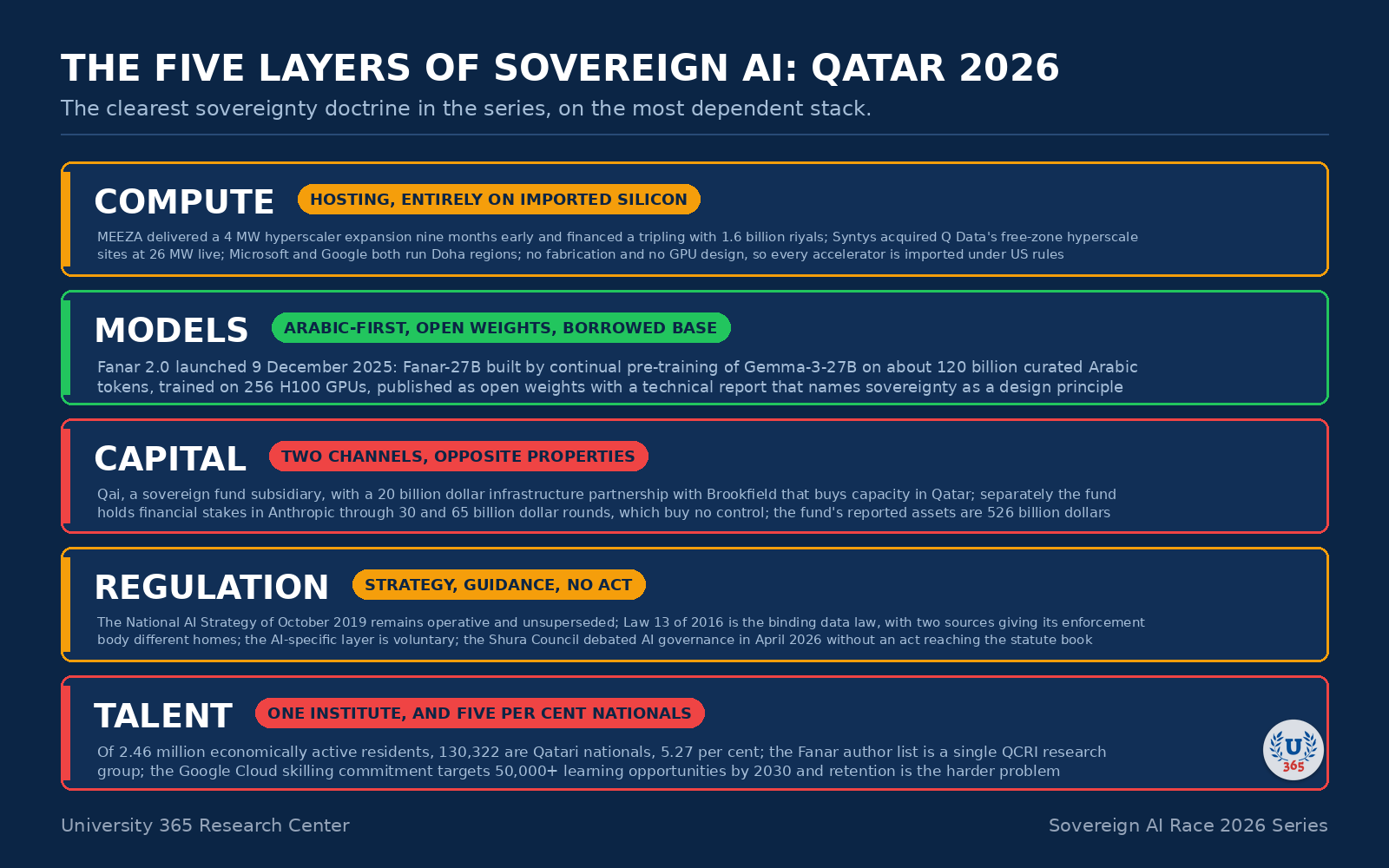
The five layers assessed. The clearest published sovereignty doctrine in the series above silicon and a base model that come from elsewhere. University 365 Research Center.
This is the nineteenth report in a twenty-part series assessing how states attempt to control the production of artificial intelligence inside their own jurisdiction. The framework is fixed and applied identically to every country. Sovereign AI capacity separates into five layers, and a state can hold any one of them without holding the others.
Compute sovereignty is the physical layer: where the chips and data centres sit, and who may switch them off. Model sovereignty is who builds the models a country depends on, and in whose languages and domains those models are competent. Capital sovereignty is who funds the build-out and on what terms. Regulatory sovereignty is who writes the rules and whether they can be enforced. Talent and education sovereignty is who builds and runs the systems, and how the next generation is prepared.
The series treats three races as running at once: the compute race, the model race and the rules race. Qatar is the country that chose one race and specified its terms in writing. Its national model line is called Fanar, Arabic for lighthouse, built by the Qatar Computing Research Institute inside Hamad Bin Khalifa University, and its published technical report states that sovereignty is a first-class design principle applied to every component from data pipelines to deployment. The second generation, Fanar 2.0, launched on 9 December 2025 and released with open weights, is a 27-billion-parameter model created by continued pre-training of a Google Gemma-3-27B backbone on roughly 120 billion tokens of curated Arabic data, trained on 256 H100 graphics processors.
The series places Qatar in the "ambition without compute" posture alongside Morocco, Brazil and South Africa, and this report tests that placement layer by layer. Qatar holds a genuine and unusual asset: an Arabic-first open model line with a published technical report and a named research team, which is more than most countries in this series can show. It also holds a substantial domestic colocation market with a national champion listed on its own stock exchange, two hyperscaler regions operating in Doha, and the cheapest power in the Gulf. What it does not hold is any part of the silicon chain, and its own model is built by continuing the pre-training of a foreign backbone. The report's question is what an explicitly stated sovereignty doctrine is worth when its two most important inputs, the base model and the accelerator, both come from abroad.
The vocabulary this report needs
Five terms recur, and they are defined here once.
Fanar. Qatar's Arabic-first generative model line, developed by the Qatar Computing Research Institute, part of Hamad Bin Khalifa University within Qatar Foundation. Fanar 1.0 was inaugurated on 10 December 2024 at the World Summit AI Qatar by the Prime Minister and Minister of Foreign Affairs. Fanar 2.0 launched on 9 December 2025 at the second edition of the same summit, with a technical report published in March 2026 describing Fanar-27B. The models are published on Hugging Face as open weights.
Qai. Qatar's national AI company, incorporated on 8 December 2025 as a wholly owned subsidiary of the Qatar Investment Authority. Its chairman and managing director also heads the Executive Office of the Prime Minister. On 9 December 2025, one day after incorporation, Qai and Brookfield announced a 20 billion dollar strategic investment partnership for AI infrastructure.
MEEZA. The national colocation champion, registered in the Qatar Science and Technology Park and listed on the Qatar Stock Exchange. In 2026 it delivered a four megawatt expansion to an unnamed global hyperscaler nine months ahead of schedule and secured an additional 1.6 billion Qatari riyals of Commodity Murabaha financing from Dukhan Bank to fund an expansion to more than triple its capacity.
The National AI Strategy. Adopted in October 2019 and never superseded on a full-text reading, drafted as a blueprint by the Qatar Center for Artificial Intelligence at QCRI. It is built on six pillars, education, data access, employment, business, research and ethics, and it is overseen by the Artificial Intelligence Committee established in 2021.
The concentration. Qatar's Arabic language research talent sits overwhelmingly in one institute, one university and one funding line. The Fanar 2.0 author list is a single research group at QCRI, and it contains the country's most visible Arabic natural language processing researchers.
The Question
Can a state declare sovereignty as a design principle and deliver it on rented silicon?
Qatar's position is the most explicitly theorised in this series, and the theory is worth taking at its word before measuring the practice against it.
The doctrine is stated. The Fanar 2.0 technical report declares that sovereignty is a first-class design principle covering every component from data pipelines to deployment, which is a stronger and more specific claim than the general aspiration language most national AI strategies use. The practice behind it has real content and it is unusually narrow. Qatar built an Arabic-first model rather than a general-purpose one, at a scale one institute can sustain, on a corpus of roughly 120 billion curated Arabic tokens, and released it as open weights rather than keeping it closed. It published the technical report and named the team. In a region where neighbouring states field larger models, Falcon in the United Arab Emirates and ALLaM in Saudi Arabia, Qatar's differentiator is depth in Arabic rather than breadth of capability, which is the choice a small state with a strong research institute should make.
The constraints are equally specific and they are structural rather than political. There is no semiconductor fabrication and no domestic graphics processor design in Qatar, so every accelerator in the country is imported under United States export rules, which places the ultimate switch on Qatari compute in Washington rather than Doha. This is not an inference about intent; it is a statement about where the licensing decision is made, and it applies to the hyperscaler regions, to the national colocation champion and to whatever Qai builds with Brookfield. The model layer has the same shape in a different dimension. Fanar 27B is created by continuing the pre-training of a Google Gemma-3-27B backbone, so the country owns the Arabic corpus, the data recipes, the fine-tuning and the release, and it does not own the base architecture it starts from.
The question this report puts to the evidence is therefore direct. A state that writes sovereignty into its model documentation, builds a genuine Arabic-first line, publishes it openly, and finances infrastructure through a 20 billion dollar partnership, has done most of what a small state can do. What it cannot do with any amount of capital is manufacture the processors or originate the base model. The report asks whether the stated principle survives that dependency, and the answer it reaches is that the doctrine is real and narrower than its wording suggests.
The Contradiction
The most explicit sovereignty doctrine in the series, on the most dependent stack
The central contradiction in the Qatari case is between the precision of its sovereignty claim and the number of foreign inputs beneath it, and both halves are unusually clear.
Take the claim first, because it is not rhetoric. The Fanar line is Arabic-first by design and the design is documented: a curated corpus of approximately 120 billion high-quality tokens across three data recipes, a stated intent to preserve and promote the Arabic language in AI systems, models published as open weights on the public hub rather than held back, and a technical report with a named author list. The first generation, launched in December 2024, was described by the government as the first Arab AI model designed to understand Arabic including its dialects, trained on more than a trillion Arabic words, a government claim carried as such. The second generation moved from that to a specific architecture and a published paper. The doctrine the paper states, that sovereignty is a first-class design principle covering every component, is the cleanest published statement of model sovereignty purpose in this series, and the report gives it full weight.
Now count the foreign inputs, because they are the other half of the finding. The base architecture is Google's Gemma-3-27B. The accelerators are NVIDIA H100s, imported under United States export rules, and there is no domestic alternative in prospect. The training ran on 256 of those processors, which means the model's own production depended on imported silicon. The cloud regions operating in Doha belong to Microsoft and Google. The national colocation champion's four megawatt expansion was delivered to an unnamed global hyperscaler, a customer whose identity MEEZA has not disclosed. And the 20 billion dollar infrastructure partnership is between a state fund's subsidiary and a Canadian asset manager, which is a genuine domestic build and also a foreign co-investor.
The contradiction resolves into a single and uncomfortable sentence. Qatar has written the most explicit sovereignty doctrine in this series onto a model created by continuing the pre-training of a foreign backbone, trained on imported accelerators, deployed through foreign cloud regions, and financed in partnership with a foreign asset manager. Each of those dependencies is normal and none of them is a failure; together they define what a stated design principle can and cannot deliver. The doctrine is real at the layer where it can be enforced, which is data, adaptation, language and licensing, and it is not operative at the layers where the state has no alternative supplier. The report's judgement is that Qatar knows this and that the doctrine's precision is what makes the gap visible, which is a more honest position than most countries in this series occupy.
The Current State
Compute: two hyperscaler regions, a national champion, and every chip imported
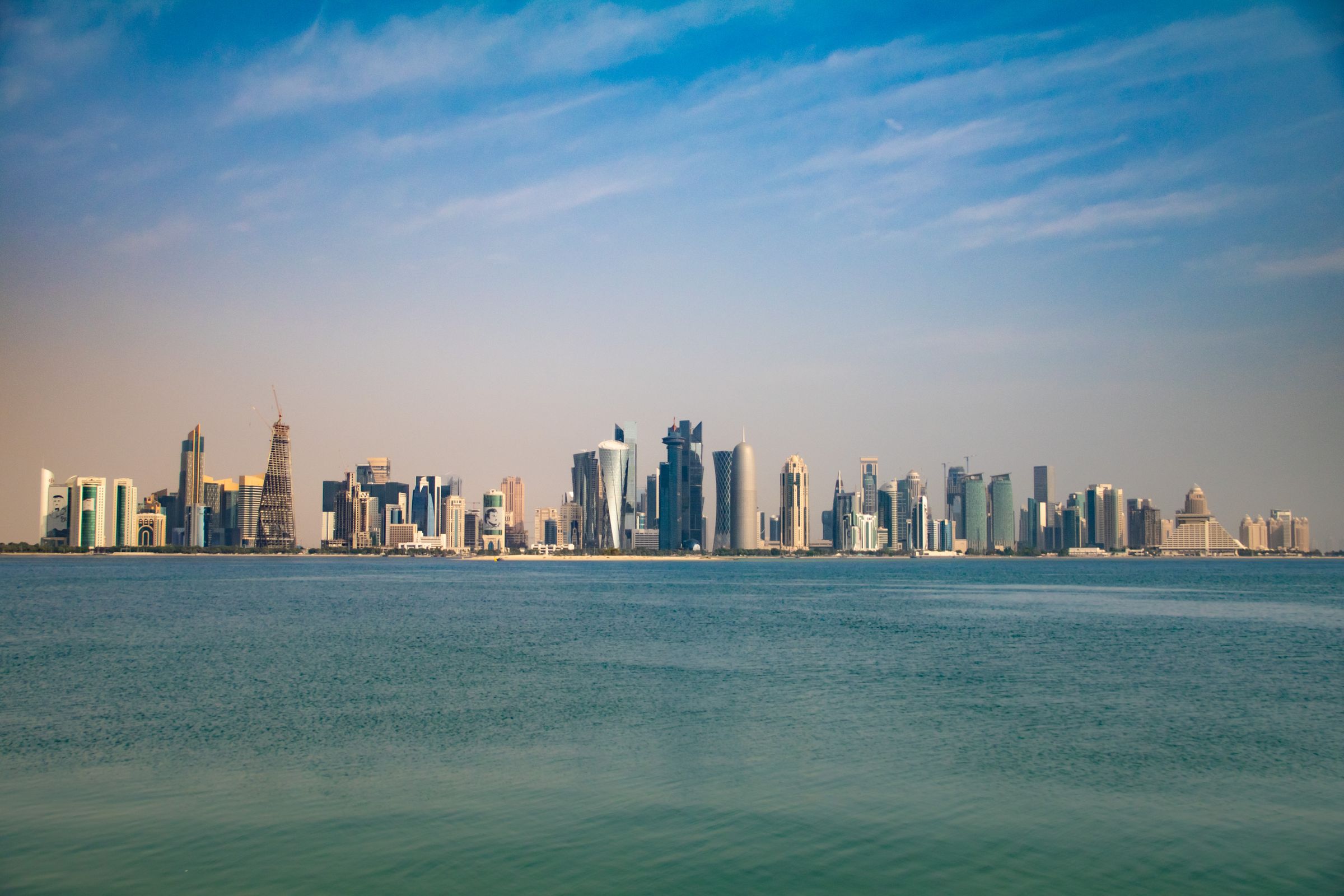
Doha. Microsoft and Google both operate cloud regions in the city, MEEZA is the listed national colocation champion, and every accelerator in the country is imported under United States export rules. Photograph: Pexels License, via Pexels.
Qatar's compute layer is small by Gulf standards, real, and built almost entirely around hosting.
The domestic operator base has three parts plus two hyperscaler regions. MEEZA, registered in the Qatar Science and Technology Park and listed on the Qatar Stock Exchange, is the national colocation champion: in January 2025 it announced four megawatts of additional capacity, in July 2026 it delivered a four megawatt expansion to an unnamed global hyperscaler nine months ahead of schedule, and on 30 July 2026 it secured an additional 1.6 billion Qatari riyals of Commodity Murabaha financing from Dukhan Bank to fund an expansion to more than triple its current size, with a stated intent to quadruple capacity within four years on a company figure reported through Gulf Times. Ooredoo operates through Syntys, a carrier-neutral platform it launched and promoted in its first-half 2025 results, and on 20 January 2026 Syntys acquired Q Data QFZ, which runs hyperscale facilities in the Qatar Free Zones; the parties describe 12.5 megawatts of hyperscale capacity added, five megawatts of live capacity transferred, total Syntys live capacity of 26 megawatts across Qatar and 30 megawatts total after the acquisition, and this report records both the 12.5 and the 5 megawatt figures rather than reconciling them, as the announcements themselves do not. Ooredoo also joined the NVIDIA Cloud Partner programme and, after a year in it, reported deploying the latest NVIDIA processors in Qatar, a company claim. Vodafone Qatar's role in compute runs through its Microsoft partnership, signed as a five-year agreement in September 2024, rather than through owned AI capacity, and no megawatt-scale Vodafone Qatar AI build could be verified.
The hyperscaler presence is the country's most significant compute asset. Microsoft launched its Qatar Azure region in Doha on or about 16 August 2022, the first hyperscaler region live in the country, and Microsoft and the Ministry of Communications and Information Technology then activated OpenAI GPT technology inside the Azure Qatar cloud so government entities could build on advanced models. Google Cloud opened its Doha region, and in September 2026 marked three years of operating cloud infrastructure in Qatar at the Google Cloud Summit Doha 2026.
The market context is small and growing. One research house estimates the Qatari data centre market at 203 million dollars in 2025 reaching 702 million by 2031 at a compound annual growth rate of nearly 23 per cent, and another describes the market as moving from 334 million dollars, with different scopes and base years that this report does not treat as comparable.
On energy, Qatar's pitch is the cheapest gas-fired power in the region, and the structural asset is real: the country was raising liquefied natural gas export capacity from 77 to 110 million tonnes per annum through the North Field East project with further expansion planned, and Reuters coverage frames the strategy as betting on cheap power to catch up in the Gulf AI race. Two gaps belong in the record here, and they are significant ones for a compute thesis built on power: no government-confirmed figure for Qatar's total installed electricity generation capacity in 2026 was located in this research, and no formally executed power purchase agreement dedicated to an AI data centre campus was verified either.
On the question of who may switch it off, the position is unambiguous and the report states it as its own analytical inference rather than a sourced quotation. Qatar has no semiconductor fabrication and no domestic graphics processor design. Every accelerator in the country is imported under United States export rules. The United States AI Diffusion Rule, which would have restricted chip exports to the Gulf and treated the region as a restricted tier, was set to take effect in May 2025 and was rescinded before taking effect as the administration changed, and the episode is instructive precisely because it shows how quickly the terms can move. The structural point survives the policy change: the ultimate switch on Qatari compute sits in Washington.
Models: the Arabic-first line, its doctrine, and the backbone underneath it

The tower, the floors of work, and the single cable arriving from elsewhere. University 365 Research Center.
Qatar's model layer is the strongest in this report and the one where the country's claim is most defensible, and the report treats it as the country's principal sovereign achievement.
Fanar launched on 10 December 2024, inaugurated by the Prime Minister and Minister of Foreign Affairs at the World Summit AI Qatar, and described by the ministry as the first Arab AI model designed to understand Arabic including its dialects, trained on over one trillion Arabic words, a government claim. Its stated objective, in the words of the Qatar Computing Research Institute's executive director, was to bolster the global prominence of the Arabic language in AI technologies, aligned with Qatar National Vision 2030. The first generation's components included an Islamic retrieval system for religious prompts, a recency system for current events, bilingual speech recognition across Arabic dialects, voice and image generation tuned to regional characteristics, and an attribution service for verifying content authenticity.
Fanar 2.0 arrived on 9 December 2025 and it is the substantive step. The technical report, published in March 2026, describes Fanar-27B, a 27-billion-parameter transformer built by continual pre-training of the Gemma-3-27B backbone on a curated corpus of approximately 120 billion high-quality tokens across three data recipes, trained on 256 H100 graphics processors. The report's benchmark gains are the authors' own evaluation claims and are carried as claims here. The models are published on Hugging Face under the Qatar Computing Research Institute's organisation as open weights, and the release notes point to the technical report and a public support address.
Three things about that release carry the analytical weight for this series. The first is the licence posture: Qatar's flagship sovereign model line is distributed as open weights rather than held closed, which is a deliberate sovereignty trade that buys influence and goodwill instead of gatekeeping capability, and it puts Qatar in the same category as Portugal and parts of China's open release programme rather than with states that keep their national models proprietary. The second is the doctrine: the report's statement that sovereignty is a first-class design principle covering every component from data pipelines to deployment is the clearest published articulation of model sovereignty purpose in this series, and it is specific enough to be tested, which is what this report does. The third is the dependency: a model built by continuing the pre-training of a Google backbone owns its language layer, its data recipes, its adaptation and its release terms, and it does not own the architecture it starts from. That is the same boundary this report drew for Portugal's AMALIA, which stacked Portuguese data on a European open base model, and Qatar's version is different only in that its base is American.
The research base behind the line is concentrated and it is deep. QCRI describes itself as the national research institute supporting Qatar in building innovation and technology capacity, and the Qatar Center for Artificial Intelligence is a research group inside it covering the full artificial intelligence spectrum. The institute co-hosted the Machine Learning and Data Analytics Symposium in February 2026 with Carnegie Mellon University in Qatar. The Fanar 2.0 author list contains the country's most visible Arabic natural language processing researchers, and this report treats that roster as the single clearest evidence of where Qatar's AI capability actually lives.
On the comparison with neighbours, the series can draw it directly because it has published both. The United Arab Emirates runs the Falcon family from the Technology Innovation Institute in Abu Dhabi with a mixture of open and restricted licences across generations, and Saudi Arabia's ALLaM is associated with the Saudi Data and AI Authority. Qatar's differentiator against both is narrow, deep Arabic-first specialisation against broader multi-modal and multi-purpose ambitions, achieved on a smaller absolute compute base. That is the correct strategic choice for a state of Qatar's size and the report credits it.
Two institutional additions since the last report round out this layer. Qatar University approved a Bachelor of Science in Artificial Intelligence under its College of Engineering for launch in autumn 2026, and operates an AI Research and Innovation Hub with scholarship and sponsorship components. Carnegie Mellon University in Qatar launched a Bachelor of Science in Artificial Intelligence described in Qatari press as the first such programme in the country.
Capital: a sovereign fund with two channels and one doctrine problem
Qatar's capital layer is the most interesting in this series because its sovereign wealth reaches AI through two channels with opposite sovereignty properties, and the report's finding is about that asymmetry.
The first channel is the domestic build, and its vehicle is new. Qai was incorporated on 8 December 2025 as a wholly owned subsidiary of the Qatar Investment Authority, positioning itself as a national AI champion and infrastructure developer that builds and operates renewable-energy-powered data centres and high-performance computing clusters. Its chairman and managing director also heads the Executive Office of the Prime Minister, which places the company close to the centre of the state. On 9 December 2025, one day after incorporation, Qai and Brookfield announced a 20 billion dollar strategic investment partnership for AI infrastructure, announced by the fund on its own newsroom and covered by Reuters as a joint venture. The reported size of the fund behind it is 526 billion dollars of sovereign wealth assets, a figure carried as reported by wire services because the fund's own assets-under-management disclosure for 2026 was not located in this research.
The second channel is passive exposure to American frontier laboratories. The fund announced increases to its investment in Anthropic through a 30 billion dollar Series G round and then a 65 billion dollar Series H round, describing the company as a leading AI safety and research business. Both announcements are the fund's own; the dates of each round could not be verified and are not asserted.
The asymmetry between the two channels is the analytical content of this layer and it is worth stating plainly. The Anthropic stakes are financial. They give Qatar a return, a relationship and a seat at the table in the sector that matters most, and they give it no control whatever over the models it is invested in, their direction, their pricing, their availability in Qatar, or their treatment of Arabic. The Qai venture is different in kind: it buys physical capacity on Qatari soil, under Qatari jurisdiction, which is a real asset and one the state can direct. A sovereign fund that holds both is therefore running a portfolio with one controlling position and one speculative one, and the report's judgement is that the passive position is the larger and the active position is the one that matters for sovereignty even though it is smaller in headline terms.
The domestic pipeline around those channels includes Qatar National Vision 2030 as the framing document, the Digital Agenda 2030 with its six strategic programmes, and a five-year investment pipeline detailed on 28 September 2026 under a newly launched Doha Investment platform worth more than 60 billion dollars, combining 38.5 billion dollars of infrastructure and 22.5 billion dollars of private sector opportunities. The International Monetary Fund's 2025 selected issues paper on artificial intelligence in Qatar assessed that the country had been actively preparing to embrace AI, allowing it to lead emerging-market peers in readiness. On the corporate side, Qatar Development Bank invested in Multiverse Computing, a Spanish model-compression specialist, and will bring it to Doha, with deal terms undisclosed.
One further element of this layer deserves mention because it is a form of capital that is often overlooked: state purchasing. The government's own adoption of AI through its Microsoft and Scale AI partnerships functions as an anchor demand signal for the domestic market, and it is the mechanism by which a small state can create a market for its own model line without a subsidy programme.
Regulation: a strategy, guidance, and a legislative pipeline that has not produced an AI act
Qatar's regulatory layer is layered, largely voluntary, and the least settled of the five, and the report states that without softening it.
The operative strategy remains the National Artificial Intelligence Strategy adopted in October 2019, drafted by the Qatar Center for Artificial Intelligence and overseen by the Artificial Intelligence Committee established in 2021 with representatives from ministries, universities and financial institutions. It has never been superseded on a full-text reading, which means the country's governing AI document predates the generative wave entirely.
The binding law is data protection, not artificial intelligence. Law No. 13 of 2016 on Protecting Personal Data Privacy took effect in 2017 and remains the foundation. Here the report records a genuine institutional conflict: one legal guide places the enforcement body in the Compliance and Data Protection Department attached to the Ministry of Communications and Information Technology, while another places it in the National Cyber Governance and Assurance Affairs division of the National Cyber Security Agency. Both are stated rather than reconciled, and the difference may reflect reorganisation over time. The Qatar Financial Centre operates a separate data protection regime for firms registered there, operating onshore with its own rules.
The AI-specific layer is voluntary. The ministry published Principles and Guidelines for Ethical Development and Deployment of Artificial Intelligence, described as non-binding and human-centred, alongside a separate set of principles for ethical use. Regulatory analysis in January 2026 recorded that the ministry and the cyber security agency published frameworks in 2024 and 2025 translating ethical principles into actionable requirements for developers and deployers, while noting that much of the national framework remains non-binding. An independent synthesis states the position directly: Qatar does not have a single economy-wide AI act in force, and AI is governed through the 2019 strategy, voluntary ethical guidance and sectoral rules.
Sectoral regulation is where enforcement capacity actually sits. The central bank publishes Artificial Intelligence Guidelines within its financial technology material alongside a regulatory sandbox, and the document is hosted on the bank's own site, though its issue date could not be captured. In May 2025 the Qatar Financial Centre indicated a draft regulation on AI use in the financial market would be issued soon. Media rules and deepfake provisions were reviewed for this report and are addressed through existing sectoral instruments rather than through an AI statute.
The legislative pipeline is active and it has not yet produced what the report looked for. On 27 April 2026 the Shura Council debated the governance of artificial intelligence and referred draft legislation to committees, a Tier 1 state record. On 9 July 2026 the Cabinet reported that the period from October had seen more than 120 decisions, draft laws and qualitative initiatives, including 22 draft laws approved by the Shura Council of which nine had been issued during 2026, with the legislative process for further draft laws to be completed in preparation for their issuance. The 9 July reporting does not name an AI law among the nine issued, and an economy-wide AI act was not verified as enacted as of this report's cut-off.
One institutional development should be flagged because it is material if confirmed and it was not verified at Tier 1 in this research: the establishment in September 2025 of a National Center for Artificial Intelligence inside the ministry under a Cabinet resolution amending its organisational structure. The report records it as unverified rather than asserting it, and notes that it would be a material institutional change since the last report if a primary source confirms it.
Talent: a concentrated research core and a demography that cannot staff it
Qatar's talent layer contains the country's deepest structural problem and the explanation for why its model line is as narrow and as good as it is.
The demographic position is the constraint and it is stark. Of Qatar's 2.46 million economically active residents, 130,322 are Qatari nationals, or 5.27 per cent, on a September 2026 policy analysis. Other sources put total residents at roughly 2.9 to 3 million with about 85 to 88 per cent expatriates. The figures use different denominators and this report does not reconcile them, and the direction of travel is identical in every source: a small national core and a large imported workforce. The consequence for this series is direct and the report states it without euphemism. Qatar cannot staff an AI industry from its national population at current size. Every compute build, every model team and every skilling target rests on continued expatriate recruitment and on retaining people after they are trained.
The skilling programme is real and it is large by the country's standards. The ministry partnered with Google Cloud on a national cloud skilling programme targeting more than 50,000 learning opportunities by 2030, restated at the Google Cloud Summit Doha in September 2026, where a partner projected 2.9 billion dollars of potential economic impact for Google Cloud's partnership with Qatar by 2030, a vendor and partner projection carried as a claim. The ministry's booth at the same summit displayed joint initiatives including an innovation lab, the national portal and an agreement for more learning places than previously announced. An earlier national skilling programme had aimed to train 50,000 people in AI and data science. An independent analysis names the harder problem accurately: 50,000 people are being trained, and retaining them after training is the more difficult challenge.
The institutions producing talent are concentrated and they are strong for the country's size. Hamad Bin Khalifa University hosts the research institute and the centre that produce the Fanar line, and is the parent institution for the model team. Qatar University approved a Bachelor of Science in Artificial Intelligence for autumn 2026 and operates an AI research and innovation hub. Carnegie Mellon University in Qatar launched the country's first such bachelor's programme. Qatar Foundation operates the Education City campus that hosts both and the science and technology park where MEEZA is registered, and it has been re-engineering how the country produces AI talent through 2026 including a partnership with Scale AI announced earlier in the year, a Tier 3 detail. The scholarship infrastructure is substantial, with government scholarship cycles, Qatar University's own programmes and a national scholarships platform administering provisions including full tuition.
On immigration instruments, the report records a negative finding that matters: no Qatar-specific AI talent visa category with published eligibility criteria was located. Expatriate AI staff are governed by the general work permit and residency regime.
The concentration is the talent layer's defining feature and it cuts both ways. The Fanar author list is a single research group at QCRI containing the country's most visible Arabic natural language processing researchers, and the model line is the vehicle through which that work reaches production. This is a coherent structure and a thin one: it does not have the research hiring volume of Saudi Arabia or the United Arab Emirates, and it has produced a recognisable Arabic-first model line with a published technical report and open weights. For a country of Qatar's size that is the right trade, and it is also a single point of failure that a larger state would not tolerate.
What changed since our May 2025 report on Qatar
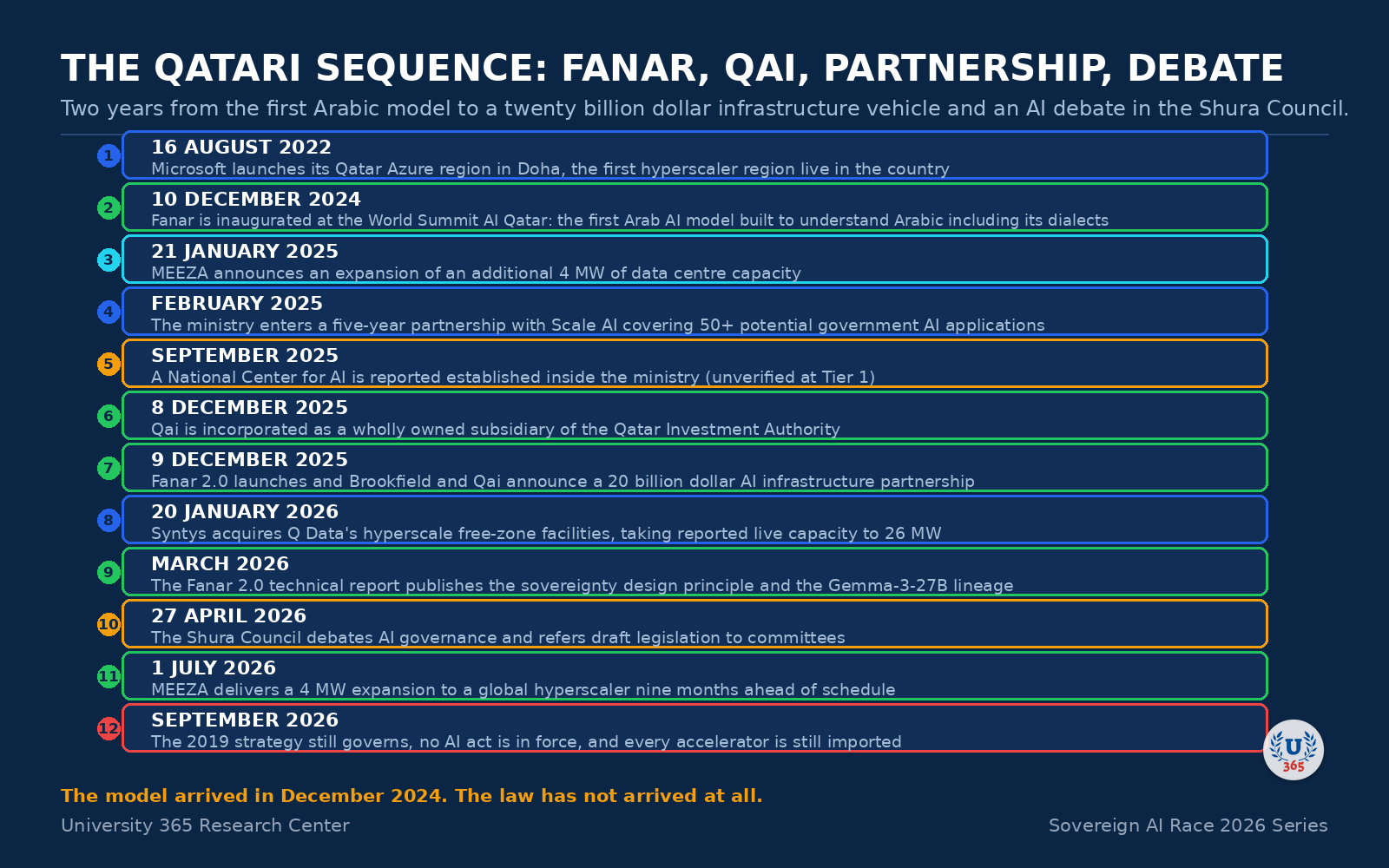
The Qatari sequence: Fanar, Qai, partnership, debate. University 365 Research Center.

Read the earlier report: Qatar's AI Development: The Evolution of Artificial Intelligence in a Gulf's Digital Pioneer. University 365 INSIDE, 8 May 2025.
University 365 published "Qatar's AI Development: The Evolution of Artificial Intelligence in a Gulf's Digital Pioneer" on 8 May 2025. That report captured Qatar in the middle of its first model generation, with Fanar 1.0 as the flagship and a strategy built on substantial investment and international partnership. Against that baseline, seventeen months have delivered a second model generation, a new national AI company, and a capital partnership an order of magnitude larger than anything the earlier report described, and it has not delivered a law.
The model line advanced a full generation and the doctrine became explicit. The May 2025 report described Fanar's first generation with its two Arabic models, Fanar Star at 7 billion parameters and Fanar Prime at 9 billion, launched in December 2024 and trained on a government-claimed trillion Arabic words. The verified position now is Fanar 2.0, launched 9 December 2025, with the technical report published in March 2026 describing Fanar-27B as a 27-billion-parameter model built by continuing the pre-training of Gemma-3-27B on roughly 120 billion curated tokens across three data recipes, trained on 256 H100 graphics processors. The parameter count has roughly tripled, the technical basis is published rather than described in press releases, and the doctrine this report quotes came from that document.
The capital architecture changed completely, and this is the largest single movement. The May 2025 report described a 2.4 billion dollar investment package to strengthen AI capabilities and attract global talent, and a 2.5 billion dollar allocation for data and AI under the Digital Agenda 2030, and a five-year partnership between the ministry and Scale AI announced in February 2025 to explore more than 50 potential government AI applications. Since then the country has incorporated Qai as a wholly owned subsidiary of the sovereign fund on 8 December 2025 and announced a 20 billion dollar AI infrastructure partnership with Brookfield the next day, and the fund has reported investments in Anthropic through two successive large financing rounds. A country whose AI capital was measured in single-digit billions now has a vehicle with a twenty billion dollar partnership and passive holdings in an American frontier laboratory, and the report's comparison treats the change in kind rather than only in scale: the earlier position was a state buying capability, and the position now is a state building one piece of infrastructure and investing financially in somebody else's.
Compute moved from plans to deliveries, and one figure needs stating carefully. The May 2025 report recorded MEEZA's four megawatt expansion announcement of January 2025. The verified position is that MEEZA delivered a four megawatt expansion to a global hyperscaler nine months ahead of schedule on 1 July 2026, and secured 1.6 billion Qatari riyals of additional Murabaha financing on 30 July 2026 to fund an expansion to more than triple its capacity. On the operator side, Syntys acquired Q Data's hyperscale facilities in the free zones in January 2026, taking its reported live capacity to 26 megawatts and total capacity to 30 megawatts. Those are deliveries rather than announcements and they validate the earlier report's account of the direction.
The legislative position did not move. The May 2025 report described the strategy and the guidance layer. The position now is that the 2019 strategy remains operative and unsuperseded, the binding law is still the 2016 data protection statute, the AI-specific layer is still voluntary, and the Shura Council debated AI governance in April 2026 and referred drafts to committee without an AI act reaching the statute book as of this report's cut-off. Seventeen months produced a second model generation and a twenty billion dollar capital vehicle and no AI law, which is a pattern this series has now recorded in several countries and which the report states as the finding rather than as an aside.
Two numbers the earlier report carried are restated with their status. The claim that artificial intelligence would boost Qatar's economy by 2.3 per cent by 2030, generating approximately 11 billion dollars in revenue and 26,000 jobs, came from International Monetary Fund analysis and is a projection rather than a measurement; it is carried here as an estimate. The statement that the government had allocated 2.5 billion dollars for data and AI initiatives under the Digital Agenda 2030 and a further 2.4 billion dollar package for AI capabilities and talent is a government allocation figure from the period and is carried with its date rather than as a current commitment.
The genuinely new items are these. The incorporation of Qai and its twenty billion dollar Brookfield partnership. The sovereign fund's reported Anthropic positions through a 30 billion dollar Series G and a 65 billion dollar Series H round. Fanar 2.0 and its technical report. The Q Data acquisition by Syntys. The delivery of MEEZA's four megawatt expansion ahead of schedule and the 1.6 billion riyal financing. Qatar University's artificial intelligence degree for autumn 2026 and Carnegie Mellon's first-in-country programme. The Google Cloud Summit Doha 2026 and its restated 50,000 learning-opportunity commitment. The 60 billion dollar investment pipeline detailed in September 2026. The Shura Council's April 2026 AI governance debate. And the unverified September 2025 establishment of a national AI centre inside the ministry, recorded as a gap rather than asserted.
Key Findings
1. Qatar's national model line is Arabic-first, published as open weights, and built on a Google backbone. Fanar 2.0 launched on 9 December 2025; the technical report of March 2026 describes Fanar-27B as a 27-billion-parameter model created by continual pre-training of Gemma-3-27B on roughly 120 billion curated Arabic tokens across three data recipes, trained on 256 H100 graphics processors. The models are on Hugging Face as open weights. The country owns the corpus, the recipes, the adaptation and the release terms, and not the base architecture.
2. The sovereignty doctrine is explicit and it is the clearest in this series. The Fanar 2.0 technical report states that sovereignty is a first-class design principle covering every component from data pipelines to deployment. That claim is specific enough to test, and this report tests it against the dependencies in the other four layers.
3. Every accelerator in the country is imported, so the switch is in Washington. Qatar has no semiconductor fabrication and no domestic graphics processor design. The United States AI Diffusion Rule, which would have restricted Gulf chip exports, was set to take effect in May 2025 and was rescinded before taking effect, and the structural dependence survives the policy change.
4. The compute base is real, small, and built around hosting. MEEZA delivered a 4 MW expansion to an unnamed global hyperscaler nine months ahead of schedule in July 2026 and secured 1.6 billion riyals of Murabaha financing to more than triple capacity. Syntys acquired Q Data's hyperscale free-zone facilities in January 2026, taking reported live capacity to 26 MW and total to 30 MW. Microsoft and Google both operate cloud regions in Doha. One research house puts the market at 203 million dollars in 2025 reaching 702 million by 2031.
5. The energy thesis rests on cheap gas and two figures are missing. Qatar was raising LNG export capacity from 77 to 110 million tonnes per annum through North Field East, and cheap power is the country's stated pitch to the AI industry. No government-confirmed total installed generation capacity figure for 2026, and no executed power purchase agreement dedicated to an AI campus, was verified in this research.
6. Sovereign capital now reaches AI through two channels with opposite properties. Qai, incorporated 8 December 2025 as a wholly owned subsidiary of the Qatar Investment Authority, announced a 20 billion dollar AI infrastructure partnership with Brookfield the next day, which buys physical capacity in Qatar. The fund separately announced increases to its Anthropic holdings through a 30 billion dollar Series G and a 65 billion dollar Series H round, which buy financial exposure and no control whatever. The fund's reported assets are 526 billion dollars on wire-service figures.
7. Qatar has no AI act and its governing strategy dates from 2019. The National AI Strategy adopted in October 2019 has never been superseded. The binding law is the 2016 data protection statute, whose enforcement body two legal guides place in different institutions. The AI-specific layer is voluntary ministry guidance. The Shura Council debated AI governance on 27 April 2026 and referred draft legislation to committees; an economy-wide act was not verified as enacted.
8. Sectoral regulation carries the real enforcement capacity. The central bank publishes AI guidelines with a financial technology sandbox, and the Qatar Financial Centre signalled a financial market AI regulation in May 2025.
9. Talent is concentrated in one institute and the demography cannot staff the industry. Of 2.46 million economically active residents, 130,322 are Qatari nationals, 5.27 per cent. The Fanar author list is a single research group at the Qatar Computing Research Institute. The Google Cloud skilling commitment targets more than 50,000 learning opportunities by 2030, and the harder problem, named by independent analysis, is retaining them.
10. Oxford Insights places Qatar 54th of 195, and the index figure needs stating as a rank rather than a score. The publisher's January 2026 table prints the rank and the six pillar scores and no overall column, so this report cites the rank and the computed overall of 58.62 from the publisher's own weights, a method that reproduces all nine overall scores the report states in its narrative exactly.
11. The honest overall verdict: Qatar is the series' most clearly theorised sovereignty position, and the theory is honest about its own boundaries. It built a genuine Arabic-first open model line with a published technical report and named researchers, created a national AI company with a twenty billion dollar infrastructure partnership, and finances a research base that produces work of real quality. It cannot make an accelerator, does not originate its base model, has no AI law, and cannot staff its industry from its own population. On this evidence the country has done the most a small state with capital and one good institute can do, and the doctrine it published is the accurate description of how far that reaches.
Deep Analysis
What a stated sovereignty doctrine can and cannot deliver
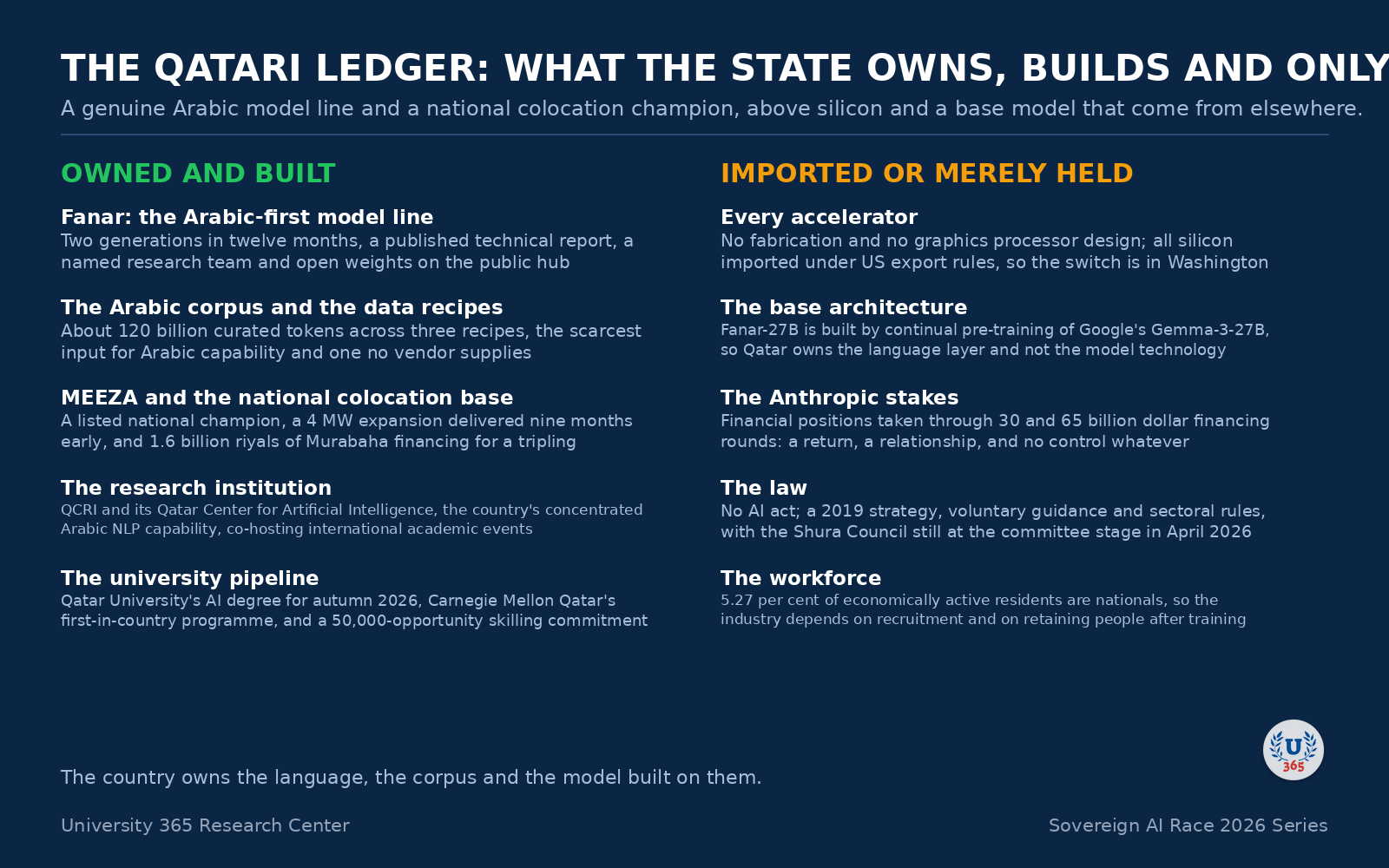
What Qatar owns and built, against what it imports or merely holds. University 365 Research Center.
Qatar is the only country in this series that published its sovereignty doctrine as a design principle in a technical report and then built to it, so its case is the best available test of what such a doctrine can actually secure.
Start with what the doctrine covers, because the report's argument is that the Fanar 2.0 statement is an accurate description of the country's real position rather than an overclaim. The report says sovereignty is a first-class design principle applied to every component from data pipelines to deployment. Read against what Qatar actually controls, that is defensible at four points in the chain. It controls the corpus, having assembled roughly 120 billion high-quality Arabic tokens across three data recipes, which is the scarcest input for Arabic capability and the one no vendor supplies. It controls the data recipes, meaning how that corpus is filtered, ordered and mixed, which is the part of model quality that is genuinely a craft. It controls the adaptation, having run the continual pre-training and the instruction tuning itself on its own infrastructure. And it controls the release, choosing open weights and a public hub over a closed licence, which determines who can use the model and on what terms. On each of those four points the sovereignty claim is operative and it is Qatar's own work.
Now measure where the doctrine stops, because the report's finding is that the same document describes a chain that begins outside the country. The base architecture is Google's Gemma-3-27B. The accelerators are NVIDIA H100s, 256 of them for the training run, imported under United States export rules. The cloud regions the country's government and enterprises use belong to Microsoft and Google. The capital for the infrastructure build is partnered with a Canadian asset manager. And the sovereign fund's other AI position is a financial stake in an American laboratory. Every one of those is a normal arrangement for a small state and none of them is a failure of policy, and together they bound what a design principle can achieve: Qatar can specify sovereignty over the components it creates, and it cannot specify it over the components it buys.
The distinction matters beyond Qatar and the report draws it as a general finding for the series. Sovereignty over a component requires either ownership of the component or an alternative supplier for it. Qatar owns the corpus and has no alternative source for Arabic training data at that quality, which makes that layer genuinely sovereign. It owns neither the architecture nor the accelerator and has no alternative supplier for the frontier version of either, which makes those layers genuinely dependent. A doctrine that states its principle without stating its boundaries will read as a claim on the whole stack, and Qatar's doctrine is unusual in this series because the boundaries of what it can enforce are discoverable from the same document that states the principle, and because the country is candid about building on a named open backbone rather than obscuring it. The report's judgement is that this is the most honest sovereignty position in the series and the most limited by construction, and that both of those things are true at once.
The two-channel capital structure and the illusion it can create
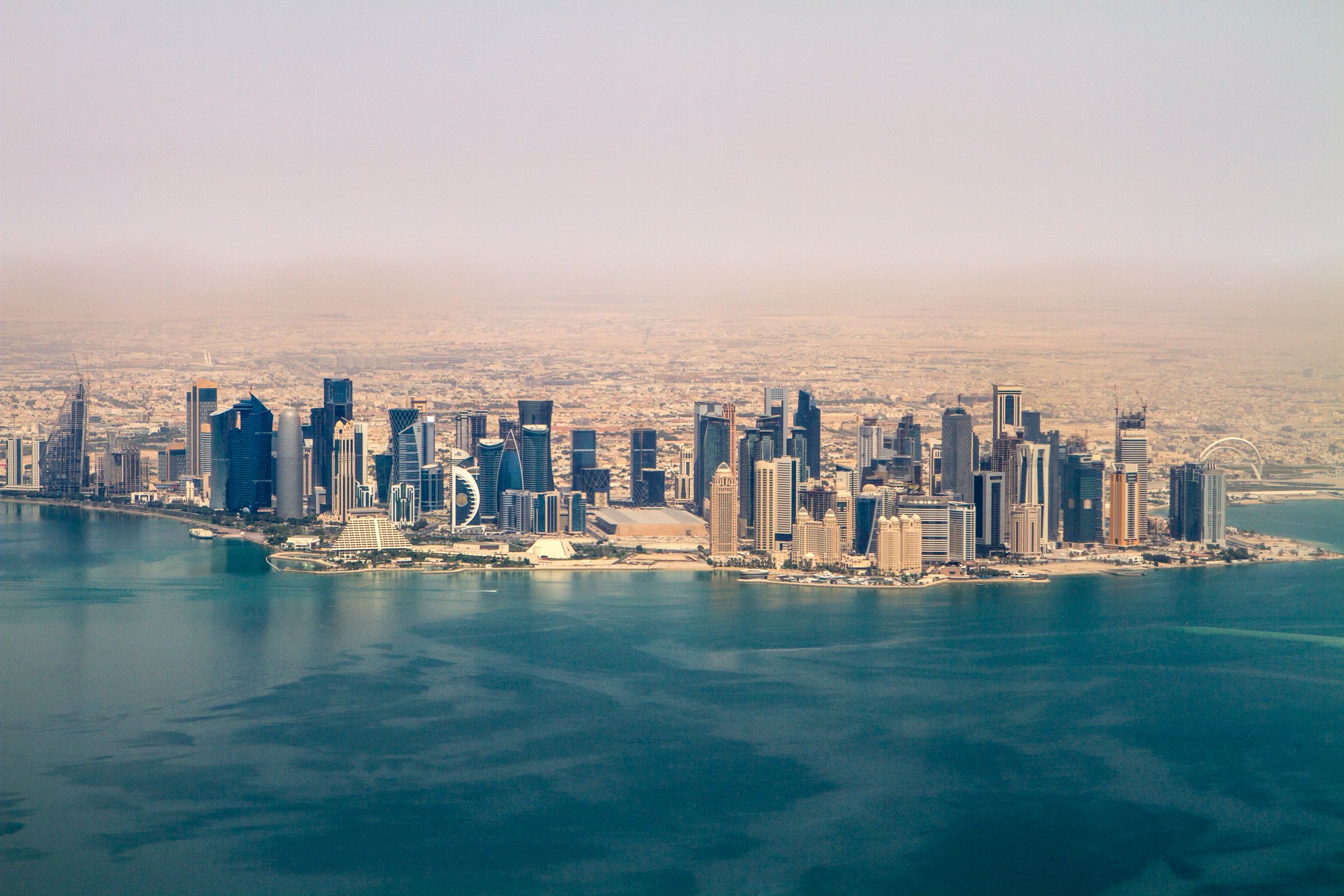
Doha from the air. Qai, a subsidiary of the sovereign fund, announced a twenty billion dollar AI infrastructure partnership with Brookfield one day after it was incorporated, and the same fund holds financial stakes in an American laboratory that confer no control over anything built here. Photograph: Pexels License, via Pexels.
Qatar's sovereign capital reaches artificial intelligence through two channels with opposite properties, and the report treats the asymmetry as the most important thing to understand about the capital layer in any Gulf state.
The active channel is Qai. Incorporated on 8 December 2025 as a wholly owned subsidiary of the Qatar Investment Authority, it announced a twenty billion dollar infrastructure partnership with Brookfield one day later. What that buys is physical capacity on Qatari soil under Qatari jurisdiction: data centres, high-performance computing clusters and renewable-powered sites that the state can direct, regulate, tax and, if it chooses, restrict to domestic users. That is a sovereignty-relevant asset in the strict sense this series uses, because the state can decide what happens to it.
The passive channel is financial. The same fund reported increasing its holdings in Anthropic through a thirty billion dollar Series G round and then a sixty-five billion dollar Series H round. Those positions give Qatar a return, a relationship, and a place in the capital structure of one of the two or three most consequential artificial intelligence laboratories in the world. They give it nothing else. It cannot direct Anthropic's research, cannot require that its models handle Arabic well, cannot obtain preferential access, cannot prevent the company from changing its terms, and cannot use the stake to keep anything running in Doha. A financial stake in a frontier laboratory is a bet on somebody else's sovereignty, and the report is precise about that because the confusion between the two channels is easy to make and consequential.
The illusion the structure can create is the important part, and it has two forms. The first is internal: a state that reads its own AI portfolio in aggregate sees frontier exposure and infrastructure ownership side by side and may treat them as one position, when in fact one is a shareholding and the other is a facility. The second is external: a country's AI standing is often assessed by the size of the figures it deploys, and a sixty-five billion dollar financing round in which a sovereign fund participates produces a headline that reads like a national achievement when it is a portfolio allocation. The report's recommendation for any state running both channels is procedural rather than financial, and it is to report them separately and to state, for each, what the state can direct and what it merely owns.
There is a further point about the scale of the fund that the report states because it explains the strategy. The reported assets are 526 billion dollars on wire-service figures, which is a figure the state could use to buy far more compute than it has. It has chosen instead to build a moderate domestic footprint through a partnership and to hold a large passive position in an American laboratory, and that is a rational choice for a fund whose purpose is returns rather than strategy. The consequence for the compute layer is that the country's own capacity remains modest by Gulf standards while its financial exposure to artificial intelligence is very large, and the two facts describe two different things.
The three races, measured in Qatar
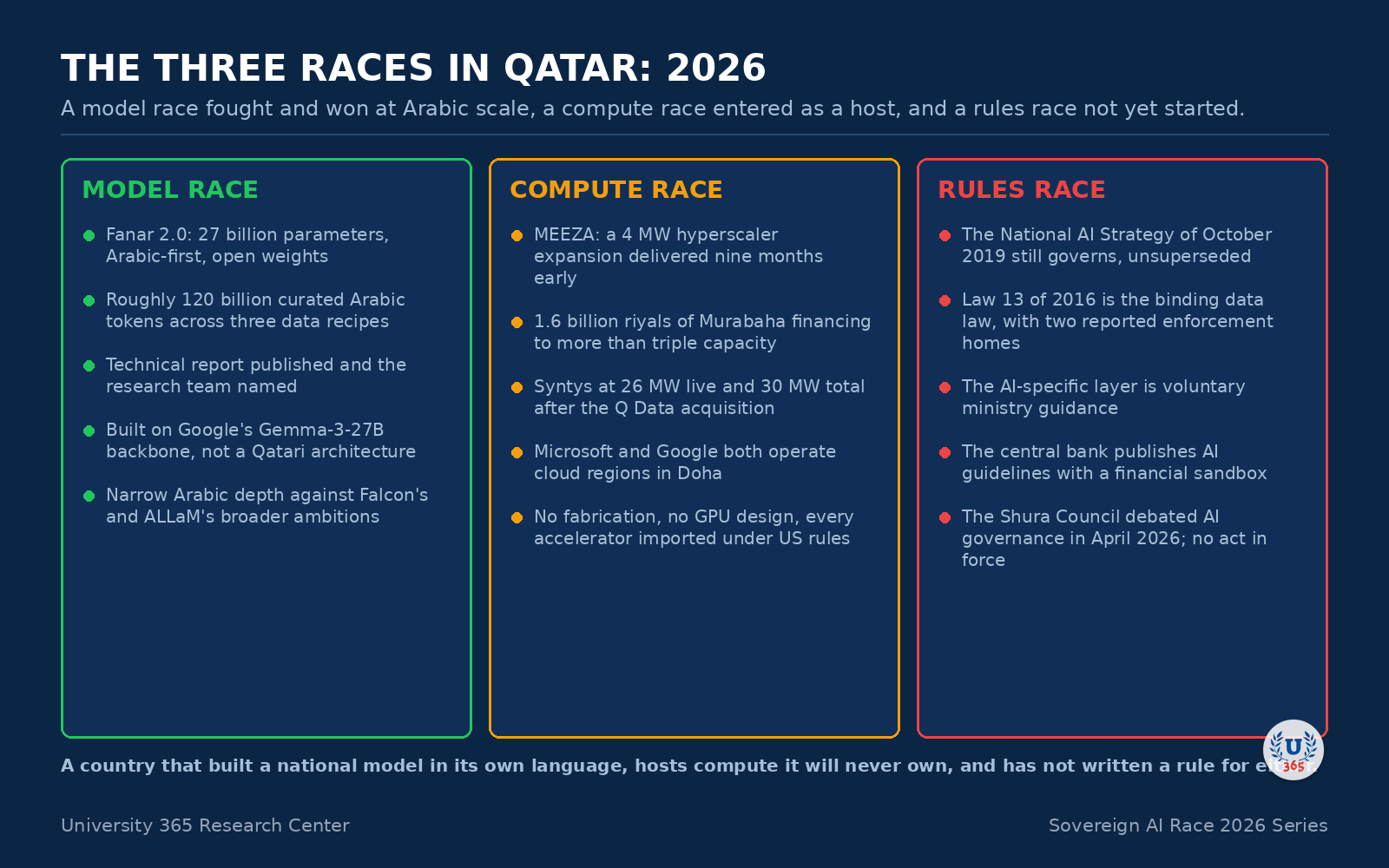
The three races in Qatar, at three different stages. University 365 Research Center.
The series separates the compute race, the model race and the rules race. Qatar is the country that competed seriously in one of the three, entered a second as a host rather than an owner, and has not yet started the third.
In the model race, Qatar competed and it has something to show. Fanar is a genuine Arabic-first line with two generations, a published technical report, a named research team and open weights. Its narrow specialisation in Arabic against the broader multi-modal ambitions of Falcon in the United Arab Emirates and ALLaM in Saudi Arabia is the correct strategic choice for a state of Qatar's size, and the concentration of its talent in one institute, while thin, is what allowed the country to produce a model of real quality rather than several of none. The dependency is the backbone, and the report records it as the boundary of the achievement rather than as a disqualification. This is the series' second case of a country owning its language layer on a borrowed base, after Portugal, and the two are worth comparing: Portugal spent 5.5 million euros and owns European Portuguese on a European base, Qatar spends vastly more across its portfolio and owns Arabic on an American base. Both did the hard part themselves.
In the compute race, Qatar is a host and a buyer, and its position is honest about that. It has two hyperscaler regions, a listed national colocation champion that delivered an expansion nine months early, a carrier-neutral platform that acquired hyperscale free-zone facilities, and the cheapest gas-fired power in the region. It has no fabrication, no graphics processor design and no domestic alternative to imported accelerators, and the United States export rules that govern those imports were the subject of a rescinded restriction in 2025 that showed how quickly the terms can change. A country whose compute thesis rests on cheap power and whose power thesis is missing two published figures, its own installed generation capacity and an executed data centre power purchase agreement, has a real case that is not yet documented to the standard the claim requires.
In the rules race, Qatar has not started. The governing strategy dates from October 2019 and has never been superseded, the binding law is a data protection statute from 2016, the AI-specific material is voluntary ministry guidance, the real enforcement capacity sits in sectoral regulators, and the Shura Council debated AI governance in April 2026 and referred drafts to committee without an act reaching the statute book. Seventeen months between this report and the last one produced a second model generation and a twenty billion dollar capital vehicle and no law, which is the same pattern this series has recorded in Italy in a different institutional form and in South Africa with a different outcome.
The three tempos produce the report's summary of Qatar. A state that built a genuine national model in its own language and published the doctrine behind it, hosts compute it will never own, and has not yet written a rule for the technology it is investing in at scale.
Data and Evidence
Table 1: The five layers, assessed for Qatar in September 2026
Layer | What Qatar holds | What it does not hold | Assessment |
Compute | MEEZA, listed on the Qatar Stock Exchange in the Qatar Science and Technology Park: a 4 MW expansion delivered to an unnamed global hyperscaler nine months early on 1 July 2026 and 1.6 billion riyals of Murabaha financing secured on 30 July 2026 to more than triple capacity; Syntys (Ooredoo) acquiring Q Data's hyperscale free-zone facilities, with 12.5 MW added and 5 MW live transferred, 26 MW reported live and 30 MW total; Microsoft Azure Qatar live since 16 August 2022 with OpenAI GPT activated inside it; Google Cloud Doha plus three years of operation marked in September 2026; Vodafone Qatar through its Microsoft partnership; cheap gas-fired power and LNG capacity rising from 77 to 110 MTPA via North Field East | Any part of the silicon chain: no fabrication, no domestic GPU design, every accelerator imported under US export rules; a government-confirmed 2026 installed generation capacity figure; an executed power purchase agreement for an AI campus; a verified Vodafone Qatar megawatt-scale AI build | Real hosting capacity and a national champion, with the accelerator switch abroad |
Models | Fanar 2.0, launched 9 December 2025: Fanar-27B, 27 billion parameters, built by continual pre-training of Gemma-3-27B on roughly 120 billion curated Arabic tokens across three data recipes, trained on 256 H100 GPUs, technical report published March 2026, models published as open weights on Hugging Face; Fanar 1.0 from 10 December 2024 with Fanar Star and Fanar Prime; the QCRI and QCAI research base; the named Fanar 2.0 author roster; Qatar University's BSc in AI from autumn 2026 and Carnegie Mellon Qatar's first-in-country programme | The base architecture, which is Google's Gemma-3-27B; a frontier-class model at any scale; independent benchmarks rather than the authors' own evaluation; a second institution of comparable depth to QCRI | The series' clearest stated sovereignty doctrine, delivered on a borrowed backbone |
Capital | Qai, incorporated 8 December 2025 as a wholly owned subsidiary of the Qatar Investment Authority, with a 20 billion dollar AI infrastructure partnership with Brookfield announced 9 December 2025; the fund's reported 526 billion dollars of assets on wire-service figures; the fund's announced increases to its Anthropic holdings through 30 billion dollar Series G and 65 billion dollar Series H rounds (financial exposure, no control); a 60 billion dollar investment pipeline detailed 28 September 2026 including 38.5 billion of infrastructure; Qatar Development Bank's investment in Multiverse Computing; the Digital Agenda 2030 with its six programmes | Any control over the frontier models the sovereign fund invests in; a verified published AUM figure from the fund for 2026; disclosed terms for the Multiverse investment; state capital at the scale of the private commitments it attracts elsewhere in the Gulf | Two capital channels with opposite sovereignty properties, and a large passive position |
Regulation | In force: Law No. 13 of 2016 on Protecting Personal Data Privacy (effective 2017) with the enforcement body placed by one guide in MCIT's Compliance and Data Protection Department and by another in the NCSA's National Cyber Governance and Assurance Affairs division, both recorded; a separate QFC data protection regime; Qatar Central Bank AI Guidelines with a regulatory sandbox (Tier 1 hosting, issue date unverified); sectoral finance rules. Voluntary: MCIT's Principles and Guidelines for Ethical Development and Deployment of AI and a companion ethical-use set. Pipeline: the Shura Council debated AI governance on 27 April 2026 and referred drafts to committee; the Cabinet reported nine laws issued in 2026 with no AI act named. Strategy: the National AI Strategy of October 2019, never superseded, under the Artificial Intelligence Committee from 2021 | An economy-wide AI act (not enacted as of 29 September 2026); a superseded strategy reflecting the generative era; a Tier 1 confirmation of the reported September 2025 National Center for AI inside MCIT; the QCB guideline issue date | A strategy, voluntary guidance and sectoral rules, with no statute of its own |
Talent and education | Of 2.46 million economically active residents, 130,322 Qatari nationals, or 5.27 per cent; the national cloud skilling programme with Google Cloud targeting more than 50,000 learning opportunities by 2030; Hamad Bin Khalifa University hosting QCRI and the model team; Qatar University's BSc in AI for autumn 2026 with its research and innovation hub; Carnegie Mellon University in Qatar's first-in-country BSc in AI; the Education City campus and QSTP; government and university scholarship programmes and the national scholarships platform | An AI talent visa category with published criteria; the volume of research hiring available to Saudi Arabia or the UAE; a national population able to staff the industry; retention after training, named by independent analysis as the harder problem | A deep, concentrated research core on a demography that cannot supply the workforce |
Table 2: The controlled metrics, series bible format
Metric | Qatar position | Source and date |
Flagship compute commitment | MEEZA, the national colocation champion listed on the Qatar Stock Exchange: an additional 4 MW announced 21 January 2025, delivered to an unnamed global hyperscaler nine months ahead of schedule on 1 July 2026, and 1.6 billion Qatari riyals of additional Commodity Murabaha financing from Dukhan Bank secured 30 July 2026 to fund an expansion to more than triple capacity, with a stated intent to quadruple within four years (company statements). Syntys (Ooredoo's carrier-neutral platform): the Q Data QFZ acquisition announced 20 January 2026, stated as 12.5 MW of hyperscale capacity added and 5 MW live transferred, 26 MW reported live across Qatar and 30 MW total (both the 12.5 and 5 MW figures recorded rather than reconciled). Hyperscaler regions: Microsoft Azure Qatar live on/about 16 August 2022 with OpenAI GPT activated inside it for government entities; Google Cloud Doha, with three years of operation marked in September 2026. Energy: LNG capacity rising from 77 to 110 MTPA through North Field East; cheap power the stated pitch. Missing: a government-confirmed 2026 installed generation capacity figure and any executed AI-campus power purchase agreement | MEEZA press releases, 21 January 2025, 1 July 2026 and 30 July 2026; Gulf Times via Zawya; Ooredoo corporate newsroom and Syntys newsroom, 20 January 2026; btw.media, 20 January 2026; Data Center Dynamics, 16 August 2022; qatarday.com reproducing MCIT material; MCIT news; Euronews, 28 September 2026; QatarEnergy; Reuters via The Economic Times, December 2025 |
Capital committed | Qai, incorporated 8 December 2025 as a wholly owned subsidiary of the Qatar Investment Authority: a 20 billion dollar strategic investment partnership for AI infrastructure with Brookfield announced 9 December 2025 (QIA newsroom and Reuters). The fund's reported assets: 526 billion dollars on wire-service figures, with no Tier 1 AUM disclosure for 2026 located. The fund's announced increases to its Anthropic holdings through a 30 billion dollar Series G and a 65 billion dollar Series H round (QIA newsroom; round dates unverified). A 60 billion dollar five-year investment pipeline detailed 28 September 2026, comprising 38.5 billion of infrastructure and 22.5 billion of private sector opportunities (Doha Investment platform). Qatar Development Bank's investment in Multiverse Computing, terms undisclosed | QIA newsroom; GlobeNewswire, 9 December 2025; Reuters, 9 December 2025; Middle East Online and The Economic Times carrying the 526 billion dollar figure; Economy Middle East and Doha News, 28 September 2026; SultanByte for the Multiverse item (Tier 3) |
Flagship national models | Fanar 2.0, launched 9 December 2025: the technical report (arXiv 2603.16397, March 2026) describes Fanar-27B, a 27-billion-parameter transformer built by continual pre-training of the Gemma-3-27B backbone on a curated corpus of approximately 120 billion high-quality tokens across three data recipes, trained on 256 H100 GPUs; benchmark gains are the authors' own claims. Published as open weights on Hugging Face under the QCRI organisation, including QCRI/Fanar-2-27B-Instruct. Named team members on the QCAI publication page include Ummar Abbas, Mohammad Shahmeer Ahmad, Minhaj Ahmad, Abdulaziz Al-Homaid, Anas Al-Nuaimi, Enes Altinisik, Ehsaneddin Asgari, Sanjay Chawla, Shammur Chowdhury, Fahim Dalvi, Kareem Darwish and Nadir Durrani. Fanar 1.0, inaugurated 10 December 2024, with Fanar Star at 7B and Fanar Prime at 9B parameters and a government-claimed trillion Arabic words | arXiv 2603.16397; QCAI publications page; Hugging Face model card; fanar.qa release notes; MCIT news, 10 December 2024; The Peninsula, 11 December 2024 and 10 December 2025; HBKU news, 12 February 2026; QCRI Cyber Security blog, 11 December 2025 |
Anchor entities | The Qatar Investment Authority through Qai; the Ministry of Communications and Information Technology and its Artificial Intelligence Committee; the National Cyber Security Agency (data protection enforcement on one reading); the Qatar Computing Research Institute within Hamad Bin Khalifa University and its Qatar Center for Artificial Intelligence; Qatar Foundation and the Qatar Science and Technology Park; MEEZA; Ooredoo through Syntys; Vodafone Qatar; the Qatar Central Bank and the Qatar Financial Centre; the Shura Council; Qatar University and Carnegie Mellon University in Qatar | QIA newsroom; MCIT; DataGuidance and Chambers and Partners; HBKU; MEEZA; Ooredoo; QCB; Shura Council, 27 April 2026; QNA, 2 August 2026 |
Chip dependency | Complete. No semiconductor fabrication and no domestic graphics processor design; every accelerator imported under United States export rules, which places the licensing switch outside Qatar. The Biden administration's AI Diffusion Rule, which would have restricted Gulf chip exports and treated the region as a restricted tier, was set to take effect in May 2025 and was rescinded before taking effect on the change of administration; the structural dependence survives the policy change. The Fanar 2.0 training run used 256 H100 GPUs. Ooredoo deploys NVIDIA technology under its 2024 agreement and NVIDIA Cloud Partner membership (company claim) | Medium/industry Gulf AI year-in-review (Tier 3) for the Diffusion Rule sequence; arXiv 2603.16397 for the H100 count; Data Center Dynamics for the Ooredoo-NVIDIA agreement; Ooredoo H1 2025 results presentation |
Regulatory instrument and status | In force and binding: Law No. 13 of 2016 on Protecting Personal Data Privacy, effective 2017, with the enforcement body recorded as MCIT's Compliance and Data Protection Department by one guide and the NCSA's National Cyber Governance and Assurance Affairs division by another; a separate data protection regime for Qatar Financial Centre firms; Qatar Central Bank Artificial Intelligence Guidelines within its financial technology material alongside a regulatory sandbox, hosted on the bank's own site with the issue date unverified; a draft financial market AI regulation signalled by the QFC in May 2025. Voluntary and non-binding: MCIT's Principles and Guidelines for Ethical Development and Deployment of AI and a companion ethical-use set, with frameworks published by MCIT and the NCSA in 2024 and 2025. Not in force: an economy-wide AI act; the National AI Strategy of October 2019 remains operative and unsuperseded. Institutional: the Artificial Intelligence Committee established 2021; a National Center for AI reported established inside MCIT in September 2025 (unverified at Tier 1) | Chambers and Partners Data Protection & Privacy 2026 Qatar chapter; DataGuidance Qatar; DLA Piper; Regulations.ai Qatar records, 2025 and January 2026; QCB financial technology page and guidelines PDF; The Peninsula, 13 May 2025; Shura Council, 27 April 2026; The Peninsula, 9 July 2026; AI in Arabia MENA Policy Atlas, September 2026; IMF Selected Issues Paper 2025/018 |
Talent anchors | Hamad Bin Khalifa University and QCRI with the Qatar Center for Artificial Intelligence; Qatar University's BSc in Artificial Intelligence for autumn 2026 and its AI Research and Innovation Hub; Carnegie Mellon University in Qatar's first-in-country BSc in AI; Qatar Foundation's Education City and the Qatar Science and Technology Park; the Machine Learning and Data Analytics Symposium co-hosted with Carnegie Mellon in February 2026; the national cloud skilling programme with Google Cloud targeting more than 50,000 learning opportunities by 2030; government and university scholarship programmes and the national scholarships platform | HBKU and QCRI; QNA, 2 August 2026; qatar.cmu.edu; Qatar Foundation; Gulf Times and ETHRWorld EMEA on the skilling programme; The Peninsula, 23 September 2026; Ministry of Education and Higher Education scholarship notices; qatarscholarships.qa |
Independent index standing | Oxford Insights Government AI Readiness Index 2025, 8th edition, January 2026: Qatar ranks 54th of the 195 countries assessed, with an overall score of 58.62 computed from the publisher's own published pillar scores and its own published pillar weights (Policy Capacity 10 per cent, AI Infrastructure 25, Governance 15, Public Sector Adoption 15, Development and Diffusion 25, Resilience 10), a method that reproduces all nine overall scores the report states in its narrative exactly. Qatar's pillar scores are Policy Capacity 80.50, AI Infrastructure 57.95, Governance 77.50, Public Sector Adoption 62.82, Development and Diffusion 44.54 and Resilience 38.95. The publisher's January 2026 report prints the rank and the six pillar scores and no overall column, and carries its own note that the December 2025 publication contained incorrect scores and rankings. Regional press described Qatar as emerging as the MENA regional frontrunner in the same index. Stanford HAI, Counterpoint and CNAS Qatar-specific metrics were not verified in this research | Oxford Insights Government AI Readiness Index 2025, January 2026 report and full rankings table; The Peninsula and Zawya, 25 December 2025 |
Adoption | No national statistics office AI adoption survey was located. The government's own adoption runs through its Microsoft and Scale AI partnerships, the latter announced February 2025 to explore more than 50 potential government AI applications. Qatar Foundation's partnership with Scale AI was announced earlier in 2026 (Tier 3 for the detail). The Google Cloud Summit Doha 2026 restated a commitment of more than 50,000 AI learning opportunities, with a partner projecting 2.9 billion dollars of potential economic impact by 2030 (vendor and partner projection, carried as a claim) | MCIT and Scale AI, February 2025; The Peninsula, 23 September 2026; AI in Arabia careers analysis (Tier 3) |
Distinguishing mechanism | An explicitly documented sovereignty doctrine: an Arabic-first open model line whose technical report states sovereignty as a first-class design principle across every component, built on a borrowed Google backbone by one research institute, above compute that is entirely imported and capital that runs through two channels with opposite sovereignty properties | This report |
Core tension | The country that wrote the clearest sovereignty doctrine in the series has no law, cannot make an accelerator, and does not originate the model its doctrine runs on, while its sovereign fund's largest AI position is a financial stake in a laboratory it cannot direct | This report |
Table 3: Timeline, 2019 to 2026
Date | Event | Source |
October 2019 | The National Artificial Intelligence Strategy for Qatar is adopted, drafted by the Qatar Center for Artificial Intelligence at QCRI, built on six pillars | National AI Strategy PDF; AI in Arabia MENA Policy Atlas, September 2026 |
2021 | The Artificial Intelligence Committee is established under a Cabinet decision to coordinate AI policy | IMF Selected Issues Paper 2025/018 |
16 August 2022 | Microsoft launches its Qatar Azure cloud region in Doha, the first hyperscaler region live in the country | Data Center Dynamics, 16 August 2022 |
24 June 2023 | Vodafone Qatar and Microsoft agree to offer a digital contact centre solution to businesses and public organisations | Vodafone Qatar |
June 2024 | NVIDIA and Ooredoo sign an agreement to deploy NVIDIA AI technology in data centres across the Middle East | Data Center Dynamics |
9 September 2024 | Vodafone Qatar signs a five-year partnership with Microsoft for its telco-to-techco transformation | Vodafone Qatar investor relations |
10 December 2024 | Fanar is inaugurated at the World Summit AI Qatar by the Prime Minister: the first Arab AI model designed to understand Arabic including its dialects, trained on a government-claimed trillion Arabic words | MCIT news; The Peninsula, 11 December 2024 |
December 2024 | Qatar's joint AI research commission with the United Kingdom launches, led by Queen Mary University of London with Hamad Bin Khalifa University | Prior U365 report of 8 May 2025 |
21 January 2025 | MEEZA announces an expansion of an additional 4 MW of data centre capacity | MEEZA press release |
February 2025 | The Ministry of Communications and Information Technology enters a five-year strategic partnership with Scale AI covering more than 50 potential government AI applications | Prior U365 report of 8 May 2025 |
13 May 2025 | The Qatar Financial Centre indicates a draft regulation on AI use in the financial market will be issued soon | The Peninsula, 13 May 2025 |
8 May 2025 | University 365 publishes its Qatar AI landscape report | University 365 INSIDE |
September 2025 | The National Center for Artificial Intelligence is reported established inside MCIT under a Cabinet resolution amending its organisational structure (UNVERIFIED at Tier 1) | megatek.ai regulatory summary (Tier 3) |
8 December 2025 | Qai is incorporated as a wholly owned subsidiary of the Qatar Investment Authority | AI in Arabia policy analysis; Brookfield and Qai announcement |
9 December 2025 | Fanar 2.0 launches at the opening of the second World Summit AI Qatar | QCRI Cyber Security blog, 11 December 2025; Fahim Dalvi blog, 9 December 2025 |
9 December 2025 | Brookfield and Qai announce a 20 billion dollar strategic investment partnership for AI infrastructure | QIA newsroom; GlobeNewswire; Reuters, 9 December 2025 |
10 December 2025 | The Peninsula frames Fanar 2.0 as a major leap in Arabic AI technology | The Peninsula, 10 December 2025 |
25 December 2025 | Qatar is reported as emerging as the MENA regional frontrunner in the Oxford Insights Government AI Readiness Index 2025 at 54th of 195 | The Peninsula and Zawya, 25 December 2025 |
20 January 2026 | Ooredoo and Syntys announce Syntys's acquisition of Q Data QFZ, adding 12.5 MW of hyperscale capacity with 5 MW live transferred and 26 MW reported live across Qatar | Ooredoo corporate newsroom; Syntys newsroom; btw.media; MEATechWatch |
8 and 9 February 2026 | QCRI co-hosts the Machine Learning and Data Analytics Symposium with Carnegie Mellon University in Qatar at Education City | HBKU |
12 February 2026 | HBKU releases its announcement describing Fanar 2.0 as strengthening Arabic-language AI through deeper intelligence and advanced bilingual reasoning | HBKU news, 12 February 2026 |
March 2026 | The Fanar 2.0 technical report is published on arXiv, describing Fanar-27B and stating that sovereignty is a first-class design principle across every component | arXiv 2603.16397; QCAI publications page |
27 April 2026 | The Shura Council debates the governance of artificial intelligence and refers draft legislation to committees | Shura Council, 27 April 2026 |
1 July 2026 | MEEZA delivers a 4 MW data centre expansion to a leading global hyperscaler nine months ahead of schedule | MEEZA press release, 1 July 2026 |
9 July 2026 | The Cabinet reports more than 120 decisions, draft laws and qualitative initiatives since October, including nine laws issued in 2026, with no AI act named | The Peninsula, 9 July 2026 |
30 July 2026 | MEEZA secures an additional 1.6 billion Qatari riyals of Commodity Murabaha financing from Dukhan Bank to fund an expansion to more than triple its data centre capacity | MEEZA press release, 30 July 2026 |
2 August 2026 | Qatar University's integrated AI programme announcement includes a BSc in Artificial Intelligence for launch in autumn 2026 | QNA, 2 August 2026 |
23 September 2026 | At the Google Cloud Summit Doha 2026, Google Cloud restates a commitment of more than 50,000 AI learning opportunities and a partner projects 2.9 billion dollars of potential economic impact by 2030 | The Peninsula, 23 September 2026; Qatar Tribune |
28 September 2026 | Qatar details a five-year investment pipeline of more than 60 billion dollars under a new Doha Investment platform | Economy Middle East, 28 September 2026; Doha News |
September 2026 | The 2019 strategy remains operative, no AI act is in force, the sovereign fund's AI positions comprise one domestic infrastructure partnership and financial stakes in an American laboratory, and every accelerator in the country remains imported | As cited above |
Implications
For the countries still to come in this series
Qatar's lesson is the most specific template in this series for a small, wealthy state with a good research institute and no industrial base, and it is worth setting out because the choices are replicable. Four practices are worth copying exactly. Build a national model in the language your population actually speaks, at a scale one institute can sustain and nobody else is serving, because Arabic depth earned Qatar more standing than a general-purpose model twice the size would have. Publish the technical report and name the team, because that document is what makes a national model claim checkable and it is why this report could assess Qatar's position precisely while it could only estimate several others. Release the weights openly, because a small state's model earns influence through use rather than through gatekeeping. And state the doctrine you are actually implementing, including where it stops, because Qatar's candid acknowledgment that it builds on a named open backbone is more credible than a claim of end-to-end sovereignty that a reader can disprove in one search. Two warnings come with the template. Do not let a financial stake in somebody else's laboratory look like a national AI capability: a sovereign fund's equity position confers returns and no control, and the two should be reported separately in every strategy document. And do not let a strategy from before the generative wave stand as your operative framework for seven years, which is what has happened to Qatar's 2019 strategy in a country that has since built two model generations and a twenty billion dollar capital vehicle.
For the technology providers
Qatar is a small market with a disproportionate appetite and a clear specialisation, and providers should read four signals. First, the hosting case is real and it is about power and location: cheap gas-fired generation, liquefied natural gas capacity rising toward 110 million tonnes per annum, two hyperscaler regions already operating, and a national colocation champion that delivered an expansion nine months early and has just financed a tripling of capacity. Second, the compliance environment is light and it is stable rather than absent: data protection law is in force, the AI-specific layer is voluntary, the central bank has published AI guidelines with a sandbox, and an economy-wide act is in drafting, which means a provider has room to shape its posture before a statute arrives rather than after. Third, the language market is unusual and it is the country's own creation: an Arabic-first open model line with published weights means a provider can build on a national asset at no licence cost, and the country's stated priority of advancing Arabic in AI systems is a durable demand signal. Fourth, the talent constraint is the practical one: with 5.27 per cent of the economically active population being nationals, any provider scaling in Qatar depends on expatriate recruitment and on retention, and neither a dedicated AI visa category nor a published national adoption survey was located in this research.
For institutional and enterprise buyers
Qatar offers buyers a small, well-connected market with two hyperscaler regions, a listed national colocation provider and an unusual open model asset. On infrastructure, capacity is available from MEEZA, Syntys and the hyperscaler regions, and the country's power position makes the cost case favourable. On models, buyers should note something rare: the national Arabic-first model line is published as open weights, so a firm with Arabic requirements can deploy or adapt it at no licence cost, and the same caveat that applies to Portugal applies here, in that the base architecture is a foreign open model rather than a Qatari invention. On the legal side, buyers face a light regime: a data protection law in force since 2017, voluntary ministry guidance, and sectoral rules that matter most in financial services, where the central bank publishes AI guidelines and a sandbox operates. The two things a buyer should plan around are the absence of an AI statute, which means no conformity assessment regime to build against yet but also no clarity on what one will require, and the fact that the national AI strategy governing all of it dates from 2019 and has not been revised for the generative era.
For University 365
Qatar is the nineteenth country in this series and the one whose AI achievement is most concentrated in a single institution, which makes it the clearest available case study in what one good research group can do for a small state and what it cannot. The Qatar Computing Research Institute produced two generations of an Arabic-first model, published the technical report, named the researchers, released the weights, and wrote the doctrine that this report quotes. Alongside it, Qatar University has approved an artificial intelligence degree for autumn 2026 and Carnegie Mellon's Qatar campus has launched the country's first, and the national skilling programme with Google Cloud targets more than 50,000 learning opportunities by 2030. What the country cannot do is staff its industry from its own population: 5.27 per cent of the economically active population are nationals, and independent analysis names retention after training as the harder problem than the training itself. That combination gives our own work two specific openings. The first is the teaching of judgement in a setting where most of the people using AI are not Qatari and will not stay indefinitely, which makes portable capability rather than institutional loyalty the realistic outcome of any programme. The second is the Arabic-language question, which is the most interesting content problem in the country: a national model line exists, is open, and was built to handle dialects that machine-translated benchmarks do not measure, and teaching people to evaluate what it does well and badly in their own dialect is a form of AI literacy with immediate practical value. That is a lesson worth carrying into our own materials, and it is the one this report would put in front of a reader in Doha.
Education and Skills Impact
What the Qatari case teaches about one institute, fifty thousand learners and a five per cent national workforce
This series returns in every report to the gap between using AI and building it. Qatar adds the case where the building is genuinely excellent and the using population is the constraint, and where the arithmetic of the workforce makes the constraint unavoidable rather than a matter of effort.
The building side is the strongest part of the country's position and it rests on concentration. The Qatar Computing Research Institute is the national research institute, its Qatar Center for Artificial Intelligence is the research group behind the model line, and the Fanar 2.0 author roster published on the centre's own page reads as the country's entire visible Arabic natural language processing research community in a dozen names. That group produced two model generations in twelve months, published a technical report with a stated design doctrine, released open weights, and co-hosted an international machine learning and data analytics symposium with Carnegie Mellon University in Qatar. The university pipeline beneath it is forming: Qatar University approved a Bachelor of Science in Artificial Intelligence for autumn 2026 with a research and innovation hub, and Carnegie Mellon's Qatar campus launched the country's first such bachelor's programme. Nobody teaching in the country needs to invent the curriculum from nothing, because the country has a model line, an evaluation problem, a set of dialects and a research community to teach from.
The using side is where the constraint sits, and it is demographic rather than educational. Of Qatar's 2.46 million economically active residents, 130,322 are Qatari nationals, or 5.27 per cent. The country cannot staff an AI industry from its national population at that ratio, and every compute build, model team and skilling target therefore rests on recruiting people from elsewhere and keeping them. The national cloud skilling programme with Google Cloud targets more than 50,000 learning opportunities by 2030, which is a serious commitment for a country with roughly three million residents, and an independent analysis names the real difficulty precisely: fifty thousand people are being trained and retaining them afterwards is the harder problem.
The educational reading of those two sides together is the finding of this section, and it has a specific implication for what a country in Qatar's position should teach. When most of the people acquiring AI capability in your country are expatriates who may leave, the value of a training programme is not institutional loyalty but portable capability, which changes what the curriculum should optimise for. The durable national asset in that setting is not the trained workforce, which can move, and it is not the compute, which is imported. It is the corpus, the model and the research community, all of which stay; and it is the judgement of the people who remain and who will deploy these systems in government and in firms. Qatar has made its investment in the right durable asset, which is the Arabic corpus and the model built from it, and the report's observation is that its human-capital spending should be read alongside that rather than as a substitute for it.
The finding for this series sharpens into its Qatari form. A curriculum produces capability and a country decides whether the capability stays by what it can offer the people who hold it. Qatar has built the research core, funded the learners, and published the model, and it has a workforce in which nineteen in twenty economically active residents are not nationals. The educational implication the report draws for other countries is the one Qatar's own structure makes obvious: when the workforce is imported, teach what can be carried and test it against what the country owns. In Qatar's case that means teaching people to evaluate an Arabic model in their own dialect, which is a portable skill, a genuine national need, and the one thing that neither an import licence nor an emigration decision can take away from the country's own corpus.
The CI-First Perspective
Where the Qatari capability is real, and where the doctrine meets its boundary

The beam, the readers beneath it, and the sealed crate. University 365 Research Center.
The Co-Intelligence First framework asks whether an arrangement amplifies human capability or substitutes for it, and where the risk of AI Imposture sits. Applied to Qatar, the verdict is that the capability is real and narrow, that the imposture risk is unusually low because the country published the doctrine and the provenance of its own model, and that the exposure is the gap between what a stated principle covers and what the state can actually enforce.
The capability is real at three layers and each has a checkable artefact. At the model layer, Fanar 2.0 is a 27-billion-parameter Arabic-first model with a published technical report, a named research team, open weights on a public hub, and a stated design principle that the report can assess directly because the underlying backbone is named. That is more verifiable than most national model claims in this series, and it is the reason this report could evaluate Qatar's position precisely rather than treating it as a claim. At the research layer, the Qatar Computing Research Institute's concentration of Arabic natural language processing talent is genuine and it co-hosts international academic events, which places it inside the research community rather than adjacent to it. At the physical layer, MEEZA's delivery of a four megawatt expansion nine months ahead of schedule is a real operational achievement and not an announcement, and it is the kind of evidence this report has had to look hard for in other countries.
The imposture risk is low and the report credits the reason, which is that Qatar's own documentation is the most candid in the series about provenance. The Fanar 2.0 technical report states that the model is built by continual pre-training of a named Google backbone, on a stated token count, with a stated GPU count, under a stated licence posture. A country that publishes all four of those facts has given any reader the means to check its claim, and the claim it makes, that sovereignty is a first-class design principle across every component, is defensible at the components it names. The pattern this series has recorded elsewhere, where a national model is described in terms that imply more domestic authorship than the evidence supports, is absent here. The one soft spot worth naming is the sovereign fund's reporting of its Anthropic positions, where two rounds with very large headline figures are described without dates and without any statement of what the holding means for Qatar's own capability; the report treats that as a presentational gap rather than as anything worse.
The exposure is the boundary between doctrine and enforcement, and it is the fact that matters most in this reading. A state can declare sovereignty over its data pipelines and its deployment and be held to that, and Qatar is. A state cannot declare sovereignty over a processor it did not design, a base model it did not pre-train, or a licensing decision made in Washington, and the same document that establishes the principle also establishes where it ends. What makes Qatar's position coherent rather than contradictory is that it has not pretended otherwise: it has built the layer it can hold, published the doctrine that describes holding it, and left the rest to arrangements it does not control. The population-level consequence is a country whose government and enterprises will run on foreign base models and foreign accelerators, with a genuine national Arabic model available to anyone, openly licensed, as the one component of the stack that is unambiguously its own.
The CI-First verdict on Qatar is this. It is the series' most precisely declared sovereignty position and its narrowest, and it is the only case where the country's own technical documentation states the boundary of its claim as clearly as the claim itself. Its model is open, its doctrine is checkable, its capital runs through two channels with opposite properties, and it has no law. Whether its position improves depends on whether it legislates before the technology it is funding outruns the framework it inherited from 2019, and on whether the Arabic corpus it owns continues to be stewarded by the institute that built it.
What This Means for You and Us
For a reader in a country with Qatar's position
If your country is small, wealthy, has one strong research institute and no industrial base, Qatar is the template to copy and the accounting to correct. Four practices are worth copying exactly. Specialise your model in the language your population speaks rather than chasing general capability, because Qatar's Arabic-first line earned it more standing than a larger general model would have. Build on an open backbone and say so, because a small state's contribution is its corpus and its adaptation, and publishing that provenance makes the claim checkable and therefore credible. Publish the technical report and name the researchers, because that document is what turns a national model from a press release into a citation. And put the language layer in a durable institution, because the corpus and the research community are the components that stay when the workforce and the hardware are rented. Two warnings come with the template and both come from Qatar's record. Report your sovereign fund's financial stakes in foreign laboratories separately from your owned infrastructure, because a shareholding confers returns and no control and the distinction disappears in any aggregate figure. And do not let a strategy document age through a technology generation: Qatar's governing framework dates from October 2019 and has survived two model launches and a twenty billion dollar infrastructure partnership without revision, which means the country is executing a plan written before the capability it now deploys existed.
For a reader watching the series
Nineteen countries in, Qatar completes the Gulf picture alongside the UAE and Saudi Arabia and sharpens the series' finding about what money can and cannot buy. The Gulf states own the entities that build their compute, which is more than most countries in this series can say, and none of them owns the silicon. Qatar adds the specific case of a state that wrote its sovereignty doctrine down, specialised in one language, published its models openly, and did so on a borrowed backbone, and it is the clearest demonstration in the series that the doctrine and the dependency can coexist without contradiction. The series' finding is now stable across nineteen reports: sovereignty in artificial intelligence is the ownership of a layer another state cannot substitute, there are fewer such layers than governments assume, and the layers available to a small state are the language, the corpus, the model built on them, and the law. Qatar holds three of those four and has not written the fourth. What it demonstrates, and what Portugal demonstrated before it, is that the language layer is real, that it is affordable, and that a country which owns it has something no export licence can revoke.
For University 365
Qatar is the nineteenth country in this series and one of the clearest cases for what this institution actually teaches, because its own documentation supplies the lesson. The Qatar Computing Research Institute stated that sovereignty was a first-class design principle across every component from data pipelines to deployment, and it published the backbone, the token count and the processor count alongside that claim, which means the statement can be tested and this report tested it. That is the discipline we teach: state what you did, name what you built on, and let a reader check it. It is the opposite of the pattern this series found in South Africa, where a policy was withdrawn because its citations could not be verified, and the two cases make an unusually clean teaching pair from the same series. There is also a substantive Arabic content opportunity here that we should take seriously. Qatar's model line exists to handle dialects that machine-translated benchmarks do not measure, which is the same measurement problem that Portugal's technical report identified for European Portuguese, and it means the country has a live, open, dialect-aware model seeking exactly the kind of evaluation our method is built for. Our learners should read the Qatari case as evidence that a small state with one good institute can build a national model openly and describe it honestly, and as evidence that the description is the part that makes it credible.
The Road Ahead
Three observable things would change this assessment.
Whether Qatar legislates, and what the act covers. The Shura Council debated AI governance on 27 April 2026 and referred draft legislation to committees, and the Cabinet reported nine laws issued during 2026 without naming an AI act. The things to watch in the eventual text are whether it establishes an enforcement body with named powers rather than another voluntary layer, whether it addresses the imported-silicon dependence in any operative way or treats hosting as sovereignty, and whether it supersedes the 2019 strategy that currently governs. An act with enforcement powers would give Qatar the fourth layer it lacks and would make its position materially stronger than the doctrine alone can. A further round of voluntary guidance would leave the country executing a plan written before the technology it deploys existed.
Whether the Arabic model line advances again and who sustains it. Fanar's trajectory is two generations in twelve months, from a described trillion-word corpus to a published 27-billion-parameter model on 256 H100s. The milestones to watch are a third generation, any independent evaluation of the line in Arabic dialects rather than the authors' own benchmarks, and whether the Qatar Computing Research Institute's concentration holds as the team is recruited elsewhere in the Gulf. A third generation with independent evaluation would make Qatar the clearest case in this series of a small state sustaining a national model line. A quiet stop after Fanar 2.0 would leave the doctrine published and the line unmaintained, which is a different outcome and a common one.
Whether the compute thesis gets the two figures it is missing. Qatar's pitch is cheap power and its evidence for the pitch is a liquefied natural gas expansion. The documents to watch are a government-confirmed installed generation capacity figure for the current year and an executed power purchase agreement dedicated to a data centre campus, neither of which this report could verify. Those two facts would convert a credible thesis into a documented one. And on the capital side, the figures to watch are whether Qai's twenty billion dollar partnership with Brookfield converts into commissioned facilities in Qatar, since that is the test of whether the country's sovereign capital is building the layer it can direct or only the layer it can invest in.
Sources and Methodology
Methodology
This report was researched from public sources with a preference for primary documents: the Fanar 2.0 technical report on arXiv (2603.16397) and the Qatar Center for Artificial Intelligence publications page, including the named author roster; the Hugging Face model card for QCRI/Fanar-2-27B-Instruct and the Fanar 2.0 release notes; the Ministry of Communications and Information Technology releases for the Fanar 1.0 inauguration of 10 December 2024, the Digital Agenda 2030 and the voluntary ethical guidelines; the Qatar Investment Authority newsroom for the Brookfield-Qai partnership and the Anthropic announcements; the GlobeNewswire release of 9 December 2025 and Reuters coverage of the same transaction; the MEEZA press releases of 21 January 2025, 1 July 2026 and 30 July 2026; the Ooredoo corporate newsroom and the Syntys newsroom for the Q Data acquisition of 20 January 2026, with secondary coverage from btw.media and MEATechWatch; the Shura Council record of 27 April 2026; the National AI Strategy for Qatar as published on the national portal; Law No. 13 of 2016 as described by the Chambers and Partners Data Protection and Privacy 2026 Qatar chapter, DataGuidance and DLA Piper; the Qatar Central Bank financial technology page and its AI guidelines document; the Oxford Insights Government AI Readiness Index 2025 as published in January 2026 including its full-rankings table; the International Monetary Fund's Selected Issues Paper 2025/018 on artificial intelligence in Qatar; and the Qatari and international press for everything else. Government targets, vendor projections and partner estimates are labelled as claims, and where sources conflict the conflict is stated rather than resolved: the 12.5 megawatt and five megawatt renderings of the Q Data acquisition; the two research houses' market size figures of 203 million and 334 million dollars with different scopes and base years; the two institutional homes given for the data protection enforcement body; the competing denominators for the Qatari national share of the population; and the Anthropic financing round dates, which are unverified and not asserted.
One correction is carried from this report's own verification work and it applies to the whole series. The Oxford Insights January 2026 full-rankings table prints the rank and the six pillar scores and no overall column, so the overall must be computed from the publisher's own published pillar weights, a method that reproduces all nine overall scores the report states in its narrative exactly. Qatar ranks 54th of the 195 countries assessed with an overall score of 58.62, and its pillar scores are Policy Capacity 80.50, AI Infrastructure 57.95, Governance 77.50, Public Sector Adoption 62.82, Development and Diffusion 44.54 and Resilience 38.95. Two reports already published in this series carried a pillar value described as an overall score, and both were corrected on the live pages on 29 September 2026; the method is recorded in the series documentation so the error cannot recur.
This report carries the series' "What Changed Since" treatment against the prior University 365 report, "Qatar's AI Development: The Evolution of Artificial Intelligence in a Gulf's Digital Pioneer", published on 8 May 2025. Five specific items from the earlier report are carried through the comparison with their corrections or their updated values: the model line, which advanced from Fanar Star at 7 billion and Fanar Prime at 9 billion parameters to Fanar-27B with a published technical report and open weights; the capital position, which moved from a 2.4 billion dollar investment package and a 2.5 billion dollar allocation to a national AI company with a twenty billion dollar infrastructure partnership and financial stakes in an American laboratory; the compute position, which moved from MEEZA's January 2025 announcement to a delivered expansion and a tripling financing; the legislative position, which did not move at all and remains a 2019 strategy, a 2016 data protection statute and voluntary guidance; and two figures the earlier report carried, the 11 billion dollar and 26,000 job projections from IMF analysis and the government allocation totals, which are restated as estimates and dated allocations rather than as measurements.
Five limits should travel with this report. First, the reported September 2025 establishment of a National Center for Artificial Intelligence inside the ministry could not be verified at Tier 1 and is recorded as unverified rather than asserted. Second, the Qatar Central Bank's AI guidelines issue date could not be captured. Third, the dates of the sovereign fund's Anthropic financing rounds are unverified and the report states the rounds and amounts without dating them. Fourth, the identity of the hyperscaler that received MEEZA's four megawatt expansion has not been disclosed by the company and is not asserted here. Fifth, several load-bearing figures rest on single or third-party sources and are labelled individually: the reported 526 billion dollars of fund assets, which is a wire-service figure with no Tier 1 disclosure located; the 2.9 billion dollar economic impact projection, which is a vendor and partner estimate; the 2.5 million dollar figure carried by company trackers for the Multiverse Computing investment; and the Qatari national share of the economically active population, which comes from a policy analysis whose underlying statistics could not be traced to a primary release in this research.
Principal sources
Government, regulatory and judicial. The Ministry of Communications and Information Technology: the Fanar 1.0 inauguration release of 10 December 2024, the Digital Agenda 2030 and its full document, the guidelines archive including the Principles and Guidelines for Ethical Development and Deployment of Artificial Intelligence and the companion ethical-use set, and the Microsoft region announcement; the National AI Strategy for Qatar as published on hukoomi.gov.qa; the Shura Council record of the regular sitting of 27 April 2026; the Cabinet's legislative progress reporting of 9 July 2026; the Qatar Central Bank: the financial technology page and the Artificial Intelligence Guidelines document; the Qatar Financial Centre: the financial market AI regulation signal of 13 May 2025 and its separate data protection regime; Law No. 13 of 2016 on Protecting Personal Data Privacy and its Cyber Policy Portal text; the National Cyber Security Agency as one recorded home of the data protection enforcement function; the Qatar Investment Authority newsroom for the Brookfield-Qai partnership and the Anthropic Series G and Series H announcements; Qatar Development Bank on the Multiverse Computing investment; the Ministry of Education and Higher Education scholarship notices; the Government of Qatar's investment pipeline announcement as reported by Economy Middle East and Doha News on 28 September 2026; the International Monetary Fund's Selected Issues Paper 2025/018 on artificial intelligence in Qatar.
Company and institutional disclosures. Qai: its corporate site and leadership, and the Brookfield partnership as announced by QIA, GlobeNewswire and Reuters; MEEZA: the four megawatt expansion announcement of 21 January 2025, the delivery announcement of 1 July 2026 and the Murabaha financing announcement of 30 July 2026; Ooredoo: the first-half 2025 results presentation covering Syntys, the Iron Mountain partnership and the FIG subsea project, and the NVIDIA agreement of June 2024 via Data Center Dynamics and the corporate newsroom for the Q Data acquisition; Syntys: the newsroom summary of live capacity; Vodafone Qatar: the Microsoft partnership of 9 September 2024 and the contact centre memorandum of 24 June 2023; Microsoft: the Qatar Azure region launch of 16 August 2022 via Data Center Dynamics and the MCIT announcement, and the OpenAI GPT activation report via qatarday.com; Google Cloud: the Doha region launch via MCIT and Data Center Dynamics, and the three-year anniversary and skilling commitment via Euronews, Qatar Tribune and The Peninsula of 23 September 2026; Hamad Bin Khalifa University: the Qatar Computing Research Institute and Qatar Center for Artificial Intelligence pages, the Fanar 2.0 release of 12 February 2026 and the Machine Learning and Data Analytics Symposium 2026; the Hugging Face model card for Fanar-2-27B-Instruct; Qatar University: the AI programme and research hub pages and the QNA announcement of 2 August 2026; Carnegie Mellon University in Qatar on its AI programme; the Qatar Foundation on Education City and the science and technology park.
Research and measurement. Oxford Insights Government AI Readiness Index 2025, January 2026 edition and full rankings; the Fanar 2.0 technical report on arXiv (2603.16397) and the QCAI publications page; the International Monetary Fund's Qatar analysis; the International Energy Agency's Global LNG Capacity Tracker and its Key Questions on Energy and AI executive summary; Arizton's Qatar data centre market estimate via openPR; Ken Research's Qatar data centre and hyperscale cloud market page; DataGuidance's Qatar jurisdiction page; Regulations.ai's Qatar records including the January 2026 overview; the Chambers and Partners Data Protection and Privacy 2026 Qatar chapter; DLA Piper's data protection guide for Qatar; the AI in Arabia MENA policy atlas and its Qatar talent retention analysis; the Eversheds Sutherland regulatory mapping of November 2025.
Reporting. Reuters, including the Brookfield-Qai coverage of 9 December 2025 and the Qatar power analysis carried by The Economic Times; The Peninsula for the Fanar coverage of 11 December 2024 and 10 December 2025, the index coverage of 25 December 2025, the Google Cloud Summit coverage of 23 September 2026 and the legislative coverage of 9 July 2026; Gulf Times for the MEEZA capacity reporting and the skilling programme; Zawya; Doha News; Qatar Tribune; btw.media; MEATechWatch; Euronews; ETHRWorld EMEA; Economy Middle East; and the specialist outlets named in the text where a claim depends on them.
About This Report
Sovereign AI Race: Qatar (2026) is report nineteen of twenty in the Sovereign AI Race series, followed by a comparative capstone. The series assesses how states attempt to control the production of artificial intelligence inside their jurisdiction, using one five-layer framework and one metric set applied identically to every country: compute, models, capital, regulation, and talent.
Each report in the series carries a "What Changed Since" treatment against the earlier University 365 report on the same country where one exists. Qatar has a 2025 landscape report from this institution, "Qatar's AI Development: The Evolution of Artificial Intelligence in a Gulf's Digital Pioneer", published on 8 May 2025, and this report is compared against it throughout The Current State, including the corrections the comparison required.
Author: Hubert Graef, Dean of Research, University 365 Research Center.
Series: Sovereign AI Race, report 19 of 20, followed by the comparative capstone.
*Published by University 365 Research Center. CI-First is University 365's Co-Intelligence First framework, a method constant of the institution.*
Revision 3, 29 September 2026, 18:46 UTC. Published 29 September 2026.




Comments