
Sovereign AI Race: Portugal (2026)

In this Report
The Co-Intelligence-First (CI-First) approach is a genuine and unique University 365 concept: a proposal for imagining a better future where AI and Human Intelligence coexist productively, each amplifying the other rather than replacing it.

The Context
The five layers, and why Portugal is the language case
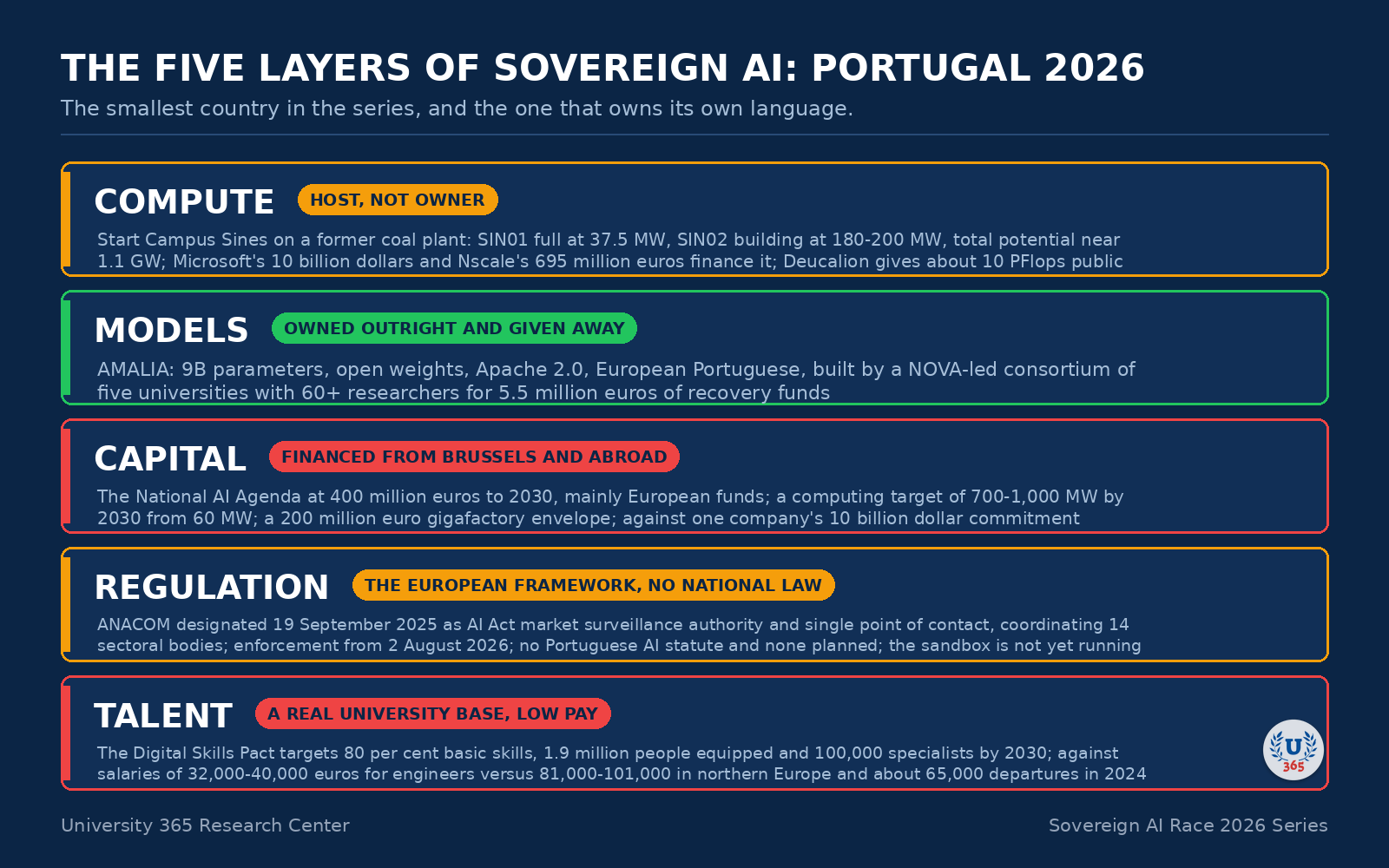
The five layers assessed. A national language model owned outright above compute hosted for foreign companies. University 365 Research Center.
This is the seventeenth report in a twenty-part series assessing how states attempt to control the production of artificial intelligence inside their own jurisdiction. The framework is fixed and applied identically to every country. Sovereign AI capacity separates into five layers, and a state can hold any one of them without holding the others.
Compute sovereignty is the physical layer: where the chips and data centres sit, and who may switch them off. Model sovereignty is who builds the models a country depends on, and in whose languages and domains those models are competent. Capital sovereignty is who funds the build-out and on what terms. Regulatory sovereignty is who writes the rules and whether they can be enforced. Talent and education sovereignty is who builds and runs the systems, and how the next generation is prepared.
The series treats three races as running at once: the compute race, the model race and the rules race. Portugal is the country where the model race was run as a language question, deliberately and successfully, at the smallest possible scale. On 1 July 2026 the government launched AMALIA, a nine-billion-parameter open model in European Portuguese, built by a consortium of Portuguese universities coordinated by the national science foundation, released under an Apache 2.0 licence with open weights, and funded with 5.5 million euros of European recovery money. In the same fortnight, the country's public administration portal began serving that model to citizens. And on the same coastline, at Sines, Microsoft had committed more than ten billion dollars to AI and cloud infrastructure and a British operator had committed a further 695 million euros to the campus where it sits, on land that was a coal plant.
The series places Portugal in the "regulator and host" posture alongside Singapore, the United Kingdom, Germany, Spain, Italy and Bahrain, and this report tests that placement layer by layer. Portugal holds a genuine open model in its own language, a functioning AI Act authority in ANACOM, one of the fastest-growing power markets in Europe and a submarine cable position at the intersection of four continents. It does not hold the compute being built on its soil, a domestic hyperscale laboratory, a sovereign wealth instrument, or an AI budget that is not mainly European. It also has the lowest enterprise AI adoption rate in this series. The report's question is what a state actually owns when it owns its language and the institutions around it, and rents everything else.
The vocabulary this report needs
Five terms recur, and they are defined here once.
AMALIA. The Portuguese national language model, launched 1 July 2026 and presented in Lisbon by Prime Minister Luis Montenegro. Developed by a consortium led by NOVA University Lisbon with Instituto Superior Tecnico and the universities of Coimbra, Porto and Minho, coordinated by the Foundation for Science and Technology, with more than 60 researchers. Named after the fado singer Amalia Rodrigues. Released open with an Apache 2.0 licence.
ANIA. The National Artificial Intelligence Agenda, approved by Council of Ministers Resolution 2/2026 of 8 January 2026 together with the AI Action Plan 2026 to 2030. Structured on four pillars, infrastructure and data, innovation and adoption, talent and skills, responsibility and ethics, implemented through 32 initiatives, and stated to use more than 400 million euros by 2030, mainly from European funds.
ANACOM. The National Communications Authority, designated on 19 September 2025 as Portugal's single market surveillance authority and single point of contact for the EU AI Act, coordinating fourteen sectoral authorities. The designation came six weeks after the European deadline of 2 August 2025.
Sines. The deep-water port and industrial site in the Setubal district, where the Start Campus data campus is being built on the site of the former EDP coal plant, with a stated ambition of 1.2 gigawatts of installed capacity and full operation targeted around 2030. The REN transmission operator gave the green light in August 2024 to double grid capacity at the campus from 495 megawatts to 1.2 gigawatts.
The PRR. The Plano de Recuperacao e Resiliencia, Portugal's European recovery plan, formally closed on 31 August 2026 with the government stating that all 44 reforms concluded and all milestones were met. AMALIA's public funding came from it, in its closing window.
The Question
Can a country own its language and rent everything else?
Portugal's position is the narrowest and clearest sovereignty claim in this series: it chose one layer, the model, and made a real asset in it while leaving the others to the market, Brussels and the sea.
The country's assets are genuine and specific. It has a functioning open model in its own language at a scale a small state can afford, trained by its own universities and released for anyone to use. It has a designated AI Act authority with the standard European enforcement powers, in an institutional arrangement that consolidated rather than fragmented oversight. It has a physical position that is unusually good for the job: a deep-water Atlantic port at Sines, cable landings that connect Europe, South America and Africa, 98 per cent fibre coverage by one industry account, and a renewables share above 70 per cent of electricity consumption in the first half of 2026. And it has a labour market in which the state has already concluded that immigration, not natural increase, is what keeps the population growing.
Its liabilities are equally specific. The compute campus at Sines is anchored by Microsoft's ten billion dollar commitment with chips owned by a British operator, which means the capacity is on Portuguese soil and not in Portuguese hands. The AMALIA consortium built its model by stacking Portuguese language data on a European open base model, EuroLLM-9B, so the country owns the language layer and shares the architecture below it. The national AI agenda is stated at more than 400 million euros to 2030, mainly European funds, against a corporate commitment at Sines that is more than twenty times larger from one company. And enterprise adoption of AI stands at 11.5 per cent, against a European average of 19.95 per cent, which is the widest such gap in this series.
The question this report puts to the evidence is therefore precise. Portugal has proved that a small state can build and give away a language model. What it has not yet proved is whether owning the language changes anything material about who controls the AI its citizens and its firms actually use, when the compute is foreign, the money is European, and the firms themselves are not adopting the technology at scale.
The Contradiction
A country with a real model and the lowest adoption in the series
The central contradiction in the Portuguese case is that its most significant sovereign achievement sits above a population and an economy that are not yet using the technology it made available.
The achievement is not cosmetic. AMALIA is a real model, openly licensed, in a language with roughly 260 million speakers worldwide, built by a public university consortium rather than by a company, and paid for with a sum that a small state can defend: 5.5 million euros of European recovery funds, with some accounts saying seven million. Its technical report argues that European Portuguese is underrepresented in both training data and native evaluation, and that machine-translated benchmarks likely miss native-language performance, which is a methodological point about how the language has been measured rather than a marketing claim. A follow-up vision and language model, AMALIA-VL, followed from the same university base. And the state put the model to work immediately, integrating it into the public administration portal launched on 1 July 2026, with a virtual assistant for citizens and businesses, and a plan to bring it into the Gov.pt mobile app.
Against that, the country's own statistics say its firms are not using AI. INE reported 11.5 per cent of enterprises using AI technologies in 2025, an increase of 2.9 percentage points on 2024 and still far below the European average of 19.95 per cent. Only 38.7 per cent of Portuguese enterprises buy paid cloud services at all. Almost a quarter of Portuguese small and medium enterprises have not reached even basic digital intensity. And one 2026 analysis, carried as a claim because its methodology is not visible, says consumer generative AI use in Portugal is the highest in Europe at 62 per cent of respondents against a European average of 52 per cent. If that claim holds, the pattern is citizen uptake running far ahead of enterprise capability, which is the exact shape of the problem the CI-First lens is designed to describe: people given tools faster than their organisations can absorb them.
There is a second contradiction, about ownership. The country built the model and does not own the compute. At Sines, the land, the power connection and the permits are Portuguese; the capital, the chips and the model choice belong elsewhere. Microsoft's commitment is more than ten billion dollars, described by Bloomberg as one of its largest investments in Europe, and the operator expanding on the site is a United Kingdom-headquartered firm whose chips are NVIDIA accelerators and whose customer is Microsoft. Portugal legislated that its public sector should use a Portuguese-language model and then, in the same year, became host to one of Europe's largest concentrations of foreign-owned AI compute. Both are deliberate and they are not inconsistent; they are simply different kinds of sovereignty, and only one of them can be revoked by a Portuguese court.
The contradiction resolves into a single sentence. Portugal has done the one thing a small state can do on its own, which is to own the language layer and give it away, and it is relying on other countries' capital, chips and money for everything beneath, in a country whose own firms have not yet adopted the technology at all.
The Current State
Compute: the coal plant became a data campus, and the chips belong to somebody else
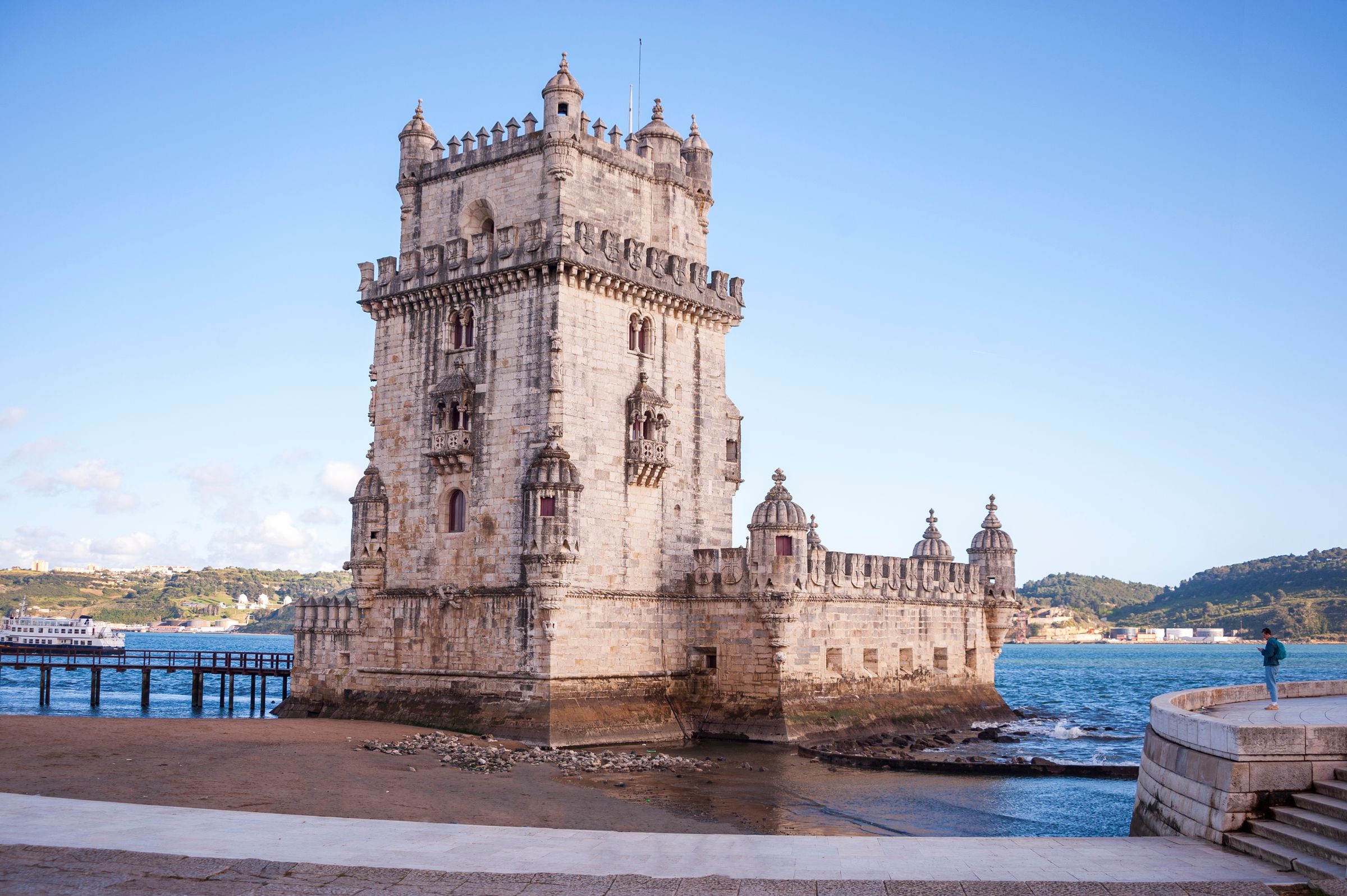
Lisbon. The Belem Tower stands on the Tagus, the river whose mouth at Sines carries the EllaLink cable to Brazil and the largest AI data campus in the country. Photograph: Pexels License, via Pexels.
Portugal's compute layer is a large build on a small base, and the distinction between what is on Portuguese soil and what is Portuguese matters at every step.
The site is Start Campus at Sines, on the former EDP coal plant, with a stated ambition of 1.2 gigawatts of installed information technology capacity and full operation targeted around 2030. The first building, SIN01, is full at 37.5 megawatts according to the company's chief marketing officer speaking to trade press in August 2026. The second, SIN02, is under construction as a 180 to 200 megawatt hyperscale building designed specifically for high-density AI and high-performance computing workloads, intended to run on 100 per cent renewable energy with seawater cooling. Independent tracking gives a more granular picture and it does not fully reconcile: DC Atlas records one operational facility with 26 megawatts live, 180 megawatts under construction and 885 megawatts planned for a total potential of 1,091 megawatts; Epoch AI lists the campus as operational with an estimated 32,000 H100-equivalents of compute, 33 megawatts of IT power, a capital cost of 1.3 billion dollars and a projection of expansion in the third quarter of 2027. The differences between 26, 33 and 37.5 megawatts likely reflect whether the figure is measured, contracted or designed capacity, and this report records all three rather than choosing.
The capital behind the capacity is foreign, and its concentration is the finding. On 11 November 2025 Microsoft announced an investment of more than ten billion dollars in AI and cloud infrastructure in Portugal, sited at the Start Campus campus, announced by vice chair and president Brad Smith during a visit for the Web Summit. The sum is a committed programme rather than money spent, and this report labels it as a claim in strict terms. On 5 May 2026 Nscale Global Holdings, a United Kingdom-headquartered AI infrastructure operator, announced it would spend 695 million euros, about 812 million dollars, to expand its Portuguese partnership with Microsoft: a second 200 megawatt building at Sines plus deployment of more than 66,000 NVIDIA Vera Rubin NVL72 graphics processors, with deployment scheduled to begin in late 2027. That GPU count is a forward purchase and installation schedule and is carried as a claim.
The wider pipeline is larger than the site. Colliers reported in its Iberian snapshot covering October 2025 to March 2026 that Portugal has more than 2.6 gigawatts of planned IT capacity, with Lisbon alone accounting for 1,389 megawatts. An aggregate industry figure circulating in 2026 puts the pipeline at around 13 billion euros of investment and frames Portugal as a spillover destination for AI data centre demand displaced from Frankfurt, London, Amsterdam, Paris and Dublin by power and land constraints; that figure comes from a third-party aggregator and is carried as a claim. The government published a National Data Centre Plan in 2026, structured around 15 initiatives for 2026 and 2027, stating that the international context presents a limited window of opportunity because mature European markets face deployment constraints.
Where the plan and the evidence diverge is the grid. The National Data Centre Plan states that the electricity grid has sufficient capacity in the short term to accommodate the pipeline. Reporting in the same period states that eight data centre projects in the pipeline would together need more electricity than the national grid can deliver at peak. This report records the conflict rather than resolving it. What is not in conflict is the direction of demand: EDP's chief executive said on 30 July 2026 that Portuguese electricity demand is expected to grow at a 4.5 per cent compound annual rate over the next decade, making the country one of Europe's fastest-growing power markets, driven by the data centre pipeline. REN reported renewables penetration slightly above 70 per cent of consumption in the first half of 2026, and the International Energy Agency described Portugal in 2026 as entering a mid-transition that requires managing two intersecting transitions.
On the public side, Portugal's national supercomputing base is modest and it is real. Deucalion, at the International Iberian Nanotechnology Laboratory in Guimaraes, is the country's most powerful high-performance computer, inaugurated in 2023, co-funded by the Foundation for Science and Technology and EuroHPC, operated by INESCTEC and the University of Minho, with a theoretical maximum around 10 petaflops, and Portugal holds a 65 per cent share of its resources. In April 2026 the government committed up to 19.3 million euros to two strategic supercomputing and AI projects, of which 3.7 million euros is earmarked for a Deucalion upgrade. The machine hosted a Barcelona Supercomputing Center AI Factory event in June 2026.
The country's bid for the next tier of European compute is a joint one. Portugal will join an Iberian candidacy in the EuroHPC AI gigafactory call, which opened on 30 July 2026 with a deadline of 12 November 2026 inside a programme reported at 30 billion euros for up to seven gigafactories. The Council of Ministers approved a package worth 200 million euros in June 2026 to support installation and operation of a gigafactory on Portuguese territory, structured as a pay-for-consumption commitment beginning at 5 million euros in 2027 and ramping to 32.5 million euros annually through 2033, with the Agency for the Technological Reform of the State filing the expression of interest and drawing funds only when invoices arrive. Sines is the named Portuguese candidate site. The 200 million figure is an approved envelope rather than spent money and is carried as a claim, and the combined Iberian investment has been described at 8 billion euros, a figure not verified against a primary source here.
On connectivity, Portugal's position is genuinely strong and it is the part of this layer the country does own. The EllaLink cable entered service in 2021 running from Fortaleza in Brazil to Sines, the first dedicated low-latency route between South America and the European Union, described by the operator and Nokia in a 2026 case study as a 5,900 kilometre system with four fibre pairs interconnecting Europe, Latin America and Africa. Secondary summaries repeatedly give the span as 17,000 kilometres, which likely counts terrestrial or branched segments, and both figures are recorded. In October 2024 EllaLink expanded its footprint to the Start Campus site, reinforcing Sines as a landing and interconnection point. Portuguese industry voices argue the country sits at the intersection of four continents with 98 per cent fibre coverage and can become a European data and AI hub if it moves now on regulation and investment incentives, a positioning argument rather than a measurement. On cloud, AWS named Portugal as one of the first three countries to host a Local Zone tied to its European Sovereign Cloud, alongside Belgium and the Netherlands, and opened an AWS Direct Connect location in Lisbon on 14 March 2025; the wider AWS sovereign cloud programme is reported at 7.8 billion euros to 2040, and no Google hyperscale data centre announcement for Portugal could be verified in this research.
Models: one small country built its own language model and gave it away

The coal plant, the halls where the coal yard was, and the cable laid to the sea. University 365 Research Center.
Portugal's model layer is where this report's central claim rests, and the claim is that a state of eleven million people can own the layer that determines whose language the technology is competent in.
AMALIA launched on 1 July 2026, presented in Lisbon by the Prime Minister, and described by the government as the first large language model developed in Portugal. Reuters described it as Portugal's first open source AI model, framed inside a growing European push for AI sovereignty and reduced reliance on United States providers, and reported that it was developed by a consortium of Portuguese universities and research institutions with government backing and 5.5 million euros of European recovery funds. The funding figure is a conflict worth recording: Reuters and others give 5.5 million euros, several outlets give seven million euros of public money, and both circulate for the same launch. The technical profile reported is a nine-billion-parameter model with a 4,096-token context window, speech-to-text among its modalities, Apache 2.0 licensing and open weights; that profile comes from a wiki entry rather than the technical report and is flagged as such.
The technical report itself is the more interesting document. Published on arXiv under the title "AMALIA Technical Report: A Fully Open Source Large Language Model for European Portuguese", it argues that European Portuguese is underrepresented in both training data and native evaluation, and that machine-translated benchmarks likely miss native-language performance. That is a methodological claim about measurement, and it is the same problem this series has documented in other countries: a language's models are judged on benchmarks that were not built for it. A follow-up vision and language model, AMALIA-VL, was published by a NOVA School of Science and Technology team.
On lineage, independent summaries report that Portugal built AMALIA by stacking its own language data on top of a European open model, EuroLLM-9B, shipping weights, data and code openly. That places the Portuguese asset inside the wider European open model effort and it also defines the boundary of the claim: Portugal owns the language adaptation and the release, and shares the base architecture with the European project beneath it. Portugal's institutional participation in the EuroLLM consortium itself could not be verified in this research.
The commercial layer is where Portugal's model position is thinner, and the country's most visible language-AI company is the cautionary case. Unbabel, founded in Lisbon in 2013, built the TowerLLM and COMET tools and was for a period Portugal's most prominent AI scale-up. On 22 August 2025 TransPerfect, a New York-headquartered language and AI provider, announced its acquisition of Unbabel, with both tools joining TransPerfect's stack. The company was later declared insolvent by the Lisbon Commercial Court, after receiving 13.3 million euros in Portuguese recovery funding, and had been owned by TransPerfect since August 2025. That sequence is a data point about capital and model sovereignty together: Portuguese public money went into a firm whose assets and brand ended under foreign ownership and whose remaining Portuguese entity failed.
The language asset itself is the strategic argument, and it is real. Portuguese is the language of the Community of Portuguese Language Countries, founded in 1993 and headquartered in Lisbon, and the community marked its 30th anniversary in 2026. The language has roughly 260 million speakers worldwide, Brazil largest among them, which means a European Portuguese model has a plausible market well beyond Portugal's eleven million residents. What this research could not verify is any community-wide AI programme: no CPLP AI initiative was located, the Ministers of Culture's 2026 to 2028 action plan has no verified AI content, and the AI-specific content of the Brazil-Portugal science and technology cooperation reinforced in February 2025 could not be confirmed. The language opportunity is a thesis with a real addressable population and no institution built to capture it yet.
The honest boundary on this layer is that Portugal has no hyperscale domestic AI laboratory comparable to Mistral in France, Aleph Alpha in Germany or Silo AI in Finland. Its model sovereignty asset is the AMALIA consortium plus its university laboratories, which is a real asset and a small one. American models still dominate Portuguese-language enterprise use through Microsoft, AWS and Google channels, and the AMALIA release is a public-sector and open-source asset rather than a replacement for commercial model access for Portuguese firms.
Capital: a European-funded strategy and a state that buys compute rather than owning it

Alfama, Lisbon. The country's AI strategy is financed mainly from European funds and its venture market raised approximately 780 million euros in 2025, while one company's commitment to a single Portuguese campus exceeded ten billion dollars. Photograph: Pexels License, via Pexels.
Portugal's capital layer is the clearest case in this series of an AI strategy financed from outside the country, and the report treats that as a structural fact rather than a criticism.
The national envelope is stated at more than 400 million euros to 2030, mainly from European funds, for the National AI Agenda approved in January 2026. The agenda is structured on four pillars and 32 initiatives, with six guiding principles including the state as catalyst and continuous evidence-based evaluation, and it sits under action 20 of the Portugal Digital Strategy's 2026 to 2027 action plan with monitoring by the Council for Digitalisation. The Council of Ministers states that accelerated AI adoption could add between 18 billion and 22 billion euros to Portuguese GDP, with productivity contributing up to an additional 2.7 percentage points of growth in a rapid automation scenario; that is a government estimate rather than an outcome and is carried as a claim. Governance is by budgetary conditionality with priority for European funds.
There is a second, narrower target that illustrates the scale question. The government has set a goal of increasing national computing capacity 10 to 15 fold by 2030, from approximately 60 megawatts in 2025 to between 700 and 1,000 megawatts. Set beside Colliers' 2.6 gigawatts of commercial planned capacity, the two figures measure different things, national computing versus commercial pipeline, and the government's target is roughly a quarter of what the private pipeline alone would deliver. The state is aiming for capacity in the hundreds of megawatts while the market builds in the thousands.
The recovery plan is the funding engine and it has now closed. The PRR was formally closed on 31 August 2026 with the minister stating the plan was fully executed and all 44 reforms concluded. The figures in circulation conflict: 16 billion euros of grants with 14.7 billion paid, or a 21.9 billion euro plan total including loans. The European Commission states Portugal allocates 21.5 per cent of recovery spending to digital, meaning 4.7 billion euros, plus 2.3 billion euros under cohesion policy for digital transformation. The government states the final design privileged investment in companies with a strong AI component, with 5 billion euros more executed than forecast. Among the specific AI items, the recovery plan funded an AI computational infrastructure for the Portuguese intelligence services at 7.5 million euros, reported by Publico on 23 September 2026, which is among the most recent facts in this research. AMALIA's 5.5 million euros came from the same source in the plan's closing window.
The oversight of that spending is contested, and this report records it. Portugal's Court of Auditors opened 43 investigations into European recovery fund spending while the government moved to strip its oversight powers. That is a headline verified in search but not extracted in full in this research, and it is recorded as reported.
On the private side, the market is small and early-stage. Portuguese startups raised approximately 780 million euros in venture funding in 2025, up from 320 million in 2020, with the market dominated by seed and Series A deals and limited local capital for larger growth rounds; the most successful Portuguese companies have needed international capital for Series B and beyond. Unicorn Factory Lisboa reported more than 350 startups and scaleups in its programmes in 2025, with portfolio startups recording 263 million euros of turnover, 2,695 jobs and 140 million euros raised in twelve months. Indico Capital Partners launched a 125 million euro Fund III in November 2025 with the European Investment Fund as anchor investor. Lince Capital had invested 140 million euros in startups as of November 2025. One 2026 outlook argues Portugal could create two to three global deep tech champions by 2030 while warning that the value created must remain in the country, which is the capital-sovereignty question stated by a Portuguese business school.
The sovereign wealth question has a simple answer: Portugal has no sovereign wealth fund. Its principal state financial holding is Caixa Geral de Depositos, founded in 1876 and fully state owned, described by one tracker as functioning as the country's de facto sovereign wealth vehicle, a characterisation rather than an official designation. Caixa Capital, the group's private equity and venture arm, is described as a leading Portuguese investor by funds under management. Portugal Ventures is the state-backed early-stage investor. No Portuguese bank foundation vehicle dedicated to AI could be verified.
The assessment this layer supports is specific. Portugal funds its AI strategy from Brussels, hosts compute funded by an American company and a British operator, and buys capacity at Sines through a consumption commitment rather than owning it. Its domestic venture market is smaller than one year of one company's commitment to a single Portuguese campus. The state is a buyer and a coordinator in this layer, not an owner.
Regulation: a designated authority, a consolidated mandate, and a sandbox still to come
Portugal's regulatory layer is the most conventional in this series because the country chose the European route and implemented it without adding a national statute.
Portugal designated ANACOM as its single market surveillance authority and single point of contact for the EU AI Act on 19 September 2025, announced by the Secretary of State for Digitalisation. The country missed the European designation deadline of 2 August 2025 and named its authority six weeks later. ANACOM coordinates fourteen sectoral authorities. The arrangement was a consolidation rather than the original plan: the work would have been split among ANACOM, the data protection commission and the media regulator, and the government instead concentrated oversight in ANACOM and folded the Digital Services Act into it as well. The enabling bill was approved in the Council of Ministers at the end of July 2025 and sent to Parliament to lock down the domestic penalty regime. The designation rests on Article 70 of Regulation (EU) 2024/1689.
The powers are the standard European set. Market surveillance derives from Article 74 and Regulation (EU) 2019/1020, allowing the authority to demand technical documentation, test systems, order corrective action and require withdrawal or recall. High-risk systems must be entered in the European database. Complaints are available under Article 85 and a right to explanation under Article 86. Maximum fines run to 35 million euros or 7 per cent of worldwide turnover for a prohibited practice, 15 million euros or 3 per cent for high-risk and most other breaches, and 7.5 million euros or 1 per cent for supplying incorrect information. The enforcement phase began on 2 August 2026, when the Commission's AI Office and national authorities gained supervisory and sanctioning powers, and Article 50 transparency obligations on disclosing AI interaction and deepfakes applied from the same date. One date conflict is recorded: one tracker lists Article 50(2) machine-readable marking as applying from 2 August 2026 in one table and 2 December 2026 in another, while another states it applies from 2 August 2026 with a transition for systems placed on the market earlier.
The high-risk timeline moved, and the movement matters for Portuguese firms. The Digital Omnibus provisional deal struck by the Council and European Parliament on 7 May 2026 postponed the most demanding high-risk obligations to 2 December 2027 for standalone Annex III systems and 2 August 2028 for the Annex I product route, with the European Parliament voting on 16 June 2026 and the Council approving on 29 June 2026. Portuguese businesses thereby gained roughly sixteen months on their compliance timelines.
Two features of the Portuguese position deserve separate mention. The first is that Portugal has no dedicated national AI law and none is planned: the European regulation is directly applicable, governance relies on ANACOM plus existing sectoral frameworks, and the National AI Agenda is a strategy rather than implementing law. Documentation and declarations to Portuguese authorities are expected in Portuguese, and IAPMEI supports small and medium enterprises with regulatory adaptation. The second is the CNPD, the Portuguese data protection commission, which applies the GDPR overlay to any AI system using personal data and can demand access under Article 77 of the AI Act. This report records a sourcing caution that the editorial record should carry: the acronym CNPD also denotes the Luxembourg data protection authority, an unrelated body, and a search for CNPD AI enforcement returns primarily Luxembourg material. No confirmed CNPD enforcement action against an AI system in Portugal was verified, and any claim that the Portuguese authority has fined an AI developer would be unverified on this evidence. The 2025 edition of its annual report was not located.
On the sandbox, every member state must operate at least one AI regulatory sandbox by 2 August 2027 under Articles 57 to 63, with priority and fee-free access for small and medium enterprises and startups. ANACOM is tasked with creating and managing Portugal's sandbox, and it is not yet operational, with its timeline aligned to the high-risk obligations. A sector-specific sandbox exists in health, positioned as a controlled environment for testing high-impact AI systems in healthcare, claimed to be aligned with the AI Act and integrated with the European Health Data Space; those alignment statements come from the project's own site and are carried as claims.
One further element of the regulatory picture sits outside the AI Act and shapes what Portuguese AI can be built. The country ran an unusual public debate about deepfakes in its own media sector, and the University of Coimbra's Institute of Systems and Robotics ran a project on deepfake detection. On platforms and telecoms, Portugal's 5G exclusion of Chinese vendors and the earlier Huawei legacy remain part of the country's technology-security posture, and they set the context in which the AI Act authority operates.
Talent: a small country with a real university base, an emigration history and a language advantage
Portugal's talent layer has the shape this series has documented in several countries, with a language asset attached that no other small country in the series possesses.
The national instrument is the Digital Skills Pact, approved under Council of Ministers Resolution 216/2025, with core actions in the 2026 to 2030 period. It is structured around four pillars and 17 initiatives: basic digital skills, intermediate and advanced skills, emerging technology skills covering generative AI, automation, cybersecurity, data science, robotics and cloud, and a cross-cutting coordination and monitoring pillar. Its targets are 80 per cent of the population with at least basic digital skills by 2030, 40 per cent above the basic level, 30 per cent of women in the information and communications technology sector and 7 per cent of the workforce in specialised technology roles, with sub-targets of approximately 1.9 million people equipped with basic skills, more than 800,000 upskilled and more than 100,000 specialists trained. Those are targets and are carried as claims.
The starting position is moderate and the reporting conflicts are worth stating. The government's own note cites the Digital Economy and Society Index for 2025 reporting 56 per cent of the population aged 16 to 74 with at least basic digital skills and a rank of 16th among member states, with only 30 per cent above the basic level. The Digital Decade 2026 report gives 59.15 per cent after an increase of 2.8 percentage points annually since 2023, when the figure was 55.97 per cent; the Commission's own interactive map quotes 56.0 per cent for a different year against a European average of 55.56. The two Commission pages quote different years and values and both are recorded. On the professional side, information and communications technology specialists account for 5.2 per cent of total employment, above the European average of 5 per cent and short of the national target of 7 per cent for 2030, and the share of female specialists was 22.7 per cent in 2024.
The university base is real and it is where the country's AI capability actually lives. The AMALIA consortium is led by NOVA University Lisbon with Instituto Superior Tecnico and the universities of Coimbra, Porto and Minho, coordinated by the Foundation for Science and Technology, with more than 60 researchers. NOVA launched the IAEdu platform in January 2026 giving its entire academic community access to advanced language models. Instituto Superior Tecnico students developed an AI fact-checking mechanism presented in Montreal in August 2025. The Champalimaud Foundation and Instituto Superior Tecnico opened a joint neurorobotics laboratory in February 2026. INESCTEC and the University of Minho operate Deucalion, and the International Iberian Nanotechnology Laboratory at Guimaraes hosts it. The industry pipeline has begun to form: Start Campus and NOVA Information Management School launched a collaboration in April 2026 covering an academic module, dissertations, applied projects, internships, workshops, scholarships and a company-sponsored chair, focused on data centre operations, energy systems and critical infrastructure for AI, which is the first case in this series of a data centre operator building a domestic curriculum for its own workforce needs.
Against that, the emigration record and the pay structure are the constraint. Approximately 65,000 Portuguese citizens left the country in 2024 on reporting that does not name its underlying statistical release and is therefore carried as a claim, with professionals aged 25 to 34 making up the majority, driven by salary gaps against northern Europe where salaries routinely double or triple Portuguese levels. Portuguese technology salaries sit roughly between 32,000 and 40,000 euros at the national median for software engineers, against around 81,495 in Germany, 89,987 in the Netherlands and 101,127 in Ireland, on aggregator estimates that disagree with each other at the margin and that disagree with a May 2026 industry survey reporting an average gross annual technology salary of 53,671 euros across 1,115 professionals. International employers pay far above the domestic median in the same market, with senior total compensation at several large technology firms in Portugal reaching 90,000 to 140,000 euros. One 2026 report claims an internal information technology talent deficit of 85 per cent in Portugal; that figure has no visible methodology and is carried as a claim.
The immigration instruments are load-bearing rather than decorative, which is the honest reading of the demographic position. The resident population was estimated at 11,424,031 in 2025, an increase of 36,809 over 2024, with 1.6 million foreigners, roughly 14 per cent of the population, and with population growth now driven by immigration rather than natural increase. A conflicting aggregator series puts the population at 10,395,362 as of January 2026, likely reflecting a different residency definition, and both are recorded. Portugal announced an AI Fast Track visa under the National AI Agenda aiming to process work visas for AI professionals in under six weeks against a two to four month baseline, and its operational launch status could not be verified. The Tech Visa, launched in 2019 and expanded in 2024, fast-tracks skilled migration to accredited technology companies. The D8 digital nomad visa requires minimum monthly income of 3,480 euros and had received 7,664 approvals from 9,322 applications by September 2025 on a third-party figure.
The language advantage is the part of this layer that is unique in the series and it deserves to be stated precisely. A Portuguese language model serves Portugal's eleven million residents and also a Portuguese-speaking space of roughly 260 million people, Brazil largest among them. That means a Portuguese AI firm can address Brazilian and African markets with the same model stack, and it means the country's model investment has a larger addressable population than its own. What the research could not establish is whether the country has built the institutional machinery to capture that market: no community-wide AI programme was verified, and the Brazil-Portugal cooperation's AI content is unconfirmed.
What changed since our last report on Portugal: there is none
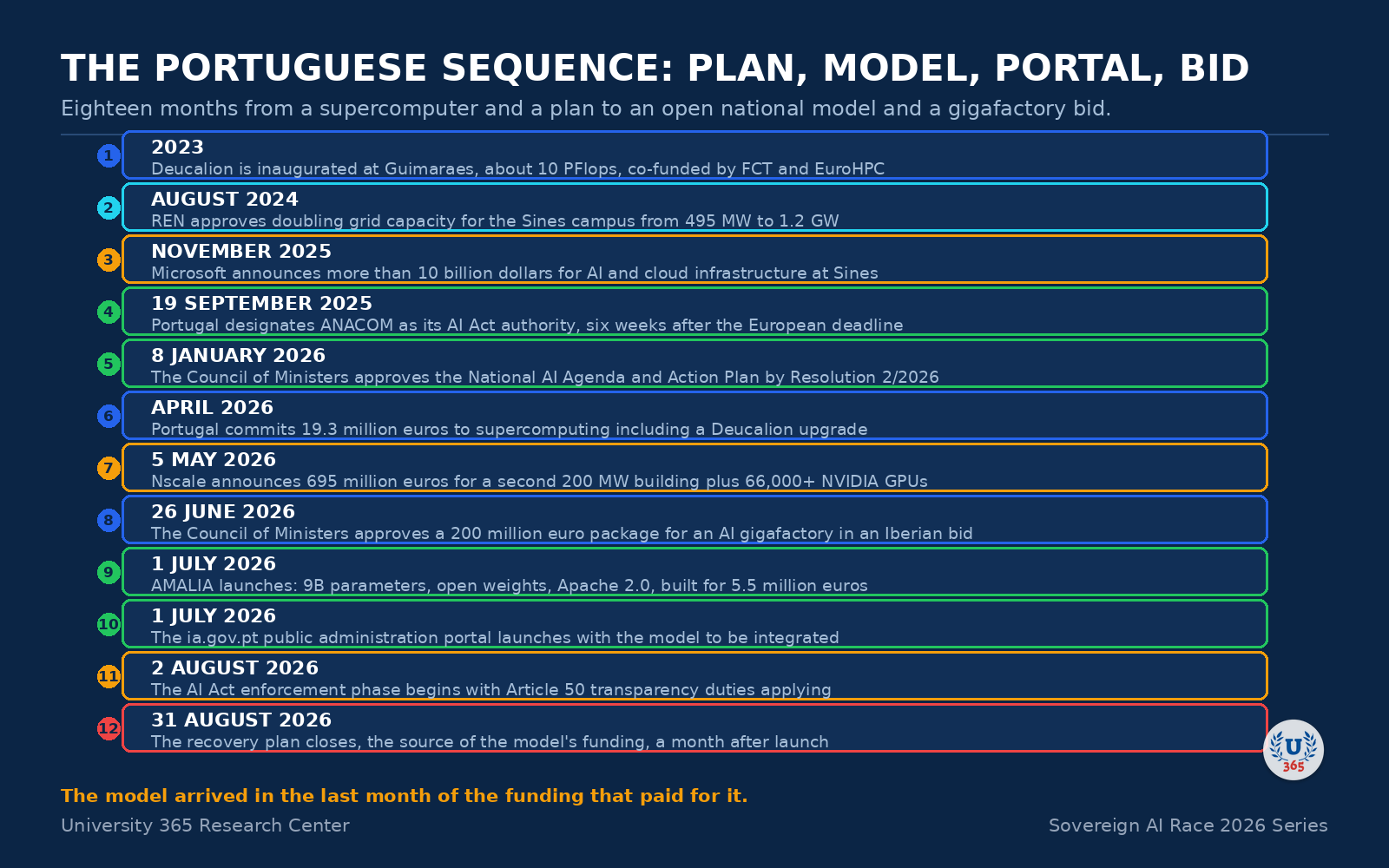
The Portuguese sequence: plan, model, portal, bid, and the funding that closed behind them. University 365 Research Center.
University 365 has not published a Portugal AI landscape report before this one, in any series. There is no prior U365 baseline for Portugal and no earlier country file in the institution's catalogue. This report says so plainly rather than implying a baseline it does not have, and it is the second of the series' three subjects with no prior report, alongside Russia and South Africa.
What can be compared instead is Portugal against itself inside this report's own research window, and the movement in that interval is substantial in one direction. In 2024 the country had a National AI Agenda in preparation, a supercomputer operating at Guimaraes and little else that was visible from outside. In the eighteen months to September 2026 it launched a national open language model, published a National Data Centre Plan, designated an AI Act authority, saw the largest single AI infrastructure commitment in its history land at Sines, joined an Iberian gigafactory bid with a 200 million euro envelope behind it, closed its recovery plan, and watched its most prominent language-AI company pass to foreign ownership and then fail. The direction is fast institutional formation around a model the country owns and an infrastructure it does not. The series will build its Portuguese baseline from this report forward.
Key Findings
1. Portugal built and gave away a national language model, at a scale a small state can defend. AMALIA launched on 1 July 2026: nine billion parameters, open weights, Apache 2.0, in European Portuguese, built by a consortium led by NOVA University Lisbon with Instituto Superior Tecnico and the universities of Coimbra, Porto and Minho, coordinated by the national science foundation, with more than 60 researchers and 5.5 million euros of European recovery funds. Its technical report argues that European Portuguese is underrepresented in training data and native evaluation and that machine-translated benchmarks likely miss native-language performance.
2. The model lineage is European, which defines the boundary of the claim. Independent summaries report that Portugal stacked its own language data on EuroLLM-9B, shipping weights, data and code openly. Portugal owns the language adaptation and the release; the architecture beneath it is shared with the European project. Portugal's own institutional participation in the EuroLLM consortium could not be verified.
3. The compute being built on Portuguese soil belongs to an American company and a British operator. Microsoft committed more than ten billion dollars to AI and cloud infrastructure at Start Campus, Sines, on 11 November 2025; Nscale Global Holdings committed 695 million euros on 5 May 2026 for a second 200 megawatt building plus more than 66,000 NVIDIA Vera Rubin NVL72 processors from late 2027. SIN01 is full at 37.5 megawatts; SIN02 is under construction at 180 to 200 megawatts; independent trackers give 26 or 33 megawatts live and total potential near 1.1 gigawatts.
4. The national pipeline is measured in gigawatts and the state's own target is a fraction of it. Colliers reports more than 2.6 gigawatts of planned IT capacity with Lisbon alone at 1,389 megawatts, and an aggregate industry figure puts the pipeline at about 13 billion euros. The government targets increasing national computing capacity 10 to 15 fold from about 60 megawatts in 2025 to 700 to 1,000 megawatts by 2030, roughly a quarter of what the private pipeline alone would deliver.
5. The grid is the contested constraint. The National Data Centre Plan says the grid has sufficient short-term capacity for the pipeline; reporting in the same period says eight projects in the pipeline would together need more electricity than the grid can deliver at peak. EDP expects national electricity demand to grow at a 4.5 per cent compound annual rate over the next decade, making Portugal one of Europe's fastest-growing power markets. Renewables covered slightly above 70 per cent of consumption in the first half of 2026, and REN approved doubling capacity at Sines from 495 megawatts to 1.2 gigawatts.
6. The AI strategy is financed from Brussels and the state buys compute rather than owning it. The National AI Agenda is stated at more than 400 million euros to 2030, mainly European funds, while one company's commitment to a single Portuguese campus exceeds ten billion dollars. The 200 million euro gigafactory package is a pay-for-consumption commitment from 5 million euros in 2027 to 32.5 million euros annually through 2033. Portugal has no sovereign wealth fund; its state holding is Caixa Geral de Depositos, described by one tracker as a de facto vehicle.
7. The recovery plan closed and its legacy is the funding source for the model. The PRR closed on 31 August 2026 with the government stating full execution and all 44 reforms concluded, with figures in conflict between 16 billion euros of grants and a 21.9 billion euro total. The Commission assigns 21.5 per cent of recovery spending to digital, some 4.7 billion euros. Among the AI-specific items, 7.5 million euros funded an AI centre for the intelligence services, reported on 23 September 2026.
8. Portugal's most visible language-AI company passed to foreign ownership and then failed. TransPerfect acquired Unbabel on 22 August 2025, taking TowerLLM and COMET into its stack; the company was later declared insolvent by the Lisbon Commercial Court after receiving 13.3 million euros in Portuguese recovery funding.
9. The regulatory layer is the European framework, applied without a national statute. ANACOM was designated on 19 September 2025, six weeks after the European deadline, coordinating fourteen sectoral authorities and folding in the Digital Services Act. Portugal has no dedicated AI law and none is planned. Portugal's AI sandbox is not yet operational; health has a sector-specific sandbox. A source-caution the record should carry: the acronym CNPD also denotes Luxembourg's authority, and no Portuguese CNPD enforcement against an AI system was verified.
10. Enterprise adoption is the lowest in this series and the consumer picture may be ahead of it. INE reported 11.5 per cent of enterprises using AI technologies in 2025, up 2.9 points and against a European average of 19.95 per cent. Only 38.7 per cent of Portuguese enterprises buy paid cloud services. One 2026 analysis, whose methodology is not visible and which is carried as a claim, reports Portuguese consumer generative AI use as the highest in Europe at 62 per cent of respondents.
11. The honest overall verdict: Portugal owns its language and rents everything else, and its firms have not yet adopted what it built. It built a genuine open model in a language with roughly 260 million speakers, designated a functioning AI Act authority, holds a strong Atlantic connectivity position and one of Europe's fastest-growing power markets. It does not own the compute at Sines, does not fund its AI strategy from domestic resources, has no hyperscale laboratory, and reports the lowest enterprise adoption in the series. On this evidence the country has bought the one layer a small state can buy outright and is a host, not an owner, in the layer that determines scale.
Deep Analysis
Why the language layer is the one a small state can actually own
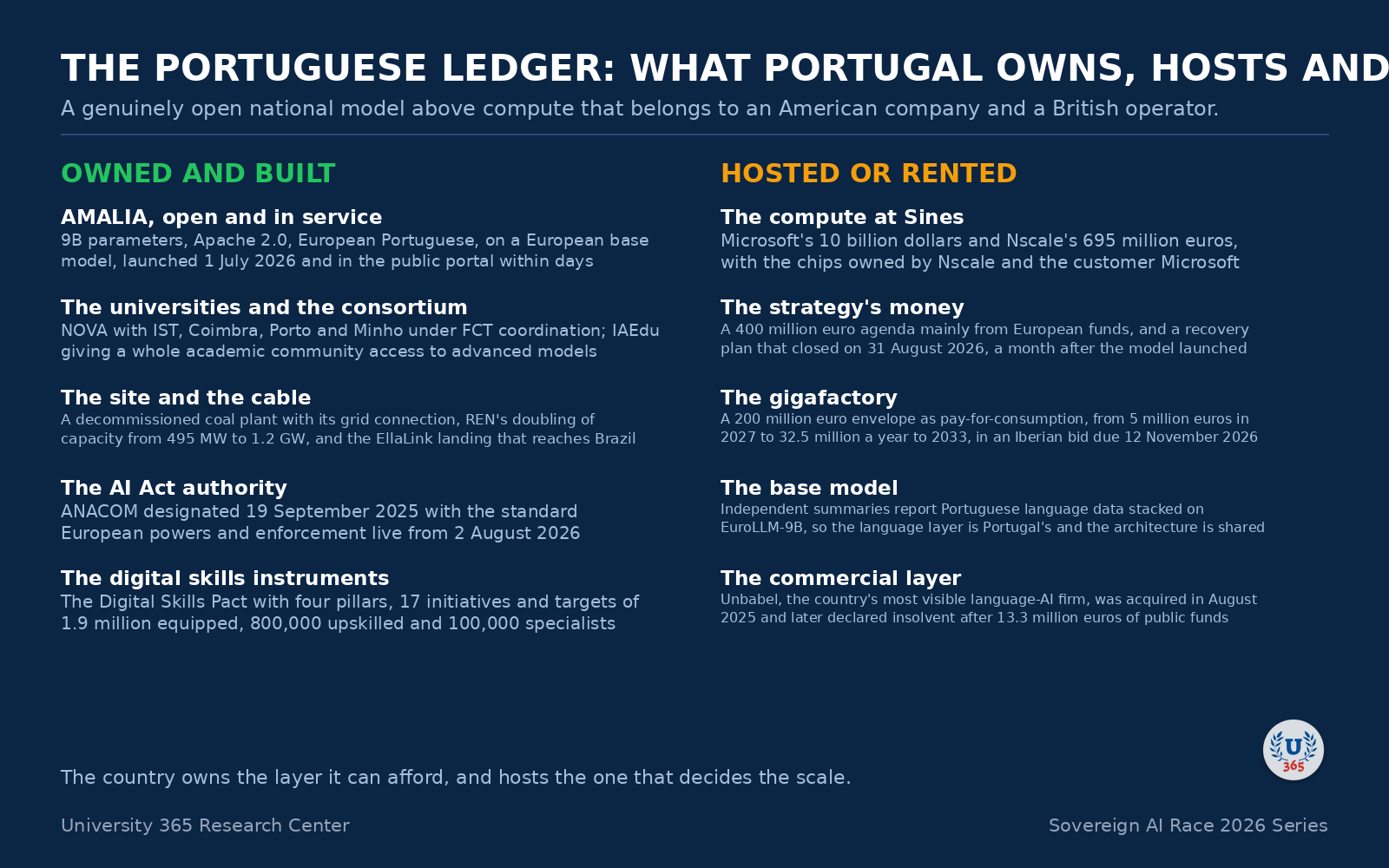
What Portugal owns and built, against what it hosts or rents. University 365 Research Center.
Portugal's choice looks modest and is in fact the most defensible strategic position available to a country of its size, and the analysis of why is the most useful thing this report can offer.
Consider what a state of eleven million people can own in the AI stack. It cannot own a frontier laboratory, because the capital required exceeds its entire venture market several times over. It cannot own leading-edge fabrication, which no European state owns at scale outside a handful of sites. It cannot own a hyperscale compute footprint without either a sovereign wealth fund or a willingness to spend defence-budget sums on data centres. What it can do is own the training data that describes its own language, the model that results, and the licence under which it is released, because those require researchers, a corpus and a few million euros rather than a few billion.
That is exactly what Portugal did, and the economics are instructive. AMALIA cost 5.5 million euros of European recovery money, or seven million on other accounts, which is roughly the price of two kilometres of motorway. It was built by a consortium of five universities and a national science foundation with 60 researchers, a structure the country already had and did not have to create. It was trained by stacking Portuguese language data on a European open base model, which means the consortium did not have to solve pretraining from scratch and could spend its budget on the part that was specifically Portuguese. And it was released under Apache 2.0 with open weights, so no downstream user has to negotiate, pay or ask permission. For a small state, that is a complete sovereignty play at an affordable price, and it is the only one on offer.
The strategic value has two parts and both are real. The first is measurement. The AMALIA technical report's argument, that European Portuguese is underrepresented in native evaluation and that machine-translated benchmarks likely miss native-language performance, is the same finding this series has reached from other directions: a language that is not in the evaluation set is a language whose models are judged by instruments built for another language. A national model with a national technical report is a country asserting the right to be measured on its own terms, which is a smaller claim than capability and a more durable one. The second is the market. A model in European Portuguese is a model in a language family of roughly 260 million speakers, which gives an eleven-million-person country a model asset whose addressable population is twenty times its own. No other small state in this series has that.
The limits are equally clear and the report states them without softening. The base architecture is European and shared, so Portugal owns the language layer rather than the model technology. The country has no hyperscale laboratory, so the model has no commercial engine behind it unless the universities keep building and the state keeps funding. Enterprise adoption is the lowest in this series, so the domestic market that would sustain Portuguese-language commercial models from the private side barely exists. And on the demand side the most striking number is the one the report cannot fully verify: if consumer generative AI use in Portugal really is Europe's highest at 62 per cent of respondents, then the country has a population eager for the technology and an economy not structured to supply or absorb it, which is precisely the gap the CI-First lens addresses. A state that owns its language and cannot sell into its own firms has made a public asset and not yet a market.
The coal plant, the cable and what hosting means

Lisbon. The state brought land, a grid connection and permits to the Sines campus; the capital, the chips and the model choices were brought by companies headquartered elsewhere. Photograph: Pexels License, via Pexels.
Sines is the most instructive physical site in this series because it contains, in one place, the three things a host country can and cannot own.
Start Campus is built on the site of a decommissioned coal plant, which is a real asset rather than a symbol: the land exists, the grid connection exists in strengthened form after REN approved doubling capacity from 495 megawatts to 1.2 gigawatts, and the cooling water and port access are there because the site was chosen for an industrial purpose a generation ago. That is what Portugal brought to the table. Microsoft brought more than ten billion dollars and a customer relationship. Nscale brought a British balance sheet and 66,000 NVIDIA processors on a forward schedule. The Portuguese state brought permits, a strategic plan and a 200 million euro consumption commitment for a gigafactory it does not yet have.
What Portugal gets from this arrangement is substantial and worth stating precisely, because the report's scepticism about ownership should not obscure it. The country gets construction employment and a supplier base; it gets electricity demand it can serve from a renewables-heavy grid that already runs above 70 per cent; it gets a skills market for the graduates its universities produce, which is why Start Campus and NOVA Information Management School built a curriculum together in April 2026; it gets physical capacity that operates under Portuguese law and Portuguese jurisdiction; and it gets, at Sines, the landing point for the EllaLink cable that connects it to Brazil and through Brazil to the South American market. Those are real returns and countries in this series with no compute at all would trade places.
What it does not get is control of the layer. The chips belong to Nscale, the customer is Microsoft, the model choices and the pricing are made elsewhere, and the continuation of the build depends on the commercial judgements of two foreign companies and on a forward GPU delivery schedule in late 2027. The state cannot direct what workloads run there, cannot require that Portuguese-language inference happens there rather than in Frankfurt or Virginia, and cannot prevent the capacity being sold to a customer outside Portugal. That is the definition of hosting rather than owning: the asset is in your territory and the decisions are not.
The comparison the series can draw is now sharp enough to state as a finding, and Portugal's version is distinct from every other case. The Gulf states own the entities that build their compute. Germany lost its fab to a cancellation and its cloud to a partnership it does not control. The United Kingdom lost its flagship data centre to a tenant's pause. Spain attracts compute it will not own at a scale exceeding almost everyone, in exchange for grid access and tax treatment. Portugal has done something narrower and cleaner: it took a decommissioned industrial site, attached a submarine cable to it, and let two foreign companies finance the capacity on land the state already controlled, in exchange for power, permits and a very favourable position on the transatlantic route. That is a defensible strategy for a small country, and the strategic question it leaves open is what Portugal intends to do with the one asset in the arrangement that is genuinely its own, which is the jurisdiction.
The three races, measured in Portugal
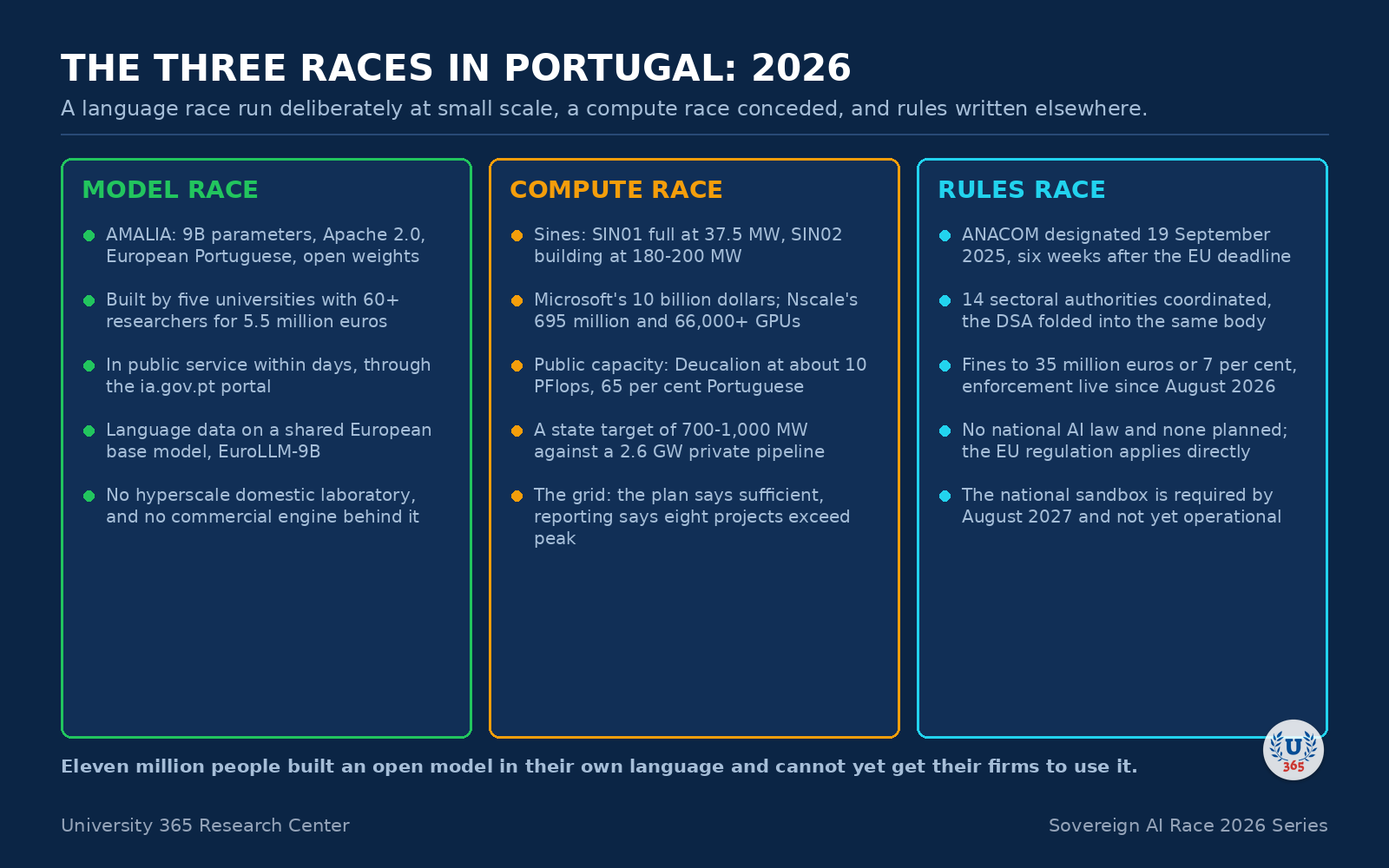
The three races in Portugal, at three different scales. University 365 Research Center.
The series separates the compute race, the model race and the rules race. Portugal is the country where the model race was deliberately run at the smallest possible scale, the compute race was lost before it started and the rules race was delegated to Brussels.
In the model race, Portugal ran a genuine national project and finished it. AMALIA is open, in the country's own language, built by its own universities with its own money, released for anyone to use, and put into public service within days of launch. Its boundary is that the base architecture is European and shared, and its commercial boundary is that the country's one prominent language-AI company ended up foreign-owned and then insolvent. Measured against its means, this is the best-executed model-layer outcome in the series for a small state, and measured against the frontier it is a language asset rather than a capability.
In the compute race, Portugal is a host and a buyer and not a competitor, and it should not try to be. The commercial capacity is being built with other people's capital on its own land; its public capacity is Deucalion at about 10 petaflops with Portugal holding a 65 per cent share; its state-level ambition is 700 to 1,000 megawatts by 2030 against a private pipeline of 2.6 gigawatts; and its most consequential recent decision is a 200 million euro consumption commitment for a shared Iberian bid rather than an owned facility. The country has correctly identified that it cannot win this race and has positioned itself to sell the inputs, land, power and cable access, that a winner needs.
In the rules race, Portugal applied the European framework without adding a national layer, designated its market surveillance authority six weeks late, consolidated oversight into one body, and has a sandbox not yet operational. That is compliance rather than leadership, and it is not a criticism: a small state has no power to set the terms of a European regulation and every reason to implement it cleanly and predictably. What Portugal can do with the rules is what it is doing, which is using a clear and fully implemented European framework as a reason for compliant infrastructure to locate there.
The three tempos produce the report's summary of Portugal. A country that built the smallest defensible version of model sovereignty, hosts compute it will never own, and implements rules it did not write, and which has therefore bet on the layer where a small state's advantages, which are language, jurisdiction and location, actually count.
Data and Evidence
Table 1: The five layers, assessed for Portugal in September 2026
Layer | What Portugal holds | What it does not hold | Assessment |
Compute | Start Campus at Sines on the former EDP coal plant: SIN01 full at 37.5 MW, SIN02 under construction at 180 to 200 MW, total potential near 1.1 GW on independent tracking; Microsoft's 10 billion dollar commitment (11 November 2025); Nscale's 695 million euros plus 66,000+ NVIDIA Vera Rubin NVL72 processors from late 2027; Deucalion at Guimaraes at about 10 PFlops with Portugal holding 65 per cent; 19.3 million euros committed to two supercomputing projects in April 2026 including a 3.7 million euro Deucalion upgrade; the 200 million euro gigafactory envelope; REN's approval to double grid capacity at Sines from 495 MW to 1.2 GW; EllaLink's Fortaleza to Sines cable with its 2024 expansion to the campus site; AWS Local Zone and a Lisbon Direct Connect location | Ownership of the commercial build-out (chips owned by Nscale, customer Microsoft, decisions made elsewhere); a verified answer on grid sufficiency (the National Data Centre Plan says yes, same-period reporting says eight projects exceed peak supply); a Google hyperscale announcement (not found); an operational national gigafactory (bid pending to 12 November 2026) | Real hosting infrastructure on a decommissioned industrial site, with the ownership of the layer entirely foreign |
Models | AMALIA, launched 1 July 2026: 9B parameters, open weights, Apache 2.0, European Portuguese, by a NOVA-led consortium with IST, Coimbra, Porto and Minho under FCT coordination, 60+ researchers, 5.5 million euros of PRR funds; the AMALIA-VL vision and language follow-up; the AMALIA technical report's native-evaluation argument; IAEdu giving the NOVA community access to advanced LLMs; integration into the ia.gov.pt public portal and the Gov.pt app; the roughly 260 million speaker language space | A hyperscale domestic laboratory; ownership of the base architecture (built on EuroLLM-9B per independent summaries); a commercial engine (Unbabel, the country's most visible language-AI firm, was acquired by TransPerfect in August 2025 and later declared insolvent after 13.3 million euros of PRR funding); a verified CPLP-wide AI programme | The smallest defensible version of model sovereignty, executed and released openly |
Capital | The National AI Agenda at more than 400 million euros to 2030, mainly European funds; the AI Action Plan 2026-2030 with 32 initiatives under Resolution 2/2026; a computing target of 700 to 1,000 MW by 2030 from about 60 MW in 2025; the 200 million euro gigafactory package as a pay-for-consumption commitment from 5 million euros in 2027 to 32.5 million annually to 2033; the PRR closed 31 August 2026 with 21.5 per cent of spending on digital (4.7 billion euros) plus 2.3 billion euros cohesion; 7.5 million euros for the intelligence services' AI centre; 780 million euros of startup funding in 2025; Indico's 125 million euro Fund III with EIF as anchor; Lince's 140 million euros; Caixa Geral de Depositos as the state holding | A sovereign wealth fund (none exists); domestic resources at the scale of the private commitments it attracts (one company's Sines commitment is more than twenty times the national AI envelope); verified AI-specific content in the Brazil-Portugal cooperation; any bank foundation AI vehicle | An externally financed strategy and a state that buys compute rather than owning it |
Regulation | ANACOM designated 19 September 2025 as single market surveillance authority and single point of contact under Article 70 of Regulation (EU) 2024/1689, coordinating 14 sectoral authorities and consolidating DSA oversight; the standard Article 74 and 2019/1020 powers; fines to 35 million euros or 7 per cent; the European enforcement phase from 2 August 2026 with Article 50 transparency duties; the Digital Omnibus deferral of high-risk duties to December 2027 and August 2028 giving Portuguese firms about 16 months; the CNPD's GDPR overlay and Article 77 access; IAPMEI support for SMEs; Portuguese-language documentation expectations; a health sector sandbox | A dedicated national AI law (none and none planned); an operational national sandbox (ANACOM's is not yet running); a verified CNPD AI enforcement action (the acronym collides with Luxembourg's authority); the 2025 CNPD annual report (not located) | The European framework implemented without a national layer, applied cleanly and late |
Talent and education | The Digital Skills Pact under Resolution 216/2025 with four pillars and 17 initiatives and targets of 80 per cent basic skills by 2030, 40 per cent above basic, 30 per cent women in ICT and 7 per cent of the workforce in specialised roles; about 1.9 million people to be equipped, 800,000 upskilled and 100,000 specialists trained; ICT specialists at 5.2 per cent of employment against a 7 per cent target; the AMALIA consortium's five universities plus FCT; IAEdu at NOVA; the Champalimaud and IST neurorobotics lab; Deucalion operated by INESCTEC and Minho; the Start Campus and NOVA IMS curriculum collaboration; the AI Fast Track visa announced and the Tech Visa operating; D8 approvals at 7,664 from 9,322 applications | Retention: about 65,000 citizens left in 2024 on a claim-level figure, salaries at 32,000 to 40,000 euros against 81,000 to 101,000 in northern Europe; a verified methodology behind the 85 per cent talent-deficit claim; the operational status of the AI Fast Track visa; digital skills figures that agree (three Commission renderings conflict) | A real university base and a language advantage, constrained by pay and retention |
Table 2: The controlled metrics, series bible format
Metric | Portugal position | Source and date |
Flagship compute commitment | Start Campus SINES Data Campus: SIN01 full at 37.5 MW (company statement via trade press, 3 August 2026); SIN02 under construction at 180 to 200 MW for high-density AI and HPC on 100 per cent renewable energy with seawater cooling; DC Atlas records 26 MW live, 180 MW under construction, 885 MW planned, 1,091 MW total potential; Epoch AI lists it operational with an estimated 32,000 H100-equivalents, 33 MW IT power, 1.3 billion dollars capital cost and expansion projected for Q3 2027. Microsoft: more than 10 billion dollars committed on 11 November 2025 (CLAIM: committed programme, not money spent). Nscale: 695 million euros and 66,000+ NVIDIA Vera Rubin NVL72 GPUs from late 2027 (CLAIM: forward purchase). Public: Deucalion at INL Guimaraes, about 10 PFlops, Portugal holding 65 per cent, with 3.7 million euros of a 19.3 million euro package for an upgrade. Gigafactory: 200 million euro Portuguese envelope in an Iberian bid, deadline 12 November 2026 | Start Campus via Capacity Global and NorthSouthHQ, August 2026; DC Atlas, 2026; Epoch AI, checked 15 September 2026; Microsoft Source EMEA and Bloomberg, 11 November 2025; NorthSouthHQ and Blackridge, 5 May 2026; FCT and EuroHPC support portal; Xinhua and The Portugal Brief, 6 April 2026; Portuguese Government, 26 June 2026 |
Capital committed | National AI Agenda: more than 400 million euros by 2030, mainly European funds. Computing target: 700 to 1,000 MW by 2030 from about 60 MW in 2025. Gigafactory: 200 million euros over seven years, pay-for-consumption, 5 million euros in 2027 ramping to 32.5 million annually to 2033. PRR: closed 31 August 2026; 16 billion euros of grants with 14.7 billion paid, or 21.9 billion euro total including loans, in conflict across outlets; 21.5 per cent of spending on digital (4.7 billion euros) plus 2.3 billion euros cohesion. Private: 780 million euros of startup funding in 2025 (up from 320 million in 2020); Indico's 125 million euro Fund III with EIF anchor; Lince's 140 million euros invested; Unicorn Factory Lisboa portfolio at 263 million euros turnover and 140 million raised. Against it: Microsoft's 10 billion dollars and Nscale's 695 million euros at one campus | Portuguese Government, January 2026; PLMJ note on Resolution 2/2026; The Portugal Post, 2026; European Commission Digital Decade communication; Portugal Post and portugal-news.today, August 2026; The Portugal Brief, 2026; EU-Startups and Vestbee, 28 November 2025; Dealroom feed, November 2025; Portugal Startup News, 31 December 2025 |
Flagship national models | AMALIA, launched 1 July 2026: reported 9.15 billion parameters, 4,096-token context, speech-to-text among modalities, Apache 2.0, open weights (technical profile from a wiki entry, flagged; the funding figure is 5.5 million euros per Reuters and 7 million per several outlets, conflict recorded). Developer: NOVA University Lisbon with IST and the universities of Coimbra, Porto and Minho, coordinated by FCT, 60+ researchers. Lineage: independent summaries report Portuguese language data stacked on EuroLLM-9B with weights, data and code shipped openly. Follow-up: AMALIA-VL by a NOVA School of Science and Technology team. Deployment: integrated into ia.gov.pt from 1 July 2026 and planned for the Gov.pt app | Portuguese Government, 1 July 2026; Reuters, 1 July 2026; arXiv 2603.26511 (AMALIA Technical Report); arXiv 2606.19100v3 (AMALIA-VL); SpoonAI, 5 July 2026; digital.gov.pt, 7 July 2026 |
Anchor entities | The Foundation for Science and Technology (FCT, consortium coordination and Deucalion co-funding); NOVA University Lisbon including NOVA FCT and NOVA IMS; Instituto Superior Tecnico; the University of Coimbra, Porto and Minho; INESCTEC; the International Iberian Nanotechnology Laboratory; ANACOM (AI Act authority); the CNPD (data protection); the Agency for the Technological Reform of the State (gigafactory filing); IAPMEI (SME regulatory support and Tech Visa accreditation); Start Campus (the Sines developer); Caixa Geral de Depositos and Caixa Capital; Portugal Ventures | digital.gov.pt; NOVA FCT; FCT; EuroHPC support portal; Portuguese Government, 26 June 2026; RegulatoryAI; The Portugal Brief, 2026 |
Chip dependency | Complete at the accelerator layer: the Sines capacity runs on NVIDIA accelerators owned by Nscale and used by Microsoft, with more than 66,000 Vera Rubin NVL72 processors on a forward schedule from late 2027; Deucalion runs on European co-funded infrastructure; no fabrication on Portuguese soil; AWS's European Sovereign Cloud Local Zone names Portugal among its first three countries but runs on AWS infrastructure | NorthSouthHQ and Blackridge, 5 May 2026; Epoch AI, 2026; FCT and EuroHPC; devs.com.pt and Portugal Dispatch, 2026 |
Regulatory instrument and status | In force: Regulation (EU) 2024/1689 directly applicable, with ANACOM designated as market surveillance authority and single point of contact from 19 September 2025 under Article 70, coordinating 14 sectoral authorities; the GDPR enforced by the CNPD with Article 77 access; the enforcement phase from 2 August 2026 including Article 50 transparency duties; Regulation (EU) 2026/1744 (the Digital Omnibus) deferring high-risk duties to 2 December 2027 and 2 August 2028. Not in force: any dedicated Portuguese AI law (none exists and none is planned); the national AI sandbox (ANACOM's not operational); the AI Fast Track visa's operational status (unverified). Conflict recorded on the Article 50(2) marking date (2 August 2026 versus 2 December 2026 across two tables) | RegulatoryAI AI Office of Portugal page, status as of 30 June 2026; The Portugal Brief, 3 August 2026; Praxikon; etude.lu and aiact-portugal.pt on the Digital Omnibus; The Portugal Post, 2026 |
Talent anchors | The Digital Skills Pact (Resolution 216/2025, four pillars, 17 initiatives, 2026-2030); the AMALIA consortium universities and FCT; IAEdu at NOVA (6 January 2026); the IST AI fact-checking project presented in Montreal (August 2025); the Champalimaud and IST neurorobotics lab (26 February 2026); Deucalion operated by INESCTEC and the University of Minho; the Start Campus and NOVA IMS curriculum collaboration (15 April 2026); the AI Fast Track visa announced under ANIA; the Tech Visa (2019, expanded 2024); the D8 digital nomad visa | European Commission Digital Skills and Jobs Platform; digital.gov.pt, 12 May 2026; NOVA University Lisbon, January 2026; Essential Business, 22 August 2025; Champalimaud Foundation, 26 February 2026; Start Campus, 15 April 2026; Talent Journey and The Portugal Post, 2026; The Portugal Brief, 2026 |
Independent index standing | Oxford Insights Government AI Readiness Index 2025, 8th edition, January 2026: Portugal ranks 28th of the 195 countries assessed, with an overall score of 66.09 computed from the publisher's own published pillar scores and its own published pillar weights (Policy Capacity 10 per cent, AI Infrastructure 25, Governance 15, Public Sector Adoption 15, Development and Diffusion 25, Resilience 10), a method that reproduces all nine overall scores the report states in its narrative exactly. Portugal's pillar scores are Policy Capacity 57.50, AI Infrastructure 55.38, Governance 93.55, Public Sector Adoption 81.87, Development and Diffusion 52.86 and Resilience 69.68. The publisher's January 2026 report prints the rank and the six pillar scores and no overall column, and carries its own note that the December 2025 publication contained incorrect scores and rankings. Portugal is 3rd on the OECD Digital Government Index with 86 per cent and 7th on the DESI per the government's own indicators page; a Moderate Innovator on the European Innovation Scoreboard 2026 with a summary innovation index of 93.2. Stanford HAI AI Index 2026 Portugal-specific metrics were not verified | Oxford Insights Government AI Readiness Index 2025, January 2026 report and full rankings table; digital.gov.pt indicators, updated 23 June 2026; OECD Digital Government Outlook 2026 country note, 15 June 2026; European Commission DG GROW country profile, 2026 |
Adoption | INE, 21 November 2025: 11.5 per cent of enterprises used AI technologies in 2025, up 2.9 percentage points on 2024. Eurostat: 19.95 per cent of EU enterprises and 55.03 per cent of large EU enterprises in the 2025 reference year. Cloud: 38.7 per cent of Portuguese enterprises buy paid cloud services (Tier 3 relay of Eurostat, flagged). Digital intensity: 74.3 per cent of SMEs at basic level by 2024 against a 90 per cent target for 2030. Consumer: one 2026 analysis reports Portugal as the European country with the highest rate of regular generative AI usage at 62 per cent of respondents against an EU average of 52 per cent (methodology and publisher not visible, carried as a claim and flagged as the most fragile number in this section) | INE, 21 November 2025; Eurostat ICT enterprise survey as cited; digital.gov.pt, 12 May 2026 citing DESI 2025; applabx infographic, September 2026 |
Distinguishing mechanism | Language as the sovereign layer: a small state built and gave away an open model in its own language for 5.5 million euros, put it into public service within days, and hosts on its own soil one of Europe's largest concentrations of foreign-owned AI compute, funded from Brussels and from two foreign companies | This report |
Core tension | The country owns the one layer it can afford and rents the layer that determines scale, and its firms report the lowest AI adoption in the series while its citizens may be among the most enthusiastic users in Europe | This report |
Table 3: Timeline, 2019 to 2026
Date | Event | Source |
2019 | The Tech Visa launches, fast-tracking skilled migration to accredited technology companies (expanded 2024) | EuroTopTech; Citizeo |
2021 | The EllaLink submarine cable enters service between Fortaleza, Brazil and Sines, the first dedicated low-latency South America to EU route | Nokia and EllaLink case study, May 2026 |
2023 | Deucalion is inaugurated at the International Iberian Nanotechnology Laboratory in Guimaraes, about 10 PFlops, co-funded by FCT and EuroHPC | FCT; EuroHPC support portal |
26 August 2024 | REN approves doubling grid capacity for the Sines campus from 495 MW to 1.2 GW | Essential Business, 26 August 2024 |
29 October 2024 | EllaLink expands its footprint to the Start Campus SINES DC | GlobeNewswire via IT News Online; SDxCentral |
19 September 2025 | Portugal designates ANACOM as the AI Act market surveillance authority and single point of contact, six weeks after the European deadline | The Portugal Brief, 3 August 2026; RegulatoryAI |
21 November 2025 | INE reports 11.5 per cent of enterprises using AI in 2025, up 2.9 points | INE |
11 November 2025 | Microsoft announces more than 10 billion dollars for AI and cloud infrastructure at Start Campus, Sines | Microsoft Source EMEA; Bloomberg; RTE |
28 November 2025 | Indico Capital Partners launches a 125 million euro Fund III with the European Investment Fund as anchor | EU-Startups; Vestbee |
22 August 2025 | TransPerfect announces the acquisition of Unbabel, taking TowerLLM and COMET into its stack | TransPerfect; Yahoo Finance; Baker Botts |
8 January 2026 | The Council of Ministers approves the National AI Agenda and the AI Action Plan 2026-2030 by Resolution 2/2026, stated at more than 400 million euros by 2030 | Diario da Republica; PLMJ; ANACOM; Mondaq |
6 January 2026 | NOVA University Lisbon launches the IAEdu platform for its whole academic community | NOVA University Lisbon; NOVA FCT |
26 February 2026 | The Champalimaud Foundation and Instituto Superior Tecnico launch a joint neurorobotics laboratory | Champalimaud Foundation |
14 March 2025 | AWS opens a Direct Connect location in Lisbon within the Equinix LS1 data centre | AWS what's-new, 14 March 2025 |
30 June 2026 | Deucalion hosts a Barcelona Supercomputing Center AI Factory event at the University of Minho | Deucalion, 30 June 2026 |
6 April 2026 | Portugal commits up to 19.3 million euros to two supercomputing and AI projects, including 3.7 million euros for a Deucalion upgrade | Xinhua, 6 April 2026; The Portugal Brief |
15 April 2026 | Start Campus and NOVA Information Management School launch a collaboration on curriculum, dissertations, internships and a sponsored chair | Start Campus |
7 May 2026 | The Council and European Parliament strike the Digital Omnibus deal deferring high-risk AI duties to December 2027 and August 2028 | Etude; aiact-portugal.pt |
5 May 2026 | Nscale announces 695 million euros for a second 200 MW building at Sines plus more than 66,000 NVIDIA Vera Rubin NVL72 GPUs from late 2027 | NorthSouthHQ; Blackridge Research |
5 May 2026 | Colliers reports Portugal has more than 2.6 GW of planned IT capacity, Lisbon alone at 1,389 MW | Colliers; Essential Business, 6 May 2026 |
16 and 29 June 2026 | The European Parliament votes and the Council approves the Digital Omnibus | aiact-portugal.pt |
26 June 2026 | The Council of Ministers approves a 200 million euro package to support an AI gigafactory on Portuguese territory in an Iberian bid | Portuguese Government, 26 June 2026 |
1 July 2026 | AMALIA launches in Lisbon, presented by Prime Minister Luis Montenegro: 9B parameters, open weights, Apache 2.0, built by a NOVA-led consortium with 5.5 million euros of PRR funds | Portuguese Government; Reuters; NOVA FCT |
1 July 2026 | The ia.gov.pt public administration AI portal launches, with AMALIA to be progressively integrated and Gov.pt integration planned | digital.gov.pt, 7 July 2026 |
30 July 2026 | The EuroHPC AI gigafactory call opens, with a deadline of 16:00 on 12 November 2026, in a programme reported at 30 billion euros for up to seven gigafactories | The Portugal Brief; Portugal Business News |
30 July 2026 | EDP says Portuguese electricity demand will grow at a 4.5 per cent compound annual rate over the next decade, making it one of Europe's fastest-growing power markets | Reuters via MarketScreener |
31 July 2026 | REN reports renewables penetration slightly above 70 per cent of consumption in the first half of 2026 | REN results transcript |
2 August 2026 | The European AI Act enforcement phase begins; Article 50 transparency obligations apply | The Portugal Brief; RegulatoryAI; AI Act Service Desk |
31 August 2026 | Portugal formally closes the PRR, with the government stating full execution and all 44 reforms concluded | Portugal Post; portugal-news.today; pollar.news |
23 September 2026 | Publico reports 7.5 million euros of PRR funding for a dedicated AI centre for the Portuguese intelligence services | Publico, 23 September 2026 |
September 2026 | The gigafactory bid awaits the 12 November deadline; ANACOM's sandbox is not yet operational; enterprise adoption remains the lowest in the series | As cited above |
Implications
For the countries still to come in this series
Portugal offers the clearest available template for a small state, and its lesson is about choosing one layer and doing it well rather than attempting all five. The template has four parts. Pick the layer your institutions already give you an advantage in, which for a country with a strong university system and a distinct language is the model layer, and accept that you will rent the rest. Budget in millions rather than billions, because a national language model built on a shared European base cost less than two kilometres of motorway, and that is a defensible political proposition in a way a data centre programme is not. Release it openly, because a state that gives away its language asset creates users it could never license, and a closed national model in a small market has no route to adoption. And put it into public service immediately, as Portugal did within days of launch, because a model the state uses is a model the state has tested, which is the only credibility a public model has with its own firms. One lesson deserves a warning and it comes from the Portuguese case directly: a national AI strategy funded mainly from outside the country ends when the funding programme does, and Portugal's recovery plan closed a month after its model launched. A country writing an AI agenda on temporary external money should say so in the strategy document and build the successor instrument before the current one ends.
For the technology providers
Portugal is a market where the inputs are unusually good and the demand is unusually thin, and providers should read four signals. First, the infrastructure case is strong and it is about power and position: a renewables-heavy grid running above 70 per cent, a transmission operator willing to double capacity at the one campus that matters, a deep-water Atlantic port with a submarine cable to Brazil, and a government that has published a national data centre plan and declared a narrow window of opportunity. Second, the labour constraint is real: salaries at 32,000 to 40,000 euros against 81,000 to 101,000 in northern Europe, about 65,000 citizens leaving in 2024 on a claim-level figure, and a data centre sector that has begun building its own curriculum with a university because the market does not supply what it needs. Third, the AI Act applies in full and the authority is designated, so compliance work is straightforward, with one distinctive requirement: documentation and declarations to Portuguese authorities are expected in Portuguese. Fourth, the enterprise market is the least penetrated in Western Europe relative to its size, with only 11.5 per cent of firms using AI and only 38.7 per cent buying paid cloud services, which means the opportunity is in adoption services for small and medium firms rather than in infrastructure, and the tax and subsidy instruments to watch are the recovery plan's successors rather than the closed plan itself.
For institutional and enterprise buyers
Portugal offers buyers a small, predictable market with an unusually good connectivity position and a public language model they can use without a licence. The model is available today: AMALIA's open weights and Apache 2.0 terms mean a buyer with European Portuguese requirements can deploy or fine-tune it at no licence cost, which is a genuine advantage over commercial alternatives and the practical value of the country's model investment. Compute in Portugal is available and it is foreign-operated, so buyers should expect commercial terms set by Microsoft and Nscale rather than by Portuguese providers, and they should plan around a build-out whose next phase depends on a GPU delivery schedule in late 2027. The regulatory position is settled and European, so a buyer's compliance work transfers from other member states with the one addition of Portuguese-language documentation. And for buyers looking at latency into South America, the Sines cable landing combined with the local compute capacity is a specific and unusual proposition that no other European country in this series offers.
For University 365
Portugal is the seventeenth country in this series and the one whose central problem is exactly the problem this institution exists to address, which is that a country can supply capability and fail to convert it into use. Portugal did the supply side well: it built an open model in its own language with its own universities, funded it, released it, and put it into public service. It also reports the lowest enterprise AI adoption in the series, with only about one firm in nine using AI at all and fewer than four in ten buying paid cloud services. That combination is not a contradiction, it is a diagnosis. The state has produced a tool and the economy has not produced the ability to use it, which is the same structural gap this series has documented in Italy in a different institutional form: a state that legislated for supervised AI before it had an AI industry. Portugal's version has a specific educational shape and a specific educational answer. Its firms do not need a better model; they already have one, openly licensed, in their own language. They need people who can judge where the technology applies in a small business, which is a teachable capability and the one the Co-Intelligence First approach is built around. The country's own Digital Skills Pact targets 1.9 million people at basic level and 100,000 specialists, and those are necessary and insufficient: the missing layer is the middle, the managers and technicians in small firms who have to decide what to deploy. That is where our own offer is directly relevant, and it is worth naming plainly.
Education and Skills Impact
What the Portuguese case teaches about a country that built the tool and not the capability to use it
This series returns in every report to the gap between using AI and building it, because that gap is where the educational argument lives. Portugal adds the purest case of the supply side being solved.
The supply evidence is genuinely strong for a country of this size. AMALIA was built by a consortium of five universities with more than 60 researchers, under the coordination of the national science foundation, meaning the country's research institutions were capable of delivering a national model without importing expertise. The technical report that accompanied it makes a serious methodological argument about the measurement of European Portuguese, which is the work of a research community rather than a vendor. NOVA put advanced language models into the hands of its entire academic community through the IAEdu platform in January 2026. Instituto Superior Tecnico students built a fact-checking system presented internationally. A neurorobotics laboratory opened between a foundation and a technical university. Deucalion operates at about 10 petaflops with Portugal holding a 65 per cent share and hosting European AI Factory events. And the country has begun to build industry pipelines: Start Campus and NOVA Information Management School created a curriculum collaboration covering modules, dissertations, internships and a sponsored chair specifically for data centre operations, energy systems and critical infrastructure, which is the first case in this series of a single facility creating its own training pathway because the labour market could not supply it.
The adoption evidence points the other way and it is severe. Portuguese enterprises report AI use at 11.5 per cent against a European average of 19.95 per cent, the lowest in this series. Only 38.7 per cent buy paid cloud services at all. About a quarter of small and medium enterprises have not reached basic digital intensity. And the pay structure explains part of why the capability leaves: national median technology salaries of 32,000 to 40,000 euros against 81,000 to 101,000 in comparable northern European markets, with international employers in the same country paying 90,000 to 140,000 euros for senior roles, against roughly 65,000 citizens departing in a single year on a claim-level figure.
The educational reading of those two sets together is the finding of this section. Portugal does not have a talent production problem; it has a talent conversion problem, and the conversion happens at the level of the firm rather than the level of the university. A country that graduates capable engineers and cannot keep them, and that owns an open model in its own language and cannot get its firms to deploy it, has a gap in the middle of its skills distribution rather than at either end. The Digital Skills Pact addresses the ends well: 1.9 million people at basic level, more than 800,000 upskilled, more than 100,000 trained as specialists, with targets for women in technology and for the share of the workforce in specialised roles. What the pact's structure leaves thinner is the layer this series keeps finding missing, which is the population inside small and medium enterprises whose job is not to build AI or to study it but to decide whether and where to deploy it under supervision.
The finding for this series sharpens into its Portuguese form. A curriculum and a model are inputs; a firm decides whether they become capability. Portugal has produced both inputs at a standard well above its size, and its firms are the least likely in this series to use AI at all. The implication for a country in that position is that the next investment is not in another model and not in more engineering graduates, but in the judgement of the people who run small businesses, which is a different curriculum for a different audience and the one least often funded.
The CI-First Perspective
Where the Portuguese capability is real, and where the country's own numbers are the warning

The books being written, and the boxes nobody has opened. University 365 Research Center.
The Co-Intelligence First framework asks whether an arrangement amplifies human capability or substitutes for it, and where the risk of AI Imposture sits. Applied to Portugal, the verdict is that the capability is real at the language, research and institutional layers, that the imposture risk is unusually low because the country describes its own position accurately and its public model is genuinely open, and that the exposure is a population-level adoption gap that the country's own statistics make visible.
The capability is real at three layers and each has an artefact. At the model layer, AMALIA is a nine-billion-parameter open-weight model in European Portuguese under Apache 2.0, built by a public university consortium for 5.5 million euros, with a technical report that argues the language has been measured with the wrong instruments and a companion vision and language model following it. That is a real asset, released without restriction, and it is the smallest defensible version of model sovereignty a state can build. At the institutional layer, Portugal designated a single AI Act authority, consolidated oversight rather than fragmenting it across three bodies, folded the Digital Services Act into the same regulator, and has the standard European enforcement powers available from 2 August 2026. At the physical layer, the country owns what it can: the decommissioned coal site with its grid connection, the Sines landing point of the cable that reaches Brazil, and one of Europe's fastest-growing power markets on a renewables-heavy grid.
The imposture risk is low and the report can say so without reservation, which is rare in this series. There is no announced capacity presented as built: the company states SIN01 is full at 37.5 megawatts and independent trackers record 26 to 33 megawatts live, and the gap is measurement rather than inflation. There is no frontier claim from a small country: the AMALIA documentation describes a nine-billion-parameter model for European Portuguese and makes a measurement argument, not a capability claim. There is no cancelled project reframed as a strategic pivot. And the government's own headline figures carry their own conditionality, with the 400 million euro agenda explicitly described as mainly European funds and the 200 million euro gigafactory package structured as pay-for-consumption rather than as an appropriation. Where the report does flag presentational framing, it is in the aggregate industry figure of a 13 billion euro pipeline, which comes from a third-party aggregator and is carried as a claim rather than as a government or company statement.
The exposure is the adoption gap and it is the fact that matters most in the CI-First reading. A country can build an open model in its own language and give it away, designate an authority to police AI under European rules, and connect itself to three continents by cable, and still have an economy in which fewer than one firm in nine uses AI at all and fewer than four in ten buy paid cloud services. In that configuration, the technology arrives in the country through consumer channels and foreign platforms rather than through its own firms and its own public assets, and the population's relationship with AI is one of use without institutional capability behind it. The one figure that suggests this is already happening is the consumer claim, Europe's highest generative AI use at 62 per cent of respondents against a European average of 52, which if true describes a population adopting tools faster than its employers or its public services can absorb them. The report carries that claim with its caveat and treats the direction it points in as the honest warning.
The CI-First verdict on Portugal is this. It is the series' best case of a small state doing the one sovereign thing it can do, and it is simultaneously the series' clearest case of a country whose capability has outrun its economy's ability to use it. Its model is open, its rules are implemented, its institutions are real, and its firms are not adopting. Whether that counts as amplification depends on the next phase: a state that follows an open model with a serious programme for the judgement and adoption capacity of its small firms will have converted a public asset into national capability, and a state that treats the model launch as the achievement will have built a good thing that its own economy does not use.
What This Means for You and Us
For a reader in a country with Portugal's position
If your country is small, has a strong university system, a distinct language and no prospect of owning compute or a frontier laboratory, Portugal is the model to copy and the warning to heed. Four practices are worth copying exactly. Choose the layer your institutions already give you an advantage in, which for a country with a language of its own is the language, and build that rather than attempting a compute programme you cannot fund. Budget in single-digit millions by building on an open base rather than pretraining from scratch, because a national model is politically defensible at five million euros and not at five hundred. Release it under a permissive licence, because a small country's model creates value only if everyone can use it without asking. And put it into public service within days, as Portugal did, because that is how a public model earns the right to be trusted by its own firms. Three warnings come with the template. Do not let a national AI strategy be financed permanently from a temporary external programme: Portugal's recovery plan closed a month after its model launched. Do not measure your achievement by the asset you built; measure it by the firms using it, and Portugal's own statistics show the gap. And do not mistake hosting for owning, which is what happens when the compute on your soil is financed by companies whose investment decisions are made on other continents.
For a reader watching the series
Seventeen countries in, Portugal completes the picture of what a small state can and cannot do, and it sharpens the finding the series has been building since the first report. The owner nations hold the frontier and the silicon. The Gulf states own the entities that build their compute. Germany, the United Kingdom, Spain and Italy hold institutions, models and rules and rent the hardware. Russia has been cut off from the frontier and has built everything above it. Portugal is the smallest case and the cleanest: it owns one layer, its language, and it owns it outright, in a country of eleven million people, for the price of two kilometres of motorway. The series' finding is now stable enough to state across seventeen reports and Portugal is the proof of the proposition rather than an exception to it: sovereignty in AI is the ownership of a layer another state cannot substitute for you, and the number of such layers is smaller than most governments believe. What Portugal adds is the demonstration that the list is not limited to silicon and frontier models. A language, with its speakers, its corpora and its measurement instruments, is also a layer, and it is the one a small state can actually hold.
For University 365
Portugal is the seventeenth country in this series and the closest to this institution's own working method, because the country's problem is the conversion of a public knowledge asset into capability and that is precisely what we do. The state built an open model in its own language, funded it, released it, and put it into public service; its firms report the lowest AI adoption in the series. Nothing about that gap is a failure of the model, which is freely available and competently built, and nothing about it is a failure of the universities, which delivered the model on budget with their own researchers. It is a gap in the middle of the economy, in the judgement of people who run small businesses and have to decide what to deploy under what supervision, and it is a gap that a curriculum can close. Two things make the Portuguese case directly instructive for our own work. The first is that its instruments are already aligned in the right direction: a Digital Skills Pact targeting 1.9 million people at basic level and 100,000 specialists, and a data centre operator that built a university curriculum because its own labour market could not supply the skills it needed. The second is that the country's own pay structure explains the leakage, with national salaries at a third to a half of northern European levels and international employers in the same market paying two to three times the local median: a country that trains people and cannot pay them keeps the ones whose judgement cannot be exported, which means its teachers, its managers and its public officials are the population where its investment sticks. That is a lesson about where to put educational money and it is worth naming plainly.
The Road Ahead
Three observable things would change this assessment.
Whether the Iberian gigafactory bid succeeds on 12 November 2026 and on what terms. Portugal has committed a 200 million euro envelope to support installation and operation of an AI gigafactory on its territory and Sines is the named candidate site, inside an Iberian candidacy with Spain. A successful bid would give the country national-scale AI compute under co-ownership, which is the layer it does not hold, and would convert the state from a buyer of foreign capacity into a part-owner of capacity on its own soil. A failed bid leaves the country's compute position entirely with Microsoft and Nscale, with the state's instruments limited to a consumption commitment and permitting. The terms matter as much as the outcome: an owned share smaller than the foreign commitments at the same site would be hosting with a larger invoice.
Whether enterprise adoption moves, and by how much. The single number to watch is INE's next enterprise AI figure, which stood at 11.5 per cent for 2025 against a European average of 19.95 per cent. A rise into the mid-teens would indicate that the open model, the public portal and the recovery plan's successor instruments are reaching firms. A second year at the bottom of the European table, with consumer use at the top, would confirm the pattern this report has identified: a country whose population adopts AI faster than its businesses do. The related indicator is the share of enterprises buying paid cloud services, at 38.7 per cent, because AI adoption at scale follows cloud adoption rather than leading it.
Whether the country keeps its model and its model builders. The figures to watch are the AMALIA consortium's funding after the recovery plan's closure, the survival and ownership of the commercial layer after Unbabel's acquisition and insolvency, and the retention numbers that will show whether the universities that built the model keep the researchers who built it. A country that produced a national model on five and a half million euros of temporary European money and then let the consortium disperse would have demonstrated that a small state can build a language asset and not sustain one, which would be the more important finding and the more expensive lesson.
Sources and Methodology
Methodology
This report was researched from public sources with a preference for primary documents: Council of Ministers Resolution 2/2026 in the Diario da Republica and the accompanying PLMJ and ANACOM notices; the Portuguese Government's AMALIA launch release of 1 July 2026 and its 26 June 2026 gigafactory decision; the AMALIA Technical Report and the AMALIA-VL paper on arXiv; the FCT's Deucalion pages and the EuroHPC support portal's Deucalion material; the INE release of 21 November 2025 on enterprise AI use; the European Commission's Digital Decade 2026 country material for Portugal and its Digital Skills and Jobs Platform pages; the Oxford Insights Government AI Readiness Index 2025 as published in January 2026, including its full-rankings table; the National Data Centre Plan; the REN results transcript of 31 July 2026; the Start Campus and Epoch AI and DC Atlas records of the Sines campus; the Microsoft Source EMEA and Bloomberg accounts of 11 November 2025; the Nscale announcements of 5 May 2026; and the Portuguese and international press for everything else. Government targets, claimed investment totals and vendor figures are labelled as claims, and where sources conflict the conflict is stated rather than resolved: the three measurements of live capacity at Sines (26, 33 and 37.5 megawatts); the two renderings of AMALIA's public funding (5.5 and 7 million euros); the grid-sufficiency question (the National Data Centre Plan against same-period reporting); the three conflicting digital skills renderings across Commission pages; the technology salary estimates, which disagree at the margin and with an industry survey; the two population series; and the PRR closure totals of 16 billion and 21.9 billion euros.
One correction is carried from this report's own verification work and it applies to the whole series. The Oxford Insights January 2026 full-rankings table prints the rank and the six pillar scores and no overall column, so the overall must be computed from the publisher's own published pillar weights, a method that reproduces all nine overall scores the report states in its narrative exactly. Portugal ranks 28th of the 195 countries assessed with an overall score of 66.09, and its pillar scores are Policy Capacity 57.50, AI Infrastructure 55.38, Governance 93.55, Public Sector Adoption 81.87, Development and Diffusion 52.86 and Resilience 69.68. Two reports already published in this series carried a pillar value described as an overall score; both were corrected on the live pages on 29 September 2026 and the method is recorded in the series documentation so the error cannot recur.
Portugal has no prior University 365 landscape report, in any series. This report states that plainly rather than implying a baseline it does not have, and it is the second of the series' three subjects with no prior report, alongside Russia and South Africa. What is compared instead is Portugal against itself inside this report's own research window, and from this report forward Portugal carries a documented U365 baseline against which later movement can be measured.
Five limits should travel with this report. First, the operational status of the AI Fast Track visa announced under the National AI Agenda could not be verified, and the report describes it as an announcement rather than an operating instrument. Second, no Portuguese CNPD AI enforcement action was verified, and the report records the acronym collision with Luxembourg's authority as a reason for caution rather than treating the absence of evidence as evidence of absence. Third, the AMALIA technical profile, including the reported parameter count and context window, comes from a wiki entry rather than the technical report, and the funding figure is in conflict; both are labelled. Fourth, no CPLP-wide AI programme and no verified AI content in the Brazil-Portugal science cooperation were located, and the report records those as gaps rather than as absences. Fifth, several load-bearing figures rest on single or third-party sources and are labelled individually: the 65,000 emigration figure whose statistical release could not be named; the 85 per cent talent-deficit claim with no visible methodology; the 13 billion euro pipeline aggregate; the 8 billion euro Iberian candidacy figure; and the consumer generative AI adoption claim whose methodology and publisher are not visible.
Principal sources
Government, regulatory and judicial. The Portuguese Government (XXV Constitutional Government): the AMALIA launch release of 1 July 2026, the National AI Agenda and 400 million euro release of January 2026, the 26 June 2026 gigafactory decision, and the PRR final-design statement of August 2026; the Diario da Republica for Resolution 2/2026 and Resolution 216/2025; digital.gov.pt: the ia.gov.pt portal launch, the Digital Skills Pact article of 12 May 2026, the responsible AI guide, and the indicators page updated 23 June 2026; ANACOM's notice of 8 January 2026 and its AI Act role; the CNPD as the data protection authority; the Foundation for Science and Technology: the Deucalion pages and the ministerial visit of February 2026; IAPMEI on SME regulatory adaptation; the Portuguese Publico report of 23 September 2026 on the intelligence services' AI centre; the transparencia.gov.pt project record for ATTRACT; the Court of Auditors through The Portugal Brief; the European Commission: the Digital Decade 2026 country report for Portugal, the Digital Skills and Jobs Platform pages, the AI Act Service Desk timeline, and the DG GROW European Innovation Scoreboard country profile; the European Investment Fund as anchor investor in Indico's Fund III; the European Investment Bank's role in the Portuguese recovery plan; EuroHPC support portal for Deucalion; the OECD Digital Government Outlook 2026 country note for Portugal; the REN results transcript of 31 July 2026; the National Data Centre Plan; the INE release of 21 November 2025 and its population release; the International Energy Agency's Portugal 2026 review.
Company and institutional disclosures. Start Campus: its Microsoft announcement of 11 November 2025, the NOVA IMS collaboration of 15 April 2026, and the SIN01 and SIN02 status statements via Capacity Global and NorthSouthHQ in August 2026; Microsoft Source EMEA and Bloomberg on the 10 billion dollar commitment; Nscale via NorthSouthHQ and Blackridge Research on 5 May 2026; EDP via Reuters and MarketScreener on 30 July 2026; EllaLink and Nokia on the Fortaleza to Sines cable and the 2024 Start Campus expansion; AWS on the European Sovereign Cloud Local Zone and the Lisbon Direct Connect location of 14 March 2025; TransPerfect on the Unbabel acquisition of 22 August 2025, with Baker Botts; NOVA University Lisbon and NOVA FCT on AMALIA and IAEdu; Instituto Superior Tecnico and the Champalimaud Foundation on the neurorobotics laboratory; the AMALIA consortium institutions; Indico Capital Partners via EU-Startups and Vestbee; Lince Capital via Dealroom; Unicorn Factory Lisboa; Caixa Geral de Depositos and Caixa Capital; Portugal Ventures; Epoch AI and DC Atlas for the Sines campus records; the EllaLink case study with Nokia of May 2026.
Research and measurement. Oxford Insights Government AI Readiness Index 2025, January 2026 edition and full rankings; the AMALIA Technical Report (arXiv 2603.26511) and the AMALIA-VL paper (arXiv 2606.19100v3); the July 2026 academic paper on AMALIA as a sovereign language model as scientific instrument (arXiv 2607.08731v2); INE's enterprise statistics; Eurostat's enterprise AI adoption data as relayed; the Digital Economy and Society Index references; Colliers' Iberian data centre snapshot; the Landing.Jobs and Damia Tech Talent Trends Report and Salary Benchmark 2026 as relayed; the Proxima and Porto Business School outlook work; the European Innovation Scoreboard 2026; the Digital Government Index via the OECD; the aggregator salary series from nextleveljobs.eu, EuroTopTech and PayMetric Labs, treated as estimates and flagged as conflicting; the worldpopulationreview series as a conflicting population source.
Reporting. Reuters, Bloomberg, Publico, Expresso and Observador as the national press, The Portugal Brief, The Portugal Post, Portugal Resident, Portugal Business News, Essential Business, Xinhua, RTE, Sifted and TechCrunch as available, Capacity Global, NorthSouthHQ, Blackridge Research, devs.com.pt, idealista/news, and the specialist outlets named in the text where a claim depends on them.
About This Report
Sovereign AI Race: Portugal (2026) is report seventeen of twenty in the Sovereign AI Race series, followed by a comparative capstone. The series assesses how states attempt to control the production of artificial intelligence inside their jurisdiction, using one five-layer framework and one metric set applied identically to every country: compute, models, capital, regulation, and talent.
Each report in the series carries a "What Changed Since" treatment against the earlier University 365 report on the same country where one exists. Portugal has no earlier University 365 landscape report in any series, and this report states that plainly: the baseline for Portugal begins here, and future reports will measure movement against this one.
Author: Hubert Graef, Dean of Research, University 365 Research Center.
Series: Sovereign AI Race, report 17 of 20, followed by the comparative capstone.
*Published by University 365 Research Center. CI-First is University 365's Co-Intelligence First framework, a method constant of the institution.*




Comments