
Sovereign AI Race: South Africa (2026)

In this Report
The Co-Intelligence-First (CI-First) approach is a genuine and unique University 365 concept: a proposal for imagining a better future where AI and Human Intelligence coexist productively, each amplifying the other rather than replacing it.

The Context
The five layers, and why South Africa is the hosting case
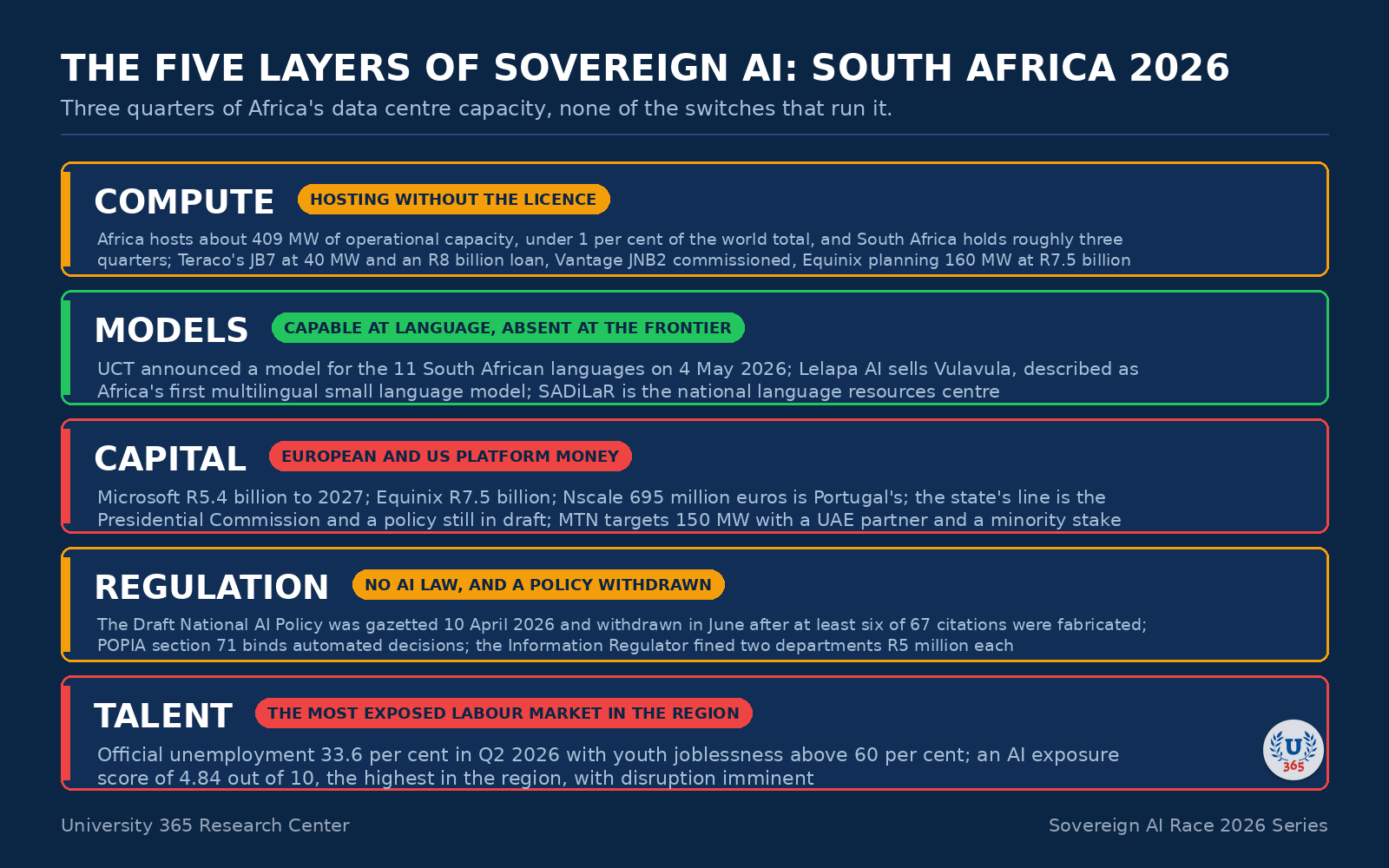
The five layers assessed. Three quarters of a continent's data centre capacity above a licensing choke point held abroad. University 365 Research Center.
This is the eighteenth report in a twenty-part series assessing how states attempt to control the production of artificial intelligence inside their own jurisdiction. The framework is fixed and applied identically to every country. Sovereign AI capacity separates into five layers, and a state can hold any one of them without holding the others.
Compute sovereignty is the physical layer: where the chips and data centres sit, and who may switch them off. Model sovereignty is who builds the models a country depends on, and in whose languages and domains those models are competent. Capital sovereignty is who funds the build-out and on what terms. Regulatory sovereignty is who writes the rules and whether they can be enforced. Talent and education sovereignty is who builds and runs the systems, and how the next generation is prepared.
The series treats three races as running at once: the compute race, the model race and the rules race. South Africa is the country where the compute race produced a real asset and the rules race produced nothing at all in the same year. On 26 August 2026 four companies announced they had begun deploying more than 400 NVIDIA graphics processors across 50 servers in a Johannesburg carrier-neutral facility, described as a 7.2 exaflop sovereign AI cloud, with the parts sourced through a Dubai-based integrator under case-by-case United States export licensing. Eleven weeks earlier, on 10 April 2026, the Department of Communications and Digital Technologies had gazetted a Draft National AI Policy. It was withdrawn in June after at least six of its 67 academic citations were found to be fabricated, at least one traced to a hallucinated source.
The series places South Africa in the "ambition without compute" posture alongside Morocco, Brazil and Qatar, and this report tests that placement layer by layer. It is the placement the evidence resists. South Africa is the only country in that group that hosts a large share of a continent's data centre capacity, and the only one with a working national language resources institution, a functioning data protection regulator that fines government departments, and a competition authority that extracted an enforceable remedy from one of the largest platforms in the world. What it does not hold is what the series means by compute sovereignty: it does not hold the licensing choke point. The report's question is what hosting is worth when the switch is abroad, and what a country can still do about that.
The vocabulary this report needs
Five terms recur, and they are defined here once.
The hosting position. South Africa's place in the AI compute chain: it has land, electricity, connectivity, colocation capacity and a functioning market for all three, and it has no fabrication, no packaging, no accelerator design at scale, and no control over the export licence under which the accelerators that matter may be used.
POPIA section 71. The Protection of Personal Information Act's provision prohibiting a decision about a person made solely by automated processing. It is the single most important enforceable AI-relevant legal provision in force in South Africa, and it predates the AI debate by a decade.
The withdrawn policy. The Draft National AI Policy, gazetted on 10 April 2026 as Notice 3880 in Gazette 54477 and withdrawn in June 2026 by Notice 3978 in Gazette 54840. A successor is targeted for the 2026/27 financial year under an expert panel chaired by Professor Benjamin Rosman of the Wits Machine Intelligence and Neural Discovery Institute.
SADiLaR. The South African Centre for Digital Language Resources, supported by the Department of Science, Technology and Innovation and hosted at North-West University, the national institutional base for work across the country's eleven official languages.
The exposure score. An AI labour-market exposure measure built on Statistics South Africa's Quarterly Labour Force Survey and International Labour Organization methodology, scoring South Africa 4.84 out of 10, the highest in the region, with disruption classified as imminent. It sits against an official unemployment rate of 33.6 per cent in the second quarter of 2026.
The Question
What does a state own when it hosts the compute and rents the licence?
South Africa's position is the most uncomfortable in this series because its strongest layer and its weakest layer are the same layer seen from two directions.
The country's compute position is real and it is regionally dominant. It accounts for roughly three quarters of Africa's data centre capacity, in a continent that hosts about 409 megawatts of operational capacity in total, under one per cent of the world's. Teraco, the largest carrier-neutral operator on the continent, started construction on a 40 megawatt hyperscale facility at Isando and financed it inside an R8 billion syndicated loan, the largest disclosed debt raise for a South African data centre in this research. Vantage has commissioned a second Johannesburg campus as an AI-ready facility. Equinix has bought land in two cities and is planning around 160 megawatts under an R7.5 billion programme. Cape Town's own pipeline implies about 1,000 megawatts of additional capacity. And the country's electricity position flipped: load shedding ended, and Eskom now reports roughly 6 gigawatts of surplus capacity it is trying to sell to hyperscalers.
Those are the assets. The liabilities are structural and specific. There is no fabrication and no advanced packaging in the country, so its role in the chip chain is design-adjacent, distribution and consumption. The largest AI cluster runs on United States-controlled parts, sourced through a Gulf intermediary, under a licensing route that was characterised in the analysis reviewed for this report as case-by-case review rather than evasion, which is a statement about legality and not about control. And the country's own biggest data centre operator has publicly contradicted the utility's optimism, saying the binding constraint is transmission and grid connection rather than generation, and that the AI gold rush may be smaller than Eskom hopes.
The question this report puts to the evidence is therefore precise. A state that hosts three quarters of a continent's compute capacity, that cannot manufacture or license the accelerators that capacity runs on, and that has not yet written a rule of its own for the technology, has achieved something real in one layer and nothing in the layer that determines whether it keeps it. The report asks what that position is worth, and what a country in it can still do.
The Contradiction
A sovereign cloud, a sovereign policy that does not exist, and a fabricated citation
The central contradiction in the South African case is between the speed at which the country acquired AI infrastructure and the speed at which it acquired any law to govern it, and the second of those has a specific and unusual cause.
The infrastructure arrived quickly and it is described in the language of sovereignty. More than 400 NVIDIA GPUs across 50 servers, deployed by Stratos Lab with ECOBLOX and Digital Parks Africa, promoted as Africa's most powerful artificial intelligence cloud and as a 7.2 exaflop sovereign AI cloud. The exaflop figure is carried in this report as a claim rather than a capability: no independent benchmark was published, and the number changes materially depending on whether it is precision FP8, FP16 or INT8. What is not in dispute is the physical deployment and the licensing route, and the licensing route is the finding. The parts are NVIDIA B300 accelerators, they are United States-controlled, they were sourced through a Dubai-based integrator, and the arrangement has been described as export compliance absorbed by an experienced intermediary under case-by-case review by the United States Bureau of Industry and Security. A sovereign cloud whose accelerators can be switched off by a decision taken in Washington is sovereign in its hosting and not in its operation.
The policy, by contrast, did not arrive at all. The Draft National AI Policy was gazetted on 10 April 2026 and withdrawn in June 2026 after at least six of its 67 academic references were found to be fabricated, with at least one traced to an AI-hallucinated citation and the failure attributed in 2026 reporting to a mistranslated source document and undisclosed use of a generative tool. That sequence is the sharpest illustration in this series of the problem the CI-First framework exists to describe, and it is worth stating precisely rather than as an embarrassment. A government department used a generative system to help draft the country's AI law and did not verify what it produced, and the country lost its only attempt at an AI statute to a defect the statute was intended to address. The state did not merely fail to regulate AI; it was regulated by it, badly, and the failure was caught by outside readers rather than by the department's own process.
There is a third element that makes the contradiction sharper rather than softer. South Africa has real enforcement capacity, and it is being used under laws that were not written for AI. The Information Regulator has fined two national departments five million rand each under the data protection framework, while stating that it must regulate more than three million data processors with about a hundred staff. The Competition Commission extracted a fully enforceable R688 million remedial package from Google and YouTube in its media and digital platforms inquiry, including AI opt-out rights for publishers equivalent to those available in the European Union, using existing competition powers rather than bespoke digital markets legislation. And on 26 June 2026 the Constitutional Court upheld the Copyright Amendment Bill's shift to open-ended fair use, which makes unlicensed AI training legally defensible under a four-factor test, struck down broad educational exceptions, and said nothing whatever about generative AI.
So the contradiction resolves into this. South Africa hosts the most significant AI compute on the continent, has no AI law and lost the draft of one to a fabricated citation, enforces against automated decision-making and against platforms using laws written before either existed, and let a court make training on copyrighted works legal by accident rather than by design. The country's regulatory sovereignty is real, improvised, and pointed in directions nobody chose.
The Current State
Compute: three quarters of a continent, and none of the switches
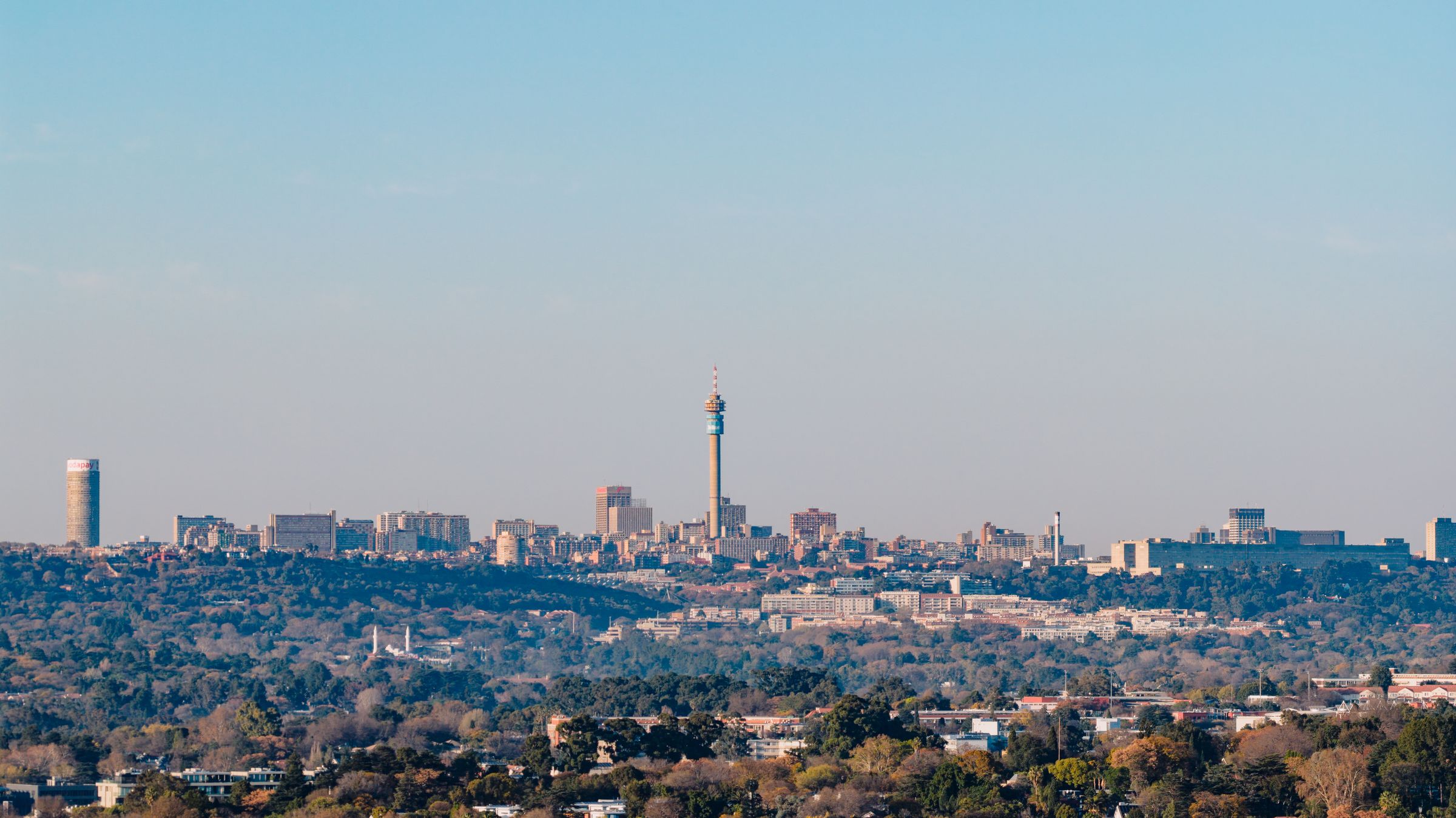
Johannesburg. The country's AI compute is concentrated in Ekurhuleni and Midrand, where Teraco is building a 40 megawatt hyperscale facility at Isando inside an R8 billion syndicated loan and Vantage has commissioned a second campus. Photograph: Pexels License, via Pexels.
South Africa's compute layer is the strongest in Africa and it is built on other countries' silicon.
The market is concentrated and the concentration is the country's. Africa hosts roughly 409 megawatts of operational data centre capacity, under one per cent of the global total, on one market-analysis figure that is carried here as a claim rather than a national statistic. South Africa accounts for about three quarters of that. Cape Town's pipeline alone implies about 1,000 megawatts of additional capacity, and City of Cape Town modelling cited in the same analysis puts the city's data centre load at 580 megawatts against 34 per cent of municipal power generation, both carried as claims. The build is real regardless of the precise denominators: Teraco started construction on JB7, a 40 megawatt critical-power-load hyperscale facility at its Isando campus east of Johannesburg, roughly 71,000 square metres, financed alongside an R8 billion syndicated loan, the largest disclosed debt raise for a South African data centre in this research. Teraco also completed a 30 megawatt expansion at its JB4 Bredell campus. Vantage operates Johannesburg I at Waterfall City as an 80 megawatt hyperscale campus with Phase 1 operational and later phases under construction, and commissioned Johannesburg II at Isando on 12 January 2026 as an AI-ready campus, a date that comes from a project database and should be treated as requiring confirmation against a company release. Equinix has acquired land in Johannesburg and Cape Town and states it plans to add about 160 megawatts under a R7.5 billion programme, while currently operating a single Johannesburg facility with about 2,415 square metres of colocation space. That gap between a small operational footprint and a large announced plan is the clearest announced-versus-built case in the South African market and the report states it as such. MTN Group is targeting 150 megawatts in the first phase of an AI data centre push across South Africa and Nigeria, with the group chief executive saying MTN will hold only a minority stake in the vehicle alongside a United Arab Emirates-based data centre investment platform. That structure is worth noting for what it says about who owns African AI capacity: the domestic telecom operator is deliberately a minority partner in its own build.
The flagship compute event of 2026 is the sovereign cloud cluster. On 26 August 2026 Stratos Lab, ECOBLOX and Digital Parks Africa announced they had begun deploying more than 400 NVIDIA GPUs across 50 servers in a Johannesburg carrier-neutral facility, described as Africa's most powerful AI cloud and as a 7.2 exaflop sovereign AI cloud. Two things about it carry the analytical weight. The first is the sourcing: the accelerators are NVIDIA B300 parts, United States-controlled, obtained through the Dubai-based integrator ECOBLOX, and the arrangement has been characterised as export compliance handled by an experienced intermediary under case-by-case Bureau of Industry and Security review rather than as an export-control breach. That characterisation is analysis rather than a primary document and is labelled as such, and the underlying transaction is reported by two outlets. The second is what it means for the series' compute metric: South Africa holds hosting and interconnection capacity, and it does not hold the licensing choke point. Any South African sovereign AI capability built on these accelerators is switchable by a licence decision taken outside the country, whether the hardware sits in Isando, Bredell or Cape Town.
The chip layer around the cluster is thin and it is honest about being thin. RS South Africa confirmed it will distribute NVIDIA's Jetson Orin Nano 2 edge module, a 78-TOPS part, with availability from the first half of 2027, which places the country in the distribution tier of the semiconductor chain. No current chip design programme tied to AI accelerators was located in this research, at the Council for Scientific and Industrial Research or elsewhere, and the report records that as a research gap rather than as a finding of absence.
On connectivity, the physical layer is foreign-funded and the country's dependence is structural. The 2Africa cable, described by its partners as the largest subsea fibre system ever deployed, connects Africa to Europe, the Gulf and India through a consortium led by Meta with partners including MTN, Vodafone, Orange and China Mobile International; the precise South African landing dates and lit capacity could not be verified. Equiano is a Google-funded cable running from Portugal along the west coast of Africa, whose South African landing launched in September 2022. A branch connecting both systems to Namibia is registered as a Southern African Development Community investment project. The consequence for AI is direct: South African compute depends on these cables for training-data ingestion, for inference traffic to non-resident model interfaces and for service export, which places the international connectivity layer of the stack under the control of two United States hyperscalers plus a consortium in which Chinese and Gulf carriers hold stakes. No published South African government assessment of the redundancy of those routes, and no statement from the communications regulator on cable security for AI traffic, was located in this research, and the report records both as gaps.
The energy layer is where the country's position genuinely improved and where the improvement is most contested. Eskom ended years of rolling blackouts, and its chair told the Financial Times on 12 August 2026 that the utility is in active discussions with Amazon, Microsoft and Google about supplying surplus electricity to their data centres, with roughly 6 gigawatts of surplus reported, a figure that comes from secondary reporting of an interview rather than a regulatory filing and is carried as a claim. The industry's own counterweight came from the country's biggest data centre operator, which argued that the sector's problem is not a shortage of power but of transmission and grid connection, and that the AI gold rush may be smaller than Eskom hopes. The two statements are both credible and they are about different things, and this report records the conflict rather than resolving it. What the reliability numbers say is sobering in either reading: Eskom's energy availability factor fell month on month in April 2026 to 59.9 per cent from 66.8 per cent in March, in a year that nevertheless passed without load shedding. A utility that ran a year without blackouts still ran at roughly sixty to sixty-seven per cent availability, which caps how much firm power can be promised to new load. The financial position is constrained too: the electricity minister said in September 2026 that government will not provide further bailouts and will not accept sustained double-digit tariff increases.
Beyond the grid, the country's firm-power future is being planned at a scale that will not arrive in time for this build-out. Cabinet approved the Integrated Resource Plan 2025 in October 2025, embedding nuclear expansion with 5,200 megawatts of new nuclear by 2039 inside a broader envelope of more than 105 gigawatts of new generation by 2039. The Department of Electricity and Energy has tendered for advisory services on procuring up to 10 gigawatts of nuclear, which is roughly double the plan's own line item, and the two figures stand in the record unexplained. Eskom is reported to be seeking to emulate the Egypt-Russia procurement model for nuclear plants, which would place a Russian state vendor inside the energy layer of South Africa's AI stack, a second foreign switch in a country already dependent on another for its accelerators. On renewables the pipeline is real: 1,920 megawatts of projects reached completion in the first half of 2026, 4,123 megawatts of full-year capacity was reaching operation, the regulator approved generation licences for four solar projects in June 2026, and eight solar projects totalling 1,760 megawatts were appointed preferred bidders under Bid Window 7 at an average of 51.2 rand cents per kilowatt hour. One specific caution belongs here: no power purchase agreement signed to serve data centre load was verified in this research, and the Eskom discussions are described in the reporting as talks rather than agreements, so the published report does not describe any as signed.
Models: capable at the language tier, absent at the frontier
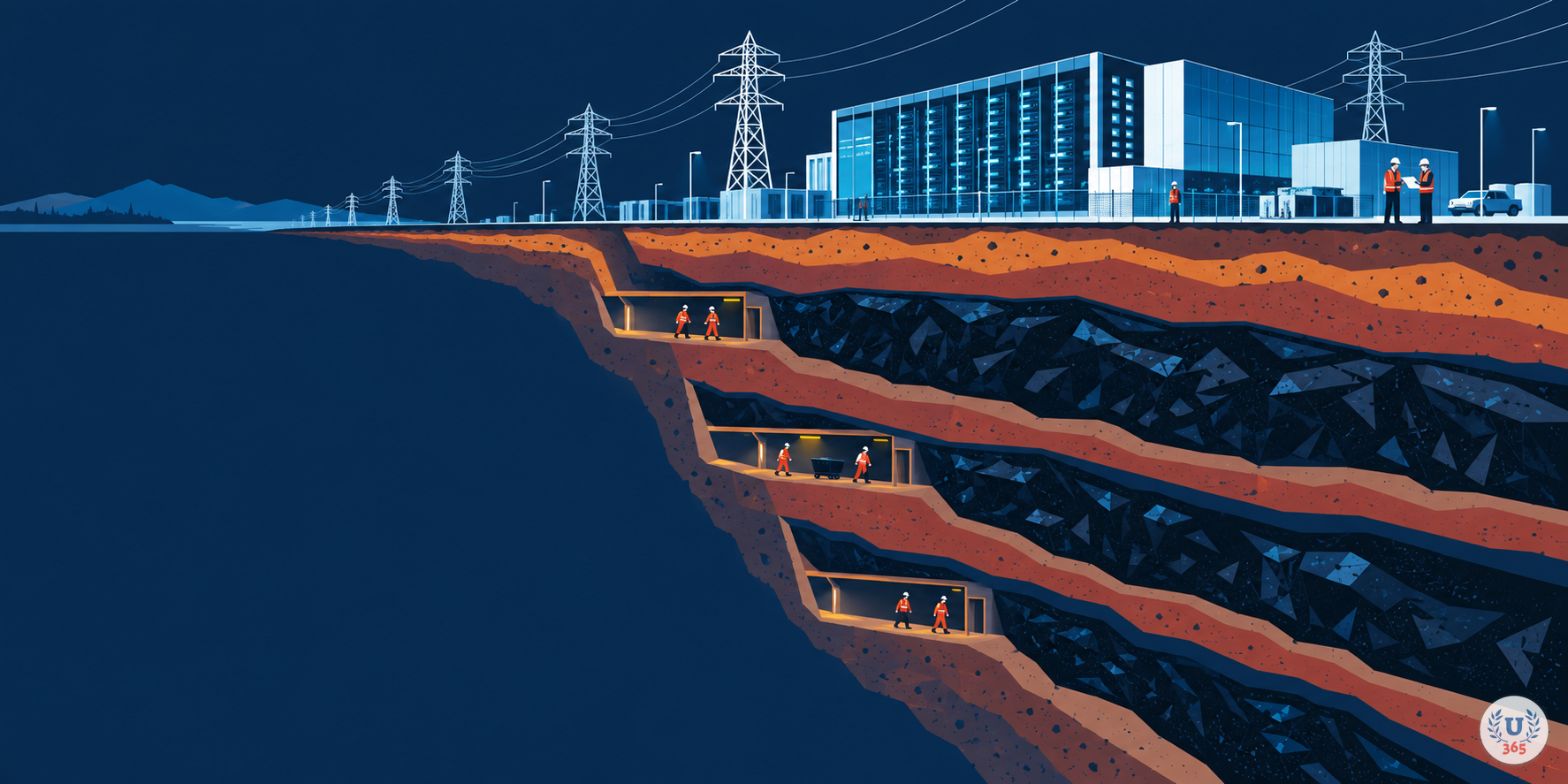
The build on the surface, and what lies under it. University 365 Research Center.
South Africa's model layer is the most interesting in Africa and it is deliberately small, and the report treats that as a strategic choice rather than a shortfall.
The strongest institutional asset is the language research base. The University of Cape Town announced on 4 May 2026 a language model trained on the eleven South African languages, which is the same problem this series has documented in Spain, Italy and Portugal, at higher difficulty: eleven official languages rather than one or two, several of them with limited digital corpora. SADiLaR, the South African Centre for Digital Language Resources supported by the Department of Science, Technology and Innovation and hosted at North-West University, ran a dense 2026 programme including grammar digitalisation work in August, a five-decade digitisation initiative in July and the inauguration of four honorary fellows, and it is the institutional backbone of the problem rather than a single project. The Masakhane collective covers more than 40 African languages and received three million dollars from Google.org inside a 37 million dollar African AI research commitment announced in September 2025, and in May 2026 Masakhane, the Microsoft AI for Good Lab, the Gates Foundation and Google.org launched an open call for African language foundation work under the name LINGUA Africa. Two South African university centres received roughly a million dollars each inside that Google.org package; the sources reviewed do not name them, and this report does not either.
The commercial layer is small and it is real. Lelapa AI, a Johannesburg startup founded in 2022 by Pelonomi Moiloa, develops and sells Vulavula, described by the company as Africa's first multilingual small language model, with total disclosed funding of 2.5 million dollars and a last round in February 2023. That is the country's most visible AI model company and its capitalisation is smaller than a single mid-sized data centre deal in the same city.
What South Africa does not hold is the frontier tier. There is no domestic frontier model, no state-funded national model programme, no independently benchmarked performance figure for any South African model, and no verified evaluation of foreign models in South African languages, which is the gap the AMALIA case in Portugal closed for European Portuguese and which no equivalent instrument has closed here. The model layer is therefore capable at the language and research tier and absent at the frontier tier, and the report states that plainly rather than upgrading it.
Capital: platform money, a minority stake, and a policy with no budget
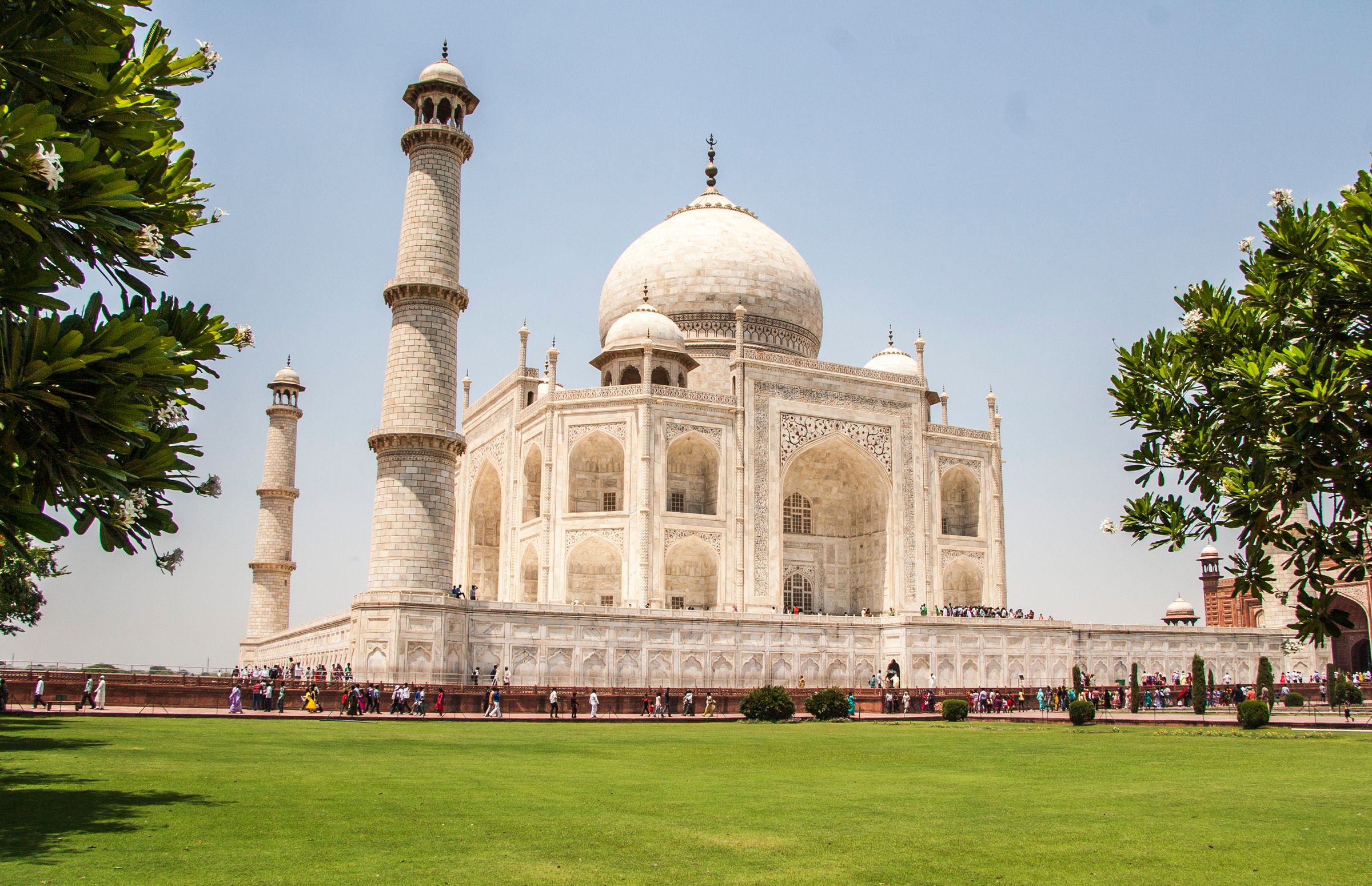
Cape Town. The city's own pipeline implies about 1,000 megawatts of additional data centre capacity, and City modelling cited in market analysis puts its data centre load at 580 megawatts against 34 per cent of municipal power generation. Photograph: Pexels License, via Pexels.
South Africa's capital layer is dominated by foreign platform investment and the state's own financial instruments are thin.
The private commitments are substantial by African standards and every one of them is foreign. Microsoft announced it would invest 5.4 billion rand, about 297 to 298 million dollars, in South Africa by the end of 2027 to expand cloud and AI infrastructure, announced in Johannesburg in March 2025. Separately, NVIDIA entered a reported 700 million dollar agreement with Cassava Technologies, the parent of Africa Data Centres, to establish AI-ready facilities across several African markets including South Africa; that figure is carried as a claim because it has not been verified against a first-hand company announcement. Equinix's 160 megawatt programme is stated at R7.5 billion. Teraco's R8 billion syndicated loan is the largest disclosed debt raise in the sample. Microsoft South Africa also committed on 24 January 2025 to train one million South Africans in digital skills, which is a company pledge rather than a state programme. Google hosted its first Africa Cloud Summit in Sandton on 1 July 2026, opened by President Ramaphosa, with an attendee count that sources give as either 3,000 or more than 2,500, a conflict recorded rather than resolved, and announced new infrastructure, a new applied AI lab on African soil and expanded connectivity; the lab's specific city could not be verified.
The state's own instruments are the weakest part of this layer. There is no sovereign AI fund, no national model budget and no committed state compute programme located in this research. The National AI Policy that would have carried a funding line was withdrawn, and its successor is not expected before the 2026/27 financial year. The G20 presidency, which South Africa held in 2025 and which produced the first leaders' summit on African soil on 22 and 23 November 2025 in Johannesburg and a Cape Town AI task force chair's statement on 30 September 2025, generated diplomatic output rather than domestic capital. The consequence is that the country's AI build-out is financed by Microsoft, Equinix, Teraco's lenders, MTN's UAE partner and Google, and its own contribution to the layer is the regulatory and permitting environment plus electricity that it cannot yet connect at the scale the build assumes.
Regulation: no AI law, and a serious enforcement record under older ones
South Africa's regulatory layer is the most distinctive in this series because the country has no AI statute at all and enforces hard against AI-adjacent conduct anyway.
The policy failure is the headline. The Draft National AI Policy was gazetted on 10 April 2026 as Notice 3880 in Gazette 54477 and withdrawn in June 2026 by Notice 3978 in Gazette 54840 after at least six of its 67 academic references were found to be fabricated, with at least one traced to a hallucinated citation and the failure attributed in 2026 accounts to a mistranslated Chile-sourced document and undisclosed use of a generative assistant. The department is now targeting finalisation in the 2026/27 financial year, the advisory panel's terms of reference are finalised, and the panel is chaired by Professor Benjamin Rosman of the Wits Machine Intelligence and Neural Discovery Institute. A register of AI systems, a risk-tier framework or a licensing regime does not exist in South Africa and none is proposed in the material reviewed.
What exists instead is enforcement under three instruments written for other purposes, and each of them is doing real AI-relevant work.
The first is the data protection framework. POPIA section 71 forbids subjecting a person to a decision based solely on automated processing, which is the binding AI-relevant provision in force, and it has been law since well before the generative wave. The Information Regulator has become a proactive enforcer, issuing five million rand fines against the Department of Justice and the Department of Basic Education while stating that it must regulate more than three million data processors with roughly a hundred staff. That ratio is the honest measure of the country's regulatory capacity, and the report treats the two fines against government departments as the significant fact: the regulator's first prominent targets were the state's own ministries.
The second is competition law. The Competition Commission's Media and Digital Platforms Market Inquiry extracted a fully enforceable 688 million rand, approximately 42 million dollars, remedial package from Google and YouTube, including AI opt-out rights for publishers equivalent to those available in the European Union, and it did so using existing Competition Act powers rather than waiting for bespoke digital markets legislation. The enforcement phase commenced on 7 May 2026. This is the most consequential platform regulation in the series achieved without a digital markets act, and the report notes it as a South African achievement rather than a footnote.
The third is copyright, and here the outcome was accidental. On 26 June 2026 the Constitutional Court upheld the Copyright Amendment Bill's shift to open-ended fair use, which makes unlicensed AI training legally defensible under a four-factor framework, struck down broad educational exceptions, and said nothing about generative AI, leaving Parliament to legislate for the AI era. The country therefore has permissive training rules by judicial outcome rather than by design, and the legislature has an explicit invitation to revisit them.
Two further elements complete the picture. On standards and telecoms, the communications regulator ICASA operates the licensing regime that governs the connectivity the AI stack depends on, and the report records no ICASA statement on AI traffic security as a gap. And the regional layer matters for a country in this position: South Africa participates in African Union and Southern African Development Community processes on AI and digital policy, and UNESCO published a South Africa artificial intelligence readiness assessment whose implementation it says cuts across assessment, multi-stakeholder consultation and a roadmap, with the report noting that the country is currently led by the recommendations of the Presidential Commission on the Fourth Industrial Revolution; the date of that UNESCO report could not be captured in this research and it is not asserted.
Talent: the most exposed labour market, and a language problem with eleven answers
South Africa's talent layer contains the country's most serious structural risk and one of its most genuine institutional strengths, and the report keeps them together because they are the same population.
The risk is exposure standing on top of unemployment. Statistics South Africa reported on 11 August 2026 that official unemployment rose to 33.6 per cent in the second quarter of 2026 from 32.7 per cent in the first, with youth joblessness above 60 per cent for ages 15 to 24, and a 2026 AI exposure study built on the same labour force survey and International Labour Organization methodology scored South Africa 4.84 out of 10, the highest exposure in the region, with disruption classified as imminent. The sequence that measure describes is the one this series has been documenting in every country: a labour market with more people exposed to AI-driven change than prepared for it, in an economy that cannot absorb the workers it already has. In South Africa the arithmetic is worse than anywhere else in the series because the absorption problem exists before the technology arrives.
The strength is the research and language base, which is nationally organised rather than scattered. UCT's eleven-language model, SADiLaR's national language resources centre, the Masakhane collective's 40-plus languages, Lelapa AI's commercial small language model and the university centres inside the Google.org package together constitute a real capability at the tier that matters most for a country with eleven official languages and limited corpora for several of them. The country's specific intellectual contribution to this field is the hardest version of the multilingual problem, and it has institutions working on it.
The adoption evidence is mixed and mostly company-disclosed. Discovery Bank reports that more than half of all client interactions now run through its in-app AI channel after a three to four month migration, which is the most concrete named adoption figure in the research and is a company disclosure at a conference rather than an audited statistic. A 2026 Xero survey of small businesses reported 52 per cent using AI tools daily or weekly while many still struggle to see where the technology fits. A study of 1,000 South Africans found adoption above the global average concentrated on learning, work support and career decisions rather than entertainment, with methodology to be verified. A financial sector survey drew 44 responses, predominantly executives, which the report treats as signal rather than measurement. No national statistics office AI adoption survey exists, and the industry and vendor surveys dominate the record as a result.
The largest domestic AI deployment by scale runs on Chinese technology, which is a fact about this layer that the report records without further interpretation: Standard Bank has entered the scaling phase of a continental AI deployment with Huawei credited with substantial cost savings.
What changed since our last report on South Africa: there is none
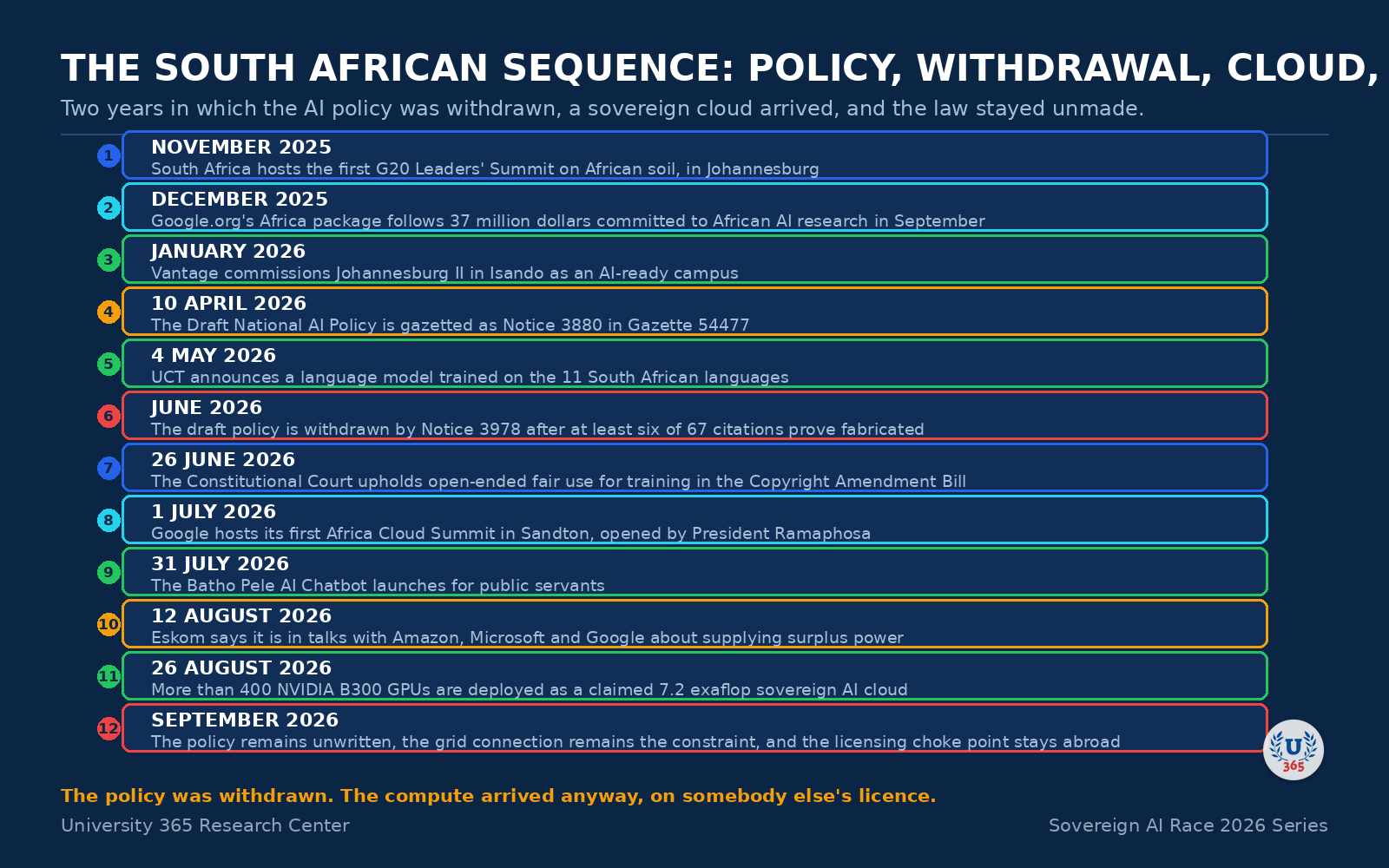
The South African sequence: policy, withdrawal, cloud, panel. University 365 Research Center.
University 365 has not published a South Africa AI landscape report before this one, in any series. There is no prior U365 baseline for South Africa and no earlier country file in the institution's catalogue. This report says so plainly rather than implying a baseline it does not have, and it is the third and last of the series' subjects with no prior report, alongside Russia and Portugal.
What can be compared instead is South Africa against itself inside this report's own research window, and the movement in that interval is substantial and contradictory. In 2024 the country had load shedding, no significant AI compute cluster, a data protection regulator that had issued no prominent AI-relevant fine, and no AI policy on the gazette. In the eighteen months to September 2026 it ended load shedding and acquired a power surplus it cannot connect, hosted the first G20 leaders' summit on African soil, gazetted and then withdrew a national AI policy after a fabricated-citation scandal, saw its competition authority extract an enforceable platform remedy, had its Constitutional Court legalise unlicensed AI training by accident, announced the largest AI compute cluster on the continent on imported accelerators, and saw Google hold its first Africa cloud summit in Sandton. The direction is fast acquisition of infrastructure and platform attention around a state that has not yet written a rule of its own. The series will build its South African baseline from this report forward.
Key Findings
1. South Africa hosts roughly three quarters of Africa's data centre capacity and holds none of the switches that run it. Africa hosts about 409 megawatts of operational capacity, under one per cent of the world's, on a market-analysis figure carried as a claim. South Africa's share is dominant, and its largest AI cluster runs on United States-controlled NVIDIA B300 accelerators sourced through a Dubai integrator under United States export licensing. The licensing choke point sits outside the country.
2. The country's largest disclosed AI compute cluster is described as a 7.2 exaflop sovereign AI cloud, and that figure is a claim. More than 400 NVIDIA GPUs across 50 servers, deployed by Stratos Lab, ECOBLOX and Digital Parks Africa in a Johannesburg carrier-neutral facility from 26 August 2026. No independent benchmark and no stated precision were published, and the exaflop number changes materially between FP8, FP16 and INT8.
3. The national AI policy was withdrawn after fabricated citations. Gazetted 10 April 2026 as Notice 3880 in Gazette 54477, withdrawn in June 2026 by Notice 3978 in Gazette 54840 after at least six of 67 academic references were found to be fabricated, at least one traced to a hallucinated citation. South Africa has no AI law in force. The successor is targeted for the 2026/27 financial year under a panel chaired by Professor Benjamin Rosman.
4. Enforcement is happening under laws written before AI existed, and it is serious. POPIA section 71 forbids decisions taken solely by automated processing. The Information Regulator has fined the Departments of Justice and Basic Education five million rand each while stating it must regulate more than three million data processors with roughly a hundred staff. The Competition Commission extracted an enforceable R688 million remedy from Google and YouTube with European-equivalent AI opt-out rights for publishers. The Constitutional Court upheld open-ended fair use for training on 26 June 2026, making unlicensed AI training defensible by judicial outcome rather than legislative design.
5. Load shedding ended and the grid, not generation, is the constraint the operators name. Eskom's chair told the Financial Times on 12 August 2026 that the utility is in talks with Amazon, Microsoft and Google about surplus power, with about 6 GW reported as surplus, a claim from secondary reporting. The country's largest data centre operator publicly disagreed, saying transmission and connection are the binding constraint. Eskom's energy availability factor fell to 59.9 per cent in April 2026 from 66.8 per cent in March even in a year without blackouts, and no data-centre power purchase agreement was verified as signed.
6. State capital is absent from the layer and foreign platform money is not. Microsoft R5.4 billion to 2027; Equinix R7.5 billion for about 160 MW; Teraco's R8 billion syndicated loan for a 40 MW hyperscale facility; MTN targeting 150 MW with a minority stake and a UAE partner; a reported NVIDIA-Cassava agreement at 700 million dollars carried as a claim. There is no sovereign AI fund, no national model budget and no state compute programme in the record reviewed, because the policy that would have carried one was withdrawn.
7. The model layer is capable at the language tier and absent at the frontier. UCT announced a model trained on the 11 official languages on 4 May 2026; Lelapa AI sells Vulavula, described as Africa's first multilingual small language model, with 2.5 million dollars of disclosed funding; SADiLaR is the national language resources centre; Masakhane covers more than 40 African languages. There is no domestic frontier model, no state model programme and no independent benchmark for any South African model.
8. The nuclear plan and the procurement envelope do not match, and the vendor may be Russian. Cabinet approved the Integrated Resource Plan 2025 in October 2025 with 5,200 MW of new nuclear by 2039 inside a 105 GW envelope, while the department tendered advisory services for up to 10 GW. Eskom is reported to be seeking to emulate the Egypt-Russia procurement model, which would place a Russian state vendor inside the energy layer of the AI stack.
9. The international connectivity layer is foreign-owned and no government assessment of its redundancy was located. Equiano is Google-funded; 2Africa is Meta-led with MTN, Vodafone, Orange and China Mobile International among its partners. No published South African government assessment of route redundancy, and no regulator statement on cable security for AI traffic, was found.
10. Talent is the country's deepest structural exposure. Official unemployment at 33.6 per cent in Q2 2026 with youth joblessness above 60 per cent, against an AI labour-market exposure score of 4.84 out of 10, the highest in the region, with disruption classified as imminent. Adoption evidence is company-disclosed rather than official, the sharpest figure being Discovery Bank's statement that more than half of client interactions now run through its in-app AI channel.
11. The honest overall verdict: South Africa is the series' clearest case of hosting without control, and it is a stronger position than the posture table implies. It holds three quarters of a continent's data centre capacity, a real language research base, a data protection regulator that fines its own government, a competition authority that made a global platform pay, and a power surplus it cannot yet connect. It does not hold the accelerator licence, an AI law, or a state instrument of any size. On this evidence the country has built the layer a country can build without permission and cannot switch off the layer that needs it.
Deep Analysis
Why the licensing choke point is the whole of the South African compute story
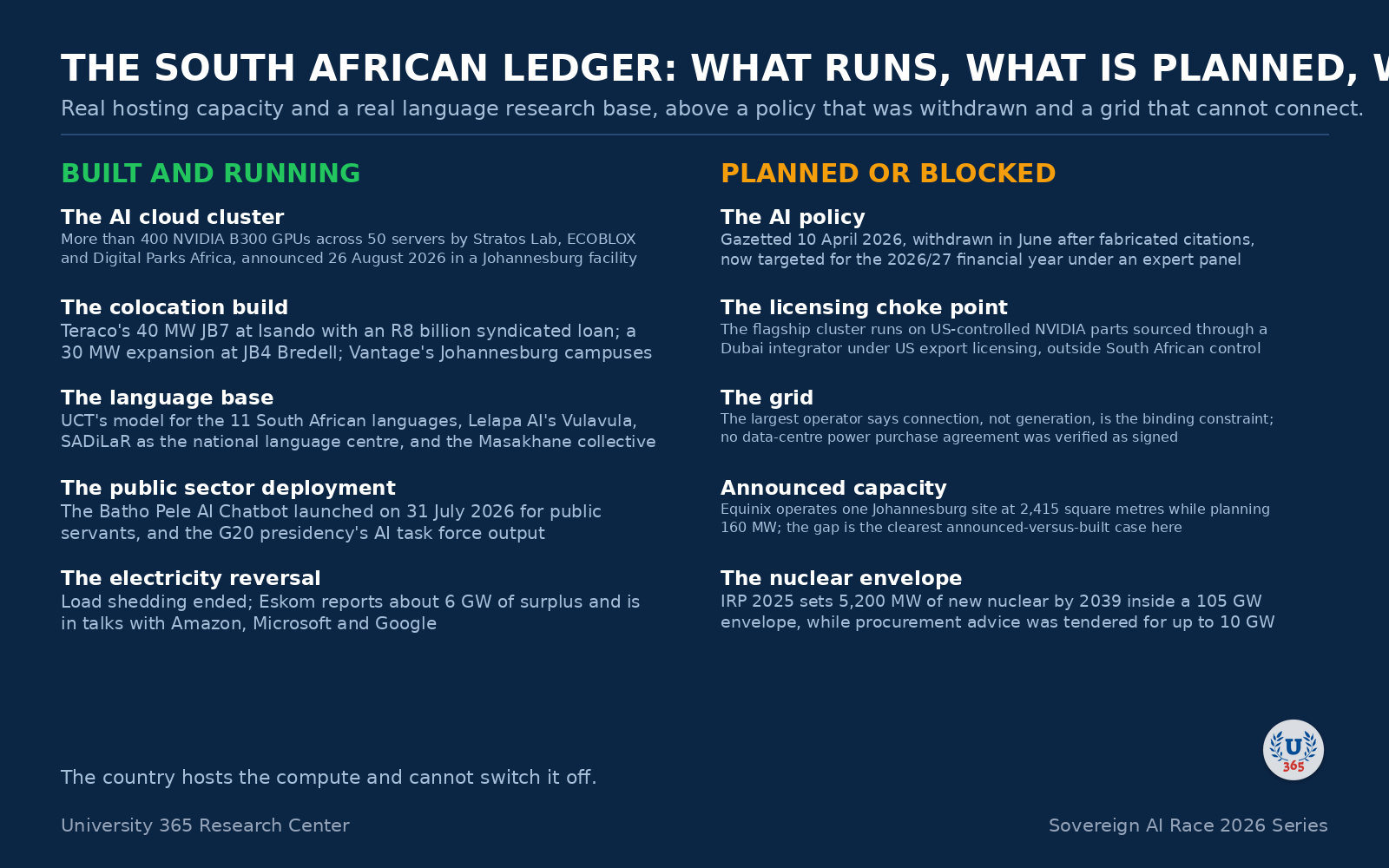
What runs, against what is planned or blocked. University 365 Research Center.
This report has one central analytical claim and this is where it is argued: a country can build every physical element of an AI compute layer and still not hold it, and South Africa is the demonstration.
Consider what hosting requires and what ownership requires. Hosting requires land, planning permission, a grid connection, cooling, security, staff and a market for the space. South Africa has all of those, and it has them at a scale no other African country approaches: three quarters of the continent's capacity, a colocation market with operators that can finance a forty megawatt hyperscale facility against an eight billion rand syndicated loan, and a city whose own pipeline implies a thousand megawatts. Those are genuine assets and the report does not diminish them. Countries in this series with no compute at all would trade places with South Africa in a moment.
Ownership requires something else, and it is not physical. It requires the ability to decide what the machines may be used for and to keep using them. On that test the South African position is thin in a way that has nothing to do with the country's competence. The accelerators in its flagship cluster are NVIDIA B300 parts, subject to United States export controls, obtained through a Dubai-based intermediary, and characterised in the analysis reviewed here as compliant case-by-case review rather than evasion. Every word of that sentence is a constraint. The parts are American-designed, which means a single vendor's supply policy applies. They are United States-controlled, which means a licensing regime written in Washington applies. They arrived through a third country, which means the supply route itself is an arrangement rather than a channel. And the compliance is described as a review process, which means it is ongoing rather than settled.
The consequence is a specific and measurable form of dependence, and the report wants to be precise about what it is and is not. It is not a claim that the United States will act capriciously or that the arrangement is unstable. It is a statement about where the switch sits. If the licensing environment changed, the country could not build a domestic substitute, because it has no fabrication, no advanced packaging and no accelerator design at scale; its role in the chip chain as the research located it is design-adjacent work, distribution, and consumption. A South African sovereign cloud is therefore sovereign in a specific and limited sense: the electricity is South African, the building is South African, the operators are South African, and the permission to run the silicon is not.
That distinction is the same one this series drew in Portugal, where a national language model was owned outright and the compute beneath it was not, and in Germany, where a cloud partnership provided capability without control. South Africa's version is the starkest because it is total: the country owns none of the accelerator layer and depends on a licence held by a firm in a third country. The comparison that gives the finding its force is with the countries that do hold something. The Gulf states own the entities that build their compute. China and the United States control the supply. South Africa hosts, competently, for anyone who can get a licence, and its hosting business is genuinely one of the best in the hemisphere. What hosting cannot do is survive a decision taken elsewhere, and the report's judgement is that a state in this position should treat its compute layer as a service it provides rather than an asset it holds, and should build its sovereignty claims on the layers where no licence is required.
The withdrawal of the draft policy is the most instructive AI governance failure in the series

Table Mountain. The country's subsea connectivity runs through the Equiano cable, which Google funded, and the 2Africa system, led by Meta with MTN, Vodafone, Orange and China Mobile International among its partners. Photograph: Pexels License, via Pexels.
The second analytical point in this report is about the fabricated citations, and it is worth stating what makes that episode unusual rather than treating it as an embarrassment.
Governments lose policies for many reasons: political defeat, fiscal constraint, a change of minister, an election. South Africa's AI policy was withdrawn because at least six of its 67 academic references could not be verified, with at least one traced to a citation that does not exist, and the failure attributed in the reporting to a mistranslated source document and undisclosed use of a generative assistant. The department was writing the country's rules for artificial intelligence and used a generative tool to help draft them without checking the output, and the country lost its only attempt at an AI statute to precisely the failure mode an AI statute is meant to prevent.
Three things follow and they are the substance of this section.
First, the episode is evidence about institutional readiness rather than about any individual's competence. A department that had an AI verification process in place would have caught six bad citations in a policy document before publication, because checking whether a cited article exists is the cheapest possible editorial control. The absence of that step is a fact about process, and it suggests that the state's own handling of AI is at a less mature stage than the infrastructure arriving in its cities. A country can host a forty megawatt hyperscale campus and simultaneously be unable to check a bibliography, and both of those are true of South Africa in the same year.
Second, the failure has a corrective consequence that a quiet withdrawal would not have had. The withdrawal is public, dated, and recorded in the Gazette, the panel chairs are named, the target financial year is stated, and the country's academic community read the draft closely enough to find the defects. Several countries in this series have AI frameworks with no independent review and no evident defect-detection, and this report has treated their unexamined claims as claims for exactly that reason. South Africa's process caught its own failure late, but it caught it through external scrutiny rather than not at all, which is a different and better case than a policy that passes unexamined into law.
Third, the episode is the sharpest illustration in this series of the framework the series uses. The CI-First lens asks where the appearance of capability outruns the capability itself. A policy document that cites research that does not exist has the appearance of scholarship and none of the substance, and it was produced by exactly the substitution the framework describes: a tool used to generate output in place of the human judgement that would have verified it. That it happened to a government writing AI rules is an irony rather than a coincidence. Every institution drafting with these tools faces the same failure mode, and South Africa's experience is the published case study.
The enforcement record, and what a country can do without an AI law
The third analytical point concerns what South Africa has done without the statute it never got, because it is the strongest counter-example in this series to the assumption that regulation requires AI-specific legislation.
The country enforces through three instruments, and each is doing work that a purpose-built AI law would otherwise have had to do. POPIA section 71 prohibits decisions taken solely by automated processing, which reaches the most consequential category of AI harm a regulator is likely to face, and it has been in force for years. The Information Regulator has used it to fine two government departments five million rand each, which establishes the principle that the state's own automated systems are in scope, a point many regulators never reach. The Competition Commission's media and digital platforms remedy extracted 688 million rand from Google and YouTube including AI opt-out rights for publishers, achieving through competition law an outcome the European Union pursued through dedicated digital markets legislation, and the enforcement phase began in May 2026. The Constitutional Court made training on copyrighted works defensible under open-ended fair use, which is a substantive AI-relevant policy outcome reached by judicial interpretation.
The report draws three conclusions from that record. The first is that the instruments a country already has are more capable than most governments assume, and a state that lacks an AI act is not without regulatory tools: it has data protection, competition, consumer law, labour law and the courts, and in South Africa's case those instruments have produced fines against ministries and a nine-figure platform remedy. The second is that improvised regulation has an agenda problem. South Africa's AI-relevant regime was assembled by accident and it points where cases happened to arise: publisher opt-outs, automated decision-making, and a fair-use ruling nobody intended as AI policy. There is no risk tier, no registration, no conformity assessment and no enforcement programme aimed at the things that most need watching, which is what the withdrawn policy would have provided. The third conclusion is about capacity, and it is the hard one. The Information Regulator's own statement of its position is the measure: more than three million data processors, roughly a hundred staff. Enforcement that strong at that ratio cannot be scaled by will, and the country's regulatory sovereignty is therefore real at the level of principle and thin at the level of coverage.
The three races, measured in South Africa
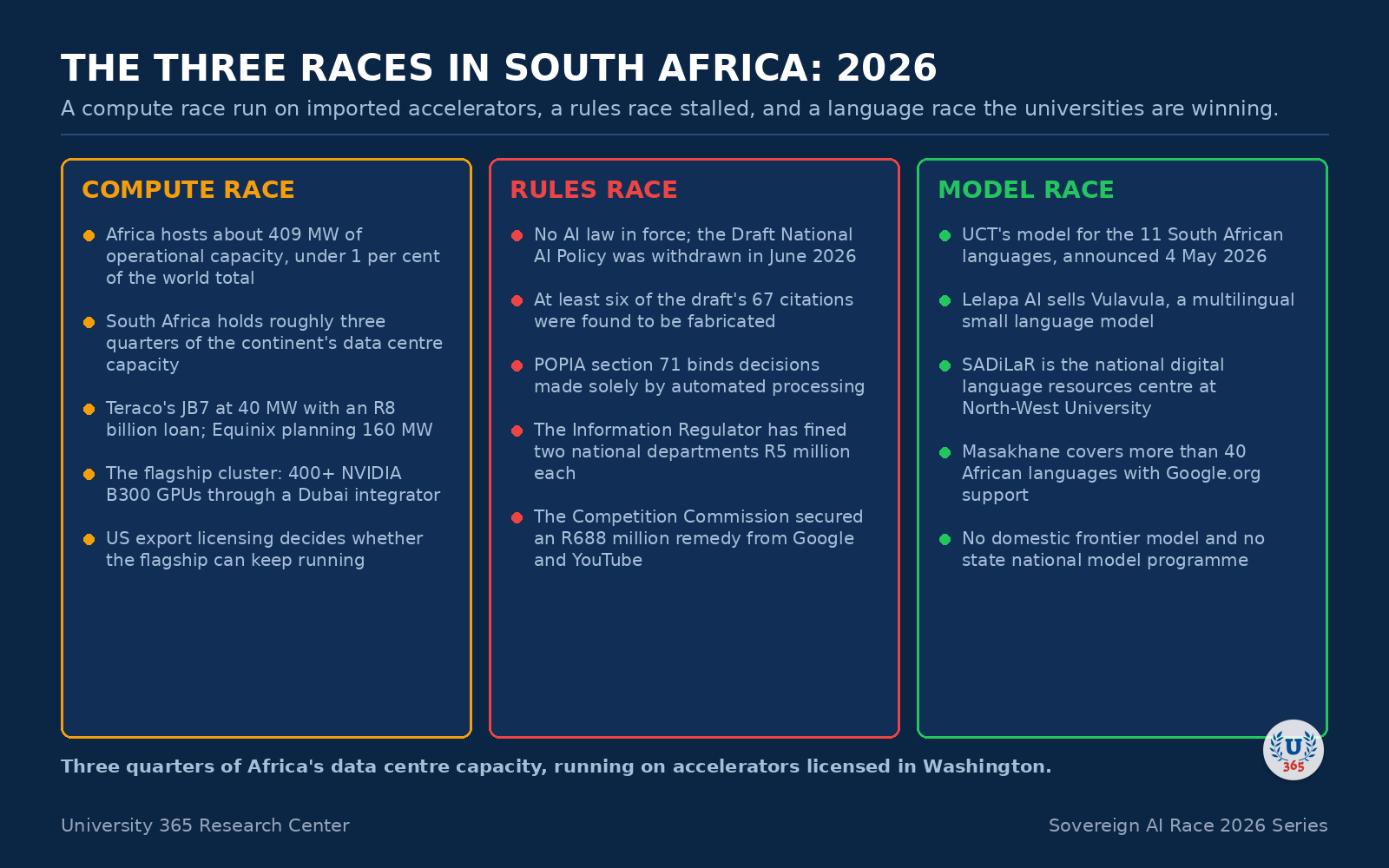
The three races in South Africa, at three different tempos. University 365 Research Center.
The series separates the compute race, the model race and the rules race. South Africa is the country where one of the three was won in a year in which another was lost outright, and the third is being run by universities rather than by the state.
In the compute race, the country hosts and does not hold. A continent with about 409 megawatts of operational capacity, under one per cent of the world total, has roughly three quarters of what exists in South Africa; Teraco can finance a forty megawatt hyperscale facility against an eight billion rand syndicated loan; Vantage has a second Johannesburg campus; Equinix plans about 160 megawatts; Cape Town's pipeline implies a thousand. And the accelerators in the flagship cluster are United States-controlled parts sourced through a Dubai intermediary under a licensing route held abroad. The country won the race to attract capacity and it did not enter the race to control it, because it has no fabrication and no accelerator design at scale.
In the rules race, the country lost its only attempt and kept its enforcement. The Draft National AI Policy was gazetted on 10 April 2026 and withdrawn in June after at least six of its 67 citations were found to be fabricated, and the successor is targeted for the 2026/27 financial year. What has continued regardless is enforcement under instruments written before the technology existed: fines against two government departments under the data protection act, a nine-figure platform remedy under competition law, and a fair-use ruling from the Constitutional Court that legalised unlicensed training on protected works by judicial interpretation rather than legislative design.
In the model race, the universities are running ahead of the state and the field is the country's hardest. There is no domestic frontier model and no state national model programme, and there is a genuine research base working across eleven official languages: a model announced by the University of Cape Town on 4 May 2026, SADiLaR as the national language resources centre, the Masakhane collective across more than 40 African languages, and one commercial startup selling a multilingual small language model. A country with eleven official languages and limited corpora for several of them is running the most demanding version of the multilingual problem anywhere in this series, and its institutions, not its government, are the ones running it.
The three tempos produce the report's summary of South Africa. A state that attracted the continent's AI capacity without owning the licence on it, discarded its own AI law over unverified citations, and left its most original AI work to universities that no AI policy has ever funded.
Data and Evidence
Table 1: The five layers, assessed for South Africa in September 2026
Layer | What South Africa holds | What it does not hold | Assessment |
Compute | Roughly three quarters of Africa's data centre capacity in a continent hosting about 409 MW, under 1 per cent of the world total (market claim); Teraco's 40 MW JB7 at Isando inside an R8 billion syndicated loan and a 30 MW expanded JB4 Bredell; Vantage's Johannesburg I at 80 MW with JNB2 commissioned January 2026; Equinix planning about 160 MW at R7.5 billion against one 2,415 square metre operating site; Cape Town's pipeline implying about 1,000 MW; MTN targeting 150 MW with a UAE partner and a minority stake; more than 400 NVIDIA B300 GPUs across 50 servers deployed as a claimed 7.2 exaflop sovereign cloud; Eskom's roughly 6 GW reported surplus in talks with Amazon, Microsoft and Google; 1,920 MW of renewables completed in H1 2026 inside a 4,123 MW full-year pipeline | The licensing choke point: accelerators are US-controlled parts sourced through a Dubai integrator; no fabrication, no advanced packaging, no AI accelerator design at scale; no verified data-centre power purchase agreement; a grid the largest operator calls the binding constraint; firm new generation (5,200 MW of nuclear planned for 2039) far beyond this build-out | Real hosting capacity at continental scale, with the switch held abroad |
Models | UCT's model for the 11 official languages announced 4 May 2026; Lelapa AI's Vulavula, described as Africa's first multilingual small language model, 2.5 million dollars disclosed funding; SADiLaR as the national language resources centre at North-West University with a dense 2026 programme; Masakhane covering 40-plus languages with 3 million dollars from Google.org; LINGUA Africa launched May 2026 with Microsoft, the Gates Foundation and Google.org; Google.org grants of about 1 million dollars to two unnamed South African university centres | A domestic frontier model; a state-funded national model programme; independent benchmarks for any South African model; verified evaluation of foreign models in South African languages; any domestic frontier laboratory | Capable at the language and research tier, absent at the frontier |
Capital | Microsoft R5.4 billion (about 297-298 million dollars) to 2027; Equinix R7.5 billion for about 160 MW; Teraco's R8 billion syndicated loan; MTN's 150 MW target with a UAE platform and a minority MTN stake; a reported NVIDIA-Cassava agreement at 700 million dollars carried as a claim; Google's Africa package including a new applied AI lab; the R688 million Competition Commission remedy as a transfer to publishers and platforms rather than to the state | A sovereign AI fund; a national model budget; a state compute programme; any committed public AI capital line, because the policy that would have carried one was withdrawn; verified AI-specific content in the Brazil or BRICS capital channels | Platform-financed capacity with no state instrument of size |
Regulation | POPIA section 71 as the binding automated-decision provision; the Information Regulator's R5 million fines on the Departments of Justice and Basic Education and its stated position regulating 3 million-plus processors with about 100 staff; the Competition Commission's R688 million enforceable remedy from Google and YouTube with EU-equivalent AI opt-out rights, enforcement from 7 May 2026; the Constitutional Court's 26 June 2026 fair-use ruling making unlicensed training defensible; ICASA's licensing regime for connectivity; UNESCO's readiness assessment whose date could not be verified | An AI law: the Draft National AI Policy was withdrawn after fabricated citations and a successor is targeted for 2026/27; a risk-tier framework; a register of AI systems; an operating national AI sandbox; any regulator statement on subsea cable security for AI traffic | Serious enforcement under older instruments and no statutory AI framework at all |
Talent and education | UCT and the university language research base; SADiLaR; the Masakhane collective; university centres inside the Google.org package; Discovery Bank's disclosure that more than half of client interactions run through its in-app AI channel; a Xero survey reporting 52 per cent of SMEs using AI tools daily or weekly; a 1,000-person study finding above-average consumer adoption concentrated on learning and work | Absorption: official unemployment at 33.6 per cent in Q2 2026 with youth joblessness above 60 per cent, against an AI exposure score of 4.84 out of 10, the highest in the region, with disruption imminent; a national statistics office AI adoption survey; scaled state skills instruments tied to AI | A genuine language research base inside a labour market with the region's highest measured exposure |
Table 2: The controlled metrics, series bible format
Metric | South Africa position | Source and date |
Flagship compute commitment | The sovereign AI cloud cluster: more than 400 NVIDIA B300 GPUs across 50 servers by Stratos Lab, ECOBLOX and Digital Parks Africa in a Johannesburg carrier-neutral facility, announced 26 August 2026, promoted as a 7.2 exaflop sovereign AI cloud (CLAIM: no independent benchmark, no stated precision; FP8/FP16/INT8 changes the figure materially). Colocation build: Teraco's JB7 at 40 MW critical power load at Isando, roughly 71,000 square metres, financed with an R8 billion syndicated loan (the largest disclosed South African data centre debt raise in this research); a 30 MW JB4 Bredell expansion; Vantage's Johannesburg I at an 80 MW campus with JNB2 commissioned 12 January 2026 (date from a project database, requiring company confirmation); Equinix planning about 160 MW at R7.5 billion against one site of about 2,415 square metres operating; MTN's 150 MW first phase across South Africa and Nigeria with a UAE partner and a minority MTN stake. Continental context: Africa hosts about 409 MW operational, under 1 per cent of the world total (market claim) | tech.africa, 26 August 2026; peopleofinternet.com analysis; ciome.economictimes.indiatimes.com; greeneconomy.media and itweb.co.za; datacenterdynamics.com and vantage-dc.com; dcpulse.com; businessday.co.za, 3 September 2026; equinix.com; techcentral.co.za; capetowndata.com market analysis |
Capital committed | Microsoft: R5.4 billion, about 297-298 million dollars, by end-2027, announced in Johannesburg March 2025; a separate commitment on 24 January 2025 to train 1 million South Africans. Equinix: R7.5 billion for about 160 MW. Teraco: R8 billion syndicated loan. MTN: 150 MW target, no financing figure disclosed at announcement. A reported NVIDIA-Cassava Technologies agreement at 700 million dollars (CLAIM, not verified first-hand). Google's Africa package with infrastructure, an applied AI lab and connectivity, following 37 million dollars committed to African AI research in September 2025. State: no sovereign fund, no national model budget, no committed state compute programme located | Xinhua and jacarandafm.com, March 2025; news.microsoft.com EMEA, 24 January 2025; businessday.co.za, 3 September 2026; greeneconomy.media; techcentral.co.za; techinafrica.com; furtherafrica.com, 18 September 2025 |
Flagship national models | No state national model programme exists. UCT announced on 4 May 2026 a language model trained on the 11 South African languages. Lelapa AI (Johannesburg, founded 2022 by Pelonomi Moiloa) sells Vulavula, described by the company as Africa's first multilingual small language model; total disclosed funding 2.5 million dollars with a last round in February 2023. SADiLaR supports the national language resources base. Masakhane covers more than 40 African languages. No independently benchmarked performance figure for any South African model was located | news.uct.ac.za, 4 May 2026; lelapa.ai; crunchbase.com and caplight.com; sadilar.org, 27 July and 18 August 2026; news.nwu.ac.za, 17 August 2026 |
Anchor entities | The Department of Communications and Digital Technologies (policy, withdrawn and in redraft); the Information Regulator (POPIA enforcement); the Competition Commission (platform remedies); ICASA (connectivity licensing); the Department of Science, Technology and Innovation and SADiLaR (language resources); the Presidential Commission on the Fourth Industrial Revolution; the Wits MIND Institute (panel chair); Teraco, Vantage, Equinix, Africa Data Centres and MTN (operators); Stratos Lab, ECOBLOX and Digital Parks Africa (the sovereign cloud); Lelapa AI and the Masakhane collective (models) | gov.za notices 3880 and 3978; businesstech.co.za and sanews.gov.za; bizcommunity.com; sadilar.org; eriinfo.com; tech.africa |
Chip dependency | Complete. No fabrication, no advanced packaging, no AI accelerator design at scale. The flagship cluster runs on US-controlled NVIDIA B300 parts sourced through the Dubai-based integrator ECOBLOX under case-by-case US Bureau of Industry and Security review, characterised as compliance rather than evasion by the analysis reviewed. Distribution tier: RS South Africa confirmed as a distributor of NVIDIA's Jetson Orin Nano 2 edge module, 78 TOPS, from H1 2027 | peopleofinternet.com analysis; tech.africa, 26 August 2026; datatech.disruptsmedia.com |
Regulatory instrument and status | In force and AI-relevant: POPIA section 71 (no decision based solely on automated processing); the Competition Act as used in the Media and Digital Platforms Market Inquiry remedy of 26 May 2026 with enforcement from 7 May 2026; the Copyright Amendment Bill's fair-use framework as upheld by the Constitutional Court on 26 June 2026; ICASA's licensing regime; the Protection of Personal Information Act enforcement record of R5 million fines on two national departments. Not in force: any AI law. The Draft National AI Policy was gazetted 10 April 2026 (Notice 3880, Gazette 54477) and withdrawn June 2026 (Notice 3978, Gazette 54840) after at least six of 67 citations were found fabricated; the successor targets the 2026/27 financial year under Professor Benjamin Rosman's panel | gov.za Notice 3880 and Notice 3978; peopleofinternet.com; eriinfo.com; techcentral.co.za; legal500.com and adams.africa on the Constitutional Court ruling; bizcommunity.com on the MDPMI remedy |
Talent anchors | The University of Cape Town; SADiLaR at North-West University; the Masakhane collective; Lelapa AI; the university centres inside the Google.org package (unnamed in the sources); the Wits MIND Institute as the policy panel's host; the Council for Scientific and Industrial Research on the microelectronics side historically, with no current AI accelerator design programme verified | news.uct.ac.za; sadilar.org; news.nwu.ac.za; furtherafrica.com; techcentral.co.za; academicjobs.com |
Independent index standing | Oxford Insights Government AI Readiness Index 2025, January 2026 edition: South Africa ranks 65th of the 195 countries assessed, the highest-ranked country in sub-Saharan Africa, with an overall score of 53.94 recomputed from the publisher's own published pillar scores and pillar weights (Policy Capacity 10 per cent, AI Infrastructure 25, Governance 15, Public Sector Adoption 15, Development and Diffusion 25, Resilience 10), a method that reproduces all nine overall scores the publisher states in its narrative exactly. Pillar scores: Policy Capacity 43.00, AI Infrastructure 60.05, Governance 76.58, Public Sector Adoption 64.93, Development and Diffusion 37.28, Resilience 40.81. The index assesses 195 countries, and the same edition notes that the December 2025 publication contained incorrect scores and rankings. Country accounts in circulation place South Africa third in the region behind Kenya and Mauritius; the publisher's own table and narrative place it first, ahead of Mauritius (67th), Kenya (68th) and Nigeria (70th), and this report uses the publisher's figures. Other indices: the Ataraxis Global Outsourcing AI Readiness Index 2026 places South Africa 8th globally and 1st in Africa (private index, CLAIM). Counterpoint, CNAS and Stanford HAI South Africa-specific figures could not be verified | Oxford Insights Government AI Readiness Index 2025, January 2026 report and full rankings table; siliconafrica.org and tv360nigeria.com as the conflicting secondary accounts; it-online.co.za, 24 August 2026 |
Adoption | Discovery Bank: more than half of all client interactions now run through its in-app AI channel after a three to four month migration (company disclosure at a conference, CLAIM). Xero's 2026 State of South African Small Business report: 52 per cent of SMEs using AI tools daily or weekly, with many unable to see where the technology fits (vendor survey, CLAIM). A study of 1,000 South Africans found adoption above the global average concentrated on learning, work support and career decisions (CLAIM, methodology to verify). A financial sector survey drew 44 predominantly executive responses (signal, not measurement). Standard Bank has entered the scaling phase of a continental AI deployment with Huawei credited with substantial cost savings. No national statistics office AI adoption survey was located | cnbcafrica.com AI Summit; africacapitalwatch.com, 29 August 2026; businessexplainer.co.za, 18 September 2026; theopenletter.io, 2026; finasa.org.za, March 2026; techfinancials.co.za, 24 July 2026 |
Distinguishing mechanism | Hosting at continental scale with the licensing choke point abroad: three quarters of Africa's data centre capacity and the continent's largest disclosed AI cluster, running on US-controlled accelerators sourced through a Gulf intermediary, governed by a policy that was withdrawn after fabricated citations, under enforcement from a data protection act written before the technology existed | This report |
Core tension | The country holds the layer it can build without permission and cannot switch on the layer it hosts, and it is simultaneously the region's best-prepared AI labour market and its most exposed | This report |
Table 3: Timeline, 2022 to 2026
Date | Event | Source |
September 2022 | The Equiano subsea cable's South African landing is officially launched | engineeringnews.co.za, 2 September 2022 |
7 November 2022 | WIOCC expands open access infrastructure with high-capacity connectivity between Europe, Nigeria and South Africa | Ciena press release for WIOCC |
February 2023 | Lelapa AI's most recent disclosed funding round | caplight.com; crunchbase.com |
December 2024 | Eight solar PV projects totalling 1,760 MW appointed preferred bidders under REIPPPP Bid Window 7 at R0.512 per kWh weighted average | solarquarter.com; renewinsider.com |
24 January 2025 | Microsoft South Africa commits to training 1 million South Africans in digital skills | news.microsoft.com EMEA |
March 2025 | Microsoft announces R5.4 billion (about 297-298 million dollars) in South African cloud and AI infrastructure investment to end-2027 | Xinhua via english.nepalnews.com; jacarandafm.com |
18 September 2025 | Google.org commits 37 million dollars to African AI research, including 3 million dollars to Masakhane and about 1 million dollars each to two unnamed South African university centres | furtherafrica.com; peopleofcolorintech.com |
30 September 2025 | The Cape Town AI Task Force chair's statement is issued under the South African G20 presidency | peopleofinternet.com |
October 2025 | Cabinet approves the Integrated Resource Plan 2025 with 5,200 MW of new nuclear by 2039 inside a 105 GW new-build envelope | trade.gov market intelligence; nuclearbusiness-platform.com |
22 and 23 November 2025 | The first G20 Leaders' Summit on African soil is held in Johannesburg | peopleofinternet.com |
15 December 2025 | REIPPPP Bid Window 7 pre-qualified and additional preferred bidders are announced | dbsa.org document |
12 January 2026 | Vantage Data Centers commissions Johannesburg II in Isando as an AI-ready campus | dcpulse.com (project database; requires company confirmation) |
10 April 2026 | The Draft National AI Policy is gazetted as Notice 3880 in Gazette 54477 | gov.za |
4 May 2026 | The University of Cape Town announces a language model trained on the 11 South African languages | news.uct.ac.za |
May 2026 | Masakhane, the Microsoft AI for Good Lab, the Gates Foundation and Google.org launch LINGUA Africa, an open call for African language foundation work | htxt.co.za |
7 May 2026 | The Competition Commission's Media and Digital Platforms Market Inquiry enforcement phase commences | bizcommunity.com |
25 May 2026 | Eskom is reported to be seeking to emulate the Egypt-Russia model for nuclear plant procurement | news24.com, 25 May 2026 |
30 June 2026 | NERSA approves generation licences for four solar PV projects | nersa.org.za |
June 2026 | The Draft National AI Policy is withdrawn by Notice 3978 of 2026 (Gazette 54840) after at least six of 67 citations were found fabricated | gov.za Notice 3978; peopleofinternet.com; eriinfo.com |
26 June 2026 | The Constitutional Court upholds the Copyright Amendment Bill's open-ended fair use, making unlicensed AI training defensible, and strikes down broad educational exceptions | legal500.com; adams.africa; modeldiplomat.com |
1 July 2026 | Google Cloud hosts its first Africa Cloud Summit in Sandton, opened by President Ramaphosa, with new infrastructure, an applied AI lab on African soil and connectivity announced | tech.africa; techafricanews.com, 3 July 2026 |
31 July 2026 | The Batho Pele AI Chatbot launches for public servants at Batho Pele House, Pretoria | dpsa.gov.za, 1 August 2026; sanews.gov.za |
11 August 2026 | Statistics South Africa reports official unemployment at 33.6 per cent in Q2 2026, with youth joblessness above 60 per cent | statssa.gov.za; reuters.com, 11 August 2026 |
12 August 2026 | Eskom's chair tells the Financial Times the utility is in talks with Amazon, Microsoft and Google about supplying surplus power, with about 6 GW reported | baseload.news summarising the FT report, 12 August 2026 |
August 2026 | SADiLaR runs grammar digitalisation work and inaugurates four honorary fellows; a five-decade digitisation initiative runs in July | sadilar.org; news.nwu.ac.za, 17 August 2026 |
26 August 2026 | Stratos Lab, ECOBLOX and Digital Parks Africa announce more than 400 NVIDIA B300 GPUs across 50 servers in a Johannesburg facility, promoted as a 7.2 exaflop sovereign AI cloud | tech.africa; ciome.economictimes.indiatimes.com |
10 September 2026 | A 2026 AI exposure study built on Stats SA and ILO methodology scores South Africa 4.84 out of 10, the highest in the region | iol.co.za, 10 September 2026 |
25 and 28 September 2026 | The electricity minister says government will not provide further Eskom bailouts and will not accept sustained double-digit tariff increases | iol.co.za |
September 2026 | The AI policy remains unwritten with a 2026/27 target; the grid connection remains the operators' stated constraint; the accelerator licensing route remains outside South African control | As cited above |
Implications
For the countries still to come in this series
South Africa's lesson is about the difference between building capacity and holding it, and it applies most directly to states that are courting hyperscaler investment. The template for what works is real: a country with land, power, connectivity and a functioning colocation market can attract compute at continental scale without spending public money, and South Africa did. Four practices are worth copying exactly. Build the permitting and grid environment first, because that is what the investor is buying and it is the only part of the deal a state controls outright. Require a domestic skills component from the operator, which at least one South African project has done, because it is the one transfer that outlasts the facility. Use the competition and data protection authorities you already have, because South Africa extracted an enforceable remedy from a global platform and fined two of its own ministries without any AI statute. And put your language corpora in a national institution with a mandate, as SADiLaR's position shows, because that is an asset no export licence can touch. Two warnings come with the template and both are South African. First, a country hosting compute on licensed accelerators holds capacity and not control, so it should describe its position accurately in its own strategy rather than letting the word sovereign do work the licence contradicts. Second, verify what a generative tool writes before it becomes your law: a withdrawn policy and a public fabricated-citation scandal cost South Africa a year, and the step that would have prevented it is the cheapest control in the whole process.
For the technology providers
South Africa is the most developed AI infrastructure market in Africa and the one where the commercial case is clearest and the constraints are most specific. Providers should read four signals. First, the hosting opportunity is genuine and it is about power and position: a terminated load-shedding regime, a reported 6 GW generation surplus, two cable systems landing on the coast, and a colocation market with operators able to finance ten-figure rand facilities. Second, the binding constraint is not generation but transmission and connection, on the operators' own account, so any capacity plan should be built against an interconnection timetable rather than a generation forecast, and providers should expect to negotiate directly with the utility and the municipality. Third, the licensing layer is the risk to price: accelerators are United States-controlled and arrive through third-country integrators, so continuity of supply is an arrangement rather than a given, and providers whose models depend on specific silicon should hold that in their risk register. Fourth, the compliance environment is unusual and it favours prepared vendors: there is no AI act, POPIA section 71 governs automated decisions, the competition authority has shown it will act against platforms with European-equivalent remedies, and the copyright position permits training on protected works under an open-ended test. A provider that maps its automated decisioning to section 71 and its publisher relationships to the competition remedy will find fewer surprises here than in most markets in this series.
For institutional and enterprise buyers
South Africa offers buyers the best AI infrastructure on the African continent and the clearest case of what that does and does not buy. On the infrastructure side, capacity is available in Johannesburg and Cape Town from multiple carrier-neutral operators, and the latency position into the rest of Africa is the best on the continent. On the model side, buyers should expect to run foreign frontier models, because no domestic frontier model exists, and should treat the South African language research outputs as an asset for African-language use cases rather than as a substitute for commercial capability. On the legal side, buyers face a market with no AI act and three enforceable constraints: POPIA section 71 on automated decisions, which is the provision most likely to affect a deployment that makes decisions about people; the competition remedy framework for platform and publisher relationships; and a permissive training regime that makes building on local content easier than in the European Union. The gap a buyer should plan around is regulatory certainty about AI itself: the successor policy is expected in the 2026/27 financial year and until it exists, any compliance design should be built to POPIA and to sectoral rules rather than to an AI framework that has not been written.
For University 365
South Africa is the eighteenth country in this series and the one whose central problem is closest to this institution's own mission, because its exposure is a labour-market fact and its capability is a language fact. The country reports the highest AI labour-market exposure in its region, 4.84 out of 10 with disruption classified as imminent, sitting on an unemployment rate of 33.6 per cent and youth joblessness above 60 per cent. Those two numbers together describe a population that must adapt to a technology transition while its economy is already failing to absorb it, which is a harder version of the problem this series has documented in India, Morocco, Italy and Spain. What South Africa adds is the language dimension at its most demanding: eleven official languages, several with limited digital corpora, a national language resources centre working across all of them, and a research community that has made the country the continent's centre of gravity for African-language modelling. That combination is the clearest case in this series for the argument that the capability a society needs is judgement rather than tool access. A country with high exposure, high unemployment and eleven languages cannot solve its problem by producing more machine learning engineers; it needs a working population that can assess what these systems do in languages they were not built for, which is precisely the taught outcome the Co-Intelligence First approach defines. The South African case is also the sharpest available warning about the tools themselves: the country's AI policy was withdrawn because a generative assistant's output was cited as scholarship without being checked. Teaching verification is not a supplement to AI literacy in that setting; it is the part that determines whether the national capability is real.
Education and Skills Impact
What the South African case teaches about exposure, eleven languages and a policy withdrawn for an unverified citation
This series returns in every report to the gap between using AI and building it. South Africa adds the case where the gap is widest in both directions at once, and where the country's own institutions supply the most instructive failure in the series.
The exposure evidence is the strongest of its kind in this research. Statistics South Africa reported on 11 August 2026 that official unemployment rose to 33.6 per cent in the second quarter from 32.7 per cent in the first, with youth joblessness above 60 per cent for ages 15 to 24. An AI exposure study built on the same labour force survey and International Labour Organization methodology scored South Africa 4.84 out of 10, the highest in the region, with disruption classified as imminent. Read together, those figures describe a labour market that must absorb a technology transition without having absorbed its existing workforce, and this report treats that pairing as the country's central educational fact rather than as economic background. A population facing high AI exposure with high unemployment is a population for whom retraining competes with basic employment, and no skills programme that assumes a job to return to will reach it.
The language capability is genuine and nationally organised. The University of Cape Town announced a model trained on the eleven official languages in May 2026. SADiLaR at North-West University works across the whole language set as a national centre supported by the Department of Science, Technology and Innovation, with a programme this year including grammar digitalisation, a five-decade digitisation initiative and new honorary fellows. The Masakhane collective covers more than 40 African languages and is funded by Google.org among others. Lelapa AI sells a multilingual small language model commercially. No other country in this series has eleven official languages and a single institution accountable for the corpora of all of them, and the country has built that deliberately.
The failure that carries the educational lesson is the policy withdrawal. At least six of 67 citations in the Draft National AI Policy were found to be fabricated, at least one traced to a hallucinated reference, attributed in the reporting to a mistranslated source and undisclosed use of a generative assistant. The country lost its only attempt at an AI statute to the exact failure the statute was supposed to address. For an institution like this one, the episode is not a scandal to note and move past; it is the clearest documented case of what happens when the ability to verify lags the ability to produce. The department produced a substantial document quickly with tool assistance and had no step in its process that asked whether the sources existed. That step costs almost nothing and its absence cost a year of the country's AI policy timetable.
The finding for this series sharpens into its South African form. A curriculum produces capability and a verification habit decides whether the capability can be trusted. South Africa has the region's deepest language research base, its most exposed labour market, and the series' best-documented case of an institution damaged by an unverified generative output. The three facts point at one conclusion and it is the one this report would put in front of a government in that position: teach verification to everyone drafting with these tools, including and especially the people writing the rules, because a state that cannot check its own citations is not ready to regulate a technology whose characteristic failure is confident fabrication.
The CI-First Perspective
Where the South African capability is real, and where the country's own year is the warning

Eleven awnings, eleven sets of blocks, and one desk. University 365 Research Center.
The Co-Intelligence First framework asks whether an arrangement amplifies human capability or substitutes for it, and where the risk of AI Imposture sits. Applied to South Africa, the verdict is that the capability is real at the hosting, language, enforcement and electricity layers, that the imposture risk is concentrated in one place and it is a documented instance rather than a suspicion, and that the exposure is a population-level mismatch between exposure and preparation.
The capability is real at four layers and each has an artefact. At the hosting layer, the country has three quarters of Africa's data centre capacity, operators financing forty megawatt hyperscale facilities against syndicated loans, and the largest disclosed AI compute cluster on the continent, and the colocation market is competent by international standards. At the language layer, UCT's work across eleven official languages, SADiLaR's national mandate, the Masakhane collective and Lelapa AI's commercial product constitute a real research community working on the hardest multilingual problem in this series. At the enforcement layer, the Information Regulator's fines against two government departments and the Competition Commission's 688 million rand remedy from Google and YouTube establish that the state will act, and it did so without an AI act. At the physical layer, the end of load shedding and a reported six gigawatts of surplus generation are genuine improvements in the investment case, whatever the grid connection problems that follow them.
The imposture risk is documented and the report states it as the central finding of this section. A national AI policy citing sources that do not exist is the framework's failure mode at government scale: a document with the appearance of scholarship and none of the verification behind it, produced by an institution that substituted a tool's output for its own judgement. This series has recorded that pattern in vendor claims across many countries; South Africa's case is different because the institution concerned was the state and the document was the law. The report treats it with the precision it deserves and without indulgence: the citations were fabricated, the policy was withdrawn, and the correction came from outside readers. That is a genuine institutional failure and it is also, on the evidence, an unusually transparent one, because the country published the withdrawal, named the panel and set a new date. Several states in this series operate AI frameworks that have never been independently examined; South Africa's is the one that was, in the hardest possible way.
The exposure is the mismatch between measured exposure and available preparation. An AI labour-market exposure score of 4.84 out of 10 with disruption imminent, standing on unemployment at 33.6 per cent and youth joblessness above 60 per cent, describes a population that will experience the technology's effects before its institutions can equip it for them. The adoption evidence points the same way: where the numbers are company-disclosed, they show a bank moving more than half its client interactions to an AI channel in three months, and a small business survey showing majority use with widespread uncertainty about where the technology fits. That is the pattern the framework describes, technology arriving faster than judgement, and in South Africa it arrives onto a labour market already under severe strain.
The CI-First verdict on South Africa is this. It is the series' clearest case of a country hosting capability it cannot switch off, and it is also the series' best evidence that control of a layer requires either the fabrication, the licence or the law, and that of those three only the law is within reach of a state in South Africa's position. Its enforcement record shows what an improvised legal framework can still achieve. Its withdrawn policy shows what happens when the verification habit is missing. Its language institutions show what a country can own outright without anybody's permission. Whether its position improves depends on whether it writes an AI law with its own hands and whether it prepares its population for a transition its labour market has already begun to feel.
What This Means for You and Us
For a reader in a country with South Africa's position
If your country is attracting AI infrastructure it will not own, is being courted by hyperscalers for land and power, and has no AI law of its own, South Africa is the case to study and the warning to take seriously. Four practices are worth copying exactly. Negotiate the grid and the skills transfer as the price of admission, because those are the two things a state controls in a hyperscaler deal and the two that outlast the facility. Use the regulators you already have: South Africa fined two of its own ministries and extracted an enforceable nine-figure remedy from a global platform without an AI act, which is a more credible demonstration of regulatory capability than a statute nobody has tested. Fund the language and data institutions, because corpora and benchmarks are the only layer in this stack that no export licence can revoke. And describe your position accurately in your own strategy, calling hosting hosting, because a country that overstates its sovereignty will make decisions on the assumption that it can act when it cannot. Two warnings come with the template. Do not let a generative tool draft your law without a verification step, which cost South Africa a year and its policy. And do not treat announced capacity as built: the clearest number in the South African market is one operator running a single site of about 2,415 square metres while planning 160 megawatts, and the gap between those two figures is the gap between a press release and a facility.
For a reader watching the series
Eighteen countries in, South Africa completes the series' catalogue of positions a state can hold in this stack, and it adds the one the others did not: the country that hosts well and owns nothing that requires a licence. The owner nations hold the frontier and the silicon. The Gulf states own the entities that build their compute. Germany, the United Kingdom, Spain, Italy and Portugal hold institutions, models and rules and rent the hardware. Russia has been cut off and built everything above the silicon. Now South Africa: three quarters of a continent's data centre capacity, the continent's largest AI cluster, a real language research base, a proven enforcement record, and the accelerator licence held in Washington. The series' finding is stable across all eighteen and this case makes the mechanism explicit: the layers of the stack differ in what it takes to hold them. Owning the model layer needs researchers and a corpus. Owning the regulatory layer needs an institution with jurisdiction. Owning the compute layer needs either the fabrication, the licence or the capital, and a country with none of the three is a host. That is not a failure and it is not sovereignty, and the series' contribution to the debate is to insist on the difference.
For University 365
South Africa is the eighteenth country in this series and the one whose own year supplies the strongest argument for how this institution teaches. The country's AI policy was withdrawn because at least six of its 67 citations turned out not to exist, in a document written with a generative assistant's help and published without a verification step. That is our subject matter at its most concrete: not a philosophical question about machine intelligence, but a government department that could not tell a real source from a fluent fabrication, and a country that lost a year of AI policy as a result. Alongside it sits the exposure problem, the region's highest measured AI labour-market exposure sitting on unemployment above a third of the workforce and youth joblessness above 60 per cent, in a country with eleven official languages and a national institution working across all of them. The two facts set the agenda for what we would teach there. High exposure plus high unemployment means the population that most needs to adapt is the one with the least room to retrain, so the offer has to travel to where people are rather than wait for them to enrol. Eleven languages and a deep research base mean the country's own institutions can supply the material and the validation, which makes this a place where our contribution can be content and method rather than infrastructure. And the withdrawn policy means the single most valuable thing we can teach any institution in South Africa is the discipline of verification: how to check a citation, how to test a claim, how to hold a tool's output to the standard the output claims for itself. That is a lesson our own learners need too, and the South African episode is the clearest case study we have.
The Road Ahead
Three observable things would change this assessment.
Whether the AI policy is finalised in the 2026/27 financial year and what it contains. The panel under Professor Benjamin Rosman has finalised terms of reference and the department is targeting the fiscal year. The three things to watch in the text are whether it establishes enforcement with named powers, whether it addresses the licensing dependence in the compute layer or treats hosting as sovereignty, and whether it carries a funding line, since the withdrawn draft's successor is the only instrument in prospect that could give the state a capital role in a layer it currently does not fund at all. A policy with enforcement powers and a budget would mark the country's first real AI capital instrument. A policy that repeats the hosting position as an achievement without naming the licence would confirm the diagnosis in this report.
Whether the compute build-out survives its grid connection timetable and its licensing route. The figures to watch are the actual commissioning dates for Teraco's JB7, Equinix's planned capacity and MTN's 150 megawatt first phase, and whether any data centre power purchase agreement is signed, which none has been on the evidence reviewed. The related and larger question is the licensing route: the flagship cluster depends on United States-controlled parts through a Gulf intermediary under case-by-case review, and any change in that review, or any disruption to the intermediary arrangement, would test what a sovereign cloud is worth when the licence is not held locally. A build-out that commissions on schedule and a licensing route that holds would leave the compute layer exactly as this report describes it, which is competent hosting. A stalled interconnection queue would make the operators' reading the correct one.
Whether the state's own handling of AI improves. The observable change is not a new announcement but a process: a policy document published with verifiable citations and an editorial control that checks them. The panel's own output is the first test, and it is a public one, because the country's academic community demonstrated that it reads these documents closely enough to find what is wrong in them. A clean successor would indicate that the verification habit has been installed where it was missing, which matters for reasons far beyond one document: the same discipline is what a country needs in every institution that will deploy these systems.
Sources and Methodology
Methodology
This report was researched from public sources with a preference for primary documents: the Government Gazette notices 3880 and 3978 of 2026 as the formal record of the AI policy's gazettal and withdrawal; the Department of Public Service and Administration's release and speech text for the Batho Pele AI Chatbot of 31 July 2026; Statistics South Africa's Quarterly Labour Force Survey release of 11 August 2026; NERSA's media statement on the four solar PV generation licences; the etenders.gov.za tender document for nuclear procurement advisory services; the dbsa.org Bid Window 7 announcement; the SADC Investment Portal record for the Equiano and 2Africa branch to Namibia; the Oxford Insights Government AI Readiness Index 2025 as published in January 2026 including its full-rankings table; UNESCO's South Africa readiness assessment report and its Southern Africa pilot material; the Integrated Resource Plan 2025 as reported by the trade.gov market intelligence note and nuclear industry analysis; the 2Africa partner site and the Equiano landing report; and the South African and international press for everything else. Government targets, vendor figures and market analyses are labelled as claims, and where sources conflict the conflict is stated rather than resolved: the 195 and 188 country counts in secondary accounts of the index; South Africa's regional ranking, where secondary accounts place it third behind Kenya and Mauritius while the publisher's own table places it first; the Google Cloud Summit attendee count of 3,000 against more than 2,500; the 5,200 MW nuclear plan line against the 10 GW procurement tender; Eskom's generation surplus against the operators' grid-connection reading; the Vantage JNB2 commissioning date from a project database; and the 7.2 exaflop cluster figure with no stated precision.
One correction is carried from this report's own verification work and it applies to the whole series. The Oxford Insights January 2026 full-rankings table prints the rank and the six pillar scores and no overall column, so the overall must be computed from the publisher's own published pillar weights, a method that reproduces all nine overall scores the report states in its narrative exactly. South Africa ranks 65th of the 195 countries assessed with an overall score of 53.94, and its pillar scores are Policy Capacity 43.00, AI Infrastructure 60.05, Governance 76.58, Public Sector Adoption 64.93, Development and Diffusion 37.28 and Resilience 40.81. Secondary accounts describing South Africa as third in sub-Saharan Africa behind Kenya and Mauritius conflict with the publisher's own table and narrative, which place it first ahead of Mauritius at 67th, Kenya at 68th and Nigeria at 70th; this report uses the publisher's figures and records the conflict. Two reports already published in this series carried a pillar value described as an overall score, and both were corrected on the live pages on 29 September 2026.
South Africa has no prior University 365 landscape report, in any series. This report states that plainly rather than implying a baseline it does not have, and it is the third and last of the series' subjects with no prior report, alongside Russia and Portugal. What is compared instead is South Africa against itself inside this report's own research window, and from this report forward South Africa carries a documented U365 baseline against which later movement can be measured.
Five limits should travel with this report. First, the licensing characterisation of the GPU sourcing route as case-by-case review rather than evasion is analyst interpretation rather than a primary document, and the report labels it as such while treating the underlying transaction as reported. Second, the Vantage JNB2 commissioning date comes from a project database and requires company confirmation. Third, the publication date of UNESCO's South Africa readiness assessment could not be captured and is not asserted. Fourth, no South African government assessment of subsea cable redundancy and no regulator statement on cable security for AI traffic were located, and the report records both as gaps rather than as absences. Fifth, several load-bearing figures rest on single or third-party sources and are labelled individually: the 409 megawatt continental capacity figure and the Cape Town pipeline from market analysis; the roughly 6 GW Eskom surplus from secondary reporting of an interview; the reported NVIDIA-Cassava agreement at 700 million dollars; the 2.5 million dollar Lelapa AI funding total from company trackers; and the AI exposure score from a 2026 study built on Statistics South Africa and ILO methodology.
Principal sources
Government, regulatory and judicial. The Government Gazette: Notice 3880 of 2026 (Gazette 54477) gazetting the Draft National AI Policy on 10 April 2026 and Notice 3978 of 2026 (Gazette 54840) withdrawing it in June; the Department of Communications and Digital Technologies' policy statements and the target for the 2026/27 financial year; the Department of Public Service and Administration: the Batho Pele AI Chatbot release of 1 August 2026 and the ministerial speech text of 31 July 2026; SANews and allAfrica coverage of the same; the Information Regulator's enforcement record including the R5 million fines and the statement of its regulatory load; the Competition Commission's Media and Digital Platforms Market Inquiry report and the R688 million remedy with enforcement from 7 May 2026, as reported by bizcommunity.com and peopleofinternet.com; the Constitutional Court's 26 June 2026 ruling on the Copyright Amendment Bill as reported by legal500.com, adams.africa and modeldiplomat.com; ICASA as the connectivity regulator; NERSA's media statement on four solar PV generation licences and the Bid Window 7 announcements via dbsa.org; the Department of Electricity and Energy's nuclear procurement advisory tender via etenders.gov.za and tenderbulletins.co.za; the Integrated Resource Plan 2025 as reported by trade.gov and nuclear industry analysis; Statistics South Africa's QLFS Q2 2026 release of 11 August 2026 and Reuters coverage of the same; the Presidential Commission on the Fourth Industrial Revolution as the lead body named in the UNESCO assessment; the SADC Investment Portal record for the Namibia branch unit; UNESCO's South Africa readiness assessment report and its Southern Africa pilot material.
Company and institutional disclosures. Teraco: the JB7 construction start at Isando with the R8 billion syndicated loan and the JB4 Bredell expansion, via greeneconomy.media and itweb.co.za; Vantage Data Centers: the Johannesburg I campus and the JNB2 site, via vantage-dc.com and datacenterdynamics.com and dcpulse.com; Equinix: the South African location pages and the R7.5 billion programme via businessday.co.za of 3 September 2026; MTN Group: the 150 MW first phase and the UAE platform partnership, via techcentral.co.za, capacityglobal.com, iafrica.com and the mtn.com release; Africa Data Centres and Cassava Technologies via tracxn.com and the NVIDIA-Cassava report at techinafrica.com; Stratos Lab, ECOBLOX and Digital Parks Africa via tech.africa and ciome.economictimes.indiatimes.com and the peopleofinternet.com analysis; Microsoft: the R5.4 billion announcement via Xinhua, jacarandafm.com and Punch, and the 1 million skilling commitment via news.microsoft.com EMEA of 24 January 2025; Google: the Africa Cloud Summit announcements via tech.africa, techafricanews.com, brandspurng.com and pan-africanvoice.com, and the 37 million dollar Google.org commitment via furtherafrica.com and peopleofcolorintech.com; Discovery Bank's disclosure via cnbcafrica.com and africacapitalwatch.com; Standard Bank and Huawei via techfinancials.co.za; the University of Cape Town's announcement of 4 May 2026; Lelapa AI via its own blog and crunchbase.com and caplight.com; SADiLaR and North-West University; Masakhane and the LINGUA Africa call via htxt.co.za; RS South Africa on the Jetson Orin Nano 2 via datatech.disruptsmedia.com; WIOCC via the Ciena press release; 2Africa via its partner site; the Equiano landing via engineeringnews.co.za.
Research and measurement. Oxford Insights Government AI Readiness Index 2025, January 2026 edition and full rankings; the Ataraxis Global Outsourcing AI Readiness Index 2026 as reported by it-online.co.za and iafrica.com; the AI exposure study built on Stats SA and ILO methodology as reported by iol.co.za on 10 September 2026; Xero's 2026 State of South African Small Business report via businessexplainer.co.za; the Our Life with AI study of 1,000 South Africans via theopenletter.io; the FSCA conference fintech survey via finasa.org.za; the Power Futures Lab H1 2026 brief via greenbuildingafrica.co.za; the Trollip and White paper in the Journal of Open Humanities Data on SADiLaR's resources; the market analysis on continental and Cape Town capacity via capetowndata.com; the peopleofinternet.com analysis of the AI supercomputer and United States export controls.
Reporting. The Financial Times as relayed by baseload.news, africa.b-empiremagazine.com and afrinz.ru, 12 August 2026; techcentral.co.za including its analysis of the AI gold rush and Eskom; businessday.co.za; businessinsider and businesstech.co.za; the Daily Maverick and Mail and Guardian as national press; news24.com; iol.co.za; citizen.co.za; explain.co.za; reuters.com; Xinhua; CNBC Africa; BusinessTech; and the specialist outlets named in the text where a claim depends on them.
About This Report
Sovereign AI Race: South Africa (2026) is report eighteen of twenty in the Sovereign AI Race series, followed by a comparative capstone. The series assesses how states attempt to control the production of artificial intelligence inside their jurisdiction, using one five-layer framework and one metric set applied identically to every country: compute, models, capital, regulation, and talent.
Each report in the series carries a "What Changed Since" treatment against the earlier University 365 report on the same country where one exists. South Africa has no earlier University 365 landscape report in any series, and this report states that plainly: the baseline for South Africa begins here, and future reports will measure movement against this one.
Author: Hubert Graef, Dean of Research, University 365 Research Center.
Series: Sovereign AI Race, report 18 of 20, followed by the comparative capstone.
*Published by University 365 Research Center. CI-First is University 365's Co-Intelligence First framework, a method constant of the institution.*




Comments