
Sovereign AI Race: France (2026)

Updated: 5 hours ago

In this Report

This publication is part of the Sovereign AI Race series.
The Co-Intelligence-First (CI-First) approach is a genuine and unique University 365 concept: a proposal for imagining a better future where AI and Human Intelligence coexist productively, each amplifying the other rather than replacing it.


Sovereign AI Race: France (2026)
The Context
The five layers, and why France is the depth case
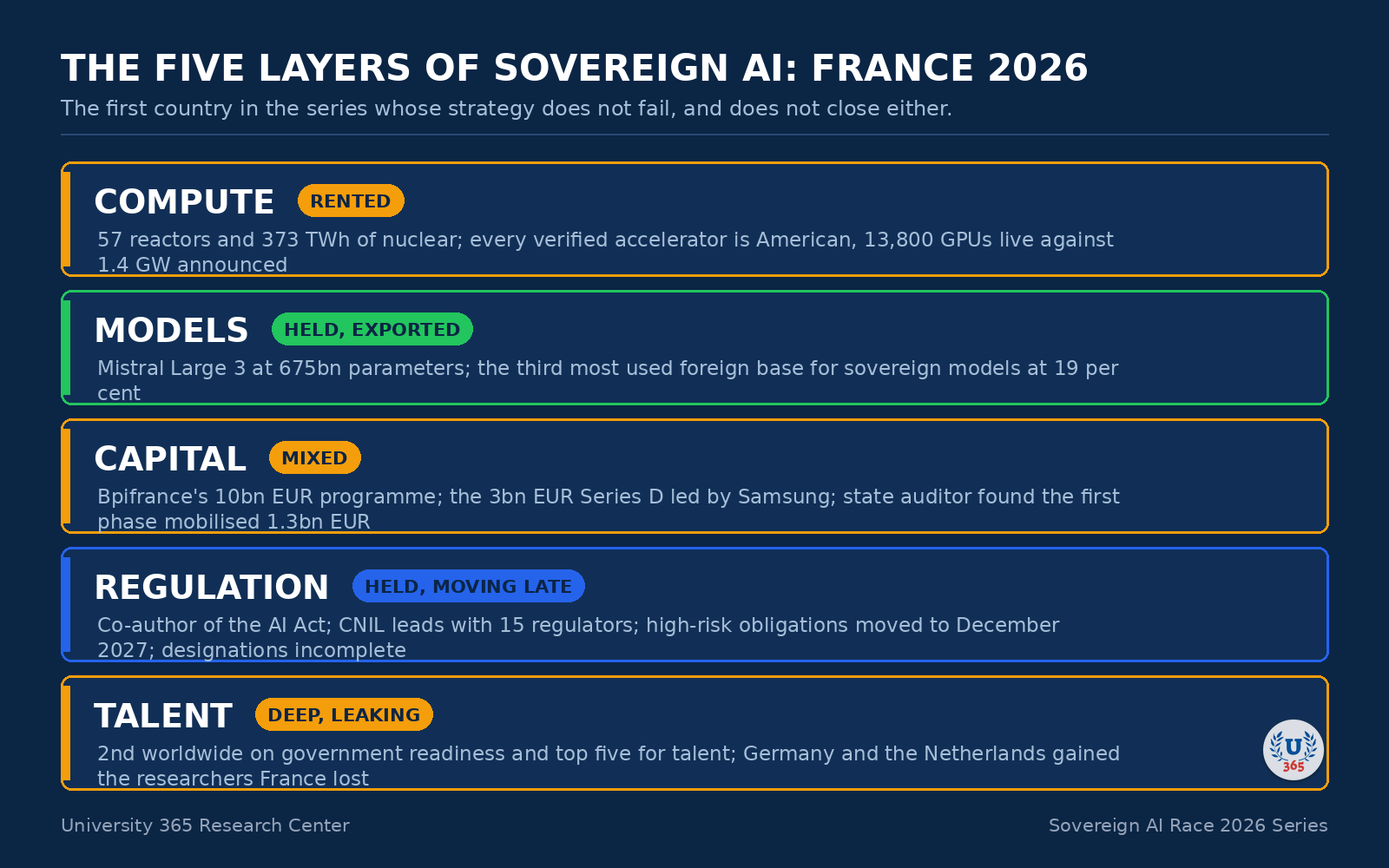
The five layers assessed. The first country in this series whose strategy does not fail, and does not close either. University 365 Research Center.
This is the fifth report in a twenty-part series assessing how states attempt to control the production of artificial intelligence inside their own jurisdiction. The framework is fixed and applied identically to every country. Sovereign AI capacity separates into five layers, and a state can hold any one of them without holding the others.
Compute sovereignty is the physical layer: where the chips and data centres sit, and who may switch them off. Model sovereignty is who builds the models a country depends on, and in whose languages and domains those models are competent. Capital sovereignty is who funds the build-out and on what terms. Regulatory sovereignty is who writes the rules and whether they can be enforced. Talent and education sovereignty is who builds and runs the systems, and how the next generation is prepared.
The four countries examined so far span the extremes. The United Arab Emirates buys what it cannot build and rents its compute on a licence. Saudi Arabia owns capital absolutely and derived its model from a Chinese base. China built everything and pays for it in efficiency. The United States owns everything and sells access on terms it can revoke. France occupies a different position again: it is the first country in the series whose strategy is built on regulatory depth and research excellence rather than scale, and the first whose national champion is genuinely competitive at the model layer while its compute is, in every verified particular, American.
The vocabulary this report needs
Four terms recur, and they are defined here once.
The national programme is the series of French AI strategies launched after the 2018 Villani report, funded through the France 2030 investment plan, and headlined at the February 2025 AI Action Summit in Paris by a stated EUR 109 billion of investment. That figure aggregates private commitments, most of them foreign, and the report treats its composition as carefully as its size.
Mistral AI is the Paris laboratory founded in April 2023, the most valuable technology company in European history by its 2026 funding round, and the model layer's answer to the question this report asks. Its funding, its compute and its licences are examined separately, because they point in different directions.
Sovereign compute, in the French usage, means capacity that sits on French soil and is powered by French electricity, whatever the provenance of the chips inside it. This report distinguishes that from the stricter sense used elsewhere in the series, where sovereignty requires that the chips themselves answer to no foreign licence.
The AI Act is the European Union's Regulation 2024/1689, in force since August 2024 and applying in stages. France is the largest member state, a co-author of the framework, and at the time of writing had not yet completed its own national implementing legislation. The implementation gap is part of this report's subject.

Sovereign AI Race: France (2026)
The Question
Can a country lead on rules and models while renting the machines underneath?
France has made a clear bet, and it is not the bet the other countries in this series made. It does not attempt to manufacture accelerators. It does not outspend anyone. It has instead concentrated its public effort in three places where it is genuinely competitive: the rules that govern the technology across the European Union, a research and talent base that ranks in the global top five on several independent measures, and a national champion at the model layer that other countries now build on.
The results are real and measurable. France ranks second worldwide and first in Europe on the Oxford Insights Government AI Readiness Index 2025. Its national laboratory raised three billion euros in September 2026 at a valuation above twenty-one billion, the largest equity round in European technology history. Its high-performance computing base was quadrupled with a forty million euro investment and its first exascale machine arrives in 2026. Its electricity system runs on fifty-seven nuclear reactors that produced 373 terawatt hours in 2025, the highest output in six years, and that is the cheapest foundation for data centres in Europe.
Underneath all of it sits one fact that reframes the achievement, and this report puts it where the series can test it rather than in a footnote. Every verified compute number for Mistral is an NVIDIA number. The Essonne cluster being energised in 2026 runs 13,800 NVIDIA GB300 processors financed by an 830 million dollar debt facility from seven banks. The 1.4 gigawatt campus near Paris is a joint venture with MGX of Abu Dhabi and NVIDIA. Counterpoint Research measured the pattern at global scale and found that 92 per cent of sovereign models worldwide are trained on the vendor's chips. France, which writes the rules the technology will live under, trains its champion on processors it cannot make, cannot license and cannot replace.
So the question is whether the combination travels. A country can lead on rules, lead on models and rent the compute. What it cannot do is control all three at once, and the choice of which to hold is the strategic decision this series is ultimately about.

Sovereign AI Race: France (2026)
The Contradiction
The country that writes the rules rents the machines that run under them

Paris, home of the AI Action Summit, the densest frontier-model research concentration in continental Europe, and the seat of the regulators who will enforce the AI Act. Photograph free-licensed via Pexels.

The framework is French; the foundation under it is imported. University 365 Research Center.
Here is the paradox, stated as plainly as the evidence allows.
France's regulatory position is the strongest in the series. It co-authored the AI Act, the first comprehensive AI statute in the world, it hosts the regulators who will enforce it, and its domestic authorities, led by the data protection commission with fifteen sectoral regulators alongside, are being positioned to supervise the largest AI market outside the United States and China. A French laboratory's models are deployed across the French state. The budget ministry stated in August 2026 that sovereign providers will be used and that a specific procurement excludes a leading American laboratory by name.
At the same time, the physical and financial foundations of the French position are imported. The champion's capital in September 2026 came from Samsung Electronics of South Korea in the lead, after a 2025 round led by ASML of the Netherlands, in a company whose earlier investors include American venture funds. The 1.4 gigawatt campus near Paris is a joint venture with the Abu Dhabi fund MGX. Of the 109 billion euros headlined at the Paris summit, the largest shares are Brookfield of Canada and commitments from the United Arab Emirates, and the Cour des comptes, the national audit institution, found in its November 2025 report that the first phase of the strategy mobilised 1.3 billion euros with complex governance and inadequate budgetary monitoring. The country that regulates on behalf of a continent funds its own champion from three other continents.
That is not a scandal and it is not unique to France. Capital moves to opportunity, and the French opportunity is real. But it produces a specific structural fact the series has not encountered before: a country whose regulatory sovereignty is maximal, whose model sovereignty is genuine, and whose compute and capital sovereignty are rented from allies. The four earlier reports described countries that bought or built their dependencies. France regulated them, and depends on them anyway.
The second tension is internal to the strategy. The AI Act's high-risk obligations were originally scheduled for August 2026. Under the simplification package agreed provisionally in May 2026, they move to December 2027, a sixteen-month delay, passed by the European Parliament by 569 votes to 45. France is a member state of the Union whose parliament adopted this delay while its own national designations of competent authorities remain incomplete. A country can legislate ambition faster than it can staff enforcement, and the gap between the two is where sovereign capability either arrives or does not.

Sovereign AI Race: France (2026)
The Current State
Compute: nuclear power and American silicon
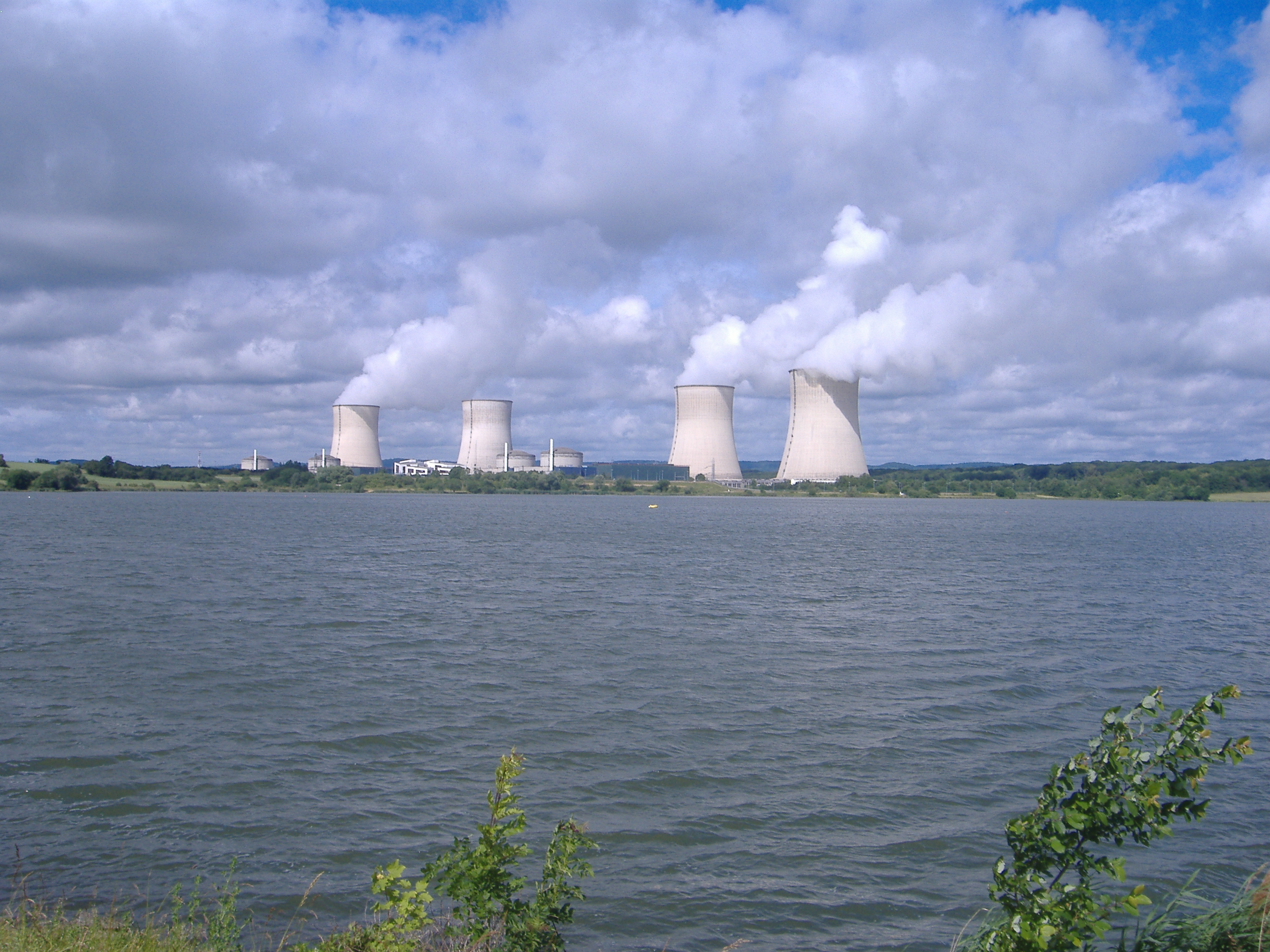
The Cattenom plant, one of the 19 sites where EDF operates 57 reactors. The French nuclear fleet produced 373 terawatt hours in 2025, the highest in six years. Photograph: Bassaar, CC BY-SA 3.0, via Wikimedia Commons.
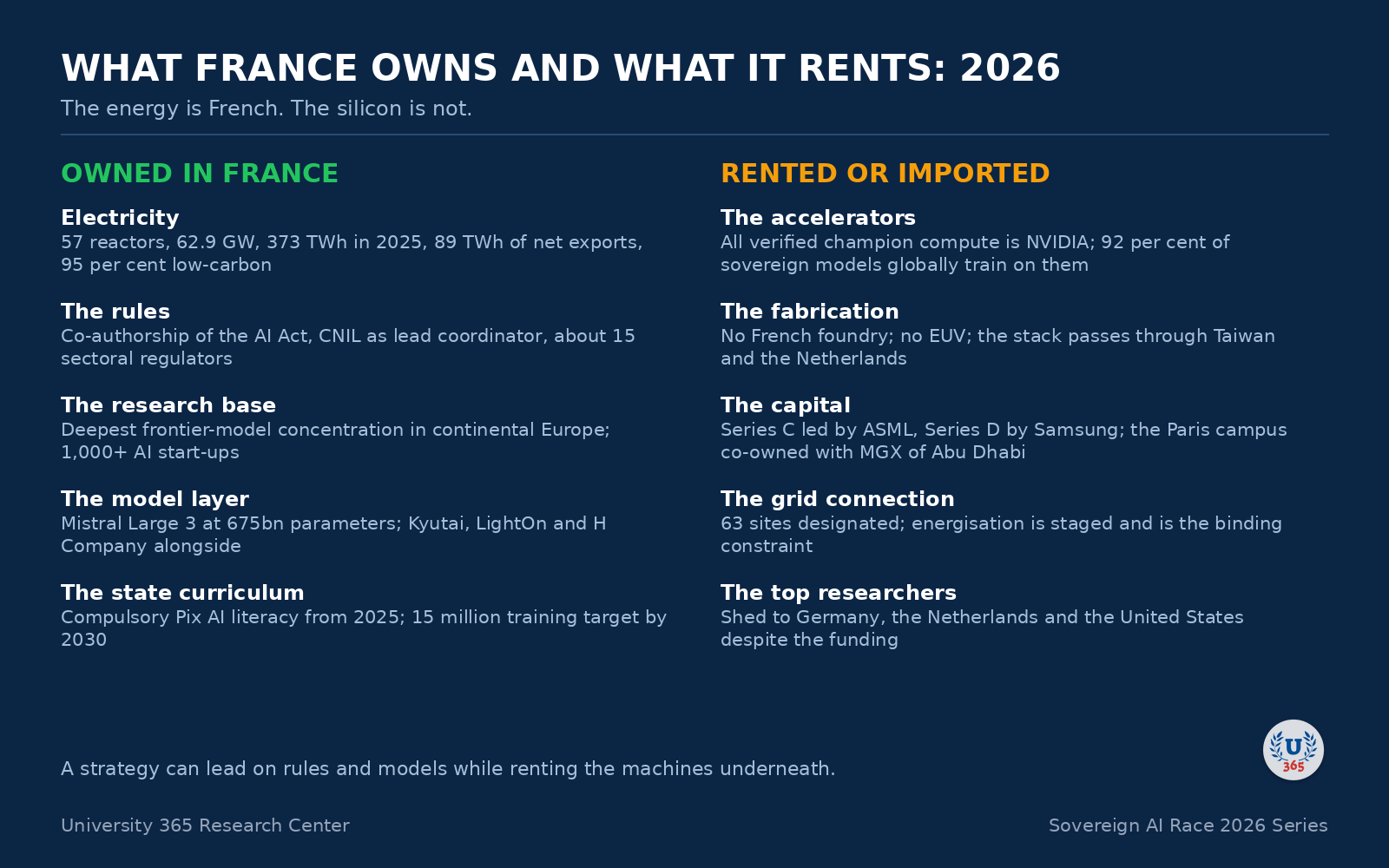
What France owns and what it rents. The energy is French; the silicon is not. University 365 Research Center.
France's compute position has two halves that do not come from the same place, and the distinction runs through everything else in the report.
The first half is electricity. EDF operates 57 reactors across 19 plants with 62.9 gigawatts of installed nuclear capacity, producing nearly three quarters of national electricity. In 2025 the fleet generated 373 terawatt hours, the highest in six years, and France was the largest net exporter of power in the European Union at 89 terawatt hours. The government's own framing, restated by President Macron in March 2026, is that France can open data centres and meet the demands of artificial intelligence because of its energy position. That is not a claim; it is a balance sheet, and it is the single strongest structural asset any country in this series holds for AI.
The second half is accelerators, and none of them are French. The national programme counts 63 turnkey data centre sites designated for development, 35 at the February 2025 summit and 28 more in November 2025, with Hauts-de-France hosting the most of any region. The flagship private project is Brookfield's EUR 10 billion commitment confirmed at Choose France in May 2025, to be built by Data4 at the E-Valley site near Cambrai with a target capacity of one gigawatt, spread over five to ten years. At the June 2026 Choose France summit, foreign investment pledges reached a record EUR 93 billion across 71 projects, led by SoftBank's initial EUR 45 billion toward a stated EUR 75 billion and up to 5 gigawatts of AI data centre capacity. And in the public sector, the state's own resources advanced: the fourth extension of the Jean Zay supercomputer, financed with EUR 40 million, quadrupled its AI capacity to 125.9 petaflops upon inauguration in May 2025, and the EuroHPC exascale machine Alice Recoque arrives in 2026 as the second European system of its class, with order value reported at EUR 387.8 million to Bull, the largest contract in the company's history.
The distinction between announced and operating capacity, which this series applies everywhere, is unusually sharp here. Mistral's own first datacentre, announced in 2025 to open that summer with 18,000 processors, slipped, changed its processor generation, and is now described as operational in the second quarter of 2026 with 13,800 GB300 units and 44 megawatts of powered capacity. The 1.4 gigawatt Fouju campus near Paris, a joint venture of MGX, Bpifrance, Mistral and NVIDIA announced in May 2025, has construction expected in the second half of 2026 and operations by 2028; independent analysis has noted that its megawatt figures describe staged grid-connection tranches rather than an accepted single connection, and that analysis is treated here as a single source. The announced pipeline is large, the energised capacity is smaller, and the difference is the interval in which nothing runs.
Capital: a state bank, a foreign round, and an audit
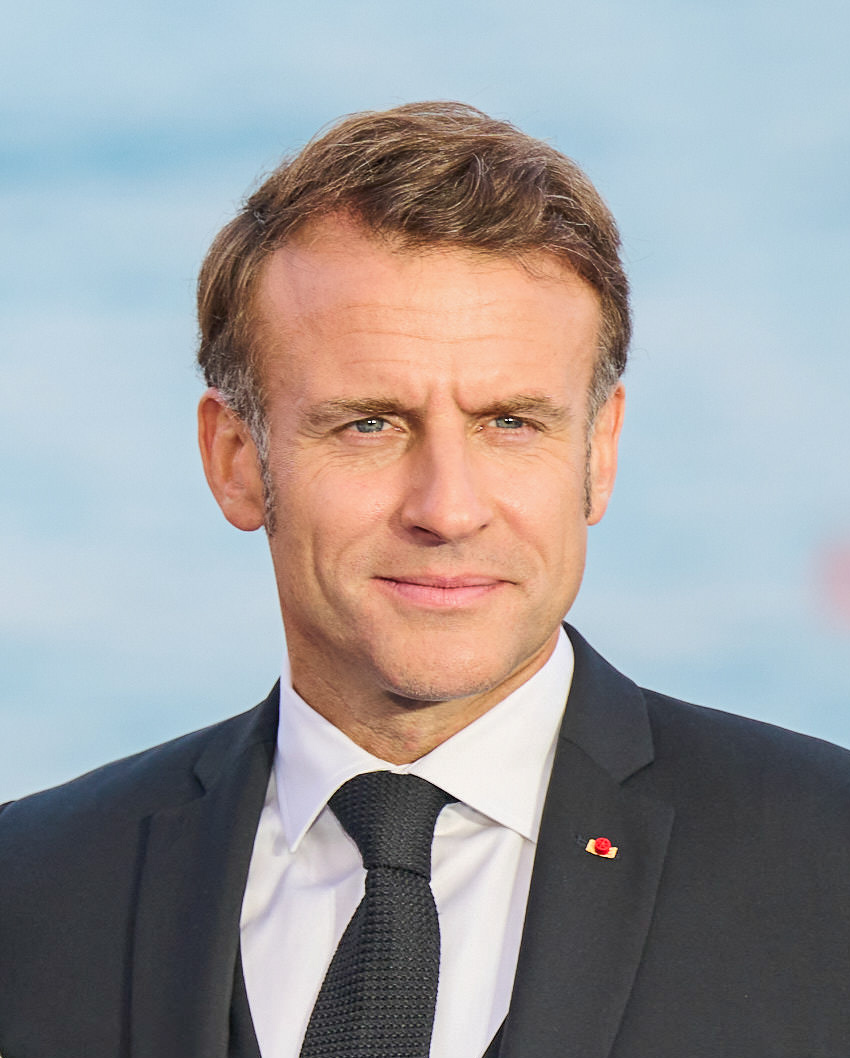
Emmanuel Macron, President of the French Republic, as of 2026. He announced the EUR 109 billion AI investment programme at the Paris AI Action Summit in February 2025 and set the nuclear-for-AI framing in March 2026. Photograph: European Commission, CC BY 4.0, via Wikimedia Commons.
The capital layer tells the same story in money.
French public capital is organised around Bpifrance, the state investment bank, which committed EUR 10 billion to the sector by 2029. It appears in every major transaction: an equity investor in Mistral's 2025 round, a lender in the 2026 debt facility, a joint venture partner in the Fouju campus, and an internal adopter that put the champion's assistant in front of all 4,000 of its employees. A further EUR 2.5 billion third phase of the national strategy is reported through the France 2030 plan, and the EuroHPC programme records public investment of 2.8 billion euros since the strategy's 2018 launch.
The private capital, however, is foreign in its leadership. Mistral's Series C in September 2025 raised EUR 1.7 billion at a EUR 11.7 billion valuation led by ASML of the Netherlands. Its Series D in September 2026 raised EUR 3 billion at more than EUR 21 billion, led by Samsung Electronics of South Korea. Both figures are company announcements carried by independent reporting, and both are correct as stated: this report corrects an early internal baseline that recorded the Series C at EUR 1.5 billion and EUR 15 billion, which matches one investor's individual commitment rather than the round.
The audit position is the part of the French record the series most respects, because it is self-imposed. The Cour des comptes published a thematic report on the national AI strategy in November 2025 finding that the first phase mobilised EUR 1.3 billion, not the EUR 1.5 billion headline, with complex governance and inadequate budgetary monitoring. A separate tracker of the France 2030 plan found that commitment rates are strong while actual transfers of funds lag. Countries in this series have announced capacity, and France counted its own money.
Models: the strongest claim in Europe, and its licences

Paris at twilight. Photograph free-licensed via Pexels.
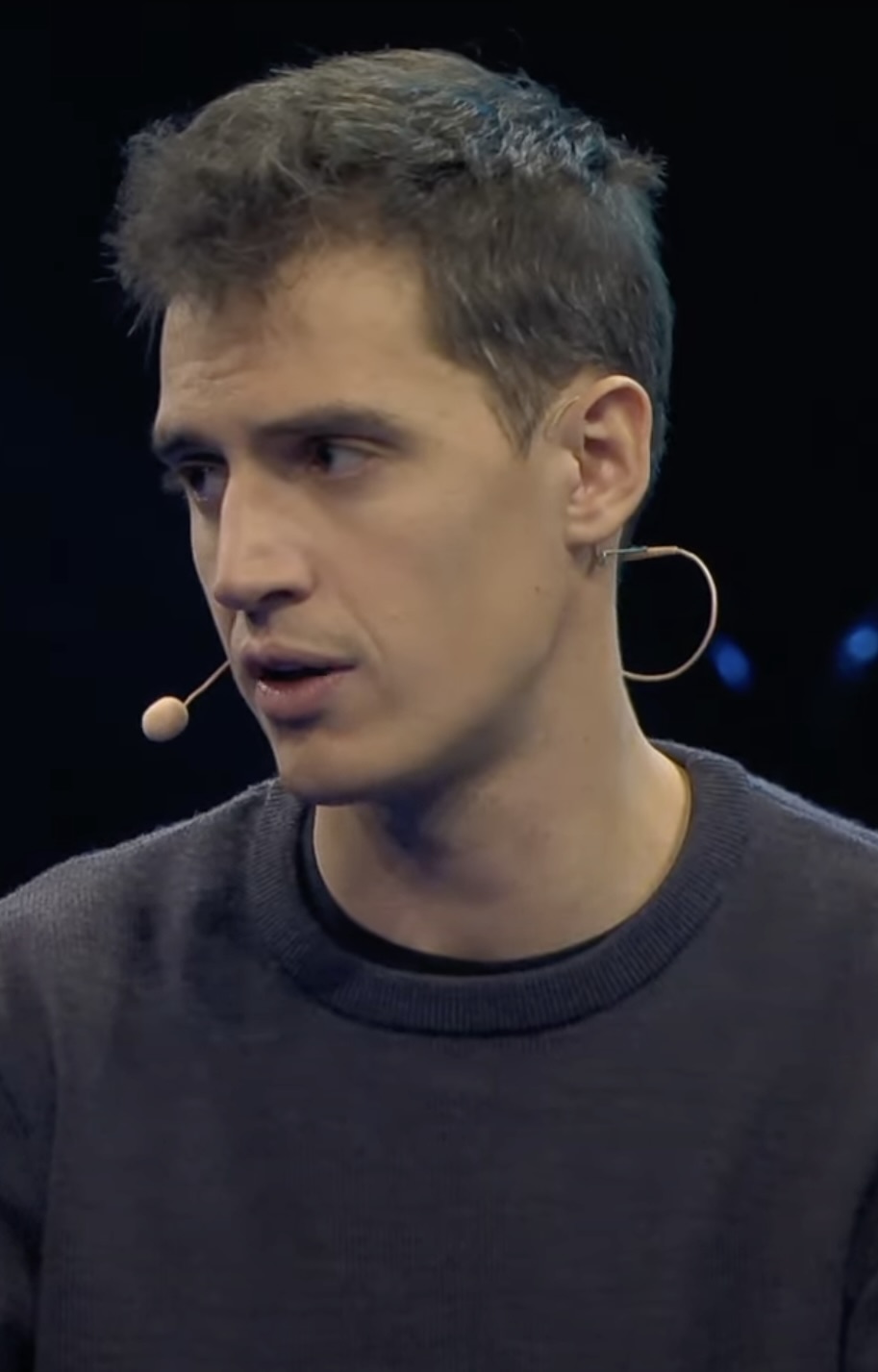
Arthur Mensch, co-founder and chief executive of Mistral AI, as of 2026. The laboratory he co-founded in April 2023 is the third most used foreign base for sovereign models worldwide. Photograph: Slush, CC BY 4.0, via Wikimedia Commons.
The model layer is where France's claim is strongest and where the series' tests bite hardest.
Mistral's flagship is Mistral Large 3, released in December 2025, a mixture-of-experts model with 675 billion total parameters and 41 billion active. The company also maintains the Medium, Small and Ministral lines, Codestral and Devstral for code, the OCR and Voxtral models for document and speech work, and the Magistral reasoning line. Its assistant, renamed Mistral Vibe in 2026, has been deployed into the French state: a partnership with the Ministry of Digital Transition announced on 24 April 2026 to equip 10,000 civil servants with a stated goal of reaching the country's 5.7 million public servants, and a separate agreement with the Caisse des Dépôts covering 100,000 public-sector workers. The revenue trajectory, per Financial Times reporting in September 2026, is a run rate above 400 million dollars against a company target of more than one billion.
Two qualifications travel with the claim, and this series states them because the China report established the distinction. First, the openness of the frontier releases is not fully verified in this research window: secondary sources describe Mistral Large 3 and Mistral Small 4 as shipping under the Apache 2.0 licence, and the claim should be read as reported pending the model card, because it is the difference between publishing weights and conducting business. Second, Mistral is itself a base other countries build on: Counterpoint Research records it as the third most used foreign base for adapted sovereign models worldwide at 19 per cent, behind Meta's Llama at 38 and Alibaba's Qwen at 20, with a documented foothold in the Middle East through partnerships including G42. France exports influence through the same open-weights channel this series documented in China, at a fraction of the scale and with a genuine licence attached.
The other French laboratories matter to the depth claim. Kyutai, the non-profit open-science lab funded at about EUR 300 million over five years, open-sourced Moshi, a full-duplex speech model, in September 2024. LightOn lists on Euronext and sells sovereign deployment to the public sector. H Company builds agentic models. The research base beneath them is the deepest in Europe: Paris concentrates the laboratories of Mistral, Hugging Face and Kyutai alongside the Paris research sites of Google DeepMind and Meta, a density of expertise unmatched by any European city outside London.
Regulation: the strongest framework in the world, applied late
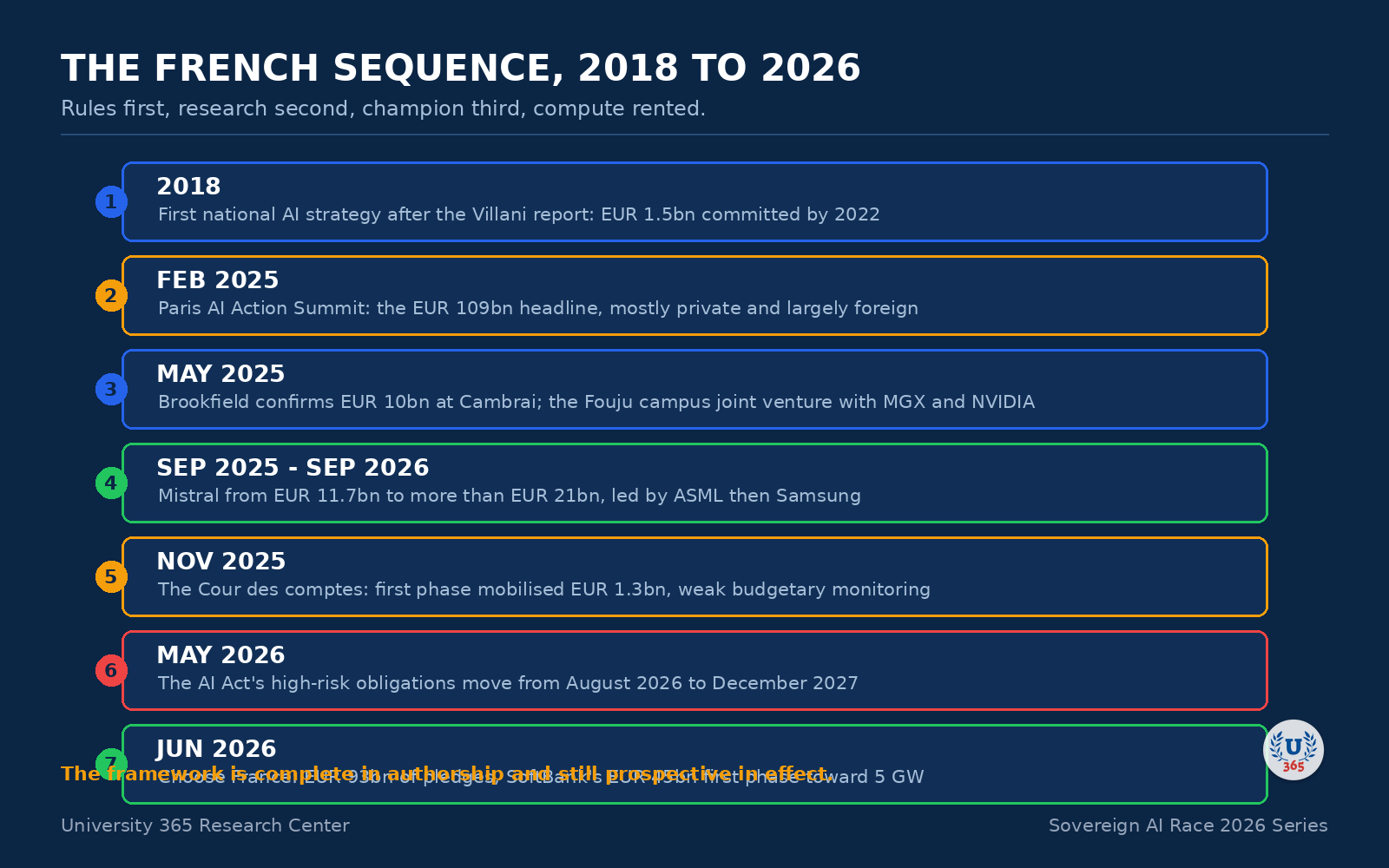
The French sequence. Rules first, research second, champion third, compute rented. University 365 Research Center.
The regulatory layer is France's clearest hold and its clearest delay.
The AI Act entered into force on 1 August 2024 and applies in stages: prohibitions from February 2025, general-purpose model obligations and the designation of competent authorities from August 2025, and high-risk obligations originally from August 2026. France adopted a multi-authority model for implementation, with the CNIL as lead coordinator, competences spread across roughly fifteen sectoral regulators, and ANSSI holding the cybersecurity remit. The implementing legislation that would formally name every authority was still pending, and sources conflict on aspects of the designation.
The instrument then moved. The European Commission proposed a Digital Omnibus in November 2025 to simplify implementation. The European Parliament adopted its position on 26 March 2026 by 569 votes to 45, adding a ban on nudification applications alongside the simplification measures, and on 7 May 2026 the Parliament and Council reached a provisional agreement moving high-risk compliance from 2 August 2026 to 2 December 2027. The delay is sixteen months, and it is the first time in this series that a jurisdictional framework's own timetable moved after enactment. France welcomed the Act at adoption; a formally stated French government position on the simplification was not verified in this research; industry bodies argued publicly for adjustment.
France also builds its own instruments. INESIA, the national institute for AI evaluation and security, was created in January 2025 alongside the international network of safety institutes. The Senate adopted a text in April 2026 on the presumption of use of cultural content by AI providers, a copyright-protection move. And in June 2026 the government announced seven measures for AI deployment across the state. The pattern is a country legislating in several instruments at once, on a framework it co-authored, while its designation of enforcers remains incomplete.
Talent and education: top five in the world, and still losing people
The talent layer is where France's bet is most clearly placed and where the evidence is most mixed.
France ranks in the global top five for talent and adoption on the Stanford AI Index 2026 while remaining, on that index's own reading, second tier behind the United States and China in models, funding and scale. It ranks second worldwide and first in Europe on the Oxford Insights government readiness index. Its university system produces the founders of its champion: Mistral was founded in April 2023 by Arthur Mensch, Guillaume Lample and Timothée Lacroix, who met at the École polytechnique, and the laboratory's 1,000 staff represent the densest frontier-model concentration in continental Europe.
The outflow continues. A European study of research migration found Germany and the Netherlands attracting AI researchers while France shed them. Stanford's index records that researchers and developers moving to the United States fell 89 per cent since 2017 even as that country remains the largest holder of AI talent. France's policy response is the most systematic in the series: a compulsory AI literacy module on the national Pix platform for secondary pupils from the 2025 school year, a stated plan for a mandatory weekly AI class for tenth-graders from autumn 2027, the Osez l'IA programme targeting 15 million people trained by 2030, a stated ambition to lift AI-trained graduates from 40,000 to 100,000 a year, and an EUR 80 million labour ministry plan announced on 23 September 2026 to help workers and small firms adapt. INSEE records that 18 per cent of French businesses used AI, which is the adoption figure the skills push exists to move.
Several of these figures are reported from secondary sources and are labelled as such in the methodology; the direction of the policy is documented in official French sources, and the direction is what this report relies on.
What changed since our 2025 report on France
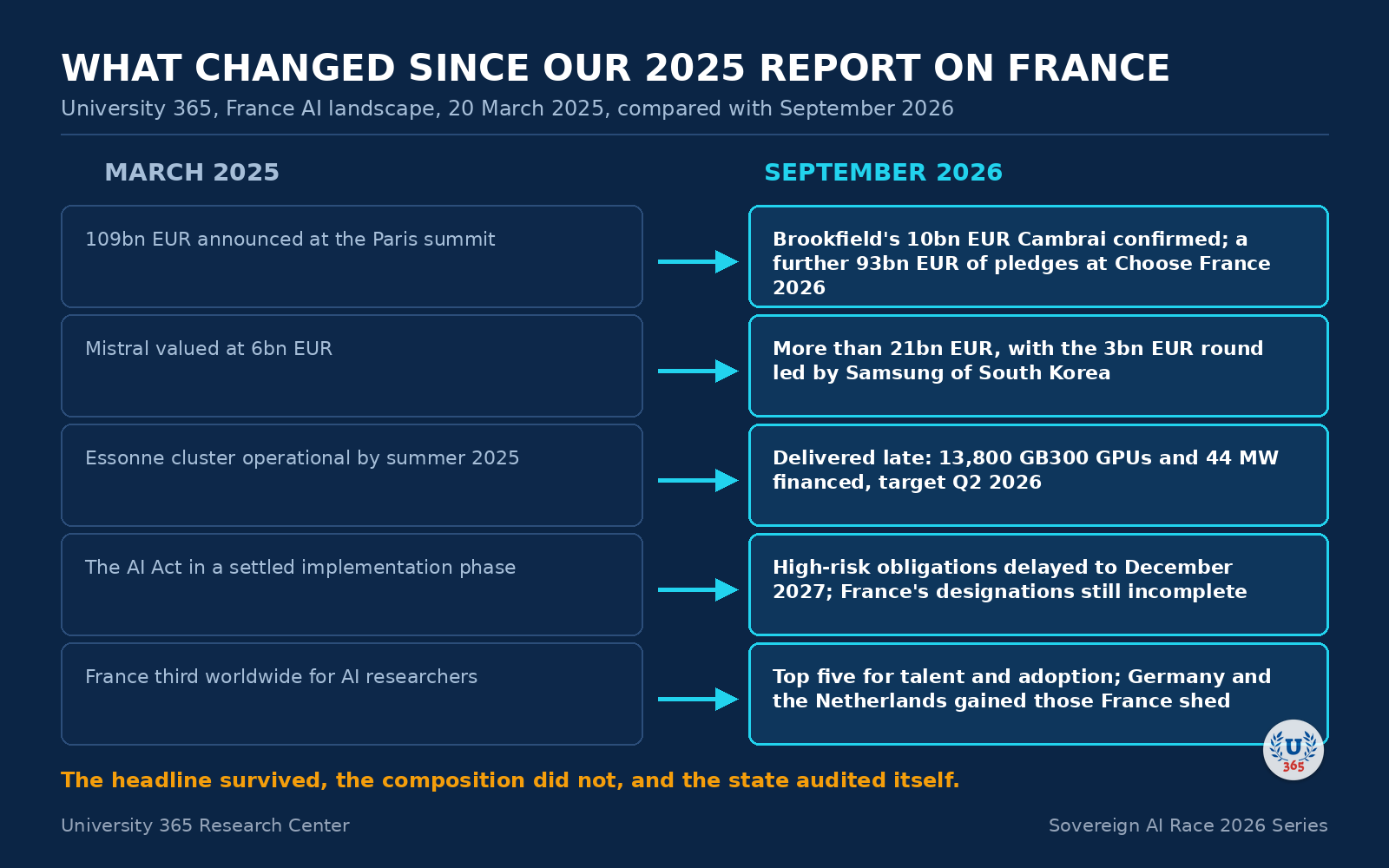
What changed since our March 2025 report on France. University 365 Research Center.
Read the earlier report: France's AI Landscape in March 2025 - From Historical Pioneers to Global Leadership. University 365 INSIDE, 20 March 2025.
University 365 published "France's AI Landscape in March 2025: From Historical Pioneers to Global Leadership" on 20 March 2025, written in the aftermath of the Paris AI Action Summit. The interval has moved the strategy from announcement to accounting, and the comparison is instructive in both directions.
The headline figure survived, the composition did not. The 2025 report recorded the EUR 109 billion announced at the summit, including EUR 50 billion associated with the United Arab Emirates, EUR 20 billion from Brookfield and EUR 10 billion from Bpifrance. The position in September 2026 is that the largest confirmed project, Brookfield's Cambrai campus, carries EUR 10 billion confirmed at Choose France in May 2025 inside a EUR 20 billion France-wide envelope, delivered over five to ten years, and that a fresh wave of commitments at Choose France in June 2026 reached EUR 93 billion across 71 projects led by SoftBank. The 2025 report described a headline. The 2026 position is a pipeline with named builders and dates.
The champion tripled and went abroad for capital. The 2025 report recorded Mistral as valued at EUR 6 billion. The verified trajectory since is EUR 11.7 billion post-money in September 2025 with ASML leading, and more than EUR 21 billion in September 2026 with Samsung leading the EUR 3 billion round. The valuation multiplied more than threefold, and the strategic investors are Dutch and Korean.
The cluster went from projection to delivered hardware, late. The 2025 report said Mistral's Essonne cluster would be operational by summer 2025. It was delayed, changed processor generation, and is now 13,800 GB300 units and 44 megawatts financed by 830 million dollars of debt, targeted for the second quarter of 2026, inside a stated objective of 200 megawatts across Europe by the end of 2027. The projection was directionally right and the schedule was wrong, which is the normal shape of compute announcements in this series.
The regulation became a moving target. The 2025 report treated the AI Act as a settled implementation phase. It has since been amended before its high-risk provisions took effect, with the deadline moved from August 2026 to December 2027, and France's own designations remain incomplete. The 2025 report described a country writing rules. The 2026 position is a country watching its own rules move.
The state audited itself. The Cour des comptes report of November 2025 found 1.3 billion euros mobilised in the first phase with inadequate budgetary monitoring. No prior report in this series has had that evidence available, and the report records it as a strength of the French system rather than a criticism of the strategy.

Sovereign AI Race: France (2026)
Key Findings
1. France is the depth case in the series, and depth is real. Second worldwide and first in Europe on government AI readiness, the third strongest model layer in the Western world, the densest research base in continental Europe, and the cheapest large-scale electricity in the group. Nothing in this report disputes the capability.
2. The compute is rented, completely. Every verified compute figure for the national champion is an NVIDIA figure: 18,000 systems in the 2025 announcement, 13,800 GB300 units in the financed build, the Fouju campus a joint venture with NVIDIA and MGX. Counterpoint Research puts the global pattern at 92 per cent of sovereign models trained on that vendor's chips. France has no accelerator industry and no announced plan for one.
3. The capital is led from abroad. The EUR 3 billion round of September 2026 was led by Samsung of South Korea, the 2025 round by ASML of the Netherlands, and the Paris campus is co-owned with Abu Dhabi's MGX. Public capital, through Bpifrance and the EUR 2.5 billion third phase, is substantial and is a minority of the whole.
4. The regulation moved later, and France's enforcement is not yet staffed. The AI Act's high-risk obligations moved from August 2026 to December 2027 by provisional agreement, passed 569 to 45 in the Parliament. France's implementing law and authority designations remain incomplete. A framework that applies late is a framework whose effects are still prospective.
5. The state's own auditor is a strength. The Cour des comptes found the first phase mobilised EUR 1.3 billion, below its headline, with weak budgetary monitoring. France counts its programme publicly, which few countries in this series do.
6. The energy position is the most underrated asset in the report. Fifty-seven reactors, 62.9 gigawatts, 373 terawatt hours in 2025, 89 terawatt hours of net exports, and 95 per cent low-carbon electricity. The binding constraint in the United States is power; in France, power is the endowment.
7. The talent system is broad and still leaking. Compulsory AI literacy from 2025, a stated mandatory class from 2027, 15 million people targeted by 2030, an EUR 80 million labour plan, and a documented outflow of researchers to Germany, the Netherlands and the United States. Depth without retention is a laboratory, not an industry.
8. The champion is now an exporter of influence. Counterpoint records Mistral as the third most used foreign base for adapted sovereign models worldwide at 19 per cent share. France's model layer travels; its hardware layer does not exist.
9. The bet is coherent and this report states it as such. France decided its comparative advantage is rules, research and models, and that compute and capital can be bought from allies. The bet has worked on its own terms. The open question is what happens on the day an ally's licence changes.

Sovereign AI Race: France (2026)
Deep Analysis
Why the French bet is rational, and what makes it fragile
France's strategy looks inconsistent from the outside, because it leads on rules while renting the machines those rules apply to. Examined as a portfolio, it is coherent.
No European country can match American or Chinese capital at the compute layer. The French nuclear advantage changes the operating economics of a data centre, not the price of the accelerators inside it, and every accelerator comes from an American designer fabricated in Taiwan. A strategy that tried to compete at the compute layer would spend ten years and tens of billions to arrive where the United States already is, which is roughly what the European processor initiatives have demonstrated so far. France instead bought compute from the market, at market prices, with market finance, and put its public money where its returns are distinctive: the model layer, through Bpifrance's equity and lending; the research layer, through the clusters and the supercomputers; and the rules, through the AI Act.
That portfolio logic has a precise danger, and the series can now name it. The day a licence changes, the compute stops. This is not hypothetical in 2026: the same American administration that rescinded the diffusion rule also moved H200-class exports to case-by-case review, imposed a 25 per cent tariff on the same chips, and demonstrated with allied safety institutes that frontier access can be sequenced as a national security asset. France's compute strategy depends on a supply chain whose licensing is decided in Washington, and nothing in the French programme changes that. The MIT-licensed weights of Mistral's models would survive such a day; the machines that serve them at scale would not.
The regulation-first strategy, tested against the record
France's regulatory leadership has produced the most complete AI governance framework in the world, and the interval since the Paris summit has tested it in three ways.
The first test is timing. The high-risk obligations of the AI Act moved by sixteen months, before they took effect, in a simplification package whose political logic was that European industry needed room. A framework can be amended for good reasons and still transmit a signal: businesses planning compliance in 2026 learned that the schedule is negotiable, and the enforcement date is now a political variable rather than a legal fact.
The second test is enforcement capacity. France's multi-authority model distributes responsibility across roughly fifteen regulators without a single new agency, and its designation instrument remained incomplete at the time of this research. The contrast with the United States is instructive: Washington also has no federal statute, but its export control regime runs through a single bureau with staff and a Federal Register. France has a statute and no complete regulator. Both countries, from opposite directions, have produced frameworks whose enforcement is thinner than their texts.
The third test is the procurement turn. The August 2026 statement excluding a named American laboratory from a specific procurement, in the aftermath of a breach affecting 678,000 taxpayers, is the strongest sovereign-preference signal any European state has sent. Whether it hardens into a general rule was not verified. What is verified is that a state with 5.7 million public servants and a domestic champion at the model layer has both the motive and the instrument to route its own demand to its own supplier, and that this is the policy lever France holds which no other country in this series except China and the United States can pull at scale.
The comparison this series is now able to make
Five countries in, a pattern has hardened, and France sharpens it. The countries that hold their compute built it under sanctions or bought it on a licence. The countries that hold their models either trained them or derived them. The countries that hold their capital either own it or attract it. France holds its models and its rules, rents its compute, and attracts foreign capital on terms it does not set. Its bet is the most intelligent reading of a European position, and it is still, at the layer where the switches live, a bet on allies.
The series will test that bet sixteen more times. For now the honest statement is this: France is the first country examined whose strategy does not fail. It also does not close.

Sovereign AI Race: France (2026)
Data and Evidence
Table 1: The five layers, assessed for France in September 2026
Layer | What France holds | What it does not hold | Assessment |
Compute | 57 reactors, 62.9 GW nuclear, 373 TWh in 2025 and 89 TWh of net exports; 63 designated data centre sites; Brookfield's EUR 10bn Cambrai campus; SoftBank's EUR 45bn first phase toward 5 GW; Jean Zay at 125.9 petaflops; Alice Recoque exascale arriving in 2026 | Any domestic accelerator; any domestic fabrication; compute that survives a foreign licence change; the announced pipeline energised (13,800 GPUs and 44 MW live against more than 1.4 GW announced) | Rented, on the best energy position in the series |
Models | Mistral Large 3 (675bn parameters, 41bn active); the Medium, Small, Ministral, Codestral, Devstral and Magistral lines; Kyutai's open-sourced Moshi; LightOn; H Company; deployment across the French state | Verified confirmation of the frontier licence terms (Apache 2.0 reported, not confirmed in this pass); a base-model lead over the American and Chinese frontier; scale in compute to train the next generation | Held, and exported as a base |
Capital | Bpifrance's EUR 10bn commitment to 2029; a reported EUR 2.5bn third phase; EUR 2.8bn of recorded public investment since 2018; the EUR 3bn Series D and EUR 1.7bn Series C | Domestic leadership of the champion's rounds (Samsung and ASML led them); control of the terms on which foreign capital arrives | Mixed, and audited by the state's own court |
Regulation | Co-authorship of the AI Act; CNIL as lead coordinator with about 15 sectoral regulators; INESIA since January 2025; a Senate copyright text; seven state AI measures in June 2026 | A completed national implementing law; finished designations; the original timetable (high-risk obligations moved to December 2027) | Held, and moving later |
Talent and education | 2nd worldwide and 1st in Europe on government readiness; global top five for talent and adoption on the Stanford index; over 1,000 AI start-ups; Paris as the densest frontier-model concentration in continental Europe; compulsory Pix AI module since 2025; EUR 80m labour plan | Retention (Germany and the Netherlands gained researchers while France shed them); scale in models, funding and scale indicators, where the Stanford index reads France as second tier | Broad, deep, and leaking |
Table 2: The controlled metrics, series bible format
Metric | France position | Source and date | |
Flagship compute commitment | EUR 109bn headlined at the February 2025 Paris summit, mostly private and largely foreign in composition; Brookfield's EUR 10bn Cambrai campus at 1 GW targeted over 5 to 10 years; SoftBank's EUR 45bn initial toward EUR 75bn and up to 5 GW; 63 designated sites; Jean Zay at 125.9 petaflops and Alice Recoque exascale in 2026 | Reuters, 9 February 2025; Brookfield via GlobeNewswire, 10 February 2025; France 3 Hauts-de-France, 2025; Sifted, June 2026; CNRS via Science | Business, 2025 |
Capital committed | Bpifrance EUR 10bn to 2029; EUR 2.5bn third phase reported; EUR 2.8bn public investment since 2018; Mistral's EUR 1.7bn Series C at EUR 11.7bn and EUR 3bn Series D at more than EUR 21bn, led by ASML and Samsung respectively | TechCrunch, 7 February 2025; EuroHPC JU France page; Mistral AI, 9 September 2025; Quartz, 8 September 2026 | |
Flagship national models | Mistral Large 3, December 2025, 675bn total parameters with 41bn active; the Medium, Small, Ministral, Codestral, Devstral, Magistral, OCR and Voxtral lines; Kyutai's Moshi open-sourced September 2024; LightOn sovereign public-sector deployments | Company releases and model documentation as compiled, 2025 to 2026; Kyutai, 2024 | |
Anchor entities | Mistral AI, Bpifrance, CNIL, INESIA, GENCI, CEA, CNRS, Kyutai, EDF as the power anchor; the France 2030 secretariat | Official and institutional disclosures, 2024 to 2026 | |
Chip dependency | Complete at the accelerator layer: all verified champion compute is NVIDIA (18,000 units announced in 2025; 13,800 GB300 financed in 2026); the Fouju campus is a joint venture with NVIDIA and MGX; no domestic accelerator programme. Globally, 92 per cent of sovereign models trained on NVIDIA | NVIDIA Newsroom, June 2025; Data Center Dynamics and The Next Web, March 2026; Ecole Polytechnique, May 2025; Counterpoint Research, 5 August 2026 | |
Regulatory instrument | EU AI Act (Regulation 2024/1689), in force August 2024, applying in stages; high-risk obligations moved from 2 August 2026 to 2 December 2027 by provisional agreement of 7 May 2026; CNIL as lead coordinator; national implementing law and designations incomplete as of August 2026; INESIA since January 2025 | European Parliament, 26 March 2026; Commission proposal COM(2025) 836; French implementation sources, 2026 | |
Talent anchors | Oxford Insights Government AI Readiness 2025: 2nd worldwide and 1st in Europe. Stanford AI Index 2026: global top five for talent and adoption, second tier overall. Over 1,000 AI start-ups including 16 unicorns. Compulsory Pix AI literacy module from the 2025 school year; Osez l'IA targeting 15 million trained by 2030 (reported); EUR 80m labour ministry plan, September 2026 | Oxford Insights, 2 March 2026; Stanford HAI via French Tech Journal, 15 April 2026; RFI, 23 September 2026 | |
Independent index standing | Government AI Readiness Index 2025: 2nd worldwide, 1st in Europe. Counterpoint Sovereign AI LLM Index H1 2026: Western Europe among the most mature, 59 per cent of the region's sovereign models being foundation models with Mistral the leading developer; Mistral the third most used foreign base globally at 19 per cent of adapted models | Oxford Insights, 2025; Counterpoint Research, 21 September 2026 | |
Adoption | INSEE: 18 per cent of French businesses used AI (2026, cited by RFI). Mistral deployed to 10,000 civil servants with a stated goal of 5.7 million; 100,000 public-sector workers through the Caisse des Dépôts; Bpifrance's 4,000 employees | RFI, 23 September 2026; Mistral AI and institutional announcements, 2026 | |
Distinguishing mechanism | Regulatory depth plus a genuine model champion, on rented compute and foreign-led capital | This report | |
Core tension | Writes the rules for a continent and rents the machines that execute them | This report |
Table 3: Timeline, 2018 to 2026
Date | Event | Source | |
2018 | First national AI strategy launched after the Villani report; EUR 1.5bn committed by 2022 | European Commission AI Watch; Cour des comptes, 2025 | |
April 2023 | Mistral AI founded in Paris by Arthur Mensch, Guillaume Lample and Timothée Lacroix | Company record as compiled, 2023 | |
December 2023 | Mistral's EUR 385m Series A led by a16z; Mixtral 8x7B released | Reuters, 11 December 2023 | |
1 August 2024 | EU AI Act enters into force | French government service-public portal | |
September 2024 | Kyutai open-sources Moshi, a full-duplex speech model | Kyutai via compiled sources, 2024 | |
January 2025 | INESIA, the national institute for AI evaluation and security, created | U365 prior report; French government sources | |
10-11 February 2025 | AI Action Summit in Paris, co-chaired with India; EUR 109bn headline announced; EUR 200bn InvestAI announced by the Commission | Reuters, 9 February 2025; European Commission, 2025 | |
7 February 2025 | Bpifrance commits EUR 10bn to the French AI sector by 2029 | TechCrunch, 7 February 2025 | |
13 May 2025 | Jean Zay's fourth extension inaugurated; capacity quadrupled to 125.9 petaflops with EUR 40m | CNRS via Science | Business, 2025 |
19 May 2025 | MGX, Bpifrance, Mistral and NVIDIA announce the Fouju campus joint venture; Brookfield confirms EUR 10bn at Choose France | École Polytechnique, 19 May 2025; France 3 Hauts-de-France, 2025 | |
11 June 2025 | Mistral's 18,000-system NVIDIA compute phase announced | NVIDIA Newsroom, 11 June 2025 | |
1 July 2025 | Osez l'IA plan launched, targeting 15 million people trained by 2030 (reported) | Reported campaign coverage, 2025 | |
September 2025 | Mistral Series C: EUR 1.7bn at EUR 11.7bn, led by ASML | Mistral AI, 9 September 2025; Reuters, 7 September 2025 | |
19 November 2025 | Cour des comptes publishes its report: first phase mobilised EUR 1.3bn with weak budgetary monitoring | Cour des comptes, 19 November 2025 | |
November 2025 | AI Factory France launched; 28 further data centre sites designated | AI Factory France; compiled sources, 2025 | |
December 2025 | Mistral Large 3 released | Compiled model documentation, 2025 | |
January 2026 | French defence framework agreement with Mistral reported; national AI law in progress in the Senate | Reported sources, 2026 | |
March 2026 | Mistral raises USD 830m of debt from seven banks for 13,800 GB300 GPUs and 44 MW at Bruyères-le-Châtel | Data Center Dynamics; The Next Web, 30 March 2026 | |
26 March 2026 | European Parliament adopts its position on the AI Act simplification, 569 to 45 | European Parliament, 26 March 2026 | |
8 April 2026 | Senate adopts the AI copyright text on the presumption of use of cultural content | French Senate, 8 April 2026 | |
24 April 2026 | Ministry of Digital Transition partnership with Mistral to equip 10,000 civil servants | Mistral AI customer page, 2026 | |
7 May 2026 | Provisional agreement moves high-risk AI Act obligations to 2 December 2027 | Council and Parliament agreement as reported, 2026 | |
1 June 2026 | Choose France records EUR 93bn in foreign pledges across 71 projects, led by SoftBank's EUR 45bn first phase | Elysee via Sifted, June 2026; Reuters, 1 June 2026 | |
16 June 2026 | Government announces seven measures for AI deployment across the state | info.gouv.fr, 16 June 2026 | |
18 August 2026 | Budget minister states sovereign providers will be used and a specific procurement excludes a named American laboratory | Reported, August 2026 | |
8 September 2026 | Mistral Series D: EUR 3bn at more than EUR 21bn, led by Samsung Electronics | Quartz, 8 September 2026 | |
23 September 2026 | Labour ministry announces an EUR 80m plan for AI skills; INSEE records 18 per cent business AI use | RFI, 23 September 2026 |

Sovereign AI Race: France (2026)
Implications
For the countries weighing a French-style bet
The French model is the most replicable strategy in this series for a country without scale. Regulate credibly, fund research deeply, buy compute from the market, and anchor one champion at the model layer. The conditions for it are specific and worth stating: a functioning electricity surplus, a research base worth funding, and allies willing to sell you the machines. Countries with the first two and not the third should read the compute section twice.
For the technology providers
France is the clearest test of whether rules and models can be held without compute, and its champion has answered by financing American processors with European debt at scale. The providers should note what the French state has now demonstrated: it will route its own procurement to its own champion, it will name an American laboratory's exclusion publicly, and it will do both while continuing to buy American silicon. The procurement lever is the one asset every state in this series holds, and France is the first in the group to pull it.
For institutional and enterprise buyers
The French position offers a genuine third option between the American stack with its conditions and the Chinese offer without its method: a European model layer, open licences where verified, European data protection rules, and compute on commercial terms. Buyers should price what it does not include: the accelerators are American in every verified case, so the continuity question that applies to the American stack applies to the French one as well, and the honest answer is that sovereignty at the model layer is a different product from sovereignty at the stack.
For the countries in this series
Five reports in, the series can state its emerging finding directly. Money buys compute, models and data centres; it does not buy an accelerator industry or a research base, which take a decade each. France bought everything it could and funded what money cannot buy quickly. The countries still to come, from India to Morocco to Brazil, will face the same menu with less money and less time. The French order of operations, rules first, research second, champion third, compute rented, is the most copyable part of the strategy, and it is also the part whose success cannot be confirmed until the day the licence changes.

Sovereign AI Race: France (2026)
Education and Skills Impact
What the French case teaches about teaching a country rather than a market
This series returns in every report to the gap between using AI and building it, because that gap is where the educational argument lives. France is the first country examined that has attacked the gap systematically from both ends at once, and the results are worth studying separately from the industrial strategy.
At the school end, the intervention is structural rather than optional. From the start of the 2025 school year, an AI literacy module on the Pix platform became compulsory for lower-secondary leavers and for pupils in the seconde and first CAP years, designed with state support under the France 2030 scheme and reaching 1.5 million pupils a year by its own figures. A mandatory weekly AI class is planned for all tenth-graders from autumn 2027. The design choice embedded in this is the one this series has argued for since its first report: the module teaches use and judgement together, in a national curriculum, at the age when both are forming, rather than leaving the acquisition of either to the market.
At the workforce end, the state is both trainer and customer. The Osez l'IA programme targets 15 million people trained by 2030. The labour ministry's EUR 80 million plan of September 2026 addresses workers, jobseekers and small firms, with attention to apprentices and working conditions, which is an unusual and correct focus: the businesses below 30 per cent adoption in France are the ones that will never hire an AI specialist and must be reached through general capability. And the state has made itself the first customer of its own champion, putting the assistant in front of civil servants at a scale no other country in this series has attempted, with a stated goal of 5.7 million public servants.
None of this closes the retention problem, and the report does not pretend it does. Germany and the Netherlands gained researchers while France shed them, and the top of the ladder, the people who build frontier systems, still leaves for the American laboratories. What France has done is something narrower and still important: it is the first country in the series running a national programme to teach an entire generation to judge what a model returns, inside the school system, at the same time as it funds the people who build the models themselves. Every reader anywhere can take the design principle from it. Tool access is a market; judgement is a curriculum; a country needs both, and only one of them can be bought.

Sovereign AI Race: France (2026)
The CI-First Perspective
Where the capability is real, and where the appearance outruns it

A light the continent reads by, powered through a cable that runs elsewhere. University 365 Research Center.
The Co-Intelligence First framework asks whether an arrangement amplifies human capability or substitutes for it, and where the risk of AI Imposture sits. Applied to France, the verdict is the most favourable in the series so far, with three specific qualifications.
The capability is real at the model layer. Mistral's models are downloadable products with measurable benchmarks, deployed in production inside the French state at a scale that can be inspected, and its revenue, reported above a 400 million dollar run rate, is earned rather than announced. The research base beneath it produced the founders and trains the successors. The regulatory capability is real in the same sense that a statute is real: it exists in text that other jurisdictions copy, and its authority is measurable by the degree to which companies outside France restructure to comply with it. The energy layer is the most real thing in the report: terawatt hours delivered, not announced.
The first qualification is the compute. A sovereignty claim that terminates at an American processor is a claim about operations rather than independence, and the French programme has made no secret of it. The risk is not deception but drift: a public that hears "sovereign AI" and pictures independence will not anticipate the day a licence changes, and this report exists so that the day, if it comes, is a known scenario rather than a surprise.
The second qualification is the announced-to-operating interval. A 1.4 gigawatt campus in permitting and a 44 megawatt site energised are both real announcements of different things, and the French record here is no worse than any other country's in the series. The discipline this series applies is simply to hold the two numbers apart, and the French sources themselves do.
The third qualification is the timetable movement. The AI Act's high-risk obligations moved sixteen months before they took effect. Nothing about the framework was fake, and the delay may well be correct policy. But a rule whose deadline is negotiable before first application is a rule whose enforcement has not yet been tested, and the honest CI-First reading is that France's regulatory sovereignty is complete in authorship and prospective in effect.
The verdict: France is the first country in this series with no imposture at the centre of its strategy. Its constraint is arithmetic rather than constructed: it rents the machines, attracts the capital and still loses some of the people. Those are the terms of a middle power's real position in the AI economy, stated without embellishment, and the strategy built on them is the most honest bet in the series so far.

Sovereign AI Race: France (2026)
What This Means for You and Us
For a reader in a country weighing its own strategy
The French sequence is the most copyable in the series and worth writing down in order: regulate credibly, because rules are the cheapest sovereignty to build; fund research and teaching, because they compound; anchor one champion with public capital and let it raise private money on its own terms; rent the compute, and know exactly what you are renting. The last clause is the one most strategies omit, and it is the one that decides what happens when the market changes.
For a reader watching the series
Five countries have now been assessed and the pattern is complete enough to state. The layers that money can buy, compute and capital, are held fastest and rented most often. The layers money cannot buy quickly, models, research and rules, are held by the countries that spent a decade on them. France spent the decade on rules and research and borrowed the rest. The finding the capstone will test is whether any country in the twenty holds all five without either sanctions or scale, and France, for all its depth, is the clearest case that it does not.
For University 365
The French case gives this institution its closest cultural comparison and its sharpest argument. France built a compulsory national curriculum in AI judgement for fourteen-year-olds and a plan to train fifteen million adults, while running the strongest sovereign research programme in continental Europe, and its own data still shows businesses adopting tools faster than they are hiring people who understand them. That is the exact gap this institution exists for, one country closer to home than the reports before it. The lesson we take from France is the one we teach: a country can buy the tools, and it should teach the judgement, and the difference between those two decisions is the whole of the argument.

Sovereign AI Race: France (2026)
The Road Ahead
Three observable things would change this assessment.
Whether the Fouju campus and the Cambrai build are energised on schedule. The 1.4 gigawatt campus targets operations by 2028 and the Cambrai campus delivers over five to ten years. Watch the grid connection tranches, not the capacity announcements. If French megawatts materialise at the announced scale, France becomes the first European country with a genuine industrial compute base, on rented silicon, which is itself the interesting result.
Whether the AI Act delay is the last one. The high-risk deadline has moved once, before first application. A second movement would establish that the framework's timetable is permanently negotiable. A clean application from December 2027 would establish the opposite, and would give France the enforcement record its framework currently lacks.
Whether the champion's next model keeps its licence open. If Mistral's next frontier release is open-weight under a verifiable permissive licence, France consolidates its position as the third base for the world's sovereign models and the strategy's model layer compounds. If the flagship closes, the country follows the pattern this series documented in China, and the open-weights channel that carries French influence narrows at exactly the point its compute dependency makes openness most valuable.

Sovereign AI Race: France (2026)
Sources and Methodology
Methodology
This report was researched from public sources with a preference for primary documents: the European Parliament and Commission texts on the AI Act and its simplification, the Cour des comptes report on the national AI strategy, the Elysee and French government releases, the EuroHPC Joint Undertaking's France materials, NVIDIA and company announcements, and the Oxford Insights, Stanford HAI and Counterpoint Research indices. Government and company claims are labelled as claims, and figures resting on single sources are labelled as reported.
The report also tests University 365's own prior coverage. The France landscape report of March 2025 is compared against the present position in The Current State, and the comparison records where that report was accurate as well as where events overtook it.
Five limits should travel with this report. First, an early internal baseline recorded Mistral's Series C as EUR 1.5 billion at a EUR 15 billion valuation; the verified record is EUR 1.7 billion at EUR 11.7 billion post-money, and this report uses the verified figures. Second, the Apache 2.0 licence claim for Mistral's frontier models is reported from secondary sources and is flagged rather than asserted, pending the model card. Third, the Osez l'IA target of 15 million trained by 2030 and the civil-servant training figures are reported from secondary sources without Tier 1 confirmation, and are labelled throughout. Fourth, the megawatt tranche figures for the Fouju campus come from a single analysis and are treated as that source's measurement. Fifth, a formally stated French government position on the AI Act simplification was not located, and none is attributed.
Principal sources
Government, regulatory and audit. Cour des comptes, thematic public report on the national AI strategy, 19 November 2025; European Parliament press release on the AI Act simplification, 26 March 2026; European Commission proposal COM(2025) 836 and the AI Continent Action Plan materials; Elysee materials on the France AI strategy and the Choose France 2026 results; info.gouv.fr on state AI deployment, 16 June 2026; the French Senate text of 8 April 2026; CNIL publications; EuroHPC Joint Undertaking France country page and AI Factory France; the French government service-public portal on the AI Act; EDF corporate disclosures and 2025 annual results.
Company and institutional disclosures. Mistral AI announcements including the September 2025 Series C; NVIDIA Newsroom on the European compute phase, 11 June 2025; Brookfield's February 2025 announcement via GlobeNewswire; École Polytechnique's release on the Fouju joint venture, 19 May 2025; Bpifrance materials; CNRS and GENCI releases on Jean Zay and Adastra; Kyutai materials; LightOn investor communications; Samsung's participation as reported.
Independent research and indices. Oxford Insights, Government AI Readiness Index 2025 and its France commentary, 2 March 2026; Stanford HAI, AI Index 2026, via the report and French Tech Journal analysis, 15 April 2026; Counterpoint Research on sovereign AI model bases and vendor shares, 5 August and 21 September 2026; the Cour des comptes tracker and France 2030 analyses; independent grid and megawatt analyses as cited in the text.
Reporting. Reuters; the Financial Times via carried reporting; Bloomberg via carried reporting; Sifted; La Voix du Nord; France 3 Hauts-de-France; La Tribune Dimanche; Data Center Dynamics; The Next Web; Quartz; Le Monde; RFI; Science|Business; and the trade press named in the text where a claim depends on it.

Sovereign AI Race: France (2026)
About This Report
Sovereign AI Race: France (2026) is report five of twenty in the Sovereign AI Race series, followed by a comparative capstone. The series assesses how states attempt to control the production of artificial intelligence inside their jurisdiction, using one five-layer framework and one metric set applied identically to every country: compute, models, capital, regulation, and talent.
Each report in the series carries a "What Changed Since" treatment against the earlier University 365 report on the same country where one exists. France has a 2025 landscape report from this institution, and this report is compared against it.
Author: Hubert Graef, Dean of Research, University 365 Research Center.
Series: Sovereign AI Race, report 5 of 20, followed by the comparative capstone.
*Published by University 365 Research Center. CI-First is University 365's Co-Intelligence First framework, a method constant of the institution.*
Revision 5, 30 September 2026, 18:25 UTC. Published 29 September 2026.




Comments