
Sovereign AI Race: India (2026)

Updated: 5 hours ago

In this Report

This publication is part of the Sovereign AI Race series.
The Co-Intelligence-First (CI-First) approach is a genuine and unique University 365 concept: a proposal for imagining a better future where AI and Human Intelligence coexist productively, each amplifying the other rather than replacing it.


Sovereign AI Race: India (2026)
The Context
The five layers, and why India is the scale case
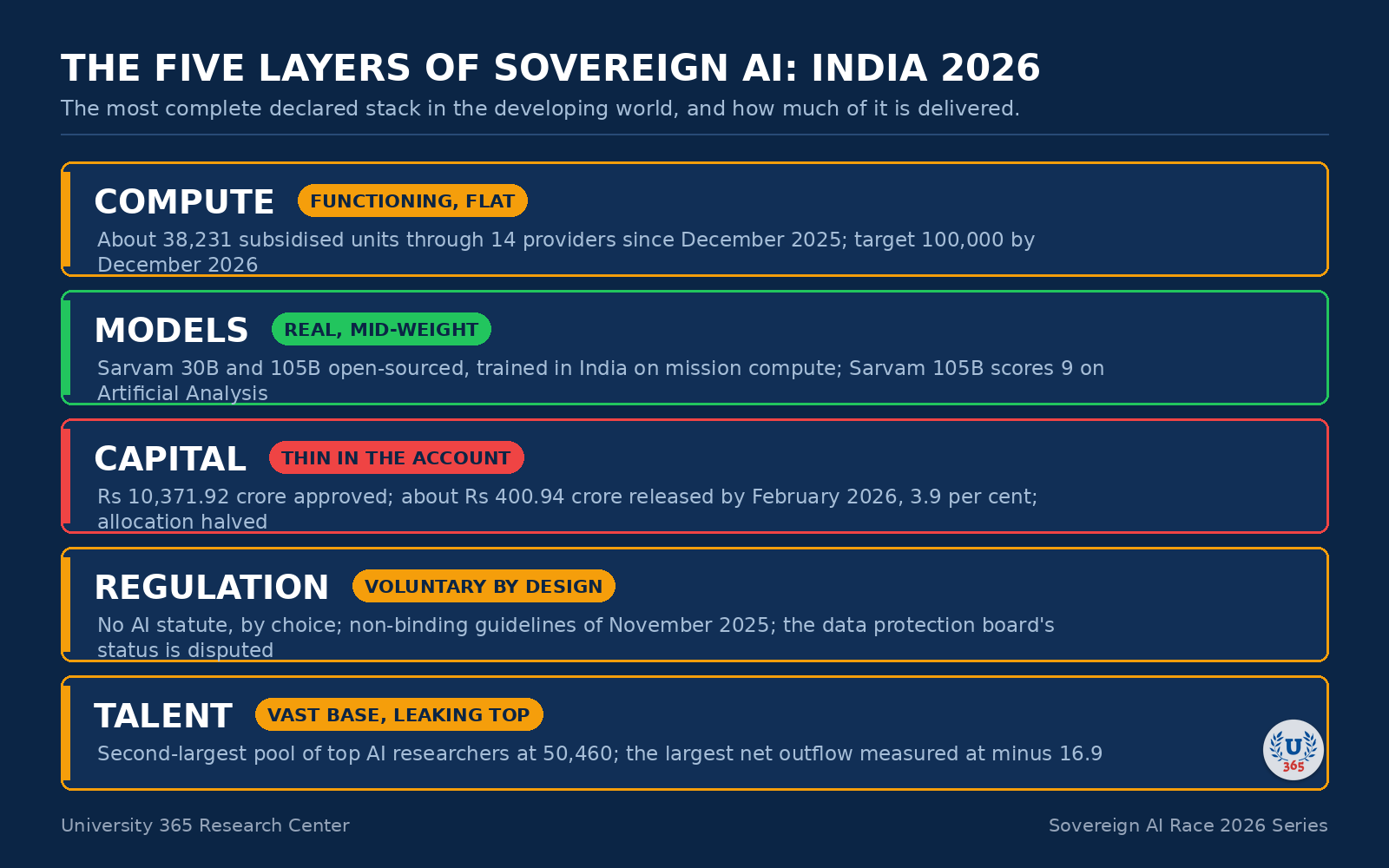
The five layers assessed. The most complete declared stack in the developing world, and how much of it is delivered. University 365 Research Center.
This is the sixth report in a twenty-part series assessing how states attempt to control the production of artificial intelligence inside their own jurisdiction. The framework is fixed and applied identically to every country. Sovereign AI capacity separates into five layers, and a state can hold any one of them without holding the others.
Compute sovereignty is the physical layer: where the chips and data centres sit, and who may switch them off. Model sovereignty is who builds the models a country depends on, and in whose languages and domains those models are competent. Capital sovereignty is who funds the build-out and on what terms. Regulatory sovereignty is who writes the rules and whether they can be enforced. Talent and education sovereignty is who builds and runs the systems, and how the next generation is prepared.
The five countries examined so far each hold a different mix. The United Arab Emirates rents compute on a licence and owns capital. Saudi Arabia buys compute and derives its model. China built everything and pays in efficiency. The United States owns everything and sells access on terms it can revoke. France holds the rules and the models and rents the machines. India enters the series as the largest population, the largest pool of AI talent measured by headcount, and the first country in the group whose sovereignty strategy is built primarily on public procurement, subsidised access and stated ambition rather than on either capital or capability.
The vocabulary this report needs
Four terms recur, and they are defined here once.
The IndiaAI Mission is the national programme approved by the Union Cabinet on 7 March 2024 with an outlay of Rs 10,371.92 crore, about 1.25 billion dollars, over five years. It is the funding instrument for every public element of the strategy: compute, models, datasets, skilling and safety.
The compute portal is the IndiaAI Mission's subsidised GPU marketplace, operated through empanelled private providers rather than state-built data centres. It is the mechanism through which any Indian researcher or startup can rent subsidised acceleration, and it is the single most important object in this report, because its number is flat.
Announced, committed and disbursed are three different things, and this series has always distinguished the first from the second. India requires the third distinction as well: the mission has been approved at Rs 10,371.92 crore, had released about Rs 400.94 crore to its implementing arm by February 2026 by analyst computation, and its allocation for the current year was halved in a parliamentary committee report of August 2026.
Indic capability means model performance in the languages of India. It is where India's verified model strength lies, and this report separates it from general frontier capability, because the two are not the same and the evidence does not support treating them as such.

Sovereign AI Race: India (2026)
The Question
Can state procurement and national scale build sovereignty that the money has not yet bought?
India has done in two years what most countries in this series have not done in a decade. It stood up a national mission with a parliamentary mandate and a five-year budget. It built a subsidised public compute layer, operated through Jio, Tata, Yotta, CtrlS and NxtGen, and opened it to any researcher at about Rs 65 per GPU-hour. It trained and released open-source reasoning models on that compute, in India, from scratch. It convened the first AI summit held in the Global South, with 92 countries endorsing its declaration and 13 frontier developers signing voluntary safety commitments. It notified a data protection framework, issued governance guidelines, launched a safety institute, and put a head of state's voice behind AI skilling for ten million young people.
Every one of those sentences is verified in this report's sources, and together they describe a state that has moved faster than almost any peer at the layer of policy and programme design.
Underneath sits the arithmetic, and the arithmetic is the subject of this report because it is unusually well documented by India's own institutions and its own analysts. The compute portal held at about 38,231 units from December 2025 into September 2026, a plateau of roughly nine months. The stated public target is 100,000 GPUs by December 2026, which would require adding some 62,000 units in four months, a 2.6-fold step, onto a fleet that analysts report as underused because demand, not supply, is the constraint. Of the Rs 10,371.92 crore approved, about Rs 400.94 crore had actually reached the implementing arm by 9 February 2026, 3.9 per cent of the outlay, 23 months into a 60-month plan. The Finance Ministry is reported to have halved the mission's allocation in the current year. And the leading commercial model laboratory in the country has left frontier model building for cloud resale.
So the question is not whether India can design a sovereignty programme. It has. The question is whether a programme that is 3.9 per cent disbursed, that runs on imported silicon, and that is governed by guidelines its own ministry declined to make law, is the thing it says it is.

Sovereign AI Race: India (2026)
The Contradiction
A billion-person democracy building sovereign AI on imported chips with undisbursed money

The India Gate, New Delhi. Photograph: Ravi Roshan via Pexels.
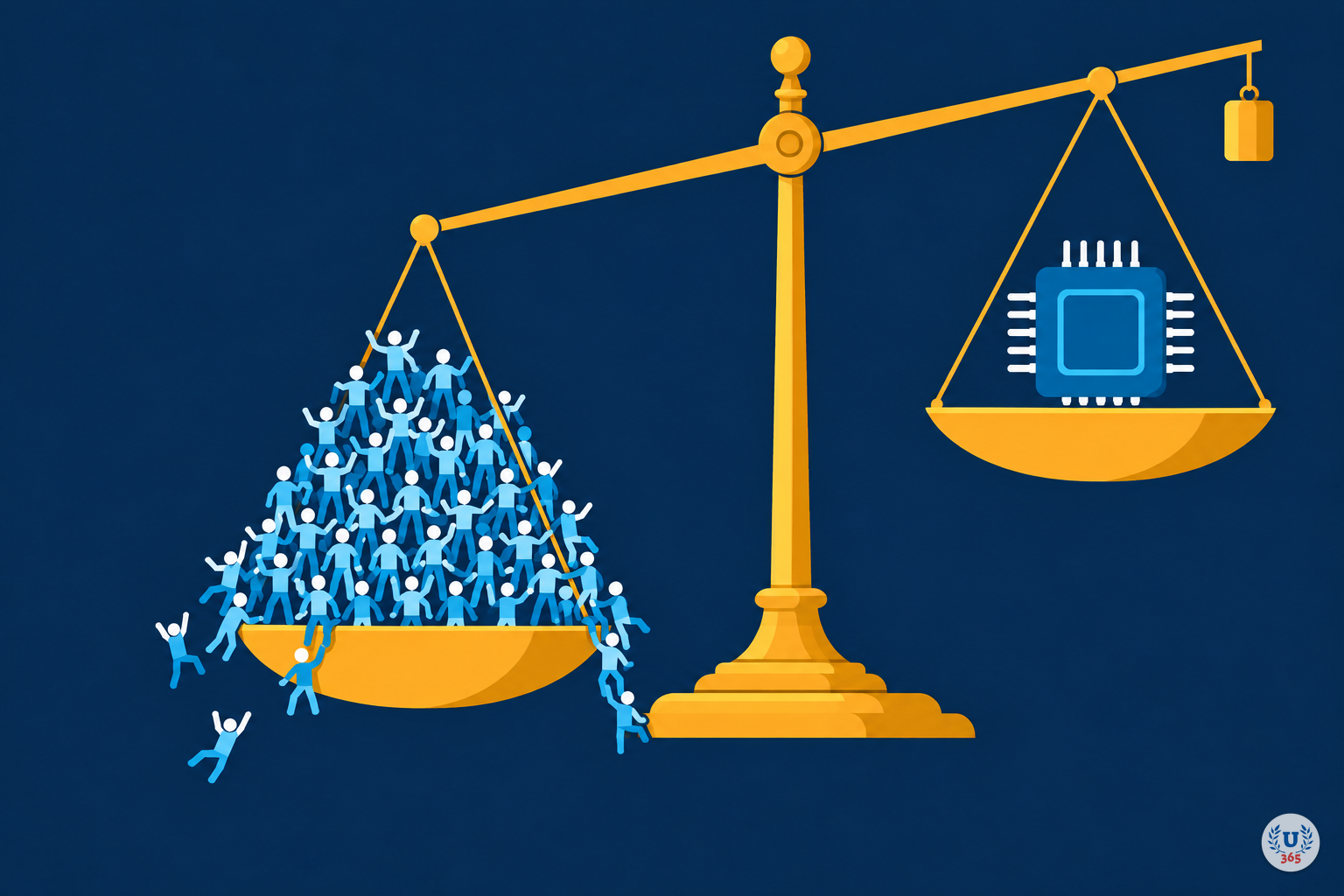
The people on one side, the silicon on the other, and the scale tipped toward the people. University 365 Research Center.
Here is the paradox, stated as plainly as the evidence allows.
The purpose of a national AI mission is to make the production of AI domestically controllable. India's mission has produced a genuine, functioning, subsidised public compute layer, faster than most peers managed, and it is an achievement the series records as real. Every accelerator in that layer is foreign-designed. NVIDIA supplies the H100 and H200 units on the portal and the Blackwell Ultra generation in the newest private builds. AMD, Intel and AWS supply the rest. The G42 supercomputer announced for India uses Cerebras wafer-scale silicon. India's own semiconductor mission has approved Rs 1.64 lakh crore across twelve projects, three of which are reported operational, and a Tata Electronics memorandum with ASML for front-end fabrication at Dholera was signed in May 2026. None of that is supplying AI accelerators in 2026, and the honest statement is that sovereign Indian AI currently runs entirely on imported silicon.
That is the first layer of the contradiction, and it is shared with most of the series. The second layer is sharper and specific to India. The mission's money exists on paper and not in the account. Analysts computed that the implementing arm had received 3.9 per cent of the approved outlay by February 2026. A parliamentary standing committee recorded in August 2026 that the Finance Ministry halved the allocation. And the compute portal, the mission's flagship deliverable, has been flat since December 2025.
The third layer is the model layer, and it cuts both ways in a way the series has not seen before. On one side, Sarvam open-sourced two reasoning models trained entirely in India on IndiaAI Mission compute, with weights published under a permissive licence on both the government's AI Kosh platform and Hugging Face. That is a genuine capability transfer to the Indian public, and it is the clearest case in the series of a state using subsidised compute to produce public goods. On the other side, Sarvam 105B is a 105-billion-parameter model with 10.3 billion active parameters, a strong mid-weight system that scores 9 on the independent Artificial Analysis Intelligence Index. Against frontier systems it is not a peer, and the country's first AI unicorn, Krutrim, dropped its chip plans and pivoted from model building to reselling AI cloud capacity, reporting roughly Rs 300 crore of revenue and its first net profit on that new business.
The fourth layer is the rules. India deliberately declined to enact an AI law. Its governance guidelines rest on seven principles and are explicitly non-binding, implemented through three committees rather than statutory powers. The data protection rules notified in November 2025 carry an eighteen-month compliance runway, and the board created to enforce them is disputed in the record: the higher-quality legal source reports that it had no appointed chairperson or members more than eight months after notification, and this report states the conflict rather than resolving it.
Put together, the contradiction is this. India has assembled the most complete declared sovereignty stack of any developing country, and the declared stack is running ahead of the built one at the compute layer, the money layer and the enforcement layer simultaneously. That is not fraud, and the report does not treat it as such. It is a state that has legislated and announced at a pace its disbursement and delivery machinery has not matched, and the gap is documented by India's own analysts, its own audit institutions and its own Parliament.

Sovereign AI Race: India (2026)
The Current State
Compute: a functioning subsidy on a flat plateau

The India Gate at sunset. The India AI Impact Summit of February 2026 was held in the capital, the first AI summit hosted in the Global South. Photograph: Ravi Roshan via Pexels.
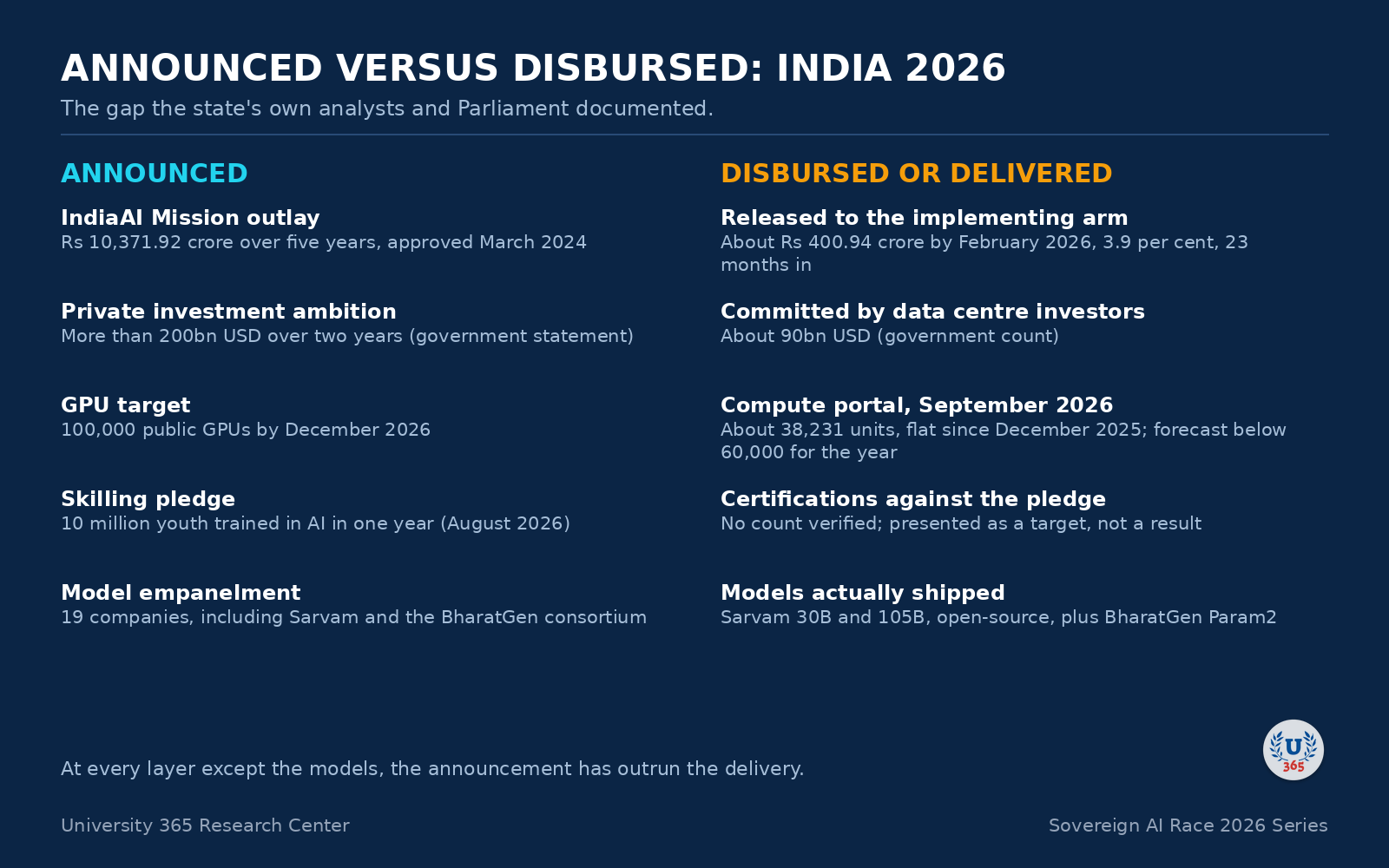
Announced versus disbursed. The gap the state's own analysts and Parliament documented. University 365 Research Center.
India's compute position divides into what the state subsidises and what private capital is building, and the two numbers are moving at very different speeds.
The public layer is real and unusual in design. Rather than building state data centres, the mission empanels private providers and subsidises GPU hours for any user at about Rs 65 per GPU-hour, which is the largest state-subsidised AI compute programme outside China by the assessment quoted in this report's sources. Fourteen service providers were empanelled, and the portal carried about 38,231 units from December 2025 into September 2026. The government's own statements put the provisioned fleet above 38,000 in February 2026 and above 45,000 by July 2026, and those two figures may measure different things, installed against portal-listed, which is why this report states the measure rather than blending them. The target is 100,000 public GPUs by December 2026, and the analyst projection, stated at high confidence, is that the year closes below 60,000.
The private layer is where the announced capacity actually is. Yotta committed more than two billion dollars to a 20,736-unit NVIDIA Blackwell Ultra deployment in Noida, with more than 10,000 B300 units committed to the IndiaAI Mission. Larsen and Toubro announced a venture with NVIDIA in February 2026 for a gigawatt-scale AI factory, first phase 30 megawatts in Chennai plus a 40-megawatt data centre in Mumbai, and in August 2026 secured a mega order with Together AI to build the country's largest NVIDIA B300 factory at a Chennai campus, phase one designed for 250 megawatts. And the diplomatic layer arrived with capital attached: Abu Dhabi will deploy an eight-exaflop national supercomputer in India, built by G42 and Cerebras with the Centre for Development of Advanced Computing, hosted inside the country and governed under Indian frameworks. That system, announced in February 2026 and following the fifth India-UAE Strategic Dialogue in December 2025, is the largest single compute commitment any country in this series has made to another's sovereignty programme.
The distinction this series applies everywhere carries its full weight here. Announced capacity in India is measured in gigawatts and billions of dollars. Operating public capacity is measured at about 38,000 units, and the mission needs to almost triple it in four months to meet its own target.
Capital: a 1.25 billion dollar mission against a 200 billion dollar ambition
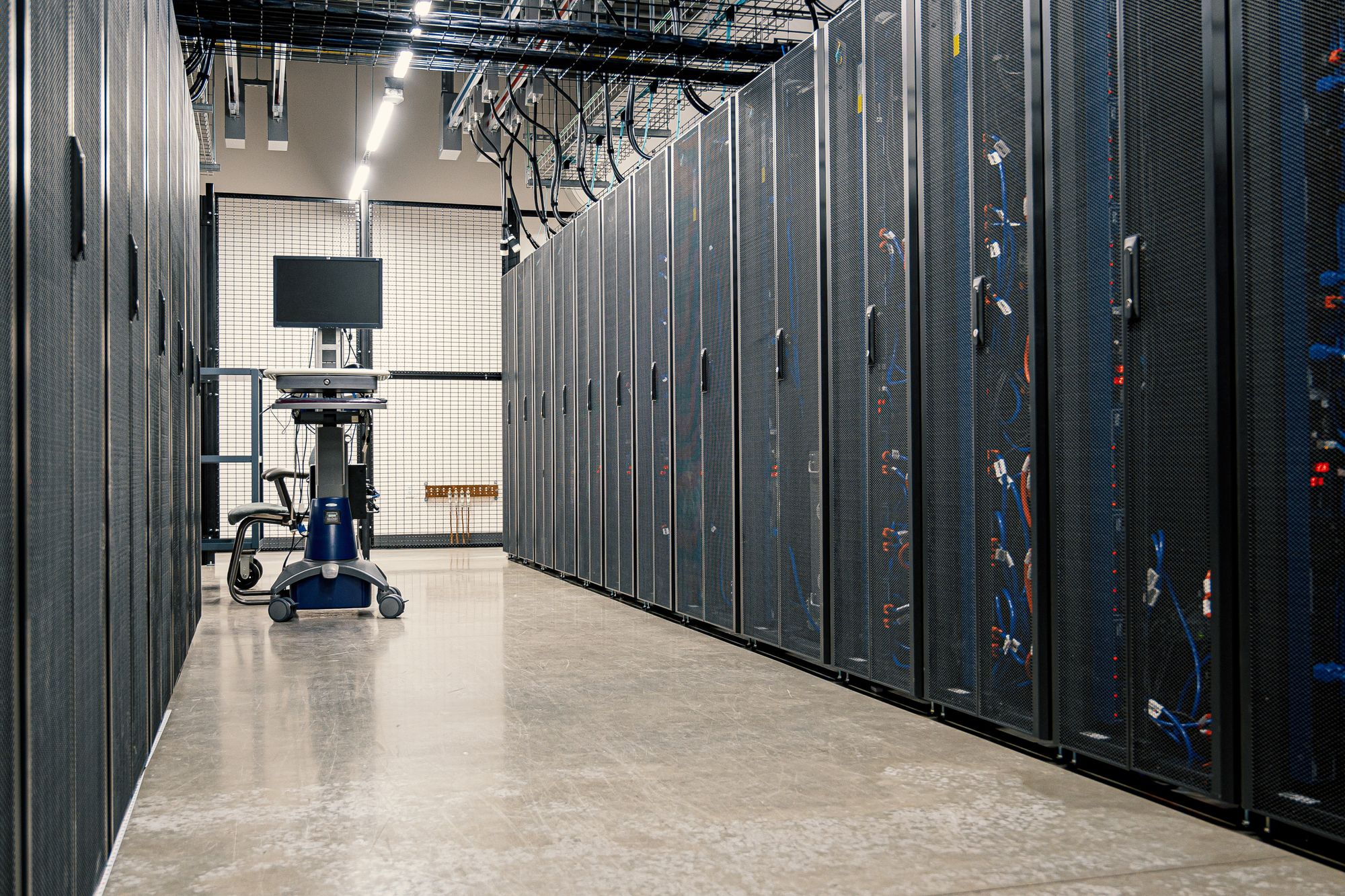
The subsidised compute layer runs through fourteen empanelled private providers rather than state-built data centres. Photograph: Brett Sayles via Pexels.
India's capital position is the most lopsided in the series, and the imbalance is the strategy.
Public capital is the mission's Rs 10,371.92 crore, about 1.25 billion dollars across five years, against a stated private ambition of more than 200 billion dollars of AI-driven investment over two years, announced by the IT minister in February 2026. Data centre investors had committed about 90 billion dollars of that at the time of the announcement by the government's own count. Microsoft pledged 17.5 billion dollars for Indian AI infrastructure in December 2024, Amazon announced more than 35 billion dollars through 2030, and India joined OpenAI's country partnership programme and NVIDIA's factory expansion.
The disbursement record is where the report applies its discipline. By 9 February 2026, the implementing arm had received about Rs 400.94 crore of the Rs 10,371.92 crore, 3.9 per cent, 23 months into a 60-month plan, by analyst computation from budget documents. Less than half the year's allocation was used, the mission's allocation was halved in the August 2026 parliamentary report, and the analysts' own warning is the one this report adopts: plan around what has been disbursed, not what has been announced.
Private Indian AI capital is growing from a small base and crossing its first milestone. Sarvam raised 234 million dollars in the first close of a 300 million dollar Series B at a 1.5 billion dollar valuation in June 2026, led by HCLTech with about 150 million dollars for a 10.5 per cent stake, joined by Bessemer and existing investors Khosla Ventures and Peak XV. That is the country's newest AI unicorn, and it is also a strategic round: the lead investor is an Indian IT services company using its balance sheet to anchor a sovereign model laboratory. Aggregate Indian AI startup funding reached about 1.34 billion dollars across 66 rounds to the end of August 2026, up roughly 143 per cent year on year on the narrowest defensible definition.
Models: real Indic capability, honestly not frontier
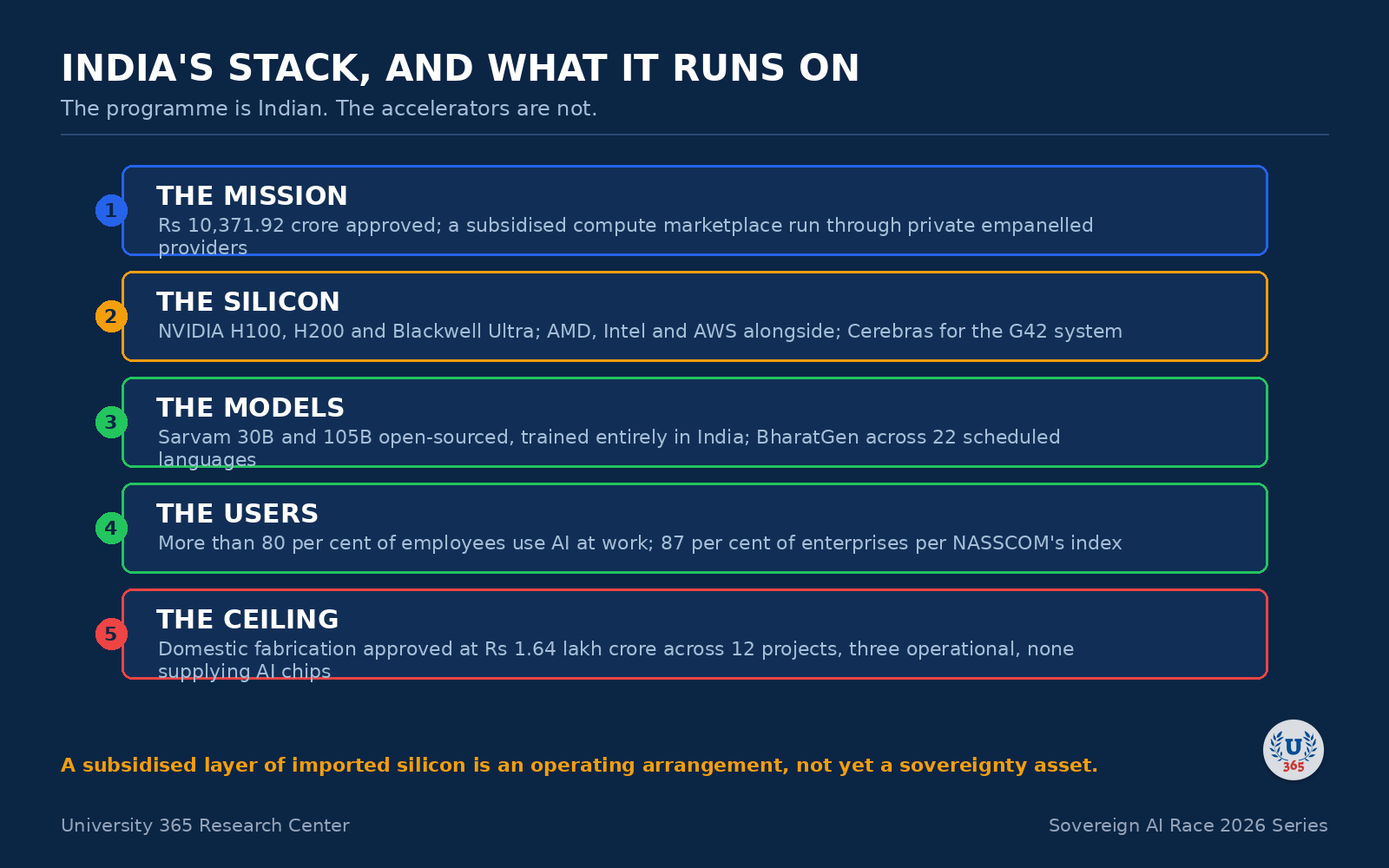
India's stack, and what it runs on. The programme is Indian; the accelerators are not. University 365 Research Center.
India's model layer is the part of the strategy that has delivered most fully against its own announcement, and the part where the report must be most precise about what has and has not been achieved.
Sarvam released two reasoning models on 6 March 2026, 30B and 105B, both trained from scratch entirely in India on compute provided under the IndiaAI Mission, with pre-training, supervised fine-tuning and reinforcement learning all executed in house. The weights are published under the Apache 2.0 licence on the government's AI Kosh platform and on Hugging Face. The 105B is a mixture-of-experts system with 10.3 billion active parameters, trained on 12 trillion tokens for the larger model and 16 trillion for the smaller, with a multilingual corpus allocating a substantial share of the training budget to the ten most-spoken Indian languages. The company's published benchmarks include 98.6 on Math500, 71.7 on LiveCodeBench v6, 81.7 on MMLU Pro and 78.7 on GPQA Diamond.
The independent position is the one that matters for this series. Sarvam 105B scores 9 on the Artificial Analysis Intelligence Index. It is a capable mid-weight model, and it is not a frontier system. The company's own claim is that it is globally competitive for its class and state of the art on Indian-language benchmarks, outperforming models significantly larger, and this report records that claim as the company's. The verified position is that India leads the world on language coverage and multilingual breadth, and that this leadership is real, measurable and valuable, without being the same thing as frontier parity.
The second pillar is BharatGen, the government-backed multilingual stack led by IIT Bombay with a consortium of nine academic institutions, covering all 22 scheduled Indian languages across four model families, text, speech, vision and datasets. Its Param2 is a 17-billion-parameter mixture-of-experts text foundation model in 22 languages, launched at the February 2026 summit, and the full stack was unveiled at Bharat Innovates 2026 in Nice in June 2026. The public record carries a funding discrepancy between the government's figure of Rs 235 crore and a secondary source's Rs 988.6 crore, and this report uses the government figure while recording the conflict. The government has empanelled eleven companies to build indigenous foundation models and added eight more, including the BharatGen consortium.
The third data point is a retreat, and the series records it because the market is entitled to its verdict. Krutrim, India's first AI unicorn, raised at a one-billion-dollar valuation in January 2024, dropped its chip plans and pivoted from foundation models to AI cloud services, reporting about Rs 300 crore of FY26 revenue, a threefold rise, and its first net profit. TechCrunch characterised the shift as reflecting the tougher economics of building large-scale AI systems. When the country's first model champion concludes that reselling capacity is the better business, that is the market's own assessment of Indian frontier model economics.
Regulation: deliberate non-law, and an enforcement question

Droupadi Murmu, President of India, as of 2026. The office is the formal head of state under which India's AI programme and the IndiaAI Mission operate. Photograph: President's Secretariat, GODL-India, via Wikimedia Commons.
India's regulatory choice is the clearest policy position in the series, and it is a choice against legislation.
The parent statute is the Digital Personal Data Protection Act of 2023. Its rules were notified on 14 November 2025, fully operationalising the Act after a consultation that drew 6,915 inputs. The main obligations phase in over an eighteen-month transition widely reported to land in May 2027. The enforcement body created by the Act is the Data Protection Board of India, and its status is the sharpest dispute in this report's record: a legal publication reported on 1 August 2026 that it had no appointed chairperson or members more than eight months after notification, while a secondary source claims appointments were made on 6 June 2026. The two claims cannot both be true, this report states the conflict, and the practical risk either way is the same: a statute with live penalty provisions and a board whose enforcement record is not yet established.
On AI specifically, the ministry released governance guidelines on 5 November 2025 built on seven principles, the first being innovation over restraint, and explicitly declined to enact a dedicated AI law at this stage. The guidelines are non-binding, with implementation routed through three committees rather than statutory powers. Sectoral regulation fills the space: an amendment to the intermediary rules in February 2026 addresses AI-generated content with labelling and provenance duties, and financial and market regulators apply their own rules to AI in their sectors. The IndiaAI Safety Institute, announced in January 2025, was formally launched in February 2026 on a hub-and-spoke model with academic partners.
Voluntary governance is where the international layer sits. Thirteen frontier developers signed the New Delhi Frontier AI Impact Commitments at the summit, and the summit's instruments include a declaration endorsed by 92 countries, guidance notes endorsed by 22, a charter for democratic diffusion supported by 22, and a reskilling framework endorsed by 23. That is a substantive diplomatic achievement at the voluntary layer, and it is deliberately not a binding one. The Stanford AI Index 2026 records that India passed one AI-related law between 2016 and 2025.
Talent: the largest pool in the world after one country, and the largest outflow in the world
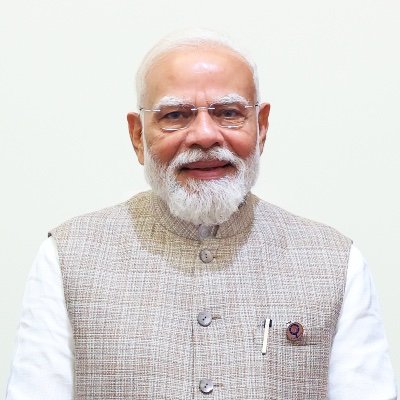
Narendra Modi, Prime Minister of India, as of 2026. He announced AI skill training for ten million young people on 15 August 2026 and opened the India AI Impact Summit in February 2026. Photograph: Prime Minister's Office, GODL-India, via Wikimedia Commons.
The talent layer is where India's position is strongest in absolute terms and most revealing in relative terms.
The Stanford AI Index 2026 records that India had the second-largest pool of top AI authors and inventors in the world in 2025, at 50,460 people, behind only the United States, and that India leads the world on LinkedIn's relative AI skill penetration index at 3.0. Indian students use generative AI at a higher rate than American students, and more than 80 per cent of employees report using AI at work regularly.
The same index records the largest net outflow of AI talent of any country in the dataset, negative 16.9 in 2025, more than double Canada's negative 7.1 and Germany's negative 2.4. India sends more AI researchers abroad than any other country in the world. The index also records that the number of AI researchers moving to the United States has fallen 89 per cent since 2017. The interaction of those two facts is the nuance this report insists on: the drain is easing not because India has closed the structural gaps that cause it, but because the destination has become materially less accessible. That is a change in the world, not a change in India, and reading it as an achievement would be a mistake.
The policy response is the largest announced skilling programme in the series. On 15 August 2026 the Prime Minister announced AI skill training for one crore young people, ten million, in one year. The national AI fellowship was expanded to 13,500 scholars across undergraduate, postgraduate and doctoral levels. FutureSkills PRIME, run by the ministry with NASSCOM, reports more than 1.629 million enrolled or trained across 500-plus courses, and the ministry with AICTE launched an initiative targeting 100,000 students. Against the ten million pledge, no count of certifications actually delivered was verified in this research, and this report presents it as an announced target rather than an achievement, which is the distinction the series exists to maintain.
What changed since our 2025 report on India
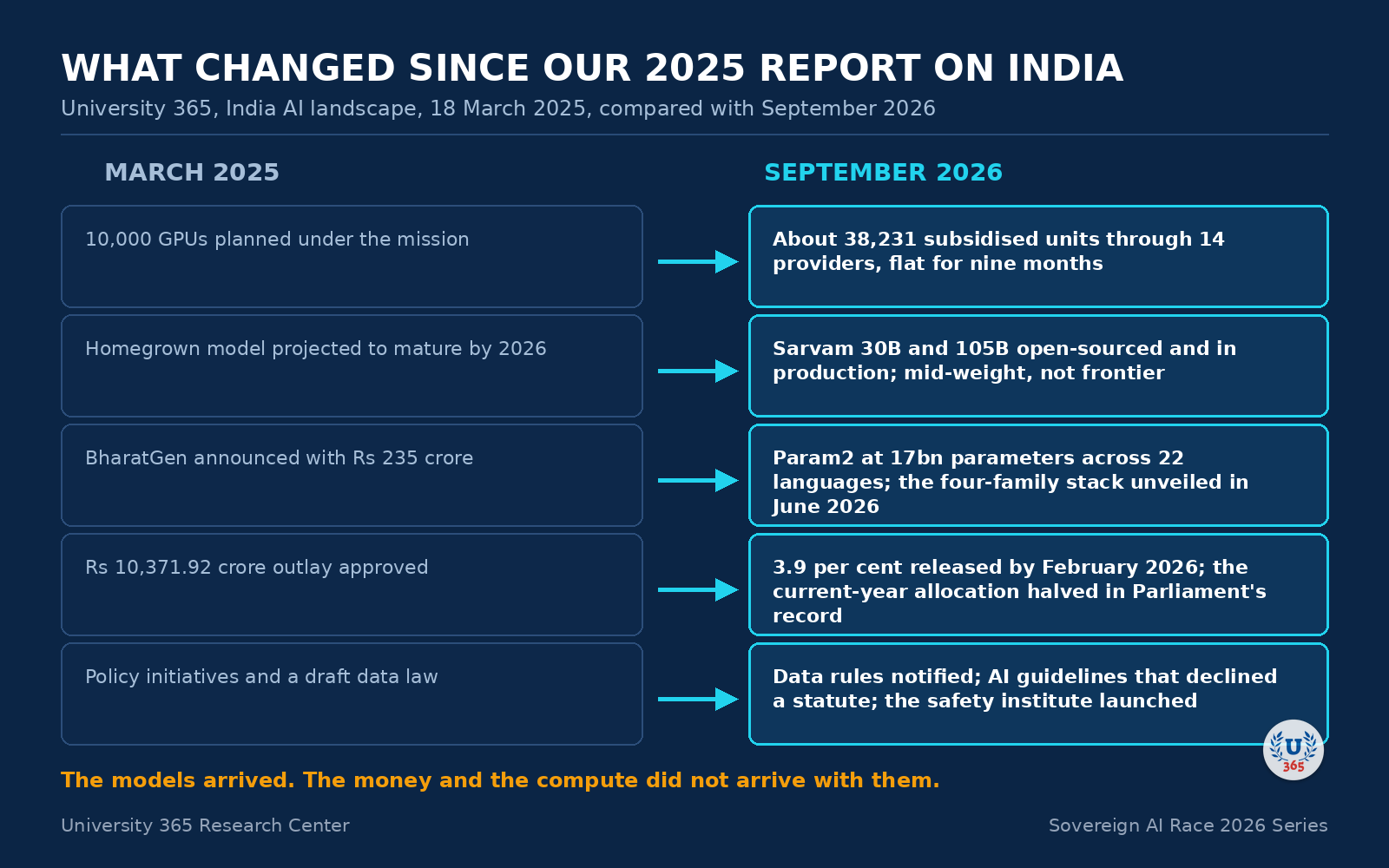
What changed since our March 2025 report on India. University 365 Research Center.
Read the earlier report: India's AI Renaissance - Mapping the Nation's Artificial Intelligence Landscape in March 2025. University 365 INSIDE, 18 March 2025.
University 365 published "India's AI Renaissance: Mapping the Nation's Artificial Intelligence Landscape in March 2025" on 18 March 2025. That report described the mission's approval, the BharatGen investment of Rs 235 crore and a generative AI adoption rate it recorded at 81 per cent of organisations, and it closed by projecting that India's homegrown model would reach maturity by 2026. The interval has realised part of that projection and reframed the rest.
The compute layer went from a tender to a subsidised marketplace, and then stalled. The 2025 report recorded the mission's plan for 10,000 GPUs and an 18,000-GPU compute facility. The verified position in September 2026 is a portal carrying about 38,231 subsidised units through fourteen empanelled providers at about Rs 65 per GPU-hour, a plateau of roughly nine months, against a 100,000-target for December 2026 that the analyst consensus expects to be missed by a wide margin. The 2025 report described capacity being bought. The 2026 position is capacity being rented, at scale, and not growing at the rate the plan requires.
The homegrown model arrived, and it is real. The 2025 report projected maturity by 2026. Sarvam's 30B and 105B models were open-sourced on 6 March 2026, trained entirely in India on mission compute, published under a permissive licence on the government platform, and are in production behind the company's assistant and agent products. That prediction held. What the 2025 report could not know is where the models would sit against the world: strong in their class and in Indian languages, and not at the frontier, which this report states plainly.
BharatGen went from one announced model to a four-family multilingual stack. The 2025 report recorded the September 2024 launch and the Rs 235 crore investment. The 2026 position is a nine-institution consortium under IIT Bombay, Param2 at 17 billion parameters across 22 scheduled languages launched in February 2026, and the full text, speech, vision and datasets stack unveiled in June 2026.
The money position became visible, and it is thin. The 2025 report described a Rs 10,371.92 crore five-year outlay. The report could not know what the disbursement would look like two years in: about Rs 400.94 crore released to the implementing arm by February 2026, 3.9 per cent, and the current-year allocation halved. The 2025 report described an appropriation. The 2026 position is the gap between an appropriation and a disbursement, and India's own analysts documented it.
The regulatory picture moved from absence to a deliberate choice against a statute. The 2025 report described policy initiatives and a data protection law in draft. Since then the data protection rules were notified in November 2025, the AI governance guidelines of November 2025 explicitly declined an AI law, and the safety institute moved from announcement to formal launch. India chose a voluntary, principle-based regime. That choice is now on the record, and this report assesses it as a choice rather than an oversight.
The geopolitics changed shape entirely. The 2025 report did not describe a bilateral chip framework. By February 2026 India and the United States had finalised an interim trade agreement in which GPUs and data centre equipment were named explicitly for the first time in such a framework, with tariffs on Indian goods reduced to 18 per cent, and India signed the US-led Pax Silica Declaration on chips, AI and critical minerals. India also hosted the first AI Impact Summit held in the Global South.

Sovereign AI Race: India (2026)
Key Findings
1. India has built the most complete AI policy stack in the developing world in two years, and every layer of it is documented in this report. A parliamentary mandate, a subsidised compute marketplace, homegrown open-weight models, a data protection framework, governance guidelines, a safety institute, a global summit and a ten-million-person skilling pledge. The programme design is not the problem.
2. The money has not moved at the same speed. About Rs 400.94 crore of the Rs 10,371.92 crore outlay, 3.9 per cent, had reached the implementing arm by February 2026, 23 months into a 60-month plan, by analyst computation from budget documents. The allocation was halved in the current year per a parliamentary committee report.
3. The compute portal has been flat for nine months. About 38,231 units from December 2025 into September 2026, against a 100,000 target for December 2026 that would require adding some 62,000 units in four months onto a fleet reported as underused. The analyst forecast is that the year closes below 60,000.
4. The models are real and their class is mid-weight. Sarvam 30B and 105B, open-source, trained entirely in India on mission compute, published on AI Kosh and Hugging Face under Apache 2.0. Sarvam 105B scores 9 on the Artificial Analysis Intelligence Index: strong for its class, not frontier. India's verified edge is Indic-language coverage and breadth, which is genuine.
5. The first AI unicorn left frontier model building. Krutrim dropped its chip plans and pivoted to cloud resale, reporting about Rs 300 crore of FY26 revenue and its first net profit. The market's verdict on Indian frontier model economics is recorded in its own pivot.
6. The regulatory regime is voluntary by design and thin in enforcement. The governance guidelines are explicitly non-binding, no AI statute exists by choice, and the data protection board's constitution is disputed in the record with the stronger source reporting no chairperson or members eight months after notification.
7. Every accelerator in the sovereign stack is imported. NVIDIA for the portal and the newest private builds, AMD, Intel and AWS alongside, Cerebras for the G42 supercomputer. India's own fabrication programme is approved and under construction: Rs 1.64 lakh crore across twelve projects, three reported operational, and an ASML memorandum for Dholera. None of it supplies AI accelerators yet.
8. The talent pool is the second largest in the world and the largest outflow in the world. 50,460 top AI authors and inventors per the Stanford index, behind only the United States, with a net talent outflow of negative 16.9, the largest measured. The outflow is easing because American access tightened, not because Indian retention improved.
9. The diplomatic layer is India's clearest success and the least costly. A 92-country declaration, thirteen frontier developers signing voluntary commitments, a Pax Silica signature, and the first Global South summit. India has positioned itself as the Global South's rule-setter in AI governance, and that position is real even where the domestic compute is not.
10. The honest overall verdict: announced more completely than achieved. This is not a criticism of India's ambition, which is proportionate to its scale. It is the arithmetic of a state that legislated faster than it disbursed, and it is the same gap the series measured in the Gulf states, in a different currency.

Sovereign AI Race: India (2026)
Deep Analysis
Why the disbursement gap exists, and why it is the report's central finding
A gap between announced and disbursed public money is common in large programmes. India's is unusually well documented, and its causes are visible in the record.
Two explanations are supported by the evidence and a third is speculative and excluded. The first is the mechanism itself: the mission operates through empanelled private providers rather than state infrastructure, which means the state's spending depends on private capacity coming online and on demand materialising to fill it. India's analysts report the existing subsidised fleet as underused, with the constraint identified as a demand problem rather than a supply one. A subsidy programme whose uptake is demand-limited will not disburse at plan speed, whatever its budget line says.
The second is fiscal competition. A parliamentary standing committee recorded the Finance Ministry halving the mission's allocation in the current year, against a backdrop of a government running an ambitious semiconductor subsidy programme at Rs 1.64 lakh crore across twelve projects. A state can only subsidise so many industrial programmes at once, and India chose to fund fabrication as well as computation.
The consequence is the finding this report draws. The series has argued, in five earlier reports, that the layers money can buy are compute and capital, and that models, research and rules take longer. India's case inverts the diagnosis in an instructive way: it is not short of capital as a country, with a 200 billion dollar private ambition and Microsoft, Amazon and Abu Dhabi committing tens of billions, and it is not short of rules, having chosen a governance framework deliberately. It is short of disbursed public money at the compute layer, and the layer it chose to subsidise through private empanelment is therefore the layer where its own target is receding.
The subsidy model and its sustainability
India's choice to subsidise GPU hours rather than build state data centres is the most market-oriented compute strategy in the series, and it deserves an assessment on its own terms.
The advantages are real and visible. The state avoids the capital risk, the construction risk and the obsolescence risk of owning accelerators, and it routes its support through providers, Jio, Tata, Yotta, CtrlS and NxtGen, who must compete for empanelment. Users pay about Rs 65 per GPU-hour, which is a genuine public good at the point of use. The mechanism can scale with demand rather than with appropriation, and it can be turned down or up without a divestment.
The disadvantages are equally real, and this series has documented them elsewhere. Sovereignty mediated by contract is a different asset from sovereignty held: the state does not own the fleet, does not control its refresh cycle, and depends on private providers whose commercial priorities may diverge from the national one. The flat portal number shows the limit in practice: the state can offer subsidy faster than private capacity arrives or demand absorbs it. And every unit delivered under the programme is foreign silicon on a foreign supply chain, which makes the subsidy an operating arrangement rather than a sovereignty asset in the sense this series uses the word.
The Global South strategy, and what it actually buys
India's international position is the most successful element of its programme on the evidence, and the series should say why clearly.
The February 2026 summit was the first AI summit held in the Global South, with roughly 600,000 in-person attendees and delegations from more than 100 countries, and it produced a declaration endorsed by 92 countries and organisations plus a series of multi-country instruments on governance, diffusion, reskilling and resilience to AI infrastructure disruption. Thirteen frontier developers signed voluntary safety commitments. India signed the US-led Pax Silica Declaration on chips and critical minerals in the same period and finalised an interim trade framework with Washington that names GPUs and data centre equipment explicitly for the first time, at an 18 per cent tariff on Indian goods.
That combination is a genuine strategic achievement: India has positioned itself between the American supply chain, which it depends on for silicon, and the Global South, whose governance it now helps write. The cost of the position is that its own model of governance, voluntary and non-binding, is the one it advocates, which is convenient for a state that has declined to legislate and useful for countries that wish to avoid European-style compliance burdens. Whether voluntary governance produces safety at the frontier is a question this report cannot settle. What it can say is that India's normative influence is now larger than its compute base, which is an unusual configuration in the series and not obviously a bad one.

Sovereign AI Race: India (2026)
Data and Evidence
Table 1: The five layers, assessed for India in September 2026
Layer | What India holds | What it does not hold | Assessment |
Compute | A functioning subsidised public marketplace: about 38,231 units through 14 empanelled providers at about Rs 65 per GPU-hour; private builds announced at scale (Yotta's 20,736 Blackwell Ultra units; L&T's gigawatt venture and B300 factory order); an eight-exaflop G42 and Cerebras system committed by Abu Dhabi and hosted in India | Growth at the speed of its own target (a plateau of nine months against a 100,000-GPU December 2026 goal); domestic accelerators (every unit is imported: NVIDIA, AMD, Intel, AWS, Cerebras); disbursement (3.9 per cent of the outlay reached the implementing arm by February 2026) | Functioning, flat, and rented |
Models | Sarvam 30B and 105B, open-source reasoning models trained from scratch in India on mission compute, published under Apache 2.0 on AI Kosh and Hugging Face; BharatGen's Param2 at 17bn parameters across 22 scheduled languages within a four-family consortium stack; 19 empanelled foundation-model builders | Frontier-class capability (Sarvam 105B scores 9 on the Artificial Analysis Intelligence Index); a commercial frontier contender (Krutrim exited model building for cloud resale) | Real Indic capability, honestly not frontier |
Capital | A Rs 10,371.92 crore public outlay; more than 200bn USD of stated private ambition with about 90bn USD committed by data centre investors; Sarvam's 234m USD first close at a 1.5bn USD valuation led by HCLTech; roughly 1.34bn USD of AI startup funding to end-August 2026 | Disbursement at plan speed (about Rs 400.94 crore released by February 2026, 3.9 per cent); protection of the mission's allocation, halved in the current year | Ambitious on paper, thin in the account |
Regulation | The DPDP Act 2023 operationalised by rules notified 14 November 2025; AI governance guidelines of 5 November 2025 on seven principles; the IndiaAI Safety Institute formally launched February 2026; the New Delhi Frontier AI Impact Commitments signed by 13 developers | A dedicated AI law (declined by choice); binding enforcement (the guidelines are non-binding; the Data Protection Board's constitution is disputed in the record) | Deliberately voluntary, and untested |
Talent | The world's second-largest pool of top AI authors and inventors (50,460); the world's highest relative AI skill penetration on the LinkedIn index; a ten-million-person skilling pledge; a 13,500-scholar fellowship; FutureSkills PRIME with over 1.629 million enrolled or trained | Retention: the largest net AI talent outflow measured (negative 16.9); verified certification counts against the ten-million pledge; IIT and IISc pipeline numbers at the granularity the strategy implies | Vast at the base, leaking at the top |
Table 2: The controlled metrics, series bible format
Metric | India position | Source and date |
Flagship compute commitment | IndiaAI Mission: Rs 10,371.92 crore over five years, approved 7 March 2024; compute portal at about 38,231 units; public target of 100,000 GPUs by December 2026; Yotta's 20,736-unit Blackwell Ultra deployment with more than 10,000 B300 units committed to the mission; L&T's gigawatt venture and B300 mega order; the G42 and Cerebras eight-exaflop national system hosted in India | PIB, 7 March 2024 and 2 March 2026; Analytics India Magazine, 2 September 2026; Data Center Dynamics, 18 February 2026; L&T press releases, 18 February and 13 August 2026; G42 newsroom, February 2026 |
Capital committed | Rs 10,371.92 crore public outlay; more than 200bn USD of stated private ambition over two years with about 90bn USD committed by data centre investors; Microsoft's 17.5bn USD pledge; Amazon's more than 35bn USD through 2030; Sarvam's 234m USD first close at a 1.5bn USD valuation | PIB; Bloomberg and AP, 17 February 2026; Economic Times, 7 February 2026; HCLTech and Reuters, 15 June 2026 |
Flagship national models | Sarvam 30B and 105B (open-source, retrained from scratch in India, Apache 2.0, released 6 March 2026); BharatGen Param2, 17bn parameters across 22 scheduled languages; the BharatGen four-family stack (text, speech, vision, datasets) | Sarvam research blog, 6 March 2026; PIB; Moneycontrol, 16 June 2026 |
Anchor entities | Ministry of Electronics and Information Technology (MeitY); IndiaAI Mission and its implementing arm; IIT Bombay's BharatGen consortium; Sarvam AI; the 14 empanelled compute providers including Jio, Tata, Yotta, CtrlS and NxtGen; C-DAC; the IndiaAI Safety Institute | Government and institutional disclosures, 2024 to 2026 |
Chip dependency | Total at the accelerator layer: NVIDIA (H100, H200, Blackwell Ultra), AMD, Intel and AWS on the portal; NVIDIA for the L&T factories; Cerebras for the G42 system. No Chinese hardware identified anywhere in the stack. Domestic fabrication approved (Rs 1.64 lakh crore across 12 projects, three reported operational) and not yet supplying AI accelerators | Economic Times; Tech Observer citing MeitY, 1 July 2026; company releases, 2026 |
Regulatory instrument | Digital Personal Data Protection Act 2023, rules notified 14 November 2025 with an 18-month runway; India AI Governance Guidelines of 5 November 2025, non-binding, on seven principles; IT intermediary amendment of February 2026 on AI-generated content; no dedicated AI law by choice | PIB, 14 November 2025; MeitY guidelines and analyses, November 2025; sectoral sources, 2026 |
Talent anchors | Second-largest pool of top AI authors and inventors at 50,460; world-leading relative AI skill penetration index of 3.0; 13,500-scholar fellowship; ten-million-person skilling pledge of 15 August 2026; FutureSkills PRIME with more than 1.629 million enrolled or trained | Stanford HAI AI Index 2026 via ThePrint and Indian Express, April 2026; PMO, 15 August 2026; PIB |
Independent index standing | Oxford Insights Government AI Readiness 2025: 27th globally with a score of 66.55, leading South and Central Asia. Counterpoint Sovereign AI LLM Index H1 2026: named with South Korea and Japan among Asia-Pacific's leading sovereign AI developers, with Sarvam 105B credited as strengthening India's position through a public-private partnership model. Stanford AI Index 2026: second-largest talent pool, largest net outflow | Oxford Insights 2025 via PIB; Counterpoint via MIT Sloan Management Review Middle East, 31 July 2026; Stanford HAI, April 2026 |
Adoption | More than 80 per cent of employees report using AI at work regularly (Stanford index, India among five countries above 80 per cent); the prior U365 report recorded 81 per cent organisational generative AI adoption in March 2025; NASSCOM's adoption index records 87 per cent of enterprises actively using AI solutions | Stanford HAI AI Index 2026; U365 prior report, March 2025; PIB citing NASSCOM, 12 February 2026 |
Distinguishing mechanism | State procurement and subsidised access at national scale, on imported silicon, with voluntary governance | This report |
Core tension | Announced more completely than it is disbursed: 3.9 per cent of the outlay releases against a 100,000-GPU target the year is on track to miss | This report |
Table 3: Timeline, 2024 to 2026
Date | Event | Source |
26 January 2024 | Krutrim becomes India's first AI unicorn, raising 50m USD at a 1bn USD valuation | Bloomberg, 26 January 2024 |
7 March 2024 | The Union Cabinet approves the IndiaAI Mission, Rs 10,371.92 crore over five years | PIB, 7 March 2024 |
September 2024 | BharatGen launched as an open multilingual foundation model project with Rs 235 crore of support | PIB; prior U365 report, March 2025 |
December 2024 | Microsoft pledges 17.5bn USD for AI infrastructure in India | Reported via the Stanford AI Index 2026 |
30 January 2025 | The IndiaAI Safety Institute is announced under the mission's safe and trusted AI pillar | IndiaAI; MeitY, January 2025 |
January 2025 | Draft Digital Personal Data Protection Rules released for consultation | MeitY |
18 March 2025 | University 365 publishes its India AI landscape report | University 365 INSIDE |
June 2025 | The mission reports 34,333 GPUs on the compute portal including 15,100 NVIDIA H100 units | Economic Times, June 2025 |
5 November 2025 | MeitY releases the India AI Governance Guidelines, declining a dedicated AI law | MeitY; analyses, November 2025 |
14 November 2025 | The DPDP Rules, 2025 are notified after a consultation receiving 6,915 inputs | PIB, 14 November 2025 |
December 2025 | The compute portal reads 38,231 units and holds that level into September 2026 | Analytics India Magazine, 2 September 2026 |
December 2025 | Fifth India-UAE Strategic Dialogue; G42 and MBZUAI release NANDA 87B, an open Hindi-English model | G42, December 2025 |
6 to 7 February 2026 | India and the United States announce the framework for an interim trade agreement; GPUs and data centre equipment named explicitly for the first time | Economic Times, 7 February 2026 |
9 February 2026 | Analyst computation: Rs 400.94 crore of the outlay received by the implementing arm, 3.9 per cent, 23 months in | Vedang Vatsa analysis of budget documents |
16 to 21 February 2026 | The India AI Impact Summit in New Delhi, the first held in the Global South; the declaration endorsed by 92 countries; the additional 20,000 GPUs announced; 13 frontier developers sign the New Delhi commitments; the Safety Institute formally launched; the G42 and Cerebras eight-exaflop system announced; L&T's NVIDIA venture and Yotta's Blackwell Ultra deployment reported | PIB, 2 March 2026; Digital India; G42; L&T, 18 February 2026; Data Center Dynamics, 18 February 2026 |
17 February 2026 | India states an ambition of more than 200bn USD of AI-driven investment over two years | Bloomberg; AP; NDTV, 17 February 2026 |
6 March 2026 | Sarvam open-sources Sarvam 30B and 105B, trained entirely in India on IndiaAI Mission compute | Sarvam research blog, 6 March 2026 |
13 April 2026 | Stanford HAI AI Index 2026 published: India second-largest talent pool at 50,460, largest net outflow at negative 16.9 | ThePrint, 20 April 2026; Indian Express, April 2026 |
4 to 5 May 2026 | Krutrim reports about Rs 300 crore FY26 revenue and its first net profit after pivoting to AI cloud services and dropping chip plans | Economic Times; TechCrunch, 5 May 2026 |
16 May 2026 | Tata Electronics signs a memorandum with ASML for front-end chip fabrication at Dholera | Reported, May 2026 |
15 June 2026 | Sarvam announces the 234m USD first close of its Series B at a 1.5bn USD valuation, led by HCLTech; IIT Bombay unveils the full BharatGen stack at Bharat Innovates 2026 | HCLTech; Reuters; The Hindu; Moneycontrol, 15 to 16 June 2026 |
1 July 2026 | MeitY reports more than 45,000 GPUs deployed and Rs 1.64 lakh crore approved across 12 semiconductor projects | Tech Observer citing MeitY, 1 July 2026 |
6 August 2026 | A parliamentary standing committee report records the Finance Ministry halving the IndiaAI allocation | Analytics India Magazine |
13 August 2026 | L&T secures a mega order with Together AI for India's largest NVIDIA B300 factory at Chennai, phase one designed for 250 MW | L&T press release, 13 August 2026 |
15 August 2026 | The Prime Minister announces AI skill training for ten million young people in one year | PMO; PIB, 15 August 2026 |
18 August 2026 | Aggregate Indian AI funding reaches about 1.34bn USD across 66 rounds year to date, up about 143 per cent | Kapyn aggregate citing PIB, Inc42 and Tracxn |
2 and 18 September 2026 | Analysts forecast the 100,000-GPU target will be missed, with the portal flat and the year closing below 60,000 deployed | Analytics India Magazine, 2 and 18 September 2026 |
26 September 2026 | Press reports India racing toward 100,000 public GPUs by December from roughly 34,000 deployed by mid-2026, alongside the 13,500-scholar fellowship | WION, 26 September 2026 |

Sovereign AI Race: India (2026)
Implications
For the countries in this series still to come
India's programme is the template most of the remaining fourteen countries will copy, and this report hands them both the template and its warning. The template is a national mission with a parliamentary mandate, a subsidised compute marketplace run through private empanelment, one or two anchor model laboratories funded with strategic capital, and voluntary governance. The warning is in India's own numbers: a programme designed around disbursement rather than appropriation, monitored publicly enough to be audited, is the only kind that can be trusted at the layers it claims to hold.
For the technology providers
India is the largest single market for AI infrastructure commitments in the world outside the United States, and the commitment pipeline, more than 200 billion dollars stated and about 90 billion committed by data centre investors, is real. The providers should note the pattern the portal makes visible: subsidised supply outran domestic demand, and the constraint on the programme has become usage rather than capital. Selling capacity into India is a straightforward business; building the demand that absorbs it is a public-good problem that the state has not yet solved.
For institutional and enterprise buyers
India's enterprises are already deep adopters: more than 80 per cent of employees report regular AI use at work, and the government's own reading of the NASSCOM index records 87 per cent of enterprises actively using AI solutions. The gap the report identifies is at the frontier, in the small number of organisations that build rather than use, and in the retention of the people who could. For a buyer choosing between stacks, India offers deep engineering talent, English-language delivery and the world's largest base of AI users, on infrastructure whose acceleration is imported and whose regulatory certainty is voluntary.
For India's own programme
The report's implication for the mission is arithmetic rather than strategic. Three things would change its trajectory, and none require a new policy: disbursement at the appropriations rate, demand generation for the subsidised fleet so that usage absorbs supply, and a decision about whether the model layer's public investment continues past the open-weights milestone into the compute that trains the next generation. The state has proved it can design the programme. The programme's own portal shows what remains.

Sovereign AI Race: India (2026)
Education and Skills Impact
What the Indian case teaches about the difference between scale and retention
This series returns in every report to the gap between using AI and building it, because that gap is where the educational argument lives. India presents the largest measurement of that gap in the series, and the measurement cuts in two directions.
The scale is real and unmatched. Fifty thousand top AI authors and inventors, second only to the United States. The world's highest relative AI skill penetration. More than eighty per cent of employees using AI at work. A national fellowship of 13,500 scholars, a reskilling programme with more than 1.629 million enrolled or trained, and on 15 August 2026 a prime ministerial pledge of AI training for ten million young people in one year. No country in this series has ever put a number that large against its skilling ambition, and none has the demographic base to make the number plausible.
The measured outcome is where the report must be honest. India records the largest net outflow of AI talent of any country measured, negative 16.9, more than twice Canada's and seven times Germany's. The people the system trains at the top leave, and the easing of that flow in 2026 is a function of tighter American access, not improved Indian retention. A ten-million-person skilling programme and a fifty-thousand-person research pool describe different layers of the same pyramid, and the pyramid's apex is the layer most exposed to the world market.
The pedagogical finding follows from the series' own frame. Teaching ten million people to use AI is a national capability programme, and India is running it seriously. Teaching the smaller number who can evaluate a model, verify its output and build the systems that depend on it is a different curriculum, and the numbers there are the ones that leave. The report's recommendation to every reader, and to this institution specifically, is the one the series has been building: usage scales with campaigns and subsidies, judgement scales with institutions, and only the second survives a change of licence or a change of border.

Sovereign AI Race: India (2026)
The CI-First Perspective
Where the appearance outruns the capability, and where the capability is real

A staircase wide at the base and narrow at the top, and the gap above it. University 365 Research Center.
The Co-Intelligence First framework asks whether an arrangement amplifies human capability or substitutes for it, and where the risk of AI Imposture sits. Applied to India, the assessment divides unusually cleanly between the layers that deliver and the layers that announce.
The capability is real at the base of the talent pyramid, in the Indic model layer, and in the diplomatic position. Fifty thousand top researchers and a national workforce that uses AI at the highest relative rate measured anywhere is a genuine national asset, and the series has not encountered a comparable breadth of adoption. Sarvam's open-source models are real artefacts, downloadable, testable and trained where the government says they were trained. BharatGen's language coverage is real. And the summit's 92-country declaration is a real instrument of influence. At those layers, India's claims survive inspection.
The appearance outruns the capability at three specific places. The first is the compute programme, where a stated target of 100,000 public GPUs coexists with a portal that has not moved in nine months and an analyst consensus that the year will close below 60,000. A target announced at a summit and missed at year end is not a lie; it is a plan, and plans are legitimate. But the gap between the two numbers is the difference between the appearance of sovereign compute and its delivery, and it is documented in the state's own portal.
The second is disbursement, and it compounds the first. An outlay of Rs 10,371.92 crore against about Rs 400.94 crore disbursed at 23 months is an appropriation presented as a programme. The Finance Ministry's halving of the allocation in the current year is the state's own recognition of the distinction.
The third is the governance posture. India chose a voluntary framework deliberately, and the choice is defensible and coherent with its Global South positioning. But a framework that is explicitly non-binding, whose safety institute is advisory, and whose enforcement board's constitution is disputed, produces the appearance of a governance regime without a demonstrated enforcement record. The report notes that India is not alone in this: France's enforcement designations are also incomplete, and the United States has no statute at all. The difference is that India's framework is voluntary by design, which makes the eventual test sharper rather than softer.
The CI-First verdict on India is this. The capability is genuine at the layers that depend on people, and the programme is genuinely ambitious at the layers that depend on money and institutions, which is where it is behind. This is the opposite configuration from the United States, whose money layer outruns its talent pipeline, and from the Gulf states, whose capital outruns everything. India has the people first and the disbursement second, and the series' framework says the order is the right one to have wrong, because people compound and appropriations do not.

Sovereign AI Race: India (2026)
What This Means for You and Us
For a reader in a country with India's constraints
The Indian template is the most relevant in the series for any country with more people than capital. Fund a mission with a parliamentary mandate and publish its disbursement, not just its budget. Buy compute through private empanelment so the state carries the subsidy and not the obsolescence. Anchor one or two model laboratories with strategic capital, as HCLTech did with Sarvam, and require the weights to be open, as both the mission and BharatGen did. Choose your governance posture deliberately, and know that voluntary means untested. Every element of that sequence is documented in this report with its measured outcome, including the parts that have not worked yet.
For a reader watching the series
Six countries in, the pattern now covers every strategic posture the series set out to test. India adds the last missing configuration: scale without disbursed capital, ambition without a completed supply chain, and the largest human base in the group. The series' emerging finding holds across all six: the layers that respond to money are bought fastest and rented most often, and the layers that require time, judgment and method are held only by those who spent a decade on them. India is spending its decade on people. Whether that is enough is the question the remaining fourteen reports will sharpen.
For University 365
India is the first country in this series whose constraints are the same shape as our own, at a thousand times the scale. It has more people to teach than any nation on earth, a state that has pledged to teach ten million of them in a year, and a measured loss of the few who reach the top of the discipline. That is precisely the problem the Co-Intelligence-First approach exists to address, and it addresses it at the layer where it matters: not in reaching more users, but in teaching judgement to the people who will carry the systems. If the series produces one practical lesson for this institution, India states it best. The state can run the campaign. The institution teaches the judgement. Neither substitutes for the other, and the country that learns that first compounds.

Sovereign AI Race: India (2026)
The Road Ahead
Three observable things would change this assessment.
Whether the disbursement rate changes. The number to watch is not the budget but the release. If the implementing arm crosses half of the outlay in the next fiscal year, the programme becomes what it says it is at the capital layer, and the compute trajectory follows. If the allocation stays halved, the gap this report documents becomes the settled shape of the programme rather than a phase of it.
Whether the compute portal moves and fills. Two numbers matter and they are different: units listed and utilisation. A portal that reaches 60,000 with rising utilisation is a functioning national compute layer. A portal that reaches 100,000 with the current reported underuse is an expensive announcement. The state's own analysts have published the test; the report will re-run it.
Whether an Indian model reaches the frontier class, or the country settles into its Indic niche. Sarvam's next generation and BharatGen's next stack will show whether the open-weights strategy compounds into scale or stabilises at mid-weight. Either outcome is a legitimate national strategy. One of them makes India a model-layer power in the sense China is. The other makes it the world's best provider of multilingual capability at the layer below the frontier, which is a real position, honestly held, and a different claim than the one its summits make.

Sovereign AI Race: India (2026)
Sources and Methodology
Methodology
This report was researched from public sources with a preference for primary documents: PIB releases on the IndiaAI Mission, the DPDP Rules and the India AI Impact Summit; the Prime Minister's Office on the skilling pledge; Sarvam's own research blog and Hugging Face model cards; HCLTech's and Larsen and Toubro's press releases; the G42 newsroom; and the Stanford HAI, Oxford Insights, Counterpoint and Artificial Analysis indices. Government and company claims are labelled as claims. Figures resting on analyst computation are labelled as computations and attributed.
The report also tests University 365's own prior coverage. The India landscape report of March 2025 is compared against the present position in The Current State, and the comparison records where that report was accurate as well as where events overtook it. Its projection that a homegrown model would reach maturity by 2026 held; its framing of capacity being bought proved not to describe what happened at the portal.
Five limits should travel with this report. First, the disbursement figure of about Rs 400.94 crore is an analyst computation from government budget documents and is treated as strong Tier 2 evidence, not an audited account. Second, the Data Protection Board's constitution is genuinely contested between a legal publication reporting no appointments as of 1 August 2026 and a secondary source claiming appointments on 6 June 2026; this report states the conflict and resolves neither. Third, the GPU figures across official statements and analyst counts diverge by up to about 11,000 units and may measure different things, so this report states the measure with each figure and never blends them. Fourth, BharatGen's funding is reported at Rs 235 crore by the government and Rs 988.6 crore by a secondary source; the government figure is used with the conflict recorded. Fifth, the ten-million-person skilling pledge is an announced target of August 2026 with no verified count of certifications against it, and it is presented throughout as a target, not a result.
Principal sources
Government and official. PIB releases on the IndiaAI Mission (7 March 2024), the DPDP Rules (14 November 2025), the summit instruments (2 March 2026) and the market and adoption figures (12 February 2026); the Prime Minister's Office on AI skilling (15 August 2026) and the summit address (19 February 2026); MeitY materials including the AI governance guidelines and the IndiaAI Safety Institute; Digital India releases; the AI Kosh model pages; the Lok Sabha question records as reported; PMO and summit documentation.
Company and institutional disclosures. Sarvam AI research blog and Series B announcement; HCLTech press release; Hugging Face model cards; NVIDIA customer stories and case studies; Yotta and Shakti Cloud pages; Larsen and Toubro press releases of 18 February and 13 August 2026; G42 newsroom and MBZUAI materials; IIT Bombay research pages and BharatGen documentation; Krutrim financial disclosures as reported.
Independent research and indices. Stanford HAI AI Index 2026 as reported by ThePrint, Indian Express and others; Oxford Insights Government AI Readiness Index 2025; Counterpoint Research Sovereign AI LLM Index H1 2026 as reported by MIT Sloan Management Review Middle East; Artificial Analysis model pages; the IMD and Indiaspora indices as reported; JP Morgan's AI readiness scorecard as reported.
Reporting and analysis. Reuters; Bloomberg; AP News; TechCrunch; The Hindu and The Hindu BusinessLine; Economic Times and ETtech; Indian Express; Hindustan Times; Moneycontrol; CNBC TV18; Business Standard; ThePrint; WION; Data Center Dynamics; Tech Observer; Analytics India Magazine; LiveLaw; and the analysis sources named in the text where a claim depends on them.

Sovereign AI Race: India (2026)
About This Report
Sovereign AI Race: India (2026) is report six of twenty in the Sovereign AI Race series, followed by a comparative capstone. The series assesses how states attempt to control the production of artificial intelligence inside their jurisdiction, using one five-layer framework and one metric set applied identically to every country: compute, models, capital, regulation, and talent.
Each report in the series carries a "What Changed Since" treatment against the earlier University 365 report on the same country where one exists. India has a 2025 landscape report from this institution, and this report is compared against it.
Author: Hubert Graef, Dean of Research, University 365 Research Center.
Series: Sovereign AI Race, report 6 of 20, followed by the comparative capstone.
*Published by University 365 Research Center. CI-First is University 365's Co-Intelligence First framework, a method constant of the institution.*
Revision 4, 30 September 2026, 18:26 UTC. Published 29 September 2026.




Comments