
Sovereign AI Race: Japan (2026)

Updated: 1 hour ago

In this Report

This publication is part of the Sovereign AI Race series.
The Co-Intelligence-First (CI-First) approach is a genuine and unique University 365 concept: a proposal for imagining a better future where AI and Human Intelligence coexist productively, each amplifying the other rather than replacing it.


Sovereign AI Race: Japan (2026)
The Context
The five layers, and why Japan is the owner of key layers
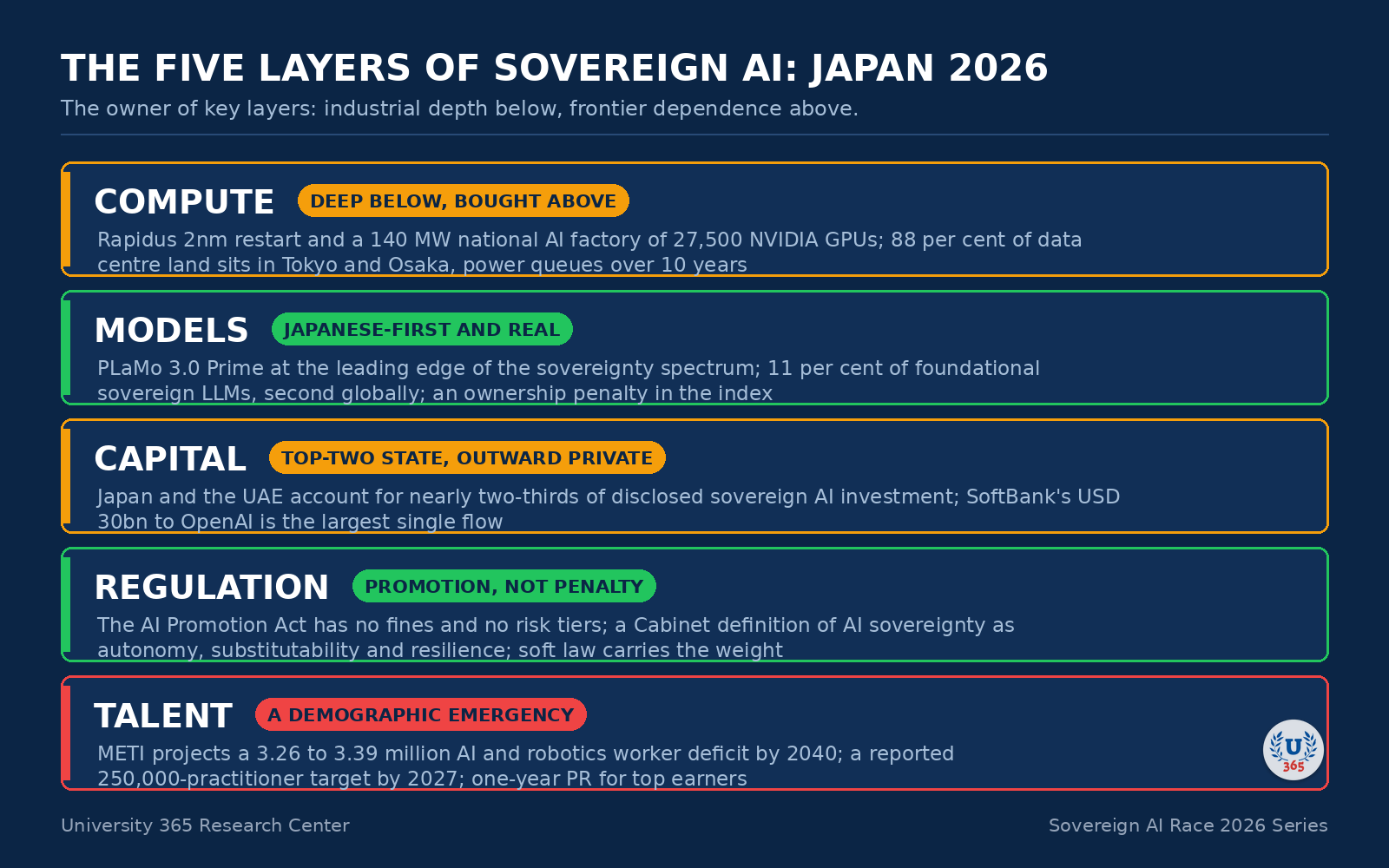
The five layers assessed. Industrial depth below, frontier dependence above, and a Cabinet definition written to manage the space between them. University 365 Research Center.
This is the eighth report in a twenty-part series assessing how states attempt to control the production of artificial intelligence inside their own jurisdiction. The framework is fixed and applied identically to every country. Sovereign AI capacity separates into five layers, and a state can hold any one of them without holding the others.
Compute sovereignty is the physical layer: where the chips and data centres sit, and who may switch them off. Model sovereignty is who builds the models a country depends on, and in whose languages and domains those models are competent. Capital sovereignty is who funds the build-out and on what terms. Regulatory sovereignty is who writes the rules and whether they can be enforced. Talent and education sovereignty is who builds and runs the systems, and how the next generation is prepared.
The series treats three races as running at once: the compute race, the model race and the rules race. A country can lead in one and lag in another, and Japan is the sharpest illustration so far of how far apart the three can sit. Japan owns, in the literal industrial sense, a large part of the substrate on which everyone's artificial intelligence is made: the materials, the deposition and etching equipment, the advanced packaging, the factory automation and the robots. It has a credible domestic model layer that writes in Japanese first. And it has chosen a competition law for AI that creates no penalties at all, on the deliberate theory that adoption, not enforcement, is what it needs.
The series places Japan in the "owner of key layers" posture, alongside the UAE, Saudi Arabia, France and India. The placement is a claim to be tested layer by layer, and this report tests it. The layers Japan owns, with evidence, are the industrial and materials layers, the robotics and physical AI layer, a domestic foundation-model layer with genuine Japanese-language depth, and a power policy machinery that can redirect electricity toward compute sites faster than most democracies. The layers Japan does not own are the frontier accelerator layer, the frontier general-purpose model layer, and the hyperscale cloud service layer, all of which are American-linked.
The vocabulary this report needs
Five terms recur, and they are defined here once.
AI Sovereignty, as the Japanese government defines it. The Cabinet's Priority Plan for the Realization of a Digital Society, decided on 21 July 2026, states that Japan will adopt the basic concept of ensuring autonomy, substitutability, and resilience against disconnection at each layer of data, computing infrastructure, models, and operations, to avoid situations where the country's independent choices are hindered by excessive dependence on digital goods such as AI and cloud services from specific countries or companies. This is the most precise official definition of AI sovereignty the series has found, and it maps almost word for word onto the five-layer frame used here. It is also a definition written for a country that knows it will keep buying from abroad, which is why "substitutability" and "resilience against disconnection" are its load-bearing terms rather than "self-sufficiency".
Announced capacity versus operational capacity. This report uses the distinction strictly. The physical AI factory in Hokkaido is announced at 140 megawatts and 27,500 accelerators for national use; Rapidus targets 2nm mass production in the second half of 2027; the government's Growth Strategy targets 370 trillion yen of investment by fiscal 2040. None of those is built capacity, and this report labels each one at its actual stage.
Residency is not jurisdiction. Foreign hyperscalers describe their Japanese data centres as sovereign because the data stays in Japan. The racks do stay in Japan. The contracting entity remains a United States company that is reachable under United States law regardless of where the racks sit. The genuinely Japanese-jurisdiction compute layer is the GPU capacity operated by Japanese companies such as Sakura Internet and SoftBank, and that distinction runs through the whole compute section.
The AI-trillion problem. Six different "trillion yen" figures circulate in Japanese AI policy, and conflating them is the easiest error a reader can make: 370 trillion yen is the total Growth Strategy envelope across 17 sectors to fiscal 2040; 101.6 trillion yen is the AI and semiconductors line inside it; 7.2 trillion yen is the cumulative government support for semiconductors and AI since 2021; 1.23 trillion yen is METI's fiscal 2026 budget line for cutting-edge semiconductors and AI; 1 trillion yen is the five-year ceiling for the physical AI factory programme, and separately the headline of the first AI Basic Plan; and 631.5 billion yen is METI's commitment to Rapidus. Every number in this report is labelled with its scope and period.
The ownership penalty. Counterpoint Research, in its Sovereign AI LLM Index for the first half of 2026, records that Japan accounts for 11 per cent of the world's foundational sovereign language models, second only to South Korea at 17 per cent, and then scores both countries lower on the ownership dimension because their models sit in government-backed private companies rather than in state hands. The term is the index's own, and it is an index methodology judgement, not a market outcome. It describes exactly the Japanese arrangement: the state funds and directs, private companies own and run.

Sovereign AI Race: Japan (2026)
The Question
Can a state own the layers it can build and rent the ones it cannot?
Japan has done something no other country in this series has done. It has written down, in a Cabinet document, what sovereignty in AI would actually mean for a country that has no intention of building everything itself. The answer it gives is layered interdependence management: hold what you can build, keep substitutes available for what you must buy, and make sure that a supplier cutting you off is survivable rather than fatal. Autonomy at each layer. Substitutability at each layer. Resilience against disconnection at each layer.
That is a coherent strategy, and it is also a testable one. If the definition is real, three things should be observable. The government should be able to switch models when it chooses, which means it should hold or fund domestic alternatives to whatever it runs today. The accelerator layer should have a credible non-NVIDIA substitute within the strategy's time horizon. And the capital the country marshals should build capacity it controls, rather than only capacity it rents.
The evidence assembled in this report tests each of those, and the results are mixed in a way that is specific rather than general. Japan's domestic model layer is real and growing, which supports substitutability at the model layer. The accelerator substitute exists on paper (Preferred Networks' MN-Core chips) but does not ship until 2027. And the country's single largest AI capital flow, SoftBank's commitment to OpenAI, builds frontier capacity in the United States, owned by an American laboratory. The binding constraints on the whole programme sit outside the AI budget entirely: the grid connection queue near Tokyo runs longer than a decade, and the workforce is shrinking.
So the question this report asks is narrower than whether Japan can build sovereign AI. It cannot, in the sense of building everything, and its own definition concedes that. The question is whether a state can convert industrial depth and policy precision into resilience faster than dependence accumulates, and what the honest scorecard looks like at the point where those two forces meet. Japan in late 2026 is the best-documented case in the series for that question, because no other country publishes both its dependence and its definition with the same clarity.

Sovereign AI Race: Japan (2026)
The Contradiction
The government that defined AI sovereignty most precisely runs foreign models in its own administration

The government office, the servers outside it, and the queue for capacity. University 365 Research Center.
Here is the paradox, stated as plainly as the evidence allows.
On 21 July 2026 the Cabinet adopted a definition of AI sovereignty that names autonomy, substitutability and resilience against disconnection as the goals at every layer of data, computing infrastructure, models and operations. Two weeks earlier, the digital administration's own AI platform, Gennai, was serving roughly 180,000 public servants across 39 ministries, and the models it called were all foreign: AWS Nova Lite and Anthropic's Claude Haiku 4.5, Sonnet 4.6 and Opus 4.8. The procurement of domestic language models for Gennai begins in fiscal 2027. The country that wrote the most careful definition of independence was, on the day it wrote it, running its government on rented American models, inside a certified government cloud rather than on Japanese hardware.
That is the first tension, and it is not a scandal. It is a sequencing choice, made explicit in the plan: fiscal 2026 is for mapping the strengths, weaknesses and biases of multiple foundation models, and fiscal 2027 is for an integrated platform to select, coordinate and evaluate domestic and international models and to keep the possibility of switching to alternatives if a provider fails or withdraws. Substitutability, by the government's own definition, is being engineered deliberately rather than assumed. But the sequence has a direction the definition does not hide: today the government depends, and the switch is a plan.
The second tension is the capital flow. Japan is one of the two largest disclosed sovereign AI investors in the world, according to the Center for a New American Security's sovereign AI index: Japan and the UAE alone account for over two-thirds of total disclosed investment in the April 2026 edition, with disclosed investment in tracked projects totalling 83.9 billion dollars through June 2026. In the same period, Japan's largest private AI champion, SoftBank Group, committed 30 billion dollars to OpenAI, funded partly by selling its entire NVIDIA stake and part of its stake in T-Mobile. The country is simultaneously a top-two state financier of sovereign AI projects and the principal private financier of an American frontier laboratory's build-out. Both facts are true, and the second one is larger than any single domestic programme the first one pays for.
The third tension is inside the compute layer itself. The national physical AI factory, announced on 16 July 2026, is a 140-megawatt facility of 27,500 NVIDIA Rubin GPUs and 13,750 Vera CPUs, built by Noetra Corp under METI's FRONTia programme. It is the clearest physical-AI commitment in the world, and it is bought. The domestic alternative in that layer, Preferred Networks' MN-Core L inference chip, begins shipping to customers in 2027 alongside the same company's plans for an initial public offering to fund mass production. Until then, resilience against disconnection at the accelerator layer is a 2027 promise attached to a 2026 purchase.
And the fourth tension is the one every Japanese policy document names first: the constraints that money cannot rush. Eighty-eight per cent of the country's data centre land sits in Greater Tokyo and Greater Osaka, and near Tokyo the queue for grid connections can exceed ten years, which is why the state has begun redesignating whole regions as strategic power and data zones. The workforce is the other half: METI projects a deficit of between 3.26 million and 3.39 million AI and robotics workers by 2040, on a broad definition that includes on-site operators, and the country has been training toward a target of 250,000 AI practitioners by 2027. The strategy's precision at the definitional layer coexists with arithmetic at the demographic layer that no definition can change.

Sovereign AI Race: Japan (2026)
The Current State
Compute: a chip restart, a national AI factory, and a grid that has not kept up
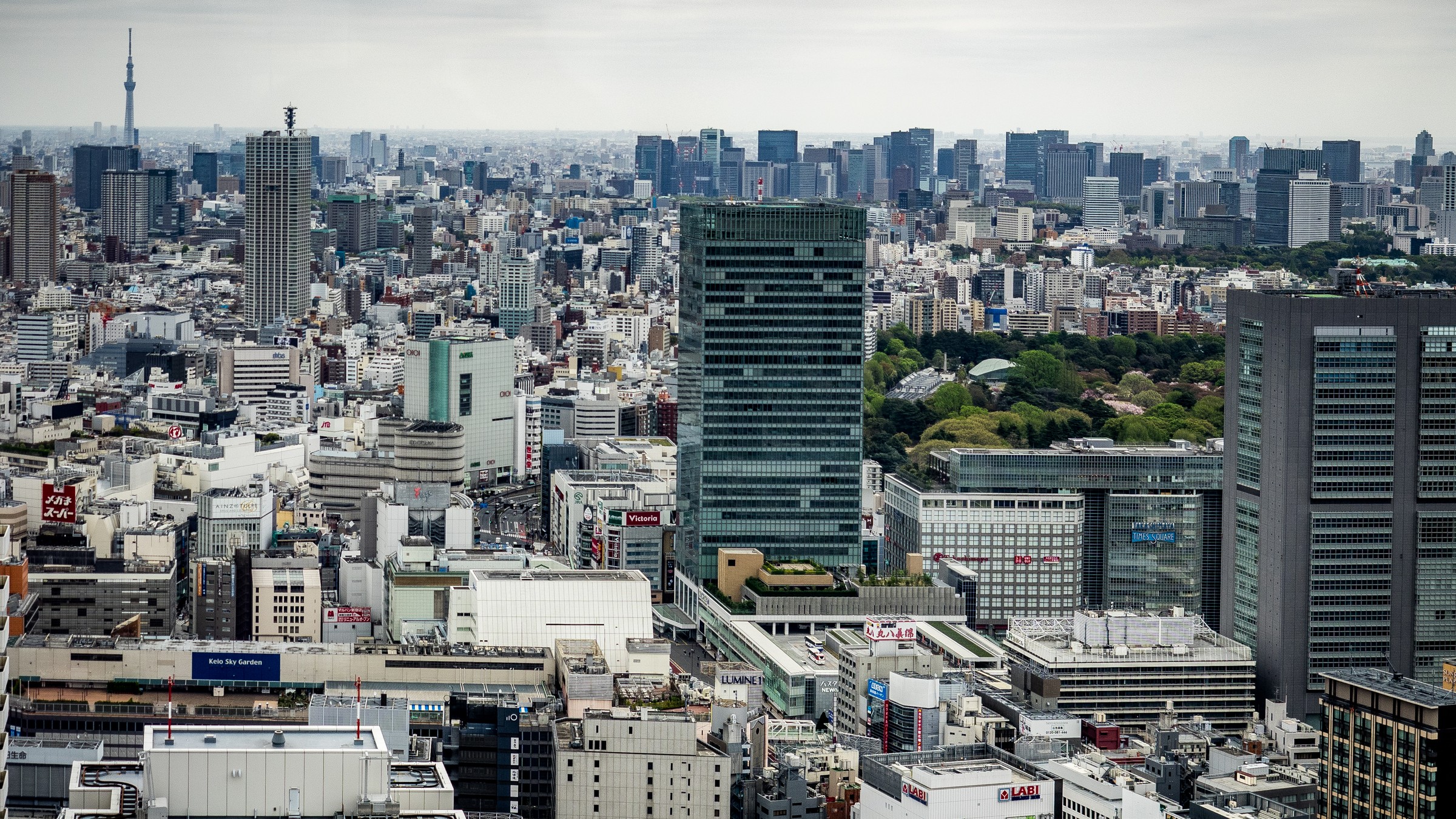
The Shinjuku skyline, Tokyo. Eighty-eight per cent of Japan's data centre land sits in Greater Tokyo and Greater Osaka, and near Tokyo the grid connection queue can exceed ten years. Photograph: Ajay Suresh, CC BY 2.0, via Wikimedia Commons.
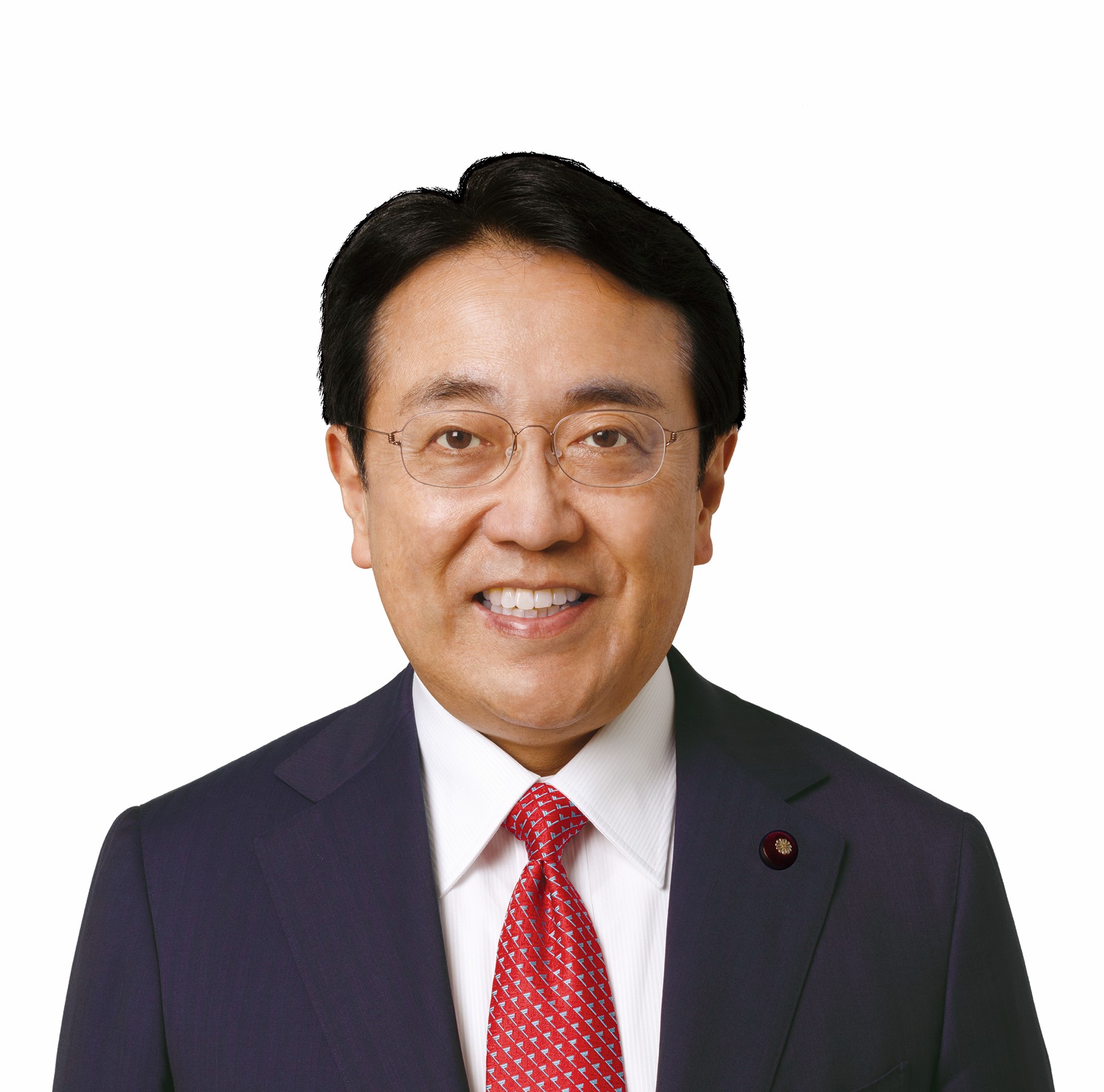
Ryosei Akazawa, Minister of Economy, Trade and Industry of Japan, as of 2026. METI carries the physical AI factory programme and the FRONTia project, and described FRONTia as the core of the country's physical AI build. Photograph: Cabinet Office, CC BY 4.0, via Wikimedia Commons.
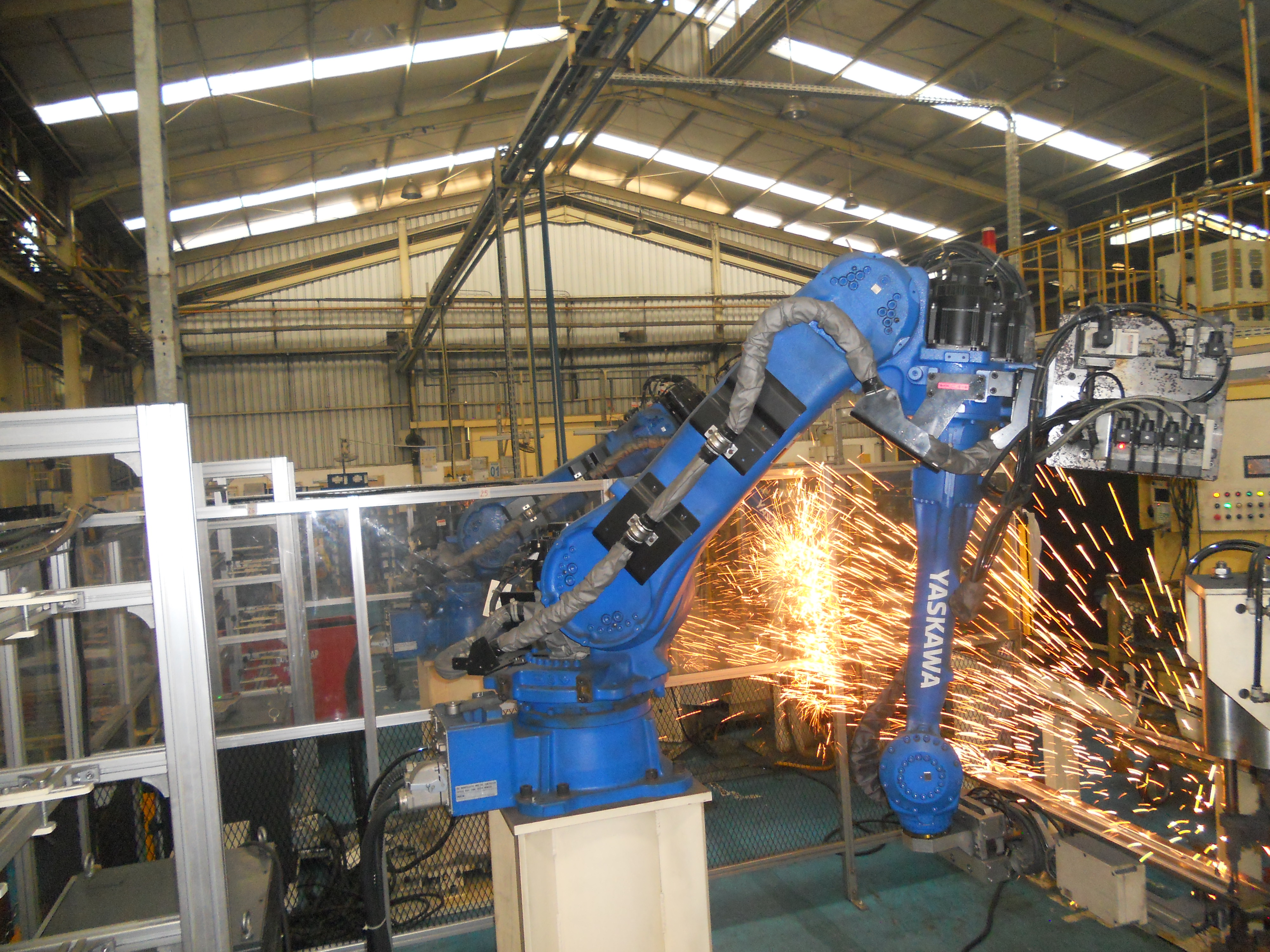
A Yaskawa welding robot at work. Japan's robotics and factory automation base is the layer the state's physical AI programme builds on, and the stated target is more than thirty per cent of the global AI robotics market by 2040. Photograph: Ptmetindoerasakti, CC BY-SA 4.0, via Wikimedia Commons.
Japan's compute position is the most layered in the series, and each layer moves at a different speed.
At the fabrication layer, the state-backed foundry Rapidus is rebuilding what Japan lost thirty years ago. It is building a 2nm logic fab at Chitose in Hokkaido, verified Japan's first 2nm gate-all-around transistor during fiscal 2025, secured 267.6 billion yen from the government and private companies in February 2026, and received NEDO approval of its fiscal 2026 plan and budget on 11 April 2026. It told The Register in April 2026 that it is on track to begin mass production in the second half of 2027, five years after founding, which the article notes will make it a little late to the 2nm generation: Samsung, TSMC and Intel all began 2nm volume production in 2025. The process technology comes from IBM under a Japan-United States collaboration frame, and the company has added an analysis centre and a chiplet solutions facility in Hokkaido. Alongside Rapidus sit the foreign fabs Japan hosts: TSMC's JASM in Kumamoto, whose second fab was upgraded to a 3nm plan with mass production expected in 2028 and up to 4.62 billion dollars of Japanese subsidies approved, and Micron's Hiroshima DRAM and HBM base (reported subsidies of 536 billion yen, labelled as reported). The materials and equipment base that made Japan indispensable to global chipmaking in the first place never left; what is being rebuilt is the leading-edge logic layer on top of it.
At the AI compute layer, the national flag is the physical AI factory announced on 16 July 2026: an NVIDIA Vera Rubin installation of 13,750 Vera CPUs and 27,500 Rubin GPUs across roughly 382 NVL72 racks, delivering 140 megawatts, built and operated by Noetra Corp with METI support of up to 1 trillion yen over five years and a fiscal 2026 first tranche of 387.3 billion yen through GX Economy Transition Bonds. It provides the computing foundation for FRONTia, METI's programme to develop multimodal foundation models for robotics and physical AI, and NVIDIA describes it as the world's first national AI infrastructure for physical AI, a vendor framing this report labels. The goal METI attaches to the wider AI robotics strategy is a claim with a number: more than 30 per cent of the global AI robotics market by 2040, an estimated 133 billion dollar opportunity. The national open research infrastructure is ABCI 3.0 at AIST in Kashiwa, tracked by CNAS as an operational sovereign AI infrastructure project, providing open AI cloud supercomputing to industry, government and academia.
Then there is the constraint that governs all of it, and Japan documents it itself. In NTT's presentation to an International Telecommunication Union workshop on 29 June 2026, the company states that 88 per cent of all data centre land in Japan sits in Greater Tokyo and Greater Osaka, that securing land is becoming harder, and that in the Tokyo area grid development has not kept up with demand, with waiting times for power supply that can exceed ten years. The example given is Inzai City in Chiba Prefecture, where as of March 2025 forty customers were waiting for power, totalling 2.5 gigawatts. Wood Mackenzie analysis reported in June 2026 projects data centre electricity demand nearly tripling by 2034, with peak data centre demand alone reaching 6.6 to 7.7 gigawatts and data centres accounting for 60 per cent of total power demand growth, consuming the equivalent of 15 to 18 million households.
The state's response is industrial policy applied to electricity. On 11 September 2026 METI certified the first 18 GX Strategic Areas, regions to be backed with land-use deregulation, anticipatory grid development and subsidies; nine of the 18 are data centre cluster type, with entry requiring the ability to grow grid connection to roughly one gigawatt, and the certified data-centre regions run from Ishikari and Tomakomai in Hokkaido through Akita, Miyagi, Tochigi, Ibaraki, Toyama, Kagawa and Fukuoka to Kagoshima. Eight further zones were designated for decarbonised power use around nuclear and renewable generation. On the generation side, Japan is restarting its nuclear fleet as a matter of AI industrial policy: the Seventh Strategic Energy Plan of February 2025 restored nuclear to a maximised role targeting about 20 per cent of electricity by 2040; the Kashiwazaki-Kariwa Unit 6, the world's largest nuclear unit by capacity, came back online in February 2026 after more than fourteen years offline, with one source dating the resumption of commercial operation to 16 April 2026 and another describing the reactor coming back online on 9 February 2026, a conflict this report states rather than resolves; and on 4 August 2026 the government decided to rebuild 2 to 5 reactors by the 2040s and 11 to 14 cumulatively by the 2050s, explicitly tied to AI data centre and advanced manufacturing demand.
The private and foreign pipeline is large and mostly announced. A Nikkei survey of 26 major Japanese data centre operators, reported in 2026, found 22 planning to increase AI-focused capacity more than fourfold by 2033 against roughly 10 trillion yen of spending, with NTT alone planning 2 gigawatts of total capacity by fiscal 2033; Blackstone has committed 30 billion dollars to build more than a gigawatt in Japan over three to five years; and Abu Dhabi's Mubadala is reported to be considering a project of approximately 1 trillion yen in Akita Prefecture targeting 500 megawatts. These figures come from aggregator and secondary reporting and are labelled as claims. On the foreign hyperscaler side, the individually confirmed anchor points are Microsoft's 10 billion dollars for 2026 to 2029, announced in Tokyo on 3 April 2026 with Prime Minister Sanae Takaichi and built with SoftBank and Sakura Internet supplying GPU capacity; Oracle's approximately 1.2 trillion yen commitment announced on 15 April 2026; and AWS's reported 2.26 trillion yen through 2027, carried by secondary sourcing. Aggregate tallies of about 26 billion dollars in international commitments use different scopes and should not be summed into one headline.
Capital: 370 trillion yen of direction, and the largest flow that goes out

Sanae Takaichi, Prime Minister of Japan, as of 2026. She chairs the AI Strategy Headquarters established under the AI Promotion Act and directed the seven AI priorities of December 2025, and told the UN General Assembly in September 2026 that Japan intends to host an AI safety summit at the earliest opportunity. Photograph: MOFA via the Cabinet Public Affairs Office, CC BY 4.0, via Wikimedia Commons.
Japan's capital position is the clearest case in the series of a state that sets direction and provides first-loss capital while the frontier is funded by private money that faces outward as often as inward.
The headline is the Growth Strategy announced on 24 June 2026: total public and private investment exceeding 370 trillion yen, about 2.3 trillion dollars, by fiscal 2040 across 17 sectors and 62 products and technologies. The AI and semiconductors line inside it is 101.6 trillion yen, which Asahi Shimbun renders as 102 trillion yen, a conflict this report records; 68 trillion of that is semiconductors, alongside 10.5 trillion yen for physical AI including AI robots and 20.5 trillion yen for next-generation wireless. The split between public and private contributions was not disclosed, the government assumes an additional 10 trillion yen in annual spending under its most optimistic scenario, and a separate multi-year investment framework is to be funded through government bonds backed by future redemption resources. This is a roadmap target, not appropriated spending, and it is labelled as such.
Underneath the envelope sit the actual budget lines, each with its own scope. Since 2021 the government has set aside about 7.2 trillion yen for semiconductors and AI cumulatively, including roughly 2.6 trillion yen of public support to Rapidus. METI nearly quadrupled its fiscal 2026 allocation for cutting-edge semiconductors and AI to approximately 1.23 trillion yen, of which 387.3 billion yen is earmarked for AI specifically: domestic foundation models, data infrastructure and physical AI. The first AI Basic Plan, decided by the Cabinet on 23 December 2025, carried more than 1 trillion yen of AI investment alongside a government AI service for 100,000 public servants and an expansion of the AI Safety Institute toward 200 staff. The physical AI factory programme carries a five-year ceiling of up to 1 trillion yen and the fiscal 2026 tranche of 387.3 billion yen. METI's cumulative commitment to Rapidus is reported at 631.5 billion yen on top of the company's February 2026 raise of 267.6 billion yen. Six different figures, six different scopes, and the report repeats them with their scopes attached because the Japanese policy space itself treats them as interchangeable in headlines.
The independent read on all of this is the strongest single data point in the capital layer. The Center for a New American Security's sovereign AI index, published on 20 April 2026 and updated on 18 August 2026, finds that the ten largest spenders account for roughly 90 per cent of all disclosed sovereign AI investment, and that Japan and the UAE alone account for nearly two-thirds of the disclosed total, which reached 83.9 billion dollars through June 2026. Japan's METI cloud programme is the index's illustrative infrastructure example. The caveat must travel with the claim, in the index's own words: disclosed totals encompass everything from announced roadmaps to operational spending, source documents do not consistently distinguish the stages, and the totals should be read as an aggregate across the pipeline rather than as deployed capital. At the same time, the index finds that roughly 70 per cent of tracked sovereign AI projects globally involve at least one foreign partner, four-fifths of those American, a structural finding that applies to Japan as much as to anyone.
And then the flow that goes out. SoftBank Group committed 30 billion dollars to OpenAI, with a 19 billion dollar initial investment specifically for Stargate, funded partly by selling its entire NVIDIA stake for 5.83 billion dollars and part of its T-Mobile stake for 9.2 billion dollars. A separate secondary source states SoftBank committed 100 billion dollars to Stargate overall, which this report treats as not verified. The Japanese sovereign fund layer is thinner than the strategy's scale suggests: the Japan Investment Corporation is an authorized corporation under METI with total assets of 1.85 trillion yen as of March 2024, but this research found no verified JIC-specific AI investment, and the report does not attribute any. The Akita prefecture projects carry reported Gulf interest, including a roughly 1 trillion yen Mubadala-linked plan, labelled as reported.
Models: a real domestic layer, built in Japanese
Fushimi Inari, Kyoto. The Second AI Basic Plan commits Japan to developing high-quality Japanese-language data and evaluating trustworthy AI based on the country's culture and customs. Photograph: Balon Greyjoy, CC0, via Wikimedia Commons.
Japan's model layer is the part of the stack where sovereignty claims are easiest to test, and the tests come back mostly positive.
Counterpoint Research's Sovereign AI LLM Index for the first half of 2026, published on 30 July 2026 and covering over 80 countries and 170 active models, places Japan's PLaMo 3.0 Prime from Preferred Networks among the models at the leading edge of the sovereignty spectrum, and records Japan at 11 per cent of foundational sovereign language models, second only to South Korea's 17 per cent. The index attaches the ownership penalty finding: both countries score lower on ownership because their models run on government-backed private ownership rather than direct state affiliation. Counterpoint separately finds that 56 per cent of sovereign models worldwide are adaptations of foreign bases, with Meta's Llama the dominant source at 38 per cent of adapted sovereign models, followed by Alibaba's Qwen and France's Mistral. Japan's position is on the native side of that line more often than most.
The domestic lab layer has four named anchors. Preferred Networks, founded in Tokyo in 2014, develops the MN-Core AI processor series, a cloud service and the PLaMo foundation model as a vertically integrated stack; its chief executive said in September 2026 that the company is seeking an initial public offering to fund chip mass production, with samples to customers in the first half of 2027 and commercial launch by December 2027. NTT provides tsuzumi 2, a lightweight Japanese-processing model sold on-premises or in private clouds, which the company frames as built from scratch with all training data under its own control; the framing is NTT's, and the on-premises deployment path matters because it is the one part of the stack a customer can hold entirely inside its own walls. SoftBank's SB Intuitions launched the Sarashina3 series in June 2026, with mini and embedding pre-trained on more than 30 trillion tokens primarily in Japanese and English, served through SoftBank's own sovereign cloud built on Oracle Alloy; it also publishes open-weight models under MIT and its own non-commercial licence, a track record running from Sarashina2 in 2024 to a text-to-speech model in April 2026. Rakuten unveiled Rakuten AI 3.0 in December 2025, a mixture-of-experts model of approximately 700 billion total and 40 billion active parameters, and released it under the Apache licence in spring 2026; its comparison table, which is the vendor's own and labelled as such, shows a Japanese MT-Bench score of 8.88 against 8.67 for gpt-4o.
The private flagship by valuation is Sakana AI, which reached a valuation of roughly 400 billion yen after its November 2025 Series B and 432 billion yen, about 2.7 billion dollars, at its April 2026 update, with strategic investors including Google, Citi, Mitsubishi Electric and In-Q-Tel, the United States intelligence community's venture fund. A discrepancy in the record should be stated: Sacra records cumulative funding of about 52 billion yen and a 2.63 billion dollar valuation against the company's own reported 66 billion yen and 412 million dollar cumulative figures, and this report states both rather than choosing. Sakana's chief executive has acknowledged that no proven profitable generative AI business model has yet emerged in the field and raised the possibility of a broader valuation bubble, which is the most useful sceptical counterweight in the model layer.
On weights policy, the honest statement is that Japan has no stated national open-weights policy. The government funds capability through GENIAC, the METI and NEDO programme that has run since February 2024 and selected 16 projects in its fourth cycle on 4 June 2026, without mandating a weight posture. The mix that results is genuinely mixed: open weights from SB Intuitions and Rakuten, proprietary frontier work at Sakana and Preferred Networks, and on-premises product from NTT. The Second AI Basic Plan commits to developing high-quality Japanese-language data and evaluating trustworthy AI based on Japan's culture and customs, and it welcomes top talent from Japan and abroad, but it does not settle the weights question either.
Regulation: a promotion act, a precise definition, and soft law that carries the weight
Japan's regulatory position is the first in the series built on a promotion statute rather than a control statute, and the design is deliberate.
The AI Promotion Act, formally the Act on Promotion of Research and Development and Utilization of AI related Technology and commonly Act No. 53 of 2025, was enacted on 28 May 2025 and has been fully in force since 1 September 2025. It contains no prohibited practices, no risk tiers, no conformity assessments, no fines and no market surveillance authority. Its enforcement tools are guidance, advice and announcement. It creates the AI Strategy Headquarters in the Cabinet, chaired by the Prime Minister with every cabinet minister a member, and obliges the government to produce and revise an AI Basic Plan; the only business-facing duty is a non-binding obligation to cooperate. Against the European Union's penalty architecture, Korea's basic act and China's interim measures, Japan's statute does the least of any major economy, on the explicit theory that the country's problem is adoption, not abuse.
The operating instruments are the two AI Basic Plans and the soft law beneath them. The first Basic Plan, decided on 23 December 2025 under the subtitle Japan's Resurgence through Trustworthy AI, sets the ambition for Japan to be the country most conducive to developing and using AI in the world, and candidly acknowledges that Japan has fallen behind other major economies in AI investment, commercialisation and talent depth. The second plan, adopted on 14 July 2026, shifts the top priority to frontier AI risk, adds commitments on AI-enabled cybersecurity, synthetic content detection, AI sovereignty and international governance, and folds the strategy into a deregulation programme: the government will proactively and fundamentally review legal systems, guidelines and regulations related to the development and utilisation of AI. Nineteen priority fields carry concentrated public-private investment, running from manufacturing, logistics and information and communications through finance, health, agriculture, construction, education, energy and disaster prevention to defence, cybersecurity, space, ocean and scientific research; the government's own count is 19, and this report uses it.
The definitional centrepiece is the 21 July 2026 Cabinet document quoted in the vocabulary above, which commits Japan to autonomy, substitutability and resilience against disconnection at each layer of data, computing infrastructure, models and operations. Its purpose clause names the fear directly: avoiding situations where the country is placed in a subordinate position because of excessive dependence on AI and cloud services from specific countries or companies. For a series that separates sovereign AI capacity into five layers, a national definition that separates it into four layers of its own, and treats substitutability as the test, is as close to a shared frame as the series has found.
Enforcement, in the absence of penalties, is carried by soft law. The AI Guidelines for Business, published jointly by METI and MIC, reached version 1.2 on 31 March 2026: 42 pages plus 185 pages of annexes, with the first explicit scope for AI agents and physical AI, a tiered requirement effectively placing human-in-the-loop control wherever an AI system takes an external action, and training-data traceability upgraded from recommended to required. The guidelines are legally voluntary and function as the de facto standard of care, which this report notes is exactly the arrangement the statute intends. The AI Safety Institute, established in 2024 and staffed at 31 as of April 2026 with targets of 60 near-term and around 200 at United Kingdom scale, evaluates and publishes guidance but issues no approvals and no fines, and has published no frontier-model evaluations.
Two data instruments matter for the model layer. The Act on the Protection of Personal Information was amended by a bill the Cabinet approved on 7 April 2026; the Diet passed it on 10 July 2026 and it was promulgated on 17 July 2026 as Act No. 56 of 2026, enacted but not yet in force, with commencement to be fixed by cabinet order. Its most commercially significant provision creates a consent exemption for processing that creates statistical information, which the Personal Information Protection Commission indicates may include AI development, subject to transparency measures and contractual safeguards; the same amendment strengthens protections for biometric data. On copyright, Article 30-4 of the Copyright Act already permits use of works, including for training, where the use does not involve enjoying the ideas or sentiments expressed, and the Agency for Cultural Affairs' 2024 guidance states that collecting training data while knowingly including pirated material should be strictly avoided. The government's procurement guidelines, revised on 12 June 2026, state that confidential information in principle cannot be handled in cloud generative AI services offered to unspecified users under standard terms, which is the rule that pushes sensitive workloads toward the on-premises arrangements companies like NTT sell.
Talent: a demographic emergency, and a visa system to match
Japan's talent position is the clearest case in the series of a country whose AI policy is driven by demography rather than by ambition, and its instruments follow from that.
The scale of the projected gap is the largest in the series. METI projects a deficit of between 3.26 million and 3.39 million AI and robotics workers by 2040, broken into roughly 1.8 million specialised technology workers and 2.6 million on-site AI and robotics operators across construction and service industries, with the Kanto region alone short 890,000 workers, and a projected shortage of 600,000 science and engineering university graduates even as the country has a surplus of liberal arts graduates. The number must carry its scope: it describes AI and robotics operation talent broadly, including on-site operators, not AI engineers. Alongside it sit the narrower projections: a METI estimate of a 380,000 IT specialist shortage by the end of 2026 as quoted in recruiting coverage, a trade ministry projection of a 220,000-person IT talent gap in the same year carried by a different source, and a Japan Economic Research Center forecast of a 430,000-person digital shortfall in Tokyo alone, which this report presents as a range with each source named. The national training target is 250,000 AI practitioners by 2027, a figure this research could trace only to secondary sources, so it is labelled as a reported target. Semiconductor talent carries its own projection, more than 35,000 skilled workers short by 2030, labelled as reported.
The immigration architecture is where the intent is most explicit. Japan operates a special fast track for highly skilled professionals that admits engineers earning at least 20 million yen a year, bypasses the points-based system and offers permanent residency in one year; a visa for graduates of top-100 world universities to job-hunt or start companies for up to two years; and a digital nomad visa for those earning at least 10 million yen a year, all on top of the standard engineer and specialist route. These are Tier 3-sourced and labelled, and the Second AI Basic Plan's own language commits Japan to actively welcoming top talent from Japan and abroad. The corporate response runs alongside: Hitachi, NTT Data, NEC and Fujitsu have all run conversion bootcamps taking liberal arts and business graduates into entry-level engineering roles, and Microsoft's Japan commitment includes training more than one million engineers, developers and workers by 2030 with five major Japanese partners, a claim pending the company's own announcement text.
The institutions are longstanding and deep. RIKEN's Center for Advanced Intelligence Project and AIST's AI Research Center anchor public research; the Institute of Science Tokyo, formed by the October 2024 merger of Tokyo Institute of Technology with Tokyo Medical and Dental University, runs institute-wide data science and AI education from first-year undergraduate through doctoral level and coordinates the national consortium for mathematics, data science and AI education. The AI Basic Plan's second edition embeds human resource development in each of the 19 priority fields through industry-academia-government councils. The demand-side data shows the conversion challenge: 86.4 per cent of Japanese firms use generative AI for at least one business task, up from 55.2 per cent a year earlier, but only 16 per cent have deployed it as an integrated tool company-wide, and just 8.4 per cent of Japanese workers use AI in their job, against 50 per cent in the United States and 56 per cent in Singapore on the OECD comparison carried by Reuters. Ministry of Finance data cited in the same coverage puts business adoption at 75 per cent, the MIC white paper at 86.4 per cent, and the Reuters and Nikkei Research poll at 16 per cent for deep integration; the definitions differ, and the report states the definitions rather than resolving the numbers. The framing that unifies all of it is demographic: with 29 per cent of the population aged 65 or over and fewer than 730,000 births in 2024, AI is treated in policy documents as shortage relief first, a frame that changes the politics of adoption relative to countries debating displacement.
What changed since our last report on Japan: there is no earlier report
University 365 has not published a Japan AI landscape report before this one. The series' prior-report mapping covers fourteen of its twenty countries, and Japan is not among them: the countries with earlier University 365 landscape reports are the UAE, Saudi Arabia, China, the United States, France, India, Morocco, Germany, the United Kingdom, Spain, Italy, Qatar and Bahrain. Japan, South Korea, Singapore, Brazil, Russia, Portugal and South Africa have none, and this report says so plainly rather than manufacturing a baseline it does not have.
What can be compared instead is Japan against itself within this report's own research window, 2024 to 2026, and the movement in that interval is documented throughout this section: an AI statute from nothing to fully in force; a Cabinet definition of AI sovereignty from absent to precise; a national AI factory from unnamed to announced at 140 megawatts; a nuclear restart policy reversed from post-Fukushima caution to rebuild targets; and an adoption figure that doubled in a single survey year in breadth while staying low in depth. The series will build its Japanese baseline from this report forward.

Sovereign AI Race: Japan (2026)
Key Findings
1. Japan is the clearest case in the series of a state that owns the industrial substrate and rents the frontier. It owns semiconductor materials, deposition and etching equipment, advanced packaging capability, factory automation, robotics and a domestic model layer. It rents the frontier accelerators (the national AI factory is NVIDIA), the frontier general-purpose models (its government runs AWS and Anthropic models), and the hyperscale cloud service layer (Microsoft, AWS, Oracle and Google, with Japanese partners supplying GPU capacity beneath them).
2. The government has written the most precise definition of AI sovereignty in the series, and it is a definition of managed dependence. The Cabinet's Priority Plan of 21 July 2026 commits Japan to autonomy, substitutability and resilience against disconnection at each layer of data, computing infrastructure, models and operations. Notably, it does not commit Japan to self-sufficiency, and the report's judgment is that the definition is honest about the country's actual strategy.
3. The government's own AI platform runs foreign models, and the domestic switch is scheduled for fiscal 2027. Gennai serves about 180,000 staff across 39 ministries using AWS Nova Lite and Anthropic Claude models as of July 2026, inside a certified government cloud. Fiscal 2026 is for comparative mapping of models; fiscal 2027 procurement is for domestic models with explicit provisions to keep switching possible. Widely quoted effectiveness figures from the 1,200-person pilot do not describe the 180,000-person deployment, and this report flags the difference.
4. Japan is one of the world's two largest disclosed sovereign AI investors, with a measurement caveat attached. CNAS finds Japan and the UAE account for nearly two-thirds of disclosed sovereign AI investment, which reached 83.9 billion dollars through June 2026, and uses Japan's METI cloud programme as its illustrative infrastructure case. The index's own caveat is reproduced here: disclosed totals mix announced intent with deployed spending and should not be read as deployed capital.
5. The largest single Japanese AI capital flow goes outward. SoftBank committed 30 billion dollars to OpenAI, funded partly by selling its entire NVIDIA stake and part of its T-Mobile stake. No domestic Japanese programme in the window matches that scale on its own, and the report treats this as a structural feature of the Japanese position rather than an anomaly.
6. The chip restart is real and on a stated schedule that has not yet been tested. Rapidus verified Japan's first 2nm gate-all-around transistor during fiscal 2025, raised 267.6 billion yen in February 2026, and received NEDO's approval of its fiscal 2026 plan on 11 April 2026; it targets 2nm mass production in the second half of 2027, which the trade press notes is late relative to Samsung, TSMC and Intel, all of which entered 2nm volume production in 2025. The process technology is licensed from IBM under a Japan-United States frame.
7. The binding compute constraint is grid access, and it is quantified. 88 per cent of data centre land sits in Greater Tokyo and Greater Osaka; power supply queues near Tokyo can exceed 10 years, with 40 customers waiting for 2.5 gigawatts in Inzai City alone as of March 2025. Japan's answer is a first-of-its-kind regional designation policy: 18 GX Strategic Areas certified on 11 September 2026, nine of them data centre cluster type with a gigawatt grid-connection entry requirement.
8. Nuclear is now AI industrial policy in Japan. The Seventh Strategic Energy Plan restored nuclear to a maximised role targeting about 20 per cent of electricity by 2040; the Kashiwazaki-Kariwa Unit 6 returned to service in 2026 as the first TEPCO restart since Fukushima; and on 4 August 2026 the government decided to rebuild 2 to 5 reactors by the 2040s and 11 to 14 cumulatively by the 2050s, explicitly tied to AI data centre demand. The report also records a dating conflict for the Unit 6 commercial resumption between two sources.
9. The domestic model layer is real, Japanese-first, and mixed on weights. Counterpoint puts Japan at 11 per cent of foundational sovereign language models, second globally, with PLaMo 3.0 Prime at the leading edge of its sovereignty spectrum, and attaches an ownership penalty because the models sit in government-backed private companies. The stack spans NTT's on-premises tsuzumi 2, SB Intuitions' Sarashina3 served through a sovereign cloud, Rakuten AI 3.0's 700 billion-parameter mixture-of-experts open-weight release, and Sakana AI as the private flagship. No national open-weights policy exists, and this report says so.
10. The regulatory model is a promotion statute with no penalties, and soft law carries the enforcement weight. The AI Promotion Act contains no fines, no risk tiers and no prohibited practices; enforcement tools are guidance, advice and announcement. The operating instruments are the two AI Basic Plans, the 21 July 2026 sovereignty definition, and the AI Guidelines for Business at version 1.2, whose training-data traceability requirements and human-in-the-loop tiering function as the de facto standard of care. The APPI amendment, which creates a consent exemption covering AI development under statistical-processing terms, was passed on 10 July 2026, promulgated on 17 July 2026 and is enacted but not yet in force.
11. The talent gap is the deepest constraint and the policy treats it as a demographic emergency. METI's 2040 projection of a 3.26 to 3.39 million AI and robotics workforce deficit (a broad measure including on-site operators) sits above a national reported target of 250,000 AI practitioners trained by 2027 and a visa architecture offering one-year permanent residency to high earners. Microsoft's one-million-worker training commitment by 2030 covers roughly 30 per cent of the projected deficit and mostly produces AI-literate workers rather than engineers.
12. Adoption is broad and shallow, and the gap defines the real constraint. 86.4 per cent of firms use generative AI for at least one task; 16 per cent have deployed it company-wide; 8.4 per cent of workers use it in their jobs. The country that owns the factory floor has not yet connected it to the model layer at depth, and that connection is the stated purpose of FRONTia and the physical AI programme.

Sovereign AI Race: Japan (2026)
Deep Analysis
Why "autonomy, substitutability and resilience" is a smarter definition than "sovereignty"
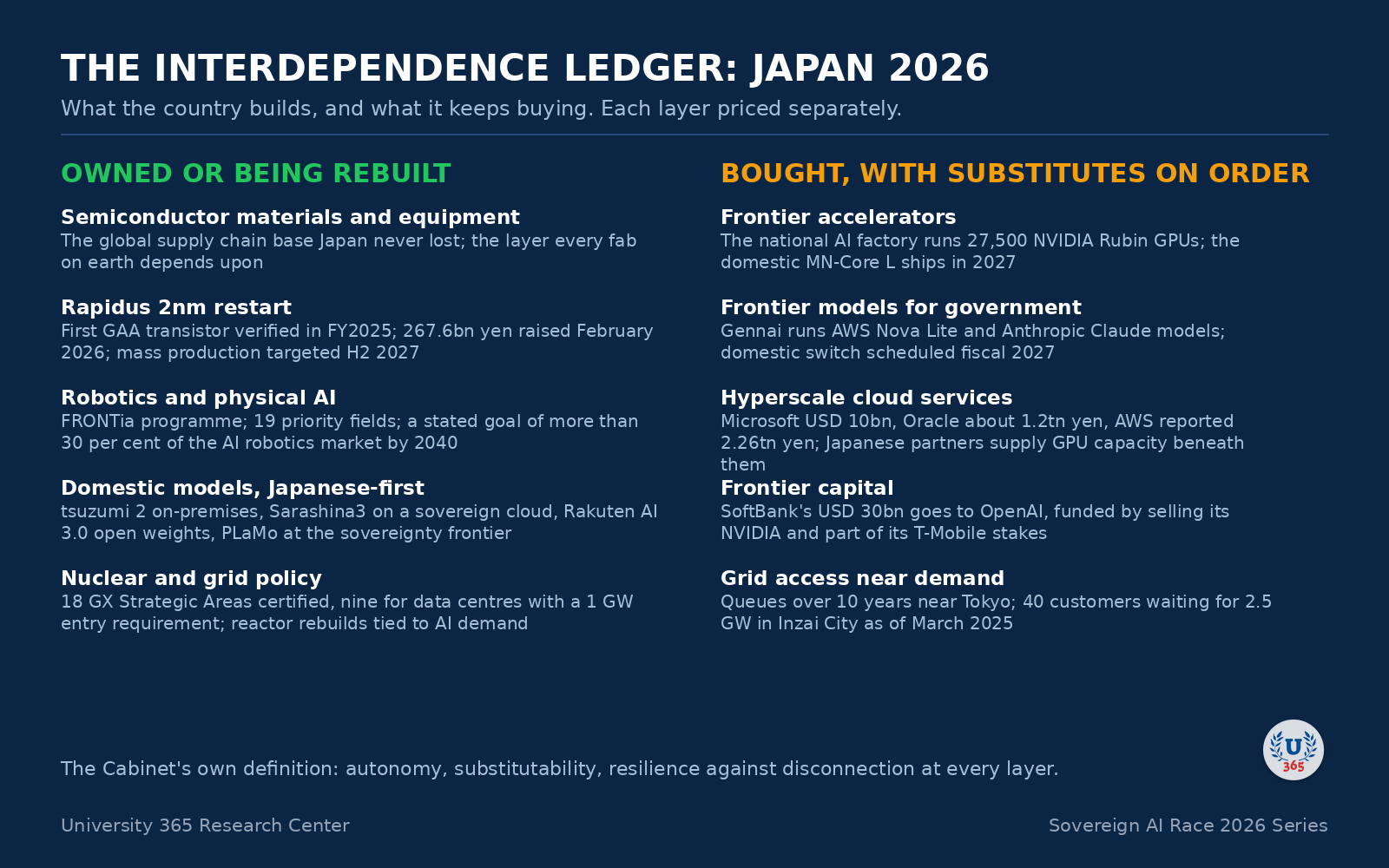
The interdependence ledger, layer by layer. University 365 Research Center.
Every other country in this series has defined its AI sovereignty ambitions in the language of capability: build the compute, build the models, own the stack. Japan's Cabinet chose different words on 21 July 2026, and the choice deserves close reading because it is the most analytically honest official definition the series has documented.
Autonomy means the country's choices are not made for it. Substitutability means that for each critical layer, more than one supplier exists, so no single provider can hold the country's operations hostage. Resilience against disconnection means that if a supplier is cut off, whether by war, sanctions or commercial decision, the consequence is degradation rather than failure. None of the three requires domestic production at the frontier. All three require deliberate redundancy, which is cheaper than autarky and harder than purchase, because it means buying and maintaining the second-best option on purpose.
Read the strategy against that definition and its internal logic appears. The physical AI factory buys NVIDIA at the frontier and funds Preferred Networks to ship the MN-Core L inference chip in 2027 beside it, which is substitutability being purchased in both directions at once. Gennai runs foreign models now and budgets for domestic model procurement in fiscal 2027 with a documented requirement to keep switching possible, which is substitutability on a schedule. The state funds GENIAC's four cycles of domestic model development without mandating an outcome on weights, which is optionality rather than doctrine. Japan's largest semiconductor revival, Rapidus, licenses process technology from IBM, because even the country's industrial rebuild is run as interdependence managed deliberately rather than dependence escaped.
The limit of the definition is that substitutability is only as good as the substitute. A domestic model that trails the frontier by a wide margin is a fallback, not a competitor, and the report's honest reading of the model layer is that Japan's domestic models are genuinely useful in Japanese and for enterprise deployment while sitting clearly behind the American and Chinese frontier. An accelerator that ships in 2027 is not a substitute for a purchase made today. The definition is a direction of travel, and Japan's own documents treat it that way: the sequence is explicit, and the test is whether the substitutes arrive before the dependency deepens.
The grid, the reactor and the gigawatt entry requirement
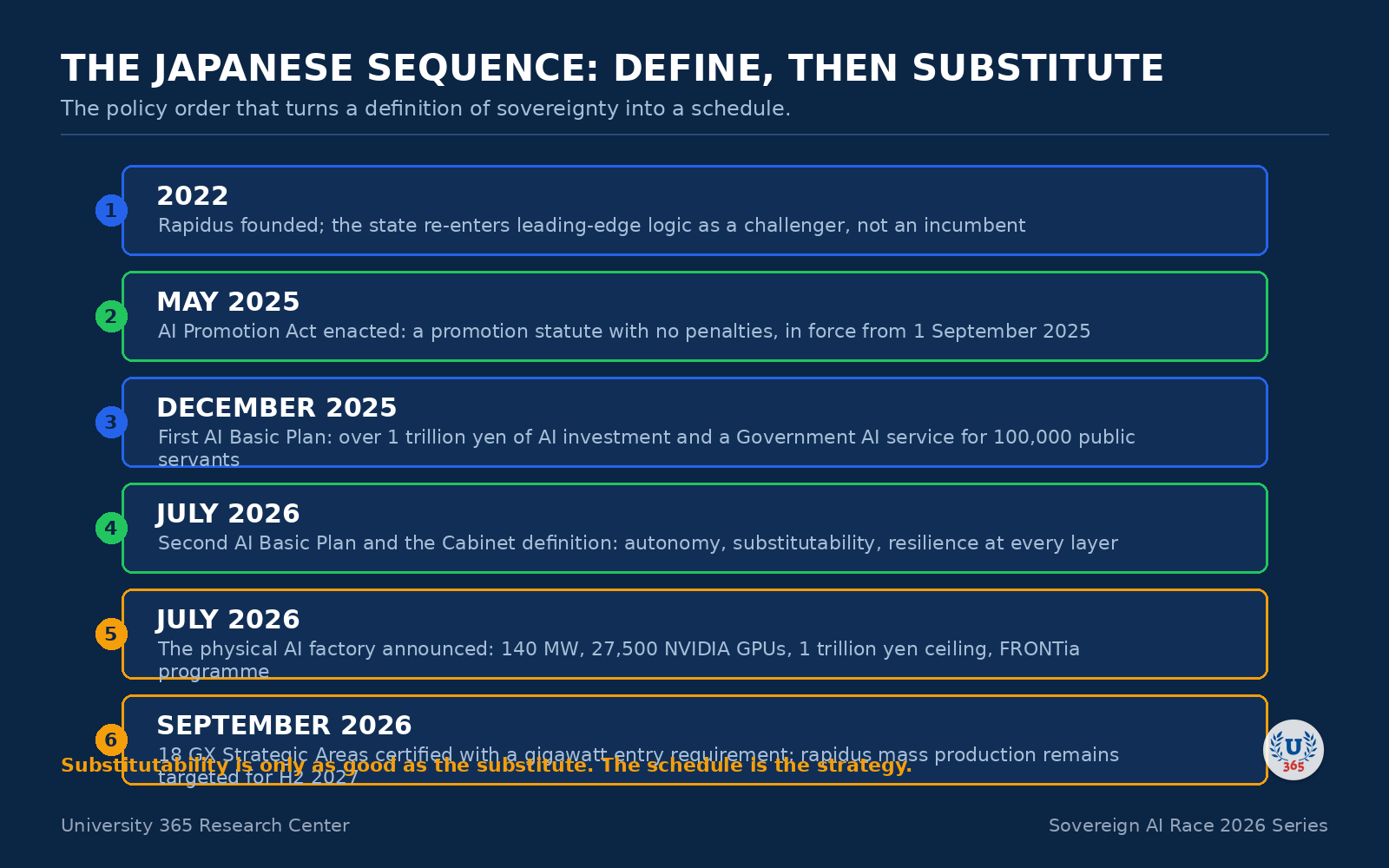
The Japanese sequence: define, then substitute. University 365 Research Center.
The most consequential number in Japan's AI policy is not in an AI document. It is the roughly one gigawatt grid-connection capability that METI requires of any region seeking designation as a data centre cluster area, set out in the certification of 18 GX Strategic Areas on 11 September 2026. Read against the two figures from NTT's June 2026 presentation, 88 per cent of data centre land in Greater Tokyo and Greater Osaka and power queues near Tokyo exceeding ten years, the requirement is the state acknowledging that the next generation of AI data centres cannot be built where the current ones are, and pricing the problem accordingly.
The policy response has three layers, and each carries a cost. First, geography: nine designated data centre zones, in Ishikari and Tomakomai in Hokkaido, Akita, Miyagi, Tochigi, Ibaraki, Toyama, Kagawa, Fukuoka and Kagoshima, each aiming at a gigawatt-class cluster over about a decade, with anticipatory grid development promised. The zones follow spare decarbonised power rather than the existing centres of demand, which means the workload is being moved to the electricity rather than the electricity to the workload. Second, generation: the nuclear restart programme is now explicitly an AI infrastructure programme, with the August 2026 decision to rebuild 2 to 5 reactors by the 2040s and 11 to 14 by the 2050s tied to data centre demand, and the Diplomat reports that new public funding for data centre and semiconductor facilities worth over a trillion yen requires that the electricity used come entirely from renewable or nuclear sources, an analytical characterisation this report labels. Third, the pipeline itself: the private and foreign commitments, from NTT's 2 gigawatts by fiscal 2033 through Blackstone's 30 billion dollars to the reported Mubadala interest in Akita, all land in the designated zones or near them, which is a state using land, power and deregulation as the industrial policy instruments it actually controls.
The comparison with the rest of the series is instructive. The UAE and Saudi Arabia buy power certainty with hydrocarbon wealth; France converts nuclear wealth into an AI argument; Morocco discovered that its binding constraint was water and heat. Japan is the first country in the series attempting to relocate its compute geography wholesale, moving a decade of data centre growth out of the two metropolitan areas that hold 88 per cent of the existing base, and the report's judgment is that this relocation, not any single fab or model, is the most ambitious industrial project in the Japanese strategy and the one most likely to determine its outcome.
The outward capital flow and what it means for the sovereignty ledger
Sovereignty accounting usually asks what a country has built. Japan's case suggests a second question that other countries in the series will face as their capital matures: where does the country's own money build? For Japan, a meaningful part of the answer is: in the United States.
SoftBank Group's 30 billion dollar commitment to OpenAI, with a 19 billion dollar initial tranche for Stargate, was funded by selling its entire NVIDIA stake and part of its T-Mobile stake. The company is simultaneously a partner in the domestic compute story through the SoftBank-led sovereign cloud and the Sarashina models, and the largest private financier of an American frontier laboratory. Both halves are rational from a shareholder perspective, and together they mean that a dollar deployed by Japanese private capital to build frontier AI capability in 2026 was more likely to purchase American capacity than Japanese. The state's own instruments show the same shape at a smaller scale: the CNAS index's finding that roughly 70 per cent of tracked sovereign AI projects involve at least one foreign partner, four-fifths American, is the global version, and Japan is its best-documented instance.
None of this makes Japan's position incoherent. A country whose private sector earns returns from global AI growth has more fiscal capacity to fund its own resilience programmes, and the alternative, blocking SoftBank's global investments to force domestic allocation, would cost the returns without guaranteeing the capability. But the ledger should read the way it actually is. Japan's sovereign AI strategy is funded by a state that invests directly at home and a private sector that invests at the frontier abroad, and the sum of the two produces a country with significant sovereign capacity at the industrial layers and significant continuing dependence at the frontier, which its own Cabinet definition anticipates precisely.
The three races, measured in Japan
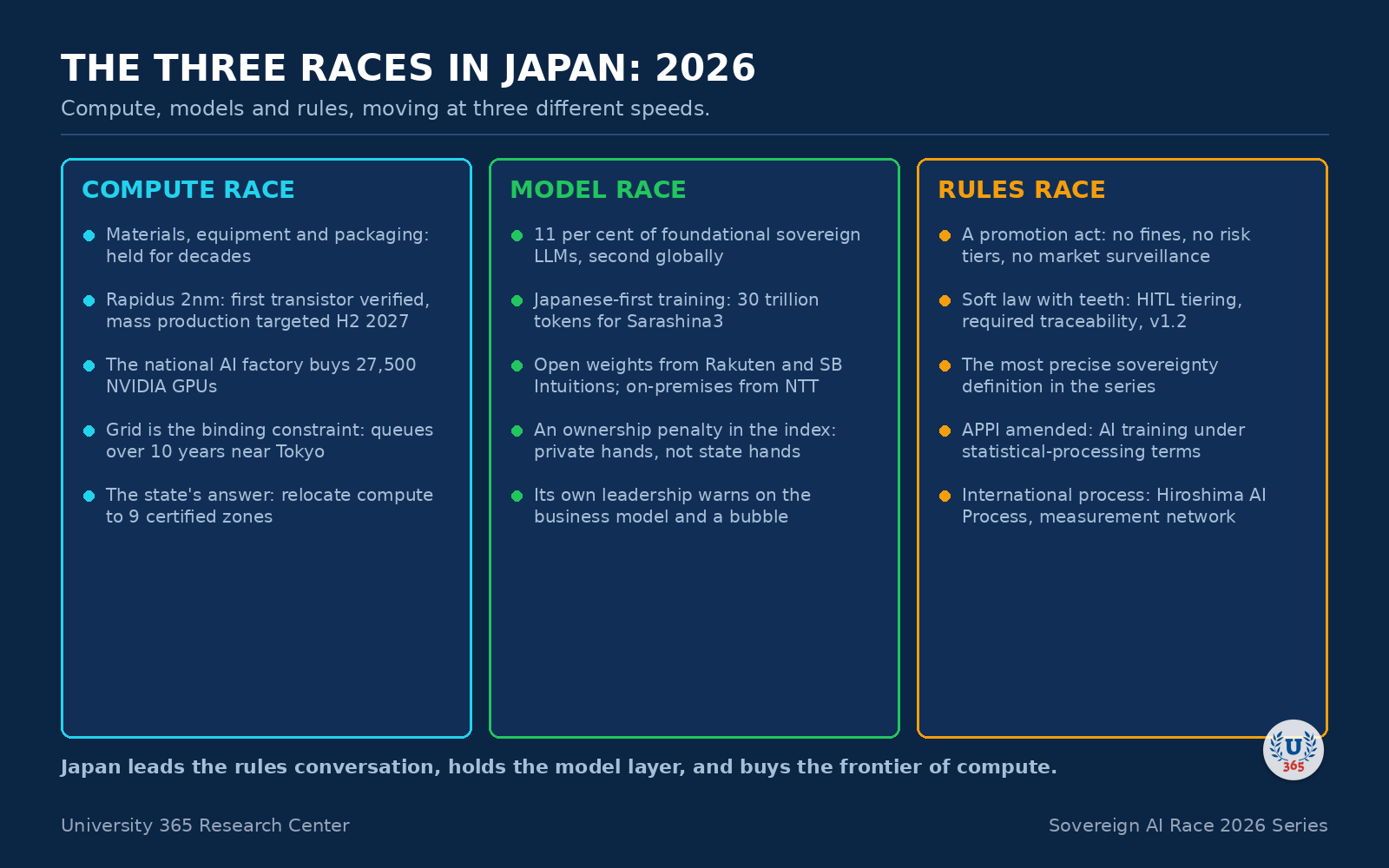
The three races in Japan, at three speeds. University 365 Research Center.
The series separates the compute race, the model race and the rules race. Japan is the cleanest case for how different their tempos are.
In the compute race, Japan is a fast follower with a materials monopoly. It hosts TSMC's second Kumamoto fab upgrading to 3nm, it is rebuilding its own leading-edge logic through Rapidus on a 2027 schedule, it has announced the world's first national physical AI factory at 140 megawatts, and it owns the equipment and materials layers that every fab on earth depends upon. It is not, and will not shortly be, the owner of the frontier accelerator layer.
In the model race, Japan holds second place by count of sovereign foundational models and a genuine language advantage, with a domestic stack that spans on-premises, cloud-served and open-weight deployment. By capability, its models sit behind the American and Chinese frontier, and the industry's own leadership says so candidly.
In the rules race, Japan has chosen the lowest-penalty framework of any major economy and compensated with soft law, international process leadership through the Hiroshima AI Process and the measurement network it helped rename, and the most precise sovereignty definition in the field. It writes norms at UNESCO and the G7 at a scale its statutes do not attempt.
The three tempos are visible in one sentence of the July 2026 plan: the government will review regulations fundamentally to accelerate AI, while ensuring autonomy, substitutability and resilience at every layer, over nineteen fields, with the switch to domestic models scheduled for the fiscal year after next. A reader who wants the Japanese position in one sentence has it there.

Sovereign AI Race: Japan (2026)
Data and Evidence
Table 1: The five layers, assessed for Japan in September 2026
Layer | What Japan holds | What it does not hold | Assessment |
Compute | Rapidus 2nm fab at Chitose, first GAA transistor verified, 267.6bn yen raised February 2026, mass production targeted H2 2027; TSMC JASM Kumamoto second fab upgraded to 3nm for 2028 with up to USD 4.62bn subsidies; physical AI factory announced at 140 MW with 27,500 NVIDIA Rubin GPUs; ABCI 3.0 operational at AIST; 18 GX Strategic Areas certified 11 September 2026, nine data centre type with a 1 GW entry requirement | Domestic frontier accelerators (MN-Core L ships 2027); grid headroom near the existing centres (88 per cent of data centre land in Greater Tokyo and Greater Osaka, queues over 10 years near Tokyo); announced capacity not yet built | Industrial depth, frontier bought, geography being relocated |
Models | PLaMo 3.0 Prime at the leading edge of Counterpoint's sovereignty spectrum; 11 per cent of foundational sovereign LLMs, second globally; tsuzumi 2 on-premises; Sarashina3 on a sovereign cloud; Rakuten AI 3.0 open weights at about 700bn parameters; Sakana AI at about USD 2.7bn valuation; GENIAC funding four cycles | Frontier general-purpose capability; any national open-weights policy; a proven profitable business model for generative AI at the domestic labs (its own leadership says so) | Real, Japanese-first, honestly positioned |
Capital | CNAS: Japan and the UAE account for nearly two-thirds of disclosed sovereign AI investment (USD 83.9bn tracked through June 2026); Growth Strategy of 24 June 2026 targeting 370tn yen by FY2040 with 101.6tn for AI and semiconductors; METI FY2026 budget of about 1.23tn yen for semiconductors and AI; 7.2tn yen cumulative support since 2021; JIC with 1.85tn yen in assets | A domestic deployment of the largest private flow (SoftBank's USD 30bn goes to OpenAI); verified JIC-specific AI investments; a published public-private split for the Growth Strategy | Top-two state funder, outward private champion |
Regulation | AI Promotion Act in force since 1 September 2025, no penalties; AI Strategy Headquarters under the PM; two AI Basic Plans (23 December 2025, 14 July 2026); Cabinet AI Sovereignty definition of 21 July 2026; Guidelines for Business v1.2 with HITL tiering and required traceability; APPI amendment passed 10 July 2026, promulgated 17 July 2026, not yet in force; APPI statistical-processing exemption for AI development | Fines, risk tiers, prohibited practices, a market surveillance authority; APPI in force (pending cabinet order); frontier-model evaluations from AISI | Promotion by design, soft law operative |
Talent and education | METI 2040 deficit projection of 3.26 to 3.39 million AI and robotics workers; reported national target of 250,000 AI practitioners by 2027; visa architecture with 1-year PR fast track; Institute of Science Tokyo institute-wide AI education; RIKEN AIP and AIST; Microsoft 1 million workers by 2030 with five partners; adoption 86.4 per cent breadth against 16 per cent company-wide | Enough workers: every projection in this report runs in the millions; retention of top researchers against US offers; deep enterprise integration | The demographic constraint is structural |
Table 2: The controlled metrics, series bible format
Metric | Japan position | Source and date |
Flagship compute commitment | Physical AI factory: 27,500 NVIDIA Rubin GPUs, 13,750 Vera CPUs, about 382 NVL72 racks, 140 MW, operated by Noetra with METI/NEDO support of up to 1tn yen over five years and a 387.3bn yen FY2026 tranche; Rapidus 2nm fab at Chitose targeting H2 2027 mass production | NVIDIA newsroom and GlobeNewswire, 16 July 2026; Rapidus, 11 April 2026; The Register, 14 April 2026 |
Capital committed | Growth Strategy target of over 370tn yen public and private by FY2040 across 17 sectors, with 101.6tn yen (Asahi: 102tn) for AI and semiconductors and 68tn of that for semiconductors; 7.2tn yen cumulative since 2021; METI FY2026 line of about 1.23tn yen; CNAS tracked disclosed sovereign AI investment at 83.9bn USD through June 2026, with Japan and the UAE at nearly two-thirds of it | Asahi Shimbun, 24 June 2026; CNAS sovereign AI index, 20 April 2026, updated 18 August 2026 |
Flagship national models | PLaMo 3.0 Prime (Preferred Networks), leading edge of Counterpoint's sovereignty spectrum; Sarashina3 series (SB Intuitions), pre-trained on more than 30tn tokens in Japanese and English; Rakuten AI 3.0, about 700bn-parameter MoE, Apache licence; tsuzumi 2 (NTT), on-premises. Vendor benchmarks are labelled | Counterpoint, 30 July 2026; SB Intuitions, 30 June 2026; Rakuten, 18 December 2025; NTT, 20 October 2025 |
Anchor entities | METI and NEDO (GENIAC, FRONTia, the physical AI factory support); the Cabinet Office's AI Strategy Headquarters (chaired by the Prime Minister); the Digital Agency (Gennai); the AI Safety Institute under IPA; Rapidus as the state-backed foundry | Official Japanese government and agency releases, 2024 to 2026 |
Chip dependency | Complete at the frontier accelerator layer in the near term: the national physical AI factory is NVIDIA Vera Rubin; domestic alternatives (Preferred Networks MN-Core L) reach customers from 2027; NVIDIA trains 92 per cent of sovereign models globally | NVIDIA newsroom, 16 July 2026; Japan Times, 8 September 2026; Counterpoint Research, 5 August 2026 |
Regulatory instrument and status | AI Promotion Act, Act No. 53 of 2025, enacted 28 May 2025, fully in force 1 September 2025; APPI amendment Act No. 56 of 2026 passed 10 July 2026, promulgated 17 July 2026, not yet in force; Guidelines for Business v1.2 of 31 March 2026; Cabinet AI Sovereignty definition of 21 July 2026 | Legal500 analysis of the APPI bill; aiinasia and theaiinsider on the Promotion Act; timewell on Guidelines v1.2; the Cabinet document as quoted |
Talent anchors | METI's 2040 projection of a 3.26 to 3.39 million AI and robotics worker deficit; reported target of 250,000 AI practitioners by 2027; RIKEN AIP, AIST, the Institute of Science Tokyo; visa routes including a 1-year permanent residency fast track | METI projections as carried by multiple secondary sources, labelled; institutional pages; studyinjapan for the visa architecture, Tier 3 |
Independent index standing | Oxford Insights Government AI Readiness Index 2025: 14th of 195, score 72.24, ranking behind South Korea (5th), Singapore (7th) and China (8th) in East Asia; top-ten pillar placements in AI Infrastructure (9th) and Resilience (7th); not top-ten for Development and Diffusion. Counterpoint H1 2026: 11 per cent of foundational sovereign LLMs, second globally, with an ownership penalty. CNAS: top-two disclosed sovereign AI investor | Oxford Insights 2025 report and index dataset; Counterpoint, 30 July 2026; CNAS, April and August 2026 editions |
Adoption | 86.4 per cent of firms use generative AI for at least one task (MIC white paper, 24 July 2026); 16 per cent company-wide deployment (Reuters/Nikkei Research poll, August 2026); 8.4 per cent of workers use AI in their job (OECD comparison via Reuters); 58.8 per cent of individuals use it | MIC white paper via ai2.work, 2026; Reuters via allwork.space, 13 August 2026; theoutpost.ai, 13 August 2026 |
Distinguishing mechanism | A state that owns the industrial substrate and rents the frontier, managing dependence by design | This report |
Core tension | The country that wrote the most precise definition of AI sovereignty runs foreign models in its own government and funds an American frontier lab with its largest private capital flow | This report |
Table 3: Timeline, 2024 to 2026
Date | Event | Source |
February 2024 | GENIAC launched by METI and NEDO; AI Safety Institute Japan established under IPA on 14 February | METI; forum analysis |
May 2024 | Agency for Cultural Affairs publishes its General Understanding on AI and Copyright | Agency for Cultural Affairs |
October 2024 | Institute of Science Tokyo created from the Tokyo Tech merger | ISCT institutional page |
February 2025 | Seventh Strategic Energy Plan approved; nuclear restored to a maximised role targeting about 20 per cent of electricity by 2040 | Japan Signal; vistergy |
28 May 2025 | AI Promotion Act enacted; promulgated 4 June; fully in force 1 September; AI Strategy Headquarters established | aiinasia; theaiinsider |
7 May 2025 | Gennai pilot begins in the Digital Agency for about 1,200 employees | note.com analysis |
17 November 2025 | Sakana AI Series B announced at 20bn yen, 400bn yen valuation | Japan Times; TechCrunch |
18 December 2025 | Rakuten AI 3.0 unveiled, about 700bn-parameter MoE | Rakuten |
23 December 2025 | First AI Basic Plan decided by the Cabinet, with over 1tn yen of AI investment and AISI expansion toward 200 staff | theaiinsider; airiskaware; timewell |
22 December 2025 | SoftBank's funding scramble for its OpenAI commitment reported, after selling its NVIDIA and part of its T-Mobile stakes | DataCenterDynamics |
15 to 16 January 2026 | Hiroshima Global Forum for Trustworthy AI hosted in Japan | Japan AISI |
27 February 2026 | Rapidus secures 267.6bn yen from government and private companies | Rapidus |
15 to 16 March 2026 | Second in-person Hiroshima AI Process Friends Group meeting, Tokyo; Action Plan 2026 announced | MOFA via CAIDP |
31 March 2026 | AI Guidelines for Business v1.2 published: AI agent scope, HITL tiering, required traceability | timewell |
3 April 2026 | Microsoft announces USD 10bn Japan investment for 2026 to 2029 with SoftBank and Sakura Internet | ai2.work |
11 April 2026 | NEDO approves Rapidus FY2026 plan; Analysis Center and Chiplet Solutions opened | Rapidus |
15 April 2026 | Oracle announces about 1.2tn yen of Japan AI and cloud investment | News on Japan |
16 April 2026 | Kashiwazaki-Kariwa Unit 6 reported to resume commercial operation (one source dates online return to 9 February) | vistergy; Japan Signal |
24 April 2026 | Digital Agency open sources Gennai | aiinasia |
May 2026 | Gennai large-scale demonstration begins: about 180,000 staff across 39 organisations | aiinasia; note.com |
12 June 2026 | Revised government procurement guidelines: confidential information in principle cannot be handled in standard cloud AI services | note.com analysis |
24 June 2026 | Growth Strategy announced: over 370tn yen by FY2040, 101.6tn yen for AI and semiconductors | Asahi Shimbun; ajupress |
30 June 2026 | Sarashina3 series launched on Cloud PF Type A | SB Intuitions |
10 July 2026 | APPI amendment passed by the Diet (promulgated 17 July as Act No. 56 of 2026, not yet in force) | Legal500; Mori Hamada |
14 July 2026 | Second AI Basic Plan adopted; 19 priority fields for vertical AI | Cabinet Office; Jiji via adnkronos |
16 July 2026 | Physical AI factory announced: 27,500 NVIDIA Rubin GPUs, 140 MW, FRONTia programme | NVIDIA newsroom |
21 July 2026 | Cabinet Priority Plan defines AI Sovereignty as autonomy, substitutability and resilience at each layer | Cabinet document as quoted |
24 July 2026 | MIC white paper: 86.4 per cent corporate generative AI usage | MIC via ai2.work |
30 July 2026 | Counterpoint Sovereign AI LLM Index H1 2026: Japan 11 per cent, ownership penalty | Counterpoint |
4 August 2026 | Government decides to rebuild 2 to 5 reactors by the 2040s, 11 to 14 by the 2050s | Nuclear Engineering International |
13 August 2026 | Reuters publishes the poll: over 80 per cent of firms limited or no AI use, 16 per cent company-wide | Reuters via allwork.space |
18 August 2026 | CNAS index update: Japan and the UAE nearly two-thirds of disclosed sovereign AI investment | CNAS |
8 September 2026 | Preferred Networks seeks IPO to mass-produce chips; samples H1 2027, launch by December 2027 | Japan Times (Bloomberg) |
11 September 2026 | METI certifies 18 GX Strategic Areas, nine data centre cluster type, 1 GW entry requirement | METI via multiple outlets |
September 2026 | PM Takaichi tells the UN General Assembly Japan intends to host an AI safety summit at the earliest opportunity | TRT World |

Sovereign AI Race: Japan (2026)
Implications
For the countries still to come in this series
Japan is the case study the remaining countries, especially Germany, the United Kingdom and South Korea, should read most carefully, because it is the only fully documented attempt to run sovereign AI as layered interdependence management rather than autarky. The transferable part is the definition and the sequencing behind it: name each layer, require substitutability at each layer, and schedule the domestic alternative before the dependency deepens. The warning is that the schedule is the strategy. A substitute that ships after the purchase is not resilience; it is a plan for resilience, and the gap between the two is where the supplier's advantage accumulates. Japan also supplies the series' clearest demonstration that the binding constraints on a wealthy country's AI ambitions can be a grid queue and a birth rate, both of which no budget can rush.
For the technology providers
Japan is a top-two sovereign AI spend pool with an unusually clear purchasing pattern, and the pattern is worth understanding before selling into it. The state buys frontier hardware (NVIDIA wins the national factory), partners with hyperscalers for cloud services while insisting on Japanese-jurisdiction GPU layers beneath them, and funds domestic model developers to keep alternatives alive. A provider entering Japan should expect the substitutability requirement to be real: contracts will increasingly carry switching provisions, the fiscal 2027 Gennai procurement will test whether domestic models can take government workloads, and the physical AI programme is a decade-long domain where the buyer controls the industrial data. The provider that treats Japanese procurement as a price competition will miss what the buyer is actually purchasing, which is optionality.
For institutional and enterprise buyers
The Japanese market offers buyers the clearest example in the series of a legitimate middle path. A firm that wants AI capability without full dependence on any single supplier can copy what the Japanese government is buying: models served inside a Japanese-jurisdiction cloud from Japanese operators (SoftBank's sovereign cloud on Oracle Alloy with Sarashina, Sakura Internet's GPU capacity), on-premises deployment for sensitive workloads (NTT's tsuzumi on an internal server), and open-weight options (Rakuten AI 3.0, SB Intuitions' MIT-licensed models) to keep exits available. The cost of this architecture is real: you run a portfolio, not a single stack, and the Japanese-language models will trail the frontier. The benefit is the one the Cabinet named: if a supplier fails or withdraws, the consequence is degradation, not failure.
For University 365
Japan is the eighth country in this series and the first whose education system is being rebuilt around an explicit demographic rather than an economic, argument: with 29 per cent of the population over 65 and every workforce projection running in the millions, AI literacy in schools and conversion bootcamps for liberal arts graduates are being treated as national survival infrastructure rather than enrichment. That framing is the most direct mirror of what this institution does that the series has produced. Japan does not need to convince its population that AI matters; it needs to convert a literate, aging workforce into one that can operate AI systems, which the Second Basic Plan itself phrases as strengthening people skills and humanness so that humans and AI evolve together. The education lesson runs both ways: for countries with aging populations, the Japanese conversion model (targeted reskilling, visa imports, machine operation literacy alongside engineering) is the plausible template, and its weakness is visible too, because the country trains AI-literate workers faster than it deepens enterprise integration, and the gap between literacy and deployment is exactly the gap this series keeps finding.

Sovereign AI Race: Japan (2026)
Education and Skills Impact
What the Japanese case teaches about training a workforce that is already shrinking
This series returns in every report to the gap between using AI and building it, because that gap is where the educational argument lives. Japan adds the first demographic version of the argument: what a country does when it cannot grow the number of people who will use the technology.
The numbers set the frame. METI's projection of a 3.26 to 3.39 million AI and robotics worker deficit by 2040 is the largest in the series, and it sits beside a country with fewer than 730,000 births in 2024 and more than 29 per cent of the population aged 65 or over. The projected shortage of 600,000 science and engineering graduates by 2040 exists alongside a surplus of liberal arts graduates, which is why the corporate response has become an education programme: Hitachi, NTT Data, NEC and Fujitsu running six-to-twelve-month conversion bootcamps that turn liberal arts and business graduates into entry-level engineers. Converting the existing workforce is not a supplement to the Japanese talent strategy; it is the strategy, because the pipeline of new graduates is the part that cannot be grown.
The government's instruments match the diagnosis. The reported national target of 250,000 AI practitioners trained by 2027 is one pillar; the visa architecture is another, with a fast track admitting high-earning engineers to permanent residency in a single year, a route for top-100 university graduates, and a digital nomad category, all aimed at importing the specialists the domestic pipeline cannot yet supply. The Second AI Basic Plan commits to welcoming top talent from Japan and abroad and to fundamentally strengthening information literacy in primary and secondary education, with training for educators and the goal of equipping all citizens to use AI appropriately and effectively; the plan's own framing, that society should build people skills and humanness so humans and AI evolve together, is the CI-First idea in the language of a government white paper.
The institutions carrying the depth are longstanding. The Institute of Science Tokyo runs institute-wide data science and AI education from first-year undergraduates through doctoral students and coordinates the national consortium for mathematics, data science and AI education that MEXT funds across the university system; RIKEN's Center for Advanced Intelligence Project and AIST's AI Research Center anchor the research end; GENIAC's community layer links the model developers to METI's programmes. But the outcome data at the other end of the system shows the conversion gap plainly: 86.4 per cent of firms use generative AI for at least one task, 16 per cent have deployed it as an integrated tool across the company, and 8.4 per cent of workers use it in their job, against 50 per cent in the United States. The country has achieved breadth of exposure faster than depth of integration, which means its next education task is not teaching more people to touch AI, but teaching the 84 per cent of firms that use it in fragments to rebuild their operations around it.
The finding this series keeps producing from different countries sharpens here. A curriculum teaches judgement; a labour market decides whether the judgement gets used. Japan has the curriculum, the literacy and the visas, and its remaining problem is the one no curriculum solves alone: enterprise practice that treats AI as a tool in every hand rather than a project in one department. The physical AI programme is the state's attempt to force that conversion through the factory floor, by making robotic and AI-assisted operation a mainstream industrial skill rather than a specialist one. It is the most ambitious such conversion in the series, and it is being run against the clock of the country's own demography.

Sovereign AI Race: Japan (2026)
The CI-First Perspective
Where capability and imposture sit in the Japanese position
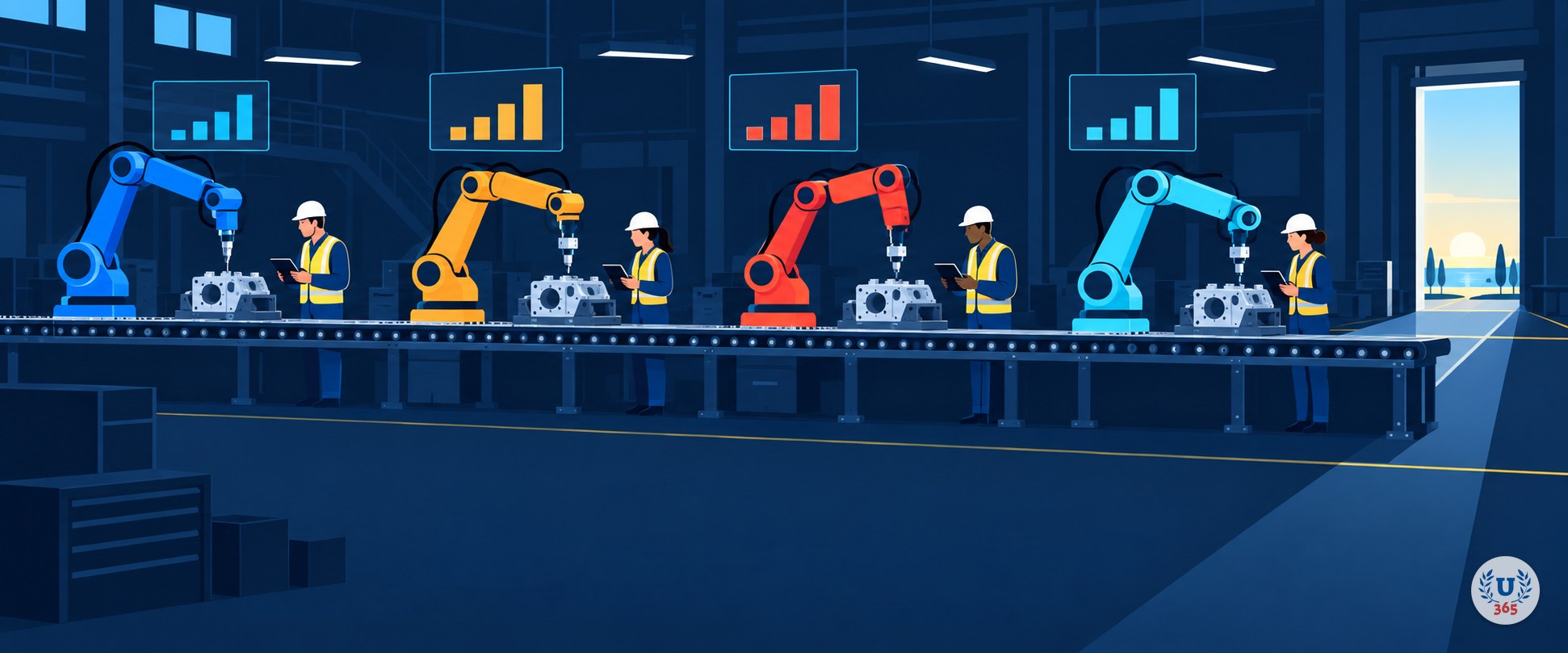
The factory floor as a co-intelligence arrangement: a worker at every robot, judging the work. University 365 Research Center.
The Co-Intelligence First framework asks whether an arrangement amplifies human capability or substitutes for it, and where the risk of AI Imposture sits. Applied to Japan, the verdict is unusual for this series because the main imposture risk is not in the country's claims about AI at all. It is in the rest of the world's assumptions about what Japan's industrial depth means.
The capability is real at four layers, and the report holds them as genuine. The industrial layer is the most substantial thing in this report: materials, equipment, packaging, robotics and factory automation that the world's AI supply chain depends upon, now extended by a state-backed 2nm restart with a verified first transistor and a financed schedule. The model layer is real in the specific sense that matters for amplifiers: Japanese-first models with 30-trillion-token training runs, open-weight releases under permissive licences, and an on-premises option that lets a customer hold the entire stack inside its own walls, which is capability in the hands of the user rather than rented from a provider. The regulatory layer is real as a design choice, executed with unusual internal consistency: a promotion statute, a precise sovereignty definition, soft law with operational teeth, and a privacy amendment that unlocks training data under statistical-processing terms while strengthening biometric safeguards. And the institutional layer is real in the way that seats and processes are real: the Hiroshima AI Process, the measurement network, the AI safety institute building toward UK scale.
The appearance-outruns-capability finding is narrower than in earlier reports, and it lands in three specific places. First, the government's own deployment: the country whose Cabinet wrote the most careful definition of independence runs its public administration on foreign models today, and the effectiveness figures quoted in its press coverage describe a 1,200-person pilot rather than the 180,000-person rollout, an inflation this report corrects. Second, the fiscal headline: the 370 trillion yen Growth Strategy is a target across all sectors with an undisclosed public-private split, and it circulates in commentary as though it were AI money, which it is not; the AI and semiconductors line is 101.6 trillion yen, itself a roadmap rather than an appropriation. Third, the accelerator substitute: MN-Core L does not ship until 2027 and the national factory is NVIDIA, so "sovereign compute" in Japan in 2026 means Japanese-jurisdiction hosting of foreign silicon, a distinction the country's own suppliers of sovereign cloud services market carefully.
The CI-First verdict on Japan is this. This is the least imposturous national AI position in the series, because the country's central claims are about what it can physically build, and it can physically build those things; where the gap opens, the government labels the gap itself, in writing, in its own Cabinet documents, down to naming the fiscal year when the domestic model switch is scheduled. The amplification question for Japan is therefore not whether its claims are true, but whether its definition of sovereignty as substitutability produces real resilience in time: whether the substitutes arrive before the dependencies harden, whether the 84 per cent of firms using AI in fragments integrate it deeply, and whether a shrinking workforce can operate the physical AI economy the strategy is building. Those are execution risks, not credibility risks, and that is a different and better position than most states in this race hold.

Sovereign AI Race: Japan (2026)
What This Means for You and Us
For a reader in a country with Japan's constraints
The Japanese sequence is the one to copy if your binding constraints are people and power rather than money. Write the definition first, in the layered form: what do you need autonomy in, where do you need a second supplier, what must survive a disconnection. Then schedule the substitutes before the purchases, because resilience bought after a supplier's advantage has accumulated costs more than resilience bought before. Buy frontier capability where it is sold, but keep the jurisdiction of your data inside providers you can reach and replace. Put the second option in the procurement, in writing, the way Japan's fiscal 2027 Gennai plan does. And treat demographic arithmetic as policy: conversion programmes for the workforce you have, visa routes for the specialists you cannot grow, and literacy in schools as an economic programme rather than a cultural one.
For a reader watching the series
Eight countries in, Japan completes the map's middle band. The full-stack owners pay in efficiency and controls; the capital sovereigns buy what they cannot build; the rule-makers write first and industrialise slowly; the constrained cases discover physics. Japan adds the interdependence manager: the country that decided, in writing, that it will own the layers it can build, rent the ones it cannot, and judge itself on whether the rents stay cancellable. The emerging finding of the series sharpens once more. Sovereignty is not a binary possession; it is a portfolio of dependencies a country can name, price and survive. Japan is the first state in the series to publish its portfolio in those terms, and the first whose credibility rests on keeping the schedule.
For University 365
Japan is the eighth country in this series and the one whose strategy most resembles a syllabus: named layers, a defined sequence, annual intake targets, and public reporting. It is also the first country in the series where the education system is explicitly a response to demographic arithmetic rather than to industrial ambition, and that is the closest mirror yet to this institution's own operating logic. The Japanese case shows both halves of our argument at once: conversion education works and is necessary, and it is not sufficient, because the 84 per cent of firms using AI in fragments and the 8.4 per cent of workers using it in their jobs are the demand-side numbers that no curriculum can move by itself. The country that trains judgement and then builds the workplaces where that judgement is used is the country that keeps both; Japan is training the judgement at the largest conversion scale in the series and is still building the workplaces.

Sovereign AI Race: Japan (2026)
The Road Ahead
Three observable things would change this assessment.
Whether Rapidus reaches mass production on schedule. The number to watch is 2nm wafers leaving Chitose in commercial volume in the second half of 2027, with qualified yields. If it ships, Japan's industrial sovereignty gains its missing layer and the strategy's most expensive bet is validated; if it slips again or the yield does not arrive, the country keeps the materials monopoly without the logic layer, and the report's compute verdict holds.
Whether the domestic model switch happens on time. Fiscal 2027 is when Gennai's procurement of domestic language models is scheduled, with the switching provisions the plan requires. If the government's own workloads move to Japanese models at government scale, substitutability stops being a plan and becomes a fact, and the ownership penalty becomes a pricing question rather than a capability question. If the switch slides, the definition and the behaviour diverge by exactly the amount of the delay.
Whether the relocated compute actually gets built in the GX zones. The gigawatt entry requirement and the nine certified data centre zones are a policy for moving a decade of growth out of Tokyo and Osaka. Watch for announced capacity in the zones converting to construction, for grid connection dates being published against the ten-year queue baseline, and for the nuclear restart schedule holding; on that schedule the zones' power base depends. If the zones fill, Japan has solved its binding constraint for a decade; if they stay announced, the constraint moves from geography to credibility.

Sovereign AI Race: Japan (2026)
Sources and Methodology
Methodology
This report was researched from public sources across two languages with a preference for primary documents: the Cabinet Office's AI Basic Plan texts and Priority Plan; METI and NEDO programme releases on GENIAC and FRONTia; NVIDIA's own announcement for the physical AI factory; Rapidus company releases and its NEDO approval; NTT's presentation to the International Telecommunication Union on grid constraints; the Center for a New American Security's sovereign AI index and its methodology caveats; Counterpoint Research's Sovereign AI LLM Index for the first half of 2026; Oxford Insights' Government AI Readiness Index 2025; the MIC white paper and the Reuters and Nikkei Research adoption poll; and the legal analyses of the AI Promotion Act and the APPI amendment by the firms that tracked the legislation. Government targets, company benchmarks and vendor framings are labelled as claims throughout, and where sources conflict the conflict is stated rather than resolved, as with the Unit 6 restart dates, the 101.6 against 102 trillion yen rendering, and the Sakana AI funding totals.
The series tests itself over time, and this report's baseline statement is part of that test: University 365 has not published a Japan landscape report before this one, so there is no prior baseline to compare against, and this report says so plainly rather than implying one. From this report forward, Japan carries a documented baseline against which later movement can be measured.
Five limits should travel with this report. First, several load-bearing programme figures rest on secondary sourcing and are labelled: the 250,000-practitioner target, the Rapidus hiring and IT shortage numbers, the visa architecture descriptions, and the private data centre pipeline totals, including the reported Mubadala interest. Second, the CNAS total for disclosed sovereign AI investment carries the index's own stage-mixing caveat and is quoted with it. Third, the ownership penalty is an index methodology judgement, not a market outcome, and is presented as such. Fourth, the AI Sovereignty definition is quoted from a published translation of the Cabinet document; the official English text should be obtained for any future citation. Fifth, no verified JIC-specific AI investment was found in this research window, and no figure is attributed to it.
Principal sources
Government, regulatory and official. Cabinet Office: the Second AI Basic Plan (provisional English translation, 14 July 2026) and its summary, the June 2026 draft, and the Priority Plan for the Realization of a Digital Society (21 July 2026) as quoted; METI and NEDO: GENIAC releases of 14 May and 4 June 2026, the GENIAC programme page, and the GX Strategic Areas certification of 11 September 2026 via METI's announcement; the Digital Agency's Gennai materials as analysed; MIC's White Paper on Information and Communications 2026 and the AI Security Assurance guideline of 27 March 2026; the Agency for Cultural Affairs' copyright guidance; the Personal Information Protection Commission's positions as analysed; NVIDIA's physical AI factory release (16 July 2026); Rapidus releases (February, April 2026); SB Intuitions, NTT and Rakuten corporate releases; the Institute of Science Tokyo; NTT's ITU presentation (29 June 2026); Japan AISI and MOFA materials on the Hiroshima AI Process.
Independent research and indices. Counterpoint Research: Sovereign AI LLM Index H1 2026 (30 July 2026) and the adapted-models finding; the Center for a New American Security sovereign AI index (20 April 2026, updated 18 August 2026); Oxford Insights Government AI Readiness Index 2025 (published December 2025, revised January 2026) and its dataset; Stanford HAI AI Index 2026 as referenced; CNAS's published methodology caveat.
Reporting. The Japan Times, Nikkei and Nikkei Asia, Asahi Shimbun, Yomiuri (The Japan News), Jiji Press, Kyodo, The Register, DigiTimes (partial), DataCenterDynamics, TechCrunch, Reuters, Wood Mackenzie via Tech Times, Nuclear Engineering International, The Diplomat, and the specialist outlets named in the text where a claim depends on them, including Legal500, Mori Hamada and Baker McKenzie for the APPI amendment, and timewell and aiinasia for the guidelines and plan analysis.

Sovereign AI Race: Japan (2026)
About This Report
Sovereign AI Race: Japan (2026) is report eight of twenty in the Sovereign AI Race series, followed by a comparative capstone. The series assesses how states attempt to control the production of artificial intelligence inside their jurisdiction, using one five-layer framework and one metric set applied identically to every country: compute, models, capital, regulation, and talent.
Each report in the series carries a "What Changed Since" treatment against the earlier University 365 report on the same country where one exists. Japan has no earlier University 365 landscape report, and this report states that plainly: the baseline for Japan begins here, and future reports in this series will measure movement against this one.
Author: Hubert Graef, Dean of Research, University 365 Research Center.
Series: Sovereign AI Race, report 8 of 20, followed by the comparative capstone.
*Published by University 365 Research Center. CI-First is University 365's Co-Intelligence First framework, a method constant of the institution.*
Revision 2, 30 September 2026, 18:27 UTC. Published 29 September 2026.




Comments