
Sovereign AI Race: Russia (2026)

Updated: 5 hours ago
In this Report

This publication is part of the Sovereign AI Race series.
The Co-Intelligence-First (CI-First) approach is a genuine and unique University 365 concept: a proposal for imagining a better future where AI and Human Intelligence coexist productively, each amplifying the other rather than replacing it.


Sovereign AI Race: Russia (2026)
The Context
The five layers, and why Russia is the series' sanctioned isolationist case
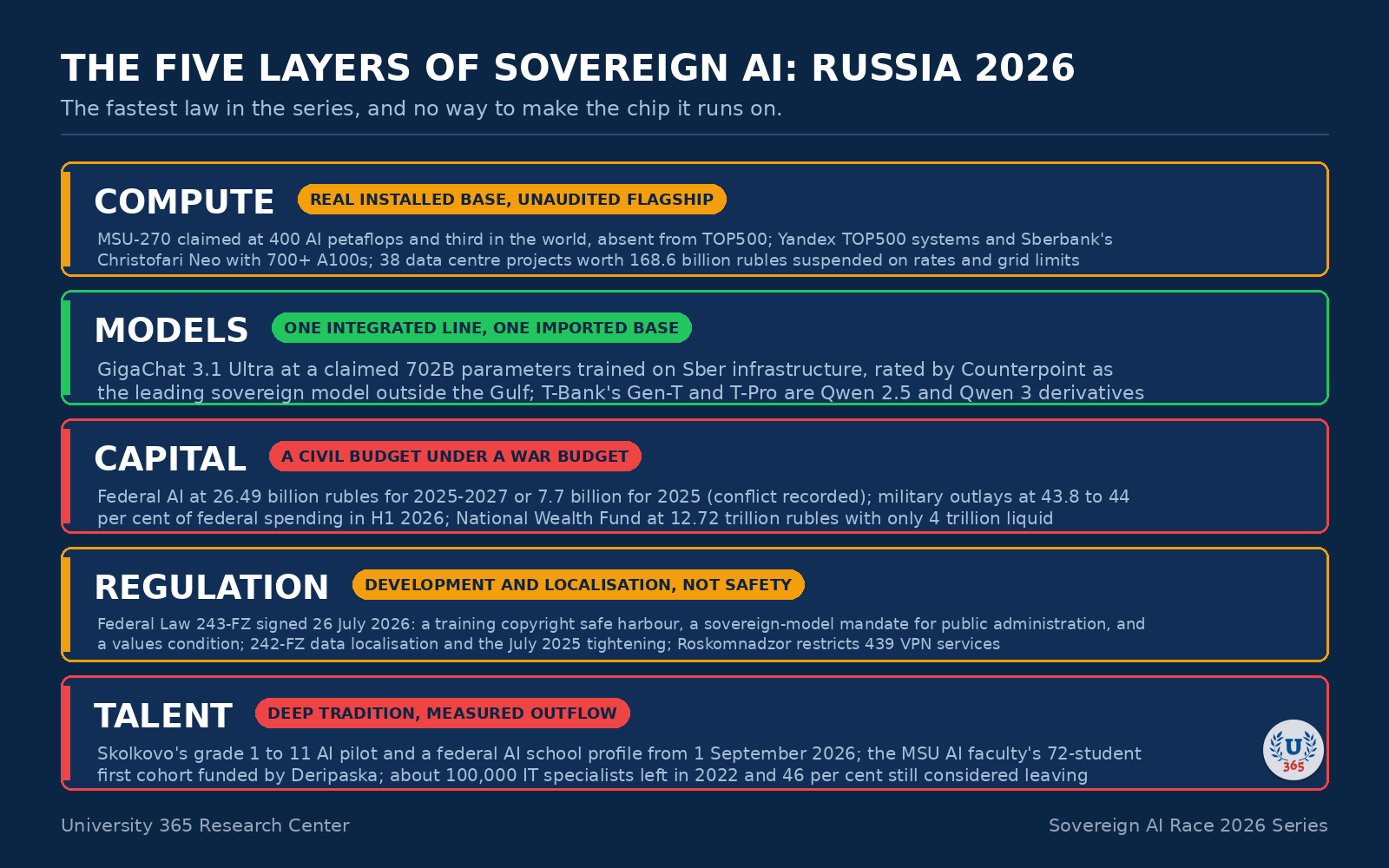
The five layers assessed. The fastest legislative programme in the series above a fabrication ceiling the state itself publishes. University 365 Research Center.
This is the sixteenth report in a twenty-part series assessing how states attempt to control the production of artificial intelligence inside their own jurisdiction. The framework is fixed and applied identically to every country. Sovereign AI capacity separates into five layers, and a state can hold any one of them without holding the others.
Compute sovereignty is the physical layer: where the chips and data centres sit, and who may switch them off. Model sovereignty is who builds the models a country depends on, and in whose languages and domains those models are competent. Capital sovereignty is who funds the build-out and on what terms. Regulatory sovereignty is who writes the rules and whether they can be enforced. Talent and education sovereignty is who builds and runs the systems, and how the next generation is prepared.
The series treats three races as running at once: the compute race, the model race and the rules race. Russia is the country that is running all three with the rules of a state that intends to remain open to the technology while closed to the world that produces it. Its first AI statute, Federal Law No. 243-FZ, was signed on 26 July 2026 and is a development and localisation law rather than a risk-tier safety law: it grants domestic developers a broad copyright safe harbour to train models on protected works without consent, requires large foundation models to be created inside the jurisdiction, and reserves to the state the power to mandate "sovereign" models for public administration. In the same weeks the European Union's transparency obligations were applying, Russia legislated the opposite emphasis.
The series places Russia in the "sanctioned isolationist" posture as its own category, and this report tests that placement layer by layer. Russia holds a genuine research and mathematics tradition, an installed supercomputing base with real machines in it, a state banking group that owns a model, a cloud and the infrastructure under it, and a domestic model family in GigaChat that third-party analysis rates the strongest sovereign model outside the Gulf. It does not hold leading-edge fabrication, and it will not before 2030 on its own published plan; it does not have an audited compute figure; its flagship commercial models include derivatives of Chinese base models; and its civil AI budget lines are two orders of magnitude below its military ones. The report's question is what sovereign AI capacity means for a state whose constraint is not ambition, capital or talent, but the physical and financial ability to build the machines.
The vocabulary this report needs
Five terms recur, and they are defined here once.
Federal Law No. 243-FZ. Russia's first AI statute, signed by President Putin on 26 July 2026 after first reading on 7 July, second and third readings on 8 July, and Federation Council approval on 18 July. It is a framework law of thirteen articles that establishes a legal basis for AI deployment and for large foundation models, makes compliance with state-defined values a condition for "sovereign" status, and localises the creation of domestic neural networks. One legal analysis dates the signature to 29 July 2026; the weight of sources, including the Kremlin's own publication, supports 26 July, and the conflict is recorded rather than resolved.
The 28-nanometre ceiling. Russia's stated domestic fabrication target. The state says it is on track to manufacture 28-nanometre chips in domestic fabs by 2030, roughly nineteen years after that node debuted in global production. Above that node, AI accelerators are not in domestic production, and the head of Baikal Electronics said in October 2025 that producing Baikal processors in Russia turned out to be impossible.
The National Wealth Fund. Russia's sovereign reserve, reported at 13.41 trillion rubles as of 1 April 2026 and 12.72 trillion rubles, about 159.3 billion dollars, as of 1 August 2026, with total assets of about 154 billion dollars but liquid assets of only 4 trillion rubles, some 46.7 billion dollars, as of 1 September 2026. The gap between the total and the liquid figure is the number that matters for strategic investment.
The MSU-270 claim. Moscow State University's supercomputer, commissioned in 2023 and named publicly only in late April 2025, presented by the university and Russian state media as a 400 AI-petaflops machine and third in the world ahead of Europe's LUMI and Leonardo systems. Neither the performance figure nor the ranking appears in the TOP500 list, and both are carried here as claims. The machine was reported by The Insider as built using smuggled NVIDIA chips and operating under the control of Katerina Tikhonova, the president's daughter, a single-source allegation labelled as such.
GigaChat. Sberbank's model family, the state banking group's sovereign flagship: GigaChat 2.0 presented on 13 March 2025 and opened to all users on 14 April 2025, GigaChat 3.0 and Kandinsky 5.0 released publicly later in 2025, and GigaChat 3.1 Ultra, a 702-billion-parameter model trained on Sber's own infrastructure, described by Counterpoint Research's sovereign AI LLM work as Russia's leading sovereign model.

Sovereign AI Race: Russia (2026)
The Question
Can a state build sovereign AI when it cannot build the machines?
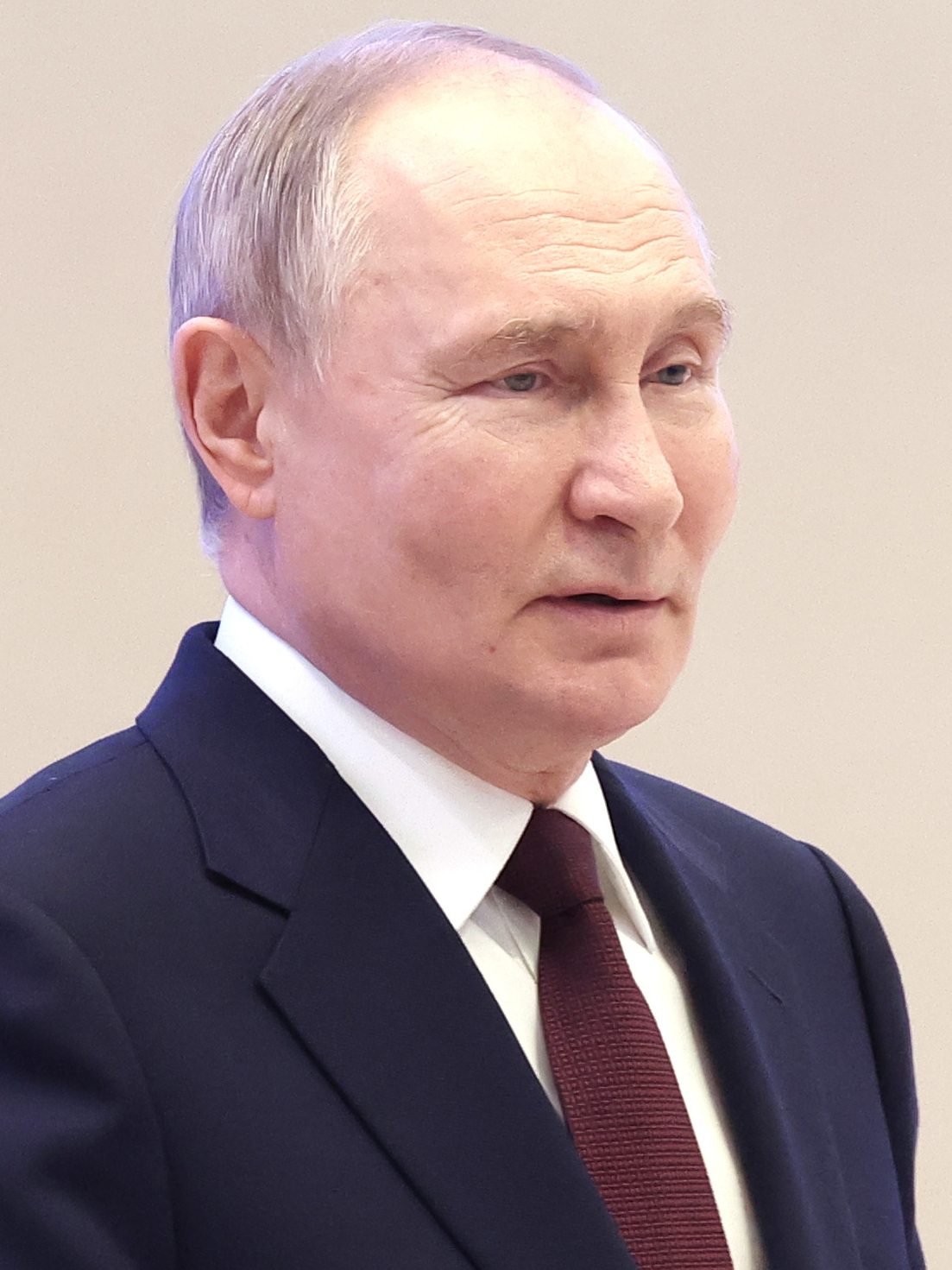
Vladimir Putin, President of the Russian Federation, as of 2026. His AI Journey remarks of 19 November 2025 set the target for AI to contribute more than 11 trillion rubles to GDP by 2030 and called for a national AI task force, and he signed Federal Law No. 243-FZ on 26 July 2026. Photograph: tatarstan.ru, CC BY 4.0, via Wikimedia Commons.
Russia's position is the sharpest version of a question that runs through this series: what happens to a sovereignty programme when the one layer that cannot be substituted, the physical ability to make the silicon, is out of reach.
The country has more AI-relevant assets than its isolation would suggest. It has a deep mathematical and computer science tradition, a national strategy since 2019 with a GDP contribution target, an installed supercomputing base that includes real TOP500-listed machines at Yandex and industrial systems at Sberbank, a state banking group that has vertically integrated model, cloud and infrastructure, and a domestic model family that third-party analysis treats as a serious sovereign alternative. It has, per its own studies, generative AI in use at 71 per cent of large companies, a figure carried as a claim. It also has the institutional machinery: a presidential commission on AI decreed in February 2026, a supercomputing roadmap signed in March 2026, and a first statute in July 2026.
Against that, every hard layer is constrained. Domestic fabrication is at mature nodes with a 28-nanometre target for 2030. The accelerators it does have arrive through grey channels: a United States prosecution unsealed in March 2026 concerned a network worth more than 420 million dollars moving NVIDIA graphics processors and American technology to China and Russia, and in August 2026 Ukrainian military intelligence disclosed an NVIDIA Jetson Orin NX module packaged in March 2025 recovered from a downed Russian S-71M cruise missile, a part manufactured years after the vendor left the Russian market. Data centre construction is throttled by the cost of money and by grid limits: 38 projects worth 168.6 billion rubles, roughly 2.26 billion dollars, were suspended over three years on high borrowing costs and power constraints, and the state has responded by directing new capacity toward Siberia, nuclear sites and hydroelectric plants. And the civil AI budget, whether measured at 26.49 billion rubles across 2025 to 2027 or at 7.7 billion rubles for 2025 alone, sits far below a military line that reached 43.8 to 44 per cent of federal spending in the first half of 2026.
The question this report puts to the evidence is therefore whether a state can hold "sovereign AI" as a working reality when its flagship compute figure is unaudited, its chips arrive through third countries, its fastest models are built on a foreign base, and its state budget is prioritising something else. The answer the evidence supports is narrower and more interesting than a verdict of failure.

Sovereign AI Race: Russia (2026)
The Contradiction
Unaudited numbers at every layer, and a state that publishes them anyway
The central contradiction in the Russian case is between the completeness of the sovereignty claim and the absence of any independent verification for the figures that carry it.
Across this series, every country has a set of numbers that can be checked against an external body: the TOP500 for supercomputers, the Oxford Insights index for government readiness, a national statistics office for adoption, a competition authority for enforcement. Russia's figures are different in kind. The flagship machine is claimed at 400 AI petaflops and third in the world, and it does not appear in the TOP500. The flagship model is claimed to rank first on benchmarks the vendor selects, and there is no neutral, continuously updated ranking that Russian vendors are obliged to submit to. The flagship banking group reports over 475 billion rubles of internal financial benefit from AI in 2025 and a target of 500 billion rubles of AI revenue in 2026, both as its own unaudited statements about itself. The National Wealth Fund's headline total is published; the liquid portion, which is what a state could actually spend on a strategic programme, is four trillion rubles against a total of twelve to thirteen trillion.
The pattern is consistent enough to state as a feature of the case rather than a series of isolated problems. In a closed system, the reporting apparatus and the reported achievement are the same institution. That is not the same as saying the numbers are false. Some of them are corroborated: Russia does have TOP500-listed machines, GigaChat 3.1 Ultra is described by a third party as the leading sovereign model outside the Gulf, and the data centre suspensions are reported by independent Russian business press. What is different is that the flagship claims, the ones a sovereignty programme most needs to be believed, cannot be checked at all. This report therefore labels every Russian government and corporate performance figure as a claim and states its provenance each time.
There is a second contradiction that sits underneath the first, and it is about dependence rather than verification. Russia's model sovereignty is partly Chinese. T-Bank's Gen-T family, including the flagship T-Pro, adapts Alibaba's Qwen base models, and the updated T-pro-it-2.1 is explicitly described on its own model card as built on the Qwen 3 family. VTB, a state-controlled bank, has acknowledged working with Qwen. And the compute direction runs the other way: the Kremlin plan turns Siberia into an AI computing hub with China identified as the biggest customer. A state that has legislated that its domestic neural networks must be created inside Russia is running flagship models built on a foreign base, and planning to sell compute to the state that supplies it. Model sovereignty and compute sovereignty therefore rest, in part, on the sovereignty of another country.
The contradiction resolves into a single sentence. The country has built a real AI capability at the layers a determined state can build without access to the frontier, and the sovereignty it claims at those layers is genuine but bounded, resting on machines it cannot verify, chips it cannot make, and base models it does not own.

Sovereign AI Race: Russia (2026)
The Current State
Compute: a real installed base, an unaudited flagship, and a fabrication ceiling
Moscow. The capital and its region hold the concentration of Russian data centre capacity, and the city's power demand is reported to outstrip grid capacity, with operators turning to gas self-generation because connections take years. Photograph: Pexels License, via Pexels.
Russia's public compute position is more substantial than its isolation suggests, and less verifiable than its claims imply.
The flagship claim is MSU-270 at Moscow State University, commissioned in 2023 and named publicly only in late April 2025. The university and Russian state media present it at 400 AI petaflops and rank it third in the world, ahead of LUMI and Leonardo. Neither figure appears in the TOP500, and both are carried as claims. The machine was reported by The Insider as built using smuggled NVIDIA chips and operating under the control of Katerina Tikhonova, a single-source allegation that this report labels as partially verified and attributes. The pattern the report notes without extending beyond the evidence is that the same account connects senior political figures to the country's most important AI assets, and that TIME reported in June 2026 that the president's daughter helps lead the new push for AI talent.
The installed base that can be checked is real but modest. Yandex's Chervonenkis machine appears on the TOP500 system list, built on AMD EPYC processors with NVIDIA A100 80-gigabyte accelerators, and Yandex operates a family of machine learning supercomputers named after Russian scientists, selling graphics processor capacity through Yandex Cloud. Sberbank's Christofari Neo launched in November 2021 with more than 700 NVIDIA A100 80-gigabyte accelerators and was described at launch as the most powerful machine in Russia at roughly 20 petaflops, a vendor claim. The Govorun system at the Joint Institute for Nuclear Research in Dubna reached 2.2 petaflops peak after a modernisation by the RSC Group, an operator claim. The state's own plan, approved by Prime Minister Mishustin in March 2026, sets a roadmap for high-performance computing, AI algorithms, grid technologies and supercomputer infrastructure, assigning roles to Rosatom, Rostec, Roscosmos, Moscow State University and the Kurchatov Institute, with the Kurchatov Institute proposing a national supercomputer centre. Russia has published a stated plan for up to ten supercomputers by 2030, carried here as a claim.
The hard ceiling is fabrication, and the state says so itself. Russia is on track, by its own plan, to manufacture 28-nanometre chips in domestic fabs by 2030, a node that debuted globally around 2011. Mikron in Zelenograd is the main commercial fab, with additional lines in St Petersburg and Voronezh. Above that node, AI accelerators are not in domestic production. Baikal Electronics, whose processors are among the country's flagship domestic designs, produced 85,000 central processing units between 2012 and 2025 and its head said in October 2025 that producing them in Russia turned out to be impossible. Elbrus, developed by MCST, was discussed as moving production from Taiwan to Mikron as early as 2022, and its current node and volume status could not be verified in this research. The status of Angstrem, the classic 90 and 130-nanometre domestic line, could not be verified either. What the country can make, at scale, sits around the nodes that were mainstream in the first decade of this century.
The consequence is that Russia's AI compute arrives by other routes. A United States prosecution unsealed in March 2026 concerned a network worth more than 420 million dollars moving NVIDIA graphics processors and American technology toward China and Russia; the figure covers both destinations and cannot be attributed to Russia alone. On 12 August 2026 Ukrainian military intelligence disclosed an NVIDIA Jetson Orin NX module, packaged in March 2025, recovered from a downed Russian S-71M cruise missile; the claim is from a belligerent party and is labelled as such, and it was corroborated by multiple outlets. NVIDIA confirmed the module's identity to reporters. What is not verifiable is the volume: no audited figure for grey-channel imports into Russia specifically for 2025 or 2026 was located in this research, and the report states that as a gap rather than estimating it.
The data centre layer shows the same pattern of real demand meeting hard limits. Russian data centre capacity stood in the range of 1.2 to 1.7 gigawatts by 2025, of which roughly 0.8 gigawatts was commercial, concentrated in Moscow and the surrounding region, with St Petersburg and the Leningrad region reported at 9.2 per cent of capacity. Moscow's power demand is reported to outstrip grid capacity, with operators turning to gas self-generation because grid connections take years. In June 2026 the Russian business press reported that 38 data centre projects worth 168.6 billion rubles, about 2.26 billion dollars, had been suspended over three years because of high borrowing costs and grid constraints. Rosseti, the state grid operator, has said an additional 3 gigawatts will be allocated to computing centres, and its chief executive discussed data processing centres as a new class of consumer in a Kremlin meeting in April 2026. Deputy Prime Minister Novak's energy policy article of 1 June 2026 directs that new data centres be located near nuclear or hydroelectric plants, with Krasnoyarsk Territory named as a priority, and the Ministry of Energy proposed an AI data centre in Siberia using spare capacity in September 2026. Rostelecom has announced a data centre planned at 100 megawatts with investment estimated around 100 billion rubles. IXcellerate operates five facilities with more than 10,000 rack spaces across two Moscow campuses with a new Vyoshki campus due in 2026, and two further data centres totalling 22 megawatts were announced for St Petersburg in the same period in which reporting describes the wider build-out as stalling.
Two structural features of the compute layer complete the picture. The first is that the state is steering capacity to where electricity is cheap and plentiful rather than where users are, which is a rational answer to the grid constraint and a decision that moves AI infrastructure into Siberia and the Far East. The second is that the customer for that capacity is expected to be Chinese, which is the mirror image of Russia buying models from China and follows from the country's real comparative advantage in this value chain: energy and land, not chips and not capital.
Models: a genuine sovereign flagship, a Chinese base under half the field
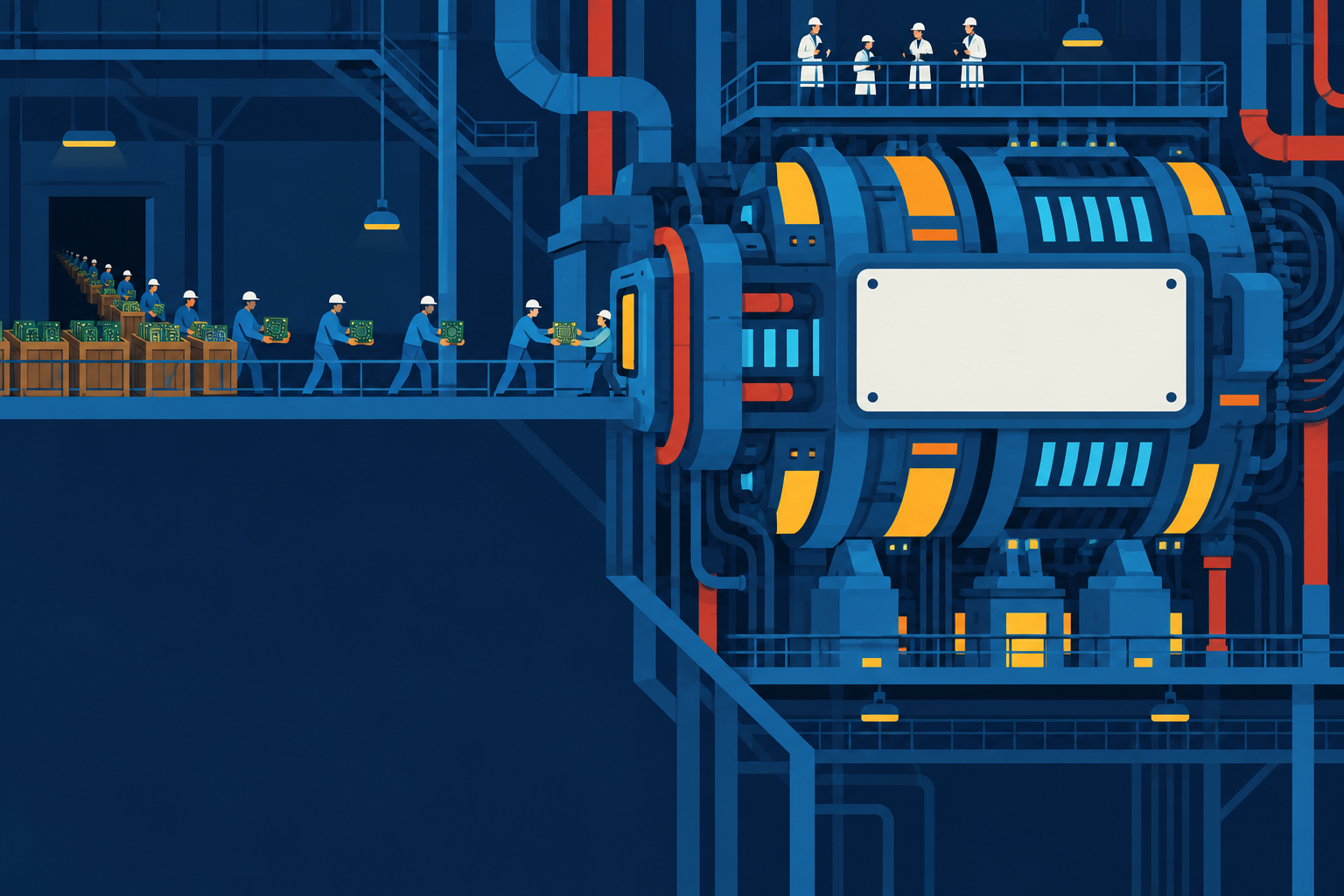
The sealed engine, the boards carried in by hand, and the observers on the railing. University 365 Research Center.
Russia's model layer is where the country's claim to sovereign AI capacity is strongest, and where its dependencies are most visible.
GigaChat is the flagship. Sberbank presented GigaChat 2.0 on 13 March 2025 and opened it to all users on 14 April 2025, claiming that GigaChat 2 MAX ranked first among AI models on the benchmarks the company chose. GigaChat 3.0 and Kandinsky 5.0 followed later in 2025, and at AI Journey on 20 November 2025 Sber positioned GigaChat as a personal assistant that takes actions rather than only answering. The most consequential third-party assessment comes from Counterpoint Research's sovereign AI LLM work, which describes GigaChat 3.1 Ultra, a 702-billion-parameter model trained on Sber's own infrastructure, as Russia's leading sovereign model and the closest counterpart to the UAE's Falcon H1, on the strength of full-stack vertical integration: one state-linked group owns the model, the cloud and the infrastructure beneath it. The parameter count is a vendor specification relayed by the index's press coverage and is carried as a claim. Sber's own reported monthly user figure, above 20 million in late 2025, is likewise a claim; the observable third-party number for the same period is the 308,806 subscribers to the company's GigaChat Telegram channel, which is a different kind of measure and is recorded as such.
Yandex is the second pole. YandexGPT 5 Pro was released on 25 February 2025 with vendor claims of quality comparable to GPT-4o, and YandexGPT Pro 5.1 followed in August 2025. On 28 October 2025 Yandex introduced Alice AI as a universal assistant that can act in chat and in the browser. The company also released open weights: YandexGPT 5 Lite, an 8-billion-parameter model trained on 15 trillion tokens of primarily Russian and English data, published in June 2025 with both pretrain and instruct variants on Hugging Face and an official quantised build. The licence is a documented conflict: the model registry describes Apache 2.0, while the Hugging Face repository labels carry a custom licence name. Both are recorded here because the licence determines whether the release is genuinely open, and a third-party tracker records the YandexGPT 5 Lite training run at 7.4 times ten to the twenty-third floating point operations, an estimate rather than a disclosure.
The third pole is where the dependency shows. T-Bank's AI centre developed the Gen-T family, released publicly in late 2024, with T-lite at 7 billion parameters and T-Pro at 32 billion, both adapted from Alibaba's Qwen 2.5 base. The updated T-pro-it-2.1 is described on its own model card as built upon the Qwen 3 family, with improvements to instruction following and tool calling, and the repository's commit history shows that lineage explicitly. MTS AI operates the Cotype line, including Cotype Pro 2 with a vendor claim of 40 per cent faster operation and 50 per cent more accurate results than its predecessor, and Cotype Nano, described as the group's first open-source model with an Apache 2.0 licence per community mirrors, plus a 1.5-billion-parameter code assistant opened in June 2025 and Cotype VL, its first vision-language model, presented at Finopolis 2025. The academic layer includes the Vikhr family of instruction-tuned Russian models from ITMO, HSE and other institutions. An earlier attribution of Vikhr to VK is not supported by the paper's own affiliations and is recorded here as unverified.
On evaluation, the structural problem is the one the report flagged in the context. MERA, the Multimodal Evaluation for Russian-language Architectures benchmark published at ACL 2024 and maintained by the A-industry alliance, is the main open independent Russian-language benchmark, and it was introduced in January 2024. Most vendor claims for 2025 and 2026 models are made on vendor-selected task sets rather than on independent evaluation, and no successor benchmark displacing MERA was located in this research. A third-party tracker counts 34 AI models with at least one contributing organisation based in Russia, with YandexGPT 5 Lite the largest by its measure. On the demand side, a Microsoft AI Economy Institute report cited in 2026 put DeepSeek's usage share in Russia at roughly 43 per cent by the end of 2025, while Statcounter's measurement of Russian AI chatbot web traffic in March 2026 put Perplexity first at 56.1 per cent with ChatGPT at 30.87 per cent and DeepSeek at 1.04 per cent. The two figures measure different populations and different things, and they conflict sharply; the report states the conflict rather than resolving it. VTB, a state-controlled bank, has acknowledged working with Alibaba's Qwen, and Sberbank's first deputy chairman said in Vladivostok in September 2025 that joint Russia-China AI efforts could become the core of a new technological architecture.
Capital: a small civil budget, a thinning cushion, and a war that outranks both
Siberia. The state now directs new data centre capacity toward nuclear and hydroelectric sites, with Krasnoyarsk Territory named a priority, and China identified as the biggest customer for the compute that results. Photograph: Pexels License, via Pexels.
Russia's capital layer is the clearest case in this series of a sovereignty programme that is fiscally outranked inside its own state.
The civil AI budget is small. Policy monitoring reports the federal AI budget for 2025 to 2027 at 26.49 billion rubles, about 315 million dollars, down from 31.5 billion rubles in the previous period, and a separate source puts the federal "Artificial Intelligence" project at about 7.7 billion rubles for 2025 as part of a multi-year digitalisation programme through 2027. The two figures are not obviously the same budget line and this report states both rather than reconciling them; the precise AI line item in the 2026 federal budget law was not extracted in this research. The umbrella programme is the national project "Data Economy and Digital Transformation of the State", running 2025 to 2030. The state's own projection under Presidential Decree No. 490 of 2019 is that AI will contribute 11.2 trillion rubles to GDP growth by 2030, and Yakov and Partners, in a study published with Yandex, projects up to 13 trillion rubles. Both are forward-looking projections that conflict on magnitude; both are carried as estimates.
The state's investment vehicles are constrained by the same fiscal position. The National Wealth Fund held 13.41 trillion rubles as of 1 April 2026, 13.104 trillion rubles on 1 July, and 12.72 trillion rubles, about 159.3 billion dollars, as of 1 August, and its total assets stood at about 154 billion dollars with liquid assets of only 4 trillion rubles, some 46.7 billion dollars, as of 1 September 2026. The composition as of 1 July included 189.8 billion Chinese yuan and 141.1 metric tons of gold held in Bank of Russia accounts, which is itself a capital sovereignty signal: the reserve cushion is substantially denominated in the currency of the state's principal AI partner. In June 2025 economists from the Russian Academy warned the fund could be exhausted by 2026 if fiscal trends persisted; the fund was still at 12.72 trillion rubles in August 2026, and both statements are true in their own terms because the warning concerned the trajectory while the later figure is a stock that includes illiquid assets. The Russian Direct Investment Fund is the designated co-investment vehicle for AI and signed an agreement with the government to develop the high-tech AI sector, having raised about 2 billion dollars from foreign investors for AI in 2019, a route that has since closed. Its chief executive also serves as the president's special envoy for investment and economic cooperation with foreign countries.
The state-linked corporate layer is where the money actually is. Sberbank is the largest single state-linked AI investor and operator: it reports more than 700 AI initiatives including 900 autonomous agents generating over 475 billion rubles in financial benefits in 2025, with a target of 500 billion rubles, about 5.5 billion dollars, of AI revenue in 2026. Those are company claims about its own deployment and value, and the concentration they describe is the core of the Russian capital story: the same group is model vendor, cloud provider, regulator-adjacent institution and investor in the national programme. Rostec, the state defence conglomerate, reported more than doubled net profit to roughly 1.4 billion dollars in the year to mid-2025, and its chief executive told the president the corporation is in a fight for the future against Western innovation; its AIS holding acquired 25 per cent of Vansel, which develops AI-based medical diagnostics.
Private capital tells a story of loss as much as of investment. The July 2024 Yandex restructuring divested the company's Russian assets for 5.4 billion dollars, and the international remnant, Nebius Group, resumed Nasdaq trading in October 2024 as an AI infrastructure company building for global customers, unveiling a second supercomputer in June 2025. That is the part of Yandex that could raise Western capital, and it no longer serves the Russian market. Domestic Yandex continues to invest in models, cloud and the Alice assistant within the bounds of domestic capital markets and sanctioned banking channels. New private money is small and specific: Selectel announced it would invest over 1 billion rubles into a joint AI service enterprise with ITMO University in July 2026, which is the clearest verified case of private cloud capital pairing with a university in the period. No Chinese equity investment into Russian AI companies was verified in this research, and the report records that as a gap rather than an absence.
The binding constraint is the budget. Russia's federal military spending reached about 16 trillion rubles in 2025, 7.5 per cent of GDP, per SIPRI, and military outlays hit a record 43.8 to 44 per cent of federal budget spending in the first half of 2026 on the economist Janis Kluge's calculation from Finance Ministry data. The 2026 to 2028 budget cuts military spending for the first time since the war began while raising value added tax to fund a deficit projected at 3.79 trillion rubles for 2026, 3.19 trillion for 2027 and 3.51 trillion for 2028. Against that, a civil AI programme measured in tens of billions of rubles across several years is not a strategic priority in fiscal terms, whatever the strategy document says. The war economy is reported as starving strategic civil projects including data centres, and high interest rates are doing the rest: the suspension of 38 data centre projects worth 168.6 billion rubles was attributed to borrowing costs and grid constraints, which means the private cost of capital, alongside sanctions, is throttling the build-out.
Regulation: a development law, a localisation regime, and the machinery of control
Russia's regulatory layer is where the country's intent is clearest, and where it diverges most sharply from the European direction of travel.
Federal Law No. 243-FZ was signed on 26 July 2026 after a legislative passage that reporting describes as rushed: first reading on 7 July, second and third readings on 8 July, Federation Council approval on 18 July. It is a framework law of thirteen articles that establishes a legal basis for AI deployment and for large foundation models, defines and restricts "large fundamental models" with localisation requirements, makes compliance with state-defined values a condition for "sovereign" status, and reserves to the state the power to mandate sovereign models for public administration. Its most consequential provision for developers is a broad copyright safe harbour that permits training neural networks on copyrighted works without consent, reserving to the state the power to mandate sovereign models for public use. Industry did not universally welcome it: on 29 August 2026 the AI Alliance, which groups Russian AI model developers, publicly opposed any requirement to pay copyright holders for training content. The assessment this report draws is that Russia's first AI statute is a development and localisation law, not a safety law, and that it was written to accelerate domestic capability rather than to constrain it.
Alongside the statute sits the March 2026 draft from the Ministry of Digital Development, published for consultation on the federal portal of draft regulatory acts between 17 and 22 March 2026. Its reported provisions include definitions, rights and responsibilities of market participants, content requirements, a right for citizens to refuse AI-system service in contexts such as a call to a bank, the requirement that domestic neural networks be created inside Russia, and a planned entry into force of 1 September 2027. The State Duma's vice speaker announced phased regulation of neural networks in June 2026. An operational state register of AI systems could not be verified as running in this research; the legal basis exists in the statute and the draft, and the report states that the registry itself is unverified.
The localisation and data layer predates the AI law and shapes it. Federal Law No. 242-FZ requires Russian citizens' personal data to be stored on servers inside Russia, and from 1 July 2025 a tightening law expanded that requirement. Federal Law No. 152-FZ, article 16, has forbidden solely automated decisions producing legal consequences for a person since 2007 with narrow exceptions, which constrains automated AI decision-making in consumer contexts before the AI wave began. Reported penalty increases under 420-FZ reaching up to 500 million rubles come from legal commentary rather than the statutory text and are carried as unverified. Taken together, localisation plus the AI statute's localisation condition means an AI service operating in Russia must keep both its data and its foundation model production inside the jurisdiction, which is the same requirement European law imposes and for a different purpose.
Enforcement runs through Roskomnadzor, and its principal lever is access. By January 2026 the authority had restricted access to 439 virtual private network services, which is the operative control determining whether a Russian user can reach a foreign AI service at all. In January 2026 it planned an AI system for filtering internet traffic and combating virtual private networks at a reported budget of 2.3 billion rubles, while separate reporting described about 2.27 billion dollars to be allocated for blocking banned sites, a roughly thirty-fold difference in scale that cannot be the same budget line and is recorded here as a conflict. In the same period the authority threatened to block WhatsApp over alleged legal violations on 28 November 2025 and blocked Snapchat while restricting FaceTime calls on 4 December 2025. Reporters Without Borders raised concern about the authority's experiments with AI in censorship, and coverage in 2026 described tightened enforcement on foreign AI data transfers and recommendation engines. The practical consequence for this series is direct: a user inside Russia cannot reliably reach foreign AI services, which makes domestic services such as GigaChat competitive by default, advertised by the company itself as free and available without a virtual private network.
The institutional machinery is consolidated at the presidential level. A Commission on the Development of Artificial Intelligence Technologies held its first meeting chaired by Deputy Chief of Staff Maxim Oreshkin and Deputy Prime Minister Dmitry Grigorenko, and President Putin signed a decree on 26 February 2026 approving its composition. At AI Journey on 19 November 2025 he called for a national task force to coordinate work on homegrown generative AI models, set a target for AI's GDP contribution above 11 trillion rubles by 2030, and issued follow-up presidential instructions. The National AI Development Strategy from Decree No. 490 of 2019, updated by Decree No. 124 in February 2024, remains in force as amended, and the 2021 voluntary AI Code of Ethics remains the non-binding layer beside the new statute. A distinct 2026 omnibus strategy document beyond those instruments could not be verified, and a specific national security strategy clause naming AI could not be verified either; both are recorded as gaps. On state deployment, Gosuslugi reported 14 million daily users as an official figure, a multi-agent AI assistant built on Sber technology was deployed for the tariff regulation department of the Voronezh region and unveiled at AI Journey 2025, and the Ministry of Justice plans AI in the free legal aid system for citizens.
Talent: a deep tradition, a measured outflow, and an oligarch-funded faculty
Russia's talent layer pairs one of the deepest technical education traditions in the world with an emigration problem the state has measured and not solved.
The outflow is documented and its scale is contested. About 100,000 IT specialists left Russia in 2022 according to the digital development minister at the time, a figure that is official, is IT-wide rather than AI-specific, and covers one year only. The Stanford CDDRL OutRush project tracks the post-2022 emigration in a longitudinal study published in March 2025, and a CASE survey of Russian IT specialists found 46 per cent considered relocating while only 2 per cent were actively seeking opportunities. Reporting through 2025 and 2026 describes the exodus as an ongoing constraint: DigiTimes framed Russia as falling behind the United States and China amid sanctions and brain drain, and independent outlets have connected the same pattern to AI progress specifically. No audited cumulative total for AI-specific emigration across 2022 to 2026 was located in this research, and the report states that gap rather than composing a figure from the parts.
The state's response has three parts. The first is impatriation: a programme developed by the Agency for Strategic Initiatives and the Ministry of Internal Affairs to simplify relocation for foreign specialists, described in a Higher School of Economics presentation as targeting talented students, scientists, in-demand specialists, entrepreneurs and investors who share traditional Russian spiritual and moral values. The second is domestic expansion: the National AI Strategy targets increasing university graduates in AI-related fields from a baseline of 3,000 to 15,500 annually, and TAdviser reports that leading universities graduated 5,951 AI specialists in 2023 while 2,134 completed advanced professional training, a baseline conflict with the strategy's own "from 3,000" figure that this report records rather than resolves. Six universities were selected to host federal AI research centres, and Skoltech's AI Centre won the third-wave selection on 6 June 2025. The Ministry of Digital Development launched a Top-AI programme for senior IT specialists with a target of about 10,200 graduates by 2030, and the Ministry of Education and Science has supported the development of more than 120 AI training programmes. St Petersburg University partnered with Yandex and Sber in the AI360 project announced on 6 May 2025, the clearest company-university talent pipeline in the country, and ITMO partners with Gazprom Neft on an AI bachelor's programme under a federal grant.
The third part is funded by private wealth, and its flagship case is instructive. In June 2026 Moscow State University established an AI faculty, due to welcome its first cohort of 72 students in September 2026, financially supported by the oligarch Oleg Deripaska, with more than half of the places sponsored. TIME's June 2026 report on the country's AI sovereignty push frames the tension precisely: talent programmes and curricula are expanding while the compute constraint binds, and the same article reports that the president's daughter helps lead the new push for talent. Funding a national AI faculty from a private fortune is a workable way to build capability and it is also a statement about the state's fiscal room to manoeuvre.
At school level the build-out is real and recent. Skolkovo signed an agreement at Startup Village on 29 May 2026 to launch a pilot AI education programme providing continuous learning for students from grades 1 to 11, and launched the first AI course for schoolchildren with Avito and a Chinese university, where younger students learn AI safety basics and prompt writing. More than 40 lessons were delivered in the first phase for grades 1 to 4. From 1 September 2026 an "Artificial Intelligence" profile appears in Russian schools, initially for students who chose an advanced computer science course. The Ministry of Digital Development and the Ministry of Education announced a large-scale teacher upskilling initiative in June 2026, following an earlier ITMO and Alfa-Bank course that trained 155 teachers. Between 12 and 26 September 2026 the Ministry of Education issued guidelines on AI use in schools, distinguishing allowed tasks from limits and stating that AI services are not intended for primary school students. The Russian Olympiad in Artificial Intelligence runs through the state education portal for grades 8 to 11, and a "Digital Skills and Competencies" programme builds applied digital skills. One precision the report owes its reader: no single national programme literally named "AI in every school" could be verified, and the report describes the component programmes instead of asserting a name the evidence does not carry. The Chinese university partner in the school-level course is worth noting, because the dependency pattern reaches into school education.
The demographic logic is why this layer is a sovereignty question rather than only a soft-power one. Unemployment fell to a record 2.1 per cent in early 2026 while the economy faces a structural shortage reported at 2.4 to 4.8 million workers, with 70 per cent of enterprises reporting staffing shortfalls. The labour minister told the president the country faces a shortage of 11 million people by 2030, an official statement carried as a claim, and Russian fertility rates are reported at a two-hundred-year low. Russia allocated more than 5,000 state-funded university places for African students in 2025 after more than 40,000 applications, and ramped up its Study in Russia campaign in Africa through the state-affiliated Regional Association of Russian Universities. The labour shortage plus the demographic decline is the reason AI adoption is framed in Russian policy as a response to a workforce problem, in the same pattern this series found in Italy and Japan.
What changed since our last report on Russia: there is none
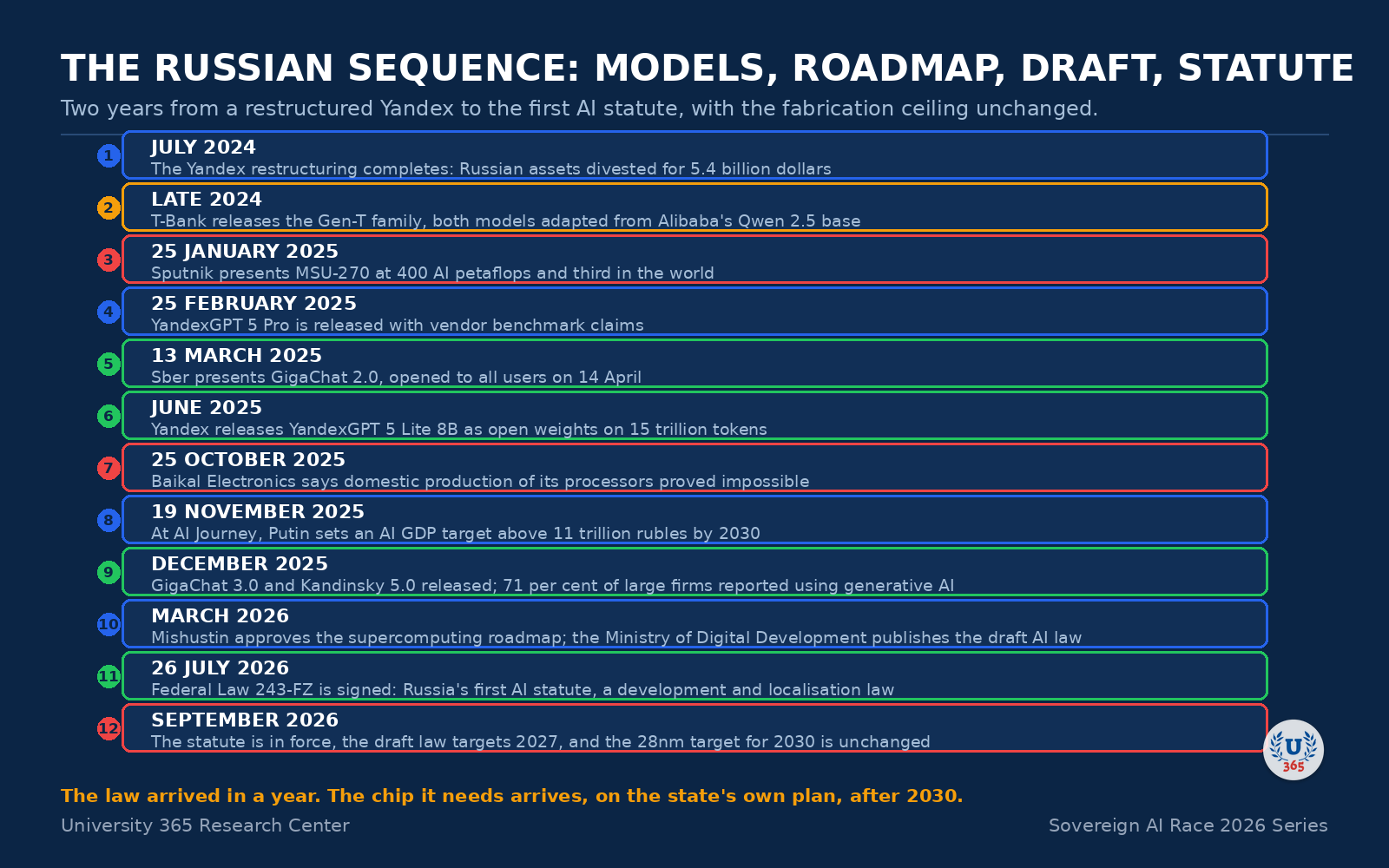
The Russian sequence: models, roadmap, draft law, statute, and the 2028 fabrication target still standing. University 365 Research Center.
University 365 has not published a Russia AI landscape report before this one, in any series. There is no prior U365 baseline for Russia, no earlier country file, and no earlier landscape analysis of Russian AI in the institution's catalogue. This report says so plainly rather than implying a baseline it does not have, and it is the first of the three remaining reports in this series that have no prior baseline, alongside Portugal and South Africa.
What can be compared instead is Russia against itself inside this report's own research window, and the movement in that interval is substantial and goes in one direction. In 2024 the country had a strategy from 2019 and a code of ethics, and its most consequential AI event was the restructuring that removed Yandex's international assets from the Russian market. In 2025 it released a generation of models, opened GigaChat to the public, set a new GDP target at AI Journey, and lost the remaining foreign capital channels for its domestic AI sector. In 2026 it decreed a presidential commission in February, approved a supercomputing roadmap in March, published a draft AI law for consultation in March, restricted access to 439 virtual private network services by January, and signed its first AI statute in July. The direction is consolidation and legal formalisation of a programme that had been running on strategy documents alone, and the constraint that has not moved is fabrication: the 28-nanometre target for 2030 was the plan before this report's window and remains the plan inside it. The series will build its Russian baseline from this report forward.

Sovereign AI Race: Russia (2026)
Key Findings
1. Russia's first AI law is a development and localisation statute, not a safety law. Federal Law No. 243-FZ was signed on 26 July 2026 after first reading on 7 July, second and third readings on 8 July and Federation Council approval on 18 July. Its thirteen articles establish a framework for AI deployment, define and restrict large foundation models with localisation requirements, make compliance with state-defined values a condition for "sovereign" status, reserve to the state the power to mandate sovereign models for public administration, and grant developers a broad copyright safe harbour to train on protected works without consent. In the same weeks the European Union's transparency obligations were applying; the directions are opposite.
2. The domestic fabrication ceiling is the country's hardest constraint and the state publishes it. Russia's own plan targets 28-nanometre domestic production by 2030, roughly nineteen years after the node debuted globally, and AI accelerators are not in domestic production above it. The head of Baikal Electronics said in October 2025 that producing Baikal processors in Russia turned out to be impossible, and the company has produced 85,000 central processing units since 2012.
3. The flagship supercomputer claim cannot be checked. MSU-270 is presented at 400 AI petaflops and third in the world, ahead of LUMI and Leonardo, and appears in no TOP500 list. The machine was reported by The Insider as built with smuggled NVIDIA chips and operating under the control of the president's daughter, a single-source allegation labelled as such here. The verifiable installed base is real but modest: Yandex's Chervonenkis on the TOP500 list, Sberbank's Christofari Neo with more than 700 A100 accelerators described at roughly 20 petaflops at launch, and the Govorun system at Dubna at 2.2 petaflops after modernisation.
4. Sanctioned compute keeps arriving, and the volume is unknown. A United States prosecution unsealed in March 2026 concerned a network worth more than 420 million dollars moving NVIDIA processors toward China and Russia; the figure covers both destinations. On 12 August 2026 Ukrainian military intelligence disclosed an NVIDIA Jetson Orin NX module packaged in March 2025 recovered from a Russian S-71M cruise missile, corroborated by multiple outlets and confirmed as to the part's identity by the vendor. No audited figure for grey-channel imports into Russia specifically exists in the located sources, and this report does not estimate one.
5. The data centre build-out is throttled by the cost of money and by the grid. Russian capacity stood at 1.2 to 1.7 gigawatts by 2025, about 0.8 gigawatts of it commercial, concentrated around Moscow. 38 projects worth 168.6 billion rubles, about 2.26 billion dollars, were suspended over three years on borrowing costs and grid constraints. Rosseti says an additional 3 gigawatts will be allocated to computing centres, and the state now directs new capacity to nuclear and hydro sites with Krasnoyarsk named a priority.
6. The sovereign model flagship is serious and the field beneath it is partly Chinese. GigaChat 3.1 Ultra, at a claimed 702 billion parameters trained on Sber's own infrastructure, is described by Counterpoint Research as Russia's leading sovereign model and the closest counterpart to the UAE's Falcon H1. YandexGPT 5 Lite was released as open weights in June 2025 with a licence conflict between Apache 2.0 and a custom name. T-Bank's Gen-T family adapts Alibaba's Qwen 2.5, the updated T-pro-it-2.1 is built on the Qwen 3 family by its own model card, and VTB has acknowledged working with Qwen.
7. There is no independent evaluation regime for Russian model claims. MERA, published at ACL 2024 and maintained by the industry alliance, is the main open Russian-language benchmark and dates from January 2024. The largest vendors' 2025 and 2026 standings are made on vendor-selected task sets, and no successor benchmark was located in this research.
8. The civil AI budget is outranked by the military line inside Russia's own budget. Federal AI funding is reported at 26.49 billion rubles for 2025 to 2027 or 7.7 billion rubles for 2025 alone, two figures this report states without reconciling. Military spending reached about 16 trillion rubles in 2025, 7.5 per cent of GDP, and hit a record 43.8 to 44 per cent of federal outlays in the first half of 2026, against a 2026 deficit projected at 3.79 trillion rubles.
9. The state's financial cushion is thinner than its headline. The National Wealth Fund held 12.72 trillion rubles, about 159.3 billion dollars, as of 1 August 2026, with total assets of about 154 billion dollars but liquid assets of only 4 trillion rubles, some 46.7 billion dollars, as of 1 September 2026. Its July composition included 189.8 billion Chinese yuan, meaning the reserve cushion is substantially denominated in the currency of the country's principal AI partner.
10. The talent outflow is measured, the response is real, and the demography is severe. About 100,000 IT specialists left in 2022 on the official figure, 46 per cent of surveyed specialists still considered leaving, and reporting through 2026 describes the exodus as a continuing constraint. Against it: an AI faculty at Moscow State University with a first cohort of 72 students funded by Oleg Deripaska, a Skolkovo grade 1 to 11 pilot with a Chinese university partner, an AI school profile from 1 September 2026, and teacher upskilling at scale. Unemployment at a record 2.1 per cent sits beside a structural worker shortage and a reported 11 million shortfall by 2030.
11. The honest overall verdict: Russia holds genuine capability at the layers a determined state can build without the frontier, and its sovereignty claim rests on numbers no independent body can check. It owns the strongest sovereign model outside the Gulf by third-party assessment, a real research tradition, and a state banking group that owns model, cloud and infrastructure. It does not own the ability to make an AI accelerator, it cannot verify its own flagship compute figure, half its commercial model field rests on a Chinese base, and its civil AI programme is fiscally subordinate to a war. On the evidence, Russia is the series' clearest case of a state that has achieved real sovereignty in the layers that do not require silicon, and none at all in the layer that does.

Sovereign AI Race: Russia (2026)
Deep Analysis
Why verification is the load-bearing question in the Russian case
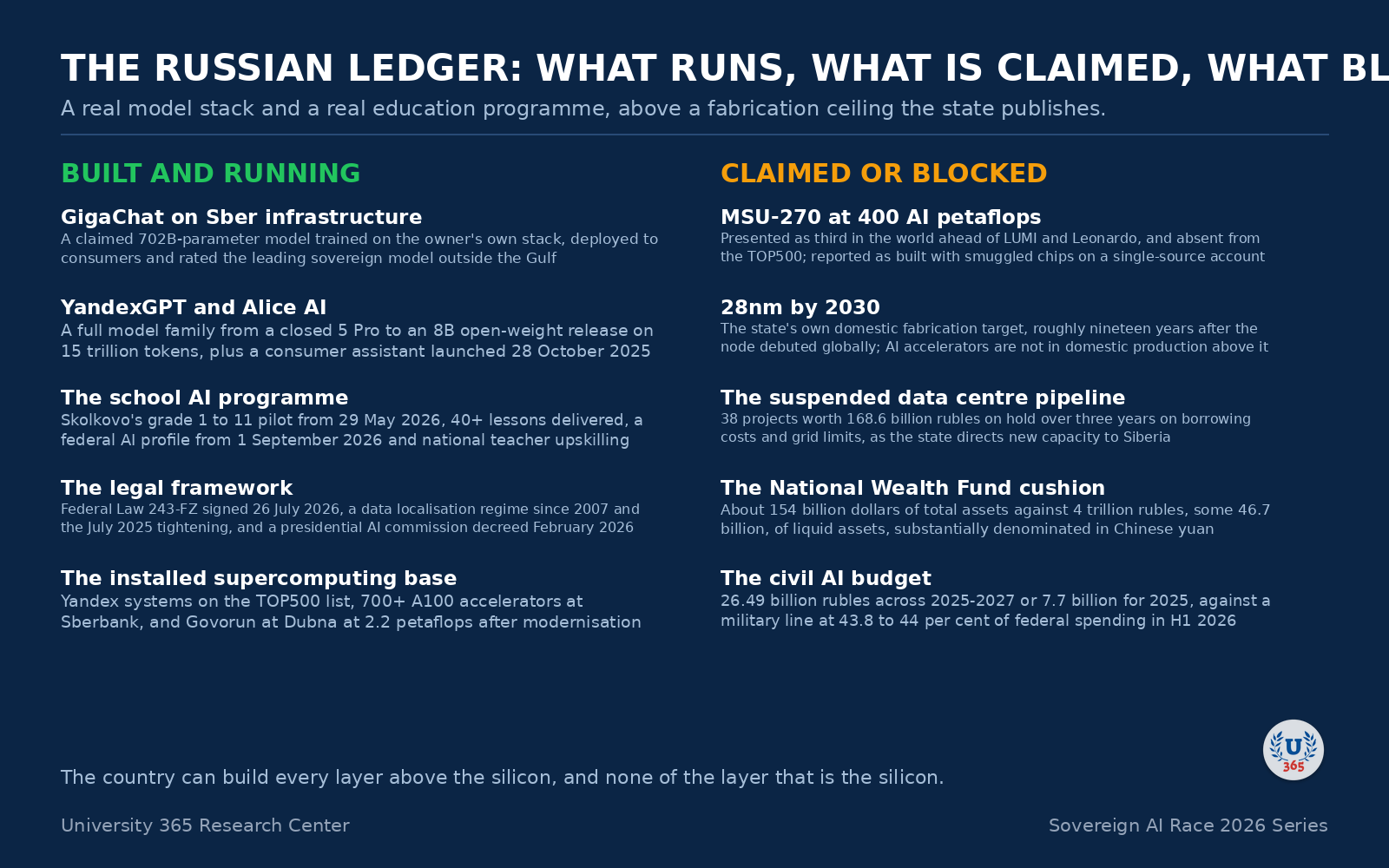
What runs, against what is claimed or blocked. University 365 Research Center.
Every country in this series has a set of claims that outrun its measured reality to some degree, and this report has documented those in fifteen other countries. Russia is different in kind, because the mechanism that normally corrects an inflated claim does not operate inside the country.
Consider what an external check requires. A supercomputer ranking requires a submission to a common benchmark, and Russia's flagship claim is absent from the list that publishes those submissions. A model ranking requires a neutral evaluator that vendors are obliged to face, and the one open Russian-language benchmark in existence, MERA, dates from January 2024 while the vendors' current claims are made on task sets the vendors selected. An adoption figure requires an independent statistical body, and the largest available Russian adoption number is a study conducted by a consultancy in partnership with the vendor it studies. A corporate value figure requires an audit, and the state banking group's reported 475 billion rubles of internal AI benefit in 2025 is a self-assessment. A sovereign reserve figure requires a distinction between what the fund owns and what it can spend, and the published headline is twelve to thirteen trillion rubles against four trillion of liquid assets.
None of this means the country's achievements are fake, and the report is careful about the distinction. Some Russian capability is independently corroborated: TOP500 does list Yandex's Chervonenkis machine, Counterpoint Research does rank GigaChat 3.1 Ultra as a leading sovereign model on stated criteria, and the data centre project suspensions were reported by Russian business press with figures attributed to the market. What cannot be checked is the class of claim that a sovereignty programme most needs to be believed, the flagship numbers that establish that the state is a serious AI power. That is a structural consequence of closure, not a conspiracy, and it has a specific cost for the programme itself: a state that cannot be audited cannot be a benchmark for anyone, including itself. When the same institution writes the strategy, runs the project, and reports the result, the reporting loses its function.
There is a second consequence, and it is the one this report treats as analytically productive. Because verification is unavailable, the report has had to reason from what can be counted rather than from what is claimed: the number of TOP500 entries, the node at which the state says it will fabricate, the megawatts actually connected, the projects actually suspended, the places actually funded, and the direction of money through a budget. Those counts tell a coherent story that the claims do not contradict, and the story is of a state that has made real progress at the layers requiring organisation and talent, and none at the layer requiring an industrial base it does not have. The unaudited claims and the auditable facts point the same way, which is the most that can be said and enough to base an assessment on.
What the Chinese dependence means for model sovereignty
Mikhail Mishustin, Chairman of the Government of the Russian Federation, as of 2026. He signed the March 2026 order approving the roadmap for high-performance computing, AI algorithms, grid technologies and supercomputer infrastructure. Photograph: government.ru, CC BY 4.0, via Wikimedia Commons.
Russia's model layer contains a dependency that the country's own legislation has now made formally awkward, and this is the section where the report draws it out.
Federal Law No. 243-FZ requires that domestic neural networks be created inside Russia, makes compliance with state-defined values a condition for "sovereign" status, and reserves to the state the power to mandate sovereign models for public administration. Set beside the model inventory, the requirement has an obvious problem. T-Bank's Gen-T family, including the flagship T-Pro, adapts Alibaba's Qwen base models, and the updated T-pro-it-2.1 is described on its own model card as built upon the Qwen 3 family. VTB, a state-controlled bank, has acknowledged working with Qwen. Those are not marginal releases: one is a flagship model from a major private bank and the other is a state bank's admitted practice. Under the new law's own terms, a model whose weights derive from a foreign base and whose behaviour has been shaped by another country's training run is a weaker candidate for the sovereign designation than its Russian branding suggests.
The dependence runs deeper than the model layer, and the report treats it as a structure rather than a series of incidents. Chips arrive through third countries, whether through a prosecution-documented smuggling network or in components recovered from weapons, and the part identities in the latter case were confirmed by the manufacturer. The country's own compute capacity is being positioned to serve Chinese customers, with the Kremlin plan for Siberia and the Far East naming China as the biggest customer. And at the school level, the first national AI course for children was launched in partnership with a Chinese university. Each link on its own is explicable: a sanctioned state buys from the suppliers willing to sell, and sells to the buyers willing to buy. Taken together they describe a programme whose compute supply, model foundations and even educational partnerships run through one partner, which means the sovereignty the programme claims is partly delegated.
The counter-evidence deserves equal weight, and the report gives it. Sberbank's GigaChat line is trained on Sber's own infrastructure, which is genuine vertical integration and the reason a third-party index rates it the leading sovereign model outside the Gulf. Yandex has released weights publicly and runs its own supercomputers. Neither of those two flagship cases depends on a Chinese base, so the dependence is real and it is not universal: Russia has a sovereign line and a dependent line, and the dependent line is the one that includes a major private bank's flagship. Sberbank's own first deputy chairman has described joint Russia-China AI work as potentially the core of a new technological architecture, which suggests the state-linked leadership does not treat the dependence as a problem to be solved. Whether that is a strategy or an accommodation cannot be determined from the public record, and the report does not assert either.
What the series can conclude is specific. Model sovereignty, in the sense this series uses the term, means owning the models a country's users actually deploy. Russia owns one such line outright, in GigaChat, and rents the foundations of another, in the Qwen derivatives. Both are deployed. A state in that position holds partial model sovereignty, and its legislation has now written a requirement that the weaker half cannot fully satisfy.
The three races, measured in Russia
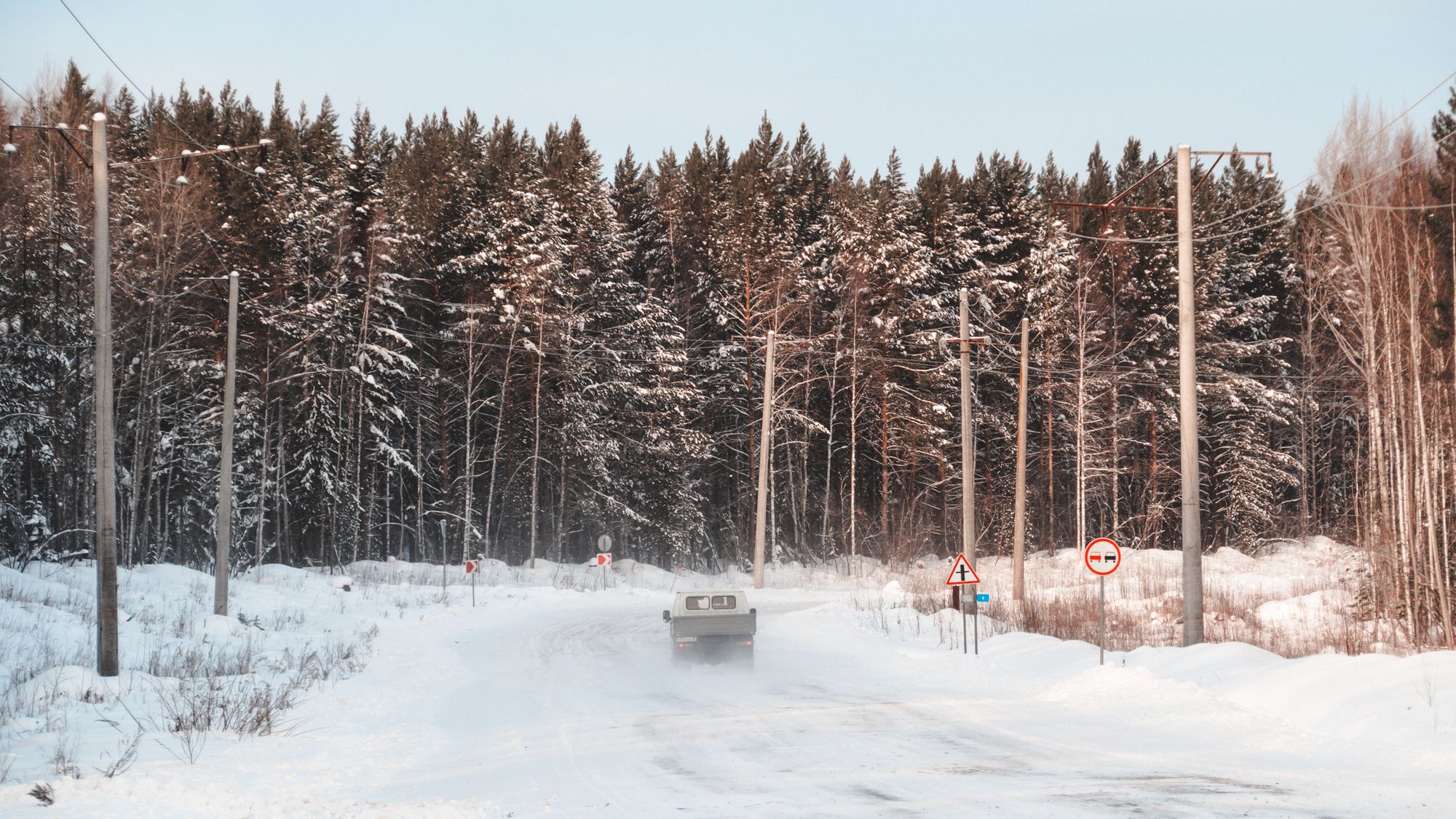
A winter road east of the Urals. The Russian Ministry of Energy proposed in September 2026 that an AI data centre be built in Siberia using spare capacity, a rational answer to a grid that cannot serve Moscow. Photograph: Pexels License, via Pexels.
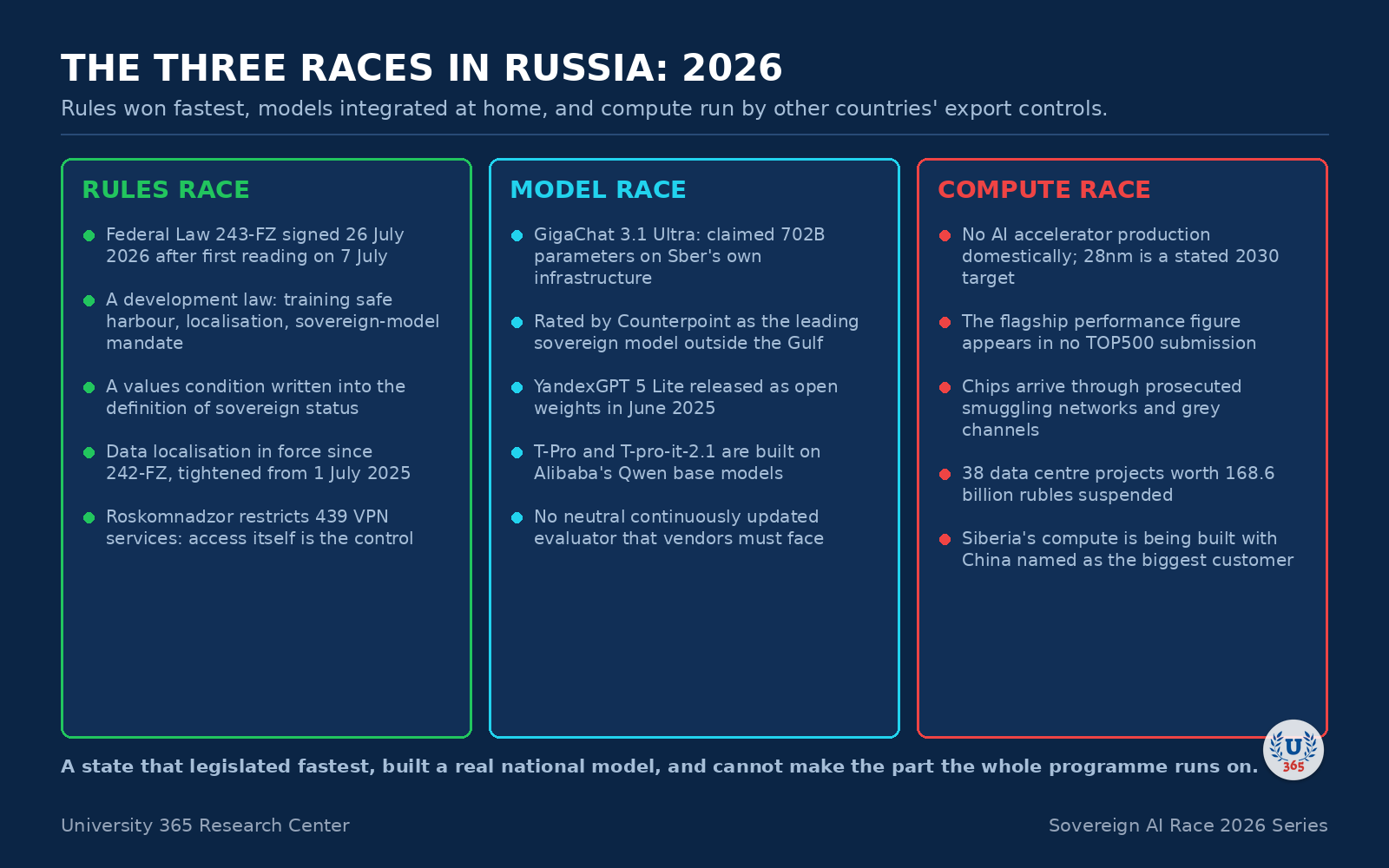
The three races in Russia, at three different tempos. University 365 Research Center.
The series separates the compute race, the model race and the rules race. Russia is the country where all three are run by the same small group of institutions and where one of them is not really being run at all.
In the rules race, Russia moves fast and in its own direction. Federal Law No. 243-FZ went through the Duma in two days in July 2026, was approved by the Federation Council within eleven days of the first reading, and was signed by the president eight days after that. Its substance is developmental: a training safe harbour, a localisation condition, a sovereign-model mandate for public administration, and a values condition for the sovereign designation. Beside it sits a data localisation regime that predates the AI wave, a draft law on the regulation portal with a September 2027 horizon, and an enforcement apparatus in Roskomnadzor whose principal lever is access. This is not a rules race toward safety; it is a rules race toward a domestically controlled stack, and it is being run faster and more decisively than any other regulatory programme in this series.
In the model race, Russia runs third in its own weight class and first outside the Gulf. GigaChat 3.1 Ultra is a genuinely integrated national model built on national infrastructure, released publicly and deployed at scale by its owner. Yandex has a full family from a 5 Pro closed model down to an 8-billion-parameter open release, plus a consumer assistant. The Gen-T and Cotype lines fill the commercial and business segments. What no Russian model has is a standing on a neutral leaderboard, which is a gap in evidence rather than a gap in capability, and what the field does not have is a frontier-class model by any independent measure available in this research.
In the compute race, Russia is not competing in the sense the series uses the term. The country cannot make an AI accelerator at the nodes that matter and will not be able to by its own plan before 2030. It acquires accelerators through networks that are the subject of criminal prosecutions in the destination countries. Its data centre pipeline is throttled by interest rates and by a grid that already cannot serve Moscow. Its national answer is to move compute to where the electricity is, in Siberia, and to sell it to the neighbour that supplies the chips. Every element of that is rational, and none of it is compute sovereignty.
The three tempos produce the report's summary of Russia. A state that legislated the fastest, built the most vertically integrated national model outside the Gulf, and cannot manufacture the part the whole programme runs on, which means its compute race is being run by other countries' export controls and other countries' willingness to sell.

Sovereign AI Race: Russia (2026)
Data and Evidence
Table 1: The five layers, assessed for Russia in September 2026
Layer | What Russia holds | What it does not hold | Assessment |
Compute | A supercomputing roadmap approved in March 2026 with roles for Rosatom, Rostec, Roscosmos, Moscow State University and the Kurchatov Institute; a stated plan for up to ten supercomputers by 2030; TOP500-listed Yandex systems and Sberbank's Christofari Neo with more than 700 A100 accelerators; Govorun at Dubna at 2.2 petaflops after modernisation; data centre capacity of 1.2 to 1.7 GW by 2025, of which about 0.8 GW commercial; Rosseti's stated 3 GW allocation to computing centres; Rostelecom's 100 MW plan at an estimated 100 billion rubles; IXcellerate's five Moscow facilities with a new campus due 2026 | Leading-edge fabrication: 28nm is a stated 2030 target; AI accelerators are not in domestic production; a verified flagship performance figure (MSU-270 claimed at 400 AI petaflops and absent from TOP500); an audited grey-import volume; the electricity to serve Moscow without self-generation; delivery of a stalled pipeline (38 projects worth 168.6 billion rubles suspended) | A real installed base and an unaudited claim above it, with the fabrication ceiling binding |
Models | GigaChat 3.1 Ultra at a claimed 702B parameters trained on Sber infrastructure, described by Counterpoint as Russia's leading sovereign model; the GigaChat 3.0 and Kandinsky 5.0 releases; YandexGPT 5 Pro and Pro 5.1 plus Alice AI; YandexGPT 5 Lite 8B open weights on 15T tokens (licence conflict recorded); T-Bank's Gen-T family; MTS AI's Cotype line including an Apache 2.0 Nano release; the Vikhr academic family; MERA as the open Russian-language benchmark | A frontier-class model on any independent measure; a neutral continuously updated evaluation regime; an unambiguous open licence on the main Yandex release; ownership of the base models under the Gen-T and T-Pro lines (Qwen 2.5 and Qwen 3 derivatives); a verified model count beyond a third-party estimate of 34 | One genuinely integrated sovereign line, a second substantial line, and a third built on a foreign base |
Capital | The National Wealth Fund at 12.72 trillion rubles (about 159.3 billion dollars) on 1 August 2026, with about 154 billion dollars of total assets and 4 trillion rubles (46.7 billion dollars) liquid on 1 September 2026; RDIF as the designated co-investment vehicle; Sberbank reporting 700+ AI initiatives, 900 autonomous agents and over 475 billion rubles of internal benefit in 2025; Rostec's doubled net profit and its AIS holding's 25 per cent of Vansel; Selectel's 1 billion ruble joint venture with ITMO; the national project Data Economy running 2025-2030 | A civil AI budget at the scale of the ambition: 26.49 billion rubles for 2025-2027 or 7.7 billion for 2025, against a military line at 43.8 to 44 per cent of federal spending in H1 2026; a liquid cushion sufficient for a strategic build-out; Western co-investment, since the Yandex restructuring removed the entity that could raise it; verified Chinese equity into Russian AI | A state that funds AI from a subordinate budget line and a thinning reserve, with the private cost of capital throttling the build |
Regulation | Federal Law No. 243-FZ signed 26 July 2026: a development and localisation statute with a training copyright safe harbour, a sovereign-model mandate for public administration and a values condition for the sovereign designation; the March 2026 Ministry of Digital Development draft with a September 2027 horizon; 242-FZ data localisation and the July 2025 tightening; 152-FZ article 16 on solely automated decisions; the Presidential Commission decreed 26 February 2026; the 2019 strategy as amended by Decree 124 of February 2024; Roskomnadzor's 439 restricted VPN services and 2.3 billion ruble filtering plan | A risk-tier safety statute comparable to the EU AI Act; an operating state register of AI systems (legal basis only); verified article-level penalty ranges for the new statute; a distinct 2026 omnibus strategy document; any independent check on the enforcement programme's scale | The fastest regulatory programme in the series and the most clearly developmental in purpose |
Talent and education | Skolkovo's grade 1 to 11 AI pilot from 29 May 2026 with 40+ lessons delivered; a federal AI school profile from 1 September 2026; teacher upskilling announced June 2026; 120+ AI training programmes supported; six federal AI research centres with Skoltech's third-wave win; the National AI Strategy's 3,000 to 15,500 graduate target against 5,951 graduates reported for 2023; the AI360 pipeline with Yandex and Sber at St Petersburg University; the MSU AI faculty's 72-student first cohort funded by Deripaska; the Top-AI programme's 10,200 target by 2030; more than 5,000 state-funded places for African students in 2025 | Retention: about 100,000 IT specialists left in 2022 and 46 per cent of surveyed specialists still considered leaving; a 2022-2026 cumulative AI-specific emigration figure (unverified); an audited total for AI graduates in the current cycles; the labour force itself, with a reported 11 million shortfall by 2030 | A deep tradition, a real and recent school-level build-out, and an outflow the state has measured without solving |
Table 2: The controlled metrics, series bible format
Metric | Russia position | Source and date |
Flagship compute commitment | MSU-270 at Moscow State University: commissioned 2023, named publicly April 2025, presented as 400 AI petaflops and third in the world ahead of LUMI and Leonardo (state CLAIM; absent from TOP500), reported as built with smuggled NVIDIA chips and under the control of Katerina Tikhonova (The Insider, single-source, labelled). Verifiable base: Yandex's Chervonenkis on the TOP500 system list; Sberbank's Christofari Neo with 700+ NVIDIA A100 80GB accelerators, described at launch at roughly 20 petaflops (vendor CLAIM); Govorun at JINR Dubna at 2.2 petaflops peak after RSC Group modernisation (operator CLAIM). Roadmap approved by Prime Minister Mishustin in March 2026; a stated plan for up to ten supercomputers by 2030 (CLAIM). Datacentre capacity 1.2 to 1.7 GW in 2025 (about 0.8 GW commercial); Rosseti's stated addition of 3 GW | Sputnik, 25 January 2025; TAdviser; The Insider; TOP500 system page 180029; DataCenterDynamics and Reuters, November 2021; JINR news release; IT Russia, 16 March 2026 and 16 April 2026; TAdviser datacentre market article, 2025 |
Capital committed | Civil AI lines: 26.49 billion rubles for 2025-2027 (Lead the Shift) and 7.7 billion rubles for 2025 (babl.ai), two figures recorded without reconciliation. National Wealth Fund 13.41 trillion rubles on 1 April 2026, 13.104 trillion on 1 July, 12.72 trillion (about 159.3 billion dollars) on 1 August, with about 154 billion dollars total and 4 trillion rubles (46.7 billion dollars) liquid on 1 September 2026; July composition included 189.8 billion CNY. Sberbank: 700+ AI initiatives, 900 autonomous agents, over 475 billion rubles of internal benefit in 2025 and a 500 billion ruble AI revenue target for 2026 (company CLAIMS). Selectel over 1 billion rubles into a joint AI venture with ITMO. Yandex Russian assets divested for 5.4 billion dollars in July 2024 | TASS, 3 April 2026, 3 July 2026, 7 September 2026; Big News Network, 10 August 2026; IT Russia, 30 July 2026 and 3 May 2026; ITMO news, 6 July 2026; MLQ.ai research; Wedbush note, 4 October 2025 |
Flagship national models | GigaChat 3.1 Ultra: claimed 702B parameters, trained on Sber infrastructure, described by Counterpoint Research as Russia's leading sovereign AI LLM and the closest counterpart to the UAE's Falcon H1 (parameter count a vendor specification relayed by index coverage). GigaChat 2.0 presented 13 March 2025, opened to all users 14 April 2025; GigaChat 3.0 and Kandinsky 5.0 released late 2025; 20+ million claimed monthly users. YandexGPT 5 Pro released 25 February 2025 (vendor benchmark CLAIM); YandexGPT Pro 5.1 August 2025; Alice AI announced 28 October 2025; YandexGPT 5 Lite 8B released June 2025 on 15T tokens (Apache 2.0 per the registry, custom licence per Hugging Face metadata; conflict recorded) | Sber press centre; TAdviser; Counterpoint Research coverage via Communications Today, 2026; Yandex IR, 28 October 2025; OpenModels and Hugging Face, June 2025 |
Anchor entities | Sberbank (model, cloud, infrastructure, largest state-linked investor); Yandex (models, supercomputers, cloud); the Ministry of Digital Development (draft law and policy); the Presidential Commission on AI Technologies with Oreshkin and Grigorenko; Rosatom, Rostec, Roscosmos and the Kurchatov Institute on the supercomputing roadmap; Roskomnadzor (access control); RDIF (co-investment); MTS AI and T-Bank (model families) | Kremlin commission and decree pages; TAdviser; IT Russia, March 2026; The Russia Program, 2026 |
Chip dependency | Complete above 28nm: no AI accelerator production in domestic fabs, with 28nm a stated 2030 target for Mikron and the Baikal head stating in October 2025 that domestic production of Baikal processors proved impossible. Acquisition runs through grey channels: the English-Kelly-Zheng prosecution of a 420M+ dollar network moving NVIDIA GPUs to China and Russia (March 2026) and the NVIDIA Jetson Orin NX packaged March 2025 recovered from an S-71M missile (HUR disclosure, 12 August 2026, corroborated) | Tom's Hardware, 2025; www1.ru, 25 October 2025; Archyde, March 2026; AI Brainer and corroborating outlets, August 2026 |
Regulatory instrument and status | In force: Federal Law No. 243-FZ signed 26 July 2026 (framework, localisation, copyright safe harbour for training, sovereign-model mandate, values condition); 242-FZ data localisation and the July 2025 tightening; 152-FZ article 16 on solely automated decisions; the 2019 strategy as amended by Decree 124 of February 2024; the 2021 voluntary AI Code of Ethics; the Presidential Commission decree of 26 February 2026. Proposed: the Ministry of Digital Development draft of March 2026 with a 1 September 2027 horizon. Conflict: one analysis dates 243-FZ signature to 29 July 2026 and cites bill No. 1271570-8 | Kremlin acts page, 26 July 2026; Nordic Star; AEB; Xinhua, 8 July 2026; theleveragedyears.com (conflict); www1.ru, 22 March 2026; IT Russia, 19 March 2026 |
Talent anchors | MSU's new AI faculty (72-student first cohort, September 2026, Deripaska-funded); Skolkovo's grade 1 to 11 AI pilot with a Chinese university partner; the six federal AI research centres including Skoltech's 2025 win; the AI Alliance university ranking with ITMO and HSE at the top; the AI360 project with St Petersburg University, Yandex and Sber; the Top-AI programme (about 10,200 by 2030); 120+ AI training programmes; more than 5,000 state-funded places for African students in 2025 | TIME, 18 June 2026; Startup Village news, 29 May 2026; ITMO news, 2024 and 2025; SPbU news, 6 May 2025; TAdviser; DW, 29 October 2025 |
Independent index standing | Oxford Insights Government AI Readiness Index 2025 (8th edition, January 2026): the Russian Federation ranks 49th of the 195 countries assessed with an overall score of 59.57. The publisher's January 2026 table prints the rank and the six pillar scores and no overall column, so the overall is recomputed from the publisher's own pillar weights (Policy Capacity 10 per cent, AI Infrastructure 25, Governance 15, Public Sector Adoption 15, Development and Diffusion 25, Resilience 10), a method that reproduces all nine overall scores stated in the report's own narrative exactly. Russia's Policy Capacity pillar score is 65.50. The index's own text states that it assesses 195 countries, the largest dataset in its history, and the same edition carries a note that the December 2025 publication contained incorrect scores and rankings that the January 2026 report corrects. Counterpoint Research's sovereign AI LLM work rates GigaChat 3.1 Ultra a leading sovereign model on vertical integration. Stanford HAI AI Index 2026 Russia-specific metrics were not located, and Russia is absent from the leading-country comparisons available in this research | Oxford Insights Government AI Readiness Index 2025, January 2026 report and full rankings table; Counterpoint Research via Communications Today, 2026; Stanford HAI, 2025 |
Adoption | Generative AI used by 71 per cent of large Russian companies in at least one business function, per the study Artificial intelligence in Russia 2025 by Yakov and Partners with Yandex (vendor-partnered study, CLAIM). Gosuslugi at 14 million daily users (official figure, CLAIM). GigaChat monthly users above 20 million claimed late 2025, against 308,806 observable Telegram channel subscribers at access time. DeepSeek usage share reported at roughly 43 per cent by end-2025 (Microsoft AI Economy Institute via eMarketer) against Statcounter's March 2026 web-visit measurement of Perplexity 56.1 per cent and DeepSeek 1.04 per cent; the two conflict and are recorded, not resolved | Yakov and Partners, 2025; AKM, 21 February 2026; Izvestia; TAdviser; eMarketer and Physical AI News, January 2026; Statcounter, accessed 2026-09 |
Distinguishing mechanism | Isolationist development: the fastest legislative programme in the series, a genuinely integrated state-bank model built on domestic infrastructure, and a fabrication ceiling the state itself publishes, with the flagship compute figure unaudited and the model field partly derived from a foreign base | This report |
Core tension | The state has achieved real sovereignty in every layer that does not require silicon and none in the layer that does, and its own laws now require a model localisation its commercial flagship cannot fully satisfy | This report |
Table 3: Timeline, 2024 to 2026
Date | Event | Source |
February 2024 | The National AI Strategy is updated by Presidential Decree No. 124 | Country policy pages; regulations.ai |
July 2024 | The Yandex restructuring completes: Russian assets divested for 5.4 billion dollars; the international remnant becomes Nebius Group | MLQ.ai research; Wedbush note |
22 July 2024 | ITMO tops the AI Alliance ranking of universities for AI education quality | ITMO news |
October 2024 | Nebius resumes Nasdaq trading as an AI infrastructure company | Wedbush note, 4 October 2025 |
Late 2024 | T-Bank's AI centre releases the Gen-T family (T-lite 7B, T-Pro 32B), both Qwen 2.5 derivatives | The Russia Program, 2026 |
4 December 2024 | A CASE survey finds 46 per cent of surveyed Russian IT specialists consider relocating | CASE Center report |
25 January 2025 | Sputnik describes MSU-270 as 400 AI petaflops and third in the world | Sputnik |
8 February 2025 | Rosatom presents a new quantum computing roadmap | www1.ru |
25 February 2025 | YandexGPT 5 Pro is released | Model Beats |
13 March 2025 | Sber presents GigaChat 2.0 | SocialNews |
25 March 2025 | The tightening of personal data localisation requirements is reported, effective 1 July 2025 | Lidings |
April 2025 | The MSU-270 name is disclosed publicly | TAdviser |
14 April 2025 | GigaChat 2.0 becomes available to all users | SocialNews |
6 May 2025 | St Petersburg University joins the AI360 project with Yandex and Sber | SPbU news |
6 June 2025 | Skoltech's AI Centre wins the third-wave federal AI research centre selection | Skoltech |
June 2025 | Yandex releases YandexGPT 5 Lite 8B as open weights on 15T tokens, with a licence conflict between the registry and the repository | OpenModels; Hugging Face |
9 June 2025 | Economists warn the National Wealth Fund could be exhausted by 2026 | The Moscow Times |
11 June 2025 | Nebius unveils a second supercomputer; MTS AI opens a code assistant and releases Cotype Nano | The Moscow Times; ixbt.pro; MTS AI |
17 June 2025 | Rostec's chief executive reports doubled net profit and frames a fight for the future | Euromaidan Press; The Moscow Times |
23 July 2025 | More than 120 AI training programmes supported by the Ministry of Education and Science | Izvestia |
August 2025 | YandexGPT Pro 5.1 is released | systems-analysis.ru |
10 September 2025 | Sberbank's Vedyakhin says Russia-China AI efforts could be the core of a new technological architecture | China Daily |
25 September 2025 | The draft 2026-2028 budget cuts military spending for the first time and raises VAT | bne IntelliNews |
25 October 2025 | The head of Baikal Electronics says domestic production of Baikal processors proved impossible | www1.ru |
28 October 2025 | Yandex introduces Alice AI | Yandex investor relations |
29 October 2025 | Russia allocates more than 5,000 state-funded university places for African students after 40,000+ applications | DW |
18 November 2025 | IXcellerate's MOS5.4 and MOS5.5 receive Tier III design certification | IXcellerate |
19 November 2025 | At AI Journey, Putin calls for a national AI task force and sets an AI GDP contribution target above 11 trillion rubles by 2030 | Reuters via KFGO; Kremlin AI Journey page |
20 November 2025 | Sber presents GigaChat as a personal assistant that acts | Sber press centre |
25 November 2025 | MTS AI presents Cotype VL, its first vision-language model, at Finopolis | MTS AI |
28 November 2025 | Roskomnadzor threatens to block WhatsApp | The Moscow Times |
4 December 2025 | Roskomnadzor blocks Snapchat and restricts FaceTime calls | The Moscow Times |
December 2025 | Sber releases GigaChat 3.0 and Kandinsky 5.0, with monthly GigaChat users claimed above 20 million | Sber annual report page; TAdviser |
December 2025 | Yakov and Partners with Yandex publish AI in Russia 2025: 71 per cent of large companies use generative AI in at least one function | Yakov and Partners; AKM |
December 2025 | A United States investigation into a 420M+ dollar network moving NVIDIA GPUs toward China and Russia is reported; arrests follow in March 2026 | Archyde |
19 January 2026 | Reporting that Roskomnadzor will use AI to filter internet traffic, with about 2.27 billion dollars planned for blocking banned sites | www1.ru |
January 2026 | Roskomnadzor plans an AI traffic filtering system at a reported 2.3 billion rubles | TAdviser |
22 January 2026 | Roskomnadzor has restricted access to 439 VPN services | www1.ru |
12 January 2026 | DeepSeek is reported at roughly 43 per cent usage share in Russia by end-2025 | Physical AI News |
21 February 2026 | The Yakov and Partners study on generative AI use by large Russian companies is reported | AKM |
26 February 2026 | Putin signs a decree on the Presidential Commission on the Development of AI Technologies | TAdviser |
16 to 18 March 2026 | Mishustin approves the roadmap for high-performance computing and supercomputer infrastructure | IT Russia; www1.ru; TV BRICS via atnews.co.za |
17 to 22 March 2026 | The Ministry of Digital Development publishes a draft federal AI law with a planned entry into force of 1 September 2027 | IT Russia; www1.ru |
March 2026 | United States federal authorities unseal the English-Kelly-Zheng case concerning a 420M+ dollar GPU and technology network | Archyde |
1 April 2026 | The National Wealth Fund stands at 13.41 trillion rubles, 5.7 per cent of projected GDP | TASS |
9 April 2026 | A VK Tech study finds AI agents and LLMs dominating investment priorities for large Russian companies | IT Russia |
10 April 2026 | Putin chairs a meeting on AI technology development | Kremlin events |
14 April 2026 | A Kremlin meeting with Rosseti's chief executive discusses data processing centres as a new class of consumer | Kremlin transcript via GlobalSecurity |
16 April 2026 | Rosseti says an additional 3 GW will be allocated to new computing centres | IT Russia |
7 May 2026 | Putin meets Rostec's chief executive for the 2025 performance report | Kremlin events; Euromaidan Press |
29 May 2026 | Skolkovo signs an agreement to launch a grade 1 to 11 pilot AI education programme | Startup Village 2026 |
30 May 2026 | The Ministries of Digital Development and Energy develop measures to remove the power bottleneck for data centres | IT Russia |
1 June 2026 | Deputy Prime Minister Novak directs that new data centres sit near nuclear or hydro plants, with Krasnoyarsk a priority | Novak article via People of Internet |
2 June 2026 | Skolkovo launches the first AI course for schoolchildren with Avito and a Chinese university | IT Russia |
3 June 2026 | Reporting that Russia is promoting its sovereign AI to Latin America, Africa and Asia through Sber | dev.ua |
10 June 2026 | The Ministries of Digital Development and Education announce large-scale teacher AI upskilling | IT Russia |
18 June 2026 | TIME reports on Russia's AI sovereignty push, its chip problem, and the MSU AI faculty funded by Deripaska | TIME |
21 June 2026 | The State Duma announces phased regulation of neural networks | www1.ru |
24 June 2026 | 38 data centre projects worth 168.6 billion rubles are reported suspended over three years on borrowing costs and grid constraints | The Moscow Times |
26 June 2026 | The Ministry of Justice plans AI in the free legal aid system | www1.ru |
1 July 2026 | The National Wealth Fund stands at 13.104 trillion rubles, including 189.8 billion Chinese yuan and 141.1 tons of gold | TASS |
6 July 2026 | Selectel announces over 1 billion rubles for a joint AI service enterprise with ITMO University | ITMO news |
7 to 8 July 2026 | The State Duma passes the AI bill in first reading (7 July), then second and third readings (8 July) | Xinhua; factum.press; Lidings |
9 July 2026 | Coverage frames the Duma's AI law as a choice between open source and own mathematics, with hundreds of billions of rubles at stake | www1.ru |
14 July 2026 | Skolkovo reports 40+ lessons delivered in the first phase of its school programme | IT Russia |
18 July 2026 | The Federation Council approves the framework AI law | Lidings; rks.global |
20 July 2026 | Lidings publishes its legal update on the Duma's passage of the AI draft law | Lidings |
26 July 2026 | Putin signs Federal Law No. 243-FZ, Russia's first AI statute (one analysis dates it 29 July; conflict recorded) | Kremlin acts page; Nordic Star; AEB |
26 July 2026 | HSE and Cherepovets State University pilot AI literacy modules with 137 future teachers and specialists | IT Russia |
30 July 2026 | Sber reports 700+ AI initiatives, 900 autonomous agents and over 475 billion rubles of internal benefit | IT Russia |
1 August 2026 | The National Wealth Fund stands at 12.72 trillion rubles, about 159.3 billion dollars | Big News Network; TASS |
3 August 2026 | T Plus proposes using thermal plant reserve capacity for data centres | www1.ru |
12 August 2026 | Ukrainian military intelligence discloses an NVIDIA Jetson Orin NX packaged March 2025 recovered from an S-71M missile | HUR via AI Brainer and corroborating outlets |
12 August 2026 | Reporting that data centres and factories are shifting to self-generation | www1.ru |
28 August 2026 | Reporting that server demand is outpacing capacity and the data centre market could triple | www1.ru |
29 August 2026 | The AI Alliance opposes payments to copyright holders for training content | www1.ru |
1 September 2026 | The National Wealth Fund reports about 154 billion dollars total assets with 4 trillion rubles (46.7 billion dollars) liquid | TASS |
1 September 2026 | An Artificial Intelligence profile appears in Russian schools for students choosing advanced computer science | news-pravda.com column |
8 September 2026 | The Kremlin says AI will feature prominently at the upcoming BRICS summit | TASS |
12 September 2026 | Kyiv Independent reports Russian AI use in cyberattacks against Ukraine and Europe | Kyiv Independent |
13 September 2026 | The Ministry of Energy proposes an AI data centre in Siberia using spare capacity | Aroged |
12 to 26 September 2026 | The Ministry of Education issues guidelines on AI use in schools, excluding primary school students | Izvestia; www1.ru; nemoskva.net |
17 September 2026 | The Far East is positioned as a testing ground for an AI-era economy | IR Press summary |
September 2026 | The AI statute is in force with the March 2026 draft pending a September 2027 horizon; the fabrication ceiling and the capital position are unchanged | As cited above |

Sovereign AI Race: Russia (2026)
Implications
For the countries still to come in this series
Russia offers the series' clearest test of what a sovereignty programme can achieve without access to the frontier, and the answer is precise. A determined state with a strong technical education system, an existing research base and a handful of large domestic firms can build a genuine national model, deploy it at scale, integrate the stack under a single owner, and legislate a framework tailored to its own purposes, all without a leading-edge fab. What it cannot do is substitute for the fab. Every layer above silicon can be built domestically, and every layer above silicon depends on the silicon. Countries reading this case should take two lessons and one warning. The lessons: vertical integration inside one institution is the fastest route to a deployable national model, as Sberbank demonstrates, and a domestic benchmark matters more than a domestic ranking, because the absence of an independent evaluator is what allows a national programme's claims to drift from its capability. The warning: a state that controls its own reporting loses the ability to know its own position, and the drift compounds over time. Any country writing an AI statute should build the measurement regime in the same act, and should make the regime independent of the programme it measures.
For the technology providers
Russia is a market where the demand is real and the supply routes are constrained, and providers outside it should read four signals. First, the domestic model market has genuine incumbents: GigaChat and YandexGPT hold the consumer and enterprise positions, and a foreign provider entering would be competing against services that are free, localised, and reachable without a virtual private network. Second, the compliance environment is now defined but not yet complete, with a localisation condition on foundation models, a data localisation regime in force, and a draft law whose entry into force is planned for September 2027; providers planning Russian operations should note that the requirement to create domestic neural networks inside the jurisdiction, read alongside the training copyright safe harbour, is simultaneously permissive about training data and restrictive about where the training happens. Third, the demand for compute exceeds what the country can connect, with a stalled pipeline, self-generation by operators, and a state-directed move to Siberia, which means colocation and power, not software, are the binding commercial constraints. Fourth, the sanctions architecture means that any provider with a United States nexus should treat the grey-channel market as a legal rather than a commercial matter; the enforcement actions of 2026 make that explicit.
For institutional and enterprise buyers
Buyers with operations in Russia face a market that is servable and closed at the same time. The domestic AI stack is now complete enough to run most enterprise workloads: a model family from a state bank with integrated infrastructure, a second full family from the country's largest technology company, open-weight options for on-premises deployment from Yandex and MTS AI, and cloud capacity from Yandex and IXcellerate among others. The constraints a buyer should plan around are three. Capacity is being built where the electricity is rather than where the users are, so latency and location decisions carry more weight than in Western markets. Compliance with data localisation is already mandatory and the foundation-model localisation requirement now applies, which means any architecture that assumes training or hosting outside the jurisdiction is no longer viable. And the evaluation evidence for the models a buyer would deploy is largely vendor-supplied, so an enterprise procuring Russian AI capability should run its own acceptance tests rather than rely on published standings, because there is no independent evaluator to appeal to.
For University 365
Russia is the sixteenth country in this series and the first whose central educational fact is the state's own measurement of failure. About 100,000 IT specialists left in one year, 46 per cent of those surveyed still considered leaving, and a demographic decline reported at a two-hundred-year low in fertility sits under a labour shortage the government expects to reach 11 million people by 2030. The response is instructive in both directions. On the positive side, Russia has built a genuinely comprehensive school-level AI programme in under eighteen months, from a grade 1 to 11 pilot to a federal school profile to teacher upskilling at national scale, which is faster than any country in this series has moved on AI in schools. On the negative side, the same state funds its flagship university AI faculty from a private fortune and partners its first children's AI course with a foreign university, which tells the reader where the capacity gaps really are. The educational lesson this report draws is specific and uncomfortable: a country that trains AI specialists and loses them, and that educates its children in AI while its best-trained adults leave, is running an education system whose output it cannot keep. For our own work, the Russian case is the strongest evidence in the series that the value of an AI curriculum is realised in the retention and deployment of its graduates, and that a state investing in AI education without a matching investment in the conditions that keep practitioners is buying capability for somebody else.

Sovereign AI Race: Russia (2026)
Education and Skills Impact
What the Russian case teaches about building an AI school system inside a shortage
This series returns in every report to the gap between using AI and building it. Russia adds the case of a country that has decided, more decisively than any other in this series, that the way to close that gap is to start at primary school, while the adults who could teach the advanced material are leaving.
The school-level build-out is real and it is recent. Skolkovo signed an agreement on 29 May 2026 to launch a pilot AI education programme providing continuous learning from grades 1 to 11, launched the first AI course for schoolchildren with Avito and a Chinese university partner, where younger students learn AI safety basics and prompt writing, and reported more than 40 lessons delivered in the first phase for grades 1 to 4. From 1 September 2026 an "Artificial Intelligence" profile appears on the federal list for students who have chosen an advanced computer science course. The Ministry of Digital Development and the Ministry of Education announced a large-scale teacher upskilling initiative in June 2026, following an earlier course with ITMO and Alfa-Bank that trained 155 teachers. Between 12 and 26 September 2026 the Ministry of Education issued guidelines distinguishing allowed tasks from limits and stating that AI services are not intended for primary school students. The Russian Olympiad in Artificial Intelligence runs through a state education portal for grades 8 to 11. Taken together, that is a national curriculum programme designed and deployed within about eighteen months, and no other country in this series has moved on school-level AI at that speed.
The higher education layer is where the shortage bites. The National AI Strategy targets growth in AI-related graduates from 3,000 to 15,500 annually, and the reported 2023 output of 5,951 AI specialists from leading universities sits above the strategy's own baseline, a conflict this report records rather than resolves. Six universities host federal AI research centres and Skoltech won the third-wave selection in June 2025. The AI Alliance publishes a ranking of universities for AI education quality, with ITMO and HSE at the top, and the two institutions describe their own positions in that ranking differently, which is the same self-assessment problem the report found at the model layer. Company pipelines are real: St Petersburg University partners Yandex and Sber in the AI360 project, and ITMO partners Gazprom Neft on an AI bachelor's programme under a federal grant. And the flagship new faculty at Moscow State University, with a first cohort of 72 students in September 2026 and more than half the places sponsored, is funded by a private fortune rather than by the state budget.
Against that, the retention numbers are the ones that decide the outcome. About 100,000 IT specialists left in 2022 on the official figure, 46 per cent of surveyed specialists still considered relocation, and reporting through 2025 and 2026 describes the exodus as a continuing constraint on AI progress. The demographic position makes the arithmetic worse rather than better: unemployment at a record 2.1 per cent, a structural worker shortage reported at 2.4 to 4.8 million, 70 per cent of enterprises reporting shortfalls, and a labour minister's projection of an 11 million shortfall by 2030 against fertility at a reported two-hundred-year low.
The finding for this series sharpens into its Russian form. A curriculum produces capability; a country decides whether the capability stays by what it offers the people who hold it. Russia has built one of the fastest school-level AI programmes in the world and one of the clearest cases of a state that cannot retain the practitioners its universities produce, and it has responded by importing students from Africa, which addresses the volume of the student body and not the retention of the professionals. The educational implication the report draws for other countries is the reverse of the Russian sequence: the school programme and the retention policy have to run together, because a state that educates children in AI and loses the adults who could teach them the advanced material is investing in capability it will not hold.

Sovereign AI Race: Russia (2026)
The CI-First Perspective
Where the Russian capability is real, and where the numbers outrun it
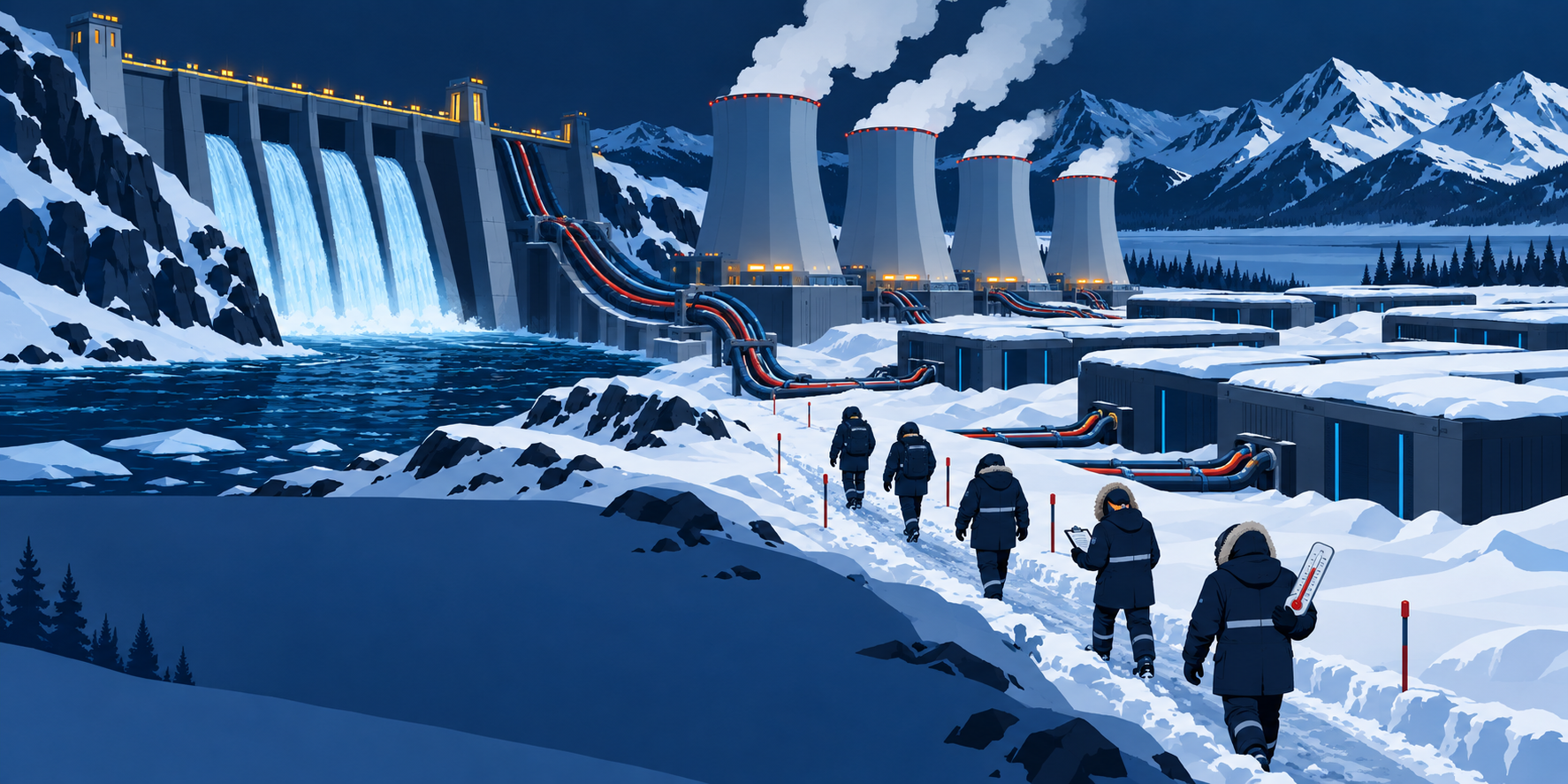
The dam, the towers, the buried halls, and the walk between them. University 365 Research Center.
The Co-Intelligence First framework asks whether an arrangement amplifies human capability or substitutes for it, and where the risk of AI Imposture sits. Applied to Russia, the verdict is that the capability is real at the model, integration and education layers, that the imposture risk sits specifically in unaudited claims and in a legislative promise the model field cannot fully keep, and that the exposure is the absence of independent measurement inside a closed system.
The capability is real at three layers, and each has a concrete artefact. At the model layer, GigaChat 3.1 Ultra is a 702-billion-parameter model trained on its owner's own infrastructure, deployed to consumers through a national platform, and independently described by a research house as the leading sovereign model outside the Gulf on the criterion of vertical integration. That is a stronger claim than most countries in this series can make, and unlike several of them it is a model people actually use rather than an announcement. At the integration layer, Sberbank owns the model, the cloud and the infrastructure, which is what makes the sovereignty claim coherent: the same institution that trains the model controls the stack beneath it. At the education layer, Russia has built school-level AI provision from grades 1 to 11 within eighteen months and put a national AI profile on the federal school list, which is the kind of state capacity that usually takes a decade.
The imposture risk is specific and the report states it precisely. MSU-270 is claimed at 400 AI petaflops and third in the world, ahead of two European systems that are documented in the TOP500, and the machine does not appear in that list; the claim is uncorroborated and it is the flagship compute figure of the national programme. GigaChat 2 MAX was claimed first on vendor-selected benchmarks, and no neutral evaluator exists that Russian vendors are obliged to face. Sberbank reports over 475 billion rubles of internal AI benefit in 2025 as a self-assessment. None of these claims is demonstrated false, and two of them come from institutions whose other work is corroborated. What they have in common is unverifiability, and in a sovereignty programme the flagship numbers are exactly the ones that determine whether the claim is credible. The third instance is legal rather than numerical: Federal Law No. 243-FZ requires that domestic neural networks be created inside Russia and makes state-defined values a condition for "sovereign" status, while more than one flagship commercial model in the market derives from a Chinese base. The law now promises a localisation that part of the field cannot deliver, which is a promise the state will have to reconcile with the products its own banks deploy.
The exposure is the absence of measurement, and this is what the CI-First reading treats as the finding. A sovereign AI programme is an arrangement for amplifying national capability. Whether it succeeds is an empirical question, and empirical questions require instruments. Russia's instruments are its own ministries, its own state banking group and its own industry alliance, which is why the country cannot say with confidence where it stands, and why its own strategy sets targets against a baseline it reports inconsistently. For a population, the practical consequence is a domestic AI stack that works and that cannot be checked: services that are reachable and free of the foreign-access problem, built on models whose performance the user has no way to assess independently. That is not imposture in the sense this series usually uses the term, which is a gap between claimed and delivered capability. It is something closer to a system that has removed the instruments that would tell it which of the two it has.
The CI-First verdict on Russia is this. This is the series' strongest case of sovereignty built without the frontier and the clearest case of its cost: a state that owns a serious national model, an integrated stack and a fast-expanding AI education system, and that cannot manufacture the part all three depend on. Its population gets AI services that work and that no independent party has evaluated. Its programme's constraint is not ambition, talent or even money but silicon, and its second constraint is that nobody outside the state, and on this evidence nobody inside it either, can measure how far the programme has actually got.

Sovereign AI Race: Russia (2026)
What This Means for You and Us
For a reader in a country with Russia's constraints
If your country faces export controls, restricted hardware access, or a fiscal position that puts an AI programme behind other priorities, Russia is the case to study, and four practices are worth copying exactly. Integrate the stack under one capable institution, because the model, the cloud and the infrastructure have to answer to the same owner for a national programme to move at all, which is what one state banking group has demonstrated. Publish open weights at the size you can support and let other builders carry the rest, as Yandex did with an 8-billion-parameter release on 15 trillion tokens. Build the school programme early, because a national AI curriculum takes years to produce practitioners and the fastest verified case in this series went from a pilot to a federal profile in eighteen months. And put compute where the power is, because connection queues and borrowing costs, not permits, decide whether a data centre gets built. One practice deserves a warning and it is the most important one in this section: build an independent measurement regime in the same act as the strategy. Russia's claims have drifted from its verifiable position precisely because the same institutions write the strategy, run the projects and report the results, and a state that cannot measure itself cannot correct itself.
For a reader watching the series
Sixteen countries in, Russia completes the series' picture of the ways a state can hold sovereignty without the full stack, and it sharpens the finding the series has been building. The owner nations, China and the United States and South Korea at the frontier, control the layer that matters. The Gulf states own the entities that build their compute. The European countries in this series own institutions, models and rules, and rent the silicon. Russia is the first case of a state that has been cut off from the frontier and has responded by building everything above it, which makes it the purest test in the series of how much of sovereignty is layer-specific. The answer on the evidence is that the answer is most of it. Russia holds a leading sovereign model, a real supercomputing tradition, a fast-expanding AI education system and a legal framework tailored to its own purposes, and it cannot make an accelerator, cannot verify its flagship compute number, and is selling compute to the country that supplies its chips. The series' finding is now stable across sixteen reports and this case makes it explicit: sovereignty in AI is the ownership of a layer another state cannot substitute for you, and there are only two such layers in the current architecture, the silicon and the frontier model. Every other layer is real, valuable, and replaceable.
For University 365
Russia is the sixteenth country in this series and the most direct test of one claim this institution makes, which is that judgement is the capability that matters most and the one least dependent on hardware. The Russian case supports that claim in an unexpected way. The country's constraint is silicon and its second constraint is that it cannot measure itself, and the second of those is an educational problem before it is an industrial one: a system that teaches people to use powerful tools without teaching them to assess the tools' actual performance has produced users who cannot tell capability from a claim. That is the specific risk this series uses the CI-First lens to describe, and Russia presents it at national scale, with a population served by capable domestic AI systems whose measured standing nobody can check. Our own work is directly relevant to that gap. Where a country builds an AI stack faster than it builds the ability to evaluate it, the teaching of verification, provenance and accountable use is not an add-on to AI literacy; it is the part that determines whether the national investment produces judgement or credulity. That is a lesson our learners can act on immediately, and it is the one this report would put in front of a reader who has to decide what to teach.

Sovereign AI Race: Russia (2026)
The Road Ahead
Three observable things would change this assessment.
Whether the domestic fabrication plan holds its date. The state's own target is 28-nanometre production by 2030. The milestones to watch are the Mikron line's qualification, any published yield or volume figures, and whether the roadmap approved in March 2026 produces capacity or planning documents. A functioning mature-node line in the next two years would not change the accelerator position, and it would change the country's ability to make the other parts of its systems at home, which is the difference between assembling from imports and building from domestic supply. A slip past 2030, or a line that produces at token volume, would leave the programme permanently dependent on grey channels whose supply is decided by enforcement actions in other countries.
Whether the model field consolidates around the integrated line or the Chinese-derived one. The two directions are both present. GigaChat is trained on domestic infrastructure and is rated a leading sovereign model; the Gen-T and T-Pro lines are Qwen derivatives and a state bank has acknowledged using Qwen. Federal Law No. 243-FZ requires domestic neural networks to be created inside Russia, so the direction the market takes now has legal consequences. A market that moves toward the integrated line would make the statute's promise credible. A market that continues to build on imported bases would make the localisation requirement a formality, and would leave the series' model-sovereignty assessment of Russia resting on a single institution.
Whether the state's measurement improves. The observable change to watch is not a new claim but a new instrument: a submission to an international ranking, an independent domestic evaluator commissioned outside the industry alliance, or published audit figures for the flagship system and the flagship model. Any of those would let a reader check a Russian AI claim for the first time. In their absence, every figure in this report that carries the claim label will still carry it in a year, and the country's own strategy will continue to be set against a baseline the state reports inconsistently to itself.

Sovereign AI Race: Russia (2026)
Sources and Methodology
Methodology
This report was researched from public sources with a preference for primary documents: the Kremlin's acts page for Federal Law No. 243-FZ and the decree establishing the Presidential Commission on AI Technologies; the Kremlin records of the AI Journey conference of 19 November 2025 and the follow-up presidential instructions; the National AI Development Strategy as amended by Decree No. 124 of February 2024; the text of Federal Law No. 242-FZ from the Roskomnadzor portal; the federal budget law text on the CIS Legislation database; the Oxford Insights Government AI Readiness Index 2025 as published in January 2026, including its full-rankings table and its own statement that it assesses 195 countries; the SIPRI analysis of Russia's 2026 military budget; the Federal Law text and the AEB and Nordic Star briefings on it; the Ministry of Digital Development's March 2026 draft on the federal portal of draft regulatory acts; the HSE ISSEK presentation on impatriation; the Yandex investor relations releases; the Hugging Face model cards for the Yandex, T-Bank and MTS AI releases; and the Russian and international press for everything else. Government and corporate performance figures are labelled as claims, and where sources conflict the conflict is stated rather than resolved: the 26.49 billion ruble and 7.7 billion ruble AI budget lines; the 26 July and 29 July 2026 signature dates for Federal Law No. 243-FZ; the 2.3 billion ruble and 2.27 billion dollar Roskomnadzor filtering budgets; the roughly 43 per cent DeepSeek usage share against Statcounter's 1.04 per cent; the 3,000 and 5,951 AI graduate baselines; the 11.2 and 13 trillion ruble AI GDP projections; the National Wealth Fund's total and liquid positions; and the Apache 2.0 and custom licence labels on the Yandex open-weight release.
Russia has no prior University 365 landscape report, in any series. This report states that plainly rather than implying a baseline it does not have, and it is the third of the series' three subjects with no prior report, alongside Portugal and South Africa. What is compared instead is Russia against itself inside this report's own research window, as set out in The Current State, and from this report forward Russia carries a documented U365 baseline against which later movement can be measured.
One correction is carried from this report's own verification work and should be recorded plainly. The research dossier underlying this report stated Russia's position in the Oxford Insights Government AI Readiness Index 2025 as 49th of 155 countries. The publisher's own January 2026 report and its full-rankings table state that the index assesses 195 countries in this edition and that Russia ranks 49th. The 65.50 in the dossier is the table's Policy Capacity pillar value for Russia, not an overall score. The overall, recomputed from the publisher's own pillar weights by the method described above, is 59.57. The same edition carries a note that the December 2025 publication contained incorrect scores and rankings which the January 2026 report corrects, and that note is the reason this report verified the figure against the publisher rather than against the secondary tabulations in circulation.
Five limits should travel with this report. First, no audited, independent measure of Russian AI compute exists in any public source located for this research, so every compute figure is either a claim or an entry on a third-party list of submitted systems, and the report labels them accordingly. Second, the volume of grey-channel chip imports into Russia specifically for 2025 and 2026 could not be verified, and the 420 million dollar figure covers a network moving goods to China and Russia jointly, so the report states the gap rather than apportioning the sum. Third, no cumulative 2022 to 2026 AI-specific emigration total could be verified; only the 2022 IT-wide official figure and survey attitudes are usable, and the report composes no substitute. Fourth, the current node and volume status of the Elbrus and Angstrem fabrication lines could not be verified, and the operating state register of AI systems could not be confirmed as functioning. Fifth, several load-bearing items rest on single or secondary sources and are labelled individually: the smuggled-chip and Tikhonova control allegation concerning MSU-270, which is a single-source report; the National Wealth Fund's composition and liquid position, which rest on state news agency reporting of Finance Ministry figures; and the March and April 2026 supercomputing roadmap items, which rest on trade press reporting of government documents rather than the documents themselves.
Principal sources
Government, regulatory and judicial. The Kremlin: the acts page for Federal Law No. 243-FZ (26 July 2026); the AI Journey conference page (19 November 2025) and the follow-up presidential instructions; the decree on the Presidential Commission on the Development of AI Technologies; the commission's first meeting page; the meetings with Rosseti's chief executive (14 April 2026) and Rostec's chief executive (7 May 2026); the RDIF AI exhibition page and the RDIF chief executive meeting; the EAEU forum page. The Ministry of Digital Development's draft federal AI law on regulation.gov.ru (March 2026). Federal Law No. 242-FZ via the Roskomnadzor portal. The federal budget law text on CIS Legislation. SIPRI's Russia military budget analysis (March 2026). The Bank of Russia and Finance Ministry figures relayed by TASS on the National Wealth Fund (3 April, 3 July, 7 September 2026). The Ministry of Education's school AI guidelines (September 2026) via Izvestia and Russian outlets. The state AI Olympiad portal and the Digital Skills and Competencies programme page. The Russian MFA statement on the UN Global Dialogue on AI Governance. The Brazilian labour ministry's BRICS Network working paper on AI and the Russian labour market (November 2025).
Institutional, company and academic disclosures. Sberbank: the GigaChat 2.0 presentation and public release, the AI Journey 2025 positioning of GigaChat, the annual report page on GigaChat 3.0 and Kandinsky 5.0, the GigaChat Telegram channel. Yandex: the investor relations release on Alice AI (28 October 2025), the company supercomputers page, and the YandexGPT model cards on Hugging Face. T-Bank's T-pro-it-2.1 model card and its commit history. MTS AI's product and technology pages. Hugging Face and OpenModels for the YandexGPT 5 Lite release. The MERA benchmark papers (ACL 2024 and arXiv 2401.04531). The Skoltech research centre announcement (6 June 2025). St Petersburg University's AI360 announcement (6 May 2025). ITMO's news items on the AI Alliance ranking, the Gazprom Neft programme, the Selectel joint venture and the teacher training course. HSE's news on the AI Alliance ranking and its ISSEK presentation on impatriation. JINR's Govorun release. IXcellerate's data centre pages and its Tier III certification document. Rostelecom's data centre announcement via IT Russia. TOP500's system page for the Yandex Chervonenkis machine. SberCloud's Christofari Neo launch material and Reuters' report of 11 November 2021.
Research and measurement. Oxford Insights Government AI Readiness Index 2025 (January 2026 edition and full rankings). Counterpoint Research's sovereign AI LLM work as relayed by Communications Today, MIT Sloan ME and Frontier News. The Microsoft AI Economy Institute's usage figures via eMarketer and Physical AI News. Statcounter's AI chatbot market share for the Russian Federation (March 2026). Yakov and Partners' AI in Russia 2025 with Yandex, and the AKM summary. The CASE Center's survey of Russian IT specialists (December 2024). Stanford CDDRL's OutRush emigration study (March 2025). The Humanity Stats tracker's Russia and Yandex pages, treated as third-party estimates. SIPRI's military spending analysis and Janis Kluge's calculation from Finance Ministry data. Rosseti's stated grid allocation via IT Russia and the TAdviser datacentre market article.
Reporting. Reuters via KFGO, TASS, The Moscow Times, bne IntelliNews, IT Russia, www1.ru, Izvestia, TIME, DigiTimes, The Insider, the Kyiv Independent, Euromaidan Press, Tom's Hardware, DataCenterDynamics, Xinhua, China Daily, Archyde, AI Brainer, dev.ua, the FDD's BRICS analysis and Defense One's republication, and the specialist outlets named in the text where a claim depends on them.

Sovereign AI Race: Russia (2026)
About This Report
Sovereign AI Race: Russia (2026) is report sixteen of twenty in the Sovereign AI Race series, followed by a comparative capstone. The series assesses how states attempt to control the production of artificial intelligence inside their jurisdiction, using one five-layer framework and one metric set applied identically to every country: compute, models, capital, regulation, and talent.
Each report in the series carries a "What Changed Since" treatment against the earlier University 365 report on the same country where one exists. Russia has no earlier University 365 landscape report in any series, and this report states that plainly: the baseline for Russia begins here, and future reports will measure movement against this one.
Author: Hubert Graef, Dean of Research, University 365 Research Center.
Series: Sovereign AI Race, report 16 of 20, followed by the comparative capstone.
*Published by University 365 Research Center. CI-First is University 365's Co-Intelligence First framework, a method constant of the institution.*
Revision 6, 30 September 2026, 18:31 UTC. Published 29 September 2026.




Comments