
Sovereign AI Race: Singapore (2026)

Updated: 5 hours ago
In this Report

This publication is part of the Sovereign AI Race series.
The Co-Intelligence-First (CI-First) approach is a genuine and unique University 365 concept: a proposal for imagining a better future where AI and Human Intelligence coexist productively, each amplifying the other rather than replacing it.


Sovereign AI Race: Singapore (2026)
The Context
The five layers, and why Singapore is the regulator and host
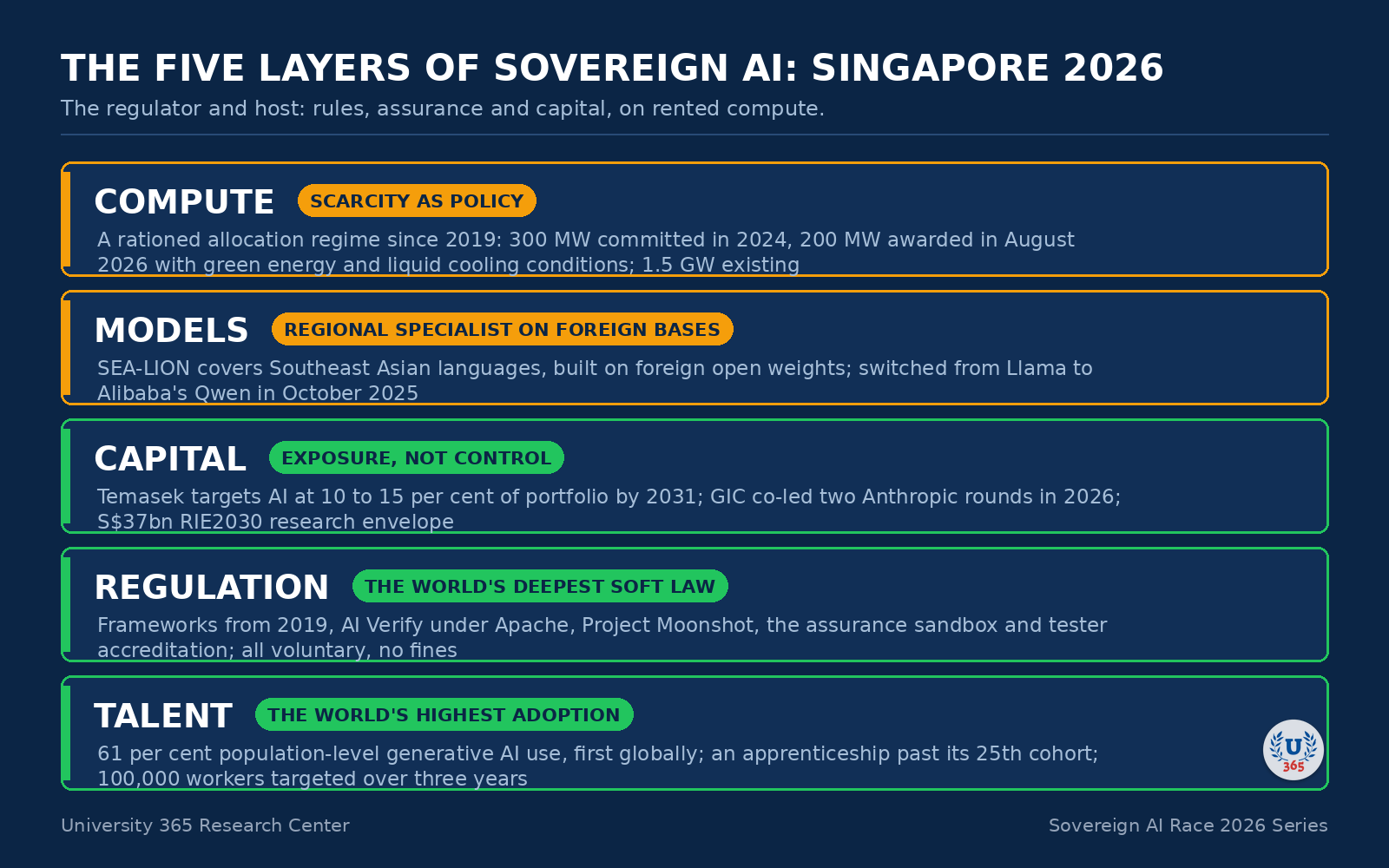
The five layers assessed. Rules, assurance and capital owned; compute and model bases rented. University 365 Research Center.
This is the tenth report in a twenty-part series assessing how states attempt to control the production of artificial intelligence inside their own jurisdiction. The framework is fixed and applied identically to every country. Sovereign AI capacity separates into five layers, and a state can hold any one of them without holding the others.
Compute sovereignty is the physical layer: where the chips and data centres sit, and who may switch them off. Model sovereignty is who builds the models a country depends on, and in whose languages and domains those models are competent. Capital sovereignty is who funds the build-out and on what terms. Regulatory sovereignty is who writes the rules and whether they can be enforced. Talent and education sovereignty is who builds and runs the systems, and how the next generation is prepared.
The series treats three races as running at once: the compute race, the model race and the rules race. Singapore is the first country in the series competing primarily in the third. It does not train a frontier model. It rations the megawatts its data centres may use. It writes the governance frameworks that other countries adopt, runs the testing toolkits that other countries use, and through its sovereign funds holds stakes in the American laboratories at the frontier. Its comparative advantage is not scale in any layer. It is the position of the jurisdiction that makes foreign artificial intelligence deployable, certifiable and financeable in Southeast Asia.
The series places Singapore in the "regulator and host" posture alongside the United Kingdom, Germany, Spain, Italy, Portugal and Bahrain. The placement is a claim to be tested layer by layer, and this report tests it. What Singapore owns, with evidence, is a rationed compute regime that selects operators by efficiency, a regional language-model programme that covers Southeast Asian languages the large laboratories neglect, two sovereign funds that have become significant shareholders in frontier AI, and the world's most developed soft-law governance stack, from AI Verify to the assurance sandbox. What Singapore does not own is compute at scale by its own decision, frontier models by its own choice, and the power and land that a larger strategy would require. Its own prime minister has stated the ceiling explicitly: the country's advantage does not lie in building the largest frontier models.
The vocabulary this report needs
Five terms recur, and they are defined here once.
Rationed capacity. Singapore's data centre regime is not a market. Since 2019 it has been a state allocation. After an effective moratorium on new construction from 2019, the state reopened capacity through successive calls for applications, each with efficiency conditions attached: a power usage effectiveness target around 1.25 to 1.3 at full load, liquid cooling requirements, green energy sourcing floors, and the highest green building certification. The state decides who builds, how much, and on what terms. The Green Data Centre Roadmap of 30 May 2024, published by the Infocomm Media Development Authority, committed to at least 300 megawatts of additional near-term capacity, most of it from efficiency gains in existing buildings rather than new land.
Regulator and host. The series' term for a state whose sovereignty strategy is governance and hosting rather than production. Singapore hosts hyperscaler regions and sovereign cloud offerings, writes the model governance frameworks, operates the testing and assurance infrastructure, and finances the frontier abroad. It is a deliberate strategy, not a small country's consolation.
The assurance stack. Singapore's regulatory instruments are voluntary by design: the Model AI Governance Framework, first issued in 2019 and extended to generative AI on 30 May 2024 and to agentic AI on 22 January 2026; AI Verify, the governance testing framework and toolkit launched in May 2022 and released open source under the Apache licence; Project Moonshot, the large language model evaluation toolkit; and the Global AI Assurance Sandbox, launched in July 2025. None of them creates binding obligations. All of them are exported, partly because they are free and open.
Sovereign capital as financial exposure. Singapore's two state investment vehicles, GIC and Temasek, hold positions in the frontier AI companies. Temasek has published a hard target: AI-related assets to rise from 6 per cent of its portfolio to 10 to 15 per cent by 31 March 2031. Both funds participated in the same frontier laboratory's recent funding rounds. This is capital sovereignty in the financial sense, and it is worth stating what it does not buy: control over the technology, or domestic capability in it.
The adjacency. Singapore's land and power constraints mean that the compute its economy demands does not all sit inside its borders. Capacity has overflowed to Johor in Malaysia and Batam in Indonesia, close enough for latency and outside Singapore's regulatory perimeter. The state governs the data, the models and the assurance layer while depending on neighbours for physical capacity, and this report treats the adjacency as a structural fact of the strategy rather than a footnote.

Sovereign AI Race: Singapore (2026)
The Question
What does a state own when it chooses to govern rather than build?
Singapore made a choice that no other country in this series has made as explicitly. Its prime minister, speaking on the 2026 budget, stated that the country's advantage does not lie in building the largest frontier models, and its national programme is aimed instead at deployment, governance, hosting and diffusion. The National AI Council he chairs was established in February 2026. The updated National AI Strategy, refreshed on 20 May 2026, prioritises the public good, the economy and the workforce rather than frontier capability. The research envelope behind all of it is substantial for the country's size: RIE2030, released on 5 December 2025, commits 37 billion Singapore dollars over five years, a 32 per cent increase over the previous plan, with more than one billion dollars of it committed to public AI research and talent between 2025 and 2030.
The strategy has produced real, verifiable assets, and this report documents each of them. The compute regime converts scarcity into selection: 200 megawatts awarded to four operators in August 2026 on Jurong Island, each of them bound to source more than half their power from green pathways and to deploy liquid cooling. The model programme is honest about its construction: SEA-LION, the national language model family, is built by continued training on foreign open-weight bases, and in October 2025 it switched from Meta's Llama family to Alibaba's Qwen, a decision this report examines without resolving. The governance stack is genuinely the world's most developed. The capital position is real and measurable.
And underneath the strategy sit two constraints that no framework can write away. The first is physical. Singapore is roughly 730 square kilometres with no domestic fossil energy, and it rations megawatts because it cannot generate its way out of scarcity at will; its data centres already took about seven per cent of national electricity when the moratorium began, and the growth the AI economy demands now runs partly in neighbouring countries it does not govern. The second is structural, and it is the question this report asks. If a state owns the rules, the testing infrastructure, the assurance brand and a financial stake in the frontier, but not the compute, the models or the power, what exactly can it control when a supplier, a model provider or a neighbour changes its mind? Singapore is the best-documented case in the series for testing whether governance capability is a form of sovereignty in its own right or a service provided to the countries that own the layers.

Sovereign AI Race: Singapore (2026)
The Contradiction
The state that governs AI most carefully builds its national model on Chinese weights and hosts American compute
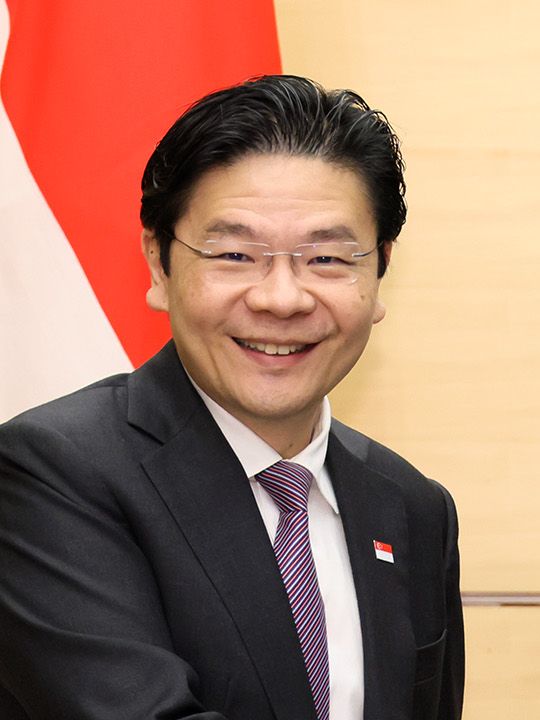
Lawrence Wong, Prime Minister of Singapore, as of 2026. He chairs the National AI Council established in February 2026 and has said publicly that the country's advantage does not lie in building the largest frontier models. Photograph: Cabinet Public Affairs Office, CC BY 4.0, via Wikimedia Commons.
Here is the paradox, stated as plainly as the evidence allows.
Singapore's governance stack is the most developed in the world, and its central premise is trust through assurance: frameworks that any jurisdiction can adopt, toolkits that any developer can run, an accreditation programme for independent testers, and a sandbox where deployers and auditors meet. The instruments are voluntary, open source and deliberately cheap to adopt, which is why they travel. The regulator that wrote them, IMDA, runs crosswalks from its frameworks to the American NIST risk management framework and to the ISO standard, so its governance is interoperable by design.
Now put the same state's model layer beside it. The national language model family, SEA-LION, is not a from-scratch model. It is built by continued pre-training and post-training on top of foreign open-weight bases, and in October 2025 the programme moved its base from Meta's Llama family to Alibaba's Qwen, with the newest model, Qwen-SEA-LION v4.5, following in May 2026. The choice was an engineering decision with a defensible technical case: the Qwen base offered materially better coverage of low-resource Southeast Asian languages than the alternatives at the time, which is the exact capability the regional programme exists to deliver. It was also a strategic event, read widely as a win for Chinese technology at a moment of intensifying competition, and taken while Singapore hosts large American hyperscaler capacity and its funds hold stakes in American frontier laboratories. The report presents both readings and resolves neither, because the sources support both and the country's own framing is technical rather than strategic.
The second tension is the physical one, and it is the sharpest constraint in the strategy. Singapore cannot build its way out of its own geography, so it has converted scarcity into policy. The 2019 moratorium on new data centre construction was an admission that the growth rate was unsustainable, and the regime that replaced it allocates capacity the way a central bank allocates credit: applicants compete on efficiency, green energy sourcing and economic contribution, and the winners receive megawatts. The August 2026 round awarded 200 megawatts in four equal tranches to Digital Realty, Equinix, Keppel Data Centres and ST Telemedia Global Data Centres, which is two and a half times the roughly 80 megawatts distributed in the 2023 pilot and about 14 per cent of the country's existing capacity. The consequence is that the compute Singapore's economy demands overflows across the causeway to Johor and across the strait to Batam, both of which attracted billions in investment precisely because Singapore would not build. The state that writes the strictest efficiency rules in the region governs the workloads, not the buildings.
The third tension is what the sovereign capital actually buys. GIC co-led two funding rounds of Anthropic, in February and May 2026, with Temasek joining the second, and both funds now sit on that company's capital table alongside their other positions. Temasek's published target, AI-related assets rising from 6 per cent of the portfolio to 10 to 15 per cent by 2031, is one of the few hard, dated AI allocation targets any state investor has set. It is also purely financial. The capital buys exposure and returns, not control, and no evidence in this research shows it building domestic frontier capability, which is consistent with the prime minister's stated strategy and worth saying plainly: this is a state that has chosen to own part of the frontier's equity rather than any part of its production.

Sovereign AI Race: Singapore (2026)
The Current State
Compute: a rationed megawatt regime, and the overflow outside the border
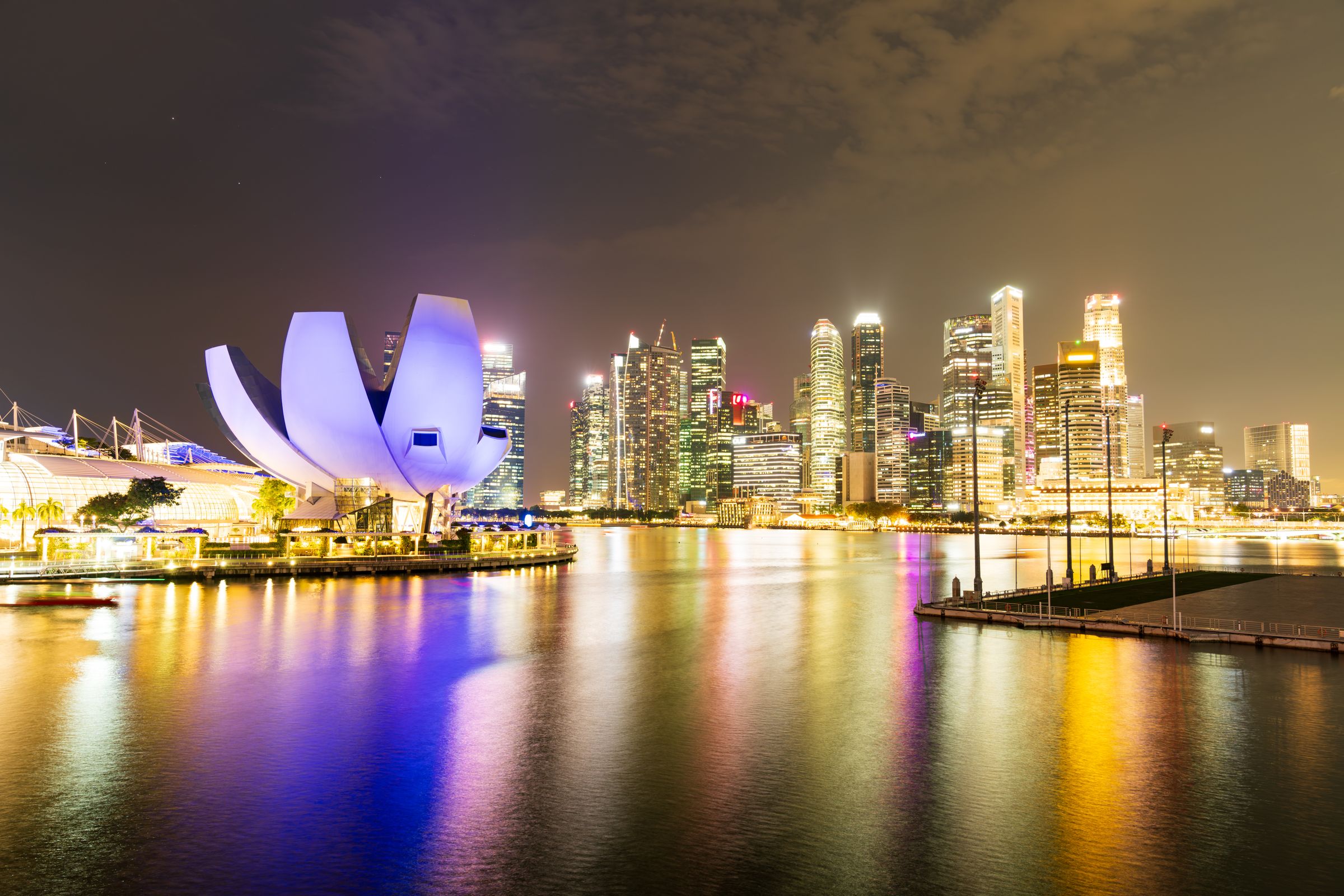
Marina Bay at night. The city state runs more than 1.4 gigawatts of data centre capacity across more than 70 facilities, and allocates every additional megawatt by condition. Photograph free-licensed via Pexels.
Singapore's compute position is the only one in this series where scarcity is the policy instrument, and every number in it should be read that way.
The starting position was a state that had stopped building. In 2019 the government imposed an effective moratorium on new data centre construction, driven by resource arithmetic: data centres were estimated to consume about seven per cent of national electricity with growth of 10 to 15 per cent a year, in a country of roughly 730 square kilometres with no domestic fossil fuel and a net-zero commitment for 2050. The trade and industry minister at the time described data centres as intensive users of resources. When the IMDA published its Green Data Centre Roadmap on 30 May 2024, the country operated more than 1.4 gigawatts of capacity across more than 70 facilities, one of the tightest and most expensive colocation markets in the world, with reported vacancy rates below 1.4 per cent.
The reopening has been staged and conditional. The first pilot call for applications, in 2022 and 2023, allocated roughly 80 megawatts to four parties, with a second account describing the approvals as about 120 megawatts of development, and this report records the discrepancy rather than resolving it. The Green Data Centre Roadmap committed the state to at least 300 megawatts of additional near-term capacity, much of it from efficiency gains in existing buildings: cooling retrofits, higher operating temperatures, better utilisation. Then came DC-CFA2, launched on 1 December 2025 with applications closing on 31 March 2026 and a baseline allocation of at least 200 megawatts. The provisional awards, announced in August 2026, split that capacity equally, 50 megawatts each, among Digital Realty, Equinix, Keppel Data Centres and ST Telemedia Global Data Centres, on Jurong Island. Each award carries conditions: more than half the power from green energy pathways, with biomethane, low-carbon ammonia, low-carbon hydrogen and building-integrated photovoltaics named as acceptable and conventional renewable certificates explicitly insufficient; liquid cooling on site; and the highest tier of the green building certification. The agencies have said they will review the need for another round in roughly 18 to 24 months.
The national research compute is a separate and smaller pool, and it is worth stating its scale because it defines what the country means by compute sovereignty for itself. The National Supercomputing Centre's Aspire 2A+ carries 320 H100 accelerators delivering 20 petaflops, and Aspire 2B, launched on 8 June 2026 at Nanyang Technological University on a 270 million dollar commitment, added more than 1,500 H200 GPUs to serve more than 9,000 public researchers. The digital development minister framed it as compute sovereignty in its own words: workloads that previously had to be sent overseas can now use national research infrastructure. That is the honest scale of Singapore's own compute ambition, thousands of GPUs for public research, against the hundreds of thousands that frontier training requires.
The corporate layer inside Singapore is real and foreign. AWS has operated there since 2010 and pledged SGD 12 billion of additional investment; Google committed 5 billion US dollars to Singapore cloud and AI infrastructure; Microsoft is reported to have committed 9 billion US dollars; Singtel secured SGD 643 million in green financing in February 2025 for its Tuas data centre, targeting net-zero emissions by 2028. Nvidia's regional presence and the national agency HTX's deployments are additional to these. And the overflow is documented: Johor and Batam have absorbed the capacity Singapore would not build, which means the state's physical compute dependence extends to two neighbours whose policies it does not write.
Capital: two funds, one hard target, and positions in the frontier

Josephine Teo, Minister for Digital Development and Information of Singapore, as of 2026. She framed the launch of the Aspire 2B research supercomputer in June 2026 as compute sovereignty: workloads that previously had to be sent overseas can now use national infrastructure. Photograph: US Department of State, public domain, via Wikimedia Commons.
Singapore's capital position is the clearest case in the series of sovereign wealth used as financial exposure rather than industrial construction, and the numbers are precise.
Temasek, one of the two state investment vehicles, published its 2026 review on 8 July with an explicit AI allocation target: AI-related assets to rise from 6 per cent of its portfolio to between 10 and 15 per cent by 31 March 2031. The 6 per cent baseline excludes AI exposure inside its existing portfolio companies, so it is a floor rather than a full measure. The target is hard, dated and public, which makes it the most concrete AI commitment any state fund in this series has made about its own portfolio.
The exposure itself reaches the frontier. GIC co-led Anthropic's Series G in February 2026, a 30 billion dollar round at a 380 billion dollar post-money valuation, and its Series H in May 2026, a 65 billion dollar round at a 965 billion dollar post-money valuation, with Temasek reported as a significant investor in the second. Singapore's funds are also participants in data centre joint ventures, including a greater-than-15-billion-dollar vehicle alongside CPP and Equinix announced in October 2024. Separately, the budget cycle carries direct instruments: Budget 2026 introduced National AI Missions in four sectors and a 400 per cent tax deduction on qualifying AI spending, capped at 50,000 Singapore dollars a year for the two years of assessment from 2027. The research envelope is the largest single domestic number: RIE2030 at 37 billion Singapore dollars over five years, with more than one billion committed to public AI research and talent development between 2025 and 2030.
Read together, the capital layer is coherent and its logic is clear. The state does not attempt to fund compute and models at frontier scale, because the returns on doing so from a small base are poor. It funds research capacity at national scale, gives its firms a tax incentive to adopt, and directs its investment vehicles to buy equity in the frontier as it is actually built, mostly abroad. The report's finding is that this is a rational portfolio and a different thing from industrial sovereignty: Temasek's and GIC's positions make Singapore a shareholder in the frontier, not a producer of it.
Models: SEA-LION, built on Qwen, covering the region's languages

The island, its four metered gates, and the capacity it cannot hold. University 365 Research Center.
Singapore's model layer is the most honest in the series about what it is, and its strategy is language coverage rather than frontier capability.
The national family is SEA-LION, the Southeast Asian Languages In One Network model line, developed by AI Singapore. It is built by continued pre-training and post-training on foreign open-weight bases: Meta's Llama family in its earlier generations, and from October 2025 onward Alibaba's Qwen. Qwen-SEA-LION v4, based on Qwen3-32B, was released in October 2025 and announced with Alibaba Cloud on 24 November 2025; Qwen-SEA-LION v4.5, based on Qwen3.6-27B, followed in May 2026; additional vision-language variants were released alongside. The stated purpose is multilingual performance in Southeast Asia, where the frontier laboratories do not optimise, and the Qwen base was chosen, according to the programme's own technical framing, because its training coverage of low-resource regional languages exceeded the alternatives available at the time. The report records the strategic reading too: media across the region treated the switch as a significant win for Chinese technology.
The research and talent scaffolding behind the model line is deeper than the model itself. AI Singapore runs the AI Apprenticeship Programme, which places people into industry roles after a structured engineering apprenticeship and has now passed its twenty-fifth cohort. The universities are building dedicated capacity, with Nanyang Technological University offering a Bachelor of Computing in Artificial Intelligence and Society and the National University of Singapore running a dedicated AI degree cohort. The national research programme MERaLiON adds a speech and language model line named alongside SEA-LION in the May 2026 strategy update, though this research could not verify its specifications and the report does not claim them.
The honest summary of the model layer is this. Singapore has not built a frontier model and has said it will not. It has built, on foreign bases, the best-documented set of language models for a region of nearly 700 million people, and it has tied them to a national talent pipeline. That is a real contribution at the layer where it exists, in the same sense that Morocco's Darija work and Japan's Japanese-first stack are real contributions, and it is not model sovereignty in the sense of owning the capability. The Qwen decision means the national language model of a country that hosts American hyperscalers and holds equity in American frontier laboratories runs on a Chinese open-weight base. This report's judgment is that the decision is defensible on capability grounds and consequential as a signal, and both belong in the record.
Regulation: voluntary frameworks, exported by design
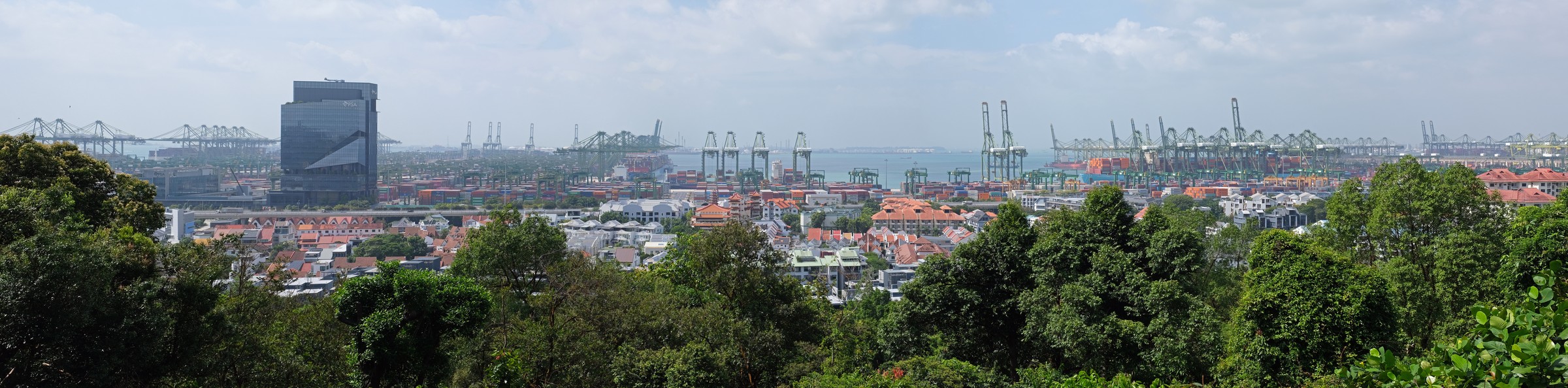
The Port of Singapore. The state's role as the region's transshipment, billing and hosting hub is why its governance frameworks, and its data centre market, matter beyond its own size. Photograph: kallerna, CC BY-SA 4.0, via Wikimedia Commons.
Singapore's regulatory position is the most developed soft-law stack in the series, and its enforcement power is deliberately the least.
The instruments are a decade's work, and they are worth listing because the sequence is the strategy. The Model AI Governance Framework was first issued in January 2019, among the earliest national AI governance documents anywhere, and it has been revised twice: for generative AI on 30 May 2024, built on nine dimensions, and for agentic AI on 22 January 2026, revised on 20 May 2026. AI Verify, launched in May 2022 by IMDA and the data protection commission, is described by the government as the world's first AI governance testing framework and toolkit, running eleven governance principles, 85 testable criteria and four technical toolboxes, and it is released open source under the Apache licence. Project Moonshot, launched in May 2024, extends it to large language model red-teaming and benchmarking. The AI Verify Foundation was established in June 2023 to run the programme. In February 2025 the government ran a Global AI Assurance Pilot pairing seventeen AI deployers with sixteen specialist testers from around the world, converting it in July 2025 into an ongoing Global AI Assurance Sandbox, and in May 2026 it launched an AI Tester Accreditation Programme. The instruments sit alongside crosswalks to the American NIST framework and to the ISO standard, making them interoperable with the two governance systems that foreign firms already use.
None of it binds. The frameworks are voluntary, the toolkits are tools, and the government's enforcement power over AI specifically is limited to the sectoral and privacy rules that already existed. No AI Act was passed; no fines are planned; the state's approach is to make good practice cheap and portable, and to accredit the private testers that make it credible. The governance architecture at the centre was formalised in February 2026 with the National AI Council, chaired by the prime minister, which sets direction rather than enforcing. The data layer runs through the privacy commission and the existing protection act. The strategy update of 20 May 2026 refreshed the national priorities and added the workforce agenda, including a target to equip 100,000 workers over three years through expanded training offerings beginning in accountancy and legal services.
The open question this report must state is whether soft law at this depth is an asset or a vulnerability, and the fair reading is that it is currently both, in different markets. As an asset, it is genuinely adopted: the frameworks and toolkits travel because they are free, open and interoperable, giving Singapore agenda-setting influence in AI governance far beyond its size, and giving foreign firms deploying in the region a single assurance vocabulary. As a vulnerability, it has no teeth against a determined deployer: the frameworks cannot compel a company to do anything, the accreditation is voluntary, and in April 2026 a group of civil society organisations criticised the pace and depth of the framework's coverage. The report records the criticism and does not adjudicate it. The comparison with the other rule-makers in this series is instructive: the European Union legislates with penalties, Japan legislates without penalties but with a promotion mandate, Korea legislates with deferred penalties, and Singapore does none of the three, which makes it the purest test in the series of whether governance capability without enforcement power is a durable foundation for a sovereignty claim.
Talent: adoption at the world's highest rate, and an apprenticeship pipeline
Singapore's talent position is the strongest in the series on the demand side and the most deliberately constructed on the supply side.
The adoption data is the headline and it is remarkable. The Stanford AI Index for 2026, released on 13 April 2026, records Singapore leading the world in population-level generative AI usage at 61 per cent, ahead of the United Arab Emirates at 54 per cent and well ahead of the United States. The Oxford Insights Government AI Readiness Index for 2025 places the country seventh of 195 with the highest public sector adoption component in the top ten, which is to say that the state's own services are among the most AI-enabled in the world. A society where three in five people use generative AI and the government's own adoption is a published strength is the opposite of the diffusion problem this series has documented in Japan and Germany.
The supply side is where the strategy is visible. The AI Apprenticeship Programme, run by AI Singapore, is the country's signature instrument: a structured full-time engineering apprenticeship, now past its twenty-fifth cohort, that converts graduates and career changers into deployable AI engineers and places them in industry. The universities have built dedicated degree capacity, including NTU's programme in artificial intelligence and society. The workforce agenda is a named target with a named delivery channel: 100,000 workers equipped over three years through expanded training offerings that began with accountancy and legal services under the National AI Impact Programme. The research talent is anchored in the universities and the national supercomputing centre, and the country's openness to foreign talent is a structural advantage the series has not encountered elsewhere: Singapore recruits globally by design, and its challenge is not a domestic shortage but the cost of living and the competition from the other hubs.
Two honest limits belong here. First, the scale of the research talent base is small in absolute terms by the standards of the larger countries in this series, which is what the strategy's regional and language focus accommodates. Second, a strategy that depends on remaining the most attractive hub in the region is exposed to the region's own development: as Johor, Kuala Lumpur, Jakarta and Ho Chi Minh City build their own AI sectors with lower costs, Singapore's talent position is a position to defend rather than a permanent endowment.
What changed since our last report on Singapore: there is no earlier report
University 365 has not published a Singapore AI landscape report before this one. The series' prior-report mapping covers fourteen of its twenty countries, and Singapore is not among them: the countries with earlier University 365 landscape reports are the UAE, Saudi Arabia, China, the United States, France, India, Morocco, Germany, the United Kingdom, Spain, Italy, Qatar and Bahrain. Singapore, Japan, South Korea, Brazil, Russia, Portugal and South Africa have none, and this report says so plainly rather than implying a baseline it does not have.
What can be compared instead is Singapore against itself within this report's own research window, 2019 to 2026, and the movement is documented throughout this section: a moratorium on construction turned into a rationed allocation regime; a governance toolkit grown from one framework into an assurance stack with international uptake; sovereign funds moving from no direct frontier exposure to positions in two of the leading American laboratories; a national language model switching its base; and a research envelope raised by nearly a third. The series will build its Singapore baseline from this report forward.

Sovereign AI Race: Singapore (2026)
Key Findings
1. Singapore is the purest "regulator and host" case in the series, and its own prime minister has stated the ceiling. The strategy is deliberately not to build the largest frontier models. The national programme aims at deployment, governance, hosting and diffusion, and this report tests that choice against evidence rather than treating it as a consolation.
2. The compute regime converts scarcity into selection, and it is the only one of its kind in the series. An effective moratorium from 2019 was replaced by a rationed allocation system: the Green Data Centre Roadmap committed to at least 300 megawatts in May 2024, and DC-CFA2 awarded 200 megawatts in August 2026 to four operators, 50 each, on conditions including more than 50 per cent green energy sourcing and liquid cooling on site.
3. The state's own compute is research-scale, and it says so. Aspire 2B, launched on 8 June 2026 with more than 1,500 H200 GPUs serving more than 9,000 public researchers on a 270 million dollar budget, was framed by the minister as compute sovereignty in the specific sense that workloads once sent overseas can now stay. Against frontier training, that is thousands of GPUs against hundreds of thousands.
4. The overflow is structural: the compute Singapore demands runs partly in Johor and Batam, outside its regulatory reach. The state governs the workloads, the data and the assurance layer while depending on two neighbours for physical capacity. This is a fact of the model rather than a failure of it, and it needs stating in any honest account.
5. The national language model is built on foreign open weights, and since October 2025 on Chinese ones. SEA-LION moved its base from Meta's Llama to Alibaba's Qwen for v4 and v4.5, on a defensible technical case about low-resource regional language coverage, with a strategic signal that regional media read clearly. The report presents both readings.
6. The governance stack is the most developed in the world and it binds no one. Frameworks from 2019 to 2026, AI Verify under the Apache licence, Project Moonshot, the Global AI Assurance Sandbox and the AI Tester Accreditation Programme, all voluntary, all exported, all interoperable with the American and international standards. Whether that is an asset or a vulnerability is the sharpest open question in the report, and both readings have evidence.
7. Sovereign capital buys exposure, not capability. Temasek's target, AI-related assets from 6 per cent to 10 to 15 per cent of portfolio by 31 March 2031, is the most concrete state-fund AI commitment in the series, and GIC co-led two Anthropic rounds in 2026 at valuations of 380 billion and 965 billion dollars. The positions are financial, and the prime minister has said the strategy is not to build frontier models.
8. The research envelope is large for the country's size and it is domestic. RIE2030 commits 37 billion Singapore dollars over five years, a 32 per cent increase, with more than one billion committed to public AI research and talent from 2025 to 2030, and Budget 2026 adds a 400 per cent tax deduction on qualifying AI spend.
9. Adoption is the world's highest and it is a state achievement as much as a market one. Singapore leads the world at 61 per cent population-level generative AI usage per the Stanford AI Index 2026 and holds the highest public sector adoption component in Oxford Insights' top ten, which is the inverse of the diffusion problem documented in several larger economies in this series.
10. The international partnerships are the strategy's sharpest recent movement. OpenAI signed a memorandum with the government on 20 May 2026 committing more than 300 million Singapore dollars to establish its first applied AI laboratory outside the United States, with more than 200 engineering roles, and Google, Microsoft and NVIDIA expanded their Singapore commitments around the same date.
11. The honest overall verdict: Singapore owns the rules, the assurance infrastructure and a financial stake in the frontier, and it rents the compute and builds on others' models. That is a coherent strategy for a small state, executed with unusual discipline, and it is not the same claim as owning the layers, which the country's own leadership declines to make.

Sovereign AI Race: Singapore (2026)
Deep Analysis
Why rationing megawatts is the most sophisticated industrial policy in the series
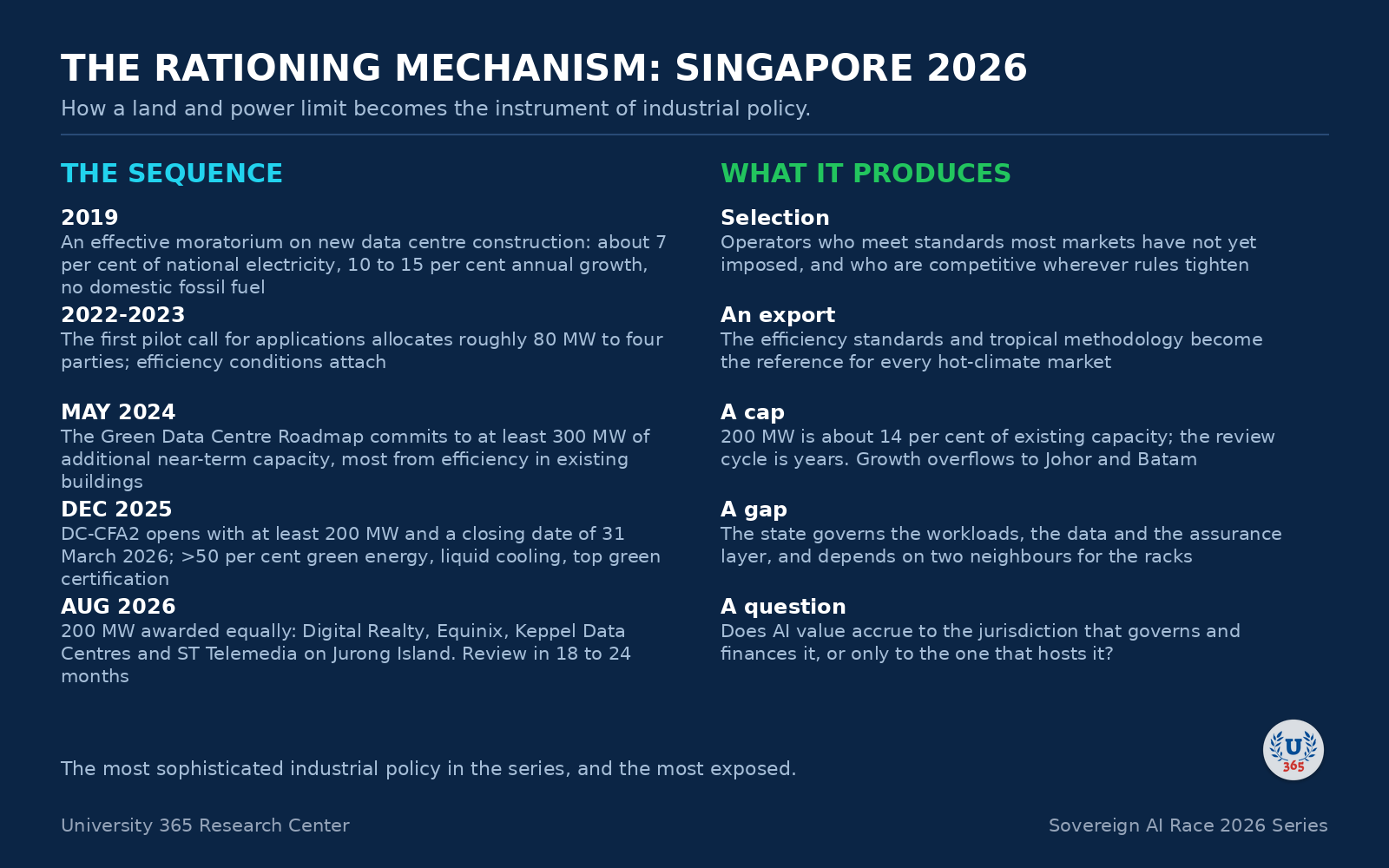
The rationing mechanism, and what it produces. University 365 Research Center.
Every country in this series faces a constraint, and most respond by trying to relieve it. Singapore's response is to make the constraint do work. The 2019 moratorium halted construction because data centres were consuming about seven per cent of national electricity in a country with no fossil resources and a net-zero commitment, and when the state reopened the sector it did not simply lift the ban. It built an allocation mechanism that makes each megawatt conditional: prove best-in-class efficiency, source more than half your power from green pathways that go beyond certificates, deploy liquid cooling, hit the top green building certification, and contribute to the economy, and you receive capacity.
The sophistication is in what this buys beyond physical savings. First, it selects for operators who can meet standards that most markets do not yet require, which builds a domestic cohort of high-efficiency operators who are then competitive wherever regulations tighten, including in Europe. Second, it converts a land and power limit into a policy instrument that the state controls entirely, since the alternative, letting the market build and then rationing electricity afterwards, would have produced both capacity overshoot and political cost. Third, it produces an export: the efficiency standards, the tropical data centre methodology and the green certification are portable, and the country that writes them becomes the reference for every tropical market facing the same arithmetic. The comparison with the rest of the series is instructive: the UAE and Saudi Arabia buy power certainty, Japan relocates compute to spare generation, Korea faces grid constraints it names but has not priced, and Morocco discovered its binding limit in water and heat. Singapore is the first state in the series whose energy scarcity is the foundation of its industrial policy rather than an obstacle to it.
The limit of the model is that it caps the country's own compute by construction. The 200 megawatts awarded in August 2026 equal about 14 per cent of the existing 1.4 gigawatts, and the review cycle is measured in years, not months. An AI economy growing at the pace the region's demand suggests cannot be served at that rate from 730 square kilometres, which is why the overflow to Johor and Batam is not an accident. The state's bet is that the value of AI accrues to the jurisdiction that governs and finances it rather than only to the one that hosts the racks. That bet is the most interesting economic proposition in this series, and it is genuinely untested.
The assurance stack as foreign policy
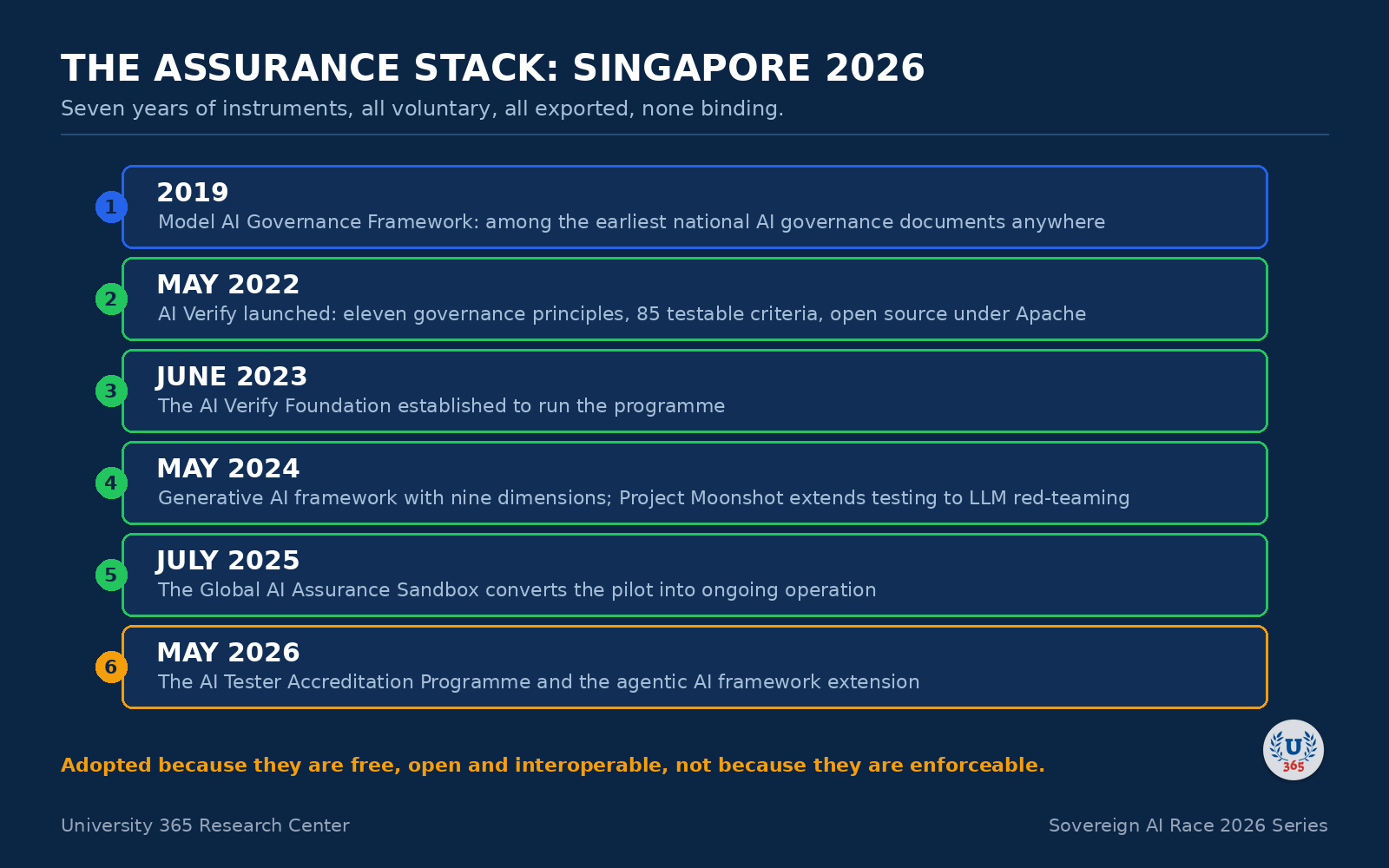
Seven years of assurance instruments, all voluntary, all exported. University 365 Research Center.
Singapore's governance instruments are usually described as regulation, and that description undersells what they are. A framework that any jurisdiction can adopt for free, a toolkit that any developer can download under an open licence, a testing protocol that interoperates with the American and international standards, and an accreditation programme for independent testers: together these constitute a foreign policy instrument, because they define the vocabulary in which AI assurance is discussed in Southeast Asia and beyond, and they do it without imposing costs that would drive firms elsewhere.
The mechanics matter. Because the frameworks are voluntary, no firm has an incentive to avoid Singapore's regime the way it might avoid a stringent mandatory one, which is why adoption spreads. Because AI Verify is open source, testers and auditors can build on it rather than reinventing it, which builds a network of practitioners whose expertise compounds in Singapore's favour. Because the frameworks crosswalk to NIST and to the ISO standard, a firm that satisfies Singapore's expectations can demonstrate compliance with the American and international ones, which makes Singapore a convenient single point of reference for multinationals deploying across the region. And because the assurance sandbox pairs deployers with specialist testers, it creates a market in assurance services where Singapore's accredited testers are the suppliers.
The open question, which this report cannot resolve and states rather than hides, is what happens when the voluntary approach meets a determined counterparty. Soft law works by alignment of interest: firms comply because it is cheap, because their customers ask, and because their regulators elsewhere will soon require it anyway. It does not work when a deployer has an incentive to defect and no binding rule to stop it, and the strongest evidence that this is a live concern is the published civil society criticism of April 2026 arguing that the frameworks lack teeth. The counter-argument is that a small state has no realistic path to enforcement against global AI firms, so exporting credible voluntary standards is the maximum achievable influence, and that framing is defensible too. The honest series-level finding is that Singapore has converted its inability to coerce into a capability to convene, and whether convening is sovereignty is the question the country's own strategy rests on.
The three races, measured in Singapore
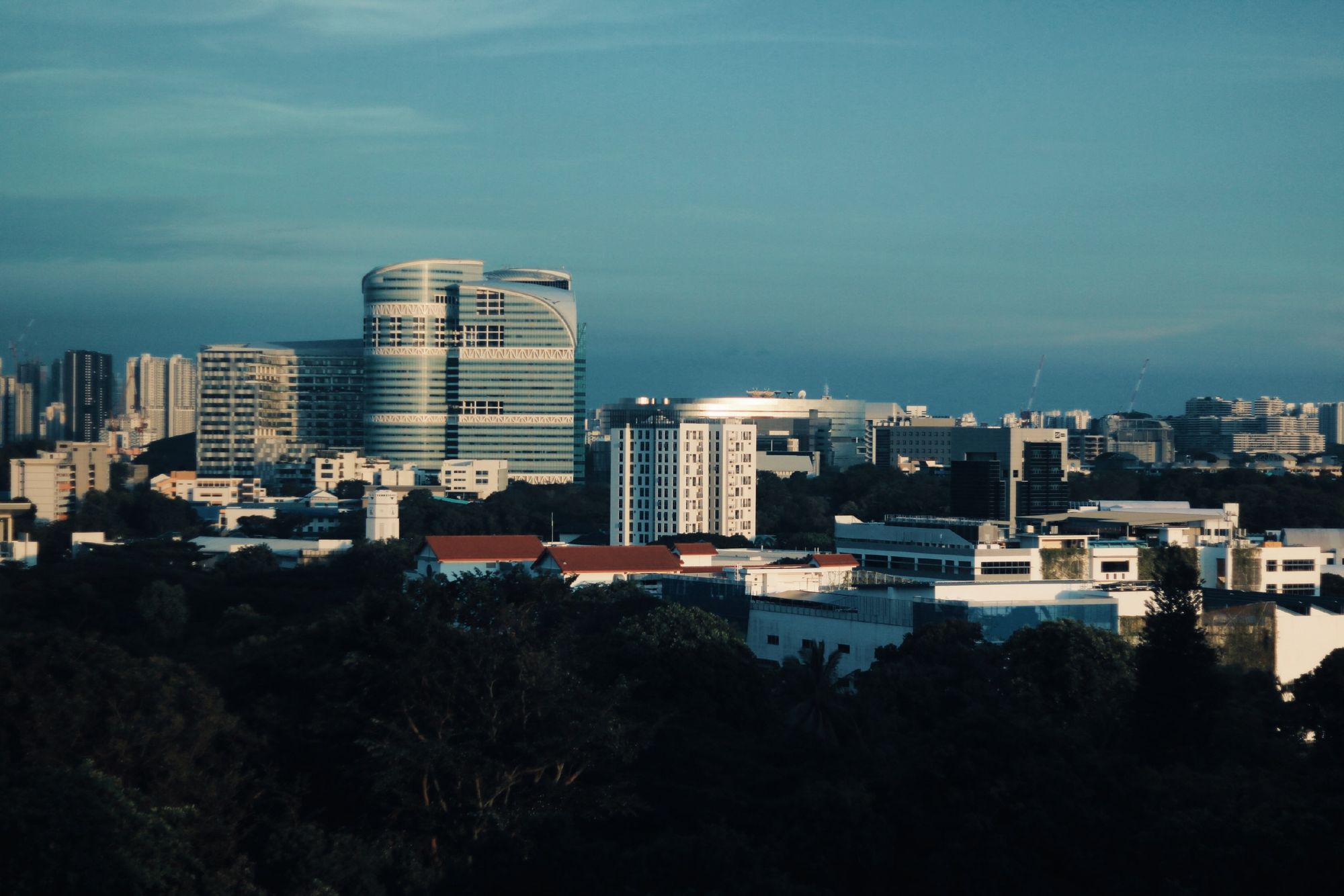
The Singapore skyline. The country leads the world in population-level generative AI use at 61 per cent per the Stanford AI Index 2026, and holds the highest public sector adoption component in the Oxford Insights top ten. Photograph free-licensed via Pexels.
The series separates the compute race, the model race and the rules race. Singapore is the case where the three are most cleanly separated, because the country has chosen to compete in exactly one.
In the compute race, Singapore is a selector rather than a builder. It has no domestic accelerator industry, no fab, and no plan to build compute at scale; it has a rationing regime, a research supercomputer fleet measured in thousands of GPUs, and a hosting sector that makes it the region's connection point. The overflow to Johor and Batam means its physical compute dependence extends beyond its border, and its control of that compute is regulatory and financial rather than physical.
In the model race, Singapore is a regional specialist. SEA-LION covers Southeast Asian languages that the frontier laboratories do not, built on foreign bases, and its value is real and bounded. The country's own leadership declines to claim frontier capability, which is a form of honesty rare in this series and a reasonable allocation of a small research budget.
In the rules race, Singapore is the world leader in the specific sense that its frameworks are the most adopted voluntary instruments in the field and its assurance infrastructure is the most developed. It holds no enforcement power, which distinguishes it from every other rule-maker in this series, and it holds the widest adoption, which distinguishes it from them too. The strategy is coherent: it competes where its smallness is an advantage, in convening and standard-setting, and it buys into the layers where scale decides, through its funds and its partnerships.
The three tempos produce the report's cleanest summary of Singapore. A state that rations the physical layer, specialises in the language layer, buys equity in the frontier, and writes the rules that everyone else borrows. Whether that is a durable form of sovereignty or an elegant position that depends on continued demand for its services is the question the next five years will answer.

Sovereign AI Race: Singapore (2026)
Data and Evidence
Table 1: The five layers, assessed for Singapore in September 2026
Layer | What Singapore holds | What it does not hold | Assessment |
Compute | A rationed allocation regime since the 2019 moratorium: at least 300 MW committed in the Green DC Roadmap (30 May 2024), 200 MW awarded in August 2026 to Digital Realty, Equinix, Keppel DC and ST Telemedia on Jurong Island, 50 MW each, with >50 per cent green energy and liquid cooling conditions; >1.4 GW existing capacity across 70+ facilities; Aspire 2B launched 8 June 2026 with 1,500+ H200 GPUs for 9,000+ researchers | Compute at growth scale by policy choice (200 MW equals about 14 per cent of existing capacity, review cycle 18 to 24 months); power and land to expand domestically; physical control of the Johor and Batam overflow it depends on | Scarcity as policy; capacity as a selected franchise |
Models | SEA-LION family covering Southeast Asian languages, built on foreign open weights: Llama in earlier generations, Qwen from October 2025 (v4 based on Qwen3-32B, v4.5 on Qwen3.6-27B, May 2026); MERaLiON speech line named in the May 2026 update; AIAP apprenticeship past its 25th cohort | A frontier model by choice (the PM has said the advantage does not lie there); independence from foreign base models, and specifically from Chinese open weights after the Qwen switch | Regional specialist on foreign bases, honestly framed |
Capital | Temasek target: AI-related assets from 6 per cent to 10 to 15 per cent of portfolio by 31 March 2031; GIC co-led Anthropic Series G (USD 30bn round, USD 380bn post-money, February 2026) and Series H (USD 65bn round, USD 965bn post-money, May 2026) with Temasek significant in H; RIE2030 at S$37bn over five years; Budget 2026's 400 per cent AI tax deduction capped at S$50,000 a year | Control of the technology the capital buys; evidence of sovereign capital building domestic frontier capability (the PM has said that is not the strategy) | Financial exposure to the frontier, deliberate and disclosed |
Regulation | The deepest soft-law stack in the series: Model AI Governance Framework from 2019, generative AI extension 30 May 2024, agentic AI extension 22 January 2026; AI Verify under Apache 2.0; Project Moonshot; Global AI Assurance Sandbox from July 2025; AI Tester Accreditation from May 2026; NIST and ISO crosswalks; National AI Council since February 2026 | Binding obligations, an AI act, penalties, or enforcement power over AI specifically; a mandatory audit regime | Exported voluntarily, binds no one, adopted widely |
Talent and education | World-leading adoption: 61 per cent population-level generative AI use (Stanford HAI 2026); highest public sector adoption component in Oxford Insights' top ten; AIAP apprenticeship with 25+ cohorts; NTU's AI and society degree; NUS AI cohorts; the 100,000-worker target over three years via the National AI Impact Programme | Research talent at the absolute scale of the largest countries; insulation from regional competition for talent and cost; outcome data for the workforce target (none exists yet) | Strongest demand side in the series, constructed supply side |
Table 2: The controlled metrics, series bible format
Metric | Singapore position | Source and date |
Flagship compute commitment | Green Data Centre Roadmap: at least 300 MW additional near-term capacity (30 May 2024); DC-CFA2 awards of 200 MW in August 2026 to Digital Realty, Equinix, Keppel Data Centres and ST Telemedia Global Data Centres, 50 MW each on Jurong Island, with >50 per cent green energy sourcing and liquid cooling; existing base exceeding 1.4 GW across 70+ facilities; Aspire 2B at 1,500+ H200 GPUs serving 9,000+ researchers | IMDA press release and roadmap, 30 May 2024; business-news-today.com, August 2026; asianews.network, 9 June 2026 |
Capital committed | Temasek AI allocation target of 10 to 15 per cent of portfolio by 31 March 2031 (from 6 per cent); RIE2030 at S$37bn over five years, a 32 per cent increase; over S$1bn committed to public AI research and talent 2025 to 2030; Budget 2026 400 per cent AI tax deduction capped at S$50,000 a year; GIC and Temasek stakes in Anthropic rounds (USD 380bn and USD 965bn post-money) | Temasek Review 2026, 8 July 2026; The Business Times, 5 December 2025; MDDI factsheet, 20 May 2026; Computer Weekly, 13 February 2026 |
Flagship national models | SEA-LION family: Qwen-SEA-LION v4 (based on Qwen3-32B) released October 2025, announced with Alibaba Cloud 24 November 2025; v4.5 (based on Qwen3.6-27B) May 2026; previous generations on Llama; purpose-built for Southeast Asian language coverage | Alibaba Cloud release, 24 November 2025; TechNode, 25 November 2025; SEA-LION documentation, May 2026 |
Anchor entities | IMDA and the Economic Development Board (the compute and governance authorities); AI Singapore (the model and apprenticeship programmes); the National AI Council chaired by the Prime Minister (since February 2026); the National Supercomputing Centre and NRF (research compute); GIC and Temasek (capital); the AI Verify Foundation (assurance) | MDDI, IMDA and EDB releases, 2023 to 2026 |
Chip dependency | Complete at the accelerator layer: the national research systems and the private sector run NVIDIA silicon (A100, H100, H200, and reported Blackwell-class deployments). No domestic accelerator programme exists. Globally 92 per cent of sovereign AI LLMs were trained on NVIDIA chips per Counterpoint | IMDA and NSCC materials; Counterpoint Research, 5 August 2026 |
Regulatory instrument and status | Voluntary by design: Model AI Governance Framework (2019, revised 30 May 2024 and 22 January 2026), AI Verify (open source, Apache 2.0), Project Moonshot, the Global AI Assurance Sandbox (July 2025) and the AI Tester Accreditation Programme (May 2026), with NIST and ISO crosswalks. No AI act; no fines; the National AI Council sets direction | IMDA and AI Verify Foundation, 2024 to 2026; Computer Weekly, 13 February 2026 |
Talent anchors | AI Apprenticeship Programme past its 25th cohort; NTU Bachelor of Computing in Artificial Intelligence and Society; NUS AI cohorts; the National AI Impact Programme targeting 100,000 workers over three years from accountancy and legal services; the National Supercomputing Centre supporting more than 9,000 researchers | AI Singapore; NTU and NUS records; MDDI factsheet, 20 May 2026 |
Independent index standing | Oxford Insights Government AI Readiness Index 2025: 7th of 195 with 76.42 points (publisher dataset), the highest public sector adoption component in the top ten. Stanford HAI AI Index 2026 (13 April 2026): first in the world in population-level generative AI use at 61 per cent | Oxford Insights 2025 dataset; Stanford HAI AI Index 2026 |
Adoption | 61 per cent population-level generative AI use, first in the world, ahead of the UAE at 54 per cent (Stanford HAI AI Index 2026). Public sector adoption among the highest measured globally (Oxford Insights 2025) | Stanford HAI AI Index 2026; Oxford Insights 2025 |
Distinguishing mechanism | A state that rations the physical layer, hosts and assures foreign AI, and owns a financial stake in the frontier while declining by choice to build frontier models | This report |
Core tension | The jurisdiction that writes the world's most adopted AI governance frameworks holds no enforcement power over AI, depends on neighbours for physical compute, and builds its national model on a Chinese open-weight base | This report |
Table 3: Timeline, 2019 to 2026
Date | Event | Source |
January 2019 | Model AI Governance Framework, first edition | IMDA and AI Verify Foundation |
2019 | Effective moratorium on new data centre construction begins | datacentres.com; introl.com |
May 2022 | AI Verify governance testing framework and toolkit launched by IMDA and PDPC | AI Verify Foundation; IMDA |
June 2023 | AI Verify Foundation established | IMDA press release, 7 June 2023 |
2023 | First DC-CFA pilot allocates roughly 80 MW to four parties (a second account describes about 120 MW of development) | introl.com; datacentres.com |
4 December 2023 | National AI Strategy 2.0 launched | MDDI; Smart Nation Singapore |
30 May 2024 | Green Data Centre Roadmap launched at ATxSummit: at least 300 MW of additional near-term capacity; Model AI Governance Framework for Generative AI published with nine dimensions; Project Moonshot in open beta | IMDA press releases and factsheets, 30 May 2024 |
October 2024 | A greater-than-USD-15bn data centre joint venture involving GIC, CPP and Equinix announced | sgai.md; announced October 2024 |
February 2025 | Global AI Assurance Pilot begins, pairing 17 deployers with 16 specialist testers | IMDA; AI Verify Foundation |
February 2025 | Singtel secures SGD 643m green financing for its Tuas data centre | introl.com |
7 July 2025 | Global AI Assurance Sandbox launched | IMDA press release, 7 July 2025 |
October 2025 | Qwen-SEA-LION v4 released, based on Qwen3-32B: the national model family switches its base from Llama to Qwen | Model card, 16 October 2025; TechNode |
24 November 2025 | Alibaba Cloud announces the Qwen partnership publicly | Alibaba Cloud press release |
1 December 2025 | DC-CFA2 launched by EDB and IMDA: at least 200 MW, applications closing 31 March 2026 | introl.com; theindustryindex.com |
5 December 2025 | RIE2030 released: S$37bn over five years, a 32 per cent increase | The Business Times, 5 December 2025 |
January 2026 | National AI R&D Plan updated: over S$1bn committed to public AI research and talent from 2025 to 2030 | MDDI factsheet, 20 May 2026 |
22 January 2026 | Model AI Governance Framework for Agentic AI launched at Davos | IMDA; secondary summaries |
February 2026 | National AI Council established, chaired by Prime Minister Lawrence Wong; Budget 2026 introduces National AI Missions and the 400 per cent AI tax deduction | Computer Weekly, 13 February 2026; EDB |
February 2026 | GIC co-leads Anthropic Series G: USD 30bn round at USD 380bn post-money | sgai.md |
April 2026 | Civil society criticism of the framework's pace and depth published | aiinasia.com |
May 2026 | Qwen-SEA-LION v4.5 released (Qwen3.6-27B base) | SEA-LION documentation, 19 May 2026 |
18 May 2026 | AI Tester Accreditation Programme launched | IMDA |
20 May 2026 | National AI Strategy updated: OpenAI MOU signed committing more than S$300m to its first applied AI lab outside the United States, with 200+ roles; Google, Microsoft and NVIDIA expand commitments; agentic framework revised; workforce target of 100,000 workers over three years | EDB, 20 May 2026; MDDI factsheet |
May 2026 | GIC co-leads Anthropic Series H: USD 65bn round at USD 965bn post-money, with Temasek a significant investor | sgai.md |
8 June 2026 | Aspire 2B launched at NTU: 1,500+ H200 GPUs for more than 9,000 public researchers | asianews.network, 9 June 2026 |
8 July 2026 | Temasek Review 2026 published: AI-related assets to rise from 6 per cent to 10 to 15 per cent of portfolio by 31 March 2031 | Temasek Review 2026 via sgai.md |
August 2026 | DC-CFA2 provisional awards: 200 MW split equally among Digital Realty, Equinix, Keppel Data Centres and ST Telemedia Global Data Centres on Jurong Island | business-news-today.com, August 2026 |

Sovereign AI Race: Singapore (2026)
Implications
For the countries still to come in this series
Singapore is the case study for any state that will never own the frontier, which is most states, and its strategy is the most transferable in the series for exactly that reason. The copyable parts are the rationing mechanism and the assurance export. Rationing capacity against efficiency conditions converts a physical limit into an industrial policy that selects for operators who are competitive in any market, and it costs the state nothing but the discipline to say no. Building the governance instruments as open, interoperable and free makes them travel, which gives a small state agenda-setting influence that its size would never command otherwise. The parts to watch are the two dependencies the model carries: the compute that runs outside the border in jurisdictions the state does not govern, and the model that runs on someone else's weights. A country copying Singapore should copy the strategy with its eyes open about what it leaves outside its own control.
For the technology providers
Singapore is the region's gateway and its most demanding gatekeeper, and providers should price both. The demanding part is the allocation regime: entrance to the Singapore market for data centre capacity runs through efficiency targets around 1.25 to 1.3 at full load, liquid cooling, green energy sourcing beyond certificates, and the top green certification, and those standards are now the reference for the tropical data centre market. The inviting part is everything around it: the highest population adoption rate in the world, a government that has adopted AI extensively in its own services, an assurance stack that shortens the path to compliance with American and European expectations, and a labour force being trained through an apprenticeship model that produces deployable engineers. Providers selling into Southeast Asia should treat Singapore as the standard-setting market and Johor and Batam as the capacity markets, because that is the division the state itself has drawn.
For institutional and enterprise buyers
Singapore offers the clearest example in the series of buying governance certainty rather than compute. A firm deploying AI across Southeast Asia can run its workloads from Singapore's hyperscaler regions, or from Johor and Batam at lower cost, and rely on Singapore's frameworks and its network of accredited testers to demonstrate responsible practice. The country's assurance instruments crosswalk to the American NIST framework and the ISO standard, which means one compliance effort can serve several regulators. The honest limit for buyers is that Singapore's governance is voluntary and unenforced, so a firm seeking a jurisdiction with binding AI obligations should look to Europe or Korea, and a firm seeking the fastest route to trusted deployment across the region should look here.
For University 365
Singapore is the tenth country in this series and the first whose education strategy is built entirely around deployment rather than capability, which is close to this institution's own argument. The country has the world's highest adoption rate, a government that uses AI in its own services, and a workforce agenda that names its targets and its delivery channels: 100,000 workers over three years, beginning with accountancy and legal services, alongside an apprenticeship programme now past its twenty-fifth cohort that converts people into deployable engineers rather than AI-literate observers. That combination, adoption at national scale plus conversion training at depth, is the most complete demand-side answer in the series to the gap this institution exists to address. The Singaporean caveat is equally instructive: the country's own leadership says the advantage is not in building the largest models, which means its education strategy is calibrated to a role it has chosen, and the measure of its success will be whether its people can operate, assure and govern the frontier systems that others build.

Sovereign AI Race: Singapore (2026)
Education and Skills Impact
What the Singaporean case teaches about training a whole economy to use AI
This series returns in every report to the gap between using AI and building it, because that gap is where the educational argument lives. Singapore adds the first case in which the strategy is deliberately to close the first half of the gap completely and to decline the second half by choice.
The demand-side numbers are the strongest in the series and they are worth stating precisely. The Stanford AI Index for 2026 records Singapore first in the world in population-level generative AI usage at 61 per cent, ahead of the United Arab Emirates at 54 per cent and far ahead of most larger economies. The Oxford Insights index places the government's own public sector adoption among the highest measured anywhere. A country where three in five people use generative AI and the state's own services are a published strength has solved the diffusion problem that this series has documented in Japan, Germany and Italy, and it has done so through deliberate policy: the National AI Impact Programme, refreshed with the strategy in May 2026, names a target of equipping 100,000 workers over three years with expanded training offerings beginning in accountancy and legal services, which is to say it started with the professions where AI changes the work most directly.
The supply side is built for conversion rather than for research scale, and that is a design choice. The AI Apprenticeship Programme, run by AI Singapore and now past its twenty-fifth cohort, takes graduates and career changers through a structured full-time engineering apprenticeship and places them into industry roles. The universities have added dedicated degree capacity, with Nanyang Technological University offering a programme in artificial intelligence and society and the National University of Singapore running dedicated AI cohorts. The national research compute, with Aspire 2B's more than 1,500 H200 GPUs serving more than 9,000 public researchers, gives the education system research infrastructure that previously had to be rented abroad, which is a direct educational benefit of the compute programme the digital development minister framed as compute sovereignty in its own right.
What Singapore's model does not attempt is frontier research at scale, and the country's leadership says so explicitly. The prime minister's statement that the advantage does not lie in building the largest frontier models is an educational statement as much as an industrial one: the country is training people to deploy, govern, assure and finance AI rather than to train models at the frontier, and it buys its position at the frontier through its investment funds instead. The finding this series keeps producing sharpens here in an unusual direction. A curriculum teaches judgement; Singapore is teaching judgement about systems other people build, at national scale, and it is doing it deliberately rather than as a consolation. Whether that is a complete education for the AI age is the open question, and the country's own bet is that the world needs far more people who can run and govern the systems than people who can train them.

Sovereign AI Race: Singapore (2026)
The CI-First Perspective
Where the Singaporean capability is real, and where the strategy rests on the choices of others
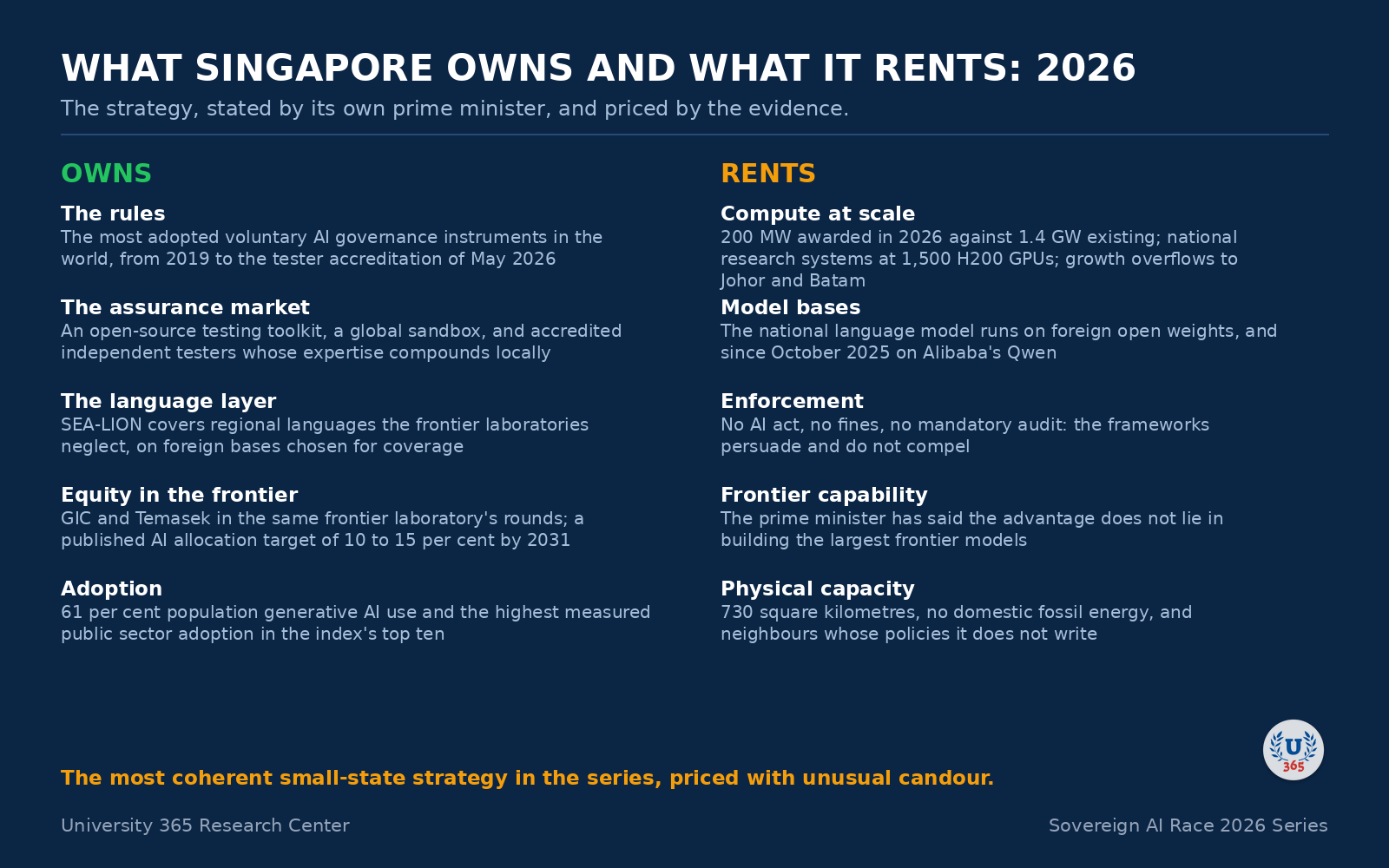
What Singapore owns and what it rents. University 365 Research Center.

The checkpoint every system passes through, and the inspector who marks each one. University 365 Research Center.
The Co-Intelligence First framework asks whether an arrangement amplifies human capability or substitutes for it, and where the risk of AI Imposture sits. Applied to Singapore, the verdict is that the capability is real at the layers the country chose, the strategy is unusually honest about the layers it declined, and the residual risk sits in the dependencies the strategy carries rather than in any gap between claim and delivery.
The capability is real in four places, and the report holds each as a genuine achievement. The allocation regime is real policy with measurable output: 200 megawatts awarded under enforceable conditions in August 2026, on top of a roadmap commitment of at least 300 megawatts, inside a rationing system that has operated since the moratorium and that no other country in the series has built. The governance stack is real in the way that widely adopted instruments are real: frameworks in use since 2019, an open-source testing toolkit, an accreditation programme for independent auditors, an international sandbox linking deployers and testers, and crosswalks that make the whole system interoperable with the American and international standards. The capital position is real and quantified: Temasek's published target of AI-related assets rising from 6 per cent to between 10 and 15 per cent of its portfolio by 2031 is the most concrete commitment any state fund in this series has made, and the funds' participation in the frontier rounds is documented. And the talent and adoption layer is real in the only way that ultimately counts, in population behaviour: three in five residents using generative AI is a fact about the society, not a communications claim.
The dependencies are equally real and the country's strategy does not hide them, which is the difference between this case and an imposture. The national language model runs on foreign weights, and since October 2025 on a Chinese base. The physical compute the economy demands runs partly in Johor and Batam, outside the state's regulatory perimeter. The assurance frameworks bind no one. And the financial stake in the frontier buys returns rather than control. A less careful state would present these as strengths; Singapore presents its model choice as a technical decision and its ceiling as a stated strategic choice, and the report treats that candour as the reason its sovereignty claim, narrower than most, is also more defensible.
The CI-First verdict on Singapore is this. This is a state that has specialised in the coordination layers of AI, the rules, the assurance, the language coverage, the hosting and the finance, and that has been explicit that it will not compete in the production layers. The amplification question for its population is answered better than in any other country in the series so far: people use the technology at world-leading rates, the workforce is being trained to operate it, and the governance system gives firms a reason to use it carefully. The residual risk is not imposture but exposure, and it is the exposure any specialist carries: a state whose sovereignty rests on being the most trusted and best-connected jurisdiction in its region depends on the region continuing to value those services, on its suppliers continuing to sell, and on its neighbours continuing to host what it will not. Singapore has priced that exposure deliberately and published the price. The series' judgment is that this is the most coherent small-state strategy in the twenty, and that its test comes not from anything Singapore does wrong but from what the larger powers decide.

Sovereign AI Race: Singapore (2026)
What This Means for You and Us
For a reader in a country with Singapore's constraints
The Singaporean playbook is the one to copy if your limits are physical and your ambitions are real. Make the constraint do work: ration capacity against standards that select for operators who are competitive anywhere, and you convert scarcity into an industrial policy that costs you nothing but the discipline to refuse. Build governance instruments that are open, free and interoperable, and they will travel further than any statute you could enforce. Buy exposure to the frontier through your investment institutions rather than pretending you can build it, and say so publicly, because a strategy that names its limits is more credible than one that does not. And train your population to operate the systems at the scale Singapore has, because adoption is the layer where a small state can genuinely lead.
For a reader watching the series
Ten countries in, Singapore completes the taxonomy's governance case. The series has now examined the full-stack owners, the capital sovereigns, the constrained ambition cases and the first pure rule-maker without enforcement power. The emerging finding sharpens once more. Sovereignty in this race is a portfolio of positions, and Singapore is the first country whose portfolio is deliberately weighted toward the layers that scale does not decide: rules, assurance, hosting and finance. Whether that weighting holds depends on a proposition no country has yet tested, that the value of AI accrues to the jurisdiction that governs and finances it as much as to the one that builds it.
For University 365
Singapore is the tenth country in this series and the one whose education strategy most closely matches this institution's own thesis about where most people will work. The country has chosen not to train frontier researchers at scale but to train operators, assurors, deployers and governors, and it has built the pipeline to do it: an apprenticeship programme past its twenty-fifth cohort, dedicated degree capacity, a research supercomputer serving nine thousand public researchers, and a workforce target that names its number and its sectors. That is the amplification agenda in national form, and its measure will be whether a population trained to use and govern systems built elsewhere can hold its position as the systems continue to change. It is the same question we face in our own work, and Singapore is running the largest deliberate experiment in answering it.

Sovereign AI Race: Singapore (2026)
The Road Ahead
Three observable things would change this assessment.
Whether the strategy's dependencies are tested by their suppliers. The number to watch is whether the Qwen-based SEA-LION line continues or is re-based again, and whether the American hyperscalers and the Chinese base-model provider remain equally available to a state that hosts both. A re-basing in either direction would reveal which dependency the country, or its suppliers, consider decisive. The report's assessment would change if the strategy's neutrality became untenable.
Whether the assurance stack acquires teeth or loses ground. The instruments to watch are the AI Tester Accreditation Programme's uptake, the sandbox's conversion to commercial assurance contracts, and whether the April 2026 civil society criticism produces a shift toward binding requirements. If Singapore's voluntary frameworks keep spreading while the regulated jurisdictions tighten, the model proves governance without enforcement can hold; if adoption stalls or a serious AI incident exposes the gap, the model's central premise is weakened.
Whether the compute constraint binds harder than the policy can absorb. Watch the next allocation round, due for review 18 to 24 months from August 2026, and whether the awarded projects on Jurong Island reach their green energy conditions; watch whether the Johor and Batam overflow stabilises or grows, since it is the measure of how much of the country's AI economy sits outside its own control; and watch whether the national research compute expands at a pace that keeps the public research base from renting abroad. On those three the Singaporean model either confirms that a small state can hold the coordination layers of a technology it does not build, or it demonstrates the outer limit of that strategy.

Sovereign AI Race: Singapore (2026)
Sources and Methodology
Methodology
This report was researched from public sources with a preference for primary documents: the Infocomm Media Development Authority's press releases, factsheets and its Green Data Centre Roadmap, including the original 30 May 2024 launch materials; the Economic Development Board's budget and strategy materials; the Ministry of Digital Development and Information's strategy updates and factsheets; AI Singapore's model documentation for the SEA-LION family; the AI Verify Foundation's own instruments; Temasek's published review materials; the Stanford HAI AI Index 2026 and the Oxford Insights Government AI Readiness Index 2025 for the independent measurements, with Singapore's own index position taken from the publisher's dataset; and the Singapore and international press for everything else. Government targets and vendor commitments are labelled as such, and where sources conflict the conflict is stated rather than resolved: the 80 megawatt pilot allocation against a secondary account of about 120 megawatts of development, and the power usage effectiveness threshold reported between 1.25 and 1.3, both appear as ranges with their sources.
Several claims circulated in secondary coverage were checked against primary sources and excluded when they could not be confirmed, and this report records the exclusions because they are the kind that would otherwise slip into print: a "500 megawatt split" between efficiency and green tranches attributed to the roadmap, which no primary source corroborates and which rests on an aggregator that also misdates the roadmap to 2026; a "700 megawatt low-carbon data centre park" on Jurong Island from a single secondary source; a figure for Singapore's share of NVIDIA's global revenue, which is distorted by the country's role as a regional billing and shipping hub and which this report does not use; and conflicting Temasek portfolio values and returns from secondary reporting, for which the report cites the published AI allocation target instead of the disputed figures. The Qwen switch is presented with both the technical case and the strategic reading, because the country's own framing and the regional coverage differ and neither is verifiable against the other.
The series tests itself over time, and this report's baseline statement is part of that test: University 365 has not published a Singapore landscape report before this one, so there is no prior baseline to compare against, and this report says so plainly rather than implying one. From this report forward, Singapore carries a documented baseline against which later movement can be measured.
Three limits should travel with this report. First, Singapore's exact installed data centre capacity as of this report's cut-off is not established beyond the IMDA roadmap's "exceeding 1.4 gigawatts"; no post-2024 total was verified and none is asserted. Second, the DC-CFA2 conditions are drawn from the allocation reporting and the agencies' statements rather than a full reading of the award documents, and the power usage effectiveness threshold is given as the range the sources support. Third, no Counterpoint Research figure specific to Singapore could be verified in this research window, and where the report cites Counterpoint it does so for the global finding about accelerator concentration, not for a Singapore number.
Principal sources
Government and official. IMDA: the Green Data Centre Roadmap launch release and factsheet (30 May 2024), the roadmap PDF and its later page updates, the Model AI Governance Framework materials, the Project Moonshot pages, the AI Verify Foundation launch release (7 June 2023) and the assurance sandbox launch release (7 July 2025); MDDI: the National AI Strategy materials of December 2023, the May 2026 update and its factsheet; EDB: the budget explainer and the May 2026 strategy and partnership release; the AI Verify Foundation's framework, sandbox and accreditation materials; AI Singapore's SEA-LION documentation and model cards; the National Supercomputing Centre and NRF materials on the Aspire systems; Temasek's published review materials; Stanford HAI's AI Index 2026; Oxford Insights' Government AI Readiness Index 2025 and its published dataset.
Company and institutional disclosures. Alibaba Cloud's release on the Qwen partnership (24 November 2025); NVIDIA's materials; Amazon Web Services, Google and Microsoft commitments as carried by the trade and national press; Singtel's green financing and Tuas project disclosures; the operators named in the August 2026 allocation.
Reporting. The Straits Times, CNA and The Business Times as the principal national outlets; Reuters, Bloomberg and the international wires for corporate announcements; TechNode and the South China Morning Post for the Qwen decision; Data Center Dynamics; Computer Weekly for the council and budget; asianews.network for the Aspire 2B launch; and the specialist energy, data centre and governance outlets named in the text where a claim depends on them.

Sovereign AI Race: Singapore (2026)
About This Report
Sovereign AI Race: Singapore (2026) is report ten of twenty in the Sovereign AI Race series, followed by a comparative capstone. The series assesses how states attempt to control the production of artificial intelligence inside their jurisdiction, using one five-layer framework and one metric set applied identically to every country: compute, models, capital, regulation, and talent.
Each report in the series carries a "What Changed Since" treatment against the earlier University 365 report on the same country where one exists. Singapore has no earlier University 365 landscape report, and this report states that plainly: the baseline for Singapore begins here, and future reports in this series will measure movement against this one.
Author: Hubert Graef, Dean of Research, University 365 Research Center.
Series: Sovereign AI Race, report 10 of 20, followed by the comparative capstone.
*Published by University 365 Research Center. CI-First is University 365's Co-Intelligence First framework, a method constant of the institution.*
Revision 2, 30 September 2026, 18:28 UTC. Published 29 September 2026.




Comments