
Sovereign AI Race: South Korea (2026)

Updated: 5 hours ago
In this Report
This publication is part of the Sovereign AI Race series.
The Co-Intelligence-First (CI-First) approach is a genuine and unique University 365 concept: a proposal for imagining a better future where AI and Human Intelligence coexist productively, each amplifying the other rather than replacing it.


Sovereign AI Race: South Korea (2026)
The Context
The five layers, and why South Korea is the memory sovereign
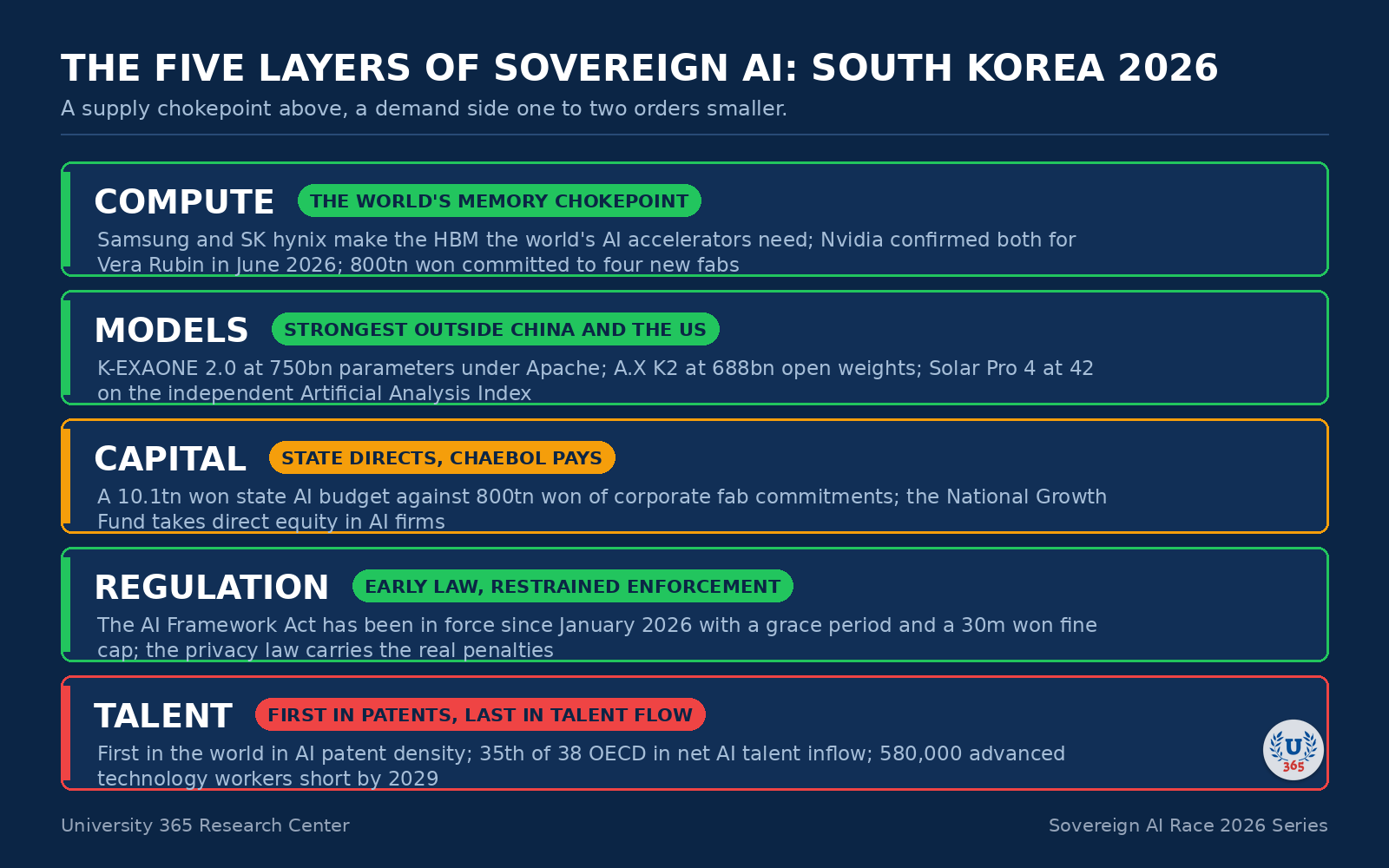
The five layers assessed. A supply chokepoint above, a demand side one to two orders of magnitude smaller. University 365 Research Center.
This is the ninth report in a twenty-part series assessing how states attempt to control the production of artificial intelligence inside their own jurisdiction. The framework is fixed and applied identically to every country. Sovereign AI capacity separates into five layers, and a state can hold any one of them without holding the others.
Compute sovereignty is the physical layer: where the chips and data centres sit, and who may switch them off. Model sovereignty is who builds the models a country depends on, and in whose languages and domains those models are competent. Capital sovereignty is who funds the build-out and on what terms. Regulatory sovereignty is who writes the rules and whether they can be enforced. Talent and education sovereignty is who builds and runs the systems, and how the next generation is prepared.
The series treats three races as running at once: the compute race, the model race and the rules race. South Korea is the only country in the series that is a global chokepoint in one of those races while competing as a customer in the others. Samsung and SK hynix between them make most of the high-bandwidth memory that the world's AI accelerators use, which means that when any country buys sovereign compute, a part of that purchase travels through Korea. The same two companies are now building four more memory fabs in a part of the country that has never hosted them, on a commitment announced at 800 trillion won. Korea's own government, for its part, runs its AI strategy on rented accelerators, its flagship model contest is still eliminating candidates, and its net AI talent flow is negative.
The series places South Korea in the "owner of the full stack" posture alongside China and the United States. That label is a series-level editorial assignment, not a scored index, and this report tests it layer by layer. The honest finding, documented throughout, is narrower than the label: Korea owns one layer of the global stack completely, and holds partial, subsidised and contested positions in the others. The test matters because it is the same test every technology economy eventually faces: what does it take to turn a supply monopoly into a domestic capability, and what happens if the people required to run it are not there.
The vocabulary this report needs
Five terms recur, and they are defined here once.
High-bandwidth memory, or HBM. The specialised stacked memory that sits beside an AI accelerator and feeds it data fast enough to be useful. It is the component without which a graphics processor cannot train a model, and it is the layer where Korea has no substitute at scale. Samsung announced it began mass production of the sixth generation, HBM4, on 12 February 2026 and claimed an industry first; SK hynix reported at the Hot Chips conference in August 2026 that its 12-layer HBM4 is in mass production and its 16-layer version in qualification; and Nvidia's chief executive, speaking in Seoul on 5 June 2026, confirmed all three major memory makers, SK hynix, Samsung and Micron, as qualified and in active HBM4 production for the coming Vera Rubin generation. The "first" claims are vendors' own, and this report records them as claims.
Announced capacity versus operational capacity. This report uses the distinction strictly. Construction started on the National AI Computing Center at Haenam on 3 August 2026, targeting 15,000 AI chips by 2028; the Naver, NVIDIA and Brookfield expansion to 200 megawatts is a plan announced on 24 July 2026; the government's target of 8.4 gigawatts of data centre capacity by 2029 and a further 10 gigawatts by 2035 is a target. Where a figure is not yet built, this report says so.
The chaebol balance sheet. Most of Korea's AI capital numbers are corporate commitments announced at government events, not treasury spending. The 800 trillion won for the southwestern fabs, the 81 trillion won packaging hub, the 30 trillion won value chain programme: these are announced corporate investments over multi-year horizons. The government's own 2026 AI budget is 10.1 trillion won. Every capital figure in this report carries which of the two it is.
The elimination contest. The government's Sovereign AI Foundation Model Project selects the companies that will build Korea's national foundation models through successive rounds of evaluation. Four teams entered the second round; Motif Technologies was eliminated on 18 August 2026; LG AI Research, SK Telecom and Upstage advanced; the final teams are to be chosen in a third round in early 2027. A national champion chosen by competition is a different asset from a national champion that already exists, and the report treats it that way.
The two PIPA amendments. Korea amended its privacy law twice in 2026, and the two are routinely conflated in coverage. The first amendment, Act No. 21445, was passed on 12 February 2026, promulgated on 10 March 2026 and took effect on 11 September 2026: it triples the punitive fine ceiling to 10 per cent of total global annual revenue, places accountability for data protection on the chief executive, and widens breach reporting. It contains no artificial intelligence training provision at all. The second, the AI route, passed the National Assembly on 20 August 2026 and was announced by the Personal Information Protection Commission on 27 August 2026: it creates a case-by-case approval path under which the Commission may allow lawfully collected personal data, original rather than pseudonymised, to be used for AI development, subject to four conditions, and it takes effect six months after promulgation, which had not happened as of this report's cut-off. The distinction matters because a compliance plan built on the wrong instrument is built on nothing.

Sovereign AI Race: South Korea (2026)
The Question
Can a state convert a supply monopoly into a domestic industry before its workforce runs out?
South Korea has done something no other country in this series has done. It has captured an indispensable layer of the global AI supply chain without capturing the demand-side industry that layer serves. The memory fabs of Pyeongtaek and Icheon and the new cluster at Yongin make the components; the accelerators they plug into are designed in California; the models that consume their output are trained mainly in the United States and China; and the Korean firms that would consume them domestically are, by the government's own measures, adopting artificial intelligence more slowly than their peers in several comparable economies.
That gap is not a secret in Korea, and the state's response is the most state-directed programme in the series outside China and the Gulf. The Ministry of Science and ICT now sits at deputy prime minister level, for the first time in 17 years. A national computing centre is under construction in South Jeolla Province. The government is procuring domestic models by rule, requiring that companies selected for its free citizen-facing AI service use a domestically developed sovereign foundation model for at least half of the service and models from other Korean developers for at least another thirty per cent. A national growth fund takes direct equity stakes in AI companies. Twelve national missions, modelled on the American moonshot vocabulary, organise public-private research to 2035.
And underneath all of it runs a constraint that budgets cannot buy their way out of. Korea does not lack science and engineering graduates; it lacks deployable engineers. The Information Technology and Innovation Foundation's June 2026 assessment is blunt: the country's incentive structure pays doctors and steers away from engineering, and the country faces a projected shortage of roughly 580,000 workers in advanced technology fields by 2029. Stanford's AI Index for 2026 records the world's highest AI patent density per capita and the third-highest count of notable models, and, in the same dataset, a net AI talent flow of minus 0.36 per ten thousand, ranking 35th of 38 OECD countries. More AI researchers leave than arrive.
So the question this report asks is not whether Korea can build sovereign AI capacity. At the memory layer it already holds the world's choke point, and at the model layer it has produced the strongest open-weight output of any country outside the United States and China. The question is whether a state can convert a supply monopoly into a domestic industry faster than its workforce and its capital commitments pull in other directions.
Sovereign AI Race: South Korea (2026)
The Contradiction
The country that makes the memory for everyone else is buying its own compute abroad
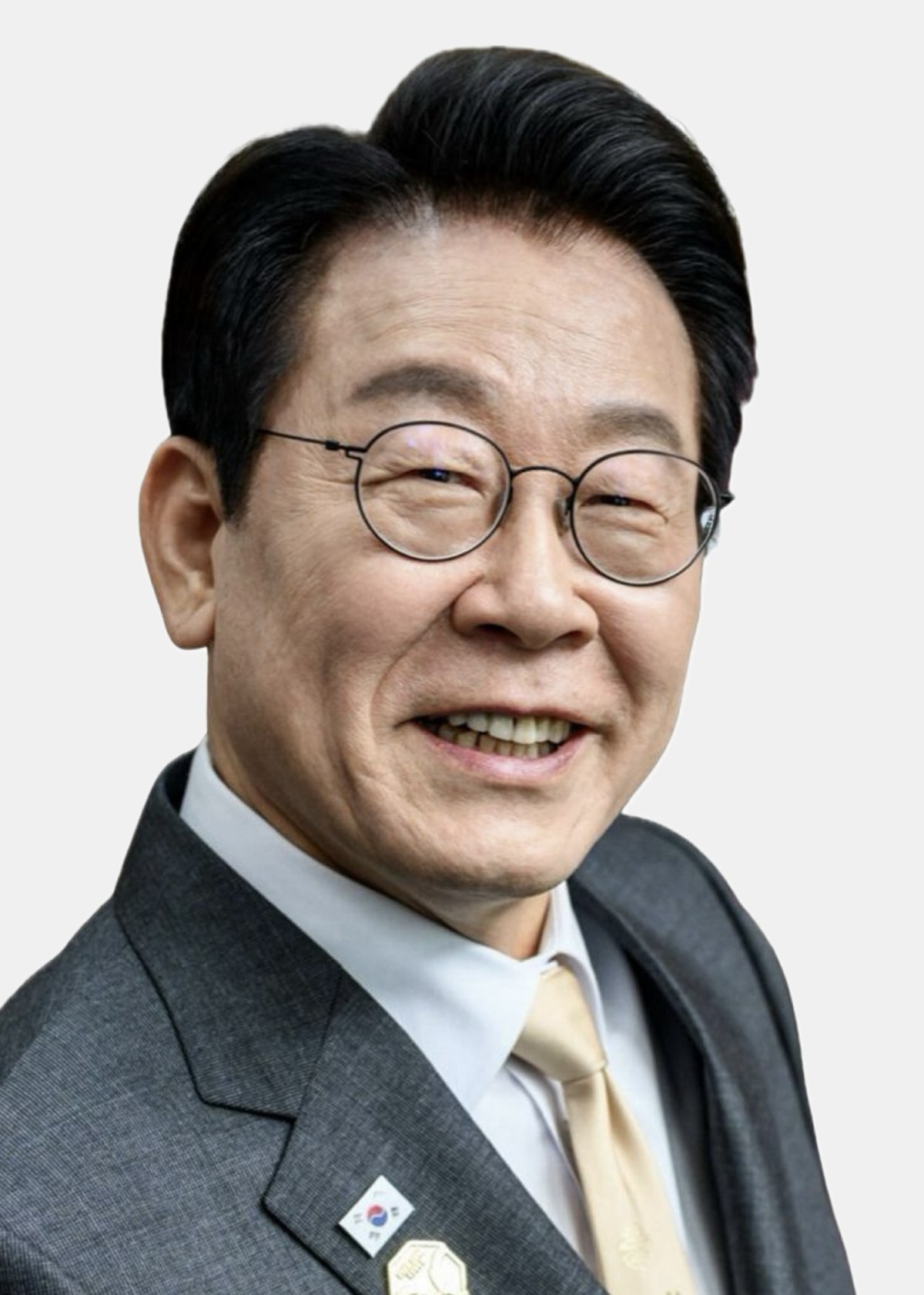
Lee Jae-myung, President of South Korea, as of 2026. He chaired the June 2026 national briefing at which Samsung and SK hynix committed 800 trillion won to four new memory fabs in the southwest. Photograph: Office of the President, public domain, via Wikimedia Commons.
Here is the paradox, stated as plainly as the evidence allows.
Every serious national AI programme in this series depends, directly or indirectly, on components made in South Korea. High-bandwidth memory is the binding physical input for AI training hardware, Korea's two memory houses supply it, and Nvidia's own chief executive confirmed in Seoul in June 2026 that both Korean firms are qualified and in production for the coming generation. When the United Arab Emirates, Saudi Arabia, Japan, France or India buys sovereign compute, a significant part of what makes that compute work is Korean.
Now read Korea's own position from the demand side. MSIT is investing approximately 1.46 trillion won, about 1.1 billion dollars, to procure 13,000 high-performance accelerators across three cloud providers, a programme recorded by the OECD's policy observatory and announced in July 2025. The national computing centre under construction in Haenam targets 15,000 AI chips by 2028. The planned Naver, NVIDIA and Brookfield expansion reaches 200 megawatts. Set against the 800 trillion won of fabs and fabs-to-come, these are the numbers of a country building its own compute on a scale one or two orders of magnitude below the industry it supplies. The memory sovereign of the world is, at the demand layer, a middle-sized customer.
The second tension is inside the model layer. The government's contest to select a sovereign foundation model is real, and the finalists are serious companies. LG AI Research released K-EXAONE 2.0 on 31 July 2026 at 750 billion parameters under the Apache licence, described by its maker as the largest foundation model developed in Korea and more than triple the size of the first-phase model; SK Telecom released A.X K2 on 29 July 2026 at 688 billion parameters with open weights; Upstage's Solar Pro 4 scored 42 on the Artificial Analysis Intelligence Index, an independent measurement, a 27-point rise over its predecessor. And in the same layer, Naver is advancing its flagship HyperCLOVA X by fine-tuning NVIDIA's Nemotron 3 Ultra open model with proprietary data, which the vendor's own announcement describes. Korea's flagship model stack is partly built on a foreign base model, and the government's own security project pairs a Naver model with an LG model in adversarial co-training precisely because the domestic alternatives need building up. A national champion contest that ends in 2027 is the plan for closing that gap; today the gap is open.
The third tension is the capital direction. The same year that Samsung and SK hynix committed 800 trillion won to build four memory fabs at home, they were weighing American tariff pressure that conditions access to the United States market on investment inside the United States, an arrangement reported in January and July 2026 and compared in the Korean press to the Taiwan model in which tariff relief follows American investment. Korea's corporate capital is being asked to build in two countries at once, and the capital being asked is the same capital.
And the fourth tension is the people. The Stanford AI Index 2026 records Korea first in the world in AI patents per capita and third in notable models, and the same index series records the country 35th of 38 OECD nations on net AI talent inflow, with more researchers leaving than arriving. A country cannot hold a full stack for long if the people who build it accumulate abroad.

Sovereign AI Race: South Korea (2026)
The Current State
Compute: the memory chokepoint, and a domestic build measured in thousands of chips
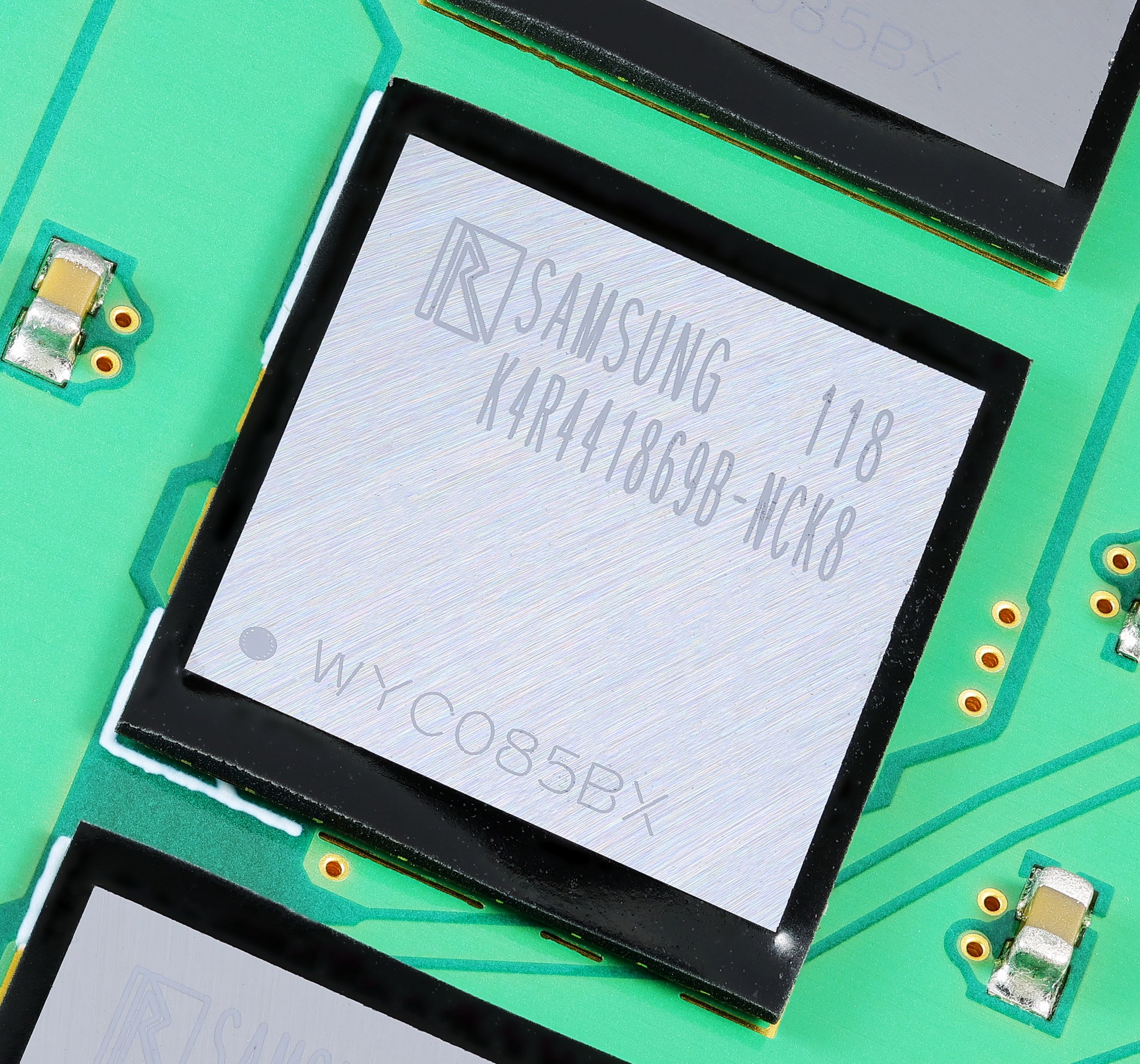
A Samsung DRAM component. High-bandwidth memory is the layer without which no AI accelerator can train a model, and Korea's two memory houses supply it. Photograph: Mister rf, CC BY-SA 4.0, via Wikimedia Commons.
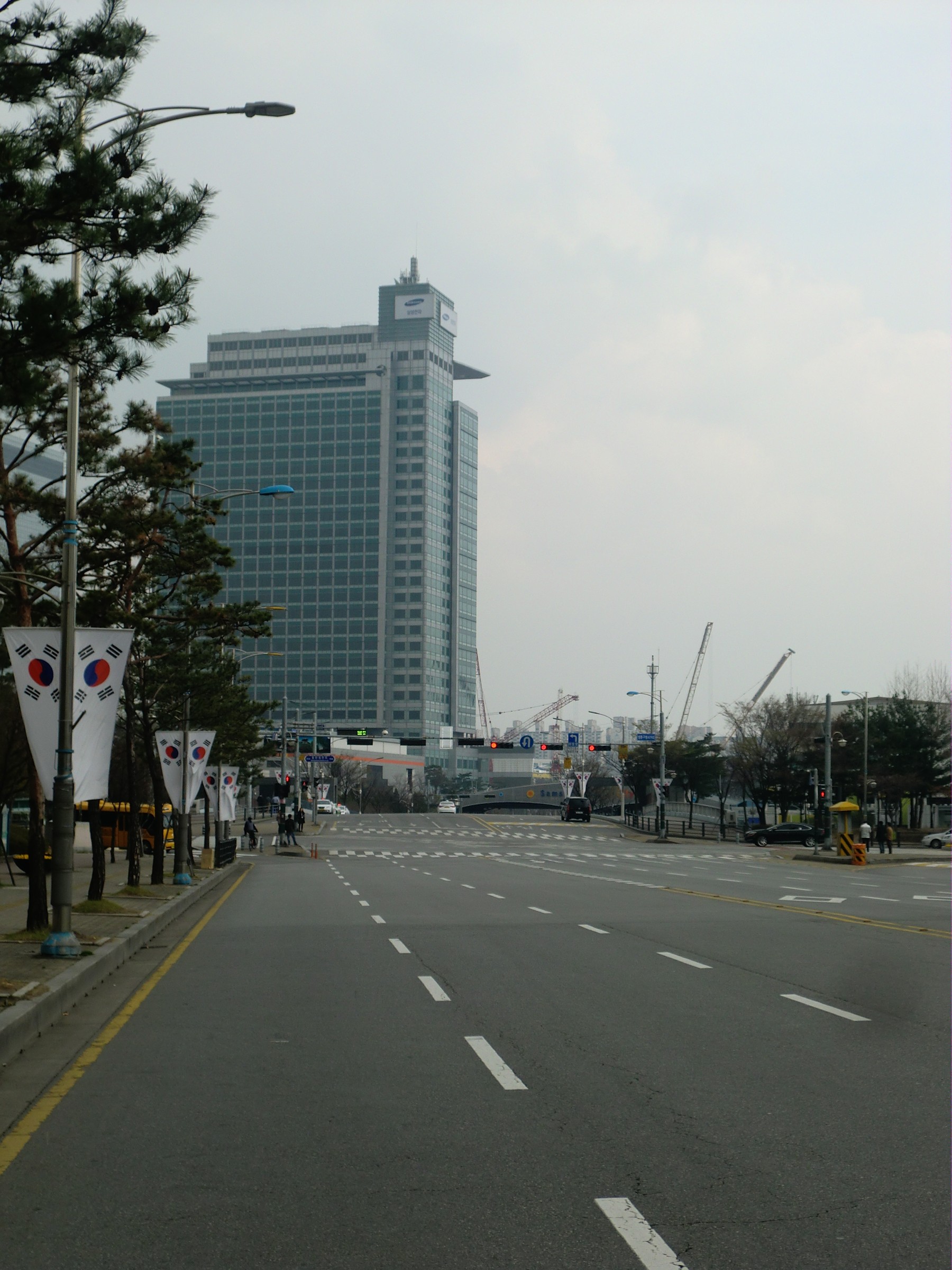
The Samsung Electronics campus at Suwon. Samsung's Pyeongtaek complex and SK hynix's Yongin cluster are the two sites on which the world's AI memory supply depends, and both companies are building four more fabs in the southwest. Photograph: hyolee2, CC BY-SA 4.0, via Wikimedia Commons.
Korea's compute position has two halves that should never be conflated, and this report keeps them apart.
The supply half is a genuine global chokepoint. Samsung's Pyeongtaek campus is the largest memory complex in the world, and its fourth plant entered full operation within 2026 on about 50 trillion won of construction, six months ahead of the original schedule, with the fifth plant and its second fab advancing and a reported floor-area increase to boost high-bandwidth memory output. SK hynix approved approximately 21.6 trillion won of additional investment in February 2026 for the first fab at its Yongin cluster, taking total first-fab investment to about 31 trillion won, and brought the first cleanroom opening forward from May 2027 to February 2027; the cluster site covers 4.16 million square metres, plans four advanced fabs, and the company's stated long-term cluster figure reaches up to 600 trillion won, a reported company figure this report labels. In August 2026 the company approved a reported 38 billion dollar investment in two further memory fabs. The technology race inside the chokepoint is real too: HBM4 doubles the memory interface to 2,048 bits and exceeds two terabytes per second per stack, and the two Korean firms are shipping or qualifying it now, with Samsung claiming the industry-first commercial shipment on 12 February 2026.
The demand half is smaller and slower. The National AI Computing Center began construction on 3 August 2026 at the Solaseado Data Center Park in Haenam, South Jeolla Province, on a total project cost of 2.4 trillion won, targeting 15,000 AI chips by 2028, with a Samsung SDS-led consortium selected as the private participant in May 2026 and advance equipment orders placed from July 2026. The MSIT GPU procurement programme of 13,000 accelerators across Naver Cloud, NHN Cloud and Kakao, at approximately 1.46 trillion won, was announced in July 2025 and is recorded by the OECD's policy observatory, with the ministry's own release the outstanding documentary gap this report notes. Naver, NVIDIA and Brookfield announced a proposed expansion of the national AI factory infrastructure to 200 megawatts on 24 July 2026. The government's capacity targets are 8.4 gigawatts of AI data centre capacity by 2029 and a further 10 gigawatts by 2035, and the same reporting that carries the targets carries the constraint plainly: power, grid timing and cooling standards are the obstacles, and the concentration of the new capacity in regional clusters, Ulsan, Donghae, Sejong, Haenam, is the state's attempt to move the load away from the Seoul metropolitan grid.
The domestic accelerator layer is small but real and worth naming, because it is the part of the stack Korea itself says it needs. Rebellions raised a 400 million dollar pre-IPO round in March 2026 led by Mirae Asset Financial Group and the Korea National Growth Fund, taking total funding to about 850 million dollars at a valuation of about 2.34 billion, and launched its rack and pod products. FuriosaAI signed an agreement to supply more than 8,800 of its RNGD inference accelerators to a 15-megawatt data centre in Stockholm, with the first phase scheduled for early 2027, took a 20 billion won direct equity investment from Korea Eximbank in June 2026, and with Samsung SDS launched what the companies describe as Korea's first domestic NPU-as-a-service offering in July 2026. In August 2026 KT shipped an enterprise appliance pairing a Rebellions inference chip with KT's own language model in a single on-premises server aimed at regulated sectors. The honest scale statement: Counterpoint Research found that 92 per cent of sovereign AI language models worldwide were trained on NVIDIA chips, and Korea's own strategy runs on NVIDIA accelerators today, with its domestic alternatives supplying inference, at enterprise scale, one server at a time.
Capital: 800 trillion won of corporate commitment against a 10 trillion won state budget
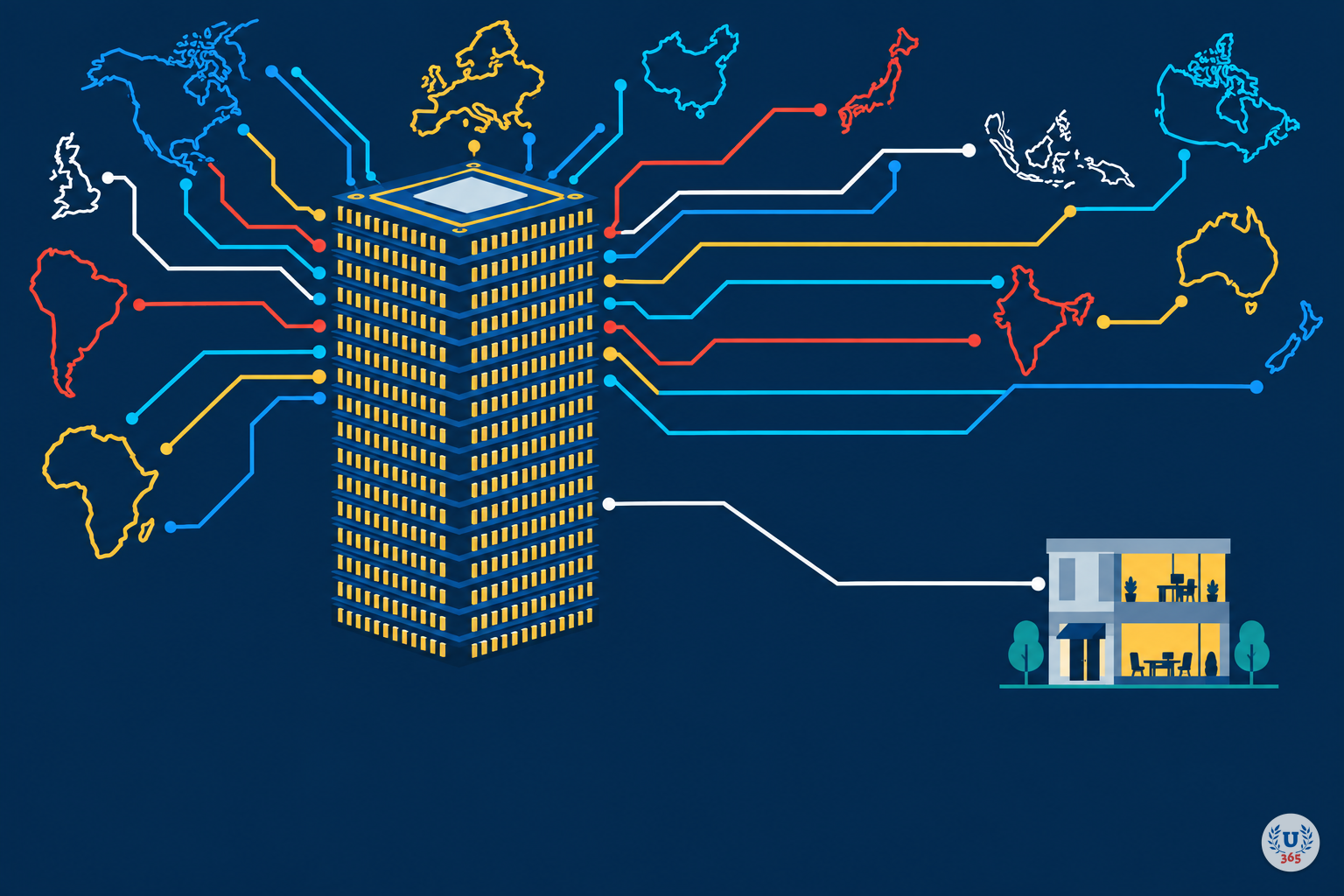
The stack that feeds everyone, and the small building that buys from it. University 365 Research Center.
Korea's capital position is the clearest case in the series of the state directing capital it does not own, and the report's first task is to keep the two numbers apart.
The state's own figures are these. MSIT's 2026 budget was finalised at 23.74 trillion won, up 13.1 per cent, of which the AI transformation line is 5.1 trillion won. The government's whole-of-government AI spending for 2026 is 10.1 trillion won, about 7.27 billion dollars, more than triple the 3.3 trillion won of 2025, inside a record 738 trillion won total budget carrying a deficit of about four per cent of GDP and a debt-to-GDP ratio rising from 49.1 to 51.6 per cent. The 2027 budget bill submitted on 3 September 2026 lifts AI and three linked mega-project spending by 97.2 per cent to 21.3 trillion won, about 2.6 per cent of total expenditure, and is a bill, not an enactment. One presentation detail should travel with these numbers: the ministry's own work plan renders the 2026 AI figure as 9.9 trillion won while other government statements and press reports use 10.1 trillion, and an MSIT page uses 5.1 trillion for its internal AI transformation line; the report states the conflict rather than resolving it, since the aggregates measure different scopes.
The corporate figures are an order of magnitude larger and belong to the companies. On 29 June 2026, at a national briefing chaired by President Lee Jae Myung and attended by the chairs of Samsung and SK, the two companies committed 800 trillion won, about 518 billion dollars at the reported conversion, to build four advanced memory fabs in the southwest, with Gwangju selected, alongside 81 trillion won for an advanced packaging hub in Chungcheong and 30 trillion won over fifteen years for the semiconductor value chain. Fab construction schedules were brought forward by up to twelve years. Different outlets convert the aggregate differently, from 518 to 520 billion dollars for the fab programme, and headline aggregates for the wider set of announcements range from 1,350 to 1,400 trillion won depending on what is counted; this report quotes the won figures with their scopes and treats the dollar conversions as the citing outlet's own.
Between the two sits the state's investment architecture, and it is more active than the budget lines suggest. The National Growth Fund invested 560 billion won in Upstage on 3 May 2026, split between 100 billion from the Advanced Strategic Industry Fund, 30 billion from the Korea Development Bank and 430 billion from private investors, alongside approval of a special purpose company with 400 billion won of capital for the national computing centre. The fund's announced size has moved across successive announcements, from 100 trillion won over five years in the August 2025 budget presentation, to 150 trillion in September 2026 reporting, to 200 trillion in an August 2026 interview with the Financial Services Commission official who runs it; the report records the sequence with dates rather than choosing one. K-Moonshot, launched with a signing ceremony on 11 March 2026, organises twelve national missions across eight fields to 2035 with 161 companies expressing intent to participate. And the state steers demand directly: the AI for All project, whose consortia were selected on 28 August 2026, requires domestic sovereign models for at least half of the citizen-facing service and models from other Korean developers for at least another 30 per cent, with government support withheld for foreign-model portions. That is a domestic-content requirement enforced through procurement, and it is unusual outside China.
Models: the strongest open-weight line outside the two superpowers, chosen by contest
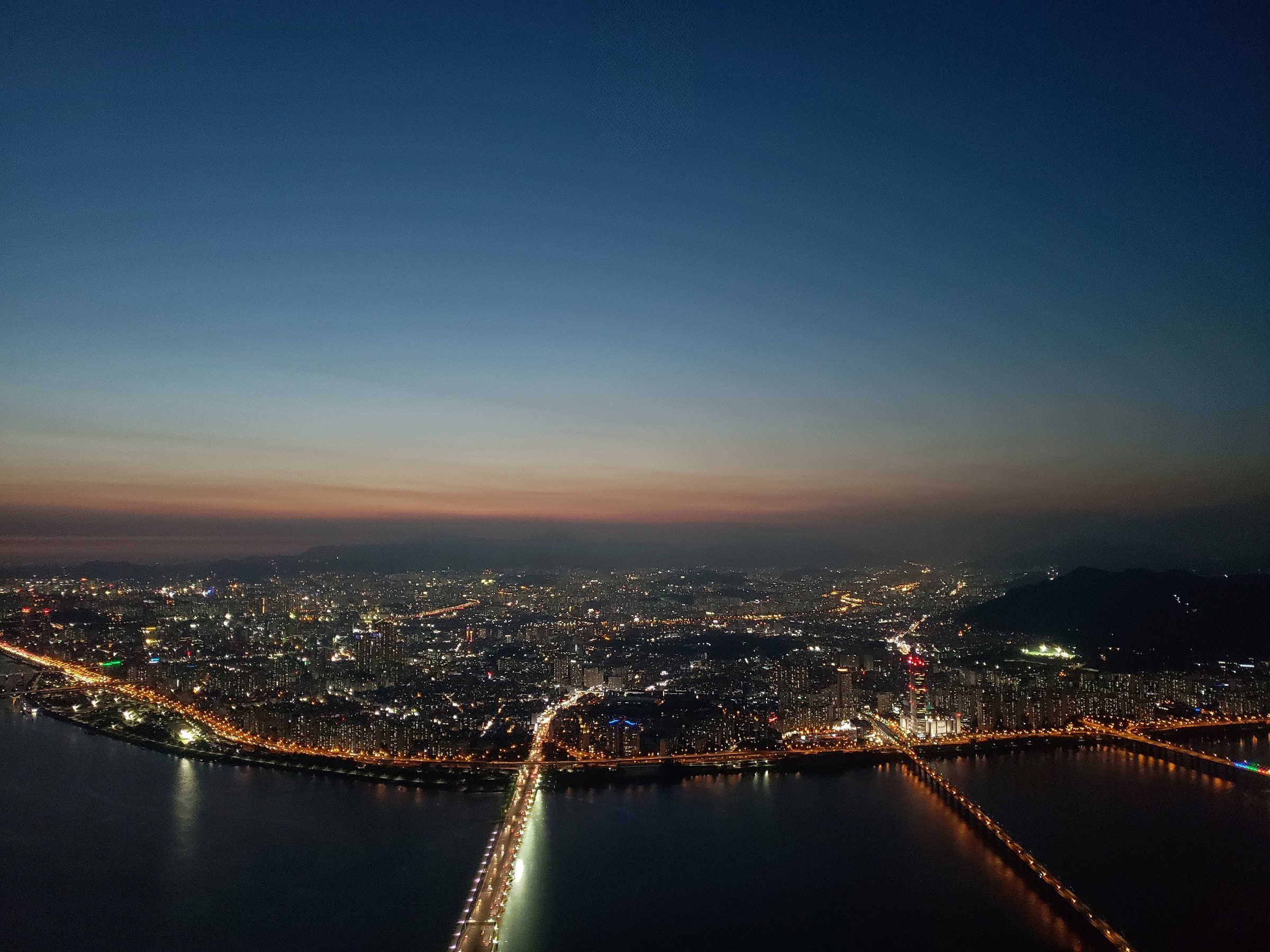
Seoul and the Han River at night. The capital region carries the model labs, the cloud businesses and the AI policy apparatus, while the state directs the new compute and fab capacity toward the regions. Photograph: CC BY-SA 4.0, via Wikimedia Commons.
Korea's model layer is the strongest in the series outside China and the United States, and it is also the layer where the state's grip is most visible.
The mechanism is a competition. The Sovereign AI Foundation Model Project, run by MSIT, evaluates the country's AI companies in successive rounds and selects the teams that will build the national foundation models. Four candidates entered the second round; Motif Technologies was eliminated on 18 August 2026, with the announcement made by Vice Minister Ryu Je-myung; LG AI Research, SK Telecom and Upstage advanced, and the final teams are to be chosen in a third round in early 2027. The first round, in January 2026, had already eliminated Naver Cloud and NC AI on the way to the current field. The contest is a deliberate instrument: it concentrates state compute and funding on a shrinking set of winners, and it means that as of this report's date, Korea's "national champion" is not yet one company.
What the contenders have shipped is substantial, and the report presents the numbers as the vendors' own benchmarks where they are. LG AI Research released K-EXAONE 2.0 on 31 July 2026: 750 billion parameters, more than triple the first-phase model, released under the Apache licence for unrestricted commercial use, an average of 70.1 across 24 benchmarks per the company, long-context scores above the comparison models it lists, safety scores of 94.6 on its internal evaluations, and support for ten languages. SK Telecom released A.X K2 on 29 July 2026 at 688 billion parameters with open weights on Hugging Face, an average gain of 32.2 percentage points over its previous model across fourteen benchmarks per the company, with defence models built with the Ministry of National Defense and manufacturing deployments including a steel cold-rolling line. Upstage launched Solar Pro 4 on 11 August 2026, a closed commercial flagship that scored 42 on the Artificial Analysis Intelligence Index, which is an independent measurement and therefore the one Korean model with a composite index position the report can cite without a vendor label, a 27-point rise over its predecessor; the company also released Solar Open 2 in July 2026, a 250-billion-parameter open-weight model with a commercially usable licence and a one-million-token context. Naver Cloud's HyperCLOVA X line runs as a closed flagship with open SEED variants, and KT's Mi:dm 2.0 is a bilingual Korea-centric line published with open weights and an accompanying technical paper.
Two findings complicate the picture and belong in the report rather than in a footnote. First, the flagship stack is partly re-based on foreign weights: Naver is advancing HyperCLOVA X by fine-tuning NVIDIA's Nemotron 3 Ultra open model, per the vendor's own announcement, which makes the open-weight American base model a component of Korea's sovereign line. Second, the national project has had a sourcing controversy: the public broadcaster KBS reported claims that a core feature of Naver Cloud's vision model for the government project was borrowed from Alibaba's model, and Naver defended the move. The report records the controversy as reported and does not adjudicate it. Neither finding diminishes the engineering; both belong to an honest account of what "domestic model" means at this stage of the field.
Regulation: a comprehensive law in force, and enforcement held back by design

The Han River skyline, Seoul. Korea's AI Framework Act was the first comprehensive AI statute in Asia-Pacific, in force since January 2026, with enforcement deferred by at least a year. Photograph: CC0, via Wikimedia Commons.
Korea's regulatory position is the earliest comprehensive AI statute in the series, and its enforcement posture is the most deliberately light.
The instrument is the Framework Act on the Development of Artificial Intelligence and the Creation of a Foundation for Trust, Act No. 20676, passed by the National Assembly on 26 December 2024, promulgated on 21 January 2025, amended by Act No. 21311 on 20 January 2026, and in force with its Enforcement Decree since 22 January 2026. That makes Korea the second jurisdiction after the European Union, and the first in Asia-Pacific, with a comprehensive AI law. The law defines high-impact artificial intelligence by listed domains including health care, energy, criminal justice and education; it requires advance notice to users where high-impact or generative AI is employed; it requires disclosure of AI-generated outputs where they could be mistaken for real; and it contemplates additional risk identification, assessment and mitigation obligations for advanced systems meeting criteria that include training compute above 10 to the power of 26 floating-point operations.
The enforcement posture is the essential nuance and the report states both halves. MSIT has indicated a grace period of at least one year before administrative fines, which puts January 2027 at the earliest for the end of the deferral. The law's principal administrative fine is capped at 30 million won, a figure that is small by international standards, while the penalties that actually bite Korean AI companies sit in the privacy statute, where the ceiling now reaches 3 per cent of related revenue in standard cases and 10 per cent of total global annual revenue in aggravated cases. No enforcement action under the AI Framework Act was found in this research window, and the report records that as its state: the law is live, the fines are deferred, and the operative pressure is the privacy regime.
That privacy regime changed twice in 2026 and the two changes are routinely confused, so this report sets them out plainly. The first, Act No. 21445, passed on 12 February 2026, promulgated on 10 March 2026, effective 11 September 2026, triples the punitive fine ceiling, makes the chief executive the ultimate responsible person for data protection, requires notification when a breach is reasonably likely rather than confirmed, and mandates information security certification for large data controllers from July 2027. It contains no artificial intelligence training provision. The second is the AI route: passed by the National Assembly on 20 August 2026 and announced by the Personal Information Protection Commission on 27 August 2026, it would allow controllers to use lawfully collected personal data, original and not pseudonymised, for AI development beyond its original purpose and without consent, on case-by-case approval by the Commission, subject to four conditions: that anonymisation or pseudonymisation is shown to be insufficient, that safeguards are in place, that the purpose involves public interest or the protection of data subjects or third parties, and that the risk of unfair infringement is markedly low. It takes effect six months after promulgation, which had not occurred as of this report's cut-off, so the AI training route is pending, not available.
The institutional layer is present and connected internationally. The Korea AI Safety Institute, founded in 2024, evaluates model risks and represents the country in international safety research, and on 17 June 2026 Korea became the fourth country to sign a formal AI safety partnership with OpenAI, after the United States, Britain and Japan, covering evaluation of advanced systems in high-risk areas including cybersecurity. The Commission has also been active on guidance, revising its privacy policy standards for generative AI in April 2026 and issuing guidelines for public sector AI transformation in July 2026. The comparative position this produces is a third path: comprehensive legislation, in force earlier than most, with fines deferred and detailed obligations settled through guidance rather than litigation.
Talent: the world's best patent record and a net outflow of researchers
Korea's talent layer is where the full-stack label is most seriously qualified, and the independent data says so.
Start with what is strong, because it is real. The Stanford AI Index 2026 records South Korea first in the world in AI patent density at 14.31 patents per hundred thousand people, ahead of Luxembourg, China and the United States; third in notable AI models released, with five, behind only the United States and China; and holding the largest year-over-year gain in AI adoption among the countries it tracks, at 4.8 percentage points. The ministry's own public response to the index frames the results as evidence that the country is on track to a top-three global position, which is the ministry's interpretation rather than the index's, and this report labels it as such.
Now the qualification. The same index records a net AI talent flow of minus 0.36 per ten thousand, ranking Korea 35th of 38 OECD nations: more AI researchers leave the country than arrive. The Information Technology and Innovation Foundation's June 2026 analysis explains the mechanism, and it is structural rather than accidental. Korea does not lack science and engineering graduates; it lacks deployable engineers and computing specialists, because the incentive structure rewards medicine over engineering: protected medical licensing, stable earnings and regulated tuition create predictable returns in medicine, while engineering offers slower early wage growth and more uncertainty. By 2029 the country is projected to face a shortage of roughly 580,000 workers in advanced technology fields including AI, cloud computing and semiconductor occupations. A separate projection reported in July 2026 puts the semiconductor industry's own requirement at 304,000 workers by 2031, with a shortfall of about 54,000 even if current cultivation continues. And the employer side shows the same shape: the OECD's own review records adoption estimates ranging from 6.4 to 30.3 per cent across national studies, with small and medium enterprises at 31 per cent, higher than Japan's 27 per cent but below several comparable economies, and names talent retention as a challenge.
The state's response has three parts, and the report gives each its due. The education build-out centres on KAIST, whose graduate school of AI was the first in Korea to offer AI degrees, and which launched an AI college vision on 1 June 2026; NVIDIA and KAIST opened a joint AI research lab on 23 July 2026 focused on agentic AI model development, providing infrastructure, funding, internships and joint appointments. The national research layer is the National AI Research Lab, which signed a letter of cooperation with the Korea AI Safety Institute in April 2026 and presented the country's AI sector at a German forum in May. And the funding line is a reported 1.4 trillion won talent programme across educational stages, a figure that appears in three separate sources attached to what may be two different programmes, so this report presents it as a reported figure rather than a settled one. The adoption side of the same ledger is better: a Microsoft global diffusion report published on 28 September 2026 put Korea twelfth globally with more than 40 per cent of the population aged 15 to 64 using generative AI in the second quarter, up 3.5 points quarter on quarter. That is Microsoft's measure, and this report labels it as such.
What changed since our last report on South Korea: there is no earlier report
University 365 has not published a South Korea AI landscape report before this one. The series' prior-report mapping covers fourteen of its twenty countries, and South Korea is not among them: the countries with earlier University 365 landscape reports are the UAE, Saudi Arabia, China, the United States, France, India, Morocco, Germany, the United Kingdom, Spain, Italy, Qatar and Bahrain. South Korea, Japan, Singapore, Brazil, Russia, Portugal and South Africa have none, and this report says so plainly rather than implying a baseline it does not have.
What can be compared instead is Korea against itself within this report's own research window, 2023 to 2026, and the movement is documented in the timeline below: the world's first national AI safety partnership network expanding to include Korea; a governance structure rising to deputy prime minister level; a comprehensive AI statute moving from passage to full operation; a memory technology generation turning over completely, from HBM3E to HBM4; and a capital commitment entering the hundreds of trillions of won. The series will build its Korean baseline from this report forward.

Sovereign AI Race: South Korea (2026)
Key Findings
1. South Korea owns exactly one layer of the global AI stack completely, and it is the memory layer. Samsung and SK hynix between them supply the high-bandwidth memory on which the world's AI accelerators depend; Nvidia confirmed both as qualified and in production for the coming Vera Rubin generation in June 2026. The series' "owner of the full stack" label is true at the supply layer and contested at the demand layer.
2. The demand side of Korea's own compute is one to two orders of magnitude below its supply side. The national computing centre targets 15,000 AI chips by 2028 at a cost of 2.4 trillion won; the MSIT procurement programme is 13,000 accelerators at about 1.46 trillion won; the corporate fab commitment alone is 800 trillion won.
3. Korea's AI law is the earliest comprehensive statute in the series and its enforcement is deferred by design. The Framework Act has been in force since 22 January 2026 with no penalties yet, a grace period of at least a year, and a principal fine capped at 30 million won. The penalties that bite sit in the privacy statute, where the ceiling now reaches 10 per cent of global revenue in aggravated cases.
4. The two 2026 privacy amendments are systematically confused in coverage, and the distinction is material. The amendment effective 11 September 2026 raises fines and CEO accountability and contains no AI training provision; the AI route passed on 20 August 2026, which would allow non-pseudonymised data to be used for AI development with Commission approval, is not yet in force.
5. The government's model programme is an elimination contest, not a settled national champion. Motif Technologies was eliminated on 18 August 2026; LG AI Research, SK Telecom and Upstage remain; the final teams will be chosen in early 2027. The contest structure concentrates state resources and defers the outcome.
6. Korea's model output is the strongest in the series outside China and the United States, and one of its models has an independent index position. K-EXAONE 2.0 at 750 billion parameters under Apache; A.X K2 at 688 billion with open weights; Solar Pro 4 at 42 on the Artificial Analysis Intelligence Index, an independent measurement, a 27-point rise.
7. The flagship stack is partly built on foreign open weights. Naver is advancing HyperCLOVA X by fine-tuning NVIDIA's Nemotron 3 Ultra open model, per the vendor's own announcement, and a reported sourcing controversy in the government security project was publicly defended by Naver. Both belong to the honest account of a maturing model layer.
8. The talent layer is the condition attached to the full-stack label, and it is negative. First in the world in AI patent density, third in notable models, and 35th of 38 OECD countries in net AI talent inflow at minus 0.36 per ten thousand, with a projected shortage of roughly 580,000 advanced technology workers by 2029. The mechanism is incentive structure, not graduate supply.
9. Most of Korea's AI capital is corporate and announced, not state and appropriated. The state's own 2026 AI budget is 10.1 trillion won against 800 trillion won of corporate fab commitments for one programme alone. The two figures answer different questions and the report keeps them apart.
10. The state steers through procurement, and the requirement is unusually explicit. The AI for All project requires domestic sovereign models for at least half of the citizen service and other Korean models for at least 30 per cent, with support withheld for foreign-model portions. That is a domestic-content rule enforced by the purse, and it is rare outside China.
11. The same capital that is building Korea's domestic cluster is under simultaneous American pressure. Samsung and SK hynix were reported in January and July 2026 to be weighing United States tariff measures that condition market access on American investment, an arrangement the Korean press compares to the Taiwan model.
12. Korea's supply position is secure; its position as a customer, a staffing base and a rules-maker is where the open questions sit. The report's overall verdict is that Korea holds the world's most valuable single AI layer and is competing, successfully so far, to convert it into more, against constraints its own data documents.

Sovereign AI Race: South Korea (2026)
Deep Analysis
The chokepoint logic: why memory is the most defensible layer in the stack
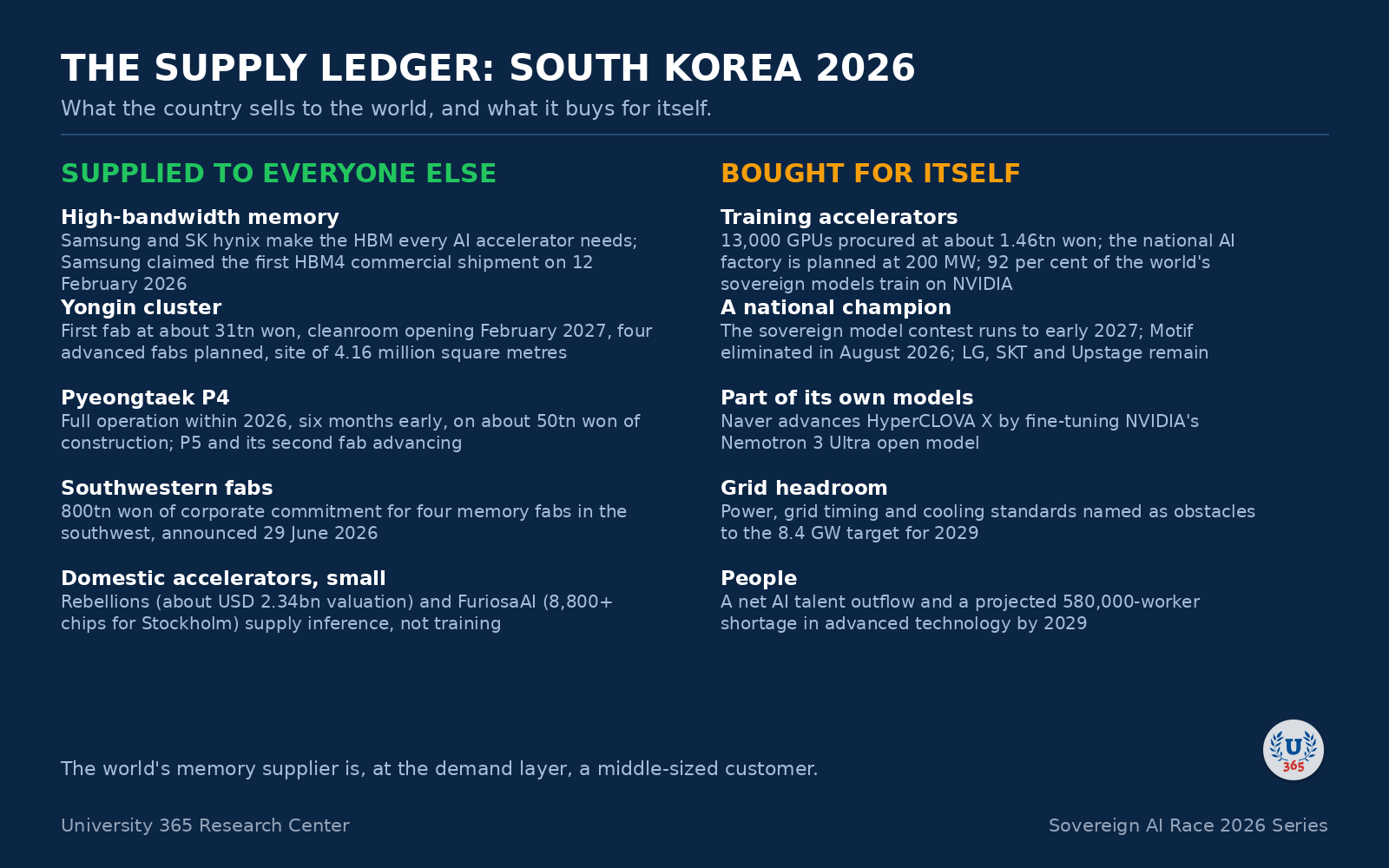
The supply ledger, layer by layer. University 365 Research Center.
Every layer of the AI stack has a substitute or a workaround except one, and Korea sits on it. Accelerators can be designed by more than one company, and are. Models can be trained from open bases, and increasingly are. Cloud capacity can be rented from several hyperscalers or built by states with capital and power. But high-bandwidth memory is a hard manufacturing problem that only three companies on earth have solved at scale, two of which are Korean, and the third, Micron, is American. The technical reason is stacking: HBM is not a chip, it is a tower of dies bonded together and wired through thousands of vertical connections, and the yield economics reward the two firms that have been doing it longest. This is why Samsung and SK hynix can commit 800 trillion won to new capacity and why their capital is treated as strategic by the Korean state and by the American government at the same time.
The strategic consequence runs two ways, and both belong in the report. For Korea, the chokepoint is negotiating power: any country that builds sovereign AI compute, including every Gulf programme in this series and Japan's and Europe's, depends on Korean components, and that position is not easily lost because the capital and process knowledge required are measured in decades. For Korea's customers, the chokepoint is a risk: the series has documented how the UAE, Saudi Arabia, Japan and others are assembling compute at gigawatt scale, and every one of those programmes has a Korean memory dependency inside it that their own strategy documents do not mention. The honest statement for the series is that Korea's supply position is the most defensible in the stack and the least substitutable, and the countries buying compute in this race are, in a partial sense, customers of Korea before they are customers of anyone else.
The limit of the position is its narrowness. A chokepoint in one component does not automatically convert into capability in the systems built on it, and the numbers in this report show the gap: the same country whose fabs are the world's bottleneck is procuring accelerators in the tens of thousands, building one national computing centre, and selecting its first national foundation models by contest. Korea's strategy reads, in this light, as an attempt to climb from a component monopoly into system capability while the monopoly is still valuable, and its success will be decided at the layers where it currently holds partial positions.
The state that directs capital it does not own
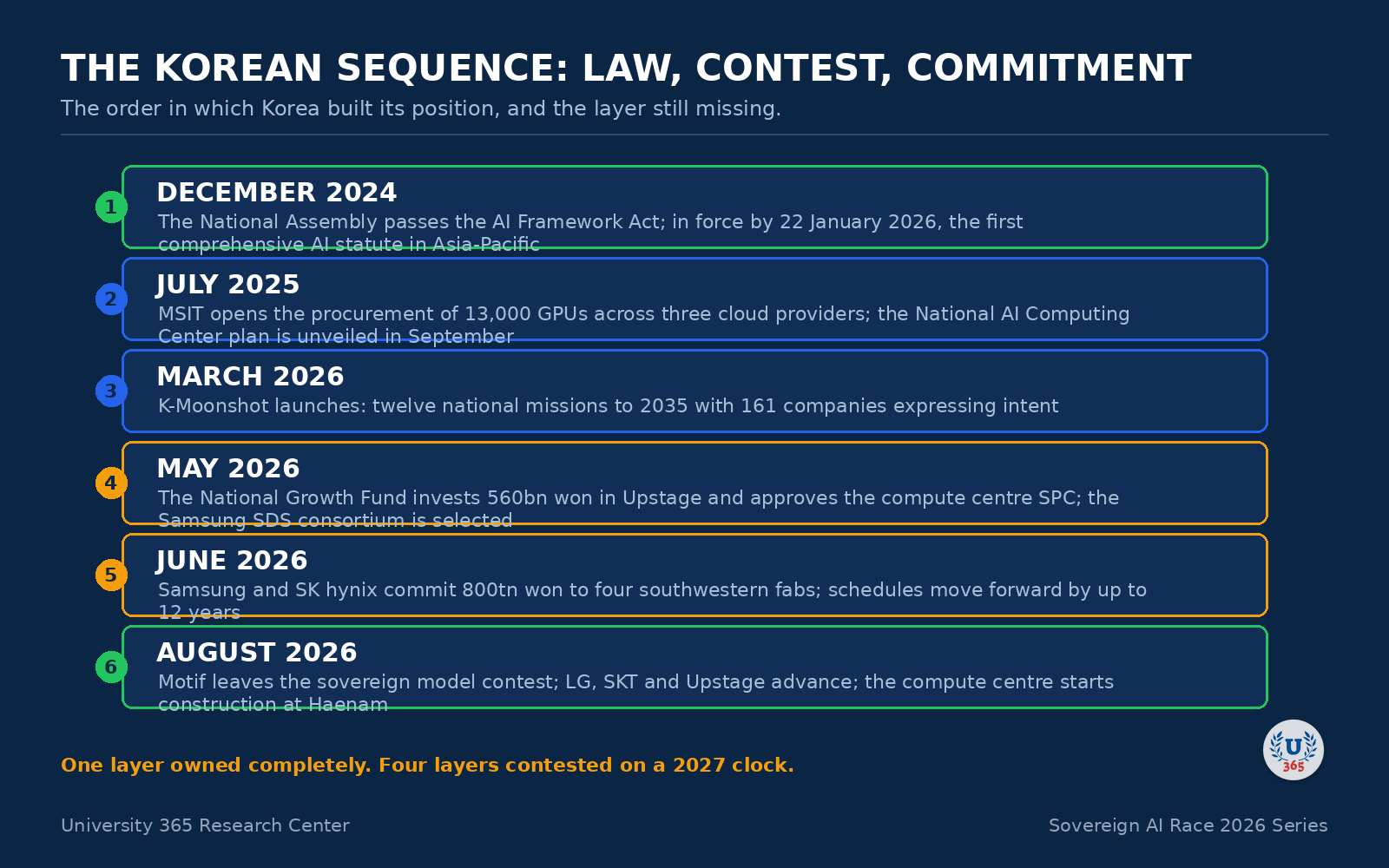
The Korean sequence: law, contest, commitment. University 365 Research Center.
Korea's capital model is different from every other country in this series, and the difference deserves naming. The Gulf states spend sovereign wealth. France and the United States mix state programmes with deep private markets. China mobilises state banks and state companies. Korea's state directs the balance sheets of a handful of family-controlled conglomerates, and its own fiscal contribution is real but an order of magnitude smaller than the commitments it convenes.
The mechanics are visible in the record. The president chairs a national briefing at which two companies commit 800 trillion won to fabs in a region that has never hosted them, and the government's contribution is the thing it does best: expedited approvals, land, power arrangements, regulatory sequencing and the promise of the associated infrastructure. The state invests directly where private capital will not go early enough, as with the National Growth Fund's 560 billion won into Upstage and the 400 billion won special purpose company for the compute centre. And where money is not the instrument, the state uses procurement: the domestic-model requirements in the AI for All programme convert citizens' AI service into a guaranteed demand floor for Korean models, which is a market-creation policy wearing a public-service costume.
This model has one large advantage and one large risk. The advantage is scale without fiscal strain: a state that can direct 800 trillion won of corporate investment can build industrial capacity that its own budget could never fund, and Korea's debt and deficit remain moderate by the standards of countries in this race. The risk is conditionality: corporate capital answers to corporate owners, and the same conglomerates building the southwestern fabs are the ones weighing American tariff pressure to build in the United States. A state that directs rather than owns its capital must keep the incentives aligned continuously, and the tariff episode is the first test of whether it can.
The three races, measured in Korea
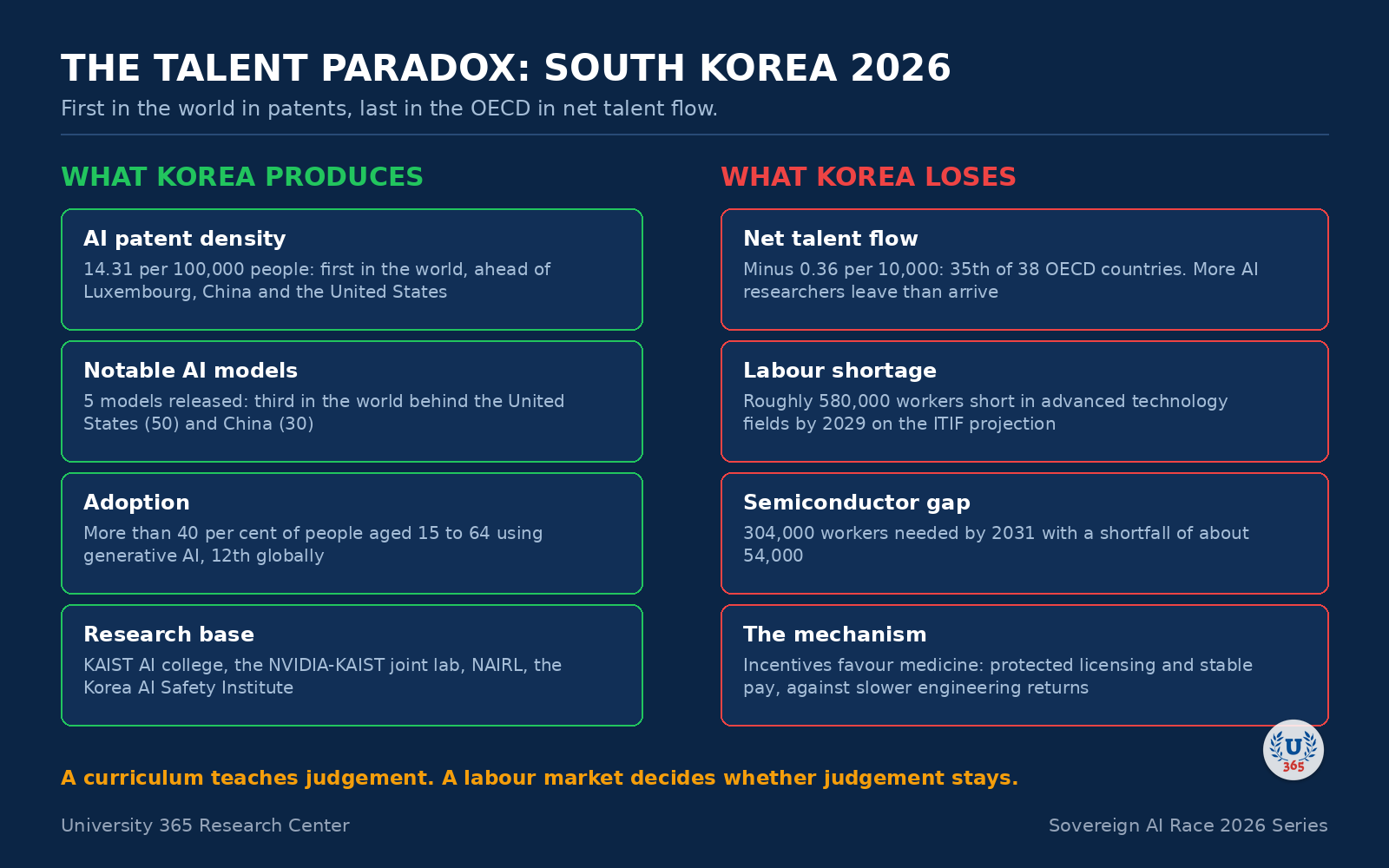
The talent paradox. University 365 Research Center.
The series separates the compute race, the model race and the rules race. Korea's position is the inverse of Japan's and clarifies the taxonomy.
In the compute race, Korea is a supplier rather than a competitor at the frontier. It does not design the leading accelerators and it does not host the largest AI data centres; it makes the memory those accelerators cannot work without, which is a different and in some ways stronger position than designing a chip that competes with Nvidia. A country can lose an accelerator design race and still hold the supply of something every accelerator needs, and Korea has.
In the model race, Korea is the strongest second-tier player in the field and it is closing on the leaders in specific domains. Its open-weight output at the 250 to 750 billion parameter scale is competitive with anything outside the American and Chinese frontier, one of its models has a real independent index position, and its deployment record in Korean-language enterprise work is deeper than most. The contest structure and the foreign-weights finding are the two caveats: the champion is not yet chosen and part of the stack is re-based on an American open model.
In the rules race, Korea wrote the first comprehensive AI statute outside Europe and then declined to enforce it hard. That combination, early legislation followed by deliberate restraint, is a considered position: the law creates the institutions and the vocabulary, the grace period protects the adoption curve, and the privacy statute carries the penalties that actually change corporate behaviour. Whether the restraint survives the first serious incident is the open question every light-touch regime eventually faces.
The three tempos produce the report's cleanest summary of Korea: the world's indispensable memory supplier, a genuine second-tier model power, an early and restrained rule-maker, and a country whose binding constraint is people.

Sovereign AI Race: South Korea (2026)
Data and Evidence
Table 1: The five layers, assessed for South Korea in September 2026
Layer | What South Korea holds | What it does not hold | Assessment |
Compute | The global HBM chokepoint: Samsung HBM4 mass production claimed from 12 February 2026, SK hynix 12-layer HBM4 in mass production as of August 2026, both confirmed by Nvidia for Vera Rubin; Pyeongtaek P4 in full operation within 2026 on about 50tn won; SK hynix Yongin first fab at about 31tn won, cleanroom February 2027; National AI Computing Center under construction at Haenam, 15,000 chips targeted by 2028, 2.4tn won | Frontier accelerator design at scale; an operational gigawatt-class AI campus; domestic capacity anywhere near its supply role (13,000 GPUs procured, 15,000 chips targeted) | A supply chokepoint with a demand side one to two orders smaller |
Models | K-EXAONE 2.0 at 750bn parameters under Apache, released 31 July 2026; A.X K2 at 688bn parameters with open weights, 29 July 2026; Solar Pro 4 at 42 on the independent Artificial Analysis Index; Solar Open 2 at 250bn parameters; HyperCLOVA X line; Mi:dm 2.0 | A settled national champion (the contest runs to early 2027); a flagship stack independent of foreign open weights (Naver fine-tunes NVIDIA Nemotron 3 Ultra); an independent composite index position for the closed Korean flagships | Strongest outside China and the US, chosen by contest, partly re-based |
Capital | Corporate: 800tn won for four southwestern fabs, 81tn for packaging, 30tn for the value chain, announced 29 June 2026. State: 10.1tn won AI budget for 2026, 21.3tn proposed for 2027, National Growth Fund at 560bn won into Upstage, 400bn for the compute centre SPC | Treasury capacity to fund the build-out alone; protection from the simultaneous pull of US tariff-conditioned investment; a settled National Growth Fund size (100tn, 150tn and 200tn all appear) | State directs corporate capital; the capital faces two directions |
Regulation | AI Framework Act in force 22 January 2026, first in Asia-Pacific, with high-impact definitions and transparency duties; a grace period of at least a year and a 30m won principal fine; PIPA amendment effective 11 September 2026 with a 10 per cent global revenue ceiling in aggravated cases; Korea AISI with an OpenAI safety partnership since 17 June 2026; the AI data route passed 20 August 2026 and not yet in force | Enforcement actions under the AI Act (none found); the AI training data route in force (pending promulgation); final clarity on how far the AI Act's obligations reach in practice | Early comprehensive law, restrained enforcement |
Talent and education | First in the world in AI patent density (14.31 per 100,000); third in notable AI models (5); KAIST AI college vision and the NVIDIA-KAIST joint lab; NAIRL; a reported 1.4tn won talent programme; adoption above 40 per cent of the 15-64 population (Microsoft measure) | Net talent inflow (minus 0.36 per 10,000, 35th of 38 OECD); 580,000 advanced technology workers projected short by 2029; deployable engineers at the rate the industry needs; deep enterprise integration at SME level | The condition attached to the full-stack label |
Table 2: The controlled metrics, series bible format
Metric | South Korea position | Source and date |
Flagship compute commitment | National AI Computing Center, Haenam: construction start 3 August 2026, 15,000 AI chips targeted by 2028, total project cost 2.4tn won, Samsung SDS-led consortium selected 11 May 2026; MSIT GPU procurement of 13,000 accelerators at about 1.46tn won announced July 2025; Naver, NVIDIA and Brookfield expansion to a planned 200 MW announced 24 July 2026; government target of 8.4 GW of data centre capacity by 2029 and 10 GW more by 2035 | MSIT releases, August 2026; Seoul Economic Daily, 4 August 2026; OECD AI Policy Observatory record; NVIDIA investor newsroom, 24 July 2026; ChosunBiz, 3 July 2026 |
Capital committed | Corporate: 800tn won for four southwestern memory fabs plus 81tn won for a packaging hub and 30tn won for the value chain, announced 29 June 2026; state: 10.1tn won AI budget for 2026 and a 21.3tn won AI line proposed for 2027; National Growth Fund: 560bn won into Upstage, 400bn won SPC for the compute centre | Yonhap, 29 June 2026; The Korea Herald, 29 August 2025; Aju Press, 9 September 2026; Chosun Ilbo, 4 May 2026 |
Flagship national models | K-EXAONE 2.0 (LG AI Research): 750bn parameters, Apache 2.0, released 31 July 2026, phase 2 of the government project; A.X K2 (SK Telecom): 688bn parameters, open weights, 29 July 2026; Solar Pro 4 (Upstage): 42 on the Artificial Analysis Intelligence Index, launched 11 August 2026; Solar Open 2: 250bn parameters open weights, 22 July 2026; vendor benchmarks are labelled | LG AI Research, 31 July 2026; SK Telecom, 29 July 2026; Artificial Analysis and PR Newswire, August 2026; Upstage, July 2026 |
Anchor entities | MSIT, raised to deputy prime minister level, chaired by Deputy Prime Minister Bae Kyung-hoon; Samsung Electronics and SK hynix; NAVER Cloud, LG AI Research, SK Telecom and Upstage as the remaining model-layer contenders; Korea AI Safety Institute; NAIRL | MSIT work plan and releases, 2025 to 2026 |
Chip dependency | The strategy runs on NVIDIA accelerators: Counterpoint found 92 per cent of sovereign AI LLMs globally were trained on NVIDIA chips. Domestic alternatives supply inference: Rebellions (about USD 850m total funding, about USD 2.34bn valuation as of 30 March 2026) and FuriosaAI (8,800+ RNGD accelerators for a Stockholm data centre; 20bn won Eximbank investment). No Korea-specific US export licensing choke point was found | Counterpoint Research, 5 August 2026; Rebellions, 30 March 2026; Korea Herald, 5 August 2026; Seoul Economic Daily, 30 June 2026 |
Regulatory instrument and status | Framework Act on the Development of Artificial Intelligence and the Creation of a Foundation for Trust, Act No. 20676, in force 22 January 2026 with its Enforcement Decree, amended by Act No. 21311; grace period of at least one year before fines; PIPA amendment Act No. 21445 effective 11 September 2026; the AI data route passed 20 August 2026, not yet in force | KLRI statute text; Library of Congress Global Legal Monitor, 20 February 2026; trade.gov, 28 May 2026; PIPC release, 27 August 2026; yeandel.co.uk, 11 September 2026 |
Talent anchors | KAIST (graduate school of AI; AI college vision of 1 June 2026), the NVIDIA-KAIST joint lab of 23 July 2026, NAIRL, the Korea AI Safety Institute; projections of a 580,000 advanced technology worker shortage by 2029 and a 304,000 semiconductor requirement by 2031; a reported 1.4tn won talent programme | ITIF, 8 June 2026; Stanford HAI AI Index 2026; KAIST and NVIDIA releases, 2026 |
Independent index standing | Oxford Insights Government AI Readiness Index 2025: 5th of 195 with 76.89 points, first in East Asia (rank confirmed from the publisher's own dataset; a Korean outlet's earlier report of 8th is superseded). Stanford HAI AI Index 2026: 1st in AI patent density, 3rd in notable models, 35th of 38 OECD in net talent inflow. Counterpoint H1 2026: Korea among the leading sovereign developers in Asia-Pacific excluding China | Oxford Insights 2025 dataset; Stanford HAI AI Index 2026; Counterpoint Research, 5 August 2026 |
Adoption | More than 40 per cent of the population aged 15 to 64 used generative AI in the second quarter of 2026, ranking 12th globally, up 3.5 percentage points quarter on quarter (Microsoft's global diffusion report, published 28 September 2026). The OECD records national study estimates of 6.4 to 30.3 per cent and SME adoption at 31 per cent | Yonhap, 28 September 2026; Korea JoongAng Daily, 28 September 2026; OECD |
Distinguishing mechanism | A country that supplies the physical memory layer of every other country's AI stack while buying its own compute, models and platforms from abroad | This report |
Core tension | The country that manufactures the memory for the world's AI cannot yet staff its own AI industry, and the same corporate capital building its domestic cluster is under simultaneous pressure to build in the United States | This report |
Table 3: Timeline, 2024 to 2026
Date | Event | Source |
21 November 2024 | Samsung unveils Gauss2, its second-generation generative model line | Asia Business Daily; The Hindu |
26 December 2024 | The National Assembly passes the AI Framework Act | AgentLiability guide; KLRI record |
21 January 2025 | The Act is promulgated as Act No. 20676 | KLRI; Library of Congress |
July 2025 | MSIT announces approximately 1.46tn won to procure 13,000 high-performance GPUs across three cloud providers | OECD AI Policy Observatory record |
29 August 2025 | The 2026 budget plan is approved: AI spending more than triples to 10.1tn won; the National Growth Fund is announced at 100tn won over five years | The Korea Herald; The Korea Times |
1 September 2025 | SBS becomes the first Korean broadcaster to set fees for AI training use of news data | The Korea Herald |
8 September 2025 | MSIT unveils the National AI Computing Center implementation plan and opens the call for proposals | MSIT |
21 October 2025 | Bidding closes with a single Samsung SDS-led consortium bid for the national computing centre | MSIT |
2 December 2025 | MSIT's 2026 budget is finalised at 23.74tn won; the AI transformation line is 5.1tn won | MSIT |
12 December 2025 | MSIT reports its 2026 work plan to the President, including an AI budget rising from 3.0tn to a stated 9.9tn won | MSIT |
20 January 2026 | The AI Framework Act is amended by Act No. 21311 | KLRI |
21 January 2026 | The Enforcement Decree of the AI Framework Act is signed | Digital Policy Alert |
22 January 2026 | The AI Framework Act and its Enforcement Decree take effect: the first comprehensive AI statute in Asia-Pacific | Library of Congress; trade.gov |
28 January 2026 | SK hynix is reported to hold about two thirds of Nvidia's next-generation HBM orders (industry sources) | Korea JoongAng Daily |
12 February 2026 | Samsung announces HBM4 mass production and commercial shipment, claiming an industry first | Samsung Newsroom |
12 February 2026 | The National Assembly passes PIPA amendment Act No. 21445 | yeandel.co.uk; headflash coverage |
25 February 2026 | SK hynix approves approximately 21.6tn won of additional Yongin investment; first cleanroom moves to February 2027 | SK hynix Newsroom; The Korea Herald |
10 March 2026 | PIPA amendment Act No. 21445 is promulgated | yeandel.co.uk; noah-news |
11 March 2026 | K-Moonshot signing ceremony: twelve national missions across eight fields, 161 companies expressing intent | MSIT; Dong-A Science; Seoul Economic Daily |
17 March 2026 | Oxford Insights Government AI Readiness Index 2025: Korea 5th of 195 with 76.89 points (publisher dataset) | Oxford Insights dataset; Asia Business Daily |
19 March 2026 | Upstage and AMD expand a strategic collaboration on Korean sovereign AI infrastructure | Upstage |
30 March 2026 | Rebellions closes a USD 400m pre-IPO at about a USD 2.34bn valuation; total funding about USD 850m | Rebellions; Reuters |
13 April 2026 | Stanford HAI AI Index 2026: Korea first in AI patent density, third in notable models, 35th of 38 OECD in net talent inflow | Stanford HAI via Pebblous analysis; MSIT |
22 April 2026 | Samsung brings Pyeongtaek P4 into full operation within 2026, six months early, on about 50tn won of construction | Seoul Economic Daily |
30 April 2026 | PIPC revises privacy policy guidelines with generative AI criteria | PIPC |
3 May 2026 | The National Growth Fund approves 560bn won for Upstage and a 400bn won SPC for the national computing centre | Chosun Ilbo; Seoul Economic Daily; Asia Business Daily |
11 May 2026 | MSIT selects the Samsung SDS-led consortium for the national computing centre | MSIT |
19 May 2026 | Korea launches a five-year state-led AI humanoid platform programme | Aju Press |
27 May 2026 | MSIT holds the K-Moonshot launch ceremony | Chosun Ilbo |
1 June 2026 | KAIST launches its AI college vision | The Korea Times |
5 June 2026 | Nvidia's chief executive, in Seoul, confirms all three memory makers qualified and in HBM4 production for Vera Rubin | TechTimes |
17 June 2026 | Korea becomes the fourth country to sign a formal AI safety partnership with OpenAI | Aju Press; Bernama |
23 June 2026 | Naver publishes HyperCLOVA X SEED 4B and its own vision encoder | CLOVA |
29 June 2026 | Samsung and SK hynix commit 800tn won to four southwestern fabs, with 81tn for packaging and 30tn for the value chain; schedules brought forward by up to 12 years | Yonhap; Chosun Ilbo; Dong-A Ilbo |
30 June 2026 | Korea Eximbank makes a 20bn won direct equity investment in FuriosaAI | Seoul Economic Daily |
3 July 2026 | The government's data centre target is reported: 8.4 GW by 2029 and 10 GW more by 2035, with power and cooling constraints named | ChosunBiz |
20 July 2026 | Samsung SDS and FuriosaAI launch a domestic NPU-as-a-service offering | FuriosaAI |
23 July 2026 | NVIDIA and KAIST launch a joint AI research lab for agentic AI | NVIDIA investor newsroom |
23 July 2026 | PIPC issues guidelines on privacy protection for public AI transformation | PIPC |
24 July 2026 | Naver, NVIDIA and Brookfield announce the planned expansion of the national AI factory to 200 MW | NVIDIA investor newsroom |
29 July 2026 | SK Telecom unveils A.X K2 at 688bn parameters with open weights | SK Telecom |
31 July 2026 | LG AI Research releases K-EXAONE 2.0: 750bn parameters under Apache 2.0 | LG AI Research |
3 August 2026 | Construction start for the National AI Computing Center at Haenam | MSIT; Seoul Economic Daily |
5 August 2026 | Counterpoint Research: 92 per cent of sovereign AI LLMs trained on NVIDIA chips; Korea among Asia-Pacific leaders excluding China | Counterpoint Research |
7 August 2026 | The National Growth Fund is reported to expand to 200tn won (a 100tn, 150tn, 200tn sequence across the year) | Chosun Ilbo |
11 August 2026 | Upstage launches Solar Pro 4, scoring 42 on the Artificial Analysis Intelligence Index | PR Newswire; Artificial Analysis |
18 August 2026 | Round 2 of the sovereign model project: Motif eliminated; LG AI Research, SK Telecom and Upstage advance | Seoul Economic Daily; AI Frontier KR |
19 August 2026 | KT launches the NPU LLM Station pairing a Rebellions chip with Mi:dm K 2.5 Pro in one on-premises server | The Korea Times; RCR Wireless |
20 August 2026 | The National Assembly passes the AI data amendment; the PIPC announces it on 27 August | PIPC |
28 August 2026 | SK Telecom, Kakao and KT are selected for the AI for All project from six consortia | SBS News |
1 September 2026 | The 2027 budget: 820.9tn won total; AI and three mega-projects raised 97.2 per cent to 21.3tn won | The Korea Times |
10 September 2026 | PIPA amendment Act No. 21445 takes effect on 11 September: a 10 per cent global revenue ceiling in aggravated cases and CEO accountability, with no AI training provision | yeandel.co.uk; headflash; TechTimes |
22 September 2026 | MSIT meets the Naver Cloud consortium: 4,512 GPUs committed for two security-specialised models | Seoul Economic Daily; Aju Press |
28 September 2026 | Microsoft's global diffusion report: Korea 12th, more than 40 per cent of the 15-64 population using generative AI in Q2 2026 | Yonhap; Korea JoongAng Daily |

Sovereign AI Race: South Korea (2026)
Implications
For the countries still to come in this series
Korea is the case study for any country that holds one strategic layer and wants more, and the lessons split into what to copy and what to watch. The copyable part is the procurement-as-industrial-policy mechanism: Korea converts its own citizens' AI service into a guaranteed demand floor for domestic models by rule, which is cheaper than subsidy and more durable than a grant programme. The second copyable part is the sequencing of contest over appointment: instead of designating a national champion, the state runs successive evaluation rounds, funds the survivors and lets the market watch the ranking. The part to watch is the talent math. Korea's patent density is the world's best and its researchers still leave, which tells every mid-sized economy that a strong university pipeline is necessary and not sufficient, and that the returns on engineering careers, relative to medicine and finance, decide where the graduates go.
For the technology providers
Korea is simultaneously a supplier to be managed and a market to be sold into, and providers should price both differently. Any provider building AI compute anywhere in the world has a Korean memory dependency inside its supply chain, and should model it: HBM allocation is a strategic input, and the two Korean suppliers decide whom they serve and when. As a market, Korea is a top-tier customer for accelerators with unusual local content rules appearing in public procurement, and a serious enterprise market for on-premises inference appliances where regulated industries cannot use cloud services. Providers entering Korea should expect the domestic-content preference to be explicit in government work and should plan their partnership structures accordingly, as NVIDIA has done with KAIST and Naver.
For institutional and enterprise buyers
Korea offers buyers outside the country the most credible non-American, non-Chinese model option in the field, and the choice is specific. For open-weight deployment at scale, K-EXAONE 2.0 under the Apache licence and Solar Open 2 under a commercial licence are deployable today with no vendor relationship required. For regulated sectors that cannot send data to a cloud, the Korean market has produced the reference appliance: a domestic inference chip and a domestic model inside one on-premises server, which is the most concrete embodiment in the series of the on-premises sovereignty pattern. And for Korean-language work specifically, the domestic models are genuinely ahead, with benchmark depth in Korean that the global frontier models treat as a secondary language. What buyers should not assume is that the Korean stack is independent end to end: part of it is re-based on American open weights, and its accelerators are American.
For University 365
Korea is the ninth country in this series and the first whose central problem is the one this institution addresses directly. Korea has the world's best AI patent record, world-class research institutions, and a workforce pipeline that does not deliver what its industry needs at the rate it needs it: too few deployable engineers, too many researchers leaving, and an incentive structure that pays doctors more than engineers for comparable talent. That is not a curriculum problem. Korea already teaches AI well. It is the same problem this series found in Morocco, India and Japan in different forms: the gap between what an education system produces and what a labour market can absorb, pay for and keep. Korea's answer, a reported 1.4 trillion won talent programme spanning school to postdoctorate and visa-adjacent recruiting, is the most structured response in the series, and its success will be visible in one number a decade from now: whether the net AI talent flow turns positive. For our own work, Korea is the sharpest available reminder that educating for AI and paying for AI careers are two different policies, and that countries need both.

Sovereign AI Race: South Korea (2026)
Education and Skills Impact
What the Korean case teaches about a country that educates for AI but cannot keep its builders
This series returns in every report to the gap between using AI and building it, because that gap is where the educational argument lives. Korea adds the first case where the gap is not about schooling at all.
The Korean education system already performs at the top of the international range in the fields that matter. The country sits first in the world in AI patent density at 14.31 per hundred thousand people, third in notable AI models released behind only the United States and China, and its research infrastructure includes the Kim Jaechul Graduate School of AI at KAIST, the first in the country to award AI degrees, a new AI college vision announced on 1 June 2026, a joint research lab with NVIDIA opened on 23 July 2026, the National AI Research Lab, and the new Korea AI Safety Institute. Korean students outperform most of the world in mathematics and science by every standard measure, and the country's engineering universities are genuinely world-class. If the education question were only about schooling, Korea would be the case that proves the model works.
The labour data says the schooling is not the constraint. The Information Technology and Innovation Foundation's June 2026 analysis puts it precisely: Korea does not lack science and engineering graduates, it lacks deployable engineers and computing specialists, and the reason is the return structure, not the pipeline. Medicine offers protected licensing, stable earnings and regulated tuition, so the rational student chooses medicine, while engineering offers slower early wage growth and more uncertainty. By 2029 the projection is a shortage of roughly 580,000 workers in advanced technology fields. The semiconductor industry's own projection of a 304,000-worker requirement by 2031 with a shortfall of about 54,000 points the same direction. And Stanford's index records the outcome at the international level: a net AI talent flow of minus 0.36 per ten thousand, thirty-fifth of thirty-eight OECD countries, with more researchers leaving than arriving. A country that produces excellent engineers and loses its best researchers has an economics problem, not a curriculum problem.
The state's response is the most comprehensive in the series and it is aimed at exactly the right place: the full span of the pipeline and the returns along it. The reported 1.4 trillion won talent programme covers students from elementary school through postdoctoral researchers, with AI-focused high schools planned for 2028, and the government has separately budgeted to secure 33,000 skilled professionals domestically and internationally and runs a reported 30.8 billion won programme matching doctoral-level talent with companies to slow the drain. KAIST's AI college and the NVIDIA lab add industry-coupled training at the top of the pipeline. The adoption side of the same ledger is working better than the pipeline: a Microsoft report published on 28 September 2026 put more than 40 per cent of Koreans aged 15 to 64 using generative AI in the second quarter, twelfth in the world and rising 3.5 points in a quarter. The country's population is using the technology faster than its industry is staffing it.
The finding for this series sharpens here, and Korea is the case that states it most clearly. A curriculum teaches judgement; a labour market decides whether the judgement stays. Korea has built one of the world's best AI education systems and is measuring the result in a negative talent flow, which means the next decade of Korean policy is less about teaching AI and more about paying for it, structuring engineering careers so that the returns match the talent, and importing or retaining the researchers the country trains. That is a harder problem than curriculum design, and it is the problem most of the countries in this series will face within a generation.

Sovereign AI Race: South Korea (2026)
The CI-First Perspective
Where the Korean capability is real, and where the label outruns it
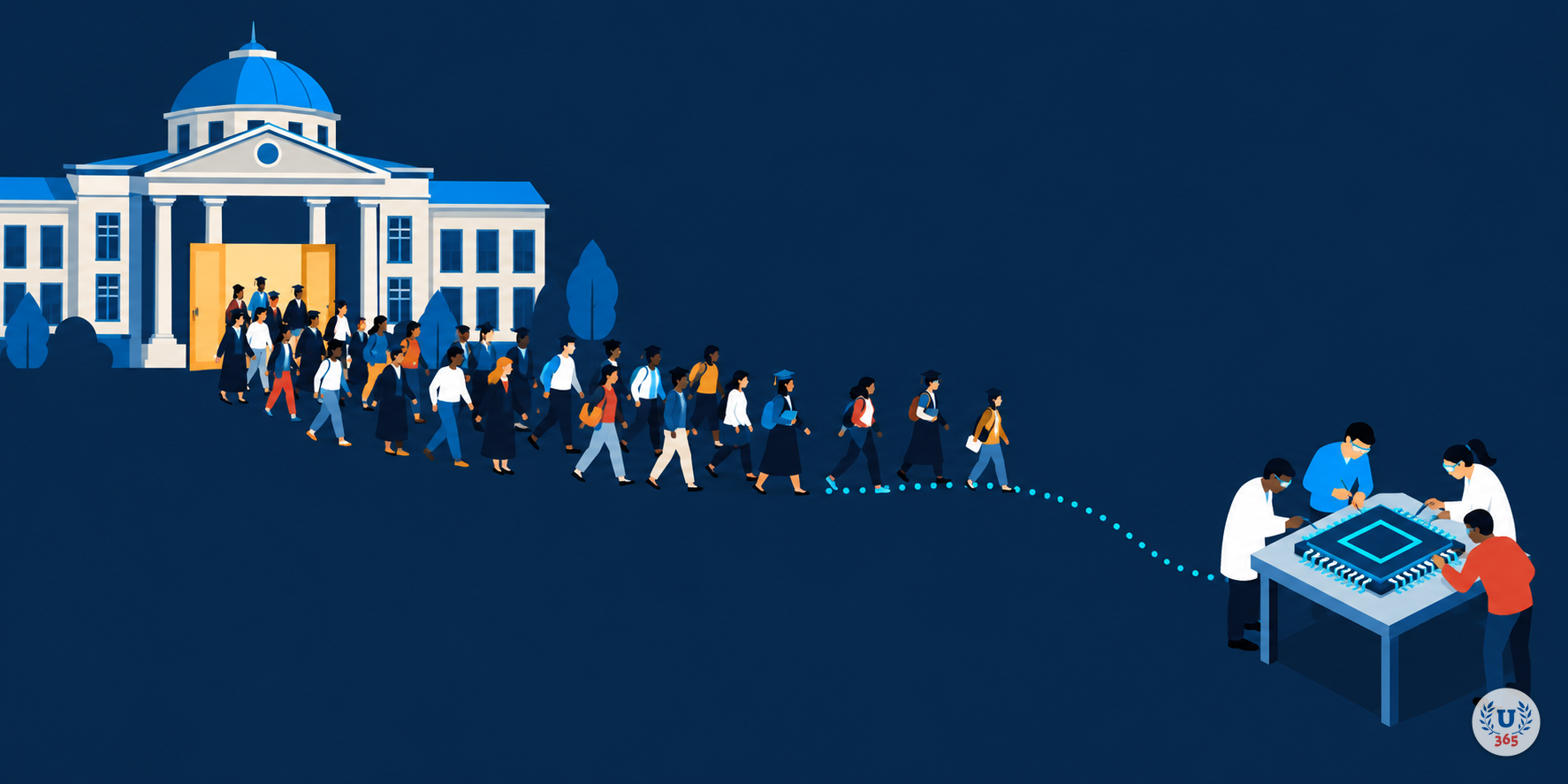
The crowd leaving, and the few who stay at the bench. University 365 Research Center.
The Co-Intelligence First framework asks whether an arrangement amplifies human capability or substitutes for it, and where the risk of AI Imposture sits. Applied to Korea, the verdict is that the capability is real, the label attached to it is generous, and the risk of imposture sits in the gap between the two.
The capability is real at three layers. At the supply layer, no country in the world has a stronger physical position: the memory fabs of Pyeongtaek and Yongin produce the component the entire AI industry needs, the technology leadership is contested and real, and the capital commitments behind it are the largest in the series measured in won. At the model layer, Korea has done something genuinely difficult: multiple domestic labs producing competitive open-weight models in the 250 to 750 billion parameter range, one of them with a real independent index score, with deployment depth in Korean-language enterprise work that foreign models do not match. At the regulatory layer, the first comprehensive AI statute outside Europe was written early, contains the right concepts, created the institutions, and has an international safety partnership with a major frontier laboratory. These are the achievements of a serious technological state.
Where the label outruns the capability is in the phrase "owner of the full stack". Korea owns one layer of the stack, completely. It holds partial positions in the layer above it: domestic accelerator companies supply inference at enterprise scale while the government procures its training compute from NVIDIA; the national model champion is undecided and the flagship stack partly fine-tunes an American open model; the hyperscale cloud layer is dominated by foreign providers with Korean partners; and the workforce that would staff the whole is shrinking relative to need. A country can be a critical supplier to the world's AI and still be a customer of it, and Korea is both. That is not a failure. It is a stage, and the honest description of the stage is what this series exists to produce.
The deeper CI-First question for Korea is whether its AI strategy amplifies its people or substitutes for them. The demand-side data gives a partial answer: more than forty per cent individual adoption, but enterprise integration lagging comparable economies, and the government's own framing of AI as labour-shortage relief in a country with a shrinking workforce. Korea is adopting AI in part because there are not enough workers, which is a substitution logic, and at the same time its talent policy is trying to build the human capability to create and run the systems, which is an amplification logic. The outcome depends on which logic wins in the institutions: if Korean firms use AI to make their existing engineers more capable, the country converts its memory position into a systems position; if they use it mainly to cover for missing staff, the country becomes a supplier of components to other people's industries without owning the industries themselves. The report's verdict is that Korea has the institutions, the capital and the models to choose the first path, and the choice is open.

Sovereign AI Race: South Korea (2026)
What This Means for You and Us
For a reader in a country with Korea's position
The Korean approach is worth copying in one specific respect and cautioning in another. Copy the procurement rule: if you want a domestic model industry, make your government the first customer by requiring domestic models in services you fund, because a demand floor is worth more than a grant and it is self-financing. Copy the contest structure: fund several teams through evaluation rounds instead of anointing one champion early, because competition concentrates effort better than appointment. And do not copy the assumption that a strong education system will staff the industry by itself. Korea's patent record is the world's best and its researchers are leaving, which means the policy that matters is the one that makes engineering careers pay as well as medicine, not the one that adds another course.
For a reader watching the series
Nine countries in, Korea completes the taxonomy's supply-side story. The series has now examined the full-stack owners at both ends of their trajectories: China building under constraint, the United States owning the frontier, and Korea holding the single most defensible component of the stack while competing to become more than a supplier. The emerging finding sharpens again. Sovereignty is not a possession; it is a set of positions in a supply chain, and the strength of a position is measured by what happens to everyone else if it changes hands. By that measure, Korea holds the strongest single position in the series and is candid that it is not enough.
For University 365
Korea is the ninth country in this series and the one whose core problem is closest to what this institution does, because Korea's problem is not access to AI education but conversion of education into capability. The country teaches AI superbly and loses the people it teaches, which is the same structural issue this series has documented in Morocco, India and Japan wearing different institutional clothes, and it is the issue we exist to address in a different setting. Korea's answer, spanning the pipeline from school to postdoctorate with industry-coupled research and a reported retention programme at the doctoral level, is the most systematic attempt in the series to solve education and opportunity as one problem. Its weak point is instructive for us: it can fund the training, and it cannot yet set the wage structure or the status hierarchy that decides where the trained go. Institutions teach judgement; economies decide whether judgement stays, and Korea is measuring that boundary in real time.

Sovereign AI Race: South Korea (2026)
The Road Ahead
Three observable things would change this assessment.
Whether the net AI talent flow turns positive. The number to watch is the Stanford index's net researcher flow, where Korea sits 35th of 38 OECD countries at minus 0.36 per ten thousand. If the reported 1.4 trillion won talent programme, the KAIST build-out and the industry partnerships move that number to or above zero by the next edition, Korea's full-stack claim gains its missing condition. If it stays negative while the 2029 shortage projection approaches, the label becomes aspirational.
Whether the national model contest produces a settled champion that closes on the frontier. The final teams are to be chosen in early 2027. The test is not the selection but the year after: whether the winning team's next model holds an independent index position comparable to Solar Pro 4's, whether the flagship stack reduces its reliance on foreign open weights, and whether the government's own procurement, including the AI for All service, shifts measurably onto domestic models at scale.
Whether the domestic compute build reaches its targets, and whether the chaebol capital stays pointed home. Watch the Haenam centre's chip count against the 15,000 targeted for 2028, the 8.4 gigawatt capacity target against grid and cooling constraints the government itself names, and the tariff negotiations with the United States, which decide whether the same balance sheets building the southwestern fabs will be obliged to build again in America. On those three the Korean position either converts its supply chokepoint into an integrated domestic industry or settles into being the world's most important component supplier.

Sovereign AI Race: South Korea (2026)
Sources and Methodology
Methodology
This report was researched from public sources across two languages with a preference for primary documents: MSIT's own English-language releases covering the National AI Computing Center, the K-Moonshot programme, the AI for All project and the annual budget; the KLRI statute text and Enforcement Decree record for the Framework Act; the Personal Information Protection Commission's own releases for both 2026 amendments; Samsung's, SK hynix's, SK Telecom's, LG AI Research's, Upstage's and FuriosaAI's own announcements for company figures; the Library of Congress and the International Trade Administration for the legal framework; the OECD's records for procurement figures; Counterpoint Research, Stanford HAI's AI Index, Oxford Insights and Artificial Analysis for independent measurement; and the Korean and international press for everything else. Vendor benchmarks are labelled as the vendors' own wherever they appear, government targets are labelled as targets, and where sources conflict the conflict is stated rather than resolved: the ministry's 9.9 against 10.1 trillion won rendering of the 2026 AI budget, the 100, 150 and 200 trillion won sequence of the National Growth Fund, and the differing dollar conversions of the 800 trillion won commitment all appear as conflicts.
The series tests itself over time, and this report's baseline statement is part of that test: University 365 has not published a South Korea landscape report before this one, so there is no prior baseline to compare against, and this report says so plainly rather than implying one. From this report forward, Korea carries a documented baseline against which later movement can be measured.
Five limits should travel with this report. First, the MSIT primary release for the 13,000-GPU procurement programme was not located in this research window; the figure is carried from the OECD's policy observatory and is labelled accordingly. Second, the grace period before administrative fines under the AI Framework Act is consistently reported but rests on secondary sources; the underlying MSIT statement should be obtained for any future citation. Third, the Motif-3-Beta parameter count, the full round-by-round elimination sequence of the model contest, and any CNAS sovereign AI project count for Korea were not verified and are not asserted. Fourth, the reported 1.4 trillion won talent figure appears in three sources attached to what may be two programmes, and it is presented as reported rather than settled. Fifth, the commencement date of the August 2026 AI data amendment depends on a promulgation that had not occurred as of this report's cut-off, and the report states it as pending rather than guessing the date.
Principal sources
Government, regulatory and official. MSIT releases: the National AI Computing Center implementation plan (8 September 2025), the 2026 Work Plan (12 December 2025), the 2026 budget finalisation (2 December 2025), the K-Moonshot record (11 March 2026), the Samsung SDS consortium selection (11 May 2026), the AI Index response (13 April 2026), the AI for All project, and the Haenam construction start (3 August 2026); the Personal Information Protection Commission: the AI data amendment release (27 August 2026), the generative AI privacy policy criteria (30 April 2026) and the public AI transformation guidelines (23 July 2026); KLRI statute texts and the amended Act No. 21311; the Library of Congress Global Legal Monitor (20 February 2026); Digital Policy Alert on the Enforcement Decree; the International Trade Administration on the AI Basic Act (28 May 2026); the Korea AI Safety Institute; the National AI Research Lab; KAIST; the OECD's AI Policy Observatory and its labour market review; and the Stanford HAI AI Index 2026.
Company and institutional disclosures. Samsung Newsroom on HBM4 and the Pyeongtaek programme; SK hynix on Yongin; SK Telecom on A.X K2; LG AI Research on K-EXAONE 2.0 and EXAONE's deployment; Naver Cloud and the CLOVA technical blog; Upstage on Solar Pro 3, Solar Open 2 and the AMD relationship; FuriosaAI on the NPU-as-a-service offering; Rebellions on its pre-IPO; KT and RCR Wireless on the NPU LLM Station; NVIDIA's investor newsroom on the Naver and Brookfield expansion and the KAIST joint lab; and Artificial Analysis as the independent measurement of Solar Pro 4.
Reporting. Yonhap, The Korea Herald, The Korea Times, Korea JoongAng Daily, The Chosun Ilbo, The Dong-A Ilbo, Seoul Economic Daily, Asia Business Daily, Maeil Business Newspaper, The Herald Business, Businesskorea, ChosunBiz, SBS News, KBS World, Aju Press, fnnews, Digital Today, The Elec, TrendForce, TechTimes, StorageReview, EE Times, Cleanroom Technology, The Wall Street Journal, Reuters, UPI, and the specialist energy and nuclear outlets named in the text where a claim depends on them.

Sovereign AI Race: South Korea (2026)
About This Report
Sovereign AI Race: South Korea (2026) is report nine of twenty in the Sovereign AI Race series, followed by a comparative capstone. The series assesses how states attempt to control the production of artificial intelligence inside their jurisdiction, using one five-layer framework and one metric set applied identically to every country: compute, models, capital, regulation, and talent.
Each report in the series carries a "What Changed Since" treatment against the earlier University 365 report on the same country where one exists. South Korea has no earlier University 365 landscape report, and this report states that plainly: the baseline for South Korea begins here, and future reports in this series will measure movement against this one.
Author: Hubert Graef, Dean of Research, University 365 Research Center.
Series: Sovereign AI Race, report 9 of 20, followed by the comparative capstone.
*Published by University 365 Research Center. CI-First is University 365's Co-Intelligence First framework, a method constant of the institution.*
Revision 2, 30 September 2026, 18:27 UTC. Published 29 September 2026.




Comments