
The Means of Prediction: How AI Really Works and Who Benefits (Maximilian Kasy)


In this Book Essential


The Means of Prediction: How AI Really Works and Who Benefits (Maximilian Kasy)
INTRODUCTION
You have been handed a story about artificial intelligence, and it is probably a story about fear. A machine that learns to improve itself, a machine that wants to survive, a machine that ends up smarter than its makers and indifferent to them. Or, in the quieter version, a machine that takes the jobs and leaves the people. Both versions end in the same place: the technology is coming, its direction is fixed, and the only question left is how frightened to be.
Maximilian Kasy, professor of economics at Oxford, opens his book by refusing that story. The direction of AI is not fixed, he argues, because AI is not a natural force. It is a set of decisions about what to maximise, and decisions have authors. Somebody chose the objective, signed the budget, bought the chips, licensed the data, and hired the people who know how to make the model converge. Kasy gives that bundle of resources a name: the means of prediction. Data, computational infrastructure, technical expertise and energy. Whoever controls those four resources controls what AI is asked to do, and therefore who benefits.
The move is small and it changes everything. If the problem were a machine escaping human control, we would need better engineers. If the problem is a machine faithfully maximising an objective that suits its owner, we need a political answer, because the harm is not a malfunction. It is a choice working exactly as designed. A feed that promotes outrage is not a broken recommender. It is a recommender that was asked to maximise clicks, and outrage travels. A hiring screen that filters out carers is not a biased algorithm in the sense of a bug. It was asked to predict who will stay, and carers leave.
This Book Essential does three things the book cannot do for itself. It condenses the technical middle of the book, the five chapters on prediction, overfitting, deep learning and exploration, into a working vocabulary you can use in a meeting without an engineer at your elbow. It separates the descriptive argument from the normative one, so you can see where Kasy is reporting how AI works and where he is arguing for a particular kind of democracy. And it converts the argument into decisions: what to ask a vendor, what to write into a procurement file, what to demand from a regulator, and how to tell the difference between an AI system that was badly built and one that was built to do exactly what it does.
Read it if you use these systems, buy them, teach with them, regulate them, or work inside an institution that is reorganising itself around them. Read the original if you want the full economics, including the arguments about welfare, externalities and the limits of statistical learning, because those chapters are the book's spine and no summary can carry all of their weight.

The Means of Prediction: How AI Really Works and Who Benefits (Maximilian Kasy)
U365'S VALUE PROPOSITION
WHO THIS IS FOR
Fellows who are asked to accept an AI tool as inevitable, and who want a frame that turns inevitability back into a decision with a name on it.
Managers and buyers who cannot answer the question "what is this system actually maximising?" and who suspect that the honest answer is not in the sales deck.
Teachers and academics who need to explain, in one session, why a benchmark score is not a measure of intelligence and why the training data matters more than the model card.
Public servants, journalists and union representatives who have some hold over an organisation and want to know where to apply it.
Readers who have had enough of both the doom story and the disruption story, and who want the third one: the conflict is between people, and it is decided by ownership.
KEY TENSIONS
Inevitability against authorship: the book's central target is the sentence "AI is coming, whether we like it or not". Kasy answers that the technology is a product of investment decisions taken by identifiable firms, and that a decision taken by someone can be contested by someone else. The tension is real, because the same firms also shape the rules, the standards and the public conversation, so authorship and impunity arrive together.
A simple technology against an opaque one: Kasy insists that AI is not that complicated, and he is right about the ideas. Gradient descent, cross-validation and the exploration trade-off can be taught in a term. But the systems that matter are also enormous, proprietary and evaluated on data nobody can inspect, so the simplicity of the principle coexists with an extreme opacity in practice. The book is honest about this and still argues that public deliberation is possible, because what needs explaining is the decision problem, not the weights.
Individual rights against collective harm: the privacy chapter is the cleanest example. A right to your own data cannot protect you from a model trained on your neighbours, because learning is the business of finding patterns across people. Kasy's point is not that privacy law is useless. It is that a framework built on individual consent cannot reach harms that are, by construction, shared.
Reform against revolution: Kasy is a democrat, not an accelerationist and not a refuser. He wants unions, courts, regulators and eventually new democratic institutions to set the objectives of AI. A reader who wants a call to shut the industry down will not find it here, and a reader who wants a technical fix will find even less.
WHY IT MATTERS NOW
The policy conversation has moved from principles to procurement. In 2026 an organisation adopting an AI system signs terms that specify data use, audit rights and liability, and the people signing are usually not machine learning specialists. Kasy's framework gives them four questions that fit on one page: what objective is being maximised, who chose it, which of the four means of prediction does the vendor control, and who bears the cost when the objective is met.
The cost of the means of prediction has become visible in budgets and in landscapes. Data centres are now a land use with a water bill and a grid connection, chips are a geopolitical instrument, and the supply of people who can make a large model train is a bottleneck that regulators cannot outbid. Each of those facts is a lever, and the book is unusually concrete about which levers exist and who can pull them.
The democratic question is no longer abstract. Sortition, citizens' assemblies, liquid democracy and workplace representation are all being tried somewhere, and the argument that AI is too complex for public judgement is being used, in the book's account, to keep those experiments away from the decisions that matter. A reader who wants to argue for public control needs a reply to that objection. This book supplies one.

The Means of Prediction: How AI Really Works and Who Benefits (Maximilian Kasy)
OVERVIEW
The book runs in five parts and twenty short chapters, and it is built as a course rather than a tract. Part one sets up the argument and dismantles the humans against machines story. Part two teaches the technical core. Part three turns the technical vocabulary into political economy. Part four applies it to five live regulatory debates. Part five returns to the ancient questions and ends with institutions.
Part one begins with HAL 9000 and the Terminator, then with the academic version of the same story: an intelligence explosion, a value alignment problem, a machine whose objectives drift from ours. Kasy's objection is not that these fears are silly. It is that the story puts a machine on one side and humanity on the other, when the actual conflicts run between people: between owners and workers, between the state and the policed, between the platform and the public. Chapter three then lays out the plan and states the thesis that the rest of the book defends, that the choice of objectives is the central issue and that control of objectives follows control of data, compute, expertise and energy.
Part two is the part a reader is most likely to skip and least likely to regret reading. Chapter four defines AI as automated decision-making that maximises a measurable reward, and places machine learning inside that definition. Chapter five explains supervised learning as prediction, and introduces the problem that the model must be judged on data it has not seen. Chapter six makes that problem vivid with Scylla and Charybdis: overfitting is superstition, underfitting is stubbornness, and cross-validation is the passage between them. Chapter seven covers deep learning, neural nets, transformers and large language models, with the useful image of a language model as a compressed picture of the internet. Chapter eight covers the settings where prediction is not enough, because the algorithm has to act to learn: the exploration and exploitation trade-off of multi-armed bandits, and the planning problem of reinforcement learning. Chapter nine summarises the technical part in five paragraphs, which is where a busy reader should start if the middle feels heavy.
Part three is the argument. Chapter ten asks what social welfare is, and walks through the questions a society has to answer before it can say whether an AI system is good: whose welfare counts, how it is measured, and how trade-offs between people are made. Chapter eleven, the title chapter, lays out the four means of prediction and tests each one on three questions: who controls it, can it be scaled, and does it generate externalities. Chapter twelve asks who could possibly change the direction of AI, and answers with an unglamorous list: workers and unions, consumer advocates, journalists, judges, regulators and politicians, each with a different kind of hold on corporate profit. Chapter thirteen names the obstacle: an ideology that presents the direction of AI as technically inevitable, politically inevitable or simply too complex for the public.
Part four takes five standard AI ethics topics and shows that each one is a question about objectives and power. Value alignment is not solved by nicer engineers. Privacy is not solved by consent. Automation is not a law of economics but a bargaining outcome. Fairness is not a deviation from profit maximisation, because that framing assumes profit maximisation is the neutral baseline. Explainability is more than a right to an individual explanation, because what the public needs to explain is the choice of the decision problem itself.
Part five steps back. Chapter nineteen traces each of the book's questions to an older one: how to learn from experience, how to act under uncertainty, what makes a good society, how agency problems and externalities break decentralised decision-making. Chapter twenty closes with institutions: sortition drawn from ancient Athens, the Icelandic constitutional experiments, liquid democracy, and the extension of democracy into the workplace. Kasy does not pretend to have a blueprint. He does insist that consulting without power is theatre, which is the sentence a reader should carry into their next governance meeting.

The Means of Prediction: How AI Really Works and Who Benefits (Maximilian Kasy)
KEY IDEAS
THE OBJECTIVE IS TYPED BY SOMEONE
Kasy's definition of AI is deliberately plain: the construction of systems for automated decision-making that maximise some measurable reward. Everything that follows comes from that word, reward. A model cannot discover what matters. It can only make larger a number that a person specified, and the specification is a social act even when it looks like an engineering detail. Maximise clicks, maximise retention, maximise the probability that a candidate stays three years, minimise predicted claims. Each of those objectives encodes a theory of whose time, whose health and whose convenience counts.
This is why the book keeps returning to the same question, who gets to pick the objective. It is not a philosophical decoration on the technical material. It is the point at which a neutral-sounding optimisation becomes a distribution of benefits. Two systems can be equally accurate and produce opposite societies, because accuracy is measured against an objective that was chosen before the model existed.

FOUR RESOURCES, THREE TESTS
The means of prediction are data, computational infrastructure, technical expertise and energy. Kasy examines each with three questions. Who controls it, and was it once held in common before being enclosed? Can its supply be scaled, or is it fixed, which decides whether the owner of the scarce input becomes permanently powerful? And does using it create costs or benefits for people who never agreed to the transaction?
The answers differ enough to matter. Data is the most important resource and the most heavily enclosed: user traces taken through surveillance, public text scraped from the commons, and copyrighted work compressed into a model. Compute is concentrated to the point where a single firm holds most of the market for the chips that deep learning needs, defended by fixed costs that make new entrants irrational. Expertise is scarce now and elastic later, which is why Kasy expects the bargaining power of AI specialists to fall and the power of capital to remain. Energy is the input that can be bought at scale, which is exactly why its costs land on the climate rather than on the buyer.
THE HARM IS NOT A BUG
The most useful sentence in the book for a practitioner is that most AI harms are not optimisation errors. An optimisation error means the algorithm failed to maximise its objective. Kasy's cases are the opposite: the algorithm succeeded. The feed maximised engagement and produced outrage. The hiring model maximised predicted tenure and excluded parents. The insurance model predicted illness and priced the sick out of cover. Profit rose in each case, and the harm arrived through the objective, not against it.
Once you see this, a whole genre of AI ethics stops working. The business case for diversity, the fairness audit that only asks whether a biased model cost the company money, the safety review that treats harm as a defect to be patched: all of them assume that a well-optimising system would be good. Kasy's framework says that a well-optimising system is good only if the objective was good, and the objective was chosen by someone with an interest.

LEARNING IS MADE OF EXTERNALITIES
The privacy chapter contains the argument that generalises furthest. Machine learning looks for patterns across people, which means your data is used to make predictions about someone else. That is an externality in the precise economic sense: the person who supplied the data does not bear the cost or receive the benefit of the prediction it enables. Differential privacy, the technical guarantee that an individual cannot be identified from an output, can be satisfied while all of the social consequences continue, because the model never needed to know who you are in order to act on what people like you do.
The policy conclusion is uncomfortable for libertarians and for privacy startups alike. If the harm is collective, a right held individually cannot reach it. Consent forms cannot price the effect of a model on the neighbours of the consenting. This is why Kasy treats collective governance not as one option among several but as the only structure that matches the shape of the problem.

CHANGE COMES FROM OUTSIDE THE BOARDROOM
Kasy is unsentimental about the ethics of engineers. A well-meaning employee inside a profit-maximising firm has room to act ethically only where it does not cost the firm money, and the firm that behaves otherwise is selected out by competition. Appeals to conscience therefore have a ceiling. What moves the objective is a cost imposed from outside: a strike, a boycott, a lawsuit, an investigation, a regulation, a procurement condition.
The list of actors with that kind of hold is longer than the usual roster of AI ethics panels: warehouse workers, click workers, gig drivers, nurses, journalists, judges, consumer advocates, legislators, and the officials who write the terms of a public contract. None of them can set the objective of a frontier model alone. Together they are the only force that has ever made an industry share the gains of a technology it did not invent.
DEMOCRACY IS A DESIGN PROBLEM
The last idea is the one the book is named for. If control of the means of prediction is what determines the objective, then democratising the objective means democratising that control. Kasy does not stop at elections. He points to sortition, the randomly selected citizens' assemblies of Athens and their modern descendants, to Iceland's constitutional experiments, to liquid democracy, and to the argument that democracy should extend into the workplace where so much of the relevant power sits.
His test for any of these arrangements is power, not participation. A consultation that cannot overrule the owner is a spectacle, and it will empty out as soon as people notice. That sentence is worth more than most governance frameworks, because it gives a reader a way to audit their own institution's AI committee in a single meeting.


The Means of Prediction: How AI Really Works and Who Benefits (Maximilian Kasy)
ULM ALIGNMENT
At University 365, the CI-First (Co-Intelligence-First) doctrine asks you to keep the human term in the equation: CI is Co-Intelligence, human intelligence plus the product of artificial intelligence and human intelligence. Kasy's book is a hard test of that doctrine, because it shows that the human term is not a private attitude. It is a question of who holds power over the objective the machine is asked to pursue.
SCHEMA PRIME: ULM Domain: Career and Finance
DOMAIN MAPPING: Primary: Career and Finance, because the book is about who captures the value of a prediction and who absorbs its cost, which is the substance of a working life: wages, hiring, tenure, professional judgement and the bargaining position of a person who is asked to work alongside a model. Secondary: Quality of Life, because the same machinery prices health cover, decides whose neighbourhood is surveilled and whose electricity bill funds a data centre, and those are conditions of daily life rather than terms of employment.
EVA PARAGRAPH: You want to use these tools without becoming the raw material for someone else's objective, and you want to say no to a system without pretending that refusal is a strategy. The obstacle is that the objective is invisible at the point of use: the interface shows a recommendation, not the number it maximised, and your own convenience arrives before anyone else's cost. The EVA cycle gives you a route. Explore the objective before you explore the features: ask what the system is rewarded for, who set that reward, and which of the four means of prediction the supplier owns. Visualise the trade in your own week, including the hours you spend checking the output and the colleague whose work the system now measures. Then convert the picture into an Action Plan with a named owner, a review date and a switch-off condition, and let the CARE cycle in LIPS hold the evidence so the next decision starts from a record instead of a demonstration.
LIPS+CARE CAPTURE CARD:
Book: The Means of Prediction: How AI Really Works (and Who Benefits)
Primary ULM Domain: Career and Finance
3 Key Takeaways:
1. The objective is typed by someone. Every AI system maximises a number that a person chose, so the first due diligence question is not how accurate the model is but what it was asked to maximise and who gains when it does.
2. Most AI harm is not a bug. The feed, the hiring screen and the insurance model work exactly as designed, which means the remedy is a different objective and a different owner, not a better solver.
3. Power comes from outside the boardroom. Engineers cannot outvote the profit target, so change arrives through the actors who can impose a cost: workers, journalists, courts, regulators and buyers who write conditions into contracts.
Apply It Action: In the Career and Finance domain, take the AI tool you rely on most and write half a page with four lines: what objective it maximises, who chose that objective, what it replaces in your week, and who bears the cost when it succeeds. Add the date and the name of the person who could switch it off. If a line cannot be filled, that gap is the finding, and it belongs in the procurement file rather than in your head.
Next CARE Step: Collect the half page, the vendor's answer or refusal, the five test inputs you ran, the checking time you measured and the review date into one LIPS folder for the tool, so the next evaluation compares evidence with evidence rather than impression with impression.
EXPLAINER LINK: For more on ULM, EVA, LIPS and CARE methods, see the ULM page and the LIPS page. For the CI-First doctrine, read the CI-First page.
APPLY IT (domain-tagged): In the Career and Finance domain, run the objective audit once a quarter on the three systems that touch your work: the one that ranks your outputs, the one that screens candidates or clients, and the one that sets a price you pay. In the Quality of Life domain, do the same for the systems that reach you as a resident rather than as an employee, starting with the data centre or the grid upgrade that your region is hosting, because a service that feels weightless is renting land and water from somebody.

The Means of Prediction: How AI Really Works and Who Benefits (Maximilian Kasy)
SUMMARY

MINDMAP SKELETON
Center: The Means of Prediction, by Maximilian Kasy.
Branch 1: Means of prediction. Data, compute, expertise and energy, and the three tests of control, scale and externality.
Branch 2: The old story. HAL, the Terminator, the intelligence explosion, the alignment problem, and the quieter story of mass unemployment.
Branch 3: Optimization. AI as automated decision-making that maximises a measurable reward, which means somebody typed the reward.
Branch 4: Prediction. Supervised learning, the twin dangers of overfitting and underfitting, and cross-validation as the passage between them.
Branch 5: Acting in the world. Exploration against exploitation in bandit problems, then planning in reinforcement learning.
Branch 6: Social welfare. Whose welfare counts, how it is measured, and how trade-offs between people are decided.
Branch 7: Agents of change. Workers, unions, consumer advocates, journalists, judges, regulators and politicians, and the costs they can impose.
Branch 8: Democratic control. Sortition, liquid democracy, workplace representation, and the test that participation without power is theatre.
Chapter 1: The Story of Humans Versus Machines
Kasy starts with HAL 9000 and the Terminator, then follows the same plot into serious places: an intelligence explosion, an alignment problem, a machine whose goals drift from ours. He notes who repeats the story, from Elon Musk at Bletchley Park to Sam Altman on extinction risk to Nick Bostrom and Stuart Russell in the academy, and adds the quieter variant in which AI does not kill us but makes human labour worthless. The chapter's argument is that the story is not false so much as misdirected: it puts a machine on one side and humanity on the other, and hides the people on both sides of the real conflict.
Chapter 2: What the Old Story Misses
Five corrections follow. Technology is not fate. AI is not that complicated. The conflict is between members of society. The answer is public control of objectives. And the decisive question is who picks the objective, because a capitalist society hands that choice to whoever owns the means of prediction. Kasy names the deployment domains that make the stakes concrete, from Amazon warehouses and Uber dispatch to predictive policing and the targeting of homes in Gaza, and credits the critics who documented them, among them Joy Buolamwini, Ruha Benjamin, Timnit Gebru, Meredith Whittaker and Kate Crawford, before arguing that their separate critiques need one frame. He ends with the promise that a reader does not need to be the type to understand AI, a sentence that is both an invitation and a rebuke to the industry that profits from the opposite belief.
Chapter 3: What This Book Does
The plan of the book in one chapter: how AI works, then the politics and economics of AI, then regulation, then the ancient questions behind all of it. Kasy defines AI, walks through supervised learning, overfitting and cross-validation, deep learning and language models, bandits and reinforcement learning, and then states the normative turn: a society is good if it is good for the people in it, so an AI system is good if it serves social welfare. He introduces the four means of prediction and the actors who might align objectives with welfare, and he is explicit that the book offers no blueprint for institutions, only the case that democratic governance is necessary and the beginnings of a debate about its forms.
Chapter 4: What Is Artificial Intelligence?
Babylonian astronomers reading eclipses as omens, the oracle at Delphi, Candomblé divination and the fortune teller's crystal ball: the desire to predict is ancient, and Kasy uses it to make the modern practice less mysterious. AI is the construction of systems for automated decision-making that maximise a measurable reward, which places machine learning inside a longer history of decision problems rather than in a separate category of magic. The chapter also sets the boundary of the definition, wider than large language models and narrower than anything involving data, and explains why that boundary matters for a political argument: the systems that shape lives include recommender models, credit scores and risk assessments, rather than chatbots alone.
Chapter 5: Supervised Learning
Prediction is the workhorse: given features, predict an outcome. Identity from an image, the next word from the previous words, future performance from a CV, an ad click from a browsing history. Kasy explains how a model is fitted, and then spends the chapter on the question that separates a demonstration from a product, which is how you know the model will work on data it has never seen. The chapter also documents where prediction runs into a wall, because the data are finite: rare disease diagnosis, macroeconomic forecasting where there is one instance of 2008, human genetics with only so many humans alive, and self-driving cars in traffic complex enough to defeat the available evidence.
Chapter 6: Overfitting and Underfitting
Odysseus between Scylla and Charybdis is the organising image. A model that overfits has superstitions: it extrapolates the accidents of the past. A model that underfits is stubborn: it keeps its belief when the evidence has changed. Scoring a model on the data it learned from cannot tell the difference, because hindsight is too easy, so the model must be tested on data held back, which is cross-validation. Kasy uses the distinction to make a larger point about institutions: the same two failures describe experts who see patterns in noise and experts who ignore what is in front of them, and the discipline of holding something back is as useful in a committee as in a training run.
Chapter 7: Deep Learning
Paracelsus and his recipe for a homunculus open the chapter, because a published recipe is not the same thing as a working practice. Neural nets model very complicated relationships, and they work best where data are abundant: images, speech, language. Kasy explains the transformer and the large language model as a next-word predictor trained on a compressed picture of the internet, a phrase he borrows from Ted Chiang, and shows how the same machinery generates images and video. The chapter's political edge is that the ideas are public and the practice is not, which is why expertise is a means of prediction that can be scarce without being secret.
Chapter 8: The Exploration/Exploitation Trade-Off
The advice to leave your comfort zone is the everyday version of a formal problem: when do you try something new, and when do you use what you already know? In bandit problems the data arrive only because the algorithm acted, so a doctor learns whether a drug works only by prescribing it. Kasy explains multi-armed bandits and then reinforcement learning, where an algorithm learns to plan by estimating how favourable future states are. The chapter matters politically because it describes the settings where an algorithm's own choices determine the evidence it will see, which is exactly the structure of a firm testing prices on customers or a platform testing engagement on users.
Chapter 9: Key Ideas to Remember
A five-paragraph summary of the technical part, and the best entry point for a reader with limited time. AI is automated decision-making that maximises a measurable objective. Most of it is prediction, which means navigating overfitting and underfitting with data splitting. Some of it must act to learn, which means trading exploration against exploitation and planning over time. Understanding AI as optimisation turns its politics into a contest over the choice of objective. The control of data and compute is the control of that choice, the limits on scaling are limits on capability, and the simplicity of the ideas is what makes democratic deliberation possible.
Chapter 10: Social Welfare
If AI should serve social welfare, then the book has to say what welfare is. Kasy walks through the questions in order: whose welfare counts, how individual welfare is measured, and how trade-offs are aggregated. He compares resources, capabilities and subjective utility, leans on Rawls and Sen, and arrives at a reassuring conclusion for a practical reader: the rival measures agree more than they disagree, and all of them say that what matters is the effect of a decision on the options available to people. The chapter ends by turning the question around. Social welfare tells us what AI should maximise. The next chapter asks what it does maximise, and who decided.
Chapter 11: The Means of Prediction
The title chapter, and the intellectual centre of the book. Kasy opens with the enclosures in England, when land held in common became private pasture and the people who farmed it became the workforce of the industrial cities, and with Marx's term primitive accumulation for the violent version of the same process in the colonies. AI has its own enclosures. Data that belonged to everyone or to no one is scraped and compressed into a private model. Compute is concentrated in a handful of firms and one chip maker with most of the market. Expertise is scarce because practice is hard, not because the ideas are secret. Energy is purchasable at scale, which is why its cost lands on the climate. Each resource is then tested on control, scalability and externalities, and the conclusion is stated without decoration: those who control the means of prediction will control the future of AI, and their objectives are the objectives that AI will pursue.
Chapter 12: Agents of Change
Who can change the direction of a technology owned by the wealthy? Kasy begins with the tempting answer, which is to ask engineers to behave ethically, and then explains why the answer fails: a private corporation is a profit-maximising entity by law and by competitive selection, so individual ethics operates only at the margins. What remains is pressure on profit, and the chapter surveys who can apply it. Workers and unions can strike or disrupt. Consumers can boycott. Journalists can impose reputational cost. Judges and litigants can impose legal cost. Regulators and legislators can impose compliance cost. The chapter is a map rather than a plan, and its honesty is the point: no single actor is sufficient, and the coalition that would be sufficient has not yet been assembled.
Chapter 13: Ideological Obfuscation
Why does the obvious argument fail to persuade? Because a set of stories makes the current direction look like the only one. Kasy names three moves. Problems are presented as optimisation errors, which turns a distributional conflict into a technical defect. Problems are presented as conflicts between humans and machines, which removes the owners from the frame. And the development of AI is presented as technically or politically inevitable, with the great-power rivalry as the political version: if we do not do it, someone else will. He ends with the case for a counter-story that names the conflicts, insists that another arrangement is possible, and gives people a reason to deliberate. A story alone will not change the world, he concedes, but a story may be necessary before the world can change.
Chapter 14: Value Alignment
Mickey Mouse as the sorcerer's apprentice, flooding the basement with a broom that does exactly what it was told, is the chapter's image of misalignment: the tool is obedient and the instruction was incomplete. Kasy separates the technical alignment problem, making a machine pursue the objective we specified, from the political one, deciding which objective and whose. He then examines the proposed remedies. Asking engineers to be careful runs into the profit constraint. Threatening corporate profits through strikes, boycotts or regulation can work, but it is a blunt instrument that demands sustained organisation across heterogeneous groups. The durable answer is democratic control of the objectives, because autonomy means that the people affected by a decision have power over it.
Chapter 15: Privacy
How do you study drug use when the honest answer might incriminate the respondent? The question introduces the randomised-response technique and then the modern version, differential privacy, which guarantees that an individual's presence in a dataset cannot be inferred from an output. Kasy then makes the argument that changes the policy debate. Machine learning is the business of patterns across people, so the data of one person is used to predict another, which means the relevant harms are externalities. Individual property rights over data cannot reach an externality by construction, and a privacy guarantee can hold while every social consequence continues. Insurance and individual pricing show the distributional result: those who cost more to insure or who need a product urgently end up paying more, and the people whose data trained the model are not the ones who gain.
Chapter 16: Automation
Ned Ludd, the weaver's apprentice who smashed two knitting machines, opens a chapter about who bears the cost of a productivity gain. Kasy makes an economic distinction that most public argument misses: output per worker can rise while wages fall, because wages track the additional output of the last worker hired, not the average across everyone. Growth without shared prosperity is therefore possible, and it is a choice about how technology is used, not a law of nature. Worker representation in the decision over objectives is his remedy, and he gives concrete cases: warehouse work paced by an algorithm, and the robots being built to lift, turn and converse with patients, where the alternative of augmenting nurses rather than replacing them is a choice that nurses would probably make themselves.
Chapter 17: Fairness
Everyone agrees that fairness is the opposite of discrimination, and nobody agrees what discrimination means. Kasy shows that the standard technical definition smuggles in an assumption: a hiring algorithm is called biased if it fails to pick the more profitable candidate, which treats profit maximisation as the neutral baseline and any deviation as an error. Judged that way, a biased algorithm is only a problem when it costs the firm money, and the interests of the excluded become an argument about the business case. The alternative is to ask who gains and who loses from the system and whose objective is being maximised, and then to let a democratic process choose the trade-off between people, with the honest warning that whoever holds the pivotal vote will carry more weight.
Chapter 18: Explainability
Josef K., arrested without being told the charge, is the image of a decision you cannot contest. Kasy reviews the case for a right to an explanation of individual decisions, and the usual proposal that follows, which is to prefer simple models. He then argues that the more important object of explanation is the system and its objective: what is being maximised, on which information, from which actions. That is explainable even when the network is not, because with enough data different methods converge on the same solution and the decision problem is what remains. Explanation is therefore a precondition for deliberation, and deliberation is a precondition for democratic control, which is why a chatbot trained to produce the most likely continuation of an online argument is a question about prediction targets rather than a question about transparency.
Chapter 19: The Ancient Questions Behind AI
A closing review that redraws the map. Every technical question in the book has an older form: how to learn from observation, how to act when the consequences of an action are the only evidence about it, how to balance superstition against stubbornness, how to weigh exploration against exploitation. Every political question has one too: what makes a good society, how control of resources determines decisions, how agency problems and externalities defeat decentralised arrangements, how technology changes inequality, and why democratic decisions need public deliberation. Kasy's summary judgement is that the governance problem reduces to one question, how to align the objectives of AI with social welfare, and that the question is old enough to be discussed without technical training.
Chapter 20: Toward Democratic Control of the Means of Prediction
The book ends with institutions rather than exhortations. Asking builders to be nice has a ceiling. Redistributing control is the alternative, which means giving the people affected by AI a say over the objectives. Kasy sketches forms: sortition and citizens' assemblies, the Icelandic constitutional experiments, liquid democracy, and the extension of democratic practice into corporate decision-making and the workplace, citing Elizabeth Anderson and Isabelle Ferreras. His criterion is power. Participation that amounts to consultation will be overruled whenever it conflicts with the owner's interest, and once people expect to be overruled they stop participating. The task he leaves is to build institutions where power over AI is shared, and he is candid that this is a project rather than a policy.

The Means of Prediction: How AI Really Works and Who Benefits (Maximilian Kasy)
IN PRACTICE
1. Ask what the system maximises before you ask how well it does it.
Accuracy is measured against an objective, so a precise model of the wrong thing is a more efficient harm. Open the vendor conversation with the objective, the unit it is measured in, and the person who signed it off.
Action: request the objective, the label definition and the evaluation set in writing, then compare the answer with the interface you were shown.
2. Treat a refusal to name the objective as a finding.
Suppliers describe features because features are demonstrable and objectives are contestable. A vendor who cannot or will not say what the model is rewarded for has told you where the decision sits, and it is not with you.
Action: record the refusal, with the date, in the procurement file, and set a review date rather than a signature.
3. Separate the optimisation error from the choice of objective.
When a system produces a harmful pattern, the first question is whether it failed at its task or succeeded. If it succeeded, more data and better tuning will make the harm sharper.
Action: write two sentences, one for what the system was asked to do and one for who gained when it did it, and keep them together.
4. Price the checking time.
A demonstration measures generation. Your work measures generation minus verification, and the second number decides whether the tool helped.
Action: run five real inputs, time the checking, and put the net figure next to the review date.
5. Read the data supply chain for externalities.
The people whose data trained the model are rarely the people the model acts on. Consent collected from the first group does not protect the second.
Action: ask whose records are in the training set, whose behaviour the model predicts, and whether those are the same population.
6. Give the governance committee a power, not a mandate.
A committee that can only advise will be overruled, and everyone will learn that it can be overruled. Kasy's test is the one to apply to your own organisation.
Action: name one decision about an AI system that your committee can actually stop, and write it into the terms of reference.

The Means of Prediction: How AI Really Works and Who Benefits (Maximilian Kasy)
QUIZ: TEST YOUR UNDERSTANDING
Question 1: Kasy calls his central resources the means of prediction. Why that phrase rather than "the means of production"?
Answer: Because the resources he has in mind, data, computational infrastructure, technical expertise and energy, are the inputs that make prediction possible, and prediction is what modern AI sells. The echo of Marx is deliberate: like the means of production, these resources can be enclosed, concentrated and used to decide what gets made and for whom.
Explanation: The phrase does the book's analytical work. It connects a technical fact, that prediction needs data and compute, to a political fact, that whoever owns those inputs chooses the objective the model maximises. It also lets Kasy compare AI with earlier enclosures, from the English commons to colonial extraction, without claiming the cases are identical.
Question 2: A model is 97 percent accurate on its test set and fails in production. Using the overfitting and underfitting chapter, what are the two likely explanations?
Answer: Either the test set was not really held back, so the model was scored on data it had already learned from, or the production data differ from the training data in a way that matters. The first is overfitting hidden by a bad evaluation, the second is a model that learned the wrong regularity.
Explanation: Kasy's point is that hindsight is too easy. A model judged on its own training data will always look good, and a model judged on data from a different period, population or process is being asked a question nobody checked. Cross-validation is the discipline of holding something back, and it only works if the held-back data resemble the world the model will meet.
Question 3: The book says most AI harms are not optimisation errors. What follows for an AI ethics programme built on fairness audits?
Answer: It will miss the cases that matter most. If the harm comes from the objective itself, an audit that asks whether the model deviated from its objective will find nothing wrong, because the model did exactly what it was asked.
Explanation: Kasy's example is the standard definition of algorithmic bias as a deviation from profit maximisation. That framing treats the firm's objective as neutral and asks only whether the algorithm served it well. A programme that adopts the same baseline can certify a system that is working perfectly and hurting people systematically.
Question 4: Why does the privacy chapter conclude that individual data rights cannot solve the problem?
Answer: Because machine learning works through externalities. Your data is used to predict things about other people, so the harm does not stay inside the transaction between you and the firm, and a right you hold over your own records cannot reach a harm that lands on your neighbours.
Explanation: Differential privacy shows the gap precisely. A model can guarantee that no individual is identifiable and still reproduce every social consequence of the data, because the model never needed identities in order to learn patterns. Kasy's conclusion is that collective governance is the only structure that matches the shape of the harm.
Question 5: Kasy ends with institutions rather than policies. What test does he propose for any democratic arrangement over AI?
Answer: Whether it has power. Participation that can only advise will be overruled whenever it conflicts with the interests of whoever controls the means of prediction, and once people expect to be overruled, they stop taking part.
Explanation: The test rules out a large share of what currently passes for AI governance, from ethics boards without authority to public consultations without consequences. It also explains why Kasy spends time on sortition and workplace representation: those arrangements are attempts to put real decision rights in the hands of people who bear the consequences.

The Means of Prediction: How AI Really Works and Who Benefits (Maximilian Kasy)
CAN THIS BOOK ESSENTIAL REPLACE THE ORIGINAL?
No. This Essential carries the argument and the working vocabulary, and it leaves out the economics that makes the argument credible: the treatment of social welfare, the analysis of externalities, the discussion of scalability limits in statistics, and the survey of agents of change. Kasy writes for a reader who wants to reason about these questions rather than recite them, and the reasoning lives in the chapters. Read the original for the full case. Read this Essential when you need the frame for a decision this quarter, and keep the book for the ones that follow.

The Means of Prediction: How AI Really Works and Who Benefits (Maximilian Kasy)
QUOTES
"What has not been presented is a unified framework for understanding how AI will proceed in a society that is shaped by power and inequality."
"the key issue that unites all the problems of AI is the choice of objectives that AI pursues, and the question of who controls these objectives."
"The key conflicts are not between humans and machines but between different people."
"the progress of AI is not fate but rather a product of human choices."
"AI is, at its core, automated decision-making using optimization."
"The important question, then, is who gets to pick the objectives of AI systems."
"this is not destiny. How new technologies are used is a choice."
"No matter who you are, don’t let anyone tell you that you are not the “type” to understand AI."
"Rather than understanding everything as an optimization problem with a single objective, it is critical to recognize that we live in a world where different people have different objectives."
"Who gets to pick the objective?"
"Data are the most important of the means of prediction."
"Those who control the means of prediction will control the future of AI; their objectives are the objectives that AI will pursue."
"An alternative story alone will not change the world, but an alternative story might be necessary to change the world."
"Explainability is a precondition for democratic control."
"Without real power, whenever democratic input conflicts with the interests of those in control, it will be overruled."

The Means of Prediction: How AI Really Works and Who Benefits (Maximilian Kasy)
AUTHOR'S EXPERTISE
Maximilian Kasy is professor of economics at the University of Oxford, where he teaches machine learning theory to graduate students and coordinates the machine learning and economics group. His work runs in two directions that this book joins: the methodology of statistics and machine learning, including publication bias, pre-analysis plans and adaptive experimental design, and the economics of inequality, including pilot evaluations of job guarantee and basic income programmes.
That combination explains the book's shape. The technical chapters are written by someone who teaches the material and can say precisely where a model's evidence runs out, and the political chapters are written by someone who studies how statistics become social processes and how policy distributes resources. The result is unusually free of both of the usual registers: there is no awe at the technology and no contempt for the people who build it.
The limits follow from the same source. Kasy is an economist writing a political argument, and his account of institutions is deliberately thin: he names sortition, liquid democracy and workplace representation, and he says plainly that he is not offering a blueprint. A reader who wants the design detail will need the literature he points to. A reader who wants the framework, which is the harder thing to build, will find it here.

The Means of Prediction: How AI Really Works and Who Benefits (Maximilian Kasy)
RESOURCES
The book: The Means of Prediction: How AI Really Works (and Who Benefits) by Maximilian Kasy (University of Chicago Press, 2025). The publisher's page carries the description, the ISBNs and the ordering options, and the author page lists his other titles.
The author's own material: maxkasy.github.io holds his papers, slides, teaching pages and code, which is where to go for the technical work behind the argument. His Oxford profile at the Department of Economics lists current publications, including the 2023 working paper on the political economy of AI that became this book.
The scholarly reception: a review in the Journal of Economic Literature by David Autor places the book in the economics of technology and labour, and is the most efficient way to see where an economist would push back.

The Means of Prediction: How AI Really Works and Who Benefits (Maximilian Kasy)
NEXT STEPS
Write the objective line this week: one sentence for the AI system you use most, in the form "this system maximises X, chosen by Y". Keep it where you will see it when the next demonstration arrives.
Audit one procurement: take a contract you are about to sign and add three questions, what the model maximises, which of the four means of prediction the supplier controls, and who bears the cost when the objective is met. A refusal is an answer.
Read the technical middle: chapters four to nine are short and they change how you hear the word "accurate". If you have one hour, read chapter nine and then the chapter that explains the part you did not follow.
Map your point of pressure: if you are inside an organisation, find the decision you can actually stop. If you are outside it, find the cost you can actually impose. Kasy's list of agents of change is a checklist, not a slogan.
Take the fairness question out of the audit: instead of asking whether the model is biased against its own objective, ask whose objective it is and who decided the trade-off. Then ask whether the people affected have any power over that decision.
Teach the frame, not the tool: one session on objectives, one on externalities, one on who can impose a cost. The tool will be replaced in a year. The questions will be the same.

The Means of Prediction: How AI Really Works and Who Benefits (Maximilian Kasy)
U365'S RECOMMENDATIONS TO LEARN MORE
This list collects the first-party pages, the recorded talks and the reference material that add something this Essential does not. Every link was checked at the time of writing. Information verified as of 2026-11-08.
Official learning resources
Video tutorials and channels
The author presents the book's argument at the Oxford Martin School, from the enclosures to the means of prediction, by Oxford Martin School, Mar 05, 2026
A research seminar version of the argument, with more of the economics and the welfare framework, by Matrix Departmental, May 14, 2026
Written tutorials and deep-dive articles
Community and social
Resources on X
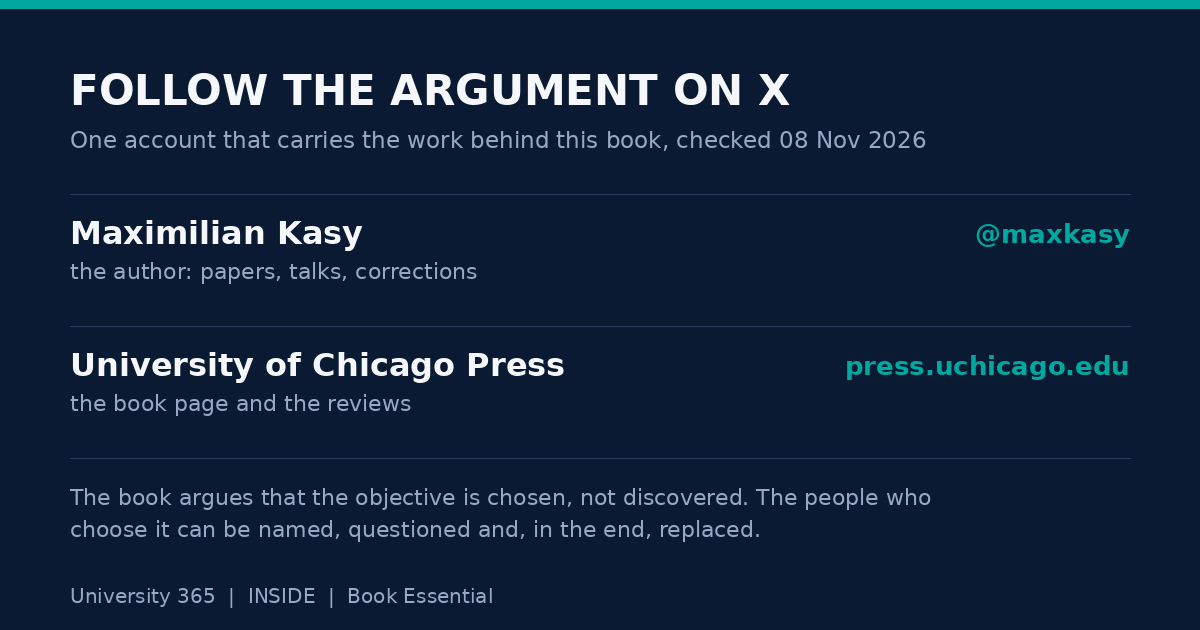
Dedicated X channels:

The Means of Prediction: How AI Really Works and Who Benefits (Maximilian Kasy)
IMPORTANT NOTICE
This Book Essential is an original summary and critical analysis of The Means of Prediction: How AI Really Works (and Who Benefits) by Maximilian Kasy (University of Chicago Press, 2025). Short quotations from the book are attributed and cited for purposes of criticism, review and education. All rights in the original work belong to its author and publisher; this Essential is not a substitute for the book, and a reader who wants the full argument should read the original at the publisher's page.
This publication is part of University 365's learning library. Explore INSIDE, our publications and our programs. The best summary is not a substitute for the book. Read the original. Discuss this book with a U.Coach.
Note: verify current editions before relying on this comparison. Information verified as of 2026-11-08.




Comments