
The Morning Light Stack
Updated: 4 days ago
In this Neuroscience Publication
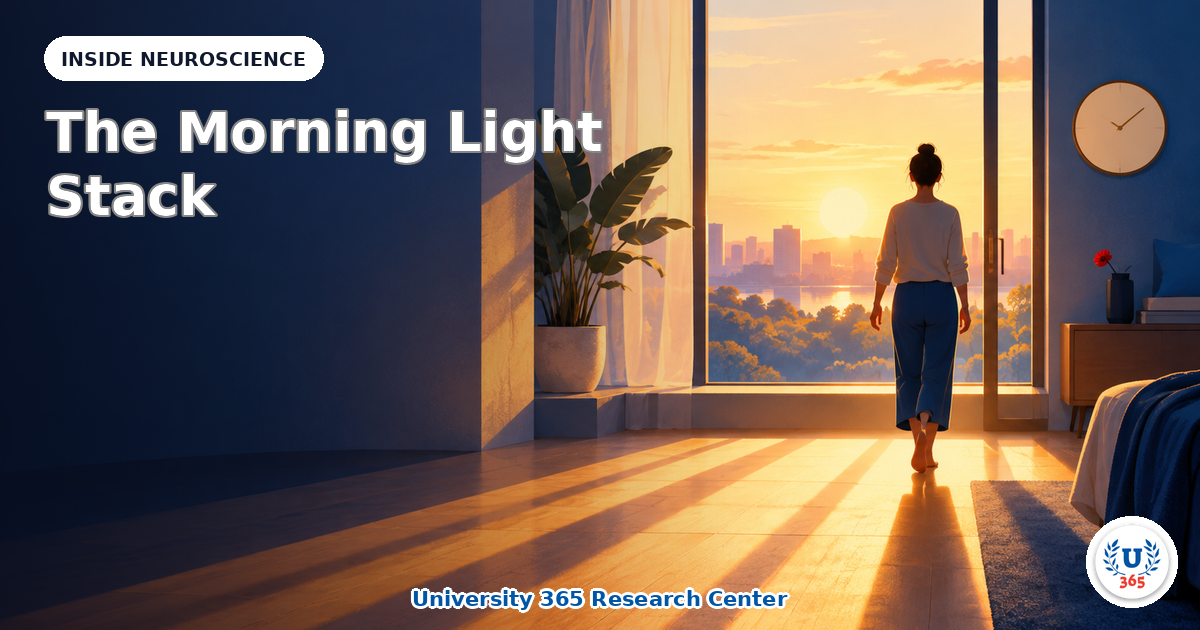
You wake up, and the first hour passes indoors: curtains half closed, screens on. The Morning Light Stack spends five of those minutes differently: open the room, step outside, and walk with the sky in view.


The Morning Light Stack
How to Do It
The stack runs inside the first hour after you wake. Five minutes, five moves, in this order:
Open the room (30 seconds). Open every curtain and blind as you get out of bed and stand in the brightest spot in the room before you pick up your phone: daylight first, not a screen.
Step outside (30 seconds). Step out while your morning drink is still warm; a doorway, balcony or small yard counts. If you cannot go out, stand at your largest window with the sky in view.
Walk with the sky in view (4 minutes). Take a short route you can repeat: around the block and back. Eyes open, no sunglasses, phone in your pocket; look toward the brighter sky, never at the sun.
Anchor it to a habit you already have (10 seconds). Attach the block to a fixed cue: right after the alarm, after you make coffee, or after you brush your teeth. When the order stays the same, the walk needs no decision.
Repeat for one week before judging (30 seconds). Tick one line a day: the hour you went out and when you felt sleepy that evening. Read your record after a week before changing anything.
The block takes about five minutes; the only equipment is a door and the sky. On dark winter mornings, walk in daylight hours and put your brightest lamp on the breakfast table.

The Morning Light Stack
The 5M2S Key Point
Bright light in the first hour is the signal your body clock reads: five minutes outside with the sky in view.

The Morning Light Stack
Origin
The practice comes from the UNOP library, where two of its twenty Neuro-Hacks are built on light: Bright Mornings, the two-minute rise-and-shine routine, and Midday Sun Recharge. This stack keeps the morning half and adds movement.
The UNOP Principles guide frames the method: it describes the pedagogy as built to respect the biological nature of the brain. Light timing is one lever a study routine can pull.
Both source entries are live: Bright Mornings for the minute you wake, and Midday Sun Recharge for midday. This stack sits between them.

The Morning Light Stack
Science-Backed
Four lines of research support the stack, each with a limit worth knowing.
Timing decides the direction. A review states that morning light advances the body clock while evening and night light delays it, and that the system integrates exposures as short as five minutes (Blume et al., 2019).
Outdoor light is far brighter than anything indoors. In a two-week field study, eight adults swapped a week of normal electric lighting for a week camping with only natural light: in the first two hours awake they received about 3,074 lux outdoors against 934 lux indoors, and every measured marker of internal time moved about two hours earlier (Wright et al., 2013). One small study, one summer at 40 degrees north; it cannot separate the light from the camping schedule.
Movement pushes the same way, and the two signals appear to add up. A study of 99 adults found that an hour of moderate exercise produced phase advances at 7 a.m., delays from 7 to 10 p.m., and advances again in the afternoon (Youngstedt et al., 2019); the same group reports evidence that bright light and exercise combined add up. The doses tested were larger than a four-minute walk, so treat the walk as the light's companion, not a measured equal.
The direction matches everyday sleep too. A survey of 1,762 adults found every 30 minutes of sun before 10 a.m. associated with a sleep midpoint 23 minutes earlier (Menezes-Júnior et al., 2025). It is cross-sectional and self-reported: association, not cause.
What the evidence does not show: no study tests this exact five-minute package, the laboratory shifts come from larger controlled doses, and the survey cannot prove causality. Read the direction as well supported and the dose as a sensible minimum.

The Morning Light Stack
Sources
All sources below were opened and read on 15 October 2026.
UNOP library. Bright Mornings (Rule 01) and Midday Sun Recharge (Rule 19).
Blume et al. (2019). Effects of light on human circadian rhythms, sleep and mood. Somnologie, 23(3), 147-156.
Wright et al. (2013). Entrainment of the human circadian clock to the natural light-dark cycle. Current Biology, 23(16), 1554-1558.
Youngstedt et al. (2019). Human circadian phase-response curves for exercise. The Journal of Physiology, 597(8), 2253-2268.
Menezes-Júnior et al. (2025). The role of sunlight in sleep regulation: analysis of morning, evening and late exposure. BMC Public Health, 25, 3362.
A U365 5M2S Microlearning 5 MINUTES TO SUCCESS UNOP Neuro-Hack |
Please Rate and Comment This Publication
How did you find this Publication? What has your experience been like using its content?
Let us know in the comments at the end of that Page!
If you enjoyed this publication, please rate it to help others discover it. Be sure to subscribe or, even better, become a U365 member for more valuable publications from University 365.
Do you have questions about that publication? Or perhaps you want to check your understanding of it. Why not try playing for a minute while improving your memory? For all these activities, consider asking U.Copilot, the University 365 AI agent trained to help you engage with knowledge and guide you toward success. U.Copilot is always available, even while you are reading a publication, at the bottom right corner of your screen. Alternatively, you can open a separate window with U.Copilot: www.u365.me/ucopilot.
Try these prompts in U.Copilot:
I just finished reading the publication "The Morning Light Stack", and I have some questions about it: Write your question.
I have just read the Publication "The Morning Light Stack", and I would like your help in verifying my understanding. Please ask me five questions to assess my comprehension, and provide an evaluation out of 10, along with some guided advice to improve my knowledge.
Or try your own prompts to learn and have fun...
Are you a U365 member? Suggest a topic you'd like to see as a Neuro-Hack,and we’ll add it for you! |
Save a crazy amount of time with our 5 MINUTES TO SUCCESS (5M2S) formula.
5M2S is University 365's Microlearning formula to help you gain knowledge in a flash. If you would like to make a suggestion for a particular topic that you would like to see as a Neuro-Hack, simply let us know as a member of U365 by providing the topic's details in the Human Chat located at the bottom left after you have logged in. Your request will be prioritized, and you will receive a notification as soon as it is added to our catalogue.
NOT A MEMBER YET?
DON'T FORGET TO RATE AND COMMENT ABOUT THAT PUBLICATION




Comments