
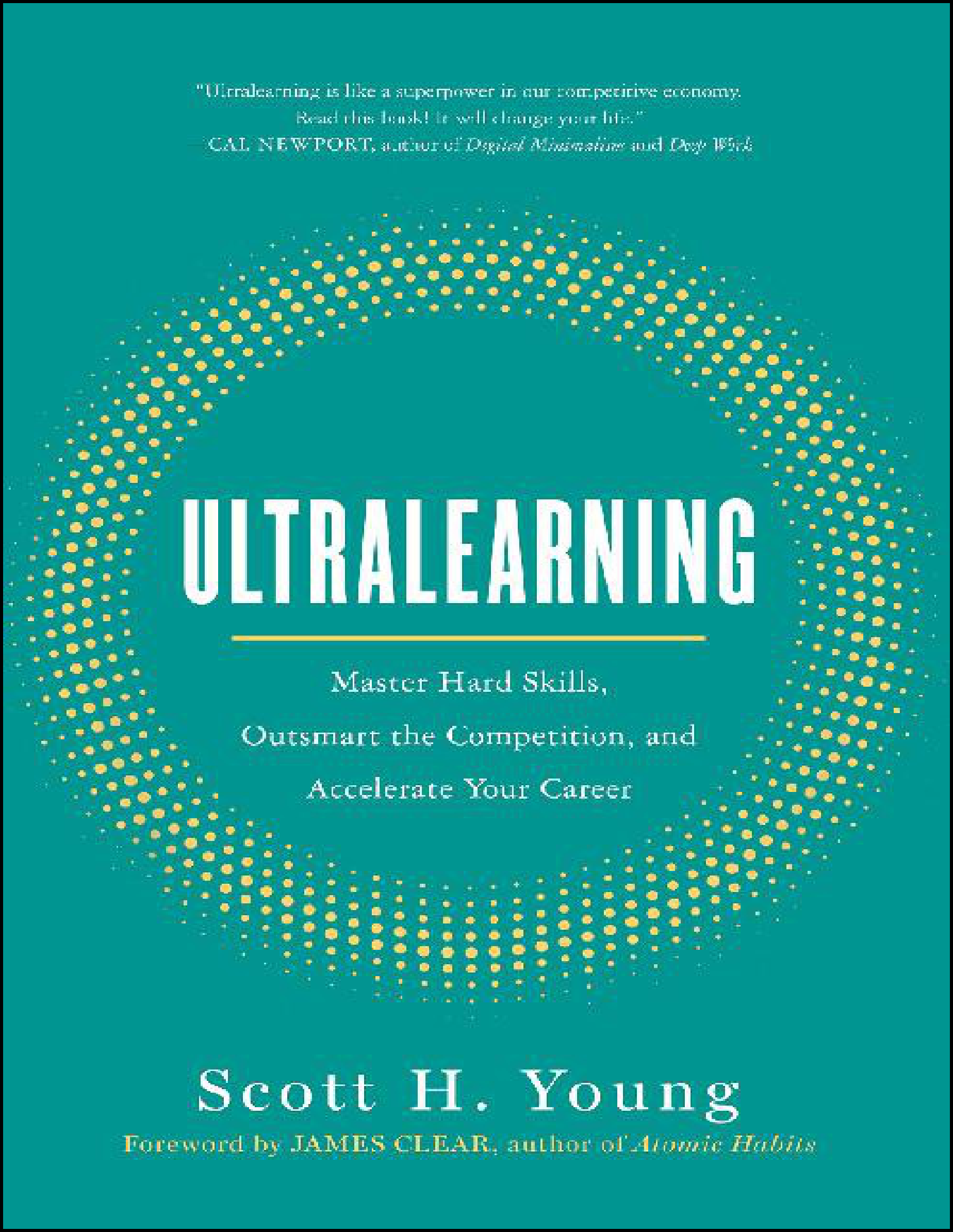
Ultralearning: Master Hard Skills, Outsmart the Competition, and Accelerate Your Career (Scott H. Young)


In this Book Essential


Ultralearning: Master Hard Skills, Outsmart the Competition, and Accelerate Your Career (Scott H. Young)
INTRODUCTION
In September 2012, Scott H. Young finished the final exam of a project he had started less than twelve months earlier: thirty-three classes of the MIT undergraduate computer science curriculum, taken from his apartment in Vancouver, with no enrolment, no campus and no instructor. He had studied sixty hours a week at the start and thirty-five to forty later. The credential was not the point. He wanted to know whether a determined learner with free course material could reproduce the substance of a four-year degree, and the answer changed how he thought about learning for the next decade.
Ultralearning is the name he gave to what he was doing, and the book defines it as a strategy for acquiring skills and knowledge that is both self-directed and intense. Self-directed means you decide what to learn, why, and how. Intense means the work is hard in a way that is deliberate rather than comfortable: speaking a language badly on day three, drilling the subskill you are worst at, testing yourself when reviewing would feel better. The definition is deliberately narrow. It excludes most of what passes for learning in a course catalogue, and it puts the responsibility for design on the person doing the learning.
The book is built from cases. Benny Lewis learned languages by speaking from the first day. Roger Craig prepared for Jeopardy! by building a database of every clue ever aired and testing himself against it, then won 77,000 dollars in a single game. Eric Barone spent five years making Stardew Valley alone because the game he wanted to play did not exist. Nigel Richards won the French Scrabble championship without speaking French. Tristan de Montebello reached the final of a world public speaking championship six months after starting. Young uses these stories as existence proofs, then extracts the method behind them.
Nine principles follow: metalearning, focus, directness, drill, retrieval, feedback, retention, intuition and experimentation. Each chapter pairs one principle with research from cognitive psychology, a case that shows it in use, and a set of tactics for applying it. The last chapters turn the nine into a project plan.
This Book Essential is for anyone with a skill they need and no course that teaches it. It gives you the principles, the evidence behind them, and the parts of the method that fail. Where the book leans on a single case, this analysis says so. Where its advice has a cost the author does not name, the cost is named here.

Ultralearning: Master Hard Skills, Outsmart the Competition, and Accelerate Your Career (Scott H. Young)
U365'S VALUE PROPOSITION
WHO THIS IS FOR
Professionals whose field changed under them and who need a specific new capability faster than a degree allows, without leaving the job that pays for it.
Career changers who need evidence that they can do the new work before anyone hires them for it.
Students and early-career readers who suspect that the credential and the skill are different purchases, and who want a method for the second one.
Teachers, trainers and academic leaders who design learning for other people and want the research on retrieval, feedback and transfer in one place.
Self-directed learners with a project already in mind and no plan for it, who need the planning steps more than the motivation.
KEY TENSIONS
Ambition against evidence: The book runs on remarkable cases. A single case proves that something is possible, not that it is typical, and Young is honest that a dozen people started projects with him and several dropped out. Read the cases as existence proofs and the principles as the transferable part.
Directness against safety: Learning by doing the real thing is the strongest principle in the book and the one with the highest cost of error. A surgeon cannot practise on a patient, which is why the chapter on directness has to be read together with the idea of a safe approximation.
Intensity against sustainability: Sixty hours a week produced the MIT result and is not a schedule most people can hold for a year. Young reduces his own load once the deadline looks reachable, and the book says less than it should about what intensity costs outside the project.
Drilling against wholeness: Isolating your weakest subskill accelerates improvement and can also train a fragment that does not transfer back. The book presents drills as a scalpel and does not spend much time on the risk of cutting the wrong thing.
Retrieval against confidence: Testing yourself feels worse and works better. The research in the book shows that students predict the opposite, which means your own sense of whether a study session worked is not evidence.
Method against talent: Young argues that method explains more than most people admit, then concedes that exceptional cases like Terence Tao exist. The useful position is in the middle: method is the part you control, and it is a large part.
WHY IT MATTERS NOW
The labour market argument has strengthened since 2019, not weakened. Medium-skilled work continues to be automated or outsourced, the premium on high skill continues to rise, and the cost of a residential degree has continued to outgrow inflation. Whatever your view of the causes, the practical result is the same: the gap between what a job requires and what a course taught has to be closed by someone, and increasingly that someone is you.
Technology has changed the supply side of learning as well. The material Young used for the MIT Challenge was early open courseware. A learner today starts with recorded lectures from every major university, translation tools, spaced repetition software, and a model that will explain a concept at whatever level you ask for. The tools lower the cost of the research phase and the feedback loop, which are the two phases where self-directed learners most often fail.
The third reason is institutional. Universities are slow to create a course for a skill that appeared eighteen months ago, and they should be: a curriculum takes years to approve and validate. Self-directed learning is not a replacement for that process, and the book does not claim it is. It is the complement that covers the period between when a skill becomes valuable and when an institution teaches it.

Ultralearning: Master Hard Skills, Outsmart the Competition, and Accelerate Your Career (Scott H. Young)
OVERVIEW
The book has three parts. The first establishes the problem: the economy rewards high skill, education is expensive and slow, technology makes self-teaching possible, and natural talent explains less than the exceptional cases suggest. The second is the nine principles, one chapter each, in the order a learner meets them. The third turns the principles into a project: research, schedule, execute, review.
Young's method for each principle is consistent. He opens with a biographical case, states the principle, reviews the research that supports it, then lists tactics with names you can remember: the expert interview, the five-minute rule, the Direct-Then-Drill approach, free recall, noise cancellation, proceduralization, the Feynman Technique. The tactics are the practical payload. A reader who skips the case studies and takes the tactics will get most of the value, which is unusual for a book of this kind and is a compliment to its structure.
The argument has a shape that is easy to miss. Each principle is presented as a lever and as a failure mode. Focus is not just concentration; it is the three different ways concentration breaks. Feedback is not just criticism; it is the distinction between outcome, informational and corrective feedback, and the finding that in over a third of the studies it made performance worse. The pattern is that a principle misapplied does damage, which is why the book spends time on the failure cases.
The limitation is the evidence base. Young is a practitioner writing a synthesis, not a researcher running a review. He reads the literature carefully and names the researchers, and he also leans on stories where the research is thin, particularly in the chapters on intuition and experimentation. This Essential marks those places rather than smoothing them over.

Ultralearning: Master Hard Skills, Outsmart the Competition, and Accelerate Your Career (Scott H. Young)
KEY IDEAS
ULTRALEARNING PRINCIPLES
The definition is a test you can apply: Ultralearning is a strategy for acquiring skills and knowledge that is both self-directed and intense. If a course decides what you learn and how fast, it may be good education, and it is not ultralearning. If your study is comfortable, it is probably not intense enough to produce the result the book is after.
Metalearning comes first: Before you learn the subject, learn how the subject is learned. Break it into concepts, facts and procedures, answer why you want it, what the skill consists of and how you will acquire it, and spend about ten percent of your total time on that research. The expert interview method is the fastest route: ask someone who has the skill what they would do again and what they would skip.
Focus has three failure modes: You fail to start, you fail to sustain, or you sustain the wrong kind of attention. Each has a different fix. The five-minute rule handles starting, environment design and interruption control handle sustaining, and deliberate practice handles quality. The order matters, and Young is explicit that you should not use a harder technique while an earlier problem is unresolved.
Directness is the strongest claim in the book: Transfer from classroom to real setting largely fails, across nine decades of research. The response is to learn in the setting where the skill will be used, or as close to it as you can build. Speak the language to people, write the software you want to write, argue the case in front of an audience. Where the real setting is unavailable, build the closest safe approximation and treat the distance as a cost.
Drills attack the rate-determining step: Every complex skill has a bottleneck, and improving the bottleneck improves everything downstream. Isolate the subskill that limits your overall performance, drill it in a form that preserves the difficulty of the real task, then put it back into the whole. The Direct-Then-Drill approach protects against drilling something that does not transfer.
Retrieval is the highest-return study behaviour: Testing yourself produces more learning than reviewing, and the effect holds when the final test is a different format. Free recall, flash cards and the question book are the three tactics. The trap is that retrieval feels harder and therefore feels less productive, so learners default to rereading.
Feedback has three levels: Outcome feedback tells you whether you succeeded, informational feedback tells you what happened, and corrective feedback tells you what to change. Most people stop at outcome. The uncomfortable finding is that in over a third of the studies feedback reduced performance, usually because it was about the person rather than the task, so the type and the target both matter.

Retention is a design problem, not a memory problem: Forgetting follows predictable curves, and four mechanisms counteract it: spacing, proceduralization, overlearning and mnemonics. Spacing is the one with the strongest evidence and the lowest adoption, because the schedule that works feels inefficient while you are on it.
Intuition is built from the bottom up: You cannot reason quickly about a subject whose fundamentals you hold loosely. The Feynman Technique exposes the gap: write the idea, explain it as if teaching it, and go back to the source wherever the explanation stalls. The exercise is uncomfortable because it makes the illusion of understanding visible.
Experimentation is the last principle and the one that makes the others durable: You can experiment with resources, with technique and with style. The mindset is a willingness to run a deliberate trial rather than repeat what already works. The risk is churn without records, which is why the tactics in the chapter are about choosing one variable and testing it for a fixed period.

Ultralearning: Master Hard Skills, Outsmart the Competition, and Accelerate Your Career (Scott H. Young)
ULM ALIGNMENT
At University 365, the CI-First (Co-Intelligence-First) doctrine teaches you to always invite AI into your reflection and work while remaining the orchestrator. Human Intelligence leads, AI amplifies. This Book Essential connects the book's nine principles of self-directed learning to U365's proprietary methods: ULM+EVA (University 365 Life Management powered by the Explore-Visualize-Action Plan cycle) helps you place a learning project inside the six life domains and turn it into an if-then plan; LIPS+CARE (your digital second brain with the Collect-Action Plan-Review-Execute cycle) captures what you learn and schedules the review that makes it stick; and SL-OS (Successful Life Operating System) integrates all of these with UP-Context-Engineering (context engineering for AI) into a unified life and learning system.
SCHEMA PRIME: ULM Domain: Career and Finance
DOMAIN MAPPING: Primary: Career and Finance. Secondary: Spirit and Mind, Quality of Life. The book is about acquiring work capability, and about the intellectual life that sustains it.
EVA PARAGRAPH: You want a specific skill at a professional level within a year, and you want the process to survive contact with a full schedule. The obstacle is that the research phase is comfortable and the practice phase is not, so planning quietly replaces doing. The plan: name the skill, the standard you will be judged by, and the date you will be judged. If a week passes without a session that produced visible work, then you cut one research source and replace it with one hour of direct practice in the real setting. Review the log every Sunday and change one variable only.
LIPS+CARE CAPTURE CARD:
Book: Ultralearning: Master Hard Skills, Outsmart the Competition, and Accelerate Your Career
Primary ULM Domain: Career and Finance
3 Key Takeaways:
1. Method is the part of learning you control, and metalearning research is the first move of the method.
2. Directness and retrieval produce most of the gain, and both feel worse than the comfortable alternatives.
3. Intensity needs a schedule and a review, or it becomes a short burst with no durable skill.
Apply It Action: In the Career and Finance domain, write the metalearning map for one skill you need this quarter, then book the first direct practice session in the real setting before the week ends.
Next CARE Step: Collect, by listing every skill your current role requires that you have never formally been taught.
EXPLAINER LINK: For more on ULM, EVA, LIPS, and CARE methods, see the ULM page and the LIPS page. For the CI-First doctrine, see the CI-First page. For the full SL-OS framework, see the SL-OS page.
APPLY IT (domain-tagged): In the Career and Finance domain, take the one skill you most need this year and run the ten percent rule on it: spend two hours mapping concepts, facts and procedures, then test the map by explaining the first chapter of the best resource you found to a colleague without notes.


Ultralearning: Master Hard Skills, Outsmart the Competition, and Accelerate Your Career (Scott H. Young)
SUMMARY

MINDMAP SKELETON
Center: Ultralearning: Master Hard Skills, Outsmart the Competition, and Accelerate Your Career, by Scott H. Young.
Branch 1: The problem. Skill polarization, tuition, technology, talent, time.
Branch 2: Metalearning. Why, what, how, concepts and facts and procedures, the ten percent rule, expert interviews.
Branch 3: Focus. Starting, sustaining, quality, the five-minute rule, the Pomodoro Technique, environment design.
Branch 4: Directness. Transfer failure, tacit knowledge, immersion, simulators, projects.
Branch 5: Drill. Rate-determining step, cognitive load, time slicing, the Direct-Then-Drill approach.
Branch 6: Retrieval. The testing effect, free recall, flash cards, the question book, closed-book work.
Branch 7: Feedback. Outcome, informational and corrective feedback, noise cancellation, the difficulty sweet spot.
Branch 8: Retention. Decay, interference, spacing, proceduralization, overlearning, mnemonics.
Branch 9: Intuition. The Feynman Technique, explanatory depth, chunking, worked examples, play.
Branch 10: Experimentation. Resources, technique, style, the experimental mindset, records.
Branch 11: The project. Research, schedule, execute, review.

Foreword: James Clear on Practice and Skill
James Clear opens the book with a year in which Young spoke no English, moving through Spain, Brazil, China and Korea and reaching conversational level in each language. Clear's own example is photography: he took more than one hundred thousand photographs in a year and became a finalist for a travel photography award, without taking a class. His conclusion is that passive learning creates knowledge while active practice creates skill.
The foreword is doing something specific. Clear is a well-known writer on habits, and his endorsement tells the reader that the method is about behaviour rather than theory. The directness story is also the cleanest illustration in the book of the principle it introduces: he did not study photography, he did photography, at volume.
The limitation is that this is testimony, not evidence. One photographer and one language learner cannot distinguish a method from a disposition. Clear would be the first to say so, and the book's own argument about transfer implies that you should discount an impressive outcome reported by the person who chose the practice.
Chapter 1: Can You Get an MIT Education Without Going to MIT?
Young sets the scene in an exam room, taking a multivariate calculus final for a course he was never enrolled in. The chapter then explains the design: he matched the MIT computer science curriculum against what was available free, found some courses had no lectures, and settled on a simpler criterion, passing the final exams and completing the programming projects. Thirty-three classes, finished in September 2012, under twelve months.
The case is a proof of concept for exam-based learning, and that is exactly where its limits sit. An exam samples a narrow band of a discipline, and the project says nothing about research, collaboration or the parts of a degree that are not tested. Young concedes this in passing. A reader should take the stronger lesson anyway: the constraint he removed was the institution's schedule, and what he replaced it with was a standard, not a syllabus.
The chapter also introduces the other cases that carry the book: Lewis and the three-month language challenge, Craig and the Jeopardy! database, Barone and five years alone on a game. The selection is deliberately extreme, and the book's later claim is that the method, not the extremity, is what transfers.
Chapter 2: Why Ultralearning Matters
The economic argument comes from Tyler Cowen's claim that average is over and from David Autor's work on skill polarization, which finds inequality rising at the top and falling at the bottom while the middle is compressed. Young adds the education and technology arguments: tuition rising faster than inflation, vocational gaps in degrees, and free or cheap tools that make self-teaching practical.
The talent section is the most careful part of the chapter. Terence Tao is presented as the hardest case for a universal method, and Young does not dismiss him. He turns instead to K. Anders Ericsson's position that most attributes of expertise are trainable, notes that other researchers are less optimistic about intelligence, and settles on a practical conclusion: even if talent sets a ceiling, method determines where you land below it.
That is a reasonable position and it is softer than the book's marketing. The external check is worth knowing. The deliberate practice literature Ericsson founded has been contested since 2014 by meta-analyses finding that practice explains a smaller share of performance variance than the theory implies, especially outside structured domains. Young's practical advice survives that critique, because the advice is about method for a motivated learner, not about explaining all expertise.
Chapter 3: How to Become an Ultralearner
Tristan de Montebello, a musician and entrepreneur, agrees to be a guinea pig and chooses public speaking. He practises several times a week, records and analyses every speech, joins several clubs to get different audiences, and within six months reaches the final of a world championship, then changes career. Young uses him to show that the method can be adopted deliberately rather than discovered by accident.
The honesty in this chapter is worth noting. Of about a dozen people Young coached, several dropped out and none matched de Montebello. He reports that. The lesson he draws is that de Montebello's advantage was not belief in an extreme outcome but an obsessive work ethic and a goal of seeing how far he could go.
The evaluative point the book leaves implicit is about selection. The participants volunteered, which means they were already motivated, and the dropout rate is the most informative number in the chapter. A reader planning a project should treat the dropout rate as the base rate and design against it, with a schedule and a review rather than enthusiasm.
Chapter 4: Metalearning, First Draw a Map
Dan Everett learns a language in half an hour in front of an audience by eliciting rather than studying, and the chapter generalises the move: before learning, draw a map. Young breaks the research into three questions, why, what and how, and breaks the what into concepts, facts and procedures, because each is learned differently.
The tactics are the expert interview and the emphasize/exclude method. The first is to find someone who has the skill and ask what they would do differently; the second is to compare your plan with a standard curriculum and then deliberately emphasize what serves your goal and exclude what does not. The chapter closes with the ten percent rule: about a tenth of your total learning time belongs to research before you start.
The ten percent rule is a heuristic presented as a rule of thumb, and it has no citation, which the chapter does not hide. The expert interview has a known bias the book does not name: experts have forgotten what was hard for them as beginners, so their advice over-weights advanced technique. Interview one recent learner alongside the expert and compare the two answers.
Chapter 5: Focus, Sharpen Your Knife
Mary Somerville educates herself against every social obstacle of the eighteenth century and becomes one of the first women elected to the Royal Astronomical Society. Young uses her to show that focus is a practice built over years, then turns to the three problems: failing to start, failing to sustain, failing to focus on the right thing.
The tactics are staged deliberately. The five-minute rule gets you started, the Pomodoro Technique extends the session, and calendar blocks come only when procrastination is no longer the main obstacle. For sustaining, he lists environment, distraction sources and the choice of task. For quality, he distinguishes active, constructive and deliberate practice, and recommends the highest level your current capacity allows.
The chapter is practical and it lacks a measure. A reader finishes it without a way to tell whether focus improved. The fix is simple and consistent with the book's own logic: log the minutes of uninterrupted work per session and the number of self-interruptions, and treat the log as the outcome. Without a measure, the techniques become preferences.
Chapter 6: Directness, Go Straight Ahead
Vatsal Jaiswal, an architecture graduate in a collapsed job market, rebuilds his portfolio around the technical documents firms actually use, and gets hired. Young uses him to introduce transfer, called the Holy Grail of education, and the bad news that formal education has largely failed at it: students who took psychology in high school do no better in college psychology, and honours physics students fail problems posed slightly differently.
The chapter names the three ways learning drifts from the real thing. It does not look like the real task, so tacit knowledge is missing. It does not feel like it, because the feedback is absent. It is not it, because the setting is artificial. The response is to move practice toward the real setting: projects, immersion, and simulators where the real setting is unavailable or unsafe.
Directness is the book's strongest empirical claim and its costs are real. The chapter acknowledges that some settings cannot be practised directly and recommends approximation, but it does not give a criterion for judging when an approximation is close enough. A useful test: name the two hardest conditions of the real task and check that your practice includes both. If it includes neither, it is preparation, not practice.
Chapter 7: Drill, Attack Your Weakest Point
Benjamin Franklin teaches himself to write by taking essays apart, making notes, shuffling them, and reconstructing the argument days later, then comparing his version with the original. Young reads this as a drill designed against a specific weakness, and borrows the concept of a rate-determining step from chemistry to explain why isolating one subskill can speed up the whole.
The chapter gives the Direct-Then-Drill approach: do the whole task until the bottleneck becomes obvious, drill the bottleneck in isolation, then return to the whole. It then lists drill designs, including time slicing, cognitive components, the copycat drill, the magnifying glass method and prerequisite chaining. It also names the three difficulties: knowing what to drill, designing a drill that transfers, and tolerating the discomfort of practising your worst subskill.
The chemistry comparison is useful and it is a comparison, not a derivation. Skills are not reactions with one slow step; components interact, and improving a subskill can change the shape of the whole task rather than just speeding it up. The chapter asserts transfer back to the whole more than it measures it, which is the one place where a reader should insist on evidence from their own log.
Chapter 8: Retrieval, Test to Learn
Srinivasa Ramanujan, with no university education, sends theorems to G. H. Hardy that Hardy initially takes for the work of a crank. Young uses him to introduce the testing effect: in the Karpicke and Blunt study, students who used free recall outperformed those who reviewed repeatedly or built concept maps, and remembered almost fifty percent more on content questions, while predicting that they would do worst.
The chapter explains why: retrieval strengthens the path to the memory and reveals what is missing, while review strengthens the feeling of familiarity. It then gives three tactics, flash cards for paired associations, free recall for arguments and structure, and the question book method, where you convert headings into questions and answer them closed-book.
The evidence here is among the strongest in the book, and the practical caution is about errors. Retrieval without corrective feedback can strengthen a wrong answer, which is why this chapter and the next have to be read together. The book sequences them correctly and does not warn the reader that using retrieval alone is the common mistake.
Chapter 9: Feedback, Don't Dodge the Punches
Chris Rock works out new material in small clubs, with notes, deliberately performing badly to find out what is funny. Young uses him to show that feedback has to be fast and honest to be useful, and then reports the uncomfortable meta-analysis: across hundreds of studies, feedback improved performance on average and made it worse in over thirty-eight percent of cases.
The explanation is the type of feedback. Outcome feedback tells you whether you succeeded. Informational feedback tells you what happened. Corrective feedback tells you what to change and is the most useful and the hardest to obtain. Feedback that targets the person rather than the task is the kind that damages performance, which is why the same intervention can help one learner and hurt another.
The number is the most important in the book and it gets a page. Its application outside the book is immediate: most performance reviews are person-targeted outcome feedback, and the research predicts they will fail about as often as they succeed. Convert one review into task-level corrective feedback and the same conversation changes character.
Chapter 10: Retention, Don't Fill a Leaky Bucket
Nigel Richards wins the French Scrabble championship without speaking French, having memorised a large share of roughly 386,000 valid word forms. Young uses the case to separate memory from understanding, then explains the three mechanisms of forgetting, decay, interference and missing cues, and the four countermeasures: spacing, proceduralization, overlearning and mnemonics.
The tactics are concrete. Spaced repetition software schedules review at expanding intervals. Proceduralization converts declarative knowledge into automatic skill through repeated application. Overlearning continues practice past the first correct performance. Mnemonics attach structure to arbitrary material, most usefully with the keyword method for vocabulary.
Spacing is the best-supported and least-used tactic, and the book is right that the schedule feels inefficient. The limitation is scope: three of the four tools are about retaining facts, and professional skill is mostly procedural. A reader whose goal is a physical or social skill should read the proceduralization section twice and treat the memory sections as supporting material.
Chapter 11: Intuition, Dig Deep Before Building Up
Richard Feynman solves problems others work on for months, and Young's question is whether the speed comes from magic or from a structure anyone can build. His answer is structure: Feynman rebuilt physics from the fundamentals, asked why at every step, and refused to accept an explanation he could not reconstruct. The chapter turns that into the Feynman Technique: write the concept, explain it as if teaching it, and return to the source wherever the explanation stalls.
The technique's purpose is to dispel the illusion of explanatory depth. Most understanding is never articulated, so it feels complete until you try to say it. The chapter adds the tactics of not giving up on intuition, using worked examples, and playing with the idea until it becomes concrete.
The technique is a repackaging of self-explanation, a strategy with its own research literature that the chapter does not cite. That matters because the literature has boundary conditions: self-explanation works best when a correct model is available to check against, and can entrench a coherent wrong model when it is not. The chapter's instruction to return to the source is the safeguard, and it deserves to be stated as a condition rather than a step.
Chapter 12: Experimentation, Explore Outside Your Comfort Zone
Vincent van Gogh starts painting at twenty-six, is told he has no talent, and spends the next decade testing materials, techniques and styles until he produces the work he is known for. Young uses him to introduce the final principle: experimentation with resources, with technique, and with style, each becoming relevant at a different stage of a project.
The mindset section is the most quoted part of the chapter. Experimentation requires a willingness to look foolish, a tolerance for uncertainty, and a habit of running trials rather than repeating what already works. The tactics are to copy the work of someone better, to compare methods over a fixed period, and to introduce constraints that force a new approach.
This is the principle with the thinnest evidence base, and the book treats it as a disposition rather than a finding. The practical gap is the absence of a record. An experiment without a pre-declared criterion and a written result is indistinguishable from churn, and the chapter would be stronger if it required a log before allowing the next trial.
Chapter 13: Your First Ultralearning Project
The final instructional chapter converts the principles into a sequence: research the skill, schedule the time, execute the plan, and review the results. Young recommends a specific scope for a first project, a defined standard, a deadline, and a retrospective at the end, and he warns that the first project carries the most uncertainty and the most value as a lesson.
The planning advice is specific enough to use. He suggests deciding the level of proficiency before starting, choosing a benchmark curriculum, and building the schedule around your real constraints rather than an ideal week. The review stage asks what worked, what did not, and what you would change, and treats that document as the asset you keep.
The gap is what to do when the project fails in week three. The chapter is written for a project that continues, and the book's own dropout rate suggests a kill criterion would be more useful than more planning. Write one: the date, the standard, and the condition under which you stop and redesign rather than continue out of sunk cost.
Chapter 14: An Unconventional Education
László Polgár decides before having children that he will raise a genius, marries a teacher who agrees to the project, and educates his three daughters in chess from the age of three. Judit becomes the youngest grandmaster at the time and the only woman to compete for the world championship, and her sisters become strong players as well. Young shows that all nine principles appear in the household's method.
The case is a strong existence proof and it is also the opposite of self-directed learning. The direction came from a parent with a theory, and the daughters' consent is not the subject of the chapter. The book notices the tension without resolving it, which is a fair choice for a chapter about method and an incomplete one for a book about self-direction.
The useful reading is narrower than the story. What transferred from the Polgár household was not the ambition but the design: early starts, play disguised as practice, measurable feedback, and a curriculum built backwards from the standard. Those are transferable to an adult learner. The parental experiment is not.
Conclusion: The Book as Its Own Project
Young closes by admitting that writing the book was itself an ultralearning project: thousands of papers, out-of-print monographs, recordings of calls with researchers, and a struggle to write in a form longer than a blog post. He is candid that his own approach was the method in the book, applied to a subject he did not know well enough at the start.
The admission is disarming and it has an evidentiary cost. A practitioner's synthesis is a different object from a systematic review, and the places where the book is thinnest, intuition and experimentation, are the places where the literature is thinnest too. The book's value is that it converts a large, scattered research base into decisions a learner can make this week.
The closing argument is about agency. The ability to learn hard things is the one capability that compounds, because it is the route to every other capability. That claim is larger than the evidence in the book supports and it is also the reason to read it: the method is portable, and the reader who applies one principle this month has changed something the cases cannot do for them.

Ultralearning: Master Hard Skills, Outsmart the Competition, and Accelerate Your Career (Scott H. Young)
IN PRACTICE

1. Write the metalearning map before you open the first resource.
Spend two hours answering why, what and how for the skill you chose. List the concepts, the facts to memorise and the procedures to practise, then find one person who has the skill and ask what they would skip.
Action: produce a one-page map with three columns and a ten percent research budget on the calendar.
2. Build the practice in the real setting.
Identify the two hardest conditions of the real task and put both into your practice. If the real setting is unavailable, build the closest safe approximation and write down the distance between them.
Action: schedule one session this week in the setting where the skill will actually be judged.
3. Test yourself before you feel ready.
Close the book and write what you remember, then check. Use the question book method to convert headings into questions, and answer them without notes.
Action: replace one planned rereading session with a free recall session and compare the result.
4. Find the bottleneck and drill only that.
Run the whole task, notice where it breaks, and isolate that component for a short, focused drill. Return to the whole task within a week to check that the drill transferred.
Action: keep a drill log with the hypothesis, the drill design and the result when you return to the whole.
5. Get corrective feedback, not applause.
Ask for feedback that names what to change, at the level of the task rather than the person. Where you cannot find a person, record yourself and score against a written standard.
Action: send one piece of work to a reviewer with three specific questions about what to change.
6. Schedule the review before you need it.
Put spacing on the calendar for anything you intend to keep, and convert the core procedures into repeated practice rather than notes.
Action: create a spaced review schedule for the ten facts and three procedures that matter most.
7. Run one experiment at a time and write down the result.
Change one variable, set the period in advance, and record the outcome against a criterion you named before you started.
Action: start an experiment log with three columns: change, period, result.

Ultralearning: Master Hard Skills, Outsmart the Competition, and Accelerate Your Career (Scott H. Young)
QUIZ: TEST YOUR UNDERSTANDING
Question 1: Young defines ultralearning with two conditions. What are they, and why does the definition exclude a well-taught university course?
Answer: Self-directed and intense. A university course can be excellent education, but the learner does not decide what to learn, why, or how, so it fails the self-directed condition even when the teaching is demanding.
Explanation: The definition is a test of who controls the design, not a judgement about quality. A course you design around a course you attend can still be ultralearning.
Question 2: A learner spends four hundred hours on a new skill. Using the ten percent rule, how much time belongs to research, and what should that research produce?
Answer: About forty hours, producing a map of why, what and how, including the concepts, facts and procedures, and a decision about which parts of a standard curriculum to emphasize or exclude.
Explanation: The rule is a heuristic, not a finding. Its value is that it forces the research phase to end, which prevents planning from replacing practice.
Question 3: A student rereads a chapter three times and feels confident. A second student closes the book and writes what she remembers, then checks. Who performs better on a later test, and why is the first student's confidence misleading?
Answer: The second student, by a large margin. Retrieval strengthens memory and reveals gaps, while rereading strengthens familiarity, which the first student mistakes for knowledge.
Explanation: The Karpicke and Blunt study found free recall beat repeated review and concept mapping, and the students using it predicted they would do worst.
Question 4: A manager gives a team member the message that the presentation went badly. Which type of feedback is that, and what does the research predict?
Answer: Outcome feedback, and it is the type most likely to damage performance, because it gives no information about what to change. Feedback targeting the person rather than the task made performance worse in over thirty-eight percent of the studies in the meta-analysis.
Explanation: The useful alternative is corrective feedback: name the specific behaviour, the standard it missed, and the change to make next time.
Question 5: Apply the Direct-Then-Drill approach to a context the book does not cover: a hospital team learning to run a new emergency protocol.
Answer: Run the full protocol in simulation first to find where the team breaks down, drill that single step in isolation with the same time pressure, then return to the full simulation and measure whether the drill transferred.
Explanation: The transferable move is to use the whole task to locate the bottleneck and the whole task again to verify the drill. Drilling without the return to context trains a fragment.
How many did you get right? Which ones surprised you?

Ultralearning: Master Hard Skills, Outsmart the Competition, and Accelerate Your Career (Scott H. Young)
CAN THIS BOOK ESSENTIAL REPLACE THE ORIGINAL?
No. This Essential gives you the nine principles, the research behind them and the tactics, but the book's value is in the full cases: the MIT project, the Jeopardy! database, the Scrabble championship, the Polgár household, and the author's own account of what the method cost him. Read the original for the stories, which carry the argument in a way a summary cannot.

Ultralearning: Master Hard Skills, Outsmart the Competition, and Accelerate Your Career (Scott H. Young)
QUOTES
"A strategy for acquiring skills and knowledge that is both self-directed and intense"
"Strategies also tend to be well suited for certain situations and not others, so using them is a choice, not a commandment"
"Self-direction is about who is in the driver’s seat for the project, not about where it takes place"
"Without exaggeration, it’s an education scandal"
"By identifying a rate-determining step in your learning reaction, you can isolate it and work on it specifically"
"The actual results, however, weren’t even close"
"Feedback is information. More information equals more opportunities to learn"
"What often separated the ultralearning strategy from more conventional approaches was the immediacy, accuracy, and intensity of the feedback being provided"
"To retain knowledge is ultimately to combat the inevitable human tendency to forget"
"The crux of this method is that it tries to dispel the illusion of explanatory depth"
"The biggest obstacle to ultralearning is simply that most people don’t care enough about their own self-education to get started"
"Being able to learn hard things quickly and effectively is a powerful skill"
"You know when you’re procrastinating, so just get started"
"Directness is the hallmark of most ultralearning projects"
"The space of learning possibilities is immense, just waiting for ambitious autodidacts to come up with new ways to exploit it"

Ultralearning: Master Hard Skills, Outsmart the Competition, and Accelerate Your Career (Scott H. Young)
AUTHOR'S EXPERTISE
Scott H. Young is a Canadian writer and programmer who has published essays on learning since 2006, first while studying commerce at the University of Manitoba and then full time. He is the author of Ultralearning (HarperBusiness, 2019), a Wall Street Journal bestseller with a foreword by James Clear, and of the later book Get Better at Anything. He hosts a podcast and writes a weekly newsletter on learning and thinking.
His credentials as a practitioner are specific and checkable. The MIT Challenge, completed in 2012, covered thirty-three classes of the MIT computer science curriculum in under twelve months. The Year Without English took him through Spain, Brazil, China and Korea, learning a language in each country while avoiding English. He has also run projects in portrait drawing, quantum mechanics and cognitive science, and he publishes the results, including the failures, on his site.
His writing style is plain, structured and unusually willing to name the tactic. He does not claim to be a researcher, and the book cites researchers directly: Karpicke on retrieval, Ericsson on deliberate practice, Kluger and DeNisi on feedback, Haskell on transfer. That combination of first-person practice and honest citation is why the book is worth reading rather than skimming.

Ultralearning: Master Hard Skills, Outsmart the Competition, and Accelerate Your Career (Scott H. Young)
RESOURCES
The book: Ultralearning: Master Hard Skills, Outsmart the Competition, and Accelerate Your Career by Scott H. Young (HarperBusiness, 2019), with a foreword by James Clear. The author's book page is at https://www.scotthyoung.com/blog/ultralearning/ and the publisher page is at https://www.harpercollins.com/products/ultralearning-scott-h-young
The author's site: Scott H. Young publishes weekly essays, project reports and reading notes at https://www.scotthyoung.com/, and the archive is at https://www.scotthyoung.com/blog/articles
Related reading for U365 fellows: Deep Work by Cal Newport for the attention side of practice, Atomic Habits by James Clear for the behaviour design that sustains a schedule, and Make It Stick by Peter C. Brown, Henry L. Roediger and Mark A. McDaniel for the retrieval and spacing research the book relies on.
For the transfer problem specifically, The Unschooled Mind by Howard Gardner is the source Young cites on the failure of classroom learning to travel.

Ultralearning: Master Hard Skills, Outsmart the Competition, and Accelerate Your Career (Scott H. Young)
NEXT STEPS
Map before you study: Answer why, what and how for one skill this week, and cap the research at a tenth of the time you plan to spend.
Practise where it counts: Move one session out of the course, the book or the app and into the setting where the skill will be judged.
Close the book: Replace one rereading session with free recall this week, then check what you missed.
Drill the weak part: Name the subskill that limits your performance and give it one short, isolated session.
Ask for the hard feedback: Request one corrective comment about the task, not the person, and act on it before the next attempt.
Keep the log: Record the session, the bottleneck and the result. The log is what turns a project into a method you can reuse.

Ultralearning: Master Hard Skills, Outsmart the Competition, and Accelerate Your Career (Scott H. Young)
U365'S RECOMMENDATIONS TO LEARN MORE
Official learning resources
Video tutorials and channels
A long interview on the nine principles, the language projects and the book, by Olly Richards
Scott Young explains why speed reading, highlighting and four other popular techniques fail, by Scott Young
Written tutorials and deep-dive articles
Community and social
Resources on X
Dedicated X channels:
X posts with visual content:

Ultralearning: Master Hard Skills, Outsmart the Competition, and Accelerate Your Career (Scott H. Young)
IMPORTANT NOTICE
This Book Essential is an original summary and critical analysis of Ultralearning: Master Hard Skills, Outsmart the Competition, and Accelerate Your Career by Scott H. Young (HarperBusiness, 2019). Short quotations from the book are attributed and cited for purposes of criticism, review, and education. All rights in the original work belong to its author and publisher; this Essential is not a substitute for the book: read the original at the publisher's page.
This book is part of University 365's learning library. Explore INSIDE, our publications, and our programs. The best summary is not a substitute for the book. Read the original. Discuss this book with a U.Coach.
Note: verify current details before relying on this comparison. Information verified as of 2026-11-07.




Comments