
Wavel AI: dubbing, voice cloning and subtitles in one credit-based localisation studio

Status: Active | Last tested: 2026-09-27 (Wavel AI, as its product, pricing and legal pages described it on that date) | Re-check: trigger-based (max 6 months)
Active: the tool is current and recommended.
Reviewed as documented at wavel.ai in September 2026. The platform sells one subscription that covers several distinct jobs: dubbing and video translation, text-to-speech and voiceover, voice cloning, subtitles, and a generative video and avatar surface. All of them are in scope here, and the credit economy that connects them is what makes the pricing behave differently from the headline monthly figure.
Wavel AI scores 5.0 out of 10 on the U365 CI-First Review, which is CI-First Positive, with a Humics-Risky protection badge and a Medium AI Imposture Risk carrying Skill Illusion High. A genuine low-cost localisation stack sits behind a credit economy that prices the revision loop, and the review below separates the two.
For detailed explanations of the CI-First evaluation terms used in this review, including the Humics Protection Badge and the AI Imposture Risk levels, see the Glossary at the end of this post.


In this Tool Review
Status and Re-check
Status: Active | Last tested: 2026-09-27 (Wavel AI, as its product, pricing and legal pages described it on that date) | Re-check: trigger-based (max 6 months)
Active: the tool is current and recommended.
For detailed explanations of the CI-First evaluation terms used in this review, including the Humics Protection Badge and the AI Imposture Risk levels, see the Glossary at the end of this post.
Re-check triggers:
Publication of an independent measurement of dubbing or voice quality. No third party has published a controlled measurement of how close a Wavel dub sits to the original speaker, of pronunciation accuracy in any language, or of subtitle accuracy. The quality position in this review rests on user reports, on one competitor review and on the vendor's own wording. A repeatable measurement would move the Quality sub-score.
A change to the refund, cancellation or chargeback terms. The published position is that refunds are not offered, that any request must arrive within two days of the transaction, that cancellation must be filed at least seven days before renewal, and that a chargeback raised without contacting the vendor first is treated as a breach of policy. Any of those four rules moving changes the adoption calculus, which Section 7c sets out.
A change to the licence over what you upload and what you generate. The terms take an unrestricted, unlimited, irrevocable, perpetual, worldwide licence over your Contributions, with your image and voice named explicitly. Any narrowing or widening of that clause is a re-check.
A change to the voice cloning consent path. The cloning pages permit any voice sample you have permission to use, including a character voice, while the terms require written consent for every identifiable person in your Contributions. If the two converge in either direction, the Social Authenticity reasoning should be re-run.
A credit or pricing change. Dubbing is charged at three credits per minute against one credit per minute for subtitles and text-to-speech, credits are deducted when a render starts, and a failed render has to be reclaimed through support. Any of those rules moving would change the Time sub-score.
A published resolution of the vendor's own language figures. The site states 100 or more languages in its headers, 40 or more in the pricing table, 70 or more in the API comparison table and 149 or more on one cloning page, in the same month. A single published figure with a definition would change the Quality reasoning, and the spread itself is a Faculty Note item.
A change to long-file reliability or to the documented file limits. Multiple user reports describe failures, lag and lost work on uploads longer than fifteen minutes, and the API comparison table caps upload length at thirty minutes on the entry paid tier. A documented improvement to long-file handling is a re-check.
A provenance or labelling obligation for synthetic speech. No labelling requirement and no default watermark is documented for downloaded audio or video. If one appears, the Critical Thinking rating should be revisited.
The name, three entities and one unrelated directory, stated before the review begins
A reader searching for this product meets at least three names and one unrelated site, so the distinction belongs at the top of the review.
Name | What it is | Relationship to this review |
wavel.ai | The platform reviewed here: dubbing, video translation, text-to-speech, voice cloning, subtitles, shorts repurposing and a generative video surface, all in one browser studio at studio.wavel.ai | The subject of this review |
Docle Pte Ltd | The legal entity named in the terms of service, registered in Singapore with a registered office at 32 Carpenter St, and the party the contract is made with. The footer of the site prints DOCLE PTE. LTD. and the same document gives the contact address reachout@wavel.co while the refund policy gives reachout@wavel.ai | The contracting party. A reader comparing the site against a purchase order should use the entity in the terms, not the brand |
Dolce lte ltd | The seller name carried on the G2 product listing for the same product, which is where its published review count and category position come from | The same product under a second spelling. It is a directory's spelling of the entity, and the review notes it rather than resolving it |
wavel.io | An unrelated AI tools and agents directory that also trades under the word Wavel, with its own catalogue, leaderboard and copyright line | Not related, and not reviewed. It is a discovery site rather than a speech product, and search results for the two are easy to mix up |
ru.wavel.ai, fr.wavel.ai, es.wavel.ai, de.wavel.ai | The vendor's own translated marketing sites, each serving the same platform in another language | The same vendor. They are surfaces of the product, not separate products, and the language figures they publish do not always match the English site |
Two consequences follow. First, the reviews a reader finds under this name are attached to more than one entity spelling, so a rating read from a search result should be checked against the platform it belongs to before it is treated as evidence about the product. Second, the language counts differ across the vendor's own surfaces, which is one of the findings in the Faculty Note rather than a detail of it.
Tool Snapshot
Wavel AI
Provider: Docle Pte Ltd, the legal entity named in the terms of service and registered in Singapore, trading as wavel.ai
Version tested: Wavel AI, as documented at wavel.ai in September 2026
License: Proprietary, sold as a subscription with a monthly credit allowance
Platforms: Browser studio at studio.wavel.ai, a documented REST API on paid plans, and a Discord community
Tagline: The homepage presents the product as "AI Video Generator, Dubbing & Voice Platform" and states "Generate AI videos with top AI video generation models. Create natural AI voices for any content, from podcasts to presentations. Localize your content into 40+ languages with AI dubbing and subtitles." A second count appears on the same page beside the first, which is discussed in the Faculty Note.
Category: Video and audio localisation platform, with a generative video surface attached. A cloud studio that dubs and translates video, converts text to speech, clones a voice from an uploaded sample, generates and translates subtitles, repurposes long video into vertical shorts, and creates avatar-led and prompt-driven video.
Primary use cases:
Dubbing an existing video into another language, with the original speaker's voice or a library voice, and exporting the dubbed audio or a re-rendered video.
Generating a voiceover from a script for a video, course module, podcast or presentation.
Producing subtitles and captions from a video or audio file, including translated subtitle tracks.
Creating a reusable clone of a voice you own or have permission to use, then using it across later projects.
Turning one long video into several vertical clips with burned-in captions for social distribution.
Pricing summary: Freemium with a seven-day trial rather than a standing free tier. Free: $0, 15 one-time credits, watermarking on output, no downloads, no editing and no credit top-up. Basic: $25 per month, or $16 per month billed annually at $198, with 100 credits per month, 10 voice clones and 3 AI twins. Pro: $40 per month, or $26 per month billed annually at $312, with 300 credits, 30 voice clones and 3 AI twins. Scale: $100 per month, or $66 per month billed annually at $792, with 1,000 credits, 100 voice clones and 10 AI twins. Credit conversion as published: 3 credits per minute of dubbing, 3 credits per minute of video edits, 1 credit per minute of subtitles and 1 credit per minute of voiceover. Credits roll over each month. Prices read from the pricing page on 2026-09-27.
Official links:
Website: https://wavel.ai/
Pricing: https://wavel.ai/pricing
API documentation: https://doc.wavel.ai/
Help centre: https://wavel.ai/help
Blog: https://wavel.ai/blog
Terms of Service: https://wavel.ai/terms-of-service
Privacy Policy: https://wavel.ai/privacy-policy
Refund and Dispute Policy: https://wavel.ai/refund-and-fraud-policy
Community: https://discord.com/invite/GkX9Z5kzjy
Video and creative tool fields:
Pipeline type: video in and dubbed video or audio out, text to speech, speech to speech, voice cloning, subtitle generation and translation, transcript editing, noise cleaning, voice changing, clip repurposing, avatar and prompt-driven video generation.
Output formats: MP4 for video, MP3 and WAV for audio, SRT, VTT and document formats for subtitles on paid tiers. The free tier exports nothing downloadable.
Languages: the vendor states several different figures, from 40 or more to 149 or more, across its own pages in the same month. See the Faculty Note.
Published file limits: upload size up to 3 GB on paid tiers against 100 MB on free, upload length from 30 minutes on the entry paid tier to 2.5 hours on the highest, archive retention from three to six months, and one minute per file for video generation on the free tier, in the vendor's API comparison table.
At a Glance Dashboard
Field | Value |
Category | Video and audio localisation platform |
CI-First Benefit Score | 5.0 / 10 (CI-First Positive) |
Sub-scores | Time 6 / Quantity 6 / Quality 4 / Skill 4 |
CI-First Profile | Primary: Co-Worker and Assistant (level 2). Secondary: Co-Creator and Thought Partner (level 1) on the script and generation surfaces, Analyst and Tester (level 4) narrowly, on the review of a rendered dub |
Collaboration Mode | Centaur (Imposture Risk Medium with Skill Illusion High) |
Humics Protection | Humics-Risky (-2 / +3) |
AI Imposture Risk | Medium overall, with Skill Illusion High |
Status | Active |
Last tested | 2026-09-27 |
Access | Browser studio, with a documented REST API on paid tiers |
Entry price | $25 per month, or $16 per month billed annually at $198 |
Free tier | 15 one-time credits, watermarked, no downloads |
The Problem
A video that only exists in one language reaches one audience. The usual fix has been expensive and slow: book a translator, book a voice actor per language, book a studio, then re-edit the audio against the picture. For a solo creator, a small business or a training team, the arithmetic rarely works, so the work does not happen and the content stays in one language. The alternative has been a stack of subscriptions, one for transcription, one for translation, one for voice, one for captions, each with its own interface and its own file handling.
Three specific problems sit in the way of doing better, and they are the ones this class of tool claims to solve.
The first is the cost of the second and third language. Translation and voice work are priced per minute by human suppliers, so a library of twenty training videos is a budget line rather than an afternoon. The gap between what a small team can afford and what its audience needs is where content stops travelling.
The second is the cost of the revision loop. A dubbed track is not finished when it is generated. Somebody has to listen to it, notice the sentence that lands wrong, the name that is pronounced incorrectly, the register that does not fit the market, and send it back. Any tool that charges per attempt makes that loop part of the price, and any tool that renders in real time makes it part of the day.
The third is the part nobody measures. A subtitled or dubbed video looks complete the moment it renders. Whether the translation is right, whether the timing sits against the mouth, and whether the voice sounds like a person are questions the interface does not answer, and the platforms in this category publish no accuracy figure a buyer could check. The gap between a finished-looking file and a finished piece of work is the risk this review spends most of its length on.
The Outcome
The concrete outcome is that a video you already own can exist in several languages for a monthly subscription rather than a per-project quote, and that the same subscription covers the subtitles, the voiceover and the clips, so the work stays in one place.
What that means in practice, stated as finished work rather than as features. A ten-minute product walkthrough recorded in English becomes a Spanish and a French version with the original speaker's voice, published the same week, for a fraction of a per-minute dubbing fee. A course module written as a script becomes narration without a recording session, and a text edit re-renders instead of requiring a second take. A webinar recording becomes captioned subtitle tracks for accessibility and three vertical clips for distribution, from the same upload. A support team turns a written FAQ into voiced explainers in the languages its customers actually use.
What a reader does not get, and this is where the honest accounting starts. The output is serviceable rather than broadcast grade, and the independent comparisons place the voice quality behind the specialist engines. The credit economy means the revision loop is priced, so a script that needs three passes costs three times one that needs none. A render that fails still consumes credits and the reclaim runs through support. Long uploads are where the platform is least reliable, and the published upload length differs between the plan table and the API comparison table. And the audio you produce arrives at your audience without a label, because no labelling obligation or default watermark is documented for downloaded output.
That combination is what the score reflects: a real and affordable capability, with a quality ceiling below the category leaders and a set of commercial and contractual terms a buyer should read before a client asset goes in.
Who Should Use Wavel AI
Wavel AI fits a person with content that already exists and an audience that speaks something else. It is not a production studio and it does not claim to be one.
Strong fit:
A solo creator or small channel with a back catalogue. The value is that twenty existing videos can acquire a second and third language without a per-project quote. The dubbing surface, the subtitle translation and the clip repurposing all run from the same upload, so the backlog stops being a reason to wait.
A training, onboarding or e-learning team. Course and compliance content is exactly the material this class of tool handles well, because the picture is often a screen recording rather than a person talking to camera, and lip-sync precision matters less. The vendor's own use-case pages lead with e-learning, distance learning and corporate training, and the file limits in the API comparison table are sized for that work rather than for cinema.
A marketing team localising ads, product demos and explainers. Subtitles, dubbed voiceover and vertical clips are the standard operations of a paid social pipeline, and having them in one subscription is the honest reason to choose this over four separate tools.
A support or documentation team turning written material into voiced explainers. Text-to-speech at one credit per minute is the cheapest surface in the product, and a written FAQ becomes spoken content without a recording session.
A small agency producing localised variants at volume. The Scale tier at 1,000 credits per month is the first tier where the arithmetic supports a steady output, and the API on paid plans means the work can be wired into an existing pipeline rather than pasted into a browser.
Weak fit, stated plainly:
Anyone producing client-facing work in a language nobody on the team speaks. This is the central limit of the review. A dub reads as finished to a person who cannot judge it, and the platform will not tell you whether the translation or the pronunciation is right. If the work carries a client's name, a native reviewer is not optional.
A team needing broadcast or cinema-grade voice. Independent comparisons place the voice engine behind the specialist providers, and the vendor publishes no quality measurement of its own. Where the audio is the product, use the specialist engines and use this for the volume work.
A team that needs 4K delivery, a timeline editor, or frame-level craft control. Exports are documented at up to 1080p, the editor is template and preset driven, and there is no collaborative workspace beyond shared accounts.
Anyone dubbing a person who has not agreed to it. The terms require written consent for every identifiable person whose likeness or voice appears in what you upload, and the clone pages require permission for any sample. A team that cannot produce that consent record should not use this tool at all.
An enterprise buying under a formal procurement review. There is no published SOC 2 or ISO 27001 attestation on the surfaces a buyer will read, the refund policy states that refunds are not offered and that a chargeback raised without contacting the vendor first is treated as a breach with a reference back to the policy as evidence, and the terms take a permanent worldwide licence over what you upload or create. Read Section 7c before a purchase order is signed rather than after.
Two honesty conditions on the strong fit. The first is that the revision loop is priced. Dubbing costs three credits per minute, credits are consumed when a render starts, and a failed render has to be reclaimed through support rather than automatically. Budget the attempts, not the runtime. The second is that the cheapest way to use this correctly is also the slowest, which is to run a native review on the output before it is published. The platform offers that step as an enterprise option and leaves it off by default, and the difference between the two is the difference between a translation and a localisation.
U365 Fellow categories:
Learner type | Difficulty | Typical ROI | Career path |
Students (Bachelor, Master) | Beginner | A presentation, a portfolio video or a course submission reaches a second-language audience without a translator's invoice. The measurable gain is reach rather than craft | Communication and marketing pathways where multilingual delivery is a hiring advantage, and design pathways where a supplied composite is read rather than authored |
Professionals (career upskilling) | Beginner to Intermediate | The strongest return in the review: a backlog of existing content acquires languages, and the review discipline it forces (naming a native reviewer for each market) is a transferable practice | Marketing, e-learning, support and content roles, plus the commercial literacy of reading a metered supplier contract before signing it |
Everyone (lifelong learners) | Beginner | A low entry point for hands-on exposure to what a metered AI service costs per finished minute, and to the difference between a translated file and a localised one | General digital literacy, with a specific gain in judging synthetic speech rather than in producing it |
Institute alignment:
UIT (Technology, AI, Data Science): Low to Medium. A documented REST API on paid tiers, a metered generation service, and a real engineering case in sizing a pipeline against a per-minute credit cost. No model configuration, architecture or reproducible evaluation surface is published, so nothing here is assessable as modelling.
UIB (Business Management, Entrepreneurship): Medium. Two commercial competencies are exercised and both can be costed: converting a tier into a cost per finished minute including the revision loop, and reading a supplier contract whose refund, cancellation, licence and fair-usage clauses all bear on what a venture can safely run through it.
UIC (Digital Communication, Marketing): High (primary). Localisation, subtitling, dubbed voiceover multilingual distribution and clip repurposing for social platforms are the platform's core loop and the institute's core subject.
UID (Digital Design, UX/UI): Low. The composition is performed for the user. What remains is the judgement of a delivered moving image and of caption typography against a placement, and that is a thinner reading exercise than the other three rows. It is not presented as a design capability.
Skill level required: Beginner. Uploading, selecting a language and generating a dub requires no production knowledge. The judgement the tool does not supply is the deciding factor, not the interface.
Prerequisites: A video or audio file you have the rights to use; written consent for every identifiable person whose voice or likeness appears; and, for any published output in a language you cannot evaluate, a named native speaker to review it.
Typical time to first result: Under fifteen minutes for a short clip, including the upload and one render. Processing itself is minutes rather than hours for short material.
Typical time to competence: An afternoon to run the interface well; weeks to run the workflow safely, because the competency is not in the tool. Learning to judge a dub you cannot fully understand, and building the review step into the schedule, is the part that takes practice.
U365 Institutes Alignment
Wavel AI sits on the localisation layer of content production, and the alignment below rates what a U365 institute could take from it as a working instrument and as an object of study. The primary home is clear. Three readings are real but thinner, and they are stated as such rather than levelled up.
Institute | Rating | Why | The limit that holds the row |
UIC (Digital Communication, Marketing) | High (primary) | Four judgements a practitioner supplies, and each survives the removal of the tool. Market selection: which languages are worth carrying, from audience data rather than from the language list. Register per market: whether the tone that works in the source language transfers, which is the decision that separates a translation from a localisation. Disclosure: whether an audience is owed the fact that a voice was synthesised, in a product that offers no default label. And the review rule: who signs off a version before it publishes, given that the tool will happily render a version nobody can check. Those four are communication craft, and this review's Getting Started checklist and its workflows supply them in the reader's hands | The tool builds none of the four. It supplies the mechanical layer under them and publishes no standard, critique or measurement a practitioner could apply to judge what came back. The Skill Illusion rating is High for exactly this reason, and the voice quality ceiling is described by third-party comparison as behind the specialist engines. A cohort can study the platform as the industrialisation of translation, and it cannot use it as a teaching instrument for register |
UIB (Business Management, Entrepreneurship) | Medium | Two commercial competencies are genuinely exercised and both are costable or citable. The first is metered-supplier cost appraisal: three credits per minute of dubbing against one per minute of subtitles, a failed render consuming credits at the start, credits rolling over monthly, and an entry tier of 100 credits, which a Fellow can convert into a cost per finished minute and defend against a measured burn rather than against the advertised allowance. The second is contract literacy applied to a purchase: the refund policy states that refunds are not offered, that a request must arrive within two days, that cancellation must be filed at least seven days before renewal, and that a chargeback raised without contacting the vendor first is treated as a breach of policy. Reading those before a venture is built on the output is doing the appraisal a purchase decision requires | The tool teaches no management, finance or entrepreneurship content of its own, and the appraisal is a costed exercise rather than a business discipline. A word-start search over all 79 published programme descriptions in the Online Programs catalogue on 2026-09-27 returned zero matches for cost, pricing, price, metered, usage-based, unit economics, invoice, procurement and supplier. The nearest published anchor is Financial Analysis Specialist, which publishes analysis of a company's own statements rather than the appraisal of a supplier's rate card. No credential is claimed here |
UIT (Technology, AI, Data Science) | Low to Medium | One real engineering reading and one real evaluation reading. The engineering reading is a metered, documented REST API with a published credit conversion, an upload-size and length matrix, and an archive retention window, which is a usable worked case in sizing a batch pipeline against a per-minute consumption rule before it is bought. The evaluation reading is the one this review itself performs: telling a serviceable synthetic voice from a good one, and recognising that no vendor in this category currently publishes a figure a buyer could audit | Nothing here is assessable as modelling. No architecture, parameter count, training data or benchmark is published for any surface, and the API page's own quality statement is a latency figure rather than an accuracy one. A term search of the same 79 published programme descriptions returned zero matches for API integration outcomes phrased against a third-party rate-limit specification, and the nearest published anchors are Software Developer and Full-Stack Web Developer, which publish application construction rather than appraisal of a metered service. No credential is claimed |
UID (Digital Design, UX/UI) | Low | The one competency that remains is evaluation rather than authorship: a Fellow can read a delivered moving image and a set of placed captions for framing, timing and legibility at the size the video will run, and can name the point at which a preset caption style and an automatic vertical reframe stop carrying the intent. That reading exercise is genuine and it survives the removal of the tool | The tool performs the composition. There is no timeline editor, no frame-level control, no multi-size asset export discipline, and the caption surface is a preset list of typefaces, five sizes and a set of emphasis colours rather than a typographic system. A design cohort makes no compositional decision and defends no design against a brief. The row is rated as evaluation contact with a supplied composite and it is stated that way rather than as a design claim |
U365 methods, not an institute (UNOP, ULM, LIPS, CARE and the UP-Context Method) | Applicable | The methods layer is relevant in one specific way and it is worth naming. The decision record this tool creates is a publication decision with a rights dimension: what was dubbed, for which market, with which consent record and who reviewed it. That record belongs in LIPS rather than in the platform, and the UP-Context method supplies the boundary the default workflow leaves out | The platform holds the media and the project, not the decision. It writes no standing instruction and maintains no register of what was published where, so a team that does not keep the record elsewhere has no record |
The sentence that holds across all four rows. No U365 institute should adopt Wavel AI as the instrument that decides whether a piece of content is ready for a market, and the reason is the same in each row: the platform removes a production requirement and supplies no standard, critique or measurement for judging what it produced. The teaching value is in the judgements the tool makes unavoidable and gives no help with, which is why the primary institute is UIC and why the recommendation to a marketer is a real one.
Relevance is not a credential, and the two diverge on this tool. A rating says a cohort has something to learn by reading or using the product. A credential says U365 assesses that competency and issues something for it. On this tool the first is true at all four institutes and the second is true at none.
Tool to Skill to Credential
No published U365 credential assesses any of the five competencies this tool exercises. That is the finding and it is not a catalogue defect. It is a statement about what this class of tool does: it removes a production requirement rather than teaching production, and U365 credentials assess what a Fellow can do rather than what a tool can do for them. The Skill sub-score of 4 records the same thing from the scoring side, and Skill Illusion High records it from the risk side.
Every row therefore does two things. It names the nearest published programme a Fellow could enrol in, and it states what that programme does not publish. An adjacent anchor is useful to a Fellow who wants the neighbouring skill. An adjacent anchor is not a credential claim, and none is presented as an assessment home for the competency in the row.
The programmes below were read from the published Online Programs catalogue on 2026-09-27, each as a published programme with its own description, module list and duration.
Tool skill | U365 competency | Credential | Institute |
Choosing which markets are worth carrying and writing the case for each language, from audience data rather than from the language list | Market selection and audience case building | No published U365 programme assesses market selection for localised content. The nearest published anchors: Social Media Marketing Manager (30 days, published) carries Social Media: Strategy and Optimization, Copywriting for Social Media, Content Creation Startegy, TikTok and Instagram Reels, Stories: Creative Strategies, which is social content strategy rather than a market-selection case; Content Marketing Specialist (30 days, published) carries Content Marketing ROI, Content Stratégy, Producing and Promoting Live Video, SEO Content Writing and Link Building, with the module spelling reproduced as the catalogue publishes it, which is content planning rather than language-market appraisal. Adjacent anchors, not assessment homes | UIC (Digital Communication, Marketing), no credential mapped |
Setting the register per market and deciding what must change beyond the words: idiom, currency, example and formality, then running a native review before release | Register judgement and localisation review | No published U365 programme assesses localisation, translation or caption review, and the gap is the striking one because it is the surface this review's own workflows are built on. A word-start search over all 79 published programme descriptions returned zero matches for localisation, localization, dubbing, translation, multilingual, subtitle, caption and accessibility. The nearest published anchors are Content Marketing Specialist and Digital Marketing Professional (30 days, published), which carry platform and SEO modules rather than a localised review. Adjacent anchors, not assessment homes | UIC (Digital Communication, Marketing), no credential mapped |
Deciding what an audience is owed about a synthesised voice, and writing the rule that governs when a clone may speak for a person | Disclosure rule authorship and synthetic-media governance | No published U365 programme assesses synthetic-media governance or disclosure. The same term search returned zero matches for synthetic, deepfake, provenance, disclosure, consent, impersonation, likeness, watermark and attribution. The nearest published anchor is AI Creator Professional (30 days, published), which carries a module titled Opportunities, Issues, and Ethics inside a generative-image and generative-art pathway, which is ethics contact within image tooling rather than a provenance or consent regime. Recorded here as a curriculum gap | |
Converting a credit-based tier into a cost per finished minute, including the attempts a revision loop consumes, and deciding the tier from a measured burn | Usage-based cost appraisal on a metered service | No published U365 programme assesses a metered or usage-based pricing outcome. The term search returned zero matches for cost, pricing, price, metered, usage-based, unit economics, invoice, procurement, supplier and total cost. Financial Analysis Specialist (30 days, published) carries Corporate Financial Statement, Financial Modeling, Forcasting Financial Statements, and Data, and Economic Modeling with Stata, with the module spellings reproduced as the catalogue publishes them, which is the analysis of a company's own statements rather than the appraisal of a supplier's rate card. Business Analysis Professional (60 days, published) carries Business Analysis Foundations, Agile Requirements, Business Bebefits Realization, Project Manager Collaboration, Business Process Modeling, Leadership Foundations and Communication skills, again as published. Adjacent anchors, not assessment homes | UIB (Business Management, Entrepreneurship), no credential mapped |
Reading a delivered moving image and a set of placed captions for framing, timing and legibility at the size the video will run | Visual evaluation of a supplied composite against a placement | No published U365 programme assesses the evaluation of a supplied video composite. Video Production Specialist (60 days, published) carries The Art of Video Editing, Creative Techniques, History of Film and Video Editing, Premiere Pro Essential Training, Final Cut Pro Essential Training and Video Dialogue Editing, which is editing craft in named applications rather than appraisal of a delivered composite. Motion Graphics and VFX Expert (60 days, published) carries Motion Graphics and Animation Foundations, Motion Graphics in After Effects, Type in Motion, Art of Rotoscoping, Introduction to 3D in After Effects and Cinema 4D: Motion Graphics and VFX. UX Designer Expert (25 days, published) carries Analyzing User Data, Creating Personas, Ideation, Scenarios and Storyboards, Paper Prototyping, Sketching and Interaction Design, which is design authorship rather than composite appraisal. Adjacent anchors, not assessment homes | UID (Digital Design, UX/UI), no credential mapped |
Where relevance is present but uncredentialed, this review says so rather than leaving it silent. Five competencies are mapped above, every one names a verified published anchor and states what that anchor does not publish, and none is presented as an assessment home.
How Wavel AI Works
The platform is a browser studio with one account, one credit balance, and a set of tools that draw on that balance at different rates. The published workflow is consistent across the surfaces and it is worth setting out plainly, because the billing behaviour follows from it.
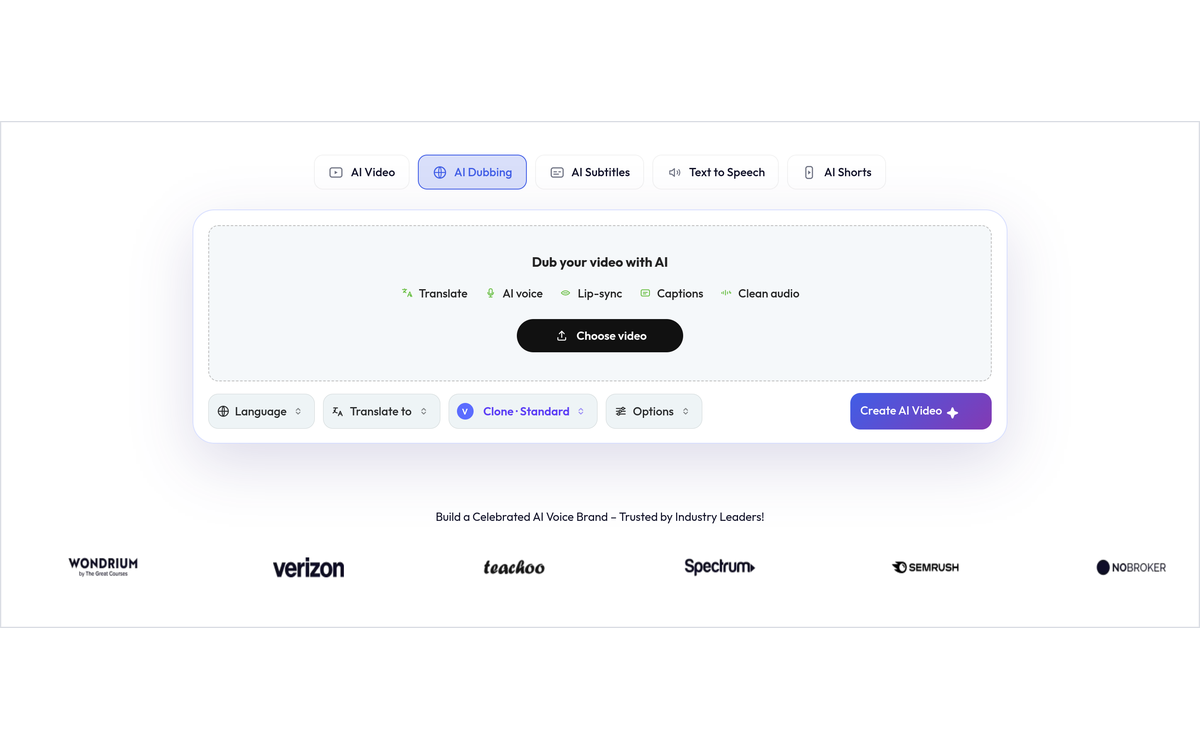
Step 1. Upload, or start from a script. A video or audio file goes in through the browser, or a script goes into the text-to-speech and generative surfaces without any upload at all. The vendor's API comparison table sets upload size at up to 3 GB and upload length from 30 minutes on the entry paid tier to 1.5 and 2.5 hours on the higher tiers, against 100 MB and one minute on the free tier. Archive retention is three months on the paid tiers and one month on free.
Step 2. Transcription, then translation. The engine detects the source language, produces a transcript, and translates it into the target language or languages. The transcript is exposed and editable, which matters more than the marketing pages suggest: the single most reliable way to improve a dub is to fix the transcript and the timing before the audio is rendered, and the subtitle and translation editors exist for exactly that.
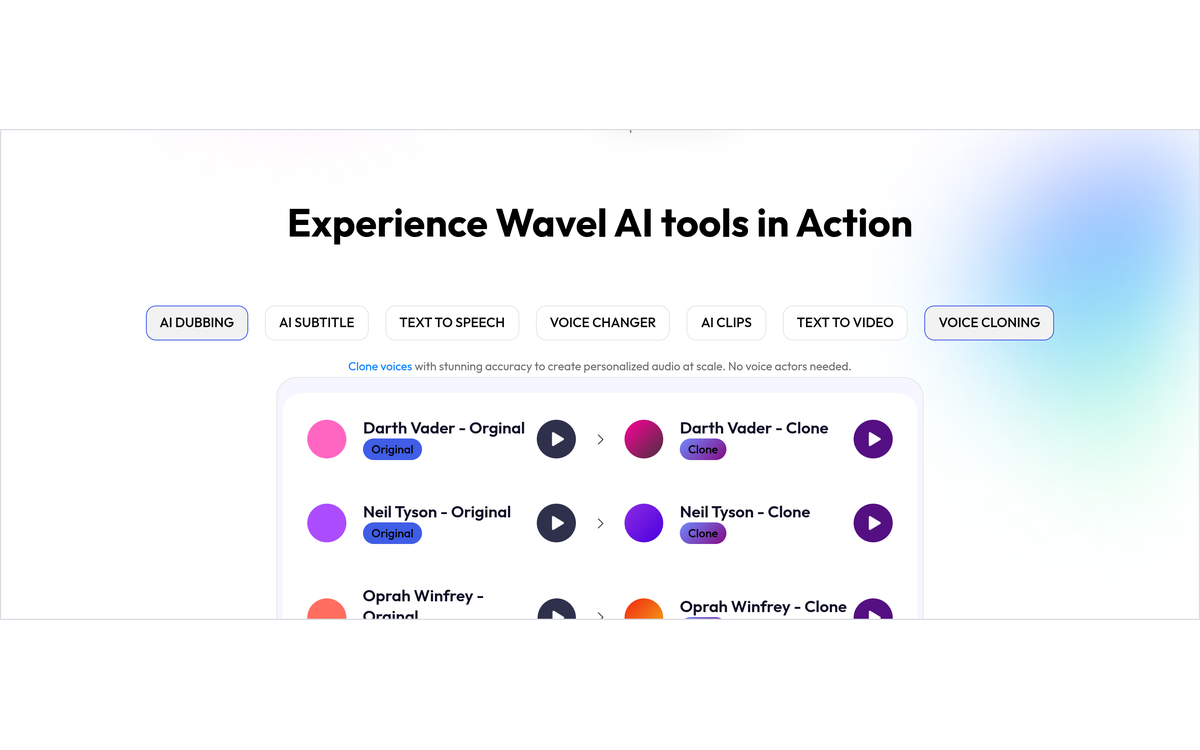
Step 3. Voice selection or a cloned voice. The dub can carry a library voice, an emotional variant of one, an accent-adjusted version of your own recording, or a clone trained on a sample you supply. The vendor's clone pages state that thirty seconds of clear audio is enough for a basic clone and that two to five minutes is recommended for professional-grade output, with MP3, WAV, M4A and FLAC accepted. The same pages state that a voice you have permission to use may be cloned and that a character voice may be cloned, and the terms separately require written consent for every identifiable person in your Contributions. Section 7c sets both statements out side by side.
Step 4. Sync, style and render. Dubbing applies lip-sync as an add-on on the higher tiers, and captions can be burned in or exported as SRT only. Caption styling is a preset surface: a list of typefaces, five sizes, a set of emphasis colours and a set of animation styles. Rendering is where the credits are consumed, and this is the step that shapes the honest cost of the product: the charge falls when the render starts, not when it succeeds.
Step 5. Repurpose or generate. The same upload can be cut into vertical clips with the captions already burned in, run through noise cleaning, or used as the input to the avatar and prompt-driven video surfaces, which draw on third-party generation models by name in the interface, including Kling, Google Veo and OpenAI Sora.
Inputs: a video or audio file in a common format; a typed or pasted script; a voice sample of at least thirty seconds; a still image or a prompt for the avatar and generative surfaces; a target language per run.
Outputs: an MP4 with the dubbed or replaced audio track; an MP3 or WAV of the generated voice; SRT, VTT or document subtitle files; translated subtitle tracks; vertical clips with burned-in captions; and, on the generative surface, a generated video file.
Technology. The platform does not publish its own architecture, model names, parameter counts or training data for the speech surfaces, and it names third-party models only inside the generative video interface. The API page states a latency target of under 300 milliseconds for the speech service, which is a responsiveness figure rather than an accuracy one, and no benchmark, test set or accuracy measurement appears on any surface of the site.
The credit model, stated as the vendor publishes it. Three credits per minute of dubbing, three credits per minute of video edits, one credit per minute of subtitles in any language, and one credit per minute of voiceover in any language. Credits roll over each month on paid plans. Tiers are 100, 300 and 1,000 credits per month on Basic, Pro and Scale, which converts to roughly 33, 100 and 333 minutes of dubbing per month before any revision work is counted, against 100, 300 and 1,000 minutes of subtitle or voiceover work on the same allowance. The free tier is fifteen one-time credits and cannot be topped up.
Integrations and the API. A REST API is documented and included on paid plans, with a developer documentation site published separately. The API comparison table adds the operational limits that the marketing pages omit, including the upload-length tiers, the export formats and the retention windows. There is also a Discord community and a documented developer path, and the platform exposes team spaces on paid plans.
Where the data goes, as the published documents describe it. The terms state that the site is hosted in Singapore and that by using it you agree to your data being transferred to and processed in Singapore. The privacy policy is a template document that describes log files, cookies, third-party advertising partners and the GDPR and CCPA rights a user holds, and it names no retention period for uploaded media, no sub-processor list beyond a reference to advertising partners, and no controller contact beyond the support address. Section 7c takes that position and the contract position together.
Getting Started with Wavel AI
The interface is easy and the setup is not, because the decisions that determine whether the output is usable are made before the first render. This is the checklist that makes the difference.
A fifteen-minute checklist:
Decide the market before you open the account. Minute 1. Ask which languages are worth carrying and why, from audience data. A language list is not a market case, and every additional language is a review obligation rather than a feature.
Read the three legal documents on the paid tier you intend to buy. Minutes 2 to 6. The terms of service for the licence and the consent requirement, the refund and dispute policy for the cancellation and chargeback rules, and the pricing page for the credit conversion. The vendor's own surfaces describe the same material from three angles and they disagree in places, which Section 7c records.
Register and run the free tier on the shortest real sample you have. Minutes 6 to 9. Fifteen one-time credits is enough for about five minutes of dubbing. Use a clip whose output you can judge and whose worst case is not a client deliverable.
Check the credit maths against a real job. Minutes 9 to 11. Dubbing is three credits per minute, so a ten-minute video is thirty credits, which is under the Basic allowance of 100 and over a third of it once you allow for one revision pass. Price your actual workload before choosing a tier.
Decide the consent and disclosure positions and write them down. Minutes 11 to 14. Written consent for every identifiable person whose voice or likeness goes into the account, and a stated position on whether each market's audience is told that a voice was synthesised. Neither is supplied by the platform.
Name the native reviewer for each target language. Minute 15. One named person per market, with the authority to reject a version. This is the single highest-value decision in the setup and the one the default workflow omits.
What to do before you start, if you are doing this on behalf of an institution:
Confirm that everyone whose voice or likeness appears has agreed in writing to a third-party service processing it. The terms require exactly that, and they also require you to hold the rights for anything you upload.
Confirm the retention position. The privacy policy names no retention period for uploaded media, and the API comparison table sets archive retention at three months on paid tiers, which is a different question answered on a different page.
Read Section 7c before uploading client material, not after. The licence over what you upload, the refund position and the chargeback clause all bear on whether a commercial deployment is safe, and none of them is on the pricing page.
Decide where the decision record lives. The platform keeps the media and the project. It does not keep the consent record, the reviewer's name or the disclosure decision.
Real Workflows
Three workflows, each with a time budget, a verification checklist and the point at which the honest user stops.
Workflow 1: The back-catalogue move, one video into two languages
What it is. A ten-minute video that already exists, dubbed into two languages for an audience the team can already name.
Steps. Upload the video. Check the auto-detected source language and correct the transcript by hand, fixing names, product terms and any sentence the engine heard wrong. Translate into the first target language and read the translated transcript before rendering, adjusting for formality and for anything that reads as foreign. Select the voice: the original speaker's clone if there is a consent record, a library voice otherwise. Render the dub. Run the same sequence for the second language.
Time budget. Roughly forty minutes of human work for two languages, plus processing. The transcript correction is twenty of those minutes and it is the part that decides the quality of everything downstream.
The point at which the honest user stops. If the translated transcript contains a sentence nobody on the team can assess, stop before the render. Rendering an unassessable translation produces a confident-sounding file that nobody is qualified to release, and the platform will not flag it.
VERIFICATION CHECKLIST for Workflow 1:
☐ Multi-Model Check: run the translated transcript through a second translation engine and compare the two, sentence by sentence. Differences mark the sentences that need a human, and they are usually the idiomatic ones.
☐ External Source: check every name, product term, figure, unit and legal phrase against the source material rather than against the translation.
☐ Human Review: a native speaker of the target language reads the transcript, then listens to the rendered audio before release. This is the review the platform offers as an enterprise option and leaves off by default.
☐ CI-First Test: can the reviewer explain what changed in the localised version, and why, without the tool? If not, the version is not ready.
Workflow 2: The script-to-narration module for a course or explainer
What it is. A written module becomes narrated audio, with no recording session.
Steps. Write or paste the script. Choose a voice and an emotion preset. Generate. Listen for the sentences that do not work when spoken, which is a different list from the sentences that do not work on the page. Edit the script rather than the audio, and re-render. Add subtitles from the same audio at one credit per minute rather than three.
Time budget. Fifteen minutes for a five-minute module including one revision, and the revision is the normal case rather than the exception. Budget two renders per module.
The point at which the honest user stops. At the second or third revision on the same paragraph. If a sentence keeps landing wrong, the problem is the writing and not the voice, and further renders will not fix it.
VERIFICATION CHECKLIST for Workflow 2:
☐ Multi-Model Check: have a second speech engine read the two or three sentences that matter most, and compare the renderings against what you intended. Where both engines mispronounce the same word, spell the word phonetically in the script.
☐ External Source: check every figure, name and quoted line in the narration against the written source before publishing.
☐ Human Review: someone who will hear this as a learner listens to the whole module and names anything they had to replay to understand.
☐ CI-First Test: could you deliver this module live without the audio? If not, the module depends on a synthetic voice rather than on your teaching.
Workflow 3: The localisation release, where the decision record matters most
What it is. The workflow that carries the real risk, because it puts a synthesised voice in front of an audience that has not been told, in a language the team cannot fully evaluate.
Steps. Decide the release scope: which markets, which channels, which audiences. Apply the disclosure rule written in Workflow 1 to each market and record the decision per market rather than once. Confirm the consent record for any cloned voice, in writing. Assign the named native reviewer per language and give them the authority to reject. Publish with the reviewer's name attached, and file the record where the team keeps its decisions rather than in the platform.
Time budget. Thirty minutes for the documentation and the review, on top of Workflow 1. It is the part that turns a translation into a localisation, and it is the part that costs the most and shows least in the interface.
The point at which the honest user stops. If the disclosure decision cannot be justified for a market, or if the named reviewer cannot be found, do not publish in that market. A synthesised voice in a market that has not been told is a reputational exposure the platform does not price.
VERIFICATION CHECKLIST for Workflow 3:
☐ Multi-Model Check: for the highest-stakes market, run the transcript through a second engine and have the native reviewer compare both before the render.
☐ External Source: verify the disclosure requirement for each market against a current source rather than against this review or a vendor page.
☐ Human Review: the named native reviewer signs off, and their name is attached to the release.
☐ CI-First Test: can the person releasing this explain, in the target language, what was said and what was changed? If not, the release is not theirs to make.
The verification rule that covers all three
The pattern is the same in each workflow and it is worth stating once, because it is the whole of this review's practical advice. Fix the transcript before you render, because the render is where the money and the time go. Put a native speaker between the render and the audience, because the platform cannot tell you whether the output is right. And keep the decision record somewhere you control, because the platform keeps the media and not the reasoning. None of the three steps is a feature. All three are the difference between using this tool well and using it to produce content nobody is qualified to release.
Strengths, Limits, and AI Imposture Risk
Strengths
The subscription covers a genuine stack, and the stack is the reason to choose it over a specialist. Dubbing, subtitles, text-to-speech, voice cloning, clip repurposing and noise cleaning all draw on one balance in one interface. A team that has been paying for four tools and moving files between them is the reader who gains most, and the gain is administrative as much as technical.
The text-to-speech and subtitle side is cheap in a way the dubbing side is not. One credit per minute against three for dubbing is a factor that matters at any volume, and it makes the platform a reasonable choice for accessible captions and narration work even where the dubbing quality ceiling is not good enough.
The transcript-first workflow is real and it is the right one. The editor exposes the transcript, the timing and the translation, and the platform is built so that fixing the text before rendering is possible. A tool that forces the loop through audio alone would be worse, and this one does not.
The published operational detail on the API page is better than most. The API comparison table carries file-size and upload-length limits per tier, export formats, retention windows, clone counts and the credit conversion in one place. That is the page that lets a buyer size a real workload, and it is more concrete than the marketing pages above it.
The platform is honest about its own limits in the places where it is asked directly. The clone pages state the sample length guidance, name the formats accepted and state that unauthorised cloning is prohibited and that consent is required. A vendor that publishes the requirements of its own riskiest feature is a better source than one that does not.
Localisation into many markets for one subscription is a real capability that most small teams simply do not have. The comparison is not against the ideal dubbed track. It is against no dubbed track at all, and on that comparison this class of tool wins clearly.
Limits
No independent measurement of quality exists, and this is the finding that caps the score. There is no published accuracy figure for any surface: no pronunciation benchmark, no subtitle-accuracy test, no dubbing-fidelity measurement. The voice quality position in this review comes from user reports and from third-party comparison articles that describe the output as serviceable but behind the specialist engines, and those are opinions rather than measurements. A quality claim without a measurement is not a quality benefit.
The vendor's own language figures do not agree with each other. The same month's pages state 100 or more languages in site headers, 40 or more in the pricing comparison table, 70 or more in the API comparison table and 149 or more on one cloning page. A reader cannot audit the coverage claim from the vendor, which is a different problem from the coverage itself being wrong.
Long files are where the platform is least reliable, and the published limits disagree too. User reports describe failures, lag and lost work on uploads longer than fifteen minutes, and the API comparison table's upload length differs from what the plan pages imply. For anyone whose material is long form, that is a practical constraint rather than a footnote.
The credit economy prices the revision loop, and failed renders cost the same as successful ones. Dubbing is charged per minute at three credits, consumption happens when the render starts, and a failed render has to be reclaimed through support rather than automatically. The advertised allowance therefore describes first attempts rather than finished work.
The voice ceiling is a real ceiling. A listener familiar with the specialist engines will hear the difference. Where the audio is the deliverable rather than a supporting layer, this is not the tool for the job.
The legal position carries several clauses a commercial reader should weigh. The refund policy states that refunds are not offered, that a request must arrive within two days, that cancellation must be filed at least seven days before renewal, and that a chargeback raised without contacting the vendor first is treated as a breach of policy and met with the policy as evidence. The terms take a permanent, irrevocable, worldwide licence over your Contributions with your image and voice named. Section 7c sets these out.
The privacy policy is a template, and a media platform's privacy policy is not a place where a template is adequate. It describes log files, cookies and advertising partners and it lists GDPR and CCPA rights, but it names no retention period for uploaded media, no controller identity beyond the support address, and no sub-processor list. Section 7c records it.
There is no labelling requirement and no default watermark for downloaded output. The platform asks for consent on the way in and provides no provenance signal on the way out. Whether an audience is told that a voice was synthesised is entirely the publisher's decision, and the platform does not prompt it.
AI Imposture Risk
Trap | Rating | Evidence |
Time Illusion | Medium | The mechanical saving is real and immediate: a script becomes audio in minutes, and a dubbed track replaces a booking, a studio and a second performer. The illusion is in the revision loop. Dubbing is charged at three credits per minute with consumption at the start of the render, so a script with three sentences that land wrong is four renders rather than one, and a failed render is a support ticket before it is a refund. Long uploads are reported as slow and unreliable, which puts the waiting time back into the day. First-draft savings are large; time to a publishable track is materially longer than the interface suggests |
Quantity Illusion | Medium | The platform makes it trivially easy to produce many languages and many variants of one asset, and that is the risk rather than the benefit. A viewer cannot audit a dub whose language they do not speak, and a serviceable synthetic voice sounds finished in a way that discourages the review that would catch a wrong register or a mispronounced name. The specific mechanism: a translation that is 90 per cent right reads as complete to every person on the team who cannot check the remaining 10 per cent, and the platform supplies no accuracy signal that would prompt anyone to look |
Skill Illusion | High | Two mechanisms, both documented. First, the product is sold on removing the production requirement: the vendor's own framing is a complete studio without the studio, and no teaching surface, critique or measurement is provided for a user to develop the judgement the tool substitutes for. Second, and more specific, a user who cannot evaluate the target language holds a published artefact they cannot defend. The platform will render confident audio in a language the operator does not understand, will label nothing, and will not indicate its own uncertainty at any point. A reader who can hear the difference between a good take and a plausible wrong one has the skill. One who ships the first render in a language they do not speak does not, and the tool will not tell them which they are |
Overall AI Imposture Risk: Medium, with Skill Illusion High. Two traps are Medium and one is High, which the framework places at Medium overall because the Time and Quantity traps carry mitigations the user controls, while the Skill trap is created by the product's own design and is not resolved by it.
Framework v1.2 clause note
Three clauses of the CI-First framework, version 1.2, are checked against this tool, and all three return a null. Each null is a finding rather than an omission.
Clause 5.2.3-a, agent-authored procedural memory, with a Skill Illusion floor of no lower than Medium. This clause governs a tool that writes procedural memory on the user's behalf: instructions, skills or rules the agent keeps and reuses as its own operating procedure. Wavel AI writes none. It produces audio files, video files, subtitle tracks, a voice model trained on a sample you supplied, and a project record inside your account. Those are artefacts you own and can delete rather than an agent's procedural memory, and the voice model is a rendering asset rather than an instruction the system follows in later sessions. The boundary matters here because the platform is agent-adjacent and a reader could reasonably assume the clause applies to a trained clone. It does not, and the reason is that the artefact is output rather than memory. The distinction is worth stating plainly in both directions: the clone is durable and it is reused, but it carries no procedure, no rule and no standing instruction. Skill Illusion is nevertheless rated High in this review on the separate ground that the product is sold on requiring no skill and provides no standard, feedback or measurement with which a user could evaluate what it produced.
Clause 4.2-a, agent-mediated conversation. This clause returns a null. It governs channel composition in agent-mediated human conversation, and it states that erosion requires either agent-authored text presented as the person's own voice in a human-facing channel, or the substitution of agent interaction for human contact. Wavel AI runs no conversational agent and writes no prose on anyone's behalf. The product is a production tool: it renders audio and video that a business or a creator then publishes under its own name, and the synthetic voice is a production asset the publisher chooses and discloses or fails to disclose. Section 7c records the consequence, which is that the disclosure decision belongs entirely to the publisher. The Social Authenticity rating of Erodes in the Co-Intelligence Rating below does not rest on this clause, and a reader should not infer that it does. It rests on the substitution of synthetic delivery for the person's own voice on the record, which is the mechanism the Humics dimension reaches directly.
Clause 7.5, team-level rooms. This clause returns a null. It applies where several named agents share a channel with the human, and it requires a written task boundary per agent with Centaur as the default. The platform's team space is several people sharing an account and a credit balance, and its API serves programmatic jobs one at a time. Neither is a room in which several agents act on one conversation, and no configuration makes two agents converse with each other. Centaur is nevertheless the recommended Collaboration Mode in this review, and it is derived from the framework's own risk rule at Section 7.2 rather than from this clause.
Section 7c: The licence over what you upload, the refund position, and the consent requirement, stated plainly
Three of the vendor's own documents decide whether a commercial deployment is safe, and each one is quotable. This section quotes the operative text, keeps allegation and finding distinct, changes no score, and states what the section does not do.
The licence you grant over your own material. The terms of service, section 7, headed Contribution License, state that by posting your Contributions you grant the vendor an "unrestricted, unlimited, irrevocable, perpetual, non-exclusive, transferable, royalty-free, fully-paid, worldwide right, and license to host, use, copy, reproduce, disclose, sell, resell, publish, broadcast, retitle, archive, store, cache, publicly perform, publicly display, reformat, translate, transmit, excerpt (in whole or in part), and distribute such Contributions (including, without limitation, your image and voice) for any purpose, commercial, advertising, or otherwise". The same section grants the right to sublicense those rights and states that the licence "will apply to any form, media, or technology now known or hereafter developed".
Two things follow, and the review states both rather than picking the more alarming one. First, the clause names your image and voice explicitly. A reader who clones a voice or uploads a video of themselves is handing over a permanent, worldwide, sublicensable licence over that likeness, granted at the moment of upload and not withdrawn by later deleting the account. Second, the terms do grant something back: the same section states "We do not assert any ownership over your Contributions. You retain full ownership of all of your Contributions". Ownership and licence are different things, and the review separates them because vendors blur them. You keep the file. You also grant a permanent right to distribute it commercially. Both sentences are in the same section of the same document.
The refund, cancellation and chargeback position. The Refund and Dispute Policy states: "Because our AI services involve real-time processing and significant infrastructure costs, we do not offer refunds, except in rare and exceptional cases." It adds that "All refund requests must be submitted within 2 days of the original transaction. Requests made after 2 days will not be reviewed," and that refunds are granted "solely at our discretion and only in cases of proven technical error or duplicate billing, supported by verifiable evidence". Cancellation requires that you "must cancel at least 7 days before the renewal date via your Wavel AI account or by emailing reachout@wavel.ai". On disputes, the policy instructs users to contact the vendor first and states that a chargeback initiated without that contact, or without proper proof, "will be treated as a breach of this policy", that the vendor "will challenge the dispute using this published Refund Policy as evidence", and that it reserves the right to "take further action, including account suspension".
This is a decision to make before purchase rather than a scandal, and the review states it that way. The two-day refund window sits inside a seven-day cancellation window, so the practical position is that a subscription is a commitment for its billing period once a plan is charged. A reader testing the platform on the free tier first, then starting on a monthly rather than annual plan, is making the choice the terms reward.
The consent requirement for a cloned voice, and the two surfaces that describe it differently. The terms, section 6, require a user to warrant that "You have the written consent, release, and/or permission of each and every identifiable individual person in your Contributions to use the name or likeness of each and every such identifiable individual person". The clone pages describe the same activity differently: one states "You can upload any voice sample you have permission to use. Cloning voices of public figures or copyrighted characters without consent may violate legal and ethical guidelines," and another permits cloning "any character's voice if you have a clear audio sample" while advising that you hold the legal rights for public or commercial use.
Read separately, the product page reads as a permissive cloning tool and the terms read as a documented consent regime. Read together, they answer the same question at two different levels of formality, and the contract is the stricter of the two. The review takes the contract as governing, and it records that the page a user is most likely to read before cloning is the permissive one.
The data position, and why a template policy is the finding here. The privacy policy is a generated document. It describes log files, cookies, third-party advertising partners and the GDPR and CCPA rights a user holds, and it names no retention period for uploaded media, no controller identity beyond a support address, and no list of sub-processors. Against that, the API comparison table publishes archive retention windows of three months on paid tiers and one month on free, and the terms state that the site is hosted in Singapore and that using it transfers your data there. A media platform holds video and voice samples, which are the two categories a buyer asks about first, and the documents answer the retention question in a plan comparison table rather than in the policy.
One asymmetry worth stating as a reader risk rather than as a defect. The platform asks for consent and permission on the way in and supplies no provenance signal on the way out. No labelling obligation and no default watermark is documented for downloaded audio or video, and the use-case pages describe publication to social platforms without mentioning disclosure. A reader who assumes the platform marks its synthetic output, because it takes consent seriously at upload, is assuming something the documents do not claim.
An unusual amount of published detail, and it belongs in the same section. The API comparison table is candid where a marketing page would not be: it publishes per-tier upload limits, retention windows, export formats, clone counts and the exact credit conversion in one place. The clone pages state the sample-length guidance, the accepted formats and the consent requirement. The refund policy states its terms without euphemism, including the chargeback consequence. A vendor that publishes the limits of its own product is a better source than one that does not, and it is why this review's Skill Illusion rating rests on a documented design choice rather than on suspicion.
What this section does not do. It does not give legal advice, and it does not assert that any clause is unlawful, unfair or unenforceable. Terms of this shape are common in the category, and the review records them so a reader can weigh them. No score in this review changed because of anything in this section: the Quality sub-score is capped by the absence of independent measurement, not by the contract, and the Social Authenticity rating rests on the synthetic-delivery mechanism rather than on the licence.
U365 Co-Intelligence Rating
CI-First Profile
Primary profile: Co-Worker and Assistant (level 2). The tool performs an execution task, producing audio, subtitles and video under human direction and review. You supply the file or the script, choose the settings and the language, and accept, reject or re-render the output. That is delegation with review, which the framework places at level 2.
Secondary profiles: Co-Creator and Thought Partner (level 1), on the script and generative surfaces, where the tool is used to explore angles or a draft that did not exist before rather than to execute a decided one. Analyst and Tester (level 4), narrowly, for the reader who uses the transcript and translation editors to interrogate a rendering: correcting the transcript by hand, comparing the translated text against the source and reading the timing before the audio is produced is analysis of the platform's own intermediate output, and it is the highest-value use of the tool.
Why level 2 and not level 1 as the primary. Level 1 would mean the human and the tool build on each other's thinking across the work. Wavel AI does not work that way: the direction of the work is supplied by the user and the platform renders. The generative video surface comes closest, and it is a surface that draws on third-party models rather than on a co-creation loop with the user.
What does not fit. Challenger and Devil's Advocate (level 5) does not apply. Nothing in the platform argues against your script, your language choice, your register or your decision to publish. The nearest thing it does is render a sentence badly enough that you notice the writing does not work when spoken, which is a production prompt rather than a challenge.
Collaboration Mode
Recommended mode: Centaur.
Mode rationale: The framework's own rule leads. Imposture Risk is Medium with Skill Illusion High, and Section 7.2 assigns Centaur when risk is Medium or High, because Centaur is safer. The independent ground is specific to this tool and it is a property of the artefact. A Cyborg mode would require a stopping criterion the human applies inside a fast iteration loop on one continuous piece of work. Here, the loop is short and it terminates in a rendered file, and the judgement that matters happens after the render rather than inside it: somebody has to listen to the finished track, in a language they may or may not speak, and decide whether it may be published. That is a review step with a name attached, not an iteration loop. The division of labour that makes the boundary real is procedural rather than technical: fix the transcript before rendering, put a native speaker between the render and the audience, keep the consent record and the disclosure decision where you can find them, and use your own voice for anything whose value depends on your presence. You own the judgement about whether a version is fit to publish in a market. The platform owns rendering.
CI-First Benefit Score
Dimension | Score (0-10) | Rationale |
Time | 6 | Moderate savings, and they are structural rather than claimed. A script becomes audio in minutes, a dubbed track replaces a booking and a studio, and a subtitle track replaces a transcription pass. The score is 6 rather than higher because the overhead is real and documented: dubbing is charged at three credits per minute with consumption at the start of the render, so the revision loop is paid for per attempt, a failed render is a support request rather than a refund, long uploads are reported as slow and unreliable, and the review step that makes the output publishable is work the tool does not do for you. First-draft savings are large; time to a publishable track is materially longer than the interface suggests |
Quantity | 6 | A genuine step change in the number of languages and variants a small team can serve from one asset. One upload becomes several subtitle tracks, several dubbed versions and several vertical clips, and the text-to-speech surface at one credit per minute makes narration volume cheap. Held at 6 rather than higher because the framework scores verified usable quantity, and the marginal unit is not free: every additional language is a native review your team has to staff, every dubbing minute is three credits, and nothing in the product or on the market measures whether the additional volume was any good |
Quality | 4 | Marginal, and it is scored from measured absence rather than from measured weakness. The vendor publishes no accuracy figure of any kind on any surface: no pronunciation benchmark, no subtitle-accuracy test, no dubbing-fidelity measurement, no evaluation methodology. Third-party comparisons place the voice quality behind the specialist engines, and user reports describe the output as serviceable and the dubbing as robotic, which are opinions rather than measurements. The platform also publishes four different language counts across its own pages in the same month, so a reader cannot audit the coverage claim from the vendor. Where measurement exists it is a latency target of under 300 milliseconds, which is a responsiveness figure and not a quality one |
Skill | 4 | Marginal, and scored conservatively because the framework directs it. There is a real learning surface in the right use of the tool: fixing a transcript before rendering, writing for the ear rather than the page, and learning to hear what a bad render sounds like are genuine production disciplines, and the editor makes the first two accessible. The score is 4 because the product's purpose is to remove the requirement, it provides no standard, critique or measurement for the user to apply, and the judgement that matters most, hearing the difference between a correct rendering and a plausible wrong one in a language you do not speak, is the judgement the platform will not teach and cannot delegate without losing. A reader gains vocabulary and production habit and does not gain the ear the vocabulary describes |
CI-First Benefit Score: (6 + 6 + 4 + 4) / 4 = 5.0 / 10 (CI-First Positive)
Why this score is not higher, and why it is not lower
Why it is not higher. The step from Positive to Strong requires evidence that the volume it produces is good, and no such evidence exists. There is no independent measurement of dubbing, voice or subtitle quality anywhere in the category, the vendor's own language figures contradict each other, and the quality ceiling is described by third parties as below the leaders. The revision loop is priced per attempt rather than per usable result, and failed renders do not refund themselves. A score above 6 would be asserting a quality position the evidence does not support, and the framework's instruction is to score the honest user and the common case net of overhead rather than the best case.
Why it is not lower. The capability is genuine and the arithmetic is honest. Localising content into several markets for a subscription rather than a quote is something most small teams simply cannot do otherwise, and the comparison that matters is against no localised version at all. The transcript-first workflow is the right design and it is exposed rather than hidden. The text-to-speech and subtitle surfaces are cheap and reliable enough to carry their own weight. And the published operational detail on the API page is more concrete than most vendors in the category supply. That is a real recommendation with a named review step, which is what the CI-First Positive band means.
Humics Protection Badge
Dimension | Rating | Rationale |
Creativity | 0 | Neutral. The platform can serve creative decisions: hearing your own writing read back regularly exposes a sentence that does not work, and a dubbed version that lands in a market can open content decisions that were not previously available. It can also replace the creative decision entirely, because selecting a voice from a library and accepting the first render means no performance choice and no language choice was ever made. The two effects balance, so the rating is neutral rather than protecting |
Critical Thinking | -1 | Erodes, and the mechanism is specific to the medium. Spoken output is harder to audit than written output: a listener cannot scan a rendering for the word that sounds wrong, and a fluent synthetic voice encourages acceptance because it sounds finished. The layer that makes this worse is language, because a dub in a language the operator does not speak cannot be audited by the person accountable for publishing it, and the platform supplies no uncertainty signal to prompt anyone to look. No labelling obligation and no default watermark is documented for downloaded output, so whether an audience is told is left entirely to the publisher. Sustained use with no review habit trains a team to accept audio nobody on it has checked |
Social Authenticity | -1 | Erodes, and this judgement is made against the mechanism rather than against the category. The erosion is not in using a synthetic voice as a tool. Dubbing and cloning replace your own voice with synthetic delivery: the output reaches other people as your voice, generated by a model trained on a sample you supplied, so the person on the receiving end experiences a performance you did not give in a language you may not speak, and the permanent licence over that likeness in Section 7c makes the arrangement durable rather than a single act. The counter-case is recorded rather than dismissed: using the platform to script, rehearse or subtitle your own spoken content, and then delivering it yourself, protects the Humic, because the tool improves what you say rather than replacing how you sound saying it. The rating is -1 because the common use of this platform is the first pattern, not the second |
Humics Protection Badge: Humics-Risky (-2 / +3)
Superhuman Usage Guidance
When to invite the tool:
Localising content you already own into markets you can name and audiences you can justify, with a native reviewer attached to each language before the work starts.
Captioning and subtitling, where one credit per minute makes accessibility work affordable and the accuracy bar is one a reviewer can actually apply.
Producing narration for internal material, draft explainers, prototypes and scripts whose audience is your own team and whose worst case is a re-render rather than a publication.
Turning a long recording into vertical clips, when the clips are for your own channels and you are checking each one before it goes out.
Working inside the transcript and translation editors, which is the one surface where using this tool builds judgement rather than replacing it.
When to keep the tool out:
Any published output in a language nobody on the team can assess, until a named native speaker has reviewed it. This is the first and most important exclusion in the review.
Client-facing work where the audio is the deliverable rather than a supporting layer, because the quality ceiling sits below the specialist engines and no measurement exists to tell you otherwise.
Anything that clones a voice or likeness you do not hold written consent for. The terms require the consent, the clone pages read more permissively, and the contract governs.
Any material you are not willing to license permanently and worldwide for commercial distribution, because uploading grants exactly that in section 7 of the terms.
Regulated, medical, financial, legal or safety-critical content, where a synthetic voice making a claim raises obligations the product supplies no workflow to manage.
Long-form material above the published upload limits, and any workflow whose deadline assumes a first-attempt render succeeds.
U365 method integration:
LIPS and CARE: the decision record belongs in LIPS, not in the platform. Put the consent records, the per-market disclosure decision and the reviewer's name against each published version in your LIPS under the project. The platform holds the media; LIPS holds the rule that governs it and the evidence that the rule was applied. In the CARE cycle the platform supports Collect and Execute, and it should never be allowed to make the Review decision on your behalf, which is precisely what happens when a rendered file is treated as a finished one.
UP-Context: the boundary this workflow needs is the one the default workflow omits. Write the publication rule before the first upload: which markets, which languages, what consent is required, what the audience is told, and who signs. The prompt pack in Verdict and Next Steps turns that into a working brief.
ULM: primarily Career and Finance, and Quality of Life. The tool changes the cost of a professional output and removes a recurring production burden, which is a Career and Finance question, and it returns time, which is a Quality of Life question. Character and Emotions is touched in one specific way: deciding not to publish a synthetic voice in a market that has not been told is a discipline rather than a feature. Weak fit for Body and Health, Spirit and Mind, and Social and Love Relationships.
My Successful Life: put the review step on the cadence your content cycle already runs on, and put the per-market disclosure decision on the same schedule as the release. The trigger to watch is the moment a version is approved for publication, because that is the point at which a reviewer's name should be attached and, in most teams, is not.
What Users Say
The platform is rated on four public surfaces, and the two that carry real volume answer differently on purpose. Averaging them would erase the reason they differ, so this review does not.
Aggregate Rating Table
Platform | Rating | Volume | What the cohort is rating |
G2 | 4.3 out of 5 | 50 reviews | A technical and business cohort, rating dubbing and translation as a working tool. The distribution is concentrated: 62 per cent of reviews are five star and 32 per cent are four star, with 4 per cent at three stars and 2 per cent at one star |
Trustpilot | 3.5 out of 5, with the profile page's own summary figure showing 3.7 | 35 reviews | A paying-customer cohort, driven by billing, credit and cancellation disputes rather than by output quality. The vendor has replied to 75 per cent of negative reviews and typically answers within a day |
Product Hunt | 4.8 out of 5 | 13 reviews | Early adopters of the launch, thin volume but detailed on the audio surfaces. The platform's own summary concedes the endorsement is favourable but thin |
Slashdot | 4.8 out of 5 | Not stated on the surfaces read for this review | A directory cohort, which the vendor reproduces on its own pages alongside the G2 and Product Hunt figures |
The spread is the finding. The same product holds 4.3 on the platform where people review what it does and 3.5 on the platform where people review what they were charged. That divergence is not noise: it is one product with a working core and a commercial layer that generates complaints, and both are real.
What Users Praise
The dubbing surface, repeatedly and specifically. A long-standing Trustpilot review states that "The video dubbing works pretty well" and that the tool is cheaper than the alternatives, and that pattern recurs across the positive reviews. The most detailed praise concerns the audio controls rather than the output alone: users describe being able to fine-tune voice speed, tone and volume for a specific audience, and one notes that the ability to clone a voice and see it improve over time was the reason for staying.
The suite being in one place. Positive reviews name the combination rather than a single feature: dubbing, translation, subtitles and voiceover from one account, which is the same reason this review's Strengths section names it. A user's summary on the vendor's own page describes using it daily to dub client videos without re-recording for each country, which is the workflow the product is built around.
Support, in a way that is worth separating from the rest. Several positive reviews and one two-star review independently praise the support team: "Very attentive customer service. They reply within a few hours and always resolve a problem and reimburse the credits if something doesn't work as expected!" The two-star review says the same thing while rating the product poorly: "Customer service is good and efficient". Support is not the complaint.
What Users Complain About
Credits consumed by failed or wrong generations. This is the most consistent complaint in the corpus. One reviewer states that "Some AI videos are generated wrong unless your platform deducts from our credits many times", and an independent review records the same mechanism: the credit balance is deducted when the render starts, and a failed render has to be reclaimed through support. The vendor's own reply in that thread confirms the pricing structure rather than disputing the mechanism.
Credits that cannot be used without changing plan. The same reviewer adds: "We have more than 1000 credits can't be used unless we have to select a plan. It is not normal since you are charging your fees by credits not monthly subscription!" Whatever the merits of the rule, the complaint is about the mismatch between a credit-based mental model and a subscription-based enforcement, and it recurs.
Translation quality in specific languages, and the free-tier boundary. One reviewer's complaint is headed "terrible translation in dutch", and the vendor's reply is that video generation is not a free-plan feature and that voiceover and dubbing were available to try. A second reviewer records the dubbing as "robotic (tiktok TTS level)" while crediting the speed and the interface, and notes that the background-music preservation option did not work as expected. These are quality complaints from people who could evaluate the output, which is the cohort whose judgement matters most here.
Long files, where the platform is least reliable. An independent review reports that uploads longer than fifteen minutes frequently lag, hit save errors or fail to render, which is consistent with the API comparison table's own upload-length tiers and with the credit-loss complaint above. This is the one limit that appears in both the vendor's published tables and the user corpus.
Billing friction around cancellation and refunds. The complaint pattern that produces the Trustpilot score is about money rather than media: cancellation windows, refund refusal, and credits that expire with a subscription. Section 7c sets out the published policy those complaints are about, and the policy explains the complaints without excusing them.
A separate class worth naming rather than merging: the vendor's own review-invitation profile. Trustpilot's own summary states that the company "hasn't invited customers recently, so reviews may not be representative", which is a statement about recruitment rather than about the product. It is recorded here because it bears on how much weight the 3.5 carries, not because it changes the direction of the complaints.
Sentiment Summary
The pattern across all four surfaces is consistent once the cohorts are separated. People who use the platform for what it is good at, which is affordable dubbing, subtitles and voiceover at volume with responsive support, are satisfied and rate it well. People who meet the credit economy, the failed-render charge or the cancellation terms rate it poorly, and they rate the money rather than the media. Nobody in the corpus praises the output as indistinguishable from a human voice, and nobody describes an independent measurement, because none exists. The two things this review would most like to have are exactly the two things the corpus cannot supply: a controlled quality measurement, and a settled account of how the platform performs on long files.
U365 Editorial Note
This review is written for the reader who is deciding whether to put content into a metered localisation service, and the public record above points at the decision rather than settling it. The praise and the complaints are not in conflict: they describe a working product with a commercial layer that costs more in practice than it does on the pricing page, because the revision loop is charged per attempt and failed renders are reclaimed through support rather than automatically. The practical consequence is that the honest cost of this platform is a cost per finished minute and not a cost per minute rendered, and a reader who measures that number on their own material before choosing a tier will not be surprised by it later. Where sentiment and rigorous evaluation agree here, the finding is strong: the tool does the mechanical work competently and supplies no judgement about whether the work is fit to publish.
Comparison and Alternatives
Five alternatives, each with the case for choosing it over Wavel AI and the case against.
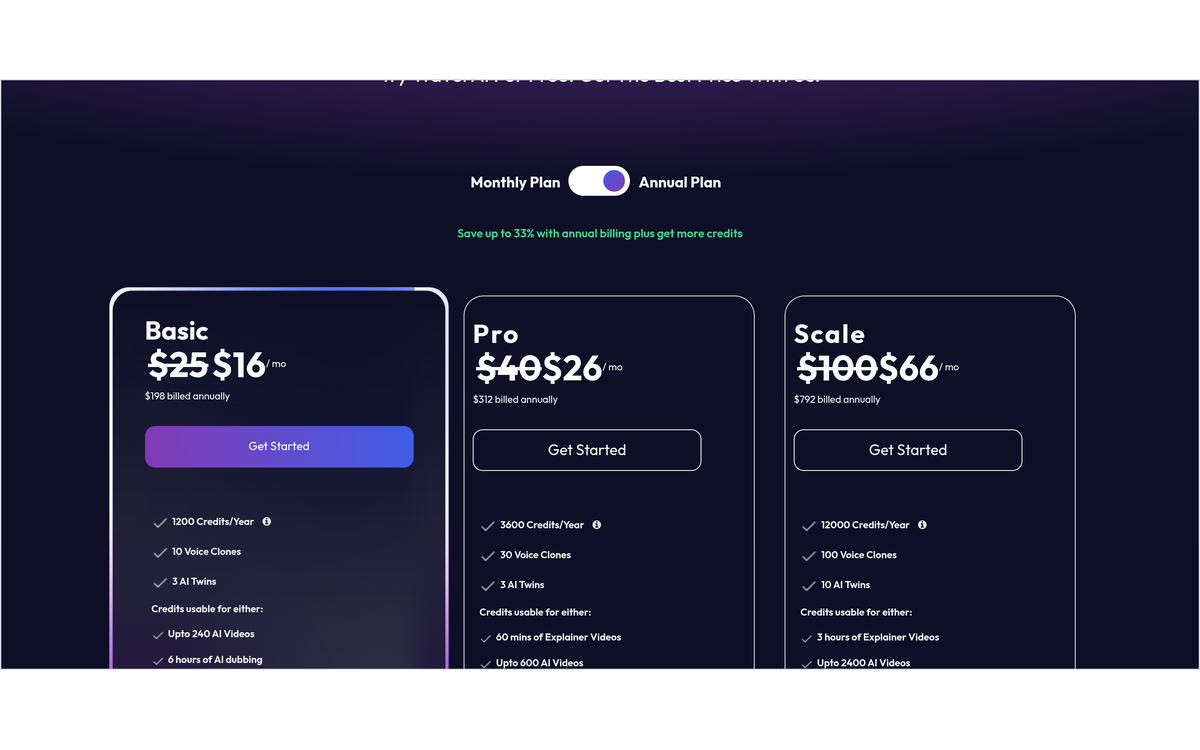
Tool | What it is | Choose it over Wavel AI if | Stay with Wavel AI if |
ElevenLabs | The specialist voice engine: text to speech, instant and professional voice cloning, dubbing, voice isolation and conversational voice agents, with five contradictory language counts of its own across its surfaces | The voice itself is the product. ElevenLabs' cloning and expressive speech sit above this platform's voice ceiling, and a reader whose deliverable is audio rather than video should pay for the better engine. It is also the stronger choice for anyone building a conversational or agent surface, which Wavel AI does not offer at all | You want the video pipeline rather than the voice. ElevenLabs gives you audio and a dubbing surface; it does not give you a subtitle editor, a clip repurposer, a caption style set or an avatar surface, and the subscription is priced for the voice rather than for the video work |
Rask AI | A dedicated video localisation platform with translation, cloning, lip-sync, glossary and terminology control, review workflows and enterprise delivery | You need the localisation workflow rather than the localisation tool. Rask publishes multi-speaker lip-sync, shared brand glossaries, reviewer roles with approval steps, and per-extra-minute pricing at the top of the scale, and those are the controls a team needs when output volume is high and the review chain is long. Its entry tiers and its per-minute arithmetic are structured around dubbing alone | You need the wider stack at a lower entry price. Wavel AI's text-to-speech and subtitle surfaces at one credit per minute, and its clip repurposing and caption styling, are outside Rask's scope, and its 100-credit entry tier is cheaper than Rask's comparable localization allowance |
HeyGen | An avatar-led video generation platform with translation and lip-sync, priced around avatar video rather than around dubbing | Your output is a presenter video rather than a dubbed one. HeyGen's avatar quality and lip-sync are the reason to choose it, and it publishes a clear plan structure with a monthly credit allocation and rollover. For training and explainer content where a synthetic presenter is the format rather than a compromise, it is the stronger product | You are localising existing footage rather than generating new video. Wavel AI's dubbing, subtitles and clip repurposing are built around material you already have, and its language and voice inventory is aimed at translation volume rather than at avatar performance |
CapCut or a general video editor with a transcription feature | The editing tool a creator already has, which increasingly includes automatic captions, translation on some plans, and template-driven vertical reframing | You want to stay in one editor and you do not need dubbed audio. For subtitling your own content in a language you speak, a general editor's caption feature is cheaper, faster and produces better craft control than any localisation platform, because you are editing rather than localising | You need other languages as audio rather than as text. A general editor gives you captions in other languages and not a dubbed track with a matched voice, and it offers no cloning or voice-generation surface at all |
A human translator and a voice actor, per language | The conventional supplier route | The content is high-stakes, client-facing, or in a language nobody on your team can evaluate. This is the option this review's own Skill Illusion finding points at, and it remains the right answer for any release where the honest question is whether the output is good rather than whether it is cheap | The volume makes the human route uneconomic and the material is internal, iterative or low-stakes. A first pass through Wavel AI and a human review of the result is a defensible pattern, and it is what Workflow 3 describes |
What none of these alternatives changes. Every tool in this comparison shares the same missing thing: no vendor in the category publishes an accuracy measurement a buyer can audit, and no product supplies a native-reviewer step by default. Choosing between them is choosing a price and a quality ceiling, not choosing whether the review obligation exists.
Verdict and Next Steps
Verdict: use it, for localising content you already own into markets you can name, with a native reviewer attached to every language before the first upload.
Wavel AI scores 5.0 out of 10, which is CI-First Positive. That is a real recommendation rather than a consolation. The platform removes a genuine production bottleneck, the subscription covers a stack that most teams currently pay four vendors for, the text-to-speech and subtitle surfaces are cheap enough to carry their own weight, and the transcript-first workflow is the right design rather than a workaround. On the honest-user and common-case basis the framework requires, that is worth recommending.
It is not scored higher for reasons that are specific rather than general. There is no independent measurement of output quality anywhere in the category, and this platform publishes none and contradicts itself on its own language counts. The credit economy charges the revision loop per attempt while failed renders are reclaimed through support. The voice ceiling is below the specialist engines and the third-party comparisons say so. Long files are the weak point and the published upload limits disagree with each other. And the contract carries a permanent worldwide licence over what you upload alongside a no-refund position and a chargeback clause, which are decisions a buyer should make deliberately rather than discover later.
Next steps, in order.
Measure before you buy. Run the Getting Started checklist on a real clip and write down credits per finished minute and wall-clock time per finished minute, revisions included. Those two numbers decide your tier, and neither appears on the pricing page.
Read section 7 of the terms and settle the licence question before client material goes into the account. If your work is client work, get the scope in writing, because the clause grants a permanent worldwide commercial licence over what you upload.
Read the refund and dispute policy. The two-day refund window, the seven-day cancellation window and the chargeback clause are the difference between a subscription you can exit and one you cannot.
Write the consent record and the publication rule, and keep them outside the platform. Written consent for every identifiable voice and likeness, and a per-market disclosure decision with a reviewer's name on it. The platform holds the media; it does not hold the reasoning.
Name the native reviewer per language before the first render, and give them the authority to reject a version. This is the step that separates a localisation from a translation, and it is the step no tool in this category supplies.
Re-check this review against the triggers at the top, and specifically when an independent quality measurement appears or when the vendor's own language figures converge.
U.Copilot Integration
U.Copilot is the front door to the U365 tool library, available at https://www.university-365.com/ucopilot. Use it before you upload anything here, because the publication rule is the part of this workflow that the platform cannot write for you and the part that decides whether the output is safe to release.
What to ask U.Copilot to do. Describe the content, the markets and the audience in each, and ask it to write the publication rule before any file is uploaded: what may be dubbed, what consent is required, what each audience is told, and who signs. Ask it to design the review step, naming what a native reviewer must check and what evidence a release needs. Ask it to build the credit budget from a measured cost per finished minute rather than from the advertised allowance. And ask it to place the decision record in your LIPS Digital Second Brain so the consent record and the reviewer's name sit with the content they govern.
U.Copilot prompt example.
Design a CI-First localisation workflow using Wavel AI for [content] into [languages] for [audiences]. Write the publication rule first: what may be dubbed, what written consent is required for every identifiable voice or likeness, what each audience is told about a synthetic voice, and who signs each release. Then produce the per-language review checklist for a native reviewer, naming the evidence a release needs. Calculate the credit budget from a measured cost per finished minute including the revision loop rather than from the plan's advertised minutes, and state which tier that implies. Connect the publication rule, the consent records and the reviewer names to my LIPS Digital Second Brain under [project], and tell me which parts of this workflow I must do myself.
SL-OS Integration
LIPS Digital Second Brain: the consent records, the per-market disclosure decisions, the reviewer names and the measured cost per finished minute belong in your LIPS under the project. The platform holds the media and the project; LIPS holds the decision record, which is what you need when a translation is questioned, a likeness is disputed or a cost is audited.
ULM routines: primarily Career and Finance, and Quality of Life. The tool changes the cost of a professional output and removes a recurring production burden, which is a Career and Finance question, and it returns time, which is a Quality of Life question. Character and Emotions is touched in one way: declining to publish a synthetic voice in a market that has not been told is a discipline rather than a setting. Weak fit for Body and Health, Spirit and Mind, and Social and Love Relationships.
My Successful Life: put the review step on the cadence your content cycle already runs on, and put the per-market disclosure decision on the same schedule as the release. The trigger to watch is the moment a version is approved for publication, because that is the point at which a reviewer's name should be attached and, in most teams, is not.
UP-Context prompt packs
Three prompts, one per decision this workflow forces: the publication rule, the review that has to happen between the render and the audience, and the cost and rights check before anything is uploaded. Each closes with the verification line, and each states where the record belongs, because this platform writes no standing instruction of its own.
Prompt pack 1: The publication rule, written before anything is uploaded
Context: The content is [describe the material]. The markets are [languages and audiences]. The voice route is [my own clone, a library voice, or a character voice]. The consent I hold is [describe, with where the record is]. The channels are [channels]. The decision I have already made is [what is settled]. Role: AI as a publication-rule author working to a written boundary. Profile: Act as a Co-Creator and Thought Partner. I own the rule and the final judgement; you test it against the risks. Task: Write the publication rule for this project: what may be dubbed, which markets are in scope and which are excluded, what written consent is required for each identifiable voice or likeness, what each audience is told about a synthetic voice, and the one named person who signs each release. Then name every case the rule does not settle and say plainly which of them must be decided before the first upload. Constraints: Never assert a legal position or a regulatory requirement as settled; where a market has a disclosure rule, tell me to verify it at source rather than stating it. Never write a rule that a reviewer cannot apply, because a rule nobody can run is not a rule. Distinguish between a licence to use a likeness and ownership of it, because they are different positions. Output format: The rule as a numbered list, a table of market, language, consent required, disclosure decision and signing reviewer, the unresolved-cases list, and the human decision required before upload. Memory: this platform writes no standing instruction of its own. The approved rule belongs in my own project record and in my LIPS record, because the platform holds the media and not the reasoning. UP-Context verification: I read the rule back against the material before the first upload, and I check that every market in the table has a disclosure decision and a named signing reviewer. I read the unresolved-cases list myself and settle each one in writing rather than leaving it to the render. I confirm the consent record for every voice and likeness is already filed in my own record, because the platform holds the media and not the reasoning. Data safety: this pack carries no personal data. I do not paste a consent record, a contract, a client name or a voice sample into it, and I keep the signed records in my own store rather than in the platform.Prompt pack 2: The review between the render and the audience
Context: The source content is [describe], in [source language]. The target language is [language], and I [can or cannot] evaluate it. The transcript has been corrected as follows: [describe the corrections]. The register the market expects is [register]. The claims that must not shift in translation are [list]. The reviewer will be [name or role]. Role: AI as a localisation reviewer working to a written standard. Profile: Act as an Analyst and Tester, applying my standard rather than inventing one. Task: Produce the checklist the reviewer runs, in order, for a language I cannot evaluate: the sentences where a translation error would change the meaning rather than the tone, the names, numbers, units and legal phrases that must be checked against the source, the register markers that signal a machine translation, and the audible signs that a render is wrong rather than merely different. Then state what the reviewer must be able to do that I cannot, and say plainly where my own sign-off would not be sufficient. Constraints: Never tell me a rendering is good without naming what was checked. Never substitute for the native reviewer on a meaning question. Where the platform offers no accuracy signal, say that the review is the only check that exists. Output format: A numbered reviewer checklist, the meaning-critical sentence list, the terminology list, the audible-defect list, and one sentence on what I may and may not approve myself. Memory: this platform writes no standing instruction of its own; the reviewer's name and the review outcome belong in my own project record and in the LIPS record. UP-Context verification: I run the checklist myself on the first language version before any later one, and I confirm the native reviewer is a person who reads the target language rather than a machine pass. I name the sentences I could not assess and I do not release a version those sentences sit in. I record the reviewer's name and the outcome against the release, because a review nobody wrote down is a review nobody can defend. Data safety: this pack carries no personal data. I do not paste a transcript, a client name or a file containing another person's voice or image into it, and I keep the reviewer's notes with the release record rather than in the platform.Prompt pack 3: The cost and rights check before anything is uploaded
Context: I intend to upload [material, and whether any third party appears in it]. The plan is [tier], the credits are [number] per month, and the consumption rule I have measured is [credits per finished minute including the revision loop]. The intended use is [purpose], published to [channels], and [may or may not] be wrapped into a service I sell. The likeness I intend to clone is [describe, with where the consent record is]. Role: AI as a cost and rights reviewer for a commercial release. Profile: Act as an Analyst and Tester. I supply the measured numbers and the contract position; you apply them and flag what is unresolved. Task: For this workload, state what the terms grant the vendor over what I upload and what I generate, whether each surface I intend to use is covered on the tier I am considering, what the consent position is for any cloned voice or visible likeness, what the measured cost per finished minute implies about the tier I should buy, and how the revision loop and any failed render change that number. Then list every question the published record does not settle and the one that must be answered in writing before anything is uploaded. Constraints: Do not give legal advice and do not assert that any party acted improperly. Where the terms, the pricing page and the API comparison table describe the same arrangement from different angles, say which one governs and say that they disagree. Use my measured number rather than any advertised allowance. Output format: A governing-document line, a licence line, a consent line, a tier-coverage line, a measured cost per finished minute, an unresolved-questions list, and the human decision required before upload. Memory: this platform writes no standing instruction of its own; the approved rights position and the consent record belong in my own working file and in the LIPS record, because the platform holds the media and not the decision. UP-Context verification: I read the terms and the refund policy myself rather than accepting your summary, and I confirm the consent record for any cloned voice or visible likeness is already in writing. I replace the plan's advertised allowance with my own measured cost per finished minute before choosing a tier. I settle every unresolved question in writing before the first upload, because the terms grant a permanent licence over what goes in. Data safety: this pack carries no personal data. I do not paste a contract, an invoice, an account number or a name from a client's material into it, and I keep the rights position and the consent records in my own store.Status and Last Tested
Status: Active | Last tested: 2026-09-27 (Wavel AI, as its product, pricing and legal pages described it on that date) | Re-check: trigger-based (max 6 months)
Active: the tool is current and recommended.
The re-check triggers listed at the top of this review are the conditions under which the assessment should be revisited. The most consequential of them is the first, because the Quality sub-score of 4 rests on the absence of an independent measurement of dubbing, voice or subtitle quality, and any published measurement with a stated methodology would require the score to be re-run rather than adjusted.
Not applicable to this tool, stated rather than left silent. The clause note in Strengths, Limits, and AI Imposture Risk records what the framework's three v1.2 clauses return, and what each null means. Where a reader expected a clause to engage, the reasoning is given rather than the outcome alone.
Migration Path
Not applicable. Wavel AI is Active. No Migration Path section is required for an Active tool, and none is included.
U365's Recommendations to Learn More
Official learning resources
The pricing page, which carries the credit conversion and the tier comparison, and which should be read next to the API comparison table because the two disagree about upload limits: https://wavel.ai/pricing
The API documentation, which is the most concrete page the vendor publishes and the source of the upload-size, upload-length, retention and export limits quoted in this review: https://doc.wavel.ai/
The API landing page, including the comparison table with the per-tier file limits: https://wavel.ai/api
The dubbing surface, for the workflow the product is built around: https://wavel.ai/solutions/dubbing
The voice cloning studio, for the clone route and the sample guidance: https://wavel.ai/studio/voice-cloning
The voice-from-sample page, which carries the thirty-second and two-to-five-minute sample guidance and the 149-language claim discussed in the Faculty Note: https://wavel.ai/studio/ai-voice-cloner/create-ai-voice-from-sample
The terms of service, and specifically section 6 on the consent and rights you warrant and section 7 on the licence you grant, which the terms section quotes: https://wavel.ai/terms-of-service
The refund and dispute policy, which is the document behind the billing complaints in What Users Say: https://wavel.ai/refund-and-fraud-policy
The privacy policy, read against the API comparison table's retention windows, because the two answer the retention question differently: https://wavel.ai/privacy-policy
Video tutorials and channels
Two third-party walkthroughs are listed below. Both are third-party material rather than vendor material, and both are listed for how the interface is organised rather than for how the output performs on your material. The vendor's own channel is named in the community section, and no vendor video is embedded in this review.
A general walkthrough of the dubbing workflow, from upload to a rendered track: https://www.youtube.com/watch?v=t0-7sRTB3BI
An independent test of the dubbing surface against other tools, which is useful for watching someone else's judgement of the output rather than for the interface: https://www.youtube.com/watch?v=bWG_NCOlfPA
Watch both for how the interface is organised and how the workflow is described, not for how the output will look on your own material. Neither is a vendor-produced film, and neither substitutes for running your own clip through the free tier.
Written tutorials and deep-dive articles
An independent review covering pricing, features and alternatives, which states the credit-loss-on-failure mechanic and the strict refund position in its own words and is the source of several findings in this review. The publisher sells discount codes and says so: https://creatoreconomytools.com/tool/wavel-ai
An independent review that scores the product against its alternatives and states plainly that the voice quality trails the specialist engines, which is the comparison this review leans on for the quality ceiling: https://toolchase.com/tool/wavel-ai
A product overview from the platform's own directory listing, useful as a record of how the vendor describes its own suite: https://www.producthunt.com/products/wavel-ai
An independent listing that records the pricing model, the API, the free-tier limits and the observation that named third-party integrations are not clearly documented: https://aivideospot.com/video-editing/wavel-ai
An independent evaluation framework's scoring page for this tool, which rates the human-review and quality-assurance dimension separately from the feature set: https://www.rfp.wiki/design-multimedia/ai-dubbing-localization/wavel-ai
A company record carrying the legal entity, the founding year and the named co-founders, which is how a reader resolves the Docle Pte Ltd name in the terms: https://www.cbinsights.com/company/wavel-ai
Community and social
Dedicated Wavel AI channels
The vendor's Discord community, which is the closest thing to a user community the product publishes: https://discord.com/invite/GkX9Z5kzjy
The vendor's YouTube channel, which carries the product demonstrations and the walkthroughs: https://www.youtube.com/channel/UCD57b5NxPKTpbPiLAw8MbUQ
The vendor's LinkedIn company page, under the product name: https://www.linkedin.com/company/wavel/
The G2 product page, where the 50-review corpus that carries the 4.3 rating lives, and which is the cohort whose complaints are about function rather than billing: https://www.g2.com/products/dolce-lte-ltd-wavel-ai/reviews
The Trustpilot profile, where the billing complaints are concentrated, and whose own page states that reviews may not be representative: https://www.trustpilot.com/review/wavel.ai
Resources on Wavel AI
The vendor's own account is the first channel to add, because a change to the credit rules, the licence over your content or the refund position would be announced there before it reached a documentation page. Verified 2026-09-27: the account is @wavel_ai, linked from the vendor's own homepage footer, and its own description reads "Easy to use. Astoundingly powerful. Wavel AI is designed to let you play & create videos. Complete dubbing studio to human-like voiceovers, subtitles and more." For this category the accounts worth following alongside it are the practitioner and analyst accounts that publish comparative work, and the competitor accounts named in the comparison section above, so that any capability claim in this review can be checked against a measurement rather than against a marketing page.
Resources on X
Dedicated X channels

CI-First Evaluation Summary Card
Field | Value |
Tool | Wavel AI (Docle Pte Ltd) |
Category | Video and audio localisation platform, with a generative video surface |
Version reviewed | Wavel AI, as documented at wavel.ai in September 2026 |
Status | Active |
Last tested | 2026-09-27 |
CI-First Profile | Primary: Co-Worker and Assistant (level 2). Secondary: Co-Creator and Thought Partner (level 1) on the script and generation surfaces, Analyst and Tester (level 4) narrowly, on the transcript and translation editors |
Collaboration Mode | Centaur (Imposture Risk Medium with Skill Illusion High; the judgement that matters happens after the render rather than inside an iteration loop, so there is no stopping criterion for Cyborg to apply) |
CI-First Benefit Score | 5.0 / 10 (CI-First Positive) |
Time | 6, moderate savings on first-attempt work, reduced by per-attempt credit charging, failed renders reclaimed through support, and slow long-file handling |
Quantity | 6, a real step change in languages and variants per asset, held down because every added language is a review the team must staff and no measurement exists of whether the volume was good |
Quality | 4, capped by the absence of any independent or vendor-published accuracy measurement and by four contradictory language counts across the vendor's own surfaces |
Skill | 4, the conservative judgement taken here: a real production learning surface in transcript-first working, and no standard, critique or measurement supplied for the judgement the platform replaces |
Humics Protection Badge | Humics-Risky (-2 / +3) |
Creativity | 0 Neutral |
Critical Thinking | -1 Erodes: spoken output is hard to audit, a fluent synthetic voice sounds finished, and a dub in a language the operator does not speak cannot be checked by the person accountable for publishing it, with no labelling obligation on the output |
Social Authenticity | -1 Erodes, on synthetic delivery replacing the user's own voice on the record, while scripting and subtitling the user's own spoken content is protective |
AI Imposture Risk | Medium overall |
Time Illusion | Medium: fast first renders, credits consumed at the start of the render, failed renders reclaimed through support, and long uploads reported as slow and unreliable |
Quantity Illusion | Medium: languages and variants are cheap to produce and a translation that is 90 per cent right reads as complete to everyone who cannot check the remaining 10 per cent |
Skill Illusion | High: the product is sold on removing the production requirement with no teaching, critique or measurement supplied, and a user who cannot evaluate the target language holds a published artefact they cannot defend while the platform signals no uncertainty at any point |
Clause 5.2.3-a | Null. No procedural memory is written: the outputs are files, a rendering model and a project record the user owns, not instructions the system follows in later sessions. Skill Illusion is recorded High on separate grounds |
Clause 4.2-a | Null. No conversational agent and no agent-authored text presented as a person's words. The Social Authenticity rating rests on the synthetic-delivery mechanism, not on this clause |
Clause 7.5 | Null. A team space is people sharing one account, and the API serves single jobs, so there is no room of named agents. Centaur is derived from framework 7.2 rather than from this clause |
Section 7c finding | The terms grant an unrestricted, unlimited, irrevocable, perpetual, worldwide licence over your Contributions with your image and voice named, while stating that you retain ownership. Refunds are not offered, a request must arrive within two days, cancellation at least seven days before renewal, and a chargeback raised without contacting the vendor first is treated as a breach of policy. The clone pages permit any voice you have permission to use while the terms require written consent for every identifiable person. No score changed |
Superhuman usage | Invite for localising content you own into markets you can name, subtitling, narration for internal and low-stakes material, clip repurposing, and the transcript and translation editors. Keep out for any published output in a language nobody on the team can assess, client work where the audio is the deliverable, any likeness without written consent, material you are not willing to license permanently and worldwide, and regulated content |
Over-delegation warning | The failure mode is a body of published content that reaches other countries in a voice nobody on the team chose and a language nobody on the team can check. If you cannot name the person who reviewed the last language version you published, and the consent record behind the voice on it, the platform has your signature and you are no longer signing anything |
Verification checklists | Per workflow, in Real Workflows: multi-model check, external source, human review, CI-First test |
U365 methods | LIPS holds the consent records, the disclosure decisions and the reviewer names, not the platform. ULM: primarily Career and Finance, and Quality of Life, with Character and Emotions touched through the standing decision about what may be published in an uninformed market. UP-Context writes the publication rule and the review step. SL-OS: the localisation review as a recurring intake, decision record in OneNote or SharePoint. UNOP: moderate and conditional, because a dubbed version supplements rather than replaces the material a Fellow is learning |
Re-check triggers | An independent quality measurement; a change to the refund, cancellation or chargeback terms; a change to the licence over uploaded and generated material; a change to the cloning consent path; a credit or pricing change; a published resolution of the vendor's language figures; a change to long-file reliability or the documented file limits; a provenance or labelling obligation for synthetic speech |
Glossary
CI-First
Co-Intelligence First. The U365 principle that the question is not whether to use AI, but whether using it leaves you more capable than working without it. Every score in this review is an attempt to answer that question for this tool, net of the time, judgment and oversight the tool requires.
CI-First Benefit Score
The average of four dimensions, each scored 0 to 10: Time, Quantity, Quality, and Knowledge and Skill. It answers whether using the tool makes Co-Intelligence more profitable than Human Intelligence alone. Bands: 0 to 2.0 CI-First Negative, 2.1 to 4.0 CI-First Neutral, 4.1 to 6.0 CI-First Positive, 6.1 to 8.0 CI-First Strong, 8.1 to 10.0 CI-First Transformative. The score accounts for the overhead of prompting, supervising and verifying, not just the benefit the tool produces. Wavel AI scores 5.0.
Time Benefit
How much time the tool saves against doing the same work alone, net of prompting, configuring, reading and correcting. For Wavel AI this is 6: first-draft savings are large and structural, and the revision loop, the failed-render reclaim and slow long-file handling return part of them.
Quantity Benefit
How much more usable output you produce in the same time. Wavel AI is 6: one asset becomes several language versions, subtitle tracks and clips, and every added language is a review your team must staff.
Quality Benefit
Whether the output is better than you would produce alone, verified and durable. Wavel AI is 4, and the score reflects measured absence rather than measured weakness: no accuracy figure exists for any surface, from the vendor or from any third party.
Knowledge and Skill Benefit
Whether the tool builds lasting capability in you, or substitutes for it. Wavel AI is 4: transcript-first working teaches a real production discipline, and the platform supplies no standard, critique or measurement for the judgement it replaces.
CI-First Profile
The role the AI plays in your working relationship. (level 1) Co-Creator and Thought Partner, (level 2) Co-Worker and Assistant, (level 3) Coach and Tutor, (level 4) Analyst and Tester, (level 5) Challenger and Devil's Advocate. Assigning a profile before giving the AI a task is a core CI-First discipline. Wavel AI is primarily a Co-Worker and Assistant (level 2), with Co-Creator and Thought Partner (level 1) on the script and generation surfaces and Analyst and Tester (level 4) narrowly on the transcript and translation editors.
Collaboration Mode
How the work is divided between you and the AI. Centaur is a clear division of labour: you hold the judgement and the AI holds the production, and you review before anything is used. Cyborg is continuous rapid iteration inside one piece of work, with no clear boundary about who did what, and it requires a stopping criterion you apply yourself. Wavel AI is Centaur, because the Imposture Risk is Medium with Skill Illusion High and because the judgement that matters happens after the render rather than inside an iteration loop, so there is no loop for a stopping criterion to end.
Humics
The three human capabilities Pascal Bornet's Humics framework identifies as the ones AI can either strengthen or erode: Creativity, Critical Thinking, and Social Authenticity. The question this review applies is whether sustained use makes you stronger or contributes to AI Obesity.
Humics Protection Badge
A rating of whether a tool protects, leaves neutral, or erodes those three capabilities. Each is scored +1, 0, or -1, and the sum gives the badge. +2 to +3 is Humics-Friendly, -1 to +1 is Humics-Neutral, -2 to -3 is Humics-Risky. Wavel AI is Humics-Risky at -2 / +3: Creativity neutral, Critical Thinking eroded, Social Authenticity eroded.
AI Imposture Risk
The likelihood that a tool traps you in one of three illusions. The Time Illusion is the appearance of saving time when net time is lost. The Quantity Illusion is high volume that looks good but does not survive inspection. The Skill Illusion is the appearance of competence in you while the underlying skill is absent or eroding. Each trap is rated Low, Medium, or High with cited evidence, and the overall level is Low when all three are Low, High when two or more are High. Wavel AI is Medium overall, with Skill Illusion High, Time Illusion Medium and Quantity Illusion Medium.
Centaur
The collaboration mode in which you and the AI hold clearly separated roles: you set the task, define the boundary and review the output, and the AI performs the production. Wavel AI's Centaur boundary is procedural rather than technical: fix the transcript before rendering, put a native speaker between the render and the audience, and keep the consent record and the disclosure decision outside the platform.
Synthetic delivery and voice cloning
Two concepts this review relies on. Synthetic delivery means a piece of communication reaches another person in a voice generated by a model rather than performed by the speaker, which is the mechanism behind the Social Authenticity rating. Voice cloning means training a reusable model of a voice from an uploaded sample: the vendor's pages state that thirty seconds of clear audio is enough for a basic clone and that two to five minutes is recommended for professional-grade output, and they permit any voice you have permission to use, while the terms require the written consent of every identifiable person whose likeness or voice appears in what you upload.
Credit economy
The mechanism that converts a monthly price into a cost per finished minute. Dubbing consumes three credits per minute, video edits three per minute, and subtitles or voiceover one per minute. Credits roll over monthly, consumption occurs when a render starts, and a failed render is reclaimed through support rather than automatically. The practical consequence is that the advertised allowance describes first attempts rather than finished work.
User Sentiment
The aggregated public opinion from review platforms, community forums and directories. It is reported separately from the CI-First score because crowd sentiment can contradict a rigorous evaluation. Where the two agree, the finding is stronger. Where they diverge, the divergence is worth explaining. For Wavel AI the two platforms carrying volume answer differently on purpose: 4.3 on G2 across 50 reviews from a cohort rating the function, and 3.5 on Trustpilot across 35 reviews driven by billing, credit and cancellation disputes. Averaging them would erase the reason they differ, so this review does not.
Review Status
Review Status records the current standing of the tool at the time of the last test. Active: the tool is current and recommended. Active (updated): recently re-checked and the content was refreshed. Changed: a re-check trigger fired and an update is pending, so read the review with that in mind. Risky: the tool has significant unresolved issues, or it has been clearly surpassed by newer alternatives. Use it with caution and read the Limits section. Stale: this review has not been re-checked in over 6 months, so treat details such as pricing and features as unverified. Retired: the tool still works but is no longer recommended. Deprecated: the tool has been shut down or fundamentally changed. Retired and Deprecated posts include a Migration Path section. Wavel AI is Active.
Last tested and Re-check
Last tested is the date on which the vendor's own published surfaces were read for this review, and it is the anchor for everything that follows: pricing, credit rules, file limits, language counts and contractual terms were read on 2026-09-27. Re-check triggers are the specific events that would require the assessment to be revisited before the six-month limit, and they are listed at the top of this review. The most consequential is the publication of an independent measurement of dubbing, voice or subtitle quality, because the Quality sub-score rests on the absence of one.
Sources
Vendor primary sources
The product homepage, for the product framing, the use-case pages and the customer logos: https://wavel.ai/
The pricing page, for the tier structure, the credit conversion, the annual rates and the free-tier limits: https://wavel.ai/pricing
The API documentation, for the developer reference: https://doc.wavel.ai/
The API landing page and its comparison table, for the upload size and length limits per tier, the export formats, the archive retention windows, the clone allowances, the premium-voice counts and the latency claim: https://wavel.ai/api
The dubbing surface, for the workflow description and the human-proofing option: https://wavel.ai/solutions/dubbing
The AI language dubbing page, for the 100-or-more language claim: https://wavel.ai/solutions/dubbing/ai-language-dubbing
The studio voice cloning page, for the clone workflow: https://wavel.ai/studio/voice-cloning
The create-voice-from-sample page, for the thirty-second and two-to-five-minute sample guidance, the accepted audio formats and the 149-language claim: https://wavel.ai/studio/ai-voice-cloner/create-ai-voice-from-sample
The AI voice cloning app page, for the statement on permission and on cloning public figures or copyrighted characters: https://wavel.ai/studio/ai-voice-cloner/ai-voice-cloning-app
The character voice cloning page, for the statement that any character voice with a clear sample may be cloned, with a rights caveat: https://wavel.ai/studio/ai-voice-cloner/character-voice-cloning
The terms of service, section 6 for the consent and rights you warrant and section 7 for the licence you grant, quoted above: https://wavel.ai/terms-of-service
The privacy policy, for the data position, the advertising partners and the GDPR and CCPA rights: https://wavel.ai/privacy-policy
The Refund and Dispute Policy, for the no-refund position, the two-day request window, the seven-day cancellation rule and the chargeback clause, quoted above: https://wavel.ai/refund-and-fraud-policy
The help surface, for the vendor's own support entry point: https://wavel.ai/help
The blog, for the vendor's own published guidance: https://wavel.ai/blog
Independent sources
Independent review covering pricing, features and alternatives, which records the credit loss on failed generations, the dubbing credit multiplier, the cancellation window and the refund position, and which is the source of several findings in Section 11. The publisher sells discount codes and discloses it: https://creatoreconomytools.com/tool/wavel-ai
Independent review that scores the product against its alternatives and states plainly that voice quality trails the specialist engines, which is the comparison this review leans on for the quality ceiling: https://toolchase.com/tool/wavel-ai
Independent listing recording the pricing model, the API availability, the free-tier limits and the observation that named third-party integrations are not clearly documented: https://aivideospot.com/video-editing/wavel-ai
Independent evaluation framework's scored page for this tool, which separates the human-review and quality-assurance dimension from the feature set: https://www.rfp.wiki/design-multimedia/ai-dubbing-localization/wavel-ai
Company record carrying the legal entity name, the founding year and the named co-founders, which is how the Docle Pte Ltd name in the terms is resolved: https://www.cbinsights.com/company/wavel-ai
Comparison article that prices the tool against a pay-per-use alternative and records the per-minute arithmetic of the credit model: https://silenis.online/compare/silenis-vs-wavel
Directory comparison recording the tier structure and the per-minute dubbing arithmetic at each plan level: https://pricetrack.dev/products/wavel-ai
Review platform sources
G2 product page, which carries the 50-review corpus, the 4.3 rating and the star distribution quoted in What Users Say, and which is where the function-focused complaints are: https://www.g2.com/products/dolce-lte-ltd-wavel-ai/reviews
Trustpilot profile, which carries the 35-review corpus, the 3.5 rating, the vendor's reply rate and the statement that reviews may not be representative, and which is where the billing complaints are concentrated: https://www.trustpilot.com/review/wavel.ai
Product Hunt page, which carries the 13-review corpus and the vendor's launch history: https://www.producthunt.com/products/wavel-ai
Product Hunt reviews page, which carries the platform's own summary of the endorsement as favourable but thin: https://www.producthunt.com/products/wavel-ai/reviews
Community and community-reported evidence
The vendor's Discord community, which is the closest thing to a user forum the product publishes: https://discord.com/invite/GkX9Z5kzjy
The vendor's YouTube channel, which carries the product demonstrations and walkthroughs: https://www.youtube.com/channel/UCD57b5NxPKTpbPiLAw8MbUQ
Third-party walkthrough of the dubbing workflow: https://www.youtube.com/watch?v=t0-7sRTB3BI
Independent test of the dubbing surface against other tools: https://www.youtube.com/watch?v=bWG_NCOlfPA
Framework and method
The U365 CI-First Evaluation Framework, version 1.2, which is the scoring method used here. It sets the benefit dimensions, the Humics protection rating, the AI Imposture risk assessment and the collaboration modes applied in this review: https://www.university-365.com/ci-first
The U365 INSIDE Tools review template, which sets the structure of this post: https://www.university-365.com/tools
Published U365 INSIDE Tools reviews, read as comparisons and linked where they are named in this post: https://www.university-365.com/tools
Faculty Note on Evidence Quality
Four things should be said plainly about the evidence behind this review, because they change how much weight a reader should put on each part of it.
First, the vendor's own surfaces disagree about the size of its own product, and the disagreement is too large to be a rounding difference. In the same month, the site states 100 or more languages in the headers of its dubbing and translation pages, 40 or more in the pricing page's own dubbing rows and in the API comparison table's AI Dubbing block, 70 or more in the AI Clone block of that same table, and 149 or more three times on the create-voice-from-sample page. A factor of nearly four separates the smallest and largest figures, all of them the vendor's own, all current. Some of the difference is reconcilable in principle, because a clone-language set and a subtitle-language set measure different inventories, and the API table's rows may distinguish the two. It is not reconcilable on the vendor's own reading, because the 100-or-more claim sits in the header of the page that carries the 40-or-more row. This review states the spread rather than picking a winner, and it is the reason the coverage claim cannot be used for planning. The signed-in interface is the only authority on what you can actually render.
Second, the voice quality position rests on opinions rather than on measurements, and that is a statement about the whole category rather than about this vendor. No vendor in AI dubbing publishes an accuracy figure for pronunciation, subtitle accuracy or translation fidelity, and no third party has published a controlled test of any of them either. What exists is a set of comparative reviews that place this platform's output behind the specialist engines, a user corpus that describes the dubbing as serviceable and, in one case, as robotic, and vendor phrasing that presents a complete studio without a studio. This review uses those opinions because they are the only evidence there is, it names their source, and it declines to treat them as a measurement. That absence is why the Quality sub-score is 4 rather than higher, and it is the first re-check trigger at the top of this document.
Third, the two review cohorts answer different questions, and averaging them would hide the finding. G2's 50 reviews come from a cohort rating a working tool and return 4.3, with 94 per cent of the distribution at four stars or above. Trustpilot's 35 reviews come from paying customers and return 3.5, with the complaints concentrated on credits consumed by failed generations, credits that cannot be used without changing plan, cancellation windows and refund refusal. Neither cohort is wrong and neither is paid. The one place they meet is support, which both praise, and the one place they diverge is money, which one rates and the other barely mentions. A reader should read the 3.5 as a statement about the commercial layer and the 4.3 as a statement about the tool, because that is what the two corpora are.
Fourth, the platform publishes operational detail that is unusually concrete, and it contradicts itself on one of the numbers a buyer most needs. The API comparison table is candid: per-tier upload sizes and lengths, archive retention windows, export formats, clone allowances and the exact credit conversion in one place. That is more than most vendors in the category supply, and it is why this review can quote limits at all. The contradiction sits in the same table: the AI Dubbing and AI Subtitles blocks state 70 or more languages while the vendor's own page headers state 100 or more, and the pricing page's dubbing rows state 40 or more. When a vendor publishes a limit and a claim on the same page, the limit is the document to believe, because it is the one the product has to honour. The review records both and treats the plan table as the operational figure.
One further asymmetry, stated as a reader risk rather than as a defect. The platform takes consent seriously on the way in: the clone pages require permission and prohibit unauthorised use, and the terms require written consent for every identifiable person in what you upload. On the way out it supplies nothing: no labelling obligation, no default watermark and no provenance signal is documented for downloaded audio or video, and the use-case pages describe publication to social platforms without mentioning disclosure. A reader who assumes the platform marks its synthetic output, because it takes consent seriously at upload, is assuming something the documents do not claim. The decision about whether an audience is told belongs entirely to the publisher, and it is the decision this review's Getting Started checklist and its Workflow 3 exist to put on the record.




Comments