
AI for Market Research: From Data to Strategy in 15 Min

Updated: 3 days ago


UIB University 365 Institute of Business
Series Business AI Series | Level Basic (Free)
Duration 15 to 20 minutes | Access Free
Business Management, Digital Entrepreneurship, Innovation, Finance, Leadership

UNOP Sound (University 365 Neuroscience Oriented Pedagogy)
Take five minutes to prepare your brain. Play the isochronous tone track (40Hz gamma frequency) with your eyes closed. Gamma-frequency tones before a learning session raise attention and make the material easier to absorb.
[Audio player: UNOP Pre-Lecture Isochrone (40Hz, 5 minutes)]
Table of Contents
The Hook: Your Question, Answered
You need to understand a market. Not in six weeks. Not after hiring a consulting firm. You need answers today, before your competitors figure out the same opportunity.
Traditional market research takes weeks and costs thousands. You send surveys, wait for responses, hire analysts to read through hundreds of reviews, and then someone writes a 60-page report that nobody reads. By the time the report lands, the market has already shifted.
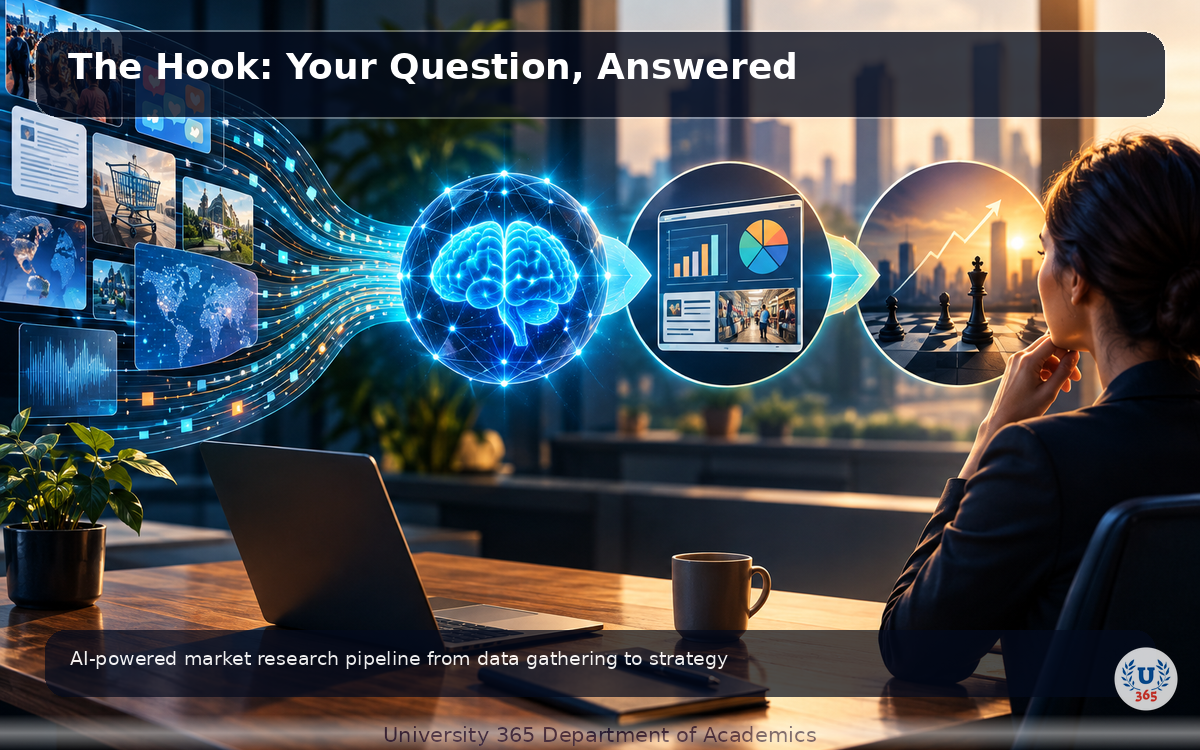
AI changes this timeline from weeks to minutes. In the next 15 minutes, you will learn how to use AI tools to gather market data, analyze competitor positioning, read customer sentiment across hundreds of reviews, and synthesize everything into an actionable strategy document.
The question is not whether AI can do market research. It can. The question is whether you know how to direct it effectively. That is what this lecture teaches.

What AI Market Research Actually Does
AI market research is not a magic button. It is a directed process where you define the question, AI gathers and processes the data, and you make the strategic decisions. The AI handles scale and speed. You handle judgment.
The Three Capabilities AI Brings
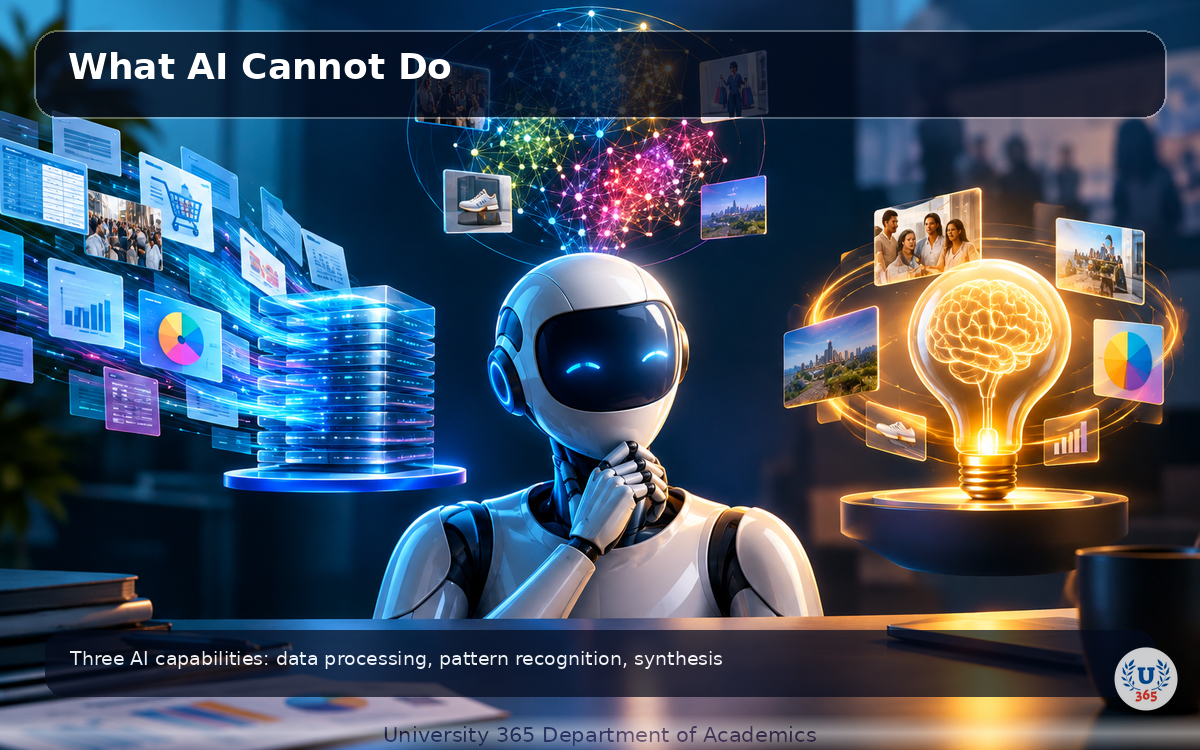
Data processing at scale: AI can read 500 customer reviews in 30 seconds and identify the top 10 recurring complaints. A human would need a full day to do the same.
Pattern recognition: AI can compare competitor pricing across 20 websites and spot the pricing gap that nobody else noticed.
Synthesis: AI can take structured data (pricing tables, feature lists) and unstructured data (reviews, social posts, news articles) and combine them into a single coherent analysis.
What AI Cannot Do
AI cannot decide what matters to your business. It cannot weigh a strategic risk against a market opportunity. It cannot tell you whether your company has the capability to execute a strategy. That is your job. The CI-First approach at University 365 means the human is the orchestrator and the AI is the amplifier. You direct, AI executes, you decide.
Step 1: Define Your Research Question
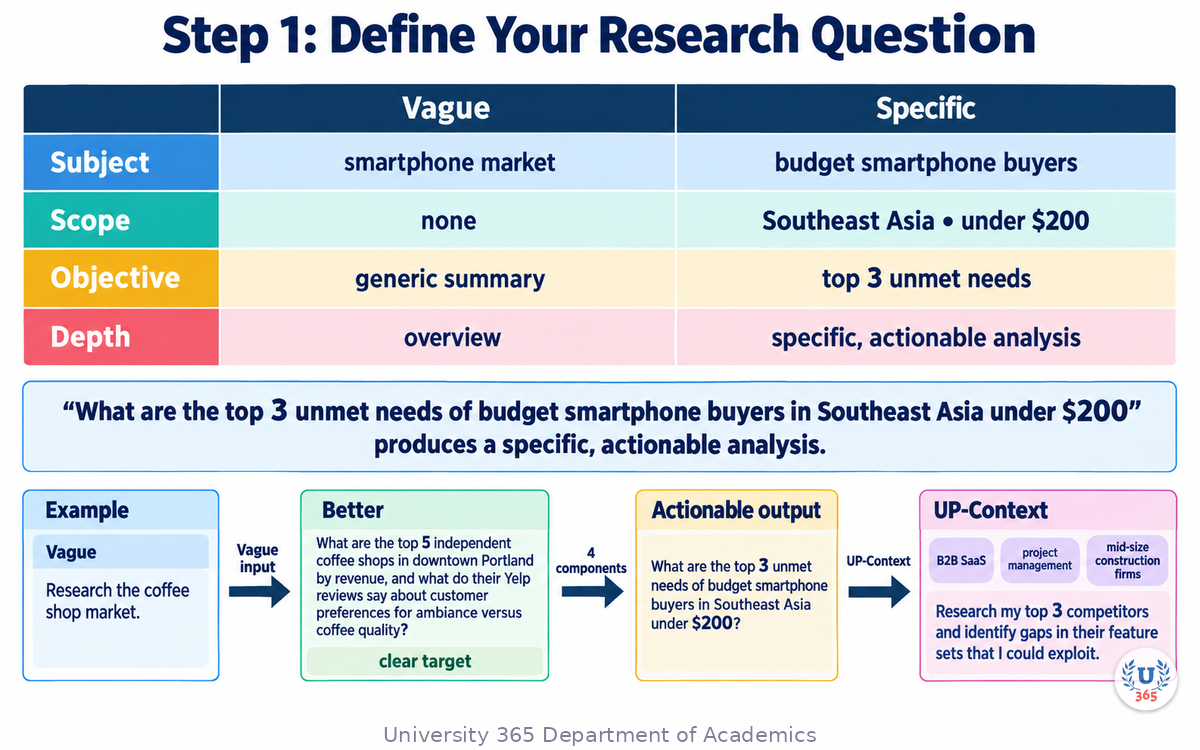
The most common mistake in AI market research is asking vague questions. "Tell me about the smartphone market" produces a generic summary that adds no value. "What are the top 3 unmet needs of budget smartphone buyers in Southeast Asia under $200" produces a specific, actionable analysis.
The Research Question Framework
A good market research question has four components:
Subject: Who or what are you researching? (customers, competitors, market segment)
Scope: What geographic, demographic, or temporal boundaries apply?
Objective: What decision will this research inform? (pricing, product features, market entry)
Depth: What level of detail do you need? (overview, detailed analysis, data tables)
Example Questions
Vague: "Research the coffee shop market."
Better: "What are the top 5 independent coffee shops in downtown Portland by revenue, and what do their Yelp reviews say about customer preferences for ambiance versus coffee quality?"
The second question gives AI a clear target. The AI can search for Portland coffee shops, cross-reference revenue estimates, pull Yelp reviews, and categorize sentiment by theme. The first question gives AI nothing specific to work with.
Using the UP-Context Method
In U365's UP-Context Method, you provide context-rich prompts that account for your specific business situation. Instead of asking AI to "research competitors," you provide context: "I run a B2B SaaS company in project management software targeting mid-size construction firms. Research my top 3 competitors and identify gaps in their feature sets that I could exploit."
Step 2: Gather Data with AI Tools
Once you have a clear research question, you need data. AI tools can gather data from multiple sources simultaneously.
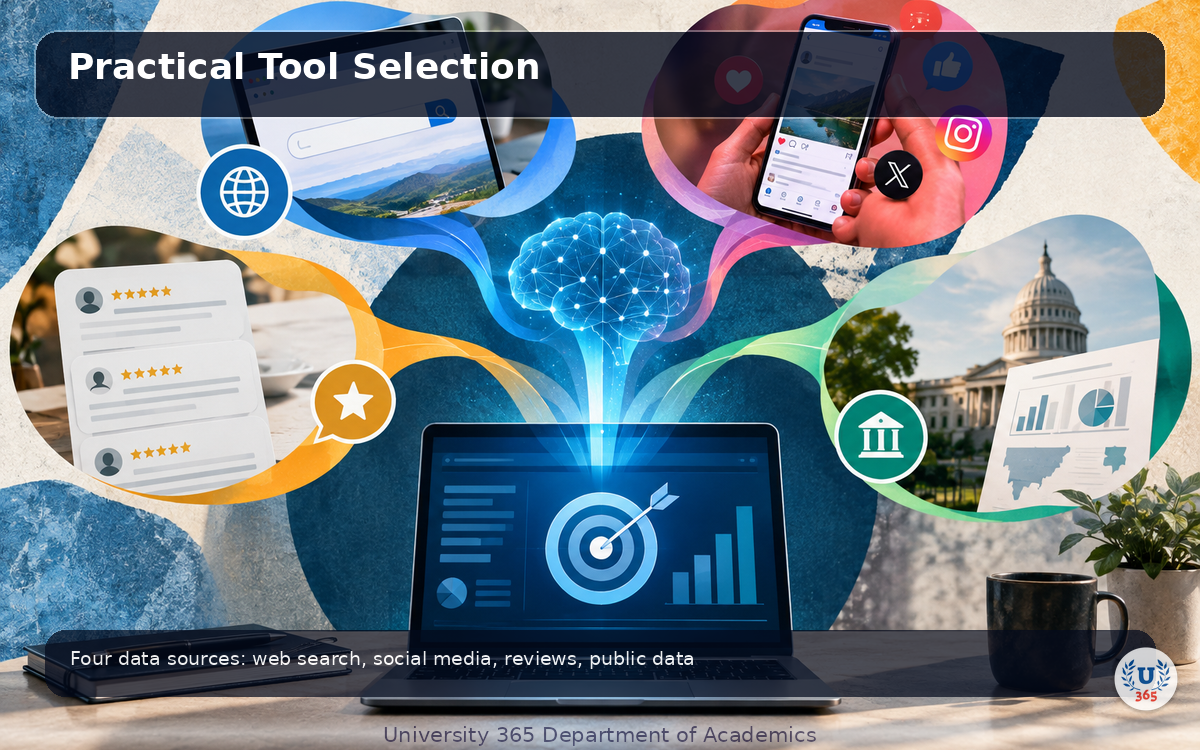
Data Sources for AI Market Research
Web search and extraction: AI can search the web, extract content from competitor websites, and structure the data into tables. Tools like Perplexity, ChatGPT with web browsing, and Google Gemini can pull current data.
Social media monitoring: AI can scan Reddit, X (Twitter), LinkedIn, and product review sites for mentions of your competitors and their products. It can categorize mentions as positive, negative, or neutral.
Review aggregation: AI can read hundreds of Amazon, G2, or App Store reviews and extract recurring themes. "Battery life" mentioned in 340 out of 500 reviews is a signal. "Battery life" mentioned in 3 reviews is noise.
Public data sources: AI can access public datasets (census data, industry reports, government statistics) and incorporate them into your analysis.
Practical Tool Selection
Tool Type | Example Tools | Best For |
AI search | Perplexity, You.com | Current market data, competitor info |
LLM analysis | ChatGPT, Claude, Gemini | Synthesis, strategic analysis |
Review analysis | AI + review sites | Customer sentiment, feature gaps |
Social listening | AI + Reddit/X/LinkedIn | Real-time market sentiment |
The key is using multiple tools for different data types and then synthesizing their outputs. No single AI tool does everything well. You are the orchestrator who combines outputs from multiple AI tools into a coherent picture.
Step 3: Analyze Competitors with AI
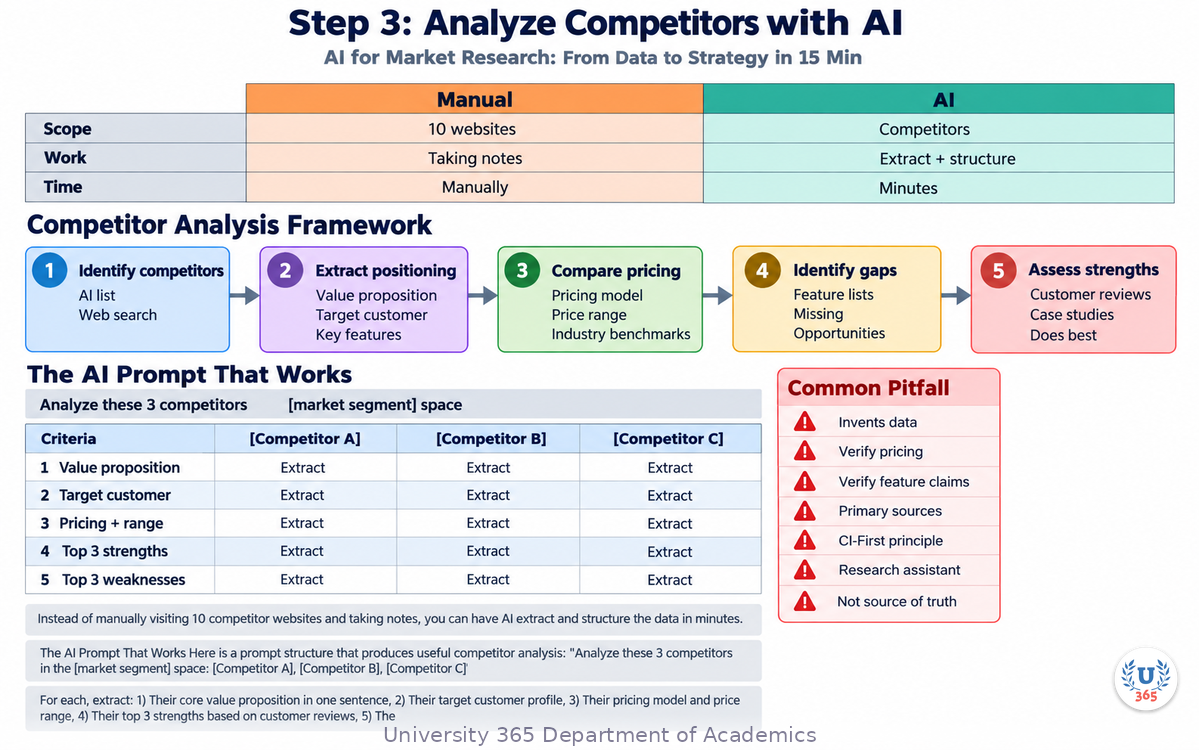
Competitor analysis is where AI saves the most time. Instead of manually visiting 10 competitor websites and taking notes, you can have AI extract and structure the data in minutes.
The Competitor Analysis Framework
Identify competitors: Ask AI to list competitors in your market segment. Use web search to verify and supplement.
Extract positioning: Have AI visit each competitor website and extract their value proposition, target customer, and key features.
Compare pricing: Ask AI to find and structure pricing information. If pricing is not public, AI can estimate based on industry benchmarks.
Identify gaps: Ask AI to compare competitor feature lists and identify what is missing. Gaps are opportunities.
Assess strengths: Ask AI to analyze what each competitor does best based on customer reviews and case studies.
The AI Prompt That Works
Here is a prompt structure that produces useful competitor analysis:
"Analyze these 3 competitors in the [market segment] space: [Competitor A], [Competitor B], [Competitor C]. For each, extract: 1) Their core value proposition in one sentence, 2) Their target customer profile, 3) Their pricing model and price range, 4) Their top 3 strengths based on customer reviews, 5) Their top 3 weaknesses based on customer reviews. Present the results in a comparison table."
This prompt gives AI a specific structure to follow and specific data points to extract. The output is immediately usable in a strategy document.
Common Pitfall
AI sometimes invents competitor data when it cannot find real information. Always verify pricing and feature claims by visiting the competitor website directly. AI is your research assistant, not your source of truth. The CI-First principle means you verify AI outputs against primary sources before acting on them.
Step 4: Understand Customer Sentiment
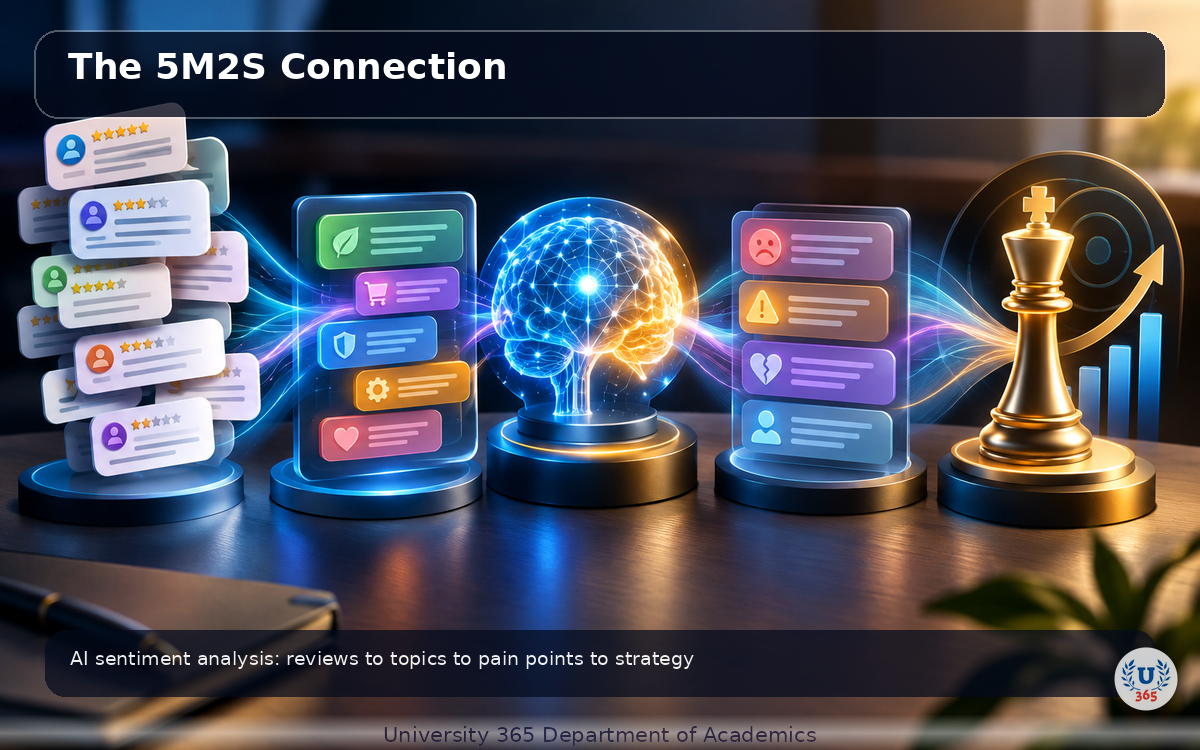
Customer sentiment analysis is where AI processing power truly shines. Reading 500 customer reviews manually takes a full day. AI does it in 30 seconds and produces structured insights.
How AI Sentiment Analysis Works
AI reads each review, classifies it as positive, negative, or neutral, and then extracts the specific topics mentioned. A review that says "Great app but the sync feature keeps crashing" gets tagged as mixed sentiment with two topics: overall satisfaction (positive) and sync feature (negative).
When AI processes 500 reviews, it produces:
Sentiment distribution: 62% positive, 23% negative, 15% neutral
Topic frequency: "battery life" (340 mentions), "customer support" (210 mentions), "pricing" (180 mentions)
Pain points: Top 5 recurring complaints ranked by frequency
Praise points: Top 5 recurring compliments ranked by frequency
Trend detection: Whether sentiment is improving or declining over time
Using Sentiment Data Strategically
Sentiment data becomes strategic when you cross-reference it with competitor data. If customers consistently complain about "slow customer support" across 3 competitors, and your company can offer faster support, you have found a market gap. That is a strategy, not just data.
The 5M2S Connection
This is the 5M2S (5 Minutes to Success) principle in action. In 5 minutes, AI can process more customer feedback than a human analyst could read in a week. The strategic insight comes from you, not from AI. AI gives you the raw material. You make the strategic decision.
Step 5: Synthesize Findings into Strategy
Data without synthesis is just noise. The final step is turning your AI-gathered data into a strategy document that drives decisions.
The Strategy Synthesis Framework
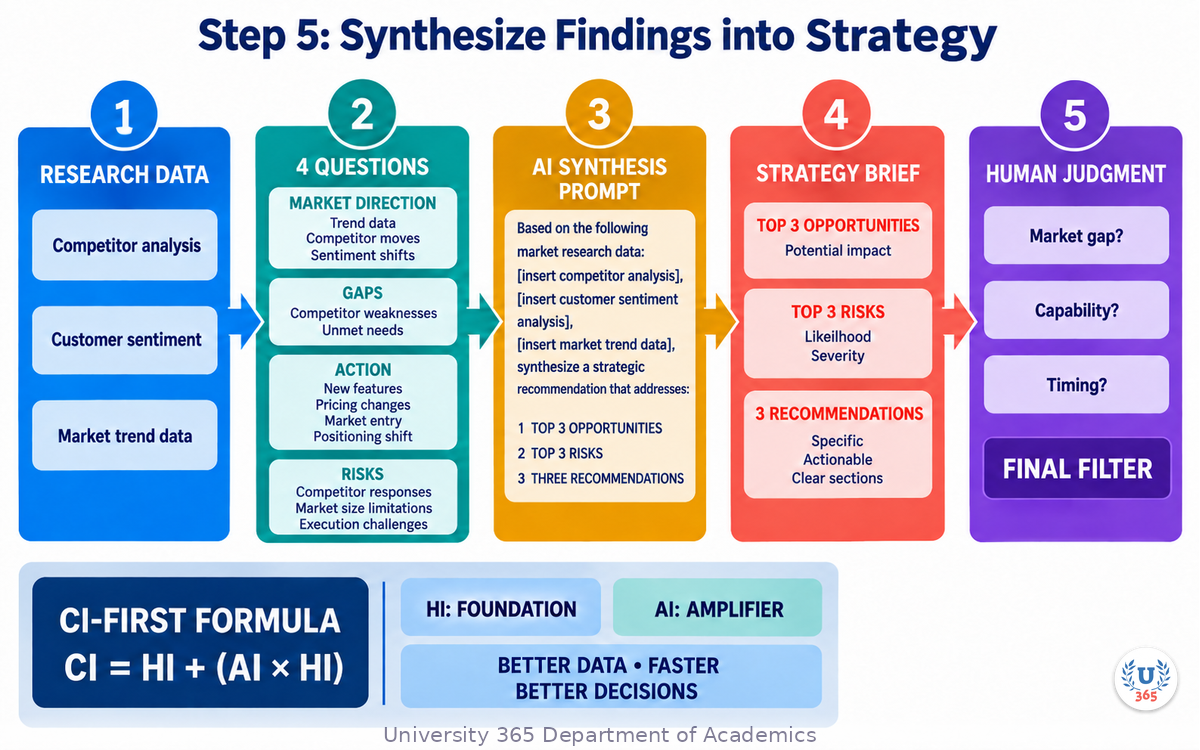
Your strategy document should answer four questions:
Where is the market going? Combine trend data, competitor moves, and customer sentiment shifts.
Where are the gaps? Cross-reference competitor weaknesses with customer unmet needs.
What should we do? Translate gaps into specific strategic recommendations (new features, pricing changes, market entry, positioning shift).
What are the risks? Use AI to identify potential risks: competitor responses, market size limitations, execution challenges.
The AI Synthesis Prompt
"Based on the following market research data: [insert competitor analysis], [insert customer sentiment analysis], [insert market trend data], synthesize a strategic recommendation that addresses: 1) The top 3 market opportunities ranked by potential impact, 2) The top 3 risks ranked by likelihood and severity, 3) Three specific actionable recommendations for our company. Present the output as a strategy brief with clear sections."
Human Judgment: The Final Filter
AI produces a strategy brief. You apply judgment. Is the market gap large enough to justify investment? Does your company have the capability to execute? Is the timing right? These are human decisions that no AI can make.
At UIB, we teach that business strategy in the AI age is not about replacing human judgment with AI analysis. It is about giving humans better data, faster, so they can make better decisions. The CI-First formula is clear: CI = HI + (AI x HI). Your human intelligence (HI) is the foundation. AI amplifies it. But the intelligence that matters is still yours.
Feynman Summary: Explain It Like You Are 12
Imagine you want to open a lemonade stand but you do not know if anyone will buy your lemonade. You need to know three things: who else is selling lemonade, what people think of their lemonade, and what kind of lemonade people actually want.
Instead of walking around for a week asking people, you have a super-fast robot friend who can read every review of every lemonade stand in your city in 30 seconds. The robot tells you: "People hate that Stand A has watery lemonade. People love that Stand B uses fresh lemons. Nobody sells spicy lemonade, but 50 people said they want to try it."
Now you know three things: do not make watery lemonade, use fresh lemons, and consider adding a spicy option. The robot did the reading. You make the decisions.
That is AI market research. The AI reads everything fast. You decide what to do with what it found.
Mindmap: The Complete Picture
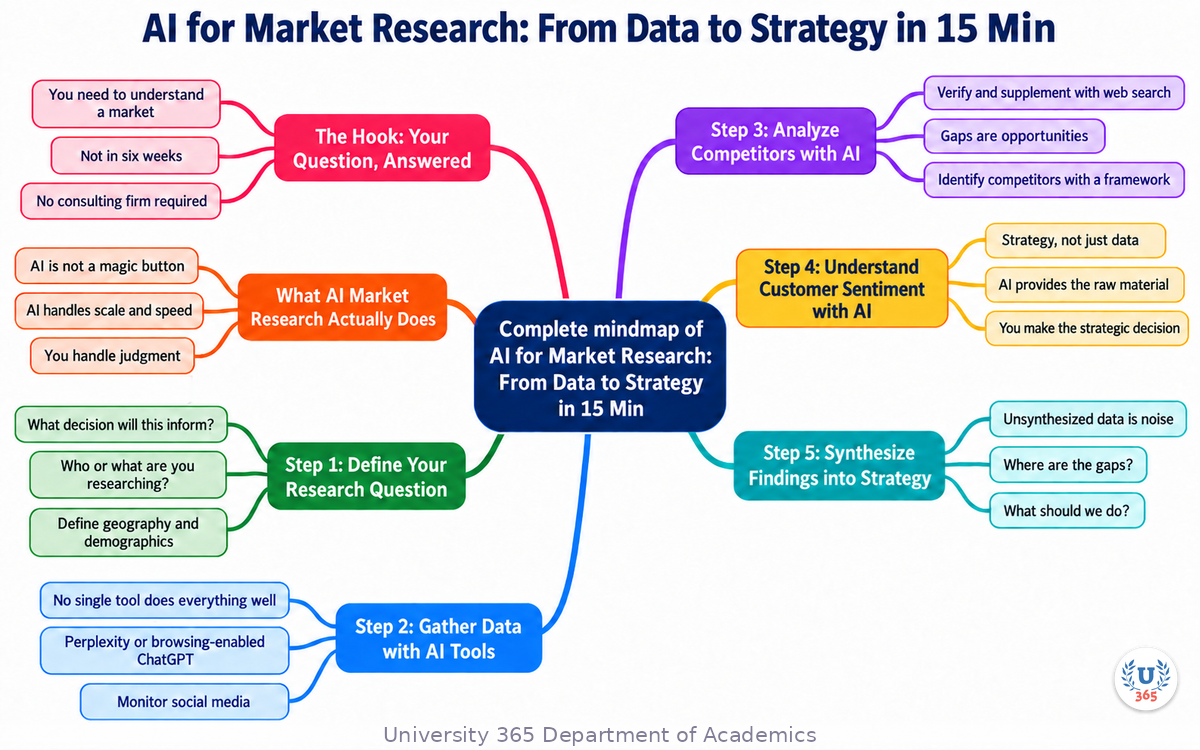
The mindmap shows the full workflow: defining your research question leads to gathering data from web, social, reviews, and public sources. That data feeds into competitor analysis (positioning, pricing, gaps) and customer sentiment analysis (topics, pain points, trends). Both feed into strategy synthesis, which produces opportunities, risks, and recommendations. The human judgment layer sits on top of the entire process, verifying AI outputs and making final strategic decisions.
UNOP Sound (University 365 Neuroscience Oriented Pedagogy)
Take five minutes to consolidate your memory. Play the isochronous tone track (10Hz alpha frequency) with your eyes closed. Alpha-frequency tones after a learning session support consolidation, helping move what you just learned from short-term to long-term memory.
[Audio player: UNOP Post-Lecture Isochrone (10Hz, 5 minutes)]
Practical Exercise: Run a Mini Market Research
Exercise: 15-Minute Market Research Sprint
Pick a market: Choose a product category you know (e.g., wireless earbuds, project management software, meal delivery services).
Write your research question: Use the 4-component framework (subject, scope, objective, depth). Example: "What are the top 3 unmet needs of budget wireless earbud buyers under $50, based on Amazon reviews?"
Gather data: Use an AI tool with web access (Perplexity, ChatGPT with browsing, or Gemini) to search for competitors and extract key data points.
Analyze sentiment: Ask AI to read 50+ reviews of the top 2 products and extract recurring complaints and praises.
Synthesize: Ask AI to produce a one-page strategy brief with top 3 opportunities and top 3 risks.
Apply judgment: Read the brief. Ask yourself: which opportunity fits my capabilities? Which risk is acceptable? What would I do differently?
What to Look For
Did AI find real competitors or did it invent some? Verify by searching for the competitor names directly.
Are the sentiment themes based on actual review content or generic statements? Good AI analysis quotes specific reviews.
Does the strategy brief feel actionable or generic? Generic recommendations ("focus on customer satisfaction") are useless. Specific recommendations ("add a battery life indicator to the case") are useful.
The quality of your research question determines the quality of your output. Refine your question and try again if results are vague.
Applied AI Connection
This exercise demonstrates the CI-First workflow in business. You defined the question (human intelligence). AI gathered and processed data (AI amplification). You verified and applied judgment (human intelligence again). The formula CI = HI + (AI x HI) means your intelligence is both the starting point and the ending point. AI multiplies your capability in the middle.
Glossary
Term | Definition |
**AI Market Research** | Using AI tools to gather, process, and analyze market data at a speed and scale that manual research cannot match. |
**Sentiment Analysis** | The process of using AI to classify text (reviews, social posts) as positive, negative, or neutral and extracting recurring topics. |
**Competitor Analysis** | Systematic examination of competitors' positioning, pricing, features, strengths, and weaknesses. |
**CI-First** | Co-Intelligence First: the U365 principle that human intelligence is the orchestrator and AI is the amplifier. CI = HI + (AI x HI). |
**UP-Context Method** | University 365 Prompting-Context Method: providing context-rich prompts that account for your specific business situation. |
**5M2S** | 5 Minutes to Success: the U365 principle of using AI to compress tasks that traditionally took hours into minutes. |
**UNOP** | University 365 Neuroscience-Oriented Pedagogy: the pedagogical framework behind all U365 lectures. |
**Market Gap** | An unmet customer need or underserved segment that represents a business opportunity. |
**Topic Frequency** | The number of times a specific topic or theme appears across a set of customer reviews or social mentions. |
**Strategy Brief** | A concise document that translates market research data into actionable strategic recommendations. |
**Data Synthesis** | The process of combining structured data (pricing, features) and unstructured data (reviews, posts) into a coherent analysis. |
**Pattern Recognition** | AI's ability to identify recurring themes, trends, or anomalies across large datasets. |
Quiz: TEST YOUR UNDERSTANDING
1. What is the most common mistake in AI market research?
A) Using the wrong AI tool
B) Asking vague research questions that produce generic summaries
C) Not spending enough money on AI tools
D) Researching markets that are too small
2. What are the four components of a good market research question?
A) Budget, timeline, team size, and expected ROI
B) Subject, scope, objective, and depth
C) Product, price, promotion, and place
D) Competitors, customers, market size, and growth rate
3. Why must you verify AI competitor analysis against primary sources?
A) AI tools are always outdated
B) AI sometimes invents competitor data when it cannot find real information
C) Primary sources are always more accurate than AI
D) It is required by law
4. What does sentiment topic frequency tell you?
A) How many competitors exist in the market
B) How often a specific theme appears across reviews, indicating its importance
C) The total revenue of a product
D) The demographic breakdown of customers
5. In the CI-First formula CI = HI + (AI x HI), what role does human intelligence play?
A) It is replaced by AI
B) It is both the starting point (defining questions) and the ending point (making decisions)
C) It is only needed at the beginning
D) It is only needed at the end
Answers: 1-B, 2-B, 3-B, 4-B, 5-B
Related Resources
U365 INSIDE Publications
Book Essential: Co-Intelligence by Ethan Mollick: The Centaur model and human-AI collaboration
Book Essential: Irreplaceable by Pascal Bornet: Humics and staying irreplaceable in the AI age
External Resources
Perplexity AI: AI-powered search engine for market research: perplexity.ai
Google Gemini: Multi-modal AI for data analysis: gemini.google.com
Harvard Business Review: Market Research with AI: How AI is transforming market research: hbr.org
McKinsey: The State of AI: Annual report on AI adoption in business: mckinsey.com
Related U365 Lectures (Coming Soon)
Lecture 2: Financial Modeling with AI: Excel + Copilot in Practice (UIB, Business AI Series)
Lecture 3: AI-Driven Customer Segmentation (UIB, Business AI Series)
Lecture 5: Automating Business Operations with AI Agents (UIB, Business AI Series)
U.Copilot for This Lecture
Discuss this lecture with U.Copilot, your AI chat companion trained on this content.
Copy and paste the following prompt into the U.Copilot chat on university-365.com:
You are U.Copilot for Lectures, an AI chat companion specially trained on University 365 lecture content. You are helping a Fellow who just completed the lecture "AI for Market Research: From Data to Strategy in 15 Min" from the Business AI series at the U365 Institute of Business (UIB). Your role is to help the Fellow deepen their understanding of AI-powered market research. You can: - Clarify any concept from the lecture (research question framework, data sources, competitor analysis, sentiment analysis, strategy synthesis) - Provide additional examples of good and bad research questions - Explain how to use specific AI tools for market research tasks - Discuss how to verify AI-generated market data against primary sources - Help the Fellow apply the CI-First approach to their own market research project - Suggest follow-up learning based on the Fellow's industry and interests Always maintain U365's CI-First approach: encourage the Fellow to think critically, verify AI outputs, and maintain human judgment as the orchestrator of AI tools. Use the UP-Context Method: provide context-rich, role-aware responses that account for the Fellow's learning level and goals.
Next Steps
Now that you understand how to use AI for market research, here is what to do next:
Try the practical exercise above to run a 15-minute market research sprint on a market you know
Refine your research question skills by writing 5 different research questions for the same market and comparing the AI outputs
Take Lecture 2 in this series: "Financial Modeling with AI: Excel + Copilot in Practice" to learn how AI accelerates financial analysis
Explore the U365 AI Skills tag on INSIDE for practical guides on using AI tools with the CI-First approach
Join a UIB program if you want structured learning in business management and digital entrepreneurship: visit university-365.com/tuition
AI market research is not about replacing your strategic thinking. It is about giving you better data, faster, so your strategic thinking produces better decisions. The companies that win in the AI age are not the ones with the most AI tools. They are the ones whose leaders know how to direct AI effectively and apply judgment to its outputs.
IMPORTANT NOTICE
This lecture is published by University 365 as part of its INSIDE Publications Hub. The content is free to read for all visitors. Lectures in this series may be part of a structured academic program leading to a Micro-Credential for your Career (MCC). To enroll in an academic program, visit university-365.com/tuition.
This content is for educational purposes. While we strive for accuracy, AI is a fast-moving field. Verify current tool capabilities and market data against primary sources for professional applications.
Copyright University 365, Inc. All rights reserved. This content is protected under University 365's copyright policies. For permissions or inquiries, contact uda@university-365.com.
Published by the Department of Academics, University 365.
Lecture delivered by the University 365 Institute of Business (UIB).
Denise Cromwell, Dean of Business, UIB
Signed for the academic year 2026.




Comments